Little is known about this six-part series that was made by ATV (Associated Television), written by Roddick John (who would later write episodes of ‘The Saint’, ‘Z Cars’ and The Edgar Wallace Mystery Theatre’), and both produced and directed by John Nelson Burton. Burton only joined ATV in 1959, so ‘Epilogue To Capricorn’ was his first piece of work cor he company. He would go on to direct episodes of ITV’s ‘Play of the Week’ ‘Love Story and ‘Sunday Night Theatre’
Broadcast under the banner of ‘The Saturday Special’, the series star was Jean Kent, who played Lady Kerwin in 5 of the episode, Adrienne Corri* as Jill Howard (thee episodes) and Peter Wyngarde as Peter Vauxhall – three episodes: ‘All On Tape’, ‘Point Of No Return’ and ‘Traitors Gate’.
It was fortuitous that the series went out live as, initially, Peter’s character was only meant to be in the first two installments named above, but such was the furore at his departure (both ATV and The TV Times were to received a deluge of complaints from fans), he was brought back for another episode.
*Peter would appear with Adrienne Corri in the ITC series ‘Sword of Freedom’: ‘The Sicilian‘ (1958) and the Department S – ‘The Man Who Got A New Face’.
Series Synopsis
Six-part serial about a World War II mystery which is being documented for the British government’s War Office. Robert Faulkner (Richard Johnson), a foreign correspondent is called in by the War Office to compile a dossier on a disastrously unsuccessful top secret wartime operation called Operation Capricorn. It becomes evident that the operation was not a failure because of bad luck, but because of somebody’s treachery. The question is – whose?
Top secret information about Operation Capricorn is recorded on tape, and is highly compromising to several people. Stolen, it becomes dynamite.
Critic’s Comments
“After such a weak cliffhanger last week, I must confess that if I watch further episodes – and at the moment I’m not inclined to – I will only watch because Peter Wyngarde is in it. For me, this actor is always a delight to watch, though I think they must have twisted his arm to make him say the dialogue.” Guy Taylor – The Stage: 5th November, 1959
Peter’s Comments
“Epilogue To Capricorn’ probably had the most excruciatingly bad script I’d ever had the misfortune to read. It probably had one of the best titles for any series in the world, but definitely the worst script.
So, the actors got together with the director, who was wild and crazy and was eager to do different things, and he said: “What do you want to do then?” I said, “Throw away the script; throw it in the bin and we’ll just ad-lib. We more or less know what the characters are and we could take it from there.” It became a top TV series of that time, because nobody knew what was happening.”
A bit of Trivia
~ While Peter was very fond of Adrienne Corri, he absolutely hated Jean Kent, who he described as a “Prize bitch”! There were numerous clashes between the two on set. The fact that the series went out live didn’t help the situation any, since Kent would try to ruin any scene Peter was in.
~ The series has often been listed with the alternative title, ‘Suspense’. This is incorrect. ‘Suspense’ was an anthology series also produced and directed by John Nelson Burton, which ran from 1959 to 1960, but ‘Epilogue To Capricorn’ had no connection to.
Rupert of Hentzau is a sequel by Anthony Hope to ‘The Prisoner of Zenda’, written in 1895 but not published in book form until 1898. The novel was serialized in The Pall Mall Magazine and McClure’s Magazine from December 1897 through June 1898.
The story is set within a framing narrative told by a minor character from ‘The Prisoner of Zenda’. The frame implies that the events related in both books took place in the late 1870s and early 1880s. This story commences three years after the conclusion of Zenda, and deals with the same fictional country somewhere in Germanic Middle Europe, the kingdom of Ruritania.
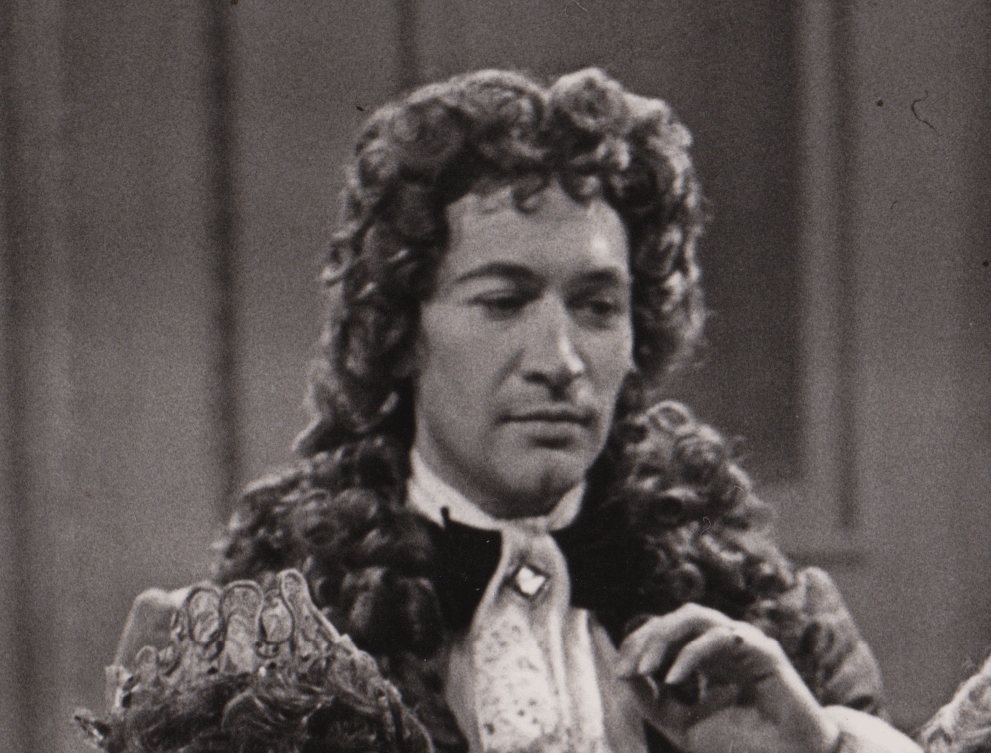
Above left: Peter, Barbara Shelly and George Baker during rehearsals.
Most of the same characters recur: Rudolf Elphberg, the dissolute absolute monarch of Ruritania; Rudolf Rassendyll, the English gentleman who had acted as his political decoy, being his distant cousin and lookalike; Flavia, the princess, now queen; Rupert of Hentzau, the dashing well-born villain; Fritz von Tarlenheim , the loyal courtier; Colonel Zapt , the King’s bodyguard; Lieutenant von Bernenstein, a loyal soldier.
The1964 British television series ran for six half-hour episodes and successive Sunday afternoon’s at 5.30pm. The series was recorded at BBC Television Centre, London, but all six episodes are listed as “lost”, having been wiped by the BBC themselves after broadcast.
The Character of Rupert
The character of Count Rupert of Hentzau is an allegory for the corrupting influence of power. Rupert is a charismatic and charming man who uses his power to manipulate and control others. He is a symbol of the dangers of unchecked ambition and the corrupting influence of power. Rupert’s character is marked by his sly ambition, leaving a trail of deception and intrigue in his wake.
Story Synopsis
The story is set three years after the events of the ‘The Prisoner of Zenda’. The dutiful but desperately unhappy Queen Flavia (Barbara Shelley) is married to her cousin, the Ruritanian King, Rudolf V (George Baker). She writes to her true love Rudolf Rassendyll (also played by George Baker). The letter is to be delivered by hand by von Tarlenheim (Tristram Jellinek), but von Tarlenheim is betrayed by Bauer (Anthony poole) and his servant, James, and it falls into he hands of exiled Rupert of Hentzau (Peter Wyngarde) and his loyal cousin the Count of Luzau-Rischenheim (Derek Blomfeld). Hentzau sees in it a chance to return to favour by presenting the leter to the pathologically jealous and paranoid King.
Rassendyll returns to Ruritania to aid the Queen, but is forced to impersonate the King after Rupert fatally shoots Rudolf V in a remote hunting lodge. After tracing Bauer to the house of Mother Holf (Nora Gordon), Rassendyll and Rupert engage in an epic duel. Hentzau is mortally wounded, and Rassendyll burns the letter. However, he is assassinated in his hour of triumph by Bauer and thus is spared a crisis of conscience over whether or not to continue the royal deception for years.
Rassendyll is buried as the King in a state funeral, while Colonal Zapt* (John Phillips) and Rassendyll’s servant, James, stage a fire at the hunting lodge that burns the King’s body beyond recognition. Rudolf V is buried as Rudolf Rassendyll, while Flavia reigns on alone, the last of the Elphberg dynasty.
*In the book, the Colonel’s name was was Sapt.
Breakdown of the episodes As they appeared in the Radio Times
‘The Queen’s Goodbye’ – Sun, Apr 19, 1964 Exiled from Ruritanta for treason, Rupert of Hentzau returns secretly, determined to discover what takes Fritz von Tarlenheim to Wintenberg.
‘Return to Zenda’ – Sun, Apr 26, 1964 Rudolf Rassendyll is again forced to imitate his cousin Rudolf V after Rupert of Hentzau fatally shoots the King in a remote hunting lodge.
‘Audience With The King’ – Sun, May 3, 1964 Rudolf Rassendyll sets a trap and Rupert of Hentzau receives an eagerly-awaited summons.
The Wheel of Change– Sun, May 10, 1964 Rudolf Rassendyll goes on a journey with surprising results, and the King receives an unexpected visitor.
‘A Perilous Reunion’ – Sun, May 17, 1964 Queen Flavia is reunited with her true love Rudolf Rassendyll but the circumstances are less than ideal.
‘The Decision of Fate’ – Sun, May 24, 1964 Rupert of Hentzau meets the play-actor face to face and the future of the kingdom is resolved.
A bit of Trivia
For the part of Rupert in the series, Peter was required to wear some tight riding breeches which the director, Gerald Blake, felt were a bit too revealing in the crotch area. In the absence of anything with which to disguise the offending bulge, Peter had stuffed cotton wool down the front of the breeches.
It was Sally Home who was played Helga von Tarlenheim in the series , and who had previously worked with Peter in ‘Duel of Angels‘ and ‘Night Conspirators‘, who first noticed the newly padded area when Peter walked on set at BBC TV Centre, exclaiming: “Oh, Peter, do take it out, it looked much better before!”
Episode 7: ‘I Am Always With You’ – Broadcast: Sunday 1st April, 1956
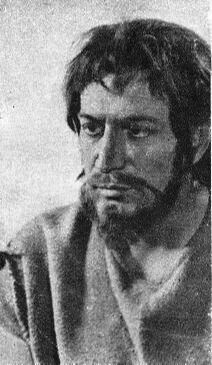
Character: John the Baptist
Peter as John the Baptist
In 1956, the BBC made Television history with a series of eight programmes on the life of Christ. Before this production censorship regulations prohibited the portrayal of Christ by an actor in public performances. It was only after the Central Religious Council approved the project, and the choice of actor in the central role, that the BBC were given the go-ahead.
Treated as an experiment, Jesus of Nazareth was placed in the children’s programmes slot on Sundays. But it attracted an adult audience whose appreciation placed it, as a BBC survey showed, next to the Coronation of 1953 in national appeal.
The series was produced by Joy Harington and would be considered her most notable work for television, for which she received the 1956 award of the Guild of Television Producers and Directors, the first to be presented for a children’s serial. Tom Fleming created a moving interpretation of Christ, and unusually for a live serial, with filmed locations in Galilee and Jerusalem, it was telerecorded so it could be reshown over the Easter holidays in future years. The scenes, especially of the Crucifixion, were regarded as some of the most powerful ever televised.
Writing in the Radio Times in February 1956, Freda Lingstrom, the Head of Children’s Television, wrote: ‘Our aim is to awaken the interest of children in the origins of the most significant influence in their lives, and help them to understand something of the background against which the Christian story was enacted.’
Lingstrom went on to explain the approach that the producer had taken; ‘In spite of this widely practised attempt to put the story of Jesus into modern speech, reverence for ‘Holy Writ’ remains for many people as sacrosanct as the spiritual truth it sought to present in the reign of James the First. It may come as a shock to some people that, although phrases which become household words remain, the cycle of plays we are about to represent will be in modern colloquial speech.’
In order to embark on such an important and ground-breaking project, advice was sought from several members of the clergy, whose scholarship and wide theological knowledge were put at the disposal of Joy Harrington, who wrote the eight scripts which began with Jesus as a boy of twelve, living in an occupied country, and ended with the Resurrection.
For the all-important casting, Harrington wanted an actor who was strong, virile, full of life and energy and convinced of his mission. Tom Fleming, born in Edinburgh, Scotland, in June 1927, was relatively unknown to television audiences in 1956, having only appeared in half-a-dozen productions, which were all single plays. The son of a Baptist preacher, he was initially anxious about playing the part. It was his interest in the spiritual value of the project that finally convinced him to undertake a part which, according the Freda Lingstrom, he approached with humility and a high sense of purpose.
In the spring of 1955, Fleming and Harrington and a contingent of the Children’s Film Unit, travelled to the Middle East, where certain sequences were shot in order to enrich the live productions. As Freda Lingstrom wrote; ‘Children will see him as Jesus in the scorching sun of the wilderness with hot desert wind blowing his robes and hair in disorder, far from the lifeless coloured-print image stamped on the minds of so many.’
This was a huge undertaking for the BBC. It was unheard of, prior to this, to take a film unit abroad to record original material for any of their productions. No doubt the Corporation was very much aware of the possible impact the series of plays could have. Especially if they got it wrong.
Linstrom again; ‘Throughout, the plays will present happenings in a straightforward manner with little emphasis on the miraculous. It is not our intention to rationalise events, nor shall we put forward any new interpretation of the gospels; our purpose is to offer children as true a picture as we can with the weight of authority behind it. Throughout, the humanity, courage and endurance of Jesus will be manifest; we shall not minimise the tragedy of the Crucifixion but care will be taken to see that it will be presented in such a way as to give older children food for thought while in no way alarming younger ones or leaving them with any suggestion of horror.’
Summing up, Lingstrom offered a word of advice to parents. Advice that most likely ensured an increased adult audience for what was seemingly being presented as a children’s series: ‘It should be remembered that this project is designed for older children and parents are asked to see that younger ones should not see the play alone.’ Nice bit of marketing.
Jesus of Nazareth began on Sunday 12 February 1956 with ‘The Prologue’. The play opened with a boy of twelve travelling with his parents to Jerusalem for the Passover feast. Jesus is seen talking with the elders in the Temple and subsequently found by Mary and Joseph and taken home. The eighth and final part of the series was broadcast on Easter Day.
In 1977, a British-Italian co-production was produced for television under the same title.
Trivia:
The series was partly shot in Galilee and Jerusalem.
Making the series was a courageous undertaking. At that time, censorship regulations prohibited the portrayal of Christ by an actor in public performances. The series was commended by The Guild of Film and Television Directors.
After it’s first broadcast in 1956, the series was reshown every Easter for three years afterwards.
The following was written by Mark Goodacre – Professor of New Testament and Christian Origins at Duke University, in the Religious Studies Department.
So, have you ever seen the TV series Jesus of Nazareth? No, not that series, but the one made twenty years earlier by the BBC? Me neither. In fact I didn’t even know about it until yesterday. Here’s the story.
I have been reporting recently on my research into the forgotten BBC production Paul of Tarsus (1960) ), research which led to the book of the series produced by its writer, producer and director Joy Harington. In the preface to that book, she writes the following:
The idea for this book and the Television series that preceded it was born in 1956 when the series ‘Jesus of Nazareth’ ended with these words from Jesus to his disciples: ‘Go and teach all nations the things that you have seen and heard . . . . . And know that I am with you always — even unto the end of the world.’ It left one with the feeling ‘What happened then?’ After all, it was a big order to give a handful of fishermen and peasants in a small occupied country . . .
And so on. So, it seems, there was a TV series on Jesus’ life broadcast in 1956 on the BBC. I didn’t think I had heard of this before, so I went to the net to see how many others had heard of it. The answer is: very few.
The IMDb weakly mentions Jesus of Nazareth from 1953, starring Tom Fleming. In the light of the above, the date is certainly wrong. Is it even the same production? Well, it looks like it is because this TV series clearly featured Tom Fleming playing Jesus. There is a good paragraph or so on it on the BFI’s Screenonline. Profile of Joy Harington:
But perhaps what is considered her most notable work for television was the eight-part Sunday serial Jesus of Nazareth (BBC, 1956) for which she received the 1956 award of the Guild of Television Producers and Directors (now BAFTA), the first to be presented for a children’s serial. A live studio production with exteriors filmed on location in Galilee and Jerusalem, it was a courageous undertaking. At that time, censorship regulations prohibited the portrayal of Christ by an actor in public performances. However, the Central Religious Council approved the project and Tom Fleming was cast as Jesus Christ. The serial was an outstanding success. Harington followed with a similar ten-part series, Paul of Tarsus (BBC, 1960), for which the exteriors were filmed mainly in Crete.
So we now know that Paul of Tarsus was filmed in Crete, and Jesus of Nazareth was partly filmed in Israel, and the latter was considered “a children’s serial”. There is more research to be done about this lost series, and I look forward to reporting back on this in due course.
Above: A page from the Radio Times (12th April, 1957) – published to coincide with the first rescreening of the series at Easter that year.
Have you ever read a really good book which the vast majority of people concur with you over, but then you spot a really peevish review that has you wondering if the person responsible for it has read the same thing as you?
I bought Tina Wyngarde-Hopkins biography/memoir, ‘Peter Wyngarde: A Life Amongst Strangers‘ on the day of publication in February 2020. I read the whole thing; all 532 pages in just two sitting as I just found it too compelling to put down. With hand on heart I can say it is the best book of its kind I’ve ever read. It’s candid, detailed and honest; written from the standpoint of someone who actually knew Wyngarde intimately. Ms. Wyngarde-Hopkins has taken further steps in publishing many of the documents referred to in the book (see the A Life Amongst Strangers Companion) and provided strong supporting evidence in the form of Peter’s letters and personal writings (see You’ve Read The Book… Now Read It In Peter’sOwn Words ). I know of no other author who has done this.
With this in mind, I’ve been stunned to read some of the nonsense posted online by persons unknown about the book in so-called ‘reviews’. I say this because none of the people who have written this stuff appear to have any real conviction in what they’re saying. Why? Because they choose not to put their real names to it,
I know what you’re all thinking: ‘Everyone is entitled to an opinion’, and you’re right. The Oxford English Dictionary’s definition of the noun ‘Opinion’ goes something like this: “A view or judgement formed about something, not necessarily based on fact or knowledge”. I ask you tokeep the final section of that sentence in mind as you read the following ‘review’ for ‘A Life Amongst Strangers’ which was posted on Amazon on 27th December 2023 by someone calling his or her self ‘City Bookworm’:
As other reviewers have mentioned, this is a decidedly odd and not very well written book; it’s also something of a rewrite of history. It was fairly common knowledge within the theatrical world of that era that PW was gay, and has subsequently come out that PW had a 10 year off-on relationship with the actor Alan Bates. This has been corroborated by many respected actors and others. So, it seems delusional at best — and homophobic at worst — that the book goes to such great lengths to try and prove PW WAS NOT GAY! Aside from that, it’s a poorly written biography of muddled chronology and facts, and overall very disappointing.
What I’m about to do now is break down this ‘review’ into sections; highlighting some of the grandiose statements contained within it:
“As other reviewers have mentioned, this is a decidedly odd and not very well written book“: The first half of this sentence refers to four other ‘reviews’ posted on Amazon back in 2020; one of which was uploaded on the day BEFORE the book was even published, which is dubious to say the least. It accuses Ms. Wyngarde-Hopkins of treating Wyngarde’s “blood family” unfairly. Alas, the person who wrote it and who concealed his or her self behind the username ‘Fisherman Fred’, provides not a single instance of this alleged mal treatment. According to Ms. Wyngarde-Hopkins, she didn’t know this “blood family” existed until the day of Wyngarde’s funeral on 25th January, 2018, and he never once mentioned them throughout the time she knew him. By their own admission, they’d never seen or spoken to him since 1974!
Another of these ‘literary appraisals’, it turns out, was penned by a disgruntled former member of The Official Peter Wyngarde Appreciation Society Facebook group page, who was unceremoniously booted out in 2019 for his involvement with a group of anti-Semitic and homophobic trolls. A third was drawn up by someone called ‘Paul Kemp’, whose grammatically inept account was typed ENTIRELY IN CAPITAL LETTERS – this to advise the rest of us about BAD WRITING! Sadly, ‘City Bookworm’ does not reference the ninety 5-Star reviews of ‘A Life Amongst Strangers’ that are diametrically opposed to his or her view.
When I asked Tina Wyngarde-Hopkins if I could write this article, and enquired as to her feelings when reading something like like this, she told me that when Steven Berkoff (the multi award-winning actor, writer and director agreed to pen the afterword for her book), he’d had nothing but praise for both its content and for her writing skills. In fact, he was staggered that this was her first book! This was corroborated by Wyngarde’s long-time friend and agent, Thomas Bowington, who recounted: “Berkoff had made a beeline for me at a theatre related event in London to wax lyrical about the book: “A wonderful, fascinating book!” he boomed. He, of course. is qualified to judge.”
“Well done Tina. This is an essential work for anyone who values this extraordinary man and his work.” Steven Berkoff
“It was fairly common knowledge within the theatrical world of that era that PW was gay,…” As Ms. Wyngarde-Hopkins has oft pointed out, both on this website and elsewhere, this alleged “common knowledge” myth was dragged into the public arena by author, Donald Spoto, in his 2007 biography, ‘Otherwise Engaged: The Life of Alan Bates’. In letters written by Peter Wyngarde in 2009 and 2011 (see the ‘A Life Amongst Strangers Companion‘), he describes how shocked he was at what Spoto had written about him in his volume and, by all accounts, had considering suing author for libel.
“I cannot tell you how shocked I was when I read what that American biographer had said those unbelievable things about me.”
And,
“The American authorsigned a letter to say he would adhere to my request about omitting material, but managed to send it to me after the book was published which was of course too late.“
As for the “fairly common knowledge within the acting world that Wyngarde was gay…” assertion, ‘City Bookworm’, not unsurprisingly. fails to provide a single shred of evidence to reinforce this.
“…and has subsequently come out that PW had a 10 year off-on relationship with the actor Alan Bates.” Again, this is a fable founded in Donald Spoto’s aforementioned biography, where it is claimed that Wyngarde and Bates shared a flat in London from 1956 until 1966, which is something a lot of young jobbing actors did at the time and probably still do. Nevertheless, Mr/Miss/Ms. ‘Bookworm’ states that this was an “on/off relationship” (more “Off” than “On” I would suggest). In her book, Ms. Wyngarde-Hopkins provides evidence that Bates did not take up residence in Wyngarde’s flat until either late in 1958 or early 1959 due to work commitments in the USA (you can see the original rental agreement that Wyngarde signed in late 1956 here). Meanwhile, between 1958 and ’60, Wyngarde was in a romantic relationship with Vivien Leigh. This is well documented. Between 1960 and 1962, Bates went to live with Rock Hudson in California for 18 months. He then moved out of the flat to a house he’d purchased for himself in St. John’s Wood, London. Suddenly the 10 years claimed by Mr. Spoto becomes nothing more than a few months, when the two passionate lovers(!) were relegated to no more than ships passing in the night. (According to the Electoral Roll, Bates was registered as living at Wyngarde’s flat between 1959 and 1964, not 1956 to 1966 as Donald Spoto insisted upon).
“This has been corroborated by many respected actors and others.”‘Again, ‘City Bookworm’ declines to provide a single solitary name from this seething mass of theatricals to substantiate his/her claim, so I suppose we’re just expected to take their word for it.
“So, it [‘A Life Amongst Strangers’] seems delusional at best — and homophobic at worst — that the book goes to such great lengths to try and prove PW WAS NOT GAY!” Tina Wyngarde-Hopkins had a 30 year relationship with Peter Wyngarde. This has been corroborated by many “respected actors and others”, all of whom were named in ‘A Life Amongst Strangers’. and elsewhere. I would very much like to ask ‘City Bookworm’ how quoting directly from letters written by Wyngarde in his own hand; publishing photographs of PW with various girlfriends, and referring to legal documentation that can be readily found in the public domain qualifies as going “to such great lengths to try and prove PW WAS NOT GAY!” What did he/she expect the author to do – falsify correspondence, tamper with legal documentation kept in the public archives and photoshop images of Wyngarde at male only orgies just to validate someone else’s mistaken beliefs?
Aside from all of the above, the most offensive thing about this ‘review’ is the assertion that the book, and one must suppose the author herself, is “homophobic” which, to paraphrase ‘City Bookworm, is insulting at best and libellous at worst!
“Aside from that, it’s a poorly written biography of muddled chronology and facts, and overall very disappointing.” Well, we can dismiss the “poorly written” statement out of hand based on Steven Berkoff comments (see above) and those of the highly respected Hollywood Reporter that described it as being, “Scholarly written”. I’m not sure where the “muddled chronology” claim comes from either, as the work has a pretty straightforward timeline: i.e. it begins with Wyngarde’s birth and ends with his death in 2018. Simples! It’s hardly Ms. Wyngarde-Hopkins fault if Mr/Ms. ‘City Bookworm’ struggled to follow it. Perhaps it would’ve helped if he/she had given us a few examples of these “muddled facts,” and explained what he/she had used as a yardstick to measure the anomalies he/she alleges: 50-year-old tabloid tittle-tattle, perhaps? Internet gossip? Who knows!
While ‘A Life Amongst Strangers’ goes a long way in dispelling many of the myths that have built up around Peter Wyngarde over the decades, the thing that appears to have rattled ‘City Bookworm’ cage most is that it fails to validate his/her preexisting ideas of what the actor’s true sexuality was. Unquestionably, this person’s primary focus seems on Wyngarde’s sex life, which comes across as rather voyeuristic. Unquestionably, they don’t appear to have much interest in anything beyond what he did in bed. I feel it’s safe in this instance to coin the term Confirmation Bias, which psychiatrist attribute to people who reject anything that is not consistent with their own preexisting beliefs. It could therefore be said that ‘City Bookworm’ has a misguided – nay “deluded” – opinion of Wyngarde, which left them vexed enough to post this a spiteful ‘review’.
It has also occured to me that Mr/Ms. ‘Bookworm’ is probably a card-carrying member of the LGBTQ++++ community his/her self, and is p*ssed because they had always counted Wyngarde as one of their own (before anyone starts sounding off, I’m gay myself). He/she definitely appears resentful of Ms. Wyngarde-Hopkins decades-long relationship with the actor.
I’ll take a wild stab in the dark here and say that dear old ‘City Bookworm’ probably never came within a 100 mile radius of PW or anyone who knew him, but is sufficiently conceited to shout down “the person who knew him best” (a description given to Tina Wyngarde-Hopkins by Flash Gordon himself, Sam J. Jones). We now seem to be living in a world where there are no longer facts, only opinions. What is being created is a wholesale denial of truth in almost every sphere of life. We suddenly find ourselves in a situation where people with absolutely no authority, personal experience or knowledge of a subject are attempting to beat down those that have.
I often wonder why people who trash other’s books don’t write one of their own to show us all how it should be done. Or is it really just another case of those that can’t, criticise?
With very special thanks to Pam, Tina and Thomas of the Official Peter Wyngarde Appreciation Society
As a young boy, Peter’s passion was aeroplanes. According to his mother, Marcheritta, he was able to identify every plane – military or civilian – from any country in the world. As an adult, his passion transferred to cars; the faster, the better. Here are the cars that he owned during his lifetime (genuine photographs of the actual vehicles in all but one instance).
Above: Peter’s mother, Marcheritta, with her car – a Volkswagen Karmann Ghia. It was this vehicle that sparked his life-long love of cars.
Above: Marcheritta’s inscription on the back of the photograph to her son.
The cars listed below are in order of when Peter owned them, and not when they were made.
1951 JOWETT ‘JUPITER’
“While appearing in ‘Hamlet’ in London, my friend and fellow actor, Andrew Faulds, would often tootle around Hyde Park in the Jowett picking up birds.” Peter Wyngarde
0-60 in 16.5 seconds
Top Speed: 145mph
N.B. This isn’t the exact car that Peter owned.
1931 STUDEBAKER DICTATOR
Colour: Green
0-60 in 16.5 seconds
Top Speed: 145mph
Peter wrote the car off while speeding to Southampton to see his future wife, Dorinda Stevens!
1939 LAGONDA DROPHEAD ‘RAPIDE‘
Colour: Green
0-60 in 8.9 seconds
Top Speed: 110mph
Peter purchased this car from the nephew of A.A. Milne – author of the Pooh Bear books.
1953 TRIUMPH TR2
Colour: White
0-60 in 12 seconds
Top Speed: 107mph
Peter drove a white TR3A in the film, Night of the Eagle/Burn, Witch, Burn
Photo: Pictured outside Peter’s home in Earls Terrace, London.
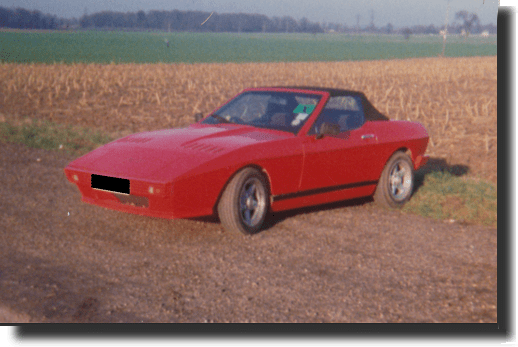
1984TVR TASMIN
Colour: Red
0-60 in 7.8
Top Speed: 110mph
Photo: Pictured at Bisley Shooting Range, Woking.
1984Porsche 911
Colour: White
0-60 in 3.9 seconds
Top Speed: 205
_________________________________
ARTICLE
In April 1972, Peter tested drove a Lotus Seven S4TC sports car for the (West) German entertainment magazine, Bravo.
A HOT THING FOR JASON KING
Anyone who wants this speedster needs strong nerves; the Lotus 7 is as airy as a Formula 1 racing car and narrow as a sardine can. At the wheel of the 18870 Mark two-seater from England, Peter Wyngarde felt like a jet pilot. Why? He tells here…
“This is the hottest car I’ve ever ridden in! Peter Wyngard,e alias Jason King, could hardly part with the 122 HP Lotus that he had driven across Munich for a day.
“At every traffic light I was surrounded by onlookers,” he laughs. “But not because they wanted autographs. The car interested them much more. This time, the Lotus was clearly the bigger star of the two of us.”
The most original two-seater in Europe comes – like almost all “tough men’s cars” – from England. The fact that the Lotus 7 looks like a racing car that has lost its way from the racing circuit into city traffic is thanks to its designer. It’s Colin Chapman, the boss of the famous Lotus Renselle.
“Externally, the speedster reminds me of a sports car from the thirties,” says Peter. “The resinous polyester body of the speedster is only 98 centimetres high and has neither doors nor bumpers.
“You have to squeeze into the cockpit in racing driver style”, explains the actor. “You have to be a skilled gymnast to do that. I had to put both feet on the seat, crouch down and push my legs under the steering wheel from that position. I can telly you, I ended up with a few bruises!”
Peter laughs: “It gets tense when you turn the ignition key and the dull roar of the engine sounds. When the accelerator pedal is pressed, the car turns into a jet fighter in a fraction of a second. It accelerates from zero to 100 km/h in seven seconds; an indescribable feeling – the thrust is so strong, that you are pressed back into the seat.
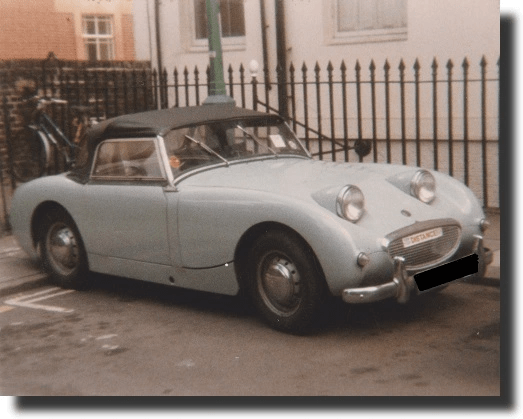
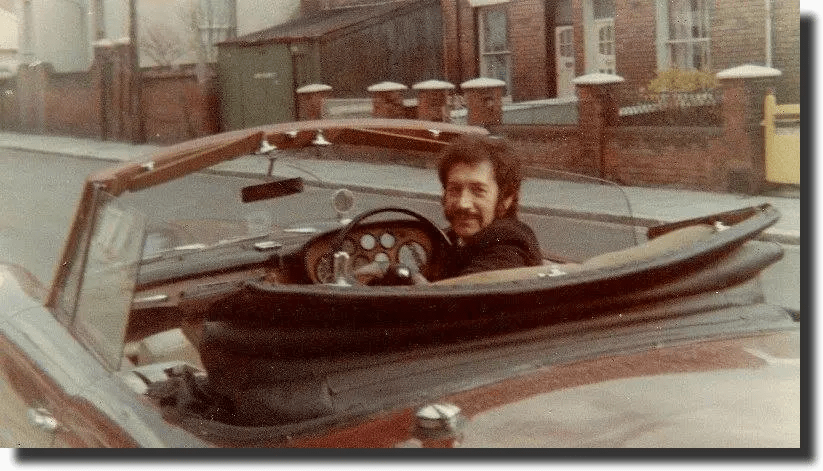
“From 80mph onwards, the breeze in the cockpit became a hurricane that tore the cigarette out of my mouth. I felt as if I was sitting on the deck of a ship with the wind at force eight. And a little later, on an uneven road, the tightly sprung racer turned into a raging bone cruncher. Every bump in the street had the effect of constantly kicking my seat from below. For a few seconds, I longed for my Bristol sports car, built in 1959, or for my Bentley Coupé back. But only until the next straight, because then the discs in my spine will recover from the worst impacts.
“The consumption of this disguised racing car is limited; around 13 litres per 100 kilometres is not too much for a 122 hp engine, with the help of which the Seven effortlessly shows it’s rear to more powerful sports cars…”
Translated by Tina Wyngarde-Hopkins
Click below for more about Peter and his love of cars…
Having watched Checkmate countless times over the years, I’ve come to the conclusion that the plan to escape was not No.6’s own, but that of the Authorities – perhaps to prove to him that escaped from The Village was impossible, and that any future attempts would therefore be futile. Let’s look at the evidence:
As the story begins, we see the Villagers is taking part in a game of human chess. Although the three opening moves a standard, the fourth: ‘Knight to Knight’s Bishop’ is rather bemusing, which begs the question – if black represents authority, might that be an indication of their ability to change the rules at will?
We are then introduced to the enigmatic ‘Man with the Stick’, who blatantly grabs the attention of No.6 by ignoring the sudden presence of Rover while all the other villagers remain perfectly still. Surely if he had not been working on the side of the authorities, he’d have been attacked without question? Having made the acquaintance of this gentleman, No.6 is informed that if an escape plan is to be successful, then he must first distinguish between “black and white” – meaning, between Prisoner and Guardian. No.6 is told that this might be achieved by judging the attitude of each individual, suggesting that the more assertive among their number must therefore be Guardians.
Initially, he decides to apply this test to ‘The Rook’ (No.58), who had dared to make a move on his own initiative during the chess game the previous day. Having perceived that ‘The Rook’ is an individualist, No.6 feels that he is someone in whom he can confide. This was of course his first major mistake since No.58, having undergone rehabilitation at the hands of No.2, is himself intimidated by No.6’s apparent air of authority and is convinced that he is a Guardian.
Having been specifically sought out to attend the so-called “rehabilitation” session at the hospital, I suspect that No.6, and not ‘The Rook’, was the main subject of No.2’s experiment. By observing No.6’s reactions to number No.58’s apparent distress, No.2 may have learned much more about his guest’s behavioural patterns than might have otherwise been allowed. By subliminally pointing him in the direction of ‘The Rook’, No.2 had already begun to take control of the game.
As No.6 busies himself with his recruitment of more villagers ‘The Rook’, fearing that he himself may be implicated, presumably decides to betrays his new comrade by reporting his movements to No.2. This, of course, was exactly what had been expected.
Meanwhile, No.6’s continued rejection of ‘The Queen’ might’ve proved to be his second fatal error. If we are to assume that the story is based on the game of chess, then it must be accepted that ‘The Queen’ is the most powerful piece on the board, if only for her great mobility – i.e. she can move as far as she likes along any horizontal, vertical or diagonal line. Perhaps if No.6 had had a less arrogant, chauvinistic attitude toward her, he may have realised this. Ergo, she just might have proven to be his greatest ally(?).
Might we also speculate that by sending ‘The Queen’. out to openly pursue No.6, No.2 had, in effect, satisfied his quarry’s expectations, and had thus thrown him off his game?
Since the men in the Control Room appeared to be taking the radio message regarding the supposed plane crash as fact, it becomes apparent that No.2 was working alone. It’s at this point that No.6 fails to consider the possibility of a patrol of the coastal perimeter. He also fails to question the somewhat convenient positioning of the MS Polotska when broadcasting his Mayday. In his role as the grandmaster, and with the assistance of ‘The Rook’, No.2 is able to predict each and every move that No.6 will make in advance, and having placed his chess pieces perfectly on the board, No.6 soon to find himself in check!
The most puzzling incident of all, however, is the look of absolute astonishment on No.6’s face when he sees No.2 on the two-way monitor and realises that The Polotska is in fact their ship. Surely for a man of such intelligence and biting suspicion, the possibility must have occurred to him?
Checkmate!
In Conclusion
This episode, which was the first of the series in which No.6 was not seen as the only individualist in The Village, demonstrates how efficient and effective the authority’s surveillance systems were – proving how unlikely the possibility of escape is.
We also learn of a huge flaw in the make-up of No.6 character – that being his loss of reason when presented with what he considers to be a sure-fire means of escape. For someone so naturally suspicious, he certainly appeared to take ‘The Man With The Stick’ at his word. Clearly No.2 knew No.6 somewhat better than he knew himself, and he used that knowledge to teach his unruly ‘guest’ a lesson.
Anyone for a game of chess?
Facts & Figures
Checkmate (or ‘The Queen’s Pawn’ as was its original title), was the third episode of The Prisoner to be shot. Filming began on Saturday 17th September, 1966 at Portmerion in North Wales, but Peter only took up residence in ‘The Green Dome’ some six weeks later at the beginning of November. All his scenes were filmed at Elstree Studios in Hertfordshire.
Part of the set seen in Checkmate was originally constructed for the making of the war film, The Dirty Dozen, which had been shot at Elstree earlier in the same year.
Although Checkmate was one of the earliest episodes of the series to be recorded, it was the 9th episode to be broadcast in Britain, and the 11th in the USA.
The karate chop that Peter executes as No.2, was totally authentic, and had been rehearsed behind closed doors for weeks prior to filming.
Checkmate was the only episode of The Prisoner to show an interior view of the sinister Watchtower.
Peter once said that the most nerve-racking part of playing No.2 was Patrick McGoohan’s insistence that he played the character as himself!
In a recent poll in Six of One – The Prisoner Appreciation Society magazine – Checkmate came runner up only to Arrival in a vote of favourite episodes.
One of the most puzzling comments in the episode comes from ‘The Man With Stick’, who congratulates No.6 on playing a “fine game of chess”. The fact that No.6 had merely been a lowly Pawn and had moved just two squares, didn’t appear to concern him!
The only memento that Peter kept from his all-too-brief appearance in the series were the plimsolls he wore as No.2.
Prisoner expert, Roger Langley, lists Peter amongst his top 20 favourite actors from the series, which boasts over 200 individual performers. He says the smooth but cold No.2: “Portrayed by Wyngarde fights to keep himself under control. The nearest we see to a show of aggression is the splitting of a plank by a deft karate blow. The village leader, with his scarf draped across his shoulder, could be a college professor. He is well-spoken, well-mannered and obviously well-bred. He is full of charm, but appears capable of applying whatever degree of force might be needed. Wyngarde capably brings off a performance of a man who will use his own disciplined methods to exert power over those who would conspire against him”.
Handsome, witty and wise – that’s Jason King, TV’s most seductive sleuth. Colette O’Hare wondered just how much Peter Wyngarde was in his screen creation…
“What is Bavarian Goulash?”
“I don’t know.”
“Well, in what way is it different from say Hungarian Goulash?”
“I don’t know, I’ve never seen Hungarian Goulash!”
Where Jason King might have rushed in, taken his investigations step stage further, or even called the manager, Peter Wyngarde wisely decided to order something else.
At the self-service counter, he instructed the new recruits to his favorite health food shop , how were they kept the trays and made sure everyone had their full complement of knives and forks.
“I like health food.” he said. “I’m not exclusively vegetarian, but somehow you feel it’s doing you good – even if it’s not. It makes you feel virtuous, you know. I think I’ll have a glass of water too to cleanse my tubes.”
Lean, indelibly tanned, moustached like a Mexican bandit, our Best Dressed Male Personality wore a superb black Kaftan – made to his own design in Morocco – and dark brown suede trousers. He carried a packet of Pall Mall in the top of one boot, and cigarette lighter in the top of the other. “It does away with bulging pockets.”
Mr. Wyngarde sounds just like you’d like your man to sound should you live so long. He does NOT grunt. “Smoke?” but asks in that graciously seductive voice, “Will you have one of these?”
He is pestered by a lot of ladies. A friend inadvertently let slip his phone number to a telephonist, and the same day eighteen eager and unidentified females were on the line. How does he feel about such adulation?
“Terrified!”
Married at the age of twenty-two, divorced five years later, he has since formulated some highly interesting theories on the subject of the wedded state.
“I’m not against marriage – but I think I would be against marrying too young – as I did. You need to be ready for marriage to really understand what you’re taking on.
“Some time ago I almost remarried. She was an actress with a small son. We had a wonderful relationship and I was quite happy with things the way they were, but she decided she wanted to get married. So I said all right. if that’s what you want – but don’t for God’s sake expect me to rush out and buy a house and all the trimmings. Don’t uproot me from my happy home where I’ve lived, man and boy, for the last 15 years. She had a lovely home of her own and so had I – why should either of us give up our independence. Gradually she came round to my way of thinking. Then her mother came on the scene. But people don’t live like that, she said. Why? Well they do just DON’T, that’s all. So we didn’t get married and the relationship faded away.”
By now he had worked his way through the final course on – economy size bowl of natural yogurt.
“Could someone get me a coffee.” he asked. “I don’t think I can move!”
Back on the subject of Jason King, he said.
“When making Department S and this present series, I took a little tip from my friend Roger Moore. He told me that in the earlier Saint programs he made the mistake, or at least the writers, did of having him win every fight. It got so he could hardly show his face in public without someone wanting to fight and prove that he wasn’t so tough. I make sure that Jason King loses more fights than he wins, but occasionally people do say, “How did you do that in that last programme? – trying to goad me into taking them on, I usually say, well. it’s like this. I was paid a lot for that program. If you’d like to pay me the same, I’ll let you in on the secret.”
“And of course no discussion on Mr. king would be complete without some mention of, well, clothes.
“I like to wear casual clothes, really more by the way of change,” said Peter. “Not just to relax in – I can relax perfectly in the suits I wore for the series – they’re designed and cut so that it IS possible to relax in them.In fact, often I feel more comfortable in a suit than in jeans if the jeans aren’t properly made.”
The coffee – decaffeinated – stirred not shaken – had arrived,
“Do you think people are physical enough?” he wonders for no particular reason. “I don’t think they are. I think we should have more physical contact – go around hugging people – not just in perfunctory sort of way – but really hugging them.”
What, everybody?
“Well if you don’t fancy hugging a particular person, then you’d have to ask yourself why. in fact the less they appeal to you the harder you ought to try – get over this thing about looks – it’s just another example of selfishness, isn’t it? Don’t you think it would be a good idea? Sales of deodorants would soar for a start.”
Interview by Collette O’Hare
The following is taken from the inside cover of the magazine:
Writer Collette O’Hare is still talking about her interview with TV super-sleuth, Jason King, alias the elegant Peter Wyngarde. Apparently Peter is even more devastating in real life and Ms. O’Hare is still starstruck with the joy of being within touching distance!
“Never mind,” we said kindly. “Working journalists and highly-paid actors shouldn’t mix anyway. Just forget him – and keep typing.”
“What?” she shrieked. “You don’t think I’d waste another minute stuck here behind a hot typewriter if he ever dropped so much as a hint of encouragement, do you?”
Loyalty, we decided, will never be her strong point…
Please note that some of the additional information provided here by the journalist named below may not be accurate, so it should be treated with caution.
Saturday, 26th September 1970
Peter Wyngarde Living Up To His Title
Did you fall madly in love with Jason King? Did you warm to his ultra cool and his rapier wit and his Immaculate way of dressing? That’s probably how Peter Wyngarde came to win the best dressed man of ’70 award. So what’s he wearing this winter?
One beautiful garment that is bound to get an airing is a fur coat that once belonged to Rudolph Valentino. It is made of black seal skin and reaches almost to the ground. The collar is Russian squirrel and there are 5 inch bands of mink around the cuffs and hem. Peter bought the coat in Hollywood and he looks as illustrious in it as the original heartthrob owner.
“I’ve always cared passionately about clothes,” he says. “In fact, maybe it’s only in the last few years that my style of dressing has really come into its own. I met a friend abroad recently whom I hadn’t seen for a few years and he said that he recognised me from a distance by the style of my clothes! I am very like Jason King – in fact the character was intended to be much quieter, much less flamboyant originally. I wore all my own clothes and I shall do so again when the new series starts shooting.”
In Peter’s Kensington home there are several wardrobes bulging with fantastically elegant clothes. ” I’m lucky as I travel a lot and I’m able to buy my clothes all over the world – as I see them. Sometimes I have things specially made. Sometimes I buy off the peg, and I don’t even mind buying things that are not new if they are what I want. In France, I got the most beautiful black and silver grey beaded waistcoat in a market.”
Among the favorite things in the Wyngarde collection is a shirt in Sheer Damascus silk, woven by nuns in a Spanish convent near Malaga. It is patterned in dark mauve and black and looks fantastic worn with white slacks. His favorite belt is Chinese and medieval, with handcarved silver links and a bird of paradise on the buckle.
Peter has a very definite idea about clothes. “If clothes really matter to you, they must be treated with respect. I love fabrics like silk and cashmere, but obviously you can’t treat them in the same way as cotton or wool.”
There are certain Wyngarde fashion points noticeable at a glance. His well tailored pale suits are one trademark, so are his turned back shirt cuffs: “A habit I developed when I was living in a hot climate. it’s cooler and it doesn’t matter if you’ve lost your cufflinks!” Another is buttonholed flaps on his sports jackets so he can turn the collar up on chilly London evenings.
Between filming and other commitments, Peter travels all over, making appearances in those far corners of the world where his success in Department S has made him a star. Everywhere he goes he well and truly lives up to his title, epitomizing everything that is best about the English gentleman in both charm and elegance. He is always perfectly dressed whether in impeccably tailored suits on quiet days or in the swirl of a grey silk Chinese Cape, heavily embroidered in white, when he’s feeling dramatic. Even Jason king couldn’t do it better
TV Ekspres was a Belgian television listings magazine published in Dutch. This interview has been translated into English for this website by Anna Veldman.
_______________________________________
Monday10th December 1971
Jason King, women, and fashion
Following a survey in Australia, Peter Wyngarde was found to be the man to whom the most women are attracted. When he arrived in Sydney there were such large numbers of female fans awaiting him that Police protection was required. It was really something big in Sydney. Not suspecting a thing Peter stepped off the plane and was immediately swamped by girls of all ages. The airport Police had to step in to get him into the terminal building in one piece. Once inside Peter said he no longer needed Police protection, left through a side door, stepped into a taxi and was driven to his hotel.
But that is not the end of the story. A girl would be waiting for him every time he opened the door to his room, each time a different one. “I was not expecting anything like this” he says, smiling. “Every time I left the hotel there would be dozens of girls waiting for me outside. It was unbelievable. The pinched everything they could get their hands on: my pocket square, my watch chain, my tie and my cufflinks. Peter doesn’t really mind. He loves women but nevertheless chooses to remain single. When he was 22 he got married but it only lasted for five years. About this he says “I was too young then. The reason so many marriages fail is that the partners are not psychologically prepared for it. I am not against marriage provided one finds the right woman. I’m a bit wary of too strong emotional ties. Furthermore, I believe that marriage would be too difficult for me. I’m afraid that being in a relationship binds one too tightly to another. The main reason for this is that I am afraid of being hurt of hurting someone”.
He continues “I ask myself do I need to be permanently attached to someone. I like independent, intelligent women. However, the problem for me is that the women who feel attracted to me don’t come under that category. But there is more. If I decided to remarry I would want my wife and myself to live under separate roofs and only meet up when we felt the need and not have to see each other every day. But with a wry smile he has to admit, “what kind of woman would want to marry me under these conditions. Perhaps it is better that I don’t marry again except maybe when I am very old”. He pauses for a moment to reconsider his words and then continues with a broad, cheeky grin “Unless of course I can marry three women at once like Mormons do. A beautiful white one, a beautiful black one, and a Japanese one, the latter to take off my shoes at night. Isn’t that what every man really wants?”.
In the meantime Peter lives in solitary splendor in his Kensington flat with Yussef his Afghan hound as his only companion. His abode is filled with beautiful antiques as elegant and sophisticated as Peter himself. The interior décor was modeled around his own personality and Peter fits into every room as the finishing touch that completes the painting.
Peter’s work schedule leaves little time for romance. Apart from his work as an actor Wyngarde is also making records, under which his revolutionary LP “Rape”{1}. He has made a start on it and must continue which means he is up at the crack of dawn every day to go to the recording studio. By the end of the day he is so exhausted that he can just manage to stumble home and collapse between the sheets.
The most remarkable fact about Wyngarde’s career as an actor is that he was never trained as such. He learned the hard way by practice and still became one of the most highly rated actors in England. His present image is that of a super sophisticated playboy. However there are more classic works and remarkable renditions on his track record than one could possibly imagine. When he played the title role on television in “Will Shakespeare” and was on screen non stop for three and a half hours the whole country sang his praises. On another occasion he played “Jesus of Nazareth”[2].
At the beginning of the TV series Department S, Jason King was portrayed as a quiet, somewhat withdrawn character. “I felt like I was 100 years old when I came home after the first couple of days so to give it some relief, I decided Jason King could do with a bit of a spicing up. I began to remodel him using myself as the model. That is, as I like to think of myself. In the new series there is no difference between Jason King and myself.
Jason King is indeed Peter Wyngarde’s own creation. The manner in which he wears his long hair, the shape of his moustache, the knot in his tie and his extravagant suits are well known in the dozens of countries where Jason King is aired. His wardrobe, considered to be one of the most flamboyant on the planet, had cost him a small fortune in which he invested much more than he now likes to admit. In every country his travels and work took him he had fancy suits made to measure. He often bought so much he hastily had to send a telegram to his manager requesting more money. He has many remarkable items in his wardrobe but most remarkable of all is a huge fur coat that up till now he has only worn once in the series. It once belonged to Rudolph Valentino the legendary lover on the cinema screen in the 1920’s.
What does he prefer to wear nowadays? Peter shows us a purple and black chiffon shirt, “I love luxurious materials such as silk and cashmere which obviously cannot be treated in the same manner as wool and cotton. Clothing made from materials such as these may have pockets but not have anything put inside them. Doing so would completely ruin the piece of clothing”.
Does he feel he should have influence on male fashion? Peter replies “Yes, I know a thing or two about fashion. Everything I wear as either Jason King or Peter Wyngarde are my own creations. Should I ever decide to give up acting I will start my own house of fashion, for men of course.
With grateful and sincere thanks to Chris Williams.
Notes:
[1]: The LP was simply called ‘Peter Wyngarde’. ‘Rape’ was a track on the LP. [2]: Peter played John the Baptist in ‘Jesus of Nazareth’.
Sherlock Holmes, just his very name is enough to bring a smile of satisfaction to the millions of fans of the science of deduction. Whether in the abundance of stories created by Sir Arthur Conan Doyle, including the classics The Sign of Four, The Red Headed League and the gothic horror The Hound of The Baskervilles or in the many film adaptations staring such luminaries as Basil Rathbone, Roger Moore, Robert Downey Jr. and Peter Cushing. There have been the very successful early stage production or in the television series’ that has caught the public imagination starring Jeremy Brett or Benedict Cumberbatch, everybody who has ever enjoyed the detective has a point of view on him and the many faces he has worn.
As the series of the 21st Century update of the man from 221B Baker Street cames to an end, viewers were treated to a glimpse into the world of the story of those who played the detective on screen in Timeshift: ‘How to Be Sherlock Holmes, The Many Faces of A Master Detective’. With Peter lending his dulcet tones to the narration, and contributions from the likes of film legend Christopher Lee, who had the unique perspective of playing both Mycroft Holmes and the inheritor of woes in The Hound of The Baskervilles, Nicholas Meyer, who penned the rather brilliant The Seven Per Cent Solution and Mark Gatiss (a huge Wyngarde fan) who co-created the latest version of Sherlock with Steven Moffat and which stars Benedict Cumberbatch and Martin Freeman, this was the closest that fans of the consulting detective could get to having every single egg in their basket looked over, scrutinised and explained by those who know him best in one place.
This was not just a look at the evolution of the work of Sir Arthur Conan Doyle, the rise of the man who went beyond the dirt of the street, the enclosing fog of Victorian London, who helped in the fight against Nazi Germany and rather incredibly helped the bastion of American freedom, Superman, in one of his many comic appearances, this was a celebration of one of the finest British literary creations of all-time; a chance to revel in the Sherlock Holmes you grew up with and to admit just how important this creation was.
There are very few definitive true detectives that have captured the attention of the public world- wide, perhaps Hercule Poirot as portrayed by David Suchet comes close, but Sherlock Holmes is the true master, the arm-chair detectives’ detective and in Timeshift: How to Be Sherlock Holmes, The Many Faces of A Master Detective, the nature of the man, the character of the detective, for all his faults and wisdom, his abuse of cocaine and his faultless observation, go hand in hand throughout three different centuries.
Click below for reviews of Peter’s appearances in Sherlock Holmes stories…