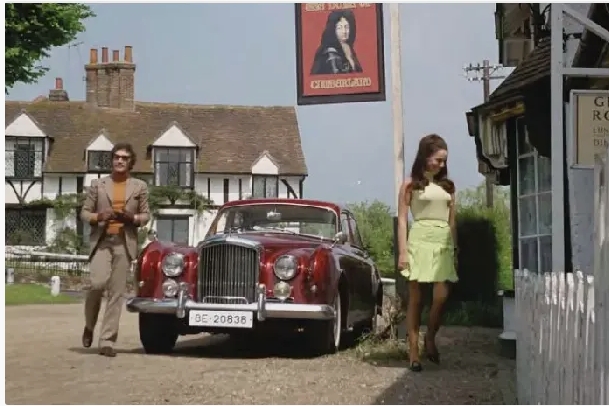
I am finding it hard to sleep at the moment, which has caused me to reacquaint myself, via the wonders of Youtube, with a TV series called Department S. I’m currently on a dose of at least two episodes a night. This was Incorporated Television Company supremo Lew Grade’s answer to ABC’S The Avengers: an elite section of Interpol, weird ‘unsolvable’ cases, a wacky main character and occasionally some interesting ideas… but mostly not. Throw in a crime-solving computer with lots of spools and flashing lights, plus an American sidekick with great hair (Joel Fabiani) to help flog the show to the USA, and you have pretty much a cliché of the ITC actionseries formula. Also lots of fast cars and pretty girls, plus a side order of comedy violence. Best of all, a great theme tune: I have very fond memories of driving my Lancia 2000 Berlina around London in the late ’80s with Edwin Astley’s arrangement as a mood-setter.
The action ranges across the UK and Europe; most episodes appear to kick off at Heathrow with a jet either landing or taking off, giving the impression the producers wanted to tap into newly emerging package-holiday aspirations. Not that anything is filmed on location: the budget only extended to potted palm trees and a few exotic numberplates. What could not be filmed on the Elstree back lot or a local hotel pool was recreated in the studio. As in Carry on Abroad, you can see the actors shivering, no matter how hard they try to invoke the feel of the south of France or the Costa del Sol. Via the tiny black-and-white screens on which it first aired, nobody noticed or cared.
The feel is ‘international crime-fighting meets early-’70s Martini advert’, particularly whenever the protagonist, Jason King, appears. With his flamboyant hair and tailored clothes, King was played by the wonderful Peter Wyngarde. This was a new kind of hero, who had the ladies’ hearts aflutter. Wyngarde was a fine stage actor, and Department S made him a household name: at the height of his fame, he published a risqué spoken-word album and was twice voted Britain’s best-dressed man.
Wyngarde became such a phenomenon that, post-Department S, he even got his own series, Jason King. This one I do remember: even aged five I was uncertain of the nature of the man’s appeal. My mum had fallen under his spell – “Do your cuffs like Jason King!” – as the ’70s replacement for the clean-cut Simon Templar.
In fairness, he is the best thing in the show, with his charisma bolstered by a James Young Bentley Continental S2 on Swiss plates; the car, and clothes, were allegedly Wyngarde’s own. He carries his myriad affectations lightly: Sobranie Cocktail cigarettes, matching shirt and tie in lurid colours, and Zapata moustache. When necessary, King/wyngarde can direct a convincing punch, taking on the likes of John Bindon and future Darth Vader actor Dave Prowse. You can even spot Anthony Hopkins in a rare – possibly unique – ITC appearance.
Department S probably has the best set of cars of any ITC series: regulars include a Vauxhall Ventora (for Fabiani), while computer boffin Rosemary Nichols swaps between a Lancia Fulvia Coupé and a Lotus Elan +2S. For foreign missions (driving on the wrong side of the road in Wales) there is a Fiat 2300S Coupé and a Mercedes SL Pagoda; baddies almost always drive Yanks or a recurring black Ford Zephyr MKIV. Corvairs turn up repeatedly – usually as a prelude to a crash – and a black Rolls-royce Silver Wraith limo often stands in for the Phantom V seen in the opening credits. When the script demands that the Wraith explodes, it magically turns into an Austin Sheerline.
They must have knocked out dozens of episodes of this show, because there is always a fresh one to watch. Or maybe they are coming around again and I’ve simply not noticed.
Among the various British television serials produced during the 1950s, Epilogue to Capricorn occupies a compelling place in broadcasting history. Broadcast by ATV on ITV in 1959, this six-part black-and-white production blended wartime intrigue, espionage, and political conspiracy, centering on the enduring consequences of a failed secret operation during the Second World War. While perhaps not categorised as one of the definitive classics of its era, the series remains a significant example of post-war British drama and serves as an important early credit for several actors who would later achieve distinguished careers.
The strength of the serial lies primarily in its premise. The narrative revolves around “Operation Capricorn,” a top-secret wartime mission whose catastrophic failure continues to cast a shadow years later. Foreign correspondent Robert Faulkner is commissioned by the War Office to investigate the operation and compile a dossier detailing the causes of the failure. As Faulkner’s inquiries progress, it becomes evident that the disaster was not merely the result of unfortunate circumstances, but may have been the product of deliberate betrayal – a truth buried beneath years of official secrecy, conflicting testimonies, and political sensitivities.
This central mystery provides a robust foundation for the drama, allowing the serial to explore themes of loyalty, patriotism, and the long-term impact of wartime decision-making. The notion that a single act of treachery could continue to destroy lives long after the cessation of hostilities gives the story an emotional resonance that transcends its genre elements. Like many post-war thrillers, Epilogue to Capricorn examines a world where victory did not bring closure and where secrets remained capable of causing profound damage.
The structure of the serial reflects the storytelling conventions of the late 1950s. Spanning six episodes, the narrative unfolds gradually, with each installment revealing a new piece of the puzzle. The episode titles—including All on Tape, Man Hunt, Point of No Return, Child’s Play, Time Factor, and Traitor’s Gate—suggest a progressive escalation of danger and revelation as the investigation nears its conclusion.
A particularly pivotal plot element involves a series of compromising recordings linked to Operation Capricorn. These tapes contain sensitive information capable of exposing those involved in the wartime operation. Once stolen, the recordings become a catalyst for the series’ primary conflicts, triggering a race to uncover the truth before further harm is inflicted.
As Robert Faulkner, Richard Johnson brings intelligence and credibility to the lead role. His character serves as the audience’s guide through a labyrinth of half-truths and hidden motives. Rather than portraying a conventional action hero, Faulkner relies upon persistence, investigation, and observation. Johnson’s restrained performance aligns well with the serial’s serious tone and helps anchor the increasingly complex plot.
The supporting cast is equally noteworthy. Jean Kent, already an established screen presence by 1959, contributes both glamour and authority, while Adrienne Corri*, Allan Cuthbertson, and George Murcell add depth to the intrigue. In retrospect, the cast list represents a catalogue of British acting talent either at the peak of their powers or on the threshold of major success.
For modern viewers, a chief point of interest is the appearance of Peter Wyngarde as Peter Vauxhall. Although his role was initially intended to be brief, contemporary reports suggest that audience reaction to his departure was so strong that he was brought back for an additional episode following complaints received by ATV and TV Times. This response underscores the impact Peter was already making on television audiences early in his career.
Peter’s natural screen presence distinguished him from many of his contemporaries. Even before his later fame as Jason King, he possessed a distinct ability to command the screen. His performance as Peter Vauxhall reportedly became one of the serial’s principal attractions, with some contemporary critics admitting that their interest in the series was largely sustained by Peter’s presence in the cast.
Epilogue to Capricorn is not without its flaws. The serial was written by John Roddick, who later achieved success with programs such as The Saint and Z Cars, yet contemporary and retrospective assessments have remained mixed. Notably, Peter himself later expressed a highly critical view of the scripts, describing them as some of the poorest he had encountered, despite praising the title. Such remarks suggest that even those directly involved recognised weaknesses in the writing.
Indeed, the material is occasionally more impressive in concept than in execution. While the themes of betrayal and espionage are compelling, the dialogue and plotting do not always fully realise their dramatic potential. Some contemporary critics found the pacing and cliff-hangers unconvincing, suggesting the story struggled to maintain tension across its six episodes.
Nevertheless, it would be unfair to dismiss the production entirely. Television drama in 1959 operated under significant technical and creative constraints compared to later decades. When judged within its historical context, Epilogue to Capricorn remains an ambitious and enjoyable thriller. Its focus on wartime secrets and government intrigue places it firmly within a tradition of British mystery drama that would flourish throughout the 1960s.
Perhaps the serial’s primary significance today lies in its preservation. Unlike many British productions of the 1950s, which were erased or lost, Epilogue to Capricorn survives intact. This makes it an important artifact of television history, offering modern viewers a rare opportunity to experience a complete British serial from that era.
Ultimately, Epilogue to Capricorn is a fascinating curiosity: an ambitious wartime mystery featuring an excellent cast and an intriguing premise. While the scripting may not always match the promise of its concept, the serial remains an engaging example of late-1950s British television. Though it may not be classified as a masterpiece of the medium, it provides a valuable glimpse into a formative period of broadcasting and demonstrates why performers such as Peter, Richard Johnson and Jean Kent continued to attract audiences for decades to come.
*Peter would appear with Adrienne Corri in the ITC series ‘Sword of Freedom’: ‘The Sicilian‘ (1958) and the Department S – ‘The Man Who Got A New Face’.
Critic’s Comments
“After such a weak cliffhanger last week, I must confess that if I watch further episodes – and at the moment I’m not inclined to – I will only watch because Peter Wyngarde is in it. For me, this actor is always a delight to watch, though I think they must have twisted his arm to make him say the dialogue.” Guy Taylor – The Stage: 5th November, 1959
Peter’s Comments
“Epilogue To Capricorn’ probably had the most excruciatingly bad script I’d ever had the misfortune to read. It probably had one of the best titles for any series in the world, but definitely the worst script.
So, the actors got together with the director, who was wild and crazy and was eager to do different things, and he said: “What do you want to do then?” I said, “Throw away the script; throw it in the bin and we’ll just ad-lib. We more or less know what the characters are and we could take it from there.” It became a top TV series of that time, because nobody knew what was happening.”
A bit of Trivia
~ While Peter was very fond of Adrienne Corri, he absolutely hated Jean Kent, who he described as a “Prize bitch”! There were numerous clashes between the two on set. The fact that the series went out live didn’t help the situation any, since Kent would try to ruin any scene Peter was in.
~ The series has often been listed with the alternative title, ‘Suspense’. This is incorrect. ‘Suspense’ was an anthology series also produced and directed by John Nelson Burton, which ran from 1959 to 1960, but ‘Epilogue To Capricorn’ had no connection to.