A Festival of Britain Production by arrangement with Bronson Albery production. Sherek Players Ltd. (in association with he Arts Council of Great Britain).
Opened at The New Theatre, London – Thursday, May 17th 1951.
Character: Voltimand and Third Player (Lucianus in the “play within a play”)
The entirety of the play takes place in Denmark.
Act 1:
- Scene 1: Elsinore, A platform before he castle.
- Scene 2: A room of state in the castle.
- Scene 3: A room in Polonius’ house.
- Scene 4: The platform.
- Scene 5: Another part of the platform.
Act 2:
- Scene 1: A room in Polonius’ house.
- Scene 2: A room in the castle.
Act 3:
- Scene 1: A room in the castle.
- Scene 2: A hall in the castle.
- Scene 3: A room in the castle.
- Scene 4: The Queen’s closet.
Act 4:
- Scene 1: A room in the castle.
- Scene 2: Another room in the castle.
- Scene 3: Another room in the castle.
- Scene 4: A plain in Denmark.
- Scene 5: Elsinore. A room in the castle.
- Scene 6: Another room in the castle.
- Scene 7: Another room in the castle.
Act 5:
- Scene 1: A churchyard.
- Scene 2: A hall in the castle.
Some Background
Rather than set this production of ‘Hamlet’ in the the late middle ages as per Shakespeare’s original Alec Guinness, who not only played the eponymous prince, but also directed (with Frank Hauser), chose to set in the 16th Century.
The sets, which one critic described as a “formal and rather bleak affair” were, again, at Guinness’ behest, as he had disliked the semi-permanent and realistic sets he’d seen in other productions of Shakespeare. he’d wanted a suggestion of reality here and there, and came to the conclusion that each scene could be played round, or influenced by, one or two specific real things – for instance, the battlement scene round a Tudor cannon, the Polonius household a table with a globe and papers, the main court scenes dominated by a large Renaissance classical doorway, and for the rest blackness and open wings. This did not work out overly well, and was not put to the best use.
Very little of the play was cut. Retrospectively, Guinness believed this to a misjudgement. He said it occurred later that perhaps Elizabethan audiences were able to stomach long entertainments for the simple reason that they were in the open air. He’d followed Granville-Barker’s advice and did not drop the curtain, as is usual, at the end of the ” Rogue and peasant slave ” soliloquy. This, he said, turned out to be the only “daring”, original and exciting thing they did in the whole production, with immense results, and it escaped the critics’ notice!
The play was not well received, either by critics or audiences. On the opening night alone, there was problems with the lighting, that found the cast drowned in bright light during night scenes, and in pitch darkness for day scenes.
Alec Guinness later wrote an article in the Spectator, explaining why he felt the play had been such a disappointment.
Above: Taken from the editorial of the June 1951 issue of ‘Theatre World’ magazine
A Synopsis
Prince Hamlet of Denmark (Alec Guinness) is devastated by the sudden death of his father, King Hamlet (John Bushelle), and is further disturbed when his mother, Queen Gertrude (Lydia Sherwood), quickly marries his uncle, Claudius (Walter Fitzgerald), who has now assumed the throne.
Guarding the castle at Elsinore, Marcellus Robert Sansom) and Barnado (Michael Godley) tell Horatio (Robert Urquahart) that they have seen the ghost of the dead king. The ghost reappears, and they decide they must tell Prince Hamlet about it.
King Claudius learns that Fortinbras (Michael Godley), the nephew of the King of Noway, is planing to invade Demark, so he sends Voltimand (Peter Wyngarde), his most loyal envoy and diplomat to ask Fortinbras to restrain his nephew and ensure peace between the two kingdoms. When Voltimand returns to Denmark, he delivers news of his successful negotiation with Fortinbras, and that war has been averted.
Claudius gives Polonius’ son Laertes permission to return to France. Hamlet reflects on the hasty marriage, and learns of the ghost’s visit. That night he meets the ghost, who reveals that King Hamlet was murdered by Claudius, and Hamlet willingly agrees to be the means of revenge. He warns Horatio and the others not to speak of what has happened, even if he should behave strangely.
He gives Polonius’ (Alan Webb) son Laertes (Michael Gough) permission to return to France. Hamlet reflects on the hasty marriage, and learns of the ghost’s visit. That night he meets the ghost, who reveals that King Hamlet was murdered by Claudius, and Hamlet willingly agrees to be the means of revenge. He warns Horatio and the others not to speak of what has happened, even if he should behave strangely.
Polonius bids farewell to Laertes and warns his daughter Ophelia (Ingrid Burke) against Hamlet’s courtship. Later, she tells Polonius of a strange visitation by Hamlet, and Polonius reports to the King and Queen that rejected love is the cause of Hamlet’s supposed madness. Hamlet’s fellow-students Rosencrantz (Robert Shaw) and Guildernstern (Patrick Crean) arrive, invited by the King to find out what is wrong. Polonius arranges for Ophelia to meet Hamlet where he and Claudius can observe them. Hamlet reflects to himself on the nature of life and death, then meets Ophelia. They argue about their relationship, and Hamlet, having become suspicious about being observed, tells her she should go to a nunnery. Claudius is convinced that love is not the cause of Hamlet’s behaviour, and decides to send him abroad.
Meanwhile, a troupe of travelling players have arrived, and Hamlet asks them to perform a play he has written entitled, ‘The Murder of Gonzago’ before the King, so that he and Horatio can judge Claudius’ guilt by his reaction. Hamlet contrasts his own inaction with the way the players can become so involved in their characters. When one of the players, (Peter Wyngarde) – in the role of a character called Lucianus – enacts the murder of a king by poring poison in his ear, Claudius leaves in high emotion, much to Hamlet’s jubilation. Gertrude asks to see Hamlet, and Polonius decides to hide in the room to hear what is said. On his way, Hamlet comes across Claudius alone, trying to pray for forgiveness, but decides not to kill him in such a state of mind.
Hamlet arrives in his mother’s room, and kills the person he discovers in hiding, thinking it to be Claudius but finding it to be Polonius. He argues fiercely with Gertrude, eventually persuading her to change her ways. The Ghost appears, restraining Hamlet’s anger towards his mother, and reminding him of the need for revenge. Claudius instructs Rosencrantz and Guildenstern to take Hamlet immediately to England. Travelling to the ship, Hamlet passes the Nowegian army on its way to fight for a small patch of land, and contrasts their determination with his own lack of resolve.
Ophelia has descended into madness. Laertes returns, blaming Claudius for his father’s death, and is incensed to see Ophelia in this state. Claudius persuades him that the blame is Hamlet’s. When Claudius receives a letter from Hamlet reporting his return to Denmark, he plots with Laertes to kill him. They arrange a duel in which Laertes’ sword will be unblunted and poisoned. Claudius will also poison a drink, which he will offer Hamlet. Gertrude arrives with the news that Ophelia has drowned.
Hamlet meets Horatio on returning to Elsinore. On the way, they see two Clowns (Stanley Holloway & Aubrey Richards) digging a grave, and Hamlet talks to the First Clown, reflecting on the skulls he finds. They discover that the grave is for Ophelia. Hamlet reveals himself to the funeral party, grappling with Laertes and proclaiming love for Ophelia. Later, Hamlet tells Horatio how the trip to England was a subterfuge for his death, arranged by Claudius, and how he managed to escape.
Osrick enters with news of the proposed fencing match, and Hamlet accepts the challenge. With Hamlet in the lead, Gertrude toasts him, and drinks from the poisoned cup. Laertes wounds Hamlet with the poisoned rapier, and is then wounded with it by Hamlet. Before he dies, Laertes blames Claudius, and Hamlet kills the King. Hamlet, close to death, passes the Danish succession to Fortinbras, and instructs Horatio to tell his story.
The Costumes
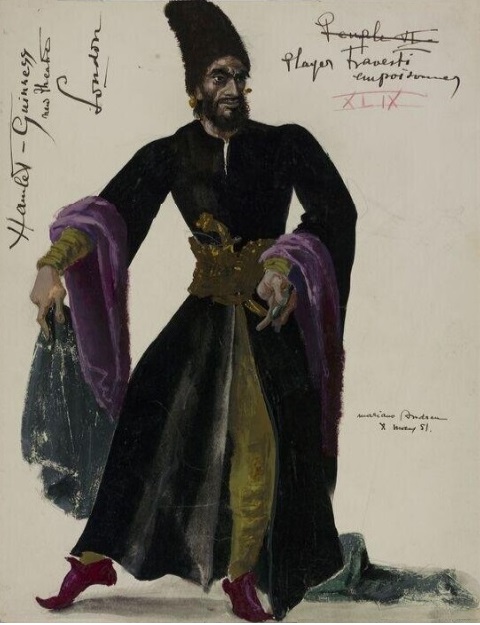
All the costumes for the play were designed by the Spanish Spanish painter, drawer, enamelling master, sculptor, and stage designer, Mariano Andreu. John Gielgud saw his work and invited Andreu to create the costumes and settings for Much Ado About Nothing at Stratford-upon-Avon in 1949. The production was a great success and was toured and revived in Stratford and London. Andreu went on to design a number of productions in Britain during the 1950s, including All’s Well That Ends Well at Stratford, and Berlioz’s opera The Trojans at the Royal Opera House, Covent Garden.
(Left) Andreu’s original design of Peter’s costume -worn as the ‘Third Player’. The painting is part of the V&A’s Theatrical Collection.











 PETER WYNGARDE: The Official Website