My admiration for Peter Wyngarde began in the mid-1960s, following his appearance in the Avengers episode, “A Touch of Brimstone.” Since then, I have harboured a desire to own a personal artifact of his – even a smallest of mementos. For the past six months, I have diligently searched saleroom catalogues and online auctions; however, the few items I encountered were unfortunately beyond my budget.
During these searches, I noticed a trend that seems to contradict the persistent rumours regarding Mr. Wyngarde’s sexuality. A variety of adult materials – which I would characterise more as erotica rather than explicit pornography – have appeared in sales at some of the country’s most respected auction houses. Some of these items are explicitly listed as originating from his estate. Every piece listed, from magazines and playing cards to a sex shop standee, features exclusively feminine imagery. Notably absent is anything that could be described as homoerotic or that one might expect to interest a gay man. This discrepancy is curious.
When I contacted Tina Wyngarde-Hopkins regarding this matter, her response was brief: “Let the evidence speak for itself.” I subsequently asked if I might collate these findings into a short article, which is presented here.
Ms. Wyngarde-Hopkins has, at times, faced significant abuse from online know-it-all’s who believe they understood Peter better than she did. This is despite the fact that most of these individuals never met him, whereas she shared a thirty-year relationship with him.
“People like that no longer bother me,” she stated. “Let them believe what they wish; it will never change the facts. I know the truth, as do those who were close to Peter. The opinions of strangers are irrelevant. These items are in the public domain, so arenot a narrative I’ve invented.”
The following listings are taken from the online catalogues of two separate auction houses. To those who still clinging to long-standing myths, I suggest that the evidence speaks for itself: If it walks like a duck and quacks like a duck, it’s a duck!
*East Bristol Auctions, 1 Hanham Business Park, Memorial Road, Hanham, Bristol, BS153JE
The items I’ve found online
Auction House Description
A collection of assorted ephemera from Wyngarde’s estate – mostly of a pornographic nature, to include; several original Edwardian postcards of nude females, a set of pornographic playing cards, and a collection of photographs of an erotic nature showing orgies and other group activity (not shown), a copy of ‘ Miss ‘ magazine and other items. Non-pornographic items include a personal photograph of Wyngarde with an unknown lady, several black and white photographs of actresses and other items from his estate.
Auction House Description
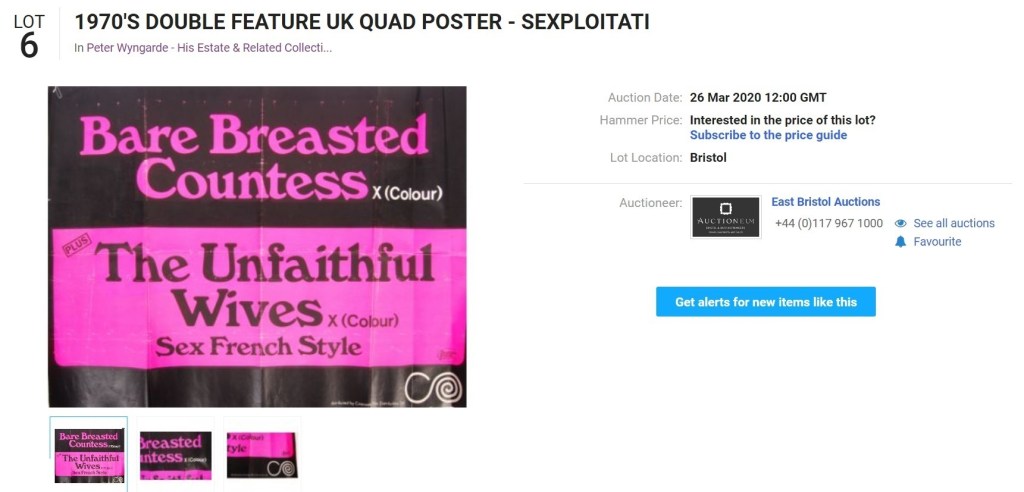
Video double-feature of The Bare Breasted Countess / The Unfaithful Wives (Cinecenta Film Distributors 1970’s) double-feature. ‘ X ‘ rated. and poster. Folded. Measures approx; 76cm x 102cm. From the private collection of Peter Wyngarde.
Auction House Description (above and below)
The Estate of Peter Wyngarde; an original vintage 1970’s (1975) Marlboro cigarettes advertising erotic calendar. Each page featuring a different topless photograph, with the month details to top. Retains original binder to top.
Auction House Description
An original 1970’s large cardboard sex shop display / advertising standee of a nude actress. The standee of cardboard construction, with wooden reinforcement to rear. Measures approx; 75cm tall. Rare.
NOTE:
Neither Tina Wyngarde-Hopkins or Thomas Bowington (Bowington Management), entered any Peter Wyngarde-related items into the aforementioned auctions, or had any connection to them whatsoever.
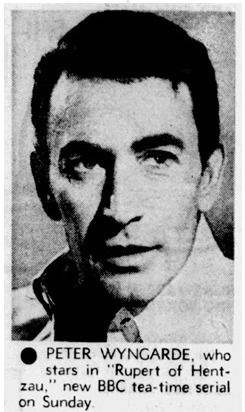
Among the many British television productions lost to history, few are as intriguing as the BBC’s 1964 serial Rupert of Hentzau. Adapted from Anthony Hope’s 1898 novel and broadcast in six half-hour episodes, the series served as a sequel to the celebrated Ruritanian adventure The Prisoner of Zenda. The production featured an impressive cast led by George Baker, Barbara Shelley, and Peter Wyngarde, with adaptation by Donald Wilson and direction by Gerald Blake. Unfortunately, all six episodes are believed to be lost, making the serial a notable casualty of the BBC’s archival policies of that era.
Despite its absence, Rupert of Hentzau retains a particular fascination. The combination of its source material, cast, and genre places it firmly within the tradition of romantic adventure stories that enjoyed immense popularity during the mid-twentieth century.
The serial was based upon Hope’s acclaimed sequel to The Prisoner of Zenda. Set three years after the original story, the plot finds Queen Flavia torn between duty and love. Although she has fulfilled her obligations by marrying King Rudolf of Ruritania, her feelings for the English gentleman Rudolf Rassendyll persist. When she writes to him, the letter is intercepted by Rupert of Hentzau, a disgraced aristocrat who seeks to restore his fortunes by exploiting the situation. This precipitates a tale of intrigue, assassination, and sacrifice, drawing Rassendyll back into the volatile politics of Ruritania.
The story possesses all the hallmarks that made Ruritanian romances so enduringly popular: clandestine plots, swordplay, mistaken identities, and noble acts of self-sacrifice. At its core lies the conflict between personal happiness and public obligation, a theme that provides the adventure with surprising emotional depth.
Central to the production was George Baker in the role of Rudolf Rassendyll. By 1964, Baker had established himself as one of Britain’s most reliable leading men. Possessing a natural sense of authority and a commanding presence, he was ideally suited to the role of the English hero who repeatedly risks everything for a foreign kingdom. Rassendyll is a compelling character because he does not seek adventure for its own sake; rather, he is compelled by honor and loyalty, even when doing so threatens his own happiness.
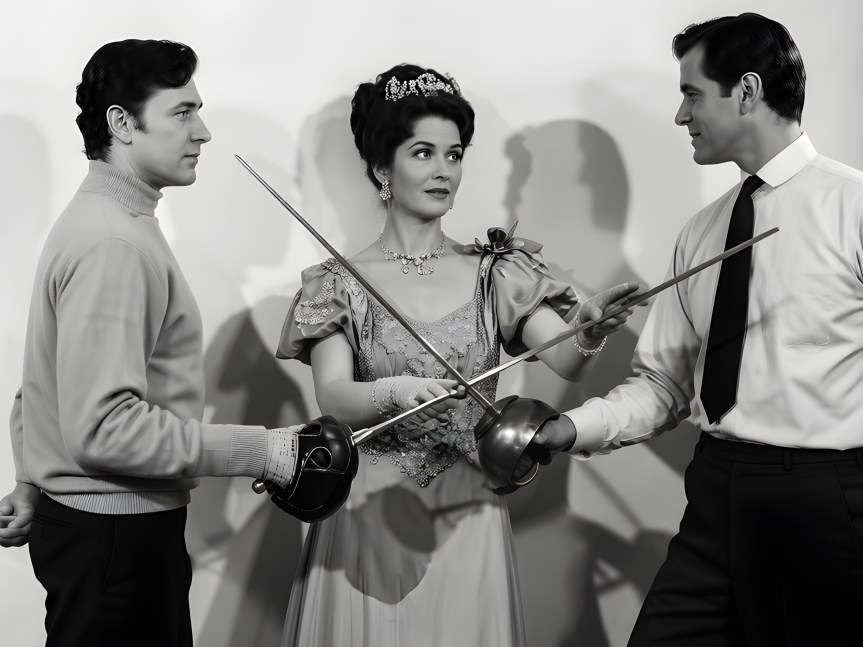
Left:Above left: Peter, Barbara Shelly and George Baker during rehearsals.
Central to the production was George Baker in the role of Rudolf Rassendyll. By 1964, Baker had established himself as one of Britain’s most reliable leading men. Possessing a natural sense of authority and a commanding presence, he was ideally suited to the role of the English hero who repeatedly risks everything for a foreign kingdom. Rassendyll is a compelling character because he does not seek adventure for its own sake; rather, he is compelled by honor and loyalty, even when doing so threatens his own happiness.
Baker’s casting appears particularly inspired, as he brought a necessary balance of strength and vulnerability to the role. Rassendyll must be capable of heroic action while simultaneously carrying the emotional burden of his impossible relationship with Flavia. It is easy to imagine Baker balancing these aspects of the character with considerable skill.
Equally significant was the casting of Barbara Shelley as Queen Flavia. While Shelley is often remembered today for her work in classic British horror, she was a versatile actress capable of conveying dignity, intelligence, and emotional complexity. As Flavia, she would have been required to embody the tragedy at the heart of the narrative.
Flavia is neither a helpless heroine nor a mere romantic interest; she is a queen whose personal desires have been sacrificed for political stability. Her dilemma provides the narrative with much of its emotional weight. Bound by her responsibilities to her country despite her love for Rassendyll, she is, in many ways, the most tragic figure in the saga. Shelley’s natural elegance made her an excellent choice, providing the grace and seriousness required to make Flavia convincing as both a monarch and a woman caught between duty and desire.
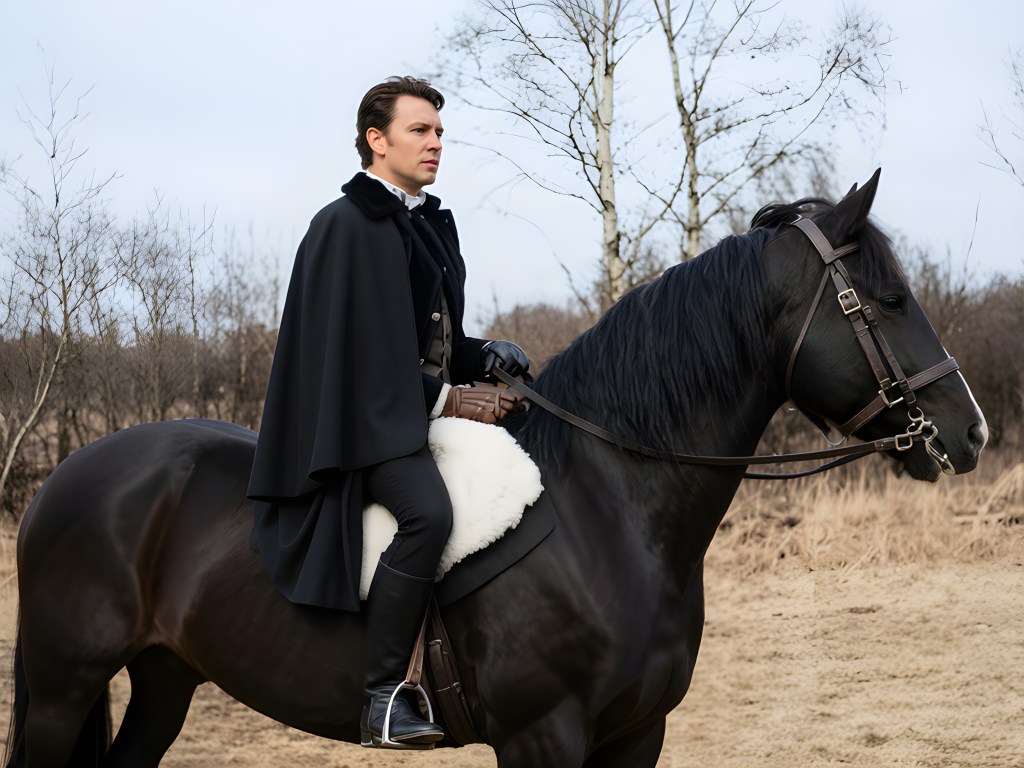
However, for many admirers of the serial, the greatest attraction was undoubtedly was Peter’s portrayal of Rupert of Hentzau. Appearing in all six episodes, Peter was perfectly suited to one of adventure fiction’s most charismatic villains.
Rupert is no ordinary antagonist; unlike many villains, he is not driven by ideology or outright malice. Instead, he is ambitious, manipulative, and opportunistic. Simultaneously, he possesses a charm and intelligence that make him as fascinating as the heroes he opposes. These qualities aligned perfectly with Peter’s strengths as an actor. Throughout his career, he excelled at portraying sophisticated, enigmatic, and morally ambiguous characters. His aristocratic bearing, distinctive voice, and remarkable screen presence made him uniquely qualified to bring Rupert to life.
It is easy to imagine Peter relishing the character’s wit and audacity. Rupert is a man who thrives on danger, treating life as a game played by his own rules. Such characters often dominate every scene, and Peter possessed the precise charisma required to ensure audiences found Rupert irresistible despite his villainy.
The supporting cast was equally impressive. John Phillips played the loyal Colonel Zapt, while Tristram Jellinek appeared as Fritz von Tarlenheim. Along with Sally Home and Derek Blomfield, they formed a strong ensemble that brought the world of Ruritania to life.
Broadcast between 19 April and 24 May 1964, the serial consisted of six episodes: The Queen’s Goodbye, Return to Zenda, Audience with the King, The Wheel of Chance, A Perilous Reunion, and The Decision of Fate.
These titles suggest a narrative rich in suspense and romance. Like many BBC serials of the era, the production was designed to unfold gradually, encouraging viewers to return weekly to discover the latest developments in the drama.
Unfortunately, modern audiences cannot judge the production directly, as all six episodes are listed as missing. Consequently, the serial survives only through documentation, cast records, programme schedules, and the memories of those who viewed it during its original transmission.
The loss is particularly regrettable given that the series brought together three performers at pivotal stages of their careers. Baker would later achieve international recognition through numerous film and television roles; Shelley became one of Britain’s most beloved screen actresses; and Peter would rise to immense popularity as Jason King, establishing himself as one of television’s most distinctive personalities.
From a historical perspective, Rupert of Hentzau represents a fascinating moment in British television. It belongs to an era when literary adaptations were a cornerstone of BBC drama and adventure serials attracted large family audiences. The production combined romance, political intrigue, and swashbuckling action in a manner that now feels nostalgic yet remains undeniably appealing.
Although the episodes themselves are lost, the reputation of Rupert of Hentzau endures. The prospect of seeing George Baker’s heroic Rassendyll, Barbara Shelley’s noble Flavia, and Peter’s dazzlingly villainous Rupert sharing the screen continues to capture the imagination. As a result, this forgotten 1964 serial remains one of the most intriguing lost treasures of British television history.
The Character of Rupert
Anthony Hope’s Rupert of Hentzau presents one of the most captivating villains in adventure fiction. Although the novel takes its title from him, Rupert is far more than a conventional antagonist. He is charming, witty, fearless, treacherous, and irresistibly charismatic. In many ways, Rupert overshadows the story’s heroes, becoming the character readers remember most vividly long after the final page.
Rupert is a young nobleman in the kingdom of Ruritania, first introduced in The Prisoner of Zenda and returning as a central figure in its sequel. Handsome and elegant, he possesses all the outward qualities of a romantic hero. However, beneath this attractive exterior lies a man governed almost entirely by self-interest. He serves no cause except his own advancement and amusement. Unlike many villains who are motivated by greed, revenge, or political ambition, Rupert appears to delight in danger for its own sake. Life is a game to him, and the greater the risk, the greater the pleasure.
One of Rupert’s most striking characteristics is his supreme confidence. He moves through the novel with an almost reckless assurance, escaping from seemingly impossible situations through a mixture of intelligence, courage, and audacity. Time and again he survives when other characters would inevitably perish. This unpredictability makes him both dangerous and fascinating. Neither his enemies nor the reader can ever be certain what he will do next.
Rupert is also notable for his complete lack of loyalty. Alliances mean little to him and promises even less. He readily betrays friends and accomplices whenever it suits his purposes. Yet there is a curious honesty about his dishonesty. Rupert rarely pretends to be virtuous. He openly acknowledges his selfishness and enjoys shocking those around him with his cynical outlook. This candour makes him oddly appealing. Readers may condemn his actions while admiring his refusal to cloak them in hypocrisy.
His relationship with the novel’s hero, Rudolf Rassendyll, is particularly compelling. The two men are opposites in terms of morality, yet they share qualities of bravery, intelligence, and resourcefulness. Rassendyll fights for honour and duty; Rupert acts purely for his own advantage. Their encounters provide some of the story’s most exciting moments because Rupert proves one of the few opponents capable of matching the hero’s skill and nerve.
Another important aspect of Rupert’s character is his sophistication. He is witty, urbane, and frequently amusing. Anthony Hope gives him some of the sharpest dialogue in the novel. Even during moments of extreme peril, Rupert maintains a lightness of touch and an air of nonchalant elegance. This combination of humour and villainy prevents him from becoming merely sinister. Instead, he emerges as a figure of almost theatrical brilliance.
Ultimately, Rupert of Hentzau endures as one of literature’s great adventurers and rogues. He embodies danger, freedom, and individualism carried to reckless extremes. While his actions are often immoral and destructive, his energy, intelligence, and irrepressible spirit make him impossible to ignore. In a novel filled with heroes, kings, and conspirators, Rupert remains the most vivid character of all: a dazzling scoundrel whose charm is every bit as formidable as his sword.
Breakdown of the episodes As they appeared in the Radio Times
‘The Queen’s Goodbye’ – Sun, Apr 19, 1964 Exiled from Ruritanta for treason, Rupert of Hentzau returns secretly, determined to discover what takes Fritz von Tarlenheim to Wintenberg.
‘Return to Zenda’ – Sun, Apr 26, 1964 Rudolf Rassendyll is again forced to imitate his cousin Rudolf V after Rupert of Hentzau fatally shoots the King in a remote hunting lodge.
‘Audience With The King’ – Sun, May 3, 1964 Rudolf Rassendyll sets a trap and Rupert of Hentzau receives an eagerly-awaited summons.
The Wheel of Change– Sun, May 10, 1964 Rudolf Rassendyll goes on a journey with surprising results, and the King receives an unexpected visitor.
‘A Perilous Reunion’ – Sun, May 17, 1964 Queen Flavia is reunited with her true love Rudolf Rassendyll but the circumstances are less than ideal.
‘The Decision of Fate’ – Sun, May 24, 1964 Rupert of Hentzau meets the play-actor face to face and the future of the kingdom is resolved.
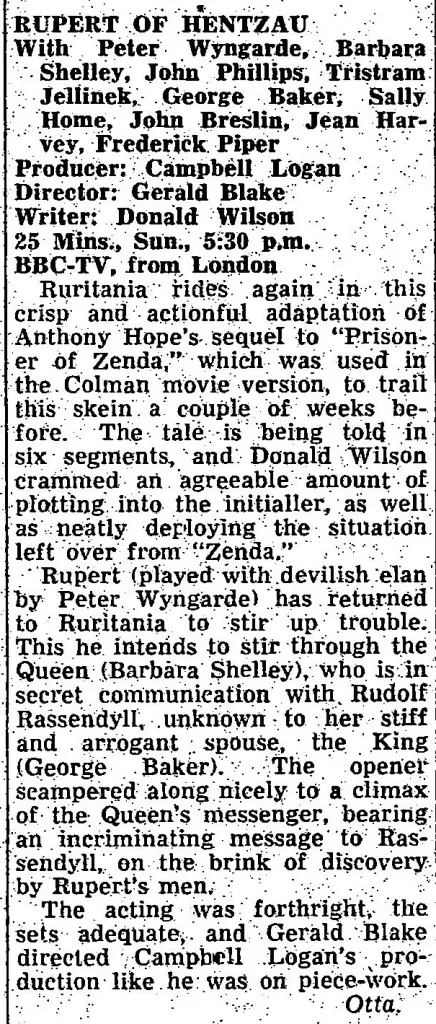
Left: The New Statesman – 29th April, 1964
A bit of Trivia
For the part of Rupert in the series, Peter was required to wear some tight riding breeches which the director, Gerald Blake, felt were a bit too revealing in the crotch area. In the absence of anything with which to disguise the offending bulge, Peter had stuffed cotton wool down the front of the breeches.
It was Sally Home who was played Helga von Tarlenheim in the series , and who had previously worked with Peter in ‘Duel of Angels‘ and ‘Night Conspirators‘, who first noticed the newly padded area when Peter walked on set at BBC TV Centre, exclaiming: “Oh, Peter, do take it out, it looked much better before!”
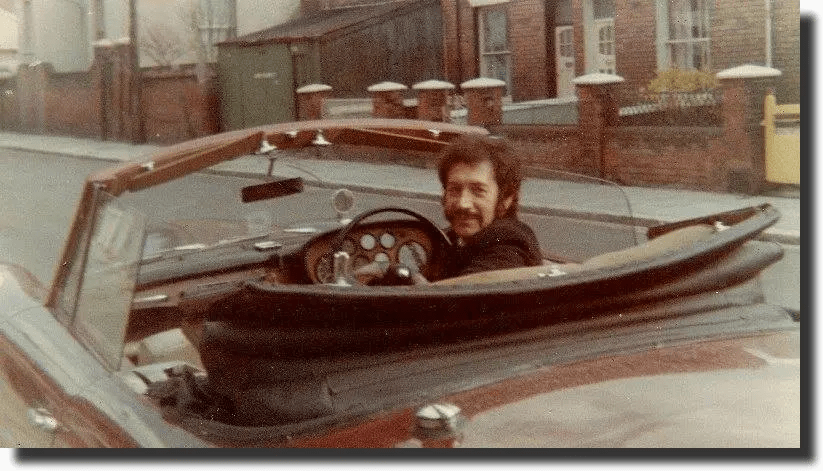
As a young boy, Peter’s passion was aeroplanes. According to his mother, Marcheritta, he was able to identify every plane – military or civilian – from any country in the world. As an adult, his passion transferred to cars; the faster, the better. Here are the cars that he owned during his lifetime (genuine photographs of the actual vehicles in all but one instance).
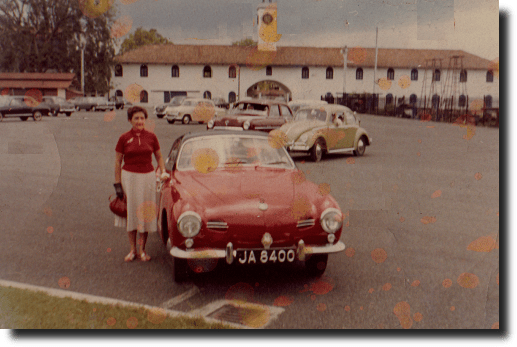
Above: Peter’s mother, Marcheritta, with her car – a Volkswagen Karmann Ghia. It was this vehicle that sparked his life-long love of cars.
Above: Marcheritta’s inscription on the back of the photograph to her son.
The cars listed below are in order of when Peter owned them, and not when they were made.
1951 JOWETT ‘JUPITER’
“While appearing in ‘Hamlet’ in London, my friend and fellow actor, Andrew Faulds, would often tootle around Hyde Park in the Jowett picking up birds.” Peter Wyngarde
0-60 in 16.5 seconds
Top Speed: 145mph
N.B. This isn’t the exact car that Peter owned.
1931 STUDEBAKER DICTATOR
Colour: Green
0-60 in 16.5 seconds
Top Speed: 145mph
Peter wrote the car off while speeding to Southampton to see his future wife, Dorinda Stevens!
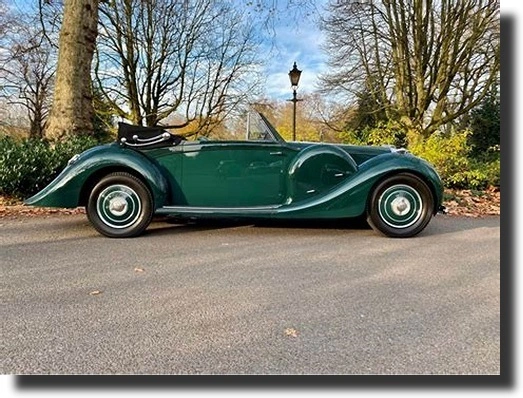
1939 LAGONDA DROPHEAD ‘RAPIDE‘
Colour: Green
0-60 in 8.9 seconds
Top Speed: 110mph
Peter purchased this car from the nephew of A.A. Milne – author of the Pooh Bear books.
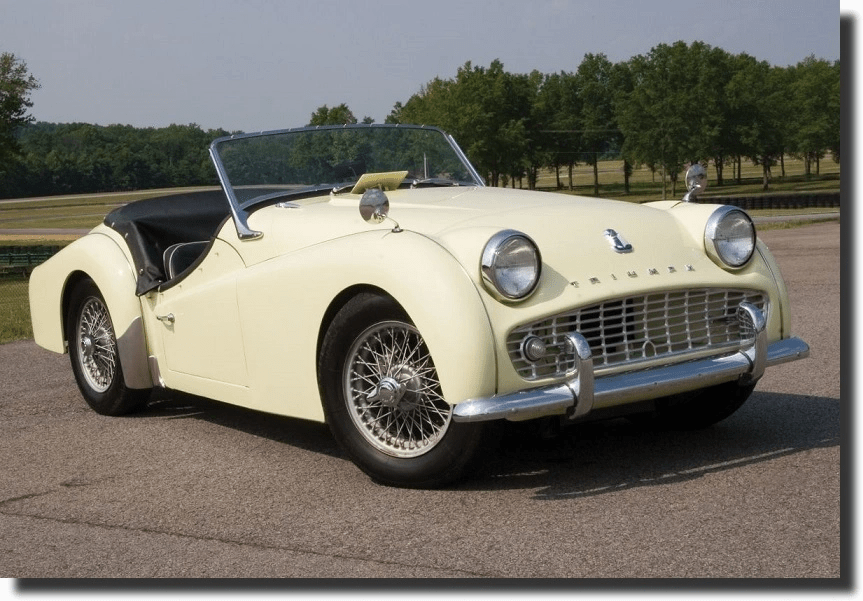
1953 TRIUMPH TR2
Colour: White
0-60 in 12 seconds
Top Speed: 107mph
Peter drove a white TR3A in the film, Night of the Eagle/Burn, Witch, Burn
Photo: Pictured outside Peter’s home in Earls Terrace, London.
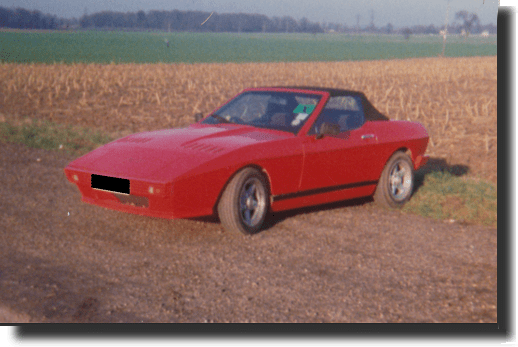
1984TVR TASMIN
Colour: Red
0-60 in 7.8
Top Speed: 110mph
Photo: Pictured at Bisley Shooting Range, Woking.
1984Porsche 911
Colour: White
0-60 in 3.9 seconds
Top Speed: 205
_________________________________
ARTICLE
In April 1972, Peter tested drove a Lotus Seven S4TC sports car for the (West) German entertainment magazine, Bravo.
A HOT THING FOR JASON KING
Anyone who wants this speedster needs strong nerves; the Lotus 7 is as airy as a Formula 1 racing car and narrow as a sardine can. At the wheel of the 18870 Mark two-seater from England, Peter Wyngarde felt like a jet pilot. Why? He tells here…
“This is the hottest car I’ve ever ridden in! Peter Wyngard,e alias Jason King, could hardly part with the 122 HP Lotus that he had driven across Munich for a day.
“At every traffic light I was surrounded by onlookers,” he laughs. “But not because they wanted autographs. The car interested them much more. This time, the Lotus was clearly the bigger star of the two of us.”
The most original two-seater in Europe comes – like almost all “tough men’s cars” – from England. The fact that the Lotus 7 looks like a racing car that has lost its way from the racing circuit into city traffic is thanks to its designer. It’s Colin Chapman, the boss of the famous Lotus Renselle.
“Externally, the speedster reminds me of a sports car from the thirties,” says Peter. “The resinous polyester body of the speedster is only 98 centimetres high and has neither doors nor bumpers.
“You have to squeeze into the cockpit in racing driver style”, explains the actor. “You have to be a skilled gymnast to do that. I had to put both feet on the seat, crouch down and push my legs under the steering wheel from that position. I can telly you, I ended up with a few bruises!”
Peter laughs: “It gets tense when you turn the ignition key and the dull roar of the engine sounds. When the accelerator pedal is pressed, the car turns into a jet fighter in a fraction of a second. It accelerates from zero to 100 km/h in seven seconds; an indescribable feeling – the thrust is so strong, that you are pressed back into the seat.
“From 80mph onwards, the breeze in the cockpit became a hurricane that tore the cigarette out of my mouth. I felt as if I was sitting on the deck of a ship with the wind at force eight. And a little later, on an uneven road, the tightly sprung racer turned into a raging bone cruncher. Every bump in the street had the effect of constantly kicking my seat from below. For a few seconds, I longed for my Bristol sports car, built in 1959, or for my Bentley Coupé back. But only until the next straight, because then the discs in my spine will recover from the worst impacts.
“The consumption of this disguised racing car is limited; around 13 litres per 100 kilometres is not too much for a 122 hp engine, with the help of which the Seven effortlessly shows it’s rear to more powerful sports cars…”
Translated by Tina Wyngarde-Hopkins
Click below for more about Peter and his love of cars…