My admiration for Peter Wyngarde began in the mid-1960s, following his appearance in the Avengers episode, “A Touch of Brimstone.” Since then, I have harboured a desire to own a personal artifact of his – even a smallest of mementos. For the past six months, I have diligently searched saleroom catalogues and online auctions; however, the few items I encountered were unfortunately beyond my budget.
During these searches, I noticed a trend that seems to contradict the persistent rumours regarding Mr. Wyngarde’s sexuality. A variety of adult materials – which I would characterise more as erotica rather than explicit pornography – have appeared in sales at some of the country’s most respected auction houses. Some of these items are explicitly listed as originating from his estate. Every piece listed, from magazines and playing cards to a sex shop standee, features exclusively feminine imagery. Notably absent is anything that could be described as homoerotic or that one might expect to interest a gay man. This discrepancy is curious.
When I contacted Tina Wyngarde-Hopkins regarding this matter, her response was brief: “Let the evidence speak for itself.” I subsequently asked if I might collate these findings into a short article, which is presented here.
Ms. Wyngarde-Hopkins has, at times, faced significant abuse from online know-it-all’s who believe they understood Peter better than she did. This is despite the fact that most of these individuals never met him, whereas she shared a thirty-year relationship with him.
“People like that no longer bother me,” she stated. “Let them believe what they wish; it will never change the facts. I know the truth, as do those who were close to Peter. The opinions of strangers are irrelevant. These items are in the public domain, so arenot a narrative I’ve invented.”
The following listings are taken from the online catalogues of two separate auction houses. To those who still clinging to long-standing myths, I suggest that the evidence speaks for itself: If it walks like a duck and quacks like a duck, it’s a duck!
*East Bristol Auctions, 1 Hanham Business Park, Memorial Road, Hanham, Bristol, BS153JE
The items I’ve found online
Auction House Description
A collection of assorted ephemera from Wyngarde’s estate – mostly of a pornographic nature, to include; several original Edwardian postcards of nude females, a set of pornographic playing cards, and a collection of photographs of an erotic nature showing orgies and other group activity (not shown), a copy of ‘ Miss ‘ magazine and other items. Non-pornographic items include a personal photograph of Wyngarde with an unknown lady, several black and white photographs of actresses and other items from his estate.
Auction House Description
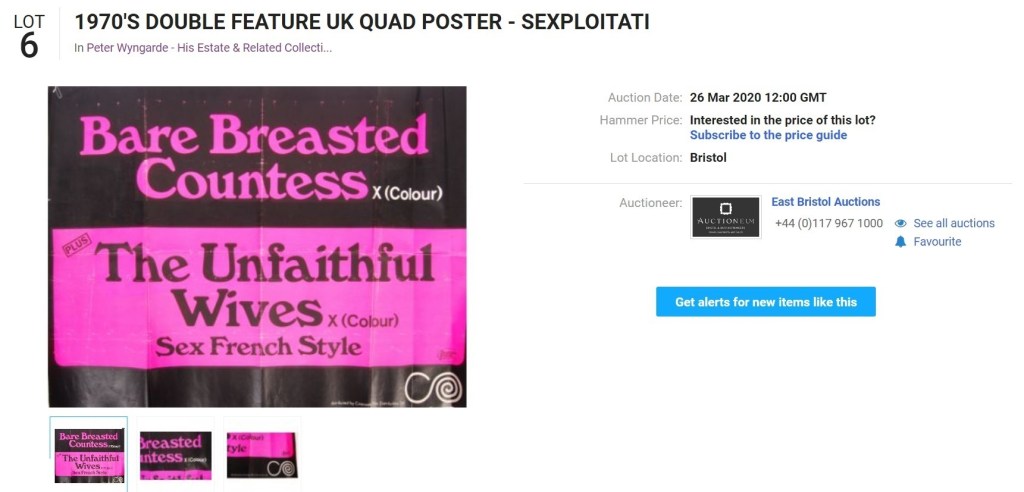
Video double-feature of The Bare Breasted Countess / The Unfaithful Wives (Cinecenta Film Distributors 1970’s) double-feature. ‘ X ‘ rated. and poster. Folded. Measures approx; 76cm x 102cm. From the private collection of Peter Wyngarde.
Auction House Description (above and below)
The Estate of Peter Wyngarde; an original vintage 1970’s (1975) Marlboro cigarettes advertising erotic calendar. Each page featuring a different topless photograph, with the month details to top. Retains original binder to top.
Auction House Description
An original 1970’s large cardboard sex shop display / advertising standee of a nude actress. The standee of cardboard construction, with wooden reinforcement to rear. Measures approx; 75cm tall. Rare.
NOTE:
Neither Tina Wyngarde-Hopkins or Thomas Bowington (Bowington Management), entered any Peter Wyngarde-related items into the aforementioned auctions, or had any connection to them whatsoever.
Among the various British television serials produced during the 1950s, Epilogue to Capricorn occupies a compelling place in broadcasting history. Broadcast by ATV on ITV in 1959, this six-part black-and-white production blended wartime intrigue, espionage, and political conspiracy, centering on the enduring consequences of a failed secret operation during the Second World War. While perhaps not categorised as one of the definitive classics of its era, the series remains a significant example of post-war British drama and serves as an important early credit for several actors who would later achieve distinguished careers.
The strength of the serial lies primarily in its premise. The narrative revolves around “Operation Capricorn,” a top-secret wartime mission whose catastrophic failure continues to cast a shadow years later. Foreign correspondent Robert Faulkner is commissioned by the War Office to investigate the operation and compile a dossier detailing the causes of the failure. As Faulkner’s inquiries progress, it becomes evident that the disaster was not merely the result of unfortunate circumstances, but may have been the product of deliberate betrayal – a truth buried beneath years of official secrecy, conflicting testimonies, and political sensitivities.
This central mystery provides a robust foundation for the drama, allowing the serial to explore themes of loyalty, patriotism, and the long-term impact of wartime decision-making. The notion that a single act of treachery could continue to destroy lives long after the cessation of hostilities gives the story an emotional resonance that transcends its genre elements. Like many post-war thrillers, Epilogue to Capricorn examines a world where victory did not bring closure and where secrets remained capable of causing profound damage.
The structure of the serial reflects the storytelling conventions of the late 1950s. Spanning six episodes, the narrative unfolds gradually, with each installment revealing a new piece of the puzzle. The episode titles—including All on Tape, Man Hunt, Point of No Return, Child’s Play, Time Factor, and Traitor’s Gate—suggest a progressive escalation of danger and revelation as the investigation nears its conclusion.
A particularly pivotal plot element involves a series of compromising recordings linked to Operation Capricorn. These tapes contain sensitive information capable of exposing those involved in the wartime operation. Once stolen, the recordings become a catalyst for the series’ primary conflicts, triggering a race to uncover the truth before further harm is inflicted.
As Robert Faulkner, Richard Johnson brings intelligence and credibility to the lead role. His character serves as the audience’s guide through a labyrinth of half-truths and hidden motives. Rather than portraying a conventional action hero, Faulkner relies upon persistence, investigation, and observation. Johnson’s restrained performance aligns well with the serial’s serious tone and helps anchor the increasingly complex plot.
The supporting cast is equally noteworthy. Jean Kent, already an established screen presence by 1959, contributes both glamour and authority, while Adrienne Corri*, Allan Cuthbertson, and George Murcell add depth to the intrigue. In retrospect, the cast list represents a catalogue of British acting talent either at the peak of their powers or on the threshold of major success.
For modern viewers, a chief point of interest is the appearance of Peter Wyngarde as Peter Vauxhall. Although his role was initially intended to be brief, contemporary reports suggest that audience reaction to his departure was so strong that he was brought back for an additional episode following complaints received by ATV and TV Times. This response underscores the impact Peter was already making on television audiences early in his career.
Peter’s natural screen presence distinguished him from many of his contemporaries. Even before his later fame as Jason King, he possessed a distinct ability to command the screen. His performance as Peter Vauxhall reportedly became one of the serial’s principal attractions, with some contemporary critics admitting that their interest in the series was largely sustained by Peter’s presence in the cast.
Epilogue to Capricorn is not without its flaws. The serial was written by John Roddick, who later achieved success with programs such as The Saint and Z Cars, yet contemporary and retrospective assessments have remained mixed. Notably, Peter himself later expressed a highly critical view of the scripts, describing them as some of the poorest he had encountered, despite praising the title. Such remarks suggest that even those directly involved recognised weaknesses in the writing.
Indeed, the material is occasionally more impressive in concept than in execution. While the themes of betrayal and espionage are compelling, the dialogue and plotting do not always fully realise their dramatic potential. Some contemporary critics found the pacing and cliff-hangers unconvincing, suggesting the story struggled to maintain tension across its six episodes.
Nevertheless, it would be unfair to dismiss the production entirely. Television drama in 1959 operated under significant technical and creative constraints compared to later decades. When judged within its historical context, Epilogue to Capricorn remains an ambitious and enjoyable thriller. Its focus on wartime secrets and government intrigue places it firmly within a tradition of British mystery drama that would flourish throughout the 1960s.
Perhaps the serial’s primary significance today lies in its preservation. Unlike many British productions of the 1950s, which were erased or lost, Epilogue to Capricorn survives intact. This makes it an important artifact of television history, offering modern viewers a rare opportunity to experience a complete British serial from that era.
Ultimately, Epilogue to Capricorn is a fascinating curiosity: an ambitious wartime mystery featuring an excellent cast and an intriguing premise. While the scripting may not always match the promise of its concept, the serial remains an engaging example of late-1950s British television. Though it may not be classified as a masterpiece of the medium, it provides a valuable glimpse into a formative period of broadcasting and demonstrates why performers such as Peter, Richard Johnson and Jean Kent continued to attract audiences for decades to come.
*Peter would appear with Adrienne Corri in the ITC series ‘Sword of Freedom’: ‘The Sicilian‘ (1958) and the Department S – ‘The Man Who Got A New Face’.
Critic’s Comments
“After such a weak cliffhanger last week, I must confess that if I watch further episodes – and at the moment I’m not inclined to – I will only watch because Peter Wyngarde is in it. For me, this actor is always a delight to watch, though I think they must have twisted his arm to make him say the dialogue.” Guy Taylor – The Stage: 5th November, 1959
Peter’s Comments
“Epilogue To Capricorn’ probably had the most excruciatingly bad script I’d ever had the misfortune to read. It probably had one of the best titles for any series in the world, but definitely the worst script.
So, the actors got together with the director, who was wild and crazy and was eager to do different things, and he said: “What do you want to do then?” I said, “Throw away the script; throw it in the bin and we’ll just ad-lib. We more or less know what the characters are and we could take it from there.” It became a top TV series of that time, because nobody knew what was happening.”
A bit of Trivia
~ While Peter was very fond of Adrienne Corri, he absolutely hated Jean Kent, who he described as a “Prize bitch”! There were numerous clashes between the two on set. The fact that the series went out live didn’t help the situation any, since Kent would try to ruin any scene Peter was in.
~ The series has often been listed with the alternative title, ‘Suspense’. This is incorrect. ‘Suspense’ was an anthology series also produced and directed by John Nelson Burton, which ran from 1959 to 1960, but ‘Epilogue To Capricorn’ had no connection to.
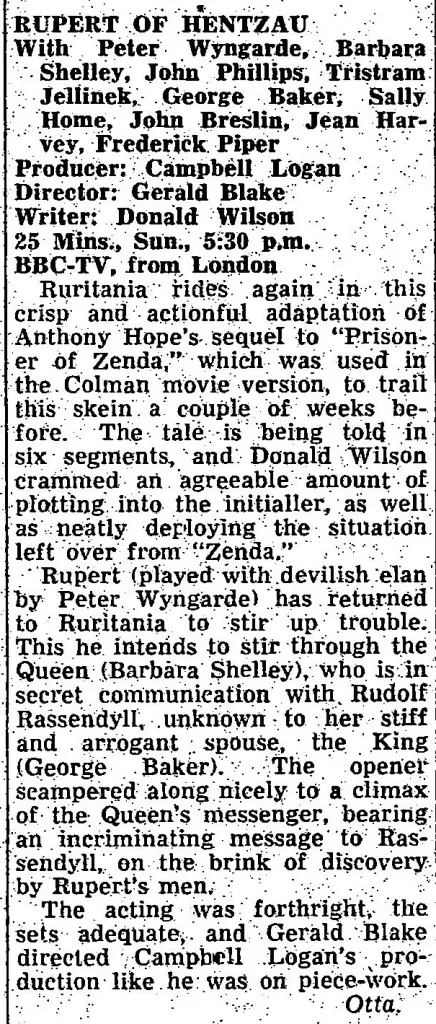
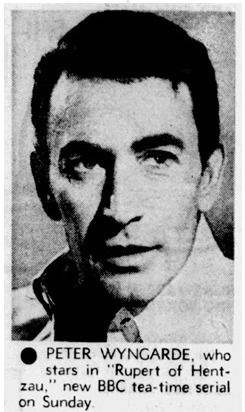
Among the many British television productions lost to history, few are as intriguing as the BBC’s 1964 serial Rupert of Hentzau. Adapted from Anthony Hope’s 1898 novel and broadcast in six half-hour episodes, the series served as a sequel to the celebrated Ruritanian adventure The Prisoner of Zenda. The production featured an impressive cast led by George Baker, Barbara Shelley, and Peter Wyngarde, with adaptation by Donald Wilson and direction by Gerald Blake. Unfortunately, all six episodes are believed to be lost, making the serial a notable casualty of the BBC’s archival policies of that era.
Despite its absence, Rupert of Hentzau retains a particular fascination. The combination of its source material, cast, and genre places it firmly within the tradition of romantic adventure stories that enjoyed immense popularity during the mid-twentieth century.
The serial was based upon Hope’s acclaimed sequel to The Prisoner of Zenda. Set three years after the original story, the plot finds Queen Flavia torn between duty and love. Although she has fulfilled her obligations by marrying King Rudolf of Ruritania, her feelings for the English gentleman Rudolf Rassendyll persist. When she writes to him, the letter is intercepted by Rupert of Hentzau, a disgraced aristocrat who seeks to restore his fortunes by exploiting the situation. This precipitates a tale of intrigue, assassination, and sacrifice, drawing Rassendyll back into the volatile politics of Ruritania.
The story possesses all the hallmarks that made Ruritanian romances so enduringly popular: clandestine plots, swordplay, mistaken identities, and noble acts of self-sacrifice. At its core lies the conflict between personal happiness and public obligation, a theme that provides the adventure with surprising emotional depth.
Central to the production was George Baker in the role of Rudolf Rassendyll. By 1964, Baker had established himself as one of Britain’s most reliable leading men. Possessing a natural sense of authority and a commanding presence, he was ideally suited to the role of the English hero who repeatedly risks everything for a foreign kingdom. Rassendyll is a compelling character because he does not seek adventure for its own sake; rather, he is compelled by honor and loyalty, even when doing so threatens his own happiness.
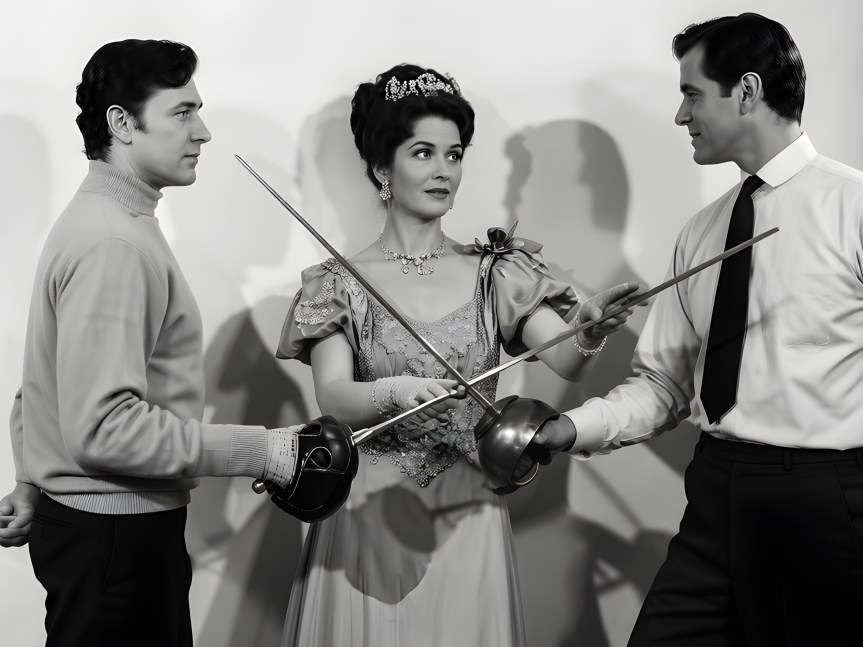
Left:Above left: Peter, Barbara Shelly and George Baker during rehearsals.
Central to the production was George Baker in the role of Rudolf Rassendyll. By 1964, Baker had established himself as one of Britain’s most reliable leading men. Possessing a natural sense of authority and a commanding presence, he was ideally suited to the role of the English hero who repeatedly risks everything for a foreign kingdom. Rassendyll is a compelling character because he does not seek adventure for its own sake; rather, he is compelled by honor and loyalty, even when doing so threatens his own happiness.
Baker’s casting appears particularly inspired, as he brought a necessary balance of strength and vulnerability to the role. Rassendyll must be capable of heroic action while simultaneously carrying the emotional burden of his impossible relationship with Flavia. It is easy to imagine Baker balancing these aspects of the character with considerable skill.
Equally significant was the casting of Barbara Shelley as Queen Flavia. While Shelley is often remembered today for her work in classic British horror, she was a versatile actress capable of conveying dignity, intelligence, and emotional complexity. As Flavia, she would have been required to embody the tragedy at the heart of the narrative.
Flavia is neither a helpless heroine nor a mere romantic interest; she is a queen whose personal desires have been sacrificed for political stability. Her dilemma provides the narrative with much of its emotional weight. Bound by her responsibilities to her country despite her love for Rassendyll, she is, in many ways, the most tragic figure in the saga. Shelley’s natural elegance made her an excellent choice, providing the grace and seriousness required to make Flavia convincing as both a monarch and a woman caught between duty and desire.
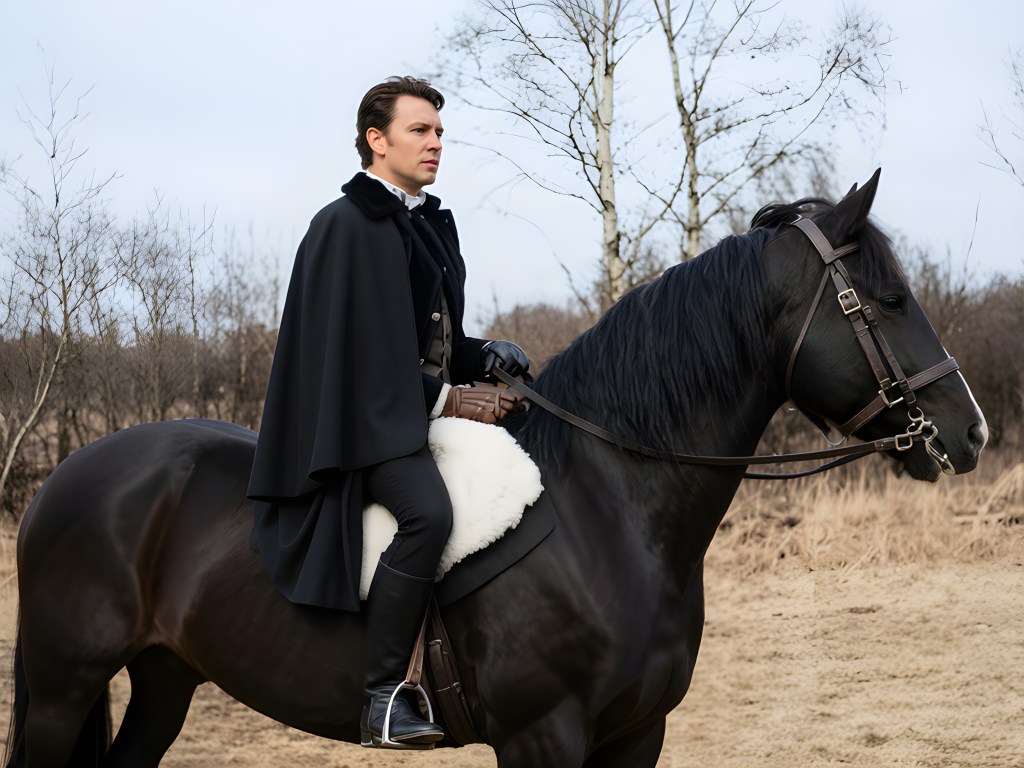
However, for many admirers of the serial, the greatest attraction was undoubtedly was Peter’s portrayal of Rupert of Hentzau. Appearing in all six episodes, Peter was perfectly suited to one of adventure fiction’s most charismatic villains.
Rupert is no ordinary antagonist; unlike many villains, he is not driven by ideology or outright malice. Instead, he is ambitious, manipulative, and opportunistic. Simultaneously, he possesses a charm and intelligence that make him as fascinating as the heroes he opposes. These qualities aligned perfectly with Peter’s strengths as an actor. Throughout his career, he excelled at portraying sophisticated, enigmatic, and morally ambiguous characters. His aristocratic bearing, distinctive voice, and remarkable screen presence made him uniquely qualified to bring Rupert to life.
It is easy to imagine Peter relishing the character’s wit and audacity. Rupert is a man who thrives on danger, treating life as a game played by his own rules. Such characters often dominate every scene, and Peter possessed the precise charisma required to ensure audiences found Rupert irresistible despite his villainy.
The supporting cast was equally impressive. John Phillips played the loyal Colonel Zapt, while Tristram Jellinek appeared as Fritz von Tarlenheim. Along with Sally Home and Derek Blomfield, they formed a strong ensemble that brought the world of Ruritania to life.
Broadcast between 19 April and 24 May 1964, the serial consisted of six episodes: The Queen’s Goodbye, Return to Zenda, Audience with the King, The Wheel of Chance, A Perilous Reunion, and The Decision of Fate.
These titles suggest a narrative rich in suspense and romance. Like many BBC serials of the era, the production was designed to unfold gradually, encouraging viewers to return weekly to discover the latest developments in the drama.
Unfortunately, modern audiences cannot judge the production directly, as all six episodes are listed as missing. Consequently, the serial survives only through documentation, cast records, programme schedules, and the memories of those who viewed it during its original transmission.
The loss is particularly regrettable given that the series brought together three performers at pivotal stages of their careers. Baker would later achieve international recognition through numerous film and television roles; Shelley became one of Britain’s most beloved screen actresses; and Peter would rise to immense popularity as Jason King, establishing himself as one of television’s most distinctive personalities.
From a historical perspective, Rupert of Hentzau represents a fascinating moment in British television. It belongs to an era when literary adaptations were a cornerstone of BBC drama and adventure serials attracted large family audiences. The production combined romance, political intrigue, and swashbuckling action in a manner that now feels nostalgic yet remains undeniably appealing.
Although the episodes themselves are lost, the reputation of Rupert of Hentzau endures. The prospect of seeing George Baker’s heroic Rassendyll, Barbara Shelley’s noble Flavia, and Peter’s dazzlingly villainous Rupert sharing the screen continues to capture the imagination. As a result, this forgotten 1964 serial remains one of the most intriguing lost treasures of British television history.
The Character of Rupert
The character of Count Rupert of Hentzau is an allegory for the corrupting influence of power. Rupert is a charismatic and charming man who uses his power to manipulate and control others. He is a symbol of the dangers of unchecked ambition and the corrupting influence of power. Rupert’s character is marked by his sly ambition, leaving a trail of deception and intrigue in his wake.
Breakdown of the episodes As they appeared in the Radio Times
‘The Queen’s Goodbye’ – Sun, Apr 19, 1964 Exiled from Ruritanta for treason, Rupert of Hentzau returns secretly, determined to discover what takes Fritz von Tarlenheim to Wintenberg.
‘Return to Zenda’ – Sun, Apr 26, 1964 Rudolf Rassendyll is again forced to imitate his cousin Rudolf V after Rupert of Hentzau fatally shoots the King in a remote hunting lodge.
‘Audience With The King’ – Sun, May 3, 1964 Rudolf Rassendyll sets a trap and Rupert of Hentzau receives an eagerly-awaited summons.
The Wheel of Change– Sun, May 10, 1964 Rudolf Rassendyll goes on a journey with surprising results, and the King receives an unexpected visitor.
‘A Perilous Reunion’ – Sun, May 17, 1964 Queen Flavia is reunited with her true love Rudolf Rassendyll but the circumstances are less than ideal.
‘The Decision of Fate’ – Sun, May 24, 1964 Rupert of Hentzau meets the play-actor face to face and the future of the kingdom is resolved.
Left: The New Statesman – 29th April, 1964
A bit of Trivia
For the part of Rupert in the series, Peter was required to wear some tight riding breeches which the director, Gerald Blake, felt were a bit too revealing in the crotch area. In the absence of anything with which to disguise the offending bulge, Peter had stuffed cotton wool down the front of the breeches.
It was Sally Home who was played Helga von Tarlenheim in the series , and who had previously worked with Peter in ‘Duel of Angels‘ and ‘Night Conspirators‘, who first noticed the newly padded area when Peter walked on set at BBC TV Centre, exclaiming: “Oh, Peter, do take it out, it looked much better before!”