

The transformation of a real-life person into a caricature

Written by Tina Wyngarde-Hopkins
An Introduction
Peter’s story is well documented, not least in my book ‘Peter Wyngarde: A Life Amongst Strangers‘.
He once said in an interview, long before interviews became minefields, that acting was “like a religion and the actor is the priest“. It wasn’t fame he wanted; it was expression. It was the chance to step into someone else’s skin and understand the world from a different angle. That hunger carried him through his early days in reparatory theatre; through the years of bit parts and auditions, through the rejections that every actor collects like bruises.
His breakthrough on television came in the BBC production of ‘Rope, broadcast on 5th January 1950. The performance was raw, slightly unpolished, and devastatingly human. Critics praised him.” Casting directors called his agent. Audiences wrote letters. Awards followed as the decade progressed. Suddenly, Peter Wyngarde was not just a promising actor—he was the actor everyone wanted.
The 1950’s and 60’s were a decades during which Peter’s career was a string of successes that seemed almost effortless. He moved between television, radio, the theatre and film with a fluidity that few actors manage. He played soldiers, villains, ghosts and romantic leads. He had a way of making every role feel lived‑in, as though he had carried the character around with him for years before stepping onto a stage or set. Directors trusted him. Co‑stars admired him. Audiences loved him.
But fame is rarely satisfied with admiration alone. It demands access. It demands intimacy. It demands pieces of a person that were never offered.
Peter’s reluctance to participate in the celebrity ecosystem— few interviews, no public relationships—only intensified the hunger around him. The tabloids began to fill the silence with invention. His determination to protect the privacy of his ex-wife was viewed with suspicion. A harmless disagreement with a director became rumours that he was a difficult character. His sharing a flat with a fellow actor became proof of a secret homosexual romance.
Every well-known personality has a moment when the tide shifts, when the whispers become shouts, when the narrative slips out of a person’s hands. For Peter, that moment came in September 1975 when he was arrested at Gloucester Bus Station and charged with Gross Indecency. The tabloid press, of course had a field day and from that moment on everyone felt they had permission to say whatever they pleased about him, regardless of how outlandish or untrue. Until then he’d been viewed as ‘Ladies Man’. Women around the world has swooned over the Jason King character had created. He was regularly voted the Sexiest Man Alive and 35,000 Australian woman had recently voted him ‘The Man We Would Most Like To Lose Our Virginity To.’
Ever since then, whenever the name Peter Wyngarde was mentioned by the press you could guarantee the Gloucester story would be brought out for another airing, with an extra pinch of spice added; for instance, something Peter allegedly said to the police officers at the time of arrest, despite the fact that none of these utterings were ever logged by Gloucester Constabulary and the journalist peddling the line not being there at the time to hear it with his own ears.
Producers panicked. Sponsors withdrew. Journalists camped outside his home. Anything anyone might have said in his defence was drowned out by the noise. Personal appearances were cancelled, and he was spat on in the street by people who only days earlier had idolised him. His reputation, once sterling, was now tarnished by a narrative he had no part in creating. Within days, Peter was being accused all manner of things. The truth had already been lost in the media mele as hysterical Fleet Street hacks jostled for their pound of flesh. The myth had already taken root.
And then came the second blow: a fabricated tale in the now defunct scandal rag, The News of the World, which had been sold to them by a former disgruntled employee and convicted fraudster. This was published just weeks before the trial at Gloucester Magistrates Court on Friday 17th October, 1975. Peter’s refusal to comment was interpreted as guilt. His silence became a canvas onto which strangers painted their assumptions.
The pressure mounted. Friends were few. The phone stopped ringing. He more or less withdrew from public life for a time. He stopped attending industry events. He turned down roles. He spent long stretches of time alone, trying to understand how a career built on authenticity might’ve been undone by fabrication.
At first, he tried to ignore what was being said about him in the press. He told those friends who’d remained loyal that these stories didn’t matter, that people would forget them, that the work would speak louder. But the world was changing. He never bargained for an invention called the internet—a machine that would never sleep, never pause, never question whether what it consumed was fact. Gossip sites multiplied. Anonymous accounts spread rumours faster than they could be disproven. And Peter Wyngarde—private, introverted, earnest—became a target precisely because he refused to play the game.
It is easy to talk about fame in abstract terms—public image, reputation, perception—but the reality is painfully concrete. Peter Wyngarde was a man whose life was dismantled piece by piece by people who had never met him. The tabloids saw him as a commodity while spiteful online gossip viewed him as entertainment. But his friends saw the toll it took: the sleepless nights, the anxiety, the shrinking of a once‑expansive spirit.
There is a particular cruelty in watching your own life become a story you don’t recognise. Peter once described it years later, as “being trapped behind glass while everyone argues about who you are.” He felt erased, replaced by a caricature created by strangers.
And yet, even in the darkest period, he never lost his love for acting. What he lost was the belief that the world would allow him to continue. But continue he did. He didn’t disappear as many of those ‘friends’ and associates did when he most needed their support. He rebuilt. Slowly, quietly, deliberately. He returned to the theatre first, where audiences still appreciated his talent, He took roles that challenged him; roles that reminded him why he had chosen this path in the first place. Critics noticed and bestowed on him some of the most glowing plaudits of his career. It reignited conversations about his talent. The word spread. The industry began to remember the actor behind the salacious headlines, yet all the narrowminded, scandal-hungry tabloids remembered was ‘The Scandal’.
This article is not a tragedy, though it contains tragic moments. It is not a cautionary tale, though it warns of the dangers of a culture that feeds on rumour, lies and myths. It is, above all, a story of reclamation.
Peter’s story is not unique. It’s happening to actors, musicians, sportsmen—anyone whose life is visible enough to be distorted. But Peter’s journey is particularly compelling because he never sought fame, never courted controversy, never invited the scrutiny that consumed him. He was, in many ways, an accidental celebrity. He was just a man who loved to act.
I wrote this article because the truth matters. Because the human being behind the headlines deserves to be seen clearly. Because the cost of gossip is too often invisible until it’s too late. And because Peter Wyngarde’s resilience is a reminder that a person’s worth is not determined by misguided public opinion.
To understand Peter’s story, we must also understand the world that shaped it. The tabloids did not act alone. They were fuelled by a culture that craves scandal, that rewards speculation, that treats celebrities as characters rather than people. Online gossip thrives because it offers the illusion of intimacy—access to someone’s life without their permission. But behind every rumour is a real person. Behind every headline is a life that can be damaged, derailed, or destroyed.
Peter’s life was not impacted by a single lie, but by thousands of small ones. A whisper here, a tweet there, a headline crafted for clicks. Individually, they seemed harmless. Collectively, they became a storm. My article is not an indictment of the media, though it critiques it. It is not an attack on the public, though it challenges the way we consume stories. It is a portrait of a man who was caught in the crossfire of a culture that often forgets its own power.
This piece is an attempt to honour Peter’s talent, to reclaim the narrative, to separate the man from the myth, and to show the world the truth that’s been buried beneath decades of unrelenting din.
Ultimately, Peter’s journey is a story of survival—not just of a career, but of identity. He survived the tabloids. He survived the gossip. He survived the erosion of his reputation by foul-mouthed troll. And he emerged not unscathed, but stronger, wiser, and more determined to live on his own terms. His story is not about perfection. It is about perseverance. It is about the courage to continue when the world misunderstands you. It is about the quiet strength required to rebuild a life that others have attempted to tear apart. It’s about the power of truth in a world that often prefers fiction.
As you move down the page, you will see the man, not the myth and, perhaps, by the end, you will understand why Peter’s story matters—not just for him and those that love and still grieve for him, but to all of us who live in a world where a rumour can become a truth simply because enough people repeat it.
This is not just the story of an actor. It is the story of a culture. It is the story of reclaiming a man’s life. It is the story of what happens when the world forgets that fame does not erase humanity.
Welcome to his truth..
The Tabloid Press And The Dark Art Of Scandal
The tabloid press has perpetually depended upon a singular, compelling catalyst: SCANDLE. Its trajectory represents the transformation of curiosity into commercial enterprise, the conversion of gossip into journalistic content, and the appropriation of individuals’ private affairs—particularly those of prominent figures—as public domain. Their preoccupation with scandal constitutes not an incidental consequence of journalistic practice but rather the fundamental mechanism driving their operations, a characteristic that has profoundly influenced contemporary media landscape.
Tabloid journalism is characterised by sensationalism; the methodology of presenting exaggerated or unsubstantiated narratives specifically engineered to stimulate prurient curiosity. This methodology frequently obscures the distinction between factual reporting and fictional narrative, emphasising emotional resonance at the expense of factual precision.
The tabloid format itself became inextricably linked with scandal, although the skirts of some of the ‘broadsheets’ have not wholly remained unsullied. The relentless pursuit of sensational stories has frequently directed tabloid journalism toward ethically problematic practices, such as “Checkbook Journalism”, which has encouraged paid sources to exaggerate and fabricate so that the purchaser gets exactly what they want to hear.
These methodologies reveal a core truth: tabloids operate not merely as recorders of controversy but as deliberate architects of it. By acquiring restricted information, cultivating networks of informants, and periodically breaching legal boundaries, tabloids ensure a continuous supply of exaggerated content.The sensationalist media’s voracious appetite for scandal is fundamentally rooted in inherent human psychological mechanisms. Scandal furnishes a malicious satisfaction derived from witnessing the decline of prominent or celebrated individuals (‘Build them up—knock them down’) which might momentarily relieve the reader from the monotony of their ordinary, humdrum existence.
The following represents a small selection of some of the more absurd and extraordinary claims directed at Peter by the press over an extended period. These unsubstantiated assertions have progressively infiltrated public awareness through various digital platforms, including encyclopedic references such as Wikipedia, as well as through blogs, fake news sources and discussion forums dedicated to gossip. The journalists in question failed to furnish any substantive evidence in support of these allegations, yet readers were nonetheless expected to accept the claims at face value. Regrettably, a considerable number did, and not only that, they disseminated these statements across digital platforms, incorporating their own distinctive interpretations to spice up the narrative.
It should be noted that I wrote to all the journalists named below for the purposes of this article to request a comment on the claims made in their respective articles responsible, but not a single one of them had the good grace (or moral fortitude?) to respond.
| Is that really Jason King, the suavest man on TV? Written by James Tapper.The Daily Mail. 21 March 2010 Wyngarde’s camp style was later adopted by the comic Mike Myers as the basis for his own spoof-sleuth creation, Austin Powers. But Wyngarde’s career ran off the rails in October 1975. when he was fined £75 for gross indecency, under his real name Cyril Louis Goldbert. |
| Jason King still reigns, just less of a woman’s man Written by Marco Giannangeli . The Daily Express. 28 March, 2015 Actor Peter Wyngarde, who played the suave author-cum-spy in Department S and Jason King between 1969 and 1972, was once mobbed by 30,000 hysterical Australian women at Sydney airport, although his career stalled in 1975 when he was fined for gross indecency in a bus station toilet. |
| Before Austin Powers there was ‘Jason King’ – and the fabulous Peter Wyngarde who has died aged 90 Witten by Sean O’Grady.The Independent – 18 January 2018. It was only much, much later that I read, I think in Private Eye, the reason for Wyngarde’s switch from ubiquity to obscurity. It was an incident that took place in the rather unglamorous and unerotic surroundings of the gents’ loos at Gloucester Bus Station. Wyngarde was caught, very possibly by some sort of a police entrapment, engaged in what was described as an act of gross indecency with a man. Wyngarde maintained his innocence and proffered the explanation, for why he had been discovered prone in a cubicle, that he had slipped backwards on a piece of soap carelessly left on the floor. He was given a token fine, but this television career, at any rate, was simply over. |
| Peter Wyngarde, flamboyant actor known for Jason King and Flash Gordon Written by Brian Pedreigh. Published in The Herald, 18th January, 2018 As Jason King, Wyngarde became a style icon, with his droopy moustache, hair that looked like a bearskin hat and a wardrobe of wide-lapelled, hree-piece suits, cravats and open-necked shirts in colours so bright they might hurt sensitive eyes. Wyngarde was a sex symbol, mobbed by women and idolised by the gay community. Although Wyngarde was married for a while, there were persistent rumours of gay relationships, including one with Alan Bates. It has been suggested he had a showbusiness nickname of Petunia Winegum, though his appreciation society argued that the name was created for a Two Ronnies sketch. In 1975 he was convicted of “gross indecency] with a lorry driver in a public toilet and was fined £75. His mother was French and married a Russian called Henry Goldbert. JG Ballard, author of Empire of the Sun, said he remembered “the future Peter Wyngarde” in Shanghai as a boy called Cyril Goldbert. |
| Peter Wyngarde, star who played 1960s TV sleuth Jason King, dies Written by Daniel Sugerman. The Jewish Chronical. 18th January 2018 Evidence suggests that Mr Wyngarde’s original name was Cyril Goldbert. Having apparently spent most of his childhood in the Far East, he arrived in the UK in the 1940s, where his next of kin and UK contact was listed as Mr H Goldbert. Henry Goldbert was Russian-Jew. who had become a naturalised British citizen while living in Singapore. According to some opinions, Henry Goldbert was Peter Wyngarde’s father. |
| An International Man of Mystery Written by Andrew Stuttaford. The National Review. 17th February, 2018. By then, sex had done rather more than that: In 1975, Wyngarde was found guilty of committing an act of “gross indecency” with a truck driver in a provincial British bus station This followed an official warning for something similar the previous year. Wyngarde blamed a “mental aberration” (the first incident had been a “misunderstanding”)[. He received a token fine, but the spell was broken. His career never recovered. Prejudice played its part, but the scandal had shattered an image inextricably connected to that of King’s globe-trotting Casanova. Making matters worse, within a year or so, the bleakness of late-1970s Britain, and the fashions that came with it, had reduced King to an embarrassing memory too recent for nostalgia to rescue. Wyngarde’s mannered style of acting only reinforced the impression that time had passed him by. A battle with alcohol and a reputation for being “difficult” won’t have helped either. His best-known role after his fall was in Flash Gordon, where he played the sinister General Klytus face hidden behind a golden mask. |
| Peter Wyngarde obituary – 1927 – 2018: Flamboyant TV star who inspired Austin Powers Written by Jane Warren. The Telegraph. 19th January, 2018 In 1975 Wyngarde was fined £75 under his real name Cyril Louis Goldbert for “gross indecency” with a lorry driver in the toilets of Gloucester bus station. This followed a caution for similar activities in Birmingham. Although he appeared on stage in South Africa and Austria after the bus-station episode his TV career came to a standstill and he took consolation in drink. |
| Gordon’s Alive: Flash Gordon at 40 Written by Pete Voder Haar.The Houston Press..23rd September, 2020 Wyngarde himself was a fascinating individual (he passed in 2018), with a childhood shrouded in mystery (of his own making) and a deeply weird personal life. A star on British TV in the 1970s. |
| Written by Etan Smallman and Adam Jacot De Boinod. The Daily Mail. 23rd August, 2021 Peter Wyngarde (1927 – 2018). The British actor made his name as sleuth Jason King in the series Department S. The character’s use of the phrase, “groovy, baby” inspired the Austin Powers films. Wyngarde, who had an affair with actor Alan Bates. |
| Peter Wyngarde’s wayward life exposes the true cost of being a ‘cult actor’ Written by Simon Heffer. The Telegraph. 18th May, 2025 His prosecution for an indecent act at a bus station in 1975 helped derail a once brilliant career, though Wyngarde still found work from time to time until the 1990s. His series are often shown on repeat channels, and if you want a taste of cult, they are unmissable. |
| The Daily Star (Date of publication and author unknown) Later on, director Matthew Vaughn wanted Wyngarde for roles in two of his films – 2005’s Layer Cake[1] and 2011’s X-men: First Class – but was wrongly told both times the actor had died. While Wyngarde dated a string of women and called Vivien Leigh the love of his life, it was assumed in the acting community he was gay. He was arrested twice for gross indecency in a public toilet, one incident involving a lorry driver.A reformed alcoholic, he was declared bankrupt in the 80s and lived partly on benefits. |
The Truth
As can be seen, the main topics that these writers are fixated with are:
- The Gloucester Bus Station Incident and the subsequent ‘quotes’
- The alleged incident in Birmingham in 1974
- Peter’s alleged “derailed” career
- The ‘nickname’, Petunia Winegum
- The alleged homosexual relationship with Alan Bates
So, lets examine those points:
ARREST/CAUTION IN KENNEDY GARDENS IN 1974
On 28th September 2010, a contributor the the Peter Wyngarde ‘Biography’ on Wikipedia stated that Peter had been cautioned for importuning in Kennedy Gardens, Birmingham, in 1974. This person named his source as Stephen Richards 2003 book, ‘Crime Through Time’ (Mirage Publishing). However, no such mention of this episode is made in the book.
It was also claimed that Peter gave an interview following this alleged incident to the Birmingham-based Sunday Mercury, but there is no record of any such interview ever taking place.
The Wikipedia entry was subsequently removed by another user around June 2016. However, by that point vultures at The Mirror had noted it and repeated it in a supposed obituary* following Peter’s passing in January 2018 (you can see the full article here).Given that contributors to the Wikipedia Peter Wyngarde ‘Biography’ consider the tabloid press to be an indisputable source, they reuploaded the story immediately after the publication of the Mirror article on 18th January 2018.
When I was researching my book, I contacted West Midlands Police (Birmingham City police when this incident was said to have occurred) to get clarification. I was told that they had no record of any such event taking place. This has not stopped online gossips from attributing statements supposedly made by Peter to the police officer(s) who were said to have issued the “Caution” – “It was a mental aberration” being the most popular.
Over the years, internet trolls have claimed that Peter had been arrested in places including Newcastle (“He used to hang around outside the gents opposite the city centre police station”), Southampton (same scenario), Portsmouth, Liverpool, Nottingham, Dover and even Hyde Park Corner! I did once comment to one of these illiterate knuckle-draggers that it might be more simple to just to name the places where they believe he wasn’t arrested. Certainly, the list would be much shorter!
THIS INCIDENT DID NOT HAPPEN!
*Newspaper obituaries are often pre-written long before the subject’s death.
THE ARREST IN GLOUCESTER IN 1975
Peter was arrested at Gloucester Bus Station in 1975. FACT!
When researching ‘Peter Wyngarde: A Life Amongst Strangers’, I managed to obtain both a copy of Peter’s ‘statement’ and the court transcripts.
Despite Sean O’Grady’s claims in his article in The Independent (see above) there was absolutely no mention whatsoever in any of the aforementioned documents of Peter professing to have slipped on a piece of soap that had been, “carelessly” or otherwise left on the floor. In fact, the arresting officer states in his statement that he had looked under the doors of two adjoining cubicles and observed “a pair of feet in both”. At no time did he state that he’d discovered one of the cubical occupants “prone” on the floor! Given that this particular assertion is unique to Mr. O’Grady’s article, it can on be concluded that he made this up in order to spice up the story.
Following the arrest, Peter was taken to Gloucester Police Station where a statement was prepared by the arresting officer. He refused to sign it as he felt it did not represent what had actually taken place.
He was given the opportunity to accept the charges there and then. This would have resulted in a fine and a criminal record. While the incident might well have passed unnoticed by the gutter press, Peter declined because he wished to look his accusers in the eye across a court of law and be afforded the opportunity to give his version of events.
It was categorically stated in court by Peter’s solicitor, Laurence Keen, under oath that his client was NOT “homosexual”.
Photographs taken by Mr. Keen of the facilities where the arrest took place were presented to the court. They showed that all the doors were hanging off; cubical walls were in a state of collapse and with large holes in them, and none of the doors had locks on them. Mr. Keen asked: “How could any police officer say with 100% certainty what may or may not have to taken place here involving ANY member of the public, when the building is in such a shameful state of disrepair?” It was agreed by the Bench that the facilities were in an appalling state and should have been closed long since. Nevertheless, Peter was pronounced guilty. He DID NOT plead guilty has has been claimed by the press and online bloggers.
In a statement to the press immediately afterwards, Mr. Keen said that Gloucester Constabulary had been “looking for a scapegoat to justify the inordinate amount of public money that had been sunk into policing this “poachers trap”. Peter was that scapegoat.
The conviction was latterly quashed by the Home Office as being “unproven”. This is a matter of public record.
Over the years numerous claims have been made and quotes attributed to Peter by people who were not there when this event took place. It has been asserted online that Peter had supposedly said to the other party arrested that day, “Are you handy?” Apart from the arresting officers and the parties who were arrested, there was no one else in the facility. Since no such utterance was mentioned in the police report, there is absolutely no evidence whatsoever that this was ever said.
PETER’S ALLEGED HOMOSEXUAL DECADE-LONG RELATIONSHIP WITH ALAN BATES
According to author Donald Spoto’s 2007 biography, ‘Otherwise Engaged – The Life of Alan Bates’ (Hutchinson – 2007), Peter and Bates moved into a flat at No.1, Earl’s Terrace, Kensington in 1956. This is NOT TRUE. Peter moved into the property ALONE in November 1958 – signing the tenancy agreement on Monday 24th November 1958 (see the original Tenancy Agreement that Peter signed, here). At the time, Bates was appearing in a long-running play in New York, therefore could only have moved into the flat in the Spring of 1959 at the earliest. Indeed, he only appeared on the Electoral Roll as living there from 1960.
Between 1957 and 1959, Peter was living with his girlfriend, Ruby Talbot at 11, Newton Row, London (again, a matter of public record).
Between 1958 and 1961, Peter was in a relationship with Vivien Leigh, with whom he appeared in the play, ‘Duel of Angels’, both in the West End and on Broadway. In 1962, Bates went to live in America with Rock Hudson for two years. In 1965, Bates bought his own house at 122, Hamilton Terrace, St. John’s Wood, so moved out of the flat in Earls Terrace. Rather than the two men “living together” for 10-years, it was more like 6 years, and then rarely at the same time, since both regularly worked abroad during that time or were engaged separately in long running theatrical tours.
At the time, it was not unusual for jobbing actors to share accommodation to help keep their expenditure down while working in London. Indeed, Alan Bates also shared flats with Peter O’Toole, Richard Briars, Keith Baxter and Brian Bedford. However, no salacious rumours have ever arose about that.
THE SUPPOSED NICKNAME, ‘PETUNIA’ WINEGUM’
The source of this “nickname” was,again, a machination of author by Donald Spoto in, ‘Otherwise Engaged: The Life of Alan Bates”. He claimed that it had been widely used by others within the by acting fraternity since the 1950’s, Again, this is wholly inaccurate. The name was actually coined by actor, Roy Kinnear (who himself had once shared a flat with Alan Bates), while he and Peter were filming different episodes of The Avengers at Elstree Studios in the 1960’s (Kinnear, ‘The See-Through Man’ and Peter, ‘Epic’). This was confirmed by Dame Diana Rigg in an interview in the 1980’s, so it couldn’t possibly have been “widely used” in the 1950’s.
The name was latterly used by The Two Ronnies in a sketch in the early 1970’s.
PETER’S ALLEGED HOMOSEXUALITY
Brian Pedreigh asserted in his Herald article (see above) that “Although Wyngarde was married for a period, persistent rumours circulated regarding gay relationships, including one allegedly involving Alan Bates,” yet he failed to provide a single name nor any substantiating evidence to support this assertion. He appeared to operate under the assumption, common among journalists of his category, that readers would simply accept his assertions without question. I contacted Mr. Pedreigh to inquire whether he might be prepared to furnish such evidence for inclusion in this article. Predictably, he chose not to respond.
While he would concede that Peter had indeed been “married for a period” (specifically five years, a duration considerably longer than numerous other entertainment industry marriages, though characterising the relationship’s length as merely “a period” conveniently reinforced his narrative), he selected to identify Bates while deliberately omitting any reference to Peter’s relationships with women. These included his first girlfriend, Violet la Perna (a photograph of them together appears in my book), Pamala Galloway, a young actress during her time in repertory theatre at Richmond in the 1950s, Ruby Talbot, another actress he encountered in repertory theatre with whom he resided at 11 Newton Row, London (a matter of public record), his five-year relationship with Vivien Leigh, his associations with Mary Ure, Anna Massey, Diana Dors, and Nyree Dawn Porter, relationships with models Elisabeth Skjortekjole and Kay Shanton, and those with individuals outside the acting profession. Naturally, this information contradicted the sensationalised narrative he sought to construct.
As already mentioned earlier in this piece, I wrote to both Pete Voder Haar regarding his characterisation of Peter’s personal life as “deeply unusual” and Simon Heffer to request clarification concerning his description of Peter as having led a “wayward existence.” As anticipated, neither responded.
This ‘inflict as much harm as desired while deliberately avoiding accountability’ mentality exhibited by journalists such as Voder Haar, Heffer, and Pedreigh put me in mind of the animated character Mr. Magoo, who would ride off into the sunset with complete indifference to the destruction he had created in his path. They demonstrate no distinction from the intellectually limited individuals who make inflammatory statements on fan forums with excessive confidence regarding subjects they possess no knowledge of, subsequently disappearing when confronted to substantiate their claims or remain silent.
In their 5th January 1958 edition, The Sunday People published interviews with Peter and South African actor and singer Denis Lotis which had taken place at Granada Television Studios in Manchester, where the discussion revolved around the portrayal of romantic roles for men in films. The two men were characterised in this manner…
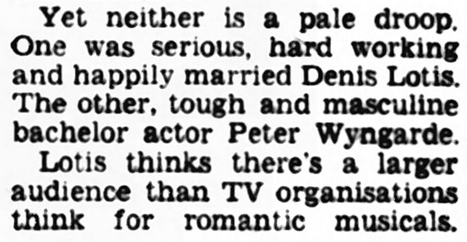
In the wake of the Gloucester incident, however, the very same newspaper was to describe Peter as “effete” and “camp.” What had altered? Peter remained unchanged; he was the same person he’d always been. The only difference was in how he was perceived by the knuckle-dragging macho men in Fleet Street who, not so long before, had probably aspired to be like him when attempting to attract “birds” at their local Top Rank club on a Saturday night .
I’ve reflected occasionally upon whether those gentlemen of the press, ensconced comfortably within their prestigious newspaper offices and quick to disparage others as “effete,” would have demonstrated comparable resilience had they been confined as children in a Japanese Prisoner of War Camp throughout a five-year period. Would they have endured malaria, beriberi, or survived the ordeal of having both feet fractured before being subjected to weeks in solitary confinement? Moreover, what if they had been compelled to assume paternal responsibility immediately afterwards for two younger siblings when no more than children themselves; labouring relentlessly to meet their needs whilst relinquishing their own personal ambitions? I very much doubt it! Peter certainly did not manifest such “effete” characteristics under those demanding circumstances!
THE SUPPOSED “DERAILED” CAREER FROM 1975 ONWARDS
Peter worked consistently from 1975 onwards as an actor, director and producer. This website has lists of all his film, radio, theatre and television, plus many detailed reviews of the plays he appeared in, which lays bare the myth that Peter’s work completely dried up following the Gloucester Incident.
Other Points
Peter NEVER, EVER claimed “social security benefits”! This bizarre claim was made by a journalist from The Daily Mirror in the early 1980.
And as for Daniel Sugerman assertion in The Jewish Chronical that Peter’s father was both Russian and Jewish. This originate in a rabidly antisemitic fake news ‘site in 2015. Peter’s Dad was, in fact, Ukrainian-British and Roman Catholic.
The Online Pile-On
The tabloids’ fixation with Peter inevitably spilled into the dark recesses of online spaces where gossip culture thrives. Anonymous accounts dissected quotes attributed to him which, in reality, had never passed his lips, and fan forums debated his “true sexuality,” often projecting traits from his characters (Jan Wicziewsky in ‘South’, for instance) onto him — a phenomenon media analysts identify as a common distortion in celebrity storytelling.
The story of a public figure being dragged through the digital mud is hardly new, but few cases illustrate the human cost of misinformation as sharply as the ordeal faced by Peter. Since the very inception on of the World Wide Web, he has been the target of relentless online hostility, not because of anything he actually did, but because of a single tabloid fabrication that metastasised across the internet. His experience reveals how fragile reputations have become in the age of viral gossip, and how difficult it is for truth to catch up once lies take root.
As already covered, the catalyst for this onslaught was tabloid sensationalism decades earlier. Online gossip sites seized the rumour and amplified it. Social media accounts—some anonymous, some malicious, some simply populated by people who had nothing better to do with their lives—spread unsubstantiated claims with gleeful abandon. What once had been a story concocted by a disgruntled employee and convicted criminal, was now “fact” in the minds of thousands. Trolls had built entire narratives around him, weaving new accusations from the original falsehood.
Peter himself tried to correct the record. His representatives issued statements. Friends and colleagues defended him. But the internet has a peculiar relationship with truth: once a lie becomes entertaining, it becomes sticky. People who had never seen Peter, never read a verified report, never engaged with evidence, felt entitled to condemn him. The mob had found a target, and the mob was not interested in nuance.
What makes this story particularly tragic is how preventable it was. The tabloid that published the lies in the first place is now defunked, so there is now no chance of them ever publishing a retraction, and even if they had it would have doubtless been buried in a corner of their website, seen by almost no one. The contents of the original article, meanwhile, continues to circulate. Trolls cite subsequent newspaper story’s and Wikipedia – the latter of which rely on the press as an incontrovertible source – as “proof” whenever Peter’s name surfaces. Even today, a quick search reveals threads and posts repeating the debunked claims as if it were established fact.
This phenomenon—where misinformation outlives correction—is well documented. Psychologists call it the Continued Influence Effect; the tendency for people to cling to false information even after it has been disproven. In Peter’s case, the effect was amplified by the architecture of social media, which rewards outrage, simplifies narratives, and encourages pile-ons. Once a person is labelled a villain online, the label becomes nearly impossible to remove.
Peter’s ordeal raises uncomfortable questions about the culture we have created. Why are we so quick to believe the worst about public figures? Why do we treat rumours as entertainment? Why do we allow anonymous hostility to shape real-world consequences? And perhaps most importantly, what responsibility do we bear when we participate—even passively—in the spread of misinformation?
Peter’s friends, colleagues and our Appreciation Society continues to work tirelessly to advocate for stronger accountability in journalism and for better digital literacy among audiences. We argue that readers must learn to distinguish between verified reporting and sensationalist fiction, and that platforms and forum admins should do more to curb the spread of demonstrably false claims.
I have for many years cited authors such as Donald Spoto* and those that have liberally quoted from his book, (‘Otherwise Engaged: The Life of Alan Bates) who have increasingly weaved online gossip and misinformation into non‑fiction because it reveals how people now form beliefs, react to rumours, and negotiate truth in a digital world. The most compelling shift is that gossip—once whispered privately—has become a public archive. Writers can trace how a rumour spreads, who amplifies it, and how platforms reward emotional, sensational content. This gives non‑fiction a new investigative texture: the story isn’t just what happened, but how the internet (and the tabloids) DECIDED what happened.
This trend raises ethical questions. Writers must decide when amplifying a rumour helps illuminate a system and when it risks legitimising falsehoods. That tension—between documenting misinformation and avoiding becoming part of it—is now central to modern non‑fiction.
The rise of the internet promised a democratisation of media, offering spaces where ordinary people could bypass corporate gatekeepers to discuss pop culture in real time. Yet, rather than fostering a more thoughtful or objective culture of commentary, online gossip forums have systematically absorbed, replicated, and amplified the worst impulses of legacy tabloid journalism. The toxic methodologies of scandal-mongering have not merely leaked into digital spaces; they have found their perfect evolutionary environment within them.
Here are just a couple of examples of the mentality of the internet gossip
Two of my most bizarre encounters with the dazed and confused, came back in September 2021.They came courtesy of Fank and Margaret – both strangers to each other and yet both were spouting the same old cr*p!
Our first case concerns a 75-year-old gentleman whom we shall refer to as Bill, for that was his name. He claims that Peter is a “Pervert” because – to quote him – “He was convicted of Gross Indecency in 1975 in Gloster (sic).”
While that may be so, such a conviction alone does not necessarily mean that someone is a “Pervert”. Therefore, I inquired of this rather confused old man what further evidence he possessed to substantiate his severe accusation.
“Well, he was also cautioned for the same offence in Birmingham (see earlier in this article about this alleged episode). That makes him a perv,” he asserted with all the conviction of his own intellect. Really?! And from where did he obtain this information?
“It’s on Google.”
“And where, pray, did Google source it from?” I probed. Unsurprisingly, ol’ Bill was unable to provide an answer. And so I regaled him with what had happened regarding this story being the machination of a Wikipedia contributor (you can read more about this here)
So what was effect did this revelation have on the gullible old fool now that he realised he’d not only been barking up the wrong tree, but was in the wrong forest entirely?
“But it still says it on Google,” he whimpered. Oh dear, oh dear!
I felt compelled to clarify to Bill that Google is merely a search engine that will continue to churn out such nonsense as long as arrogant, misguided gossips like his good self persist in disseminating any piece of unverified drivel they encounter. I inquired how he would feel if some fool with too much idle time began to circulate any scandalous nonsense they found online about one of his loved ones. Needless to say the silly old sod had no response to that either.
The second portion of absurdity on the agenda came from a woman called Margret, who asserted that her brother had, at some point, lived “near” Peter in London. He’d claimed to have seen our man in a his car – cruising around Kensington and Chelsea with his “toy boys.” When I questioned this, Margare’ abruptly shifted the identity of the alleged ‘eyewitness’ from her “brother” to herself: “The young men,” she insisted, “all appeared to be foreign.” How on earth could she possibly ascertain that? Were they all adorned in keffiyehs or silk kimonos while playing the Balalaika? And when exactly did this occur? “In the late 60s or early 70s. He [Peter] then went to ground.” Oh, really!
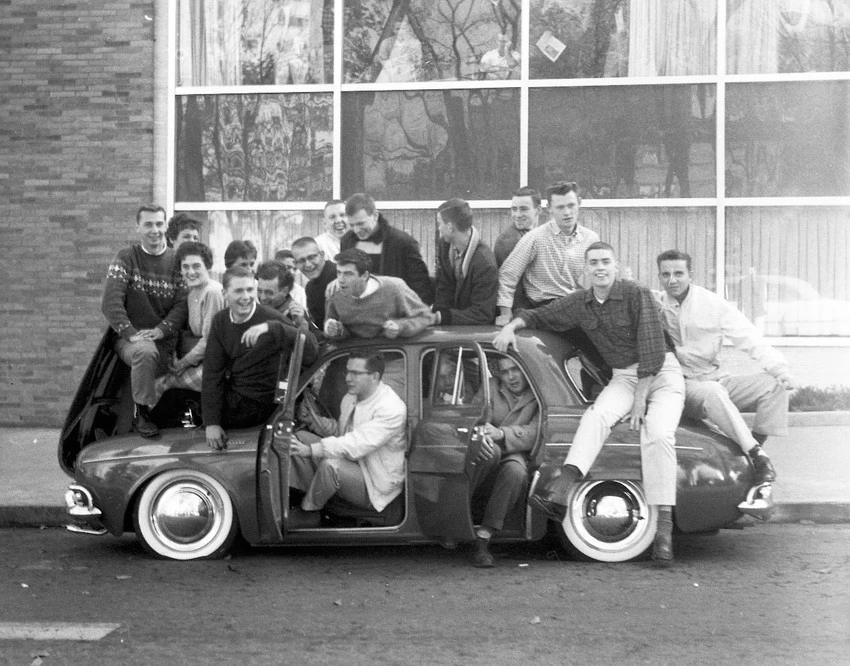
In the late 1960s and early 1970s, the sole vehicle owned by Peter was a two-seater Austin-Healey ‘Frogeye’. Therefore, unless he was reenacting a scene from the classic British game show, ‘It’s A Knockout’, I find it difficult to comprehend how many “foreign toy boys” could possibly fit into such a car?!
Left: An illustration of what Peter’s car likely resembled in the 1960s… at least according to dear old Margaret.
I presume that the point she intended to convey was that Peter frequently drove around the Royal Boroughs of London accompanied by a group of young, exotic men, which, in her perspective, unequivocally indicated that they were his romantic partners. Did this, in her view, provide a comprehensive understanding of Peter’s existence? I suppose I will never ascertain this, as Margaret would abruptly ‘go to ground’ once she recognised that she had backed herself into a corner. Now, if I were to be uncharitable, I might speculate that her sudden withdrawal was related to her argument collapsing under scrutiny, but let us extend her the benefit of the doubt, shall we?
For the benefit of Margaret if no one else – during the late 1960s and early 1970s, Peter was at the pinnacle of his fame. He was the highest-paid actor on British television and was performing to sold-out audiences in the West End of London. How this is interpreted as ‘going to ground’ remains a mystery, but it is likely that the old dear was becoming somewhat confused.
It appears that, over the years, humanity has diminished its capacity for independent thought – as demonstrated by individuals like Bill, who will read a statement from an anonymous source online and accept it as truth without question. Furthermore, they will not hesitate to replicate and disseminate it. It never seems to occur to people like him to investigate how the person who originally posted this information obtained it; were they directly involved in the event they’re discussing, or did they witness it firsthand? Did they have a personal relationship with Peter? Did they attend a court hearing in person, or do they possess privileged information such as court documents, witness statements, or transcripts? Given that 99.999% of the time the answer to such questions would be a definitive “No!”, what justification does ANYONE have to circulate scandalous rumours? Certainly, people like Bill and Margret would not approach a random person on the street and accuse his or her spouse, sibling, child, nephew, niece, cousin, or friend was a “Pervert”. I suspect that Bill would find himself with a broken nose if he attempted such a thing, which likely explains why he opts to make unfounded, outrageous claims about others while hiding behind a computer screen in the comfort of his own home!
Read more online lies and invention in our article, ‘That Vacant Look‘ and the Open Letter sent to the admin of the Facebook group,UK Nostalgia Vice in September 2026 after a particularly nasty attack on Peter by some of their members.


