

Broadcast: 12th April, 1953
Character: Count Franz von Prokesch-Osten
- Act I: The Gilded Cage
- Act II & III: Dreams of Glory
- Act IV: The Flight to Wagram
- Act V: Betrayal and Death
Some Background
L‘Aiglon represented the 15th episode of Series 4 of the BBC’s Sunday Night Theatre. In the initial five years of its airing, each production was broadcast on Sunday evenings and subsequently re-performed live the following Thursday. This practice was partly due to the technical constraints of the time and the theatrical foundation of early television drama.
Among the earliest collaborations between Rudolph Cartier, who directed L’Aiglon, and Nigel Kneale were produced for this series, including L’Aiglon itself.
The vast majority of the series’ run from 1950 to 1959, which consisted of 721 plays, is absent from television archives; it’s believed that only 27 of these plays still exist as telerecordings. Unfortunately, L’Aiglon is one of the plays that has been lost.
The Story
The story begins in the court of Vienna, Austria, where Count Franz von Prokesch-Ostenapoleon Franz, the Duke of Reichstadt (Peter Wyngarde) son of Napoleon I and Empress Marie-Louise (Eileen Peel), resides in a gilded exile. Affectionately referred to as L’Aiglon (The Eaglet), this delicate yet astute young prince is regarded less as royalty and more as a mere political pawn.
Franz harbors aspirations of returning to France as its emperor, yet his health is precarious. He devises a plan to escape from his ever-watchful guards, but his scheme is uncovered, and he is thwarted in his attempt to flee. He comes to the realization that he lacks the strength and courage to make the sacrifices required to emulate his father, Napoleon. Ultimately, he succumbs to pulmonary tuberculosis.
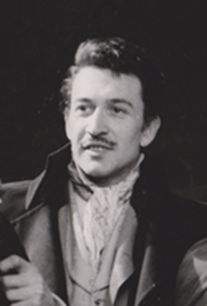
His grandfather, Emperor Franz I (Milton Rosmer), along with the iron-willed Austrian Chancellor, Prince Metternic (Andre Van Gysengham), maintains strict oversight over him. Metternich is resolute in his efforts to eradicate the boy’s French identity—compelling him to communicate in German and erasing his Bonapartist lineage—to thwart any possibility of his return to France to reclaim his father’s imperial throne.
Left: Peter as Count Franz von Prokesch-Ostenapoleon
In spite of the court’s oppressive indoctrination, Franz remains profoundly inspired by his father’s illustrious military legacy. He clandestinely studies Napoleon’s historic campaigns and longs to escape Austria to realize his destiny as the legitimate ruler of France.
He discovers enthusiastic supporters within his close circle, including his fervent cousin Countess Camerata (Margot Van der Burgh)and Séraphin Flambeau (Wilfred Lawson), a devoted former grenadier of Napoleon’s Grande Armée who has cleverly infiltrated the palace disguised as a French tailor. Together, they establish a covert network and devise an audacious escape plan.
During an extravagant masquerade ball at Schönbrunn Palace, the conspiracy is set into motion. Countess Camerata dons a military uniform identical to that of the Duke, serving as a clever decoy to divert the attention of Metternich’s overly vigilant guards.
Franz and Flambeau manage to slip into the night and ride towards the border. They reach the historic battleground of Wagram, renowned for being the site of one of Napoleon’s most significant military victories. As they stand on the moonlit plains, Franz is engulfed by a sense of tragic fervor, haunted by ghostly visions of the bloody battlefields and the resonances of his father’s illustrious past.
However, the romantic illusion is swiftly shattered. Metternich’s efficient secret police catch up with the fugitives before they can enter French territory. To evade the disgrace of capture and interrogation, the loyal Flambeau takes his own life right on the historic battlefield.
A shattered and defeated Franz is taken back to Vienna, his spirit utterly crushed. The physical strain of the escape worsens his existing tuberculosis. Weak, disheartened, and confined to his bed, the Eaglet quickly deteriorates. He passes away at the tragic age of twenty-one, ensnared by his unfulfilled aspirations. In a final act of political erasure, Metternich decrees that the prince be interred in an Austrian military uniform, thereby stripping him of his identity as a Bonaparte even in death.
Some Notes
L’Aiglon was written by Edmond Rostand who also wrote Cyrano De Bergerac.
Austrian born Rudolph Cartier also directed ‘The Dybbuk‘ (1952), in which Peter played Channon and ‘Will Shakespeare – An Invention’ (1953) – both with Peter in the lead role.

 PETER WYNGARDE: The Official Website