

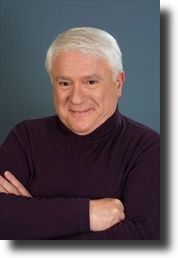
“I cannot tell you how shocked I was when I read what unbelievable things that American biographer had said about me.“ Peter Wyngarde
Written by Tina Wyngarde-Hopkins
As widely recognised, I have maintained a critical stance regarding author Donald Spoto’s biographical work, Otherwise Engaged; The Life of Alan Bates (Hutchinson – 2007). This book was referenced in my own biography, Peter Wyngarde: A Life Amongst Strangers (Austin-Macaulay – 2020),with numerous supporters also contesting his interpretations—particularly those passages addressing Peter – both through this platform and on other forums.
Spoto’s biographical account has exercised considerable influence over public perception of Peter Wyngarde. The author contended that Peter had shared a flat at No.1, Earls Terrace, London for approximately ten years (from 1956 to 1966) with fellow actor Alan Bates. Furthermore, he asserted that their arrangement transcended a mere practical arrangement based on financial considerations – that is, the reduced expense of two aspiring thespians sharing accommodation – and instead constituted, in Spoto’s assessment, a romantic partnership.
Contrary to the assertion that both men relocated to the apartment together, documentary evidence demonstrates that Peter established residency there in November 1958 (as evidenced by the original Tenancy Agreement signed by Peter on November 24th, 1958 – see below). Prior to this date, Peter had first been residing with his partner, Ruby Talbot, at 11, Newton Row, London, then latterly at his weekend home in Kilndown, Kent. Given that Bates was engaged in work in the United States from the autumn of 1958 through to the spring of 1959, he could not have relocated to the flat from his previous residence in Battersea (London) before March or April of 1959 at the earliest. Notably, Bates first appears on the Electoral Register as a resident at Earls Terrace in 1960.
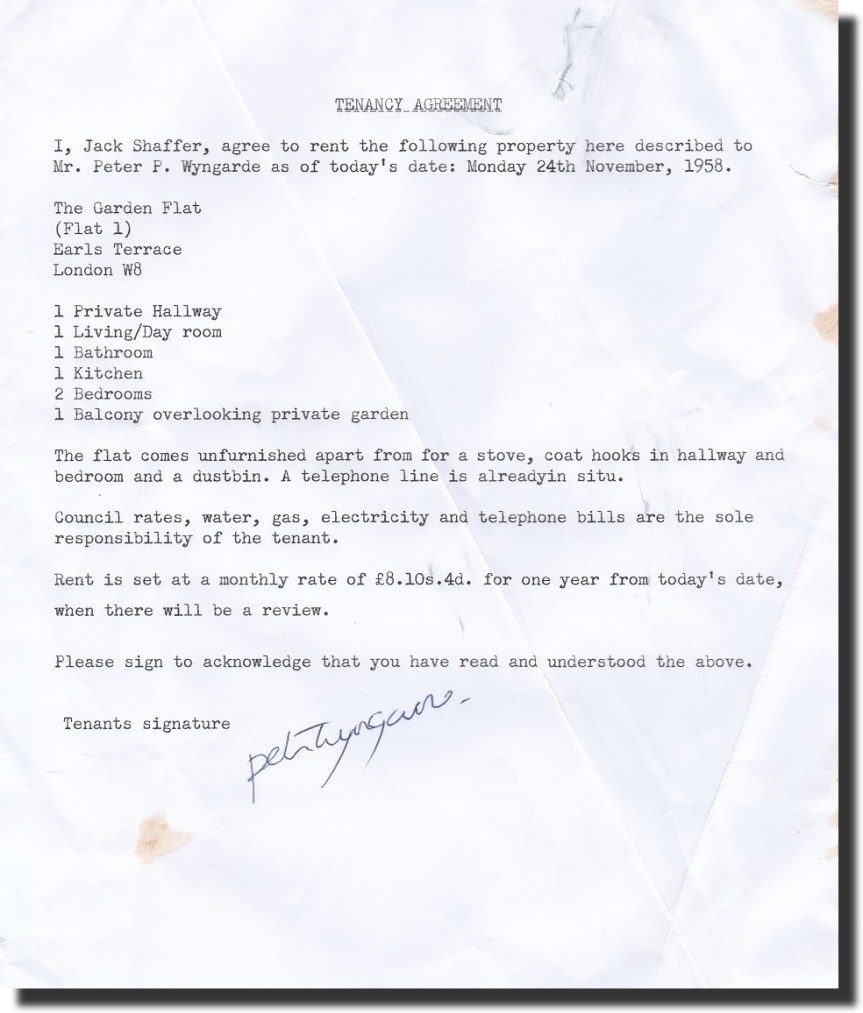
From 1958 through to the latter part of 1960, Peter maintained a romantic relationship with acclaimed actress Vivien Leigh, with whom he had performed in the theatrical production ‘Duel of Angels‘ during both a British tour and a subsequent tour of the United States. Between 1960 and 1962, Bates cohabitated with prominent American film star Rock Hudson in California. He subsequently vacated Earls Terrace in 1965 upon acquiring a house at 122 Hamilton Terrace in St. John’s Wood. The purported “decade” of shared accommodation that Spoto asserted they’d maintained was, in actuality, a period spanning fewer than SEVEN years. Subsequently, as Peter characterised their arrangement, the two actors resembled “ships passing in the night” owing to their respective touring commitments and professional engagements, which encompassed both domestic and international schedules.
It all looks rather different now….
When being interviewed by Spoto in 2003 in connection with the author’s research for the Bates biography, Peter executed an agreement stipulating that he would be permitted to review the intended publication prior to the book going to print. The author subsequently reneged on this contractual obligation by proceeding to print without establishing further contact with Peter. Upon reading the author’s characterisations of him, and the assertion that he and Bates had had a decade-long romantic relationship, Peter was incandescent with rage.
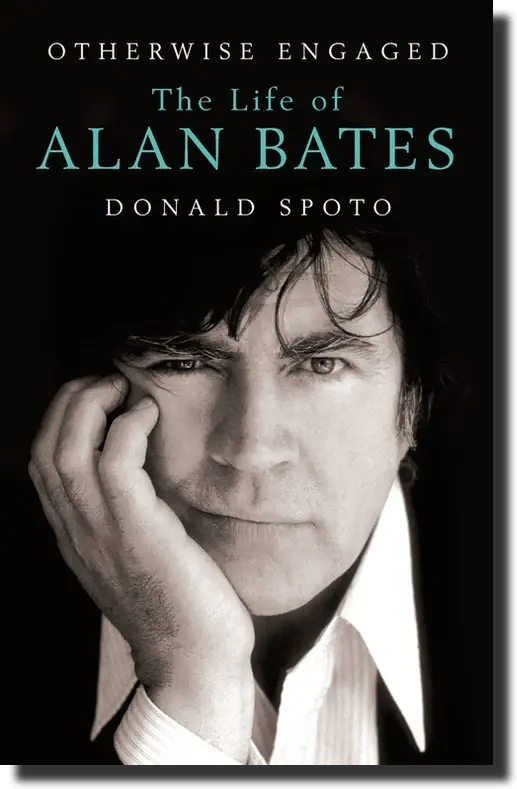
Right: Otherwise Engaged: The Life of Alan Bates. The book that spawned a thousand ridiculous myths about Peter Wyngarde
“The American author [Spoto] signed a letter to say he would adhere to my request about omitting material, but managed to send it to me after the book was published which was of course too late.“ Peter Wyngarde
(See the above written in Peter’s own hand here).
Donald Spoto, a prolific biographer of celebrities, was born in New Rochelle, New York, in June 1941. He obtained his Ph.D. in New Testament studies from Fordham University in 1970 and subsequently devoted more than ten years to academic positions as a theology professor and teacher at institutions including Fairfield University and the University of Southern California before transitioning to a career in full-time writing. Although his work was recognised in certain circles, his practice of attributing psychological interpretations to his subjects’ creative output frequently resulted in assertions that remained disputed or unsubstantiated.
Spoto was frequently characterised as a “gossipmonger” and faced criticism from reviewers for emphasizing sensational and darker narratives concerning Hollywood personalities. Notwithstanding his own propensity for salacious content and investigative muckraking, he condemned the ostensibly hypocritical “Cottage Industry” of gossip journalism – critiquing predecessors such as Anthony Summers for fabricating sensationalised, unsubstantiated gossip for commercial gain. He contended that such lurid writing constituted a “deplorable” undermining of factual accuracy that disregarded the personal standing of actual individuals. Regrettably, he failed to apply these same standards to his own work when writing Otherwise Engaged: The Life of Alan Bates.
Although presenting himself as an authority on Alfred Hitchcock’s filmography, his 1999 biography entitled The Dark Side of Genius: The Life of Alfred Hitchcock (Da Capo Press) received substantial criticism from both admirers and scholars of the renowned British director and producer.
The primary objections to the work centered on pervasive misquotations of sources and inaccurate representations of production environments. Film historians have identified numerous instances in which Spoto either misquoted sources or selectively omitted contextual information to portray Hitchcock in an unfavourably, distorted manner. Notably, Spoto characterises an incident involving Hitchcock striking actress Joan Fontaine as indicative of a hostile, exploitative workplace, despite documented evidence demonstrating that Fontaine had specifically requested the physical contact to enhance her performance authenticity.
In Spellbound by Beauty (Cornerstone – 2008), Spoto extensively examined Hitchcock’s purported sexual preoccupation with actress Tippi Hedren. Although Hedren corroborated these assertions, other actresses who collaborated with Hitchcock – including Kim Novak, Doris Day, and Barbara Leigh-Hunt – publicly disputed Spoto’s depiction, asserting they could not identify the malevolent individual Spoto portrayed. Contemporary scholarly evaluations, such as Tony Lee Moral’s A Century of Hitchcock: The Man, the Myths, the Legacy (The University Press of Kentucky – 2026), contend that Spoto and actress Tippi Hedren functioned as unreliable sources motivated by personal animosity, transforming routine Hollywood tensions and theatrical exaggeration into a prejudicial, asymmetrical account.
Historian Tony Lee Moral authored two separate works (Hitchcock and the Making of Marnie and The Making of Hitchcock’s The Birds) expressly designed to challenge Spoto’s chronologies and assertions, demonstrating that archival production documentation from the 1960s fundamentally contradicted the narrative framework Spoto established years afterward.
Spoto’s distorted characterisation of Hitchcock also provoked considerable objection from the director’s family, associates and professional collaborators – including Hitchcock’s daughter Patricia Hitchcock, producer Herbert Coleman, and associate Norman Lloyd – all of whom maintained they could not recognise the vindictive, sadistic administrator depicted by Spoto, maintaining instead that he demonstrated warmth, courtesy, and professionalism.
Beyond those inaccuracies already mentioned, additional errors have been identified in Spoto’s works that further undermine the credibility of his scholarship and analytical rigour in his Hitchcock studies. In The Art of Alfred Hitchcock: Fifty Years of His Motion Pictures (Hopkinson and Blake, 1976), Spoto claims to have devoted over 1,500 hours to viewing and reviewing Hitchcock’s films. However, he subsequently identifies the character portrayed by Joan Fontaine in Suspicion as having the surname “McKinlaw,” when the correct surname is actually “McLaidlaw.” Furthermore, he identifies Anthony Dawson’s character in Dial M for Murder as “Swan Lesgate,” whereas the character’s true name is “Swann” with two n’s, despite his temporary assumption of the alias “Captain Lesgate” during the film’s narrative. Additionally, the renowned director F.W. Murnau is referred to as “Fred W. Murnau,” a designation by which he was never known.
Scholars have frequently observed that Spoto demonstrated a tendency to construe cinematic themes and artistic decisions as direct autobiographical revelations of personal aberrations, psychological disturbances, or concealed aggression, relying predominantly upon popular psychological frameworks rather than substantiated documentary analysis.
In Spoto’s work entitled Laurence Olivier: A Biography (HarperCollins – 1993), the author asserted that Olivier maintained an intense, decade-long homosexual relationship with American comedian Danny Kaye (sound familiar?). This assertion was vigorously contested by Olivier’s surviving spouse, Joan Plowright, alongside numerous intimate associates and contemporary biographical scholars who contended that no substantive factual or documentary evidence existed to corroborate such an extended romantic involvement. Subsequent authorised biographers similarly refuted Spoto’s claims, emphasising that he possessed no verifiable factual documentation, correspondence, or credible witness accounts to substantiate either the chronological framework or the existence of the purported relationship.
Subsequent biographers, including Terry Coleman in his officially sanctioned family biography titled Olivier (Bloomsbury Publishing – 2005), systematically refuted this assertion. Coleman and fellow writers demonstrated that credible evidence supporting a decade-long romantic relationship does not exist, and contended that Spoto advanced this narrative chiefly to substantiate an expansive psychological framework concerning Olivier’s bisexuality while simultaneously minimising the significance of Vivien Leigh’s documented bipolar disorder diagnosis.
Consistent with certain other celebrity biographies authored by Spoto, reviewers identified a pervasive absence of meticulous verification regarding established historical chronologies, minor details, and peripheral figures connected to Olivier’s personal history.
Although Spoto’s 1993 book Marilyn Monroe: The Definitive Biography – The Life and Death of The Hollywood (Arrow – 1994) received considerable acclaim for refuting conspiracy theories connected to John and Robert Kennedy, it nonetheless presented its own substantive factual and analytical deficiencies. Academic examination by Monroe researchers, including David Marshall, demonstrated that Spoto modified or condensed particular chronologies pertaining to Marilyn’s final years to align with his predetermined interpretive framework.
In an effort to exonerate the Kennedys, Spoto advanced the proposition that Marilyn’s death resulted from an accident involving a chloral hydrate enema, which was purportedly administered by her housekeeper, Eunice Murray, who was acting under the guidance of her psychiatrist, Dr. Ralph Greenson. Medical professionals and historians have contested this hypothesis as excessively conjectural, medically unconvincing, and devoid of conclusive forensic substantiation. Others described Spoto as “arrogant and ignorant of the facts,” regarding Monroe, and of having a “condescending attitude” towards those associates of her’s who dared to challenge him.
During the writing process, Spoto engaged genealogist Roy Turner to contribute to his investigative efforts. According to Monroe archivist David Marshall, Turner stated that he had furnished Mr. Spoto with extensive detailed research materials; however, upon the book’s publication, Spoto had modified portions of that research – not comprehensively, but selectively enough to ensure narrative consistency with the author’s underlying thesis. Does this not parallel what Peter reported regarding Otherwise Engaged: The Life of Alan Bates; specifically, that the majority of the information he provided during an interview preceding the book’s publication was either altered or excluded to accommodate one of the work’s central premises, namely the alleged intimate relationship between Bates and Peter?
Detractors of Spoto’s biographical work, Possessed: The Life of Joan Crawford (Arrow – 2012), contended that Spoto’s approach oscillated between excessive sensationalism and problematic overcorrection. He devoted substantial energy to systematically refuting the narrative established by Christina Crawford’s Mommie Dearest (Grafton – 1989); a strategy that prompted critics to observe he minimised Crawford’s well-documented behavioural shortcomings in order to present an artificially sanitised portrayal. His assertion that Crawford exclusively employed expensive, cushioned coat hangers became a point of contention used to undermine Christina’s account that her mother wielded wire hangers as instruments of physical abuse. Likewise, his biographical treatment of Grace Kelly encountered considerable critical scrutiny for demonstrating “uncharacteristic restraint,” offering an excessively refined, formal, and romanticised account of her existence while disregarding extensively documented personal adversities.
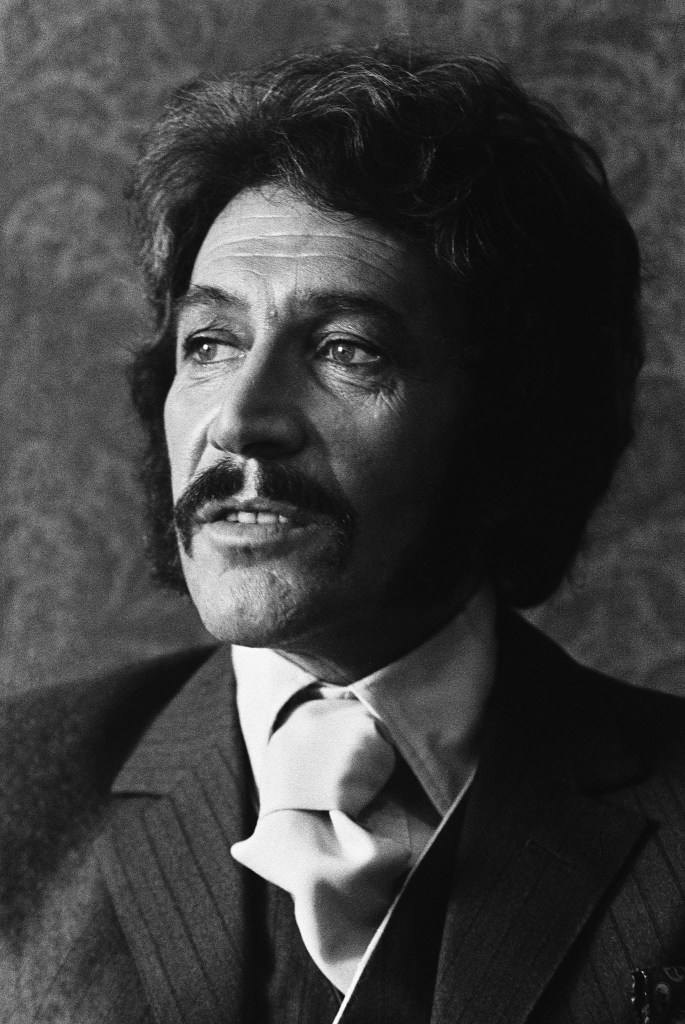
Biography is one of the most influential forms of historical writing. For actors, a well-researched biography can preserve their achievements and introduce their work to new generations. However, when a biography is based on poor research, unreliable sources or the author’s personal assumptions, it can do significant damage to an actor’s reputation. Inaccuracies often become accepted as fact, creating a distorted image that can overshadow a performer’s personal life and career accomplishment. This is exactly what happened to Peter since the publication of Otherwise Engaged: The Life of Alan Bates.
One of the greatest dangers of poor biographical research is the spread of false information. Readers often assume that a published biography has been carefully checked and verified. When an author includes incorrect dates, fabricated incidents, or unsubstantiated rumours, these claims can quickly enter the public record. Future writers, journalists, and online contributors may repeat the errors, making them difficult to correct. As a result, a mistaken story can become more widely known than the truth. I personally have suffered abuse and years of attacks from certain individuals online – none of whom had any direct contact with Peter or ever met him – who had taken Spoto’s word as gospel, and yet I’ve refused to back down since Peter is sadly no longer here to defend himself.
Actors are particularly vulnerable to this problem because their lives are often surrounded by myth and speculation. The entertainment industry has always generated gossip, and some biographers are tempted to include sensational stories in order to attract attention. Unfortunately, a dramatic claim is not necessarily an accurate one. A rumour repeated often enough can become accepted history, even if there is no evidence to support it. When this happens, an actor’s professional achievements may be overshadowed by stories that are exaggerated or entirely fictional.
Poor research can also lead to unfair judgements about an actor’s character. A biographer who relies on a limited number of sources may present a one-sided portrait of their subject. Personal conflicts, professional disagreements, or isolated incidents can be portrayed as defining characteristics rather than being placed in their proper context. Readers then receive an incomplete picture, which may paint the actor as difficult, arrogant, or unreliable when the reality was far more complex. In Spoto’s Alan Bates biography, Peter was portrayed as a “Svengali” type character, who bullied Bates rather than attempting to help him. This characterisation has however been challenged by those who knew both actors during the 1950’s and 60’s, with one describing Peter as being “more sinned against than sinning”.
Another problem occurs when authors fail to understand the historical context in which an actor worked. Standards, business practices, and social attitudes change over time. Actions that seem unusual today may have been common in a previous era. Without proper context, a biographer risks judging historical figures by modern expectations and creating a misleading interpretation of their behaviour. This can unfairly damage reputations and obscure the challenges actors faced during their careers.
The consequences of inaccurate biographies extend beyond the actor’s legacy. Family members, friends, and loyal admirers may be distressed by the publication of claims that are misleading or untrue. In some cases, these inaccuracies can influence academic research, documentaries, and media coverage for years. Certainly in the case of Otherwise Engaged: The Life of Alan Bates, journalist and bloggers alike have quoted liberally from the book in reference to Peter. Alas, once an error has entered the public consciousness, correcting it can be extremely difficult.
For these reasons, biography writers have an important responsibility. Thorough research, careful fact-checking, and a commitment to fairness are essential. A biography should seek to illuminate rather than sensationalise. By presenting evidence honestly and acknowledging uncertainty where facts are unclear, writers can help preserve an actor’s true legacy. When these standards are ignored, the result is not simply a flawed book but a distorted historical record that can unjustly tarnish an actor’s reputation for generations.
It’s telling that Donald Spoto concentrated his writings on famous personalities who had already passed on so were unable to challenge his claims. He knew full well that you can’t libel the dead – at least in the eyes of the law.
Spoto demonstrated sensationalist tendencies and exhibited minimal concern for the veracity of his work. Consequently, he has damaged and, in many cases, destroyed professional reputations. His dismissive response to those who questioned his methodology reflected his self-importance and disregard for the harm inflicted upon others. Spoto functioned less as an impartial historian and more as an academic purveyor of unsubstantiated claims. His characteristic methodological deficiency involved establishing a compelling psychological narrative first – whether concerning Alan Bates’s ambiguous sexuality, Joan Crawford’s complete vindication, or Hitchcock’s psychological struggles – subsequently adjusting, excluding, or distorting historical evidence until it aligned with his predetermined conclusion.
Spoto died of a brain haemorrhage in Køge, Denmark, on 11th February 2023, at the age of 81.


