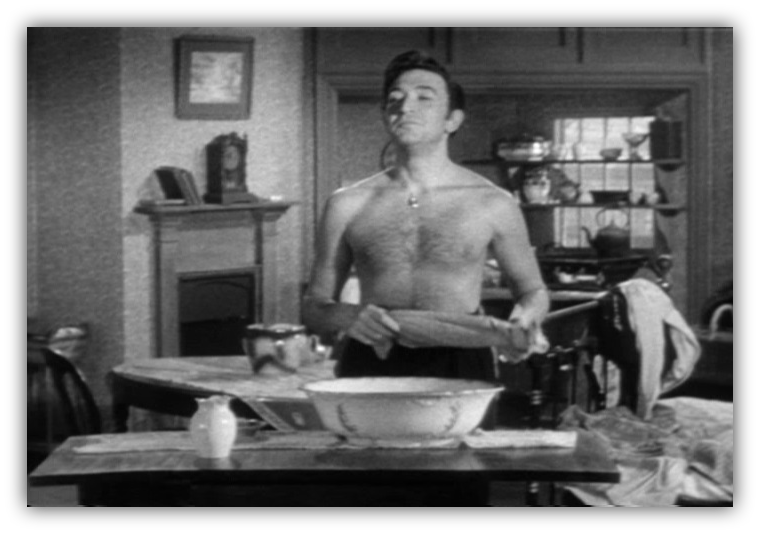
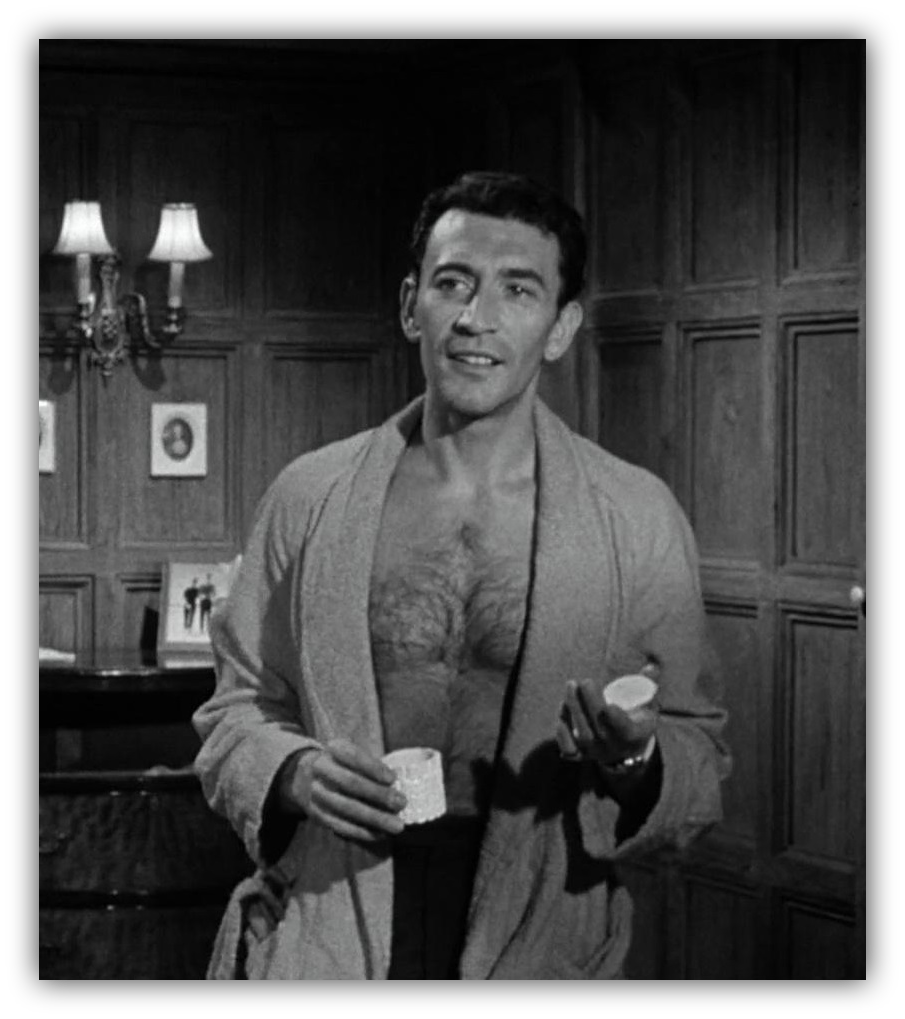
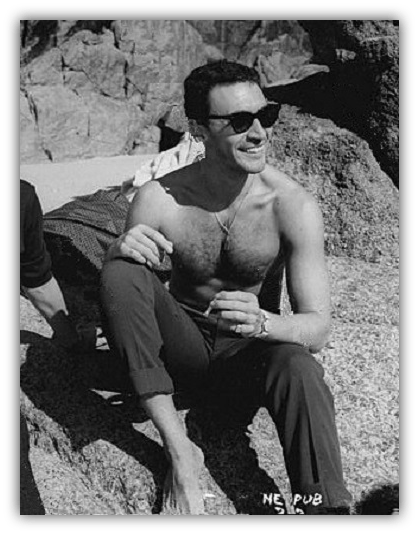
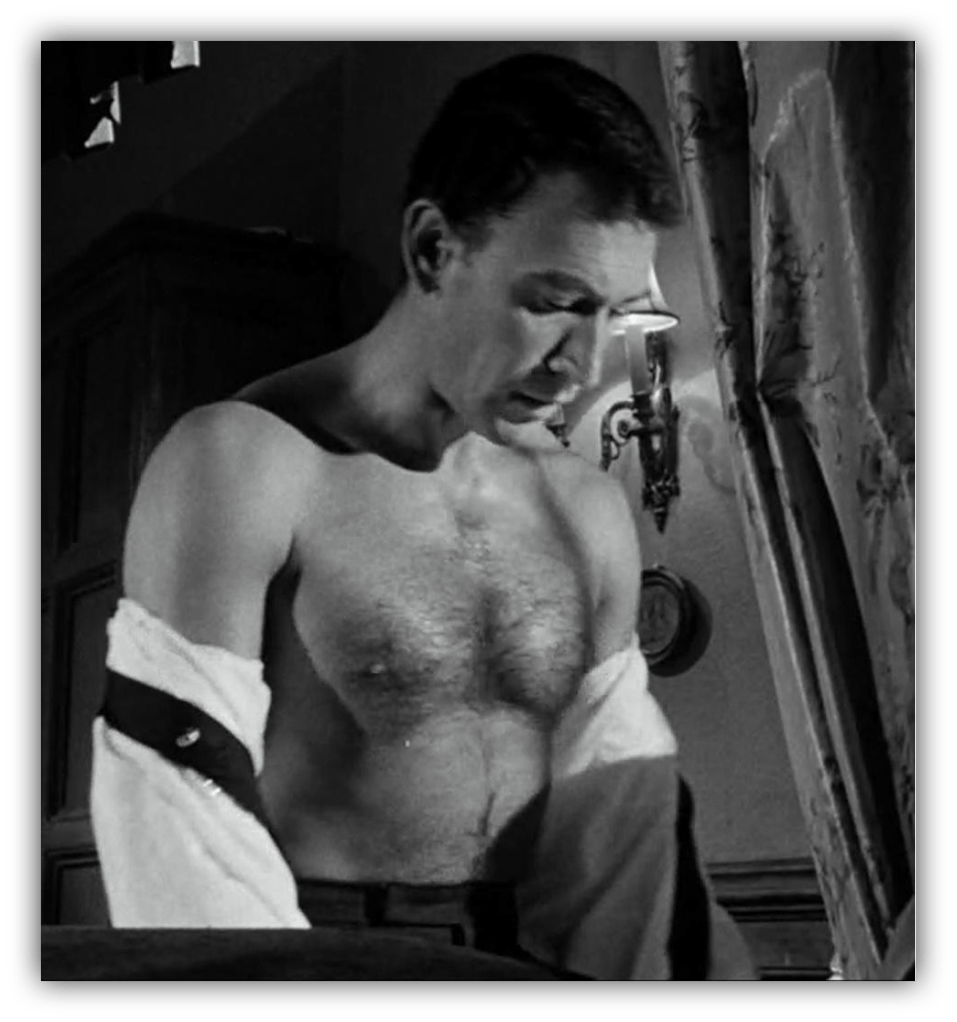
ON THE MAGNIFICENCE OF PETER WYNGARDE

By BlackberryJuniper

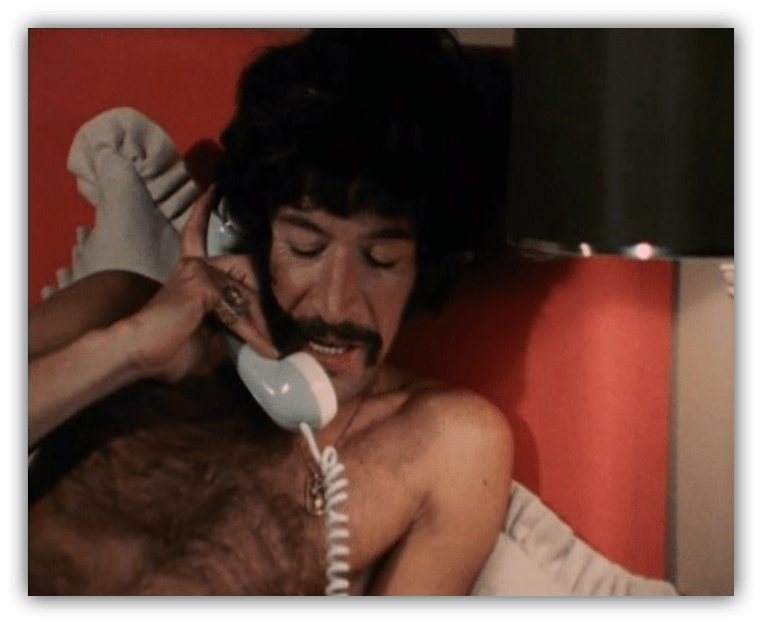
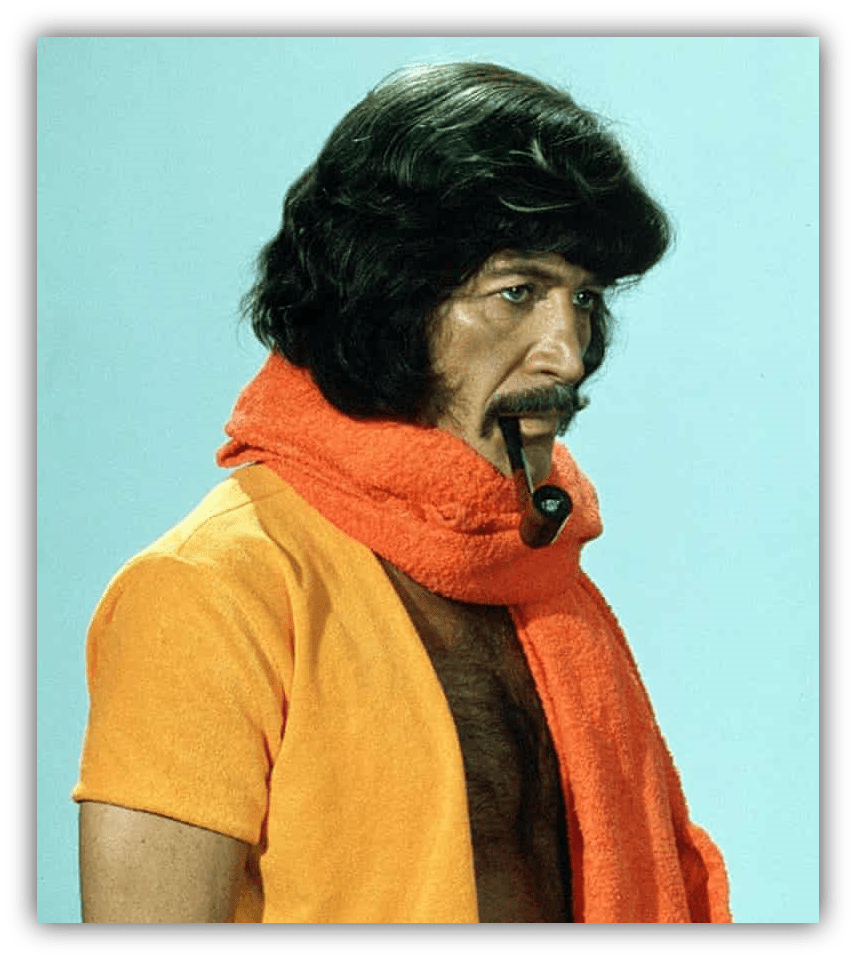
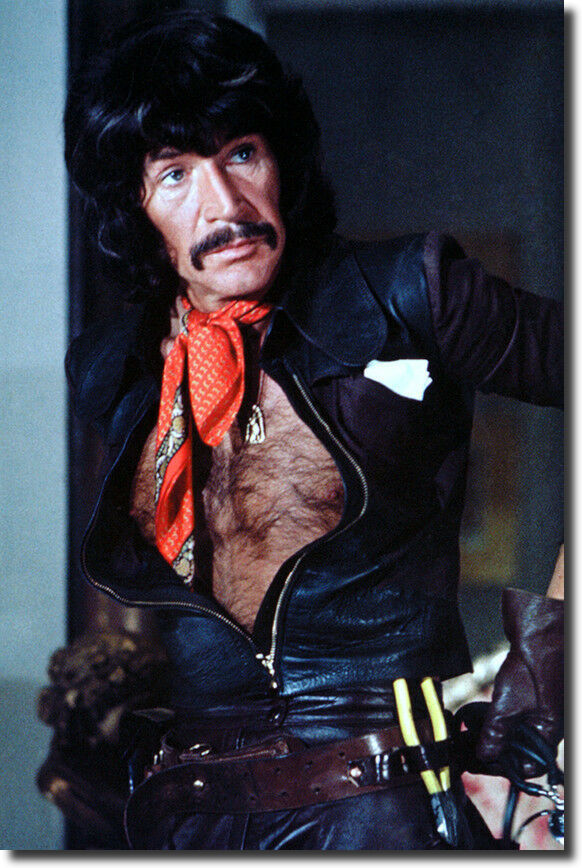
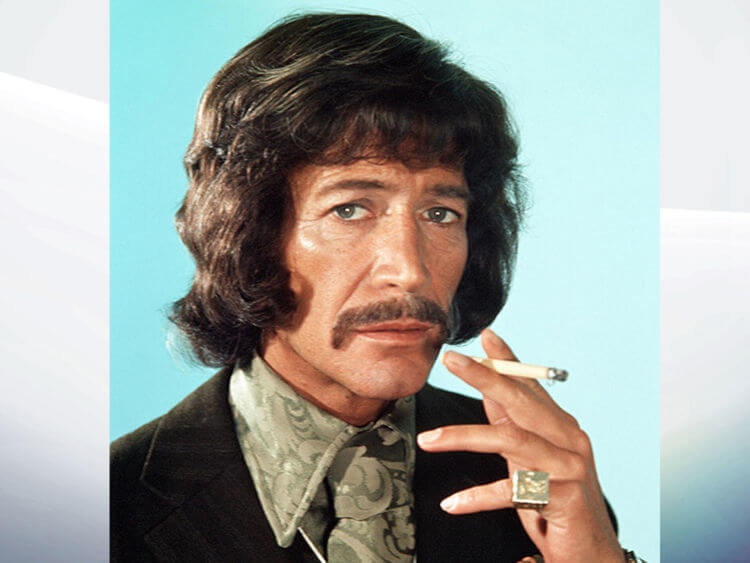
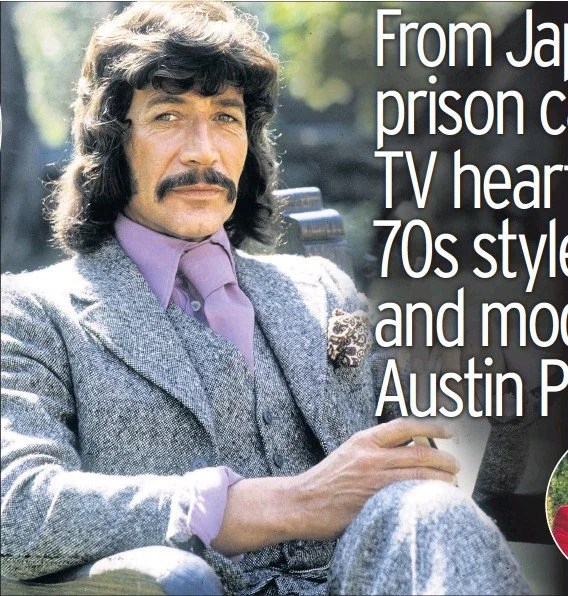
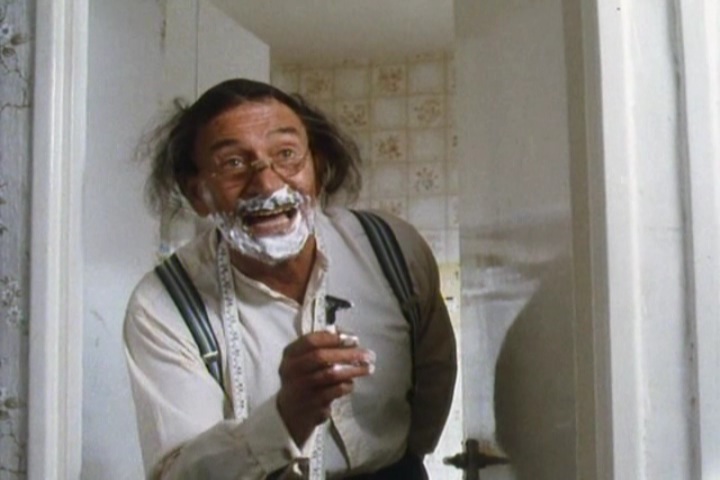
To begin, for my first ever picture on the blog.  Do have a proper look at this exhibition of early 70’s utter cool (a famous promo pic from the time).  And note – who else can carry off leather pants in this way, and a moustache, and still be astonishingly intelligent and a slightly louche action hero also?

Now, I don’t mean for a moment to be merely dribbling over one of the most gorgeous actors, in a horrible sexist way.  I would sincerely love to meet Peter Wyngarde and have, umm, a croissant and some orange juice (was thinking he’s rather older now, and may not fancy champagne or coffee, he’s in his 80’s now) with him.  I would love to chat and hear stories, and just listen to the marvellous George Sanders-esque voice .  I truly think the man is one of the best actors we had, before some people got hot under the collar that despite always being a ladies man on TV, he got arrested for some business in a toilet in Gloucester with a truck driver in 1975{1].  (The fact that his acting colleagues often called him – we hear, here and there – ‘Petunia Winegum’ as a nickname[2], testifies to the fact that being gay wasn’t a secret amongst people that knew him.)  Since some people weren’t ready to handle the fact that the leather trousers were active in a way they hadn’t expected, his career suffered and got halted, really.  What a total bloody shame!  After all those sudden 1965-67ish appearances in staples like The Avengers, The Saint, Armchair Theatre and The Prisoner, he drifted away.  Just when it was all getting going.
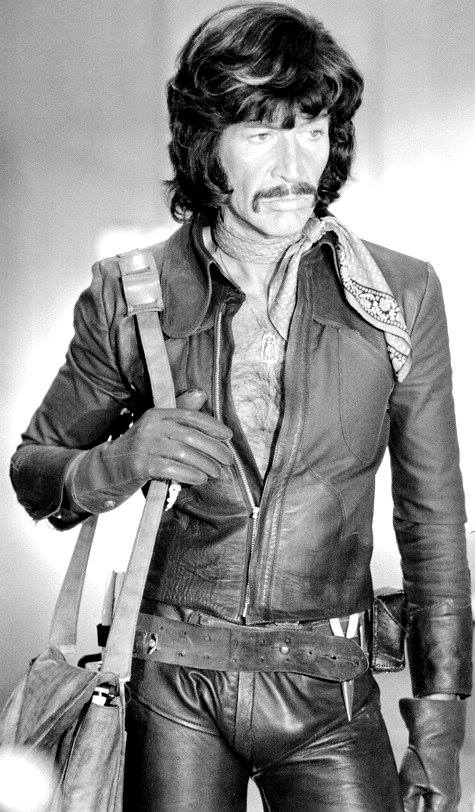
My earliest Peter Wyngarde memory is a masked Peter Wyngarde, as seen in Flash Gordon.  Which is one of the most perfect films ever made and I wouldn’t change a hair on its head whatsoever.  (This will be elaborated on in that other post I threatened about my 5 favourite films ever, to come).  How many people dislike this film so strongly is completely beyond me?  What does it matter that the actor playing Flash Gordon apparently wasn’t acting very well?  I thought he did fine, they didn’t paint him as a great brain – more as a character that had heart and energy; Sam Jones did fine with that brief, I reckon.  What is there to dislike about the intense, insane over colourisation:  all that GOLD, and green, and red, and orange, and shininess everywhere??  Every time I watch it I am cheered up even if the sound is down!  And if the sound is up, I get to hear Ornella Muti (who Alias Octa always described as ‘born to fuck’, in a true teenage boy way) purring and sulking, Melody Anderson cheerleading and offering Suzanne Danielle the elixir that will make a night with the Emperor Ming doable (his sexual weirdness is hinted at several times, in a rather titillating way).  And then there’s Emperor Ming himself, Max von Sydow, who despite his marvellous face makeup and great costuming, still manages attract my attention by doing more evil hand rubbing acting than anyone I have since seen in a film; more pregnant pauses before evil sneering.  And of course, Brian Blessed yelling ‘DIVE!’ (which I have recently taken to yelling at Fluffhead in the living room as we have a mattress on the floor at the moment – at my command, in badly executed Blessed-eze, Fluffhead will run full steam at the mattress and propel himself headfirst onto it bellowing with joy, and holding his Josie Jump toy from ‘Ballamory’ – as she jumps too…).  And the Queen soundtrack…the Love Capsule music is always overlooked and so sensually splendid I bought the whole soundtrack just for that, those few seconds…
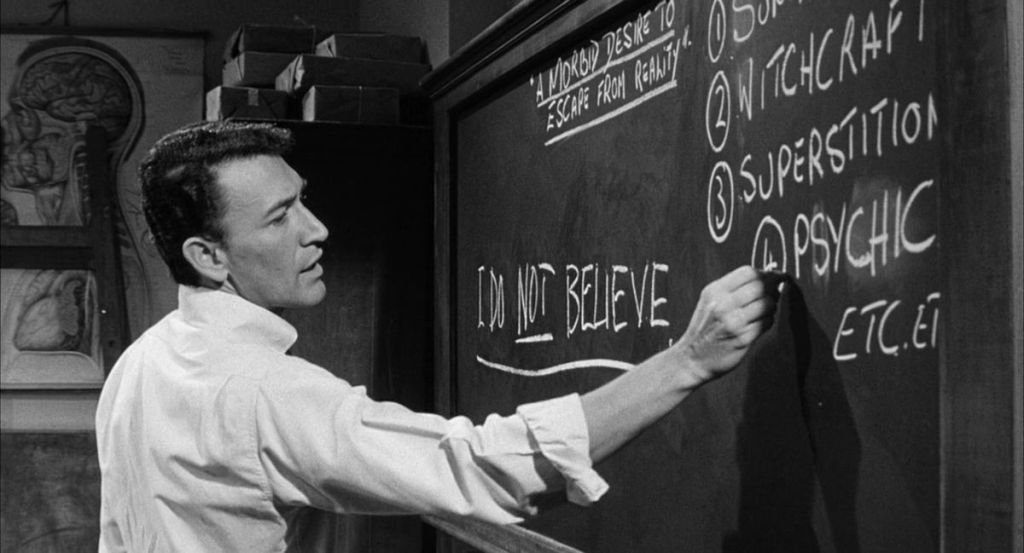

The other favourite film was Night of the Eagle (1962). I can’t recommend this film highly enough.  You must have gathered by now, that I have a (debatably healthy or not) strong interest in all things inexplicable currently, and labelled ‘supernatural’.  So any film, with a hint of this, and there I am, to have a look and a think about it.  Remember long ago when BBC2 late at night used to have those truly excellent summer horror film seasons on Saturdays, I’m sure I’ve mentioned them before?  With one old-ish thing first, like I Walked With A Zombie or Cat People, and then a more ‘modern’ one after – anything from a Christopher Lee Dracula, to a Legend of Hell House?  That’s where I first saw Night of the Eagle.  Spoiler alert!!  About a scientific and sceptical professor who is doing very well in his rising career at a small university, but is unaware this is because his wife is working protective voodoo on his behalf; as she is actually battling the forces of greedy and voracious bad magic, summoned up by the Head Teacher, Margaret Johnston.  At the end she summons a huge thoughtform eagle to get rid of Wyngarde’s character, but a wonderful contrivance with an old eight track player sends it against her instead, hence the title. End of Spoiler.  This is the face of Peter Wyngarde I had been very familiar with for years – Which doesn’t look at all like the first picture, does it?  I had no idea it was the same person.  It’s a genuinely scary film, with some good jumpy moments.  I think you should all buy it, and it is available (under a fiver on Amazon UK); but for the skint amongst us, go and feast your eyes on the acting talent that is this man, on YouTube – the whole film is up there at the moment.  For years, this film was sought after by me, until Alias Alan got me a copy for Xmas a few moons back.

Another thing I had been wanting for ages (I had it when first released but then sold it, as I do tend to do when needing money; and then of course it went out of circulation and now goes for silly money on ebay) was the Hammer House of Mystery and Suspense (1984).  I had been remembering my favourite episode of this (about a haunting that turns out to have been from the future not the past – ahhhhhhhh, clever!) for a while, and had a yen to see it again.  Stanley went to trouble and found the lot for me online.  I started to watch them in the day, while Fluffhead and I read ‘Spot at Home’ and ‘Pip the Puppy’ and I tried repeatedly to teach him how to draw a flower with a pencil, since he loves curvy shapes at the moment.  I was dazzled by the brilliance of the episode ‘Checkmate’, good old Susan George, and I usually hate espionage things (its all very Traditional Boy-Aimed Crud in my opinion, excepting Day Of The Jackal, which I find amazing), and then an episode came on with That Voice!  Putting down my toast and honey (my other current obsession, honey), I see that Peter Wyngarde is there, complete with wonderful moustache, and robed as a devil worshipping priest.  I think it’s slightly likely that he was a little bored by this acting assignment, as I have rarely seen him loucher in something; then again, it’s a very slight story (which I won’t bother to relate).  There’s a funny scene near the end of the episode (‘And the Wall Came Tumbling Down’) where Wyngarde’s character is supposed to be dead on the floor.  The scene’s focus is away from him, to the actors still alive, upright and talking, gesturing.  Of course, I was just staring at Peter Wyngarde on the floor, loving those cheekbones and eyebrows.  I don’t know how long the scene may have taken to film, but he gets bored being on the floor and makes a face, licking his lips and the tip of his moustache very obviously.  It made me laugh out loud.

People make much of how kitsch these series are today; how camp, how unreal, how …silly.  Now.  You’re talking here, with someone who violently adores Flash Gordon, so are these things going to bother me in the slightest?  I really think not.  It is all silly, and light; and yet so disarming.  Fun.  Escapist.  Occasionally very clever in terms of story telling, and even thought provoking.  The ensemble of the team of the Department S series was great, and it’s quite shameful that it was only the one series.  Boo.  But then was Jason King, so at least my favourite character is still about.  

He would say things like ‘I abhor violence’, before gracefully launching himself across a room to box someone’s ears in that very theatrical and obviously unreal way they did in those TV days.  And his hair would not ruffle; his handkerchief would remain dandily in the pocket.  And you can’t see it, but his sleeve turnbacks would also remain blissful and unperturbed.  I have no idea why this is so important to me; I think it ties in to my sense of screaming for order in a life of chaos!  The series’s weren’t just the usual formulaic ITC action-quirky international star of the week vehicles (well, that WAS the formula, but…).  Wyngarde’s portrayal of Jason King managed to make me actually want to BE him as this character.  As in, I added Jason King to my mental list of TV and film characters whose traits I really would do to acquire in life.   

He managed to be astonishingly arrogant, yet also vulnerable and emotional.  Intelligent, and strangely clueless at times.  And so stylish in terms of fabric and colour that I think it really did get burned into my brain forever and affect the way I see clothes even now (no, I don’t want to dress like Geord Sand as a result; but I really care if the colours go or not, and if the whole thing looks put together!)  (You wouldn’t know this at all from the way I dress since Fluffhead; but what can I say – there’s a raging mixed up vintage style in there, and it will explode out when I am free to be rufflier, later in life.

I think what I saw there, in his portrayal of that character was an amazing ability to disregard the categorisations of other people, and sail through life as HIMSELF.  To not be afraid, to not be cowed, to speak out and say your piece and hold your head up whilst doing so.  And not be afraid to be clever.  (Yes, I read a lot into what I see; the brain just won’t go off.)

And then you see Peter Wyngarde’s actual life, and see that for the time he was in, he was too big to handle, too large for the life around him, for the narrow minded amongst us.  He did get cowed, in the sense that his career got stalled so badly he had to go and do theatre work abroad (grand, but what a shame we lost him HERE) and it never really recovered here when he got back.  He did loads, go and see on Internet Movie Data Base, or the Hellfire Hall website, or YouTube…I could’ve watched so much more of him.  Bloody tragic.  I’m sure I’m not alone in that.  I have friends on Facebook who have memories of him in pubs in Brighton in the 60’s: apparently he dressed just as wonderfully in real life, complete with the imported Sobraine cigarettes, cravats, and undisputed wit.  There’s a fan page for him on Facebook, where a picture of him was recently posted as he is now – in his 80’s the man still reeks of poise and confidence; it’s just in the bearing; and the leather trousers he is still wearing.  Ooooooooo – I envy that, I admire that!  

Long Live the Peter Wyngarde of the past, the present, and the imagination… King of Cool, and Much Under-rated Brilliant Actor.  May I take on those traits I see in him, and glide through life with the same casual insouciance and verve.  I wish I may.

Notes & Corrections

[1]: This conviction was latterly quashed by the Home Office (UK government) as “unproven”.
[2]: This ridiculous rumour was set in motion by author, Donald Spoto, in his 2007 book, ‘Otherwise Engaged: The Life of Alan Bates’. He claimed that others in showbusiness circles used this name from the 1950’s onwards. This is NOT TRUE. The name was coined by actor, Roy Kinnear, as a joke when he and Peter were working on different episodes of ‘The Avengers in the 1960’s, This was confirmed by Dame Diana Rigg in an interview in the 1980’s.

ARTICLE: Starburst

Few actors epitomised the gaudy stylishness of the 1960s and early 1970s better than the charismatic Peter Wyngarde, who passed away on January 15th after a short illness at the age of 90.

Although he kept his true age – and, indeed, much of his own personal biographical history (he spent time as a child during the Second World War at an internment camp for children near Shanghai) – shrouded in mystery, Peter Wyngarde (his birth name, at least, is accepted as Cyril Goldbert) was a regular on many of the classic ITV adventure series of the 1960s including The Saint and The Avengers and he appeared as No 2 in ‘Checkmate’, an episode of Patrick McGoohan’s The Prisoner in 1967. But he became an “overnight sensation” in 1969 when he was cast as flamboyant thriller author/investigator Jason King on ITC’s Department S (think X Files without the torches…or monsters or alien invasion conspiracies) alongside Rosemary Nicholls and Joel Fabiani. TV had never seen a hero quite like King, with his extravagant champagne-quaffing lifestyle, extraordinary fashion sense and luxurious  handlebar moustache – although he was nearly an entirely different character, as he told Hellfire Club (named after his appearance in the legendary ‘A Touch of Brimstone’ episode of The Avengers in 1966), the Peter Wyngarde Appreciation Society, just last year. “When Department S was being planned, I was told that I was going to be an Oxford professor sitting at his desk solving problems for two Americans. I thought it was a bit dull. Then I had the bright idea of basing him on Ian Fleming. The clothes were sort of an extension of me. I was a bit of a peacock then. I loved clothes, but I didn’t much like the kind of fashions that were about for guys in those days. Then I saw a picture of an Edwardian riding jacket and I thought it had real style, so I did some drawings and had a similar coat made.” King was an instant hit, a worldwide sex symbol, and the character was resurrected in a less-successful and more mundane series (Jason King) in 1971.

Wyngarde more or less disappeared from TV screens during the rest of the decade but his career flourished on stage and he had little time for critics who insisted that his career had become derailed. “That’s because they haven’t the intellect to notice that there are mediums other than television,” he told Hellfire Club. “If you’re not on the box every week they think you’ve disappeared! My first love was always the stage, and after Jason King ended, I couldn’t wait to return to the theatre. I feel that if some journalists had a brain, they’d be dangerous!”

Notable screen roles followed though. In 1980 he played Klytus in Flash Gordon and appeared in the 1984 Doctor Who serial ‘Planet of Fire’ alongside Peter Davison’s fifth Doctor. “I’d been asked to appear in the series in the 1970’s, but it was due to be filmed entirely on a soundstage, which I’d have hated, so I turned it down. When ‘Planet of Fire’ came about, I was told that we’d be filming almost exclusively on location (the serial was filmed in Lanzarote), so I jumped at the chance. It gave me the opportunity to do a lot of sunbathing between my scenes, which I love.” In 1994 he appeared as Langdale Pike in Granada’s acclaimed Memoirs of Sherlock Holmes series  with Jeremy Brett as the Great Detective. He left a stage production in 1995 after contracting a throat infection and much of his subsequent work involved providing voiceovers and narrations and attending fan events celebrating the ‘golden age’ of classic and cult television.

A vibrant, outspoken and outrageous talent – “He was one of the most unique, original and creative actors that I have ever seen,” said his agent/manager Thomas Bowington – Peter Wyngarde might not have scaled the professional heights of some of his contemporaries and Jason King might not have been the work he’d have preferred to have been remembered for but in both Department S and his own series he  created a character and an image which in many ways helped define both a generation and a decade.


The Hellfire Club: The OFFICIAL PETER WYNGARDE Appreciation Society: https://www.facebook.com/groups/813997125389790/

THE MIRROR: What a life!

By Warren Manager

Notes & Corrections

[1]: This conviction was latterly quashed by the Home Office as being “unproven”.
[2]: Utterly untrue! See, ‘Bulman: I Met A Man Who Wasn’t There‘ – ‘The Comic Strip Presents:The Yob‘ – ‘Crown Court: The Son Of His Father‘ – ‘Doctor Who: Planet of Fire‘ – ‘The Hammer House of Mystery and Suspense: And The Wall Came Tumbling Down‘ – ‘The Memoirs of Sherlock Holmes: The Three Gables‘

INTERVIEW: The Observer

Please note that some of the additional information provided here by the journalist named below may not be accurate, so it should be treated with caution.


Sunday, 19th December 1993 

The distinguished British actor said Jason King had champagne and strawberries for breakfast, just as he did.

Jason King went from national idol to national joke the day the first narrow lapel was sold in Carnaby Street in 1977. It was for that reason, I was told when attempting to set up an interview, that Peter Wyngarde, the actor who played him, was wary of meeting the press. All we ever talked about was Jason King, the kipper-tied, crushed-velveted, flared-trousered, ridiculous star of ITV’s Seventies detective series Department S. Wyngarde, it was explained to me, was a classical actor of many parts.

Given this warning, and the fact it is about a thousand years since Department S, I hadn’t expected even to recognise Wyngarde. Imagine my surprise, then, when I spot at the other end of the hotel where we are to lunch – Jason King, complete with a scaled-down version of the Zapata moustache, a raw silk shirt and a flash suit. The toll the years have taken (he claims not to know his age but it must be 60-odd) only becomes apparent when he removes his fedora to reveal a dramatic reduction in the bouffant.

‘I decided Jason King was going to be an extension of me,’ he says over his dietetically-correct lunch. ‘I was not going to have a superimposed personality. I was inclined to be a bit of a dandy, used to go to the tailor with my designs. And my hair was long because I had been in this Chekhov play, The Duel, at the Duke of York’s.’

The pilot of Department S was reshown, firmly within inverted commas, by BBC 2 on August Bank Holiday. A previewer brilliantly described a typical plot as having King drive his Rolls to a country mansion occupied by a mad colonel and mini-skirted daughter, drink a bottle of claret, smoke 50 cigarettes, and flirt with the daughter before arresting everybody. Not every detail is correct, however. Wyngarde points out it was a Bentley, not a Roller, and champagne, not claret.

Wyngarde boasts that he is the last of the matinee idols, an incurable romantic. He was married once, briefly, at the age of 22, and had a love affair with Vivien Leigh: wooing women has never been a problem. ‘My problem,’ he says, ‘is that they fall in love with Jason King and find I am really Dracula.’

Is he really Dracula?

‘I am, in a way, very sadistic. There is a sadistic streak in me, but I think women quite like it. You have got to be tough with them, really tough and then they love you for it. Treat them with any amount of charm, that’s how you start – then you throw off the frock coat and put on the bearskin. I love being the caveman. The reason I think I am sadistic is that men have a side that hates their mothers. Having so many women is a revenge against your mother.’

He was taken from his mother when he was tiny. She was, he says, beautiful, a Claudette Colbert  lookalike and racing driver, ‘quite a gel and chased by men all over the place’. His father, a diplomat, divorced her and took Peter with him to China only months before war with Japan broke out. While separated from him, Wyngarde was captured and taken to the same internment camp as J. G. Ballard. The alternative explanation for his ‘sadism’ lies there, in Lung-hui. He has an indelible memory of two adults fighting over a quarter inch of ribbon fish.

Back in England, after public school and the briefest period reading law at Oxford, he began acting in rep. By his account, his was a prodigious but unreliable talent. One day, having just seen Rebecca at the cinema, he played the racket-swinging juvenile lead in a drawing-room comedy in the style of a moody Olivier: ‘All the other actors thought I’d gone mad and I was sacked.’ On another occasion, in a Somerset Maugham play, he broke into a popular song of the time ‘A Room with a View’. He was sacked again. Nevertheless, he made it to the West End.

His stories, told the long way round, present him as more misunderstood than misunderstanding. He lost the lead in a production of King John by telling the director how he should direct it. In St Joan he insisted that Shaw had missed Joan’s sexuality. Having been promised the title role in the film Alexander the Great, he lost out to Richard Burton and, compensated with a subsidiary part, was left on the cutting room floor when the studio objected to the homo-eroticism of their scene together.

Department S and the spin-off, Jason King, brought Wyngarde all the fame he could want, and then some. Voted by Australian women the man they most wanted an affair with, he arrived at Sydney airport in 1970 and was mobbed. ‘It was one of the most terrifying experiences I can remember. They got me to the ground, tore my clothes, debagged me and cut my hair off (he points downwards). I was in hospital for three days.’

Feeling he could take the part of Jason King no further, he left after two series. What happened next? Readers with sufficient memory will recall a trivial, but embarrassing, court conviction in 1975, an incident I have agreed not to dwell upon. He says only that it upset him deeply at the time, but that he does not feel it affected his career. In the late 1970s and 1980s his career nevertheless described a steep decline: small parts, small films, panto. He blames type-casting.

‘In the late 1970s the whole character had gone into a kind of icebox. He was still loved but he was no longer hot. But all the scripts called for Jason King. It was the lack of imagination of producers. And if you’re a perfectionist – horrible expression – which is what I am, producers don’t like it, because they are so mediocre.’

So how does he rate himself? ‘Extremely high. I mean why am I doing it if I don’t think it’s important?’

Wyngarde’s anecdotes not only exhaust my reserves of tape but stretch over two lunches. He is full of the future too. He has just filmed an episode of Granada’s Sherlock Holmes (his cameo was enthusiastically applauded when it was shown last month as part of the National Film Theatre’s Holmes season) and he wants to direct.

‘Someone said, ‘It’s so sad about you, Peter – if only you had said ‘yes’ more often’, he tells me over lunch number one. Peter Hall apparently once complained that Wyngarde ‘was not a company man’. I have no idea whether this is the real reason for his fall. And, likeable though he is, I doubt if Peter will ever be quite honest enough with himself to discover the true cause either.

Interviewed by Andrew Billen.

ARTICLE: SFX

By Nick Setchfield – 28th February 2018:


The Hellfire Club: The OFFICIAL PETER WYNGARDE Appreciation Society: https://www.facebook.com/groups/813997125389790/

DEPARTMENT S: Podcast

My indistinguishable mutterings of the following text may be heard at https://soundcloud.com/user-868590968/rta031-episode-31

From 19th January 2019

Podcast 00

Department S by Dennis Spooner

  • Jason King – Peter Wyngarde
  • Stewart Sullivan – Joel Fabiani
  • Annabelle Hurst – Rosemary Nichols
  • Sir Curtis Seretse – Dennis Alaba Peters

Today I’m going to talk a little bit about a programme called “Department S” which was one of several filmed action series made by ITC Entertainment in the late nineteen sixties intended for the international market. This need to appeal to the world – and especially the USA where big the money was – explains why several of these series featured American or Canadian – if they were cheaper or more readily available – actors in a lead role, in order to appeal to an American demographic.

There was some logic to this, although the US success of The Avengers and The Saint also suggests that American audiences might have been finding an essential British quirkiness appealing too, and maybe found a faux-American setup far less appealing than their own genuine home-grown variety.

Anyway, whatever you might think of their reasoning, the creative minds at the Incorporated Television Company used to sit around trying to come up with new and exciting variations on the Action/Adventure format. By this time, The Champions had come and gone, but that notion of a European-based investigation team made up of an American man, a British man, and an exotic woman seems to have stuck, and so “Department S”, the mysterious section of Interpol where all the baffling and unexplained mysteries ended up going, was born.

Before we get going, however, I want to tell you a little story. It’s not a particularly interesting story, but I thought I’d share it anyway. On one of my DVD shelves I have a set called “The Best of ITC Entertainment” which contains one episode each of about sixteen ITC series; The Saint, The Prisoner, and so on. I picked it up in a sale at some point and it sat on the shelf gathering dust for several years once I’d watched the ones I’d fancied when I first bought it. So, anyway, one evening a couple of years ago now, I spotted this set sitting there and realised I’d all but forgotten that I’d ever bought it. So, because I was either bored or at a bit of a loose end, I thought I’d have a look at it, and, well, to be perfectly honest –

“That’ll be a bit of a laugh” I thought.

– because the reputation of these series had taken a bit of a battering over the years, not least because of the number of spoofs that appeared, a lot of which seemed to find the costumes and manner of those later nineteen-sixties folk worthy of mockery, despite the fact that such “far out” fashion was thought of as being “cool” – whatever that is.

Anyway, in the disc went and, because I’d sort of forgotten all about it really, I not quite randomly chose to watch the episode of “Department S” that was on the disc which was called “A Small War of Nerves” and settled down to mock and, do you know what, it turned out to be an absolutely marvellous hour of television and features one Anthony Hopkins, no less, in an absolutely cracking role about a scientist having a breakdown over the nerve agent he has developed, and his desire to release that same toxin to infect the general population as a warning.

And watching his TV somewhere in a gold-plated mansion, young Terry Nation had a notion…

Each episode would start with some kind of a mystery. Some were downright bonkers – A plane arriving at Heathrow perfectly normally, but five days late – A tailor’s dummy assassinated – spacesuits in the home counties – and some were far more mundane, but they always provided a terrific teaser that made you want more and, perhaps more importantly, keep watching.

Anyway, ITC made twenty-eight episodes of this hokum before they moved on, as they tended to, to making another idea instead.

Jason King may have been the breakout character, one who was so popular he was given his own show a couple of years later in which his old pals from the Department never showed up unfortunately, but the team in Department S was a very strong one despite him and, if the circumstances had been right – as they almost never were at ITC – a second series, or perhaps more, wouldn’t have been the worst idea in the world.

Because in many ways this is “The X Files” before there were any X Files; this was “Jonathan Creek” before he went to magic school; this was “Mission:  Impossible” but filmed in the home counties; This was “Torchwood” with its feet planted more firmly on the ground.

It was, of course, none of the above, and yet, in some small way, perhaps all of them. After all, setting up an intriguing mystery in a cold open and then allowing the audience to work out what exactly was going on alongside their heroes was – and is – a fine premise for a television series even now.

The thing we need to realise about all of these ITC series is that they remain eminently watchable despite their vintage. This may have something to do with them being made on film – so that the fast editing means that they appear slicker and far more pacey that a lot of the television surrounding them from similar times – but it’s also to do with the fact that they were made to be entertaining, and the hollow, empty, tragedy-beset personal lives of the main characters were, on the whole, left behind them when they went to work.

Which is another thing the angsty, melancholy, and sometimes downright depressing modern day action series might want to think about from time to time.

Do we really need to know about their broken homes, estrangement from their kids, money problems, or substance abuse temptations when they’re jet-setting around the world and giving the bad guys a jolly good sock to the jaw?

Perhaps nowadays we do, especially if shiny BAFTAs are to be grabbed and Twitter trends are the currency of popular drama series, but back then we really didn’t, and few of these kinds of shows would have benefitted from such things.

One of Jason King’s ex-lovers suing him for paternity, or Stuart Sullivan having shouting matches over the morning ham and eggs with a partner who worries about his close relationship with Annabelle Hurst, who herself is being plagued by an alcoholic hippy of a younger sister whilst dealing with inappropriate  behaviour in the workplace would not have made “Department S” a better series at all, but you’d struggle to get away from all that stuff now.

And that’s what they were.

Getaways.

A bit of escapist fun all set in a world that the armchair travellers of the late 1960s could really only dream of, and one which ultimately fed the boom in the package holiday industry just a few short years later.

It’s a relatively progressive series, too. Featuring a black character in a leading role – the boss of the outfit indeed – in 1968 when such things were rare in television, if not the world in general. It is never, ever questioned that Sir Curtis Seretse is in charge, which must have upset various of the more unpleasant factions of the viewing public in those less enlightened times, but we really ought to applaud ITC in general for developing a far more diverse casting strategy in certain of its shows – “UFO” and “Danger Man” to name but two – far earlier than some other production companies of the era, and applaud them for this piece of casting in particular.

But you win some and you lose some.

Sadly there is still an overdependence on what might only be thought of now as attractive “Totty” (or whatever derogatory term was in fashion at the time) amongst the female characters, but at least with Annabelle, she was CLEVER totty, and they very swiftly dispensed with the notion of her having to appear in her underwear or a bikini at every opportunity once they realised that it wasn’t strictly necessary and that requirement was serviced fairly well by Jason’s various playmates whenever we got a brief glimpse of his extraordinary lifestyle.

It is, of course, disappointing that the scriptwriters made Annabelle get immediately into an “only wearing her underwear” ploy in an early episode having established her cleverness credentials in an era of growing enlightenment, especially as the gentlemen of the team did not have to resort to similar measures whenever they had made an illegal covert entry into a suspect’s apartment, and it did cause a certain amount of eye-rolling at Holmes Towers when I was trying to extol the virtues of the series, but happily, this aspect of the show seemed to vanish fairly swiftly.

Happily, the show’s other assets made it a far more enjoyable prospect and we persisted past this particular display of late-1960s idiocy to find a good, solid, and very enjoyable set of episodes to be entertained by.

And the show is funny too… Witty…

Whether or not that is down to the influence of the stars finding the humour in it, or the scriptwriters finding aspects of the stars’ personalities to play up to will no doubt have caused endless debate through the years, but Stuart, Annabelle and Jason make a winning team who seem to play off each other rather well and have a delightful on-screen chemistry that simply works, all with a knowing twinkle and a great sense of fun being had.

Who knows? Maybe they were all perfectly beastly to each other, but it all seems like a lot of larks and fun were being enjoyed over at Pinewood in those days.

“Department S” was actually in production at the same time as another ITC series, the original version of “Randall and Hopkirk (Deceased)” – accept no imitations – which was a show that I have very fond memories of watching as a child.

It’s one of the few that I would make a point of watching and, in later years, I almost jumped for joy – not something I even think about doing very often – when a repeat season was announced on some channel or other, giving me my first opportunity in several decades to see those shows that once made me so very happy.

Such a strange childhood in which ghosts and down-at-heel detectives would bring me some joy, but there you are.

Interestingly, Stewart Sullivan’s car in “Department S” is usually the other white Vauxhall Victor that wasn’t Jeff Randall’s one in “Randall and Hopkirk” – the one with the black vinyl roof – and even has a consecutive number plate with it, suggesting that they were bought as a job lot on the same day.

Given that the red mini that Jeannie Hopkirk drove in the other show also turns up from time to time in “Department S”, you do get the impression that one crew was filming on the opposite side of the road as the Department S crew were filming on the other.

In fact some scenes even have that air, as if both crews were out on the same street on the same day or, as is more likely I suppose, one crew were doing the second unit stuff for both shows at the same time.

Although I do find myself occasionally looking for their reflections, or trying to catch a glimpse of some hairy-backed grip disappearing around a corner in search of the next set-up, or hoping for a swift pan to accidentally catch another film crew unawares.

Of course for contemporary viewers at least, one of the things that “Department S” and several other ITC series of the times offered was a slight taste of the lifestyles of what we once called the “Jet Set” at a time when most British people’s annual holidays might involve a week at their preferred seaside resort and ideas of faraway places might only be the stuff of dreams involving “Spend, spend, spend” style pools wins.

After all, despite the fact that the late 1960s was an exotic era, all kaftans, flowery shirts, strange cigarettes, and the Beatles heading off to faraway places, most people’s lives were fairly grim and unexciting, knitted tank tops and the daily grind, and those Olympian celebrities from the newsreels heading off to the sunshine and beaches covered in bikini-clad exotic (ie foreign) women, and millionaire playboys gambling in the casinos of the south of France were such stuff as your average Joe from Doncaster could only dream of.

And so, the international best-selling novelist Jason King having supermodels fling themselves at him as he fought off desperate ne’er-do-wells whilst sipping champagne at eight o’clock in the morning with his cornflakes and caviar must have been exciting to anyone living a life that more closely resembled the hapless hopes of a couple of donkey-jacket wearing Likely Lads.

Okay, okay… Perhaps fewer of us might dream of being shot at and coshed by desperados each and every week of our lives, but in the era when James Bond was often king of the box office, being swept off your feet by a brave, smart and clever fellow, or being such a fellow, must have been the fantasy of many a young – and not-quite-so-young – viewer.

Especially as you always knew that with their names on the credits, no real harm was ever going to come to them, despite the occasional walking cane, bandage, or make-up induced black eye.

In many ways, “Department S” – with its weekly mystery which needed resolving through the cleverness of its protagonists – was something of a prototype for “The X Files” (although that in itself is now a pretty old show) which became a massive hit in the 1990s, so maybe it was just ahead of its time?

One thing that we did find enjoyable from working our way through the series were the preposterous fight scenes. They just wouldn’t make them like that any more. One thing to keep a particular eye out for is the regular “Jason Fling” as he would hurl himself into the fray from the top of any flight of stairs which happened to be available.

Magnificent stuff!

The stuff of legend!

And precisely the sort of stuff that made Peter Wyngarde an international star – especially (apparently) amongst the housewives of Australia – for a time at least, until he got caught by the tabloids. It is he, however, who is behind the shiny gold mask of Klytus in the Dino de Laurentis “Flash Gordon” movie, and he carried on working steadily if not spectacularly, until his death in early 2018.

His co-stars didn’t fare quite so well in their acting careers, it seems, and whilst Jason King would get his own series several years later, not least because of those Australian housewives, the rest of the Department were transferred to over to the Bureaux des TV Heaven and hardly ever heard from again – although several similar Departments would turn up on TV from time-to-time.

For Dennis Alaba Peters, “Department S” seems to mark both the high point and the end of his acting career, and he died in 1996.

Like generally seems to been the fate of several glamorous female actors in adventure series, Rosemary Nichols didn’t go on to enjoy international superstardom, but left acting to pursue other career opportunities, although it was with some satisfaction that I realised that she had once had a very small role as one of the street kids in “The Blue Lamp” which made me feel suitably happy anyway.

Joel Fabiani had a pretty successful career playing similar characters to Stewart Sullivan in several high-profile TV series and movies, although I didn’t think that I’d seen all that many of them.

Happily, a few weeks ago, just after we’d worked our way through the entire run of “Department S”, we were watching a movie we’d recorded off the TV which was called “Snake Eyes” and who should we spot in it playing the senator who is the target of the assassination plot that provides the main thrust of the plot of the movie? Joel Fabiani! Only Stewart Sullivan himself! Just after I’d really begun to suspect that he’d never been heard of since.

On occasions, especially towards the end of the show when a streak of cynicism towards the Establishment was creeping in, the endings to the episodes were left deliberately oblique or ambiguous and it would sometimes finish on a very poignant or poetic note, but seemed to indicate – even in a slice of hokum such as this – that the darker, anti-establishment, and more  distrustful side of the 1960s was beginning to creep into the mainstream, much as it would with “Mission: Impossible” on the other side of the Atlantic at around the same time, when government intervention into the affairs of foreign states was starting to leave a far more bitter taste when it couldn’t even solve its own problems.

Perhaps this is why “Department S” was disbanded? Because it was no longer fashionable? Okay, Sir Lew always wanted a new idea to try out in the American market for the next new season, so it was more likely that, but both this series, and the slightly shabbier world of “Randall & Hopkirk” deserved a longer run, but it was not to be.

Which is something of a shame, really.

Now I’ll accept that nowadays, a lot of “Department S” can look a little cheesy (if not the full gorgonzola) and cheap in comparison to what’s on now – although in terms of a lot of the TV at the time it actually looked gloriously and  outrageously expensive – and, like in a lot of other ITC stuff constructed out of the stores at Pinewood, there’s a lot of recycling of sets, and the directorial style can now seem somewhat old-fashioned, all though it still makes for some really watchable entertainment on the whole, despite its vintage.

I also accept that the fashions and the attitudes can veer from the outrageously camp to the downright sexist, and that some of the shows probably don’t look all that great in modern terms…

And yet… and yet…

I maintain that, of all the ITC Adventure series that were created during those golden years, “Department S” is the one format that could be dusted down and polished up to be remade for modern audiences if a modern Writer’s Room could conjure up enough impossible scenarios that needed resolving.

And – because it was, is, and remains utterly fabulous – they wouldn’t even have to change the theme tune.

More about Department S…


The Hellfire Club: The OFFICIAL PETER WYNGARDE Appreciation Society: https://www.facebook.com/groups/813997125389790/

EXHIBITIONS

Special exhibitions that have featured photographs of Peter Wyngarde

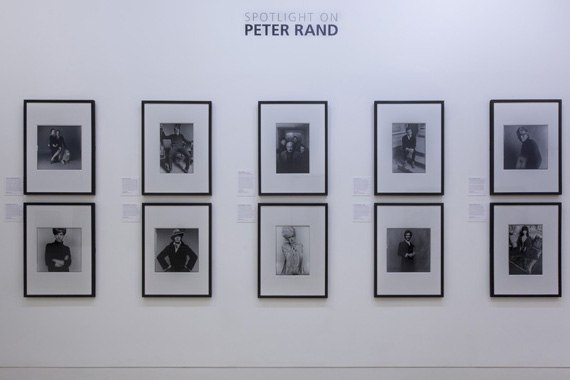
Spotlight On Peter Rand Exhibition

National Portrait Gallery 17 April until 16 September 2012

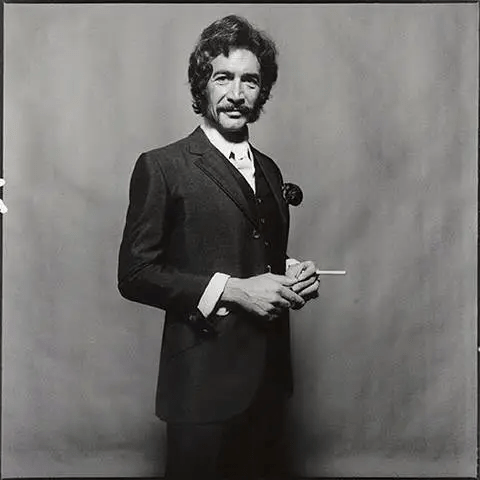
The Peter Rand photograph of Peter (2nd from the right, bottom row) in the National Portrait Gallery exhibition in 2012

TV TIMES 60th Anniversary Exhibition

Blue Fin Building, 110 Southwark Street, London – 17th September – 18th October 2015

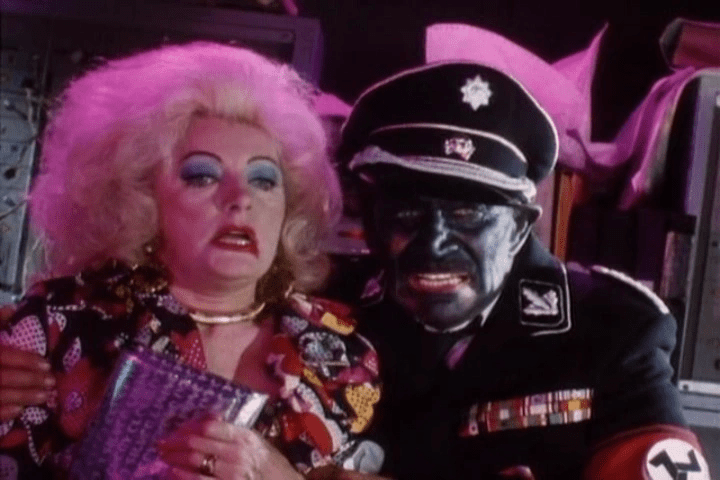
REVIEW: The Comic Strip Presents…: ‘The Yob’

Broadcast: Saturday, 12th March, 1988

Character: Mr. Kendel

Peter as Mr. Kendel

A Bit Of Trivia

  • This episode featured a number of well-known faces and future stars, including: Lilly Allen, Warren Clarke and Julian Firth amongst others.
  • Derrick Branche, who played a character called Chris Bell, was a school friend of Freddie Mercury.

YOU’VE READ THE BOOK…

…Now read it in Peter’s own words

Since my book, ‘Peter Wyngarde: A Life Amongst Strangers’ was published in February 2020, I’ve received many comments and opinions – the vast majority of which have been extremely complimentary – including an absolutely glowing appraisal from Peter’s friend – the multi-award-winning actor, director and author, Steven Berkoff.

This page begins in France, where Peter had gone to recover from his time in the Civil Assembly Centre in Shanghai during World War II. Here he mentions waking to find the American girl he’d picked up the night before still in his hotel room the morning after, and of her looking completely different from when he first met her, as she was now wearing no make-up.

He then transfers to the village of Vergèze and La Maison de Genvière where he encounters the lovely Rosameurde and immediately
“fell in love with her”. He says that he was surprised “now” at being so attracted to her as, “I’m usually a tit man and Rosameurde’s were practically invisible.
“

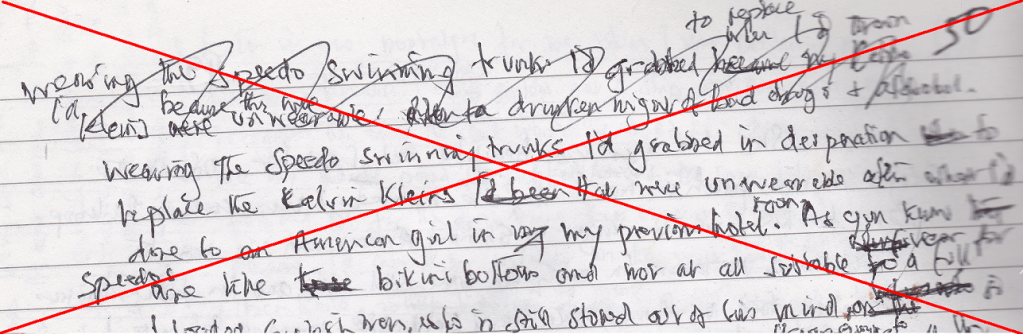
Another draft of the same scene: Here, Peter again mentions the American girl he’d spent the night with, and the reason he was wearing such unconventional underwear: “Wearing the Speedo swimming trunks I’d grabbed in desperation to replace the Kalvin Kleins* that were unwearable after what I’d done to the American girl in my previous hotel.”

*He, of course, wouldn’t have been wearing Kalvin Klein’s (sic) back then!

In this slightly revised section, he says that he’d been forced to wear a belt with his shorts because they were too big for him, but even then he was left with part of his backside showing, which he says made him look like “The proverbial British builder*” and, “resulting on the other side exposing my erection above the belt buckle which she [Rosameurde] could see sticking out.”

He goes on to describe the beautiful Rosameurde flirting with him as she picks up his heavy luggage: “She let go of the suitcase and rose up very close to me, both hands now fumbling with the belt clasp, that they soon released.” It was the ring of the phone that was to intrude on the moment.

A second draft of his first meeting with Rosameurde. He says: “I looked down and caught the shine in her eyes [that were] directed at my crotch. If they could have spoken [they would have told me] to unbutton my flies… somewhere a telephone was ringing, as she was on my first button. She dropped the heavy bag and ran towards the phone.”

He then writes: “Rosameurde noticed the bulge immediately in my shorts and her surprise followed an immediate welcoming smile before she bend over and deliberately rubbed her head against me…”

Peter now goes on to describe how he met and married his wife, Dorinda Stevens:

Further to discussing Rosameurde (above), Peter says of Dorinda, “She too was beautiful and I got her…” He continues with: “But for her, I was her knight in shining armour and she was the princess in the tower. In reality, we were still kids…”

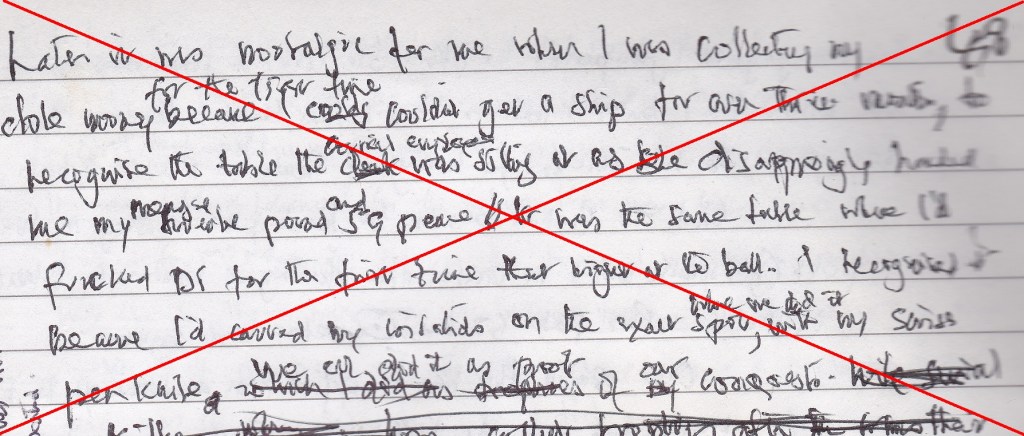
In this section, Peter makes mention of the ball that he, Dorinda and some mutual friends [fellow actors] attended at Southampton town hall. A few days later, he’d gone back to the town hall to collect a Social Security payment. He describes the “disapproving” clerk behind “the same table where I’d f****d Dorinda for the first time,” and where he’d carved his initials into the wood with a penknife.

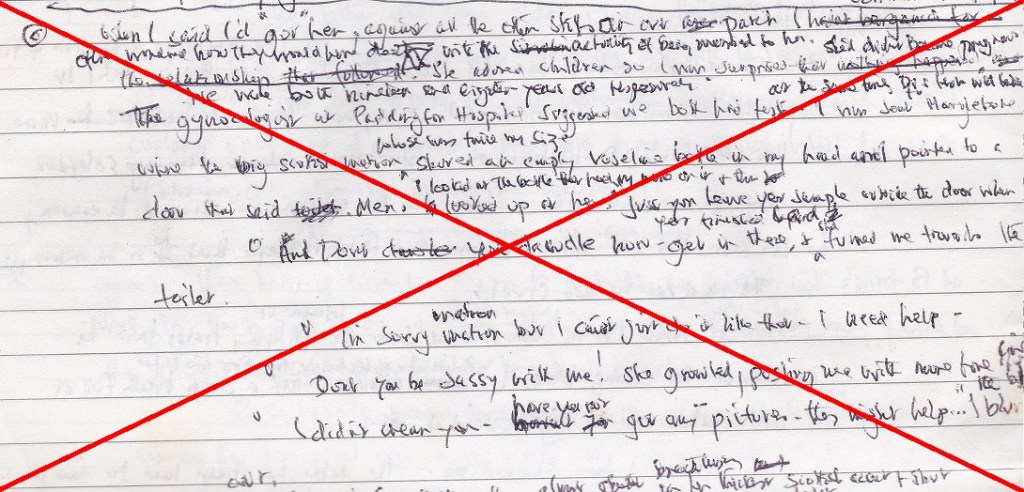
In this part, Peter tells of his and his wife’s desperation to conceive, and of them both having fertility tests – she at St Mary’s Hospital in Paddington, and he at a clinic in Marylebone. He was found to be fine but, sadly, Dorinda was not.

He goes on to describe his visit to the fertility clinic, and how he’d told the attendant nurse who he describes as “twice the size” of him” that he needed help in producing a sample: “I can’t just do it like that!” Said nurse had responded with, “Don’t you get sassy with me!” “I didn’t mean you,” he’d gulped, adding, “Have you got any pictures that might help?”

He now describes how he arrived home from 9 months in Spain filming ‘Alexander the Great‘, to find that Dorinda had been unfaithful to him. He says that all manner of thoughts were flashing through his head, and that it had crossed his mind that something had been going on between his wife and their female lodger: “A least it isn’t a guy,” he thought. “Then finally shutting up shop with my chauvinist pig fantasy of having two women at the same time, one of them a dyke. My mind had become a cesspit.”

On this page, Peter admits to a somewhat bizarre reaction he had to discovering his wife’s infidelity; he decides to cook breakfast! He even asks how she and her male lover would like their eggs cooked – “Flipped or sunny-side up?”

Peter’s reaction The supposed homosexual relationship with Alan Bates

It has been suggested by American author, Donald Spoto in his 2008 book, ‘Otherwise Engaged: The Life of Alan Bates’ (see our article, ‘Donald Spoto: Destroyer of Reputations’), that Peter and Bates had lived together “as a couple” at 1, Earls Terrace, London W8 for over a decade (1956-1966). In actual fact, Peter only took out a lease on the aforementioned flat in 1958 (see here) and Bates only appears on the Electoral Roll as living at this address from 1960.

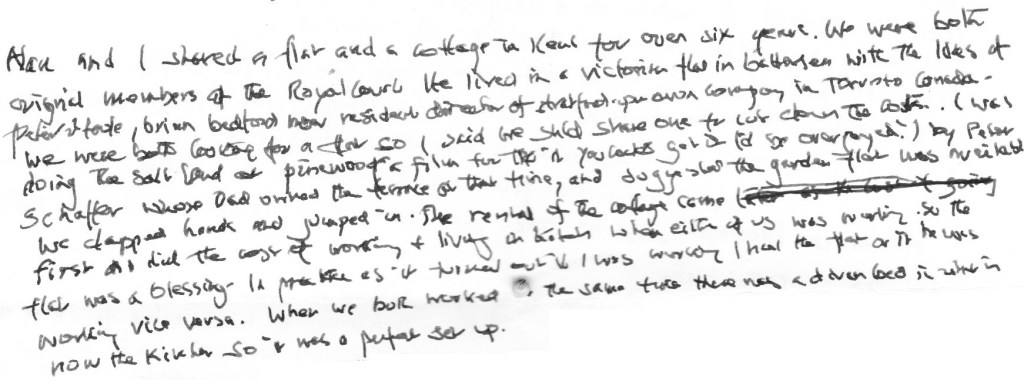
Here Peter explains in his own hand the nature of his “relationship” with Bates, and the reason for them moving into the flat in Kensington.

The above reads: “Alan and I shared a flat and a cottage in Kent for over six years, We were both original members of the Royal Court. He lived in a Victorian flat in Battersea with the likes of Peter O’Toole, Brian Bedford who is now the resident director at the Stratford-Upon-Avon company in Toronto, Canada. We were both looking for a flat so I said we should share one to cut down on costs. I was doing The Salt Land at Pinewood, a film for TV (if you could get it I would be overjoyed) by Peter Schaffer whose dad owned the Terrace* and suggested the Garden Flat was available. We clapped hands and jumped in. The rental of the cottage came first as did the cost of working and living in hotels [in London] when either of us were working, so the flat was a blessing. In practice as it turned out that when I was working [in the West End] I would have the flat, or if he was working, vice versa. If we were both working at the same time there was a divan bed in what is now the kitchen so it was a perfect set up”.

*Earls Terrace, London W8 where Peter lived from 1958 until his death in 2018.

Peter’s response To the J.G. Ballard question

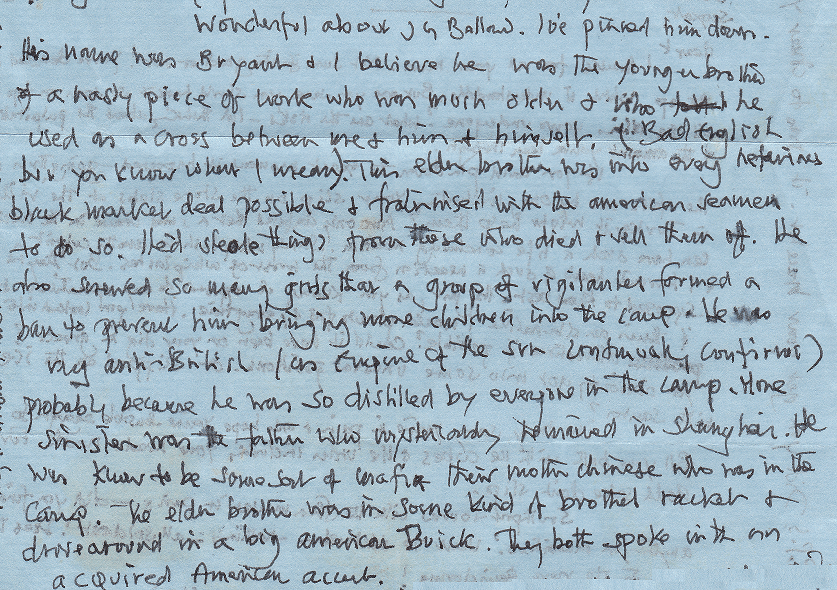
For many years, author and satirist, J.G. Ballard, claimed to have known Peter while the two of them were internees at Lunghua Civil Assembly Centre near Shanghai during World War II. Peter had always denied this – saying that he had no memory of Ballard at all.

On 7th August 1997, The Guardian newspaper published an interview with the Ballard, which was conducted by journalist, Andrew Billen. The following extract is from that article:

“Ballard is not being pious and he is, anyway, in little danger of being damned as politically correct. In 1973, when he was still thought of as a science fiction writer, he published Crash, a novel celebrating the eroticism of car smashes. The kinkiness of Crash, and of some of his other works (one, featuring the Kennedy assassinations, is called The Atrocity Exhibition), reminds me of a fairly weird interview I once conducted with the actor Peter Wyngarde. The one-time Jason King had talked about his preference for sadistic sex. I am reminded because Wyngarde and Ballard were in the same internment camp. ‘Oh,’ Ballard says when I mention it, ‘I don’t think that sort of thing affects your sex life. I’d have thought it needed to be much more personal than that, but then I don’t have any strain of S&M in me, so I wouldn’t know.’” See the full interview here:

In actual fact, Peter’s exact words were as follows: “I adore flying. I’m trying to improve my tennis and my passion is sex. I think I’ll change that. My passion is sophisticated sex.”

Here, in Peter’s own hand, is his thoughts on the matter:

And, below, about the ‘sadistic sex’ slur:

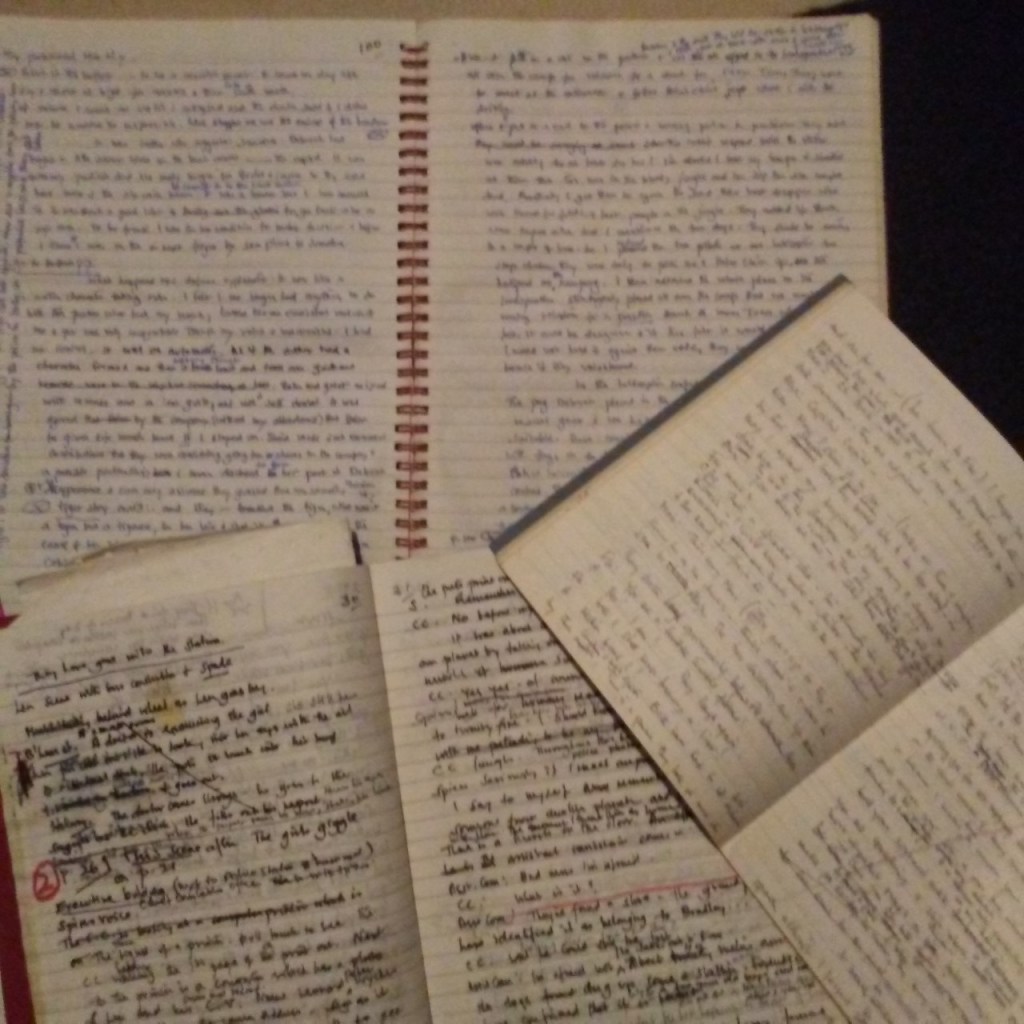
Other writings As quoted from in the book

All the books seen below are written in Peter’s own hand

Having been the victim of a supposed ‘sex scandal’ himself in 1975, Peter comments on the incident involving actor, Hugh Grant, and LA call girl, Divine Brown (Estella Marie Thompson) in June 1995.

In a 2012 letter to his, then, recently widowed sister-in-law, Peter confirms to having never known his “blood family” (see pages 399-400). The final two paragraph of the letter read: “There never seemed to be enough time to get to know people – Henry and his family included.

Since we have never managed to continue(?) relations, you’ll forgive me if I don’t attend Henry’s funeral.”


Some of the following are already posted on this website to illustrate other points, but were used in the book:

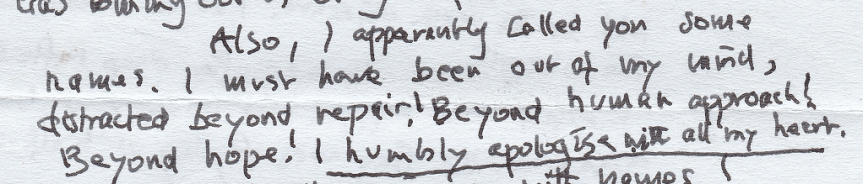
When Peter and I reconnected back in the early 2010’s, he wrote this in his second letter to me. Prior to our earlier parting, we’d exchanged some rather cutting words, which is what he’s apologising for here. Alas, one idiot who I’d been foolhardy enough to confide in some years ago, has taken one specific word out of many spoken during an heated exchange and used it as an excuse to fuel a vendetta.

The above reads as follows: “Also, I apparently called you some names. I must have been out of my mind, distracted beyond repair! Beyond human approach! Beyond hope! I humbly apologise with all my heart“.

Thank you so much for your letter.  I was very moved and touched by your concern

[I] will never understand the vindictiveness of the gutter press or the police and their obvious need to trap the public for their own ends.  It is of course our laws that are still barbaric and its attitude that is Victorian.

My only consolation is that there are still people like you who are intelligent enough to know what is truth.

For that, and the faith you have, has given me a strength which is infinitely more powerful than all their stupid rubbish.

With affection and love,

Peter

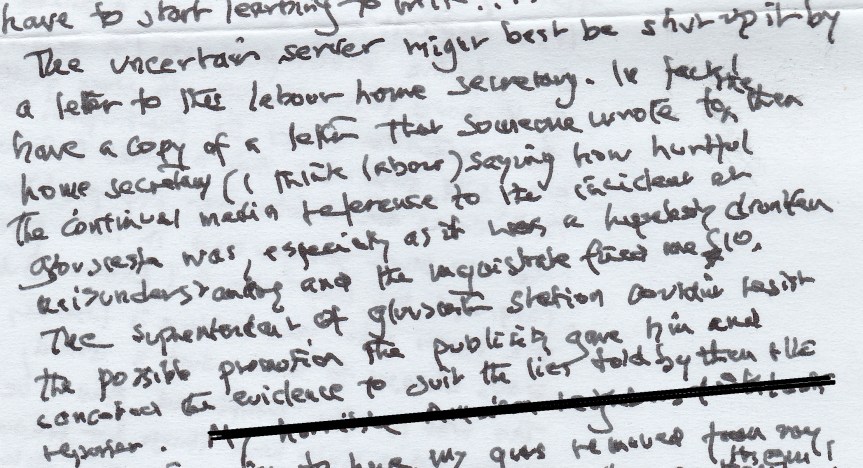
Above and Below: Peter writes about the hurt he has felt at the continued harassment by the press over the incident in 1975.

This image has an empty alt attribute; its file name is press.jpg

Peter’s reaction the the (in)famous interview with Princess Diana – ITV, 1995.

Above: A letter to ‘Kenny Grice’* – the reprobate that I speak of in my book.

*As you know, ‘Kenny Grice’ is a pseudonym that I gave to this person as I didn’t wish cause any upset or embarrassment to his family.

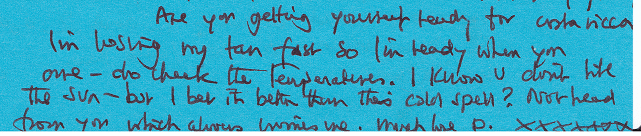
Above: A note to me from Peter while he was in France attending to his recently deceased stepbrother’s business affairs. It reads: “Are you getting yourself ready for Costa Ricca (sic). I’m ready when you are – do check the temperatures. I know U don’t like the sun – but I bet it’s better than this cold spell? Not heard from you which worries me. Much love, P xxxxxx”

I was to meet him in France with the intention of flying out to Costa Rica for a holiday.

A letter that reached me the day after the previous one. Here he talks about finding a villa for us to get away for a while.

Here he tells of the Paternity Trial in Vienna during the mid-1970’s (see Page 282 – ‘A Life Amongst Strangers’).


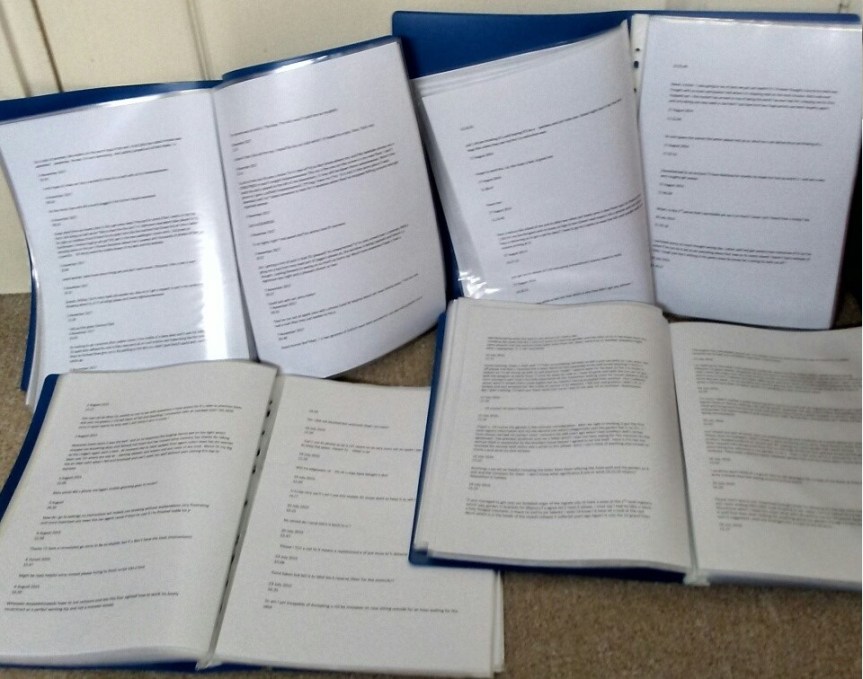
I was to download every text message that Peter sent to me over a 20 year period, initially as an aide memoire when helping him both professionally and personally with various projects. Ultimately, I was thankfully that I did as I was not only able to use many of them in my book, but they have also become incredibly precious to me on a personal level.

There are several thousand messages which have been printed out and stored in four files. This made it easier for me to look up specific times and dates.


I have many hundreds of personal letters and other writings which I relied on when writing my book which I will add to this page when time allows.


Peter Wyngarde: A Life Amongst Strangers is available from the following retailers:

Amazon – Bam! – Blackwells – The Book Depository – Foyles – The Hive – Waterstones – WH Smith – Blackwells etc. Or directly from the publisher.

Click below for further information…

Please note that everything on this website, including the name Peter Wyngarde™ is Trademarked to Tina Wyngarde-Hopkins and Bowington Management.