


- Part 1 Broadcast: Tuesday, 17th January 1984
- Part 2 Broadcast: Wednesday 18th January 1984
- Part 3 Broadcast: Thursday, 19th January 1984
Character: Sir Charles Marchington QC
Among the final narratives produced for Granada Television’s long-running legal drama Crown Court, The Son of His Father remains one of the most intriguing and morally complex cases of the series. Broadcast over three consecutive afternoons in January 1984, the serial focused on a blackmail prosecution that evolved into a deeply personal dispute involving paternity, social standing, and the pursuit of truth. The production featured a distinguished cast, led by Peter Wyngarde as prosecuting counsel Sir Charles Marchington QC, Rosalie Crutchley as defence barrister Eloise Hunter QC, Carol Frazer as Mary Ginsel, and Gerald Flood as the esteemed Member of Parliament, Sir Roland Richardson.
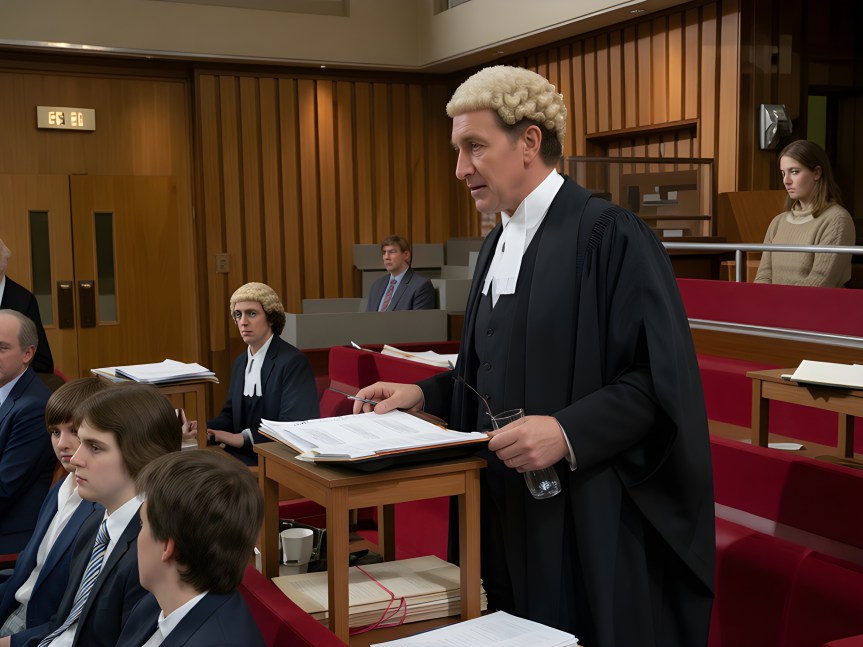
Above: Peter as Sir Charles Marchington QC
Consistent with the majority of Crown Court episodes, the story employed a realistic courtroom format. The series distinguished itself from contemporary legal dramas through the innovative use of a jury composed of ordinary members of the public, whose verdicts were determined by the evidence presented rather than a pre-scripted outcome. Although the programme was approaching the end of its run by 1984, The Son of His Father demonstrated the format’s continued ability to engage viewers with intelligent and emotionally charged legal conflicts.
The case begins with a seemingly straightforward allegation of blackmail. Mary Ginsel is accused of attempting to extort money from her local MP, Sir Roland Richardson. The prosecution contends that Mary falsely claimed Richardson was the father of her young son and threatened to expose the relationship publicly unless maintenance was paid. Richardson maintains that the accusation is entirely baseless, asserting that his relationship with Mary was limited to a shared interest in philately. He claims that any funds provided to her were strictly related to stamp transactions rather than parental obligations.
Initially, the prosecution’s position appears strong. Sir Roland is presented as a highly respectable public figure—measured in his speech and seemingly beyond reproach – making the accusations against him seem improbable. He explains that he met Mary through the local philatelic society, where their mutual interest in rare stamps led to regular contact. He further asserts that while she assisted him with auctions and collecting, there was never any romantic or sexual involvement.
The strength of Michael Dean’s script lies in its gradual challenge of these first impressions. As witnesses are called and evidence examined, the case becomes less clear-cut. The defence argues that Mary is truthful and that the child is indeed Sir Roland’s son. The exchange of letters, the frequency of their meetings, and Richardson’s efforts to conceal specific aspects of their relationship raise uncomfortable questions. As was characteristic of the series’ best episodes, certainty becomes increasingly elusive.
A primary strength of the drama is its refusal to provide easy answers. Rather than painting either participant as wholly innocent or guilty, the script encourages viewers to evaluate the reliability of competing testimonies. Mary’s insistence that Sir Roland was the only man with whom she had been intimate is weighed against the MP’s adamant denials. Because both accounts appear plausible, the audience and the jury are forced to consider not only the evidence but the motivations behind it.
The central theme of the serial is credibility. The proceedings repeatedly question who is more likely to be believed: an establishment figure with an impeccable reputation or a young woman whose character is under intense scrutiny. The courtroom becomes a battleground not just over facts, but over assumptions regarding class and social standing, inviting the viewer to consider whether respectability automatically confers trustworthiness.
The production is further elevated by Gerald Flood’s performance as Sir Roland Richardson. Flood expertly portrays a man whose polished exterior masks an underlying uncertainty. While Richardson remains calm and articulate throughout the proceedings, the audience is left to wonder whether this composure is a result of honesty or years of political experience. Flood’s measured approach keeps the character intriguingly ambiguous.
Similarly effective is Carol Frazer as Mary Ginsel. Frazer avoids the tropes of the “victim” or the “schemer,” instead presenting a woman whose determination remains steadfast despite the hostility of the court. Mary’s conviction regarding her child’s father provides the drama’s emotional core; regardless of whether the viewer believes her, they understand that she genuinely believes her own account.
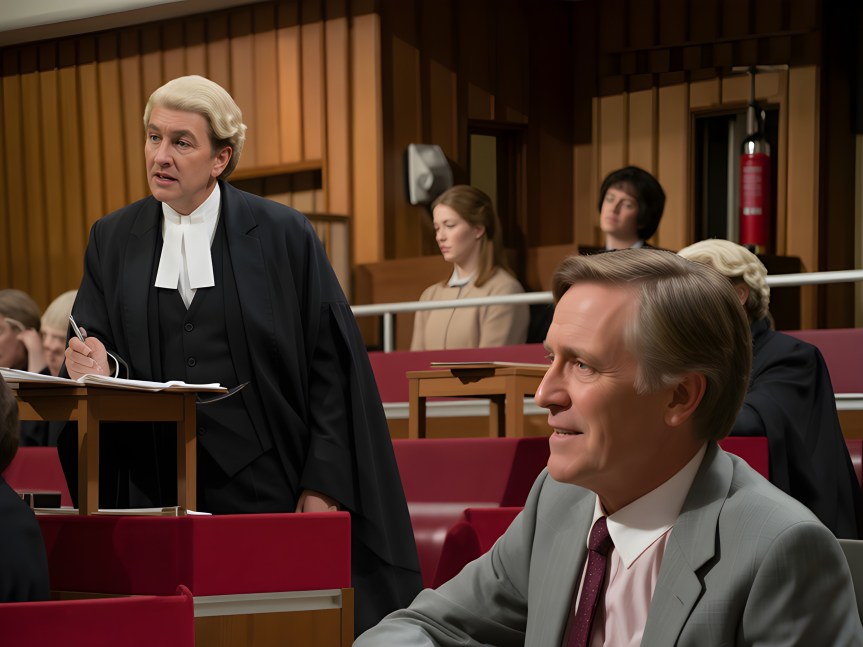
The legal duel between the two counsels provides significant dramatic energy. Rosalie Crutchley, as Eloise Hunter QC, delivers an intelligent and persistent defence. Her cross-examinations expose weaknesses in the prosecution’s narrative and ensure that critical questions remain central to the case. Hunter refuses to accept appearances at face value, consistently challenging assumptions about the relationship between Mary and Sir Roland.
Opposite her, Peter portrays Sir Charles Marchington QC with a presence that seems tailor-made for the role. Throughout his career, Peter excelled at portraying authoritative and commanding figures, and Sir Charles is no exception. Immaculately dressed and confidently spoken, Marchington projects the exact authority expected of a senior King’s Counsel.
Peter’s performance is compelling for its restraint. Eschewing theatrical excess, he adopts a measured and disciplined approach, avoiding the tendency to overwhelm proceedings through sheer force of personality. His questioning of witnesses is precise and methodical, conveying the confidence of a barrister with absolute faith in the prosecution’s case. Nevertheless, beneath this polished exterior lies a palpable determination—and at times, aggression—particularly when challenging Mary’s credibility.
The courtroom exchanges between Peter and Crutchley are among the production’s highlights. Both actors imbue their roles with intelligence and authority, creating a believable clash between two experienced legal professionals. Their confrontations avoid melodrama; instead, the tension arises from carefully constructed arguments and subtle shifts in emphasis, aligning perfectly with the realistic atmosphere of Crown Court.
Consistent with the series’ strongest narratives, The Son of His Father succeeds by exploring themes that extend beyond the immediate legal charges. While blackmail is the offense before the court, the drama is equally concerned with reputation, responsibility, and social prejudice. The implication that an influential politician fathered a child outside of marriage creates stakes that reach far beyond the courtroom, while Mary’s struggle for recognition reflects broader questions regarding power and credibility.
The serial also benefits from the concise storytelling format that defined Crown Court. Spread across three episodes, the narrative unfolds steadily without unnecessary digression. Each installment introduces new evidence and perspectives, ensuring that audience interest remains sustained throughout the proceedings.
Viewed today, The Son of His Father remains an excellent example of what made Crown Court such a distinctive programme. Rather than relying on sensational crime or dramatic action, it derives its power from character development, testimony, and uncertainty. The audience is invited to function almost as an additional juror, weighing conflicting evidence and questioning initial impressions.
Ultimately, the production demonstrates the enduring appeal of intelligent courtroom drama. Supported by strong writing and accomplished performances from Peter, Rosalie Crutchley, Carol Frazer, and Gerald Flood, The Son of His Father captures the essence of Crown Court at its peak: thoughtful, engaging, and morally ambiguous. As one of the final cases heard in Fulchester Crown Court, it serves as a fitting reminder of the qualities that sustained the series’ popularity for over a decade.
| Notes: [1]. ‘The Son Of His Father’ was episode 290. |


3 thoughts on “REVIEW: Crown Court – ‘The Son of His Father’”