










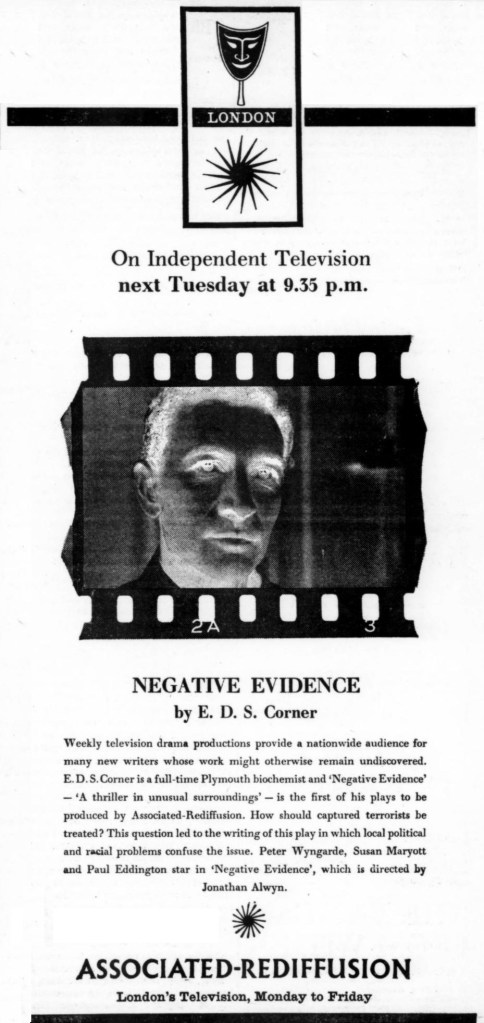
Series: ITV Play Of The Week
Broadcast: Tuesday, 7th February, 1961
Character: Major Peter Brayling
The Story
The play is set in Koaran, a fictional Far Eastern state under British colonial rule.
The Governor of the university in the territorial capital of Sawalli is Dr. Charles Brayling (Laidman Browne), an entomologist whose son, Peter (Peter Wyngarde), serves as a Major in the British Army. A company from his regiment is currently stationed at Fort Melenby on the outskirts of the city.
The opening scene depicts Dr. Brayling in his office discussing his field of study with a local politician, Sir John Callington (William Fox). Standing before a glass case of indigenous insect specimens, Brayling suggests that these creatures are representative of the individuals within the British community – specifically his own son, whose personality he likens to a prominent spider in the display.
Peter’s mother (Vivienne Bennett) is deeply devoted to her son. Despite his philandering and explicit refusal to marry, she tolerates no criticism of him, even from her more discerning husband.
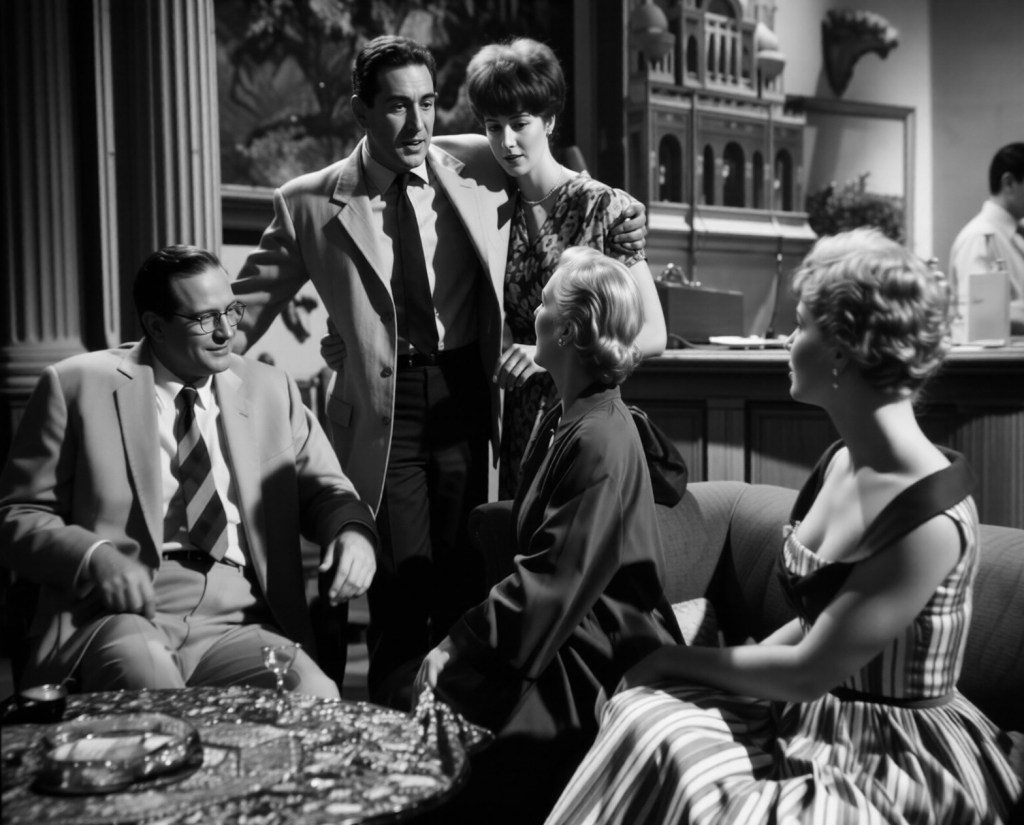
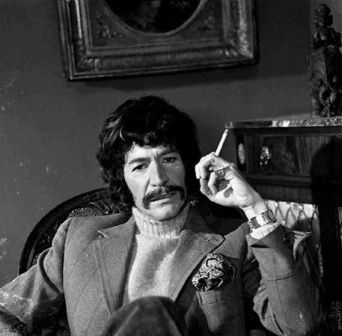
Left: Peter – centre, standing
Major Brayling had been involved in a relationship with Diana Claveney (Susan Marryott) for some time, though he recently appeared to lose interest in her. However, Alec Felson (Paul Eddington), a botanist at the University, was eager to take the Major’s place in Diana’s affections. Regrettably for Felson, Diana remained in love with Major Brayling, a fact that caused the botanist considerable resentment.
Over recent months, the British community in the capital had repeatedly fallen victim to terrorists loyal to the Koarani State. As Commander of the Army Garrison in Sawalli, it was Major Brayling’s duty to maintain order and ensure the safety of the residents. During a routine patrol of the border between Koarani and a neighbouring state, Major Brayling and his subordinate, Sergeant Aspery, spotted a group of men whom Brayling believed to be insurgents. The two soldiers tracked the group for nearly two miles across the frontier, eventually observing them taking refuge in a Buddhist temple.
When the rebels stubbornly defended the shrine, Brayling’s suspicions were confirmed, and he felt justified in crossing the border to attack the temple. Once the firing ceased and the Major gained entry to the building, he began a thorough search for evidence of the rebels’ activities. During this search, he discovered a cellar containing a terrified man dressed in the robes of a Buddhist monk. Believing the man to be part of the terrorist cell, the young officer immediately began to interrogate him. Despite the monk’s inability to provide the requested information, the officer continued to press for answers until his captive eventually succumbed to the interrogation.
The Major decided to intern the body of the monk in the cellar and returned to Sergeant Aspery, who had been injured during the exchange of gunfire. With his wounded comrade slung over his shoulder, Brayling undertook the gruelling march back to Fort Melenby, where he reported finding a printing press used by the rebels to manufacture propaganda leaflets.
He immediately ordered another junior officer, Lieutenant Varden (John Ronane), to lead a group of villagers to the shrine to retrieve the press and any other discovered materials. However, despite the Major providing detailed directions, the Lieutenant managed to lose his way in the dark and arrived at his destination several hours later than intended. By that time, the press, its generator, and all the photographic equipment described by Brayling had disappeared.
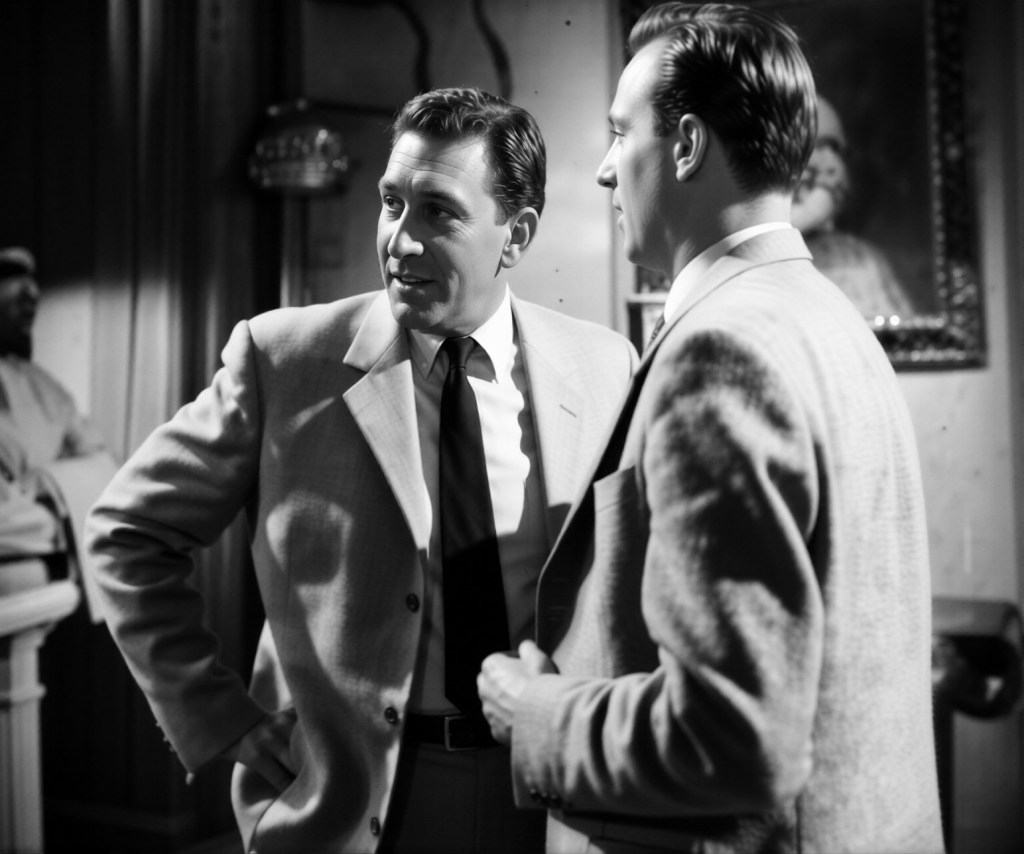
Right: Peter and Paul Eddington as Alec Felson
Vaden, however, discovers the body of the ‘Monk’ that the Major had concealed in the cellar earlier that day. When Vaden reports his findings at the temple, the Major suggests that the insurgents must have removed the printing press and accompanying materials during the interval between Vaden’s departure and the Lieutenant’s arrival. While the Major’s family and close associates accept this account without question, the Army immediately launches an investigation into the action, requiring the Major to spend the majority of his leave at Fort Melenby.
The gravity of the Army inquest seemingly has little effect on the Major’s composure; a few evenings later, he arrives at a local bar and restaurant to meet with his parents, accompanied by a new female companion. Also present is Diana, who appears despondent, yearning for the Major to acknowledge her.
At the same venue, university botanist Alec Felson is seated with Lieutenant Varden, the latter of whom appears visibly anxious at the mention of the military inquiry. Felson is already aware that his companion has submitted a request to leave Major Brayling’s company; when pressed, the unsettled officer concedes that, unlike his commander, he has never been suited for the “paths of glory,” believing himself better matched for the Education Corps.
Alec senses that there is a deeper motive behind the Lieutenant’s sudden request for transfer and suspects he is concealing information. Consequently, he decides to divulge his own suspicions regarding the events at the Temple, producing a photograph of the Major posed with the bodies of two deceased terrorists. Varden reveals that Brayling frequently had such incidents documented, as he enjoyed being photographed with his “trophies.”
Felson inquires whether the Major had a camera with him on the evening he patrolled with Sergeant Aspery. Varden confirms that he did. The scientist then questions why the Major did not photograph the printing press and other paraphernalia inside the Temple upon first encountering them; did he not consider it prudent to take a photograph to validate his account?
Varden recalls that the photograph in Felson’s possession had been taken with the final exposure of a roll of film. Felson then asks why the Major would have carried the camera at all, unless there had been a second roll of film. Varden confirms that there was indeed another roll in the camera when Brayling returned to the Fort. The scientist speculates as to its contents, a notion to which the Lieutenant objects, arguing that it is unfair to hypothesise before the film has been processed.
Felson swiftly points out that several days have passed since the events at the shrine, suggesting there was ample time for the film to be developed – unless, of course, there was something Brayling wished to keep hidden.
A further question arises concerning the camera itself, as Brayling had asserted that some of the released photographs were not taken with his equipment. However, Felson identifies a mark on the photograph in his possession caused by a fault in the lens of Brayling’s camera – a detail brought to his attention by Diana Claveney. As Lieutenant Varden is keen to point out, however, Ms. Claveney had recently been spurned by the Major, noting that “hell hath no fury like a woman scorned.”
Varden, having heard enough, warns Felson to cease interfering in matters that do not concern him. Realising he is making no progress with the Lieutenant, Alec decides to bring his argument to Sir John Callington, who also happens to be at the bar. It becomes evident that the two men share a mutual dislike; consequently, the Peer is unsympathetic to the accusations against the Major. Indeed, Sir John tells Felson that he has no justification for attempting to ruin Brayling’s career, warning him that by taking the matter to the State Governor, Paruder, he risks the loss of a substantial grant promised for a new botany laboratory at the university.
Meanwhile, Major Brayling finds Lieutenant Varden seated alone in the bar and asks for his impression of Felson. The junior officer pauses momentarily, then declares that Alec gives the impression of “someone with a very vivid imagination.”
“So he might be easily persuaded?” the Major enquires shrewdly. Varden confirms with a single word: “Yes.”
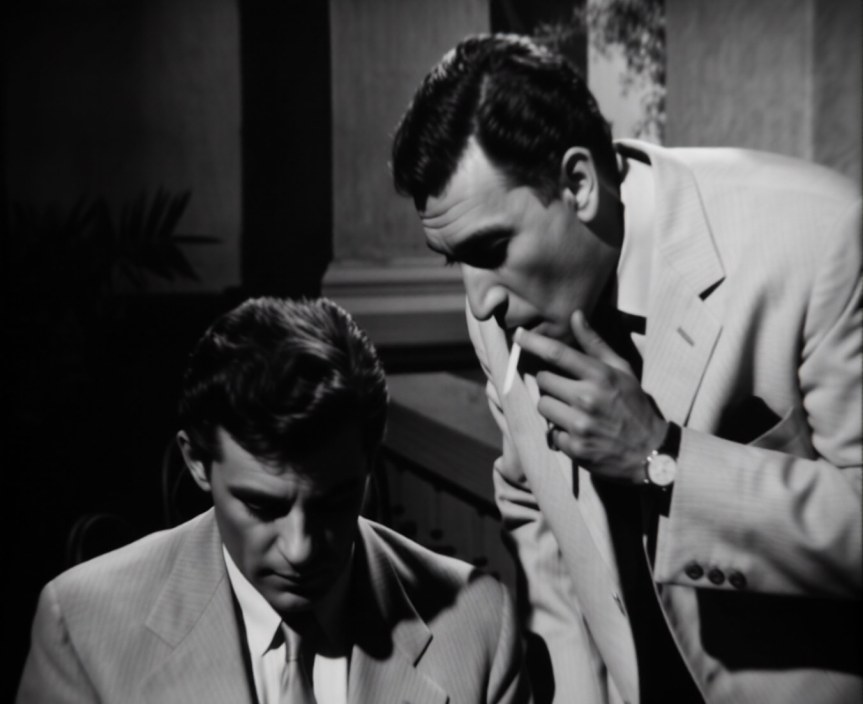
Leaning in to get a light for his cigarette, Brayling requests to know what he’d told Felson during their exchange: “To mind his own business!” the now visibly shaken Lieutenant replies.
Right: With John Ronane as Lieutenant Varden.
Alec, however, is not inclined to heed such advice. Following the implications of the previous evening, he seeks out Paruder (Patrick Cargill) and presents the same theory he had previously shared with Varden. On this occasion, he introduces an additional premise: that the man discovered in the Temple cellar was not a member of the terrorist faction, but rather exactly what he appeared to be – a Buddhist monk tending the shrine. If this were the case, Brayling was nothing more than a cold-blooded murderer.
Paruder merely grins at the suggestion and remarks that the botanist would make an excellent screenwriter. Infuriated, Alec produces the same photograph he had shown Varden at the bar the previous evening, maintaining that it had been taken with Brayling’s camera. To support his claim, he points out a specific mark on the print which he believes to be unique.
Paruder rises purposefully from his chair and retrieves a framed portrait of his eldest daughter from a ledge adjacent to his desk. He informs Felson that the photograph was taken in his garden by a friend. The print bears the same mark as the one held by Alec, yet it is certain that the image was not captured by Major Brayling’s camera. Paruder explains to a deflated Alec that the flaw is generic to all camera lenses produced in Koaran; consequently, Alec’s evidence proves nothing..
In Retrospect
The play concludes without a decisive resolution, leaving Major Brayling’s guilt or innocence open to the viewer’s interpretation.
The perceptions of the characters are largely shaped by the assumptions of others within the narrative. For example, Major Peter Brayling’s father, an entomologist, sets a particular tone by comparing his son to a deadly spider in his collection. Meanwhile, the doting mother is convinced that Felson harbours a hatred for her son, believing that Diane Claveney – the woman Alec desires – remains hopelessly in love with the young Officer.
Lieutenant Varden suggests that the spurned Ms. Claveney implicated Brayling as a form of retribution for his infidelity. In contrast, Sir John Callington admits to a mutual dislike between himself and Alec Felson, while openly admiring the Major – a sentiment shared by the State Governor, Paruda. Finally, Lieutenant Varden has hastily submitted a request to transfer out of Brayling’s command, citing a desire to join the Education Corps.
Based on these accounts, two conflicting depictions of Major Brayling emerge. While his father clearly cares for him, he is not as blind to the Major’s shortcomings as the mother is; the comparison to a poisonous arachnid suggests a lethal side to Brayling’s nature. Conversely, although blinded by maternal love, Brayling’s mother is astute enough to notice the Botanist’s interest in Diane Claveney. This suggests a motive for Felson’s dogged determination to see the Major charged with murder: with Brayling removed from the picture, Alec would have a better chance of winning Diane’s affections.
Lieutenant Varden’s argument – that Ms. Claveney acted out of malice by providing Felson with technical advice regarding the camera lens – could be viewed from two angles: either she intended to implicate Peter Brayling in murder, as Varden suggests, or her actions were designed merely to make Felson appear foolish, thereby shielding her former lover.
When considering Sir John Callington, a well-respected politician, it is clear he has little deference for Felson but holds the Major in high regard. This prompts the viewer to question who the true villain of the piece is. Similarly, the nervous demeanour of Lieutenant Varden suggests he is genuinely troubled. It remains unclear whether his request to join the Education Corps is sincere or merely an attempt to distance himself from the Major.
Furthermore, Felson’s version of events appears to be pure speculation. He is neither a serving Army officer nor an eyewitness to the events at the Temple. His inference that the body found in the cellar was that of a simple Buddhist monk, rather than an insurgent, is mere conjecture. His theories regarding the second roll of film and the blemish on the photograph are effectively dismantled by Varden.
Admittedly, Brayling breached protocol by crossing the frontier in pursuit of suspected terrorists; however, even Paruder suggests that the Army would overlook such an abuse if the officer were “able to bring something back.”
Lieutenant Varden describes Major Brayling as a man who enjoys “shooting Nig-Nogs,” implying a lack of respect for the native population regardless of their status. To such a man, the monk in the temple cellar would be viewed as nothing more than collateral damage, regardless of whether he aided the insurgents or not.
Despite the use of outdated and politically incorrect language, Negative Evidence is an intriguing piece of television. Broadcast live, it was meticulously written, well-acted, and utterly thought-provoking.
Critics Comment
| ‘Negative Evidence was interesting (as almost any play with Peter Wyngarde in it is bound to be. He has such a dynamic personality, he makes other players seem like shadows), but there was rather too much technical blather and the women characters were wholly unbelievable. I never for one movement believed Peter Brayling was guilty of the crimes that the immature little toad, Felson, tried to pin on him, and neither would his Mother and fiancé. No woman who had loved and was engaged to such a man would betray him in the way she did, and the Mother showed a total lack of understanding of the female mind in making her behave in such a manner, however disappointed she may have been in him as a once prospective husband. But then, perhaps, only a woman can write convincingly about the inner workings of a woman’s mind. a man can only go by guesswork. Eileen Waugh |
BBC Radio – Wednesday, 19th November 1974
You see James Bond on television on film lying on a bed being massage by a beautiful woman, but somehow you think it can’t be real. I found out the other day that it is quite real. As an ardent fan of Department S, I decided that I want you to meet and interview Peter Wyngarde who plays Jason King in the series. As one of the best dressed men in the world, and with his talent for acting, he was made for the part of the author turned investigator.
I managed to get in touch with his agent in London and after a lot of telephone calls, I was given the address and number of where he was staying. I arrived in the depths of sorry and stood outside the wire fence, tape recorder in hand believe it or not, there was a guard on the gate and it was only a health farm! But a health farm where all the stars go to relax and sleep and avoid people like me.
I was shown to a waiting room and down a long, steamy corridor, I saw Peter being massage by a tall blonde. Another blonde was giving him a manicure. I was offered a glass of carrot juice, and I waited until he was finished. I looked down the corridor and saw him walking towards me, and for a fleeting moment I felt I was playing opposite him in an episode of Department S. I have met some people in my town, but never one who has left such an impression on me as a nice, genuine, kind, thoughtful person. We sat down together and I offered him some carrot juice. He promptly turned round and said, “My dear boy, if I have any more carrot juicer shall die!”
Where do you buy your clothes?
My tailor is a closely guarded secret. I work with him on the design and style. As I use the same clothes I wear in Department S for my everyday life, I have been inundated with letters and telephone calls pleading with me to put them in touch with my tailor. Hey, however, has decided to remain exclusively mindful stop
What are your interests in hobbies in life?
I adore flying. I’m trying to improve my tennis and my passion is sex.
Who does your hair?
A guy called Anthony.

What kind of car do you drive?
I don’t really want to tell you the make, as it is really recognisable, but it is a sports car and there are only 12 of them in the world.
What are your aims in life?
To make Jason King movies, I feel that the Jason King character would lend itself so well to movies that they would sell, and eventually I would direct.
Do you have any advice for young people who want to become actors?
The best thing for them to do is to get on a tramp steamer and travel the whole world meeting as many people as possible. Then come back and think about it and when they’ve thought about it travelled the world again as I’m sure they’d enjoyed that far more than acting!
If anyone should ever be voted the best dressed man and one of the most sincere people in the world, then it should be Peter Wyngarde. My last words to you tonight are if you haven’t seen partners as Yankee bet you are missing her completely new and unique Adam enacting, enjoyment and excitement, and a thoroughly good detective series to boot.
John Dunn: …and on the ‘phone to me now, our star guest this evening, Peter Wyngarde. Good evening, Peter.
Peter: Good evening, Keith… (referring to a comment made during the link) …what a nice thing to say.
John Dunn: I’ve seen this picture of you (a publicity poster from ‘The King and I’) and it really is startling…
Peter: A very old King, it looked to me. Not a balding King.
Peter: (Laughs). A very old King.
John Dunn: No, you’re not really bald.
Peter: Well, he was a bit older, you know, really. He was about sixty-three, but I’m not playing him at sixty-three.
John Dunn: Well, you’ve got a way to catch up on that, certainly. But assuming that this is your stage appearance, how far do you get back to normal once you leave the stage door?
Peter: Well, it takes a little time, because you see all this hair is put up and tied in some sort of ridiculous; Granny-Knot, on the top of one’s nut, and then the eye make-up is a bit tricky, and you have to take all that off. Is that what you meant?
John Dunn: Yes, I mean that exactly, together with the fact that…
Peter: And I have to take all this, you know, sort of, because he has Siamese eyes – they’re slightly almond shaped.
John Dunn: I think you’ve made yourself distinctly more sinister than we’ve seen the part played before – than I’ve seen it played before.
Peter: Yes. I think that this sort of King – an omnipotent king, and being feudal. Because the interesting thing about it from my point of view is that in the Far East, over about six or seven hundred years, there was no difference, you know. There was a feudal system and that was that. So therefore, he’s almost a Medieval King, in fact.
John Dunn: Actually, you make it sound as though you’ve got a bit stuck with it; from Jason King to Siamese king!
Peter: (Loud laugh) I like playing kings, I think!
John Dunn: I don’t know why, but in a newspaper quote I’m looking at, it says that “The show is optimistically believing there’ll be a West End place for it in October.”
Peter: Yes.
John Dunn: Why does it sound so, erm…
Peter: Well, it’s the politics of the theatre, isn’t it? That awful thing that goes on. Everyone sort of plays little games about it all. And I believe there are certain people who are very interested in bringing it in, but it’s a question of availability I suppose.
John Dunn: Well, it’s a great musical. Are you involved in a great deal of the singing and dancing?
Peter: Well, I sort of make a noise. Actually, I make a very loud noise, but I’m enjoying it immensely. I mean, we’ve just had the first night at the Grand theatre in Wolverhampton, and there was a great standing ovation, and everyone was screaming and shouting and yelling. You know, it’s a marvellous feeling. It’s great to have that sort of rapport with the audience.
John Dunn: Oh yes, indeed.
Peter: For them to come over like that – I mean, it really was sensational.
John Dunn: Maybe you could fill in a terrible gap in my knowledge. What is your previous experience of musicals, Peter?
Peter: The only one I’ve ever done before was ‘The Good Woman of Setzuan’ by Bertold Brecht, at the Royal Court with Dame Peggy Ashcroft – and I believe I sang in that too – I remember singing the elephant song in it, and whipping John Osborne, who was also in it.
John Dunn: (Laughing). Was that a pleasant experience?
Peter: Yes – it was a very gruelling experience (laughs). It didn’t deter him!
John Dunn: What about your successful TV roles? Do you plan to do anymore?
Peter: I hope we will later on, but at the moment I want a rest – not a rest, I don’t think that’s the right word. I’ve always done theatre work, and I enjoy it so much that I thought I’d like to get back into it, so I went to Australia and did ‘Butley’ the moment I finished the series (Jason King), and then I did a marvellous play by Charles Dyer called ‘Mother Adam’, which we did at the Hampstead Theatre, and I adored doing that. And now ‘The King and I’. So that’s three very different – completely different – kind of characters, you know?
John Dunn: Well, since you’ve introduced the word ‘rest’…
Peter: Yes.
John Dunn: How would you define that? When you’re not working, and voluntarily not doing anything, what do you like to do?
Peter: I think possibly the most exciting thing I could do is lie on a beach and do absolutely nothing, and maybe just swim occasionally.
John Dunn: Not even a book in your hand?
Peter: No, not even a book in my hand! No, just absolutely lying in the sun and soaking it up, doing really nothing all day.
John Dunn: And have you a favourite beach where you like to pursue this?
Peter: Well, I’m mad about Morocco at the moment. And I’ve been back and forth about five or six times because I’m dotty about it. There a great stretch of beach there which goes on for about…. well, I should think all along the coast of Africa.
John Dunn: You don’t mean the bit that goes down from the North West corner where the lighthouse is, do you?
Peter: (Laughs). No, not as far as that. I like solitude, but that’s ridiculous!
John Dunn: Yes, there’s about ninety miles of it there.
Peter: Well, there’s a long stretch – about ninety miles, yeah – around Agadir.
John Dunn: I looked at that stretch of beach and I thought if a holiday camp king saw that he’s have a heart attack on the spot!
Peter: Well, I’m afraid I think they have. I think there’s a German concern that’s pretty interested in it at the moment.
John Dunn: Ah well, there’s still quite a bit of Morocco left. Anyhow, I wish you many more good times there, every success with ‘The King and I’, and thank you for talking to us on Late Night Extra.
Peter: Very kind of you, Keith.
John Dunn: Peter. Thank you and good night.
Peter: Thank you very much. Good night.


During his career, Peter worked with many legends of the cinema, stage and television. This is a directory of some of the more memorable ones.
Alfie ALLEN: The Comic Strip Presents… The Yob (TV), 1988
Keith ALLEN: The Comic Strip Presents… The Yob (TV), 1988
Lily ALLEN: The Comic Strip Presents… The Yob (TV), 1988
Patrick ALLEN: The Widows of Jaffa (TV), 1957; A Midsummer Night’s Dream (TV), 1964
Nicholas AMER: Nom-de-Plum – Child of Her Time (TV), 1956:
Harry ANDREWS: Alexander the Great (Film), 1956
Anthony ANDREWS: Time and the Conway’s (Stage), 1975
Tony ANHOLT: Jason King – A Thin Band Of Air (TV), 1972
Peter ARNE: Night Conspirators (TV) 1963; Department S – The Double Death of Charlie Crippen, 1969: Department S – Soup Of The Day (TV), 1969
Anne ASTON: Jason King – Wanna Buy A Television Series? (TV), 1972
Dame Peggy ASHCROFT: The Good Woman of Setzuan (Stage),1956
Jane ASHER: Out of this World Cold Equations (TV),1962
Peter BARKWORTH: The Revenue Men – The Exile (TV), 1967
Alexandra BASTEDO: The Champions – The Invisible Man (TV), 1968; Department S – The Man Who Got A New Face (TV), 1969;
Ralph BATES: Jason King – Variations On A Theme (TV), 1972
Hermione BADDELEY: The Gambler (TV) 1956; The Innocents (Film), 1960; Mother Adam (Stage),1972
George BAKER: Rupert of Henzu (TV), 1964 – (See below left: Peter with Barbara Shelley and George Baker)

Stanley BAKER: Alexander the Great (Film), 1956
Lucille BALL: Lucy in London (TV),1966
Trevor BANNISTER: Turn Out The Light – A Boyhood Haunt (TV), 1967
Ronnie BARKER: Nom-de-Plum – Child of Her Time (TV), 1956: The Two Ronnies Christmas Special (TV), 1984
Peter BARKWORTH: The Revenue Men – The Exile (TV), 1967
Alfie BASS: A Midsummer Night’s Dream (TV), 1964
Stephanie BEACHAM: Jason King – Chapter One: The Company I Keep (TV), 1972
Norman BIRD: Night of the Eagle/Burn Witch Burn (Film), 1962
Ed BISHOP: The Saint – The Man Who Likes Lions (TV), 1972
Norman BIRD: Night of the Eagle/Burn Witch Burn (Film), 1962
Isla BLAIR Department S – The Treasure Of The Costa Del Sol (TV), 1969; Jason King – A Red, Red Rose Forever (TV), 1972
Janet BLAIR: Night of the Eagle/Burn Witch Burn (Film), 1962
Brian BLESSED: Flash Gordon (Film), 1980
Clare BLOOM: Rosalynde (Radio play), 1955; Alexander the Great (Film), 1956; Duel of Angels (Stage), 1958
James BOLAM: Present Laughter (TV),1964
Peter BOWLES: Department S – Six Days (TV), 1969
Wilfred BRAMBLE: The Widows of Jaffa (TV), 1957
Bernard BRESSLAW: Nom-De-Plum – The Man From The Sea (TV), 1956: The Spies (Stage),1966: A Midsummer Night’s Dream (TV), 1964
Jeremy BRETT: The Memoirs of Sherlock Holmes – The Three Gables (TV),1993
Johnny BRIGGS: Department S – The Perfect Operation (TV), 1969
Tony BRITTON: The Rose Without A Thorn (TV), 1953
Brenda BRUCE: No Laughing Matter (Stage), 1957
Michael BRYANT: Jesus of Nazareth, 1956; The Duel (Stage),1968

Alfie BURKE: Peter and Burke were in the same repertory company, and performed together in numerous plays
Raymond BURR: Underground (Stage),1983 (See right: Peter with Raymond Burr)
Richard BURTON: Alexander the Great (Film), 1956
Patrick CARGILL: Negative Evidence (TV), 1961: The Revenue Men – The Exile (TV), 1967; Babes in the Wood (Stage), 1986
Tony CAUNTER: Department S – The Man In The Elegant Room (TV), 1969: Wait Until Dark (Stage), 1989
Christopher CAZENOVE: Time and the Conways (Stage), 1975
Warren CLARKE: The Comic Strip Presents… The Yob (TV), 1988
Carol CLEVELAND: The Avengers – A Touch of Brimstone, 1966
Fay COMPTON: The Sleeping Prince (Radio) 1967
Kenneth CONNOR: As You Like It (Radio), 1953; Stage By Stage – The Relapse (A.K.A. Virtue in Danger) (TV), 1954
Tom CONTI: The Queen of Scots (TV), 1961
Adrianne CORRI: Sword of Freedom (TV), 1957: Epilogue To Capricorn (TV),1959; Department S – The Man Who Got A New Face (TV), 1969;
George COULOURIS: R3 – The Forum (TV), 1965; The Prisoner – Checkmate, 1967
Peter CRAZE: Engineer Extraordinary (TV), 1959 (See below left: Peter with Peter Craze)
Rosalie CRUTCHLEY: The Gambler (TV) 1956; A Tale of Two Cities (TV), 1957; The Prisoner – Checkmate (TV), 1967: Crown Court – The Son Of My Father, 1984
Ronnie CORBETT: The Two Ronnies Christmas Special (TV), 1984

Bill COSBY: I, Spy – Let’s Kill Karlovassi (TV),1966
Robert CULP: I, Spy – Let’s Kill Karlovassi (TV), 1966
Peter CUSHING: Alexander the Great (Film), 1956
Timothy DALTON: Flash Gordon (Film), 1980
Stuart DAMON: The Champions – The Invisible Man (TV), 1967; Department S – Handicap Dead (TV), 1969
Windsor DAVIES: Turn Out The Lights – A Boyhood Haunt (TV), 1967
Dame Judi DENCH: Time Remembered (Radio), 1965
Edward DE SOUZA: A Tale of Two Cities (TV), 1957; Two Gentlemen of Verona (Recording), 1965; Department S – The Double Death of Char lie Crippen (TV), 1969;
George DEVINE: The Good Woman of Setzuan (Stage), 1956
Basil DIGNHAM: Sword of Freedom – The Sicilian (TV), 1957; The Champions – The Invisible Man (TV), 1968; Department S – The Duplicated Man (TV), 1969; Department S – The Perfect Operation (TV), 1969; Department S – One Of Our Aircraft Is Empty (TV), 1969; Jason King – Variations On A Theme (TV), 1972
Vernon DOBCHEFF: Casino Real (TV), 1963
Amanda DONOHOE: Tank Malling (Film),1989
Michelle DOTRICE: Jason King – Buried in the Cold Cold Ground, 1972
Gabrielle DRAKE: The Servant (Stage), 1967
Paul EDDINGTON: Negative Evidence (TV), 1961 (See below righ: Peter with Paul Eddington)

Adrian EDMONDSON: The Comic Strip Presents… The Yob (TV), 1988
Denholm ELLIOTT: The Man In Room 17 – First Steal Six Eggs (TV),1966
Michael ELPHICK: Department S – Who Plays The Dummy? (TV), 1969
Clifford EVANS: Jason King – Every Picture Tells A Story (TV), 1972: Jason King – A Kiss For A Beautiful Killer (TV), 1972
Dame Edith EVANS: The Light is Dark Enough (TV),1958; This Book Is News (TV), 1958
Fennella FIELDING: The Country Wife (Stage), 1990; Graham Roos album, ‘Quest’ – Track: ‘Night Dragon’ (2010).
Gerald FLOOD: Crown Court (TV), 1983; Underground (Stage), 1983
Steve FORREST: The Baron – The Legions of Ammak (TV), 1969
William FRANKLYN: Guilty Conscience (Stage), 1986
Liz FRASER: Jason King – An Author In Search Of Two Characters (TV), 1972
Ronald FRASER: Nom-De-Plum – The Man From The Sea (TV), 1956
Caron GARDNER: Department S – Black Out (TV), 1969
Julian GLOVER: Jason King – Variations On A Theme (TV), 1972
Colin GORDON: Night of the Eagle/Burn Witch Burn (Film), 1962; Department S – A Small War of Nerves (TV), 1969
Hannah GORDON: Light Up The Sky (Stage), 1986
Dulcie GRAY: Time and the Conways (Stage),1975
Nigel GREEN: The Bridge (TV), 1956; Jason King – As Easy As A.B.C. (TV), 1972
Sir Alec GUINNESS: Hamlet (Stage), 1951
Michael GWYNN: Department S – A Ticket To Nowhere (TV), 1969; Jason King – All That Glisters parts I & II (TV), 1972
Patricia HAINES: Night Conspirators (Stage),1963; Department S – The Trojan Tanker (TV), 1969
John HALLEM: Department S – The Man In The Elegant Room (TV), 1969; Jason King – A Thin Band Of Air (TV), 1972; Flash Gordon (Film), 1980
Sheila HANCOCK: Bulman – I Met A Man Who Wasn’t There (TV), 1985
Jenny HANLEY: Department S – The Bones of Byrom Blain (TV), 1969
Edward HARDWICKE: The Memoirs of Sherlock Holmes – The Three Gables (TV),
Juliete HARMER: Department S – A Ticket To Nowhere (TV), 1969; Department S – The Man In The Elegant Room (TV), 1969; Jason King – Uneasy Lies The Head (TV), 1972
Laurence HARVEY: As You Like It – (Radio play), 1953
Linda HAYDEN: Underground (Stage), 1983
Patricia HAYES: The Hammer House of Mystery and Suspense – And The Wall Came Tumbling Down (TV), 1984
James HAYTER: The Duel (Stage), 1968
Joan HEAL: The Taming of the Shrew (Stage), 1959 (See below left, Peter with Joan Heal)

Don HENDERSON: Bulman – I Saw A Man Who Wasn’t There (TV), 1985
Ian HENDRY: The Crossfire (TV),1967
Benny HILL: A Midsummer Night’s Dream (TV),1964
Jan HOLDEN: Present Laughter (TV), 1964; Guilty Conscience (Stage), 1986
Sally HOME: Rupert of Hentzau (TV), 1963; Night Conspirators (TV, 1962; Dracula (Stage), 1975
(Sir) Anthony HOPKINS: Department S – A Small War of Nerves (TV), 1969
Michael HORDEN: Alexander the Great (Film), 1956
Donald HOUSTON: Department S – The Ghost of Mary Burnham (TV), 1969′ Jason King – A Deadly Line In Digits (TV), 1972
Sally Anne HOWES: The King and I (Stage), 1976
Gareth HUNT: The Hammer House of Mystery and Suspense – And The Wall Came Tumbling Down (TV), 1984
Freda JACKSON: Duel of Angels (Stage), 1960
Colin JEAVONS: Nom-de-Plum – Child of Her Time (TV), 1956: The Avengers – A Touch of Brimstone (TV), 1966
Mervyn JOHNS: A Tale of Two Cities (TV), 1957
Stratford JOHNS: Department S – The Man In The Elegant Room (TV), 1969;
Margaret JOHNSON: Night of the Eagle/Burn Witch Burn (Film), 1962
Freddie JONES: Jason King – A Deadly Line In Digits (TV), 1972
Sam J. JONES: Flash Gordon, 1980
Yootha JOYCE: Turn Out The Lights – A Boyhood Haunt (T), 1967; Jason King – If It’s Got To Go, It’s Got To Go (TV), 1972
John JUNKIN: Jason King – That Isn’t Me, It’s Someone Else (TV. 1972
Felicity KENDAL: Jason King – Toki (TV), 1972
Jean KENT: Love Her To Death (TV), 1957; Epilogue to Capricorn (TV), 1959
Deborah KERR: The Innocents (Film), 1960
David KILLICK: The King and I (Stage), 1974; Dracula (Stage), 1975; Present Laughter (Stage), 1975
(Sir) Ben KINGSLEY: Turn Out The Lights – ‘The Boyhood Haunt’ (TV), 1967
Roy KINNEAR: Jason King – An Author In Search Of Two Characters (TV), 1972 (See below right: Peter with Roy Kinnear)
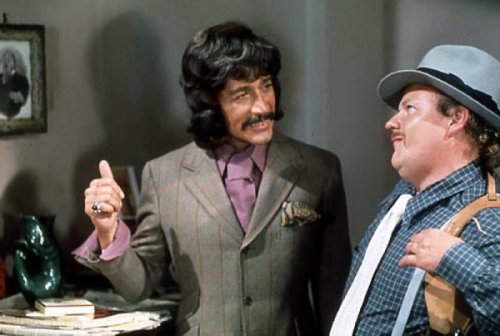
Ronald LACEY: Department S – The Soup of the Day (TV), 1969: Jason King – Regular character, 1972
Dinsdale LANDEN: Jason King – It’s Too Bad About Auntie (TV), 1972
John LAURIE: The Queen of Scots (TV), 1961; The Two Gentlemen of Verona (Audio Book), 1965
Wilfred LAWSON: Liebelei (TV), 1954: Will Shakespeare (TV), 1953; L’Aiglon (TV), 1953
Rosemary LEACH: Sherlock Holmes – The Illustrious Client (TV),1966
Vivien LEIGH: Duel of Angels (Stage), 1958/1960
Ronald LEIGH-HUNT: Nights Conspirators (Stage & TV): Department S – The Perfect Operation (TV), 1969; Underground (Stage), 1983
John Le MESURIER: Jason King – If It’s Got To Go, It’s Got To Go (TV), 1972
Tutte LEMKOW: The Dybbuk (TV), 1952; L’Aiglon (TV), 1953; Will Shakespeare (TV), 1953; Siege Of Sidney Street (Film); Jason King – To Russia With… Panache! (TV), 1972
Sue LLOYD: Present Laughter (Stage), 1975; Department S – Black Out (TV), 1969: Jason King – An Author In Search Of Two Characters (TV), 1972
Charles LLOYD PACK: The Enchanted (Stage), 1953; St Joan (Stage), 1954; Jesus of Nazareth, 1956; Evening in Hochsberg (TV), 1957: Jason King – The Constance Missal (TV), 1972
David LODGE: The Avengers – Epic (TV), 1967
Arthur LOWE: Turn Out The Lights (TV),1967
Cyril LUCKHAM: Night Conspirators (Stage & TV), 1963; A Midsummer Night’s Dream (TV), 1964; Department S – The Perfect Operation (TV), 1969
Patrick MACNEE: The Avengers – A Touch of Brimstone (TV); The Avengers – Epic (TV), 1967
Philip MADOC: Casino Real (TV), 1963; Jason King – A Page Before Dying (TV), 1972
Elspeth MARCH: The Duel (Stage) 1968; Anastasia (Stage),1976; Underground (Stage), 1983
Fredric MARCH: Alexander the Great (Film), 1956
David MARKHAM: Rope (TV), 1950
Millicent MARTIN: The Sleeping Prince (Radio) 1967
Alfred MARX: Jason King – Nadine (TV), 1972
Jean MARSH: Department S – The Perfect Operation (TV), 1969
Anna MASSEY: Esso World Theatre (TV),1966; A Midsummer Night’s Dream (TV), 1964
Patrick McGOOHAN: The Prisoner – Checkmate (TV), 1967
Siobhán McKENNA: St. Joan (Stage), 1956
Leo McKERN: Also Amongst The Prophets (TV), 1955; The Widows of Jaffa (TV), 1957 (See below, left: Peter with Leo McKern and Patrick Allan at rehearsals for, The Widows of Jaffa)
Murray MELVIN: The Two Gentlemen of Verona (Audio), 1964.
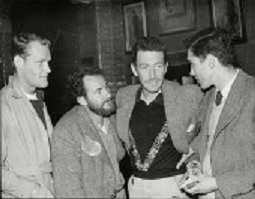
Keith MICHELL: Loyalties (TV), 1962
Bernard MILES: This Book Is News (TV), 1958
Spike MILLIGAN: Babes in the Wood (Stage), 1986
Isla MIRANDA: The Baron – The Legions of Ammak (TV), 1966; The Avengers – Epic (TV), 1967
John MOFFAT: The Adventures of Ben Gunn (TV), 1958
Geraldine MOFFAT: Department S – Six Days (TV), 1969; Jason King – The Constance Missal (TV), 1972
Kieron MOORE: The Siege of Sidney Street (Film), 1961; Department S – Dead Men Die Twice (TV), 1969; Jason King – Toki (TV), 1972
Sir Roger MOORE: The Saint – The Man Who Likes Lions (TV), 1966: The Saint – The Gadic Collection (TV), 1967 (See below right: Peter with Roger Moore in The Saint – The Man Who Likes Lions)

Peggy MOUNT: Brighton Festival – Royal Pavillion (Stage), 1974
Patrick MOWER: Department S – The Soup of the Day (TV), 1969; Jason King – Nadine (TV), 1972
Barbara MURRAY: The Rose Without A Thorn (TV), 1953; Present Laughter (TV), 1964; Department S – Dead Men Die Twice (TV), 1969; Jason King – A Red, Red Rose Forever (TV), 1972
Patrica NEAL: The Royal Family of Broadway (TV), 1958
Hildegaard NEIL: Present Laughter (Stage),1975; Jason King – Flamingoes Only Fly On Tuesdays (TV), 1972
Anthony NICHOLLS: Night of the Eagle/Burn Witch Burn (Film), 1962; Department S – The Ghost of Mary Burnham (TV), 1962
Bill NIGHY: Crown Court – The Son Of My Father (TV), 1984
Derek NIMMO: Duel of Angels (Stage), 1958
Merle OBERON: Assignment Foreign legion – The Debt (TV), 1956
Edmond O’BRIEN: Walt Disney’s Wonderful World of Color: The Further Adventures of Gallagher (TV), 1965
Richard O’BRIEN: Flash Gordon (Film), 1980
Kate O’MARA: Department S – Who Plays The Dummy (TV), 1969; Jason King – A Kiss For A Beautiful Killer (TV), 1972; Light Up The Sky (Stage) 1985; As You Like It (Stage), 1988
Julian ORCHARD: A Tale of Two Cities (TV), 1957
John OSBOURNE: The Good Woman of Setzuan (Stage), 1956
Richard O’SULLIVAN: The Queen of Scots (TV), 1961
Lance PERCIVAL: Jason King – Uneasy Lies The Head (TV), 1972
Esme PERCY: Rosalynde (Radio play), 1955; The Good Woman of Setzuan (Stage), 1956
Bill PERTWEE: Babes in the Wood (Stage), 1986
Ingid PITT: Jason King – Nadine (TV), 1972 (See below left: Peter with Ingrid Pitt)

Donald PLEASENCE: The Dybbuk (TV), 1952
Joan PLOWRIGHT: The Good Woman of Setzuan (Stage), 1956
Olaf POOLEY: English Family Robinson – Free Passage Home (TV), 1957: The Adventures of Ben Gunn (TV), 1958; Jason King – A Page Before Dying (TV), 1972
Nyree Dawn PORTER: The Duel (Stage), 1968
Eric PORTMAN: The Crossfire (TV), 1967
Mike PRATT: Jason King – A Red, Red Rose Forever (TV), 1972
Dennis PRICE: Jason King – Regular Character (TV), 1972
David PROWSE: The Champions – The Invisible Man (TV), 1968; Department S – The Treasure of the Costa del Sol (TV0; 1969
Edmund PURDOM: Sword of Freedom – The Sicilian (TV), 1957.
Anthony QUAYLE: The Rules of the Game (TV), 1965
Ronald RADD: The Bridge (TV), 1956; Ordeal By Fire (TV), 1957; A Tale of Two Cities (TV), 1957; Night Conspirators (Stage & TV), 1963; The Prisoner – Checkmate (TV), 1967; Department S – The Perfect Operation (TV), 1969; Jason King – Chapter One: The Company I Keep (TV), 1972 (See below right: Peter with Ronald Radd in The Prisoner)

Ronald REAGAN: General Electric Theatre – Time To Go Now (TV), 1958
Sir Michael REDGRAVE: The Innocents (Film), 1960
Wendy RICHARD: Turn Out The Lights – A Boyhood Haunt (TV), 1967
Sir Ralph RICHARDSON: Cyrano de Bergerac (Audio Recording), 1964; Esso World Theatre (TV), 1964
Dame Diana RIGG: The Avengers – A Touch of Brimstone (TV), 1966; The Avengers – Epic (TV), 1967
Edina RONAY: The Servant (Stage), 1966; Department S – Les Fluers Du Mal (TV), 1969; Department S – One Of Our Aircraft Is Empty (TV), 1969; Jason King – A Thin Band Of Air (TV), 1972
Michael ROBBINS: On Trial – Sir Roger Casement (TV), 1960; Turn Out The Light – A Boyhood Haunt (TV), 1967: Department S – The Man In The Elegant Room (TV), 1969
Toby ROBINS: Department S – The Man In The Elegant Room (TV), 1969; Jason King – Chapter One: The Company I Keep (TV), 1972; Jason King – That Isn’t Me, It’s Someone Else (TV), 1972; Present Laughter (Stage), 1975
Anton RODGERS: Department S – One Of Our Aircraft Is Empty (TV), 1969; Jason King – All That Glisters parts I & II (TV), 1972
Guy ROLFE: Department S – Death On Reflection (TV), 1969;
Ruth ROMAN: I, Spy – Let’s Kill Karlovassi (TV), 1966 (See below left: Peter with Ruth Roman)

Margaret RUTHERFORD: Time Remembered (Stage), 1964; (Radio Play), 1965
John SAVIDENT: Department S – The Double Death of Charlie Crippen (TV), 1969
John SCHLESSINGER: Will Shakespeare (TV), 1953
Tony SELBY: Department S – The Man From X (TV), 1969
1958
Elizabeth SELLARS: Will Shakespeare (TV), 1953; Ordeal By Fire (TV), 1957; The Shining Hour (TV),
Barbara SHELLEY: Rupert of Henzu (TV),1964; The Revenue Men – The Exile (TV), 1967
Frank SINGUINEAU: The Widows of Jaffa (TV), 1957; Night of the Eagle (Film), 1962
Donald SINDEN: The Siege of Sidney Street (Film),1960
Madeline SMITH: Jason King – All That Glisters parts I & II (TV), 1972
Sir Patrick STEWART: Cyrano De Bergerac (Stage), 1959
Sheila STEAFEL: Hotel Riviera (TV), 1957
Nigel STOCK: Sherlock Holmes – The Illustrious Client (TV), 1965 (See below right: Peter with Nigel Stock)

Dudley SUTTON: Department S – Handicap Dead (TV), 1969
Ann TODD: Duel of Angels, (Stage), 1958
Chaim TOPOL: Flash Gordon (Film), 1980
Patrick TROUGHTON: Nom-De-Plum – The Man From The Sea (TV), 1956; Ordeal By Fire (TV), 1957; Night Conspirators (Stage), 1963; Jason King – That’s Not Me, It’s Someone Else (TV), 1972
Mary URE: Duel of Angels (Stage), 1960; The Two Character Play (Stage), 1967 (see below left: Peter with Mary Ure in Duel of Angels)
Anthony VALENTINE: Department S – The Soup of the Day (TV), 1969
Wanda VENTHAM: Department S – The Man From X (TV), 1969

Richard VERNON: The Man In Room 17 – First Steal Six Eggs (TV), 1966
Max VON SYDOW: Flash Gordon (Film), 1980
Billie WHITELAW: Terminus – Hour of Decision (TV), 1955
Kenneth WILLIAMS: St Joan (Stage), 1954
Douglas WILMER: Rosalynde (Radio play), 1955; St Joan (Stage), 1954; Sherlock Holmes – The Illustrious Client (TV), 1965
Ray WINSTON: Tank Malling (Film), 1989
John WOODVINE: The Taming of the Shrew (Stage), 1959; Turn Out The Lights – A Boyhood Haunt (TV), 1967
Jeremy YOUNG: Department S – The Pied Piper of Hambledown (TV), 1969
Taken from the Bradford Telegraph and Argus

A PRESENTER of Bradford-based BCB Radio has paid tribute to the late Peter Wyngarde who died in 2018 aged 90. The British actor was best known for his TV role as suave, flamboyantly-dressed sleuth Jason King in Department S and its Seventies spin-off, which was named after his character.
Carl Gresham, who has been presenting with BCB for 18 years has shared his memories of the actor to whom he was promotional manager for public appearances in front of adoring female fans in his hey-day.
Mr Gresham rose from a local record shop manager “for a tenner a week” to an entrepreneur and theatrical and promotional manager rubbing shoulders with some of the biggest stars to hit stage and TV screens.
He has also been a columnist, disc jockey, actor, presenter and a musicologist.
He developed many personal friendships with the stars who he later employed when he launched his personal appearances company.
One of these great friends was Peter Wyngarde.
On hearing the news he had died, Mr Gresham told the Telegraph & Argus: “I’d just like to say how sorry I was to read of Peter’s death.
“During the ’70s we had a contract to officially open over 30 Woolworths newly refurbished stores throughout the UK.
“Other than my friends and clients, Morecambe & Wise, Peter was the most requested and highest paid celebrity making personal appearances.
“He was a charmer with the ladies and his appearances on the Woolworths engagements drew in excess of 5,000 screaming ladies.
Though Mr Gresham was from Bradford, the nearest he got Wyngarde to the city was to Barnsley’s Arndale Centre.
“Peter was an absolute joy to work with and drew massive crowds. We were even turned away from a Woolworths store on one occasion.
“The police said the stores around “Woolies”, in the Arndale Centre, were worried their all-glass frontages might break.
“On the way there we were stopped by a police car and a lovely police lady said: “Hello, Jason.” (They always called Peter by his TV role name). “I’m sorry but we can’t let you go any further.
“Peter asked me: “Dear Boy, will I still get paid?”
“To which I replied, of course you will, and, of course, he did. Woolworths said whilst they were sorry not to have had Peter in person the story hit nearly all the front pages of the daily newspapers. They couldn’t have bought that publicity!
“He was a wonderful gentleman.”
Wyngarde, the French-born son of a diplomat, also notched up roles in The Avengers, The Saint, The Prisoner and appeared as villain Klytus in Flash Gordon and as Timanov in Doctor Who: Planet Of Fire.
“He died at the Chelsea and Westminster Hospital, in London after having been unwell for a couple of months.”
Click HERE for Carl Gresham’s interview with the Official Peter Wyngarde Appreciation Society.

Richmond Theatre production. October 1950
Character: Willy Pentridge
The action of the play takes place in the Convent of Our Lady of Rheims; a French Nursing Order, at Denzil St David, and in a village some miles from Norwich, England. It’s 1947.
ACT I: The Great Hall of the Convent, around 6pm.
ACT II
ACT III
The Story
Bonaventure, Charlotte Hastings’ acclaimed post-war mystery, is a multi-layered production that functions simultaneously as a murder mystery, a study of faith under pressure, a suspense thriller, and a compassionate examination of individuals trapped by circumstances beyond their control. Set against the backdrop of the devastating East Anglian floods of 1947, the play takes place within a convent nursing home isolated from the outside world. The arrival of prison officials escorting Sarat Carn – a young woman condemned to hang for the murder of her brother – triggers a chain of events that gradually expose hidden truths and challenge long-held assumptions. Central to the narrative is Sister Mary Bonaventure’s conviction that Sarat is innocent, despite the legal verdict already rendered.
While the plot may initially appear straightforward – following the classic detective trope of identifying a culprit before time expires – Hastings elevates the material through a keen focus on character and moral conflict. Consequently, the audience becomes invested not only in the resolution of the crime but in the broader question of whether justice will prevail.
The setting is integral to the play’s success. The convent provides an atmosphere of calm and spirituality that contrasts sharply with Sarat Carn’s emotional turmoil and the looming threat of her execution. This isolation is intensified by the surrounding floodwaters; although the play lacks dramatic chases or violence, there is a constant, palpable sense of urgency. The confined environment also creates a feeling of claustrophobia, forcing the characters to confront one another and the truths they would prefer to avoid.
The heart of the drama lies in Sister Mary Bonaventure. She is a compelling heroine whose strength is derived from moral certainty rather than institutional power. Possessing wisdom and an unshakeable belief in justice, Bonaventure refuses to accept a guilty verdict simply because it was delivered by a court. Her determination to secure another chance for Sarat drives the narrative. In a lesser work, such a figure might seem overly sentimental, but Hastings provides Bonaventure with enough intelligence and humanity to remain entirely believable.
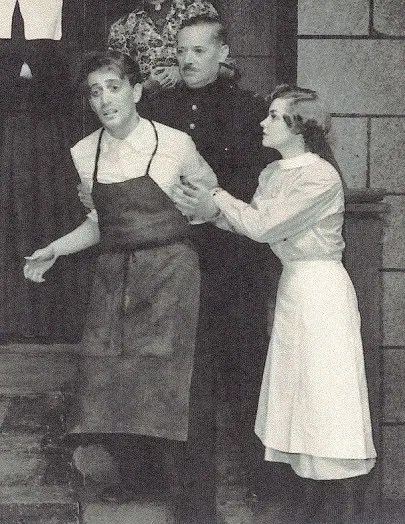
While Sister Bonaventure dominates the drama, the character of Willy Pentridge (Peter Wyngarde) provides a fascinating counterpoint. Though not a central figure, Willy, an autistic man, is one of the play’s most memorable creations. Employed to perform odd jobs around the convent, he initially appears to be a background character; however, Hastings gradually reveals that Willy possesses a unique and perceptive perspective on the events unfolding around him.
Left: Peter as Willy Pentridge
Modern audiences often view Willy as one of the play’s most complex roles. Recent production reviews have noted his portrayal as an autistic man, highlighting how his character exists somewhat apart from the social conventions influencing others. While those around him become entangled in prejudice and misunderstanding, Willy often perceives situations with a clarity that others lack.
There is a poignant quality to Willy’s characterisation; he is vulnerable yet observant. Hastings treats him with notable sympathy, granting him moments of genuine dignity. Rather than utilizing him for mere comic relief, Hastings ensures that Willy remains an integral part of the dramatic fabric, contributing significantly to the play’s most emotionally resonant moments.
Willy’s presence reinforces a central theme: the danger of judging individuals by appearances. Throughout the play, assumptions repeatedly prove unreliable. Sarat is assumed guilty due to her conviction, and Willy is underestimated because of his social position and personal traits. Through this, Hastings demonstrates that truth is often more complex than it first appears, reminding the audience that insight can come from unexpected sources.
The relationships between Willy and the other inhabitants are equally revealing. The varying levels of patience and understanding shown toward him allow Hastings to quietly explore themes of compassion and acceptance.
The mystery itself is skilfully constructed. Hastings plants clues carefully while maintaining an atmosphere of uncertainty. The ultimate revelation is satisfying because it emerges naturally from the preceding events rather than relying on improbable twists. This is supported by the play’s strong dialogue, which is clear, intelligent, and distinctive, revealing personality and advancing the plot simultaneously.
Perhaps the play’s greatest achievement is its balance of suspense and moral inquiry. Beneath the mystery lies a serious examination of justice, mercy, and personal responsibility. Sister Bonaventure’s quest to save Sarat becomes a defence of fundamental human dignity, inviting the audience to question whether legal judgments are always correct.
Ultimately, Bonaventure is a richly rewarding drama. Its compelling mystery, atmospheric setting, and thoughtful themes create a powerful theatrical experience. While Sister Bonaventure provides the moral centre, Willy Pentridge adds a layer of emotional depth that transforms the work from a simple thriller into a profoundly human story. More than seventy years after its debut, Bonaventure remains an engrossing work that speaks to the importance of looking beyond first impressions.
| Notes: There is a lot of action that take place ‘off-stage’, such as Willy helping to restore the cottage of a local villager, and the actions of several named characters that are never seen by the audience – including a gentleman by the name of Jason Kingham(!), who is Sarat’s fiancé. The primary theme of the play appears to be the importance of the accepted over the judiciousness of power. This is fundamental to Sister Mary’s struggle with the Mother Superior and vital too, the positioning of Willy, the supposed moron, and the nurses that function on the basis of authority – especially Nurse Phillips who states that the “tolerance” of someone like Willy “undermines authority”. |

© Copyright The Hellfire Club: The OFFICIAL PETER WYNGARDE Appreciation Society: https://www.facebook.com/groups/813997125389790/
This is a track from Graham Roos 2010 album, ‘Quest’, which features the voices of Peter Wyngarde and Fenella Fielding
Graham Roos is a multi award winning writer and director.
He was born in Sheffield and won an Art Scholarship to Rugby School. His career has spanned the media of art, theatre, film, music, radio, opera and publishing.
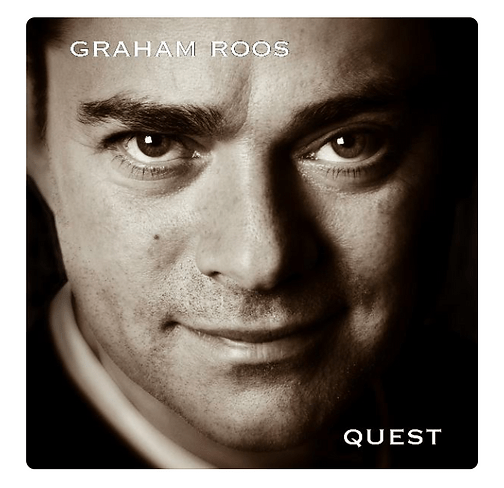
Quest – CD of spoken word, with the voices of Fenella Fielding, Peter Wyngarde, Martin Hancock, Sam Fox, James Dreyfus.
Download from:


Guest
Broadcast: November 1973
Click below for…
‘The King and I’: Review and Photographs
Television Listings and Reviews
© The Hellfire Club: The OFFICIAL PETER WYNGARDE Appreciation Society: https://www.facebook.com/groups/813997125389790/
South (Clip)
The Prisoner – ‘Checkmate’ trailer
Present Laughter (Clip)
Department S trailer
Jason King trailer
Bravo TV trailer (24th July, 1995)
Click HERE for The Film Room

