Rupert of Hentzau is a sequel by Anthony Hope to ‘The Prisoner of Zenda’, written in 1895 but not published in book form until 1898. The novel was serialized in The Pall Mall Magazine and McClure’s Magazine from December 1897 through June 1898.
The story is set within a framing narrative told by a minor character from ‘The Prisoner of Zenda’. The frame implies that the events related in both books took place in the late 1870s and early 1880s. This story commences three years after the conclusion of Zenda, and deals with the same fictional country somewhere in Germanic Middle Europe, the kingdom of Ruritania.
Above left: Peter, Barbara Shelly and George Baker during rehearsals.
Most of the same characters recur: Rudolf Elphberg, the dissolute absolute monarch of Ruritania; Rudolf Rassendyll, the English gentleman who had acted as his political decoy, being his distant cousin and lookalike; Flavia, the princess, now queen; Rupert of Hentzau, the dashing well-born villain; Fritz von Tarlenheim , the loyal courtier; Colonel Zapt , the King’s bodyguard; Lieutenant von Bernenstein, a loyal soldier.
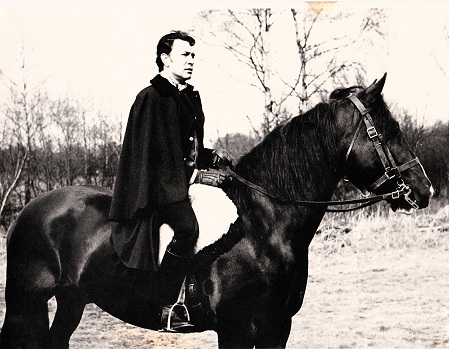
The1964 British television series ran for six half-hour episodes and successive Sunday afternoon’s at 5.30pm. The series was recorded at BBC Television Centre, London, but all six episodes are listed as “lost”, having been wiped by the BBC themselves after broadcast.
The Character of Rupert
The character of Count Rupert of Hentzau is an allegory for the corrupting influence of power. Rupert is a charismatic and charming man who uses his power to manipulate and control others. He is a symbol of the dangers of unchecked ambition and the corrupting influence of power. Rupert’s character is marked by his sly ambition, leaving a trail of deception and intrigue in his wake.
Story Synopsis
The story is set three years after the events of the ‘The Prisoner of Zenda’. The dutiful but desperately unhappy Queen Flavia (Barbara Shelley) is married to her cousin, the Ruritanian King, Rudolf V (George Baker). She writes to her true love Rudolf Rassendyll (also played by George Baker). The letter is to be delivered by hand by von Tarlenheim (Tristram Jellinek), but von Tarlenheim is betrayed by Bauer (Anthony poole) and his servant, James, and it falls into he hands of exiled Rupert of Hentzau (Peter Wyngarde) and his loyal cousin the Count of Luzau-Rischenheim (Derek Blomfeld). Hentzau sees in it a chance to return to favour by presenting the leter to the pathologically jealous and paranoid King.
Rassendyll returns to Ruritania to aid the Queen, but is forced to impersonate the King after Rupert fatally shoots Rudolf V in a remote hunting lodge. After tracing Bauer to the house of Mother Holf (Nora Gordon), Rassendyll and Rupert engage in an epic duel. Hentzau is mortally wounded, and Rassendyll burns the letter. However, he is assassinated in his hour of triumph by Bauer and thus is spared a crisis of conscience over whether or not to continue the royal deception for years.
Rassendyll is buried as the King in a state funeral, while Colonal Zapt* (John Phillips) and Rassendyll’s servant, James, stage a fire at the hunting lodge that burns the King’s body beyond recognition. Rudolf V is buried as Rudolf Rassendyll, while Flavia reigns on alone, the last of the Elphberg dynasty.
*In the book, the Colonel’s name was was Sapt.
Breakdown of the episodes As they appeared in the Radio Times
‘The Queen’s Goodbye’ – Sun, Apr 19, 1964 Exiled from Ruritanta for treason, Rupert of Hentzau returns secretly, determined to discover what takes Fritz von Tarlenheim to Wintenberg.
‘Return to Zenda’ – Sun, Apr 26, 1964 Rudolf Rassendyll is again forced to imitate his cousin Rudolf V after Rupert of Hentzau fatally shoots the King in a remote hunting lodge.
‘Audience With The King’ – Sun, May 3, 1964 Rudolf Rassendyll sets a trap and Rupert of Hentzau receives an eagerly-awaited summons.
The Wheel of Change– Sun, May 10, 1964 Rudolf Rassendyll goes on a journey with surprising results, and the King receives an unexpected visitor.
‘A Perilous Reunion’ – Sun, May 17, 1964 Queen Flavia is reunited with her true love Rudolf Rassendyll but the circumstances are less than ideal.
‘The Decision of Fate’ – Sun, May 24, 1964 Rupert of Hentzau meets the play-actor face to face and the future of the kingdom is resolved.
A bit of Trivia
For the part of Rupert in the series, Peter was required to wear some tight riding breeches which the director, Gerald Blake, felt were a bit too revealing in the crotch area. In the absence of anything with which to disguise the offending bulge, Peter had stuffed cotton wool down the front of the breeches.
It was Sally Home who was played Helga von Tarlenheim in the series , and who had previously worked with Peter in ‘Duel of Angels‘ and ‘Night Conspirators‘, who first noticed the newly padded area when Peter walked on set at BBC TV Centre, exclaiming: “Oh, Peter, do take it out, it looked much better before!”
Episode 7: ‘I Am Always With You’ – Broadcast: Sunday 1st April, 1956
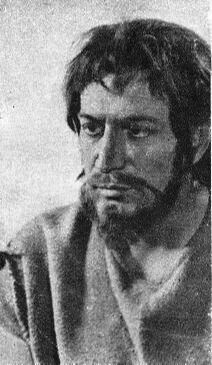
Character: John the Baptist
Peter as John the Baptist
In 1956, the BBC made Television history with a series of eight programmes on the life of Christ. Before this production censorship regulations prohibited the portrayal of Christ by an actor in public performances. It was only after the Central Religious Council approved the project, and the choice of actor in the central role, that the BBC were given the go-ahead.
Treated as an experiment, Jesus of Nazareth was placed in the children’s programmes slot on Sundays. But it attracted an adult audience whose appreciation placed it, as a BBC survey showed, next to the Coronation of 1953 in national appeal.
The series was produced by Joy Harington and would be considered her most notable work for television, for which she received the 1956 award of the Guild of Television Producers and Directors, the first to be presented for a children’s serial. Tom Fleming created a moving interpretation of Christ, and unusually for a live serial, with filmed locations in Galilee and Jerusalem, it was telerecorded so it could be reshown over the Easter holidays in future years. The scenes, especially of the Crucifixion, were regarded as some of the most powerful ever televised.
Writing in the Radio Times in February 1956, Freda Lingstrom, the Head of Children’s Television, wrote: ‘Our aim is to awaken the interest of children in the origins of the most significant influence in their lives, and help them to understand something of the background against which the Christian story was enacted.’
Lingstrom went on to explain the approach that the producer had taken; ‘In spite of this widely practised attempt to put the story of Jesus into modern speech, reverence for ‘Holy Writ’ remains for many people as sacrosanct as the spiritual truth it sought to present in the reign of James the First. It may come as a shock to some people that, although phrases which become household words remain, the cycle of plays we are about to represent will be in modern colloquial speech.’
In order to embark on such an important and ground-breaking project, advice was sought from several members of the clergy, whose scholarship and wide theological knowledge were put at the disposal of Joy Harrington, who wrote the eight scripts which began with Jesus as a boy of twelve, living in an occupied country, and ended with the Resurrection.
For the all-important casting, Harrington wanted an actor who was strong, virile, full of life and energy and convinced of his mission. Tom Fleming, born in Edinburgh, Scotland, in June 1927, was relatively unknown to television audiences in 1956, having only appeared in half-a-dozen productions, which were all single plays. The son of a Baptist preacher, he was initially anxious about playing the part. It was his interest in the spiritual value of the project that finally convinced him to undertake a part which, according the Freda Lingstrom, he approached with humility and a high sense of purpose.
In the spring of 1955, Fleming and Harrington and a contingent of the Children’s Film Unit, travelled to the Middle East, where certain sequences were shot in order to enrich the live productions. As Freda Lingstrom wrote; ‘Children will see him as Jesus in the scorching sun of the wilderness with hot desert wind blowing his robes and hair in disorder, far from the lifeless coloured-print image stamped on the minds of so many.’
This was a huge undertaking for the BBC. It was unheard of, prior to this, to take a film unit abroad to record original material for any of their productions. No doubt the Corporation was very much aware of the possible impact the series of plays could have. Especially if they got it wrong.
Linstrom again; ‘Throughout, the plays will present happenings in a straightforward manner with little emphasis on the miraculous. It is not our intention to rationalise events, nor shall we put forward any new interpretation of the gospels; our purpose is to offer children as true a picture as we can with the weight of authority behind it. Throughout, the humanity, courage and endurance of Jesus will be manifest; we shall not minimise the tragedy of the Crucifixion but care will be taken to see that it will be presented in such a way as to give older children food for thought while in no way alarming younger ones or leaving them with any suggestion of horror.’
Summing up, Lingstrom offered a word of advice to parents. Advice that most likely ensured an increased adult audience for what was seemingly being presented as a children’s series: ‘It should be remembered that this project is designed for older children and parents are asked to see that younger ones should not see the play alone.’ Nice bit of marketing.
Jesus of Nazareth began on Sunday 12 February 1956 with ‘The Prologue’. The play opened with a boy of twelve travelling with his parents to Jerusalem for the Passover feast. Jesus is seen talking with the elders in the Temple and subsequently found by Mary and Joseph and taken home. The eighth and final part of the series was broadcast on Easter Day.
In 1977, a British-Italian co-production was produced for television under the same title.
Trivia:
The series was partly shot in Galilee and Jerusalem.
Making the series was a courageous undertaking. At that time, censorship regulations prohibited the portrayal of Christ by an actor in public performances. The series was commended by The Guild of Film and Television Directors.
After it’s first broadcast in 1956, the series was reshown every Easter for three years afterwards.
The following was written by Mark Goodacre – Professor of New Testament and Christian Origins at Duke University, in the Religious Studies Department.
So, have you ever seen the TV series Jesus of Nazareth? No, not that series, but the one made twenty years earlier by the BBC? Me neither. In fact I didn’t even know about it until yesterday. Here’s the story.
I have been reporting recently on my research into the forgotten BBC production Paul of Tarsus (1960) ), research which led to the book of the series produced by its writer, producer and director Joy Harington. In the preface to that book, she writes the following:
The idea for this book and the Television series that preceded it was born in 1956 when the series ‘Jesus of Nazareth’ ended with these words from Jesus to his disciples: ‘Go and teach all nations the things that you have seen and heard . . . . . And know that I am with you always — even unto the end of the world.’ It left one with the feeling ‘What happened then?’ After all, it was a big order to give a handful of fishermen and peasants in a small occupied country . . .
And so on. So, it seems, there was a TV series on Jesus’ life broadcast in 1956 on the BBC. I didn’t think I had heard of this before, so I went to the net to see how many others had heard of it. The answer is: very few.
The IMDb weakly mentions Jesus of Nazareth from 1953, starring Tom Fleming. In the light of the above, the date is certainly wrong. Is it even the same production? Well, it looks like it is because this TV series clearly featured Tom Fleming playing Jesus. There is a good paragraph or so on it on the BFI’s Screenonline. Profile of Joy Harington:
But perhaps what is considered her most notable work for television was the eight-part Sunday serial Jesus of Nazareth (BBC, 1956) for which she received the 1956 award of the Guild of Television Producers and Directors (now BAFTA), the first to be presented for a children’s serial. A live studio production with exteriors filmed on location in Galilee and Jerusalem, it was a courageous undertaking. At that time, censorship regulations prohibited the portrayal of Christ by an actor in public performances. However, the Central Religious Council approved the project and Tom Fleming was cast as Jesus Christ. The serial was an outstanding success. Harington followed with a similar ten-part series, Paul of Tarsus (BBC, 1960), for which the exteriors were filmed mainly in Crete.
So we now know that Paul of Tarsus was filmed in Crete, and Jesus of Nazareth was partly filmed in Israel, and the latter was considered “a children’s serial”. There is more research to be done about this lost series, and I look forward to reporting back on this in due course.
Above: A page from the Radio Times (12th April, 1957) – published to coincide with the first rescreening of the series at Easter that year.






 PETER WYNGARDE: The Official Website