REVIEW: The Avengers – Epic

Broadcast: Saturday, 1st April 1967

Character: Stewart Kirby
EPIC

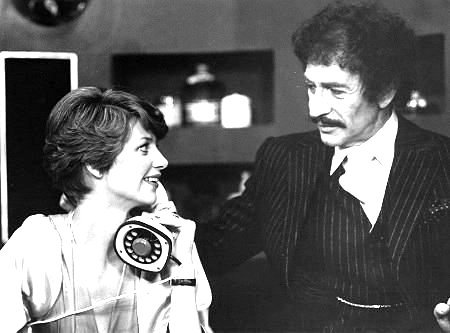
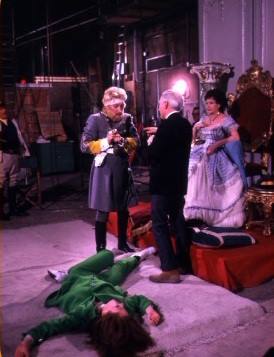
As the story opens, the camera focuses upon a life-size movie promotional poster for “The Bad, Bad Lady” starring actress Damita Syn, shown dressed in glamorous, but long outdate attire. Standing beside the poster is Miss Syn in the identical dress and elegant pose. The camera pans to an immense and impressive trophy, which had been awarded in the past to film director/producer Z. Z. von Schnerk, and then to another old promotional poster for a movie starring Stewart Kirby, entitled “Sophisticated Scoundrel.” Stewart Kirby (Peter Wyngarde) is seated on the couch–a rather distinguished, laid-back looking fellow, with flowing silver hair, dressed in a smoking jacket and passively enjoying his pipe and a glass of wine. A third gentleman is standing before Z.Z. von Schnerk and Damita who appear to be sizing him up for a movie part. When they ask Stewart for his opinion of the actor for the “non- speaking” part, he sedately steps up to the man, puts on his glasses, peers directly into the actor’s eyes, and agrees, although he drolly comments that the actor is “a bit tall.” A “screen test” is called for, and without a word, Stewart pulls a pistol, s hoots and kills the actor with one shot. “Non-speaking,” chides Damita as the moaning actor falls to the floor.

Across town, dapper investigator John Steed arrives at Mrs Emma Peel’s home just in time to find her leaving to meet an unknown contact. She explains to Steed that she has just received a phone call whereby an anonymous caller has asked to meet her on Fitzroy Lane, stating that it was urgent.

Parked on a rural country lane, Steed and Mrs Peel await the rendezvous with the mysterious caller. Soon an old Preacher comes peddling along on a bicycle and politely tips his hat as he passes the car. “False alarm,” says Mrs Peel, who does not see the Preacher stop to make an adjustment to the parcel in his basket–a parcel that appears to conceal a camera. Returning to her apartment, she plays the tape of the mysterious caller for Steed. The voice is strong and masculine; the words spoken with the eloquence, articulation and enunciation of a trained Shakespearean actor. The caller insisted that he had to see her, to meet him five tenths of a mile down Fitzroy Lane . . . it’s life and death, Mrs Peel . . . I must see you.” Since Mrs Peel is about to go visit a friend, Steed makes a dinner date with Mrs Peel for six o’clock that evening.

kirby

At the derelict von Schnerk studios, the three “has-beens” view a film–the one just taken by the Preacher (also known as Stewart Kirby) of Mrs Peel and Steed on Fitzroy Lane. Z.Z. is ecstatic–he has found his “leading lady” for his newest film endeavour, to be titled “The Destruction of Emma Peel.”

Above Left: Peter as Stewart Kirby.

A mysterious gloved hand is seen cutting a wire in Mrs Peel’s car engine, and when it next fails to start for her, a taxi coincidentally pulls up at the same time. Conveniently, Mrs Peel directs the moustachioed, bespectacled cabbie (a.k.a. Stewart Kirby) to her destination, but soon realizes she is being kidnapped as gas seeps into the rear compartment. Behind locked gates and an electric fence, Stewart unloads Mrs Peel w ho eventually awakes on a living room floor. Puzzled, she begins to explore what turns out to be a movie studio set.

In a scene of deja vu, she stumbles upon what looks like her own car, which still won’t start; and the same taxi reappears with the familiar cabbie politely tipping his hat to her as he drives past. Next a black limousine, the peeling of wedding bells, a contrived gale-force wind, a blowing a wedding vale, and an engraved invitation to the wedding of Mrs Peel set the stage for her next, almost dream-like encounter. She ponders the invitation with some amusement until she spies a familiar-looking Preacher, standing at the top of a hill, beckoning her onward. When she reaches the top of the hill, the Preacher pushes her over backwards and she rolls down the hill where she finds herself in a graveyard. Each headstone is inscribed with her name–R.I.P Emma Peel. Behind the wheel of a hearse, the undertaker (a.k.a. Stewart Kirby), who bears an uncanny resemblance to the Preacher, calls out, “Mrs Peel . . . we’re waiting for you,” then slowly drives away.

Continuing her exploration of the studio, Mrs Peel discovers the body of the unfortunate actor killed by Kirby–propped up in a director’s chair marked “John Steed.” She hears a woman’s voice and soon finds Damita, dressed like a Queen, seated on a throne, and knitting. In a dramatic entrance, a gladiator bursts onto the scene and shouts to Mrs Peel, “Leave her alone . . . I told you before, stay away from Mother!” In a touching scene of reunion, Damita calls to him, “Alexander.” Alexander (a.k.a. Stewart Kirby) falls before her, “Mother, mother,” he cries. When she asks him how went the war, he exclaims, “It was hell, Mother, the noise, the people . . . and how has my wicked little sister been behaving, Mother?” “She’s evil,” replies the Queen. “Shall we be rid of her, Mother?” “Yes,” she responds, and Alexander attacks and tries to strangle Mrs Peel. Emma Peel, however, is playing for real, and gets a few good licks to her opponent before the Queen hits her with a sword and knocks her unconscious. Stewart is looking slightly frazzled from his pounding by Mrs Peel.

This slideshow requires JavaScript.

Bizarre encounters with a variety of characters continue for what are now obviously scenes for Z. Z. von Schnerk’ s newest film extravaganza. Armed with a six-shooter, Emma’s next showdown is with a gunslinger (a.k.a.–you guessed it, Stewart Kirby!) in an Old West saloon. After downing a shot of whiskey, he drawls, “Tell you what . . . give you three seconds . . . get out of town. “Catching on to the game, Mrs Peel anticipates the action, and guns down her opponent. “Beautiful, perfect . . . this picture will be my ultimate masterpiece” proclaims Z.Z.. Wiping the sweat from his brow, Stewart staggers off the s et, exhausted.

“Meanwhile, back at the ranch,” John Steed arrives to pick up Mrs Peel for their date, and finding her gone, again listens to the voice on the tape recorder. Back at the von Schnerk studio, over a glass of wine, Stewart and Damita listen half-heartedly as Z.Z. proclaims that this picture would restore them to their former pedestals of glory.

Below Right: A break during filming. Peter chats with director, James Hill.
Epic21

Mrs Peel’s next encounters are with a German soldier (a.k.a. Stewart Kirby of course) wielding a machine gun, a horseman brandishing a sword (ineptly played by Damita), and Indians! As an Indian warrior rushes towards Mrs Peel, she shoots three times, and he falls three times, before she realizes she’s shooting blanks. The Indian (a.k.a. Stewart Kirby) physically attacks Mrs Peel who knocks him senseless before escaping into the back reaches of the studio. “You were supposed to win, Kirby,” shouts Z.Z. to a most dishevelled, exhausted and obviously frustrated Stewart. “Why didn’t you tell her that!” pants Stewart, his rich British accent out of character with his Indian costume. “Time for the climax . . . the real death of Emma Peel,” Z.Z. proclaims.

As the wayward trio views the film thus far, it is obvious that Stewart Kirby has always gotten the worst of it during his encounters with Mrs Peel. “She’s an Amazon,” he exclaims . . . “I’m not a stunt man!” Meantime, Mrs Peel encounters a policeman patrolling the studio grounds and she leads him to the body, still in the director’s chair; however, the policeman turns out to be a film extra, an “artiste,” and not a real bobby. When Z.Z., Damita and Stewart discover the intruder, Z.Z. exclaims that the script didn’t call for a policeman. “Well, you’ve got one now,” states Stewart as he placidly sips his wine. “We’ll write him out, permanently,”announces Z.Z.

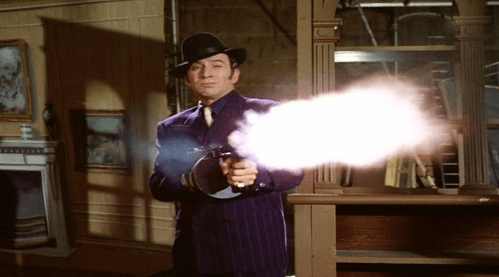
Soon the policeman and Emma Peel come face to face with a most sinister looking gangster armed with a machine gun. After some amusing banter, the gangster (yup, right again, a.k.a. Stewart Kirby) blows the cop away, permanently.

Back at Mrs Peel’s apartment, Steed finally remembers where he has heard the mysterious voice before as he recalls the famous “To be or not to be, that is the question” Shakespeare line as spoken by the once-famous actor Stewart Kirby.

Again Mrs Peel encounters Damita, now dressed as a southern belle, again sitting on her throne, knitting. A wounded Confederate soldier (yessuh, a.k.a. Stewart Kirby) staggers onto the scene and mustering his best southern accent, addresses Mrs Peel, “I told you before, stay away from Maw!” “Edgar . . . home from the war . . . was it so awful?” Damita asks. He replies, “It was hell, Maw, the noise, the people . . . those darn Yankees. How’s my baby sister been?” “She’s evil,” replies Damita. “I’ll kill her for you Maw . . . they taught me Maw, those darn Yankees, they taught me.” Emma Peel stands by in pleasant anticipation of yet another chance to whip her inept opponent in an almost identical scene as with the gladiator. Again Damita appears to knock out Mrs Peel with a sword, and the rumpled, bedraggled Stewart drags Mrs Peel off to prepare her for the final scene.

With Mrs Peel tied to a chair, Z.Z. introduces himself and reveals his intent, explaining that he is making a movie, perhaps a bit “down beat” but highly authentic because the heroine dies. “I will make you a star . . . posthumously,” he exclaims.

Having put the pieces of the puzzle together, John Steed arrives at the studio and carefully makes his way over the electric fence. He finds a copy of the movie script, “The Destruction of Emma Peel,” and then the body of the actor who is dressed in a suit and hat identical to his own.

Back inside the studio, the set is fitting of the finest horror movie classic–a torture chamber, buzz saw and Poe’s swinging pendulum. Mrs Peel helplessly awaits the final act, as a Dracula-like character, “Herr Doctor,” (a.k.a. Stewart Kirby) and his assistant, Natasha (a.k.a. Damita) approach their victim. “(I must) experiment on living tissue” proclaims the good doctor, “her death must have more poetry . . . it will take time and yet be inevitable. What do you think of that?”

“I think I’m in danger of becoming a split personality,” she calmly replies. Z.Z. stops the action. Stewart is now showing obvious signs of great physical stress and strain from the rigors of this movie; and, never being far from a bottle, thankfully takes a long swig from his pocket flask. Z.Z. orders the two out to fetch the corpse–unaware that the ” body” is now actually the very much alive John Steed. “You’re not feeling the part, Mrs Peel,” says Z.Z. as her chair moves closer to the blade. “I have a feeling I will be feeling it,” she says, eyeing the saw. Z.Z. calls for music then jumps to the nearby piano and strikes up a tune in the melodramatic style of a silent movie. The two wheel in the “live” body of John Steed who leaps into action. Stewart dons his glasses and aims a chair at Steed’s head, but it hits Damita instead. Steed catches Stewart, rips off his wig, removes his glasses, and knocks him out cold. Unfortunately, Z.Z. has a real gun; but during the brief struggle, he accidentally shoots himself and gasps with his dying breath, “Cut, print!”

The story has a happy ending, and Mrs Peel tells Steed the part she liked best in the movie was when Kirby tried to hit Steed over the head with a fake chair, and then demonstrated the act. Problem was, the chair she used was a real one, and Steed is k nocked out. The closing scene shows Mr s. Peel and Steed in a living room, trying to decide which movie to see that evening. Mrs Peel nixes the old Stewart Kirby flick, and they opt instead to go over to her place. With that, Mrs, Peel kicks down the wall of the living room, revealing that they are still on a movie set.

In Retrospect
EPIC2

REVIEW: Camino Real

Broadcast: Monday, 27th January 1964

Character: Jacques Casanova

In his own words, Tennessee Williams “Kicks over the traces” in ‘Camino Real’, the play he had favoured most of the 20 he’d written to date. Its appeal for him was in its “Unusual degree of freedom”.

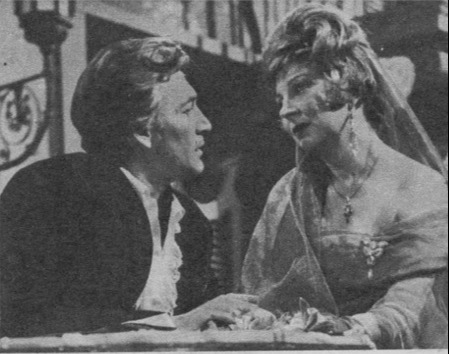
Theatrically, he took liberties with convention and threw open his stages to a rich assortment of characters. They ranged from a mingling of literary real-life romantics – Casanova (Peter Wyngarde), Marguerite Gautier (Pamela Brown), Byron (Philip Madoc) and Don Quixote (Donald Eccles) – to a wandering American prize fighter with a heart of complaint, Kilroy (Donald Madden), a gypsy (Patience Collier) and her daughter, Esmeralda (Diane Cilento), and many others. It was colourful, eloquent and stimulating.

Above: Peter as Jacques Casanova with Pamela Brown as ‘Camile’

There was, of course, no direct explanation, for this unlikely mixture of characters. “To go to Camino Real with the inflexible demands of a logician is unfair to both parties,” wrote the author in a foreword to the play published in the New York Times before its premier on Broadway in March, 1953. “But stay with it for the first three minutes,” said television director Henry Kaplan, “and you’ll be caught up and captivated by the goings on the plaza.”

The plaza is the central square of the town where the play is set, with its luxurious hotel on one side, and on the other, its “flop house” and “loan shark”. Outside the town is the Terra Incognito – a formidable arid wasteland – through which anyone wanting to leave must pass.

“But it requires innocence to get away and most people when they take stock of their life has taken its toll of innocence, has corrupted them, or that we’ve given way to excesses,” says Peter of the play. “So not many people are able to get away. Certainly not Casanova, the old rake, who led so an exhausting life that he’s too tired to even look for a way out. Instead he drinks.”

He also courts Marguerite Gautier – Camille. “And there’s no way out for her either – especially now that she’s taken to drugs,” said Pamela Brown. “She’s an aging voluptuary.”

REVIEW: Play of the Week – Darkness At Noon

Broadcast: Tuesday, 15th January 1963

Character: Colonel Glenkin

When Sidney Kingsley’s adaptation of Arthur Koestler’s harrowing novel, ‘Darkness At Noon’ was performed on Broadway in 1951, a New York theatre critic described it as “Savagely gripping and provocative.”

It is a description which also applied equally well to Cyril Coke’s TV version, which was broadcast on Tuesday, January 15th, 1963. The question being asked was: Does the end justify the means?

During the Stalin era in the Soviet Union, the end was everything. But Rabashov (Albert Lieven), hero of the play, as Party chief, has known what the cause could demand, and is now imprisoned.

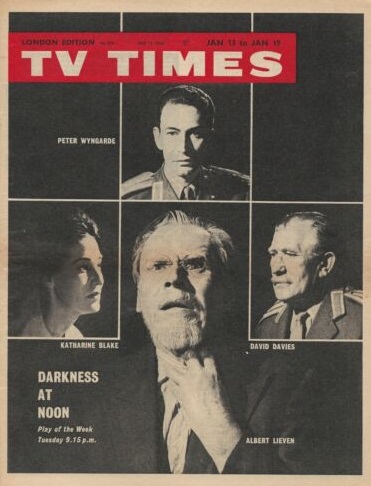
Below Right: TV Times. Peter as Glenkin, top centre.

The year is 1937. The year of the Moscow Purge Trials. Commissar Rabashov has made the unfortunate mistake of expressing an unorthodox opinion at the wrong time. In his cell, he is tormented by his past, his earlier, loyal life in the Party. He has always believed that this particular end justified the means: now he has been caught up in his own belief. Wracked by the realisation of his own guilt, his own acceptance of cruelty, he awaits his fate.

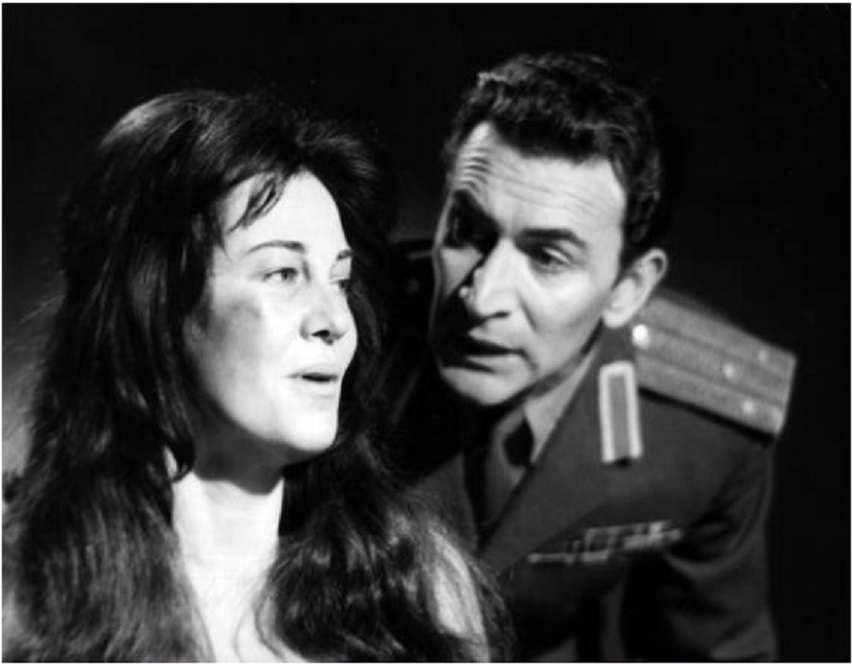
He recalls his past – his girlfriend, Luba (Katherine Blake), his betrayal, his comrades. One of his former friends – another member of the old Communist brigade, Ivanov (David Davies), tried to exhort a “confession” from him. He wants to keep Rabashov out of the hands of the young but merciless officer, Glenkin (Peter Wyngarde). When Rabashov refuses to talk, Ivanov asks: “Which are we to save? Your dignity or your head?” But before long, Glenkin has Rabashov in his evil clutches…

Cyril Coke, who directed and adapted the play said: “I read Koestler’s book years before, and I’d always wanted to televise it. Now that the Soviet leaders admit the wrongs perpetrated on the ‘Old Guard Of The Revolution’, in Stalin’s time it seemed the right moment to screen it. Those wrongs it exposed still exist today.

“Sidney Kingsley’s play won the Annual Award of the New York Drama Critics in 1951, but this was the first dramatisation of Koestler’s novel in England, and I was delighted to direct it.”

As Rabashov, Albert Lieven had, stated at the time, “One of the most exciting parts I could imagine. I think this was one of the really worthwhile things to do.”

Sentiments echoed by Katherine Blake: “It was one of those plays where the meaning was very clear from the very first rehearsal. I could understand the role of Luba immediately so the part was easy to learn; easy to speak.” Equally enthusiastic was David Davies: “It was the best part that I’d ever had, and that includes the part of the drunken father in Gorki’s play, ‘Mother’.”

Although Peter enjoyed playing the evil Glenkin, he said back in 1963 that he might soon win a few more sympathetic roles: “I’m tired of being hated!” he confessed.

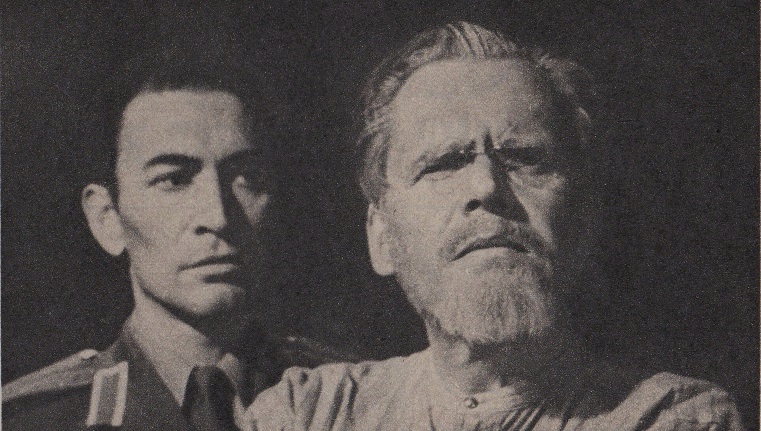
Above: Peter with Albert Lieven as Rubashov

REVIEW: Queen of Scots

Characters: William Maitland of Lethington and William Cecil, 1st Baron Lord Burghley

Some Background

The Great Hall at Fotheringay Castle, 1587. The executioner knelt to beg customary forgiveness from his victim. Then, the axe fell and gave birth to the most romantic legend in royal history.

Mary Stuart was colourful, reckless, indulgent, passionate and extraordinarily graceful. A mammoth two-hour dramatisation of her life ‘The Queen of Scots’, was screened on Wednesday, November 29th, 1961.

The production was directed by Geoffrey Nethercott whose wife, actress Ellen McIntosh, played the difficult title role. In the play, Ellen had to wear twelve heavy period costumes; they were lovely, but difficult to work in. However, the actress who suffered most from the costume difficulty, was Mary Kerridge, who played Queen Elizabeth. Her costume was copied from a portrait, was four feet wide and quite impossible to sit down in.

Altogether, there was a cast of sixty actors in the production, all meticulously dressed in 16th century costume. Peter, who played two parts in the production – William Maitland and Lord Burleigh – says that the play was extremely dramatic, which had caused a few headaches for the writers: “Some of the more crucial turning points in Mary’s life were some of the most shrouded in doubt. Although history professors from Glasgow University were on hand to advise, the writers had to make a few decisions of their own.

“For example, at the heart of Mary’s ruin were the so-called Casket Letters. These were reported to have been written by Mary to Boswell. They were love-letters full of poetry and sentiment, but also implicated her in her husband’s murder. The writer’s decided to assume these were forgeries.”

The writer’s, Ian Stuart Black and Jack Gerson, set out to cut through the romance and put forward the truth. Gerson believed that Mary did a Pontius Pilate act and washed her hands of Darnley’s murder. Co-Writer, Ian Stuart Black had been taught at school that Elizabeth had been a bad Queen, but the research he’s done later taught him that she was actually a very courageous woman deserving more sympathetic consideration, which was just what she got in the play. In fact, as both history and this production showed, it was only Elizabeth herself who was protecting Mary from her inevitable execution. But Mary’s ambition for her throne made her a constant source of danger which finally had to be resolved.

A Bit Of Trivia

Critics Comments

Pretty impressive for when it was made and given that it was a Scottish Television production. This TV play went out live on 29th November 1967 to celebrate the tenth anniversary of STV and was the most expensive show produced by them up to that point.

Ellen McIntosh, from the great city of Dunfermline, takes on the title role but is joined by a huge array of recognisable acting talent. There are a few notable non-Scots (a brilliant Peter Wyngarde for example), but the majority of the cast are Scottish and include the great John Laurie playing John Knox (not for the first time on screen), a young Tom Conti playing Rizzio, and a string of well-kent Scottish faces including Walter Carr, Gerry Slevin, James Copeland and more.

It is of course entirely studio-bound so perhaps feels somewhat lacking scale, but you can’t argue with a cast like that and given how much detail of the various plots surrounding Mary is packed in, it certainly does move along at a fair old pace. It’s dialogue-heavy of course, but it never feels too talky.


Feels like it should really be regarded as a landmark of sorts in the history of Scottish TV but seems largely forgotten now, perhaps due to how scarcely it is seen.

Alan Maxwell

REVIEW: The Salt Land

Broadcast: Tuesday, 8th November 1955

Character: Arich

In the mid-50s, Independent Television was still in its infancy, and was seen as a threat to the old guard of the BBC. And while it would be met with a peculiar mixture of groans and cheers according to taste, the new kid on the block was determined that it was here to stay. The highlight of ITV programming on Tuesday, 8th November 1955, however, was a play lasting 90 minutes. under news flash of about as many seconds! The play was Peter Shaffer’s The Salt Land – the land in question being Israel.

It opened on a boat carrying a variety of immigrants to mandated Palestine. Within a few minutes, viewers were introduced to most of the cast and had received an uncomfortable impression that they were about to be led on a guided tour of the Jewish people – from the aged rabbi, who has come to die and be buried in the land of his faith, to the arch rouge who had made his fortune through deals with the Nazis, and whose only interest in the ‘homeland’ is to make himself even richer.

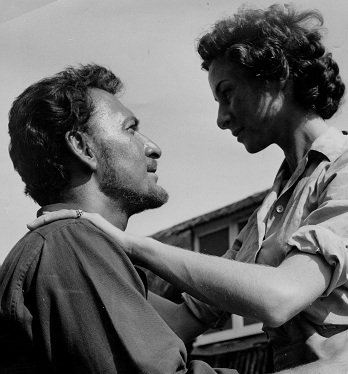
There is the simple man with his two sons; the older – a wastrel and petty criminal (Peter Wyngarde), the younger, a selfless idealist who is stirred by the fierce fanatical passions of the Old Testament. There is the ship’s captain, intent only on doing his job and getting the boat to the proper place at the proper time, and the faithful girl who loved the petty criminal and will follow him wherever he goes. And with them is an assortment of other ‘Jewish types’, most of them made of cardboard.

Right: Peter as Arich, with Clare Austin as Kulli

Long before they arrive there is quarrelling – personally and politically – and with a brilliant touch of irony, they are at each other’s throats when the promised land homes into view over the horizon.

Once there, the feeling of dramatic compression dissolves to some extent in the stresses of the war for independence, in which the bat brother tempts the good one with offers of arms, and the even greater stresses of the following piece. In which the bad brother then tempts the good one with offers of agricultural machinery. Eventually, in a paradoxical twist, it is Able who kills Kane.

As a play, The Salt Land was never one of Shaffer’s best. The great flood of tediously pedantic messages which rolled out of the screen must have become wearisome before long to all but the most passionate supporters of the author’s case. They must have been asking themselves as I did, how many more times must we have proof that sincerity and righteousness are not of the slightest use in the construction of a work of good television?

Of the characters, only the two brothers had any real depth, and this may have been due in no small part to the burning sincerity of David Peel’s ‘Able’ and the understudied casualness of Peter’s ‘Caine’. Otherwise, the dialogue had a flatness about it that was, unfortunately, emphasised by the endless questions from the Old Testament that was scattered throughout.

Regardless its shortcomings, The Salt Land was exactly suited to its medium; certainly it could not have been done so stirringly on radio or as vividly in print. It could not have been done in the theatre, or indeed on the big screen without losing a great deal. The production and director were designed to make the maximum possible effect in the medium that had been chosen, and at that rate it unquestionably succeeded.

Suitable for television then, but something else, too. I suggest it was a sense of purpose. There was a point and I feel that it mattered; somebody was saying something and it had meaning. The play, then, was an exercise in sincerity rather than a work of real dramatic value. It might also be noted that the opening and closing narration was not just the filtered voice of an announcer, but by the director himself, John Clements. His clipped tones set the play afire, a coupled with Peter’s masterful performance, made what might have been a failure into a worthwhile experience. This was one of Peter’s first venture into the realms and television; the first step on a memorable and magical journey.

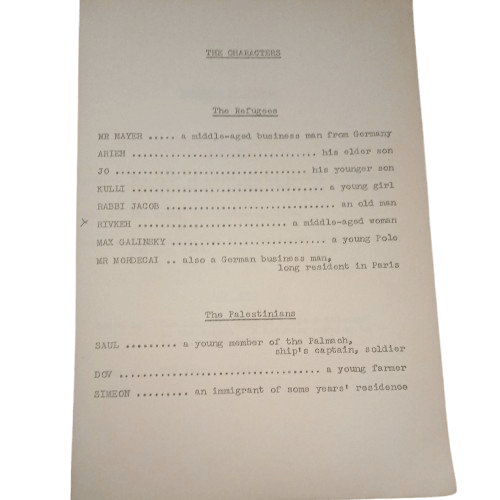
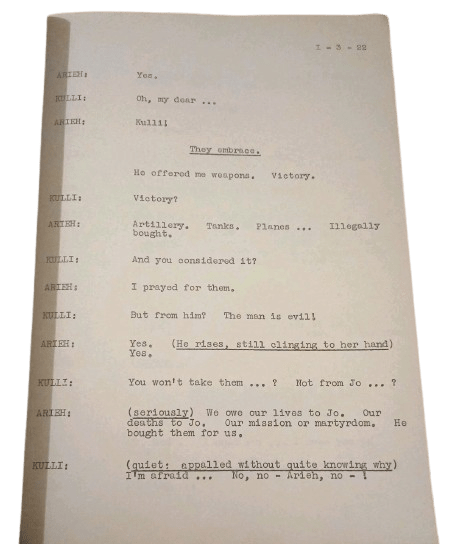
The Script

‘The Salt Land’ Peter Shaffer’s debut work. He would later go on to win Academy Awards, Tony Awards, and universal acclaim for ‘Amadeus’ and ‘Equus’. Written while Shaffer was working at the New York Public Library,
This 90-minute television drama marked Shaffer’s first exploration of themes that would define his career: faith versus cynicism, idealism versus corruption, and the burden of history. Critics noted it contained “most of the themes that would re-emerge, transformed and magnified, time and time again” in his later work.

One of only a handful of known surviving copies. Peter Shaffer’s personal copy is held at Trinity College, Cambridge (catalogued as disbound with damaged title page). Another copy exists in the National Library of Australia.

PETER SHAFFER (1926-2016)

REVIEW: Sunday Special -Shadrach, Neshach and Abednego

Broadcast: Sunday, 11th May 1958

Character: Storyteller

ABINGO

One of Peter’s greatest ever performances was not in the role of a hero in a stage play or villain on T.V., but as a storyteller on BBC Television’s ‘Sunday Special’ programme in February 1958.

On the occasion he read the bible story of ‘Shadrach, Neshach and Abednego’, and made such an impression on one of his viewers, Reverend Prebendary, J.B. Philips – translator of the Bible. He wrote: “The ‘Sunday Special’ reading of the story of ‘Shadrach, Neshach and Abednego’ was absolutely magnificent and, to my mind, the best Scripture reading I have ever heard in my life.”

The BBC acknowledged Peter’s work with an announcement in the Radio Times, congratulating him on his tremendous abilities, and suggesting that an earlier piece read by the late, great Charles Laughton on the same programme, had appeared flat and dull by comparison. The Canon Roy McKay, head of Religious Broadcasting at the BBC echoed Reverend Philips’ sentiments by stating that he’d particularly appreciated Peter’s rendering of Saint Paul’s speech in Athens, going on to say it had been the highlight of an “excellent programme.”

REVIEW: Big Toys

Presented by English Theatre, Vienna – 1977

Directed by Peter Wyngarde

Character: Richie Bosenquet.

Written by Nobel Laureate, Patrick White. European Premier 1978

The Story

The Action takes place in a Sydney harbourside penthouse in the Winter and early Spring of 1976.

That enterprising institution, Vienna’s English Theatre, gave ‘Big Toys’ – a play by Patrick White, the Australian author who was awarded the 1973 Nobel Prize for Literature, its first performance outside of its native land. By 1978, only 11 dramatists had been bestowed with the Nobel Prize. This disproportionate list suggests that drama was ranked way below fiction and poetry by the Stockholm jurors.

BIG TOYS

In Retrospect

Programme Notes

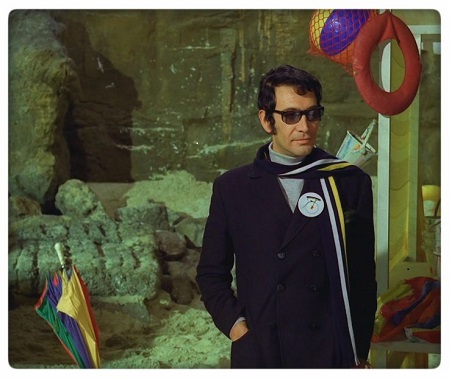
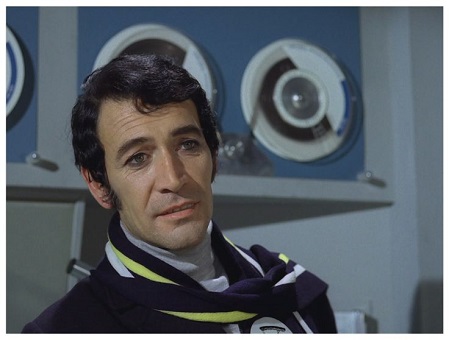
REVIEW: The Prisoner – ‘Checkmate’

Broadcast: Monday, 27th November 1967

Character: Number 2

2

Above: Peter as Number 2.

“In society one must learn to conform.” Number 2

The Story

With the dawning of another beautiful day in The Village, the roar of the Village’s inanimate watchdog, Rover causes everyone to freeze in their tracks. Everyone, that is, except an elderly gentleman with a walking stick who pays no heed to Rover as it bounces by. No. 6 is somewhat bewildered by this phenomenon, and follows the old man to The Village green where a crowd is gathering. There he invites him to join in a game of “human chess,” where real people are the playing pieces and the game board is an appropriately marked open lawn. Two masters seated upon high chairs and speaking through megaphones direct the moves. No. 6 is assigned to play the White Queen’s Pawn. The game proceeds smoothly until another player, the Rook, takes matters into his own hands and moves without being ordered by the master – a blatant display of individuality in flagrant violation of Village rules. With alarm, the Control Supervisor sends out an urgent cry over The Village loudspeakers to call the substitute and to “remove White Queen’s Rook to Hospital.” Within minutes, the poor Rook is being whisked away on a stretcher. No. 6 questions the Queen as to the Rook’s fate, and is told that he would be well looked after, that they would get the best specialists to treat him. She explains that in The Village, such individualistic behaviour, the “cult of the individual” is not allowed.

After the game, No. 6 engages in conversation with the winning master, No. 14– the man with the walking stick. He asks why the game was played with real people, and is told that psychiatrists claimed it satisfied the desire for power.

Continuing his query of No. 14, No. 6 asks why players on both sides look alike, and No. 14 explains that one tells the blacks from whites by their dispositions; by the moves they make. “You soon know who’s for you or against you. It’s simple psychology, the way it is in life. You judge by attitude . . . people don’t need uniforms.” He alludes to the fact that at one time he, like everyone else, also had a plan to escape, but adds that all of the plans fail unless one learns to distinguish between the blacks and the whites. And so a seed of an idea is planted.

Until now, the charismatic and debonair “new No. 2” has maintained a passive interest in the daily activities of the charges within his domain, remaining perfectly content to monitor his world from a distance via video surveillance. Out for a morning drive, he chances upon No. 6, and cordially invites him to join him. “Why?” queries No. 6.

“I’m going to the Hospital . . . I thought perhaps you’d like to see our friend the Rook,” explains No. 2.

“Yes,” says No. 6 as he hops into the mini-moke.

At the Hospital, No. 2, No. 6 and a nurse witness the “rehabilitation” of the Rook through a one-way window. The Rook is seated in a wheelchair before four coloured water dispensers. The nurse explains that the Rook had been dehydrated and upon awaking (after an injection), would have an insatiable thirst. The procedure was based upon Pavlov’s experiments with dogs. As predicted, upon awakening the Rook is driven for water. He first tries the yellow dispenser, which is empty. As he reaches for the blue one, a voice commands him to leave it; and when he ignores the order and tries the dispenser, he receives a powerful electric shock. In agony he falls to the floor, whimpering.

With a look of disgust, No. 6 turns to No. 2 and says, “Don’t tell me, it hurts you more than it hurts him.”

Without a shred of compassion in his voice, No. 2 pronounces one of his most memorable, chilling and powerful lines of the episode, perhaps of the entire series, “In this society, one must learn to conform.”

78b8705919b3e2dd0fe06e14eacc75a2

The Rook continues his plea for water as he tries the other dispensers without success and is curtly told he would get water when he obeyed. He is then ordered to go back to the blue dispenser. In fear of receiving another shock, the Rook hesitates, as the voice coldly and sternly demands that he do as he is told, that he has nothing to be afraid of, and to go to the blue dispenser.

Finally, with great trepidation, the Rook obeys and receives water without the electrical shock, greatly pleasing all that were watching. “From now on he’ll be fully cooperative,” proudly croons No. 2.

The next day, in an effort to sort out the prisoners from the warders, No. 6 strolls around The Village taking note of the individual behaviour of other residents and their response to his eye contact. He encounters the Rook, obviously a prisoner, and convinces the man to assist him in organizing an escape from The Village. Together, the two confront various Villagers to find their “reliable men,” determined by each man’s attitude and reactions to questions posed by No. 6.

Back at the Hospital, the Queen is wheeled into an examination room where, under the approving eye of No. 2, a nurse proceeds to hypnotize the woman, telling her that she is passionately in love with the man on the video screen before her . . . No. 6. She instils upon her a desire to follow and protect him, even to a point of betraying him should he try to escape. A locket is then place around her neck, which contains a tiny reaction transmitter, which turns the Queen into an automatic alarm system whereby No. 6’s movements would be tracked without his knowledge. The nurse explains that the procedure is based upon research done with dolphins, and No. 2 is obviously amused and impressed by this latest display of scientific technology.

Up until now, this handsome, cool and charming No. 2 has appeared to be a less than formidable obstacle for No. 6, but he would soon learn differently. Except for the continuing peskiness of the Queen, the plan unfolds and seems to be running smoothly as No. 6 and the Rook assemble the components needed to build a crude radio transmitter. The small band of would-be fugitives assemble at the Stone Boat one dark night while from the beach, No. 6 broadcasts a distress signal simulating an aircraft in trouble and about to go down at sea, which is received by a passing ship, the MS Polotska. The Rook then paddles an inflatable raft and the transmitter out to sea to bring in the ship.

CheckmateNumber2-540x405

In his chambers within the Green Dome, No. 2 is seated cross-legged on the floor beside the control console, deep in meditation and dressed in a white tunic; before him is a plank of wood set between two bricks. The phone rings and after a brief pause, he answers, chastising the caller for disturbing him against his orders. The Control Supervisor on the other end reports that the search light crew in the tower had just been attacked (by No. 6 as it turns out). In a lightning swift display of martial arts prowess, accompanied by a ritual karate cry, No. 2 deftly snaps the plank in two with a single chop. He then rises gracefully to take charge of the situation.

Now alerted to trouble, No. 2 begins monitoring the distress signal and seems almost unsurprised when he is confronted and subdued by No. 6 and his small band of fugitives. In fact, he offers no resistance whatsoever. When the signal suddenly stops, No. 6 leaves the others to investigate. He finds the raft and radio washed up on the shore and no sign of the Rook.

A ship approaches, and No. 6 paddles out to bring her in. Once on board, he begins to explain the situation to the captain when No. 2 appears on the TV screen in the ship’s cabin and smugly informs No. 6 that the MS Polotska belongs to The Village. The Rook is standing alongside No. 2, and No. 6 learns of a “slight misunderstanding” on the part of the Rook. It seems that the Rook applied to No. 6 his own tests and became convinced that No. 6 was actually a warder out to trap him. When No. 6 asks No. 2 what had become of the rest of his men, he replies that they would be back tomorrow on the chessboard . . . as pawns. No. 6 then smashes the TV screen, disables the crew in a violent scuffle, and takes command of the MS Polotska. Unfortunately, The Village’s unique policeman, Rover, has already been activated by No. 2, and escorts the ship and its prize prisoner, No. 6, back to The Village. In the closing scene, set to some rather ominous music, the silent, black-gloved Butler places the White Queen’s Pawn back into its proper square upon the chessboard before No. 2.

9016ef2982327968f9fbc8f2c84802b8

The Prisoner is an allegory . . . there is no defined meaning to any episode and the interpretations offered by viewers are as varied as the people who make them. A particular scene from another episode, Arrival, comes to mind while viewing Checkmate, and could well have been a precursor to this episode. That scene opens with the old admiral seated before a game of chess, awaiting a partner. He addresses the woman who has just tried to help No. 6 escape, and asks her if she plays chess. When she says no, he replies, “You should learn . . . we’re all pawns my dear.” In Checkmate, it could be stated that No. 6 and all the players in the human chess game are merely pawns of the masters who shouted the moves through their megaphones. Just as it is in life, everyone takes orders from someone else. When the Rook made his unauthorized move, retribution was quick and absolute. When one breaks the law and gets caught, the reaction is also swift. “One false move and he’ll be wiped out,” states No. 2. How true!

It seems that No. 2 had the most profound lines of this episode. His proclamations are relevant to all mankind and world order. “In this society, one must learn to conform,” can be applied to many present-day situations. The hippies of the 1960’s, the bizarre fashions and hair styles which have been in vogue with every generation, even slang expressions in use today raise the eyebrows of the conservative populace. The individual who fails to conform to the ways of the majority, will remain outcast until he submits. That is precisely the message transmitted to No. 6 when the Rook made his unauthorized, individualistic move upon the chessboard. “The cult of the individual,” was simply not allowed. In today’s society, individualistic behaviour is often frowned upon or viewed with suspicion. For example, persons who choose to live alone are often viewed as being slightly odd, regardless of the circumstances. The cult of the individual . 

There is another underlying theme, which prevails throughout The Prisoner, taken from a line in The Schizoid Man, whereby No. 6’s double, No. 12 pronounces that “the trouble with science is that it can be perverted.” Two scientific methods were employed in Checkmate, methods applied for sinister, almost sadistic purposes. The Rook was subjected to a perverse form of the Pavlovian experiment of conditioning as a way of making him conform to the rules of Village society. The Queen ironically became another pawn when her emotions, through hypnosis, became yet another tool of Village surveillance. She was provided a locket containing a tiny transistor, given to her, she was told, by No. 6; and in the name of love she began a relentless pursuit of No. 6, much to his chagrin. Again, the Queen’s emotions were considered a small sacrifice by Village authorities. Scientific methods are only as good (or as evil) as the men who make use of them. This has been proven time and time again looking back through history. The closing scene of the black-gloved Butler placing the errant pawn back into its proper place perhaps symbolizes the fact that everyone has his own place in the scheme of things; that there is always someone waiting to put us back where we belong if we get out of line. Follow the rules, play the game, and society will welcome you into the fold; but disobey, and in the words of No. 2, “one false move and (you’ll) be wiped out.”

“He’s just a pawn; one false move and he’ll be wiped out.”

f8e47a21c113695019e1aad4d0cabfa5

Looking at Peter Wyngarde’s portrayal of No. 2, we see a shrewd, cool and calculating man in complete control yet seemingly content to let nature take its course. He didn’t see it necessary to become unduly concerned with the day-to-day comings and goings of his charges; but chose instead to keep an eye on things from a distance, waiting until something happened before taking any action. “No need to get excited” would probably have been his motto. Yet his rather passive disposition was merely a mask for a devilishly cunning administrator who probably had No. 6’s anticipated behaviour pattern in any given situation committed to memory. He seemed to be merely amused rather than distressed by the escape attempt, which he knew was doomed to failure before it ever got started. He was toying with No. 6 from the very beginning, and enjoyed every minute of it. His one brief display of anger when he snapped a wooden board in two with one swift karate chop was the only hint of any violent tendencies or temper, which might be lurking beneath the surface of this No. 2’s handsome façade. In my mind I’ve tried to envision a weakness by which this No. 2 might be dethroned. So far, I’m still trying–he’s one tough No. 2!

Click below for more about ‘Checkmate’…

REVIEW: Love Her To Death

Broadcast: Friday, 13th December 1957

Character: Lionel Collins

Nine times out of ten, murder is a sordid affair, and Lyndon Brooks storytellers instinct was sound in coupling death with love and money in their glossiest forms. ‘Love Her To Death’ was a competent and absorbing story set amongst a handful of wealthy people cruising in the Mediterranean aboard the ill-named private yacht, ‘First Love’.

LOVE

The central character is a handsome young man by the name of Lionel Collins, who has married an older woman – Alicia – purely for her wealth. When by chance he meets his former sweetheart, Aimee, he begins to think how he might rid himself of his wife without losing her money. His idea is to tempt her into adultery and catch her in her lover’s arms, thereafter pleading guilty to manslaughter. Under such circumstances, he reasons, a plea of gross provocation would result in nothing more than a nominal sentence.

Above Right: Peter, Jean Kent and Robert Riettey in a scene from ‘Love Her To Death’.

Rising abruptly during a poker game, Collins carefully times himself to find Alicia in their cabin with another man. In a dramatic display of mock rage, he strangles her. He is caught out however, when a suspicious fellow-player happens to look at the cards he never played: A straight flush. Surely no Englishman would have abandoned such a hand – not even to check on his wife! The final five minutes of the play – in which Peter succeeds in trapping himself – were the best most persuasive part of the production. Author Lyndon Brooks worked up to an exciting climax extremely plausibly by means of intellect, characterisation and dialogue. When watching the play, you felt as if the villain’s resource would’ve been more than a match for any accident that inevitably tripped him. I suspect that Brooks didn’t really want him caught at all!

Since this all took place in the Mediterranean with the atmosphere of rich idling (Satan finding work for idle hands to do, perhaps?), the absence of any action was amply compensated by a neat screenplay and Cyril Cokes direction. On the whole, the plot was logically worked out, and with many little touches of suspense – this was as good a murder play as you were ever likely to see. The actors played it in an almost intimate manner, making it appear as if the characters existed only for each other and not at all for the viewer, so that conversations seemed to be overheard and scenes overlooked as if by accident. This was Peter’s first real venture into television theatre, having been all-to-often obscured by costume parts in brave failures, and made a solid figure as the murderer.

Peter’s Comments

“Lionel Collins has a kink not only about money but about another woman, Diane Fellowes. He is unscrupulous; a moral coward, yet likeable. He is the kind of character I like to play – subtle, difficult”.

REVIEW: They’ll Arrive Tomorrow

International Season – The Irvine Theatre, June 1952

Character: Jonah

Stanhope

 Above: Peter as Jonah

The Story

In play writing, the heart is not as a rule an acceptable substitute for the head, although a good plot may be. In ‘They’ll Arrive Tomorrow’, Natam Shaham – the author of this play – managed to stick to the hard theatrical facts, such as a minefield that surrounds a military outpost and its demoralizing effect it had on the soldiers there. In so far as this, he was safe enough and, potentially exciting.

Here we had a theme based around an incident during the Israeli-Arab war, which was reminiscent of an earlier play, ‘Journey’s End’, and like the latter, this production was not only realistic, but also theatrically effective, both in drive and direction. In both plays, a platoon of a civilian army are holding a strategically important point against all odd. In both plays, the commander (here played by Peter Wyngarde) is represented as a natural soldier – a born leader of men. But while Stanhope in ‘Journey’s End’ justifies the description, Jonah in the play under review, does not.

Jonah’s problem is of course the minefield that lies inside his position, the presence of which is destroying the morale of his men. These mines do create a situation, but the trouble seems to be that neither Jonah or his author seem to know what to do about them. Jonah’s idea seems to be to say nothing about them and hope that they will gradually be exploded by the less valuable members of his command. However, what actually happens is that the victims include his least replaceable officer and the girl he loves; the mines therefore, are used as the theme for some very illuminating discussions on military ethics.

In Retrospect

CARTOON-removebg-preview

What is strictly the point of this play? A situation of real tension! There are the mines, and no means of detecting them. The men are reluctant to leave their hut, and the officers are divided in their views on the proper way to treat them.

Left: A caricature of Peter from ‘Punch’ magazine, June 1952

The tension is heightened when it becomes a question of informing the relieving forces and running the risk of spreading the reluctance. Running of this main line of possible development were several branch subsidiary lines; the commanding officer’s (Jonah) passion for the only woman in the party, the sharp divergence of opinion between him and his second in command, a commander’s duty to take no unnecessary risks, and so on. But as one might expect in drama, none of them worked out plainly or sufficiently.

Critics Comments