REVIEW: Night Conspirators

ABC Armchair Theatre
Episode: Night Conspirators
Broadcast: Monday, 6th May 1963

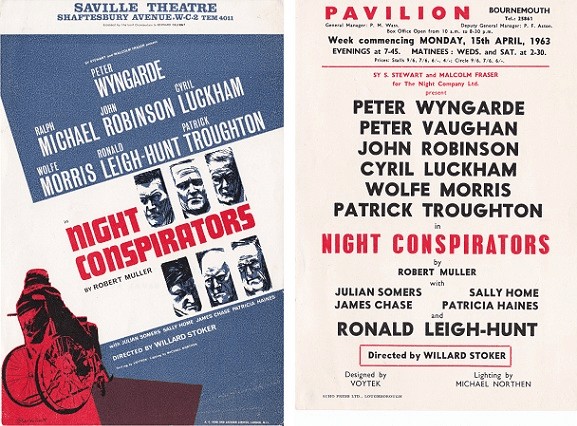
Presented by Sy S Stewart and Malcolm Fraser: Regional Tour, May 1963

Regional Tour. May 1963.

The following review is based on the television presentation of Robert Muller’s controversial play, which was originally broadcast as an Armchair Theatre production in 1962. The play was performed on stage in London in 1963 with a slightly different cast – both of which are listed below.

The Story

 The Place: Berlin. The Time: Tonight...

The Latinian Ambassador has not been sleeping well; something heavy has been weighing on his mind. Something that he so desperately needs to share.

In a secluded room in the Embassy, he stands anxiously by the window – his wife, Carla at his side, he awaits the powerful guests with whom he intends to share his deadly secret.

Across the street in a deserted warehouse hides a shadowy figure, who peers who peers down on the entrance to the Embassy building through a broken window pane. A car arrives and from it a high-ranking German Army officer steps out, who we learn is General Otto von Shiltz of the Bundeswehr’s Third Zone Command. A outspoken critic of the West, he was awarded the Iron Cross in 1942, and was said to have been a regular speaker at SS rallies before and during the Second World War.

The next individual to arrive is Franz von Markheim who, prior to 1939, was one of Germany’s foremost shipbuilders. During the War, he had turned his skills to the building of U-boats, but in 1947, he was convicted of War Crimes. Today, he is once again one of Germany’s leading industrialists, but tomorrow… who knows!
Third in this procession is the unmistakeable figure of Dr. Wolfgang Himmermann – the Archbishop of Ruhraphalia. As a crony of the powerful and friend of the rich, he had recently fought and won a libel case against one of Germany’s most respected newspapers, when it had accused him of a social scandal. It was rumoured that he’d donated the money he had been awarded in compensation to his favourite charity: The Fighting Fund of the German Nationalist Union.

Twenty-five years ago, wearing the brown shirt of the Hitler Youth, was Karl-Hines Fessel – now minister of national Rehabilitation, and fourth to arrive. Highly thought of in Washington and decorated for bravery by the French, Fessel is however greatly mistrusted in London.

The fifth and final guest is Werner Loder – a young newspaper publisher, who appears to be the only figure amongst the elite gathering who’s aware that he’s being watched from the warehouse window. Tipping his hat as if in acknowledgement, the man in the shadow breaths: “The Latinian Embassy is under observation, Herr Loder. I await your signal.”

At first the bemused guests indulge in small talk, which suggests that each is already acquainted with the other. On entering the large white marble room, the Ambassador’s wife makes an immediate beeline for Loder who assumes that he, a lowly journalist, has been invited to such a prestigious gathering merely because he’s once frequented in the same club as her and her husband. Carla dismisses this theory, reminding Loder that he is in fact the owner of eighteen magazines and eleven newspapers; his influence on society might in fact be greater than that of any of the other guests. “On the contrary,” he replies. “In a democracy, newspapers don’t control anything. We merely inform.”
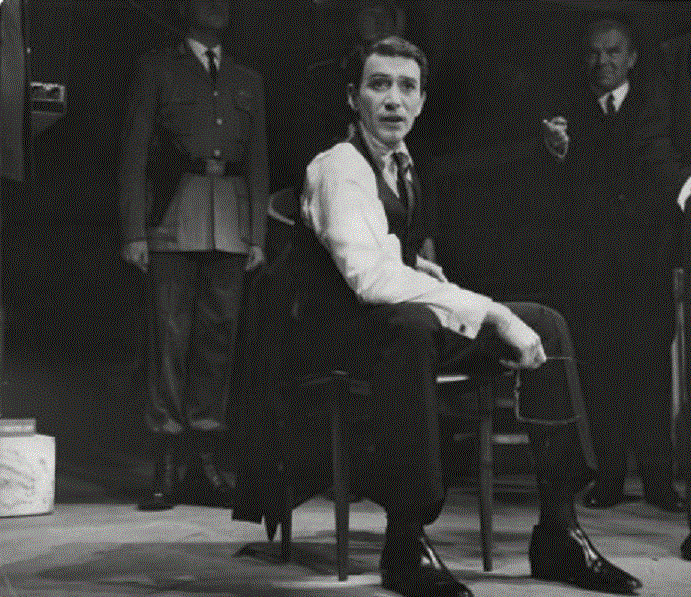
Meanwhile on the opposite side of the room, von Schiltz, Fessel and Markheim have formed a huddle to and discuss the possible reason for this mysterious invitation – each quietly pondering both his and the others possible role. All agree that Loder is indeed the most unwelcome of dining partners, since previous encounters with the publishing magnate has resulted in a damaging exposes for each of them.

Right: Peter as Werner Loder on stage

As the gusts sip champagne and ready themselves for dinner, a white van draws up outside the Embassy, and from it a wheelchair carrying an elderly man is unloaded by a tall, blond youth. A camera lens peeps through the broken window of the warehouse in an attempt to identify the passengers. Without uttering a word, the two men are directed inside the Embassy building.

Amidst the political banter, the Ambassador’s attention is drawn to an insistent light that flashes and send s him rushing to the door. After checking his wristwatch, he demands the attention of his powerful guests, and announces the arrival of a most important individual.

With his face almost entirely obscured by a woollen scarf, the person in question is pushed into the room by the tall blond youth, where they’re met with a deathly silence. The Ambassador begs the patience of the mystified gathering, who begin joking amongst themselves – comparing the evening’s entertainment to a game of charades.

As the youth slowly begins to remove the layers of wrapping from around the face of the old man’s face, the assembly reel in disbelief and horror at the startlingly familiar features that are revealed to them. After the gasps have subsided, the old man is ushered from the room, and it’s left to von Schiltz to utter just a single word: “Alive!”

Below: A cutting from the Times-Herald: Friday, April 12th, 1963.

With catlike curiosity, Werner Loder pounces on the Ambassador to confirm what they have all just seen: “Adolf Hitler! But how…?” The Ambassador explains that, just hours before Germany fell to the Allies in 1945, Hitler had been flown out of Berlin by the Luftwaffe, and had been given refuge in Iceland. It was there that he’d lived in a safe house just outside of Reykjavik. He now felt that it was time that he faced his accusers, and the men present at the Embassy had been handpicked to act as judge and jury.

Of all of them, Fessel appears the most agitated by the events of this most strange of evenings. Whilst the others all demand confirmation from the man himself, Fessel remains tight lipped , and appears relieved when the Ambassador suggests that, for the moment, only general von Schiltz should be allowed to speak with him.

Having deduced that the old man is now incapable of speech, Loder enquires how they might be expected to communicate with him. Loder is informed that the youth – Hitler’s son, Adam – is to speak on his behalf. But as Loder points out, Adolf Hitler was known to have been impotent, and would’ve therefore be unable to father a son. “His impotence appears to have been slightly exaggerated”, quips Carla. “Like his death!” adds Loder, extinguishing a cigarette.

Adam’s re-entry to the room goes unnoticed as the gathering debate who amongst them will take part in the “trial”, and who will abstain. The Ambassador explains the Hitler is content to let his fate rest in their hands.

Before deliberations even begin, both von Schiltz and von Markheim demand that the old man must be executed there and then. Loder, however, has a more practical solution: Why not exhibit him in a zoo: “Behind bars, of course!”

Loder asks von Markheim why he might wish to see of The Fuhrer so quickly: might it have something to do with the reopening of old wounds? After all, was he not among those that financed Hitler’s rise to power in the first place!

Although the Archbishop agrees in theory with the General and the Shipbuilder, he feels that he cannot condone any bloodshed. Loder suggests proposes that von Markheim’s past record must disqualify him from sharing his opinion. Fessel, on the other hand, refuses outright to discuss and alternative, which would most certainly result in the German government handing Hitler over to the Israeli authorities for the extermination of 6,000,000 Jews.

Loder submits that it’s the right of the new German to deal with the old, – saying that, unlike his powerful companions, he did not lie for Hitler, nor did he build ships or pray for him.

Von Markheim implies that Loder’s argument is based entirely on the question of age, to which the journalist relies: “Is it my age that you can’t forgive, von Markheim? What you can’t forgive is that I didn’t share in your legacy; a legacy of guilt! You won’t rest until every single German helps you carry that intolerable load. But we won’t share that with you, von Markheim, not any of us. The guilt is on your back, and there it will remain!”

Although he acknowledges his own guilt, von Markheim claims that he was merely a victim of the time; he was given order, and he obeyed them. For that, he says, he was thrown into prison to ease Germany’s conscience. Fessel agrees, but insists that this isn’t the time for private quarrels: regardless of the views of the individual, Adolf Hitler must be tried, found guilt and hanged!

In an attempt to bring order to the assembly, the Archbishop proposed that, whatever the outcome, their decision must be forever kept within the confines of the Embassy walls, lest each man present that evening might one day himself be unpleasantly compromised. He goes on to curse the Ambassador for placing them in such an intolerable position.

Von Schiltz thoughts, it appears, are somewhat less cloudy. He professes that, because of Hitler, the good name of the Germany Army had been tainted by the worst atrocities known to mankind, and as far as he was concerned, the old man must be disposed of. “Dispense with your butchery if you must,” he comments, “but not with my blessing!”

Werner Loder immediately reminds Himmermann that he was not quite so sparing when he himself sent out the man of the SS to commit THEIR atrocities. “Forgive them, “mocks the pressman, between mouthfuls of bread and paté, “for they know not what they do!”

Von Markheim concludes that, should they take the Archbishop’s advice, they themselves might be accused of attempting to spare Hitler’s life. In their own interests at least, the General should have his way.

Karl-Hines Fessel now finds himself with the casting vote, but without a moment’s hesitation, agrees with the majority – but only with the assurance that the evenings events should never be made known to the public via the newspapers.

“But aren’t you forgetting something?”, interrupts Loder. “What about Adam?” Whatever would stop him coming forward at some point in the future to tell of his father’s private execution? Then, he admits, it would be his duty to publish the story.

At that very moment, Adam enters the room to thank each man in turn on his father’s behalf:

To Franz von Markheim, he gives thanks for fending off all attempts to break up his empire, and for retaining much of the Fatherland’s wealth.

To General Otto von Schiltz, he gives his highest commendation for rehabilitating Germany’s Armed Forces for the historic mission of defending the free world.
To Karl-Hines Fessel, he offers gratitude for upholding the ideal of the greater Germany, and to Archbishop Himmermann, he offers thanks for absolving the German people of all feelings of guilt for their past.

But what of Wener Loder? A salute for enlightening the people to the corruption upheld in the so-called democratic way of life.

With that, the old man is once again wheeled into the room to face his ‘judges’. “You have made your decision/”, Adam enquires, coldly. “Eh, no!”, replies von Markheim. “Tell your father we need more time.”

Once again the debate rages, but this time only Werner Loder insist that Hitler must be destroyed, whilst the other attempt to excusing The Fuhrer’s existence by justifying their own. What would each individual gain by sparing the old man’s life?

The abolition of a free press, perhaps? The complete destruction of all political opposition? And, of course, the rehabilitation of the Armed Forces and the freedom to re-arm? In the adjoining room, Adam and his father listen intently to the arguments and grin inanely.

As a nearby clock tower announces the arrival of dawn, von Schiltz declares that a final decision must be reached. At the request of Karl-Hines Fessel, the General is invited to assume power in the name of the German government, which he readily accepts for the greater good of the “Fatherland”.“

“Excellent!”, Fessel declares. “From tomorrow, we shall argue from a position of strength!”

Raising his hand in an attempt to demand reason, the Archbishop observes that Fessel is already speaking with “his” voice. But already the plans are being drawn for the rebirth of the German state, and with von Markheim in full support, the three men request an audience with their Fuhrer.

But what of Werner Loder? An offer of complete control of the nations press, and the opportunity to exclusively report plans for the “new Germany”.
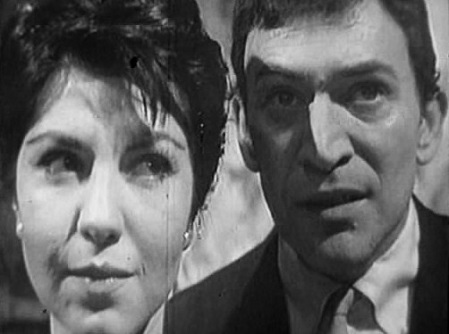
night-conspirators_avi_snapshot_26_54_2013_02_23_17_43_11

…”Or?” Arrest and execution!

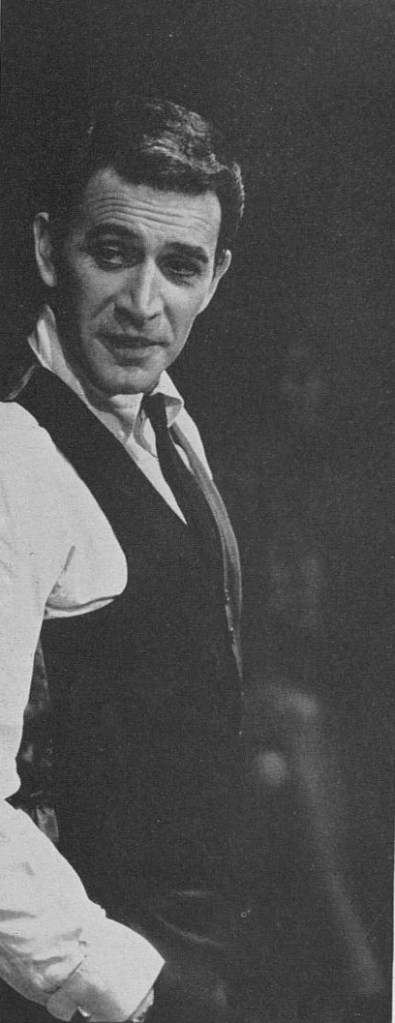
Left: Peter as Werner Loder in the television adaptation of the play

On refusing their terms, Loder reveals that he’s taken precautions in the form of the man at the warehouse window, who awaits his signal. Determined that no such signal will be given, von Schiltz draws his pistol and fires a single shot that rips through Loder’s left shoulder, sending him withering to the cold marble floor.

Directly, the General gives orders for his men to deal with the spy in the warehouse – telling Loder that his colleagues death rests firmly on his shoulders.

A telephone call is made results in orders being given for the deployment of armed troops to defend Germany’s eastern boarder against possible Communist reprisals, and a toast is made to the Fatherland.

And from his wheelchair in the doorway, his son standing proudly at his side, the all too familiar voice of Adolf Hitler explodes into the room…

“We will not fail. The men and women of Germany will dedicate their lives to the restoration of the Reich, which will last a thousand years. We will not fail. God is with us!”

Werner Loder looks on with horror!

In Retrospect

‘Night Conspirators’ by former theatre critic, Robert Muller, was characterised at the time of its premier as “The most exciting thriller to have been written in recent years”. His subject was hugely fascinating and while not entirely new, it was treated with a perception and an accuracy that was, to say the least, disturbing.

The play sported a formidable line-up of familiar names whose inclusion bore out the high hopes expected of Muller’s work. What it was about had to remain a secret because the dramatic impact of the first act depended very much on surprise.

Suffice it to say that it was one of those “possibilities” which, like the Loch Ness monster, the audience could savour all the more satisfactorily as long as it’s neither proved nor disproved. This particular monster is proved but still managed to retain an intriguing air of unreality.

Having thereby rather restricted any detailed analysis it was only possible to continue with generation. Muller reached into a bag of dramatic devises and pulled out a plumb of considerable size, not in the pure theatrical sense but in the intensely personal reactions of his plot. He set out to investigate truth with some unpleasant situations; he dug into ego and false pride and split them; and he found that guilt, hypocrisy and blind devotion are incorrectable parts of a man’s character. The full implications of the play’s theme were followed up ruthlessly.

The story was written with tension as the key-word, not the contrived tension of a second-rate whodunit but compelling, mounting tension which relied equally on dialogue and stage technique. Occasionally an odd cliché jarred slightly but these were few enough to be excusable.

Critics Comment

“From Peter Wyngarde there is a triumphant portrayal of a truth-seeking newspaper publisher”. Time Herald – Friday, 12th April, 1963

Notes Of Interest

A Professor of History commented: “The author of ‘Night Conspirators’, Robert Muller, – himself a German refugee who fled to England in 1938 – imagined a fugitive Führer conspiring with post-war German elites to create a Fourth Reich as means of casting doubt in the political reliability of the Federal Republic.

‘Night Conspirators’ was significant, finally, for the considerable attention it attracted. In Britain the play met with a largely positive reception. Muller’s pessimism about post-war Germany’s structural continuities with the Nazi’s past resonated with British viewers – many of whom agreed with the drama’s skeptical assessment of the nation. One wrote that his work provided “A terrifying and all too likely glimpse of the future”.

Not unsurprisingly ‘Night Conspirators’ met with an angry response from the Germans. Indeed, the West German Ambassador to Britain went so far as to protest to the airing of the television drama and declared his hope “That a play like this will never again be shown on British television”.

From ‘The World Hitler Never Made: Alternate History and the Memory of Nazism (New Studies in European History). Cambridge University Press. Gavriel D. Rosenfeld, 2005.
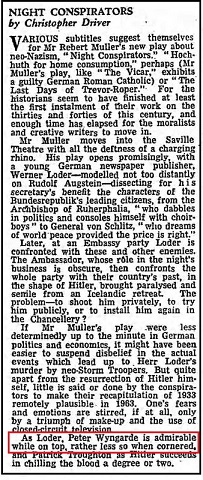
CONSPIRITORS

REVIEW: The Innocents

The Story

‘The Turn of the Screw’ is one of the great ghost stories in world literature, Henry James’ 1898 novella, It has been adapted countless times for the stage, television, cinema and even as a ballet, an opera (by Benjamin Britten in 1954) and a graphic novel (by Guido Crepax in 1989). Among the many film versions, however, most agree that The Innocents (1961), directed by Jack Clayton, is the most elegant, evocative and frightening of them all.

Below left: Original costume design for Peter Quint

P QUINT COST

The screenplay by Truman Capote was actually based on the 1950 stage adaptation by William Archibald and may be one reason Henry James purists find fault with the 1961 film version. The story of a governess, Miss Giddens, who is entrusted with the care of two small children, Flora and Miles, by their uncle at a remote country estate, James’ novella creates a mood of dread and menace through the increasing anxiety of Miss Giddens who suspects that the children may be influenced and corrupted by the malevolent spirits of the deceased former governess, Miss Jessel, and caretaker Peter Quint of Bly House. The beauty of The Turn of the Screw is that you are never sure whether Miss Giddens is imaging the supernatural occurrences or whether they are actually happening. In The Innocents, there is never any doubt that Bly House is haunted – you see the ghosts. Yet a sense of mystery and ambivalence still exists regarding the children. Are they conduits for the evil spirits or truly innocent? Miss Giddens’ obsession with discovering the truth brings a feverish intensity to the proceedings which are almost as chilling as the phantoms she seeks to exorcise.

In Conversations with Capote, conducted by Lawrence Grobel, the author recalled his involvement on The Innocents: “When it was offered to me to do it as a film, I said yes instantly, without rereading it…Then I let several weeks go by before I reread it and then I got the shock of my life. Because Henry James had pulled a fantastic trick in this book: it doesn’t stand up anywhere. It has no plot! He’s just pretending this and this and that. It was like the little Dutch boy with his fingers trying to keep the water from flooding out – I kept building up more plot, more characters, more scenes. In the entire book there were only two scenes performable.”

Regardless of Capote’s comments about Henry James’ novella, he based the screenplay structure on the Archibald stage adaptation and added the Freudian subtext of Miss Giddens’ repressed sexuality which surfaces in scenes of a disturbing erotic nature such as an uncomfortably long goodnight kiss between Miles and his governess. Playwright and screenwriter John Mortimer (Rumpole of the Bailey) is also credited with adding additional scenes and dialogue for The Innocents.

In the biography Deborah Kerr by Eric Braun, director Jack Clayton recalled how The Innocents and the casting of Deborah Kerr as Miss Giddens came about. “Deborah had one film to do for Twentieth Century [Fox], and so did I: that was the one we both wanted to do and which we had discussed when we met the previous year. I had admired her work in two films with that very underrated actor, Robert Mitchum – Heaven Knows, Mr. Allison [1957], which showed her at her best without makeup, and The Sundowners [1960], in which her freckles were so attractively in evidence.”

POSTERS

Kerr remarked in the same biography on her performance: “I played it as if she were perfectly sane – whatever Jack wanted was fine; in my own mind, and following Henry James’ writing in the original story, she was completely sane, but, because in my case the woman was younger and physically attractive – Flora Robson had played her wonderfully on the stage – it was quite possible that she was deeply frustrated, and it added another dimension that the whole thing could have been nurtured in her own imagination.”

Filmed on Locations in East Sussex, England and Shepperton Studios in Surrey, The Innocents proved to be a physically challenging role for Kerr. Clayton said, “To achieve what we wanted in the monochrome photography the arcs had to be of considerable intensity, and the atmosphere on the set, with fifteen “brutes” burning away, often stifling. During a long schedule, imprisoned in those voluminous Victorian dresses, she never complained, never showed a trace of the discomfort she had been feeling.” She also had to do a scene that required numerous retakes where she had to carry Martin Stephens (who was cast as Miles) in her arms. She later revealed to the director that she had felt quite ill and feverish during that day of filming but never acknowledged it at the time.

Clayton discovered prior to production on The Innocents that the film needed to be shot in Cinemascope, a screen format he did not want to use. Luckily, he had one of the best cinematographers in the business working for him – Freddie Francis; they had previously collaborated on Room at the Top (1959). In The Horror People by John Brosnan, the cameraman recalled that, “…I had quite a lot of freedom, and I was able to influence the style of The Innocents. We worked out all sorts of things before the picture started, including special filters. I still think it was the best photography I’ve ever done – as much as I like Sons and Lovers [1960] I think The Innocents was better, but you rarely get an Academy Award for a film that isn’t successful no matter how good your work on it.”

innocents-17-copy

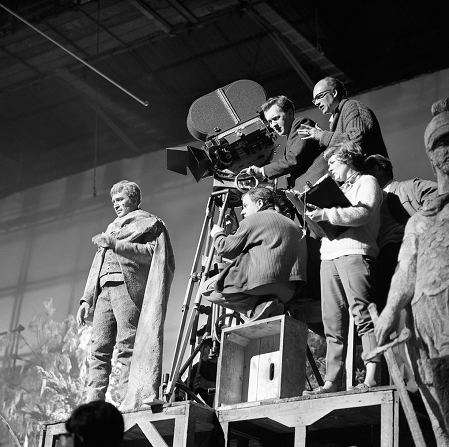
Left: A rare still taken during filming. Peter is seen standing on a platform to the far left.

As strange as it seems now, The Innocents didn’t receive any Oscar® nominations. It did garner international awards such as a Best British Film nod from the BAFTA and a Palme d’Or nomination at the Cannes Film Festival. Still, the film was not a box office success in the U.S. Francis said, “I’m sure Jack [Clayton] was terribly disappointed with the reaction that The Innocents received. He, unfortunately, gets terribly tied up in his films. Everybody, I’m sure, involved with it thought it was a great picture and I’m not completely sure what went wrong but I think it was because it was based on Henry James. When you read James you’ve got to think about it and make up your own mind…The film lacked this ambiguity and I think, basically, that was the reason it wasn’t a success…in the film all the suspicion fell on the children – whereas having read The Turn of the Screw one doesn’t know whether it is the governess who is a bit strange or the children.”

Deborah Kerr has her own theory about why The Innocents wasn’t a success at the time. In the Braun biography, she noted “The subtlety with which he [Clayton] and his team established the atmosphere of the two worlds – the everyday and the spirit world – was so evocative of decadence, in the most delicate manner, that it completely escaped the majority of the critics. Today, a new generation of young movie “buffs” realise how extraordinary were the effects he achieved. One instance is the way the edges of the screen were just slightly out of focus, as though seen through a glass, perhaps. Now it is acclaimed as a great work of art; then they didn’t push it because they didn’t know how to respond to something so genuinely spooky – so interwoven with reality that it could be real – and that’s something people didn’t like.”

Not all of the critics unfavourably compared The Innocents to Henry James’s original novella. Pauline Kael of The New Yorker called the film “one of the most elegantly beautiful ghost movies ever made…The filmmakers concentrate on the virtuoso possibilities in the material, and the beauty of the images raises our terror to a higher plane than the simple fears of most ghost stories. There are great sequences (like one in a schoolroom) that work on the viewer’s imagination and remain teasingly ambiguous.” 

The Innocents (1961) - Scariest scene on Make a GIF

Besides Clayton’s superb direction, Francis’s stunning cinematography and Kerr’s masterful performance (possibly the best of her entire career), The Innocents is distinguished by an unforgettable supporting cast including Michael Redgrave in a brief opening cameo, Megs Jenkins as the fretful Mrs. Grose, Peter in a chilling, non-speaking role as Quint, Clytie Jessop, equally silent but haunting as Miss Jessel and two of the finest child actors of their generation – Martin Stephens as Miles and Pamela Franklin as Flora. Stephens had already made a strong impression as the blonde alien child leader in Village of the Damned (1960) but he would retire from acting in 1966 and pursue an education in architecture. Franklin would go on to star in other similar genre efforts such as The Nanny (1965), And Soon the Darkness (1970), Necromancy (1972), The Legend of Hell House (1973) and The Food of the Gods (1976).

Among the other notable adaptations of Henry James’s The Turn of the Screw are numerous television productions including a 1959 version with Ingrid Bergman (directed by John Frankenheimer), one in 1974 with Lynn Redgrave (directed by Dan Curtis), one in 1995 entitled The Haunting of Helen Walker with Valerie Bertinelli, Michael Gough and Diana Rigg, and one in 1999 with Jodhi May and Colin Firth. Film versions of the novella include the 1985 Spanish film Otra vuelta de tuerca, directed by Eloy de la Iglesia (Cannibal Man, 1973), The Turn of the Screw (1992) with Patsy Kensit, Stephane Audran, and Julian Sands, Presence of Mind (1999) with Sadie Frost, In a Dark Place (2006) with Leelee Sobieski, and even a prequel to the events in the James story entitled The Nightcomers (1971), a kinky S&M portrayal of Quint and Miss Jessel played by Marlon Brando and Stephanie Beacham. None of them appear to have the fervent cult following of The Innocents which looks better and better with each passing year.

The Innocents: Forbidden Games

By Maitland McDonagh – 2014

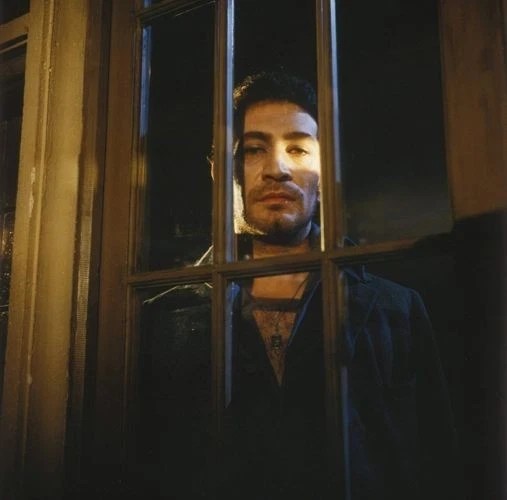
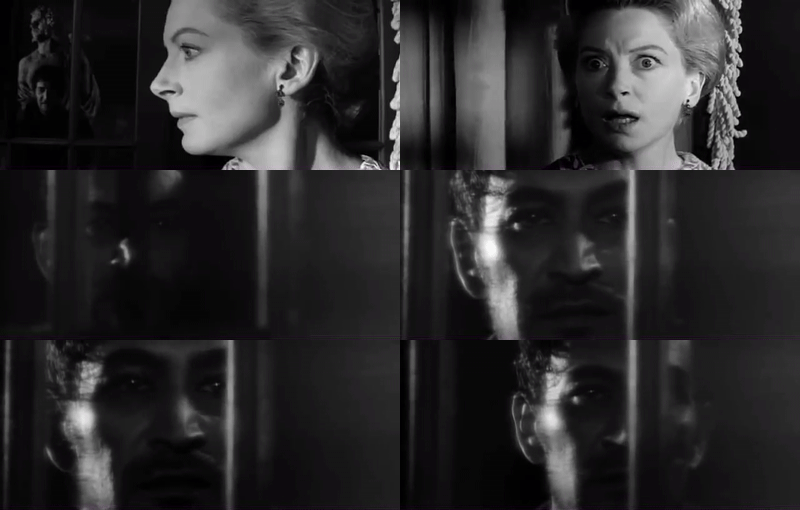
It is Quint’s ghost that shakes Miss Giddens’s optimism to the core, and casting Peter Wyngarde, a TV actor with a handful of minor movie credits, as the serpent in Bly’s tranquil garden was an underappreciated stroke of brilliance. Little-known in the U.S. but a familiar face on UK television, he was born to the part. Quint is never seen to do anything overtly indecent—in fact, he’s never seen to do anything more than peer in windows, walk along a rooftop, and allow himself to be glimpsed in a mirror. The spirit of his disgraced lover is merely sad, but his rudely sensual physicality—especially disturbing in a ghost—is palpably malignant, and it’s clear that Quint’s greatest offence was not just possessing but embracing the kind of coarsely potent maleness that drives the natural world but is abhorred by a particularly refined notion of civilization, one that defines and is defined by the story’s women.

Awards & Nominations

1961

  • National Board of Review, USA
  • Awarded (NBR Award): Best Director – Jack Clayton

1962

BAFTA

  • Awarded: Best Film from any Source
  • Nominated: Best British Film

Cannes Film Festival

  • Nominated (Palme d’Or): Jack Clayton

Directors Guild of America

  • Nominated: Outstanding Directorial Achievement in Motion Pictures
  • Awarded (DGA Award): Jack Clayton

Edgar Allan Poe Awards

  • Awarded: Best Motion Picture
  • Best Script: Truman Capote and William Archbald

Writers Guild of America

  • Nominated: Best Written American Drama: Truman Capote and William Archbald
  • In 2014, The Innocents was voted ‘The Most Frightening British Horror Film Ever Made’ by the British Film Institute.

MILE’S LAMENT TO PETER QUINT

peter-wyngarde-the-innocents-martin-stephens

Critics Comments

Sound of Cinema: Landmarks – The Innocents

p01h0j5b

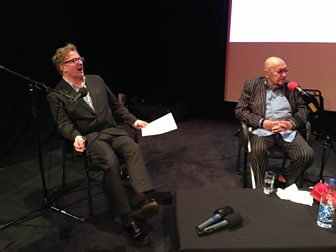
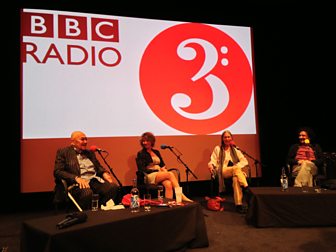
A Landmark edition recorded in front of an audience at the British Film Institute as part of the Sound of Cinema season: Matthew Sweet is joined by the film’s stars Peter Wyngarde and Clytie Jessop, psychoanalyst Susie Orbach, writer and critic Christopher Frayling and stage and screenwriter Jeremy Dyson to examine the British horror classic The Innocents.

Images: (Above Left) – Matthew Sweet and Peter. (Below Right) – Peter, Susie Orbach, Clytie Jessop & Jeremy Dyson.

p01h0j4f

The Innocents is a supernatural horror film based on the novella The Turn of the Screw by Henry James starring Deborah Kerr as Miss Giddens, the young governess who begins her first assignment caring for two orphaned children on a remote estate. She becomes convinced that the house and grounds are haunted – the film achieving its gothic effects through lighting, music and direction rather than conventional shocks, as we follow the increasingly erratic behaviour and visible deterioration of the ever-present governess. But are we watching a real ghost story or is this just the projection of the imagination of the repressed governess?

As part of Radio 3’s Sound of Cinema season, Matthew Sweet and guests are joined by an audience at the British Film Institute for a Landmark edition of Night Waves, to examine how the combination of cinematography, the script of William Archibald and Truman Capote and Georges Auric’s original music and the direction of Jack Clayton created a masterpiece that terrified even the critics.

Producer: Laura Thomas.

Credits

Presenter: Matthew Sweet

Guests: 

  • Peter Wyngarde
  • Susie Orbach
  • Christopher Frayling
  • Jeremy Dyson
  • Clytie Jessop

Featured in…

  • Landmarks A series from Free Thinking and Night Waves devoted to celebrating cultural landmarks.
  • Sound of Cinema season Listen to highlights from the Sound of Cinema season on Radio 3.

The Innocents voted one of the Top 10 most scary films of all time by The Guardian

This is absolute classic British black-and-white horror, creepy and atmospheric despite – or perhaps because of – the elegance and gentility of its visuals. Adapted fairly freely from Henry James’s The Turn of the Screw, via William Archibald’s play and Truman Capote’s dialogue, it was directed by Jack Clayton, who had just had a big hit with the kitchen-sink flagwaver, Room at the Top. The Innocents couldn’t be more different.

Essentially, it is a story of possession. Deborah Kerr plays Miss Giddens, a governess hired to look after little Flora and Miles by their uncle (Michael Redgrave). The pair initially seem sweet and fun but, as is the way with creepy horror-film kids, they soon turn demonic and troubled. The first intimation of this arrives when it transpires that Miles has been expelled from school, as a “bad influence”; this is compounded by the children’s odd behaviour, apparent secrets and reports of strange visions.

Miss Giddens eventually connects all this to two previous employees of the house, both dead: governess Miss Jessel (Clytie Jessop), and valet Peter Quint (Peter Wyngarde), who were locked in an abusive relationship. Are Jessel and Quint using the children as vehicles to continue it from beyond the grave?

With legendary cameraman Freddie Francis on board, supplying arguably his most spectacular visual accompaniment to the action, this is a film in which setting and atmosphere play a significant role in beefing up the Freudian subtexts. The final scene earned the film an X-certificate on its initial release, and an enduring reputation as a properly disturbing depiction of repressed sexuality.

Above Left: Peter as the ghost of Peter Quint atop ‘Bly House’ and, Right, the house at Sheffield Park, East Sussex, where the scene was shot.

Click below for more information on ‘The Innocents’…

THE MAKING OF A DEPARTMENT S EPISODE

‘The Treasure Of The Costa Del Sol’

In shooting order, ‘The Treasure of the Costa del Sol’ was the 20th installment of ‘Department S’ to be made at Elstree Studios, but was the 10th episode to be broadcast on television – on Wednesday, 8th October, 1969

N.B.: The figures in brackets indicate Scene Numbers.

department-s_the-treasure-of-the-costa-del-sol-1

WEEK ONE

TUESDAY AUGUST 27th, 1968:

Filming starts at 6.45am prompt, on Sound Stage No.1 at Associated Elstree Studios in Borehamwood. The first scene (25) to be shot is the interior of the Department S office in Paris. The characters involved are Jason King, Steward Sullivan and Annabelle Hurst. The Props Department have provided the following items, which are placed on a table: A plastic fish, a locket and chain with a small photograph of a woman inside it; a tattered notebook; a pack of cigarettes for Jason, and a sheaf of reports. The entire scene takes 25 minutes to shoot, but lasts just 2 minutes on-screen.

The following five scenes (34, 36, 38, 40 & 62), which are again set inside the Department S office involve, firstly Annabelle, then Annabelle and Stewart. Although shot together, in the completed episode, they will appear to be set on different days.

The next three scenes (98, 100 & 102) are set in Annabelle’s hotel room. The Props Manager arrives with a small electronic device which is described as a ‘Transmitter/Receiver’. A note book and ball point pen is placed on the table beside it. All three main cast members are involved. In total, only four minutes and 55 seconds of footage is shot.

WEDNESDAY AUGUST 28th, 1968:

The day begins with the completion of the scenes started the previous day (104) in Annabelle’s hotel room. An additional 40 seconds of action is captured on film. Peter then moves on to Sound Stage No.6, nowhere a set has been built to represent his hotel room. Since these scenes (33, 35, 37, 39 & 41) are meant to be taking place in daylight, a lighting change is required.

The following segment (85) once again take place in Jason’s hotel room., where Sullivan has now joined him. A make-up lady arrives to paint a streak of blood on Peter’s cheek – the result of an altercation with a guard dog which has not, as yet, been shot. Also on set is the Wardrobe Mistress, who places crumpled suit on the bed, which we will see Peter wearing as he runs from the dog in the finished episode.

Two further scenes (87 & 101) are shot on this set, but subtle changes are made to the props; a small silver flask and a pack of cigarettes are brought in and then replaced moments later with a map and pencil. 4 minutes and 25 seconds of footage is captured on film.

THURSDAY AUGUST 29th, 1968:

Today, the action is due to take place on Sound Stage No.1, which has now been transformed into a luxury villa with elegant furnishings and intricate engravings adorning the walls. Rosemary Nicols takes the day off since her character is not required for the next seven sequences (73, 79, 86, 99, 103, 121 & 123), which are scheduled to be shot today.

It is night-time. At the villa, the characters are: Camilo Garria, Elaine, Achillie, Adolfo and Maxime. Members of the Props Department bring in and remove an array of items where and whenever necessary. These include (amongst other things) a telephone, wine glasses, plastic food on dinner plates and brandy bottles. Peter and Joel join the ensemble to complete the days shoot which lasts in excess of nine hours… or 4 minutes and 15 seconds of screen time.

FRIDAY AUGUST 30th, 1968:

Director, John Gilling, assembles the cast – including Peter, Rosemary Nicols and Joel Fabiani, on Sound Stage No.1 for a briefing before attempting to record two final scenes of the week (94 & 128). A lighting change is required., as these sequences are to take place in daytime. Staff from the Make-Up and Props Departments work frantically to create an illusion of passing days between scenes. By the end of yet another exhausting day, Mr. Gilling has managed to capture another 3 minutes and 40 seconds of footage.

TOTAL SCREENTIME FOR THE WEEK: 16 minutes and 6 seconds.

department-s_the-treasure-of-the-costa-del-sol-2

MONDAY, SEPTEMBER 2nd, 1968:

No filming takes place, as this is a Public Holiday.

TUESDAY, SEPTEMBER 3rd, 1968:

Sound Stage No.6 has been turned into the cabaret lounge of the hotel where the Department S operatives are staying. The Props Department have set out masses of flowers, drinks, menu cards and champagne ice-buckets on all the tables, at which a small number of extras are seated.

Only Peter’s character is required for today’s shoot, which involves two scenes (43 & 63), featuring Jason and Elaine. Peter Thomas and David Prowes are also on set. 4 minutes and 10 seconds of screen time is captures.

WEDNESDAY, SEPTEMBER 4th, 1968:

Peter’s first port of call on this morning is the Make-Up Department to have a rather nasty-looking bruise applied to his jaw. He then makes his way over to Sound Stage No.6, where he completes a 10-second sequence (69), which involves him stepping out of a lift and knocking on Elaine’s apartment door. Unusually, the next scene (70), follows on directly from the last, and David Prowes, Peter Thomas, John Louis Mansi and Isla Blair all join Peter on set.

As Peter takes a well-earned break, Rosemary Nicols, Joel Fabiani, John Louis Mansi and George Pastell complete another small piece (95), which is set in the studio of Camilo Carria’s villa. Moments later, Peter and Joel take center stage on the same set to play out a 15-second scene (122), which will appear in the completed episode as taking place several hours AFTER the sequence filmed previously (i.e. 95).

A rather frantic scene (124) in Garria’s studio involving Peter, Joel Fabiani and John Louis Mansi is next on the agenda before the three actors are moved on to the set of Garria’s villa (125), where a huge printing press is placed centre stage. As stunt doubles for David Prowes, George Pastell and Peter Thomas take their places, the Props Department begin staking the wall cupboards with wads of counterfeit American dollars. Two pistols – one for Fabiani and the other for Pastell’s stand-in.

THURSDAY, SEPTEMBER 5th, 1968

On this day, the action moves back to Sound Stage No.1, where part of the floor space has been laid out as a restaurant with small iron and marble tables, complete with coffee cups and wrapped sugar cubes. In the first scene (28), Peter takes his cue at one of the tables, where he is seated opposite Jean Abbott, who is playing a young woman called Estelle.

Meanwhile, on the opposite side of the floor, Joel Fabiani and Dennis Alaba peters are playing out three brief sequences (57, 59 & 61), which is set in a cable car with a huge mountain backdrop.

Remaining on the same Sound Stage, a mockup of a motor launch has been erected, and skin-diving equipment is brought in. Three Extras play out the following eight segments (107, 127, 132, 140, 144, 148, 150 & 152) – some of which are seen from Jason’s perspective, who is watching the action through a pair of binoculars.

FRIDAY, SEPTEMBER 6th, 1968

Once again the main cast members find themselves on Sound Stage No.1, onto which Sullivan’s Vauxhall Ventora, Jason’s Bentley Continental and an American car have been brought. A huge matte backdrop has been erected, and various items constantly arrive courtesy of the Props Department, including diving suits, an underwater spear gun and an automatic pistol. David Gregory who is playing Cal, and Peter Jay Elliot as Thorn, arrive on set and begin work on their first four scenes (3, 5, 7, 11).

Next up are Rosemary Nicols and Joel Fabiani for their scenes (92 & 97), which take place in Sullivan’s car. They are then joined by Peter for a further two sequences (110 & 113), before Peter and Nicols leap out of the vehicle, leaving Fabiani to complete the scene (25 & 27) alone. These pieces make use of the matte backdrop, onto which a piece of ‘Stock Footage’ last used in the Department S episode, ‘One of Our Aircraft Is Empty’, is projected.

While Rosemary Nicols and Joel Fabiani leave the set for the day, Peter is required to take part in a further five scenes (48, 52, 54, 66 & 31) – the first three of which are with David Prowes and Peter Thomas, and the fourth and fifth, alone. All are set in the Bentley.

The final and longest sequence of the day finds Peter and Olivier Hamnett, who plays Anita, on the hotel balcony, which is furnished by the Props Department with potted palms and various flowers.

MONDAY, SEPTEMBER 9th, 1968

On this day, both the cast and crew move out of the studio lot to film the first of eight scenes (6, 8, 10, 12, 14, 17, 21 & 23). The Props Department provides the necessary equipment: air bottles, diving suits and plastic fish for David Gregory and Peter Jay Elliot. A police motorcycle with Spanish number plates is rode onto the lot, and a special FX rig-up for a harpoon gun is tested. An Extra dressed as a Spanish Police Patrolman joins the cast.

Both Peter and his ‘Fight Double’ now arrive with David Prowes for two brief sequences lasting just 20 seconds. The Bentley is then driven across the lot to another site where Rosemary Nicols and Joel Fabiani – the latter of whom is dressed in a skin divers suit, join Peter for nine individual sequences (130, 134, 136, 138, 142, 145, 147, 149 & 154). These are all set against a coastal backdrop, and add up to a mere 1 minute and 30 seconds of action.

TUESDAY, SEPTEMBER 10th, 1968

For just one scene only (89), Rosemary Nicols and Joel Fabiani step back onto the set of the hotel restaurant, where a sheaf of photographs of Achille, Adolpho, Maxime and Camilo Garria have been placed on one of the tables. ‘Extras’ dressed as a waiter and a small gaggle of customers take their places on set.

Meanwhile, out on the Lot, Peter acts out four brief segments (75, 77, 81 & 83), in which he is seen dashing through the grounds of Garria’s villa. He’s then joined by Fabiani for two further scenes (117 & 119) – again, in the villa grounds.

While Fabiani makes a brief visit to the Make-Up Department, Peter, David Prowes and Peter Thomas make their way over to the studio car park to film five more sections (45, 47, 49, 65 & 67), in which Jason is set upon by two thugs.

With Joel Fabiani dressed in a frogman suit, he and Peter record three more short sequences (115, 20 & 143) – the latter of which features Fabiani in an underwater scene, which is filmed through a large plastic sheet to give the effect of water.

This is the final day that the three main cast members – Peter, Rosemary Nicols and Joel Fabiani – are required on set.

WEDNESDAY, SEPTEMBER 11th, 1968

Today Post Production of the episode begins, with a number of inserts being filmed – including the views of three notebooks (26, 29 & 32), in which the following words are written:

(I) ‘Estelle, Madrid 247-12-21’

(II) ‘Anita, Marbella 846333’

(III) ‘Camille, Barcelona 254.53.59

Other shots include photographs of girls (32), Cal’s hand holding a set of plans (5), and Sullivan’s hand holding a wad of $20 bills (39).

THURSDAY, 12th SEPTEMBER, 1968:

Peter Thomas and both Peter and Joel Fabiani’s doubles, work on a total of even short sequences (72, 74, 76, 78, 80, 82, 84, 93, 111, 118, 120), which are set in the grounds of Garria’s villa – the majority of which are made up of ‘Point of View’ shots, as seen by Jason as he is chased across a wooded area of the villa gardens by two guard dogs. Sullivan’s car and two huge Bull Mastiff’s are amongst some of the props used during the day’s shoot.

department-s_the-treasure-of-the-costa-del-sol-10

FRIDAY, 13th SEPTEMBER, 1968:

On the final day of filming, David Gregory and Peter Jay Elliot are the first on the lot to record two scenes (2 & 4) for the episode’s opening teaser. They’re latterly joined by the Extra seen earlier playing the Spanish Police Patrolman. Together they film three short pieces (15, 18 & 22). Stunt doubles for Peter, Joel Fabiani, David Prowes and Peter Thompson now arrive on set to complete the final seven shots (51, 91, 96, 109, 112, 114 & 116) of the week’s schedule outside the villa.

More about Department S…

DEPARTMENT S: Episode Guide

20643279_1958412214372319_7111114726483709864_o

The cases are inexplicable, baffling, and illogical. They have to be to interest…

Department ‘S’ was the world’s most unusual police department. An off-shoot of Interpol based in Paris. It stepped into cases which could not be handled or solved bay any other authority. They were mysteries which may have been caused by a natural occurrence, a calamity, a disaster or by premeditated or spontaneous crime.

Each case was apparently inexplicable, baffling everyone with its total lack of logic.

This was the premise of ITC’s Department ‘S’ series, produced by Monty Berman. It was a complete departure from all other mystery-adventure programmes, and served as a precursor to the popular X-Files series of the Nineties.

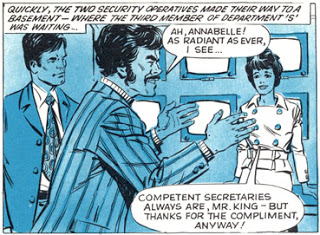
The mysteries themselves were only part of its fascination. The appeal of the series lay, more than anything else, in the three principal characters, played by Peter Wyngarde, Joel Fabiani and Rosemary Nicols. They had many ways of approaching the task of solving mysteries. Jason, Stewart and Annabelle worked together in close harmony, but their methods were sharply contrasting.

Department ‘S’ therefore had a many-sided appeal. The stories were intriguing with plenty of action, which provided the viewer with the challenge of spotting the solution to each mystery as the three operatives unravelled one knot after another. Even the most illogical of situations had a logical answer…

Department S was a complete departure from all other mystery/adventure series of the Sixties and Seventies, as the mysteries themselves were only part of the fascination. Its appeal lay, more than anything else, in its principal characters: Two men and one woman. Contrasting personalities as well as styles, each with an individual approach to proving that even the most illogical situations have a logical explanation. Three different ways of approaching each crime, with three outstanding personalities.

“Whenever I feel the urge to exercise, I lie down until it passes!” Jason King

Peter on Jason King

departscreen

“When I used to see that person up there on the screen and I knew it was me, I still couldn’t not believe it was me. I thought: ‘What the… no one could have a nose like that. And that voice! I mean, what are you doing! Why are you an actor!

“Originally, Department S was based on a very good idea by Ian Flemming. He was working for MI5, which was a special department – it wasn’t Department S – but it was something very similar to it. So we took all the stories which had happened during the war and other domestic stories which had taken place. We got them together and tried to find a solution to the ones that were never solved. And that’s how Department S started.

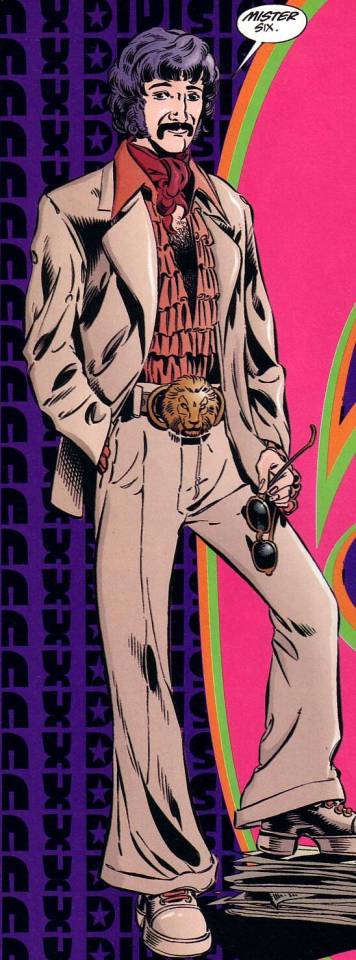
“I thought that the clothes that were going around for guys at the time were boring. One day I saw a drawing of a 17th Century riding jacket, and thought ‘That looks good. There’s a kind of style to that There’s something about that; it looks good’. And I started doing some drawings, and slowly it became the kind of jacket that Jason wore.

“I remember saying to the producer, ‘Look, we’ve got to go on more locations – we’ve got to stop with this terrible back-projection thing with me in the car and you see this thing wobbling behind. The audience isn’t fooled – you can’t fool them,. We’ll go to Rome and walk down the Spanish Steps, and something will happen, because no matter what anyone says, the camera doesn’t lie. There was a moment where I had to go and do some parachuting, and I said: ‘This is not good. Let’s go and do it for real.’ I was showing off again, of course!”

Department S Characters

Department S was a complete departure from all other mystery/adventure series of the Sixties and Seventies, as the mysteries themselves were only part of the fascination. Its appeal lay, more than anything else, in its principal characters: Two men and one woman. Contrasting personalities as well as styles, each with an individual approach to proving that even the most illogical situations have a logical explanation. Three different ways of approaching each crime, with three outstanding personalities.

Department S Personnel Files

Episode Guide

Six Days

  • First Broadcast: 9 March, 1969
  • Location: Aboard Astair flight Golf-Alpha-Zulu-Echo-Bravo, Karachi to London
  • Date: July 17th

An airplane lands at Heathrow 30 minutes early, according to all indications on board. When the plane lands the crew is met by anxious airport officials, notifying them that they are not 30 minutes early, but six days overdue. Department S has a vested interest in the flight, because Sir Curtis was aboard. As they begin investigating, people start dying.

The Trojan Tanker

  • First Broadcast: 16 March, 1969
  • Location: Bedfordshire, England
  • Date: July 22nd

A tanker is involved in an accident. A witness swears he saw a woman in the back of the tanker, but when the police look there is no one inside. The tanker, however, is not carrying fuel, but rather is elaborately rigged as a living space. A search for the missing woman leads Jason to an old friend, and eventually to France.

A Cellar Full Of Silence

  • First Broadcast: 23 March, 1969
  • Location: London, England

Date: June 20th Four men dressed in various costumes are gunned down in a cellar. The gun of one had been fired, the bullet turning up in the body of a man found in the trunk of a submerged car. Stewart pays a call on a crime broker to see who hired the men and how the crimes relate to a house in St. John’s Woods, where a woman is being kept sedated because she thought she saw four men wearing disguises committing a robbery in the house.

The Pied Piper Of Hambledown

  • First Broadcast: 30 March, 1969
  • Location: Hambledown, Hampshire, England
  • Date: April 16th

A woman goes to bed early, taking a sedative, to get enough sleep for a beauty contest. When she wakes up the next morning her entire village is deserted. The only clues Department S can find are a man with a shotgun in a home on the outskirts of the village and a freshly-painted mailbox post.

One Of Our Aircraft Is Empty

  • First Broadcast: 6 April, 1969
  • Location: London Airport
  • Date: April 30th

Sky Tripper 190 requests auto land clearance at Heathrow Airport in London. When boarded, the plane is totally empty. While investigating Stewart locates the body of the pilot, and Annabelle sees a reclusive industry CEO boarding the plane in a photograph.

The Man In The Elegant Room

  • First Broadcast: 13 April, 1969
  • Location: Islington, London, England
  • Date: May 12th

A real estate agent, taking a man to see a warehouse, discovers a room constructed inside the warehouse. Worse, a dead body and a babbling man are locked inside the room. Stewart tries to interrogate the man, but he is killed before anything can be made of his babbling.

Handicap Dead

  • First Broadcast: 20 April, 1969
  • Location: Colindale Golf Course, Scotland
  • Date: June 6th

Stewart attends a golf tournament in Scotland. The tournament leader is found dead near the course. The Department is unofficially involved until someone breaks into the dead man’s living quarters and steals his golf clubs.

Black Out

  • First Broadcast: 27 April, 1969
  • Location: London, England
  • Date: May 26th

A chef goes to the opera in London. Three days later he is found by Mexican authorities in the desert, still his formal attire, unaware of what happened after he left the opera. A case of mistaken identity, leading the Department to Jamaica for turtle in the shell while Sir Curtis is off to America to witness a rocket launching. How are they connected?

Who Played The Dummy?

  • First Broadcast: 1 October, 1969
  • Location: The Sierra de Guadarrama, Spain
  • Date: September 12th

A car, apparently out of control, rushes to its doom in a mountainous, uninhabited area of Madrid. And its only occupant is a tailor’s dummy sitting at the wheel. The chief clue is the expensive tie on the dummy, a British-made tie that Jason notices on someone else in town.

The Treasure Of The Costa Del Sol

  • First Broadcast: 8 October, 1969
  • Location: The Costa del Sol, Spain

Date: July 31st A man goes scuba diving while his friend waits in the car. The man returns from the dive with a fish, and his friend shoots him. Before he dies he is able to return fire with a spear gun, killing the shooter. A policeman happens upon the scene and finds the diver’s catch: a plastic fish with $100,000 inside.

The Man Who Got A New Face

  • First Broadcast: 15 October, 1969
  • Location: Cap d’Antibes, France
  • Date: August 16th

A man takes enormous risk by sneak onto the grounds of an estate. He steals nothing, taking the gamble instead to glue a classic theatrical comedy mask onto a sleeping man’s face. The man wakes and sees the mask, dying of a heart attack trying to remove it. Since the man was a friend of Sir Curtis, he wants the Department to investigate who performed “this bad joke”–and why.

Les Fleurs Du Mal

  • First Broadcast: 22 October, 1969
  • Location: Rome, Italy
  • Date: September 26th

A small package has the key to the disappearance of $5 million taken in a robbery. The man charged with delivering the package to a man in Paris is curious, so he opens the package to find three flowers and a cryptic passage from a book. He does not know what the message means only that people involved in the robbery are being murdered, including the prime suspect in the robbery.

The Shift That Never Was

  • First Broadcast: 29 October, 1969
  • Location: Stepney, London, England

Date: October 10th The police are called to investigate a manufacturing company manager’s claim that no one showed up for work on a Wednesday in spite of neighbours’ claims that everything at the plant appeared to be perfectly normal. The shift substitution somehow ties to the opening of a nuclear-powered generating station.

The Man From X

  • First Broadcast: 5 November, 1969
  • Location: London, England
  • Date: February 2nd

A couple, necking in a car, are shocked to find a man in a spacesuit coming at them. He falls dead before he reaches their car. The Department wants to know what a man in a spacesuit was doing in London at night, and how it might tie to a planned robbery.

Dead Men Die Twice

  • First Broadcast: 12 November, 1969
  • Location: Southern France
  • Date: July 19th

A man’s home is invaded by armed intruders’ intent on killing him. He has a heart attack and dies before they can, however. The two men go to the morgue to see the body, where they put two bullets into the corpse. Department S investigate the shooting of the body of a man who bears a striking resemblance to a notorious criminal who allegedly died three years earlier.

The Perfect Operation

  • First Broadcast: 26 November, 1969
  • Location: City of Southwark Hospital, London
  • Date: October 24th

A British government official suffers a brain haemorrhage. While in surgery, his surgeon is replaced by another man. Instead of killing the official, the substitute doctor completed the operation. The Department must find out why, while Jason disputes the official government records that state the official has never been to Istanbul.

The Duplicated Man

  • First Broadcast: 3 December, 1969
  • Location: Foreign Office, London
  • Date: February 16th.

A plane carrying a British MI5 agent explodes over the English Channel. Witnesses on a boat crossing the Channel see the plane explode and are certain no one survived. Sir Curtis, however, is confident the agent jumped from the plane prior to the explosion, and sends the Department out to find the agent. The Department’s activity catches the interest of Russian agents, who are also certain the agent – who was also working for the Russians – is still alive.

The Mysterious Man In The Flying Machine

  • First Broadcast: 12 December, 1969
  • Location: Paris, France
  • Date: March 8th

A man murders another man on a flight. He then orders no one to move and opens the airplane door, jumping – to the floor of a warehouse. Other men aboard the “plane” chase and shoot the killer in the warehouse. The Department is called in to learn who would build such an elaborate set in order to murder someone.

Death On Reflection

  • First Broadcast: 17 December, 1969
  • Location: Bond Street, London, England
  • Date: January 18th

Sir Curtis attends an auction. A mirror that he suspects is worth no more than £2,500 goes for £9,000. He is perplexed as to why, and even more concerned when the man who bought the mirror at auction is murdered.

The Last Train To Redbridge

  • First Broadcast: 14 January, 1970
  • Location: London
  • Date: November 22nd

A tube train arrives at its final destination for the evening. A conductor finds a car filled with dead people, and he is overcome by something in the air and dies as well before he can leave the car or notify anyone. As Annabelle is escorting the widow of one of the victims from the morgue, the widow is abducted at gunpoint. Jason further complicates matters by being abducted by the people responsible, while Stewart and Annabelle try to figure out why the massacre happened and who was behind it.

A Small War Of Nerves

  • First Broadcast: 21 January, 1970
  • Location: Wiltshire, England
  • Date: April 20th

Greg Halliday is fed up with his work as a chemical engineer creating weapons that can obliterate the population of large cities. He leaves his job with a canister of the deadly chemical. The Department is out to find him before others who want the chemicals get to him — or before Halliday uses the weapon himself.

The Bones of Byrom Blain

  • First Broadcast: 21 January, 1970
  • Location: Marling Dale, Cheshire, England
  • Date: April 4th

When a chauffeur opens the door for his passenger, a diplomat named Byrom Blain, he discovers a skeleton instead. The Department is called in, but they cannot stop other diplomats from turning into skeletons — including Sir Curtis.

Spencer Bodily Is Sixty Years Old

  • First Broadcast: 11 February, 1970
  • Location: London, England
  • Date: May 8th

A man commits suicide beneath a tree in a park. He has no identification and is completely untraceable. To complicate matters, the coroner’s report indicates the dead man is 60 years old – even though his physical appearance makes him appear to be in his 20s. Before the Department can question the autopsy, the corpse is stolen.

The Ghost Of Mary Burnham

  • First Broadcast: 18 February, 1970
  • Location: London
  • Date: January 4th

John Burnham’s wife was murdered in the parking garage as they were leaving for the evening. However, John continues to see Mary and receive phone calls from her. Who killed Mrs. Burnham and why is a matter of utmost importance for the Department to solve, since, as Sir Curtis tells Stewart in giving him the case, “John Burnham is an important man to the world.

A Fish Out Of Water

  • First Broadcast: 18 February, 1970
  • Location: Beirut, Lebanon
  • Date: March 22nd

The body of an Interpol agent is found near the shore shortly after he arrives in Beirut for vacation. Stewart is upset, not only because the man was a friend but also because Sir Curtis accepts the report that the death was accidental. Stewart rejects that, claiming his friend was an expert diver. Stewart must control his emotions and work around his supervisor’s order to not work on the case in order to discover the truth.

Soup Of The Day

  • First Broadcast: 4 March, 1970
  • Location: Liverpool, England
  • Date: May 2nd

Department S is called upon to investigate a most unusual burglary: four men break into a warehouse and break through a stone wall, all to steal one crate of Portuguese fish soup. The crime becomes more confusing when the stolen soup cans are found discarded less than a day after they are stolen.

A Ticket To Nowhere

  • First Broadcast: 11 March, 1970
  • Location: London Airport, London, England
  • Date: December 6th

A pilot coming in for a landing spies a man on the runway. He is unable to miss the man, killing him. Jason, at the airport to fly to Paris, stumbles onto the situation by befriending the deceased’s niece. In Paris, the Department is charged with the task of finding a missing scientist who has perfected an advanced form of brainwashing. When Jason finally arrives in Paris, he realizes the man discovered on the runway dressed in pyjamas is their missing scientist.

The Double Death Of Charlie Crippen

  • First Broadcast: 24 April, 1970
  • Location: Bay of Naples, Italy
  • Date: August 14th

Assassins attack a limousine with a land mine, but the “man” killed turns out to be a mannequin. Jason nicknames the mannequin “Charlie Crippen” while the Department sets to find out who did the attack, and who the real target is.

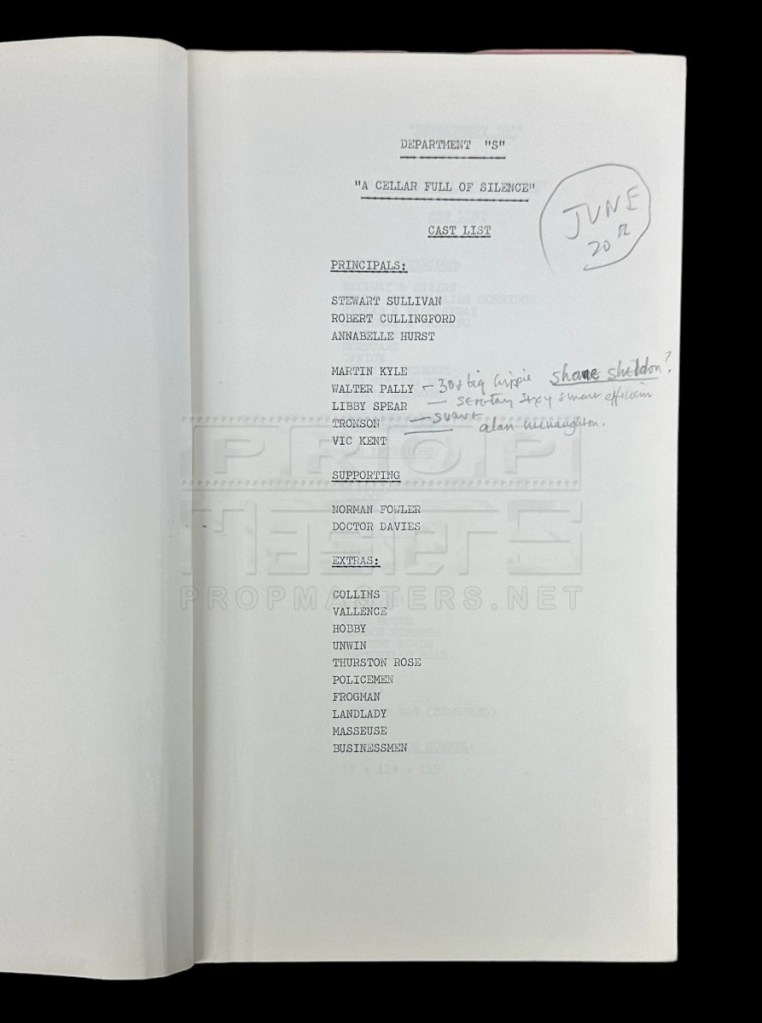
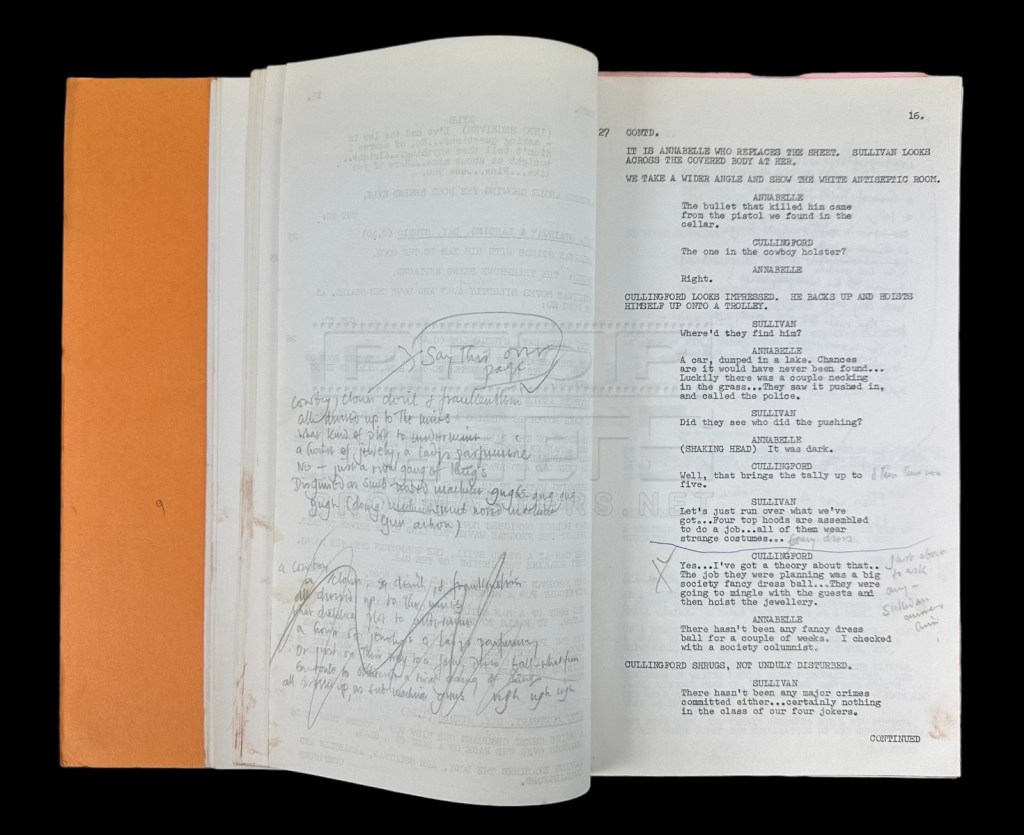
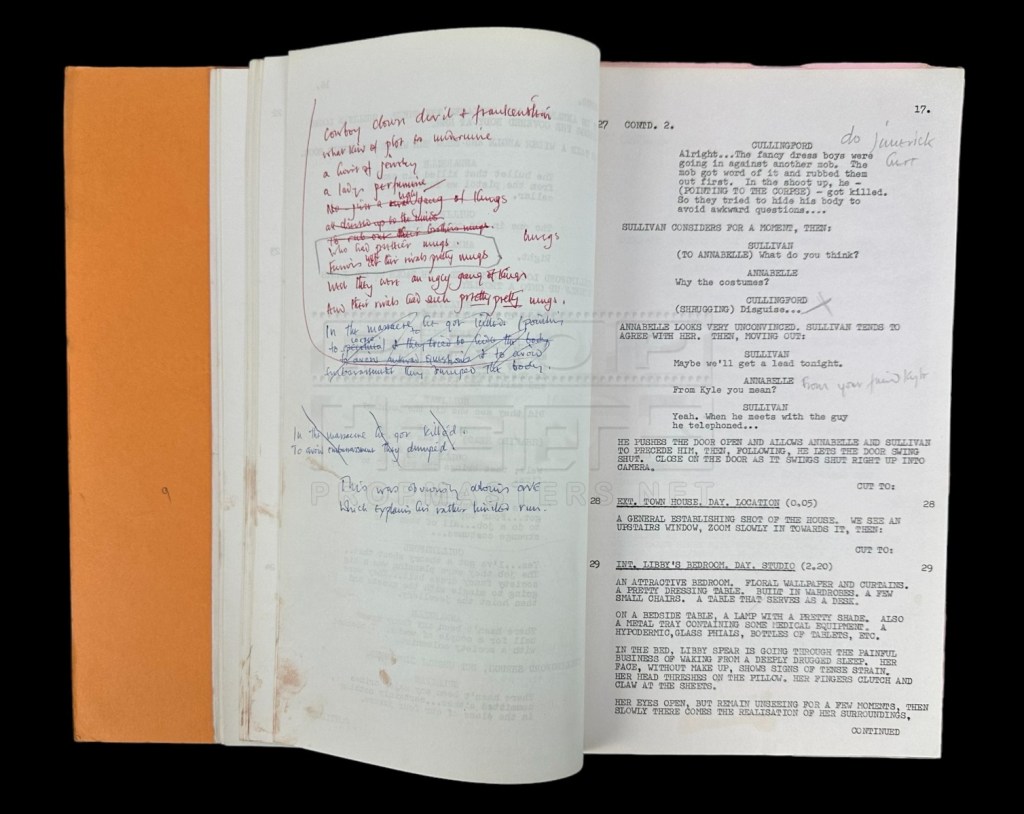
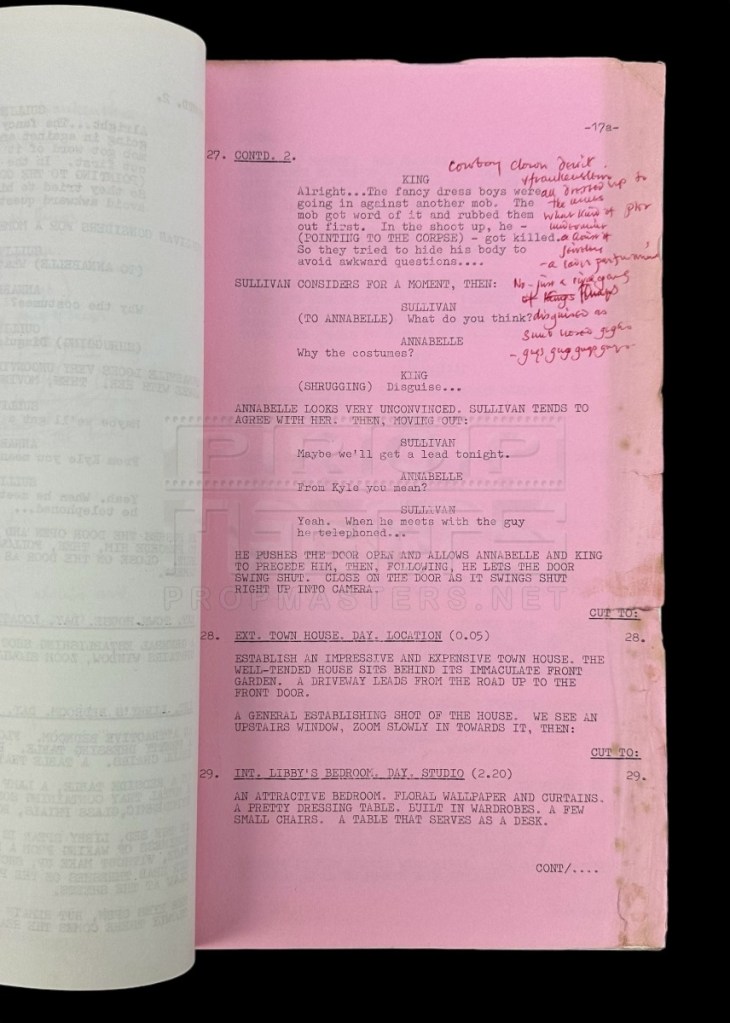
Peter’s original script ‘A Cellar Full Of Silence’

Department S In date order

If you wish to watch the Department S episodes in 'Date Order' - those being the dates under the title at the beginning of each episode - here is your guide:
 
18 - 20 - 19 - 22 - 23 - 25 - 27 - 4 - 26 - 5 - 28 - 24 - 6 - 8 - 7 - 3 - 2 - 15 - 1 - 10 - 9 - 12 - 11 - 13 - 14 - 21 - 17 - 16.

Click below for more about Department S and Jason King…

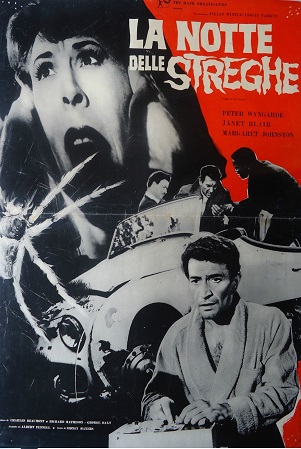
REVIEW: Night of the Eagle/Burn, Witch, Burn

SCREAM

The Story

Sociology professor Norman Taylor seems fortunate indeed. He has a smart, beautiful wife, Tansy, who helps him with his research. They share a pleasant house, flashy sports car and well-appointed coastal cottage. He is popular with his students at Hempnell College, respected by his academic colleagues and acknowledged as a front-runner for the college’s chair in sociology. He does not realise that he and Tansy are bitterly resented and envied by his colleagues’ wives, especially Evelyn Santelle and Hilda Gunnison. Only the crippled Flora Carr, who works at the college with her husband Lindsay, seems to take a more charitable view.

Norman’s pleasant complacency is disrupted when he discovers that Tansy has been practising witchcraft. Her belief in magic originates from a field trip to Jamaica two years’ before, when they became acquainted with a warlock who succeeded in bringing a young girl back from the dead, albeit at the cost of her mother’s life. True to his almost religious faith in rationalism, Norman insists that Tansy burn all his magical paraphernalia, despite his wife’s fearful objections. She warns him that they are the targets of malicious spells cast by someone at the college.

That evening Norman receives an amorous phone call from an infatuated female student, Margaret, who subsequently accuses him of raping her. Bill, her distraught boyfriend, threatens him with a gun. Norman easily disarms Bill and the rape accusation is soon proved to be false, but Norman’s problems continue. When he plays an audiotape of one of his lectures received in the mail, it carries a strange distortion that seems to summon something to his house. Tansy stops the tape, but the strange throbbing sound resumes when Norman answers the phone. His wife disconnects the call just in time to prevent catastrophe. Norman attributes Tansy’s fear to an over-active imagination.

Realising that she will never persuade Norman of the danger they face, Tansy gets him drunk and performs a ritual that substitutes her life for his. The next morning he wakes to find her gone, but learns from Hilda that his wife is on her way by bus to their coastal cottage. A recording left by Tansy makes it clear she plans to sacrifice herself in his place. Although he catches up with the bus carrying Tansy, a near-collision with a truck delays him. When he eventually reaches the cottage, there is no sign of Tansy, but he finds her notes on a magical ritual used to break curses. The ritual must be performed in ‘the house of the dead in the place of the dead’.

s-l1600

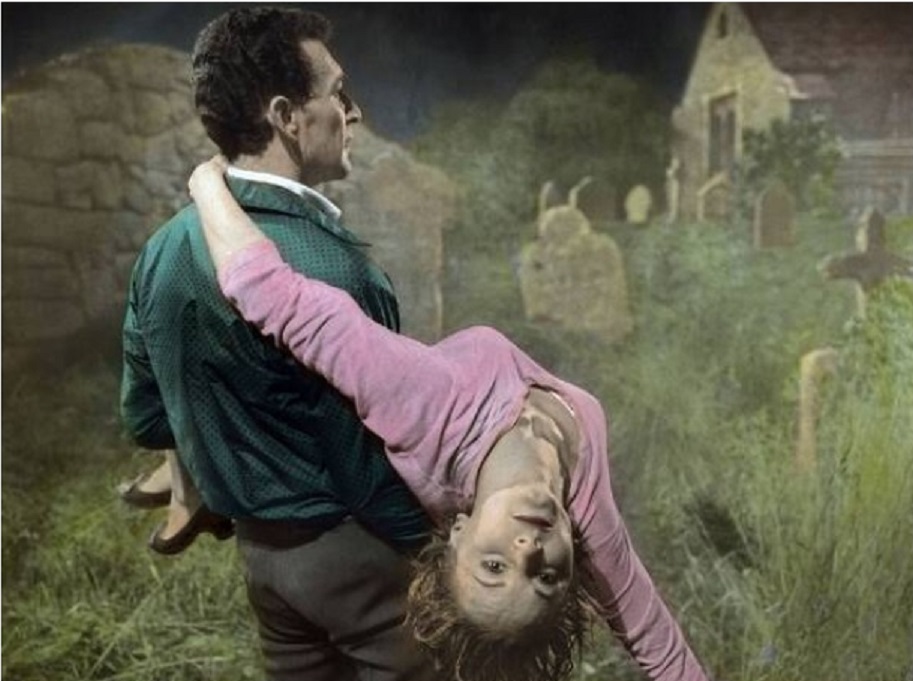
In a crypt in the local churchyard, Norman performs the ritual and Tansy is saved from drowning in the ocean. She seems to be in a trance. He takes her back to their home, where she suddenly wakens, removes a carving knife from a kitchen drawer, and limps to the chair where Norman was dozing. During the subsequent struggle, Norman disarms Tansy, who collapses. After returning her to bed and locking the bedroom door, Norman takes the distorted audiotape with him to the college.

There, having recognised his bewitched wife’s limp, Norman confronts Flora and accuses her of hypnotising Tansy out of resentment and jealousy. Flora mocks his rationalistic explanation of all the misfortunes that have recently befallen him. She arranges Tarot cards to represent the Taylors’ home and Tansy, then sets alight the cards. A fire is immediately started outside Tansy’s bedroom. Fearing the worst despite his scepticism, Norman runs from Flora’s office to return home. Flora plays the throbbing audiotape over the college’s public announcement system. It brings to life the stone eagle on the college roof above the main entrance. The eagle pursues Norman back into the college.

Lindsay’s arrival at his wife’s office forces Flora to turn off the tape, sparing Norman’s life. Finding that the damage caused by the giant eagle has vanished, Norman returns to his house. It is engulfed in flames, but Tansy is safe thanks to the local fire department. Lindsay tells Flora, as they leave the college, that Norman has been appointed to the chair in sociology. The stone eagle above the college entrance inexplicably topples from its perch and crushes Flora.

A successful school teacher discovers that his wife has been dabbling in white magic and that his house is filled with good luck charms and talismans. As he is a non-believer in the occult, he burns the whole lot in the fire. Unfortunately for him, an enemy with a grudge is now free to use all of their black magic to attack the teacher and his wife – with devastating results.

In Retrospect

Very much regarded as a classic of the genre, Night of the Eagle is a well-shot black and white chiller with plenty of spooky moments to enjoy. Made in an era when the best horror moments still came from subtlety and a brooding atmosphere, the film conjures up a nightmarish world of spells and powerful forces beyond our comprehension. Some fine acting from the distinguished cast help to make us care for the characters and believe the events that play out.

The film kicks off happily enough, with teacher Norman Taylor, a resolute non-believer in the supernatural, lecturing his students on superstition and the like. Soon, however, he discovers that something is amiss at home and his house is filled with dead spiders, locks of hair, dirt from cemeteries and allsorts. He destroys all of these, much to his wife’s horror, and then the real nightmare begins. Taylor’s life begins to fall apart. He is accused of raping a female student at the school, and his wife suffers a nervous breakdown. Eventually he is forced to revaluate his opinion on the black arts when he realises that the misfortune he is suffering is the work of an emery masquerading as a close friend.

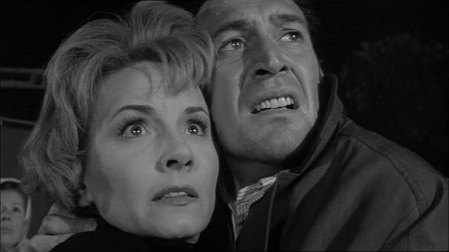
Strong on atmosphere, Night of the Eagle is packed with suspense and tension as the horror of the situation escalates up until the finale. The trappings of a good score and nice photography make this easy on the eye and ear, and Peter himself is very good as the lead who ends up being absolutely terrified and a broken man. Janet Blair, on the other hand, is a little irritating – unfortunately at this particular period in the cinema actresses who had to display fright had a tendency to overact (widening their eyes, screaming, etc.) which can look a little dated. The supporting cast are fine, with Margaret Johnston as a creepy, limping fellow teacher who has a few secrets to hide.

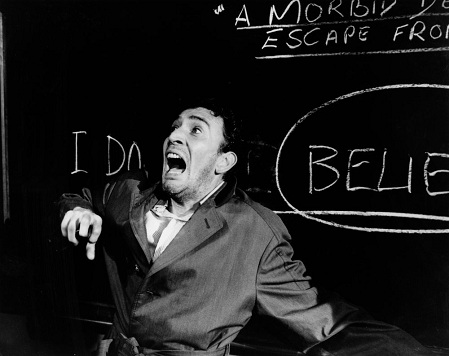
Probably the best-remembered part of this film is the ending, which sees Peter trying to save his wife from their burning home. Along the way, one of the stone eagles on the roof of the school comes to life and chases him through the corridors, until he is saved at the last moment. A simple effect, this, but a clever and memorable one. During this chase, Peter rubs up against his blackboard and a phrase previously written on there – “I do not believe” becomes simply “I do believe”. A lovely little touch in what is a very nice film indeed, not totally brilliant but providing enough thrills and chills to be an above average entry in the genre.

Film Facts

The working title for the film was ‘Torment’, but was changed to Night of the Eagle. Burn, Witch, Burn was always meant to be the title for the American release.

The indoor scenes where shot at Beaconsfield Studios in Buckinghamshire, while the outdoor locations where at Cape Cornwall, St Just, Cornwall; Porthcurno Beach, Porthcurno, Cornwall; and Interesting? Yes No Taplow Court, Berkshire.

Night of the Eagle was the second film adaptation of Fritz Leiber’s classic horror story, ‘Conjure Wife’. In 1944, Lon Chaney played Professor Taylor in ‘Weird Woman’, opposite Evelyn Ankers as his wife.

BurnWitchBurn03

During the filming of one scene, Peter was accidentally hit by a lorry but was, thankfully, uninjured.

Peter Cushing was actually producer Albert Fennell’s first choice to play Professor Taylor, but he fell ill just prior to the start of filming in 1961, and so Peter was called in to replace him.

There was another scene in the original script in which Peter, as Norman Taylor, had to find a gramophone needle that had played only Scriabin’s 9th Piano Sonata, otherwise known as the Black Mass. However, director Sidney Hayers decided to cut it from the final film.

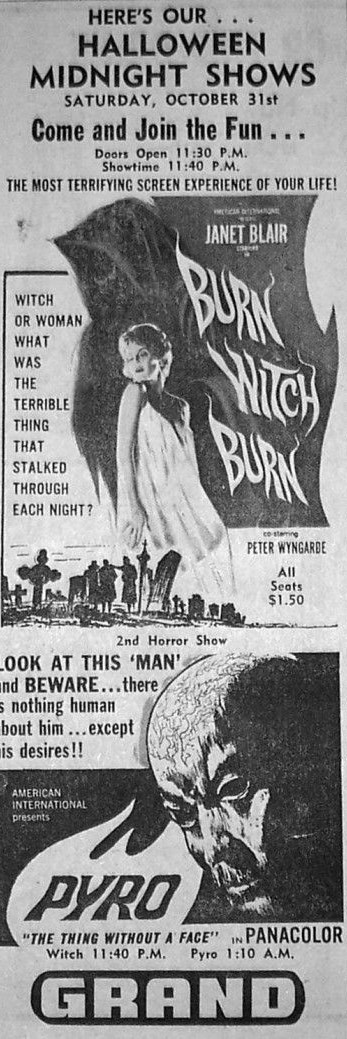
In the United States, where the film was released under the title, ‘Burn, Witch, Burn’, special “De-Witching” ceremonies were performed by cinema managers before every screening, and sachets of salt were given out to patrons who hadn’t already been “hexed”.

The eagle which appears in the film was called Lochinvar, and had been loaned from London Zoo.

In 1993, a special edition widescreen version of the film was released on video in the United States containing a three minute introduction, written by Paul Frees and narrated by Orson Welles. 

Below: A rare still from one of the deleted scenes from the film

18839688_1761425713884177_846355979013362786_o

“I DO NOT BELIEVE!” Written emphatically on a blackboard in the presence of his students, Professor Norman Taylor dispels belief in witchcraft and all trappings of the supernatural. However, Taylor’s wife, Tansy (Janet Blair), has been liberated from so much scientific logic by a mind-expanding experience in Jamaica, where a witch doctor literally brought the dead back to life, and it is Taylor’s discovery of her convictions that serves as the catalyst for Burn, Witch Burn. Made in England in 1961 as Night of the Eagle, this renowned thriller has achieved cult status – along with Jacques Tourneur’s Night Of The Demon (1957) and Terence Fisher’s The Devil Rides Out (1967) – as one of the finest examples of black magic ever put on the screen. Its reputation has steadily gained momentum and it is only now, with the release of this LaserDisc, that the film is readily accessible to a new generation of connoisseurs and aficionados of terror.

Burn, Witch, Burn was directed by Sidney Hayers, whose only other excursion into fantastic cinema was 1960’s Circus of Horrors, starring Anton Differing. Hayers went on to helm many memorable episodes of “The Avengers” in Britain and continues to this day, yet Burn, Witch, Burn remains his most accomplished work. The fortuitous collaboration of writers Richard Matheson (The Incredible Shrinking Man), Charles Baumont (Masque Of The Red Death) and George Baxt turned Fritz Leiber, Jr.’s thrice-filmed novel “Conjure Wife” into a taut, gripping screenplay. Superb production values were overseen by Julian Wintle and Leslie Parkyn. Leiber’s work first hit the screen in Universal Pictures’ Weird Woman (1944), starring Evelyn Ankers and Lon Chaney in the second instalment of the studio’s famed “Inner Sanctum” series. This adaptation is certainly not faithful to its material, making Burn, Witch, Burn the definitive version of the novel (in 1980, a third filming – somewhat pirated, as the Leiber original was not given screen credit – appeared as the horror/comedy Witches Brew starring Richard Benjamin, Teri Garr and Lana Turner). Interviewed exclusively for this LaserDisc presentation, the still-vivacious Janet Blair remembers the production with enthusiasm and respect. She recalls her first day of shooting was Tansy’s drowning scene off the northern coast of England.

“It was bitterly cold and I had to go over this rocky cliff and continue to walk into the ocean for what seemed to be for me an eternity. By the time I was retrieved out of the water, I was frozen and soaked to the bone. One of the grips ran up to me and made me drink from a thermos which was filled with brandy. Being a non-drinker, I immediately spat it out. So much for the glamorous work of a movie star! “Originally I was told Peter Finch was to be by leading man, but lost no time in becoming utterly bewitched by my co-star, Peter Wyngarde, who was so dramatic and sexy that I nearly forgot I was acting! I do believe this was one of Peter’s largest film roles at the time, and I remember after a day’s shooting he drove me to my hotel and continued that atmosphere of a happily married couple. I adored working with him.”

Also commenting for this disc release, director Sidney Hayers fondly recalls the shooting as very quick and fun to do. After some initial misgivings about the casting of Wyngarde and Blair, he was quite pleased to find these two professionals had great chemistry together. He remarked that even Ms. Blair said at the time she gave this role her all and considered it to be some of her finest work.

Hayers also remembers that the actress playing the true villainess of the piece, Margaret Johnston, had by then become a theatrical agent representing one of the actors in the film. Hayers persuaded her to play the unbalanced Flora, ruthlessly driven to practice the black arts against the happy couple, thereby creating one of the screens most memorable wretches.

The giant stone eagle which terrorises Peter was in actuality an eight-foot Styrofoam figure that could do no harm should it fall from great heights. The script called for full camera as this prop is transformed from its solid state into a living, winged gargoyle. As Hayers puts it, “It is Peter Wyngarde’s acting and intense focus that really allows the audience to suspend disbelief.” Neither Ms. Blair nor Mr. Hayers have seen the film in thirty years, and were most gracious to share their thoughts on the film’s amazing longevity with horror fans. Now, for the first time on the home screen, Burn, Witch, Burn is presented in its proper 1.75:1 aspect ratio, giving the viewer the chance to see the film as originally intended. Also featured here are the film’s original British title sequence (Chapter 33) and Paul Frees’ deliciously demonic rendering (created strictly for the American version) of the incantation that will protect one from deadly contact with the supernatural evil of Burn, Witch, Burn. “DO YOU BELIEVE?”

Additional Comments

Cast Views

Peter… “Can an actor’s life be affected by a fictional supernatural screen role?” asks Peter Wyngarde, star of Night of the Eagle.

Answering his own question, the handsome young actor avows that while a year ago he would have thought an affirmative ridiculous, today he has real doubts after starring in two successive tales of the supernatural.

“I laughed at stories that my fifteenth century weekend cottage in Kent was haunted, but since making ‘Burn, Witch, Burn’ and before that other “spook” thriller, The Innocents, I’m beginning to have my doubts,” Peter says.

PDVD_031

The young actor revealed that during the making of both pictures he would often wake up in the middle of the night sweating – that the roles got right under his skin and made him think of the terrifying subject matter.

Night of the Eagle’ and The Innocents have made me over-susceptible to ghosts, strange noises and things that go bump in the night,” Peter says. “And now I’m beginning to wonder how I stand up under the influences of witchcraft and the supernatural which have dominated these motion picture roles.”

Janet Blair… Interviewed exclusively for this Laser Disc presentation, Janet Blair remembers the production with enthusiasm and respect. She recalls her first day of shooting was Tansy’s drowning scene off the northern coast of England.

“It was bitterly cold and I had to go over this rocky cliff and continue to walk into the sea for what seemed to be for me an eternity. By the time I was retrieved out of the water, I was frozen and soaked to the bone. One of the grips ran up to me and made me drink from a thermos which was filled with brandy. Being a non-drinker, I immediately spat it out. So much for the glamorous work of a movie star!

“Originally I was told Peter Finch was to be by leading man, but lost no time in becoming utterly bewitched by my co-star, Peter Wyngarde,  who was so dramatic and sexy that I nearly forgot I was acting. I do believe this was one of Peter’s largest film roles at the time, and I remember after a day’s shooting he drove me to my hotel and continued that atmosphere of a happily married couple. I adored working with him.”

Sidney HayersAlso commenting for this laser disc release, director Sidney Hayers fondly recalls the shooting as very quick and fun to do. After some initial misgivings about the casting of Peter and Janet Blair, he was quite pleased to find these two professionals had great chemistry together. He remarked that even Ms Blair said at the time she gave this role her all and considered it to be some of her finest work.

Hayers also remembers that the actress playing the true villainess of the piece, Margaret Johnston, had by then become a theatrical agent representing one of the actors in the film. Hayers persuaded her to play the unbalanced Flora, ruthlessly driven to practice the black arts against Tansy, thereby creating one of the screen’s most memorable wretches.

The giant stone eagle which terrorises Peter was in actuality an eight-foot Styrofoam figure that could do no harm should it fall from great heights. The script called for full camera as this prop is transformed from its solid state into a living, winged gargoyle. As Hayers puts it, “It is Peter Wyngarde’s acting and intense focus that really allows the audience to suspend disbelief.” 

CRITICS COMMENTS

This low-budget, British import, with Janet Blair and a small cast, is quite the most effective “supernatural” thriller since Village of the Damned. The New York Times

The film is never less than gripping, and past a certain point, you have no idea where this movie is going. With neither the budget nor the technology for flashy effects, the filmmakers had to fall back on quality acting, writing, directing, and editing. They succeeded. Film Threat

THE AWARDS

img (2)

Above: The Daily News, New York – 7th July, 1962

img (1)

Above: Lansing State Journal, Michigan, USA – 12th October, 1962

note

Below: A very interesting review of the film by Tania Donald


Click below for more more Night of the Eagle/Burn Witch Burn information…

COMIC BOOK CHARACTERS

There are probably more cartoon characters based on Peter Wyngarde than any other actor, here are those that are known to us.

The X-Men Jason Wyngarde

The Villainous adversary of The X-Men, based partly on Peter Wyngarde, and the characters of Jason King and Sir John Claverly Cartney.

  • Name: Jason Wyngarde
  • Real Name: Mastermind
  • His first appearance: Uncanny X-Men 4
  • Death: Uncanny X-Men Annual 22

Who is Jason Wyngarde? A mutant with sophisticated illusionary powers, Jason Wyngarde always appeared to try be more than what he was. He first attempted a shot with Magneto’s original Brotherhood of Evil Mutants, and later to join the Hellfire Club casting a more handsome disguise for himself. Suffering from low self-esteem and later a bout of insanity brought about by Dark Phoenix, Mastermind was always trying to use his powers for selfish reasons until his death from the Legacy Virus.

His Most Famous Quote: “Teacher’s pets!” A dour Mastermind is annoyed at all the favouritism Magneto is showing Quicksilver and the Scarlet Witch.

84360-60494-mastermind

What Are His Special Powers: Jason Wyngarde was a sophisticated illusionist, able to create images that would appear very real to people, even enough to cause psychosomatic damage. With the help of the White Queen’s Mindtap Mechanism, Wyngarde was able to put illusions directly into the mind of Phoenix.

His Most Heinous Act: Spending time with Phoenix to corrupt her into becoming the Hellfire Club’s Black Queen is probably Mastermind’s best known dastardly deed. He also was responsible for a series of covert attacks on the X-Men, including inducing Mariko to reject Wolverine at the altar, Storm’s “punk” phase, and Rogue running away from Mystique to join the X-Men.

His Adversaries: As a mutant, Mastermind primarily went up against the X- Men, both on his own and as part of teams. He also once battled Excalibur when he tried to tap into the Phoenix force through Rachel Summers.

His Allies: He got along well enough with Magneto and came close to being accepted into the Hellfire Club. Mastermind was also able to make peace with Jean Grey shortly before his death, genuinely sorry for the misery he had caused. In the Age of Apocalypse timeline, Jason was part of Forge and Nate Grey’s team of traveling performers/rebels.

The New Mastermind: Wyngarde’s previously unknown daughter, Martinique, has taken up the name Mastermind out of respect for her father. Blessed with similar illusionary powers, she has battled Wolverine, Gambit and Daredevil.

Appearances of Jason Wyngarde in Marvel Comics and their current availability:

  • Vol. 1 – No.129: ‘God Spare The Child’. Published: January 1980.
  • Vol.2 – No.130: ‘Dazzler’. Published: February 1980.
  • Vol.3 – No.131. ‘Run For Your Life’. Published: March 1980.
  • Vol.4 – No.132: ‘And Hellfire Is Their Name’. Published: April 1980.
  • Vol.5 – No.133: ‘Wolverine Alone’. Published: May 1980.
  • Vol.6 – No.134. ‘Too Late The Heroes!’ Published: June 1980.

The Essential X-Men – Book 2.

A black and white anthology of the above mentioned Marvel comics featuring the Jason Wyngarde character. Published in the U.S.A. by Marvel Comics. $14.95 (UK – £10.95).

The Uncanny X-Men – The Dark Phoenix Saga.

X-Men comics featuring the Jason Wyngarde Character. Published in the U.S.A. by Marvel Comics.

TV 21 Department S strip

Department S cartoon strip

DeptS (1)

TV Century 21, later renamed TV21 (from issue 155), TV21 and Tornado (from issue 192), TV21 and Joe 90 (from issue 243), TV21 (from issue 278) and TV21 and Valiant (from issue 347), was a weekly British children’s comic published by City Magazines during the 1960’s and 70’s.

The comic dropped the “Century” from its title in January 1968, after 155 issues, and became known as TV21. The previous year, the character the latter half of the 1960s. The comic dropped the “Century” from its title in January 1968, after 155 issues, and became known as TV21.

The previous year, the character of the “indestructible” Captain Scarlet, the hero of Captain Scarlet and the Mysterons (1967 – 68), had made his first appearance. The backstory of the Mysterons, Scarlet’s Martian enemies, was being revealed in TV Tornado, another City Magazines publication. In September 1968, after 192 issues, TV21 merged with TV Tornado to form TV21 and Tornado.

deptS2

Mr Six

From the mind of acclaimed writer Grant Morrison! Join disaffected British teen Dan McGowan as he encounters the clandestine group known as the Invisibles and discovers the strange underside of the world in this mind-bending series!

First appeared in the DC Vertigo comics, ‘The Invisible’ comics. First published in 1994, Mr Six appeared in 23 issues.

His alias’s were: Big Malkie Brian Malcolm Jon Six Mister Six Mr. Malkie

Division X

‘6 And A Half Dozen Of The Other’

Division X have been reformed and are brought to the House of Fun to investigate the happenings there, and to find out what is going on in the Mother of Parliaments. Someone has found some magic matter. They manage to track some paranormal material back to Quimper in Soho. While they are meeting him a woman gives a video tape to Jack Flint. They watch it and it shows a woman who looks like Princess Diana and the Moon Child/Shoggoth in delicate circumstances. Quimper has vanished by now, but he speaks to them through a woman at his club. The conspiracy goes right to the top, and it is up to Division X to go to the top too….

CARTOON

It is glaringly obvious that the character of Mr Six as seen in issue No.6 of ‘Division X’ is based on Jason King, as played by Peter in Department S, with Jack Flint and George Harper being inspired by Jack Regan and George Carter as played by John Thaw and Dennis Waterman in The Sweeney.

Flash Gordon

Faithfully adapted by Bruce Jones and supported by amazing art by award-winning Al Williamson, the Flash Gordon comic of the movie would appear in various guises all over the world.  Arguably most common Stateside was the softcover album by Western Publishing on newsstands as the film hit theatres – Hardcovers were to follow as the release travelled across the pond to the UK and beyond.  The adaptation would last be seen across three issues of the Whitman comic book.

FlashComic7

Look In

Jason King made a guest appearance in a three-part comic strip entitled ‘Sky-Jackers’, in issues 47, 48 and 49 of the junior TV listings magazine, Look-In in 1972. (See below).

12011348_423931911137697_1865351478704729073_n

Televise Favorieten Department S

Published in Holland in 1969, features four different Department S cartoon strips entitled:

  • ‘De Verwenen Geleeden’ (The Disappeared Scientists),
  • ‘Gouldkapers Aan Boord’ (Gold Stealers On Board),
  • ‘Het Poppenmysterie’ (The Puppet Mystery),
  • ‘Diplomaat Vermist’ (The Missing Diplomat).

Bullet Fireball

Fireball, whose real name was never revealed, but who bore more than a passing resemblance to Peter Wyngarde, going up against villains such as Catriona Klangsburg (alias the Cat) while protecting Britain’s interests. He was raised as the legal ward of Lord Peter Flint (the former World War II era super-spy code-named Warlord) after the deaths of his parents, and his “Uncle Pete” continued to be a help and inspiration to him in his adult career.

Could it be… ?

‘Napoleon Dynamite’

Right: Professor Koontz, Napoleon’s so suave British science teacher in the American cartoon series, ‘Napoleon Dynamite’.

Professor Howe And The Plastic Peril

130-page paperback by Jamie Hailstone – published 1st June, 2018. It couldn’t be anyone else…!

Doctor Who The Third Doctor

Published by Titan – we find John Pertwee’s Doctor is in a London gentlemen’s club, playing chess, and nattering to a fellow member who looks uncannily like a young Peter Wyngarde.

2000 AD

Here’s a fellow with some rather obvious creative inspiration who may not have strolled your way before … ‘Dandridge’ appeared in the foremost UK anthology comic 2000AD between 2009 and 2013.

TRIBUTE RECORDS

Over the years Peter has inspired a number of semi-professional bands to write and record tribute songs in recognition of the impact he made on Seventies culture. Here are just a few of the more memorable ones and the stories behind them.

BITTER SWEET COMPANY Edmund Kötscher, Rudi Lindt and Peter Ström

This (West) German musical conglomerate released this single via Columbia (Catalogue No.: 1 C006-29 926) in 1972 in the ‘Schlager’ style.

The B Side: ‘Chi-Chi-Ba-Ba’.

Listen to the song here


Kate+O+Mara+Peter+Wyngarde+EXP+NEW+23jdWc6q0uVl

BREADWINNER: Morris De Cony, Fay Allright, Mr. Rubbish and Bob McGrath.

A British-based pop-combo, whose brand of music has been described as not unlike “Ray Coniff filtered through the eyes of a social outcast like Charles Manson…”. Their fascination with Peter began when percussionist/singer/composer, Bob McGrath, found a copy of his infamous album under a tree in the New Forest. After playing it to friends in a local art group, he sent a questionnaire to Peter via his agent for inclusion in a fanzine, ‘One More War’.

‘Hey There, Petter (sic) Wyngarde’.

‘Jason Kinky Winky’.

Click here to read more about these songs and the band.


THE PAISLEY WHEELCHAIR EXPERIENCE: Freddie, Karen, Elizabeth, Helen, Amado, The Pogeria Twins.

RETURN CD

This Slough-based “avant-garde cabaret” combo were, during the late 90’s, one of the hottest bands on the London pub and club circuit, boasting a set which included such numbers as ‘Shaken Not Stirred’, which paid homage to the legendary Jason King and his TV contemporaries.

In 1997, the band released a limited-edition CD featuring four tracks entitled: ‘The Return of Jason King’, ‘Medallion Man (Disco Mix), and ‘Tank Top Wearers Lament’. Each copy of the CD, which was issued in a black and white sleeve featuring photographs of Peter as Jason, were personally signed by the great man himself and sold exclusively via the Official Appreciation Society.

‘The Return of Jason King’, which was written by Freddie Valentine, calls for the resurgence of the Seventies crime-fighter to help rid our streets of muggers and teenage tearaways:

“With regard to the ‘The Return of Jason King’ CD,” says Freddie Valentine of the Paisley’s.,”all copies were sold within in two and half months of its release! As we vowed to make this a collector’s item for JK fans, we have resisted the temptation of pressing up more copies! So the people that have a copy, have one of only 40 in the whole universe!!!”

Trivia fact: One of the last copies was taken by Mike Flowers of Mike Flowers Pops! Aside from the 40 copies signed by the great man himself, there were ten promo copies which were given to easy listening DJ’s in London clubs, where the song got a nice bit of exposure!

Listen to the song here


The Adventures Of Parsley:

Another band of interest to Peter Wyngarde fans is The Adventures of Parsley. They are a space-age Hammond Organ combo from London who perform various TV and film themes wearing authentic Space 1999 outfits. Their album ‘Top TV Themes’ includes a great version of the Department S theme, and they have even covered The Paisley Wheelchair Experience’s ‘The Return of Jason King’ single in their live set! 


MINX: Jez Fielder

In the autumn of 1999, this Sussex-based rock band recorded a “medium-paced pop cheeser” entitled simply ‘Jason King’, which was written by the bands’ lead-singer, Jez Fielder.

Recent contact with Jez Fielder revealed that the band are now no more, and the song was never released.

Listen to the song here


HARRINGTON PAPWORTH AND WHITWORTH STOTES:

Gloucester-based Indie band released a one-off single in 1997 entitled ‘Shake and Shout’, which fans of Department S will instantly recognise as the disco frequented by one Jason King in the ‘Man From X’ episode.

Initially named ‘Guns For Hire’ and formed in 1980, ‘Department S’ changed their name to escape any links with the spreading ‘Ska’ & Two Tone craze that was sweeping the country. The name was chosen due to the various members fond memories of the TV show and the fact that it seemed to tie them to no particular youth movement.

After releasing one single as ‘Guns For Hire’, the band released 3 singles under the new name. ‘Is Vic There?’ and ‘Going Left Right’ both charted in the UK, while ‘I Want’ fared better in Europe. They split up in 1982.


PAUL LINDEBOOM:

Paul is a musician from Holland who records in his own studio at home, playing all the instruments himself.

One of his songs, ‘Flux Spleen Kittens’ has a strong connection with Peter Wyngarde , since it features a sample of the drum beat from the first track on Peter’s album, ‘Come In’.

“The song came about after I heard the Wyngarde album at a friend’s house,” says Paul. “After sampling the drum beat, I added lead and bass guitar, plus loads of synths to the track. The whole intro to ‘Come In’ gave me a feeling of something that was way ahead of its time. Bearing in mind that the album was recorded in 1970, it still fits today’s musical colours perfectly.”


ROBIN GIBB

Although not strictly a tribute song, these lyrics were written for Peter by Bee Gee, Robin Gibb, in 1970 for his self-titled album. Sadly, the song was never recorded.

imageedit_1_6069970160

More about Peter Wyngarde tribute records…

ALBUM: Lyrics

1. Come In

2. You Wonder How These Things Began

3. Rape

4. Jenny Kissed Me

Jenny kissed me when we met, jumping from the chair she sat in.
Time, you thief who loved to get sweets into your list, put that in.
Say I’m weary. Say I’m sad. Say that health and wealth have missed me.
Say I’m growing old, but add – Jenny kissed me…

Words and Music by Hunt and Smith – EMI Harmonies Ltd

5. The Way I Cry Over You

6. Unknown Citizen
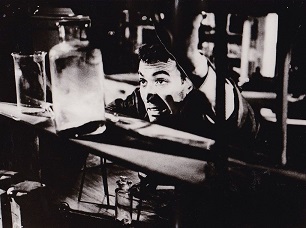
7. It’s When I Touch You

1. The Hippie and the Skinhead

2. Try To Remember To Forget

3. Jenny Kissed Me (reprise)

4. Widdecombe Fair

5. Neville Thumbcatch

6. Over Again (Flight Number 10)

7. Pay No Attention

8. April

Click below for more information on this album


© Copyright The Hellfire Club: The OFFICIAL PETER WYNGARDE Appreciation Society: https://www.facebook.com/groups/813997125389790/

PETER WYNGARDE: The Album & CD

  • That Peter would receive 7% of the retail selling price in the UK; 6% in the rest of the world.
  • The contract would last for one year, with an extension option of a further year.
  • RCA would require to release two albums each year from which it was hoped they would wish to take a single.
  • And that the budget for each album would not exceed £2,000.

The original track listing was as follows:

Side One:

  1. Come In
  2. Where Shall We Begin?
  3. Rape
  4. Silent Thanks To Noisy Yanks
  5. To Call a Man a Man’
  6. You May Think I Have Not (It’s Then When I touch You)
  7. Colour TV

Side Two:

  1. Merry Christmas
  2. Nurse, Your Hands Are Cold
  3. Taxi Drivers Talk Too Much
  4. Flight No.10 (Once Again)
  5. Try to Remember to Forget
  6. Pay No Attention
  7. Hippy and the Skinhead (Originally entitled ‘The Letter’)

THE FINAL TRACK LISTING WAS:

Entrac

  1. Come In
  2. You Wonder How These Things Began
  3. Rape
  4. La Ronde De L’Amour
  5. Jenny Kissed Me
  6. The Way I Cried Over You
  7. Unknown Citizen
  8. It’s Then When I Touch You

Sectrac

  1. Hippie and the Skinhead
  2. Try To Remember To Forget (Riviera Cowboy)
  3. Jenny Kissed Me And It Was…
  4. Widdecombe Fair
  5. Neville Thumbcatch
  6. Once Again (Flight Number 10)

Lastrac

  1. Pay No Attention
  2. April

SONGS THAT DIDN’T MAKE THE FINAL CUT

  • D.J.’s
  • If I Have Made, My Lady (Ballad)
  • Marie (Ballad)
  • Merry Sexmas (sung as if drunk)
  • Nurse, Your Hands Are Cold
  • Robinson Crusoe’s Story
  • Silent Thanks To Noisy Yanks
  • Taxi Drivers Talk Too Much
  • The Duel
  • To Call a Man a Man (Ballad)
  • Walk Into My Eyes (Ballad)

Written by Peter Wyngarde Hubert Valverde.

Opens with a strident percussion rhythm, which fades to uncover a familiar voice singing excerpts from a later track, ‘La Ronde De L’Amour’. Peter is evidently making preparations for a female guest – this establishes the album’s leaning towards the romantic side of his image, obviously building upon the Jason King following of the time. The lyric – penned by Peter himself, displays all the modesty of his alter-ego who, as the connoisseur of all things sensual, a single sniff is all that is required to determine his lady’s particular brand of perfume. However, one wonders as to the status of his companion with the inclusion of the line, “No, the lights haven’t fused, it’s candlelight!” The track establishes a relaxed, intimate mood, but implies that all might soon change. “Here’s to a pleasant evening… and a few surprises!

Track 2: You Wonder How These Things Began.

Written by Schmidt and Jones.

Track 3: Rape.

Written by Peter Wyngarde and Hubert Valverde.

LP

Track 4: La Ronde De L’amour.

Written by Straus and Decreux.

Track 5: Jenny Kissed Me.

Written by Hunt and Smith.

Track 6: The Way I Cary Over You.

Written by F. & H. Valverde.

Track 7: Unknown Citizen.

Written by W.H. Auden.

Unknown Citizen’ brings us to yet another change in style from Peter. As a poem by W.H. Auden, this could have been done as a straight recital. However, by slipping into yet another character, Peter dives into the mood of the poet – adopting his best accent of civil servant pomposity to deliver this seemingly innocent eulogy to a model citizen. The gravity of tone set by this character makes the satirical sting in the tail all the more painful: “Was he free? Was he happy? The question is absurd. Has anything been wrong? We really should have heard.”

Track 8: It’s Then When I Touch You.

Written by Peter Wyngarde and Hubert Valverde.

Once again it’s back to romance for the final track on Side One. This segment is again a sensual experience – as manifested within the title – as Peter’s lyric examines another facet of human relationships; the hesitancy and insecurity of longing: “Maybe you want to care, once bitten, twice shy.”

SIDE TWO

Track 1: Hippie and the Skinhead.

Written by Peter Wyngarde and Hubert Valverde.

Track 2: Try To Remember To Forget.

Written by Peter Wyngarde and Hubert Valverde.

Track 3: Jenny Kissed Me And It Was…

Written by F. & H. Valverde.

Track 4: Widdicombe Fair.RCA

Written by Vic Smith.

Reversed recordings and a chunky piano-sound reminiscent of John Lennon’s ‘Imagine’, herald another change in style as we slip into a brief burst of floating psychedelia. This track seems to be more than a segue into the next humming chorus leading us deftly into…

Track 5: Neville Thumbcatch.

Written by Smith and Bain.

Track 6: Once Again (Flight Number 10).

Written by Peter Wyngarde Hubert Valverde.

Track 7: Pay No Attention.

Written Peter Wyngarde by Vic Smith.

Track 8: April.

Written by Peter Wyngarde Vic Smith.

SIGN

Album Reissue On CD

51NuxyD3e9L

For four years fans waited with baited breath whilst one record company after another did battle over the reissue of Peter’s album on CD. Then, in 1998, Sheffield based R.P.M. finally came up with the goods under the title, ‘When Sex Leers Its Inquisitive Head’, which came complete with a re-designed sleeve and re-mastered sound.

R.P.M. were renowned as a company who liked to pitch a curved ball. Sometimes it was the restoration of a long lost classic, such as ‘The Teenage Opera’; occasionally it was a barely musical but kitsch experience along the lines of the 1970 ‘England World Cup Album’; or it could be a real slice of classic pop culture like the fabulous ‘Jamie Jones Singles Collection’. So it shouldn’t have come as much of a surprise the R.P.M. has again took one of pop’s more bizarre offerings – Peter’s one and only recording venture, and album steeped in myth and controversy.

RCA, who issued the original album, gave total artistic control to Peter, the Valverde Brothers and producer, Vic Smith. The result ended up being an album that was banned by the BBC due in large part to the “Rape” cut that seems to make light of the act.

“Well, I did promise at the beginning of the album a pleasant evening… with a few surprises!” Peter said with a grin. “The song was never meant to be about physical rape. People take things so literally these days and ignore the humour in it. I’m not saying that rape is meant to be taken light-heartedly. My album was meant to be a bit of fun, that’s all!”

It’s been suggested by some misinformed journalists that the album was withdrawn within a week of its release. THIS IS NOT TRUE. In fact, it completely sold out in just 3 days, resulting in Peter becoming one of RCA’s most successful acts ever (second only the Elvis Presley) based on initial album sales.

“It sold out in next to no time,” Peter explains, with a sardonic smile. “But RCA point-blankly refused to press any more. I was fuming, as I’d been given a three-album contract with the company, who promised to release one LP every 12 months. The excuse was that production was being moved from Middlesex, I think, to Hollywood in Gloucestershire. They told me that everything would have to go on the backburner, but I just believe that they got cold feet”.

In spite of this, and due to the divisive nature of the album, the decision was made to make no further pressings. Since its original release, the album has achieved a legendary status over the years, with some copies of the album fetching as much as £400+ on the collector’s market.

When, in the 1990’s, it was decided that the time was ripe to re-issue the record, the various labels found to their dismay that it’d become mired in contractual complications, so R.P.M. alone certainly couldn’t have found the resources to free it up. Indeed, the title was scheduled to appear on Creation’s re-issue label, Rev-Ola in 1997, until the powers that be at the label (in the form of CEO, Alan McGhee) said “No way!”, and R.P.M. were able to offer it a more suitable home.

Peter’s masterful portrayal as Jason King, the TV sleuth masquerading as a crime-fighting shag-monster, was so rooted in its rakish era that a revival seemed as likely as the return of the classic Bentley Continental he drove.

The character of Jason King, who was first created for ITC’s ‘Department S’ series back in 1969, epitomised “easy” culture; a decorative hirsute look comprising of sideburns, moustache, and a matching collar-and-tie of raw silk, and suits that made heads turn right around.

For women, most of whom were still chained to the kitchen sink, Jason King was the Romeo who’d come to liberate them from suburban domesticity. All of which makes Peter’s vinyl love-letter, even more bizarre.

A collection of contemporary standards it is not. The album includes songs which explode into rages of male sexuality, crouching in an aesthetic abandon that set off the alarm bells even in those permissive climes. Labels had long been sniffing around, hoping to get Peter into the studio.

680d0b075f4dd6153e4b71ff2576dbed

“I’d known the Valverde Brothers for a while, and had written some lyrics for them which they used on tour. They’d been on at me for years to collaborate with them, but I hadn’t really taken it seriously. When RCA came up with an offer, they told me I could do whatever I liked – that’s what really appealed to me. I saw the record as an entertainment in its own right; to be enjoyed tongue-in-cheek.

“I think they (RCA) expected eight or nine Sinatra cover-versions, but we wanted to do something new. The album’s success really took them by surprise. They were mired in a scenario similar to ‘The Producers’, were the only really successful act they had on their books at the time was Elvis Presley, and the plan was that my record would go down as a tax loss. It rocked them on their heels when the opposite happened and it became a tax gain!

The central idea was to string the songs together into one long suite and none were more interesting than the opening trio of ‘Come In’, ‘You Wonder How These Things Begin’ and ‘Rape’. Truly the album’s centre-piece, it’s this suit which has given the album such cult notoriety that collectors will happily shell out £400+ for an original copy. Peter defends the piece on which his musical infamy is based:

“Is it politically incorrect? I’ve really no idea. It’s about all kinds of rape. There’s so much rape going on; rape within bureaucracy, rape at so many government levels, rape of countries. You know, even attempting to explain it totally defeats its purpose.”

The records’ outrageousness often overwhelms what would still be one of the most curious episodes in popular music. The listener is unlikely to forget ‘The Hippy and the Skinhead’, in which Peter reads out a letter written to The Times by two Home Counties Skinhead girls, or the tale of ‘Billy the Queer, Pilly Sexy Hippy’, sung over an incongruous Nashville backing. And there’s even something for discerning lovers of the late Sixties British rock as he takes on The Attack’s ‘Neville Thumbcatch’, which was written by Vic Smith.

Until the release of ‘When Sex Leers Its Inquisitive Head’ the ‘Peter Wyngarde’ album had largely been circulated on enthusiastically-copied cassettes. That was because of how quickly RCA snuffed it out. Over 45 years later, perhaps the rest of the world has finally caught up with Peter’s postmodernist bent. And as with all R.P.M.’s releases, this reissue had been specially crafted. Careful sound restoration has been couple with another of their large fold-out inlays, covered in pictures and notes, which Peter penned as if written by Jason King for the original sleeve, are all included in full.

Catalogue No.: RPM 187

The CD How it nearly didn’t happen

As reported in the Official Peter Wyngarde Appreciation Society quarterly magazine:

Winter 1994: Rumour has it that Creation Records are planning to re-release Peter’s wonderful self-titled album on compact disc in the near future, via their Rev-Ola label.

Summer 1995: Creation Records tell us that the reason for the delay in releasing Peter’s self-titled album on CD as hoped, is down to their inability to track down his original contract with EMI.

Winter 1996: Following Creation’s failed attempt to re-issue Peter’s self-titled album on CD back in 1994, Island Records are now showing a keen interest in putting the recording back on the market.

At the time of writing, Island’s Bernard McMahon is having discussions with Peter regarding the missing part of his original contract with RCA which, as many of you may remember reading in earlier issues of this magazine, was one of the reasons behind Creation’s failure to re-issue the album originally

Spring 1997: After what has seemed like an eternity in the making, Creation Records have finally named the day for the release of Peter’s album on CD as Monday, 12th May, 1997.

At the time of going to print, Creation were negotiating with Peter in regard to his taking part in a signing session at one of London’s leading record stores, but as yet, nothing has been confirmed.

Summer 1997: After almost five years of battling it out with EMI for the right to re-issue Peter’s album on CD, London-based Creation Records have decided NOT to release the LP after all!

Although Creation have not as yet bothered to let us in on the ‘official’ reason behind their suddenly getting cold feet, their reasoning appears to be based on a press leak which suggested that many newspapers and magazines might slate the album because they felt that the track, ‘Rape’, might now be considered “politically incorrect’.

As a result of Creation’s decision, a number of interviews between Peter and various music-related publications – including Melody Maker, had to be cancelled during the latter part of April.

This image has an empty alt attribute; its file name is 104323881_1740280179445483_4381049245008491801_n.jpgWinter 1997: According to a letter that I received on Friday, October 25th, (1997) Creation Records appear to have had a change of heart concerning the re-issue of Peter’s LP on CD. This appears to have a lot to do with the fact that they’ve finally secured the licence to “immediately” release the recording – pipping RCA themselves to the post.
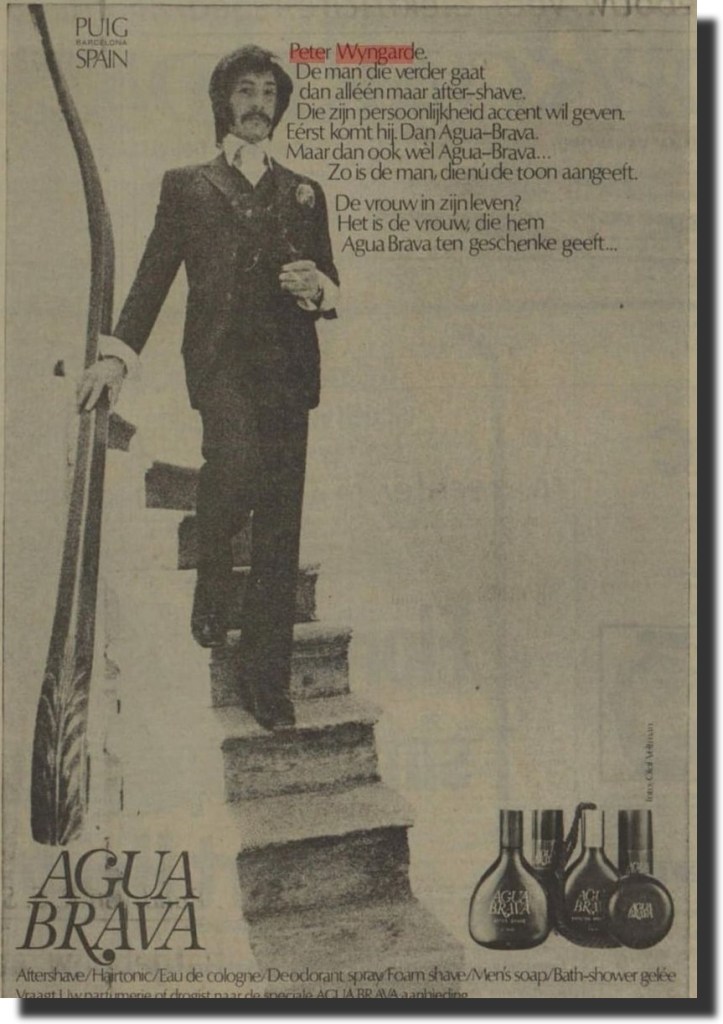
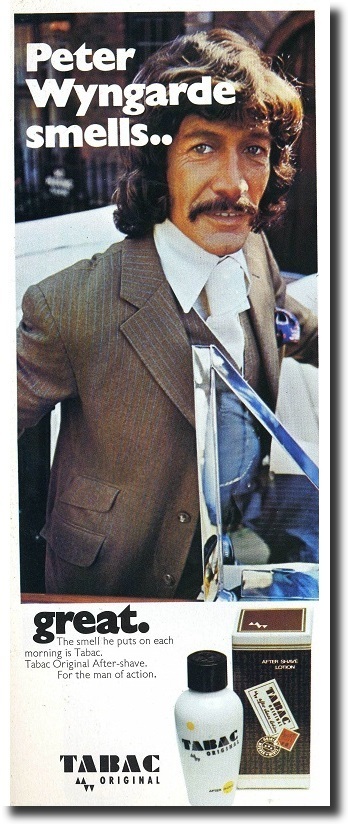
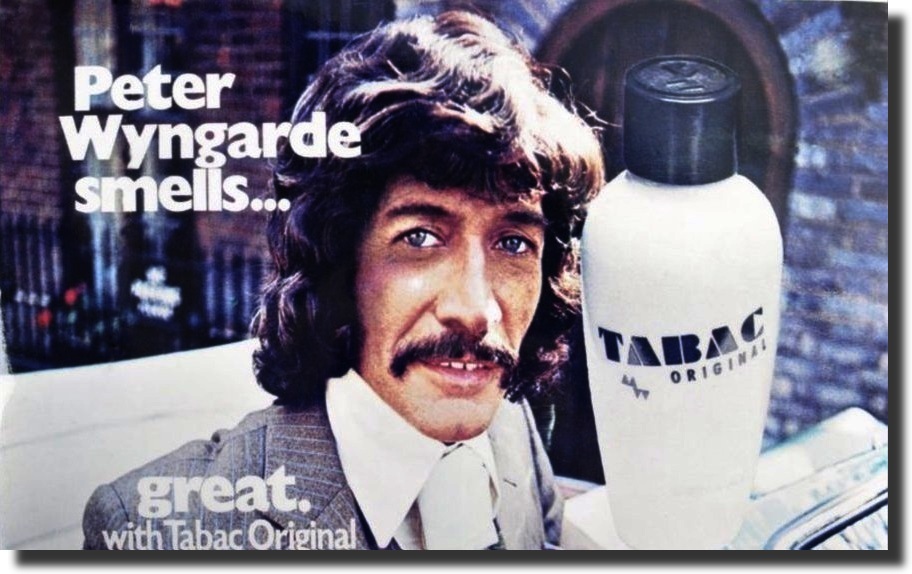
Spring 1998: Having recently released the highly successful collection of recordings from the BBC archives, which included Sandie Shaw’s ‘Live in the 80’s’, and Ian Gillan’s ‘The BBC Sessions’, R.P.M Records have indicated that they may now be interested in taking over where Creation/Rev-Ola left off last year, and re-issue Peter’s album on CD.

Although nothing has as yet been confirmed, rumours are circulating that there could be a “late Spring” release.

Autumn 1998: Early indications are that Peter’s new CD is selling extremely well. The Virgin Megastore in London’s Oxford Street announced sales upwards of 25 units during its first week of release, and the HMV shop – also in Oxford Street, displayed posters and a standee to promote it. 

However, in spite of an initial invitation to all members of the Hellfire Club to attend the launch party in London prior to release, I am yet to receive confirmation of a date, time or venue.

Click below for more on this album…

ADVERTISING


1970 Agua Brava

Dutch media campaign from 1970 for Agua Brava men’s grooming products, which included aftershave, soap, shampoo, deodorant and talcum powder.

1971 Tabac

TABAC

The Tabac range of men’s toiletries was given its first-ever national campaign, running from the week beginning November 12th, 1971, until Christmas of that year, fronted by a £30,000 magazine burst and the broadcasting of live action advertisements on TV and in cinemas in the London area.

A spokesman for Pembertons told newspapers at the time that Peter had been specifically chosen to feature in the advertisements as market research had revealed that upwards of 70% of all men’s toiletries were actually purchased by women on behalf of their husbands and boyfriends, and that they felt that his association with the product would have a huge effect on future sales.

Having already invested in a £40,000 account with Pembertons, Eylure had hoped to boost Tabac into prominence within the “middle-market” area which, at the time, was dominated by Shoulton’s Old Spice range of products.

It was later reported that as a direct result of Peter’s involvement in the campaign, Tabac aftershave was the biggest-selling men’s fragrance in the United Kingdom during the Christmas 1971 period.

The Tabac range had been taken over by the unlikely-named Etlure Eyelash and Eye Make-Up Company in January of 1971, and had not had a British agency before. The minimal advertising that had been undertaken in the past has been limited to Europe, as it had originated in (West) Germany.

Peter had been approached by the London-based advertising agency, Pembertons, following his hugely successful role as Jason King in Department S, which had been commanding massive audiences from its very first episode.

In addition to the two live-action segments for screening on TV and in the cinema – both of which had been scripted by Peter himself, the campaign also included space in several magazines, including Honey, Vogue, Good Housekeeping, She and Petticoat, which included a “money-off” incentive in conjunction with Penthouse.

The TV screenings began in London on November 23rd, 1971, and ran until December 22nd of that year.

The story of how Peter was recruited

1974 Gower Kitchen Furniture

adshad

“For people prepared to go out and get business, it’s still there,” said Philip Gower, Chairman and Managing Director of the Halifax-based Gower Kitchen Furniture in 1974.

Gower was speaking about the state of business following a highly successful merger with the Armitage-Shanks group, and was confident that sales of the newly-launched Gower LA range of self-assembly kitchen units would meet the £1.8 million figure projected by September of the following year – particularly as they’d managed to enlist the services of Peter to help promote the Module 21 units, which the company described as an “above-average quality KD kitchen unit.”

The advertising campaign began in earnest in April of 1974, with half-page space being bought in such high-profile publications as the Radio and TV Times, and most national daily newspapers.

Within three and a half weeks of its launch in Stratford-Upon-Avon, the manufacturers reported that orders for the Module 21 Kitchen Unit had reached £274,000, which was a huge uplift from the all-time low which had rocked the industry only six months earlier.

In one of the newspaper advertisements, Peter told prospective customers: “Module 21 is essentially designed to suite all sizes and shapes of kitchen, and there are nine worktop finishes and seven door colours featured in the range.”

Thanks mainly to Peter, the year-long campaign proved so successful that Gower were able to open a brand new 125,000 square feet factory and warehouse in Halifax, West Yorkshire, in 1975, costing in excess of £1,000,000.

1970/74 Milk Tray

Peter was the voice behind the famous “And all because the lady loves Milk Tray” line for the famous Seventies advertising campaign.

1970 Additional

Free poster with Typhoo Tea