


International Season – The Irvine Theatre, June 1952
Character: Jonah
The Story
They’ll Arrive Tomorrow is a compelling wartime drama by Israeli playwright Nathan Shaham. First published in 1949, the play was inspired by experiences tied to the Arab-Israeli conflict. Rather than focusing on military action, the narrative examines the psychological strain endured by soldiers at an isolated outpost, where the primary threat is not the enemy beyond the perimeter, but the unseen danger lurking within their own position. At its core, the play is an exploration of fear, leadership, responsibility, and the moral burdens of command.
The central premise is both simple and effective. A military unit is stationed at a critical defensive position surrounded by hidden mines. This creates a state of constant anxiety, as every movement carries the risk of sudden death. Consequently, the enemy becomes a secondary concern; the true antagonist is uncertainty. Contemporary commentary notes that the soldiers become increasingly demoralised by the knowledge that a lethal threat exists beneath their feet, undetectable and inescapable.
Shaham skilfully translates this tension into a theatrical experience. While the mines remain largely unseen, their presence dominates every scene, serving as a symbol of psychological paralysis and fear. Because the soldiers cannot escape the threat, the audience shares in this persistent sense of unease, which effectively drives the drama forward.
Much of the play centres on Jonah (Peter Wyngarde), the commanding officer. In a 1952 production, this role was played by Peter, whose performance earned significant critical praise. Jonah is presented as a natural leader tasked with maintaining discipline and morale under extraordinary pressure. However, he is not portrayed as a conventional hero, but rather as a flawed and conflicted individual forced to make impossible decisions.
The most intriguing aspect of Jonah’s character is his response to the minefield. Rather than confronting the issue directly, he attempts to minimise discussion of it, fearing that an open acknowledgment of the danger would undermine morale and incite panic. This strategy raises profound ethical questions: Does a commander have the right to withhold critical information from his subordinates? Is it more effective to preserve morale through silence or to risk anxiety by telling the truth?
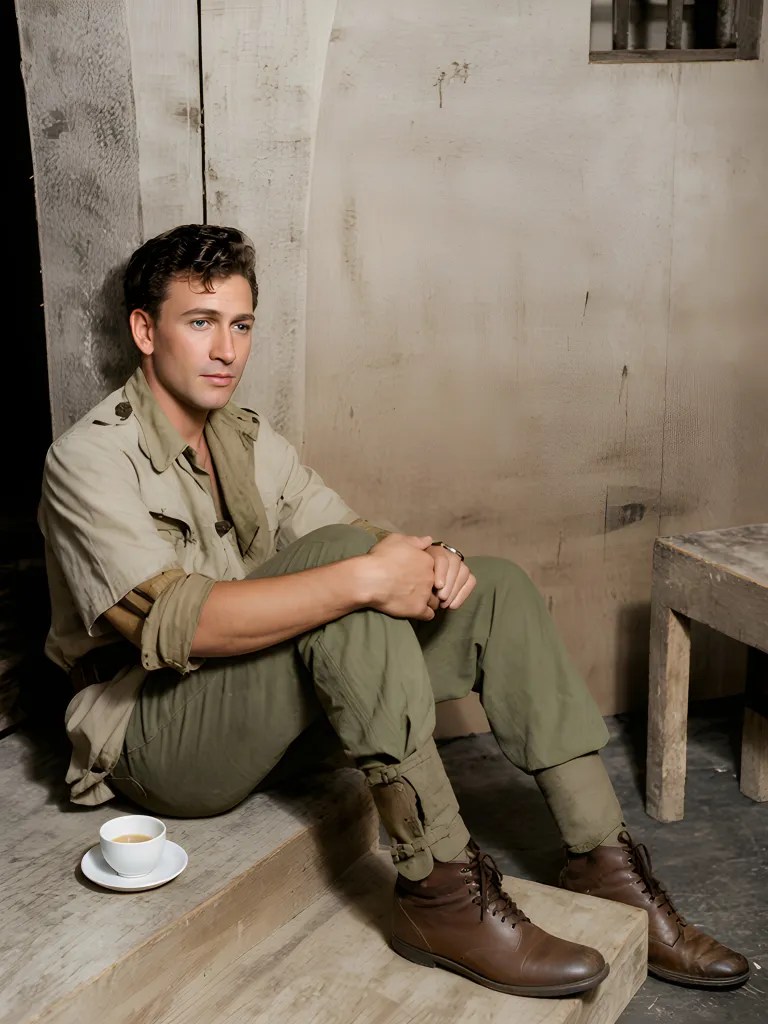
Shaham uses these dilemmas to explore broader themes of authority and accountability. The play repeatedly questions what is expected of those in power when every available option carries potentially disastrous consequences. This ambiguity remains one of the drama’s greatest strengths.
Furthermore, the play highlights the conflict between differing philosophies of military leadership. Contemporary reviews point to a significant divergence of opinion between Jonah and his second-in-command. These disagreements add a layer of intellectual tension to the story, evolving it from a mere survival drama into a study of competing ideas regarding duty, courage, and command.
They’ll Arrive Tomorrow has frequently been compared to R. C. Sherriff’s celebrated First World War drama, Journey’s End. Both works focus on soldiers defending a vital position under intense psychological pressure and prioritise character development and morale over battlefield spectacle. By employing confinement and anticipation as primary sources of tension, both plays provide a poignant look at leadership within high-stakes military environments.
They’ll Arrive Tomorrow possesses a distinct thematic identity. While Journey’s End focuses primarily on endurance in the face of inevitable attack, Shaham’s play examines how latent threats affect both individuals and organizations. The minefield serves as a metaphor for uncertainty, reflecting a world where danger is not always visible or understood.
The romantic subplot involving Jonah and the play’s sole female character adds significant emotional complexity. Rather than distracting from the military themes, this relationship highlights the personal sacrifices demanded by conflict, demonstrating that the consequences of the minefield extend beyond strategic concerns to affect the characters’ emotional lives.
Notably, Shaham maintains a strong commitment to realism. The characters react to fear and frustration in believable, human ways, and the play avoids glorifying war or presenting simplistic notions of heroism. Instead, it explores the confusion, doubt, and moral uncertainty inherent in wartime command.
Although some contemporary critics felt that certain dramatic possibilities were not fully realised, they acknowledged the strength of the central premise and the effectiveness of the theatrical tension. The image of soldiers trapped by an invisible danger remains compelling decades after the play’s debut.
Ultimately, They’ll Arrive Tomorrow is a thoughtful drama that blends military realism with psychological insight. Its exploration of fear, authority, and ethical responsibility provides significance that transcends its historical setting. While it may lack the international fame of some wartime classics, it warrants recognition as a serious work that examines the human cost of leadership under extreme conditions. Through its central dilemma and probing examination of moral responsibility, the play remains both dramatically effective and emotionally resonant.
Focus on Jonah
Peter’s portrayal of Jonah in this play was one of the earliest stage performances to highlight the qualities that would later make him a distinctive presence in British theatre, film and television. Playing the commander of an isolated military outpost during a time of conflict, Peter was required to carry much of the play’s emotional and dramatic weight. Contemporary critics singled him out for praise, with The Times describing him as making “perhaps the strongest impression” and Punch judging him to be the best performer in the cast.
Jonah is a challenging role because he is not a conventional war hero. Unlike the bold, decisive military leaders often found in wartime dramas, Jonah is a man confronted by an impossible situation. A hidden minefield within his own position is steadily destroying the morale of his troops, yet there is no obvious solution to the problem. As the commanding officer, he must somehow maintain discipline and confidence while privately wrestling with doubts of his own. This conflict between public authority and private uncertainty forms the heart of the character.

Wyngarde appears to have understood these contradictions well. Rather than portraying Jonah as a fearless commander, he emphasised the burdens of leadership. Jonah is responsible not only for military strategy but also for the psychological wellbeing of his men. Every decision carries the risk of tragic consequences, and the audience is constantly aware that lives depend upon his judgement. Such responsibility creates a tension within the character that Wyngarde was particularly well suited to convey.
Above: A caricature of Peter from ‘Punch’ magazine, June 1952
Physically, Peter possessed many of the attributes associated with command. Even as a young actor, he had a natural bearing that suggested authority and self-confidence. His striking appearance and commanding voice enabled him to dominate the stage, making it entirely believable that other characters would look to Jonah for leadership. Yet his performance seems to have avoided simple heroics. Instead, he portrayed a man attempting to appear certain while navigating profound uncertainty.
The comparison frequently drawn between They’ll Arrive Tomorrow and Journey’s End is particularly revealing. Critics noted similarities between Jonah and Stanhope, the famous commanding officer in R. C. Sherriff’s wartime classic. However, Jonah is a more ambiguous figure. Whereas Stanhope’s authority is largely unquestioned, Jonah’s decisions and methods become subjects of debate within the play itself. This ambiguity gave Peter the opportunity to explore a more complex form of leadership.
An important aspect of the role concerns Jonah’s handling of information. Faced with a demoralised unit, he appears reluctant to discuss the danger posed by the mines openly. Whether this decision is wise or misguided remains open to interpretation, and the character’s uncertainty becomes one of the play’s central themes. Peter’s task was therefore not simply to portray a commander giving orders but to embody a man struggling with difficult moral and practical questions.
The romantic element of the play also adds another dimension to Jonah. Beyond his duties as an officer, he is a man capable of deep personal feeling. This aspect of the story allows glimpses of vulnerability beneath the military exterior and prevents the character from becoming merely a symbol of authority. Peter’s ability to balance strength with sensitivity would later become a hallmark of many of his best performances.
Looking back, Jonah can be seen as an early indication of the qualities that would define Peter’s career. The intelligence, charisma and emotional complexity that later distinguished his celebrated performances were already evident in this role. Although They’ll Arrive Tomorrow is rarely discussed today, contemporary reviewers clearly recognised the impact of Peter’s work, and their praise suggests that his portrayal of Jonah was one of the production’s principal strengths. More than seventy years later, it remains an important early milestone in the development of a remarkably distinctive actor.
Critics Comments
| “Mr Peter Wyngarde, as the commanding officer, makes perhaps the strongest impression.” The Times – Friday, June 27th, 1952 “Of a moderate cast, Mr Peter Wyngarde, as the platoon commander, is much the best.” Punch – June 1952 |


