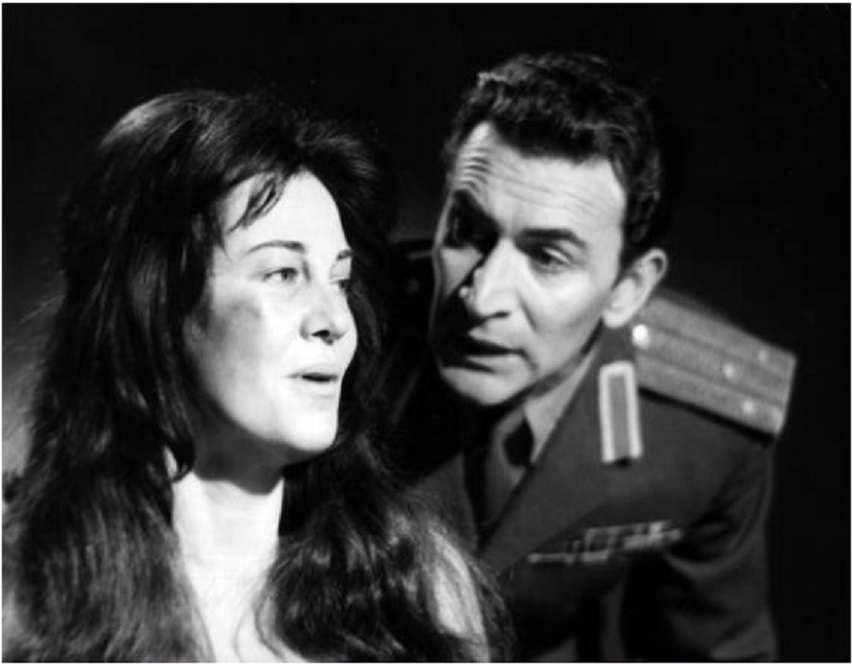
Above: Peter as Glenkin with Katherine Blake as Luba
When Sidney Kingsley’s adaptation of Arthur Koestler’s harrowing novel, ‘Darkness At Noon’ was performed on Broadway in 1951, a New York theatre critic described it as “Savagely gripping and provocative.”
It is a description which also applied equally well to Cyril Coke’s TV version, which was broadcast on Tuesday, January 15th, 1963. The question being asked was: Does the end justify the means?
During the Stalin era in the Soviet Union, the end was everything. But Rabashov (Albert Lieven), hero of the play, as Party chief, has known what the cause could demand, and is now imprisoned.
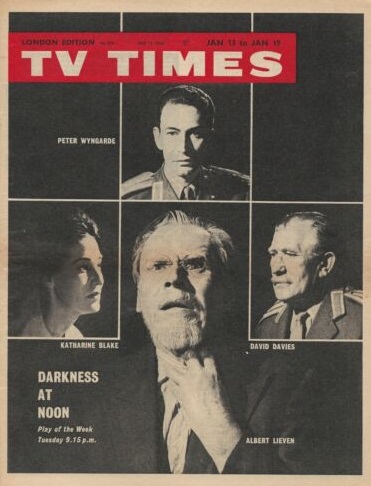
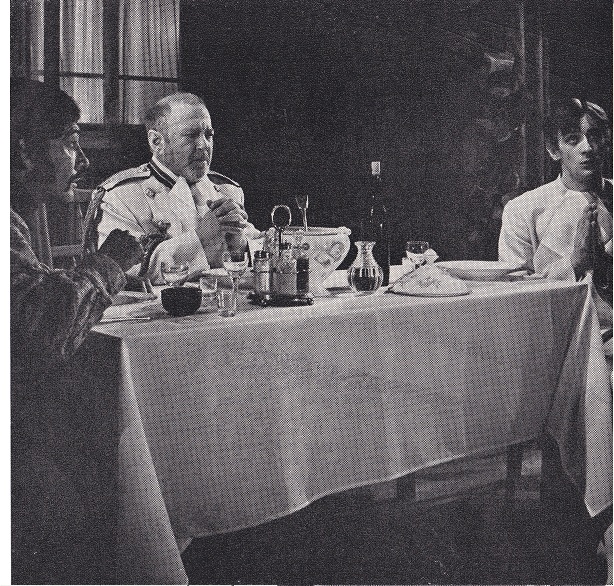
BelowRight: TV Times. Peter as Glenkin, top centre.
The year is 1937. The year of the Moscow Purge Trials. Commissar Rabashov has made the unfortunate mistake of expressing an unorthodox opinion at the wrong time. In his cell, he is tormented by his past, his earlier, loyal life in the Party. He has always believed that this particular end justified the means: now he has been caught up in his own belief. Wracked by the realisation of his own guilt, his own acceptance of cruelty, he awaits his fate.
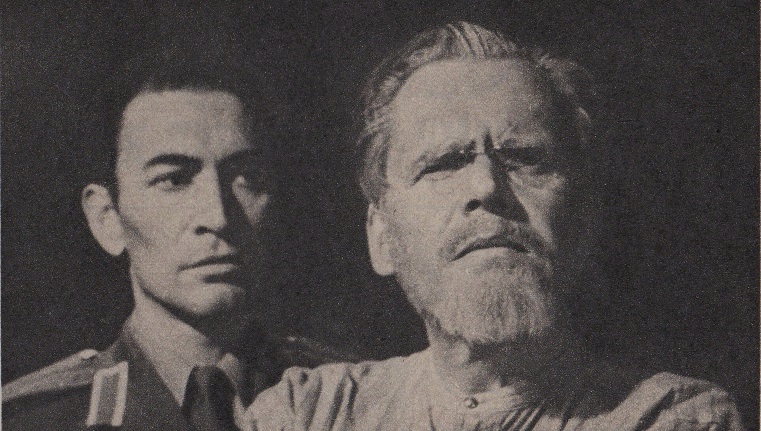
He recalls his past – his girlfriend, Luba (Katherine Blake), his betrayal, his comrades. One of his former friends – another member of the old Communist brigade, Ivanov (David Davies), tried to exhort a “confession” from him. He wants to keep Rabashov out of the hands of the young but merciless officer, Glenkin (Peter Wyngarde). When Rabashov refuses to talk, Ivanov asks: “Which are we to save? Your dignity or your head?” But before long, Glenkin has Rabashov in his evil clutches…
Cyril Coke, who directed and adapted the play said: “I read Koestler’s book years before, and I’d always wanted to televise it. Now that the Soviet leaders admit the wrongs perpetrated on the ‘Old Guard Of The Revolution’, in Stalin’s time it seemed the right moment to screen it. Those wrongs it exposed still exist today.
“Sidney Kingsley’s play won the Annual Award of the New York Drama Critics in 1951, but this was the first dramatisation of Koestler’s novel in England, and I was delighted to direct it.”
As Rabashov, Albert Lieven had, stated at the time, “One of the most exciting parts I could imagine. I think this was one of the really worthwhile things to do.”
Sentiments echoed by Katherine Blake: “It was one of those plays where the meaning was very clear from the very first rehearsal. I could understand the role of Luba immediately so the part was easy to learn; easy to speak.” Equally enthusiastic was David Davies: “It was the best part that I’d ever had, and that includes the part of the drunken father in Gorki’s play, ‘Mother’.”
AlthoughPeter enjoyed playing the evil Glenkin, he said back in 1963 that he might soon win a few more sympathetic roles: “I’m tired of being hated!” he confessed.
Characters: William Maitland of Lethington and William Cecil, 1st Baron Lord Burghley
Peter as William Maitland, with Ellen MacIntosh as Mary
Some Background
To mark its tenth birthday, STV decided to mount the biggest and most expensive single drama production in its history to date. The Queen of Scots, which was broadcast under the ‘Scottish Playbill’ umbrella, had 34 main parts and more than 20 extras, and ran for two hours. It featured an impressive cast list, including Peter Wyngarde, Victor Carin, John Laurie, James Copeland and Ellen McIntosh in the title role.
This historical play is centred around the reign, the captivity and, finally, the execution of Mary Stuart. “Scots have maintained a curious love-hate relationship for this fascinating woman which has never waned,” said the TV Times. “Some 150 books have been written about her, variously interpreting her character and actions according to their own prejudices.”
The play was in two parts, the first of which was written by Jack Gerson and set in Loch Leven, where Mary was imprisoned by the Scottish nobles, and the second part, written by Ian Stuart Black, was set in Fotheringay, where Mary’s cousin, Queen Elizabeth, kept her a prisoner. The writers set out to cut through the romance and put forward the truth. As Gerson told TV Times. “I believe that Mary did a Pontius Pilate act and washed her hands of Darnley’s murder. But I don’t believe she was further implicated. There are some matters like this in which you can’t be sure, but you have to make a decision.“
Mary Kerridge as Queen Elizabeth and Peter Wyngarde as Lord Burghley
Co-author Ian Stuart Black said: “When I was at school in Scotland, I believed that Elizabeth was a bad Queen, but the research I did in the past has taught me that she was a courageous woman deserving more sympathetic consideration than she usually gets.“
In fact, history shows that in the final years, it was only Elizabeth herself who was protecting Mary from her inevitable execution. But Mary’s ambition for her throne, made her a constant source of danger which finally had to be resolved.
The Great Hall at Fotheringay Castle, 1587. The executioner knelt to beg customary forgiveness from his victim. Then, the axe fell and gave birth to the most romantic legend in royal history.
Mary Stuart was colourful, reckless, indulgent, passionate and extraordinarily graceful. A mammoth two-hour dramatisation of her life ‘The Queen of Scots’, was screened on Wednesday, November 29th, 1961.
The production was directed by Geoffrey Nethercott whose wife, actress Ellen McIntosh, played the difficult title role. In the play, Ellen had to wear twelve heavy period costumes; they were lovely, but difficult to work in. However, the actress who suffered most from the costume difficulty, was Mary Kerridge, who played Queen Elizabeth. Her costume was copied from a portrait, was four feet wide and quite impossible to sit down in.
Altogether, there was a cast of sixty actors in the production, all meticulously dressed in 16th century costume. Peter, who played two parts in the production – William Maitland and Lord Burleigh – says that the play was extremely dramatic, which had caused a few headaches for the writers: “Some of the more crucial turning points in Mary’s life were some of the most shrouded in doubt. Although history professors from Glasgow University were on hand to advise, the writers had to make a few decisions of their own.
“For example, at the heart of Mary’s ruin were the so-called Casket Letters. These were reported to have been written by Mary to Boswell. They were love-letters full of poetry and sentiment, but also implicated her in her husband’s murder. The writer’s decided to assume these were forgeries.”
The writer’s, Ian Stuart Black and Jack Gerson, set out to cut through the romance and put forward the truth. Gerson believed that Mary did a Pontius Pilate act and washed her hands of Darnley’s murder. Co-Writer, Ian Stuart Black had been taught at school that Elizabeth had been a bad Queen, but the research he’s done later taught him that she was actually a very courageous woman deserving more sympathetic consideration, which was just what she got in the play. In fact, as both history and this production showed, it was only Elizabeth herself who was protecting Mary from her inevitable execution. But Mary’s ambition for her throne made her a constant source of danger which finally had to be resolved.
A Bit Of Trivia
The drama was broadcast only broadcast by Scottish Television and Grampian Television. Whilst filming ‘Queen of Scots’ – which went out live, Peter had decided to have a cigarette during an interval.When the red light went on to say that the commercial break had ended and that transmission had been resumed, the director was horrified to see Peter still puffing away in full Elizabethan costume! The Director had tried to contact the Studio Manager, but he had been standing in what’s known as a “blind spot”, so his radio wasn’t working.Thankfully, the moment Peter realised that they were back on air, he subbed out the cig and went straight into Shakespearian mode as if nothing had happened.
The Play was only shown in the STV and Grampians (ITV) regions of Scotland but, thankfully, it remains intact, with the master tapes being kept in a Scottish film and TV archive.
Critics Comments
Pretty impressive for when it was made and given that it was a Scottish Television production. This TV play went out live on 29th November 1967 to celebrate the tenth anniversary of STV and was the most expensive show produced by them up to that point.
Ellen McIntosh, from the great city of Dunfermline, takes on the title role but is joined by a huge array of recognisable acting talent. There are a few notable non-Scots (a brilliant Peter Wyngarde for example), but the majority of the cast are Scottish and include the great John Laurie playing John Knox (not for the first time on screen), a young Tom Conti playing Rizzio, and a string of well-kent Scottish faces including Walter Carr, Gerry Slevin, James Copeland and more.
It is of course entirely studio-bound so perhaps feels somewhat lacking scale, but you can’t argue with a cast like that and given how much detail of the various plots surrounding Mary is packed in, it certainly does move along at a fair old pace. It’s dialogue-heavy of course, but it never feels too talky. Feels like it should really be regarded as a landmark of sorts in the history of Scottish TV but seems largely forgotten now, perhaps due to how scarcely it is seen.
In the mid-50s, Independent Television was still in its infancy, and was seen as a threat to the old guard of the BBC. And while it would be met with a peculiar mixture of groans and cheers according to taste, the new kid on the block was determined that it was here to stay. The highlight of ITV programming on Tuesday, 8th November 1955, however, was a play lasting 90 minutes. under news flash of about as many seconds! The play was Peter Shaffer’s The Salt Land – the land in question being Israel.
It opened on a boat carrying a variety of immigrants to mandated Palestine. Within a few minutes, viewers were introduced to most of the cast and had received an uncomfortable impression that they were about to be led on a guided tour of the Jewish people – from the aged rabbi, who has come to die and be buried in the land of his faith, to the arch rouge who had made his fortune through deals with the Nazis, and whose only interest in the ‘homeland’ is to make himself even richer.
There is the simple man with his two sons; the older – a wastrel and petty criminal (Peter Wyngarde), the younger, a selfless idealist who is stirred by the fierce fanatical passions of the Old Testament. There is the ship’s captain, intent only on doing his job and getting the boat to the proper place at the proper time, and the faithful girl who loved the petty criminal and will follow him wherever he goes. And with them is an assortment of other ‘Jewish types’, most of them made of cardboard.
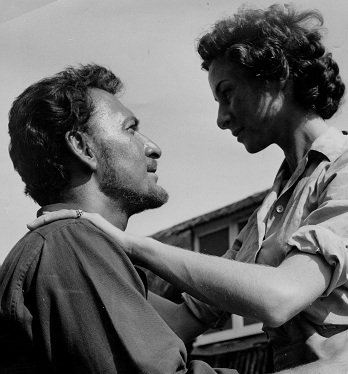
Right: Peter as Arich, with Clare Austin as Kulli
Long before they arrive there is quarrelling – personally and politically – and with a brilliant touch of irony, they are at each other’s throats when the promised land homes into view over the horizon.
Once there, the feeling of dramatic compression dissolves to some extent in the stresses of the war for independence, in which the bat brother tempts the good one with offers of arms, and the even greater stresses of the following piece. In which the bad brother then tempts the good one with offers of agricultural machinery. Eventually, in a paradoxical twist, it is Able who kills Kane.
As a play, The Salt Land was never one of Shaffer’s best. The great flood of tediously pedantic messages which rolled out of the screen must have become wearisome before long to all but the most passionate supporters of the author’s case. They must have been asking themselves as I did, how many more times must we have proof that sincerity and righteousness are not of the slightest use in the construction of a work of good television?
Of the characters, only the two brothers had any real depth, and this may have been due in no small part to the burning sincerity of David Peel’s ‘Able’ and the understudied casualness of Peter’s ‘Caine’. Otherwise, the dialogue had a flatness about it that was, unfortunately, emphasised by the endless questions from the Old Testament that was scattered throughout.
Regardless its shortcomings, The Salt Land was exactly suited to its medium; certainly it could not have been done so stirringly on radio or as vividly in print. It could not have been done in the theatre, or indeed on the big screen without losing a great deal. The production and director were designed to make the maximum possible effect in the medium that had been chosen, and at that rate it unquestionably succeeded.
Suitable for television then, but something else, too. I suggest it was a sense of purpose. There was a point and I feel that it mattered; somebody was saying something and it had meaning. The play, then, was an exercise in sincerity rather than a work of real dramatic value. It might also be noted that the opening and closing narration was not just the filtered voice of an announcer, but by the director himself, John Clements. His clipped tones set the play afire, a coupled with Peter’s masterful performance, made what might have been a failure into a worthwhile experience. This was one of Peter’s first venture into the realms and television; the first step on a memorable and magical journey.
The Script
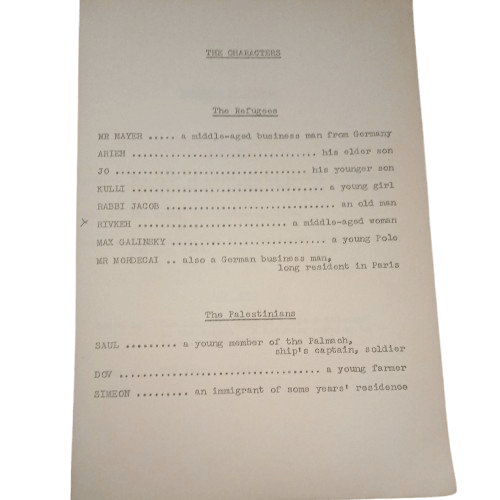
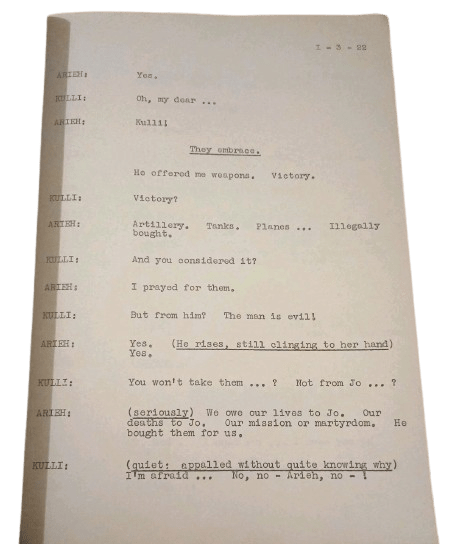
‘The Salt Land’ Peter Shaffer’s debut work. He would later go on to win Academy Awards, Tony Awards, and universal acclaim for ‘Amadeus’ and ‘Equus’. Written while Shaffer was working at the New York Public Library, This 90-minute television drama marked Shaffer’s first exploration of themes that would define his career: faith versus cynicism, idealism versus corruption, and the burden of history. Critics noted it contained “most of the themes that would re-emerge, transformed and magnified, time and time again” in his later work.
One of only a handful of known surviving copies. Peter Shaffer’s personal copy is held at Trinity College, Cambridge (catalogued as disbound with damaged title page). Another copy exists in the National Library of Australia.
One ofPeter’s greatest ever performances was not in the role of a hero in a stage play or villain on T.V., but as a storyteller on BBC Television’s ‘Sunday Special’ programme in February 1958.
On the occasion he read the bible story of ‘Shadrach, Neshach and Abednego’, and made such an impression on one of his viewers, Reverend Prebendary, J.B. Philips – translator of the Bible. He wrote: “The ‘Sunday Special’ reading of the story of ‘Shadrach, Neshach and Abednego’ was absolutely magnificent and, to my mind, the best Scripture reading I have ever heard in my life.”
The BBC acknowledged Peter’s work with an announcement in the Radio Times, congratulating him on his tremendous abilities, and suggesting that an earlier piece read by the late, great Charles Laughton on the same programme, had appeared flat and dull by comparison. The Canon Roy McKay, head of Religious Broadcasting at the BBC echoed Reverend Philips’ sentiments by stating that he’d particularly appreciated Peter’s rendering of Saint Paul’s speech in Athens, going on to say it had been the highlight of an “excellent programme.”
Written by Nobel Laureate, Patrick White. European Premier 1978
The Story
The Action takes place in a Sydney harbourside penthouse in the Winter and early Spring of 1976.
That enterprising institution, Vienna’s English Theatre, gave ‘Big Toys’ – a play by Patrick White, the Australian author who was awarded the 1973 Nobel Prize for Literature, its first performance outside of its native land. By 1978, only 11 dramatists had been bestowed with the Nobel Prize. This disproportionate list suggests that drama was ranked way below fiction and poetry by the Stockholm jurors.
‘Big Toys’ had its premiere in Sydney in September 1977 and was scheduled for Broadway in the autumn of ’78. It had also been hoped that the Vienna production would be bound for the West End which, sadly, didn’t come about. White’s play is a weighing of ethical values in ‘todays’ chaotic world. However, it occasionally became vague in its mixing of the general and the particular, but it was always fascinating; a discussion of ideas with rumbling melodramatic undertones.
Below: Peter as Richie and Helen Gill as Mag in a scene from the play.
Terry (Keith Buckley), the story’s Socialist leading character is, on the surface, a stock figure; a young man of humble origin and high ideals caught in a net of his cynical social betters. We’ve seen him often before. There was certainly irony in White’s selection of his ‘hero’s’ profession, since compromise is mandatory in the successful public man and the author managed to juggle the account of his education contemptuously.
His smooth-talking orator is converted by Mag (Helen Gill) – the frivolous wife of a successful lawyer, who specialises in the defence of shady clients. The young Marxist succumbs to her flattering admiration and he becomes her lover – much to the satisfaction of her complacent husband, Richie (Peter Wyngarde). However, there’s subterfuge in this seduction: The defence attorney is anxious to have the leftist firebrand testify on the behalf of an aggressive Capitalist.
At the trial, the young crusader doesn’t perjure himself, but refuses from offering the condemning evidence, and so the turncoat who he hates is acquitted and let loose to, apparently, corner the uranium market for immoral ends.
The deceitful lawyer and his wife might’ve won over the young man’s integrity, be he cuts all relations with them having learned a valuable lesson: He’s no longer the starry-eyed bumpkin of the start. He’s gained a necessary polish by the association and he goes on to continue his career – his personal taste having shifted from beer to bonded Scotch.
In Retrospect
The main theme of the play is sometimes clouded by the ambiguous behaviour of the trio – the lawyer, his wife and the lover – the only characters that appear. There is eccentricity in their relationships and hints of bizarre sexuality. Two near-nude bedroom scenes betweenPeterand Gill were inserted for this production, perhaps to lend a racy tone, since neither of the sections moved the action forward.
The production of Vienna’s English Theatre skillfully camouflaged the theatrical blunders. It avoided the pitfalls of a script that now and again skirted the burlesque, maintaining firm control over several different passages. For sure, this was down to Peter’s shrewd, intelligent direction, which was deserving of full marks, and he also played the oily lawyer with delightful drawing room panache; an excellent and extremely entertaining performance.
Helen Gill scored as his lascivious wife – a brainless tart who was visited by sudden pangs of conscience, and Keith Buckley as socialist Terry who, like Samson, escaped with the loss of only a few locks of his hair instead of being cropped of his power.
Roderich Proksch designed the miniature stage with a striking set of the luxurious apartment overlooking Sydney Harbour.
Programme Notes
If author Patrick White’s biggest seller in the West was the novel ‘Voss’, then ‘Big Toys’ – his first play in more than 12 years, might well have been called ‘Gloss’.
Comic, tragic, cruelly baited and barbed, ‘Big Toys’ was a play for the Seventies, displaying a sophisticated and elegant overlay, but revealing the corruption and confusion that arise in a society unsure of its direction and in ambitious people unsure of themselves. This production not only marked the European unveiling of the play, but the very first presentation of any of the Australian writer’s plays in Austria.
In the first act, when Labour leader Terry Legge tries to escape the world of seduction and manipulation, fashionable Conservatism and interchangeable sex, that White has put on the stage and thrust him into, he calls it “Darling Land”, but he can no more leave it than the audience and take its eyes and ears off it – for Terry is already part of it himself. Or, as critic Axel Kruse observed when ‘Big Toys’ had its premiere in Sydney in September, 1977: “You look at this play the way you look at a beautiful woman, and you hear the conversation as a voice of intimate consciousness that might be your own, although it certainly is not.”
The most glittering of White’s toy people is Mag. Cattier than Tennessee Williams’ sex-starved Maggie in ‘Cat on a Hot Tin Roof’, she might be Mag-the-Cat in a panoramic penthouse overlooking Sydney Harbour. Yet it is she who, early in the encounter, calls Terry a cat – and, in the end, after numerous costume changes by all concerned and Mag’s reference to her own “infinitesimal core of good which hasn’t been smothered by all the drag,” we are no longer certain of anyone’s sex, breed, or appetites. Cats, which see by night, can look alike in White’s light!
Terry Legge entered stage left like Marlon Brando’s Terry Malloy in ‘On The Waterfront’, but as he travels from beer to Scotch, from devout Marxist to plaything of a woman he calls “The Rich Bitch”, and from ‘mateship’ (that compulsive camaraderie of the Australian male) to mellowness in “Darling Land”. In the end, we have any and all three reactions to his heroic choice: We might cheer him; distrust him; even envy him.
Above it all, with his back turned when he had “anything important to discuss” is Peter Wyngarde in the role of the elegant Richie Bosenquet, Queen’s Counsel, who is described by his wife Mag as someone who has never been a human being, though dressed up as one.
In playwright White’s stage directions, Richie is described as follows: ‘His manner has assurance of a carefully considered kind, which will not prevent him lapsing into an almost frenetic diffidence when he feels threatened by the unforeseen. Everything he does is studied – or perhaps on the other hand, it isn’t: he is simply enigmatic. There is sexuality in his make-up, but he uses it coldly and deliberately.”
In the beginning of ‘Big Toys’, there is a balloon that bursts. It might be a toy or maybe it’s the earth we live on. In the end, there is the threat of class war and nuclear disaster, with uranium described as “the biggest, gaudiest toy that ever escaped from a child’s hand.”
Of course, the dark threat is left lurking discreetly off-stage, but this does not mean that White shirks confrontation. ‘Big Toys ‘ tells us in terrible detail, in wonderful words of fire and ice, that we are in great danger of going down the drain because we have become distraction, falling for shadows rather than substance, of not closing with power games for what they really mean because we prefer to play on the periphery – to be side-tracked by style.”
And persuasion by the distraction of glittering entertainment and literary style was the substance of ‘Big Toys’.
Notes:
When this play was staged, Peter was spending his second consecutive summer at the English Theatre in Vienna.
The previous July, he’d played George Bernard Shaw opposite Ruth Brinkmann in ‘Dear Liar’ – a play which re-opened in September of that year to accommodate the large number of subscribers and members of the public who has missed it in the summer.
During his stay, Peter also directed and played Shylock in the English Theatre’s television production ‘Scenes From Shakespeare’; he performed excerpts from ‘The Merchant of Venice’ that were shown on the ORF (Austrian Educational Television) in 1976.
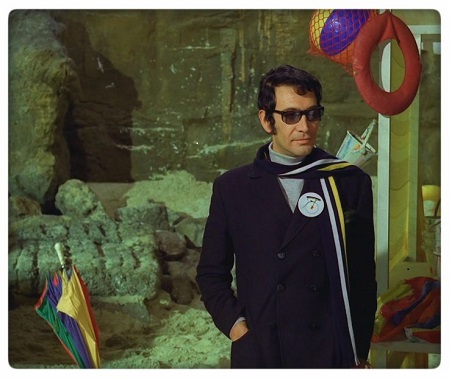
With the dawning of another beautiful day in The Village, the roar of the Village’s inanimate watchdog, Rover causes everyone to freeze in their tracks. Everyone, that is, except an elderly gentleman with a walking stick who pays no heed to Rover as it bounces by. No. 6 is somewhat bewildered by this phenomenon, and follows the old man to The Village green where a crowd is gathering. There he invites him to join in a game of “human chess,” where real people are the playing pieces and the game board is an appropriately marked open lawn. Two masters seated upon high chairs and speaking through megaphones direct the moves. No. 6 is assigned to play the White Queen’s Pawn. The game proceeds smoothly until another player, the Rook, takes matters into his own hands and moves without being ordered by the master – a blatant display of individuality in flagrant violation of Village rules. With alarm, the Control Supervisor sends out an urgent cry over The Village loudspeakers to call the substitute and to “remove White Queen’s Rook to Hospital.” Within minutes, the poor Rook is being whisked away on a stretcher. No. 6 questions the Queen as to the Rook’s fate, and is told that he would be well looked after, that they would get the best specialists to treat him. She explains that in The Village, such individualistic behaviour, the “cult of the individual” is not allowed.
After the game, No. 6 engages in conversation with the winning master, No. 14– the man with the walking stick. He asks why the game was played with real people, and is told that psychiatrists claimed it satisfied the desire for power.
Continuing his query of No. 14, No. 6 asks why players on both sides look alike, and No. 14 explains that one tells the blacks from whites by their dispositions; by the moves they make. “You soon know who’s for you or against you. It’s simple psychology, the way it is in life. You judge by attitude . . . people don’t need uniforms.” He alludes to the fact that at one time he, like everyone else, also had a plan to escape, but adds that all of the plans fail unless one learns to distinguish between the blacks and the whites. And so a seed of an idea is planted.
Until now, the charismatic and debonair “new No. 2” has maintained a passive interest in the daily activities of the charges within his domain, remaining perfectly content to monitor his world from a distance via video surveillance. Out for a morning drive, he chances upon No. 6, and cordially invites him to join him. “Why?” queries No. 6.
“I’m going to the Hospital . . . I thought perhaps you’d like to see our friend the Rook,” explains No. 2.
“Yes,” says No. 6 as he hops into the mini-moke.
At the Hospital, No. 2, No. 6 and a nurse witness the “rehabilitation” of the Rook through a one-way window. The Rook is seated in a wheelchair before four coloured water dispensers. The nurse explains that the Rook had been dehydrated and upon awaking (after an injection), would have an insatiable thirst. The procedure was based upon Pavlov’s experiments with dogs. As predicted, upon awakening the Rook is driven for water. He first tries the yellow dispenser, which is empty. As he reaches for the blue one, a voice commands him to leave it; and when he ignores the order and tries the dispenser, he receives a powerful electric shock. In agony he falls to the floor, whimpering.
With a look of disgust, No. 6 turns to No. 2 and says, “Don’t tell me, it hurts you more than it hurts him.”
Without a shred of compassion in his voice, No. 2 pronounces one of his most memorable, chilling and powerful lines of the episode, perhaps of the entire series, “In this society, one must learn to conform.”
The Rook continues his plea for water as he tries the other dispensers without success and is curtly told he would get water when he obeyed. He is then ordered to go back to the blue dispenser. In fear of receiving another shock, the Rook hesitates, as the voice coldly and sternly demands that he do as he is told, that he has nothing to be afraid of, and to go to the blue dispenser.
Finally, with great trepidation, the Rook obeys and receives water without the electrical shock, greatly pleasing all that were watching. “From now on he’ll be fully cooperative,” proudly croons No. 2.
The next day, in an effort to sort out the prisoners from the warders, No. 6 strolls around The Village taking note of the individual behaviour of other residents and their response to his eye contact. He encounters the Rook, obviously a prisoner, and convinces the man to assist him in organizing an escape from The Village. Together, the two confront various Villagers to find their “reliable men,” determined by each man’s attitude and reactions to questions posed by No. 6.
Back at the Hospital, the Queen is wheeled into an examination room where, under the approving eye of No. 2, a nurse proceeds to hypnotize the woman, telling her that she is passionately in love with the man on the video screen before her . . . No. 6. She instils upon her a desire to follow and protect him, even to a point of betraying him should he try to escape. A locket is then place around her neck, which contains a tiny reaction transmitter, which turns the Queen into an automatic alarm system whereby No. 6’s movements would be tracked without his knowledge. The nurse explains that the procedure is based upon research done with dolphins, and No. 2 is obviously amused and impressed by this latest display of scientific technology.
Up until now, this handsome, cool and charming No. 2 has appeared to be a less than formidable obstacle for No. 6, but he would soon learn differently. Except for the continuing peskiness of the Queen, the plan unfolds and seems to be running smoothly as No. 6 and the Rook assemble the components needed to build a crude radio transmitter. The small band of would-be fugitives assemble at the Stone Boat one dark night while from the beach, No. 6 broadcasts a distress signal simulating an aircraft in trouble and about to go down at sea, which is received by a passing ship, the MS Polotska. The Rook then paddles an inflatable raft and the transmitter out to sea to bring in the ship.
In his chambers within the Green Dome, No. 2 is seated cross-legged on the floor beside the control console, deep in meditation and dressed in a white tunic; before him is a plank of wood set between two bricks. The phone rings and after a brief pause, he answers, chastising the caller for disturbing him against his orders. The Control Supervisor on the other end reports that the search light crew in the tower had just been attacked (by No. 6 as it turns out). In a lightning swift display of martial arts prowess, accompanied by a ritual karate cry, No. 2 deftly snaps the plank in two with a single chop. He then rises gracefully to take charge of the situation.
Now alerted to trouble, No. 2 begins monitoring the distress signal and seems almost unsurprised when he is confronted and subdued by No. 6 and his small band of fugitives. In fact, he offers no resistance whatsoever. When the signal suddenly stops, No. 6 leaves the others to investigate. He finds the raft and radio washed up on the shore and no sign of the Rook.
A ship approaches, and No. 6 paddles out to bring her in. Once on board, he begins to explain the situation to the captain when No. 2 appears on the TV screen in the ship’s cabin and smugly informs No. 6 that the MS Polotska belongs to The Village. The Rook is standing alongside No. 2, and No. 6 learns of a “slight misunderstanding” on the part of the Rook. It seems that the Rook applied to No. 6 his own tests and became convinced that No. 6 was actually a warder out to trap him. When No. 6 asks No. 2 what had become of the rest of his men, he replies that they would be back tomorrow on the chessboard . . . as pawns. No. 6 then smashes the TV screen, disables the crew in a violent scuffle, and takes command of the MS Polotska. Unfortunately, The Village’s unique policeman, Rover, has already been activated by No. 2, and escorts the ship and its prize prisoner, No. 6, back to The Village. In the closing scene, set to some rather ominous music, the silent, black-gloved Butler places the White Queen’s Pawn back into its proper square upon the chessboard before No. 2.
The Prisoner is an allegory . . . there is no defined meaning to any episode and the interpretations offered by viewers are as varied as the people who make them. A particular scene from another episode, Arrival, comes to mind while viewing Checkmate, and could well have been a precursor to this episode. That scene opens with the old admiral seated before a game of chess, awaiting a partner. He addresses the woman who has just tried to help No. 6 escape, and asks her if she plays chess. When she says no, he replies, “You should learn . . . we’re all pawns my dear.” In Checkmate, it could be stated that No. 6 and all the players in the human chess game are merely pawns of the masters who shouted the moves through their megaphones. Just as it is in life, everyone takes orders from someone else. When the Rook made his unauthorized move, retribution was quick and absolute. When one breaks the law and gets caught, the reaction is also swift. “One false move and he’ll be wiped out,” states No. 2. How true!
It seems that No. 2 had the most profound lines of this episode. His proclamations are relevant to all mankind and world order. “In this society, one must learn to conform,” can be applied to many present-day situations. The hippies of the 1960’s, the bizarre fashions and hair styles which have been in vogue with every generation, even slang expressions in use today raise the eyebrows of the conservative populace. The individual who fails to conform to the ways of the majority, will remain outcast until he submits. That is precisely the message transmitted to No. 6 when the Rook made his unauthorized, individualistic move upon the chessboard. “The cult of the individual,” was simply not allowed. In today’s society, individualistic behaviour is often frowned upon or viewed with suspicion. For example, persons who choose to live alone are often viewed as being slightly odd, regardless of the circumstances. The cult of the individual .
There is another underlying theme, which prevails throughout The Prisoner, taken from a line in The Schizoid Man, whereby No. 6’s double, No. 12 pronounces that “the trouble with science is that it can be perverted.” Two scientific methods were employed in Checkmate, methods applied for sinister, almost sadistic purposes. The Rook was subjected to a perverse form of the Pavlovian experiment of conditioning as a way of making him conform to the rules of Village society. The Queen ironically became another pawn when her emotions, through hypnosis, became yet another tool of Village surveillance. She was provided a locket containing a tiny transistor, given to her, she was told, by No. 6; and in the name of love she began a relentless pursuit of No. 6, much to his chagrin. Again, the Queen’s emotions were considered a small sacrifice by Village authorities. Scientific methods are only as good (or as evil) as the men who make use of them. This has been proven time and time again looking back through history. The closing scene of the black-gloved Butler placing the errant pawn back into its proper place perhaps symbolizes the fact that everyone has his own place in the scheme of things; that there is always someone waiting to put us back where we belong if we get out of line. Follow the rules, play the game, and society will welcome you into the fold; but disobey, and in the words of No. 2, “one false move and (you’ll) be wiped out.”
“He’s just a pawn; one false move and he’ll be wiped out.”
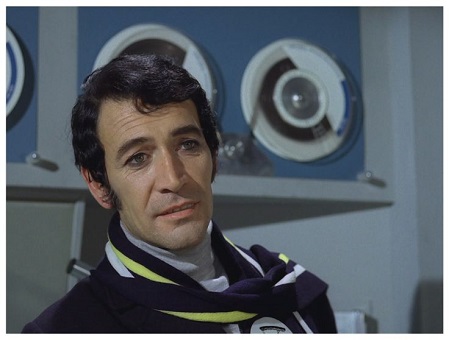
Looking at Peter Wyngarde’s portrayal of No. 2, we see a shrewd, cool and calculating man in complete control yet seemingly content to let nature take its course. He didn’t see it necessary to become unduly concerned with the day-to-day comings and goings of his charges; but chose instead to keep an eye on things from a distance, waiting until something happened before taking any action. “No need to get excited” would probably have been his motto. Yet his rather passive disposition was merely a mask for a devilishly cunning administrator who probably had No. 6’s anticipated behaviour pattern in any given situation committed to memory. He seemed to be merely amused rather than distressed by the escape attempt, which he knew was doomed to failure before it ever got started. He was toying with No. 6 from the very beginning, and enjoyed every minute of it. His one brief display of anger when he snapped a wooden board in two with one swift karate chop was the only hint of any violent tendencies or temper, which might be lurking beneath the surface of this No. 2’s handsome façade. In my mind I’ve tried to envision a weakness by which this No. 2 might be dethroned. So far, I’m still trying–he’s one tough No. 2!
Nine times out of ten, murder is a sordid affair, and Lyndon Brooks storytellers instinct was sound in coupling death with love and money in their glossiest forms. ‘Love Her To Death’ was a competent and absorbing story set amongst a handful of wealthy people cruising in the Mediterranean aboard the ill-named private yacht, ‘First Love’.
The central character is a handsome young man by the name of Lionel Collins, who has married an older woman – Alicia – purely for her wealth. When by chance he meets his former sweetheart, Aimee, he begins to think how he might rid himself of his wife without losing her money. His idea is to tempt her into adultery and catch her in her lover’s arms, thereafter pleading guilty to manslaughter. Under such circumstances, he reasons, a plea of gross provocation would result in nothing more than a nominal sentence.
AboveRight: Peter, Jean Kent and Robert Riettey in a scene from ‘Love Her To Death’.
Rising abruptly during a poker game, Collins carefully times himself to find Alicia in their cabin with another man. In a dramatic display of mock rage, he strangles her. He is caught out however, when a suspicious fellow-player happens to look at the cards he never played: A straight flush. Surely no Englishman would have abandoned such a hand – not even to check on his wife! The final five minutes of the play – in which Peter succeeds in trapping himself – were the best most persuasive part of the production. Author Lyndon Brooks worked up to an exciting climax extremely plausibly by means of intellect, characterisation and dialogue. When watching the play, you felt as if the villain’s resource would’ve been more than a match for any accident that inevitably tripped him. I suspect that Brooks didn’t really want him caught at all!
Since this all took place in the Mediterranean with the atmosphere of rich idling (Satan finding work for idle hands to do, perhaps?), the absence of any action was amply compensated by a neat screenplay and Cyril Cokes direction. On the whole, the plot was logically worked out, and with many little touches of suspense – this was as good a murder play as you were ever likely to see. The actors played it in an almost intimate manner, making it appear as if the characters existed only for each other and not at all for the viewer, so that conversations seemed to be overheard and scenes overlooked as if by accident. This was Peter’s first real venture into television theatre, having been all-to-often obscured by costume parts in brave failures, and made a solid figure as the murderer.
Peter’s Comments
“Lionel Collins has a kink not only about money but about another woman, Diane Fellowes. He is unscrupulous; a moral coward, yet likeable. He is the kind of character I like to play – subtle, difficult”.
International Season – The Irvine Theatre, June 1952
Character: Jonah
Above: Peter as Jonah
The Story
In play writing, the heart is not as a rule an acceptable substitute for the head, although a good plot may be. In ‘They’ll Arrive Tomorrow’, Natam Shaham – the author of this play – managed to stick to the hard theatrical facts, such as a minefield that surrounds a military outpost and its demoralizing effect it had on the soldiers there. In so far as this, he was safe enough and, potentially exciting.
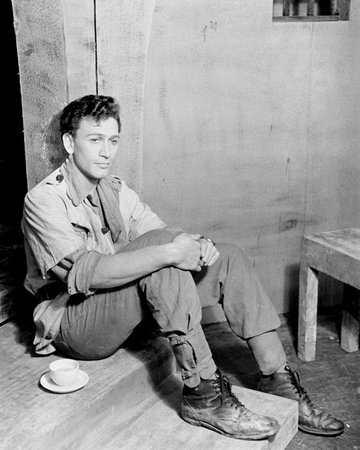
Here we had a theme based around an incident during the Israeli-Arab war, which was reminiscent of an earlier play, ‘Journey’s End’, and like the latter, this production was not only realistic, but also theatrically effective, both in drive and direction. In both plays, a platoon of a civilian army are holding a strategically important point against all odd. In both plays, the commander (here played by Peter Wyngarde) is represented as a natural soldier – a born leader of men. But while Stanhope in ‘Journey’s End’ justifies the description, Jonah in the play under review, does not.
Jonah’s problem is of course the minefield that lies inside his position, the presence of which is destroying the morale of his men. These mines do create a situation, but the trouble seems to be that neither Jonah or his author seem to know what to do about them. Jonah’s idea seems to be to say nothing about them and hope that they will gradually be exploded by the less valuable members of his command. However, what actually happens is that the victims include his least replaceable officer and the girl he loves; the mines therefore, are used as the theme for some very illuminating discussions on military ethics.
In Retrospect
What is strictly the point of this play? A situation of real tension! There are the mines, and no means of detecting them. The men are reluctant to leave their hut, and the officers are divided in their views on the proper way to treat them.
Left: A caricature of Peter from ‘Punch’ magazine, June 1952
The tension is heightened when it becomes a question of informing the relieving forces and running the risk of spreading the reluctance. Running of this main line of possible development were several branch subsidiary lines; the commanding officer’s (Jonah) passion for the only woman in the party, the sharp divergence of opinion between him and his second in command, a commander’s duty to take no unnecessary risks, and so on. But as one might expect in drama, none of them worked out plainly or sufficiently.
Critics Comments
“Mr Peter Wyngarde, as the commanding officer, makes perhaps the strongest impression.”The Times – Friday, June 27th, 1952
“Of a moderate cast, Mr Peter Wyngarde, as the platoon commander, is much the best.” Punch – June 1952
Presented by Stephen Michell Theatre Productions Ltd. at the Theatre Royal, Brighton – March 1968 and at The Duke of York’s Theatre, London – May 1968.
Character: Nicolay Von Koren.
The Story
The action takes place in the house of Alex Samoylenko and André Laevsky at a resort on the Caucasian Coast of the Black Sea, in the Autumn of 1891.
Anton Chekov didn’t pen many plays, although those he did write became extremely popular on Forties and Fifties radio, and in the Sixties on television. All did remarkably well – perhaps because these were the mediums that the author would’ve used at the time of writing if they’d been available to him. Short stories are often themselves well suited to forms of restraint. Director and adaptors, it would seem, were drawn to Chekov’s work because of the apparent ease in which the playwright could make an otherwise inert situation glow with interest.
When it came to the theatre, however, it was a different matter. Unoriginal as it may be to say so, if Chekhov had wanted his (longer) short story, ‘The Duel’, to have been a play, he’d surely have written a play. And this production showcased at the Duke of York’s by an Iowan PhD, Jack Holton Dell, whilst a capable job, makes it all the clearer that Chekhov was right.
Right: Peter as Von Koren
In the open scenes the typically Chekhovian characters and ingredients are all there – at least on the surface. A gauze backdrop representing a heaving stretch of the Black Sea coast rises to reveal a proverbial summer residence; its windows and doors thrown open to catch the breeze.
We now find ourselves in a Caucasian resort in the long hot summer of 1891. Here, in a sleepy and specific moment of time, where the cross-currents of lives which had been gently slumbering are about to be awoken.
There’s Alex Samoylenko (James Hayter) – a laid-back and welcoming ex-military physician, played by James Hayter; Marya Konstentine (Elspeth March), a hectoring and tightly-corseted matron, her husband and daughter, Katya (Janet Hannington), plus the self-important officer, Igor Kirilin (John J. Carney), who fancies his chances with the young lady.
In addition, we have Atchmianov (Anthony Watkins) – a draper, and Pobyedov (Lewis Fiander), an likable virginal deacon. Also into this provincial backwater, the author throws in three interlopers: André Laevsky (Michael Bryant) – a liberal arts graduate, who is pining for his hometown of Moscow and Nadya Federovna (Nyree Dawn Porter) – whom he’s been involved with for several years. And as if for good measure, there’s Nickolay Von Koren (Peter Wyngarde) – a German Marine Biologist with Nietzschean-Nazi ideals about the future of the race, and who has spent the summer on the Black Sea studying the development of the jelly fish.
Below (from left to right): Peter, James Hayter as Alex Samoylenko and Lewis Liander as Deacon Pobyedov.
Naydya, it occurs, is a married woman – only her husband is dead, tho’ her lover hasn’t got around to telling her yet. The two have been on the run for two years, and now as he reaches a high point of frustration with the affair, she takes other lovers and run up a series of debts at Atchmianov’s shop. Together the two have caused a public scandal by “fornicating” in the Black Sea waters.
Thunder rumbles occasionally off stage, which signifies that we’re at the wonderfully clear point of time before the storm breaks. The play’s theme tangles around love and violence as a means to an end. It’s a affecting essay in human foolishness and objectives; in other words, what is probable and what is possible. Expressed in those generous yet mildly scornful terms in which Chekhov saw his fellow man, it made appealing viewing.
The play produced so many unswerving similarities with the immediate past. For instance, isn’t it our own society – distressed and dazed by its own freedoms, disgusted at its own liberalism – that is correspondingly keen to find a Nicolay Von Korden within its number? This campaigning botanist, preaching his scientific tyranny; haven’t we heard his deadly logic before – pre-1939? Don’t some, even good liberal souls such as Deacon Pobyedov here, flirt dangerously with its persuasive strength as a welcome relief from all the indecisiveness and gloom around us now?
The splendour, of course, flows from the Chekhov essence of the piece – a flavour faithfully re-created by the author and given the understated quietness of portentously repressive emotion by director, Norman Marshall. I got a feeling of a mood preserved moments before it crumbled to dust; like an autumn leaf caught in full beauty just before its irreversible decay.
In Retrospect
It never ceases to amaze me how many of Anton Chekhov’s unhurried 19th Century reflections find their echo in the commotion of the present day. Watching his expressive creations eat out their hearts and act out their predicaments on stage takes on an almost self-absorbed fascination, like watching our modern condition reflected in a stylishly gilt, but slightly grubby mirror.
I must admit, though, to a complete and inexcusable ignorance of the Chekhov novel on which Jack Holton Dell had based ‘The Duel’. Consequently, with all the fewer trees with which to see the wood, I was able to judge it on the theatrical entity in itself. No side-tracking round to check whether or not the author had remained true to the original. And as a play, it hit me as a thing of unique splendour and arresting significance.
(Left): An original poster from the Duke of York’s Theatre.
Only hours before I saw a recording of this play, I’d watched some archive film footage from the Seventies and one hitherto rational fellow human being uttered the statement: “Student demonstrators! They ought to shoot a few. That would stop all the violence!” The speaker doubtless imagined himself as deeply rooted on the side of law and order as Nickolay Von Koren does when he speaks out so fervently and convincingly against the freedom of individuals to follow their individuality. His damnation of André Laevsky and Nadya Federovna for their chaotic emotions was a tremendous feat of twisted truths.
Peter made out of it a towering piece of theatre, as he did with the whole role. It was little wonder watching his handsome menace, that Laevsky, the object of his fervent hate, says: “Tomorrow the world will be run by men like him; and we will be the ones who put him in power.”
There were, however, a number of questions and puzzlements with which I was left. For instance: after the Deacon has illustrated the virtues of light through love, Von Koren on his world of superior men, and Madam Konstantine on the dangers of moral corruption, there is an abusive argument between Laevsky and Von Koran, but no apparent reason is given for the subsequent duel, during which Laevsky is shot in the neck. All we get is a blackout! That’s it.
We’re told that Laevsky and Nadya are to be married. Why? Has the Deacon, who had been seen as a religious buffoon, now become a considerable spiritual authority? Had the bullet from Von Koren’s pistol, perchance, softened Laevsky’s brain? Or might the scientists’ assault on his character compelled him, shuddering and quaking, into the obsessional arms of Nadya? He is, we’re invited to believe, a changed man, but are provided no real reason why.
Perhaps Chekhov’s translation is clearer in the original story, but it was most certainly a serious flaw in the play.
Press Article
The Sunday Times: 5th May, 1968
Jack Tinker at the World Premier
AN AUTUMN LEAF IN FULL BEAUTY
It never ceases to intrigue me how many of Anton Chekhov’s languid 19th century musings find the echo in the clamour of our present day.
Watching his eloquent creations eat out their hearts and act out dirt dilemma’s onstage takes on an almost narcissistic fascination, like watching our modern malaise reflected in an elegantly gilded slightly dusty mirror.
I must, however, confess a total and lamentable ignorance of the Chekhov novel on which Jack Holton Dell as based the play that had its world premiere at Brighton’s Theatre Royal last night. Thus, with all the fewer trees through which to see the wood, I can judge it only as a theatrical entity in itself. No side tracking round the proscenium to check whether or not the author remains faithful to his original. And as a play it strikes me as a thing of unmistakable beauty and striking relevance.
The beauty, of course, flows from the Chekhov flavour of the piece, a flavour faithfully recreated by the author and giving the supple stillness of ominously oppressive heat by director Norman Marshall. One gets that feeling of a mood crystallised it before it crumbles to dust; an autumn leaf caught in full beauty just before the point of irrevocable decay.
Thunder rumbles occasionally off stage. We are at the magnificently clear point of time before the storm breaks.
The play’s theme angles around love and violence as means to an end. It is a poignant essay in human folly and human aspiration; what is probable and what is possible. Couched in those generous yet gently mocking terms in which Chekhov saw his fellow creatures, it makes irresistible viewing.
So many direct parallels with the immediate present and the immediate past. For instance, isn’t our own society – alarmed and shaken at its own freedoms, sitting at its own permissiveness – equally willing to find a Von Koran in its midst?
This crusading botanist preaching is scientific tyranny; haven’t we heard this poisonous logic before pre-1939? Don’t some – even good liberals souls such as Deacon Popyedov here – flirt dangerously with its persuasive strength as a welcome relief from all the indecision and greatness of purpose around us now? Only hours before I took my seat in the theatre, I had listened to one hitherto rational fellow human being uttered the sentiment: “Student demonstrators! They ought to shoot a few. That would stop all the violence!”
The speaker probably imagined himself as deeply entrenched on the side of law and order as Von Koran does when he speaks out so passionately and persuasively against the freedom of individuals to follow their individuality.
His damnation of the play’s tortured lovers for their anarchy of emotion in a tremendous feet of twisted truths.
Peter Wyngarde makes out of it a towering piece of theatre, as he does with the whole role. Small wonder, watching his handsome menace, that Andre Laevsky, the object of Von Koran’s passionate loathing, should say: “Tomorrow the world will be run by men like him; and we will be the ones who put him in power.”
Michael Bryant, as Laevsky, gives the line a weary, saddened emphasis as though to heighten its inevitability; the comparisons are too obvious to list.
More to the play’s point; doesn’t blood still spill before men of opposing ideals find themselves shaking hands?
All through this sensitively felt production there are performances which have their own delights. Lewis Flander as the earnest, innocent young deacon delving breathlessly to find sweetness and light in every dark corner; James Hayter as the portly military doctor beaming a benign commonsense; Bruce Walker, neatly dodging the overwhelming hypocrisy so splendidly perpetrated by Elspeth March, with the quiet dignity of a husband not yet henpecked out of existence.
For Nyree Dawn Porter’s glamorous golden Nadya the can be nothing but glorious golden praise. Here, if ever there was, is woman teetering on the brink of her own ruin, poised on the rim of eternal sadness in the pursuit of lasting happiness.
You know a compelling disturbing piece of theatre.
Associated Items
Peter in his dressing room at the Duke of York’s Theatre, London. The photograph was taken by James Hayter (who played Alex Samoyenko in ‘The Duel) and is signed and dedicated by him on the back.It was here that Peter was first introduced to Joel Fabiani – his future ‘Department S’ co-star.
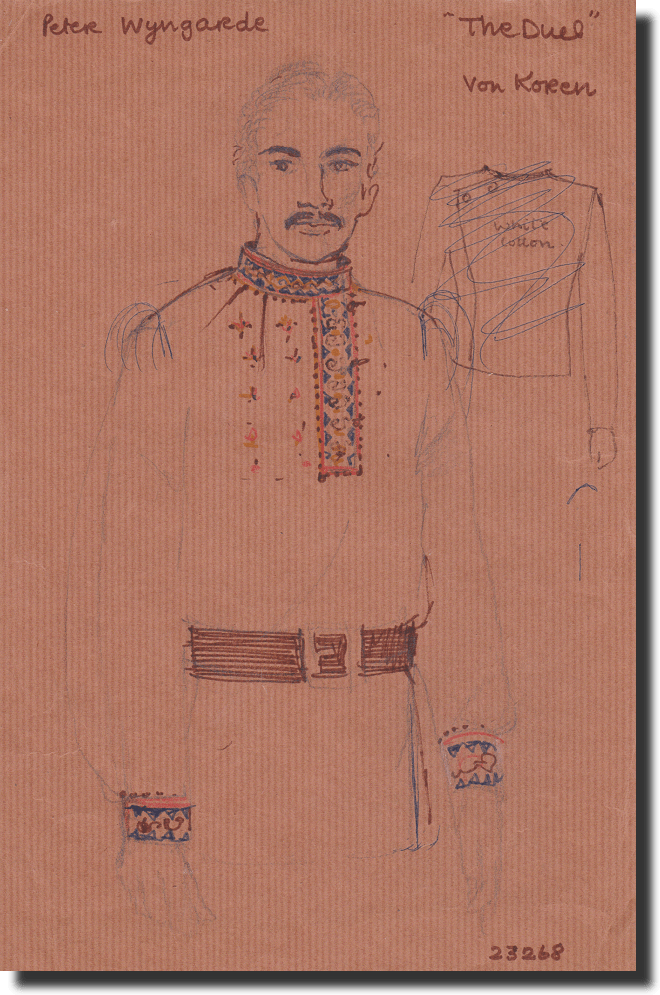
Original sketches of Peter’s costume in (left) Pen & Ink and, (right), watercolour.
Above: Peter’s copy of the script showing amendments and additions in his own hand.
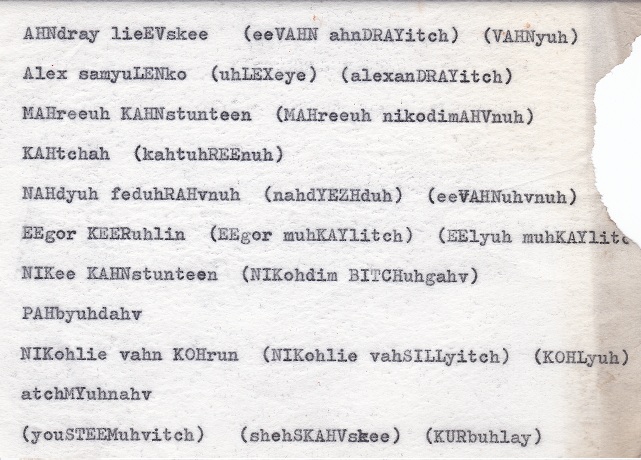
Above: This is a copy of an supplementary sheet that was added to Peter’s script to help with the pronunciation of certain Russian names and words.
Above: Full page (broadsheet) advertisement for the play in the 5th May 1968 edition of The Sunday Times.
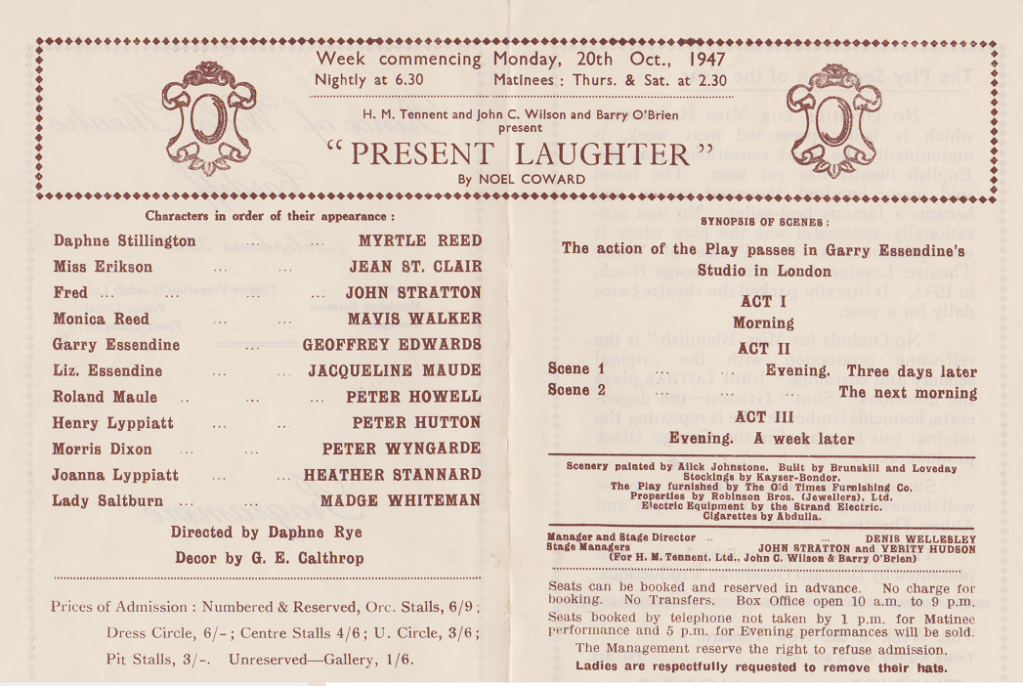
Presented byH.M. Tennant Ltd. and John C. Wilson and Barry O’Brien. British Tour, 1947.
Character: Morris Dixon
ITV Play of the Week – ‘Present Laughter’: Monday, 10th August, 1964
Character: Garry Essendine
Triumph Theatre Productions – British Tour September 1974
Character: Garry Essendine
The Story
The action takes place in the drawing room of Garry Essendine’s house.
Act I
Scene One: Morning
Act II
Scene One: Evening. Three days later.
Scene Two: The next evening.
Act III
Scene One: A week later.
Garry Essendine is the quintessential star; flamboyantly dressed and devastatingly handsome. He revels in female adulation and casual love-affairs.
Peter conveyed all that and more as Garry in Noel Coward’s play, which toured throughout the UK during the Winter of 1974.
The play was 1940’s Coward at its best, but had been skilfully updated. Although some Coward purists may have resented Peter’s reworking of this production, to many critics minds he had done an excellent job streamlining the work. Although some of the updates failed marginally, the play, which was written nearly 15 years after Coward penned some of his more famous scripts, took well to the modern treatment.
Peter, who directed as well as starred, added to his reputation for professionalism with his deft handling of the play. He proved in this particular work to be the complete actor, using it as a vehicle to manoeuvre with dazzling variations of pace. His own playing of the flamboyant lead was a first-class modernization of itself. Not only had he adapted it to the style of Jason King, who had of course given him the kind of following such as Garry Essendine would lividly envy, but enough individuality and magnetism of his own not to need to dress up in the Noel Coward mantle and turn to the latter’s affectionate self-mockery of his own public image.
Left: Peter on stage as Essendine during the 1974 British tour.
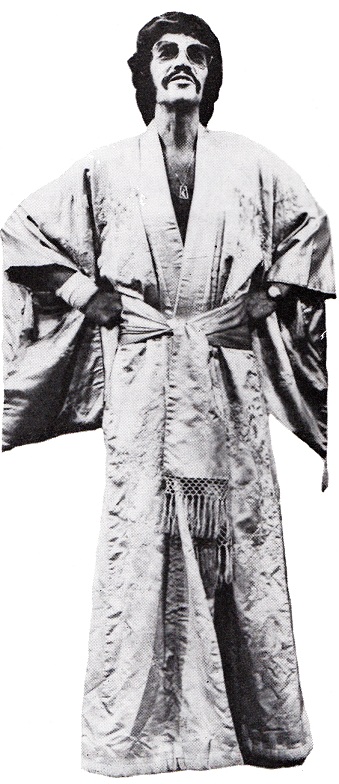
Originally, Coward had surrounded himself with décor befitting a star of those times, including a trendy wardrobe that, although elegant, amusingly over emphasized what was expected of him. His Essendine studio was eye-catching Japonaise, and his own outfits successfully competed with it for dazzle, with silk Oriental gowns, sharp fashion suits and so on, all worn with casual panache (of course!).
The play had been astutely, but sensitively, edited so that only those who were very familiar with it would be aware of the extensions. And in dispensing with Fred the Valet and retaining only the dourly contented spiritualist housekeeper, further successful paring-down was achieved.
Above: Peter as Garry Essendine with Barbara Murray as Joanna Lyppiatt in the ITV play: ‘A Choice of Coward: Present Laughter’. Broadcast: 10th August, 1964.
Some may have wagged a finger at Daphne Stillington – the twee debutante of the original – with a screaming groupie accent, and her aunt, Lady Saltburn with a Brummie one. But in the days of proletarian titles, the substitution was quite an apt one. However, in one moment the modernization slipped: Monica Reed talks of “a wholesome fear of the gallows”: in 1974, it should have read “life-imprisonment-but-let-out-after-five-years-for-good-behaviours”, surely!
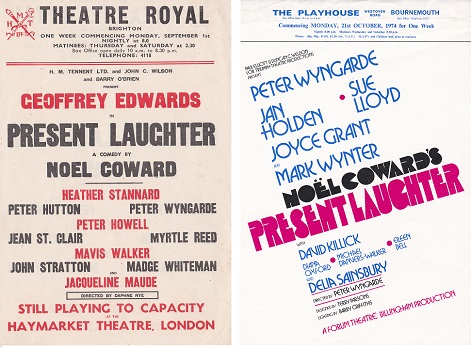
Below: Original posters from Peter’s appearances in ‘Present Laughter’. Left: He played Morris Dixon (1947) and, right, Garry Essendine(1974)
By nature, this is the star’s show, but in his role of both actor and director, Peter manipulated neatly so that all the other characters got their share of the action, and that each role was worth playing. Former pop star, Mark Wynter, for instance, was given a free rein in his cameo as the eccentric avant garde playwright, Ronald Maule. The woman who perused and complicated the life of the desirable Garry, where on the whole, slightly disappointing, although Jan Holden who took over the role of his elegant but long-suffering wife from Hildergarde Neil, was delightful to watch, whilst Joyce Grant as Monica was a little more cozier than the acid-tongued secretary usually seen.
The woman who did get most of the audience’s laughter and sympathy was Eileen Bell as the elderly Swedish maid, Miss Erikson, and her clothes were cleverly contrast to the more glamorous ladies.
Left: Taken from the Yvonne Arnaud Theatre programme. The play was performed there between 28th October and 15th November, 1975.
One of the highlights of the play were the comical but cleverly presented duel between Garry and his manager’s wife – the affected man-eater, Joanna Lyppiatt, with whom he was having a torrid affair. The famous confrontation lit up the stage as the two knowing sexual sophisticates verbally skirmish before gliding into bed.
The action of the play takes place over the course of week at Garry’s studio apartment in London, where the star revels in being as temperamental as a prima donna: “Everyone worships me,” he says in the first act. “It’s nauseating!”
Pestered by various friends and adoring females, Garry pretends he is harassed to the point of a nervous breakdown, but secretly relishes the adulation.
He becomes more involved with Joanna, however, and an adoring young girl called Daphne – not to mention the hopeful young playwright, Ronald Maule, who is desperate to have Garry endorse his work. It is left to Liz to extract him from the inevitable trouble when, on the eve of his departure for a South African tour, they all announce they are going to accompany him.
Above: Taken from the programme from The Prince of Wales Theatre, Cardiff, where ‘Present Laughter’ ran from 20th October, 1947 for one week. Peter was cast in the role of Morris Dixon.


















 PETER WYNGARDE: The Official Website