REVIEW: The Baron – ‘The Legions of Ammak’

Broadcast: Friday, 18th November 1966

Character: King Ibrahim/Ronald Noyes

Made in 1966, The Legions of Ammak is an episode of the cult classic, The Baron and, as a rival to such legendary series as The Saint and The Champions, is very much shaded by its contemporaries. Overtones of Roger Moore’s Bond are the order of the day, for it lends of everything remotely espionage orientated, and Steve Forrest as the eponymous hero adds only his North America accent to the genre. That said, the episode is entertaining.

We begin by meeting Olaf Cossakian (George Murcell) – an obnoxious man, visiting his bank in the prologue. The teller attempts to wave him away, believing him to be a nutcase when he’s presented with a cashier’s cheque for $3,000,000. The intrigue begins when the bank manager arrives to greet him by name and ushering the teller to arrange the cheque. Cossakian laughs it off, exclaiming that he doesn’t understand what all the fuss is about: “It’s only three million dollars!”

Enter John Mannering (Steve Forrest) in his antiques shop where he’s discussing his client, Mr Cossakian, with his assistant, David Marlow (Paul Ferris). It transpires that the $3,000,000 cheque is in payment for the Legions of Ammak – a necklace from which hangs “seven perfectly-matched black pearls”.

At Cossakian’s squalid apartment his wife, Mira (Isa Miranda) has only just discovered that her husband is the third richest man in the world, such is his miserly nature, and she is understandably vexed. There is friction between the two and it’s difficult to ascertain why the relationship has endured – especially as Mira had been ignorant of her husband’s vast empire.

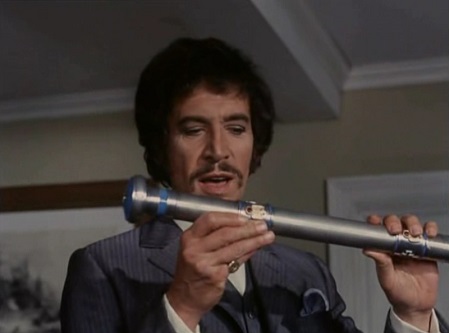
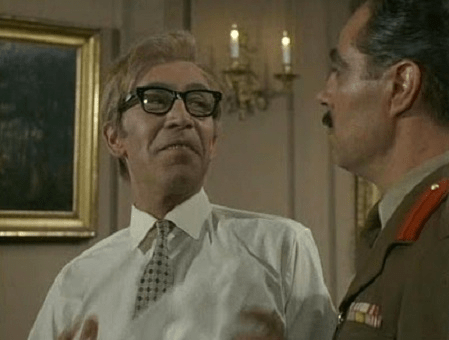
Later, as Cossakian talks with Mannering at his shop, Marlow enters and introduces the King of Ammak (Peter Wyngarde) and Colonel Ahmed Bey (Michael Godfrey). The King naturally owns the necklace of his namesake and wishes to sell, utilising Mannering’s antique business as he’s seemingly dealt with him before. Ahmed ushers in a photographer to capture the moment and seems keen to complete business swiftly, but the King appears to be enjoying the exchange and takes his time – much to the distain of the Colonel. During the brief celebration, Marlow manages to spill champagne over the King’s clothes and notices His Majesties tie. The photo. The Tie. Ahmed’s nervousness. Something is obviously awry.
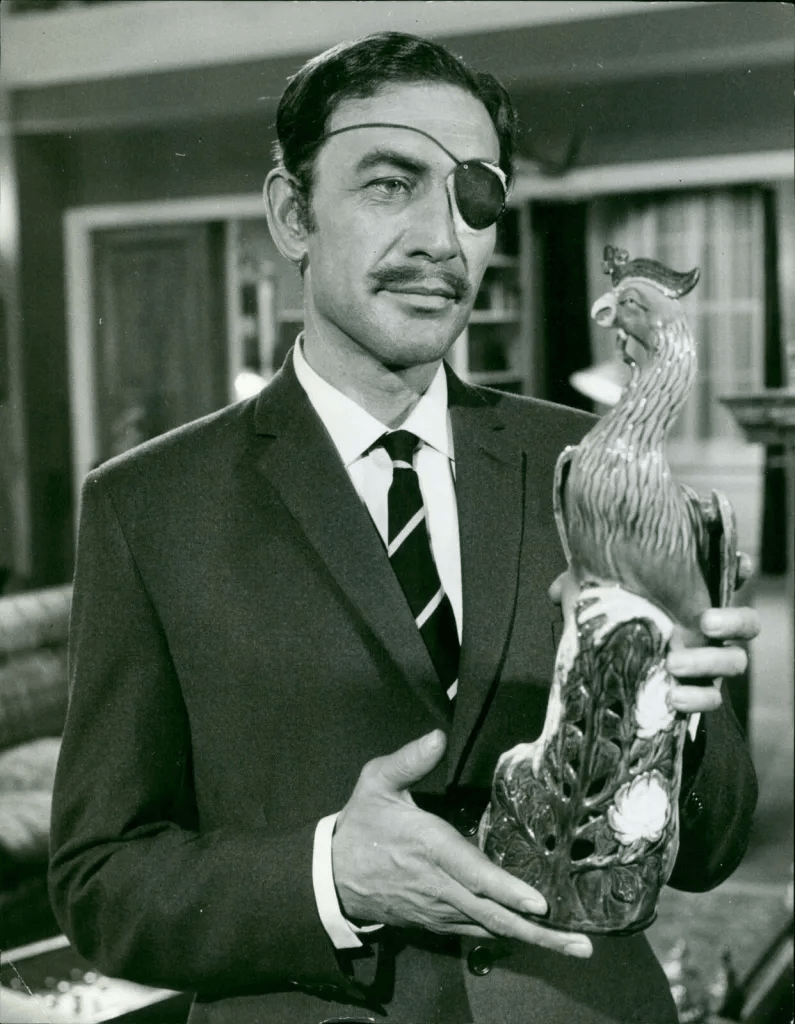
The Colonel grabs him by the lapels and throws him up against the wall: “One word from me could destroy your entire plan!”, Noyse retorts. The Colonel threatens to kill him in such an event. At that, the real King of Ammak (Peter Wyngarde) enters the room and claims that he’s “tired of being an invalid”. Ahmed quickly ushers Noyse out: “So that was the king!”

“But only for another twenty-four hours!” Ahmed replies.
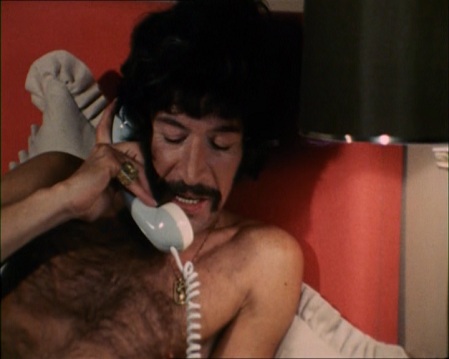
Left: Peter as Ronald Noyes

Mannering and Marlow are now on the case. They plan to make a social call at the Ammak Embassy; a ruse to discover if the ‘King’ is really who he claimed to be. “But what if I’m wrong?”, the decidedly uneasy David asks. “We all make mistakes,” Mannering replies. “You can get another job easy enough”. Cold comfort indeed!

Mannering and Marlow are now on the case. They plan to make a social call at the Ammak Embassy; a ruse to discover if the ‘King’ is really who he claimed to be. “But what if I’m wrong?”, the decidedly uneasy David asks. “We all make mistakes,” Mannering replies. “You can get another job easy enough”. Cold comfort indeed!

Inside the Embassy, Noyse and Ahmed are still quibbling over payment when news of Mannering’s arrival interrupts them. The actor panics, but Ahmed tells him to go. Outside, Noyse hails a cab and asks to be taken to the “Sirocco club” – all of which is witnessed by Marlow. He trails the taxi, while Mannering is kept waiting as the real King and Ahmed plans for their return to Ammak. Irritated by the Colonel’s dominance, the King comments to his nurse that he’s “beset by tyrants!”

Mannering presses Ahmed to call the king, When Ahmed refuses, Mannering plays his ace: he mentions that the King had once been a student at Harrow. Why then would he be wearing an Old Etonian’s tie? Ahemed dismisses the point as a “waste of time”, and asks a bodyguard to escort Mannering from the premises.

Meanwhile, Noyse arrives at the Club, and after blowing a kiss to the belly dancer, Sirocco (Valli Newby), he disappears into a back room, swiftly followed by her. She asks if all went well and Noyse flashes the £1,000 as proof, and claims there might be more.

Marlow, having witnessed Noyse actions, returns to the Embassy, where he picks Mannering up outside. He reveals that he knows where the man who impersonated the King is.

Noyse celebrates with Sirocco by having their photograph taken by the very same photographer who’d captured the transaction at the Embassy earlier that day. Noyse is flattered that he’s not been recognised, and asks the photographer is he found the King to be handsome, but is miffed when the photographer says not.

At that point Mannering and his sidekick arrive, and on recognising them, Noyes bolts for the door. Marlow gives chase, while Mannering catches and quizzes Sirocco. She claims she doesn’t know Noyse, even when Mannering spots a signed and framed photo’ of the actor in her dressing room.

Noyse runs into the photographer’s dark room, where he sees recently developed prints of the transaction between the King and Cossakian, but there’s no way out. He makes a dart for Sorocco’s dressing room – casting a pot of talcum powder over Marlow on the way.

The actor finally returns to Sirocco, telling her that he has a plan for the two of them to get out of the country. She has her reservations, but he advises that this might be their last chance, adding: “I’ll not let anything or anybody stand in my way”.

When Cossakian learns of the bluff, and despite claiming that he has lawyers at his beck and call, Mira takes great delight in his losses and laughs hysterically.

Ahmed finally receives the photographs of the earlier transaction, and declares: “Let the King try and protest his innocence now!” However, when he opens the delivered package, he finds inside only Sirocco Club promotional leaflets. At that very moment, the Colonel receives a call from Noyes, who advises that he expects to be paid a further £10,000 for the prints and negatives. They arrange a meeting, and Ahmed leaves with his silence-equipped pistol.

In the meantime, Marlow has called on his girlfriend, who happens to own a stack of actors directories. The pair flick through the volumes until the happen upon a likeness of Noyse. He immediately calls Mannering with Noyse address.

Amhed and the bodyguard, Abdullah arrive at Noyse flat. Bursting through the door, the Colonel fires, killing the actor stone dead. They then begin to ransack the apartment in search of the photographs. It’s now that Marlow arrives and spots Noyse lying on the floor. As he attends the actors body to find an signs of life, he’s clubbed on the head from behind, and knocked unconscious. Ahmed carefully places the gun in Marlow’s hand. Mannering, who arrives moments later with Sirocco, manages to revive Marlow, but the dancer lies hysterically over Noyes body. She finally confesses that Ahmed had approached her in Cairo some months earlier to enquire if she knew anyone who might be able to impersonate the King. While Marlow makes a urgent ‘phone call, Sirocco quietly slips away with both the photographs and the gun.
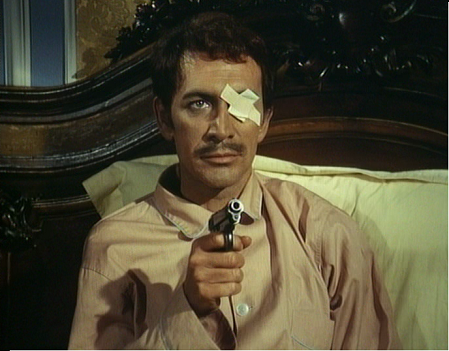
The Baron Legions of Ashaak Peter Wyngarde eyepatch gun

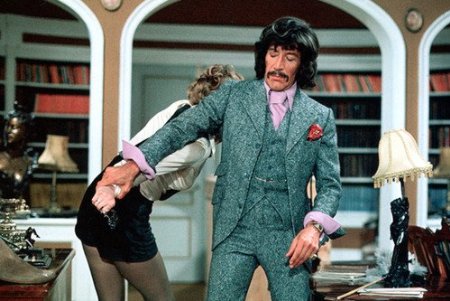
Right: Peter as the King

At the Embassy, Mannering manages to sneak into the King’s chamber, where he stifles an attendant nurses screams by placing his hand over her mouth. The King, however, has a gun trained on him, and demands to know what he’s doing there. Mannering quickly recounts the story concerning the scam and the Legions. The King maintains his aim and wants to know more. Together, he and Mannering work out a plan to retrieve the necklace. His Majesty reveals that he would be expected to wear the Legions at a forthcoming religious festival in Ammak. He doesn’t, he’s sure that Ahmed would attempt to overthrow him and take his place. He promises that if Cossakian is willing to help them, he would be willing to grant the millionaire special oil concessions.

Meanwhile, Sirocco calls Ahmed as asks him to come to the Club to collect the photographs. He agrees. However, in a bungled attempt to arrest Ahmed, the King, Mannering and the nurse are left in the company of Abdullah whilst Ahmed leaves to meet Sirocco. Thanks to the quick thinking by the Nurse who throws ether into the Abdullah’s face, Mannering chases after Ahmed, hoping to reach the Club before he does.

When Ahmed arrives at the nightclub he finds Sirocco waiting with the gun raised in his direction. He tries to manipulate the dancer by promising to give her the money meant for Noyes. At that moment, Mannering arrives, and a fight ensues between the two men.

Mannering reaches the King without a second to spare, bringing Cossakian with him. The latter assures the King that he had no part in the ruse, and points out that he too had been swindled. The King acquiesces – promising that any future bids for oil concessions would be looked upon favourably.

The King leaves for Ammak on his private jet, with the Legions safely in his possession.

In Retrospect

As Ronald Noyes, Peter almost goes overboard as the exuberant thespian – an actor so excitable that it’s difficult to imagine him managing the impersonation without straining credence. The task calls for intelligence and flawless improvisation, where just one mistake could cause the whole charade to collapse. Even though the oversight with the tie does set things in motion, Noyes performance does stay intact in the story. That said, it’s easy to empathise with him – he attempts to scam the scammers and the stakes are high.
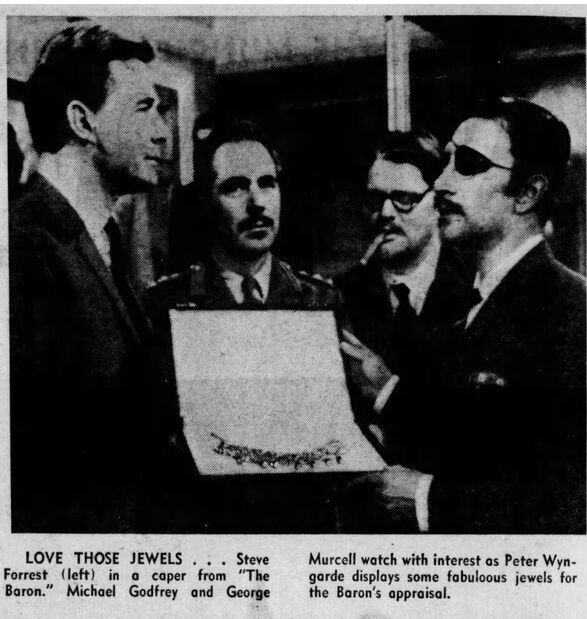
Peter imbues Noyes with quite different qualities to the King himself, who is somewhat disconnected and cool, fringing on dull-witted at times. Although from a wider perspective, Peter Wyngarde could be argued to have played mainly intelligent, upper/upper-middle class characters in much of his work, it is easy to understand why he was in such demand, since the skill he commands is impressive and the energy he invests is captivating.

One weakness is that Noyse is a bit silly in places, between astute actor and simple blackmailer, but the responsibility there is attributed more to the writers rather than to Peter’s execution of the part.

I can’t help wondering if he toned down King Ibrahim to intensify the contrast with the more colourful Noyse. Certainly from a dramatic viewpoint the actor would be more challenging and interesting to play. All the same, this episode of The Baron provided Peter with a double helping of lines and an opportunity to exercise his artistic abilities to the full.

JASON KING: Episode Guide

Crime Writer! Adventurer! Lover!

Created by Monty Berman and Dennis Spooner

ITV/Scoton – 26 x 50 minute episodes. Recorded on 16mm colour film.

Peter Wyngarde created one of television’s most popular characters when he played the flamboyant Jason King in Department S. Only one aspect of this colourful, amusing and romantic crime-novelist-investigator was emphasized in those programmes, however. Jason came into the stories when called on to help solve baffling crimes for Interpol. Seen more briefly was the other aspect of Jason King, the successful writer with the world (and women) at his fingertips.

When Interpol called, Jason’s other activities were interrupted. He was found in the most exotic places all over the globe, lured away from glamorous female companions, dragged from personal adventures which had nothing to do with Department ‘S’.

Then from Department ‘S’ sprang a fascinating new series of one-hour colour films: Jason King.

Once again, this fabulous character was portrayed by Peter Wyngarde, released from the shackles of one line of pursuit to be seen at random throughout the world in adventures that befell him as he sought inspiration and backgrounds for his best-selling Mark Caine novels.

He was on his own, but accompanied throughout by top-name guest stars and gorgeous girls galore. There were no limitations. No longer attached to Department ‘S’ in any way, he was free to roam the four corners of the earth at will. Every type of adventure befell him. His inquiring mind took him into everything from international intrigue to local revolutions. From tense drama to comedy-filled situations. From dire peril to the welcoming arms of beautiful girls.

He tumbled headlong into adventure, whether he sought it or not. He was lured into danger by those who thought they could use him. He jet-propelled himself into situations because of his insatiable curiosity, and was tricked into situations because of his reputation.

The Episodes

Wanna Buy A Television Series?

Broadcast: 15th September, 1971

In order to interest a television mogul in buying his stories for the small screen, novelist and adventurer Jason King describes to the man a typical plot involving his hero Mark Caine. Caine meets a girl who has been given plastic surgery to resemble the deceased Michele who died in a fire. She is taken by two crooks to meet Bellini, a fence of Michele’s acquaintance, supposedly suffering from amnesia, to find out where he has hidden his private stash of valuables. Caine is aware that the girl will be killed once she has served her purpose and steps in to rescue her.

A Page Before Dying

Broadcast: 22nd September, 1971

British Intelligence plan to copy the plot of Jason’s book, ‘A Page Before Dying’, to smuggle Gorini, a man who has information for them, out of East Berlin hidden in a safe. The first part of the scheme involves Jason being smuggled into the East in the safe but when he reaches the meeting place he finds that he has been duped and used as a decoy whilst Gorini has already been taken to safety through other means.

Buried In The Cold, Cold Ground

Broadcast: 6th October, 1971

Jason needs to finish his latest book so he decides to go into isolation in the south of France. When he picks up a pretty hitchhiker and a recently released prisoner, it becomes the start of yet another Jason King novel.
A Deadly Line In Digits

Broadcast: 13th October, 1971

On a visit back to England, Jason finds himself with income tax problems. However, it turns out to be a way of blackmailing him into helping the police solve a series of robberies where the police computer seems to be illegally accessed.

Variations On A Theme

Broadcast: 20th October, 1971

A close friend of Jason King, a double agent called Alan Keeble, was supposed to be dead. However, when Jason receives a letter telling him to come to Vienna to meet Alan, he just has to go.

6c96da93-16a8-4631-a2b8-ab7d01541523

As Easy As A.B.C.

Broadcast: 11th November, 1971

Two English criminals, Charles and Edward, are committing copy-cat robberies stolen from the plots of Jason’s books, which causes the police to take an interest in the author after a security guard is killed. Jason and his girlfriend Arlene have an encounter with the two villains and escape but, as they can now recognize the pair, they are in danger as they head for Venice, where a trap has been set for them.

To Russia With… Panache

17th November, 1971

Jason is abducted in order to help the Moscow police work out how three men on a workers’ delegation, got into a lift and then, when the doors opened again, there was nothing left of them but three piles of ashes. He discovers that they made their exit from the lift by means of a trap door but comes to appreciate that they are part of a larger plan to tunnel into the Kremlin to steal art treasures.

A Red, Red Rose Forever

Broadcast: 1st December, 1971

Jason gets off a plane in Switzerland and is mistaken for the hitman taken ill on the plane as he has picked up the bunch of red roses which will allow the killer’s employers to identify him. He plays along out of curiosity though his cover is blown when the real assassin leaves hospital turns up. As a test Jason is told to shoot dead his mark but uses an elaborate little stunt as seen in his books to create the illusion of killing whilst identifying the villains.

All That Glisters: Part 1

Broadcast: 8th December, 1971

An antique salt cellar made of gold by Benevenuto Cellini is stolen in California from collector Dreshfield by thief Frankie Luca, who brings it to Paris to sell to Philippe De Brion. De Brion was cheated out of its ownership some years earlier by Dreshfield, who told him it was worthless. However free-lancer Mallen has been hired by Dreshfield to pursue Luca to Paris, where he meets up with Jason, and asks him to introduce him to De Brion. After Mallen has been shot at he and Jason track down the salt cellar, only to find that it is a fake and Luca has escaped with …

All That Glisters: Part 2

Broadcast: 15th December, 1971

Having killed De Brion,who was out to double cross him, Luca gets on a train to Rome with the Cellini salt cellar, pursued by Jason and Mallen. In Italy a former Mafiosi called Angelo Andrea joins the chase, intending to steal the Cellini from Luca. Ultimately all the interested parties end up at Andrea’s house where they discover that all that glisters is not gold.

Flamingoes Only Fly On Tuesdays

Broadcast: 29th December, 1971

Jason arrives on a Caribbean island and find himself in the middle of a revolution when he inadvertently makes a remark about flamingos as he arrives at the airport.

Toki

Broadcast: 5th January, 1972

In France Jason meets Toki, whose boyfriend Jean Le Grand and another gangster Olivier plan to steal a cache of emeralds, after which Le Grand plans to kill Olivier. Given that she knows all the plans Jason believes that she is a young girl who has got out of her depth and is danger. He resolves to help her but they are pursued by LeGrand and his mobsters.

The Constance Missal 

Broadcast: 12th January, 1972

Jason falls under the hypnotic spell of two glamorous thieves, Claudia and Elaine. They steal the only copy of his recently completed film script, demanding that, for its return, he poses as an expert in ancient manuscripts in order to steal the Constance Missal, a valuable document recently acquired by the British Museum. He is to authenticate it for one Lord Barnes but his lordship is also planning to obtain the Constance Missal for himself. 

PW18

Uneasy Lies The Head

Broadcast: 19th January, 1972

Having refused to help the British government investigate an international drugs ring Jason is surprised to learn that a man in Istanbul is impersonating him. This turns out to be Trim, a government operative, who has been studying him in order to make contact with the gang leaders and persuade then that he is Jason King. However Trim is captured and Jason has to go to Istanbul after all to save the day.

Nadine

Broadcast: 2nd February, 1972

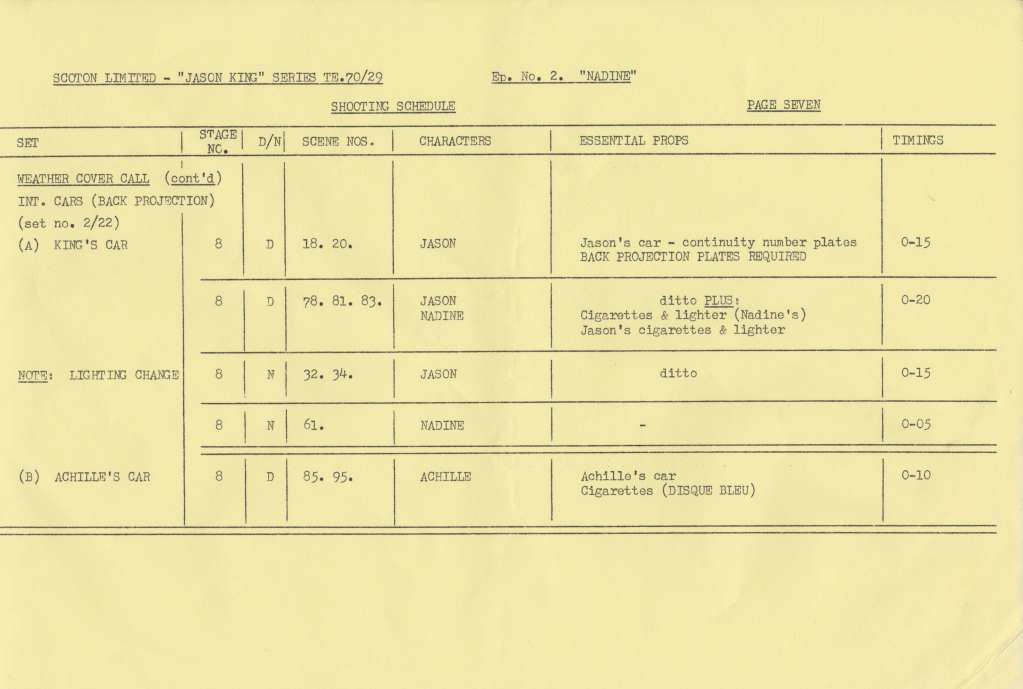
Jason is suffering writer’s block so his publisher sends him to Greece to inspire him. However, some Greek criminals use a beautiful woman to seduce Jason using his fame to smuggle drugs into France – but who is seducing who?

A Kiss For a Beautiful Killer

Broadcast: 9th February, 1972

Jason travels to a South American republic to receive an award – in the form of a medallion – for one of his books. In fact both the corrupt President Cordoba, who has bugged the medallion, and the opposing rebel forces, led by glamorous government minister Delphi, believe that the book is so close to the truth about events in their country that he has an actual source of information, and neither will believe that it is all a fiction.

If It’s Got To Go, It’s Got To Go

Broadcast: 16th February, 1972

Jason’s temporary secretary in Germany convinces him to go to a health clinic. However, when several strange events occur he realises that there is much more to the clinic than it appears.

A Thin Band Of Air

Broadcast: 3rd March, 1972

Jason is in Paris taking publicity photos for his latest novel when a man with a rifle shoots at him. It appears that there is bounty of 100 000 francs on him, but who is putting up the money and why? King has to find out.

It’s Too Bad About Auntie

Broadcast: 10th March, 1972

Andrew Bishop is a nasty piece of work who lives with, and makes life unpleasant for, his elderly, housebound Aunt Claire. One day, in the process of robbing a house, he commits a murder, for which Pamela, an innocent woman, is charged. He also steals a vacuum cleaner which, somewhat bizarrely, becomes Jason’s chief clue in leading him to the real culprit.

The Stones Of Venice

Broadcast: 17th March, 1972

Arriving in Venice, Jason is surprised to learn that he is the apparent author of a book entitled ‘The Stones of Venice’, which he assuredly is not. However, after he is attacked by two would-be assassins a jewel robbery takes place and Theresa Bonival, employee of a firm specializing in antique jewellery, is abducted – incidents closely related to events in the book and therefore sufficient for the police to ask for his help in their enquiries.

A Royal Flush

Broadcast: 24th March, 1972

A mysterious girl calling herself Karen invites Jason to meet her at the Capri hotel but when he gets there he finds a note requesting he catches up with her at a night-club. He meets up with her but an apparent drunk drops a lighter into his pocket. Then Karen takes him to meet a lady who may or may not be a princess and who has a proposition for him.

BED

Every Picture Tells A Story

Broadcast: 31st March, 1972

Jason makes a stopover in Hong Kong, where his character Mark Caine appears in a Chinese comic strip but with deliberate alterations to Jason’s original story in the translation. He teams up with Lucy Cameron, nurse to wealthy businessman Arthur Tsung, to confront Irish-American Sam Finnigan, the editor of the paper publishing the strip and a man whom he has met before, for an explanation.

Chapter One: The Company I Keep

Broadcast: 7th April, 1972

Jason King arrives in Rome just after a night-club dancer is murdered. When he finds out that the events in the book he is currently writing mirror what is happening in real-life, Jason is determined to find out what is going on.

PW22

Zenia

Broadcast: 14th April, 1972

Whilst travelling on a plane Jason recognizes a man whom he knew from his Department ‘S’ days to be a professional assassin and so he is intrigued and on his guard when he arrives at his destination – not without due cause, as he will soon find himself caught up in a plot to foil a group of revolutionaries out to kidnap the daughter of the country’s president.

An Author In Search Of Two Characters

Broadcast: 21st April, 1972

In London Jason is paid a great deal of money for a film script only to be relieved of it by two robbers. Later, whilst taking a moon-light stroll he sees an astronaut shooting somebody and then he is attacked and knocked unconscious by a bear. When he wakes up next morning with a head-ache it all seems very real but the police obviously believe that he dreamed it.

That’s Not Me It’s Someone Else

Broadcast: 28th April, 1972

Jason has an invitation to go to Italy and stay with Bonisalvi, an international criminal who lives in the most secure seclusion. A rival gangsters’ syndicate uses the opportunity to send Bennett, a hit-man posing as Jason to kill Bonisalvi whilst Jason himself has problems fleeing the beautiful but deadly Martine, who seems to have more than marriage on her mind.

A Shooting Schedule

1

Script from the Jason King episode, ‘As Easy As A.B.C.’, with Peter’s amendments and suggestions.

Documentary Making of Jason King

More about Jason King…

REVIEW: The Adventures of Ben Gunn

EPISODES:

  • The Parson’s Son. Broadcast: Sunday, 1st June 1958
  • The Taking of the Walrus. Broadcast: Sunday, 8th June 1958
  • The Winning of the Treasure. Broadcast: Sunday, 15th June 1958
  • How The Treasure Was Buried. Broadcast: Sunday, 22nd June 1958
  • The Honest Seaman. Broadcast: Sunday, 29th June 1958
  • Marooned. Broadcast: Sunday, 6th July 1958

Character: John Silver

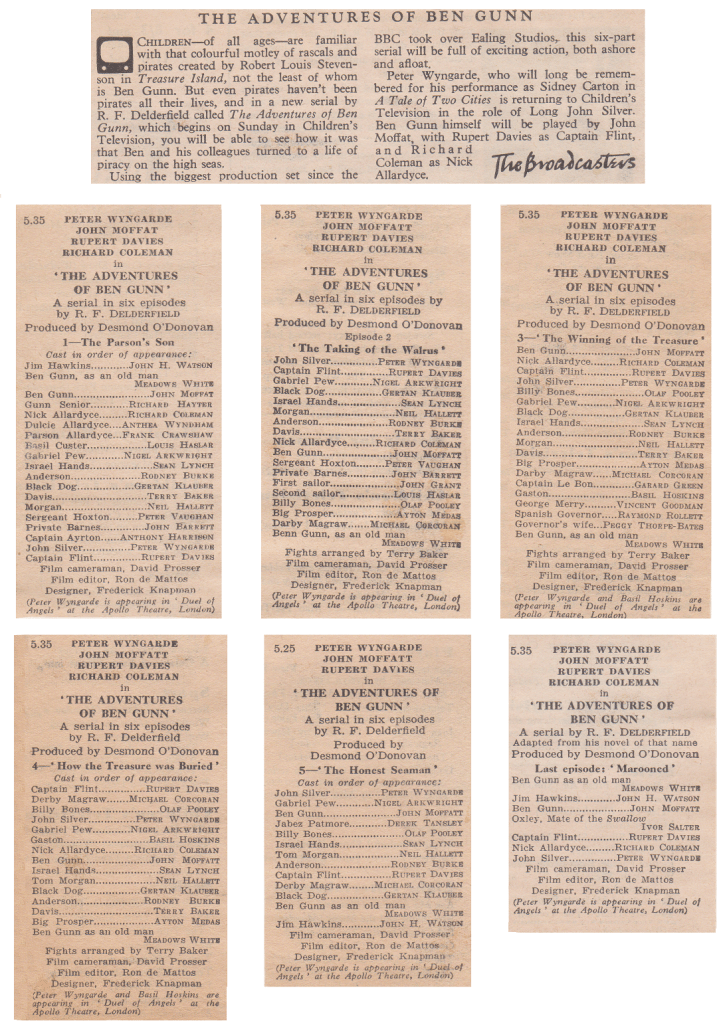
Broadcast live from Ealing Studios, The Adventures of Ben Gunn (John Moffat) was the biggest production since the BBC took over the studios. Complete with a giant wave machine and mock-up of a Spanish galleon Director, R.F. Delderfield, and Producer, Desmond O’Donovan, had made the most of the soundstages for their sequel to Treasure Island.

LONGJOHN

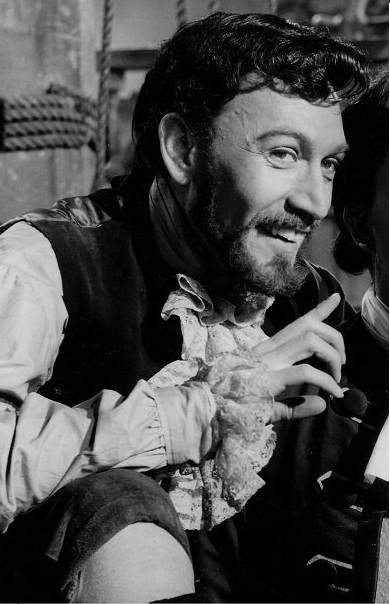
The series not only explained how Ben Gunn came to be a pirate, but by what means Captain Flint (Rupert Davies) came by the treasure and why he buried on that particular island. Viewers also learned how Billy Bones (Olaf Pooley) found the famous map, how Long John Silver (Peter Wyngarde) lost his leg and took over as Captain after the death of Flint.

Long John Silver probably means a stubble beard, one leg and an evil eye to most of us. If so, the whole of Britain’s television-viewing public must’ve had quite a shock when they switched on their sets on the afternoon of June 1st, 1959, to see the grouchy old pirate being played by a very young and sophisticated Peter Wygarde.

Long John on this occasion was one of the characters in ‘The Adventures of Ben Gunn’, which the BBC serialised in six weekly episodes.

But wasn’t the role of Long John a rather odd one for such a renowned smoothie: “Long John had usually been played by actors such as Bernard Miles or Robert Newton, who was a Cornishman.

“In previous productions he had therefore always had some sort of country accent. I played Long John absolutely straight. In this series he was a young man – about 30 years before the Long John of Treasure Island”.

According to this particular account, Silver comes from a good family; is well educated, but like most young people, he has a sense of adventure, so he joins up with a gang of marauding pirates.

“It was only subsequently when Long John became greedy for money that he also became gross and uncouth. That was my interpretation of the situation anyway”, said Peter.

At the time that the series was aired, Peter was appearing nightly as the libertine Marcellus in Duel of Angels at London’s Apollo Theatre. Did the two parts ever come into conflict with him? Apparently not!

“An actor playing a meaty, tricky role likes nothing better than to relax in a different part,” he said.

Strangely, he says that he did find some features in common in the two parts. “Some of the basic ideas were very much the same”, said Peter.

.

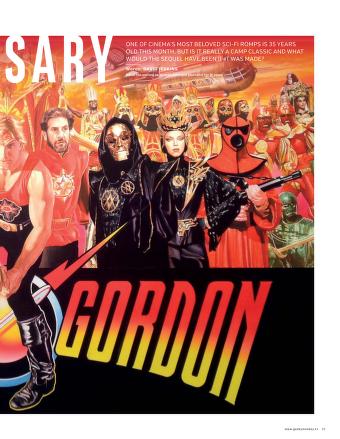
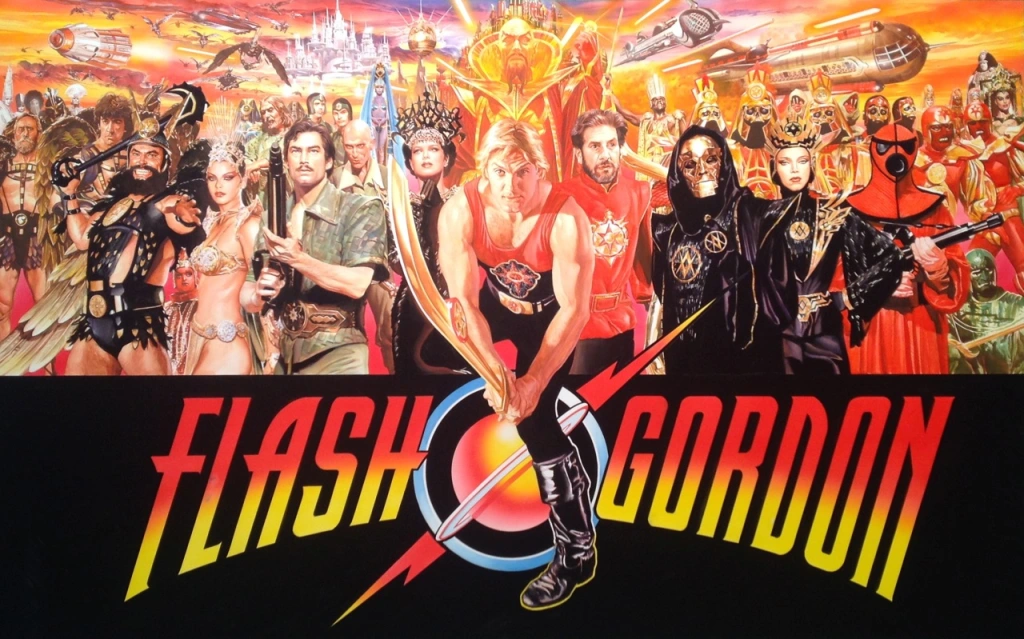
FLASH GORDON 35th ANNIVERSARY CELEBRATION

VIP-Back-001

In December 1980, the film Flash Gordon first hit cinema screens like a bolt of lightning, and on Saturday, 28th November, 2016, the cast and crew once again were reunited for a celebration of the iconic film.

The Guest List

  • PETER WYNGARDE – General Klytus
  • Sam Jones – Flash Gordon
  • Melody Anderson – Dale Arden
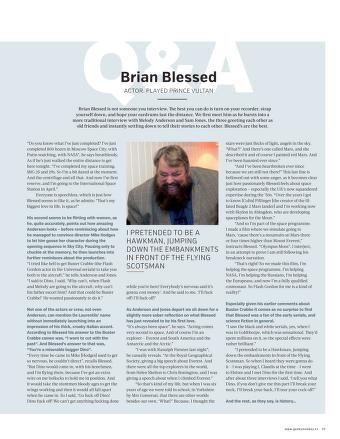
  • Brian Blessed – Prince Vultan
  • Mike Hodges – Director
  • George Gibbs – SFX Supervisor
  • Trevor Butterfield – Hawkman
  • Brian Cook – 1st Ad
  • Howard Blake – Composer

The evening took place at BAFTA, 195, Piccadilly, for a black tie event with other UK celebrities such as Matt Berry, Nicky Clarke and Marcus Brigstocke.

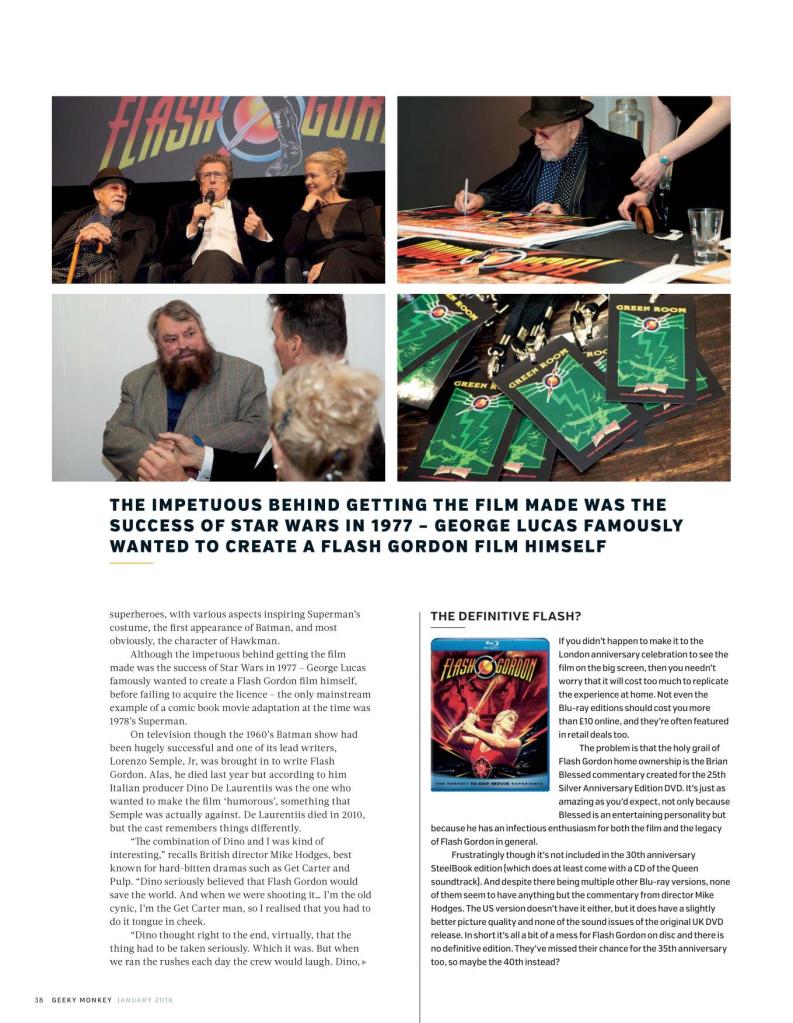
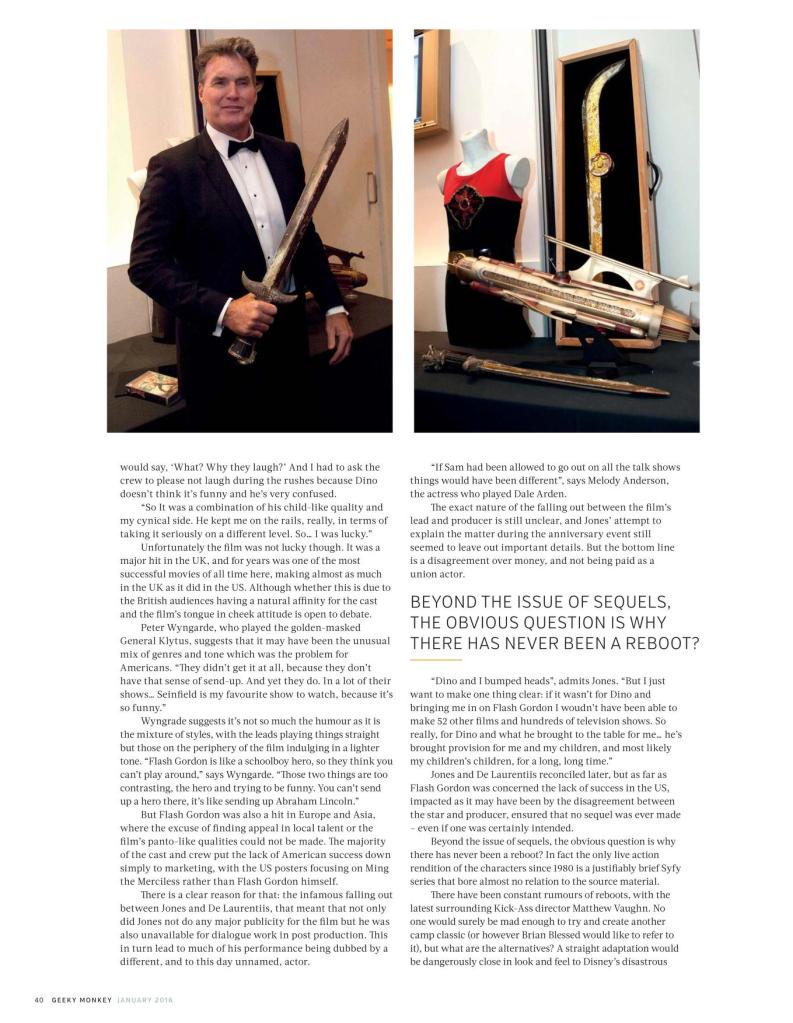
A welcome reception featuring original props from the film was followed by a screening of the 1980 classic, and a Q&A panel hosted by Jason Lenzi – founder of Biff Bang Pow!

099

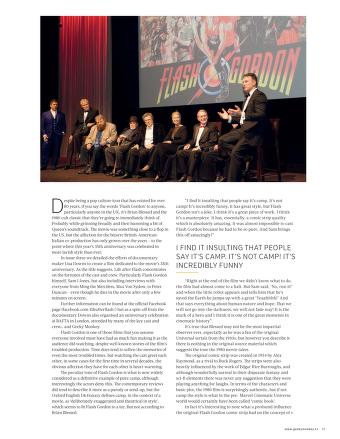
Above: Cast and crew on stage for the audience question and answer session (Peter is fourth from the left)

An account of the evening By Martin Lakin

Bob was on a roll now and had gotten the attention of Mike Hodges, also having been shown the Klytus mask was then given a guided tour of the costumes and props and seemed just as bewildered by their presence as the fuss all around him. With so much effort made to bring these precious relics across the pond, Bob had earned every plaudit and was clearly enjoying the responses provoked…

Catching up again with Chris King as the evening was coming to a close he told me how he longed to speak to Sam about his efforts to recreate the Rocket Cycle for Ted but was hesitant to approach. Sam had worked the room long and hard all night, not once denying any fan his time and attention with his beautiful wife patiently watching from the sidelines. Eventually Chris seized his moment and told Sam all about his endeavours to accurately reproduce the famous prop. Sam seemed genuinely impressed, mentioning the producers had gifted it to him and it was now parked in his garage, which Chris was overjoyed to hear and made his night…

One item of merchendise that I had never quite managed to obtain to date was the Flash orchestral score on CD, a desire compounded by having just listening to the affable composer’s fascinating stories about its creation. Missing out again by not winning the several copies raffled out earlier I was amazed to see a few randomly appear on the programme table available to purchase there and then for a donation to MediCinema!

Buying it up quickly I turned to see an empty space where Howard had been standing and was told that he had just left for the evening. Due to all the other lucky encounters so far It felt churlish to not be able to get his autograph on the cover so didn’t worry but then Bob dashed back into the room saying ‘Howard is still here!!”. Never had rapid removal of cellophane felt like such a pitched battle but just as Howard slipped his raincoat on, my Sharpie was in his hand and my night just kept getting better – With that the event was drawing to a very satisfactory close and the guests had started to make good their escape. I felt I should shake the hand of Sam J. Jones just one more time to at least try and show my gratitude to him for continuing to be such a positive influence and class act. As ever, his grip is solid and the response genuine.

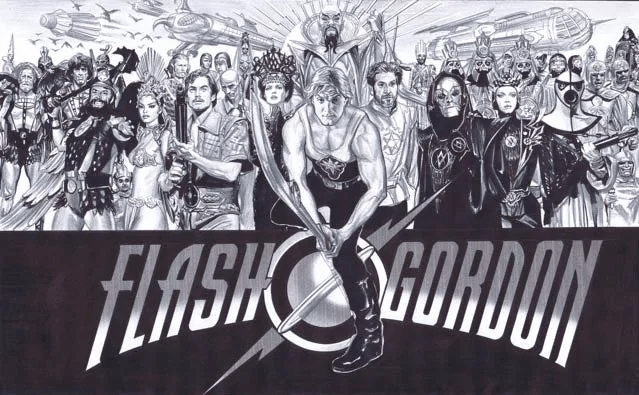
Finally, as the parting gift of Special Edition Alex Ross Flash posters in their cardboard tubes were hauled away by all, I couldn’t leave without saying goodbye to Lisa Downs and thanking her for efforts in transcending this event from the potentially mundane to the positively sublime. I already felt so totally spoiled by the experience to the point where I imagine no con could ever aspire to it . Bashful and sweet, Lisa thanked us for coming and for all we know probably collapsed from exhaustion under such pressure soon as the doors were closed. From the funding campaign to the BAFTA stairwell the whole thing rested on her tiny shoulders and she had managed to put on the fanboy celebration to end them all. For this and the unimaginable encounters inbetween I will be eternally grateful.

DSC_3595

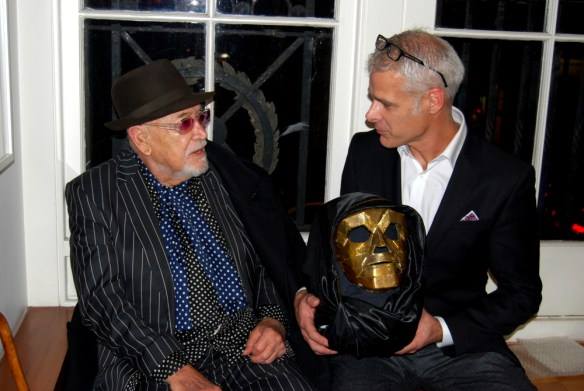
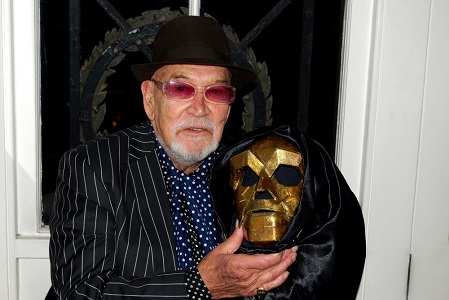
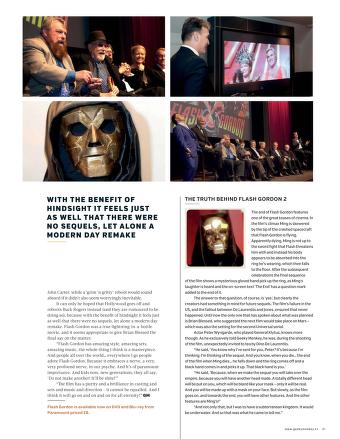
Peter said that being reunited with the mask was like meeting an “old friend”. 

The evening helped to raise money for charity ‘Medicinema’.

Below: The Cast and Crew Q&A

Magazine Article

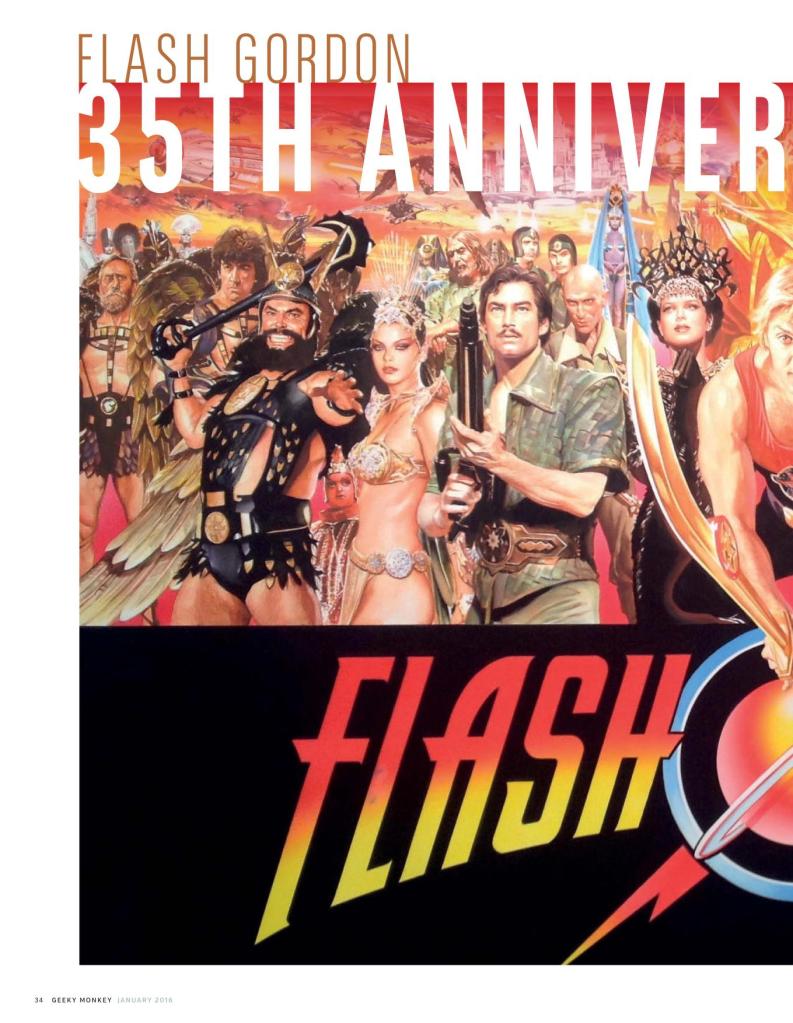
Geeky Monkey: January 2016

New Poster How it was created

This image has an empty alt attribute; its file name is flashgordon-prelim1-full.jpg

Click below for more Flash Gordon…

REVIEW: Flash Gordon

“Bring me the Bore Worms!” General Klytus

The Story

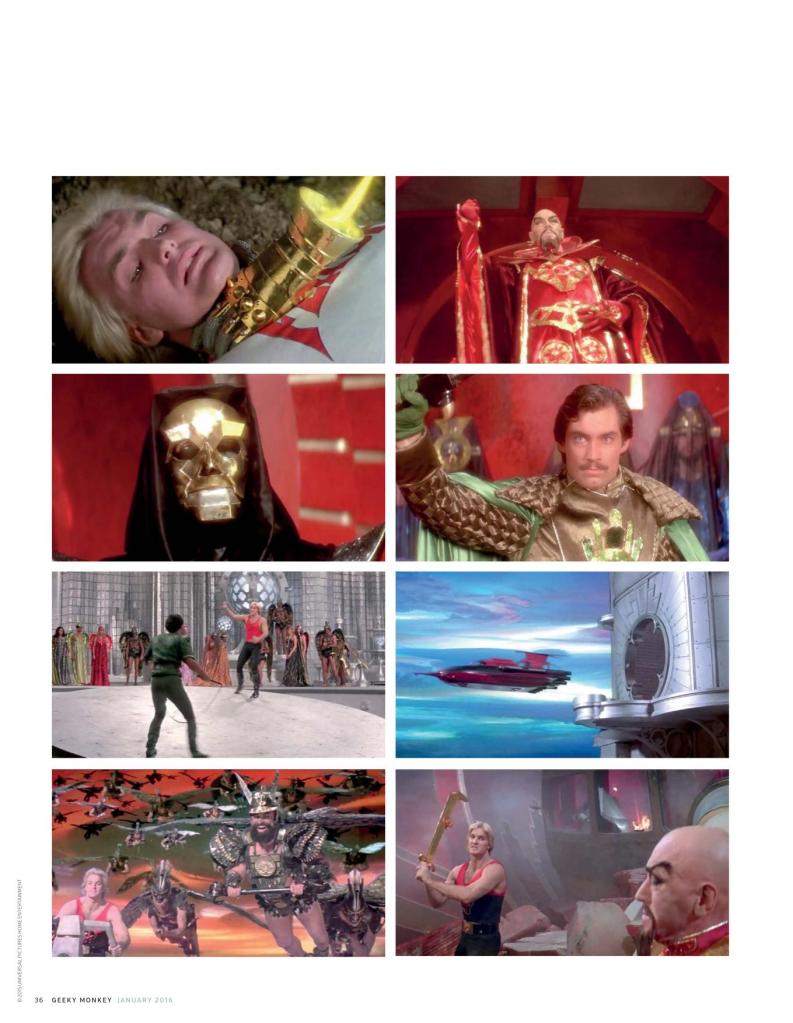
After almost a year’s detailed and intensive preparation, Dino De Laurentiis’ production of Flash Gordon started shooting in England on Monday, August 6th, 1979. The highly ambitious space epic, designed by Danilo Donati was spread over six sound stages at Shepperton Studios, the entire ‘Star Wars’ facility at EMI Borehamwood, plus a large complex at Brooklands, Surrey.

The cast chosen by De Laurentiis and Mike Hodges had a distinctly international flavour and featured talents both young and old to the movie industry. twenty-six year old American, Sam J. Jones, only 10 months a professional actor, portrayed the legendary Flash Gordon, whilst the part of Dale Arden is played by Canadian-born actress, Melody Anderson.

Sweden’s Max Von Sydow dug deeply into his repertoire of menace to portray Emperor Ming the Merciless. The role of Doctor Hans Zarkov, nuclear scientist who foresees the final destruction of the Planet Earth and attempts to stop it, was played by Chaim Topol.

From Italy came two of Europe’s brightest prospects. Ornella Muti was the mysterious Princess Aura and Mariangela Melato played the callous Kala of Ming’s secret police.

Among the British actors, Prince Vultan – leader of the Hawkmen, was played by Brian Blessed. Timothy Dalton, with a list of film, television and film credits behind him was chosen as Prince Barin of Arboria, with Peter Wyngarde portraying General Klytus, the controller of the Mongo Secret Police Force.

Emperor Ming the Merciless declares that he will first play with and then destroy the Earth using natural disasters. On Earth, New York Jets football star “Flash” Gordon boards a small plane, where he meets travel journalist Dale Arden. Mid-flight, the cockpit is hit by a meteorite and the pilots are lost. Flash takes control and manages to crash land into a greenhouse owned by Dr. Hans Zarkov. Zarkov, who believes the disasters are being caused because an unknown source is pushing the Moon towards Earth, has secretly constructed a spacecraft which he plans to use to investigate. Zarkov’s assistant refuses to go, so he lures Flash and Dale aboard. The rocket launches, taking them to the planet Mongo, where they are captured by Ming’s troops.

The three are brought before Ming. He orders Dale be prepared for his pleasure. Flash tries to resist, but is overpowered. Ming orders Zarkov be reprogrammed and Flash executed. Ming’s daughter, Princess Aura, seduces Ming’s surgeon into saving Flash, to whom she is attracted. As they escape, Flash sees Zarkov being brainwashed by Klytus, the metal-faced head of the secret police. Aura and Flash flee to Arboria, kingdom of Prince Barin, Aura’s lover. En route, Aura teaches Flash to use a telepathic communicator to contact Dale. He lets her know he is alive. Dale is locked in Ming’s bedchamber, but encouraged by Flash, she escapes. Klytus sends Zarkov to intercept Dale, who tells him and Klytus that Flash is alive. They then escape, as Zarkov reveals he resisted the brainwashing. They are captured by Prince Vultan’s Hawkmen and taken to Sky City.

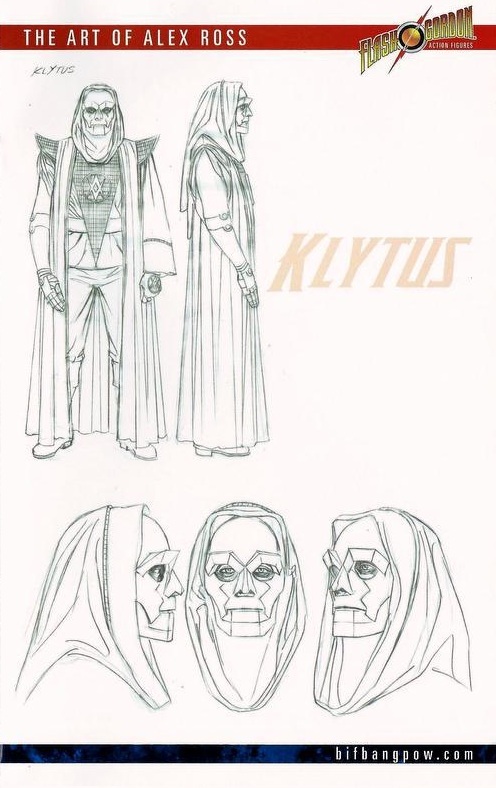
DRAWING-KLYTUS

Aura and Flash arrive at Arboria. Aura asks the Prince to keep Flash safe. A distrustful Barin, in love with Aura, agrees not to kill Flash, but then forces him to perform a deadly ritual. Barin and Flash take turns sticking their hands into a hollow stump with a giant scorpion-like Wood Beast inside. When Flash has to take an extra turn, he pretends to be stung as a distraction and escapes. Barin follows, but they are both captured by the Hawkmen.

Right: Original drawings of General Klytus by Alex Ross.

Klytus informs Ming that Flash is alive and is given authority to find out who is responsible. Aura returns and is taken prisoner and tortured by Klytus and General Kala. They force her to confess and Ming banishes her to the ice moon Frigia after his wedding. Meanwhile, Flash and Barin are taken to Sky City, where Flash and Dale are briefly reunited. Flash is forced to fight Barin to the death, but Barin joins him when Flash saves his life. Klytus arrives and Flash and Barin kill him. Knowing that this will bring retribution, Vultan orders the Hawkmen to evacuate, leaving Barin, Flash, Dale and Zarkov behind. Ming’s ship arrives and he orders Barin, Zarkov and Dale to be taken aboard. Ming is impressed with Flash, and offers him lordship over Earth in exchange for loyalty, which Flash refuses. Ming gives the order to destroy Vultan’s kingdom along with Flash. Flash finds a rocket cycle and escapes before Sky City is destroyed.

Flash contacts Vultan, who is hiding on Arboria and they plot an attack on Mingo City. Flash pretends to attack Mingo City alone on his rocket cycle. General Kala dispatches the war rocket Ajax to kill Flash, but the Hawkmen ambush and seize the rocket. Meanwhile, Princess Aura overpowers her guard and frees Barin and Zarkov from the execution chamber. Flash and the Hawkmen attack Mingo City in Ajax and Kala activates the defenses, as Ming and Dale’s wedding begins. Mingo City’s lightning field can only be penetrated by flying Ajax into it at a suicidal speed. Flash volunteers to stay at the helm to ensure success and allow the Hawkmen to invade the city.

thumbnail_20200811_195747_HDR_resized

Left: Peter minus Klytus mask during a run-though of the Zarkov “Mind-Draining Scene” 

Barin and Zarkov enter the control room to stop the lightning field, encountering Kala who refuses to deactivate it. She attempts to kill Zarkov, but Barin shoots and kills her. Without Kala they are unable to deactivate the field from that control room. Barin tells Zarkov to hold the fort while he heads to Sector Alpha. Zarkov keeps trying, but is unable to deactivate the shield.

Barin fights through Ming’s guards and gets to Sector Alpha and deactivates the lightning field before Ajax hits it. Flash flies the rocket ship into the city’s wedding hall and the ship’s bow impales Ming. He falls off the rocket nose, seriously wounded and Flash offers to spare his life if he will stop the attack on Earth, but Ming refuses. Ming attempts to use his power ring on Flash, but his power falters and nothing happens. He then aims the ring at himself and is seemingly vaporised by its remaining power seconds before the counter to the destruction of the Earth reaches zero. A huge victory celebration ensues.

Barin and Aura become the new leaders in Ming’s place. Barin names Vultan the leader of their armies. Flash, Dale, and Zarkov discuss returning to Earth. Zarkov says he doesn’t know how they will get back, but they will try. Barin tells them all they’re welcome to stay, but Dale says she’s a New York City girl, and it’s now too quiet around Mongo.

The final frame shows Ming’s ring being picked up by the hand of an unseen person. Ming’s laugh echoes as the credits roll. Following the credits the text “The End” is shown on the screen before a question mark(?) is appended.

Film Facts

Initially, producer De Laurentiis wanted Italian director Federicao Fellini to direct the picture; Although Fellini optioned the Flash Gordon rights from De Laurentiis, he never made the film. Having attempted to make a Flash Gordon film in the 1970s; unable to acquire the rights from De Laurentiis, Lucas decided to create Star Wars instead. De Laurentiis then hired Nicolas Roeg to make the film. Roeg, an admirer of the original Alex Raymond comic strips, spent a year in pre-production work. However, De Laurentiis was unhappy with Roeg’s treatment of Flash Gordon, and Roeg left the project. De Laurentiis also considered hiring Sergio Leone to direct the Flash Gordon film; Leone refused, because he believed the script was not faithful to the original Raymond comic strips. De Laurentiis then hired Mike Hodges to direct.

Lorenzo Semple, Jr wrote the script, and recalled: “Dino wanted to make Flash Gordon humorous. At the time, I thought that was a possible way to go, but, in hindsight, I realise it was a terrible mistake. We kept fiddling around with the script, trying to decide whether to be funny or realistic. That was a catastrophic thing to do, with so much money involved… I never thought the character of Flash in the script was particularly good. But there was no pressure to make it any better. Dino had a vision of a comic-strip character treated in a comic style. That was silly, because Flash Gordon was never intended to be funny. The entire film got way out of control”.

According to a 2012 interview in Maxim, Sam J. Jones had disagreements of some sort with De Laurentiis and departed prior to post-production, which resulted in a substantial proportion of his dialogue being dubbed by a professional voice actor, whose identity is still a mystery.

A sequel was proposed, but the departure of Jones effectively ended any such prospects. The airfield scene at the beginning of the film, although set in the U.S., was shot at the Broadford Airfield in Skye, Scotland.

Flash Gordon, in total, grossed well above double its $20 million budget, grossing $27,107,960 in North America, which was augmented by a very strong showing in the United Kingdom, grossing nearly £14 million (c. $22 million in 1980 dollars) there. Additionally, the film performed well in Italy, due to the two Italian actors prominent in the credits. The film found appreciation with the majority of critics, notably The New Yorker’s Pauline Kael. Kael described Flash Gordon as having “some of the knowing, pleasurable giddiness of the fast-moving Bonds. The director, Mike Hodges, gets right into comic-strip sensibility and pacing”. Von Sydow (Ming) received a good deal of praise for his performance, but Jones (Gordon) was nominated for a Golden Raspberry Award for Worst Actor. Before the film’s run in cinemas, a sequel was considered and according to Brian Blessed on the Region 2 DVD commentary for Flash Gordon – Silver Anniversary Edition, the sequel was going to be set on Mars, as a possible update of the Buster Crabbe serials.

Time Line

Flash Gordon has since become a cult classic with fans of science fiction and fantasy. It is a favourite of director Edgar Wright, who used the film as one of the visual influences for Scott Pilgrim vs. The World. Acclaimed comic book artist Alex Ross names the film as his favourite film of all time. He painted the cover of the film’s 2007 “Saviour of the Universe Edition” DVD release, and starred in a featurette to talk extensively about his affection for the film. In Seth MacFarlane’s 2012 comedy  Ted, the characters of Ted and John are fans of the film, and it is referenced several times throughout the film. Jones (playing himself) also appears in the film during a manic party sequence and in the film’s conclusion. He also appears in the sequel, Ted 2. Horror punk musician Wednesday 13 based the song “Hail Ming” on his 2013 album The Dixie Dead on the film.

Blessed’s performance as Prince Vultan lodged the veteran stage and screen actor into the UK collective consciousness for the utterance of a single line – “Gordon’s alive?!” – which, more than 30 years later, remains the most repeated, reused, and recycled quotation from both the film and Blessed’s career.

The Dynamite Entertainment comic Flash Gordon: Zeitgeist drew on several elements of the 1980 film, including the reappearance of the villain Klytus (who does not appear in the original comic strips). In this adaptation, Klytus again serves as Ming’s main henchman. The 2014 Dynamite Flash Gordon comic also contained several allusions to the film, including having Vultan speak the line “Gordon’s alive?!”.

The film was originally released in North America via Universal Studios. Universal has retained the domestic theatrical and home video rights, while the international rights passed on through different distributors, eventually landing with StudioCanal. However, the film’s UK distributor, Thorn EMI, controlled U.S TV rights. Although StudioCanal now holds those rights due to ownership of the EMI film library, they licensed them to MGM for U.S syndication, which explains why MGM’s logo appears on current television airings.

A comic book adaptation, written by Bruce Jones and illustrated by classic Flash Gordon artist Al Williamson (himself not a fan of the movie due to its overall campy nature, numerous script changes and resulting alterations to his artwork), was released by Western Publishing to coincide with the film’s release. It was serialised in three issues of the Flash Gordon comic book (No. 31–33) and released in a single large format softcover and hardcover editions.

A novelization by Arthur Byron Cover of the movie script by Lorenzo Semple Jr. was published in 1980.

A video game adaptation for the Atari 2600 was developed by Sirius Software and published by 20th Century Fox Games in 1983.

The film was released in 1981 on VHS, Betamax and MCA DiscoVision, and re-released in 1998 on both LaserDisc and Region 1 DVD via Universal. It was released in Region 2 in 2001 (Japan) and again in 2005 (UK/Europe); with the 2005 release including commentary by Brian Blessed winning the “Commentary of the Year” award from Hotdog Magazine for his humour and enthusiasm.

In October 2007, a high definition transfer of the film premiered on the MGM HD cable/satellite channel.

In November 2007, Sam J. Jones and Melody Anderson together created a new commentary track for the StudioCanal DVD edition of the film. Flash Gordon was released on Blu-Ray on 15 June 2010.

2019 saw the release of the documentary, ‘Life After Flash’ on DVD and BluRay.

‘Flash Gordon – The Official Story Of The Film’ was published in November 2020 by Titan Books.

Also in 2020, it was announced in the British press that ‘Flash Gordon’ was Queen Elizabeth II favourite film.

In 2021, a 40th Anniversary 4K BluRay collectors box set was released.

Critics Comments

“But above all these is Peter Wyngarde who plays Ming’s evil sidekick and confidante Klytus. His delivery and tone is perfect, shame he’s only in it for an hour…” R2

“Lively comic strip addition to the increasing numbers of such things at enormous expense fifty years after their prime.” Halliwell’s Film Guide.

“Klytus is actually my favourite character, with his (relatively) calm demeanour and restrained performance. Even with his entire head encased in gold-plated plastic, one can taste the withering sneer every time he says “Pathetic…” Jonathan Ross, Film Critic.

The Awards

Image result for Klytus gif animated


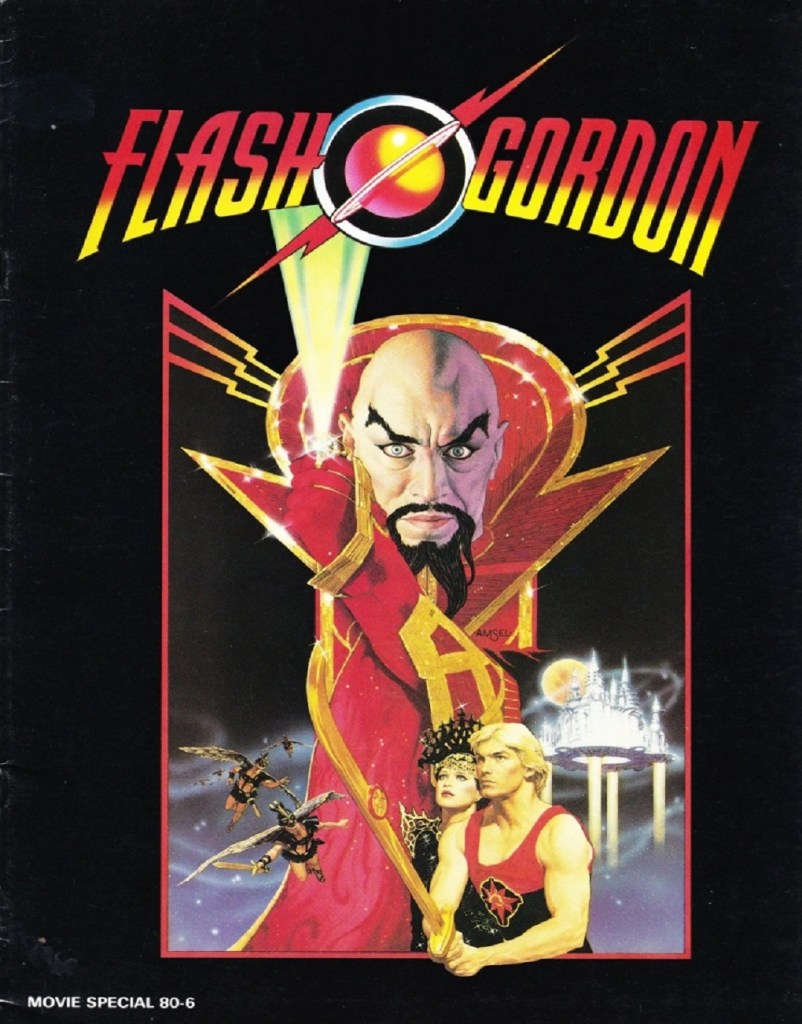
Promotional Materials

Above: Japanese – Cover and inside

Above: American – Cover and inside

Listen to Howard Blakes orchestral version of the Flash Gordon soundtrack here

Click below for more on ‘Flash Gordon’…

THE MAKING OF: The Siege of Sidney Street

A spatter of shots whacked savagely in a dismal street on Dublin’s North Side. A policeman topples into the gutter in a pool of colour –corrected panchromatic blood, and an old woman in a shawl says nostalgically: “Isn’t it like the oul times!”

The Director, Robert s. Baker, said: “Alright. Take Ten”. Whereupon a hundred Scots Guards, detectives and extras in Cockney costumes of 1911 vintage stampede into Bob Norman’s corner pub.

The second Siege of Sidney street was rolling on schedule. A few years ago, Mr Sean McBride – an otherwise estimable politician declares optimistically, “We have taken the gun out of Irish politics!”

In January of 1960, the Irish film industry was competing with less constitutional industries to put it back again. Each of the three films made during the previous year or so at the new Ardmore studios outside Dublin had been overwhelmingly ballistic in content. When the producer of this particular picture said, “We’re shooting this afternoon,” he meant just that!

614CZSEzCDL

In fact, the siege of Sidney Street ran up the most impressive ammunition bill of any British film ever made!

Robert S. Baker and his then partner, the legendary Monty Berman who met, aptly enough, in a battle in the western Desert, had had a fair string of successes in the horror-film field. They decided to make ‘Siege’ in Dublin because of the back streets on the Liffy still had the old East End atmosphere which had vanished with The Blitz.

Accordingly, men with hammers arrived one morning in Wellington Street on the edge of Sean O’Casey’s tenement territory, and took down its proud green and Gaelic nameplates.

The inhabitants phlegmatically imagining it was going to be renamed after some saint or forgotten patriot, blinked when they saw instead a new plate without a syllable of Irish on it, saying Sidney Street E1.

The word went around that Churchill himself was coming over to act as technical adviser, and expectant crowds of men with sticks and dogs – Dublin was full of men with sticks and dogs in 1960 – turned up to await him. Sir Winston was not the City’s favourite pin-up. Various holes in the elegant Georgian fabric were directly attributed to the 18-pound field guns he sent to one lot of Irishmen in 1922 with explicit instructions to fire them at the other lot.

Nevertheless, Dubliners mostly accorded him the respect they had always given a tough old scrapper, and when 32-year-old screenplay writer, Jimmy Sangster appeared in a top hat, astrakhan-collared coat and cane, a cheer went up.

Sangster took on the role after being told he looked like the young Churchill. Though he had never acted before, the part was not too demanding. He had no lines to speak.

On his first day on the film he was being posed for photographs when it was discovered that a vital prop was lacking. This led to a unit assistant rushing into Norman’s pub with a startling request: “Havey’e ’er cigar for Churchill?”

Down on location the flavour of the “oul times” was asserting itself in another way. The street had been blocked off at one end with a real police officer on guard at the other.

Several feet away out of sight of the cameras Peter, Donald Sinden and French actress, Nicole Berger were sitting in a heated caravan playing a New Statesman-ish quiz game with Dame Sybil Thorndike’s son, Christopher Carson, and a small collection of Irish actors.

“I begin with a ‘D’, and I’m early 19 century,” declared Peter. “Who am I?”

This was all far too much for one journalist from the News Chronicle, who asked Peter if he liked playing an anarchist: “Sure. Weren’t they the surgeons of politics?! They were the first people in England in this century to do anything active against the system.”

He was interested to learn that the IRA, which later adopted this principle on a more ambitious scale, cherished the memory of his character – the anarchist prototype, ‘Peter the Painter’, in a chilling way. The Sidney street gunman held off his police besiegers with high-powered Mauser pistols, which were known in Ireland to that day as ‘Peter the Painters’.

A small child puts her head around the door of the caravan and asked Peter for his autograph and a penny for the African missions. He obliged on both counts. An announcement then went up that Brendan Behan was coming down to take a look at the morning’s shooting, and the publicity girl went off to meet him in a local pub called The Tree. Four hours later she came back and reported that the rendezvous, like so many things in Dublin, had been completely imaginary; a figment.

A spatter of shots whacked savagely in a dismal street on Dublin’s North Side. A policeman topples into the gutter in a pool of colour –corrected panchromatic blood, and an old woman in a shawl says nostalgically: “Isn’t it like the oul times!”

The Director, Robert s. Baker, said: “Alright. Take Ten”. Whereupon a hundred Scots Guards, detectives and extras in Cockney costumes of 1911 vintage stampede into Bob Norman’s corner pub.

The second Siege of Sidney street was rolling on schedule. A few years ago, Mr Sean McBride – an otherwise estimable politician declares optimistically, “We have taken the gun out of Irish politics!”

In January of 1960, the Irish film industry was competing with less constitutional industries to put it back again. Each of the three films made during the previous year or so at the new Ardmore studios outside Dublin had been overwhelmingly ballistic in content. When the producer of this particular picture said, “We’re shooting this afternoon,” he meant just that!

In fact, the siege of Sidney Street ran up the most impressive ammunition bill of any British film ever made!

Robert S. Baker and his then partner, the legendary Monty Berman who met, aptly enough, in a battle in the western Desert, had had a fair string of successes in the horror-film field. They decided to make ‘Siege’ in Dublin because of the back streets on the Liffy still had the old East End atmosphere which had vanished with The Blitz.

Accordingly, men with hammers arrived one morning in Wellington Street on the edge of Sean O’Casey’s tenement territory, and took down its proud green and Gaelic nameplates.

The inhabitants phlegmatically imagining it was going to be renamed after some saint or forgotten patriot, blinked when they saw instead a new plate without a syllable of Irish on it, saying SIDNEY STREET E1.

The word went around that Churchill himself was coming over to act as technical adviser, and expectant crowds of men with sticks and dogs – Dublin was full of men with sticks and dogs in 1960 – turned up to await him. Sir Winston was not the City’s favourite pin-up. Various holes in the elegant Georgian fabric were directly attributed to the 18-pound field guns he sent to one lot of Irishmen in 1922 with explicit instructions to fire them at the other lot.

Nevertheless, Dubliners mostly accorded him the respect they had always given a tough old scrapper, and when 32-year-old screenplay writer, Jimmy Sangster appeared in a top hat, astrakhan-collared coat and cane, a cheer went up.

Sangster took on the role after being told he looked like the young Churchill. Though he had never acted before, the part was not too demanding. He had no lines to speak.

On his first day on the film he was being posed for photographs when it was discovered that a vital prop was lacking. This led to a unit assistant rushing into Norman’s pub with a startling request: “Havey’e ’er cigar for Churchill?”

Down on location the flavour of the “oul times” was asserting itself in another way. The street had been blocked off at one end with a real police officer on guard at the other.

Several feet away out of sight of the cameras Peter, Donald Sinden and French actress, Nicole Berger were sitting in a heated caravan playing a New Statesman-ish quiz game with Dame Sybil Thorndike’s son, Christopher Carson, and a small collection of Irish actors.

I begin with a ‘D’, and I’m early 19 century,” declared Peter. “Who am I?”

This was all far too much for one journalist from the News Chronicle, who asked Peter if he liked playing an anarchist: “Sure. Weren’t they the surgeons of politics?! They were the first people in England in this century to do anything active against the system.”

He was interested to learn that the IRA, which later adopted this principle on a more ambitious scale, cherished the memory of his character – the anarchist prototype, ‘Peter the Painter’, in a chilling way. The Sidney street gunman held off his police besiegers with high-powered Mauser pistols, which were known in Ireland to that day as ‘Peter the Painters’.

A small child puts her head around the door of the caravan and asked Peter for his autograph and a penny for the African missions. He obliged on both counts. An announcement then went up that Brendan Behan was coming down to take a look at the morning’s shooting, and the publicity girl went off to meet him in a local pub called The Tree. Four hours later she came back and reported that the rendezvous, like so many things in Dublin, had been completely imaginary; a figment.

While she was thawing out in the caravan a man (with a stick and a dog!) put his head around the door, and roared: “The blessin’s of God on yiz all. I hear yiz have Churchill here!”

Jimmy Sangster buttoned up his astrakhan collar and reluctantly obliged with a brief personal appearances: “I’m beginning to regret getting myself into this!”, he was heard to mutter.

Outside, Robert S. Baker was setting up the next shot. The Scots Guards put down their pints and fall in. A Make-Up Assistant combs Peter’s hair and powdered Nicole Berger’s nose as the sound truck moved up.

Even in Dublin, anarchy needed careful organisation!

Click below for more on The Siege of Sidney Street


© Copyright The Hellfire Club: The OFFICIAL PETER WYNGARDE Appreciation Society: https://www.facebook.com/groups/813997125389790/

REVIEW: The Siege of Sidney Street

SIDNEY

The Story

The Siege of Sidney Street, a dramatisation of the famed battle between a gang of desperadoes and 150 armed police officers, is strong, well-made entertainment that did the British film industry a power of good. The opening scene has the kind of impact that is necessary to television, but doubly effective on the big screen. And thereafter, the film maintains a tremendous pace with a series of climaxes – each in staggering succession.

A flashback introduces the events leading up to the Siege. A gang of Slavic émigrés (“Anarchists, atheists and vegetarians, as one pub landlord truculently describes them) are committing violent armed robberies to collect funds for “The Cause” (since this is 1911, there is of course no need to ask what cause!).

They are a mixed bunch: some sincere fanatics. Some riff-raff… and one burglar. Things, however, inevitably begin to go wrong when the gang execute one of their number, whose carelessness causes the death of two of their colleagues during a wages snatch.

The loot is hidden by their leader – the enigmatic ‘Peter The Painter’, in a room rented by his girlfriend, Sara.

Posing as a wanted man, Inspector Mannering begins searching for the criminals haunts for the gang and befriends Sara after he saves her from an assault by the anarchist, Yoska.

After some sample skirmishes, that includes the shooting of three policemen, the gang’s violent intentions are compellingly established as they are finally perused by the police to a hideout at 100, Sidney Street. A siege by 100’s of police and troops ends with the house in flames and two of the three remaining anarchists dead.

Peter escapes amongst the sightseers, but too late to save Sara who dies from a broken heart.

Scan8 001

Above: Norwegian promotional brochure. 

Scan10 001

Above: Inside – showing a scene with Peter and Tutte Lemkow and, Below: Back cover – featuring Peter and Nicole Berger

Scan9 001

In Review

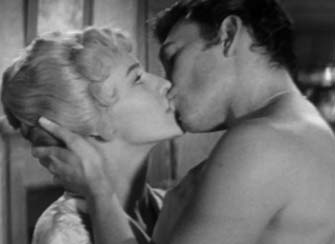
Peter-Wyngarde-kisses-Nicole-Berger

The Siege of Sidney Street is a film which is basically uncluttered with pretentions beyond pure entertainment. And it entertains magnificently well.

Dramatic lighting and rich photography of actual settings – drenched streets, crisp, frosty lines of trees; bleak backstreet lodgings, and a sinister period mood.

Despite the rather hangdog Sinden as a stool-pigeon with an upper-class accent, and Kieron Moore tendency to overplay his hand, the film achieves a certain realism that transcends the level of bad man versus “our man”.

Peter’s portrayal of the handsome yet ruthless gang leader, ‘Peter the Painter’, is ably partnered by Nicole Berger – his loyal yet long-suffering girlfriend. This was a love story as well as a gang man’s siege with a sad and pathetic ending.

On the whole the acting is constantly good, and there are several neat cameos of minor characters, including the then Home Secretary, Winston Churchill, grappling with a Havana as he stations himself (inevitably!) in the front line, and some solid performances from supporting players.

STREET

Several ironic sequences occur, in fact, when characters are made aware of conflicts between “causes” and human conflicts. These more subtle levels of characterisation in a thriller might have easily confused the plot, or sentimentalised it, were it not for the deft storytelling of Jimmy Sangster and understanding direction of Robert S. Baker.

If there is a weak link in the film, then it must be the dialogue, as it’s prone to the excessive use of the shorthand of thriller writing: “Peter wouldn’t like it” or, “It’s better this way, Sara”.

Even in a film that ends in a holocaust, there is possibly unnecessary emphasis on homicide throughout – like one of the more groundling-orientated Elizabethan plays. But violence is implicit in the subject, and rarely degenerates here into the witless bang-banging that replaces originality in so many of today’s movies.

Critics Comments

Click below for…

REVIEW: Alexander the Great

The Story

The danger in making a spectacle is that the widescreen format and the cast of thousands often submerge the central theme and its characters in glittering trivialities. So many of the spate of spectacles in the mid-to-late Fifties suffered in that way. Writer, director and producer, Robert Rossen, however, succumbed to another danger. So passionate was his admiration for Alexander; so sincere was his interpretation of the Warrior’s life and times, that the rambling narrative lost its dramatic momentum and the final result was to instruct rather than entertain.

The greatness of this film is that it represents one man’s conception of Alexander, a conception based on two years study of the documented evidence from both classical and contemporary writers. Rossen saw Alexander as something more than the world’s first great militarist – he drew him as a man convinced that his destiny was to be a god.

aleander the great peter wyngarde tt

Most people may not be aware of it, but Peter – a relative unknown in 1956, was chosen to play the lead role after Rossen saw him play Dunois in ‘St Joan’ at the Art’s Theatre’ in London. Although he was excited about the opportunity of appearing in a major Hollywood blockbuster Siobhan McKenna, his co-star in play wasn’t quite so enthusiastic.

In a private letter to Peter, she expressed her misgivings, saying that while he was ALL Dunois”, he would be sorely miscast as Alexander. Ms McKenna was right. In the end, director Robert Rossen saw it too, and Richard Burton was latterly brought in to take over as the film’s leading man. Peter was then offered the role of Pausanius –the General’s lieutenant and confidant.

It has to be said that Burton was a much better choice. Whilst Dunois was a deep-thinker who was both unswervingly devoted and sexually attracted to his Commander, Joan, Alexander was single-minded and driven by power.

In spite of the obvious shortcomings, the construction of the sets that made use of the natural surroundings for their backgrounds proved very successful. There was none of the unrealistic perspective models that frequently marred Cinemascope productions. The many battle scenes were on a vast scale but were frequently a bit tame.

Thankfully, Robert Rossen didn’t succumb to the temptation to follow in the footsteps of Orson Welles and play the lead as well as direct and write the script. Yet ‘Alexander the Great’ would’ve been a superior film had Rossen sought a second opinion on the script. As it is, it is among the few spectacles that merit intelligent consideration as it made no small contribution to the progress of the cinema.

Making Of…

At the foot of a mountain outside Madrid, muscular Greek warriors were being taken to fight the Persians in luxury – motor coaches! General Alexander, alias Richard Burton, was dealing with the vanquished before the battle had even begun, and Claire Bloom, who was almost stripped to the waist, was a “spoil of war”.

Then a whistle blows for a break in filming. The armies fraternised; Burton eased his blond wig, and Ms Bloom slips into something less scanty than her hostage’s gown. Meanwhile, Peter arrives in Madrid airport, fresh from playing Dunois in St Joan, to play Alexander’s confidant, Pausaunius.

After settling in to his hotel, Peter is welcomed by writer, producer and Director, Robert Rossen. During his first visit to the make-up department, Peter’s hair is lightened from its natural dark brown to blond, and his beard trimmed to a more appropriate 356BC style.

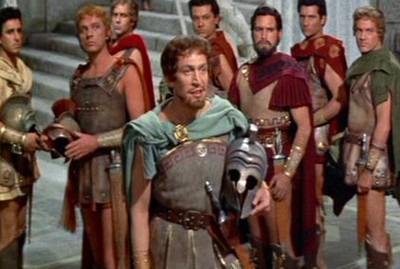
According to well-documented history, Pasaunius – a 20-year-old commander in King Philip’s army, was the lover of both Queen Olypias AND her son, Alexander. Both Peter and Richard Burton feel that this fact is integral to the story, and that it would go some way to explaining the young Macedonian’s infatuation with Alexander and his eagerness to do the Queen’s bidding.

Although Rossen agrees with the two actors in theory, after further study courtesy of the British Museum, The Hellenic Society and the French Classical Dictionary of Great Antiquity, Rossen deem this pre-Christian love- triangle to be too risqué for 1950’s cinema audiences, and decides to leave some of the footage they’ve shot on the cutting room floor.

Scenes ranging from Alexander’s army of 30,000 crossing the Hellespont, the mass wedding of 10,000 soldiers to Persian maidens, and the cutting of the Gordian Knot (which was soaked in acid to make it easier to break), take its toll on Rossen’s $5,000,000 budget, and as a result, many other scenes are cut – including some of Peter’s.

Alexander3

Left: Peter (foreground) as Pausaunius

One sequence that does survive, however, is the assassination of King Philip by Pausaunius, which was filmed mid-afternoon under the relentless Spanish sun. So enthusiastic was Peter at his work that veteran American actor, Fredric March, who played Philip, cries: “Suppress your talent, kid. There’s one more take!”

Peter was also required to ride bareback during one scene, which he’d never done before. The horse he was given had come directly from the set of Lawrence Olivier’s Richard III, which had also been shot in Madrid.

Each evening after filming, Robert Rossen returned to his hotel room to sit down with a tablet of yellow paper – it had to be yellow, as it was the only colour he could work on! – to edit the script. Peter and Richard Burton, meanwhile, stayed in the same hotel, and Burton would often learn Peter to sing old Welsh songs whilst they showered – songs which he remembers to this day.

In the mornings, with the sun blazing, Peter would often strip off his leather armour and took a swim in one of the rock streams which flowed down the mountain to cool off.

Prince Peter of Greece joined the crew on set on one occasion to check on the authenticity of each scene. Rossen wanted the finished film to be as historically accurate as possible, and his assistants were forever seen rushing back and forth with various heavy reference books just to be sure. Of course, there were some things, like the Spanish extras playing both Greeks and Persians- sometimes changing sides during a mornings work!

pw_alex11

On the set, Peter drank chilled milk and mixed with such legendary stars of stage and screen as Peter Cushing, Stanley Baker, Barry Jones and Harry Andrews. In total, actors from 28 countries. Bottles of cold water were regularly handed out to 30,000 or so extras gathered to take part in the Battle of Chaeronea scene, which would end the supremacy of the Athenians and make King Philip of Macedonia leader of all the Greeks.

 For Robert Rossen, ‘Alexander the Great’ was the most ambitious film of his career –the result of a 5 year labour of love involving countless hours of painstaking research. Not usually given to lofty appraisals of his work, Rossen considered his performance in the Director’s Chair to be a serious one; “Everything Alexander said was beautifully, and constrained something worth saying. The utterances of Napoleon were those of a megalomaniac by comparison.”

Peter, who was the original choice to play Alexander, only lost out to Richard Burton at the eleventh hour, said: “At times when we were filming out there in Spain, I often felt very close to Alexander.”

‘Alexander the Great’ was much more than a big, bawling CinemaScope film. It was a symptom of film production in a n age of television.

7525-original

According to American producers at the time, there were only two types of film at the time with enough intrinsic drawing power in the Fifties to lure the constant viewer. On the right, the gigantic-spectacle-historical-panorama-five-thounsand-extras-and-sixteen-fires-in-colour-and-preferably-CinemaScope epic. On the left, the so-called “off beat” picture, usually in black and white, grimly and “diametrically” analysing headline ‘problems’, like juvenile delinquency, Communism, trade unionism, drink/drug addiction, or political skulduggery.

To the producer, the new pattern made business sense. To his public, it offered size and shock, neither of which TV had yet learned to provide.

With $5,000,000 to spend (a fortune in those days), and a distribution contract in his pocket, the Hollywood producer of the 1950’s would try his hand at making the biggest, longest, most colourful film in the world. These cinema blockbusters were prepared with a ripe awareness of social and artistic responsibility and much scholarly devotion.

In Spain, Robert Rossen was joined by actors and technicians from 28 nations to work on ‘Alexander the Great’ – including Prince Peter of Greece who acted as a technical adviser, Andre Andrejew – the Russian-born Art Director, and Robert Krasker who photographed The Third Man and Romeo and Juliet.

With the enormous talent employed in its making, ‘Alexander the Great’ was much bigger than your average greatest-picture-ever-made. But its chief aim was to get the new TV generation way from their home screens and back into the cinema.

And to do that, it had to be GOOD as well as big!

Picture Story

ALEXANDER

King Philip (not pictured) has requested reconciliation with his estranged son, Alexander, who he wishes to lead his armies on a campaign into Europe. Philip, however, demands that four of his generals – including his most loyal companion, Pasaunius, must be sent into exile. The four men reluctantly agree, but upon their departure, Philip mocks Pasaunius, saying: “How will you live without your god, Alexander?”

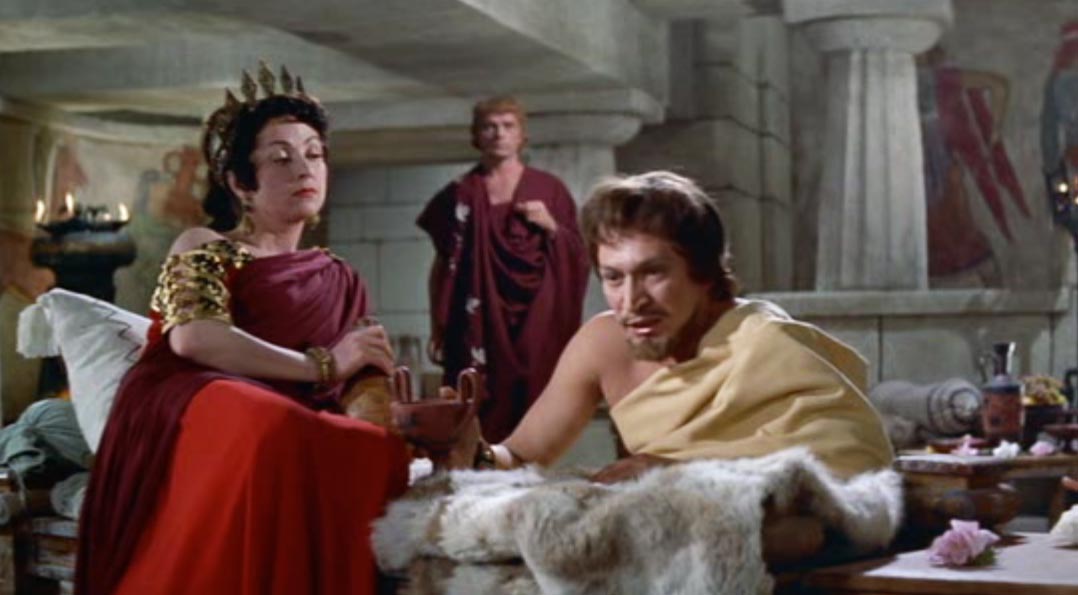
The following evening, Queen Olypias invites Pasaunius to her bedchamber where she plies him with wine. He tells her of Philip’s insult, adding that the King had treated him no better than a stable boy.

Olypias divulges to him something her father once said: “He who wishes to hand his name down for prosperity should kill the person who has accomplished the greatest deeds. Whenever that person is spoken of, he too will be remembered.”

When Alexander arrives to ask his Mother what she has been filling Pasaunius’ head with, she replies: “Nothing that was not already there.”

The following morning, as Philip arrives in Pellas, Pasaunius darts from the cheering crowd and assassinates the King with his sword.

Publicity Materials

Scan2 001

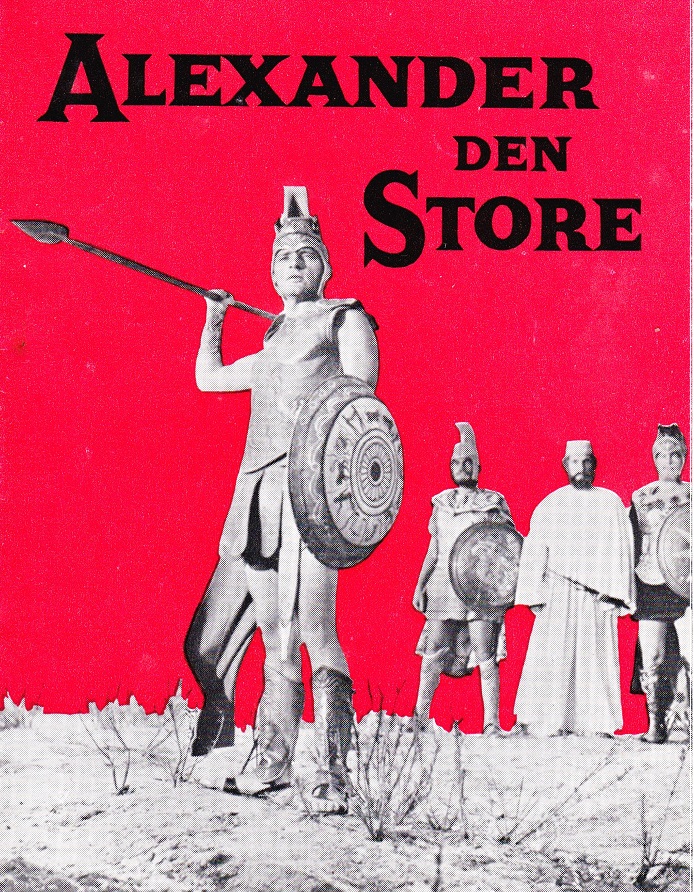
Above: Dutch brochure – Below: Inside

Scan3 001

Scan4 001

Above: (West) German brochure – Below: Inside

Scan5 001

INTERVIEW WITH… Cyril Frankel

department-s_a-cellar-full-of-silence-9

⇐ PETER as Jason King in Department S

PETER had first caught my eye in the controversial ‘Whipping Scene’ with Diana Rigg in the Avengers episode, a Touch of Brimstone.” However, Monty Berman didn’t see the, then, unnamed character in quite the same way as Messrs’ Frankel and Spooner did. “I had to convince Monty to give me a free hand in nurturing PETER”, Cyril explained. “ But firstly a name for the character had to be found. It was PETER who chose ‘Jason’, whilst the wife of actor Michal Bryant – a personal friend of PETER’s, chose ‘King’.

With the formal tweed-wearing university lecturer formally shelved in favour of the elegant and flamboyant King, production began on department S at Associated British Elstree in April 1968, with Randall and Hopkirk (Deceased) being filmed simultaneously.

“I’d been appointed director of the pilot episode of both series,” said Cyril, “their being The Man In The Elegant room in the case of Department S, which had been scheduled for broadcast on September 3rd, 1969 (later replaced by Six Days), and my Late Lamented Friend and Partner for Randall and Hopkirk.”

While it’d had seemed like a good idea at the time, filming working on both series at the same time soon began to take its toll. “It became apparent that I was spreading myself a little too thinly”, Cyril explained, “and I felt that some of the leading actors were beginning to take advantage.”

Frankel was experiencing certain difficulties with Kenneth Cope who played the ghost of Marty Hopkirk: “He could get away with what he wanted with other directors, Cyril said, “but not with me!”

PETER, he claimed, had also started to lead people a merry dance on the Department S set, “Although this was just a trait of his perfectionist nature, rather than anything more sinister.”

While Frankel would sometime incorporate an idea put forward to him by the cast, particularly those presented to him by PETER who was, of course, instrumental in the development of the Jason king character. But if any notion meant disrupting a sequence or altering the concept of a scene, then it would’ve been rejected.

Nevertheless, Cyril felt that Department S was in urgent need of his services, and towards the end of production, he was spending much more time on D.S. than on Randall and Hopkirk, which hadn’t been the plan.

In spite of their differences of opinion, Frankel did acknowledge PETER’s great talent and invaluable contribution to the series, saying: “PETER is a fine actor. I cast him myself, but he did need controlling.”

Frankel ended up directing nine out of the twenty-eight episodes of Department S. One of those stories was a Fish Out Of Water, which he names as his favourite, adding: “It had a certain romanticism about it.” He also named The Invisible Man as his No.1 Champions instalment.

“I have to say that working with PETER wasn’t always easy,” Cyril confessed. “He’s arrive with more and more extravagant ideas about his character. One day he just said, quite matter of factly: ‘It might be nice if I have a falcon on my arm in one scene!’ “When I point blankly refused, he looked at me and said: ‘Oh, you’re just so mediocre!’”

Unfortunately, it wasn’t always a question of whether his ideas were good enough, since Frankel was under great pressure from his employers to get at least twenty-five shots a day on film in order to keep up with the studios hectic schedule. His responsibility as Director was basically to get things done.

With PETER’s popularity at an all-time high, his desire to perfect every word; every scene in the series began to infuriate Frankel: “I saw it as a colossal ego-trip, which cause no end of problems, yet the show’s creator, Dennis Spooner, experienced no disruptive behaviour, and would say: “I think PETER is the finest actor, technically, that I have ever worked with”.

“I think that PETER was the most accomplished actor on TV at the time”, he said finally. “I cast him as Jason King in Department S, and he really hit the jackpot!”


The Hellfire Club: The OFFICIAL PETER WYNGARDE Appreciation Society: https://www.facebook.com/groups/813997125389790/

INTERVIEW WITH… Caron Gardner

Flying high with 007, taking a ticket to ride with the Beatles, a cinema date with the Saint, seeing justice served with Danger Man or soaking up the Riviera sun with Jason King – these are just a handful of examples from the onscreen adventures of actress Caron Gardner.

Caron has enjoyed a prolific career, which has taken her from modelling in the 1950s, through representing ‘London After Dark’ in New York in the 60s and working with Hammer at Bray, plus so much more. She recently agreed to chat about her role as Billie in the ‘Department S’ episode, “Blackout.”

BEACH

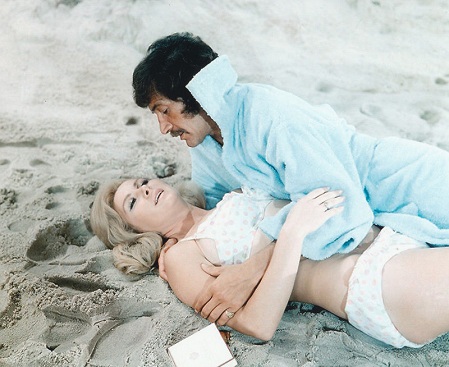
Left: Peter and Caron Gardner

A: When you look around, if anything was anything in the Sixties, you were there. You experienced the best of the times I think.

C: It was a fabulous time! Every job I went for I got. I did the Hammer films. Freddie Francis liked me so whenever he had a film he’d say, “Oh I think you can do this- I think you can do that…” and it was just one thing after another. And television work- I did a lot of things like Benny Hill and Morecambe & Wise before I went to New York. Then when I came back there were lots of things at the BBC I did. Some things I can’t now remember- and when these things come up, when your pictures come up, you sort of think, “When did I do that?” I was flat out!

Peter Wyngarde and Department S

A: Did you audition for ‘Department S’ or did you just get a call through your Agent?

C: Do you know I can’t remember! I do know did have a good Agent called Richard Jackson.

A: Do you recall if you got much rehearsal for ‘Department S’?

C: Well Peter didn’t need much rehearsal because he was so accomplished, and I wasn’t. I have to say that at the time- you know when you do a scene dancing with somebody, in real life you’d look them in the eye? He was looking over my shoulder! Well I know what he was doing- he was looking at the camera. He was aiming at it with his best profile, which is what you do on film. If he’d looked at me all you would see would be two sides of faces. I learned from that.

A: How many days did you do on ‘Department S’ for the role?

C: I can’t remember. I’d have to find my 1960s diaries. I’m better with diaries now, and I was certainly better when I was doing all this advertising and modelling, because I had so many different agents- I had to keep account of who’d paid me and who hadn’t!

A: Did you know Peter before you did the ‘Department S’?

C: No I didn’t. We didn’t really share a social circle; I was just work, work, work in those days. My social life was more Variety Club of Great Britain and the Water Rats. You were mixing with actors and things but it was more on the charity side. For ‘starlets’ it was signing autographs and going to premieres. I didn’t do a lot of stage work. I did my stage work probably in the late 60s, but I didn’t actually do the sort of work he did.

A: Your initial scene with Peter set in the bar, with him coming on to you.

C: I’m sitting on the stool and he starts to talk to me. He’s talking about my face and my eyes, saying, “Does she talk?” or something like that. (Laughs)

A: That’s correct. You were given direction, obviously, just to be inscrutable.

C: Yes, and not say anything and just sort of look- look at the party and just keep still. I’m supposed to be listening, enjoying it but not taking too much notice.

A: Was it difficult to keep that steadiness with Peter beside you?

C: No, because his lovely voice, his rich voice, and the way he spoke- it was just beautiful.

A: Your Director was Ray Austin- how did you get on with him?

C: Oh fine. Yes, he was nice to work with. I wish I’d been to see him actually, when he came back to the UK recently. I looked him up- that’s what you do now with your I-Pad or your computer, you can find out about all these people that you knew all those years ago. I did check him out and I thought, “He’s done well!” (Laughs)

A: So in your appearance with Peter was that your own voice?

C: That was my voice. Or at least I think it was. It sounded like me. I seem to remember doing that beach scene.

A: Towards the end of the scene in the bar Peter leans in to you and whispers something into your ear.

C: I don’t remember what he said! What did he say?

A: Well it’s out of mike range and I just wondered if he’d said anything cheeky to you, that you could remember at the time.

C: He probably would because we were sort of cheeky with each other on the beach. I can’t remember what he said but I think he did it to relax me. (Laughs) Gosh, if only I could remember!

A: I suspect he might have said something saucy…

C: …Probably…

A: something to tease you and try to break your concentration.

C: Well what was my reaction- do you remember?

A: You were perfect- you were fine. I assume you reacted as you were supposed to. You turn out to be well, I was going to say ‘a bad lot’- but I don’t think that’s right. It’s probably more sort of ‘easily led astray’. In the beach scene you talk of, you’re used by the villains to act as a diversion.

C: Well they were supposed to be killing him. I got up, we had this glass of wine- I don’t quite know how I was sent there. Did he invite me? I haven’t seen the show for years.

A: Well I wondered if there was a cut scene because suddenly we jump to a scene where one of the villains’ henchmen is temping you with a bundle of cash- just to take Peter down to the beach and out of the way.

C: I don’t remember that. Gosh! I was luring him to be there and positioning him for being shot I suppose. Then I go to talk to him or kiss him or something and I get it!

A: Yes. He’s being a bit chauvinistic- he sends you down to the bottom of the beach, to get the wine out of the sea (Laughs). A bit naughty! And then you come back and you’re just about to get along with Peter and (as you say) you reach up to kiss him, and you end up in the way of the sniper!

C: So they didn’t get him after all…

A: No. So there’s poor old you, flat out at the end of beach if you remember.

C: (Laughs) Gosh, I’ll have to see this again!

A: Did you do separate publicity shots, because there are one or two of you on the beach?

C: They probably did them in between shots I think. We’re posing on the beach, aren’t we? Just looking at the camera. Then there are dancing ones too.

A: That’s right, yes. Taken in the round what was Peter like to work with on the show?

C: Well as I said I was quite in awe of him because of his professionalism and how much he’d done, and how little I had done. I have to say that I was so thrilled to work with Peter because here was this handsome man. He had a moustache like my father – my father was very handsome. My father had lots of hair like Peter had, except that my father’s was by then very white. Peter had the handsome face, the clothes, the Windsor type knot, and the way he dressed – he was a dandy. It was the look of the day, wasn’t it? (A: Yes, it was).

He was charming- absolutely charming, and I was just thinking, “Why isn’t he looking me in the eye?” and I then did realise afterwards that’s what you do. You have your angles not to look into the camera, but to have the best look, rather than facing into me. It was a good lesson for me. But he was so solid, in what he was doing and in a way that’s quite reassuring.

When I first met him we were doing that scene on the beach, and they wanted him to have a bare chest and he was insisting that he wear his blue towelling beach jacket. There was a little bit of an argument about it. It was a nice blue- and he was right you know, because it actually fitted the scenery. With the beach and trees and thing, the blue stood out. I don’t know whether he didn’t want to show his chest, but he won the day. He said, “I’m keeping this on- I’m keeping this on!” (Laughs)

A: That would have been a beach on a soundstage presumably?

C: Yes- unfortunately, only Elstree.

A: The notoriously tight ITC budgets! Did you get to meet either of the other leads, Rosemary or Joel?

C: Yes I did- Joel Fabiani and Rosemary- what was her surname? (A: Nichols) Nichols, yes. Yes, everybody was very friendly, very chatty; is she still here, in England?

A: Very difficult to say because she slipped off the radar very soon after ‘Department S’

C: I seem to remember her talking about living in a different country.

A: She became an Astrologer or something, it’s said. Some people are a little disparaging about her acting ability when they talk in terms of ‘Department S’. I met Jeremy Wilkin at Westminster and we got talking about ‘Undermind’ – the series he starred in with Rosemary – he was full of praise for her.

C: I would have said in ‘Department S’ it was an understated role, but it was perfect for the part she was playing. I do remember her and that she was so cool and so efficient at what she was doing- which was her role in that, wasn’t it?

A: It was indeed, yes – to be the efficient computer expert.

C: It’s funny how that’s stuck with me, isn’t it? (Laughs)

A: Have you met up with Peter since you did ‘Department S’

C: Well you and I sort of said hello at the Birmingham Memorabilia event earlier this year, but it was very brief because you were chatting to Shirley Anne Field and so I went to talk to Peter, then Angela Douglas came over. She grabbed him while I was in the middle of a conversation with him, so that was it- that was the end of my contact! (Laughs) How dare she! How dare she! (Laughs) However, I’d met him before at signings and we’d sat together and he’s still lovely!

Caron’s screen adventures mean that she keeps busy these days, making appearances by popular demand at film fairs and events all over the country. Her singing talents are similarly in demand and she takes great enjoyment in her musical career.

ACKNOWLEDGMENTS

I’d like to give my sincere and grateful thanks to Caron for generously giving her time for this interview and for sharing so many unique and fascinating details of her career.

Thanks also to Tina Wyngarde-Hopkins for initiating the project.

© 2016, Al Samujh


© Copyright The Hellfire Club: The OFFICIAL PETER WYNGARDE Appreciation Society: https://www.facebook.com/groups/813997125389790/