

The Story
Released in 1960, The Siege of Sidney Street is a compelling British crime drama that dramatises one of the most notorious criminal episodes of Edwardian London. Directed by Robert S. Baker and Monty Berman, the film stars Peter Wyngarde, Donald Sinden, Nicole Berger and Kieron Moore. It is based on the real-life events of the Tottenham Outrage and the subsequent siege of Sidney Street, incidents that profoundly shocked Britain in the years preceding the First World War.
More than sixty years after its release, the film remains a significant example of British historical crime cinema. By blending elements of the police procedural with political intrigue, action, romance, and tragedy, it functions not merely as a historical retelling but as a sophisticated human drama. While certain facts were altered or compressed for dramatic effect, the film skilfully captures the atmosphere of fear and uncertainty that characterised the original events.
The narrative begins with armed police surrounding a house in London’s East End. As tension mounts, the story shifts into a flashback, detailing how a group of immigrant anarchists became embroiled in the series of robberies and murders that culminated in the famous siege. This structural choice is highly effective, establishing immediate suspense before systematically revealing the chain of events leading to the confrontation.
One of the film’s primary strengths is its atmospheric direction. The directors create a vivid portrait of Edwardian London, characterised by grimy, threatening streets and claustrophobic lodging houses, all set against a backdrop of social unrest. The film presents a city living under the shadow of violence and political extremism; despite a relatively modest budget, the production maintains a scale and authenticity that make the setting entirely convincing.
The central conflict involves revolutionary émigrés funding their political cause through criminal activity. The group is composed of idealists, hardened criminals, and those occupying a morally ambiguous middle ground. This complexity elevates the film beyond a simple “cops and robbers” narrative; while the anarchists are depicted as dangerous and often brutal, the script occasionally provides insight into the motivations driving their actions.
As Inspector Mannering, Donald Sinden provides a reliable point of entry for the audience. His performance is understated and believable, avoiding the clichés of a conventional action hero. Instead, Mannering relies on intelligence and persistence, and Sinden effectively conveys the calm professionalism of an officer navigating a rapidly escalating crisis.
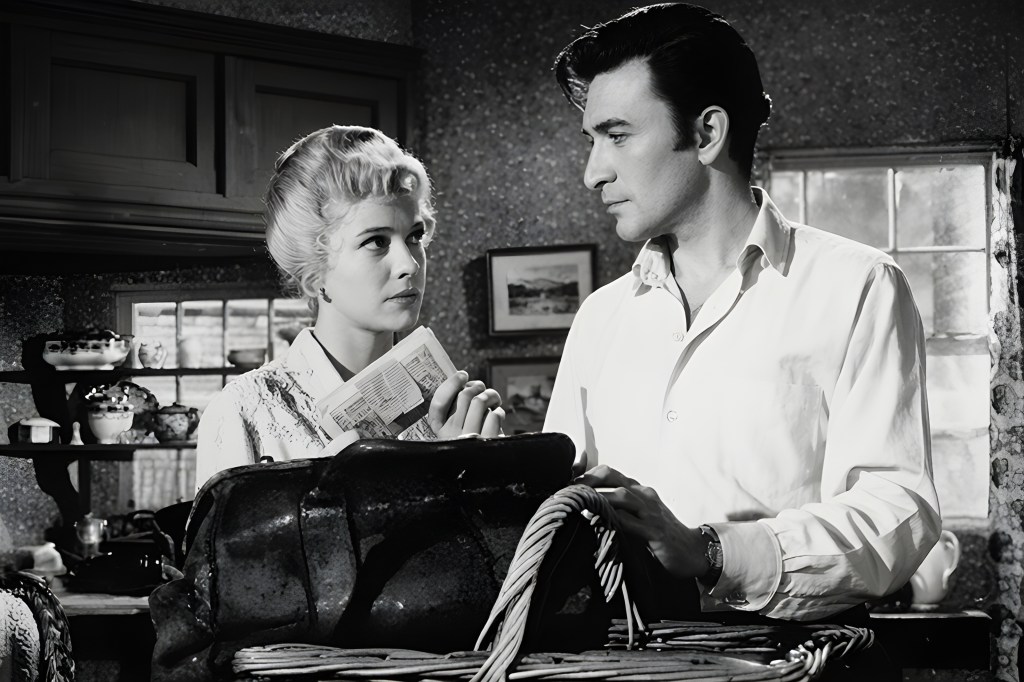
The romantic subplot involving Sara, played by Nicole Berger, adds an emotional dimension that prevents the film from becoming a mere catalogue of violent incidents. Sara is portrayed as a woman caught between her loyalty to “Peter the Painter” and the dangerous world in which he operates. Berger delivers a sensitive performance, portraying a woman torn between love and survival, and her character serves as the film’s conscience, reminding the viewer of the personal cost of fanaticism.
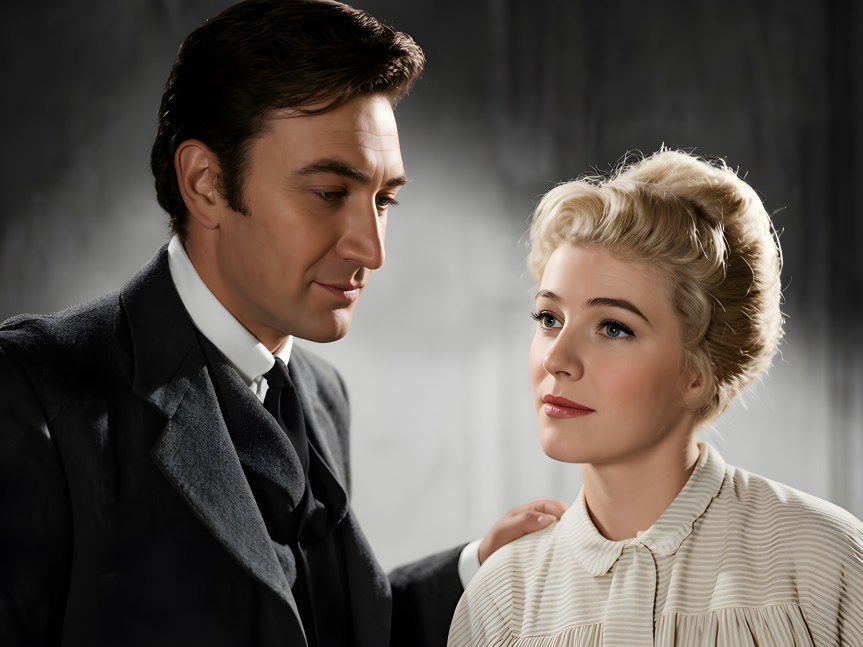
Above: Peter with Nicole Berger
Finally, the film’s most fascinating figure is undoubtedly Peter the Painter, who is portrayed by Peter. Although his greatest fame as Jason King was still years away, Peter demonstrates many of the qualities that would later make him one of the most distinctive stars of British television.
Peter the Painter is portrayed as a charismatic, intelligent, and ruthless figure. Departing from the trope of the simple cinematic thug, he possesses an air of sophistication and mystery that renders him simultaneously alluring and dangerous. Peter commands the screen upon every appearance; even in scenes featuring other strong performers, the viewer’s attention naturally gravitates toward him.
The performance is particularly noteworthy for its restraint. Peter avoids the temptation of a theatrical villain, instead suggesting menace through confidence and composure. His character rarely needs to shout or threaten, as the danger remains an understated presence beneath the surface. This nuanced approach results in a far more effective antagonist than a more flamboyant interpretation would have achieved.
The emotional core of the film is found in the relationship between Peter and Sara. Despite Peter’s criminal trajectory and increasingly desperate circumstances, the audience can discern why Sara remains devoted to him. The convincing chemistry between Peter and Nicole Berger lends credibility to a partnership that contributes significantly to the story’s tragic conclusion.
Visually, the film is striking. The cinematography effectively captures both the grandeur and the squalor of Edwardian London, employing a documentary-like quality that enhances the sense of realism. The directors make excellent use of period settings, and the production design successfully recreates a world poised between Victorian tradition and the dawn of the twentieth century.
The action sequences are similarly effective. The robberies, police pursuits, and gun battles are staged with considerable energy. Unlike many British films of the era, which often treated violence with restraint, The Siege of Sidney Street does not shy away from the lethal consequences of armed confrontation. The violence remains controlled and purposeful, yet it carries a genuine impact.
The climactic siege is undoubtedly the film’s highlight. Drawing upon the infamous real-life event in which police and troops surrounded fugitives in London’s East End, the sequence generates sustained excitement and tension. As the house is engulfed in flames and the confrontation reaches its inevitable end, the film achieves a level of dramatic intensity that remains impressive today. Contemporary accounts of the production noted the meticulous care taken with the fire effects, and the results remain convincing on screen.
If the film has a weakness, it is the limited development of some supporting characters. Due to the large ensemble, certain members of the anarchist gang appear interchangeable, particularly during the middle act. However, this is a minor criticism in an otherwise engaging production.
Ultimately, The Siege of Sidney Street is distinguished by its refusal to rely on simplistic moral divisions. While the police represent order and the anarchists represent violence, the film allows for human complexity on both sides. This results in a narrative that feels richer and more nuanced than many contemporary crime dramas.
Today, the film remains notable not only as an entertaining historical thriller but also as an important early showcase for Peter. Long before becoming one of Britain’s most recognizable television personalities, he demonstrated here the charisma and magnetic screen presence that would define his career. As Peter the Painter, he delivers a performance that is both stylish and compelling, elevating a strong film into a memorable one.
Viewed now, The Siege of Sidney Street stands as one of the more accomplished British crime dramas of the early 1960s: atmospheric, exciting, intelligently written, and anchored by an excellent cast. While Donald Sinden provides the story’s moral centre and Nicole Berger its emotional core, it is Peter’s enigmatic revolutionary who lingers longest in the memory, ensuring the film’s enduring appeal.

Above: Norwegian promotional brochure.

Above: Inside – showing a scene with Peter and Tutte Lemkow

Critics Comments

| Whenever Peter Wyngarde appears on television a cry goes up from many fans who write to us asking: “Why don’t we ever see Peter in a really big role on the cinema screen?” Well, you haven’t agitated in vain. For here Mr. Wyngarde is the mainspring of a fascinatingly different spy tale. His sharply elegant good looks mask the mind of a fanatic prepared to sacrifice life and happiness for his chosen cause. Yet he’s also a man who can inspire the kind of love in a girl that suffocates every other emotion. Both as the icy fanatic and the passionate lover, Peter is utterly convincing. The dark brown voice can be as warm as a caress; as ruthless as a razor slash. That he should make such a devastating impact in his first sizeable role will surprise no one who has seen him on television or the stage. What is his appeal? I think it is the aura of excitement he carries around with him. And in this film, the excitement isn’t misplaced. Margaret Hinxman: The Daily Mail, October 25th, 1960. |

| This turns out to be quite a lively version of a gangster episode that had the East End of London on its ears early in 1911. It’s a re-vamp [from a story by Jimmy Sangster] of the celebrated incident when a gang of Russians brought out the police and the army before they could be smoked out of their hideout in Sidney Street. In straightforward fashion, this shows Donald Sinden as a dedicated police officer who patiently tracks down the gang of Russian patriots, led by a character named Peter the Painter (Peter Wyngarde). They robbed allegedly to gain funds for their cause, which was anarchy. By disguising himself as a down-and-outer, Sinden eventually gets the thugs penned up. The result was one of the bloodiest gangster scenes that London has ever known. The East End of London in 1911 is vividly brought to life, direction is sound without being over- emphasized while the final siege is an exciting sock climax. Wyngarde gives an alert, strong portrayal of the quiet but ruthless top gangster. Kieron Moore, a trigger-happy lieutenant, and Leonard Sachs, as an older but equally devoted member of the cause, are also first-rate. Sinden, as the cop, tends to play much on same note, but his is a comparatively colorless role compared with those of the Russo thugs. |
Click below for…


2 thoughts on “REVIEW: The Siege of Sidney Street”