The Parson’s Son. Broadcast: Sunday, 1st June 1958
The Taking of the Walrus. Broadcast: Sunday,8th June 1958
The Winning of the Treasure. Broadcast: Sunday, 15th June 1958
How The Treasure Was Buried. Broadcast: Sunday, 22nd June 1958
The Honest Seaman. Broadcast: Sunday, 29th June 1958
Marooned. Broadcast: Sunday, 6th July 1958
Character: John Silver
Broadcast live from Ealing Studios, The Adventures of Ben Gunn (John Moffat) was the biggest production since the BBC took over the studios. Complete with a giant wave machine and mock-up of a Spanish galleon Director, R.F. Delderfield, and Producer, Desmond O’Donovan, had made the most of the soundstages for their sequel to Treasure Island.
Below Right: Peter as John Silver in the episode, ‘The Winning of the Treasure’
The series not only explained how Ben Gunn came to be a pirate, but by what means Captain Flint (Rupert Davies) came by the treasure and why he buried on that particular island. Viewers also learned how Billy Bones (Olaf Pooley) found the famous map, how Long John Silver (Peter Wyngarde) lost his leg and took over as Captain after the death of Flint.
Long John Silver probably means a stubble beard, one leg and an evil eye to most of us. If so, the whole of Britain’s television-viewing public must’ve had quite a shock when they switched on their sets on the afternoon of June 1st, 1959, to see the grouchy old pirate being played by a very young and sophisticatedPeter Wygarde.
Long John on this occasion was one of the characters in ‘The Adventures of Ben Gunn’, which the BBC serialised in six weekly episodes.
But wasn’t the role of Long John a rather odd one for such a renowned smoothie: “Long John had usually been played by actors such as Bernard Miles or Robert Newton, who was a Cornishman.
“In previous productions he had therefore always had some sort of country accent. I played Long John absolutely straight. In this series he was a young man – about 30 years before the Long John of Treasure Island”.
According to this particular account, Silver comes from a good family; is well educated, but like most young people, he has a sense of adventure, so he joins up with a gang of marauding pirates.
“It was only subsequently when Long John became greedy for money that he also became gross and uncouth. That was my interpretation of the situation anyway”, said Peter.
At the time that the series was aired, Peter was appearing nightly as the libertine Marcellus in Duel of Angels at London’s Apollo Theatre. Did the two parts ever come into conflict with him? Apparently not!
“An actor playing a meaty, tricky role likes nothing better than to relax in a different part,” he said.
Strangely, he says that he did find some features in common in the two parts. “Some of the basic ideas were very much the same”, said Peter.
PIRACY – A DANGEROUS BUSINESS
During the filming of The Adventures of Ben Gunn, Peter ended up being rushed to the hospital when a fight scene went disastrously wrong.
During rehearsals, the careful choreographed sword fight between Peter and Olaf Pooley had gone swimmingly and according to plan, but once Director, R.F. Delderfield, called “Action!”, Pooley seemingly lost his mark and ended up plunging his rapier straight through Peter’s right knee.
After the studio nurse determined that Peter’s injury was serious enough to require hospital treatment. An ambulance was called, and he was carted off with the rapier still protruding from his knee!
In December 1980, the film Flash Gordon first hit cinema screens like a bolt of lightning, and on Saturday, 28th November, 2016, the cast and crew once again were reunited for a celebration of the iconic film.
Above: Limited edition brochure
The Guest List
PETER WYNGARDE – General Klytus
Sam Jones – Flash Gordon
Melody Anderson – Dale Arden
Brian Blessed – Prince Vultan
Mike Hodges – Director
George Gibbs – SFX Supervisor
Trevor Butterfield – Hawkman
Brian Cook – 1st Ad
Howard Blake – Composer
The evening took place at BAFTA, 195, Piccadilly, for a black tie event with other UK celebrities such as Matt Berry, Nicky Clarke and Marcus Brigstocke.
A welcome reception featuring original props from the film was followed by a screening of the 1980 classic, and a Q&A panel hosted by Jason Lenzi – founder of Biff Bang Pow!
Above: Cast and crew on stage for the audience question and answer session (Peter is fourth from the left)
An account of the evening By Martin Lakin
In December, 1980, the film Flash Gordon first hit cinema screens like a bolt of lightning, and on Saturday 28th November, the cast and crew once again were reunited for a celebration of that iconic film.
Creator and Show Producer Lisa Downs, event company Sledge, and sponsors Rosewood London, Stress Free Print, and Addison Lee, brought together Peter Wyngarde, Sam J Jones, Melody Anderson, Brian Blessed, Mike Hodges, Howard Blake, George Gibbs, Trevor Butterfield, Dave Watson and Brian Cook for a night of celebration.
The evening took place at BAFTA 195 Piccadilly, for a black tie event with other UK celebrities such as Matt Berry, Nicky Clarke and Marcus Brigstocke.
A welcome reception featuring original props of the film, was followed by a screening of the 1980 classic, and a Q&A panel with host Jason Lenzi – founder of Bif Bang Pow!
To help celebrate this historic event, artist Alex Ross created a stunning and unique print inspired by the occasion that was available to all ticket holders, before being released as a print to the public this year.
The evening also raised money for the charity “MediCinema”.
I think it was Sam Jones himself that first hinted a Flash Gordon reunion could potentially be taking place in London – city of its production 35 years earlier – on his Facebook page. The rumours would persist as months went by and as footage from the ‘Life After Flash’ documentary steadily emerged an Indiegogo campaign popped up out of nowhere to make it official and make it happen.
Much as I had longed for such an occasion I was initially sceptical. The target seemed ambitious to say the least and as I had envisioned more of a traditional ‘con’ type event I was surprised that the ticket price was so high (even though the incentives were admittedly very tempting.) so with a heavy heart I resigned myself to not attending.
Anyways, a black tie event at BAFTA? really? This was a celebration of geekdom in the extreme for a movie that is almost the perfect definition of cult, not exactly Merchant Ivory. Where were the autograph opportunities going to be? Why do we need a screening of the film we obviously all know and love and have probably seen a thousand times already? I just didn’t understand it.
Then, a couple of revelations. First was from show organiser Lisa Downs who I had emailed (not expecting a reply) who turned out to be not only open to ideas, (I mean, who the hell was I to try and influence which direction her event should take?!) but listened carefully and considered my suggestions. When some were implemented she had me on board for good and was willing to help in any way possible. But even though she was a pleasure to talk to I still wasn’t convinced.
Word had obviously spread by now as my very good friend Chris King had gotten in touch to say he’d already bought tickets so why on Earth hadn’t I? Besides being a lifelong fan, Chris had briefly crossed the border into Tinseltown itself by having his Rocket Cycle research adapted for a full-scale recreation of the prop for the movie TED a few years back so was very keen to mix it up with the guests.
As the weeks went by and contributions went up and up I started to believe there may be some merit to this thing after all – and then the whirlwind that is Jason Lenzi breezed across this site and straight into my inbox with such unbridled enthusiasm that I was reconsidering going just to meet him – The final impetus for buying the ticket (besides the campaign actually hitting the target!) was the wonderful Bob Lindenmeyer. We had been in touch for some time regarding my Flash costume reproduction and he had assured me he’d be bringing along some items from his astounding collection, including the iconic sword and red tank top. Now that I couldn’t miss, even if the event didn’t live up to expectations…
After the months of buildup, the night itself seemed to come literally in a Flash. Chris, his lovely girlfriend and I pulled up in a taxi in our Sunday best outside of BAFTA in Picadilly and were astonished to see crowds of autograph hunters and paparazzi outside waiting on the celebs. Right then and there I realised my perceptions about this whole deal had been wrong. Far from a busy, sweaty con, this was Oscar Night on Planet Mongo and we were there for the afterparty.
BAFTA itself is an appropriately grand building adorned with black & White portraits of stars old and new. In stark contrast to the plain walls of the David Lean room was the colourful table of Flash props and costumes as promised, all 100% accessible and meticulously laid out . After a warm greeting from the girls at the reception we took our VIP passes and hurriedly went over to realise the first of many boyhood dreams…
Standing proudly next to his artefacts, Bob Lindenmeyer was the first person we encountered. Having emailed back and forth so long it was such a pleasure to find Bob every bit as cool and savvy a character as you could hope to meet. He’s well aware of the significance of his items to fans and is pleased to share it – even offering the opportunity to handle these most rare of props. As with most screen-used items, up close they are surprisingly rough and thrown together and all the more fascinating for it. Just to know these things were actually on set all those years ago was worth the admission price alone.
Despite a glittering guest list, my biggest disappointment early on was the cancellation of the long-touted Ornella Muti. I had consoled myself with the idea there would only be fleeting glimpses of the celebs on the night anyway so It mattered not. Wrong again. The stars not only made an appropriately glamorous entrance, but went straight into meet & greet with the crowd. Before I even knew what was happening I had my arm around Dale Arden herself, and she came to me!!
If you have ever had the privilege of meeting the delightful Melody Anderson before you will know what I’m talking about. Personable, grounded and no end of fun she was a sheer delight.
I had in no way expected what was basically a social gathering with the stars where you were free to rub shoulders and take pics with them while enjoying (several) drinks. No con I had ever been to had come close to the sheer class of this night and to think I had given it no credit. Credit was, unsurprisingly, all due to Lisa, who had shattered all my misconceptions thus far. But there was much more to come…
Sam J. Jones is the living embodiment of a comic-book hero. Literally larger than life with beaming smile and gravelly voice, his swagger alone is enough to convince he could save every one of us. Commanding the room with his beautiful wife beside him, Sam cut a gentle swathe through the crowd, taking time to speak to everybody. This was, justifiably, his night and it was a delight to see him interact with fans.
Contrary to the schedule as illustrated on our passes – (another great design, Bob at it again!) the screening was already an hour late and there was a Q&A to follow! though the socialising could’ve gone on and on we were finally ushered into the Princess Anne Theatre to take our seats. The setting (red drapes etc) was perfection and even though everybody present must have seen the picture many times there was definite anticipation in the room.
First to take the stage was Lisa and after a short introduction an exclusive trailer (featuring new footage) for Life After Flash played out to a captive audience, followed by a genuinely touching trailer for MediCinema. For the unitiated as we were, it is clearly a very worthy cause.
I had emailed Lisa ahead of time to ask about the condition of the print, as having seen some other films from the era screened unrestored looking dirty and horribly dated I was concerned it might spoil the experience. In fact, having not seen it theatrically since my dad first took me to the Kings 123 Cinema in West Bromwich in 1980 I was full of trepidation. Would I enjoy it as much? Could it still hold up on the big screen?
In fact, the crystal clear print and booming sound were the least of it. What made it so rich was the atmosphere and reactions of my like-minded fans I was fortunate enough to be surrounded by. While not quite a sing-along event Rocky Horror style all the famous lines (you can imagine which) drew the appropriate responses and it lived up to my every expectation.
Take my seat for the phonecam video above which manages to convey the sheer awesomeness of the post-screening Q&A session better than I could ever express. Kudos to the comparing talents of Jason Lenzi who had the unenviable job of trying to restrain the uncaged beast that is Brian Blessed in full flow while challenging the rest of the panel with some inspired and original questions.
Missing from the video is the closing of the panel which was a long letter (read aloud by Brian Blessed) from a relative of Dino De Delaurentiis bringing some much needed closure to any misunderstandings that had endured in the intervening years and thanking everybody for their contribution. This was echoed by Sam Jones who was keen to set the story straight about his allegedly turbulent relationship with the Producer, acknowledging him for providing his big break.
Heading back the the David Lean room with mind positively swimming by now I wondered what else could possibly top the evening so far. I was pulled from my daze by Flash Fan Rob Beardsley who recognised me from the site and introduced himself. Rob is a friendly giant and we hit it off immediately (look out for contributions from his great collection in future posts). As we talked about what precious memorabilia we’d managed to snag already on the night I noticed none other than Mike Hodges himself was trying to enjoy a quiet drink but was in fact being mobbed. I waited for the crowd to disperse a little and slid my programme under his pen to sign while thanking him for making such a ground-breaking movie. As I turned round I bumped into Sam and did the same – Curiously I had not seen Bob Lindenmeyer since I noticed he left the screening 10mins in and when he reappeared looking smug I had to ask where he’d been. His bombshell was that the cast had been sat in the adjacent Green Room during the show catching up on the last 35 years with hilarious results, and he had witnessed it all. Before I had chance to say how much I envied him he hurriedly beckoned me over with my camera as apparently something very special was about to take place…
Preferring to avoid the crowds, legendary British actor Peter Wyngarde had taken quiet refuge by the reception desk and was sat observing the furore. Sensing opportunity, Bob had yanked out the Klytus mask and hood from his prop display and had been granted an audience by his representative, beckoning me over to capture the moment on camera. And what a moment it was. Peter seemed as genuinely touched to be presented with his iconic costume as Bob was pleased to show him (read Bob’s reaction below). Of all the staggering occurrences that had befallen me so far, this was top amongst them.
Bob was on a roll now and had gotten the attention of Mike Hodges, also having been shown the Klytus mask was then given a guided tour of the costumes and props and seemed just as bewildered by their presence as the fuss all around him. With so much effort made to bring these precious relics across the pond, Bob had earned every plaudit and was clearly enjoying the responses provoked…
Catching up again with Chris King as the evening was coming to a close he told me how he longed to speak to Sam about his efforts to recreate the Rocket Cycle for Ted but was hesitant to approach. Sam had worked the room long and hard all night, not once denying any fan his time and attention with his beautiful wife patiently watching from the sidelines. Eventually Chris seized his moment and told Sam all about his endeavours to accurately reproduce the famous prop. Sam seemed genuinely impressed, mentioning the producers had gifted it to him and it was now parked in his garage, which Chris was overjoyed to hear and made his night…
One item of merchendise that I had never quite managed to obtain to date was the Flash orchestral score on CD, a desire compounded by having just listening to the affable composer’s fascinating stories about its creation. Missing out again by not winning the several copies raffled out earlier I was amazed to see a few randomly appear on the programme table available to purchase there and then for a donation to MediCinema!
Buying it up quickly I turned to see an empty space where Howard had been standing and was told that he had just left for the evening. Due to all the other lucky encounters so far It felt churlish to not be able to get his autograph on the cover so didn’t worry but then Bob dashed back into the room saying ‘Howard is still here!!”. Never had rapid removal of cellophane felt like such a pitched battle but just as Howard slipped his raincoat on, my Sharpie was in his hand and my night just kept getting better – With that the event was drawing to a very satisfactory close and the guests had started to make good their escape. I felt I should shake the hand of Sam J. Jones just one more time to at least try and show my gratitude to him for continuing to be such a positive influence and class act. As ever, his grip is solid and the response genuine.
Finally, as the parting gift of Special Edition Alex Ross Flash posters in their cardboard tubes were hauled away by all, I couldn’t leave without saying goodbye to Lisa Downs and thanking her for efforts in transcending this event from the potentially mundane to the positively sublime. I already felt so totally spoiled by the experience to the point where I imagine no con could ever aspire to it . Bashful and sweet, Lisa thanked us for coming and for all we know probably collapsed from exhaustion under such pressure soon as the doors were closed. From the funding campaign to the BAFTA stairwell the whole thing rested on her tiny shoulders and she had managed to put on the fanboy celebration to end them all. For this and the unimaginable encounters in between I will be eternally grateful.
Preferring to avoid the crowds, legendary British actor Peter Wyngarde had taken quiet refuge by the reception desk and was sat observing the furore. Sensing opportunity, Bob had yanked out the Klytus mask and hood from his prop display and had been granted an audience by his representative, beckoning me over to capture the moment on camera. And what a moment it was. Peter seemed as genuinely touched to be presented with his iconic costume as Bob was pleased to show him (read Bob’s reaction below). Of all the staggering occurrences that had befallen me so far, this was top amongst them.
Bob was on a roll now and had gotten the attention of Mike Hodges, also having been shown the Klytus mask was then given a guided tour of the costumes and props and seemed just as bewildered by their presence as the fuss all around him. With so much effort made to bring these precious relics across the pond, Bob had earned every plaudit and was clearly enjoying the responses provoked…
Catching up again with Chris King as the evening was coming to a close he told me how he longed to speak to Sam about his efforts to recreate the Rocket Cycle for Ted but was hesitant to approach. Sam had worked the room long and hard all night, not once denying any fan his time and attention with his beautiful wife patiently watching from the sidelines. Eventually Chris seized his moment and told Sam all about his endeavours to accurately reproduce the famous prop. Sam seemed genuinely impressed, mentioning the producers had gifted it to him and it was now parked in his garage, which Chris was overjoyed to hear and made his night…
One item of merchendise that I had never quite managed to obtain to date was the Flash orchestral score on CD, a desire compounded by having just listening to the affable composer’s fascinating stories about its creation. Missing out again by not winning the several copies raffled out earlier I was amazed to see a few randomly appear on the programme table available to purchase there and then for a donation to MediCinema!
Buying it up quickly I turned to see an empty space where Howard had been standing and was told that he had just left for the evening. Due to all the other lucky encounters so far It felt churlish to not be able to get his autograph on the cover so didn’t worry but then Bob dashed back into the room saying ‘Howard is still here!!”. Never had rapid removal of cellophane felt like such a pitched battle but just as Howard slipped his raincoat on, my Sharpie was in his hand and my night just kept getting better – With that the event was drawing to a very satisfactory close and the guests had started to make good their escape. I felt I should shake the hand of Sam J. Jones just one more time to at least try and show my gratitude to him for continuing to be such a positive influence and class act. As ever, his grip is solid and the response genuine.
Finally, as the parting gift of Special Edition Alex Ross Flash posters in their cardboard tubes were hauled away by all, I couldn’t leave without saying goodbye to Lisa Downs and thanking her for efforts in transcending this event from the potentially mundane to the positively sublime. I already felt so totally spoiled by the experience to the point where I imagine no con could ever aspire to it . Bashful and sweet, Lisa thanked us for coming and for all we know probably collapsed from exhaustion under such pressure soon as the doors were closed. From the funding campaign to the BAFTA stairwell the whole thing rested on her tiny shoulders and she had managed to put on the fanboy celebration to end them all. For this and the unimaginable encounters inbetween I will be eternally grateful.
Peter said that being reunited with the mask was like meeting an “old friend”.
The evening helped to raise money for charity ‘Medicinema’.
Below: The Cast and Crew Q&A
New Poster How it was created
To help celebrate this historic event, artist Alex Ross created a stunning and unique piece of artwork (above), inspired by the occasion that was available to all ticket holders, before being released a print in 2016. Various copies of the poster will be signed by the cast and sold for charity at the event.
After almost a year’s detailed and intensive preparation, Dino De Laurentiis’ production of Flash Gordon started shooting in England on Monday, August 6th, 1979. The highly ambitious space epic, designed by Danilo Donati was spread over six sound stages at Shepperton Studios, the entire ‘Star Wars’ facility at EMI Borehamwood, plus a large complex at Brooklands, Surrey.
The cast chosen by De Laurentiis and Mike Hodges had a distinctly international flavour and featured talents both young and old to the movie industry. twenty-six year old American, Sam J. Jones, only 10 months a professional actor, portrayed the legendary Flash Gordon, whilst the part of Dale Arden is played by Canadian-born actress, Melody Anderson.
Sweden’s Max Von Sydow dug deeply into his repertoire of menace to portray Emperor Ming the Merciless. The role of Doctor Hans Zarkov, nuclear scientist who foresees the final destruction of the Planet Earth and attempts to stop it, was played by Chaim Topol.
From Italy came two of Europe’s brightest prospects. Ornella Muti was the mysterious Princess Aura and Mariangela Melato played the callous Kala of Ming’s secret police.
Among the British actors, Prince Vultan – leader of the Hawkmen, was played by Brian Blessed. Timothy Dalton, with a list of film, television and film credits behind him was chosen as Prince Barin of Arboria, with Peter Wyngarde portraying General Klytus, the controller of the Mongo Secret Police Force.
Emperor Ming the Merciless declares that he will first play with and then destroy the Earth using natural disasters. On Earth, New York Jets football star “Flash” Gordon boards a small plane, where he meets travel journalist Dale Arden. Mid-flight, the cockpit is hit by a meteorite and the pilots are lost. Flash takes control and manages to crash land into a greenhouse owned by Dr. Hans Zarkov. Zarkov, who believes the disasters are being caused because an unknown source is pushing the Moon towards Earth, has secretly constructed a spacecraft which he plans to use to investigate. Zarkov’s assistant refuses to go, so he lures Flash and Dale aboard. The rocket launches, taking them to the planet Mongo, where they are captured by Ming’s troops.
The three are brought before Ming. He orders Dale be prepared for his pleasure. Flash tries to resist, but is overpowered. Ming orders Zarkov be reprogrammed and Flash executed. Ming’s daughter, Princess Aura, seduces Ming’s surgeon into saving Flash, to whom she is attracted. As they escape, Flash sees Zarkov being brainwashed by Klytus, the metal-faced head of the secret police. Aura and Flash flee to Arboria, kingdom of Prince Barin, Aura’s lover. En route, Aura teaches Flash to use a telepathic communicator to contact Dale. He lets her know he is alive. Dale is locked in Ming’s bedchamber, but encouraged by Flash, she escapes. Klytus sends Zarkov to intercept Dale, who tells him and Klytus that Flash is alive. They then escape, as Zarkov reveals he resisted the brainwashing. They are captured by Prince Vultan’s Hawkmen and taken to Sky City.
Aura and Flash arrive at Arboria. Aura asks the Prince to keep Flash safe. A distrustful Barin, in love with Aura, agrees not to kill Flash, but then forces him to perform a deadly ritual. Barin and Flash take turns sticking their hands into a hollow stump with a giant scorpion-like Wood Beast inside. When Flash has to take an extra turn, he pretends to be stung as a distraction and escapes. Barin follows, but they are both captured by the Hawkmen.
Right: Original drawings of General Klytus by Alex Ross.
Klytus informs Ming that Flash is alive and is given authority to find out who is responsible. Aura returns and is taken prisoner and tortured by Klytus and General Kala. They force her to confess and Ming banishes her to the ice moon Frigia after his wedding. Meanwhile, Flash and Barin are taken to Sky City, where Flash and Dale are briefly reunited. Flash is forced to fight Barin to the death, but Barin joins him when Flash saves his life. Klytus arrives and Flash and Barin kill him. Knowing that this will bring retribution, Vultan orders the Hawkmen to evacuate, leaving Barin, Flash, Dale and Zarkov behind. Ming’s ship arrives and he orders Barin, Zarkov and Dale to be taken aboard. Ming is impressed with Flash, and offers him lordship over Earth in exchange for loyalty, which Flash refuses. Ming gives the order to destroy Vultan’s kingdom along with Flash. Flash finds a rocket cycle and escapes before Sky City is destroyed.
Flash contacts Vultan, who is hiding on Arboria and they plot an attack on Mingo City. Flash pretends to attack Mingo City alone on his rocket cycle. General Kala dispatches the war rocket Ajax to kill Flash, but the Hawkmen ambush and seize the rocket. Meanwhile, Princess Aura overpowers her guard and frees Barin and Zarkov from the execution chamber. Flash and the Hawkmen attack Mingo City in Ajax and Kala activates the defenses, as Ming and Dale’s wedding begins. Mingo City’s lightning field can only be penetrated by flying Ajax into it at a suicidal speed. Flash volunteers to stay at the helm to ensure success and allow the Hawkmen to invade the city.
Left: Peter minus Klytus mask during a run-though of the Zarkov “Mind-Draining Scene”
Barin and Zarkov enter the control room to stop the lightning field, encountering Kala who refuses to deactivate it. She attempts to kill Zarkov, but Barin shoots and kills her. Without Kala they are unable to deactivate the field from that control room. Barin tells Zarkov to hold the fort while he heads to Sector Alpha. Zarkov keeps trying, but is unable to deactivate the shield.
Barin fights through Ming’s guards and gets to Sector Alpha and deactivates the lightning field before Ajax hits it. Flash flies the rocket ship into the city’s wedding hall and the ship’s bow impales Ming. He falls off the rocket nose, seriously wounded and Flash offers to spare his life if he will stop the attack on Earth, but Ming refuses. Ming attempts to use his power ring on Flash, but his power falters and nothing happens. He then aims the ring at himself and is seemingly vaporised by its remaining power seconds before the counter to the destruction of the Earth reaches zero. A huge victory celebration ensues.
Barin and Aura become the new leaders in Ming’s place. Barin names Vultan the leader of their armies. Flash, Dale, and Zarkov discuss returning to Earth. Zarkov says he doesn’t know how they will get back, but they will try. Barin tells them all they’re welcome to stay, but Dale says she’s a New York City girl, and it’s now too quiet around Mongo.
The final frame shows Ming’s ring being picked up by the hand of an unseen person. Ming’s laugh echoes as the credits roll. Following the credits the text “The End” is shown on the screen before a question mark(?) is appended.
Film Facts
Initially, producer De Laurentiis wanted Italian director Federicao Fellini to direct the picture; Although Fellini optioned the Flash Gordon rights from De Laurentiis, he never made the film. Having attempted to make a Flash Gordon film in the 1970s; unable to acquire the rights from De Laurentiis, Lucas decided to create Star Wars instead. De Laurentiis then hired Nicolas Roeg to make the film. Roeg, an admirer of the original Alex Raymond comic strips, spent a year in pre-production work. However, De Laurentiis was unhappy with Roeg’s treatment of Flash Gordon, and Roeg left the project. De Laurentiis also considered hiring Sergio Leone to direct the Flash Gordon film; Leone refused, because he believed the script was not faithful to the original Raymond comic strips. De Laurentiis then hired Mike Hodges to direct.
Lorenzo Semple, Jr wrote the script, and recalled:“Dino wanted to make Flash Gordon humorous. At the time, I thought that was a possible way to go, but, in hindsight, I realise it was a terrible mistake. We kept fiddling around with the script, trying to decide whether to be funny or realistic. That was a catastrophic thing to do, with so much money involved… I never thought the character of Flash in the script was particularly good. But there was no pressure to make it any better. Dino had a vision of a comic-strip character treated in a comic style. That was silly, because Flash Gordon was never intended to be funny. The entire film got way out of control”.
According to a 2012 interview in Maxim, Sam J. Jones had disagreements of some sort with De Laurentiis and departed prior to post-production, which resulted in a substantial proportion of his dialogue being dubbed by a professional voice actor, whose identity is still a mystery.
A sequel was proposed, but the departure of Jones effectively ended any such prospects. The airfield scene at the beginning of the film, although set in the U.S., was shot at the Broadford Airfield in Skye, Scotland.
Flash Gordon, in total, grossed well above double its $20 million budget, grossing $27,107,960 in North America, which was augmented by a very strong showing in the United Kingdom, grossing nearly £14 million (c. $22 million in 1980 dollars) there. Additionally, the film performed well in Italy, due to the two Italian actors prominent in the credits. The film found appreciation with the majority of critics, notably The New Yorker’s Pauline Kael. Kael described Flash Gordon as having “some of the knowing, pleasurable giddiness of the fast-moving Bonds. The director, Mike Hodges, gets right into comic-strip sensibility and pacing”. Von Sydow (Ming) received a good deal of praise for his performance, but Jones (Gordon) was nominated for a Golden Raspberry Award for Worst Actor. Before the film’s run in cinemas, a sequel was considered and according to Brian Blessed on the Region 2 DVD commentary for Flash Gordon – Silver Anniversary Edition, the sequel was going to be set on Mars, as a possible update of the Buster Crabbe serials.
Time Line
Flash Gordon has since become a cult classic with fans of science fiction and fantasy. It is a favourite of director Edgar Wright, who used the film as one of the visual influences for Scott Pilgrim vs. The World. Acclaimed comic book artist Alex Ross names the film as his favourite film of all time. He painted the cover of the film’s 2007 “Saviour of the Universe Edition” DVD release, and starred in a featurette to talk extensively about his affection for the film. In Seth MacFarlane’s 2012 comedy Ted, the characters of Ted and John are fans of the film, and it is referenced several times throughout the film. Jones (playing himself) also appears in the film during a manic party sequence and in the film’s conclusion. He also appears in the sequel, Ted 2. Horror punk musician Wednesday 13 based the song “Hail Ming” on his 2013 album The Dixie Dead on the film.
Blessed’s performance as Prince Vultan lodged the veteran stage and screen actor into the UK collective consciousness for the utterance of a single line – “Gordon’s alive?!” – which, more than 30 years later, remains the most repeated, reused, and recycled quotation from both the film and Blessed’s career.
The Dynamite Entertainment comic Flash Gordon: Zeitgeist drew on several elements of the 1980 film, including the reappearance of the villain Klytus (who does not appear in the original comic strips). In this adaptation, Klytus again serves as Ming’s main henchman. The 2014 Dynamite Flash Gordon comic also contained several allusions to the film, including having Vultan speak the line “Gordon’s alive?!”.
The film was originally released in North America via Universal Studios. Universal has retained the domestic theatrical and home video rights, while the international rights passed on through different distributors, eventually landing with StudioCanal. However, the film’s UK distributor, Thorn EMI, controlled U.S TV rights. Although StudioCanal now holds those rights due to ownership of the EMI film library, they licensed them to MGM for U.S syndication, which explains why MGM’s logo appears on current television airings.
A comic book adaptation, written by Bruce Jones and illustrated by classic Flash Gordon artist Al Williamson (himself not a fan of the movie due to its overall campy nature, numerous script changes and resulting alterations to his artwork), was released by Western Publishing to coincide with the film’s release. It was serialised in three issues of the Flash Gordon comic book (No. 31–33) and released in a single large format softcover and hardcover editions.
A novelization by Arthur Byron Cover of the movie script by Lorenzo Semple Jr. was published in 1980.
A video game adaptation for the Atari 2600 was developed by Sirius Software and published by 20th Century Fox Games in 1983.
The film was released in 1981 on VHS, Betamax and MCA DiscoVision, and re-released in 1998 on both LaserDisc and Region 1 DVD via Universal. It was released in Region 2 in 2001 (Japan) and again in 2005 (UK/Europe); with the 2005 release including commentary by Brian Blessed winning the “Commentary of the Year” award from Hotdog Magazine for his humour and enthusiasm.
In October 2007, a high definition transfer of the film premiered on the MGM HD cable/satellite channel.
In November 2007, Sam J. Jones and Melody Anderson together created a new commentary track for the StudioCanal DVD edition of the film. Flash Gordon was released on Blu-Ray on 15 June 2010.
2019 saw the release of the documentary, ‘Life After Flash’ on DVD and BluRay.
‘Flash Gordon – The Official Story Of The Film’ was published in November 2020 by Titan Books.
Also in 2020, it was announced in the British press that ‘Flash Gordon’ was Queen Elizabeth II favourite film.
“But above all these is Peter Wyngarde who plays Ming’s evil sidekick and confidante Klytus. His delivery and tone is perfect, shame he’s only in it for an hour…” R2
“Lively comic strip addition to the increasing numbers of such things at enormous expense fifty years after their prime.” Halliwell’s Film Guide.
“Klytus is actually my favourite character, with his (relatively) calm demeanour and restrained performance. Even with his entire head encased in gold-plated plastic, one can taste the withering sneer every time he says “Pathetic…” Jonathan Ross, Film Critic.
The Awards
Nominee: BAFTA – Best Costume Design.
Nominee: BAFTA – Best Production Design/Art Direction
Promotional Materials
Above: Japanese– Cover and inside
Above: American – Cover and inside
Listen to Howard Blakes orchestral version of the Flash Gordon soundtrack here
A spatter of shots whacked savagely in a dismal street on Dublin’s North Side. A policeman topples into the gutter in a pool of colour –corrected panchromatic blood, and an old woman in a shawl says nostalgically: “Isn’t it like the oul times!”
The Director, Robert s. Baker, said: “Alright. Take Ten”. Whereupon a hundred Scots Guards, detectives and extras in Cockney costumes of 1911 vintage stampede into Bob Norman’s corner pub.
The second Siege of Sidney street was rolling on schedule. A few years ago, Mr Sean McBride – an otherwise estimable politician declares optimistically, “We have taken the gun out of Irish politics!”
In January of 1960, the Irish film industry was competing with less constitutional industries to put it back again. Each of the three films made during the previous year or so at the new Ardmore studios outside Dublin had been overwhelmingly ballistic in content. When the producer of this particular picture said, “We’re shooting this afternoon,” he meant just that!
In fact, the siege of Sidney Street ran up the most impressive ammunition bill of any British film ever made!
Robert S. Baker and his then partner, the legendary Monty Berman who met, aptly enough, in a battle in the western Desert, had had a fair string of successes in the horror-film field. They decided to make ‘Siege’ in Dublin because of the back streets on the Liffy still had the old East End atmosphere which had vanished with The Blitz.
Accordingly, men with hammers arrived one morning in Wellington Street on the edge of Sean O’Casey’s tenement territory, and took down its proud green and Gaelic nameplates.
The inhabitants phlegmatically imagining it was going to be renamed after some saint or forgotten patriot, blinked when they saw instead a new plate without a syllable of Irish on it, saying Sidney Street E1.
The word went around that Churchill himself was coming over to act as technical adviser, and expectant crowds of men with sticks and dogs – Dublin was full of men with sticks and dogs in 1960 – turned up to await him. Sir Winston was not the City’s favourite pin-up. Various holes in the elegant Georgian fabric were directly attributed to the 18-pound field guns he sent to one lot of Irishmen in 1922 with explicit instructions to fire them at the other lot.
Nevertheless, Dubliners mostly accorded him the respect they had always given a tough old scrapper, and when 32-year-old screenplay writer, Jimmy Sangster appeared in a top hat, astrakhan-collared coat and cane, a cheer went up.
Sangster took on the role after being told he looked like the young Churchill. Though he had never acted before, the part was not too demanding. He had no lines to speak.
On his first day on the film he was being posed for photographs when it was discovered that a vital prop was lacking. This led to a unit assistant rushing into Norman’s pub with a startling request: “Havey’e ’er cigar for Churchill?”
Down on location the flavour of the “oul times” was asserting itself in another way. The street had been blocked off at one end with a real police officer on guard at the other.
Several feet away out of sight of the cameras Peter, Donald Sinden and French actress, Nicole Berger were sitting in a heated caravan playing a New Statesman-ish quiz game with Dame Sybil Thorndike’s son, Christopher Carson, and a small collection of Irish actors.
“I begin with a ‘D’, and I’m early 19 century,” declared Peter. “Who am I?”
This was all far too much for one journalist from the News Chronicle, who asked Peter if he liked playing an anarchist: “Sure. Weren’t they the surgeons of politics?! They were the first people in England in this century to do anything active against the system.”
He was interested to learn that the IRA, which later adopted this principle on a more ambitious scale, cherished the memory of his character – the anarchist prototype, ‘Peter the Painter’, in a chilling way. The Sidney street gunman held off his police besiegers with high-powered Mauser pistols, which were known in Ireland to that day as ‘Peter the Painters’.
A small child puts her head around the door of the caravan and asked Peter for his autograph and a penny for the African missions. He obliged on both counts. An announcement then went up that Brendan Behan was coming down to take a look at the morning’s shooting, and the publicity girl went off to meet him in a local pub called The Tree. Four hours later she came back and reported that the rendezvous, like so many things in Dublin, had been completely imaginary; a figment.
A spatter of shots whacked savagely in a dismal street on Dublin’s North Side. A policeman topples into the gutter in a pool of colour –corrected panchromatic blood, and an old woman in a shawl says nostalgically: “Isn’t it like the oul times!”
The Director, Robert s. Baker, said: “Alright. Take Ten”. Whereupon a hundred Scots Guards, detectives and extras in Cockney costumes of 1911 vintage stampede into Bob Norman’s corner pub.
The second Siege of Sidney street was rolling on schedule. A few years ago, Mr Sean McBride – an otherwise estimable politician declares optimistically, “We have taken the gun out of Irish politics!”
In January of 1960, the Irish film industry was competing with less constitutional industries to put it back again. Each of the three films made during the previous year or so at the new Ardmore studios outside Dublin had been overwhelmingly ballistic in content. When the producer of this particular picture said, “We’re shooting this afternoon,” he meant just that!
In fact, the siege of Sidney Street ran up the most impressive ammunition bill of any British film ever made!
Robert S. Baker and his then partner, the legendary Monty Berman who met, aptly enough, in a battle in the western Desert, had had a fair string of successes in the horror-film field. They decided to make ‘Siege’ in Dublin because of the back streets on the Liffy still had the old East End atmosphere which had vanished with The Blitz.
Accordingly, men with hammers arrived one morning in Wellington Street on the edge of Sean O’Casey’s tenement territory, and took down its proud green and Gaelic nameplates.
The inhabitants phlegmatically imagining it was going to be renamed after some saint or forgotten patriot, blinked when they saw instead a new plate without a syllable of Irish on it, saying SIDNEY STREET E1.
The word went around that Churchill himself was coming over to act as technical adviser, and expectant crowds of men with sticks and dogs – Dublin was full of men with sticks and dogs in 1960 – turned up to await him. Sir Winston was not the City’s favourite pin-up. Various holes in the elegant Georgian fabric were directly attributed to the 18-pound field guns he sent to one lot of Irishmen in 1922 with explicit instructions to fire them at the other lot.
Nevertheless, Dubliners mostly accorded him the respect they had always given a tough old scrapper, and when 32-year-old screenplay writer, Jimmy Sangster appeared in a top hat, astrakhan-collared coat and cane, a cheer went up.
Sangster took on the role after being told he looked like the young Churchill. Though he had never acted before, the part was not too demanding. He had no lines to speak.
On his first day on the film he was being posed for photographs when it was discovered that a vital prop was lacking. This led to a unit assistant rushing into Norman’s pub with a startling request: “Havey’e ’er cigar for Churchill?”
Down on location the flavour of the “oul times” was asserting itself in another way. The street had been blocked off at one end with a real police officer on guard at the other.
Several feet away out of sight of the cameras Peter, Donald Sinden and French actress, Nicole Berger were sitting in a heated caravan playing a New Statesman-ish quiz game with Dame Sybil Thorndike’s son, Christopher Carson, and a small collection of Irish actors.
“I begin with a ‘D’, and I’m early 19 century,” declared Peter.“Who am I?”
This was all far too much for one journalist from the News Chronicle, who asked Peter if he liked playing an anarchist: “Sure. Weren’t they the surgeons of politics?! They were the first people in England in this century to do anything active against the system.”
He was interested to learn that the IRA, which later adopted this principle on a more ambitious scale, cherished the memory of his character – the anarchist prototype, ‘Peter the Painter’, in a chilling way. The Sidney street gunman held off his police besiegers with high-powered Mauser pistols, which were known in Ireland to that day as ‘Peter the Painters’.
A small child puts her head around the door of the caravan and asked Peter for his autograph and a penny for the African missions. He obliged on both counts. An announcement then went up that Brendan Behan was coming down to take a look at the morning’s shooting, and the publicity girl went off to meet him in a local pub called The Tree. Four hours later she came back and reported that the rendezvous, like so many things in Dublin, had been completely imaginary; a figment.
While she was thawing out in the caravan a man (with a stick and a dog!) put his head around the door, and roared: “The blessin’s of God on yiz all. I hear yiz have Churchill here!”
Jimmy Sangster buttoned up his astrakhan collar and reluctantly obliged with a brief personal appearances: “I’m beginning to regret getting myself into this!”, he was heard to mutter.
Outside, Robert S. Baker was setting up the next shot. The Scots Guards put down their pints and fall in. A Make-Up Assistant combs Peter’s hair and powdered Nicole Berger’s nose as the sound truck moved up.
Even in Dublin, anarchy needed careful organisation!
Click below for more on The Siege of Sidney Street
The Siege of Sidney Street, a dramatisation of the famed battle between a gang of desperadoes and 150 armed police officers, is strong, well-made entertainment that did the British film industry a power of good. The opening scene has the kind of impact that is necessary to television, but doubly effective on the big screen. And thereafter, the film maintains a tremendous pace with a series of climaxes – each in staggering succession.
A flashback introduces the events leading up to the Siege. A gang of Slavic émigrés (“Anarchists, atheists and vegetarians, as one pub landlord truculently describes them) are committing violent armed robberies to collect funds for “The Cause” (since this is 1911, there is of course no need to ask what cause!).
They are a mixed bunch: some sincere fanatics. Some riff-raff… and one burglar. Things, however, inevitably begin to go wrong when the gang execute one of their number, whose carelessness causes the death of two of their colleagues during a wages snatch.
The loot is hidden by their leader – the enigmatic ‘Peter The Painter’, in a room rented by his girlfriend, Sara.
Posing as a wanted man, Inspector Mannering begins searching for the criminals haunts for the gang and befriends Sara after he saves her from an assault by the anarchist, Yoska.
After some sample skirmishes, that includes the shooting of three policemen, the gang’s violent intentions are compellingly established as they are finally perused by the police to a hideout at 100, Sidney Street. A siege by 100’s of police and troops ends with the house in flames and two of the three remaining anarchists dead.
Peter escapes amongst the sightseers, but too late to save Sara who dies from a broken heart.
Above: Norwegian promotional brochure.
Above: Inside – showing a scene with Peter and Tutte Lemkow and, Below: Back cover – featuring Peter and Nicole Berger
In Review
The Siege of Sidney Street is a film which is basically uncluttered with pretentions beyond pure entertainment. And it entertains magnificently well.
Dramatic lighting and rich photography of actual settings – drenched streets, crisp, frosty lines of trees; bleak backstreet lodgings, and a sinister period mood.
Despite the rather hangdog Sinden as a stool-pigeon with an upper-class accent, and Kieron Moore tendency to overplay his hand, the film achieves a certain realism that transcends the level of bad man versus “our man”.
Peter’s portrayal of the handsome yet ruthless gang leader, ‘Peter the Painter’, is ably partnered by Nicole Berger – his loyal yet long-suffering girlfriend. This was a love story as well as a gang man’s siege with a sad and pathetic ending.
On the whole the acting is constantly good, and there are several neat cameos of minor characters, including the then Home Secretary, Winston Churchill, grappling with a Havana as he stations himself (inevitably!) in the front line, and some solid performances from supporting players.
Several ironic sequences occur, in fact, when characters are made aware of conflicts between “causes” and human conflicts. These more subtle levels of characterisation in a thriller might have easily confused the plot, or sentimentalised it, were it not for the deft storytelling of Jimmy Sangster and understanding direction of Robert S. Baker.
If there is a weak link in the film, then it must be the dialogue, as it’s prone to the excessive use of the shorthand of thriller writing: “Peter wouldn’t like it” or, “It’s better this way, Sara”.
Even in a film that ends in a holocaust, there is possibly unnecessary emphasis on homicide throughout – like one of the more groundling-orientated Elizabethan plays. But violence is implicit in the subject, and rarely degenerates here into the witless bang-banging that replaces originality in so many of today’s movies.
Critics Comments
Whenever Peter Wyngarde appears on television a cry goes up from many fans who write to us asking: “Why don’t we ever see Peter in a really big role on the cinema screen?”
Well, you haven’t agitated in vain. For here Mr. Wyngarde is the mainspring of a fascinatingly different spy tale. His sharply elegant good looks mask the mind of a fanatic prepared to sacrifice life and happiness for his chosen cause. Yet he’s also a man who can inspire the kind of love in a girl that suffocates every other emotion.
Both as the icy fanatic and the passionate lover, Peter is utterly convincing. The dark brown voice can be as warm as a caress; as ruthless as a razor slash. That he should make such a devastating impact in his first sizeable role will surprise no one who has seen him on television or the stage.
What is his appeal? I think it is the aura of excitement he carries around with him. And in this film, the excitement isn’t misplaced.
Margaret Hinxman: The Daily Mail, October 25th, 1960.
This turns out to be quite a lively version of a gangster episode that had the East End of London on its ears early in 1911. It’s a re-vamp [from a story by Jimmy Sangster] of the celebrated incident when a gang of Russians brought out the police and the army before they could be smoked out of their hideout in Sidney Street.
In straightforward fashion, this shows Donald Sinden as a dedicated police officer who patiently tracks down the gang of Russian patriots, led by a character named Peter the Painter (Peter Wyngarde). They robbed allegedly to gain funds for their cause, which was anarchy. By disguising himself as a down-and-outer, Sinden eventually gets the thugs penned up.
The result was one of the bloodiest gangster scenes that London has ever known. The East End of London in 1911 is vividly brought to life, direction is sound without being over- emphasized while the final siege is an exciting sock climax.
Wyngarde gives an alert, strong portrayal of the quiet but ruthless top gangster. Kieron Moore, a trigger-happy lieutenant, and Leonard Sachs, as an older but equally devoted member of the cause, are also first-rate.
Sinden, as the cop, tends to play much on same note, but his is a comparatively colorless role compared with those of the Russo thugs.
The danger in making a spectacle is that the widescreen format and the cast of thousands often submerge the central theme and its characters in glittering trivialities. So many of the spate of spectacles in the mid-to-late Fifties suffered in that way. Writer, director and producer, Robert Rossen, however, succumbed to another danger. So passionate was his admiration for Alexander; so sincere was his interpretation of the Warrior’s life and times, that the rambling narrative lost its dramatic momentum and the final result was to instruct rather than entertain.
The greatness of this film is that it represents one man’s conception of Alexander, a conception based on two years study of the documented evidence from both classical and contemporary writers. Rossen saw Alexander as something more than the world’s first great militarist – he drew him as a man convinced that his destiny was to be a god.
Most people may not be aware of it, but Peter – a relative unknown in 1956, was chosen to play the lead role after Rossen saw him play Dunois in ‘St Joan’ at the Art’s Theatre’ in London. Although he was excited about the opportunity of appearing in a major Hollywood blockbuster Siobhan McKenna, his co-star in play wasn’t quite so enthusiastic.
In a private letter to Peter, she expressed her misgivings, saying that while he was “ALL Dunois”, he would be sorely miscast as Alexander. Ms McKenna was right. In the end, director Robert Rossen saw it too, and Richard Burton was latterly brought in to take over as the film’s leading man. Peter was then offered the role of Pausanius –the General’s lieutenant and confidant.
It has to be said that Burton was a much better choice. Whilst Dunois was a deep-thinker who was both unswervingly devoted and sexually attracted to his Commander, Joan, Alexander was single-minded and driven by power.
In spite of the obvious shortcomings, the construction of the sets that made use of the natural surroundings for their backgrounds proved very successful. There was none of the unrealistic perspective models that frequently marred Cinemascope productions. The many battle scenes were on a vast scale but were frequently a bit tame.
Thankfully, Robert Rossen didn’t succumb to the temptation to follow in the footsteps of Orson Welles and play the lead as well as direct and write the script. Yet ‘Alexander the Great’ would’ve been a superior film had Rossen sought a second opinion on the script. As it is, it is among the few spectacles that merit intelligent consideration as it made no small contribution to the progress of the cinema.
Making Of…
At the foot of a mountain outside Madrid, muscular Greek warriors were being taken to fight the Persians in luxury – motor coaches! General Alexander, alias Richard Burton, was dealing with the vanquished before the battle had even begun, and Claire Bloom, who was almost stripped to the waist, was a “spoil of war”.
Then a whistle blows for a break in filming. The armies fraternised; Burton eased his blond wig, and Ms Bloom slips into something less scanty than her hostage’s gown. Meanwhile, Peter arrives in Madrid airport, fresh from playing Dunois in St Joan, to play Alexander’s confidant, Pausaunius.
After settling in to his hotel, Peter is welcomed by writer, producer and Director, Robert Rossen. During his first visit to the make-up department, Peter’shair is lightened from its natural dark brown to blond, and his beard trimmed to a more appropriate 356BC style.
According to well-documented history, Pasaunius – a 20-year-old commander in King Philip’s army, was the lover of both Queen Olypias AND her son, Alexander. Both Peterand Richard Burton feel that this fact is integral to the story, and that it would go some way to explaining the young Macedonian’s infatuation with Alexander and his eagerness to do the Queen’s bidding.
Although Rossen agrees with the two actors in theory, after further study courtesy of the British Museum, The Hellenic Society and the French Classical Dictionary of Great Antiquity, Rossen deem this pre-Christian love- triangle to be too risqué for 1950’s cinema audiences, and decides to leave some of the footage they’ve shot on the cutting room floor.
Scenes ranging from Alexander’s army of 30,000 crossing the Hellespont, the mass wedding of 10,000 soldiers to Persian maidens, and the cutting of the Gordian Knot (which was soaked in acid to make it easier to break), take its toll on Rossen’s $5,000,000 budget, and as a result, many other scenes are cut – including some of Peter’s.
Left: Peter (foreground) as Pausaunius
One sequence that does survive, however, is the assassination of King Philip by Pausaunius, which was filmed mid-afternoon under the relentless Spanish sun. So enthusiastic was Peter at his work that veteran American actor, Fredric March, who played Philip, cries: “Suppress your talent, kid. There’s one more take!”
Peter was also required to ride bareback during one scene, which he’d never done before. The horse he was given had come directly from the set of Lawrence Olivier’s Richard III, which had also been shot in Madrid.
Each evening after filming, Robert Rossen returned to his hotel room to sit down with a tablet of yellow paper – it had to be yellow, as it was the only colour he could work on! – to edit the script. Peter and Richard Burton, meanwhile, stayed in the same hotel, and Burton would often learn Peter to sing old Welsh songs whilst they showered – songs which he remembers to this day.
In the mornings, with the sun blazing,Peter would often strip off his leather armour and took a swim in one of the rock streams which flowed down the mountain to cool off.
Prince Peter of Greece joined the crew on set on one occasion to check on the authenticity of each scene. Rossen wanted the finished film to be as historically accurate as possible, and his assistants were forever seen rushing back and forth with various heavy reference books just to be sure. Of course, there were some things, like the Spanish extras playing both Greeks and Persians- sometimes changing sides during a mornings work!
On the set, Peter drank chilled milk and mixed with such legendary stars of stage and screen as Peter Cushing, Stanley Baker, Barry Jones and Harry Andrews. In total, actors from 28 countries. Bottles of cold water were regularly handed out to 30,000 or so extras gathered to take part in the Battle of Chaeronea scene, which would end the supremacy of the Athenians and make King Philip of Macedonia leader of all the Greeks.
For Robert Rossen, ‘Alexander the Great’ was the most ambitious film of his career –the result of a 5 year labour of love involving countless hours of painstaking research. Not usually given to lofty appraisals of his work, Rossen considered his performance in the Director’s Chair to be a serious one; “Everything Alexander said was beautifully, and constrained something worth saying. The utterances of Napoleon were those of a megalomaniac by comparison.”
Peter, who was the original choice to play Alexander, only lost out to Richard Burton at the eleventh hour, said: “At times when we were filming out there in Spain, I often felt very close to Alexander.”
‘Alexander the Great’ was much more than a big, bawling CinemaScope film. It was a symptom of film production in a n age of television.
According to American producers at the time, there were only two types of film at the time with enough intrinsic drawing power in the Fifties to lure the constant viewer. On the right, the gigantic-spectacle-historical-panorama-five-thounsand-extras-and-sixteen-fires-in-colour-and-preferably-CinemaScope epic. On the left, the so-called “off beat” picture, usually in black and white, grimly and “diametrically” analysing headline ‘problems’, like juvenile delinquency, Communism, trade unionism, drink/drug addiction, or political skulduggery.
To the producer, the new pattern made business sense. To his public, it offered size and shock, neither of which TV had yet learned to provide.
With $5,000,000 to spend (a fortune in those days), and a distribution contract in his pocket, the Hollywood producer of the 1950’s would try his hand at making the biggest, longest, most colourful film in the world. These cinema blockbusters were prepared with a ripe awareness of social and artistic responsibility and much scholarly devotion.
In Spain, Robert Rossen was joined by actors and technicians from 28 nations to work on ‘Alexander the Great’ – including Prince Peter of Greece who acted as a technical adviser, Andre Andrejew – the Russian-born Art Director, and Robert Krasker who photographed The Third Man and Romeo and Juliet.
With the enormous talent employed in its making, ‘Alexander the Great’ was much bigger than your average greatest-picture-ever-made. But its chief aim was to get the new TV generation way from their home screens and back into the cinema.
And to do that, it had to be GOOD as well as big!
Picture Story
King Philip (not pictured) has requested reconciliation with his estranged son, Alexander, who he wishes to lead his armies on a campaign into Europe. Philip, however, demands that four of his generals – including his most loyal companion, Pasaunius, must be sent into exile. The four men reluctantly agree, but upon their departure, Philip mocks Pasaunius, saying: “How will you live without your god, Alexander?”
The following evening, Queen Olypias invites Pasaunius to her bedchamber where she plies him with wine. He tells her of Philip’s insult, adding that the King had treated him no better than a stable boy.
Olypias divulges to him something her father once said: “He who wishes to hand his name down for prosperity should kill the person who has accomplished the greatest deeds. Whenever that person is spoken of, he too will be remembered.”
When Alexander arrives to ask his Mother what she has been filling Pasaunius’ head with, she replies: “Nothing that was not already there.”
The following morning, as Philip arrives in Pellas, Pasaunius darts from the cheering crowd and assassinates the King with his sword.
“PETER had first caught my eye in the controversial ‘Whipping Scene’ with Diana Rigg in the Avengers episode, a Touch of Brimstone.” However, Monty Berman didn’t see the, then, unnamed character in quite the same way as Messrs’ Frankel and Spooner did. “I had to convince Monty to give me a free hand in nurturing PETER”, Cyril explained. “ But firstly a name for the character had to be found. It was PETER who chose ‘Jason’, whilst the wife of actor Michal Bryant – a personal friend of PETER’s, chose ‘King’.
With the formal tweed-wearing university lecturer formally shelved in favour of the elegant and flamboyant King, production began on department S at Associated British Elstree in April 1968, with Randall and Hopkirk (Deceased) being filmed simultaneously.
“I’d been appointed director of the pilot episode of both series,” said Cyril, “their being The Man In The Elegant room in the case of Department S, which had been scheduled for broadcast on September 3rd, 1969 (later replaced by Six Days), and my Late Lamented Friend and Partner for Randall and Hopkirk.”
While it’d had seemed like a good idea at the time, filming working on both series at the same time soon began to take its toll. “It became apparent that I was spreading myself a little too thinly”, Cyril explained, “and I felt that some of the leading actors were beginning to take advantage.”
Frankel was experiencing certain difficulties with Kenneth Cope who played the ghost of Marty Hopkirk: “He could get away with what he wanted with other directors, Cyril said, “but not with me!”
PETER, he claimed, had also started to lead people a merry dance on the Department S set, “Although this was just a trait of his perfectionist nature, rather than anything more sinister.”
While Frankel would sometime incorporate an idea put forward to him by the cast, particularly those presented to him by PETER who was, of course, instrumental in the development of the Jason king character. But if any notion meant disrupting a sequence or altering the concept of a scene, then it would’ve been rejected.
Nevertheless, Cyril felt that Department S was in urgent need of his services, and towards the end of production, he was spending much more time on D.S. than on Randall and Hopkirk, which hadn’t been the plan.
In spite of their differences of opinion, Frankel did acknowledge PETER’s great talent and invaluable contribution to the series, saying: “PETER is a fine actor. I cast him myself, but he did need controlling.”
Frankel ended up directing nine out of the twenty-eight episodes of Department S. One of those stories was a Fish Out Of Water, which he names as his favourite, adding: “It had a certain romanticism about it.” He also named The Invisible Man as his No.1 Champions instalment.
“I have to say that working with PETER wasn’t always easy,” Cyril confessed. “He’s arrive with more and more extravagant ideas about his character. One day he just said, quite matter of factly: ‘It might be nice if I have a falcon on my arm in one scene!’ “When I point blankly refused, he looked at me and said: ‘Oh, you’re just so mediocre!’”
Unfortunately, it wasn’t always a question of whether his ideas were good enough, since Frankel was under great pressure from his employers to get at least twenty-five shots a day on film in order to keep up with the studios hectic schedule. His responsibility as Director was basically to get things done.
With PETER’s popularity at an all-time high, his desire to perfect every word; every scene in the series began to infuriate Frankel: “I saw it as a colossal ego-trip, which cause no end of problems, yet the show’s creator, Dennis Spooner, experienced no disruptive behaviour, and would say: “I think PETER is the finest actor, technically, that I have ever worked with”.
“I think that PETER was the most accomplished actor on TV at the time”, he said finally. “I cast him as Jason King in Department S, and he really hit the jackpot!”
Flying high with 007, taking a ticket to ride with the Beatles, a cinema date with the Saint, seeing justice served with Danger Man or soaking up the Riviera sun with Jason King – these are just a handful of examples from the onscreen adventures of actress Caron Gardner.
Caron has enjoyed a prolific career, which has taken her from modelling in the 1950s, through representing ‘London After Dark’ in New York in the 60s and working with Hammer at Bray, plus so much more. She recently agreed to chat about her role as Billie in the ‘Department S’ episode, “Blackout.”
Left: Peter and Caron Gardner
A: When you look around, if anything was anything in the Sixties, you were there. You experienced the best of the times I think.
C: It was a fabulous time! Every job I went for I got. I did the Hammer films. Freddie Francis liked me so whenever he had a film he’d say, “Oh I think you can do this- I think you can do that…” and it was just one thing after another. And television work- I did a lot of things like Benny Hill and Morecambe & Wise before I went to New York. Then when I came back there were lots of things at the BBC I did. Some things I can’t now remember- and when these things come up, when your pictures come up, you sort of think, “When did I do that?” I was flat out!
Peter Wyngarde and Department S
A: Did you audition for ‘Department S’ or did you just get a call through your Agent?
C: Do you know I can’t remember! I do know did have a good Agent called Richard Jackson.
A: Do you recall if you got much rehearsal for ‘Department S’?
C: Well Peter didn’t need much rehearsal because he was so accomplished, and I wasn’t. I have to say that at the time- you know when you do a scene dancing with somebody, in real life you’d look them in the eye? He was looking over my shoulder! Well I know what he was doing- he was looking at the camera. He was aiming at it with his best profile, which is what you do on film. If he’d looked at me all you would see would be two sides of faces. I learned from that.
A: How many days did you do on ‘Department S’ for the role?
C: I can’t remember. I’d have to find my 1960s diaries. I’m better with diaries now, and I was certainly better when I was doing all this advertising and modelling, because I had so many different agents- I had to keep account of who’d paid me and who hadn’t!
A: Did you know Peter before you did the ‘Department S’?
C: No I didn’t. We didn’t really share a social circle; I was just work, work, work in those days. My social life was more Variety Club of Great Britain and the Water Rats. You were mixing with actors and things but it was more on the charity side. For ‘starlets’ it was signing autographs and going to premieres. I didn’t do a lot of stage work. I did my stage work probably in the late 60s, but I didn’t actually do the sort of work he did.
A: Your initial scene with Peter set in the bar, with him coming on to you.
C: I’m sitting on the stool and he starts to talk to me. He’s talking about my face and my eyes, saying, “Does she talk?” or something like that. (Laughs)
A: That’s correct. You were given direction, obviously, just to be inscrutable.
C: Yes, and not say anything and just sort of look- look at the party and just keep still. I’m supposed to be listening, enjoying it but not taking too much notice.
A: Was it difficult to keep that steadiness with Peter beside you?
C: No, because his lovely voice, his rich voice, and the way he spoke- it was just beautiful.
A: Your Director was Ray Austin- how did you get on with him?
C: Oh fine. Yes, he was nice to work with. I wish I’d been to see him actually, when he came back to the UK recently. I looked him up- that’s what you do now with your I-Pad or your computer, you can find out about all these people that you knew all those years ago. I did check him out and I thought, “He’s done well!” (Laughs)
A: So in your appearance with Peter was that your own voice?
C: That was my voice. Or at least I think it was. It sounded like me. I seem to remember doing that beach scene.
A: Towards the end of the scene in the bar Peter leans in to you and whispers something into your ear.
C: I don’t remember what he said! What did he say?
A: Well it’s out of mike range and I just wondered if he’d said anything cheeky to you, that you could remember at the time.
C: He probably would because we were sort of cheeky with each other on the beach. I can’t remember what he said but I think he did it to relax me. (Laughs) Gosh, if only I could remember!
A: I suspect he might have said something saucy…
C: …Probably…
A:… something to tease you and try to break your concentration.
C: Well what was my reaction- do you remember?
A: You were perfect- you were fine. I assume you reacted as you were supposed to. You turn out to be well, I was going to say ‘a bad lot’- but I don’t think that’s right. It’s probably more sort of ‘easily led astray’. In the beach scene you talk of, you’re used by the villains to act as a diversion.
C: Well they were supposed to be killing him. I got up, we had this glass of wine- I don’t quite know how I was sent there. Did he invite me? I haven’t seen the show for years.
A: Well I wondered if there was a cut scene because suddenly we jump to a scene where one of the villains’ henchmen is temping you with a bundle of cash- just to take Peter down to the beach and out of the way.
C: I don’t remember that. Gosh! I was luring him to be there and positioning him for being shot I suppose. Then I go to talk to him or kiss him or something and I get it!
A: Yes. He’s being a bit chauvinistic- he sends you down to the bottom of the beach, to get the wine out of the sea (Laughs). A bit naughty! And then you come back and you’re just about to get along with Peter and (as you say) you reach up to kiss him, and you end up in the way of the sniper!
C: So they didn’t get him after all…
A: No. So there’s poor old you, flat out at the end of beach if you remember.
C: (Laughs) Gosh, I’ll have to see this again!
A: Did you do separate publicity shots, because there are one or two of you on the beach?
C: They probably did them in between shots I think. We’re posing on the beach, aren’t we? Just looking at the camera. Then there are dancing ones too.
A: That’s right, yes. Taken in the round what was Peterlike to work with on the show?
C: Well as I said I was quite in awe of him because of his professionalism and how much he’d done, and how little I had done. I have to say that I was so thrilled to work with Peter because here was this handsome man. He had a moustache like my father – my father was very handsome. My father had lots of hair like Peter had, except that my father’s was by then very white. Peter had the handsome face, the clothes, the Windsor type knot, and the way he dressed – he was a dandy. It was the look of the day, wasn’t it? (A: Yes, it was).
He was charming- absolutely charming, and I was just thinking, “Why isn’t he looking me in the eye?” and I then did realise afterwards that’s what you do. You have your angles not to look into the camera, but to have the best look, rather than facing into me. It was a good lesson for me. But he was so solid, in what he was doing and in a way that’s quite reassuring.
When I first met him we were doing that scene on the beach, and they wanted him to have a bare chest and he was insisting that he wear his blue towelling beach jacket. There was a little bit of an argument about it. It was a nice blue- and he was right you know, because it actually fitted the scenery. With the beach and trees and thing, the blue stood out. I don’t know whether he didn’t want to show his chest, but he won the day. He said, “I’m keeping this on- I’m keeping this on!” (Laughs)
A: That would have been a beach on a soundstage presumably?
C: Yes- unfortunately, only Elstree.
A: The notoriously tight ITC budgets! Did you get to meet either of the other leads, Rosemary or Joel?
C: Yes I did- Joel Fabiani and Rosemary- what was her surname? (A: Nichols) Nichols, yes. Yes, everybody was very friendly, very chatty; is she still here, in England?
A: Very difficult to say because she slipped off the radar very soon after ‘Department S’
C: I seem to remember her talking about living in a different country.
A: She became an Astrologer or something, it’s said. Some people are a little disparaging about her acting ability when they talk in terms of ‘Department S’. I met Jeremy Wilkin at Westminster and we got talking about ‘Undermind’ – the series he starred in with Rosemary – he was full of praise for her.
C: I would have said in ‘Department S’ it was an understated role, but it was perfect for the part she was playing. I do remember her and that she was so cool and so efficient at what she was doing- which was her role in that, wasn’t it?
A: It was indeed, yes – to be the efficient computer expert.
C: It’s funny how that’s stuck with me, isn’t it? (Laughs)
A: Have you met up with Peter since you did ‘Department S’
C: Well you and I sort of said hello at the Birmingham Memorabilia event earlier this year, but it was very brief because you were chatting to Shirley Anne Field and so I went to talk to Peter, then Angela Douglas came over. She grabbed him while I was in the middle of a conversation with him, so that was it- that was the end of my contact! (Laughs) How dare she! How dare she! (Laughs) However, I’d met him before at signings and we’d sat together and he’s still lovely!
Caron’s screen adventures mean that she keeps busy these days, making appearances by popular demand at film fairs and events all over the country. Her singing talents are similarly in demand and she takes great enjoyment in her musical career.
ACKNOWLEDGMENTS
I’d like to give my sincere and grateful thanks to Caron for generously giving her time for this interview and for sharing so many unique and fascinating details of her career.
Thanks also to Tina Wyngarde-Hopkins for initiating the project.
ABC Armchair Theatre Episode: Night Conspirators Broadcast: Monday, 6th May 1963
Presented by Sy S Stewart and Malcolm Fraser: Regional Tour, May 1963
Regional Tour. May 1963.
The following review is based on the television presentation of Robert Muller’s controversial play, which was originally broadcast as an Armchair Theatre production in 1962. The play was performed on stage in London in 1963 with a slightly different cast – both of which are listed below.
Television ProductionCast
Werner Loder – Peter Wyngarde Marianne – Patricia Haines General Otto von Schiltz – Ralph Michael Karl-Hines Fessel – Wolfe Morris Franz von Markheim – John Robinson Dr. Wolfgang Himmermann – Cyril Luckham The Ambassador – Ronald Leigh-Hunt Carla – Sally Home Adolf Hitler – Peter Arne Adam – James Chase
StageCast
Werner Loder – Peter Wyngarde Marianne – Patricia Haines General Otto von Schiltz – Peter Vaughan Karl-Hines Fessel – Wolfe Morris Franz von Markheim – John Robinson Dr. Wolfgang Himmermann – Cyril Luckham The Ambassador – Ronald Leigh-Hunt Carla – Sally Home Adolf Hitler – Patrick Troughton Adam – James Chase
The Story
The Place: Berlin.The Time: Tonight...
The Latinian Ambassador has not been sleeping well; something heavy has been weighing on his mind. Something that he so desperately needs to share.
In a secluded room in the Embassy, he stands anxiously by the window – his wife, Carla at his side, he awaits the powerful guests with whom he intends to share his deadly secret.
Across the street in a deserted warehouse hides a shadowy figure, who peers who peers down on the entrance to the Embassy building through a broken window pane. A car arrives and from it a high-ranking German Army officer steps out, who we learn is General Otto von Shiltz of the Bundeswehr’s Third Zone Command. A outspoken critic of the West, he was awarded the Iron Cross in 1942, and was said to have been a regular speaker at SS rallies before and during the Second World War.
The next individual to arrive is Franz von Markheim who, prior to 1939, was one of Germany’s foremost shipbuilders. During the War, he had turned his skills to the building of U-boats, but in 1947, he was convicted of War Crimes. Today, he is once again one of Germany’s leading industrialists, but tomorrow… who knows!
Third in this procession is the unmistakeable figure of Dr. Wolfgang Himmermann – the Archbishop of Ruhraphalia. As a crony of the powerful and friend of the rich, he had recently fought and won a libel case against one of Germany’s most respected newspapers, when it had accused him of a social scandal. It was rumoured that he’d donated the money he had been awarded in compensation to his favourite charity: The Fighting Fund of the German Nationalist Union.
Twenty-five years ago, wearing the brown shirt of the Hitler Youth, was Karl-Hines Fessel – now minister of national Rehabilitation, and fourth to arrive. Highly thought of in Washington and decorated for bravery by the French, Fessel is however greatly mistrusted in London.
The fifth and final guest is Werner Loder – a young newspaper publisher, who appears to be the only figure amongst the elite gathering who’s aware that he’s being watched from the warehouse window. Tipping his hat as if in acknowledgement, the man in the shadow breaths: “The Latinian Embassy is under observation, Herr Loder. I await your signal.”
At first the bemused guests indulge in small talk, which suggests that each is already acquainted with the other.On entering the large white marble room, the Ambassador’s wife makes an immediate beeline for Loder who assumes that he, a lowly journalist, has been invited to such a prestigious gathering merely because he’s once frequented in the same club as her and her husband. Carla dismisses this theory, reminding Loder that he is in fact the owner of eighteen magazines and eleven newspapers; his influence on society might in fact be greater than that of any of the other guests. “On the contrary,” he replies. “In a democracy, newspapers don’t control anything. We merely inform.”
Meanwhile on the opposite side of the room, von Schiltz, Fessel and Markheim have formed a huddle to and discuss the possible reason for this mysterious invitation – each quietly pondering both his and the others possible role. All agree that Loder is indeed the most unwelcome of dining partners, since previous encounters with the publishing magnate has resulted in a damaging exposes for each of them.
Right: Peter as Werner Loder on stage
As the gusts sip champagne and ready themselves for dinner, a white van draws up outside the Embassy, and from it a wheelchair carrying an elderly man is unloaded by a tall, blond youth. A camera lens peeps through the broken window of the warehouse in an attempt to identify the passengers. Without uttering a word, the two men are directed inside the Embassy building.
Amidst the political banter, the Ambassador’s attention is drawn to an insistent light that flashes and send s him rushing to the door. After checking his wristwatch, he demands the attention of his powerful guests, and announces the arrival of a most important individual.
With his face almost entirely obscured by a woollen scarf, the person in question is pushed into the room by the tall blond youth, where they’re met with a deathly silence. The Ambassador begs the patience of the mystified gathering, who begin joking amongst themselves – comparing the evening’s entertainment to a game of charades.
As the youth slowly begins to remove the layers of wrapping from around the face of the old man’s face, the assembly reel in disbelief and horror at the startlingly familiar features that are revealed to them. After the gasps have subsided, the old man is ushered from the room, and it’s left to von Schiltz to utter just a single word: “Alive!”
Below: A cutting from the Times-Herald: Friday, April 12th, 1963.
With catlike curiosity, Werner Loder pounces on the Ambassador to confirm what they have all just seen: “Adolf Hitler! But how…?” The Ambassador explains that, just hours before Germany fell to the Allies in 1945, Hitler had been flown out of Berlin by the Luftwaffe, and had been given refuge in Iceland. It was there that he’d lived in a safe house just outside of Reykjavik. He now felt that it was time that he faced his accusers, and the men present at the Embassy had been handpicked to act as judge and jury.
Of all of them, Fessel appears the most agitated by the events of this most strange of evenings. Whilst the others all demand confirmation from the man himself, Fessel remains tight lipped , and appears relieved when the Ambassador suggests that, for the moment, only general von Schiltz should be allowed to speak with him.
Having deduced that the old man is now incapable of speech, Loder enquires how they might be expected to communicate with him. Loder is informed that the youth – Hitler’s son, Adam – is to speak on his behalf. But as Loder points out, Adolf Hitler was known to have been impotent, and would’ve therefore be unable to father a son. “His impotence appears to have been slightly exaggerated”, quips Carla. “Like his death!” adds Loder, extinguishing a cigarette.
Adam’s re-entry to the room goes unnoticed as the gathering debate who amongst them will take part in the “trial”, and who will abstain. The Ambassador explains the Hitler is content to let his fate rest in their hands.
Before deliberations even begin, both von Schiltz and von Markheim demand that the old man must be executed there and then. Loder, however, has a more practical solution: Why not exhibit him in a zoo: “Behind bars, of course!”
Loder asks von Markheim why he might wish to see of The Fuhrer so quickly: might it have something to do with the reopening of old wounds? After all, was he not among those that financed Hitler’s rise to power in the first place!
Although the Archbishop agrees in theory with the General and the Shipbuilder, he feels that he cannot condone any bloodshed. Loder suggests proposes that von Markheim’s past record must disqualify him from sharing his opinion. Fessel, on the other hand, refuses outright to discuss and alternative, which would most certainly result in the German government handing Hitler over to the Israeli authorities for the extermination of 6,000,000 Jews.
Loder submits that it’s the right of the new German to deal with the old, – saying that, unlike his powerful companions, he did not lie for Hitler, nor did he build ships or pray for him.
Von Markheim implies that Loder’s argument is based entirely on the question of age, to which the journalist relies: “Is it my age that you can’t forgive, von Markheim? What you can’t forgive is that I didn’t share in your legacy; a legacy of guilt! You won’t rest until every single German helps you carry that intolerable load. But we won’t share that with you, von Markheim, not any of us. The guilt is on your back, and there it will remain!”
Although he acknowledges his own guilt, von Markheim claims that he was merely a victim of the time; he was given order, and he obeyed them. For that, he says, he was thrown into prison to ease Germany’s conscience. Fessel agrees, but insists that this isn’t the time for private quarrels: regardless of the views of the individual, Adolf Hitler must be tried, found guilt and hanged!
In an attempt to bring order to the assembly, the Archbishop proposed that, whatever the outcome, their decision must be forever kept within the confines of the Embassy walls, lest each man present that evening might one day himself be unpleasantly compromised. He goes on to curse the Ambassador for placing them in such an intolerable position.
Von Schiltz thoughts, it appears, are somewhat less cloudy. He professes that, because of Hitler, the good name of the Germany Army had been tainted by the worst atrocities known to mankind, and as far as he was concerned, the old man must be disposed of. “Dispense with your butchery if you must,” he comments, “but not with my blessing!”
Werner Loder immediately reminds Himmermann that he was not quite so sparing when he himself sent out the man of the SS to commit THEIR atrocities. “Forgive them, “mocks the pressman, between mouthfuls of bread and paté, “for they know not what they do!”
Von Markheim concludes that, should they take the Archbishops advice, they themselves might be accused of attempting to spare Hitler’s life. In their own interests at least, the General should have his way.
Karl-Hines Fessel now finds himself with the casting vote, but without a moment’s hesitation, agrees with the majority – but only with the assurance that the evenings events should never be made known to the public via the newspapers.
“But aren’t you forgetting something?”, interrupts Loder. “What about Adam?” Whatever would stop him coming forward at some point in the future to tell of his father’s private execution? Then, he admits, it would be his duty to publish the story.
At that very moment, Adam enters the room to thank each man in turn on his father’s behalf:
To Franz von Markheim, he gives thanks for fending off all attempts to break up his empire, and for retaining much of the Fatherland’s wealth.
To General Otto von Schiltz, he gives his highest commendation for rehabilitating Germany’s Armed Forces for the historic mission of defending the free world.
To Karl-Hines Fessel, he offers gratitude for upholding the ideal of the greater Germany, and to Archbishop Himmermann, he offers thanks for absolving the German people of all feelings of guilt for their past.
But what of Wener Loder? A salute for enlightening the people to the corruption upheld in the so-called democratic way of life.
With that, the old man is once again wheeled into the room to face his ‘judges’. “You have made your decision/”, Adam enquires, coldly. “Eh, no!”, replies von Markheim. “Tell your father we need more time.”
Once again the debate rages, but this time only Werner Loder insist that Hitler must be destroyed, whilst the other attempt to excusing The Fuhrer’s existence by justifying their own. What would each individual gain by sparing the old man’s life?
The abolition of a free press, perhaps? The complete destruction of all political opposition? And, of course, the rehabilitation of the Armed Forces and the freedom to re-arm? In the adjoining room, Adam and his father listen intently to the arguments and grin inanely.
As a nearby clock tower announces the arrival of dawn, von Schiltz declares that a final decision must be reached. At the request of Karl-Hines Fessel, the General is invited to assume power in the name of the German government, which he readily accepts for the greater good of the “Fatherland”.“
“Excellent!”, Fessel declares. “From tomorrow, we shall argue from a position of strength!”
Raising his hand in an attempt to demand reason, the Archbishop observes that Fessel is already speaking with “his” voice. But already the plans are being drawn for the rebirth of the German state, and with von Markheim in full support, the three men request an audience with their Fuhrer.
But what of Werner Loder? An offer of complete control of the nations press, and the opportunity to exclusively report plans for the “new Germany”.
…”Or?” Arrest and execution!
Left: Peter as Werner Loder in the television adaptation of the play
On refusing their terms, Loder reveals that he’s taken precautions in the form of the man at the warehouse window, who awaits his signal. Determined that no such signal will be given, von Schiltz draws his pistol and fires a single shot that rips through Loder’s left shoulder, sending him withering to the cold marble floor.
Directly, the General gives orders for his men to deal with the spy in the warehouse – telling Loder that his colleagues death rests firmly on his shoulders.
A telephone call is made results in orders being given for the deployment of armed troops to defend Germany’s eastern boarder against possible Communist reprisals, and a toast is made to the Fatherland.
And from his wheelchair in the doorway, his son standing proudly at his side, the all too familiar voice of Adolf Hitler explodes into the room…
“We will not fail. The men and women of Germany will dedicate their lives to the restoration of the Reich, which will last a thousand years. We will not fail. God is with us!”
Werner Loder looks on with horror!
In Retrospect
‘Night Conspirators’ by former theatre critic, Robert Muller, was characterised at the time of its premier as “The most exciting thriller to have been written in recent years”. His subject was hugely fascinating and while not entirely new, it was treated with a perception and an accuracy that was, to say the least, disturbing.
The play sported a formidable line-up of familiar names whose inclusion bore out the high hopes expected of Muller’s work. What it was about had to remain a secret because the dramatic impact of the first act depended very much on surprise.
Suffice it to say that it was one of those “possibilities” which, like the Loch Ness monster, the audience could savour all the more satisfactorily as long as it’s neither proved nor disproved. This particular monster is proved but still managed to retain an intriguing air of unreality.
Having thereby rather restricted any detailed analysis it was only possible to continue with generation. Muller reached into a bag of dramatic devises and pulled out a plumb of considerable size, not in the pure theatrical sense but in the intensely personal reactions of his plot. He set out to investigate truth with some unpleasant situations; he dug into ego and false pride and split them; and he found that guilt, hypocrisy and blind devotion are incorrectable parts of a man’s character. The full implications of the play’s theme were followed up ruthlessly.
The story was written with tension as the key-word, not the contrived tension of a second-rate whodunit but compelling, mounting tension which relied equally on dialogue and stage technique. Occasionally an odd cliché jarred slightly but these were few enough to be excusable.
Critics Comment
“From Peter Wyngarde there is a triumphant portrayal of a truth-seeking newspaper publisher”.Time Herald – Friday, 12th April, 1963
Notes Of Interest
A Professor of History commented: “The author of ‘Night Conspirators’, Robert Muller, – himself a German refugee who fled to England in 1938 – imagined a fugitive Führer conspiring with post-war German elites to create a Fourth Reich as means of casting doubt in the political reliability of the Federal Republic.
‘Night Conspirators’ was significant, finally, for the considerable attention it attracted. In Britain the play met with a largely positive reception. Muller’s pessimism about post-war Germany’s structural continuities with the Nazi’s past resonated with British viewers – many of whom agreed with the drama’s skeptical assessment of the nation. One wrote that his work provided “A terrifying and all too likely glimpse of the future”.
Not unsurprisingly ‘Night Conspirators’ met with an angry response from the Germans. Indeed, the West German Ambassador to Britain went so far as to protest to the airing of the television drama and declared his hope “That a play like this will never again be shown on British television”.
From ‘The World Hitler Never Made: Alternate History and the Memory of Nazism (New Studies in European History). Cambridge University Press. Gavriel D. Rosenfeld, 2005.
We lay my love and I beneath the weeping willow. But now alone I lie and weep beside the tree.
Singing ‘Oh willow waly’ by that tree that weeps with me. Singing ‘Oh willow waly’ ’till my lover return to me.
We lay my love and I beneath the weeping willow. A broken heart have I. Oh willow I die, oh willow I die.
Peter as Peter Quint
The Story
‘The Turn of the Screw’ is one of the great ghost stories in world literature, Henry James’ 1898 novella, It has been adapted countless times for the stage, television, cinema and even as a ballet, an opera (by Benjamin Britten in 1954) and a graphic novel (by Guido Crepax in 1989). Among the many film versions, however, most agree that The Innocents (1961), directed by Jack Clayton, is the most elegant, evocative and frightening of them all.
Below left: Original costume design for Peter Quint
The screenplay by Truman Capote was actually based on the 1950 stage adaptation by William Archibald and may be one reason Henry James purists find fault with the 1961 film version. The story of a governess, Miss Giddens, who is entrusted with the care of two small children, Flora and Miles, by their uncle at a remote country estate, James’ novella creates a mood of dread and menace through the increasing anxiety of Miss Giddens who suspects that the children may be influenced and corrupted by the malevolent spirits of the deceased former governess, Miss Jessel, and caretaker Peter Quint of Bly House. The beauty of The Turn of the Screw is that you are never sure whether Miss Giddens is imaging the supernatural occurrences or whether they are actually happening. In The Innocents, there is never any doubt that Bly House is haunted – you see the ghosts. Yet a sense of mystery and ambivalence still exists regarding the children. Are they conduits for the evil spirits or truly innocent? Miss Giddens’ obsession with discovering the truth brings a feverish intensity to the proceedings which are almost as chilling as the phantoms she seeks to exorcise.
In Conversations with Capote, conducted by Lawrence Grobel, the author recalled his involvement on The Innocents: “When it was offered to me to do it as a film, I said yes instantly, without rereading it…Then I let several weeks go by before I reread it and then I got the shock of my life. Because Henry James had pulled a fantastic trick in this book: it doesn’t stand up anywhere. It has no plot! He’s just pretending this and this and that. It was like the little Dutch boy with his fingers trying to keep the water from flooding out – I kept building up more plot, more characters, more scenes. In the entire book there were only two scenes performable.”
Regardless of Capote’s comments about Henry James’ novella, he based the screenplay structure on the Archibald stage adaptation and added the Freudian subtext of Miss Giddens’ repressed sexuality which surfaces in scenes of a disturbing erotic nature such as an uncomfortably long goodnight kiss between Miles and his governess. Playwright and screenwriter John Mortimer (Rumpole of the Bailey) is also credited with adding additional scenes and dialogue for The Innocents.
In the biography Deborah Kerr by Eric Braun, director Jack Clayton recalled how The Innocents and the casting of Deborah Kerr as Miss Giddens came about. “Deborah had one film to do for Twentieth Century [Fox], and so did I: that was the one we both wanted to do and which we had discussed when we met the previous year. I had admired her work in two films with that very underrated actor, Robert Mitchum – Heaven Knows, Mr. Allison [1957], which showed her at her best without makeup, and The Sundowners [1960], in which her freckles were so attractively in evidence.”
Kerr remarked in the same biography on her performance: “I played it as if she were perfectly sane – whatever Jack wanted was fine; in my own mind, and following Henry James’ writing in the original story, she was completely sane, but, because in my case the woman was younger and physically attractive – Flora Robson had played her wonderfully on the stage – it was quite possible that she was deeply frustrated, and it added another dimension that the whole thing could have been nurtured in her own imagination.”
Filmed on Locations in East Sussex, England and Shepperton Studios in Surrey, The Innocents proved to be a physically challenging role for Kerr. Clayton said, “To achieve what we wanted in the monochrome photography the arcs had to be of considerable intensity, and the atmosphere on the set, with fifteen “brutes” burning away, often stifling. During a long schedule, imprisoned in those voluminous Victorian dresses, she never complained, never showed a trace of the discomfort she had been feeling.” She also had to do a scene that required numerous retakes where she had to carry Martin Stephens (who was cast as Miles) in her arms. She later revealed to the director that she had felt quite ill and feverish during that day of filming but never acknowledged it at the time.
Clayton discovered prior to production on The Innocents that the film needed to be shot in Cinemascope, a screen format he did not want to use. Luckily, he had one of the best cinematographers in the business working for him – Freddie Francis; they had previously collaborated on Room at the Top (1959). In The Horror People by John Brosnan, the cameraman recalled that, “…I had quite a lot of freedom, and I was able to influence the style of The Innocents. We worked out all sorts of things before the picture started, including special filters. I still think it was the best photography I’ve ever done – as much as I like Sons and Lovers [1960] I think The Innocents was better, but you rarely get an Academy Award for a film that isn’t successful no matter how good your work on it.”
Left: A rare still taken during filming. Peter is seen standing on a platform to the far left.
As strange as it seems now, The Innocents didn’t receive any Oscar® nominations. It did garner international awards such as a Best British Film nod from the BAFTA and a Palme d’Or nomination at the Cannes Film Festival. Still, the film was not a box office success in the U.S. Francis said, “I’m sure Jack [Clayton] was terribly disappointed with the reaction that The Innocents received. He, unfortunately, gets terribly tied up in his films. Everybody, I’m sure, involved with it thought it was a great picture and I’m not completely sure what went wrong but I think it was because it was based on Henry James. When you read James you’ve got to think about it and make up your own mind…The film lacked this ambiguity and I think, basically, that was the reason it wasn’t a success…in the film all the suspicion fell on the children – whereas having read The Turn of the Screw one doesn’t know whether it is the governess who is a bit strange or the children.”
Deborah Kerr has her own theory about why The Innocents wasn’t a success at the time. In the Braun biography, she noted “The subtlety with which he [Clayton] and his team established the atmosphere of the two worlds – the everyday and the spirit world – was so evocative of decadence, in the most delicate manner, that it completely escaped the majority of the critics. Today, a new generation of young movie “buffs” realise how extraordinary were the effects he achieved. One instance is the way the edges of the screen were just slightly out of focus, as though seen through a glass, perhaps. Now it is acclaimed as a great work of art; then they didn’t push it because they didn’t know how to respond to something so genuinely spooky – so interwoven with reality that it could be real – and that’s something people didn’t like.”
Not all of the critics unfavourably compared The Innocents to Henry James’s original novella. Pauline Kael of The New Yorker called the film “one of the most elegantly beautiful ghost movies ever made…The filmmakers concentrate on the virtuoso possibilities in the material, and the beauty of the images raises our terror to a higher plane than the simple fears of most ghost stories. There are great sequences (like one in a schoolroom) that work on the viewer’s imagination and remain teasingly ambiguous.”
Besides Clayton’s superb direction, Francis’s stunning cinematography and Kerr’s masterful performance (possibly the best of her entire career), The Innocents is distinguished by an unforgettable supporting cast including Michael Redgrave in a brief opening cameo, Megs Jenkins as the fretful Mrs. Grose, Peterin a chilling, non-speaking role as Quint, Clytie Jessop, equally silent but haunting as Miss Jessel and two of the finest child actors of their generation – Martin Stephens as Miles and Pamela Franklin as Flora. Stephens had already made a strong impression as the blonde alien child leader in Village of the Damned (1960) but he would retire from acting in 1966 and pursue an education in architecture. Franklin would go on to star in other similar genre efforts such as The Nanny (1965), And Soon the Darkness (1970), Necromancy (1972), The Legend of Hell House (1973) and The Food of the Gods (1976).
Among the other notable adaptations of Henry James’s The Turn of the Screw are numerous television productions including a 1959 version with Ingrid Bergman (directed by John Frankenheimer), one in 1974 with Lynn Redgrave (directed by Dan Curtis), one in 1995 entitled The Haunting of Helen Walker with Valerie Bertinelli, Michael Gough and Diana Rigg, and one in 1999 with Jodhi May and Colin Firth. Film versions of the novella include the 1985 Spanish film Otra vuelta de tuerca, directed by Eloy de la Iglesia (Cannibal Man, 1973), The Turn of the Screw (1992) with Patsy Kensit, Stephane Audran, and Julian Sands, Presence of Mind (1999) with Sadie Frost, In a Dark Place (2006) with Leelee Sobieski, and even a prequel to the events in the James story entitled The Nightcomers (1971), a kinky S&M portrayal of Quint and Miss Jessel played by Marlon Brando and Stephanie Beacham. None of them appear to have the fervent cult following of The Innocents which looks better and better with each passing year.
The Innocents: Forbidden Games
By Maitland McDonagh – 2014
It is Quint’s ghost that shakes Miss Giddens’s optimism to the core, and casting Peter Wyngarde, a TV actor with a handful of minor movie credits, as the serpent in Bly’s tranquil garden was an underappreciated stroke of brilliance. Little-known in the U.S. but a familiar face on UK television, he was born to the part. Quint is never seen to do anything overtly indecent—in fact, he’s never seen to do anything more than peer in windows, walk along a rooftop, and allow himself to be glimpsed in a mirror. The spirit of his disgraced lover is merely sad, but his rudely sensual physicality—especially disturbing in a ghost—is palpably malignant, and it’s clear that Quint’s greatest offence was not just possessing but embracing the kind of coarsely potent maleness that drives the natural world but is abhorred by a particularly refined notion of civilization, one that defines and is defined by the story’s women.
Awards & Nominations
1961
National Board of Review, USA
Awarded (NBR Award): Best Director – Jack Clayton
1962
BAFTA
Awarded: Best Film from any Source
Nominated: Best British Film
Cannes Film Festival
Nominated (Palme d’Or): Jack Clayton
Directors Guild of America
Nominated: Outstanding Directorial Achievement in Motion Pictures
Awarded (DGA Award): Jack Clayton
Edgar Allan Poe Awards
Awarded: Best Motion Picture
Best Script: Truman Capote and William Archbald
Writers Guild of America
Nominated: Best Written American Drama: Truman Capote and William Archbald
In 2014, The Innocents was voted ‘The Most Frightening British Horror Film Ever Made’ by the British Film Institute.
MILE’S LAMENT TO PETER QUINT
“What shall I sing to my lord from my window? What shall I sing, for my lord will not stay? What shall I sing, for my lord will not listen? Where shall I go, for my lord is away?
Who shall I love when the moon is arisen? Gone is my lord, and the grave is his prison.
What shall I say when my lord comes a calling? What shall I say when he knocks on my door? What shall I say when his feet enter softly, leaving the marks of his grave on my floor?
Enter my lord, come from your prison. Come from your grave, for the moon has arisen!”
Critics Comments
There are few moments in cinema as primally scary as Peter Wyngarde’s gliding ghoul appearing at the window. The Guardian
One of the most elegantly beautiful ghost movies ever made.The New Yorker
A ravishing neo-romantic takedown of Victorian repression, spooky and scathing in equal measure. The AV Club
The Innocents manipulates the viewer’s imagination as few films can, with Kerr and Redgrave doing a masterful job of creating a sense of repressed hysteria. TV Guide Magazine
A perfectly balanced adaptation of Henry James’ The Turn of the Screw, with Deborah Kerr in her greatest performance. The Seattle Times
The film thrives on unsettling images of overgrowth and rot, such as the dead flower that drops at Kerr’s touch, and the beetle that crawls obscenely out of the mouth of a cherub statue.The Telegraph
One of the scariest films ever made. Deborah Kerr gives one of her greatest performances as a rather high-strung governess. The Los Angeles Times
Catches an eerie, spine-chilling mood right at the start and never lets up on its grim, evil theme. Director Jack Clayton makes full use of camera angles, sharp cutting, shadows, ghost effects and a sinister soundtrack. Variety
Director Jack (Room at the Top) Clayton, sensitively seconded by Cameraman Freddie Frances, has filled every coign and corridor with a dangerous, intelligent darkness. Moreover, the main performances are most capably carried off. Time
A Landmark edition recorded in front of an audience at the British Film Institute as part of the Sound of Cinema season: Matthew Sweet is joined by the film’s stars Peter Wyngarde and Clytie Jessop, psychoanalyst Susie Orbach, writer and critic Christopher Frayling and stage and screenwriter Jeremy Dyson to examine the British horror classic The Innocents.
Images: (Above Left) – Matthew Sweet and Peter. (Below Right) – Peter, Susie Orbach, Clytie Jessop & Jeremy Dyson.
The Innocents is a supernatural horror film based on the novella The Turn of the Screw by Henry James starring Deborah Kerr as Miss Giddens, the young governess who begins her first assignment caring for two orphaned children on a remote estate. She becomes convinced that the house and grounds are haunted – the film achieving its gothic effects through lighting, music and direction rather than conventional shocks, as we follow the increasingly erratic behaviour and visible deterioration of the ever-present governess. But are we watching a real ghost story or is this just the projection of the imagination of the repressed governess?
As part of Radio 3’s Sound of Cinema season, Matthew Sweet and guests are joined by an audience at the British Film Institute for a Landmark edition of Night Waves, to examine how the combination of cinematography, the script of William Archibald and Truman Capote and Georges Auric’s original music and the direction of Jack Clayton created a masterpiece that terrified even the critics.
Producer: Laura Thomas.
Credits
Presenter: Matthew Sweet
Guests:
Peter Wyngarde
Susie Orbach
Christopher Frayling
Jeremy Dyson
Clytie Jessop
Featured in…
Landmarks A series from Free Thinking and Night Waves devoted to celebrating cultural landmarks.
The Innocents voted one of the Top 10 most scary films of all time by The Guardian
This is absolute classic British black-and-white horror, creepy and atmospheric despite – or perhaps because of – the elegance and gentility of its visuals. Adapted fairly freely from Henry James’s The Turn of the Screw, via William Archibald’s play and Truman Capote’s dialogue, it was directed by Jack Clayton, who had just had a big hit with the kitchen-sink flagwaver, Room at the Top. The Innocents couldn’t be more different.
Essentially, it is a story of possession. Deborah Kerr plays Miss Giddens, a governess hired to look after little Flora and Miles by their uncle (Michael Redgrave). The pair initially seem sweet and fun but, as is the way with creepy horror-film kids, they soon turn demonic and troubled. The first intimation of this arrives when it transpires that Miles has been expelled from school, as a “bad influence”; this is compounded by the children’s odd behaviour, apparent secrets and reports of strange visions.
Miss Giddens eventually connects all this to two previous employees of the house, both dead: governess Miss Jessel (Clytie Jessop), and valet Peter Quint (Peter Wyngarde), who were locked in an abusive relationship. Are Jessel and Quint using the children as vehicles to continue it from beyond the grave?
With legendary cameraman Freddie Francis on board, supplying arguably his most spectacular visual accompaniment to the action, this is a film in which setting and atmosphere play a significant role in beefing up the Freudian subtexts. The final scene earned the film an X-certificate on its initial release, and an enduring reputation as a properly disturbing depiction of repressed sexuality.
AboveLeft: Peter as the ghost of Peter Quint atop ‘Bly House’ and, Right, the house at Sheffield Park, East Sussex, where the scene was shot.
Click below for more information on ‘The Innocents’…


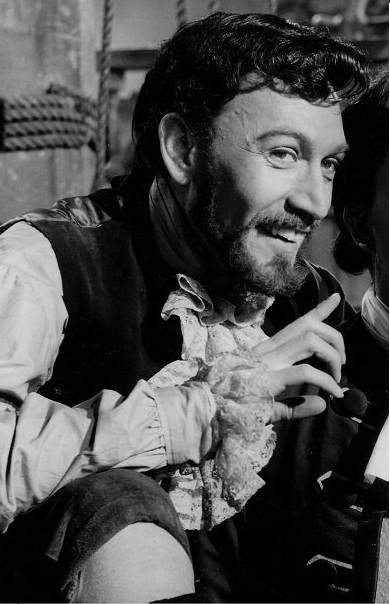

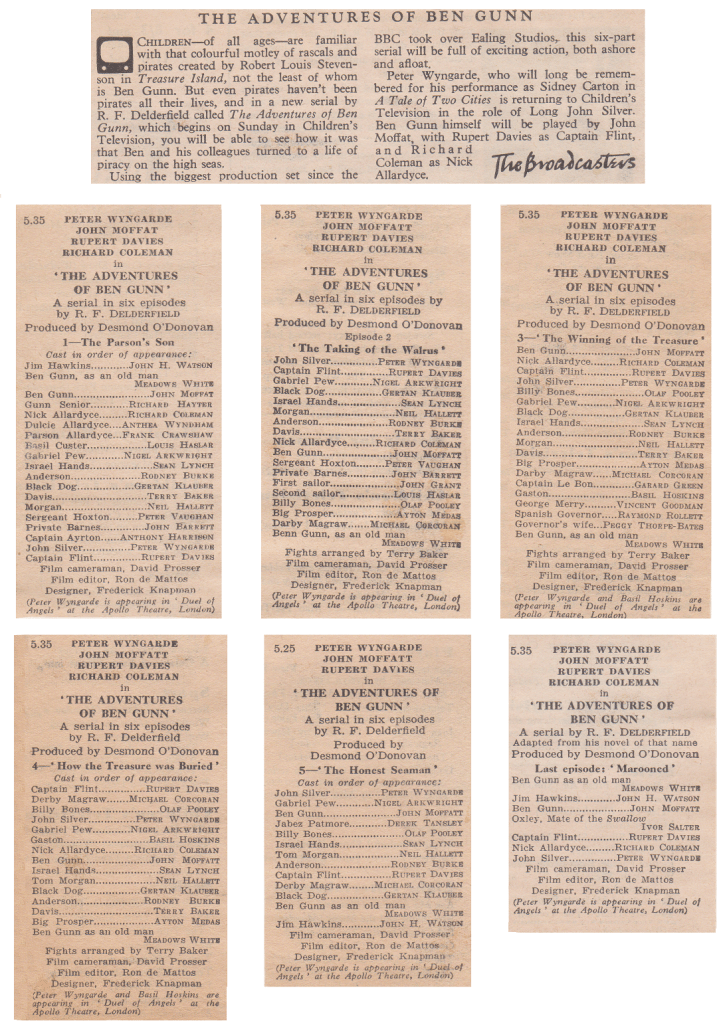


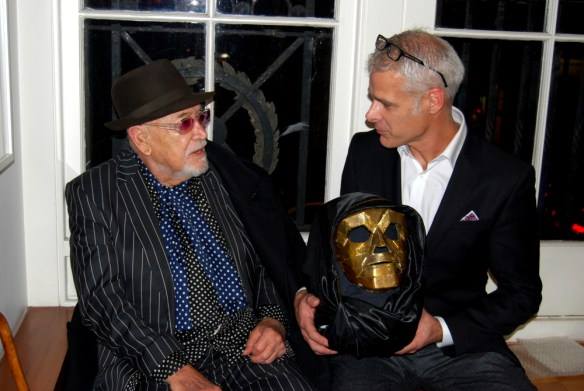
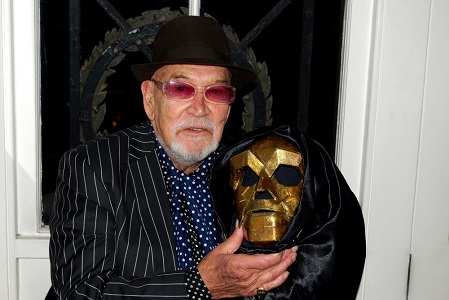


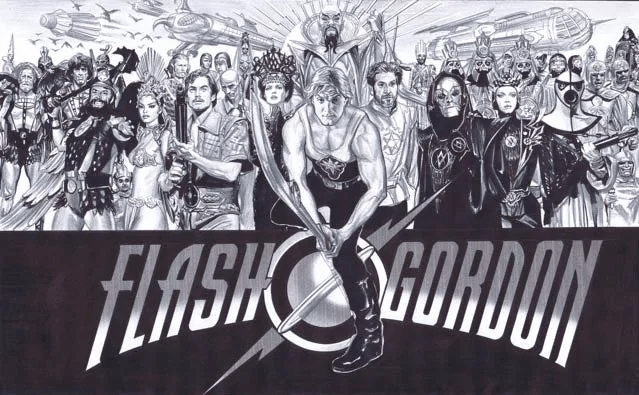
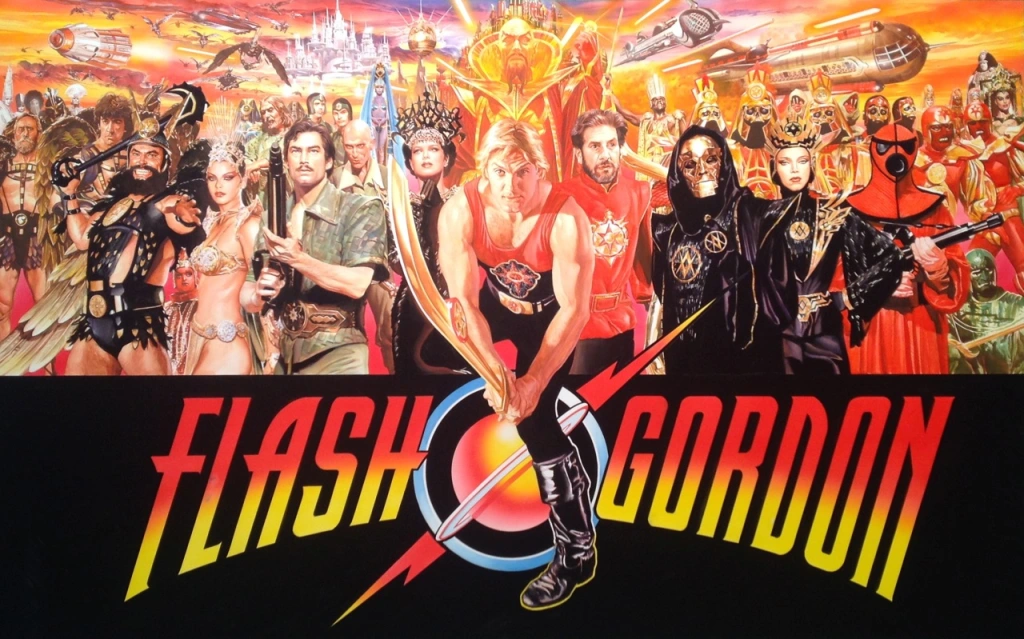

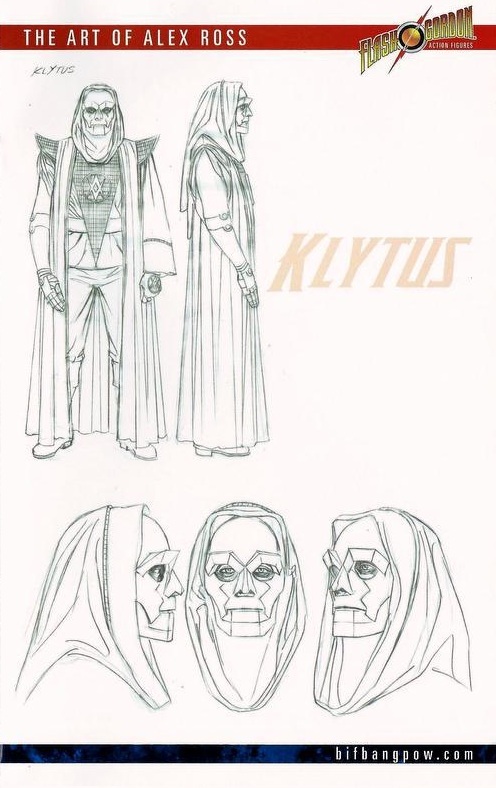


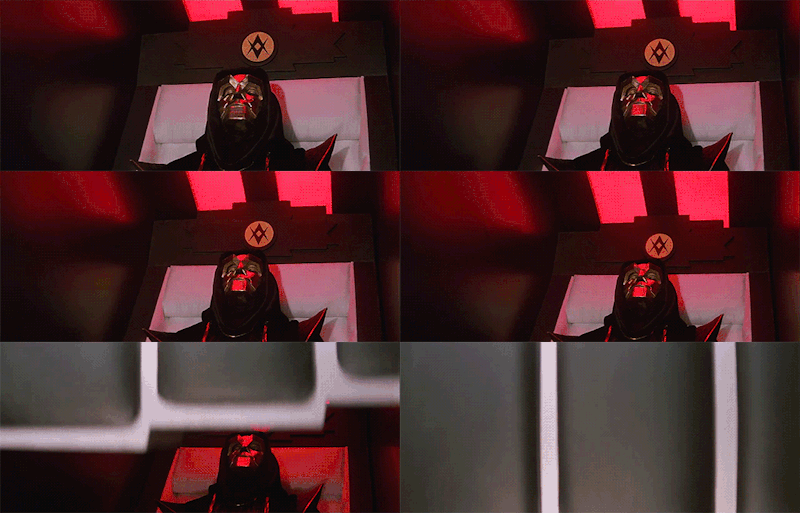


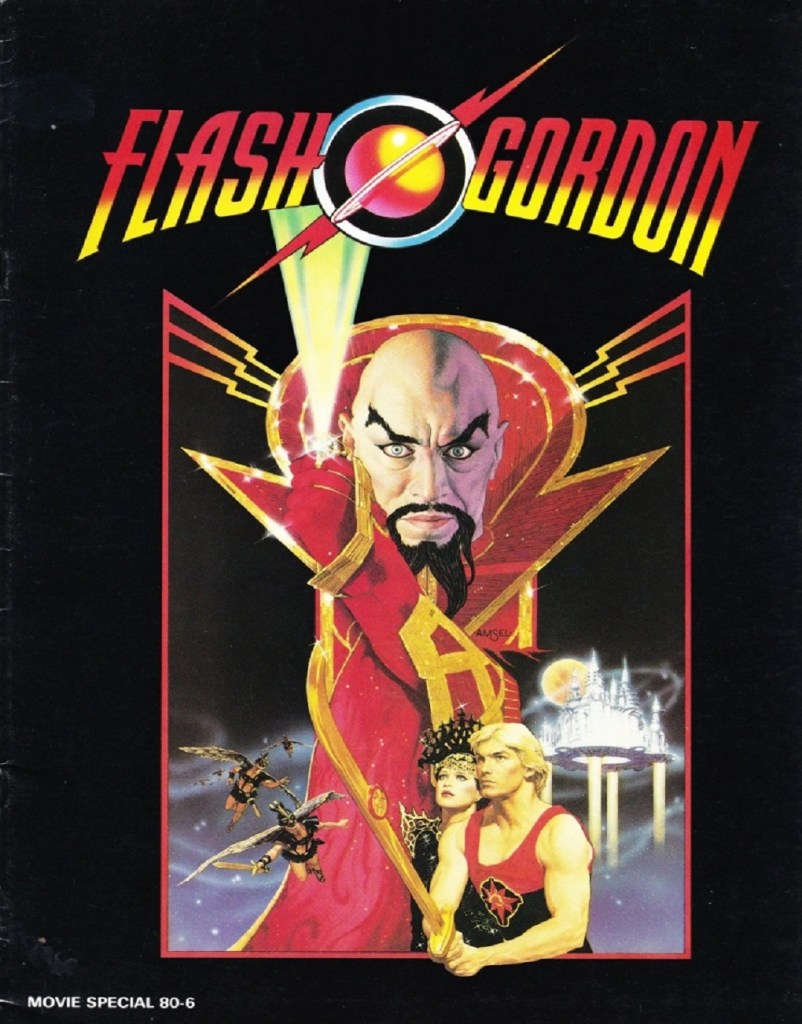


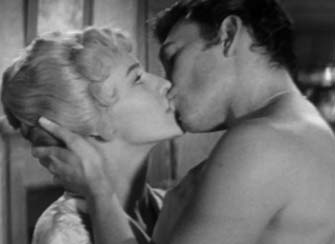
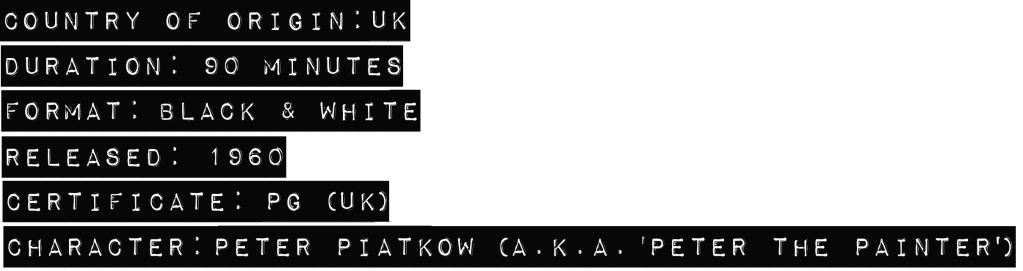


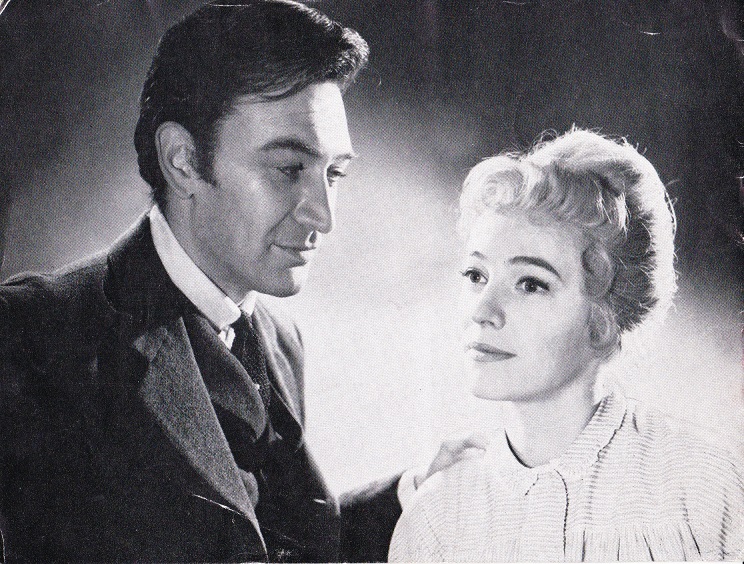




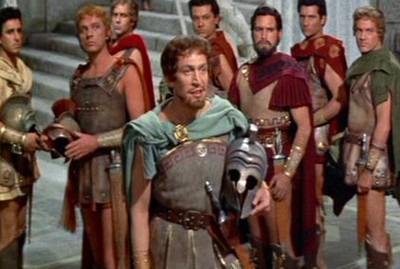
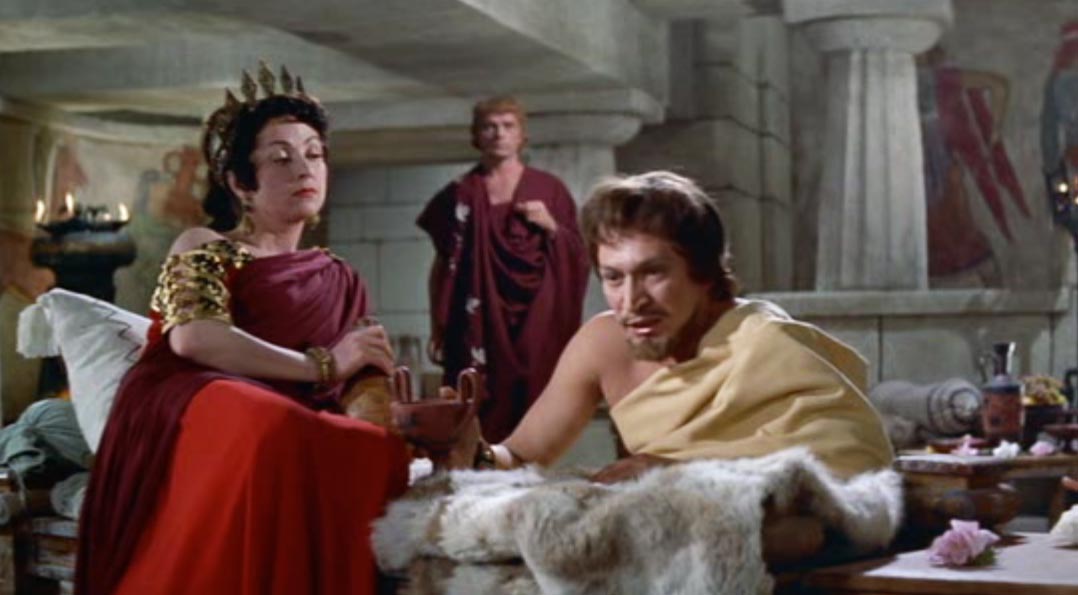


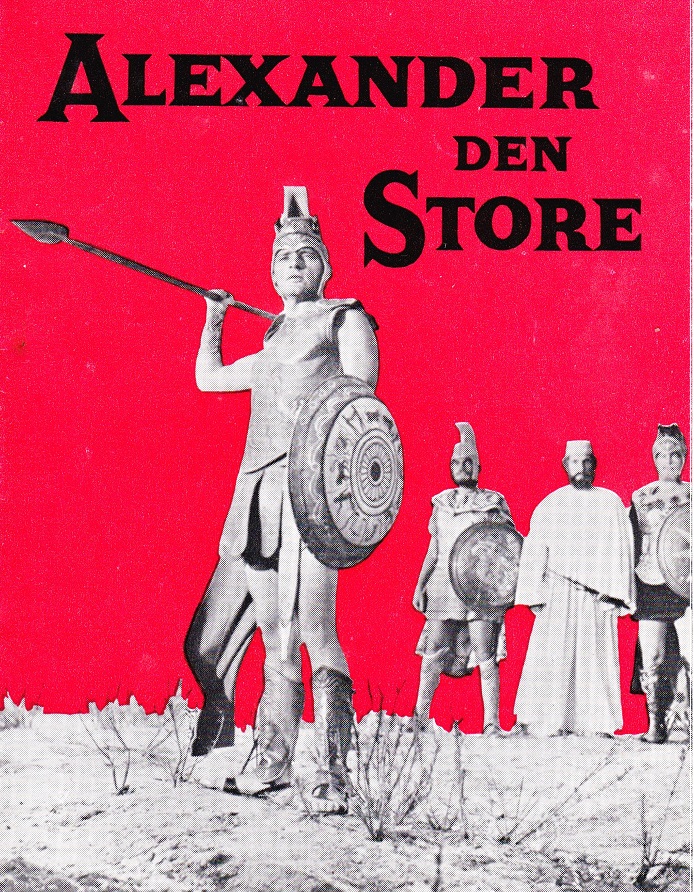


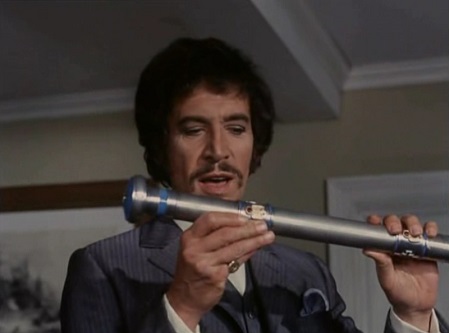
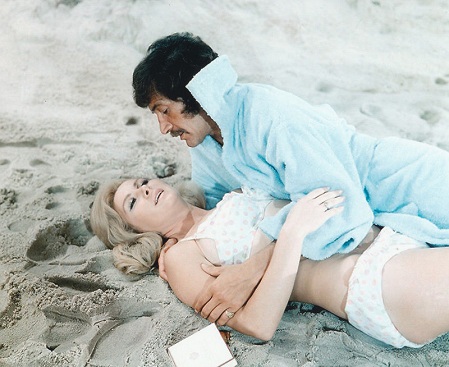

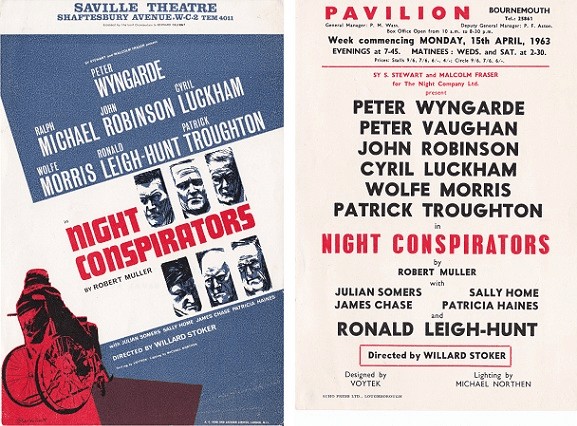
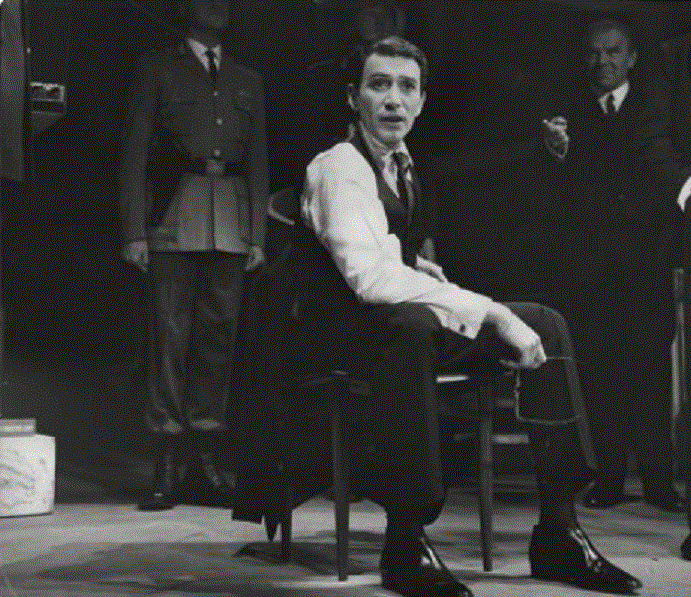

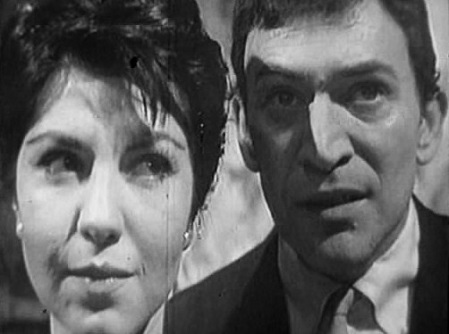
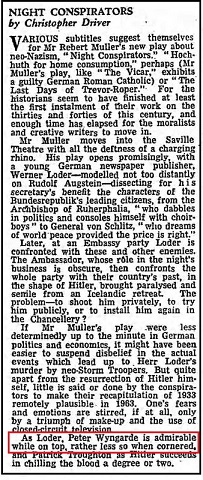
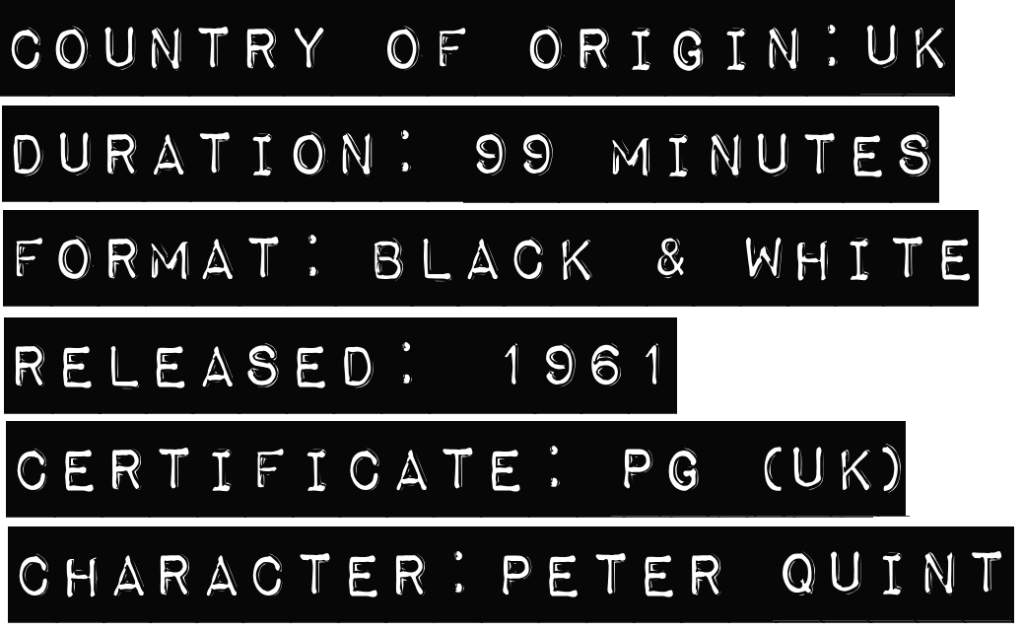


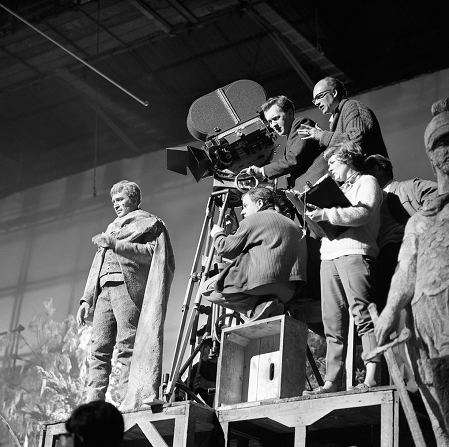
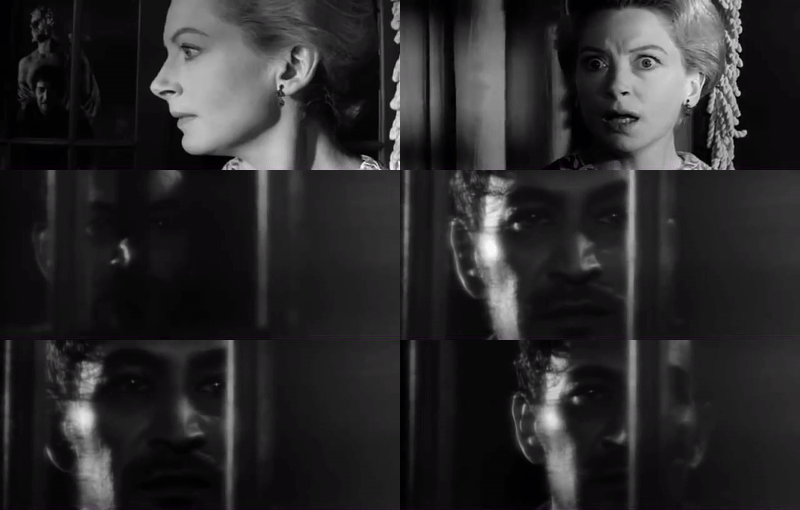

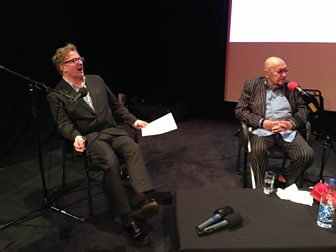
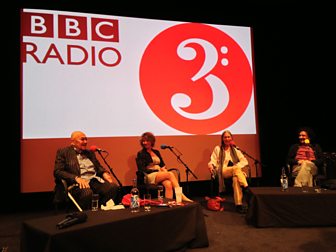


 PETER WYNGARDE: The Official Website