

When One Actor Becomes the Scapegoat
The entertainment industry has always been built upon storytelling. Actors bring fictional characters to life, studios create glamorous public images, and publicity departments carefully craft narratives that capture the public imagination. For more than a century, performers have often seen their personal histories polished, simplified, or occasionally embellished to make them more appealing to audiences. Yet, despite this long-established tradition, there are instances where a single actor becomes unfairly singled out and criticised for practices that were once widespread throughout the profession. The actor most stigmatised for this is Peter Wyngarde.
The creation of a public persona is almost as old as the film industry itself. During Hollywood’s golden age, studios routinely altered actors’ backgrounds. Ages were adjusted, places of birth changed, family histories rewritten, and life stories refined to fit a marketable image. These changes were not necessarily initiated by the performers themselves. More often, they were part of an industry-wide publicity machine designed to maximise public interest and commercial success.
Many well-known stars benefited from carefully managed biographies. Some performers understated their age in order to secure younger or older roles. Others modified details of their upbringing to appear more exotic, sophisticated, or relatable. In some cases, actors adopted entirely new names and identities for professional reasons. These alterations were generally accepted as part of the entertainment business and rarely attracted serious criticism. Here are a few examples…
Errol Flynn, the celebrated protagonist of classic adventure films renowned for swashbuckling performances, demonstrated a notorious disregard for factual accuracy. Within his notably extravagant autobiography, My Wicked, Wicked Ways, he substantially embellished and fabricated significant portions of his formative years, asserting dramatic and adventurous exploits throughout New Guinea and across the South Seas that subsequent biographers determined to be predominantly fictional narratives.
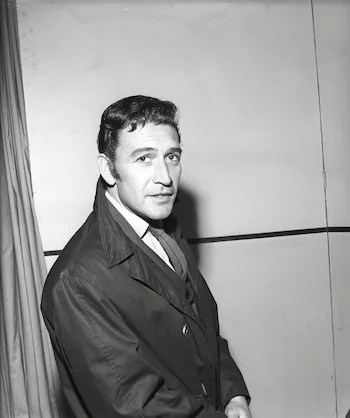
Left: Peter in the late 1950’s
Brian Dennehy, an accomplished veteran character actor, maintained publicly for many years regarding his service in the United States Marine Corps and sustaining injuries during the Vietnam War. He subsequently acknowledged that these military service and injury claims were inaccurate, resulting in formal retractions disseminated through prominent publications including The Wall Street Journal.
During the initial phase of her professional career, Whoopi Goldberg deliberately modified and augmented her personal background, encompassing adjustments to her stated age across multiple occasions at different career stages to facilitate positioning for more mature or varied casting opportunities.
Jay Robinson: Asserted that he possessed Anglo-American heritage and had engaged in extensive professional work in England prior to relocating to the United States. In actuality, he was born in New York to American parents and raised in Florida. His representative disseminated a sixteen-page biographical document upon the theatrical release of The Robe, claiming he was twenty-seven years of age, when he was actually twenty-two.
Idris Elba represented that he had been born in the United States and adopted an American accent during auditions for theatrical roles.
Marlon Brando asserted that he had been born in Cairo when, in actuality, he was born in Omaha, Nebraska.
However, when discussion turns to certain actors, the tone can become markedly different. Instead of acknowledging the historical context in which these embellishments occurred, commentators sometimes focus disproportionately on a single individual, portraying them as uniquely dishonest or deceptive. This creates a misleading impression that the actor’s behaviour was unusual when, in reality, it was often commonplace within the industry.
One reason for this phenomenon is the tendency of journalists and biographers to seek a compelling narrative. A story about a performer who allegedly fabricated elements of his past can make for sensational reading. Over time, the narrative itself can become more significant than the facts. Repetition of the claim leads readers to accept it as a defining characteristic of the actor, while comparable behaviour by others is overlooked or forgotten.
The Wikipedia Effect
The British press prides itself on holding others to account, yet too many journalists appear increasingly willing to rely on Wikipedia and other easily accessible online sources rather than undertaking thorough, independent research. While Wikipedia can be a useful starting point, it is not a substitute for examining primary sources, consulting archives, conducting interviews, or verifying facts through multiple reliable references. This dependence on second-hand information can lead to the repetition of inaccuracies, myths, and unsubstantiated claims that become accepted as fact simply through constant repetition. In the pursuit of speed and cost-cutting, some sections of the media risk sacrificing the very principles upon which quality journalism is built: accuracy, diligence, and a commitment to uncovering the truth through genuine investigation rather than merely recycling information already available on the internet.
In other words, when Wikipedia sneezes, Fleet Street is catching a cold!
Wikipedia contributors have obsessively concentrated their attention on Peter’s early biographical particulars, distinguishing him as exceptionally distinctive despite the existence of numerous other actors from both preceding and subsequent generations who have similarly enhanced their biographical accounts. No examination has been undertaken to consider the rationale behind his decision to exclude specific information regarding his family circumstances. His motivations may have been multifaceted; perhaps he sought to safeguard their privacy, or more likely, he simply preferred to have no association with them given that he maintained limited closeness with them as a child.
As ancestry websites proliferate and family records become increasingly accessible, the Wikipedia editors responsible for maintaining the Peter Wyngarde’s ‘biography’ have busied themselves by delving deeper and deeper into his genealogical background; progressively publishing an increasing amount of information regarding his family lineage extending back to the nineteenth century. One must consider where the appropriate boundary should be established between legitimate public interest in an actor’s professional life and the comprehensive violation of an individual’s right to privacy.
Wikipedia can sometimes reflect the biases, assumptions, or personal opinions of contributors rather than presenting a fully balanced picture. When writing about a particular actor, an editor who has formed a negative opinion may give disproportionate attention to controversies, rumour, or disputed claims* while minimising achievements, critical acclaim, or positive aspects of the individual’s career. As a result, casual readers may come away with a distorted impression that places undue emphasis on a small part of the actor’s life rather than viewing their career in its proper context.
*It was discovered in 2022 that the disgraced journalist responsible for the atrocious ‘obituary‘ in The Guardian in 2018 (see ‘Wikipedia: To Theheartof it‘ and ‘The Public’s Response‘) was one of the contributors that was so jealously guarded the Peter Wyngarde ‘Biography’ on Wikipedia that were preventing others from outside this clique to add anything, or correct or remove any erroneous content as is, supposedly, Wikipedia’s edict.
So let’s look at Peter’s biographical ‘Crimes’:
He said he was born in Marseilles, France. His mother confirmed this in a 1955 interview with The Straits Times in September 1955. And you’d think she should know!
He shaved five years off his age.
- Whoopie Goldberg added several years to her age early in her career to be taken more seriously for mature roles.
- Sandra Bullock Trimmed or shifted her age early in her career to fit specific casting calls. Gillian Anderson and Lawrence Fishburn lied about their ages for the same reason.
NONE of the above have ever been pilloried like Peter!
He omitted or changed certain details about his family background:
An actor who is estranged from or simply disconnected from his family background may sometimes be tempted to embellish or reinvent aspects of his personal history when dealing with the press. In an industry that often values compelling narratives, a difficult, painful or unremarkable family life can seem less appealing than a more colourful or romanticised version of events. While such distortions are not easily justified, they can sometimes reflect a desire to protect private family matters, distance oneself from unhappy memories or create an identity separate from a past that no longer feels relevant. Critics may view these inventions as dishonest, but they can also be understood as a coping mechanism for someone seeking to escape personal circumstances that caused them distress or offered little sense of belonging.
It should be remembered that Peter spent much of his childhood in a Japanese Interment camp (Lunghua Civilian Assembly Centre near Shanghai) during the Second World War, leaving him separated from his family. As one of the youngest detainees in the camp, he endured years of hardship, uncertainty and isolation during a period that would normally have been devoted to family life and emotional development. According to his accounts of his wartime experiences, he was effectively alone among family groups, a circumstance that may have intensified his feelings of abandonment and made it difficult for him to form the secure family bonds that many children rely upon during times of crisis.
While it’s impossible to know with certainty the full emotional impact these experiences had on Peter, it’s understandable that such prolonged separation could have left lasting scars. A child who spends their formative years in a wartime internment camp, cut off from parents and siblings, may struggle to feel the same sense of connection enjoyed by family members who shared experiences together elsewhere. Certainly, he felt deeply affected by his wartime separation and by his relationship with his parents and siblings. It’s therefore reasonable to speculate that feelings of resentment, abandonment or emotional distance may have influenced his later view of family life.
NONE of the above has ever been taken into consideration by those who are quick to criticise or mock.
Most decent people would argue that it is both unfair and insensitive to criticise Peter for distancing himself from aspects of his family history without first considering the extraordinary circumstances of his childhood.
It is important to remember that people who endure traumatic events often respond in different ways. Some maintain strong links with their past, while others choose to distance themselves from painful memories or from people they associate with those experiences. Whether one agrees with that choice or not, it is difficult to judge fairly from the comfort of hindsight. Critics frequently focus on inconsistencies in a public figure’s biography without recognising the emotional wounds that may lie behind them. In Peter’s case, whose wartime experiences were exceptionally harsh, so you would think that a degree of empathy and understanding is more appropriate than condemnation.
He changed his name. Well so did a lot of other actors..
- Marilyn Monroe: Born Norma Jean Mortenson.
- John Wayne: Born Marion Robert Morrison.
- Carey Grant: Born Archibald Alec Leach.
- Kirk Douglas: Born Issur Herschelevitch Danielovitch.
- Demi Moore: Born Demetria Gene Guyers
- Martin Sheen. Born Ramón Antonio Gerard Estévez.
- Jamie Foxx. Born Eric Marlon Bishop.
The list goes on. For the record, Peter was named after his father’s brother – Cyril Goldbert.
________________________
Selective scrutiny of a particular person can have lasting consequences for an actor’s reputation. A performer who devoted decades to his craft may find his achievements overshadowed by endless discussion of disputed biographical details. Instead of being remembered for memorable performances, artistic contributions or professional accomplishments, he becomes associated with nonsense that may represent only a tiny fraction of his life and career, and which is certainly not anyone else’s business!
There is also a question of fairness. If historians and journalists are prepared to criticise one actor for embellishing aspects of his background, then intellectual consistency demands that they apply the same standards to everyone else (see the examples earlier in this article). Selectively targeting a single individual while ignoring similar behaviour by numerous contemporaries creates an obvious double standard.
The context of the era is particularly important. In the mid-twentieth century, privacy was often difficult for public figures to maintain. Many actors felt pressure to conform to public expectations, while studios actively shaped how stars were presented to audiences. Information that would today be easily verified through digital records was often inaccessible to the public. As a result, publicity biographies frequently contained inaccuracies that remained unchallenged for years.
Modern audiences sometimes evaluate these historical situations through a contemporary lens. Today, there is a greater expectation of transparency, and factual discrepancies can be exposed almost instantly. While such scrutiny has its advantages, it can lead to unfair judgements when applied retrospectively. What may appear unusual today was often routine practice decades ago.
Another factor is the tendency to reduce complex individuals to simple narratives. Human beings are rarely defined by a single aspect of their lives. Actors, like everyone else, contain contradictions, aspirations, insecurities, and ambitions. Some may have enhanced elements of their personal story because they believed it would help them succeed. Others may have enjoyed cultivating an air of mystery. Neither motivation necessarily negates their talent, professionalism, or artistic value.
Indeed, audiences have historically been fascinated by larger-than-life personalities. The public often celebrates performers who project glamour, mystery, and intrigue. Yet when an actor participates in creating such an image, critics may later condemn him for the very qualities that once attracted attention. This contradiction reveals how public attitudes towards celebrity can shift dramatically over time.
A more balanced approach would place alleged embellishments within their proper historical and professional context. It would recognise that the entertainment industry has long blurred the boundaries between reality and image. It would also acknowledge that many celebrated figures engaged in similar practices without suffering lasting damage to their reputations.
Most importantly, an actor’s legacy should be evaluated primarily through the quality of his work. Performances endure long after publicity stories have faded. Great actors are remembered because they moved audiences, created memorable characters, and contributed to the cultural landscape. These achievements deserve greater attention than endless debates over biographical minutiae.
Ultimately, the tendency to single out one actor for behaviour that was widespread among his peers says as much about modern commentary as it does about the performer himself. History should strive for fairness, consistency, and perspective. If an actor embellished aspects of his personal biography, that fact should be acknowledged honestly. But it should also be understood in the context of an industry where image-making was an accepted and often expected practice.
To judge one individual harshly while excusing or ignoring others who did the same is neither balanced nor historically accurate. A fair assessment requires looking beyond sensational claims and considering the broader picture. Only then can we appreciate both the realities of the entertainment industry and the full complexity of the people who worked within it.
Anyone who does not understand any of the above has no business to be writing about actors!


