


Broadcast: February 2, 1966 (CBS Canada)
Character: Paris Beaumont
“That’s one of the nice things about Cornwall. It’s like living abroad; you can get away with murder abroad.” Paris Beaumont
Some Background
Festival, originally named Festival ’61, was a Canadian entertainment anthology television series that aired on CBC Television for nine seasons, from October 1960 to March 1969.
The series highlighted cultural productions encompassing a variety of theatrical, literary, and musical presentations. It included both classic and contemporary plays, operas, ballets, orchestral works, and television adaptations drawn from Canadian and international repertoires, performed by esteemed professional companies such as the Stratford Festival, the Metropolitan Opera, and the National Ballet of Canada, among others.
Season 6 consisted of 32 episodes and featured the story, ‘Ashes To Ashes’ – a supposed ‘spoof’ penned by Marc Bradel and directed by Eric Till. ‘Ashes To Ashes’ was episode 17 of Season Six, and 148.overall.
“Darling, I’ve poisoned you.” Paris Beaumont
The Story
Barbara Manson (Pat Galloway) – a no-nonsense advertising executive, encounters the charming artist, Paris Beaumont (Peter Wyngarde), in an unexpected location: the Chamber of Horrors at Madam Tussaud’s in London. An instant attraction develops between them, leading to a swift romance that culminates in marriage.
Paris takes Barbara to his remote cottage perched on the edge of a steep Cornish cliff, where they establish their home. The first warning sign appears almost immediately after they enter their new residence, as Paris expresses his fondness for the isolation, stating, “One can get away with murder.”
The young bride’s initial excitement shifts to intrigue when she stumbles upon a suitcase filled with women’s clothing. Paris is compelled to admit that he was previously married.—a detail he had withheld from Barbara until this moment, Further unease arises when Barbara discovers an urn containing ashes in the house while Paris is away; he dismisses her concerns by asserting that the urn holds the ashes of his cherished dog, Susan.
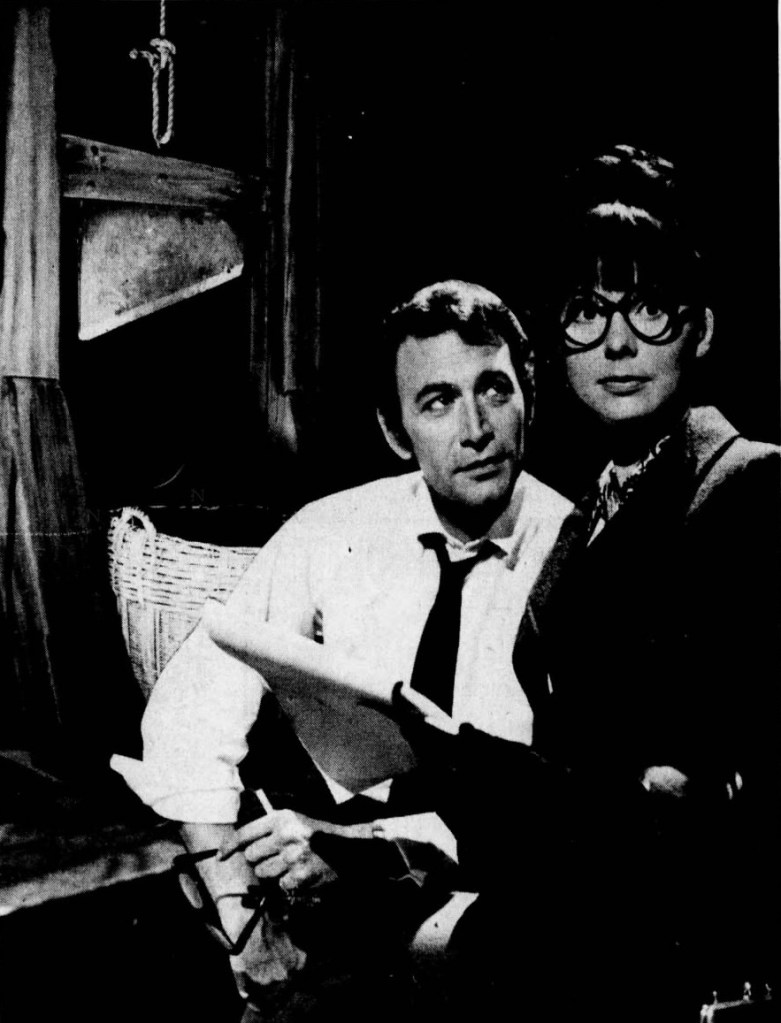
Above: Peter and Pat Galloway in the Madam Tussauds Chamber of Horrors
When Helen (Joyce Campion) and George Statten (Bernard Behrens), two of Paris’s friends come to visit while Barbara is home alone, she asks them about his first wife, and they confirm that she left him.
When he is not tending to his backyard kiln, which he uses to fire his sculptures (“Anything you put in there is reduced to ashes in minutes, darling”), he can be found sharpening knives in the kitchen, all the while expressing his fascination with the ideal “ritual of murder.”
When Barbara discovers not only a second urn, but a tin containing arsenic in the garden shed, she begins to descend into an abyss of terror,suspecting that the ashes contained in it are those of her husband’s first wife, and that she might well be his next victim.
The audience is left to decide whether Paris is a killer, or whether his new wife is merely driving herself mad with paranoia.
“Do you think I got rid of Marion, or something?” Paris Beaumont
A Spoof… Or was it?
I am curious about how many viewers of the Festival felt a bit irritated after Ashes To Ashes was screened? Many Canadian critics certainly were.
The production of this episode was outstanding; the cinematography, the narrative, and the manner in which the audience was gradually drawn into identifying with the protagonist, whose suspicions about her charming husband slowly escalated into a sense of dread, were executed with remarkable skill and expertise.
We were immersed in the heroine’s world, where the carefully curated elements of her reality became increasingly unsettling. These elements were chosen as her psyche descended deeper into a state of fear, and even when they were not overtly perceived, they were still selected with her perspective in mind. The initial humor of the situation transformed into a more profound sense of terror that enveloped the heroine.
The urn containing the ashes of her husband’s dog, the suitcase belonging to his previous wife whom he claimed had abandoned him, and the second urn’s appearance, along with the knives and shards, all contributed to a narrative that, despite our refined sensibilities, we interpreted as malevolent. This was sufficient to evoke a delightful sense of terror, and we became increasingly complicit as the story progressed.
We all have an affinity for thrillers; we all enjoy suspense and the thrill of being frightened by the night and the storm.
However, the standard has been established by Hitchcock, who positions the storyteller above us, mocking and ridiculing us for being gullible. Suddenly, someone leans back in an easy chair, laughing heartily at what drives these mortals. We were never informed whether he actually murdered her; we were left to speculate. As we pondered, we were led to realize that it was merely a trivial tale. We had been deceived, as someone gleefully informed us that it was just a story. “Do you think he killed her?” someone inquired, a glimmer of mischief in their eye.
Now, whether this individual is the writer Mark Brandel or the director/producer Eric Till, it should be conveyed to them that it is simply not amusing.
The entire premise was intended to be a spoof; we were meant to recognize that every line was a parody, every situation a satire. How were we supposed to know? Don’t ask me; how could I know? I read the press release that explained that the audience was meant to guess.
Thus, it was superb, as I mentioned, but the joke fell flat for the simple reason that no one informed us in any manner, and there was no internal evidence to guide our guesses. It simply did not work and was therefore a failure for those who attempted to execute it.
What this incidentally highlights is that the techniques used in suspense or mystery thrillers can often be seen as stereotypical and clichéd.
Nevertheless, we are drawn to them because we care; it amuses us to invest our emotions, and we find enjoyment in being frightened, just as we did when our grandfather would sit us on his knee and recount tales of dark and stormy nights. We would pause, anticipating what he would say next, and we would still ask, ‘And then what happened?’
Additionally, it suggests that a parody of terror and suspense must be a farce; otherwise, it risks being mistaken for the genuine article, which is ultimately what we desire to experience as real.
Critics Comments
| “As the lethal charmer, Wyngarde was superbly convincing, I would doubt that a single member of the feminine side of Festival’s audience would hesitate for a moment would dash off to his Cornwall cottage with him. Urns, knives, kilns and all.” The Ottawa Citizen – 3rd February, 1966 |
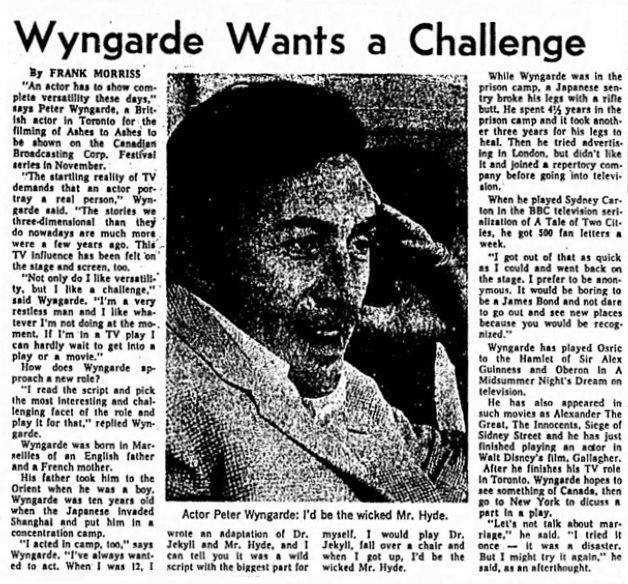
Above: From the Globe and Mail (Canada): 9th September, 1965


