The Dybbuk(also known as ‘Between Two Worlds’) is a celebrated play of the same name by S. Ansky (pseudonym for Shloyme Zanvl Rappoport), which was written during the years between 1912-1917. The idea for the play came to Ansky as he led a Jewish folklore expedition through small towns of Eastern Europe, which was cut short by the outbreak of World War I. The Dybbuk reflects Ansky’s deep perception of the shtetl’s religious and cultural mores, as well as his insightful appreciation of its hidden spiritual resources. Plans to produce the play in Russian by Stanislavsky’s Moscow Art Theater in 1920 were aborted by the Bolshevik Revolution. Ansky, who died in 1920 never lived to see his play produced. The play however, was destined to become one of the most widely-produced in the history of Jewish theater. Its rich ethnographic tapestry, mystical themes, star-crossed lovers and haunting melodies were designed to bridge the historical abyss.
The Story
The Dybbuk tells the tragic, but ultimately triumphant story of a young man and his sweetheart, who are bound together by love, but who are separated by ignorance and the strictures of convention. However, as in the case of Romeo and Juliet, the device of the young lovers provides an opportunity to explore and reveal other, more profound issues; issues of power, of culture and tradition and, most importantly, of modernity.
The setting is the small village of Brinnitz in Poland in around 1850, where poor hasidic scholar, Channon (Peter Wyngarde), who is deeply in love with Leah (Yvonne Mitchell) – the beautiful stepdaughter of the rich and powerful merchant, Sender (Harold Kasket). For Channon, Leah is no ordinary woman, but the immortal beloved; the human vessel of God’s divinity, and in aspiring to her love, his soul aspires to divine fulfilment.
When Channon is away from the village pursuing his studies, Leah’s stepfather promises her in marriage to Menashe (Donald Morley). When Channon returns, he is devastated. In an attempt to reverse Sender’s decision, Channon turns to his friend and fellow scholar, Chennoch (John van Eyssen) who is known to dabble in the dangerous power of the Kabbalah in an attempt to help him win her back. He chooses a horrific death and the damning his own soul to possess Leah and the entire community of Brinnitz as a Dybbuk to force her release.
When Leah rebels against her stepfather and invites her now deceased lover to her wedding, she rejects Menashe in front of his family and all the other wedding guests, leaving Rabbi Samson (Marne Maitland) powerless to officiate. A message is sent to Azrael (Mark Dignam), a Rabbi from the nearby city of Mirapol who is wise in the arts of the Kabbalah who pronounces the ‘great malediction’ to exorcise Channon’s spirit from Leah. But she is intent on resisting, choosing death over marriage and patriarchy, promising her lover Channon that they will ascend to heaven and live together in eternity.
A Bit Of Trivia
Playing Channon was one of Peter’s favourite roles.
The ‘great malediction’ – or ‘Cherem’ in Hebrew – which is used by Rabbi Azrael to exorcise Channon’s spirit from Leah is the most powerful religious curse in religion. Jewish authorities were at all times reluctant to perform it because of its dreadful implications; its utterance condemns the sinner to everlasting hell. As far as anyone can be certain it was only ever pronounced once in the 20th Century; by Rabbinical Court in Eastern Europe during World War II against Adolf Hitler.
The producer of the play, Rudolph Cartier, also worked with Peter on ‘Will Shakespear’ in 1953.
‘The Dybbuk’ is sometimes called ‘the Jewish Romeo and Juliet’, however, scholars have often argued that Ansky’s play is a more multidimensional work, with a deeper philosophical meaning than Shakespeare’s famous drama.
The choreographer on the play was Tutte Lemkow, who also worked with Peter on L’Aiglon (TV), 1953; Will Shakespeare (TV), 1953; Siege of Sidney Street (Film); Jason King – To Russia With… Panache! (TV), 1972
Hard-nosed former police detective, George Bulman, has left the force under a cloud and set himself up as a private detective in London with his assistant, Lucy McGinty.
Created by writer and producer, Murray Smith, the series ran on British television (ITV) June 1985 until August 1987.
The Story
Bulman (Don Henderson) is hired by Kate (Sheila Hancock) to obtain proof that former gangland boss, Lol Gallio (Peter Wyngarde) is back in London after being forcibly exiled for over 20 years. Having formally managed one of Gallio’s numerous brothels and strip joints in London, she wishes to convince the Home Office that he’s back in town and out for revenge.
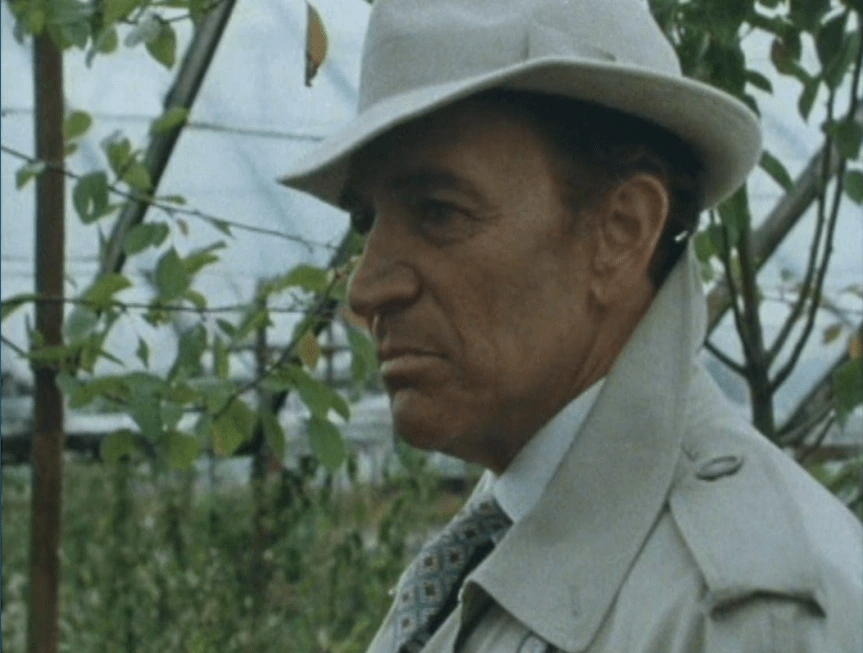
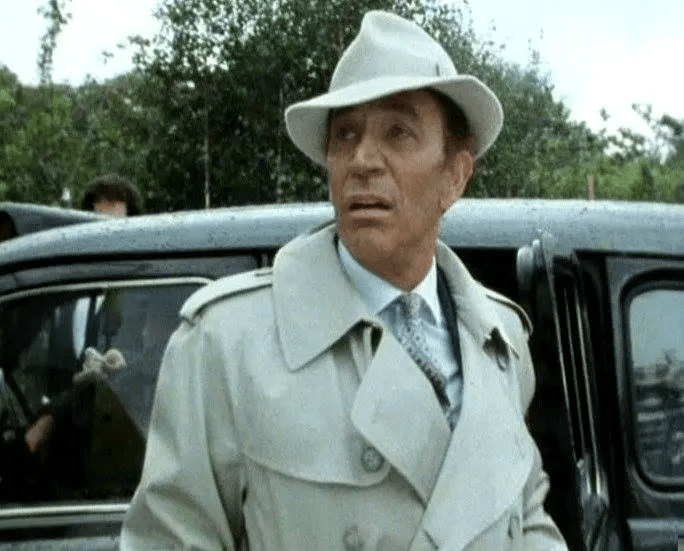
Peter as Lol Gallio
The grumpy detective attempts to snap a photograph of the crook on his arrival at Heathrow Airport, but is thwarted by a couple of Gallio’s heavies and he’s able to slip away without capture.
Bulman finds Kate at her cafe, which is really just a front for a seedy ‘Peep Show’ she’s running. She tells the detective that she plans to get out of the sex industry and has bought herself a small garden centre in Norwood, Northwest London, and fears that Gallio’s reappearance will end her dream of a new life.
The detective’s assistant, Lucy McGinty (Siobhan Redmond), is dispatched to search the archive of the local newspaper for any information about Gallio that might be on file there. She learns from a reporter there that the ‘paper has already received calls concerning the whereabouts of Gallio, which Lucy finds concerning given that on she, Bulman and Kate knew that he would be returning to the UK.
Bulman learns that Gallio has entered the country under a false name and is now posing as an Amazonian Trade Delegate, and so he heads to Amazonian High Commission where he hopes to catch up with the criminal. However, when he reached the Commission he’s informed that no one by the name of Lol Gallio is there, despite the fact that Bulman has already caught a glimpse of his quarry. To add to the conundrum, the detective is warned off from perusing Gallio by one of his former colleagues (John Benfield).
For her own protection, Bulman advises Kate to temporarily leave her home, so she moves in with one of the strippers that works for her. In the meantime, Bulman realises that his office phone has been bugged, which answers the question as to how the news of Gallio’s arrival in the country had got out.
In spite of her moving out of her own home, Gallio learns where Kate is and forces his way into the taxi she’s hired to take her to her garden centre. There, the Gallio attempts to force her into signing over all her assets to him, but when she refuses, he instructs his gang of henchmen to set about destroying all the buildings and stock at the Centre.
Having got what he came for, Gallio places the documentation he’d forced Kate to sign into a briefcase and heads Straight for the airport. When he gets there, however, he finds a crowd waiting for him that include Bulman and Lucy, plus several members of the press. In the scuffle, Gallio misplaces his briefcase which just happens to fall into Bulman’s hands. Harassed and jostled by the press pack, Gallio finally loses his cool and punches a female reporter in the face, knocking her to the ground. He’s immediately arrested and marched away by the police, much to Bulman and Lucy’s delight.
Publicity photograph of Peter for the episode
A Bit Of Trivia
Peter told The TV Times at the time of broadcast that he decided to base the character of Lol Gallio on George Raft’s portrayal of American gangsters in 1940s and ’50s melodramas.
The action takes place in Stratford-Upon-Avon and London in the 17th Century
Scene 1: The cottage in Stratford, 1584
Scene 2: The Palace of Whitehall – 10 years later
Scene 3: Backstage at the Globe Theatre – the first performance of ‘Romeo and Juliet’
Scene 4: Shakespeare’s lodgings in London, the same year
Scene 5: An inn at Deptford – the same night
Scene 6 The Palace of Whitehall – the next afternoon
Rudolph Cartier’s production of Miss Clement Dane’s ‘invention’ was a spirited and dramatic explanation of a problem which has troubled critics and commentators for centuries. How did Will, a seemingly raw and ordinary lad from Stratford, become William Shakespeare, the greatest dramatist of all time; what were the forces that shaped him?
The story begins, funnily enough, in Stratford with Will, though only 20, already married to an ill-tempered Anne Hathaway. Fame, in the shape of Henslowe, a strolling minstrel, beckons the young man to London and encouraged, too, by the coursing demand of his genius, the cries of his characters as yet unborn.
Will (Peter Wyngarde) chooses to seek his fortune and finds it. He also discovers the exacting price of fame. We are to see some of the stormy seas which beset him, and also some of the experiences which contained the very stuff of tragedy.
Here is Kit Marlowe, Murray, the Dark Lady of the Sonnets, and, overshadowing all of them, the splendid figure of Queen Elizabeth I. She is the heroine of this play – concerned for her drama as she was for her navy, and ringing greatness from herself and from Will.
Many of Will’s yet-to-be characters made an appearance in the play, including Ophelia, Desdemona, Hamlet, Rosalind, Shylock, Falstaff and MacDuff – the latter played by the future film and stage director, John Schlessinger.
Ms. Dane certainly presents Shakespeare as a wordy, windy and morbidly introspective man; certainlythe long speeches, most of them in blank verse, may well have bored many viewers.
Her Elizabeth I was evidently influenced by subsequent twentieth-century representations, and her portrayal of Shakespeare’s relationship with Christopher Marlowe (and others, seldom read or performed today) were equally shaped by myths current in 1921, which was when the play was written.
Istanbul: Simon Templar (Roger Moore) is in the Turkish capital to meet his old friend, Geoffrey Bane (Hedger Wallace) – deputy curator of the Silbatakin Museum; home to the 3,000-year-old Gadic Collection.
While he waits for Bane in one of Museum’s galleries, Templar notices a young woman by the name of Ayesha (Nicole Shelby), who appears to be comparing the items from the Gadic Collection to a set of photographs she has with her. He also observes that she’s being watched by a somewhat unkempt man of seemingly local origin, whose attempt to grab and manhandle her to the ground is thwarted by Templar’s timely intervention.
As she hastily makes her exit from the museum gallery, Ayesha drops several of the photographs which Templar retrieves and hands to Bane on his arrival. The images are taken to the Curator, Ahmed Bayer (Andre Van Gysegham), who recalls that the last time the Gadic Collection was outside the Museum had been 30 years ago, which couldn’t possibly have been when the photographs were taken. It transpires, however, that the artifacts had been taken off display just 3 months earlier for cleaning. The work had been carried out, not by the Museum itself, but by an outside specialist by the name of Abdul Kemal. Templar and Bane decide to pay this contractor a visit, but when they reach his workshop in the city they find it abandoned.
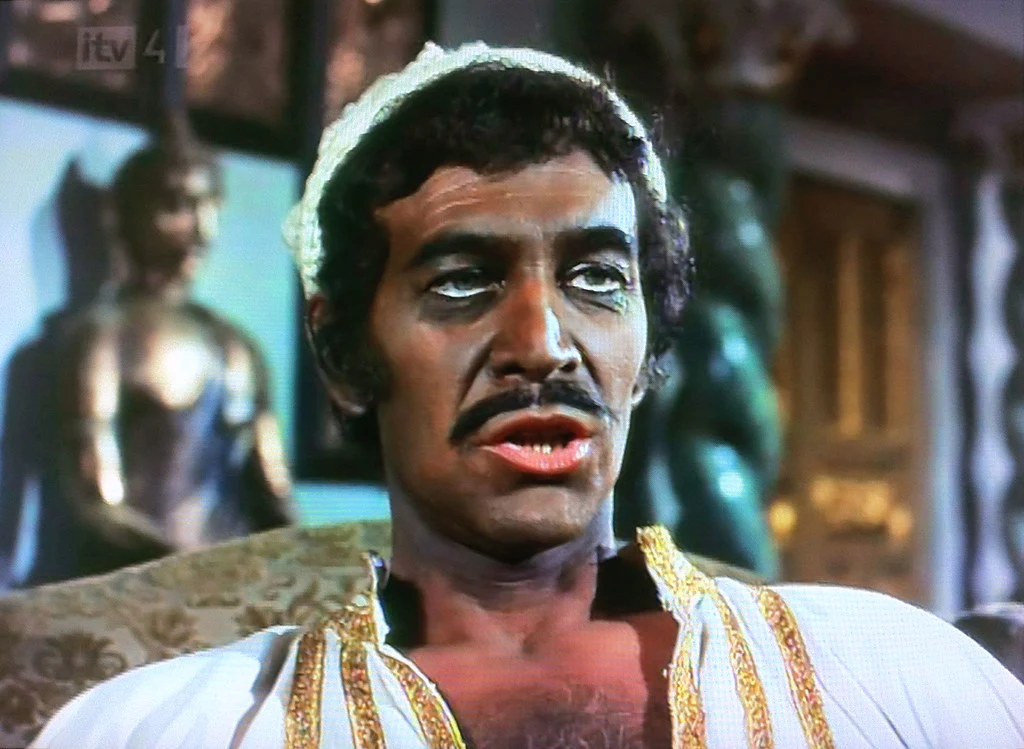
Peter as Turen
While they’re still on the premises, none other that Ayesha arrives followed in short order by the unkempt man that Templar had tackled just an hour earlier at the Museum who, once again, is thwarted in his attempt to abduct the young woman. Bane recognises Ayesha as Kemal’s niece. Templar insists that she take the two of them to meet her uncle.
Kamal is shown the photographs that Ayesha had dropped at the museum and admits to having taken them for the purpose of making replicas of the items from the famous Gadic Collection. He had latterly sold the forgeries to a wealthy foreign art collector. Watching Templar and Bane leave Kamel’s home is Sukan (Michael Ripper), who his himself interested in The Gadic Collection.
Later that evening at his hotel in the city, Templar receives a call from Geoffrey Banewho asks the Englishman to meet him at the Museum. However, when he arrives there he finds Bane dead in his office having discovered that the Collection in the Museum is fake. Within minutes, the police arrive.
Templar attempts to explain to Inspector Yolu (Martin Benson), the senior officer on the scene, what had happened so far – insisting that Ayesha and her uncle will confirm his story, but when they arrive at Kamel’s home they find no one there and that the house appears as if no one has lived there for some years.
After being released by the police on license, Templar returns to Kamal’s home where he runs into an elderly couple who live in the same building. While both of them had seen him, Ayesha and Bane the previous day, they had had told the police they had never seen the Englishman before and that they knew nothing of Kamal. Templar learns that Kamal had paid them to lie to the police.
Peter with Roger Moore as Simon Templar and Michael Ripper as Sukan.
In the meantime Sukan, who believes that Templar is in possession of the real Gadic Collection, offers to acquire the artifacts for millionaire art collector and criminal, Turen (Peter Wyngarde). Sukan agrees to arrange a meeting. But when Templar refuses to tell Turen the whereabouts of the Collection, he’s put into a dungeon with spiked walls are set to close in an kill its occupant unless he confesses. Horrified by her husband’s behaviour Diya (Georgia Brown) – Turen’s wife – conspires to drug him and manages to release Templar just in the nick of time.
With the help of Ayesha, Templar retrieves the genuine Gadic Collection from where Kamal had hidden them and returns them to the Museum. With Inspector Yolu present, the Englishman reveals that Kabal had not acted alone. Indeed, the instigator of the plot is none other than curator, Ahmed Bayer!
With the real Collection back on display in the Museum, the fakes are handed over to Templar by the police to dispose of a his discretion. With the full approval of Turen’s now estranged wife, Templar contacts the crook who agrees to buy the ‘Collection’ for $100,000, believing it to be the genuine article, with Diya and Templar splitting the proceeds.
A Bit Of Trivia
Freddie Francis, the director of this episode, also directed Peter in ‘The Innocents’.
Peter hated ‘The Gadic Collection’ and never watched it.
In the 2015 Channel 4 documentary, ‘It Was Alight In The Sixties’, Peter was hauled over the coals for ‘Blacking-Up’ to play Turen. The condescending producer of the programme didn’t appear to realise that white actors playing ethic characters was the done thing back in the 1960s, and that Peter wasn’t unique in doing this.
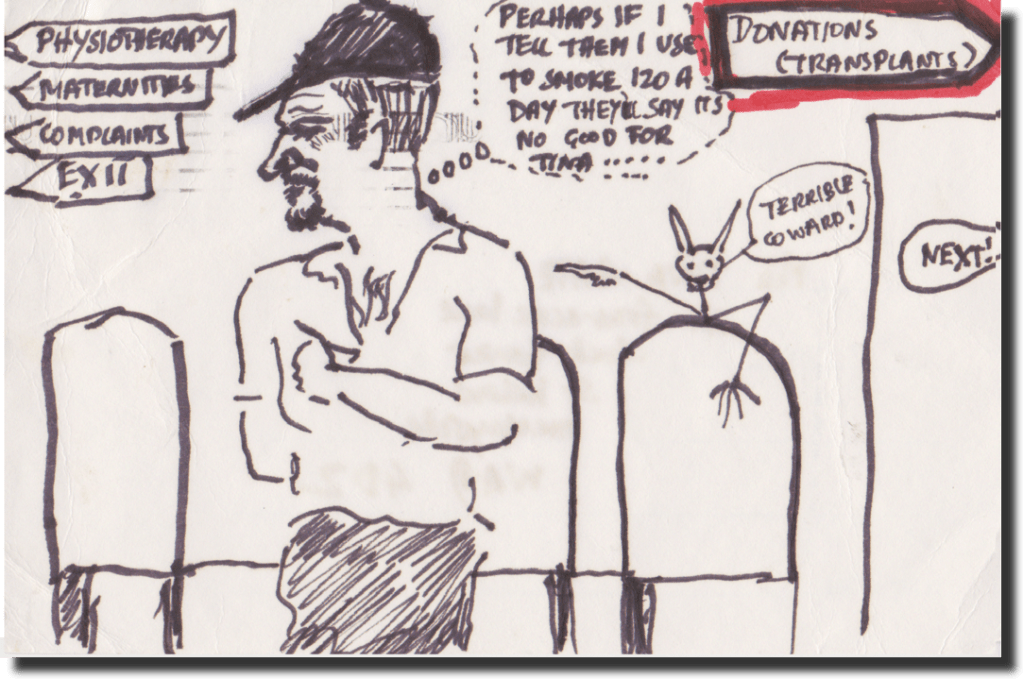
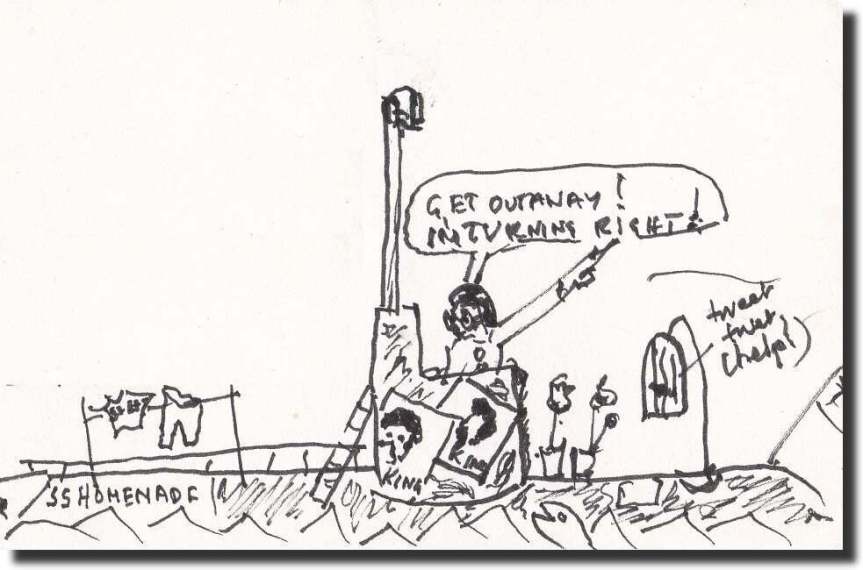
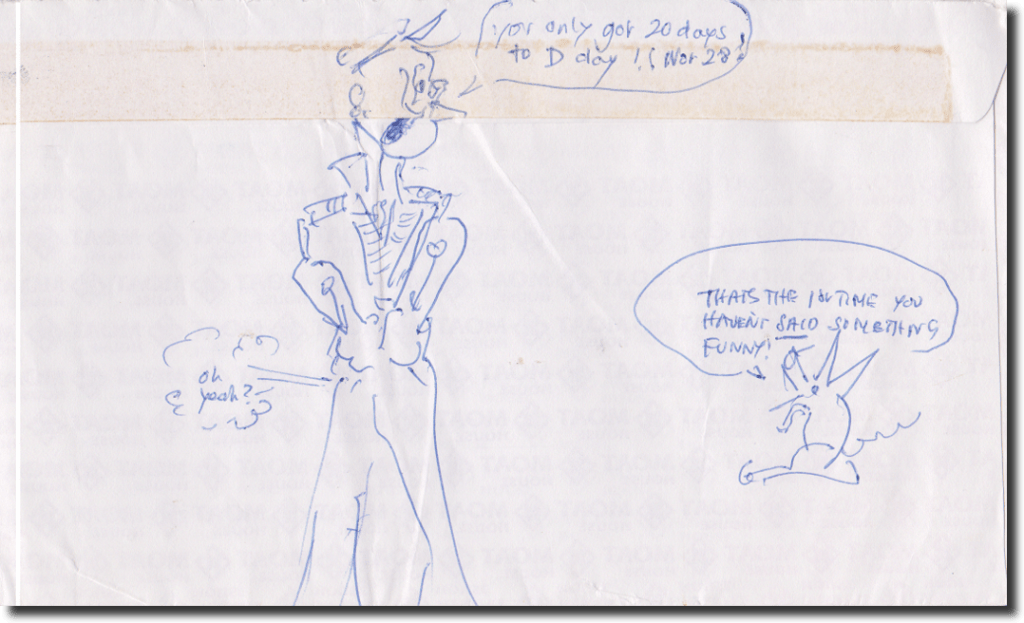
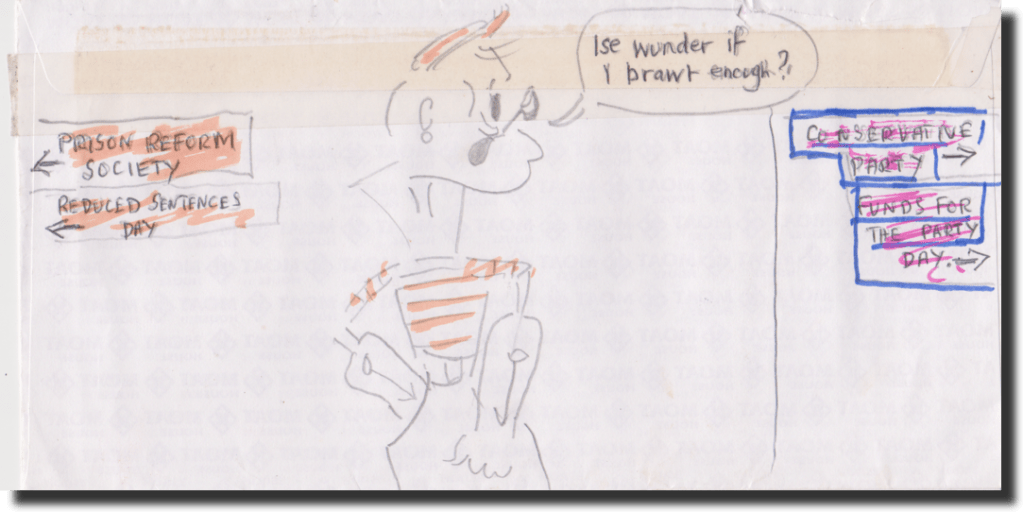
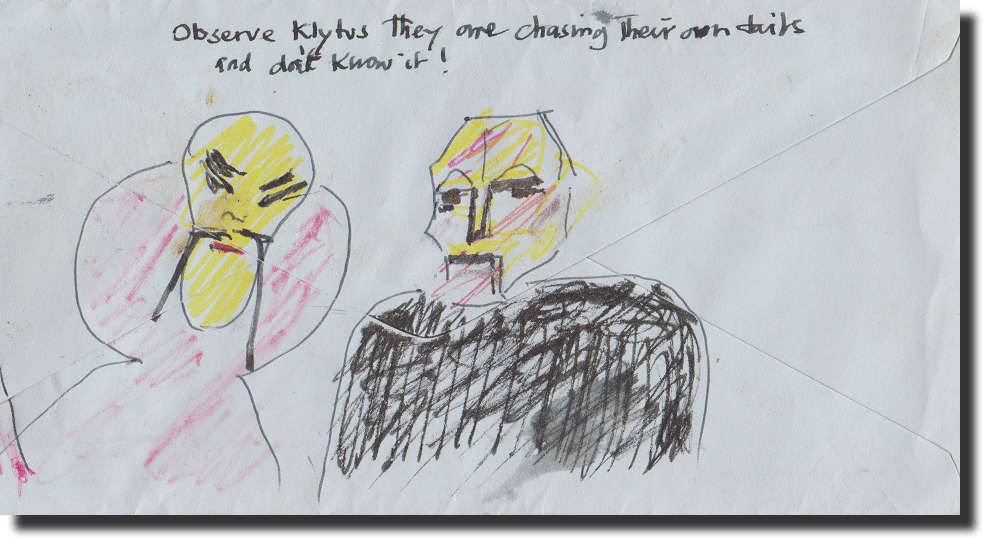
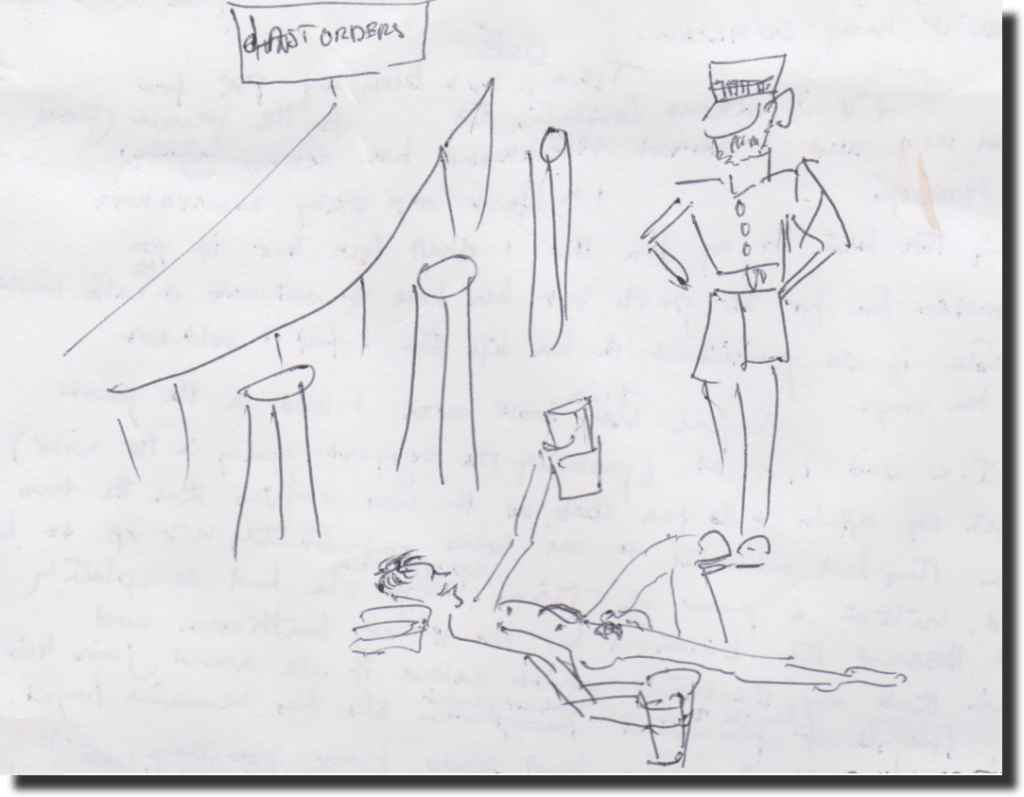
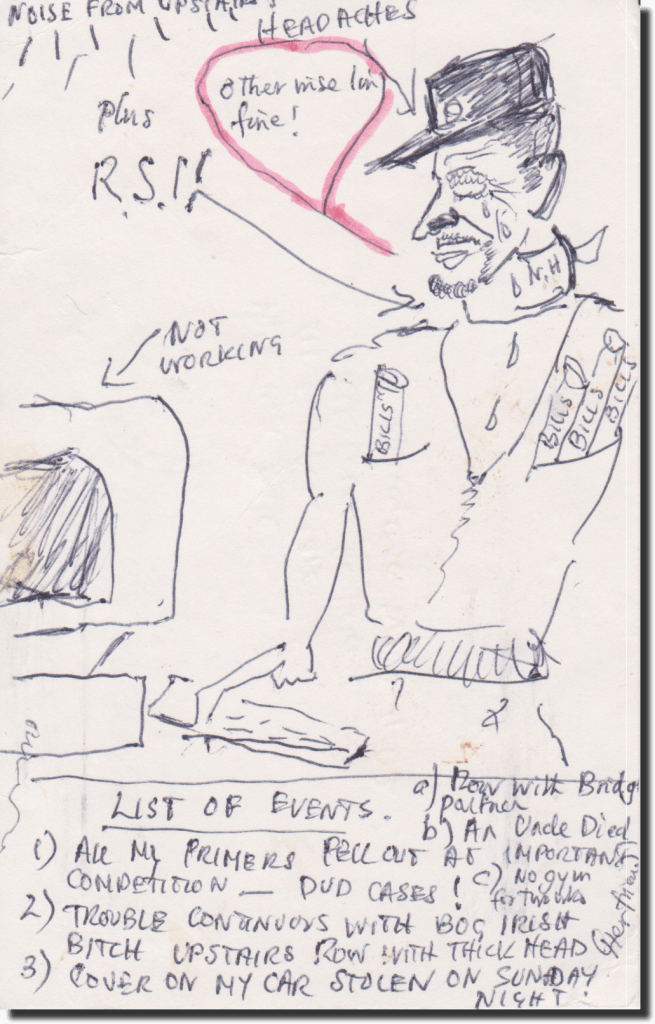
He was no Leonardo da Vinci, but that didn’t stop Peter from drawing on anything and eveything he could find, including on postcards and the backs of envelopes. Here are just some of the sketches and cartoons I saved over the years…
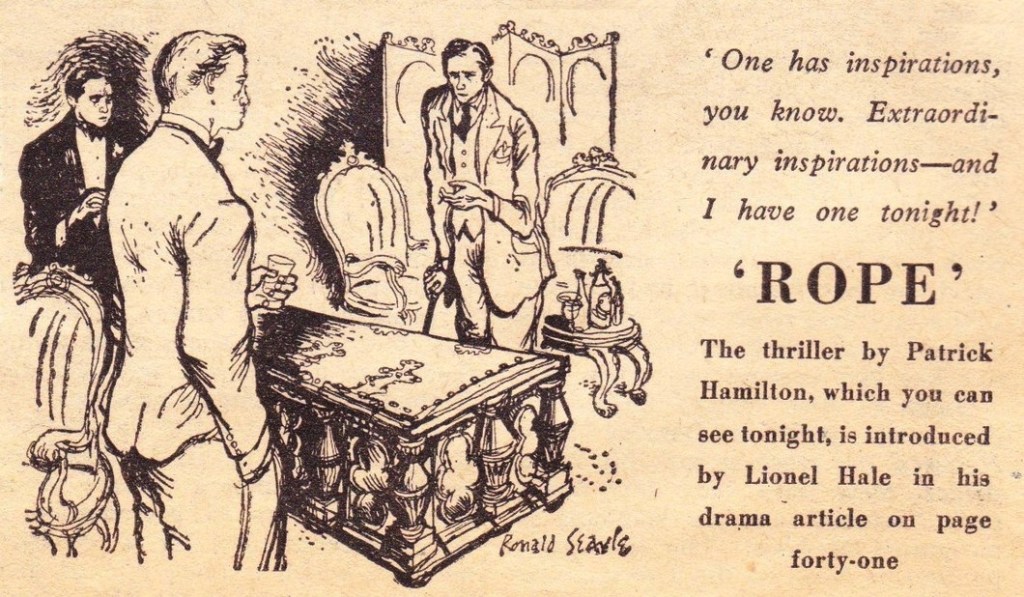
The first edition of the Radio Times in 1950 advised “People with weak nerves” to find something “soothing” to do such as play dominos or draughts when the BBC broadcast Stephen Harrison’s production of Rope, as it might be too much for them. may be too much for them.
Patrick Hamilton’s Rope concerns upper class Oxford student Wyndham Brandon (David Markham) who, under the malign influence of German philosopher, Fredrich Nietzsche and his philosophy of the Ubermensch – the superior man, persuades his weak-minded friend, Charles Granillo (Peter Wyngarde), to help him in the murder a fellow undergraduate, Ronald Raglan, simply for the fun of it.
The pair then place the body in a wooden chest, and to add spice to their crime, invite some carefully chosen acquaintances – including the Raglan’s father, Kenneth (Floyd Allen) – to a dinner party, using the chest as the table from which the food is served.
The theme of the play was suggested by a classic American murder case, in which two young men killed a friend solely for the pleasure of killing him. No motive, surely, could be more appalling.
Brandon: “I have committed murder. I have committed passionless motiveless faultless and clueless murder. Bloodless and noiseless murder.”
Granillo. “Yes.”
Brandon: “An Immaculate murder. I have killed. I have killed for the sake of killing. I am alive. Truly and wonderfully alive.”
Brandon’s first topic of conversation at the party is, of course, murder and, inevitably, the death penalty. Since the play is the perfect whodunit in reverse, as it has the distinction of revealing the murderers from the outset; the thrill of it is to see whether his two undergraduates will get away with it… or end up on the end of a rope.
The man who, in the end, defeats the murderers is poet, Rupert Cadell (Alan Wheatley), who finds the first world war has not made him quite the amoral cynic he thought he’d become. He spots the one mistake that Brandon and Granillo have made. With what appears to be his singular insight into Brandon’s perverted character, Cadell points out that even a seemingly motiveless murder is bound to be found to be solved.
“Because, dear Brandon, that sort of murder would not be a motiveless murder at all. It would ever quietly emotive. Vanity! It will be a murder of vanity. And because of that, the criminal would be quite unable to keep from talking about it or showing it off in some fantastic way or another”.
Hamilton creates tension not with an Agatha Christie-style guessing game, but with the fear of imminent exposure. As with many plays of the era, Rope values neatly constructed plot over character development. It delighted momentarily, but had little further resonance.
Patrick Hamilton always denied that the famous case involving Nathan Leopold and Richard Loeb case in the United States in 1924 in which two teenagers from prominent Chicago families committed an apparently motiveless murder of a 14-year-old boy, was the inspiration for Rope. The similarities between his play, and the Leopold and Loeb crime, make his claim lack credibility.
At the time, this was the 2nd television production of the play.
Since the early 70s when the supremo style and panache of superscribe, Jason king, rule supreme and was hardly ever off our TV screens, appreciation on the box by the man behind one of television’s all-time favourite characters, Peter Wyngarde,have been all too brief and few and far between. One such appearance was the guest star on The Two Ronnie’s Christmas Special on BBC television in 1984. For all self-respecting members of the Hellfire club, this is definitely one performance not to be missed.
The sketch, set in mediaeval times, is a spoof of the classic ‘Robin Hood’ and ‘Ivanhoe’ series of the 1950’s and played for laughs from start to finish. Messrs (Ronnie) Corbett and (Ronnie) Barker play two bungling peasants on their travels through an English forest as a minstrel merrily sings along – strumming away on his lute.
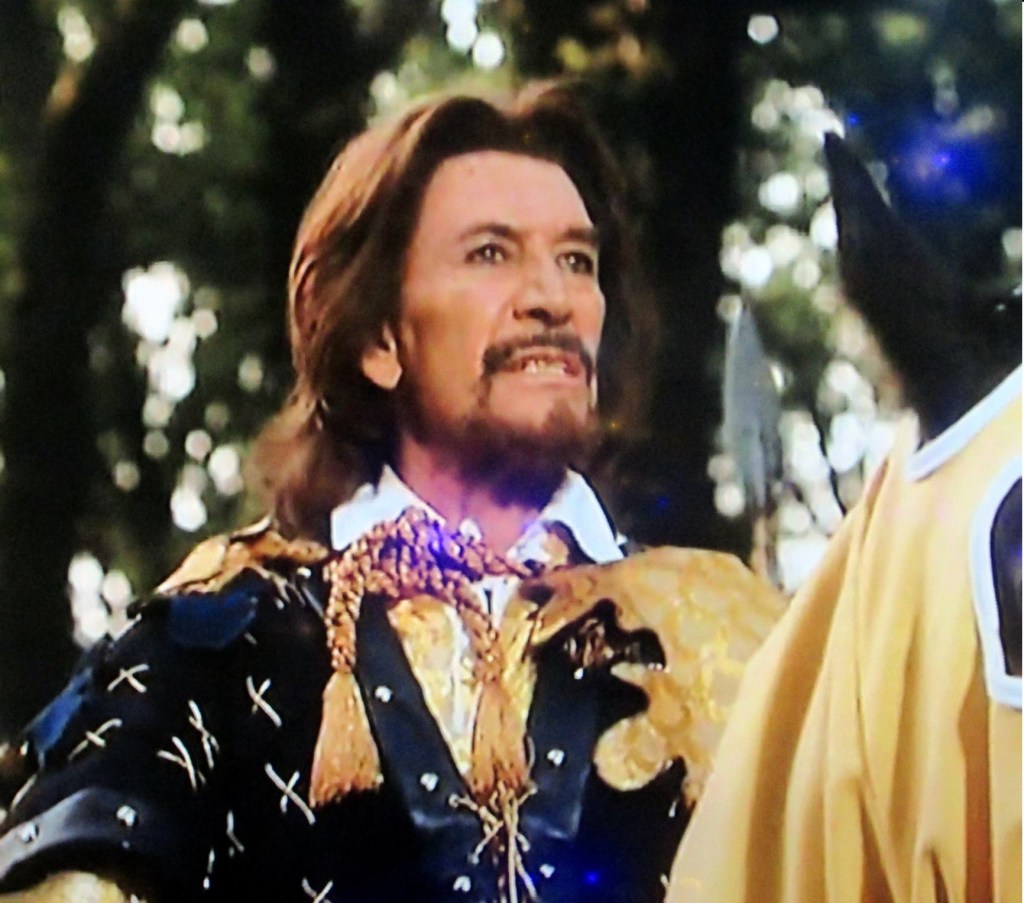
Peter is perfectly cast as the local lord, Sir Guy (Peter Wyngarde), who appears astride his trusty mount; galloping through the trees with his henchmen in tow. Resplendent in blue and
gold robes – his horse decked out to match – his tousled locks flowing in the wind and his fine aristocratic features, he portrays a masterful and mischievous look. His majestic air is completed by a bird of prey perched on his arm! Here we have a man of style and authority, perhaps a distant mediaeval ancestor of the inimitable and illustrious Mr. King!
Sir Guy seeks out the two peasants, Snivelling (Ronnie Corbett) and Grudge (Ronnie Barker) who, apparently, dabble in the medicine of the day and who he hopes might assist his beloved daughter who, we learn, has sunk into a deep despair over a lost love.
His henchmen search high and low for the pair, but when the hunt proves fruitless, Sir Guy calls for his Sergeant at Arms. Alas, the poor soldier is unable to get a word in, as his Master cusses and shouts over him. Despite his inability to respond to a single demand his superior makes, the hapless subordinate is given the following warning: “I’ve had enough of you! One more word from you and I’ll have you beheaded!”
The tongue-tied sergeant at managed to begin a sentence, but the impatient Sir Guy once again cuts him dead before he’s able to finish – bellowing, “Answer me!” Again the browbeaten sergeant splutters and stammers over his reply, which is of course all too much for his Lordship: “That’s it!” he yells. “Off with his head!”
It’s at this very point that the two miserable peasants appear from the undergrowth, led by the soldiers. Sir Guy appears to rest more easily in his saddle as he has the two men brought to him. Snivelling immediately pays due homage: “Honoured to be in your presence, m’Lord,” he sniffles, then throws himself to the grand and kisses the horse on one of its hoofs. Sir Guy looks down from aloft at this… person and slightly puzzled and demands, “What are you doing?”
“I’m kissing your ‘orse, m’Lord.”
“Are you Snivelling?” inquires his Lordship, to which the ragamuffin replies, “No – Snivelling!”
Silent until now, Grudge now decides to chime in: “We ain’t done nuffin’ wrong, m’Lord… but we’d like 27 other offenses to be taken into account.”
But all Sir Guy is interested in is their ability to help his daughter, and so he enquires: “Did you two miserable creatures sell a patent medicine to a Freeman of the City?”
Grudge, fearing the worst, quickly replies, “No! No! We didn’t!… Well, we might have done.” He turns to his friend to get his reaction to what had just been said.
“It cured his constipation,” Sir Guy continues, quite oblivious to Grudge. “Do you think you could help my daughter? She’s fallen into a morbid flux”.
“Oh, I stepped into one of those myself,” Grudge sniggers.
Clearly not taking in anything the two down and outs are saying, Sir Guy simply continues with his concerns about his daughter: “She is much distempered!”
Concerned, Snivelling interjects: “Oh, we don’t do decorating!”
This latest interruption doesn’t go down at all well with Sir Guy, who demands: “You will give her your Ethiopian Elixir. The alternative is the rack!”
Missing the order entirely, Snivelling responds with concern: “Oh, she doesn’t deserve that, m’Lord!”
Angered by the obvious stupidity of the pair, Sir Guy makes it clear that The Rack awaits them if they fail to cure his beloved daughter: “For YOU! Followed by hanging, drawing and quartering!”
He instructs his soldiers to take the “learned gentlemen” to his daughter’s apartments but has a warning for them before he gallops off: “You have until the cock crows!” Snivelling and Grudge are left to ponder their fate.
“What do we do?” inquires Snivelling of his friend. “Well, for a start we strangle the cock!” comes the reply.
The action now transfers to Sir Guy’s castle. The two peasants are seated next to the young maiden’s bedside as she lies in slumber. While they are trying in desperation to hatch plan to escape, they fall asleep and fail to hear the wandering minstrel enter the room and attempt to comfort the tender young maiden, serenading her with this ditty:
The maid lies here – unloved, unwed,
but our heroes cannot save her.
So I’ll creep into the fair maid’s bed
And do us all a favour.
This is possibly the cure she’s really been in need of. “Oh minstrel,” she enquires sweetly, “is that your loot?”
“No,” he replies, “I keep my money in my back pocket”.
In the meantime, Snivelling and Grudge have managed to find a secret passage from the castle and make their escape. Seconds later, in comes the girl’s anxious father who is shocked to find that the two peasants have fled. He immediately dispatches his soldiers to follow the escapees. Pausing for a moment, he listens to the content murmurings coming from behind his daughter’s bed curtains. Speechless, he takes another quick look and emerges with a rather puzzled look on his face.
At first light, the two peasants are being chased through the forest by Sir Guy and his henchmen – completely unaware that the fearsome Lord believes that its they that are responsible for his daughter’s newfound happiness.
With no sign of their quarry, Sir Guy halts his men in a clearing. “Cures! Curses!” he exclaims, producing a bag of coins. “I’ve brought them this 10 pieces of gold. I’ve never seen my daughter so happy. Someone must have given her the right medicine!“ Sighing, he tosses the purse over his shoulder and then gallops off to carry on with this business round the estate.
In the meantime, Snivelling and Grudge have concealed themselves in the very cunning disguise of a horse, and are making a getaway through the forest.
The name of Peter Quint strikes fear into some who hear it. The name is that of some kind of monster… Or it is just that of a course and perhaps highly sexualised man of lowly station who is just a corrupter of virtue and innocence…
When I hear the name of Peter Quint I think of my grandfather as I was reading about Peter Quint in the original source material The Turn of the Screw (1899-1900) written by Henry James (1843-1916) the night my grandfather died…. I never finished that novella and was spooked by what was essentially a ghost story. Peter Quint for boys is the male adult of who leaves an impression on them either good or bad as a part of their childhood. I wondered if my grandfather had pulled the pin deliberately and staged his death that night to leave maximum impression…
Henry James
I was and still am a gullible sort open to the questionable lies of others and I wondered if it was his ghost that came to visit me in my Hindley Street flat as a red dust storm engulfed the city of Adelaide between the time he died and his funeral. Fortunately, or unfortunately, despite all the positive influences my grandfather had on me, this was a disturbing end to our relationship. It sent me over the precipice.
There is the character of Quint played by Robert Shaw in Steven Spielberg’s Jaws (1975) who is of the ilk of the Peter Quint character in The Turn of the Screw… The original novel is set in Victorian England and was printed in weekly portions before being published in book form. Most people these days say it deals with sexual
repression, while others say it’s all about ghosts and it could be too – but, really, it’s about the corruption of the young and even the madness of not giving into corruption – for some.
There is the character of Quint played by Robert Shaw in Steven Spielberg’s Jaws (1975) who is of the ilk of the Peter Quint character in The Turn of the Screw… The original novel is set in Victorian England and was printed in weekly portions before being published in book form. Most people these days say it deals with sexual repression, while others say it’s all about ghosts and it could be too – but, really, it’s about the corruption of the young and even the madness of not giving into corruption – for some.
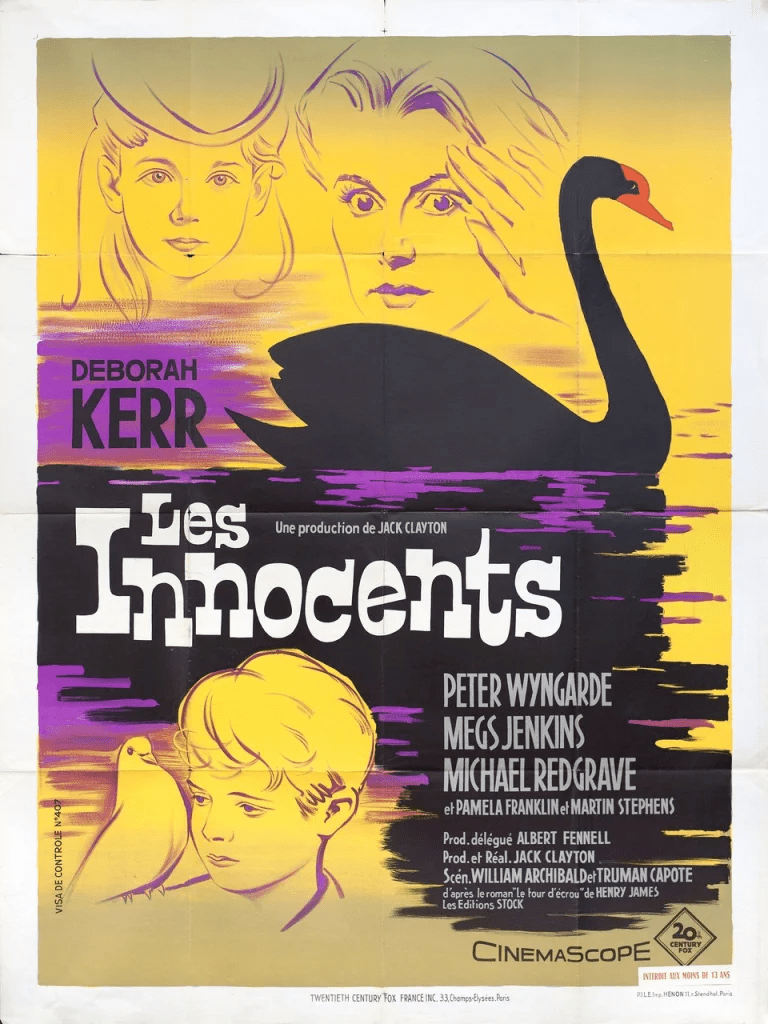
There are some interesting versions of the novel which have been transformed onscreen. The best being director Jack Clayton’s (1921-95 heart attack) The Innocents (1961) starring Deborah Kerr (1921-2007 Parkinson’s disease) as the repressed governess to two young children named Miles and Flora on a large countryside estate owned by their uncle. It was there the previous governess had died under mysterious circumstances along with another manservant on the grounds Peter Quint. Kerr becomes obsessed with these two dead servants, so much so that she begins seeing them around the house and gardens.
Director Jack Clayton
This dead pair seem to have left and impression on the children in terms of bad language and also ape their sexual behaviour to a certain degree.
The story, as told in The Innocents, has a great performance by Kerr as the governess who may really be seeing ghosts, or are they just hallucinations conjured by her own Victorian repressed sexuality. She knows these two had a sex life and even the children may have one among themselves as in one version of the story they dress up and apply lipstick and fondle each other.
Filmed in Cinemascope The Innocents opens with the praying hands of Kerr’s governess, possibly in a madhouse as she weeps. She is trying to save the souls of the children with prayer. The film also ends with the clasped hands as a kind of bookend. Sometime director Freddie Francis (1917-2007 after stroke) photographed the movie and a whole article could be written about his use of the widescreen and the black and white film stock.
“I want to save the children not destroy them,” Kerr tells herself about her worries that the souls of the children are possibly lost.
The truth being that once the innocence of a child has been erased to a certain degree, there is no going back, except if the child is perhaps only aping the behaviour of the corrupt adult – say of the name of Peter Quint… there is still a kind of innocence in that case if the child does not fully understand what is happening… As Kerr becomes involved with the household and knows of its past, she possibly, as a Christian, grows hysterical when the extent of Quint’s reputation starts to manifest itself as he hardly led people down the path of righteousness including children… As a result, it has her groaning sexually in her sleep while the children watch. Her latent sexuality is near awoken but she will not allow it.
Photographer Freddie Francis
Kerr’s sexual innocence is one that has remained intact or ‘pure’ since childhood we assume and also through adolescence. She thinks the same should be for Miles and Flora, but the children have already seen things. We suspect Quint and his woman even made love in front of the fireplace, but it is all ghostly and unproveable. They are impressions in the minds of the children.
Flora knows foul language and Miles kisses Kerr full on the lips like a lover despite being barely eight or ten years old. This is shown in close-up in the movie just to underline the point. The photography as I mentioned is fantastic with dark corridors in the house enclosing the characters from either side almost like death or an otherworldly realm.
“Thank heaven for children,” says the head maid played by Megs Jenkins (1917-98). This actress would appear again as the maid in another version entitled The Turn of the Screw (1974) which starred Lynn Redgrave as the governess. Shot on video tape, this is a solid adaptation by American director Dan Curtis.
Peter Wyngarde as the evil Peter Quint
And also from the maid: “He really had the devil’s own eyes” she says of no one in particular except Quint himself and she swallows her words when Kerr almost gasps. He is a character who we only see briefly in this movie but Peter Wyngarde (1928-2018 unspecified) makes a great impression in the role. It is an evil countenance.
“Would the Lord just leave me here to walk around? Doesn’t that happen to some people?,” asks Flora of Kerr after saying her prayers and doubting their efficacy. Flora innocently believes in ghosts at this point in the movie.
And so, we have the set up as we will wonder if the house is haunted by the spectre of Peter Quint, or is it only the minds of those in his former living realm that are disturbed by his spirit as it was in life and the troubles it has left behind in those who know him and those infected by his legend through word of mouth.
Meanwhile the boy Miles may have the power “to contaminate, to corrupt” says Kerr to the maid and herself with a spooked look on her face… It is said that the author of the novel Henry James had his own Peter Quint in the form of his father who chose for his son not to be educated in the classics but had him opened up to many influences, both scientific and philosophical, which one biographer described as “haphazard and promiscuous”. It should also be added that James admired the morally ambiguous and totally human work of the French writer Honore de Balzac (1700-1850).
The excellent script for The Innocents is based on the 1950 play by William Archibald (1917-70 hepatitis) with the help of legend Truman Capote (1924-84 liver disease and drug overdose) while there are extra scenes by John Mortimer (1923-2009 stroke) of Rumpole of the Bailey fame.
Archibald’s original play said the ghosts in James’ novel were real but one could imagine Capote injecting the repressed sexuality scenario into the new screenplay. It was director Clayton who decided to go with the psychological aspect of the script right through to the ending and he asked Kerr to try and balance her performance between reality and unreality, something she found to be difficult and intense. Archibald was upset about the doubts cast about the ghosts and argued with Clayton… The director won out and a classic was forged with the children watching Kerr moan in her sleep and Miles later strangling Kerr in fun and games like some sado-masochistic lover getting carried away.
The book in play form
It is then Kerr ‘sees’ Quint and the beginning of her spiritual disturbance has begun and quickly turns to the hysteria in one scene of being like a caged bird to the sound of canaries or cheeping birds trapped in an airless place. We even get the idea that Miles has learnt cruel behaviour such as breaking the wings and necks of doves from Quint. The spectre of Quint is disturbing in many ways even if he wanders and appears nary at all: “You didn’t know Quint… such power he had over people” says the maid as she tells Kerr about how Miles followed the man around like a dog.
Just a word on the screenplay once more and it is said that Capote was brought in to do rewrites and it turned out that 90 percent of the screenplay was his… Thus, the American Southern Gothic feeling to it all while Mortimer was brought in to polish the dialogue and give it a Victorian feel which he succeeded in doing.
Part of the blurring of reality and the ghosts Kerr sees in the children themselves as well as a part of her disturbed personality is suggested when she says: “They’re playing some monstrous game” with the words monstrous and game brought together to show corruption and innocence as well as reality and unreality and perhaps also the evil supernatural and the rules of the psychological: “Unless they’re deceiving us, unless they’re both deceiving us… the innocents!”
Kerr says the title of the movie with irony and yet there is no conviction to this irony as if she herself can’t even imagine how the kids could deceive her. It’s as if Kerr has forgotten what it’s like to be a child, or else she was raised in a convent and has a childish adult perspective of an uninitiated adolescent.
The strange thing about the effect of Peter Quint, once his spirit or legend takes hold of Kerr, is that it’s effect on Miles is twofold just as the spirit of Quint’s governess girlfriend Miss Jessell affects Flora…. So massively when Kerr tells her the ghost is present.
Not only does Quint and Miss Jessell’s contact with the children before their deaths remain intact in the minds of Miles and Flora but Kerr’s stirring of the memories of these dead personalities from Resting in Peace again into the monsters they once were, makes them seem they ‘once are’ once more. So, the children are The Innocents as Kerr overestimates how corrupt they really are.
“They lure, they know, they share this hell,” says Kerr about “casting out these devil’s forever” as she sees the ghosts as a manifestation of the children and still can’t see how it is herself which is responsible for these so-called manifestations in the first place. It is like she has a neurosis as she projects it upon the children themselves.
Let me just mention that Kerr was around forty when she made this movie and the role in the original novel had the governess aged only around twenty. It’s an amazing performance.
Further, the sound design for the movie is pure genius at moments especially when matched with Clayton and Francis’ work… Let’s not go into that as you must study the movie yourself.
The ending of the movie has Kerr reducing Flora into a screaming hysterical mess while a bit later Miles dies of heart failure after imagining he sees or can sense the presence of Peter Quint after Kerr prompts him that he is watching from the darkness. Such is the essence of ghost stories. Quint in Miles mind may have returned from the grave as the boy succumbs with no REAL presence. Or was there? The power of suggestion can kill. So, the legend of Peter Quint has imprinted himself in his lifetime on the boy and in the boy’s death as well. Such is the experience of some children who suffer or learn at the hands of adults. Kerr as a teacher hoped her Christian learning would also rub off on the children while Quint’s lessons in life are on the other far end of the scale. It is sometimes not the fault of the children that they learn such behaviour in certain communities or in a society… the Quint affect continues… even Kerr’s Christian ‘cruelty’ in the end against Miles and Flora is comparable to Quint, or even worse, once she is too is affected by this man. Triggered late in life after a lifetime of prayer, something she returns to at the very end as she doesn’t take responsibility of the reality of the ending but instead directs it with her belief in Christ and the New Testament. It possibly saves her but not the children as she wished and she prays with an almost detached delusion.
Kerr has seen two worlds collide in terms of her own Christianity and those who live without it… Unfortunately, ghosts, whether they are in the mind on a part of the supernatural can destroy lives and that goes for the man that was Peter Quint who was obviously not a Christian at all.
There was a prequel to The Turn of the Screw directed by Michael Winner (1935-2013) entitled The Nightcomers (1971). It starred Marlon Brando (1924-2004 respiratory failure) as Peter Quint and it showed some of his boorish behaviour as well as his intelligence laziness and lust. The most interesting part of this movie is perhaps the ending where the children murder Miss Jessell and Peter Quint, which is probably the ultimate set up for the original novel The Turn of the Screw. The children are older in The Nightcomers and so the sexual themes could be explored further.
As you know, Winner isn’t known for being a great director and the script is by Michael Hastings (1938-2011). I found the movie forgettable otherwise.
The trailer proclaimed: “Marlon Brando as Peter Quint who took two children and taught them everything” while it also mentioned Brando’s “Inventive film acting.”
Another remake of the original stars one of my favourite underused actresses from the 1990s… Her name is Jodhi May (1975-) and she stars in the 1999 version of the movie which keeps the original title. May, some will remember, was the younger sister in The Last of the Mohicans (1993). She does a good job here. Whereas the uncle, who gives the governess the job at the beginning of The Innocents, was played by Michael Redgrave (1908-85 Parkinson’s disease), here it is played by Colin Firth (1960-). It’s a good movie and the ending, rather than having Miles die of heart failure, instead has May seem to smother him to death at her breast. Certainly, another way to express repressed sexuality.
Then there’s director Rusty Lemorande’s version made in 1992 which doesn’t quite have the polish or the previous films and it has languished in obscurity thanks to its reputation. It is however a different take on the tale. This one has Patsy Kensit (1968-) as the governess and the movie this time is set during the 1960s with Julian Sands (1958-) as the uncle and French actress Stephane Audran (1932-2018) as the maid or housekeeper. There is even a performance which bookends the movie by Marianne Faithfull (1946-) who tells the tale from a diary and who may be Flora now one of the inmates of a ‘home’. It’s a version which, like the Dan Curtis version starring Lynn Redgrave, is agreeable without being particularly special.
And I will visit another version from a couple of decades back which was a Spanish-American production which starred Sadie Frost (1965-) as the governess, Harvey Keitel (1939-) as the uncle and Lauren Bacall (1924-2014 stroke) as the governess. It is called Presence of Mind (1999). Set in Catholic Spain at the turn of the 20th Century, it has the courage to use an adolescent child in the form of NIlo Zimmerman (Nilo Mur) (1986-) and more or less have a scene of sensuality of the child changing his clothes in front of Frost and baring his backside. The film is not a great one otherwise but here’s some dialogue to wrap up the article.
“The dead are dead Miss… There’s nothing else they can do to harm the living anymore,” says Lauren Bacall in an ironic twist for later on. And meanwhile Miles later in the classroom looks up the word ‘ghost’ in the dictionary… “Because sometimes things have more than one meaning. Ghost. One, the spirit or soul. Two, or haunting memory. And three, the supposed spirit of a dead person, appearing to the living as a shadowy apparition…. If ghosts don’t exist. Then why are they in the lexicon.”
Is there no choice for the boy but to become this man?
Well, I guess they are not banned and Kerr reads about the Holy Ghost in her Bible… Why is it that many of us are fascinated by ghost stories? Why do we like being scared by them? Or why do we become scared in the first place? There must remain some doubt as to their existence for us to let them into our mind and scare us… for some, deeply.
And so, I am back to the spirit of my grandfather as the dusty winds blew through the window of my second-floor apartment with the curtains blowing and I imagined this man who had shown me Treasure Island through to Tennessee Williams from Jaws (Quint! Quint! Quint!) through to Jacques Tati had returned to admonish me for being a failure… It was at that midnight hour when I could not sleep that my mind began to disintegrate to a point where I would be almost classically mad…
He had once warned me with a laugh of Dame Judith Anderson’s character in Rebecca (1940) as she madly and almost queerly believed that there could be such a thing as a ghost in the first place. I see now in that dusty midnight hour that I need not have been scared and I need not believe he had returned to torture me: “He was dead” and like in Old Marley in Charles Dickens’ A Christmas Carol: “as a doornail”!
And like Kerr, I pray over this keyboard with a sense I don’t really believe this at all and yet I try to believe in the good in people… and try to forget the Peter Quints’ of the world who may haunt me either living or dead for the rest of my mortal existence.
With grateful and sincere thanks to J.P. Quirk for allowing us to reproduce this work.
Soviet-style language, sockpuppetry and importuning
One bemused old man’s journey into the bizarre world of Wikipedia
Written by Austin Makinson
Towards the end of June (2022), I sent an email to this website concerning, amongst other things, the myths that continue to surround Peter Wyngarde – the origins of which, more often than not, can be traced back to the online encyclopedia, Wikipedia.
My Email: 27th June, 2022
Hello Tina,
Just been reading many of the comments below and was especially shocked to learn about the amount of misinformation there is out there about Peter. It must have been appalling for him to have to live knowing that there are such malicious and unthinking people out there. As someone has already stated, what ever has happened to ‘Do unto others as you would have done unto you’?
As has quite rightly been highlighted on this page, Wikipedia (W.P.) has much to answer for. I recall them insisting at one time that Peter had been given a police caution in 1974, supposedly for importuning in Birmingham. They asserted that the information had come from a book entitled, ‘Crime Through Time: the Black Museum’ by Stephen Richards. The trouble was there was no such claim in the book. But even if this allegation had been in this publication, what made Wiki believe that the Richard’s was correct? It was actually a very serious statement to repeat, especially as Mr Wyngarde was alive at the time this appeared on Wikipedia, and since much research has been done both by myself and other, there has been no evidence found to substantiate this declaration*. Had the Wiki lot stopped to consider for a second what impact such false information could have on someones life? Evidently not.
From Wikipedia, this blatant lie has since seeped into the public consciousness having been picked up by the press. I wonder if the person or persons responsible for posting it on W.P. have or ever will have the decency to apologise? I for one won’t be holding my breath! I’ve attempted to contribute to the Peter Wyngarde biography on W.P., but despite there being an open invitation to any and all of us add to the encyclopedia, my contribution(s) have immediately been deleted by those that have created the P.W. biography.
Another thing about those referred to above and the fuss they make over Peter embellishing his ‘biography’: As has been pointed out previously on this page, almost every actor did this. In addition to those personalities already mentioned, there’s William Hartnell. He claimed that his father was a farmer but latterly said he was a soldier who’d taken up stockbroking. Where’s the song and dance over that?
There is far too much reliance on W.P. by the press, bloggers, authors and the public in general. The people who compile these biographies and other articles on there are not philosophers and scholars they’re just ordinary Joes like the rest of us with no access to privilege knowledge than anyone else. They simply cherry pick what they think will pique the reader’s interest while discarding the information that doesn’t fit their agenda. In that they’re no different to the tabloid newspapers that feed off them.
Bless you Tina in you’re inexhaustible mission to expose the truth.
Austin Makinson
* All references to this alleged incident in the press have come AFTER this allegation was made on Wikipedia, NOT before.
Following the publication of my email [see right] both on this website and the Official Peter Wyngarde Appreciation Society Facebook Grouppage, it was reported that over 312 Wyngarde fans responded to the points I’d raised via the aforementioned platforms.
One of those peoplewas a gent by the name of Andrew Humphries, who himself is a member of the Official Peter Wyngarde Appreciation Society (O.P.W.A.S.) and is also a semi-regular contributor to Wikipedia (W.P.).
Mr Humphries took it upon himself to investigate one of the more damaging assertions made by W.P., namely that Peter Wyngarde had been “cautioned” for importuning in Kennedy Gardens, Birmingham, in 1974. It was claimed at the time that the source of this story had been a book entitled, ‘Crimes Through Time: The Black Museum’ by Stephen Richards (Mirage Publishing – 2003), but no mention of such an incident could be found in the book.
According to Tina Wyngarde-Hopkins[1] who was Wyngarde’s soulmate for almost 30 years the actor had, from time to time, referred to an episode that had taken place in Gloucester in 1975, but had never once spoken of an incident in Birmingham a year earlier.
While this baseless contention had latterly been removed from the Peter Wyngarde biography, it was reuploaded onto Wikipedia in 2018. The ‘Contributor’ responsible for this cited The Mirror[2] as his/her source without realising that The Mirror had got the story from Wikipedia in the first place (Andrew Humphries sleuthing at the end of June and into July of 2002 revealed categorically that this myth had it’s roots firmly planted in Wikipedia soil).
Conclusion of Andrew Humphries detective work:
‘I have been sleuthing again, because I found some blogs from 2013 and 2014 that mentioned a Kennedy Gardens incident. This was long before the 2018 Mirror article that I said was the original source, but I can see I was wrong about that. Looking at the Wikipedia article again, but going back much further, I can see that a user added the info on 28 Sept 2010, but with no source. It was only removed by another user in about June 2016 who noticed it was not sourced, or not sourced properly. It was then added back in after the Mirror article was published in Jan 2018, but without any citation of The Mirror. The true crime book was already a source for something else, and sloppy editing made it look like it was also being cited for this new info. I tend to agree with Tina [Wyngarde-Hopkins] now, that the earliest trace of this factoid is when a Wikipedia editor added it in 28 Sept 2010. It *appears* to have been sincerely added as a fact, and specific newspapers are mentioned, but without any proper verifiable source or citation. As for The Mirror, I think they probably had a pre-written obit for PW, perhaps prepared when that questionable info had been live on Wikipedia between 2010 and 2016.’
Andrew Humphries
Although I was warned several times about how jealously the Wikipedia PW biog is guarded, and that the chances of me being allowed to contribute, edit, change or challenge any of its content was virtually nil, I decided to chance my arm and join Wikipedia nonetheless. I mean, what’s the worst that could happen? Famous last words…
And so by merely entering a ‘Username’ and not much else, I was suddenly to find myself a fully-fledged Wikipedia “Expert” who was free to post on just about any subject I fancied, regardless of whether I actually had any knowledge about it or not. After locating the Peter Wyngarde biography, I went ahead and added the following into the body of the article:-
It was wrongly stated on this page some years ago that Peter Wyngarde had been arrested and charged for importuning at Kennedy Gardens, Birmingham in 1974. The origin of this claim was said to have been ‘Crime Through The Ages: The Black Museum’, a 2003 publication by Stephen Richards. It has latterly been discovered that the author of this book was in error and that the contributor responsible for repeating this unreliable information here had failed to carry out the necessary checks befitting such a consequential statement. It is now understood that much pain, anger and embarrassment had been caused to Mr Wyngarde by this appalling inaccuracy prior to his death. While this wholly inaccurate paragraph has since been withdrawn it had, unfortunately, already been picked up on by the British press and subsequently republished by bloggers and those frequenting online forums, which is continuing to cause unimaginable upset to those people closest to Mr Wyngarde and who still morn him. This is of sincere and deep regret.’
As predicted, my contribution was immediately removed by someone calling his or herself ‘Theheartof’ (username), who turned out to be one of the dreaded editors/admins/contributors that oversee the biography. I was duly informed that I’d broken W.P. rules by not “discussing” with (for this read ‘failing to gain the permission of’) the conglomerate that appear to own this particular article. And so a ‘discussion’ ensued between myself and others during the course of which I attempted to put my case across. Not unsurprisingly, the false information about Wyngarde which had been proven to have originated on Wikipedia and latterly seized upon by the tabloids, was explained away as “vandalism”[3], which seems to be the go-to excuse for anything any one of these ‘Contributors’ gets wrong. And yet in spite of this defacement being reposted on Wikipedia for a second time in 2018, I was soon to realise that the chances of anyone actually acknowledging the damage caused by this misinformation was even less likely than my contribution being allowed to stand.
Being point-blankly prevented from updating, editing or contributing to the online encyclopedia is not unique to this specific ‘biography’. Watch Sharyl Attkisson’s jaw-dropping exposé ‘The Dark Side Of Wikipedia’ by clicking HERE
Now that the shutters had come down on any kind of dialogue regarding the Kennedy Gardens myth and my protest ostensibly being stifled, I attempted to debate as to why, when there are so many more credible sources of information out there about Peter Wyngarde, this apparent closed shop still insist on quoting so persistently from a universally condemned “obituary” published by The Guardian three days after Wyngarde’s death in January 2018. Once again, I was shouted down. I was soon to discover why… (see under ‘Suddenly It All Becomes Clear…’ later in this article).
Above: Peter Wyngarde has repeatedly been misrepresented by Wikipedia contributors
Having basically given up on getting anywhere with both the first and second issues I’d raised, I thought I’d take a look at what else was being discussed in the ‘Talk’ section of the Wyngarde biography. It was then that I came across the following under the title, “1 child” in Infobox:-
“This has been recently added, but there is no source nor any other evidence that he [Peter Wyngarde] and Dorinda Stevens [Peter’s wife of 5 years] had a child together. Delete?” “Theheartof (talk) 11:09, 21 September 2021 (UTC) [reply]
“Have removed as unsourced. Was added here on 24 August, by User: Ecosseboy, who might care to explain further.” Martinevans123 (talk) 11:35, 21 September 2021 (UTC) [reply]
“It may be connected, although the date given is years after his purported marriage, to a baffling, and needless to say, unsupported claim under ‘Trivia’ on Wyngarde’s IMDb entry that “He had one child — born in 1977.” “Dolmance (talk) 14:27, 29 October 2021 (UTC) [reply]
I responded as follows:-
“I would assume that at least one of the regular contributors to this biog will have read ‘Peter Wyngarde: A Life Amongst Strangers'(?). On Page 381, with regard to the claim by the author that she and Wyngarde had discussed having a baby and buying a villa in Greece. Wyngarde is speaking. He lists a series of names for their child: “Here is a list of possibilities. Remember, he’ll be called by his Christian name more times than he will his surname – unless he’s in the Army – so we must call them out loudly and listen to how they sound. Here goes: Jason (my favourite), Justin, Jake, Togan, Sab or Seb, Jasper, Jonathan, Titus, Dugdale, Colwyn, Clayton, Vivyan (the male equivalent of my Vivien Leigh). One of these is what I’d like to call my next son.” How did you miss that?” TheWoolpack (Talk) 19:33, 7 July 2022 (UTC) [reply]
I immediately regretted posting the above statement, not least because I envisaged this collection of busybodies attempting to track down Wyngarde’s son and dragging him, kicking and screaming, into the limelight whether he desired to be there or not!
It was reported in the 2020 biography, ‘Peter Wyngarde: A Life Amongst Strangers‘, that one of the above circle had actually ventured to extract personal information about the actor from members of staff at Golders Green Crematorium within days of Wyngarde’s funeral taking place. If they are capable of something so distasteful, their exposing Peter’s offspring to public scrutiny, regardless of his age, would doubtless trouble this collective not one iota. My observation would prompt ‘Theheartof’ to snap back at me as follows:
“The only reek seems to be he (sic) great smell of sockpuppetry.” Theheartof (talk) 08:59, 10 July 2022 (UTC) [reply]
As a man of almost 70 years of age who isn’t entirely au fait with Internet parlance, I was obliged to look up what a “sockpuppet” is. Here is Wikipedia’s own definition of the term: ‘Another word to describe a sock puppet would bealter ego. Often, a sock puppet identity is used to promote ideas or gather intelligence anonymously. Very often, they are used by individuals on the Internet praising themselves while pretending to be someone else.’ I responded to ‘Theheartof’ thusly:-
Me… apparently
“Is labelling someone a “sockpuppet” how you self justify any sort of descent or challenge to what you post on here? From the little experience I’ve had of Wikipedia, it would appear to be something of a closed shop and that if potential contributors (to this bio at least!) aren’t willing to nod wildly in agreement with everything you say then they’re either accused of deception or vetoed. In view of this, might I remind you of W.P.’s own guidelines:-“Assume good faith” and “Be welcoming to newcomers” Is it any wonder that W.P. has such an atrocious reputation?”TheWoolpack (talk) 18:02, 12 July 2022 (UTC) [reply]
So having had the door slammed in my face twice already for daring to question the misinformation touted by Wikipedia about Wyngarde over the years, I now found myself accused of dishonesty by someone who doesn’t know me from Adam but who, rather hypocritically, had just spent several minutes attempting to absolve W.P. contributors like his/herself of their own sharp practices! And if this wasn’t enough of an affront, out of the blue, and without any kind of provocation or suggestion, I was approached by someone sporting the username ‘ColinProbert’, who made the following enquiry…
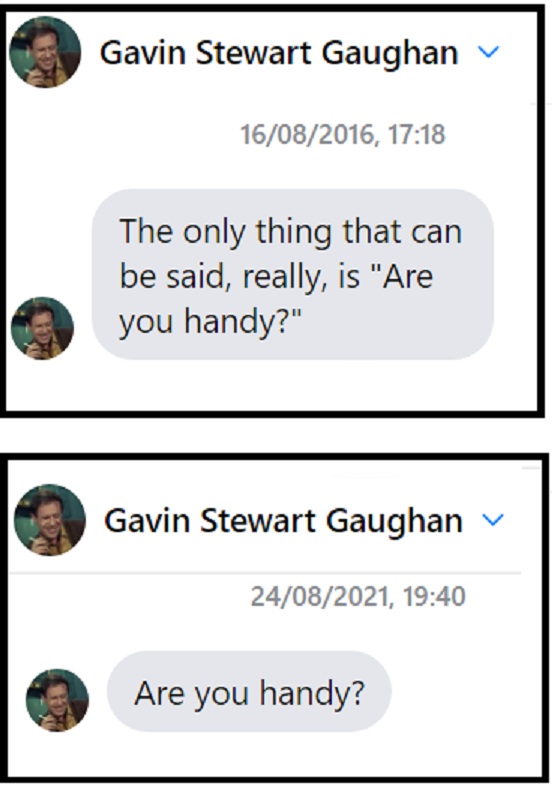
When I made inquiries of various friends and family members, I was reliably informed that “Are you handy?” is an old pick-up line oft used by gay men when importuning (“cottaging”[4]) back in the days when homosexuality was illegal in the United Kingdom[5]. In the 67+ years I’ve been on this planet, I have never once been propositioned in such a way and to be perfectly honest, I found the approach (on no less than a public forum) nothing short of nauseating. I was beginning to wonder what in the name of God I’d stumbled into with this Wikipedia thing. It was completely and utterly bizarre.
As was my right under Wikipedia ‘law’, I brought these two matters to the attention of one of the ‘Administrators’ who, basically, volunteer to police the W.P. website; act as arbiters and, when disputes arise, employ their powers to remove any offending material. I explained to him/her that, as someone new to Wikipedia, ‘Theheartof’s’ lack of “good faith” and allegation of “Sockpuppetry” had made me feel unwelcome, and regardless of ‘ColinProbert’s’ personal sexual orientation, his uninvited approach had genuinely turned my stomach. As it happened, the ‘Admin’ agreed that ‘Theheartof’s’ assertion was wholly unjustified and entirely groundless, and since “soliciting for sex on Wikipedia is forbidden” (who’d ‘ave thought?!?), both of these crass posts were removed forthwith.
Like the ashen faced thrill seeker who emerges from a shark cage after facing off a Great White, I’m relieved that my one and only dalliance with Wikipedia is over. As far as the inner circle behind the Peter Wyngarde biography is concerned, I can’t say I wasn’t warned…
Sorry Peter, wherever you are; I did my best. But as my dear old dad would often say, “Arguing with idiots is like playing chess with a pigeon. No matter how good you are, the bird is going to sh*t on the board and strut around like it won anyway.”
A wise man was my dad.
Suddenly It all becomes clear…
It was only when I presented the screengrabs and other material to be formatted for this article that the “Are you handy?” enquiry was identified as the calling card of none other than Gavin Stewart Gaughan – the disgraced author of the previously cited ‘Obituary’ (The Guardian – 18/01/18[6]. Gaughan was banned from the Official Peter Wyngarde Appreciation Society in 2014 having been cautioned on no fewer than three occasions for posting abuse and for behaving in an age-inappropriate manner. Because it’s now apparent that he’s involved to some degree with the Wikipedia Peter Wyngarde biography, it’s small wonder that his universally condemned ‘obituary’ is still being used as an, a-hem, “reliable source”.
Above Right: Gavin Gaughan had trolled the Official Peter Wyngarde Appreciation Society throughout 2014 by repeatedly posting this threadbare “Are you handy?” slogan on their Facebook page.These are his attempts in 2021 to regain entry to the Society’s Facebook group page, in spite of him being wholly unwelcome there. Undeterred, Gaughan continued to harass the Appreciation Society in early 2022(see below).
My grateful and sincere thanks to Pam of the Official Peter Wyngarde Appreciation Society for providing these screengrabs. Austin Makinson
There was then a lightbulb moment…
Tina Wyngarde-Hopkins to Austin Makinson:
“It didn’t occur to me, even after Mr Gaughan had posted this “slogan” on our Facebook page and elsewhere over a dozen times that he might actually be soliciting; I just viewed him as an attention-seeker. I suppose it takes a fresh eye to see what’s actually staring you in the face.He’s persistent – I’ll give him that. It’s all extremely childish.”
A bit of trivia... Even after being called out by the public following the publication of The Guardian ‘obituary’, Gaughan still had the brass neck to approach Thomas Bowington, Peter Wyngarde’s agent and friend of almost 15 years, to request his assistance in writing a book about the actor. Mr Bowington said, quite wisely it would seem: “I’d have rather placed Peter’s legacy into the hands of Old Nick than in Gavin Gaughan’s!”
Notes:
[1]. Peter Wyngarde’s soulmate of 30 years. Secretary of the Official Peter Wyngarde Appreciation Society, 1991 to present day. Admin of this website and of the associated Facebook group. Author of, ‘Peter Wyngarde: A Life Amongst Strangers’ (Austin-Macaulay, 2020). [2]. British national newspaper formally known as The Daily Mirror. [3]. On Wikipedia, “vandalism”is the editing of an article in an intentionally disruptive or malicious manner. [4]. “Cottaging” is a gay slang term, originating from the United Kingdom, referring to anonymous sex between men in a public lavatory. [5]. The Sexual Offences Act 1967 is an act of parliament in the United Kingdom (citation 1967 c. 60). It legalised homosexual acts in England and Wales on the condition that they were consensual, in private and between two men who had attained the age of 21. [6]. After being castigated both by the public and members of the film, television and theatre community for the hatchet job he’d done on his Peter Wyngarde ‘obituary’, Mr Gaughan ostensively went to ground, only remerging in August 2021 to revive his infantile campaign of harrassment against the Official Peter Wyngarde Appreciation Society. In May 2022, after being barred from the Society for eight years, Mr Gaughan twice attempted to gain entry to the group’s Facebook page – repeatedly using the line, “Are you handy?”
Mr Gaughan was dismissed by The Guardian newspaper in April 2018 after Obituary’s Editor, Richard White, learned of the extent of his harrassment of the Appreciation Society. Mr White wrote the following:-
“The circumstances that you detail in your email certainly sound disturbing, and I’m sorry for your distress. Up to the appearance of the piece, we had found Gaughan to be a dependable, occasional contributor. However, we immediately appreciated the need to present a better picture [of Peter Wyngarde], so I asked Tony Hadoke to provide a replacement.
Gaughan isn’t among the writers who we’d now think of turning to. We would much rather have published a piece that no-one would consider unfair. We are not planning to ask Gaughan for any further pieces, and I cannot foresee any situation in which he would write for us again”
With thanks to Tina Wyngarde-Hopkins for supplying a copy of the above email.
Click below for more about Wikipedia misinformation about Peter Wyngarde…
Crown Court was a British television courtroom drama series that was produced by Granada Television – part of the Independent Television (ITV) network. The first of 300 episodes[1] was broadcast in 1972, and ran until 1984.
Typically, a ‘case’ would be played out over the course of three 25 minute episodes, shown over as many afternoons. The court was set in the fictional town of Fulchester.
While the main characters were played by actors, the jury was made up by members of the public chosen from the Electoral Register. It was this group of people that would decide whether the character on trial was guilty or not guilty.
Notes:
[1]. ‘The Son Of His Father’ was episode 290.
The Story
The episode opens at Fulchester Crown Court. The defendant – a young woman by the name of Mary Ginsel (Carol Frazer) – is accused of blackmailing a prominent MP, Sir Roland Richardson (Gerald Flood), who she claims is the father of her 3-year-old son, Gavin.
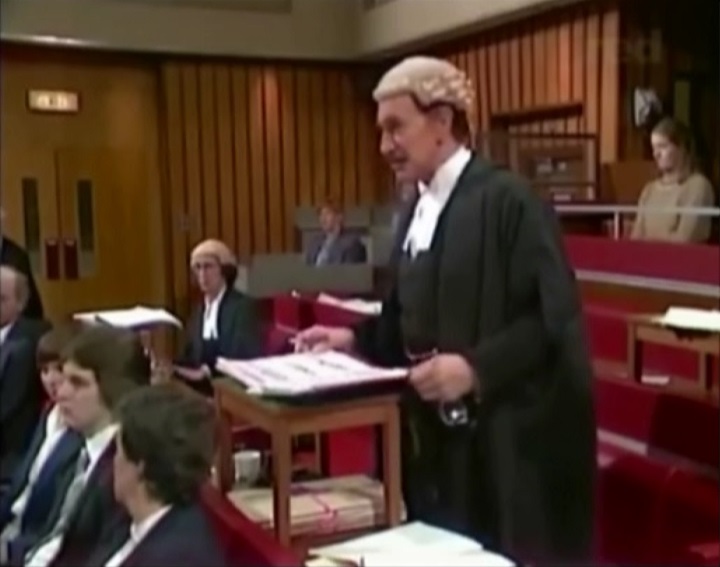
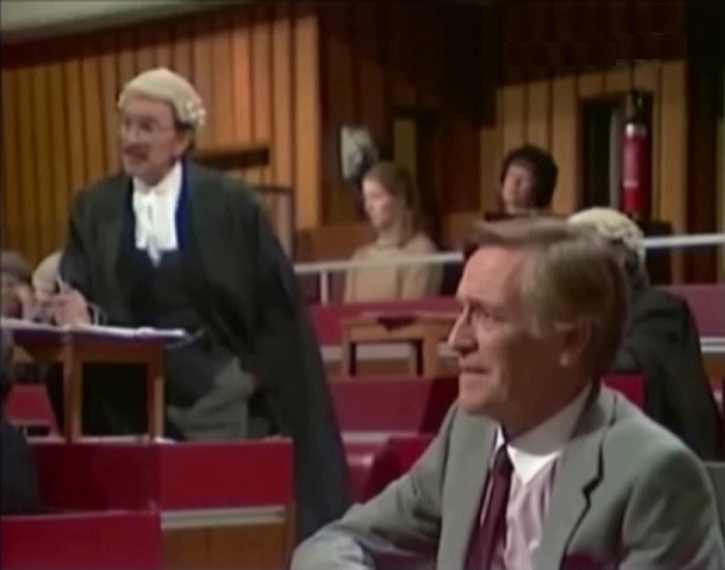
Sir Roland is the first to take to the witness stand, where he is questioned by Prosecution lawyer, Sir Charles Marchington QC (Peter Wyngarde), who enquires as to the nature of the relationship he’d with Ms Ginsel.
The elderly Lord explains that he and the young woman share an interest in stamp collecting – indeed, he had once been chairman of the Fulchester Philately Society, which is where he’d met Ms Ginsel. Latterly, she had acted as his advocate when bidding for rare stamps at auction.
Sir Roland admits to visiting the young woman at her home on several occasions, which he describes as a modest flat 15 miles from where he himself lived. There he had met the child, Gavin, and also one-time musician and photocopier salesman, Lee Sinclair – a friend of Ms Ginsel.
Despite receiving a number of rather familiar letters from Ginsel over the course of many months, including a somewhat accusatory note demanding the sum of £200 for the care of young Gavin, Sir Roland vehemently denies that his relationship with the young woman had been anything other than businesslike. He categorically denied that he was child’s father.
When Sir Charles completes his examination of the MP, Ms Ginsel’s defence lawyer – Eloise Hunter QC (Roselie Crutchley) – takes to the floor and immediately makes the charge that Sir Roland is the child’s father that in actual fact, he had been in an long-term, intimate relationship with the boy’s mother. She further contends that he had merely been using their mutual interest in stamp collecting as a foil; the fact that he hadn’t told his wife about Ms Ginsel’s numerous letters only confirmed this.
The next witness to take the stand is Jean Tomson – a middle-aged widow who lives in the same block of flats as Ms Ginsel. Sir Charles learns during his questioning that she had been a friend of the younger woman but that the two had recently fallen out. She insists that Ginsel and Lee Sinclair had been co-habiting for some time, saying that he was at the defendant’s flat “all the time”. She makes mention of an incident some months earlier when she’d seen Sinclair sitting on the stairs, crying, and that Ginsel was attempting to comfort him.
When cross-examined by The Defence, Mrs Tomson is obliged to reveal that she herself had been involved with Lee Sinclair, which prompts the accusation that she is in fact jealous of Ginsel and that her agreeing to act as a witness for the Prosecution had come out of malice. Tomson refutes this.
Following Sir Roland’s resignation from the Philately Society teacher, Leonard Alldis (John Quentin), had taken over as Treasurer. He is next to step into the witness box.
Left: Peter as Sir Charles Marchington QC
He tells Sir Charles Marchington that it had been common knowledge within Society circles that Lee Sinclair was the father of Mary’s baby, as she herself had told anyone who cared to listen. However, the court is stunned to learn that Ginsel had been pregnant, not once but twice. It was when she began to attend group meetings that Mr Alldis himself had gone to her home to check on her as he and other members of the Society were concerned about her. At that time, she’d told Alldis that Sir Roland was the father of the child she was expecting – claiming that he’d seduced her and then left her to fend for herself. As a long-time acquaintance of the MP, Allis had found this difficult to believe.
When the teacher had next seen Mary, she was no longer pregnant. He was described her as “hysterical” and that she’d claimed that the whole thing had been a “mistake”.
Mr Alldis latterly admits to Elois Hunter during her cross-examination, that there had been rumours about Mary and Sir Roland circulating amongst members of the philately group for months before he resigned.
The next witness to be called to the stand is Alisdair Miller (Andrew Downie) – editor of the Fulchester Recorder newspaper. He remembers receiving a letter from Mary Ginsel accusing Sir Roland of failing to send maintenance payments for her son. However, instead of publishing the note Miller, who had been a good friend of the MP for around 15 years, called Sir Roland to inform him of it’s receipt. Some days later, Mary had called the newspaper office to ask for the letter back, as she wished to retract her allegation.
When asked by Sir Charles whether he had believed the contents of the letter, Miller said he did not: “It was not Roland’s style,” he replied.
At last, Mary Ginsel takes the stand. She confirms to Sir Charles that she is presently unemployed, but that she had previously worked as both a librarian and supply teacher. She had no criminal record.
She immediately refuted Sir Roland’s claim that it was she who had invited him to visit her home. In fact, she says, it had been very much the other way around; he had often turned up, uninvited. Beyond their shared interest in stamps, she had nothing in common with the older man and confesses that she didn’t really like him.
On either the second or third visit to the flat, she reveals, the MP had “made a pass” at her, and in spite of finding him creepy, she had gone to bed with him nonetheless. This had happened several times thereafter. Until then, she claimed, she’d had had no experience with men.
It was around the same time that she’d first met Sir Roland that Lee Sinclair had come into her life, and although they had become close, she denied having a sexual relationship with him. She did, however, admit that she’d told members of the Philately Society that he was the father of her son.
Ms Ginsel goes on to tell the court that, suddenly and without warning Sir Roland, who had agreed to forward her £200 in cash each month for the care of their child, stopped visiting and reneged on his promise concerning the maintenance money. Soon after she had lost her job at the library; she was destitute. Understandably, she was both desperate and angry – that is why she had sent the letters both to Sir Roland and the newspaper.
Sir Charles begins his cross-examination of Mary Ginsel by reading aloud the letter she had sent to Sir Roland Richardson – emphasising the section in which she’d threatened to contact the Fulchester Recorder should he fail to send her the £200 she insisted he owed her.
Sir Charles points out that she was not merely “requesting” for the payment but was, in fact, making threats to expose the MP and ruin his family life. If the young woman was so resolute in her arraignment of Sir Roland, why had she not simply instigated a Affiliation Proceeding against him so that there would’ve been no need for the letters? She was to cite a lack of money and the fact that she had not wanted to cause problems for Sir Roland.
Although she would claim to be destitute, she admitted under incessant questioning by Sir Charles, that she had not only been claiming Social Security benefits since losing her job at the library, but that the local authority had also been paying her rent. Additionally, Lee Sinclair who, she admitted had stayed with her between 5 and 10 times over a 6 month period, had also been giving her money.
The final witness to face Sir Charles’ questions is Lee Sinclair (Bill Nigh), who confirms to the court Ginsel’s story concerning the nature of their relationship, and that she had been there for him after he’d suffered a breakdown. Although he admits to staying at her flat on many occasions, he insists that he was not living there on a permanent basis as Jean Tomson had claimed.
He is also to confess that the medication he had been taking for his condition at the time had rendered him impotent, so he could not possibly be the father of Ms Ginsel’s child. Nonetheless, he had agreed to go along with her story that he was Gavin’s dad.
The Judge – Mr Justice Hamond (Donald Eccles) – directs the jury in his summing up that they must now decide whether Mary Ginsel is guilty of maliciously using threats to obtain money from Sir Roland or had merely been asking the father of her child’s for a payment she was entitled to.
When the jury return to the court room, the Foreman is asked to stand and give the verdict: NOT GUILTY.






























 PETER WYNGARDE: The Official Website