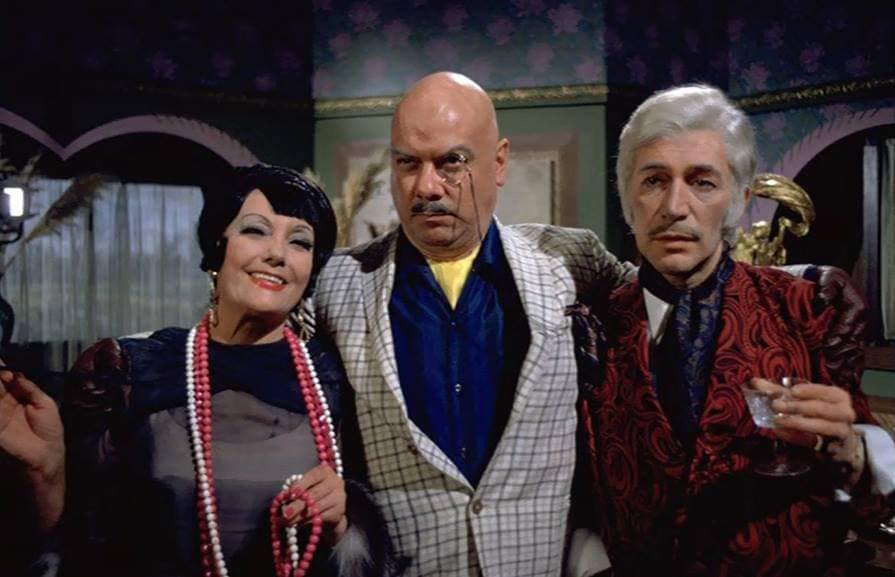
REVIEW: Crown Court – ‘The Son of His Father’

  • Part 1 Broadcast: Tuesday, 17th January 1984
  • Part 2 Broadcast: Wednesday 18th January 1984
  • Part 3 Broadcast: Thursday, 19th January 1984

Character: Sir Charles Marchington QC

Crown Court was a British television courtroom drama series that was produced by Granada Television – part of the Independent Television (ITV) network. The first of 300 episodes[1] was broadcast in 1972, and ran until 1984.  

Typically, a ‘case’ would be played out over the course of three 25 minute episodes, shown over as many afternoons. The court was set in the fictional town of Fulchester. 

While the main characters were played by actors, the jury was made up by members of the public chosen from the Electoral Register. It was this group of people that would decide whether the character on trial was guilty or not guilty.  

The Story

The episode opens at Fulchester Crown Court. The defendant – a young woman by the name of Mary Ginsel (Carol Frazer) – is accused of blackmailing a prominent MP, Sir Roland Richardson (Gerald Flood), who she claims is the father of her 3-year-old son, Gavin.

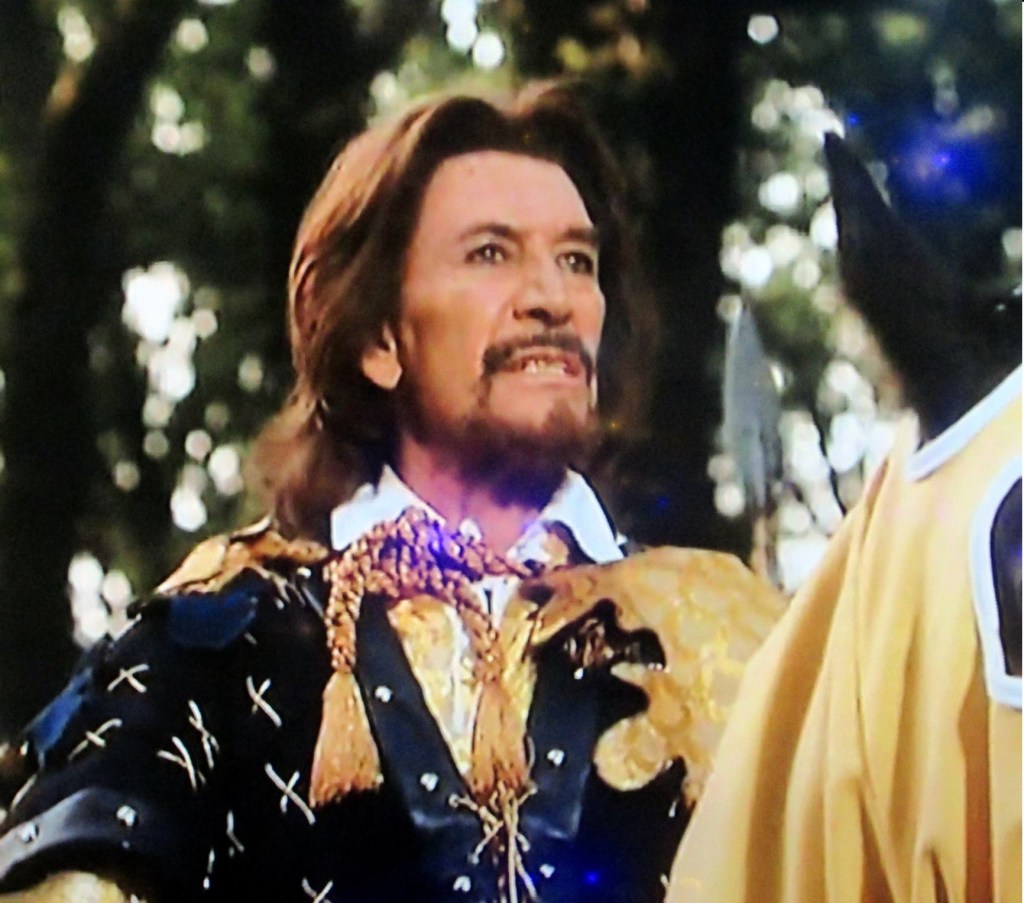
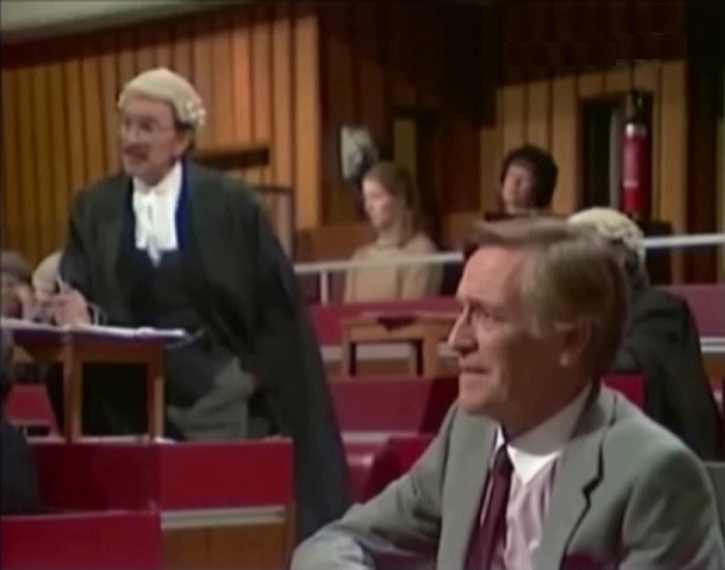
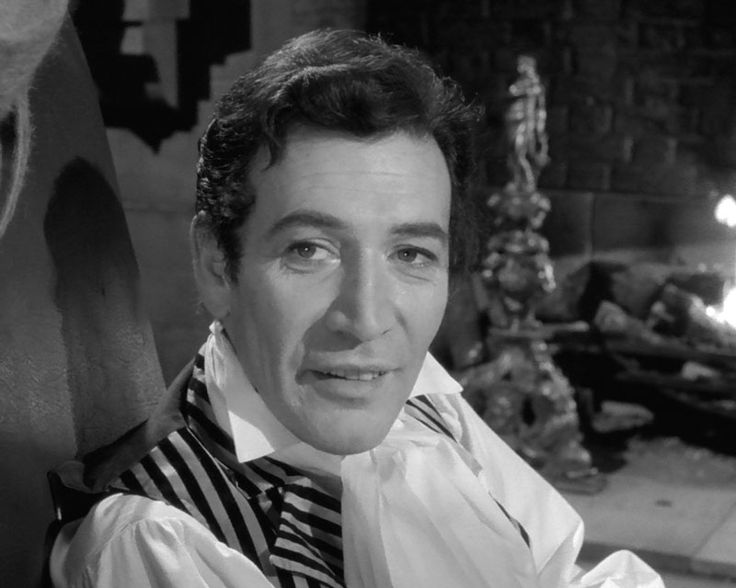
Sir Roland is the first to take to the witness stand, where he is questioned by Prosecution lawyer, Sir Charles Marchington QC (Peter Wyngarde), who enquires as to the nature of the relationship he’d with Ms Ginsel.

The elderly Lord explains that he and the young woman share an interest in stamp collecting – indeed, he had once been chairman of the Fulchester Philately Society, which is where he’d met Ms Ginsel. Latterly, she had acted as his advocate when bidding for rare stamps at auction.

Sir Roland admits to visiting the young woman at her home on several occasions, which he describes as a modest flat 15 miles from where he himself lived. There he had met the child, Gavin, and also one-time musician and photocopier salesman, Lee Sinclair – a friend of Ms Ginsel.

Despite receiving a number of rather familiar letters from Ginsel over the course of many months, including a somewhat accusatory note demanding the sum of £200 for the care of young Gavin, Sir Roland vehemently denies that his relationship with the young woman had been anything other than businesslike. He categorically denied that he was child’s father.

When Sir Charles completes his examination of the MP, Ms Ginsel’s defence lawyer – Eloise Hunter QC (Roselie Crutchley) – takes to the floor and immediately makes the charge that Sir Roland is the child’s father that in actual fact, he had been in an long-term, intimate relationship with the boy’s mother. She further contends that he had merely been using their mutual interest in stamp collecting as a foil; the fact that he hadn’t told his wife about Ms Ginsel’s numerous letters only confirmed this.

The next witness to take the stand is Jean Tomson – a middle-aged widow who lives in the same block of flats as Ms Ginsel. Sir Charles learns during his questioning that she had been a friend of the younger woman but that the two had recently fallen out. She insists that Ginsel and Lee Sinclair had been co-habiting for some time, saying that he was at the defendant’s flat “all the time”. She makes mention of an incident some months earlier when she’d seen Sinclair sitting on the stairs, crying, and that Ginsel was attempting to comfort him.
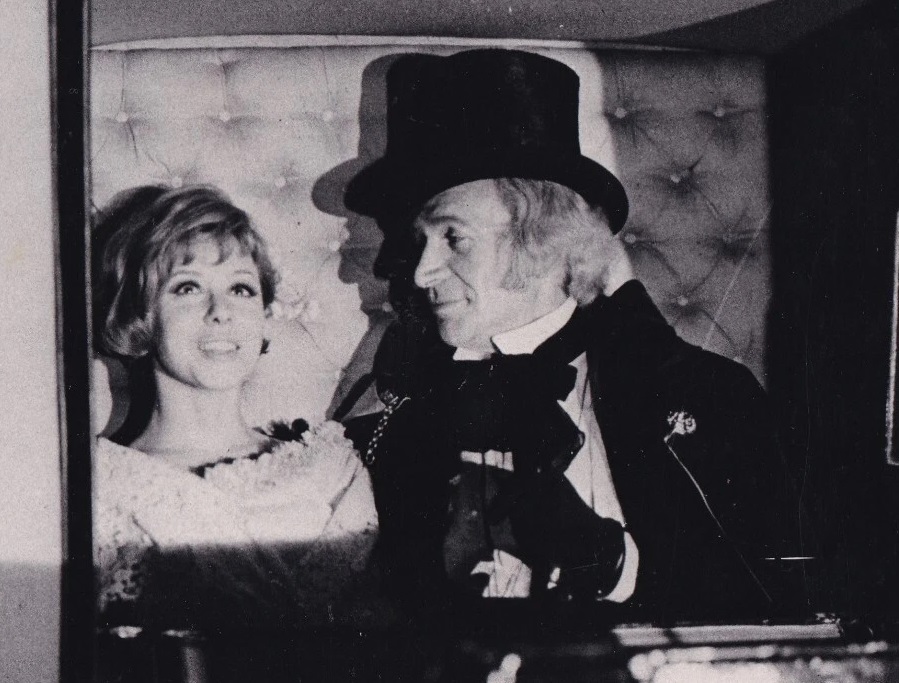
When cross-examined by The Defence, Mrs Tomson is obliged to reveal that she herself had been involved with Lee Sinclair, which prompts the accusation that she is in fact jealous of Ginsel and that her agreeing to act as a witness for the Prosecution had come out of malice. Tomson refutes this.

Following Sir Roland’s resignation from the Philately Society teacher, Leonard Alldis (John Quentin), had taken over as Treasurer. He is next to step into the witness box.

Left: Peter as Sir Charles Marchington QC

This image has an empty alt attribute; its file name is 20220608-135204.jpg

He tells Sir Charles Marchington that it had been common knowledge within Society circles that Lee Sinclair was the father of Mary’s baby, as she herself had told anyone who cared to listen. However, the court is stunned to learn that Ginsel had been pregnant, not once but twice. It was when she began to attend group meetings that Mr Alldis himself had gone to her home to check on her as he and other members of the Society were concerned about her. At that time, she’d told Alldis that Sir Roland was the father of the child she was expecting – claiming that he’d seduced her and then left her to fend for herself. As a long-time acquaintance of the MP, Allis had found this difficult to believe.

When the teacher had next seen Mary, she was no longer pregnant. He was described her as “hysterical” and that she’d claimed that the whole thing had been a “mistake”.

Mr Alldis latterly admits to Elois Hunter during her cross-examination, that there had been rumours about Mary and Sir Roland circulating amongst members of the philately group for months before he resigned.

The next witness to be called to the stand is Alisdair Miller (Andrew Downie) – editor of the Fulchester Recorder newspaper. He remembers receiving a letter from Mary Ginsel accusing Sir Roland of failing to send maintenance payments for her son. However, instead of publishing the note Miller, who had been a good friend of the MP for around 15 years, called Sir Roland to inform him of it’s receipt. Some days later, Mary had called the newspaper office to ask for the letter back, as she wished to retract her allegation.

When asked by Sir Charles whether he had believed the contents of the letter, Miller said he did not: “It was not Roland’s style,” he replied.

At last, Mary Ginsel takes the stand. She confirms to Sir Charles that she is presently unemployed, but that she had previously worked as both a librarian and supply teacher. She had no criminal record.

She immediately refuted Sir Roland’s claim that it was she who had invited him to visit her home. In fact, she says, it had been very much the other way around; he had often turned up, uninvited. Beyond their shared interest in stamps, she had nothing in common with the older man and confesses that she didn’t really like him.

On either the second or third visit to the flat, she reveals, the MP had “made a pass” at her, and in spite of finding him creepy, she had gone to bed with him nonetheless. This had happened several times thereafter. Until then, she claimed, she’d had had no experience with men.

It was around the same time that she’d first met Sir Roland that Lee Sinclair had come into her life, and although they had become close, she denied having a sexual relationship with him. She did, however, admit that she’d told members of the Philately Society that he was the father of her son.

Ms Ginsel goes on to tell the court that, suddenly and without warning Sir Roland, who had agreed to forward her £200 in cash each month for the care of their child, stopped visiting and reneged on his promise concerning the maintenance money. Soon after she had lost her job at the library; she was destitute. Understandably, she was both desperate and angry – that is why she had sent the letters both to Sir Roland and the newspaper.

This image has an empty alt attribute; its file name is 20220608-135048-1.jpg

Sir Charles begins his cross-examination of Mary Ginsel by reading aloud the letter she had sent to Sir Roland Richardson – emphasising the section in which she’d threatened to contact the Fulchester Recorder should he fail to send her the £200 she insisted he owed her.

Sir Charles points out that she was not merely “requesting” for the payment but was, in fact, making threats to expose the MP and ruin his family life. If the young woman was so resolute in her arraignment of Sir Roland, why had she not simply instigated a Affiliation Proceeding against him so that there would’ve been no need for the letters? She was to cite a lack of money and the fact that she had not wanted to cause problems for Sir Roland.

Although she would claim to be destitute, she admitted under incessant questioning by Sir Charles, that she had not only been claiming Social Security benefits since losing her job at the library, but that the local authority had also been paying her rent. Additionally, Lee Sinclair who, she admitted had stayed with her between 5 and 10 times over a 6 month period, had also been giving her money.

The final witness to face Sir Charles’ questions is Lee Sinclair (Bill Nigh), who confirms to the court Ginsel’s story concerning the nature of their relationship, and that she had been there for him after he’d suffered a breakdown. Although he admits to staying at her flat on many occasions, he insists that he was not living there on a permanent basis as Jean Tomson had claimed.

He is also to confess that the medication he had been taking for his condition at the time had rendered him impotent, so he could not possibly be the father of Ms Ginsel’s child. Nonetheless, he had agreed to go along with her story that he was Gavin’s dad.

The Judge – Mr Justice Hamond (Donald Eccles) – directs the jury in his summing up that they must now decide whether Mary Ginsel is guilty of maliciously using threats to obtain money from Sir Roland or had merely been asking the father of her child’s for a payment she was entitled to.

When the jury return to the court room, the Foreman is asked to stand and give the verdict: NOT GUILTY.

Ms Ginsel is free to go.

FILM AND TELEVISION TIE-INS

A film or television tie-in can not only give you the story of the movie, it can give an additional amount of description to fill in of some of the blanks, and help flesh out the characters.

Here are some of the novels that have either inspired film in which Peter appeared, or are direct tie-ins. As you will see, there are often quite a number of differences between the two which have been highlighted.

Film The Siege of Sidney Street

  • Title: The Siege of Sidney Street
  • Author: Frederick Oughton
  • Published by: Pan Books
  • Date of Publication: 1st January, 1961
  • Number of Pages: 188
  • Country of Origin: UK

The real life event of 1911 are transformed into a tale of a devoted police officer who becomes part of a love triangle with a gangster and his girlfriend, and the gang of Russian anarchists that rob and murder – not for self, but for the ideology that drives them on.

A good proportion of the novel is devoted to Mannering’s investigation around the social club where the Russian immigrants meet. His enquiries lead him to talk with the landlord of the pub opposite the club who tells the detective: “It’s a club alright! God, you can hear them jabbering’ away – fifty to the dozen – right down the perishing street. Club they calls it! Whore house more like! God, you should hear them. I’ll tell you something else too. All they drinks there is tea. Tea. Round here folks say as they’re vegetarians.

Perhaps they don’t like meat, that’s all,” says the detective.

Meat?” replies the landlord “Who said anything about meat? Vegetarians, that’s what I said. That or them anarchists. Wouldn’t be surprised to hear they was atheists too. Tell you, that club’s got a bit of a name round this district, sir.

Vegetarians! And atheists to boot! How brilliant is that?

Taken from the back of the book: ‘The Day Anarchy Clutched At London. London’s East End – January 3rd 1911. Bullets whine in Sidney Street, holding back hundreds of police, guardsmen and the Home Secretary – Winston Churchill. Three anarchist fanatics – Peter the Painter, Yoska, Svaars – had robbed and killed for their cause. Now had come the bloody day of reckoning… Here is a sensational story with a scaffolding of truth – of the gaslit, gin-soaked era when marauding anarchists took whatever they could grab.’

The Differences:

  • The book tells us that Peter Piatkow (A.K.A. Peter the Painter) is a pipe smoker, having taken to smoking to appear “more English”.
  • After leaving Russia, Peter had intended to go to Paris, but due to the political jostling there, he chose London instead.
  • On his arrival in England, Peter had first lived in the Hyde Park area of London, before taking rooms in the East End.
  • His first love had been Nina, played by Angela Newman in the film, and had considered proposing marriage to her.
  • Sara (Nicole Berger in the film), is said to have had many lovers but had never been in love until meeting Peter.
  • The book describes Peter as loving as he lived – for the accusation of a prize: “His lovemaking was almost harsh, burning up like magnesium.” He encourages Sara to resist him so that he might eventually “conquer” her.
  • In the book, Sara, dies without knowing that Peter has escaped the fire in the house on Sidney Street, but in the film, she lives to see him make his escape.

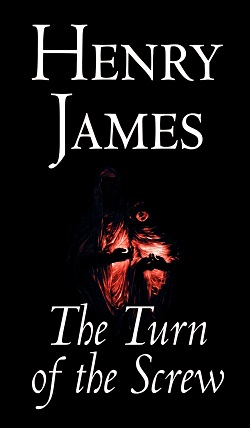
Film Turn of the Screw and The Innocents

  • Title: The Siege of Sidney Street
  • Author: Henry James
  • Published by: Penguin
  • Date of Publication: 16th April, 1898
  • Number of Pages: 121
  • Country of Origin: UK

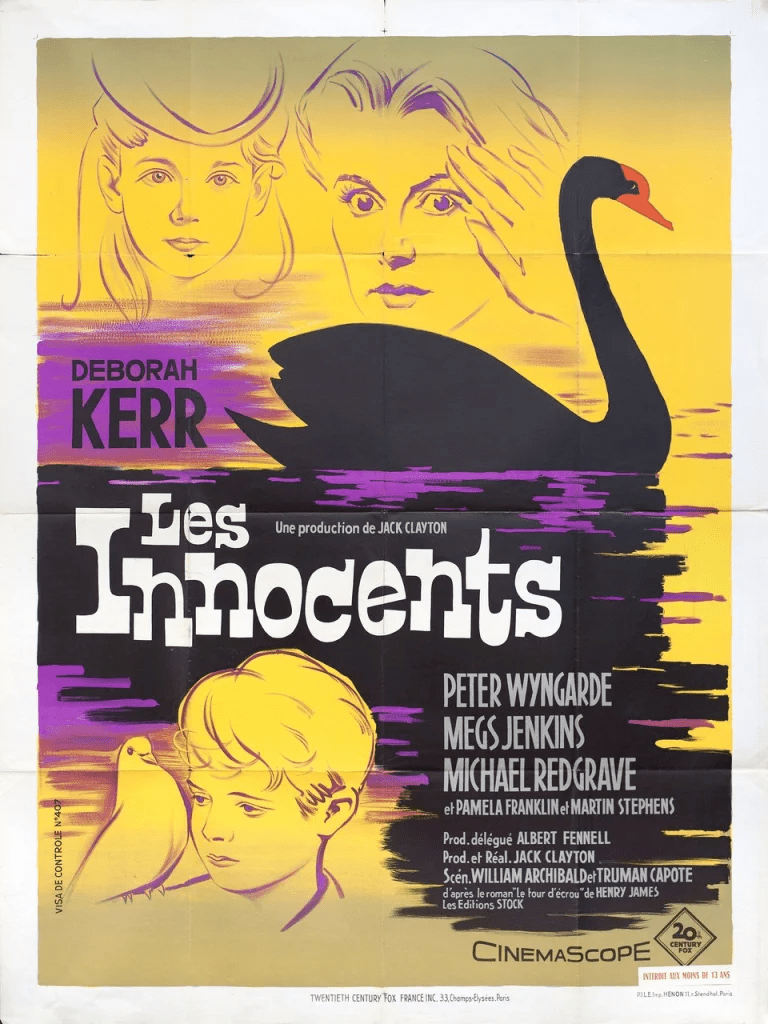
Author, Henry James, once said that ‘The Turn of the Screw’ began as a “shadow of a shadow.” In 1895, a story was told to him by the Archbishop of Canterbury about “a couple of small children in an out-of-the-way place, to whom the spirits of certain ‘bad’ servants, dead in the employ of the house, were believed to have appeared with the design of ‘getting hold’ of them.” Three years later, the 1st chapter of ‘The Turn of the Screw’ was published in an American magazine entitled, Collier’s Weekly. In 1950, the characters of Peter Quint and Miss Jessel appeared in another form in William Archibald’s play, The Innocents. Four years later, the two servants would be resurrected again in Benjamin Britten’s opera, but perhaps their most well-know incarnation would be in Jack Clayton’s classic 1961 film – also called The Innocents, in which Peter Wyngarde was to play the evil spectre, Peter Quint.

On the surface, the plot of the film is relatively simple. A governess (Deborah Kerr) is employed to care for two young children named Flora (Pamela Franklin) and Miles (Martin Stephens) at a lonely manor house called Bly. She begins seeing the ghosts of the former governess Miss Jessel (Clytie Jessop) and valet, Peter Quint. According to housekeeper, Miss Grose (Megs Jenkins), the two had been having a sordid affair under the noses of the children (it is implied that they had been witnessed by Miles and Flora having sex in front of the fire in the drawing room). Miss Giddens becomes convinced that the children are in some way in touch with the ghosts, so her mission is now to rescue them from the spirits influence by getting them to admit that they are haunted by Miss Jessel and Peter Quint.

The Differences:

  • The differences between the film and the novel can be summed up this way: The Turn of the Screw is a complex psychological drama that features ghosts. – The Innocents – A ghost/haunted house story with psychological underpinnings.
  • The Turn of the Screw begins with a group of friends who are gathered on Christmas Eve night to listen as someone recites a ghost story. The film, however, opens with a young governess visiting the office of her well-to-do employer in, we presume, London.
  • In the book, the governess remains unnamed throughout the story, but in the film she’s given the name, Miss Giddens.
  • The spectre of both Miss Jessel and Peter Quint are omnipresent throughout the book, but only appear occasionally in the film.
  • When the governess sees either Jessel or Quint, but the other characters claim not to see them, the ghosts are on screen. From the camera’s perspective, the ghosts are there – they exist, and the other characters, in denying their presence, could well be seeing them but lying about it. In the book, however, the text presents the governess’s in such a way that there is evidence both for and against her. Without the vindication of her own narrative, her paranoia and perceptible anxiety, in addition to her tendency to jump to complex conclusions, become increasingly obvious. Otherwise, the film plays up the children’s peculiarities enough so that her conjecture that they’re possessed could be possible. The behaviour of them while at play, could be seen as malicious.
  • The most significant way in which the film preserves book’s ambivalence is in the way it visually projects the subtext of the governess’s mental or emotional attitudes towards sex. Director, Freddie Francis, skillfully preserves the novella’s subtlety concerning this facet of the story. That said, it’s clear that there is something questionable about Miles, not least when he passionately kisses the adult governess.
  • Miss Gidden’s discusses her family in both in the book and in the film; mentioning that her father is a stern church minister. Her family home, where she had lived until moving to Bly, she describes as being small – certainly “too small for secrets.”
  • The nature of Quint and Jessel’s supposed malevolency is never fully defined, either in the book or the film. Henry James wrote in the preface to the New York Edition of the story in 1908: “What, in the last analysis, had I to give the sense of? Of their being, the haunting pair, capable, as the phrase is, of everything – that is of exerting, in respect to the children, the very worst action small victims so conditioned might be conceived as subject to.” Only make the reader’s general vision of evil intense enough . . . and his own experience, his own imagination, his own sympathy (with the children) and horror (of the false friends) will supply him quite sufficiently with all the particulars. Make him think the evil, make him think it for himself, and you are released from weak specifications.” This is exactly what happens to the reader of The Turn of the Screw, and it is also, in a sense, the experience of the governess, who thinks the evil for herself with an imaginative ferocity that becomes, over a long country summer, a malignity of its own.
  • To a extraordinary degree The Innocents succeeds in replicating on the screen the author’s play of perception: it makes us – the viewer – question what we see, and amplify what we imagine. The film is in black and white, which has always been an excellent medium for a ghost story. CinemaScope also leaves a lot of empty space for us to fill with dark conclusions and images, which is just what the author wanted. Most ghost stories are claustrophobic. The Turn of the Screw is meant to grow in the fearful minds of its audience. It does so in both the film and the book.
  • In the final scene in which Miles dies in Miss Gidden’s arms: This takes place in the house itself in the book, but in the film, the piece is played out in the garden with what appears to be the figure of Peter Quint standing amongst the statues.

Click below for more about The Innocents…

Film Conjure Wife and Night of the Eagle/Burn, Witch, Burn

  • Title: Conjure Wife/Burn Witch Burn
  • Author: Fritz Leiber
  • Published by: Berkley Medallion Corporation
  • Date of Publication: 1st April, 1943 (Reissued as ‘Burn Witch Burn’ in 1962)
  • Number of Pages: 176
  • Country of Origin: USA

While Fritz Lieber’s Conjure Wife was not a film tie-in; it was, in fact, written in 1943 – almost 20 years prior to the release of Night of the Eagle/Burn, Witch, Burn – it was reissued in 1962 in the USA with a cover featuring a representation of Peter and his screen wife, Janet Blair.

Conjure Wife was first published (in a shorter form) in ‘Unknown’ magazine and as a single book 10 years later in 1953. The setting for the novel was New England, USA, while this was changed to rural England.

It does – as he steps into his wife’s dressing room on a whimsy and goes randomly through her drawers, and discovers that she is a witch.

What makes the story works so well, in addition to smooth writing and engaging characters, is Leiber’s careful management of Norman’s attitude. He’s forced to weigh whether magic really exists, or the events of the story are complex and unconscious psychological constructs. Reason pushes him one way, while the need to save his beloved wife pushes in another.

Leiber’s plots are always unique and this short novel is no exception. Norman Saylor and his beautiful young wife Tansy are residents of a small academic township in America, in whose college Norman is a professor. He is unconventional and disliked by the college’s conservative intelligentsia, but has still somehow managed to climb to the top: Tansy, looked down upon by the professors’ prim wives, has also managed to survive and become quite popular. Norman is happy about it, a bit too pleased with himself, one can say – we meet him at the beginning of the novel in a moment of perfect contentment which feels too good to be real, and which he feels must pass, as such moments are too good to last.

The Differences:

  • In the novel, Norman’s surname is ‘Saylor’, while in the film, he is ‘Taylor’.
  • Norman discovers that his wife is a witch within the opening to pages of the book, while in Night of the Eagle (by sneaking a look around her “dressing room” [read walk-in wardrobe] while she’s out of the house). In the film, however, it’s later on – after the game of Bridge with his colleagues from the college.
  • For the script of Night of the Eagle, Richard Matheson and Charles Beaumont strip back the more Leiber’s book which, for many, was much to the film’s advantage. In the book, ALL of the college wives are engaged in witchcraft, whereas in the film only Flora Carr (Margaret Johnson) and Tansy Taylor are.
  • Having been written in 1943, Norman Saylor’s language, thoughts and opinions concerning woman are of that age. By 1962, Norman Taylor are, thankfully, updated.
  • The inanimate stone gargoyles of Hempnell Collage, New England, become the animated stone eagle of Hempnell, UK, in the film.
  • Further stripping by Matheson, Beaumont and director Sidney Hayers a level that was not in the Fritz Leiber story and tell Night of the Eagle as a psychological horror story not unrelated to the work of producer Val Lewton in the 1940s, such as Cat People, I Walked Like A Zombie and The Seventh Victim.

Click below for more about Night of the Eagle/Burn, Witch, Burn…

Film Flash Gordon

  • Title: Flash Gordon
  • Author: Arthur Byron Cover
  • Published by: Jove Books
  • Date of Publication: 1st January 1980
  • Number of Pages: 220
  • Country of Origin: USA

  • Title: Flash Gordon
  • Author: Arthur Byron Cover
  • Published by: New English Library
  • Date of Publication: 1st January 1980
  • Number of Pages: 220
  • Country of Origin: UK

Ming the Merciless! He rules the planet Mongo with cold terror – and if he has his Imperial way, will conquer the entire universe! But first the king of Mongo must destroy Flash Gordon, the fair-haired earthling and Superbowl star, destined to challenge his sinister forces… together with Doctor Zarkov and the beautiful Dale Arden, Flash is sent hurdling through interstellar space to the Towers of Mingo City, the heartless armies of the all-seeing secret police, and the deadly creatures and half-human beings lurking in Ming’s lair. There, the space hero has a triple-task: survive Ming’s onslaught, free his own friends, and save – billions of light years away – the planet Earth!

The Differences:

  • In there book there are several ‘Interludes’ in which the reader is updated on what effect Ming’s attack is having on the earth.
  • During the first meeting of the Earthling’s with Ming in the great hall of the palace, the Emperor is said to be displeased with the conduct of the Minister of Propaganda and wishes him to be executed. It is Klytus that speaks up on the elderly Minister behalf – reminding Ming that, “Until now, he has performed his duties well.” The Emperor yields and allows the old man to live.
  • Klytus is described in the novel as being approximately 5 feet, five inches tall.
  • In the film, Klytus wears a powerful ring that he uses to remove the metal helmet Flash Gordon is forced to wear in the Palace dungeon. In the book, however, the General has a small gadget which he keeps in a pocket in his robes.
  • While the film leads us to believe that Klytus and General Kala are and ‘item’, the book says otherwise; that they are in fact rivals.
  • We learn from the book that Dale Arden is a black belt in Karate.
  • The book tells us that Klytus had been seriously injured while attempting to increase his intelligence using the same Mind Altering Probe used to empty Dr. Zarkov’s mind. His face and right arm had been badly burned, which resulted in him having to wear the mask and metal plating to his arm.
  • Klytus’s “sexual drives” are said to have been increased as a result of the incident with the Mind Altering Probe.
  • We learn that Ming has other children aside from Princess Aura. She, as the oldest, is in line to take over from her father upon his death.

Click below for more about Flash Gordon…

TV Jason King

  • Title: Jason King
  • Author: Robert Miall
  • Published by: Pan Books
  • Date of Publication:
  • Number of Pages:
  • Country of Origin: UK

During the height of ‘Jasonmania’ back in 1972, Pan Books published two novels by Robert Miall entitled ‘Jason King’ and ‘Kill Jason King!’ – both of which were described on their covers as being “Based upon the successful ATV television series starring Peter Wyngarde, and which were basically re-writes of a selection of four episodes from the series.

The first of the duo, ‘Jason King’, follows the exploits of the inimitable scribe as he adopts the guise of Vershinin Miklos – a Bulgarian master crook, who is sent undercover by Whitehall in an attempt to infiltrate an international crime syndicate who have successfully eluded the watchful eye of Scotland Yard with their computer wizardry.

Having been blackmailed by Rylans with the threat of being turned over to Her Majesty’s Inspector of Taxes, Jason makes the most of the situation by eating, drinking and making merry with Jan, one of the gang’s female companions.

The story deviates only slightly from the original which was penned by Tony Williamson for the episode. ‘A Deadly Line in Digits’, and seems to flow quite naturally into a somewhat raunchier version if, ‘Chapter One: The Company I Keep’, in which we find our hero believing that he’s developed the powers of ESP overnight when, in fact, he has merely been set up by the beautiful yet deadly Countessa Arabella do Maggiore.

In Maill’s rendition of Donald James’ original screenplay, there are a number of minor adjustments – most noticeably, the absence of the rutting rhino in the opening ‘scene’ and, sadly, there’s no nuns habit. But Jason certainly makes up for their absence by his antics with the Contessa, which are only touched upon superficially on screen, but leave little to the imagination in print!

  • Title: Kill Jason King
  • Author: Robert Miall
  • Published by: Pan Books
  • Date of Publication:
  • Number of Pages:
  • Country of Origin: UK

The second of the two books, ‘Kill Jason King!’, encompasses the episodes ‘As Easy As A.B.C.’ by Tony Williamson, and ‘A Red. Red Rose Forever’ by Donald James; the latter of which quite outshines the former, which as I am sure anyone who had seen the live-action story on screen will testify.

In the first segment of the book, Jason finds himself the prime suspect following a series of crimes which have in fact been perpetrated by two upper-crust villains by the names of Charles and Edward, who have taken to recreating incidents as described in Jason’s Mark Caine novels.

Matters take a drastic turn for the worst when a security guard is shot and killed during the course of one of the robberies, and a considerable fortune in platinum bullion mysteriously turns up in the boot of Jason’s car. All hope appears lost when Arlene – Jason’s beautiful bedtime companion (and only alibi!), is kidnapped by the two bounders, leaning poor J.K. with little hope of proving his innocence.

The unlikely combination of Adolf Hitler, a Swiss Bank vault and a pretty air hostess lead to yet more intrigue, adventure and romance for Jason who, as always, manages to outwit the bad guys and get the girl!

It was a very good year for villains...
a good year for blondes, diamonds and furs in London...
for brunettes, orgies, blackmail and murder in Rome...
for redheads in St Moritz. 
A bad year for Department S - until his past caught up with Jason King.

The security guard was cold. Cold as the Vienna morgue where he lay. Arlene, blonde and sultry, had been kidnapped. A fortune in platinum filled the car boot. The latest haul in a series of daring robberies that stretched from Munich to Barcelona. And Jason King found himself Europe’s number one police suspect. The only suspect…

Both titles were best sellers in the UK, Australia, New Zealand, South Africa and Canada.

Click below for more information on Jason King…

TV Doctor Who

  • Title: Doctor Who – Planet of Fire
  • Author: Donald Cotton
  • Published by: New English Library
  • Date of Publication: 1987
  • Number of Pages: 128
  • Country of Origin: UK

The Doctor is enjoying the sun on a holiday island – but things are soon hotter than he bargained for.

The young American Perpugilliam Brown brings to the TARDIS a mysterious object that her archaeologist step-father has found in a sunken wreck. Kamelion, the Doctor’s robot friend of a thousand disguises, reacts to the object totally unexpectedly, with bewildering consequences for the TARDIS crew.

For Kamelion sends the Doctor and his friends to Sarn, a terrifyingly beautiful planet of fire. This strange world provides the key to Turlough’s secret past — and once again the Doctor is pitted against the wily Master.

The Differences:

  • The description of Sarn and the site of Howard’s dig is clearly in Greece or Cyprus rather than in the Canary Islands.
  • The Chief Elder, Timanov (Peter Wyngarde) is described in the book as being around 70-years old, while in the episodes he is said to be “As old as the mountain itself”.
  • In the book, Timanov is portrayed to be far more understanding of his younger charges and less fanatical.

Click below for more on Doctor Who: Planet of Fire

REVIEW: Babes in the Wood

The Panto Scene-By-Scene

Act I Opens in the grounds of Nottingham Castle, where the orphaned Colin and Mary – ‘The Babes’ of the title (Amber Jane Raab & Corinna Reardon or Joanne Smith & Amber Finlan), arrive to meet their uncle and new Ward, The Sherriff (Peter Wyngarde) who, like all good Panto villains, is up to no good.

Although he was at first deeply inconvenienced at being left his brother’s children to care for, The Sherriff and his two henchmen, Spike Head (Spike Milligan) and Billy Blunt (Bill Pertwee) soon realise that they could actually be quite useful to them in carrying out their evil machinations.

Over at Sherwood School, Nurse Goodbody (Patrick Cargill) believes that she has Colin and Mary under her control… until two new pupils arrive in the form of robbers, Spike and Billy.

Back in the nursery, Freddie the Jester (Ken Goodwin) is telling the two children a story before bedtime, but poor Nurse Goodbody has the devil’s own job in getting them to take their medicine. Eventually ‘though, the children drift off to sleep, and it’s then that Spike and Billy break into the nursery to steal The Babes and take them to Sherwood Forrest. But as fate would have it, Fairy Christabel (Evelyn Laye) is on hand to save them. With the help of the Spirits of the Forest, she takes them to a safe haven.

Act II. Back at Nottingham Castle, Nurse Goodbody confronts The Sherriff, and a fight ensues between the two of them involving a basket of fish!

Meanwhile in Sherwood Forest, Maid Marion (Susie Blake) brings Robin Hood (Deirdre Forrest) the news that he and his Merrie Men must find and rescue the children before The Sherriff and his henchmen are able to carry out their evil plan.

While Little John (Simon Brotherhood), Friar Tuck (Ralph Meanley), Will Scarlet (Jeremy Rose) and Much the Miller (David Capri) are searching for The Babes, Robin and Nurse Goodbody happen upon something creepy – cue the obligatory “He’s behind you!” scene. (“Oh no he isn’t” etc.)

Back at the Castle, however, The Sherriff already has the children in his power, and forces Freddie the Jester to give away a vital secret. Nevertheless, as is usually the case with such stories, good inevitably triumphs over bad, and everyone – except The Sherriff and the two Robbers presumably – live happily ever after.

Above: A rare survivor from the show is this paper mask that came as a wraparound gift on the front of the programme.

In Retrospect

Something old, something news, something borrowed but never blue – that was the philosophy of Jimmy Perry’s[1] lavish production of ‘Babes in the Wood’ at the Richmond Theatre. It, of course, had all the ingredients that has made the Pantomime a staple of the British stage since the 16th Century.

Panto is often scoffed at by theatre snobs, but it is often the case that this Christmas and New Year perennial is the first taste of the stage that many people in the UK have. Certainly, many of our greatest actors have confessed to having gained their love of live theatre as a result of being taken to a pantomime either by a parent or school. And, of course, it’s the not-so-humble panto that has helped many small provincial theatres survive, often because the majority of their revenue is created over the Christmas period.

As a local to Richmond, it was only natural that Jimmy Perry should both direct and write the script. By the mid-1980s, his connection to theatre stretched back over 30 years. As a young actor, he’d been a member of the Repertory Company under the Direction of Alan Miles and Freddie Piffard. It was also something of a nostalgic return for Peter who had also been a member of the same company, but much later than Perry.

This would be the 15th panto that he would create in his career, and with such an illustrious cast to do it justice, it was a certainty that it would give the packed houses two-and-a-half hours of fun.

Fun Facts

  • Peter appeared as the Sherriff in all 76 performances of the show.
  • His first pantomime appearance was in ‘Aladdin’ at His Majesty’s Theatre, Aberdeen, over Christmas and New Year 1984/85, playing the wicked Abanaza. It was there that Producer, Duncan Weldon, had seen him and asked him to appear in this star-studded as the equally wicked Sherriff of Nottingham.
  • As was his way, Peter re-wrote several pieces of his character’s dialogue, one of which included a reference to Jason King.
Notes:

[1]. Jimmy Perry wrote numerous classic British TV comedies during his career, including: ‘It Ain’t Half Hot Mum’, ‘Hi-De-Hi’ and ‘Dad’s Army’.

REVIEW: ‘Love Story: It’s a Long Way to Transylvania’

Broadcast: Thursday, 7th September, 1967

Character: Konrad von Kroll

Some Background

‘Love Story’ was a series of 60-minute television plays that were produced by Associated Television (ATV) in the UK and aired on the Independent Television Network (ITV) between 1963 and 1974. There were 128 episodes made.

The Story

Robert Mueller’s ‘It’s A Long Way To Transylvania’ featured a splendid and immensely stylish performance by Peter Wyngarde as Konrad von Kroll, an aged former screen vampire making a personal appearance at a small town cinema. Lisa (June Barry) attending a diminutive press conference after the unremarkable event was soon swooning over the antique horror star, with his still hypnotic gaze and his reminisces of Boris Karloff and Bella Legosi in the days when even blood was richer.

While the play dragged a little in the middle but revived towards the end, which came when the the elderly actor has a fatal heart attack while chasing his young admirer through the damp woods of an imaginary Transylvania.

This was quite an original piece and a perfect vehicle for Peter’s sinister brand of charm.

Notes:

‘It’s A Long Way To Transylvania’ was written by former newspaper journalist, Robert Mueller, who also penned ‘Night Conspirators’ – a play in which Peter starred both on TV and the stage.

The ‘Love Story’ episode was one of Peter’s personal favourites. He did, however, feel that he was too young at the time that the play was recorded and had hoped that it might one day be remade with him in the lead.

FAN FICTION: ‘A Dedicated Follower of Fashion’

Written by Tina Wyngarde-Hopkins

“Mr. King!”

Jason woke with a start to find himself staring into a pair of beautiful blue eyes belonging to a stewardess. “I’m sorry to wake you,” she whispered almost seductively, “but were due to touchdown in Sydney at any moment. You really must fasten your seat belt.”

Stretching his arms out in front of him, the scribe yarned softly before attempting to locate the belt straps which had rather inconveniently become lodged between the seats. “Do you know,” he replied as he wrestled to find them, “I was just dreaming that a beautiful girl was trying to tether me to a chair, and now I’ve woke up to find it’s true!”

“Your restraint, Mr. King!” she instantly, as she tried in desperation to maintain her polite but frigid stare. Jason on the other hand flashed her his most devastating smile which caused her to melt a little – albeit just around the edges.

“Maybe later we could continue this little scenario,” Jason purred seductively. “But I thought we might have dinner first.” She finally returned his smile.

Reacting to a call from neighbouring passenger, the young woman obligingly turned on her heel just as the aircraft began to bank to make its final approach to the airport. Inhaling deeply, Jason redirected his eyes to the window at his right shoulder and delighted at the breath-taking view of Sydney Harbour, with his famous bridge and Opera House.

After collecting his jacket and hand-luggage from the storage compartment above his seat, he began to threading his way down the crowded gangway and out into the bustling terminal. Meandering casually through the seemingly miles of corridors – all crowded with excited tourists and weary businessmen.

Having picked up his luggage from the carousel and negotiate his way to passport control, Jason took up a position in the queue, where he noticed more than one of his fellow passengers do a double-take, then ask a companion in a whisper, “It is him, isn’t it?”

At last he found himself at the head of the column of travellers, Jason reached into his jacket pocket and produced the required documentation, which he duly handed to the bearded customs officer seated behind a desk. The photograph affixed to the inside cover of the passport was scrutinised, as was Jason with a somewhat suspicious eye. “It was taken before I grew my moustache,” announced the writer in response to the enquiring glare, before suddenly finding himself in the amorous clutches of a large American woman sporting half a market garden around the brim of her hat.

Immediately producing copies of the ‘Russian Roundabout’ and ‘Dead Dames Don’t’ from her handbag, Jason tried desperately to disentangle himself from her octopus-like grip. Frantically signing both of the book, Jason explained that he had a terribly urgent appointment to keep with his Australian publisher, before making his escape in the direction of the Nothing To Declare gate.

As he calmly made his way across the concourse between the Arrivals area and the hurley burly of the city outside, he allowed himself a brief smile and remembered his recent encounter with Rylans’, whose continual blundering had resulted in public humiliation for Sir Brian and the Department, earning Jason a grovelling apology from the Home Secretary himself. The payment of an undisclosed amount courtesy of Her Majesty’s Government had also come in useful.

The sound of a pair of size 10 boots on the tiled floor behind him, however, succeeded in coaxing Jason back to the present and as his eyes rolled ever skywards, he discovered that the owner of the footwear belonged to a mountain of a man, clad in a Border Force uniform; the name badge pinned to his chest identifying him as Superintendent Robert Mercer.

“Mr. King,” he rasped, while running a thumb over the stubble on his chin. Extending a finger in the direction of an office door to Jason’s right, he continued: “I’d like a word with you, if I may.”

Taking a gold pocket watch from his waistcoat pocket, Jason made known his displeasure at this inconvenience in the form of a loud ‘tut’ before, reluctantly, following the officer through the door of the office, which duly slammed behind them.

Jason couldn’t imagine why on earth he’d been brought to this tardy little room. Having been in customs offices around the world from time to time over the years, he’d invariably noted the difference in amenities from one country to another, and yet all at a certain basic similarity. When you’d seen one, Jason had always maintained, you’d seen them all. In this one, an effort had been made to disguise the pungent stench of years of cigarette smoke with Glade magnolia and vanilla fresh air spray which, when mixed together, smelt not unlike a pair of armoured trousers after the Hundred Years War. Regardless of this, Jason wondered why he was there, but realised as Mercer gazed down through the window onto the runway below, it was unlikely that he’d be enlightened any time soon.

Inevitably, it would be Jason who would break the silence: “Do you mind telling me why I here?” When no answer came, and Mercer began systematically cracking each of his 10 knuckles in turn, the author’s eyes suddenly darted to the office door and the thought of making a break for it was already beginning to shape in his mind… ‘That door looks like it’s made from plywood; it would surely splinter if I were to give it a good-old shoulder charge’ he reasoned. He then noticed that pistol resting on the officer’s hip which immediately caused him to reconsider. ‘What are you thinking? Pull yourself together, King!” His thoughts were rudely interrupted when Mercer suddenly turned around and took up residence behind the desk which, if it hadn’t been for Mercer’s own bulk, would’ve dominated the room.

“Oh come on – get on with it,” Jason demanded as he took a cigarette from his jacket pocket and placed it between his lips. “This silent treatment lark went out with the Inquisition!” Mercer smiled in response, but it was not the friendly kind.

Yes, Mercer was a large man; as wide as he was tall in fact. His eyebrows, Jason noticed, were permanently raised, which gave him a look of perpetual surprise. Despite his downbeat appearance, he spoke rather well, with only the occasional word giving away his nationality. He leaned forward menacingly. “You think you’re so bloody smart, don’t you King?”

Jason shrugged casually, sending a puff of smoke spiralling ever skyward. “I try not to fly in the face of public opinion.”

“And amusing too!”

“At least I can be amusing should the mood take me!”

Realising that he could never win a verbal dogfight with Jason King, he quickly turned his attention to a file that had been lying on the desk in front of him. Tapping the leatherette-bound volume with a stubby forefinger, the official began: “Federal Intelligence…”

“Now there’s a contradiction in terms!” Interrupted King.

“….Federal intelligence have advised that, before returning to England a month ago you were in Beirut. Is that correct?”

There was a brief pause while Jason considered his answer. Crossing his left leg over his right, he exhaled another cloud of smoke virus nostrils: “That’s none of your business.”

“Oh, I think you’ll find it is, Mr. King,” Mercer countered. “What was the purpose of your visit there?”

There was another brief pause. “I was on holiday,” the author answered with a certain amount of restrained steadiness.

“In the Sudan?” Mercer inquiredin a mocking tone.

“That’s right,” Jason countered, “I got there every year – last week in July, first week in August. The beaches are delightful at that time of year.”

Jason took out of his pocket watch and noted that it had been over two hours since he brought to that dingy little room, and yet he was no closer to learning why he was there. Straining to suppress a weary yaw, the slowly lilting Englishman listened with increasing impatience to the relentless barrage of questions, and at Mercer’s growing disbelief at his answers.

Mercer left his chair and began to circle the table. Jason shifted in his seat. The telephone interrupted the growing tension with its cheerful tone but with far less harmonious chatter.

Jason’s hands became suddenly restless as Mercer stared at him from across the desk – a scarlet cast started to wash over the officer’s furious features. Returning the receiver to its cradle, the huge man rubbed his meaty hands together: “Open the bag!”

Before Jason could rise from his seat in protest, Mercer had grabbed the black leather case which, until that point, had been lying at the scribe’s feet and flung it onto the desk. “We have reason to believe,” Mercer began, “that you are concealing something illicit in that bag, Mr. King, and I intend to find out exactly what it is!”

Jason leapt to his feet in an almost half-hearted manner, knowing all too well that the game was up. He scrutinised Mercer’s chunky features; the furrowed brow, piercing eyes and thick, powerful neck. He suspected that this man was truly vindictive and that he might pursue his prey even to the grave to reverse a verdict.

Reluctantly, Jason surrendered the key to the bag – sliding across the desk to the waiting officer. Immediately he began to regret the last few months. Once again he began to consider an escape.  He would tear up the file that lay in front of him, but then he remembered the heavy wooden door and the twisted knee he’d sustained on a recent skiing holiday. As before, he decided to stay put. Jason shifted uneasily in his seat and awaited Mercer’s next revelation. It didn’t take long. The zip on the bag was snatchedback purposefully and watched in horror as his personal affect spilled out onto the desk: a diary and notebook. Shaving bag. A pair of neatly pressed trousers and a rather loud raw silk shirt.

“Don’t you ever get stared at in this get-up,” Mercer snorted sarcastically.

“Mr. Mercer,” replied Jason, adopting his most bold expression. “I’m man who prefers to be looked over, not overlooked!”

The pause was brief while the big man digested this latest affront, he then he continued his search.

Jason lit another Sobranieand tried to look indifferent, but inside his heart beat so fast he feared Mercer might hear it. The Official uptick Jason, from moment felt he’d underestimated in. But just as he was beginning to resign himself to the fact that the Englishman had no intentions of breaking, he was given this first glimmer of hope: A tiny bead of sweat barely visible below the author’s dark brown mane. He smiled to himself.

Jason sands trust heart around them of the chair and his left knee gave an involved jerk which only the most unobservant might have missed. Mercer could not be counted amongst such those people. The author stared at the window blankly and began to wonder how many more hours he would have to endure that horrid little room. His eyes crave for sleep and some taste of the present. As Mercer continued to forage with faultless efficiency. Jason felt the tug of weariness on his eyelids as his head dropped.

His excursion into sleeps welcoming arms was brief, for no sooner had he begun to drift away that Mercer let out a shriek of triumph. Jason sat bolt upright,

The Border Officer’s face displayed its ultimate in cruelty with an expression verging on that of a madman. But for the first time his gloating smirk would be of secondary importance to Jason whose attention befell the object Mercer was clutching in his right hand. A stark wave of isolation descended upon the Englishman, while the full vacuum of these enclosed hours revealed itself to him. He looked down on his empty hands.

Jason rose and fast is accused of. He began to shake uncontrollably – the thoughts of a ruined career and reputation flashed before his eyes. The effect was claustrophobic. Neither man spoke; only the sound from the busy terminal below them encroached on the otherwise deafening silence. For Jason, the hush felt oppressive. He waited motionless for Mercer to speak – his breath suspended until the object of the big man’s endeavours was waved under his nose.

“SpongeBob Square Pants boxer shorts, Mr. King?” Mercer mocked.

Jason met the floor with a hefty thud!


© Copyright The Hellfire Club: The OFFICIAL PETER WYNGARDE Appreciation Society: https://www.facebook.com/groups/813997125389790/

FAN FICTION: An Interview with Stewart Kirby

Written by Jean Orcutt

The Hellfire Club’s American correspondent, Jean Orcutt, is pleased and proud to present the following exclusive person live interview with the legendary star of screen and stage, Mr. Stewart Kirby.

Mr Kirby, you were once a very well-known celebrity; a huge star of stage and screen. Why did you decide to make this bizarre ‘Epic’ movie, ‘The Destruction of Emma Peel’?

Stewart Kirby: Z.Z. von Schnerk made me an offer I couldn’t refuse! It did sound like great fun at first… a chance to return to the limelight, and the challenge of using a real person as the unsuspecting star was tantalising

Setting up a false rendezvous with Mrs Peel on that country lane was the most ingenious, since you had never seen her before. What was your first impression of her?

Stewart Kirby: I thought she was one foxy lady but certainly no great challenge. Since the movie called for several physical confrontations with Mrs Peel – you know, swords, guns, perhaps even hand-to-hand combat – her outward appearance gave me no cause for concern, considering my own athletic agility, skill and cunning.

Were you physically attracted to Emma Peel?

Stewart Kirby: I’d hardly be a man if I weren’t, but being the professional that I am, I could not allow my emotions to get in the way of my acting. Besides, there was that Steed person who was always snooping about… I could never figure out where he fit into her life. He always called her “Mrs Peel”, but I never saw a “Mr Peel.” She called him John and gave the impression of being rather fond of him. Then there was dear Damita to consider – you know she and I were the last of Z.Z.’s big-name stars to stay with the dying studio. We have always been very close all of these years.

What did you think when you learned that the action was to be real – when there would be “no fake bullets” so to speak?

Stewart Kirby: I never quite believed it would come down to Mrs Peel’s actual death I always start that at the very last minute, Z.Z. would jump up and yell “Cut!” On the other hand, I’ve never had a problem with “getting into character”… only getting out of character. I will follow the script and action without question or deviation. The director is always right!

What about the poor fellow who was auditioning for the non-speaking part – that fella you shot at point blank range?

Stewart Kirby: Oh, that one… it wasn’t what it seemed at all. That was actually a case of self-defence. We had gotten into a little disagreement… couldn’t follow directions… he insisted upon adding lines to his “nonspeaking” part. Then he called me a drunk, a has-been and threatened to tell the world what von Schnerk was doing. I saw him reach towards his coat pocket and I just knew he was about to pull a gun. How was I to know that he was going for his handkerchief and that he was unarmed? Well, we needed a corpse anyway, and he filled the role admirably. I had complete faith in Z.Z. – he would protect us from anything.

The kidnapping of Mrs Peel – whose idea was that?

Stewart Kirby: I must take the bow for that. Brilliant, wasn’t it? Mrs Peel played right into my hands, having found her car out of commission, and the simultaneous arrival of an available black cab. Once she was in the taxi, she was mind. I actually borrowed the idea from an old TV series, The Prisoner, where the hero is kidnapped in similar fashion, only to awaken in a replica of his own. When Mrs Peel awoke, she too found herself in what looked like her own flat, but it was actually a stage set in a studio.

As the shooting began you of course had a script to follow. Damita Syn had a few minor parts to play, and the unsuspecting Emma Peel was clueless as to her part in the movie. Did Mrs Peel react as you expected?

Stewart Kirby: Most of the scenes unfolded in good order, but that woman turned out to be an Amazon! That coy little smile, her unflappable demeanour masked a lethal weapon. I was completely unprepared for her agility and strength. She flipped me in the Gladiator Scene as if I were a ragdoll, How embarrassing… I was lucky that Damita was able to get a crack at her, knocked her out cold before she killed me! Z.Z. didn’t tell me Mrs Peel was such a fighter.

In the Old West Saloon Scene. Was your gun loaded and were you confident that Mrs Peel’s gun was loaded only with blanks?

Stewart Kirby: That was an interesting confrontation. By the time that scene rolled around, I was not at all certain Mrs Peel was the easy mark. Z.Z. had assured me that her gun was not loaded, and the script did not yet call for her demise. When I called a “Draw!” I felt my gun get hung up momentarily in the holster, and not wishing to take any chances that the gun was actually be loaded with real bullets, I took the fall, quite convincingly I might add. After that scene, I needed a real drink in that saloon to steady my nerves for the next act.

There were other confrontations, but it seems that things really started to go downhill during your Indian attack on Mrs Peel. What went wrong?

Stewart Kirby: Yes, that was a dreadful scene wasn’t it? Let me see if I can remember. Mrs Peel had is six-shooter loaded with blanks. Having first caught her attention by shooting an arrow into the wagon beyond where she was hiding, I then charged out from behind a building with a bloodcurdling war cry. She fired at me, and since I knew she was fighting blanks, or at least I hope she was, and not wanting her to get wise to that fact, I feigned a hit. I got up and continued the attack, she fired, and again I went down. I came at her like a lightning bolt but, suddenly, she was all over me and had me down before I knew what had happened. Well, naturally I thought she would finish me off right there and then, but she must have already figured out what was going on, and believed it was really a game. She let me go and then disappeared. I was so shaken by this turn of events that I collapsed exhausted off camera. Maybe I shouldn’t have stayed for that last round of drinks on the saloon set. Z.Z. and I both realised that Mrs Peel was getting wise to what was going on, and that we were running out of time. It was time to get serious… time for the climax in ‘The Destruction Of Emma Peel’. Besides, she had made a fool of me on camera! I vowed right there and then that during the next confrontation, Mrs Peel would see a very different side of Stewart Kirby!

Which was?

Stewart Kirby: The unscheduled appearance of a policeman, actually a film extra who had somehow got into the studio grounds, gave me the perfect opportunity to show Mrs Peel that I was no fool and that I was also a bit upset with the trespasser. I always wanted to play the infamous American gangster Al Capone, and this was a golden opportunity. Once I was in costume, a mysterious force took hold of me and I actually became Capone – and with a machine gun. I was still angry with Mrs Peel over the earlier scenes, and furious with that bumbling film extra who insisted that what was happening was nothing more than a scene in a film. I opened fire, and quite honestly didn’t care or consider whether the gun was loaded with bullets or blanks. I was Capone, and I really didn’t give a damn that I killed that man. I figured I didn’t have anything to lose at that point, and I wanted nothing else to stand in the way of our reaching the ultimate climax of the movie.

You did a replay of an earlier scene except for costume and character change. Tell us about that scene.

Stewart Kirby: You are referring to the scene where I play a Confederate soldier returning from the American Civil War. Actually, that was Damita’s idea. She liked the Gladiator Scene so much, and got such a thrill out of rescuing me from Mrs Peel’s vicious attack, that she begged to let her do it again. Z.Z. rewrote the dialogue, changed the characters, and retained the basic action of the scene. For me, preparation for this act was harrowing as I had to watch four hours of the movie classic, ‘Gone With The Wind’ in order to master that “Old South” dialogue. Do you know, critics in American gave me ‘thumbs up’ on my accent?

Were you satisfied with Mrs Peels repeat performance during this same?

Stewart Kirby: Satisfied? She again made a idiot of me. Apparently, I failed to learn my lesson from the Gladiator Scene and she caught me off guard again. That woman is like a cat… quick, silent, agile… and she has nine lives. She threw me across the set again and then presented herself before Damita to be knocked out, or at least she pretended to be knocked out. At any rate, that was the final straw and we quickly tied her to a board in preparation for the final, lingering death scene.

Ah yes, the final scene – the melodramatic climax to ‘The Destruction Of Emmal Peel. Whose idea was it to set the stage in a torture chamber, complete with swinging pendulum and a buzzsaw as the weapon of choice? And what about your count Dracula character?

Stewart Kirby: Z.Z. von Schnerk, of course, wrote the screenplay, so this climax was the fruit of his creative genius. Personally, I would have preferred something that looked a little less theatrical and required a much less makeup. All that get-up took hours to put on. Damita said it made her look like an old hag.

At this point, did you think that Mrs Peel was really destined to die?

Stewart Kirby: It was late in the day when we shot this scene. When Z.Z. called for action and turned on that huge saw, I remember thinking that this could become rather messy and for the first time wondered if he really was mad. Of course, we didn’t know that John steed was lurking around the studio and was about to write himself into the picture. But I was exhausted, and my flask was empty. I thought that that the sooner we could finish shooting, the sooner I could get out of that hideous makeup and costume. Then Steed burst in onto the set, and that’s the last thing I remember. When I came to, I found Damita and me in handcuffs and on our way to the local police station. Poor Z.Z. – Steed shot him dead you know.

What an interesting yet tragic story, Mr Kirby, I want to thank you for sharing some of your recollections with our readers. What are you doing these days?

Stewart Kirby: Well, I served my time for those unfortunate murders, and retired from show business. Damita and I now own a shop in Wigan called ‘Send In The Clowns’. It’s hires out fancy dress costumes. Our motto is, “Everybody plays the fool, sometimes”.

Thank you Mr. Kirby. Readers, watch for another exciting Hellfire Club interviewing future issues which will feature the last public interview with well-known British socialite the late Mr. John Cleverly Cartney.


© Copyright The Hellfire Club: The OFFICIAL PETER WYNGARDE Appreciation Society: https://www.facebook.com/groups/813997125389790/

FAN FICTION: Interview with Sir John Cleverly Cartney

By Jean Orcutt

American correspondent, Jean Orcutt, conducted that last known personal interview with the well-known British socialite, Sir John Cleverly Cartney. This interview was conducted three days before his untimely and tragic death.

Sir John, you have been a-well known personality in British society for many years. Your presence is a must at any social function of merit. You are quite often considered the life of the party. What do you do in your spare time – any hobbies?

Sir John: Funny you should ask, and I mean that literally. Over the years I have enjoyed many hobbies – polo, sailing, travel, and of course, entertaining. Lately I found great pleasure in indulging my rather wicked sense of humour. I’ve always been fascinated by magicians, sleight of hand tricks, and practical jokes. I’m especially proud of my collection of practical joke paraphernalia which I’ve over the years. You never know when you will need that whoopee cushion or rubber spider. People would be greatly disappointed if something peculiar didn’t turn up at one of my party. It’s expected.

Have you ever had a practical joke backfire?

Sir John: Never! I am the master when it comes to timing and effect.

Lately there have been a rash of practical jokes played on foreign dignitaries and VIPs visiting the country. The Queen is naturally quite upset. Your name has been mentioned by some as a possible suspect. What is your response to these accusations?

Sir John: Preposterous! I play my jokes for laughs, not to hurt anyone, and certainly not my country. I’m incensed that people would even think I would do such a thing. I will admit, however, that I got a chuckle from the exploding cigar trick played on that oil Baron. He had no sense of humour at all.

Do you have any idea about who might be beyond the pranks?

Sir John: Haven’t got a clue – some big Middle Eastern syndicate, or perhaps organised crime who knows. I’ll be glad when they catch the perpetrator so people will quit pointing their fingers at me.

Now to change the subject. What can you tell me about the Hellfire Club?

Sir John: The Hellfire Club… oh yes, a most interesting organisation. Once upon a time there was a rather unique social club comprised a gentleman from England’s upper classes. The original Club originated in 1759 as a powerful political organisation which actually controlled the whole country and whose aim was to topple the government. Men gathered to indulge in some of the more ribald pleasures of the day; beautiful women, and revelry. Women were allowed merely as vessels for sexual pleasure. The term “orgy” could well describe the meetings. Obviously, political upheaval was never achieved – probably due to a lack of a strong leader and the presence of a thick alcoholic haze which blanketed their meetings. The Hellfire Club continued for many years as a rather harmless men’s Club until the women’s right movement stomped it into obscurity. A pity.

Recently I read in a newspaper report that indicated you add reorganised the Hellfire Club and that its existence was being targeted by Mrs Emma Peel as a male chauvinist, sexist organisation which has no place in today society. She says she intends to see it abolished once and for all. What would you say to her?

Sir John: Emma Peel… I’ve heard of her. Doesn’t she run around with that fellow, John Steed, tracking down criminals and solving crimes which have baffled Scotland Yard?

Yes, she’s the one.

Sir John: I’ve never met the lady, but she should keep her nose out of matters that don’t concern her. The Hellfire Club of today, for which I proudly take credit for its reorganisation, is comprised of fine, upstanding gentlemen. We prefer to partake in spirits and manly conversation without the company of women. It provides a safe lair where men can relax, let their hair down, and be themselves without the worry of causing offence. I dare say Mrs Peel has places where she can go to escape the company of men, so I don’t see why she is targeting my Club. She should stick to her knitting.

Perhaps if you invited Mrs Peel to attend one of your meetings as a guest, maybe she would leave you alone.

Sir John: That’s an excellent idea I’ll invite her at once. I’ve seen her picture – she’s most attractive. She would certainly find our Club most entertaining. She might even enjoy yourself. I also hope that Steed fellow will join our ranks as well. That should convince her we are a harmless organisation. Maybe then she will leave us alone. Perhaps after Mrs Peel has seen the Hellfire Club for herself, you could do an interview with her and then the rest of the world will know the truth.

What a great angle for a story. Thank you for this suggestion on for the interview.


© Copyright The Hellfire Club: The OFFICIAL PETER WYNGARDE Appreciation Society: https://www.facebook.com/groups/813997125389790/

FAN FICTION: ‘Dangerman – Village of the Champ

A Department S/Dangerman/Champions Crossover Story by Romantic Twist

John Drake Dangerman , and agents from Nemesis and Department S have gone missing. The remaining Champions and Department S operators team up to solve the disappearances.

1968…

In a Secret Service meeting room in London, the leaders of three intelligence organisations were conferring to address a serious problem. The meeting had been convened by Hobbs, and included Sir Curtis Seretse (the chief of Department S) and Tremayne (the head of the Geneva based Nemesis organisation).

“So each of us has lost one of our best operators,” said Seretse, “Hobbs has lost John Drake. Tremayne has lost Richard Barrett, and I’ve lost Stuart Sullivan.”

“Let me say at the outset, Mr Hobbs, that I flew here from Geneva, because I highly approve of your suggestion that we team our remaining operatives up to look for a lead on the whereabouts of Drake, Sullivan and Barrett. I would like to propose that we mix the teams up, to give each agent a fresh perspective on the case.”

“I must confess that I called you in, because I don’t have any agents with the means to find Drake,” said Hobbs, “But I could coordinate our three organisations and make the crime files of our organisation temporarily available to your operators.”

“That sits well with me,” said Seretse.

So it came to pass that the Champions and Department S were teamed in pairs.

Tremayne assigned Craig Stirling to work with Anabel Hurst of Department S. They went to Paris, France and began making inquiries with the local law enforcement divisions.

Sir Curtis asked Jason King to work with Sharon McCready, and they went to West Berlin.

“So you write detective stories?” asked Sharon.

“Yes. Have you read Mark Caine?” Jason replied, wondering if she would consider the question rather rhetorical, since she hadn’t mentioned the lead character of his novels.

“Unfortunately, I haven’t finished a book for years,” said Sharon, “Nemesis keeps us fairly busy.”

Sharon was wondering about Richard. It had not been that long, since he had been conditioned and hypnotized by an evil twisted man, programmed with false memories of Craig Stirling as the cause of the death of a non-existent girl whom Richard had been convinced that he loved. When Craig had tracked Richard down, they had fought, evenly matched with their special powers, which would have made the fight look normal to the hypnotist, had he witnessed any of it. It had taken Sharon’s help to subdue Richard and give him an antidote. Tremayne had been subjected to the same thing. These two were the only Nemesis victims who’d been given the antidote in time to save their lives. The previous victims were dead.

So Sharon kept asking herself if Richard had come unstuck again. Had there been a delayed effect of the hypnotic conditioning, which Richard had concealed, or not even been aware of?

She could not share these considerations with Jason King of Department S. It made the teaming of Nemesis and Department S operators rather a pointless exercise. Yet even her own chief Tremayne had not been let in on the secret powers held by Richard Barrett & Craig Stirling and Sharon McCready after their advanced surgical operations performed by the advanced civilization they had encountered that day in the snow.

Sharon resorted to an uncharacteristic level of flippancy.

“So tell me, Jason, why do you wear matching ties and shirts? Most men prefer a contrast.”

“I suppose I borrowed the idea from Mark Caine,” said Jason, without the faintest trace of a smile on his face.

Jason was relieved. At least she hadn’t asked him why he always lost his fights. He’d learned that a civilian (one who had occasionally helped Major Carter) was forever being challenged in pubs by people who knew of his fighting prowess. As a result, Jason had avoided winning any fights.

So both of them were hiding matters to do with their abilities.

Over in Paris, Craig Stirling was having strange images appear in his mind. He could see things through Richard Barrett’s eyes. Richard was a prisoner. He was being subjected to a bizarre interrogation. To Craig this had an awfully familiar ring. He had been locked up and interrogated once, only to learn that his ordeal was instigated with Tremayne’s approval. He had eventually let it go, including his frustration with the lack of help he’d received from Sharon and Richard. Had Richard now been put through the same thing? The interrogator Craig remembered had been obsessed with Craig’s abilities to get results in the most difficult cases, and had sought Tremayne’s permission to subject him to several attempts to force Craig’s secrets from him.

Yet why would Tremayne have gone along with the Department S team-ups, if he had known himself what was happening to Richard? Was it to keep them from learning the truth? No. That wasn’t it. Department S and Hobbs had lost agents too, and they couldn’t all be prisoners of Nemesis’s in house interrogator.

Craig also enjoyed a form of telepathy with Sharon. He did his best to concentrate on her mind until he felt a form of recognition from her in Berlin.

“Sharon,” he thought to her, “You need to get to a telephone and contact me. I’ll send you another mental signal when I’m back at the hotel with Anabel.”

“Craig, is anything wrong? You seem a bit distant,” said Anabel.

“I think I need to get back to the hotel and check on Sharon and Jason’s progress,” said Craig.

“Alright,” said Anabel, “… Are you and Sharon involved?”

“No. We work well together, with Richard too. I think I’d be more likely to take an opportunity to become involved with an agent from another organisation, during a combined operation.”

His hints were not lost on Anabel, who smiled, and offered her hand. Craig took it and felt pleased to have met someone on the job, someone who took his fancy and also understood the nature of the job’s risks, its hours, its frequent travel, and its necessity. For the moment though, he didn’t want her knowing about their special powers. Her reciprocating feelings for him would keep her off guard enough to be less suspicious of his private call to Sharon.

Soon Craig and Sharon were in their adjacent rooms at L’Hotel de Tourisme.

Craig called reception.

“I’d like to make a person to person call,” said Craig, wondering why that expression sounded so much like a tautology, “to a Sharon McCready at the Grossberg in West Berlin, Germany. I’ll give you the number.”

Craig waited for the connection to be made.

“Sharon, is King in the room with you?”

“No. We’ve got separate rooms too,” said Sharon, “Craig, I’ve been getting a mental image from Richard. He’s being given the works by an interrogator in a location. I do have a directional feeling for it too.”

“I’ve got the same thing from here,” said Craig, “If we get to him, we’ll most likely find John Drake and Stuart Sullivan too. Let’s triangulate our mental perceptions of Richard’s direction, and try it again as we get closer after some travelling.”

“How will we explain these hunches to Jason and Anabel?” asked Sharon.

“We’ll each tell our temporary team mate that we got a tip from the other,” said Craig.

All four agents were soon flying from either France or Germany to the location indicated by Sharon’s and Craig’s mental messages from Richard Barrett.

In time, all four found themselves converging on an island with a picturesque holiday village.

Richard Barrett had found himself put in a room and asked endless questions about the time he had taken off after his encounter with the hypnotist. He had assumed that anyone who abducted him worked for criminals, and had refused to offer information. If it had been another in house interrogation plot, he would still not cooperate, in order to protect the secret powers that he shared with Craig and Sharon.

Stuart Sullivan had been questioned about a report that he had lost a fight with a woman, whom Anabel Hurst had subsequently despatched with a minimum of effort. The truth was as simple as the fact that he had been caught off guard by his admiration for the woman’s radiant beauty. He had found himself struggling not to imagine the woman as a softer, innocent person. Yet every time she gave him a haughty almost sneering stare, he couldn’t help picturing her as a vampire killer or a vampire itself, or a strange invader. Then she had begun to throw him around the room, using a series of martial arts manoeuvres.

John Drake had been bitter about the way his superior Hobbs had operated, deporting a man to whom Drake had offered clemency in order to strike a deal with him; attempting to have a married couple killed, because the wife had unwittingly framed the husband as a double agent, and various other callous approaches. He had thought of resigning in late 1965, but put the idea on hold. At the beginning of 1968, his life had seemed to become more colourful, but in the end, his old feelings of disapproval had resurfaced in his mind. Finally he had had it out with Hobbs, and resigned. The next thing he knew he had been abducted and taken to the village and interrogated by a succession of men who only referred to themselves as Number 2.

Now there were two more victims of whoever had resented Hobbs’ acceptance of Drake’s sudden resignation. They stayed in small villas on either side of Drake’s. John Drake introduced himself to Stuart Sullivan and Richard Barrett, and they all swapped notes.

Richard could not chance using his powers. It was bad enough to think what would happen if the other abducted agents knew of his powers. Yet he was now on an island, where he suspected he was monitored all day long by a very dangerous group of people.

To make things worse, Drake soon told him that the island was guarded by remote controlled large blob shaped constructions which made strange metallic howling noises and rolled and bounced after any would be escapee.

Sharon, Jason, Craig and Anabel waited until nightfall and then snuck onto the island, hoping that their boat would not be discovered. Suddenly the strangest sight came towards them. In the light that shone down from the village lamps, they saw a huge blob of something or other. It was actually howling.

“Sharon,” whispered Craig, standing right beside her, “Try to move around, to position yourself, so that the blob is between us and Department S. Then let’s punch that blob with all our strength, and see what happens.”

“Alright, but no jumping, even when the others aren’t looking, Craig. Whoever set that spherical monstrosity on us probably did so because they observed our arrival with a hidden camera. We don’t want them seeing us leap several feet in the air.”

Keeping an eye on the movements of the Department S agents, Craig and Sharon ducked around, until the blob was between Department S and Nemesis. To their closed circuit TV audience, it would look as though the four agents had been trying to surround the blob.

“Now Sharon, hit it,” said Craig.

Both Champions punched the strange opponent with all their strength. It fell apart and lay on the ground in a heap of material, some metallic and electronic, some of a more pliable material for cosmetic purposes.

“We got it!” called Craig.

“We?” thought Jason, “I always lose my fights, and this was the strangest one I’ve ever had. I seem to have won for once, without even participating. I have no idea how I’ll convert this to a Mark Caine yarn.”

“I’m afraid we weren’t much help,” said Anabel.

“Let’s head up to that lamp lit village,” said Sharon.

With his main line of defence defeated, Number 2 fled the island in a helicopter, before he himself could be questioned about the purpose of the Village or about the people behind it.

Drake, Sullivan and Barrett were united with the rest of the trios from Nemesis and Department S. An extensive search of the island discovered a number of files and documents proving that the Village had been run by a man called Igor Terrence Cornish, who kidnapped agents and attempted to have them interrogated and broken. They planted explosives timed to destroy the Village as soon as they were a safe distance away on their boat.

The three teams began a combined global manhunt, until they located and captured Igor Terrence Cornish. Again it was the Nemesis trio who first got a bearing on them. Anabel and Jason and Stuart were soon talking, and it became apparent that neither one had seen their partner obtain any of the information which led both teams to the Village in the first place. So how had they done it. They met with Drake, Hobbs and Seretse and reported their suspicions that the Nemesis operators might have been responsible for the Village project.

After his lengthy stay at the Village, Drake was now more convinced than ever of the need for him to rejoin the service and work to unearth and defeat criminal powers the world over. He requested Hobbs’ permission to team with Department S and spy on the Nemesis trio.

Anabel Hurst concealed the fact that she was the only one who couldn’t be objective. Her feelings for Craig were in conflict with her team’s suspicions of Nemesis. Yet she resolved to stay on the job, to find out whether or not it was prudent to continue seeing Craig. She was unwilling to confide in her team mates, let alone in Drake, regarding her feelings for Craig, and certainly didn’t want to risk being asked to manipulate their relationship to learn if Craig had been keeping any criminal secrets.

Tremayne assembled his three best operators at Nemesis headquarters.

“I’m assigning you three to protect a prominent judge due for retirement soon. He has been keen to see the conviction of this man: Anton Panz. Panz has a global criminal conglomerate, with one of its legitimate fronts recently exposed. He has been threatening Judge Fulton’s life, if the case is not decided in his favour.”

The Champions got on the case and became Judge Fulton’s escort, but soon learned that Panz was playing for keeps. He sent a small horde of armed hoods to abduct the whole party and take them out to sea to be drowned.

Richard, Craig and Sharon were not, at this point, worried about the Judge learning their secrets. Yet Craig had once said, “Nothing can cure a chest full of lead.”

Several criminals armed with automatic rifles could not all be ducked or dodged, not even by three super powered agents of Nemesis. Yet it played on their minds, that they would all soon be dead anyway.

Suddenly the boat was hit with several canisters of tear gas, and another boat’s lights were turned on, to reveal three men wearing gas masks. It was Department S and John Drake.

Finally the Champions were able to act, and help Drake and Department S gain control of the situation.

“How did you find us?” asked Richard.

Without actually telling any lies, Drake and Department S let the Nemesis team assume that they had been after Panz’s men themselves.

Panz was convicted and jailed.

Department S and Drake never did learn the Champions’ secret. Yet their suspicions were somewhat weakened, after seeing how the Nemesis team had lost control of the situation and required rescuing themselves.

Judge Fulton invited all three teams to a special retirement party and then settled down to enjoy retirement, while still doing his best to redress the occasions where the guilty managed to avoid convictions. A few years later, he would find two younger allies and channel their energy into assisting him: Daniel Wilde and Brett Sinclair.


FAN FICTION: ‘A Rare Woman’

A ‘Jason King’ Story Written by J. Ferguson

The knock on the door echoed cavernously in the darkened room. The curtains had been drawn tight against the morning sun, permitting not one cheerful golden ray to penetrate the pervasive gloom. As it was, the only illumination came from the glowing end of a single cigarette, smouldering quietly between elegant fingers.

The knock repeated, this time accompanied by a voice. “Jason!” it called insistently. “Open the door.”

The ember bobbed lazily through the gloom, settled between a pair of thin lips, and flared once, brightly, as they sucked in the smoke, then faded again, and travelled back to its original position.

“Jason, come along! I know you’re in there!” It was a woman’s voice, slightly shrill, and intimately familiar to the dusky flat’s occupant. “The doorman told me you haven’t been out since yesterday afternoon, and I promise you I’m not leaving until you answer this door.”

The ember was unmoved by the voice’s demands, hovering silently in the darkness. There was a moment of silence, as the voice considered its next move, and the ember waited. Finally, the voice reasserted itself, calmer this time.

“Jason,” it said slowly. “If you don’t answer this door in the next five seconds, I shall tell the maintenance man I fear for your well-being, and have him let me in himself, and then we can both bear witness to whatever sorry state you’re in. So if you’d like to limit your embarrassment, I’d suggest you open the door. Because no matter what happens, I’m coming in there.”

The cigarette sagged in resignation. “The door’s open, Nicola,” a hoarse voice sighed.

“Oh.” The woman sounded sheepish, but the owner of the cigarette was in no mood to ridicule her for the mistake. The doorknob turned, and suddenly a crack of light pierced the darkness. It expanded in size until much of the room was illuminated, including the figure sprawled on the couch. The owner of the voice, now silhouetted in the doorway, took a step inside, and wrinkled its nose.

“Oh,” Nicola Harvester repeated, and wafted her hand in front of her face. “Jason, it’s absolutely stifling in here. There’s no oxygen left, just smoke. How do you breathe?”

“Oxygen is highly overrated, I think you’ll find,” Jason King drawled back, with little enthusiasm.

“Well, I like it,” Nicola shot back, striding purposefully inside. “And some light would go a long way as well.”

“Nothing to see,” opined Jason.

“Probably not, but as I’m here…” Nicola thrust back the curtains, letting sunlight in, and opened all the windows to admit the fresh summer breeze. She inhaled gratefully before turning back to close the front door. It was only when that task was complete that she finally had a proper look at Jason.

Jason King, international best-selling author, was a lover of fashion, and meticulous about his grooming, but anyone who saw him at this moment would have difficulty believing it. The man slouched on the couch had dark circles under his eyes, and equally dark hair that stuck up in disarray. The parts of his face not occupied by his over-the-top moustache were covered in stubble. The dressing gown he wore was crumpled, and hung on his slim shoulders in disarray. The fingers were nicotine-stained, and even now clutched at a gently-smouldering cigarette. Several of its discarded mates were heaped in an over-flowing ashtray, resting on the coffee table along with several empty bottles of champagne and scotch, empty glasses, and dirty dishes. Beautifully-tailored clothes lay scattered carelessly over furniture and strewn across the floor, no consideration given to their expense. Nicola Harvester took all of this in in a matter of seconds, and crossed her arms in disgust.

“Jason, you’re a mess!” she scolded. “What on earth have you been up to? No one’s seen or heard from you since the publisher’s party on Tuesday.”

“I’ve been here,” Jason replied unconcernedly, taking a distracted drag of his cigarette.

“Jason, that party was two days ago!” Nicola exclaimed. “Don’t tell me you’ve been here all this time?”

“All right, I won’t. I’ll see if you can work it out on your own.”

“Jason!” Nicola repeated in exasperation. “And this is what you’ve been doing, is it? Drinking and smoking yourself into a stupor? I’ve been worried sick. You left with scarcely a word to anyone and dropped right off the edge of the earth. No one had the foggiest idea what happened to you. If you were going to hang about in the dark, at the very least you could have answered your phone. I must have rung a dozen times.”

“Fourteen, to be exact,” Jason corrected, tapping some ash into the tray, even though it was so full already that it hardly mattered. “If you count the messages left by your receptionist.”

“And you didn’t think to answer or ring back?”

“I’ve been busy.”

“Yes, I can see that.”

Jason sighed in a long plume of smoke. “Look, Nicola, as charming as it is to have your ever-sparkling personality grace my humble abode, I’m not feeling particularly inclined to visitors at the moment. The manuscript is on the desk, so be a good girl and scoot along with it.”

Nicola pressed her lips into a thin line. Jason’s condescension knew no bounds. “I’m not here for the manuscript, Jason,” she said tersely.

“Don’t tell me you missed my biting wit?”

Nicola ground her teeth in infuriation, but tried to calm down by reminding herself why she was there. “Hardly. I came because…well, because I know what today is. I know why you wanted to be on your own.”

Jason eyed her warily. “Do you, Nicola?”

“Of course I do. I’m your publisher. I control your official biography for all press releases and dust jackets. And to do that, I need to know everything about your life.” She paused, and added, “Including about Marianne.”

Jason looked at her then, really looked at her for the first time since she’d stepped in the door. The sarcasm was suddenly replaced by almost childlike wonder. “You know,” he breathed, “about Marianne?”

Nicola felt her heart soften. Despite her reputation in the publishing industry as something of a pitbull, she wasn’t heartless. She did what she needed to survive as a woman in a cutthroat business, and she was good at it. But that didn’t mean she lacked empathy, or that she wasn’t a good friend. And that was why she was here. As a friend.

“Yes, Jason,” she said gently. “I know about Marianne. I know she was your darling wife, whom you loved more than anything, though you rarely speak of her. I know you married her in 1960, and spent three very happy years together. And I know she was killed in a plane crash eight years ago, today.”

Jason’s face crumpled at that, in a way Nicola had never seen in all the years she’d known him. His head fell forward into his hands, and his shoulders began to shake. Taken aback and unsure of what to do, Nicola reached out a comforting hand and touched his shoulder. “Jason, I’m so sorry,” she said softly. “I came to offer my support. I didn’t mean to upset you.”

He removed his hands and glanced up at her with moist, red-rimmed brown eyes. “No,” he managed. “It’s not your fault. Usually I’m better than this. It’s this damned time of year that gets to me. Summer. She loved summer. And, poetically, romantically, tragically…she died in the summer. And so I miss her most in the summer. Especially today.” He glanced over his shoulder and out the window, where blue skies presided over sunny streets.

“What else?” Nicola inquired, and Jason whirled round to look at her.

“What do you mean, ‘what else’?” he snapped, anger slipping in to mask sadness. “She’s dead. I’m not. Life is unfair. There’s little else to say.”

Nicola shook her head. “I don’t buy that for a moment, Jason King. A woman who managed to tame you must have been very special. Tell me about her.”

Jason snorted. “I’m not a child. I don’t need you to humour me.”

“Believe me, Jason. The last thing I’d do is humour you. I have many, many other things I could be doing, but I chose to be here.” She settled into the armchair next to the couch. “Tell me about her.”

Jason eyed her for a moment, as though waiting for the other shoe to drop, but when no catch seemed forthcoming, he stubbed out his cigarette, leaned back against the couch, closed his eyes, and began to speak.

“I met Marianne at a writing club, in the days when I scraped along penning short stories and serials for magazines, trying to support myself until I could publish my first novel. The club met at a university, and she was a student there, studying English literature. I never could abide most of the classics—too pretentious by half, often just for the sake of it, and to the detriment of characterisation and narrative—but she managed to convince me that some of them had merit. She was very beautiful, but also stunningly intelligent. I’d never loved a girl for her mind before, but her mind was as beautiful as the rest of her, a rare jewel. I wooed her extravagantly, just as I did all the girls, even though my pocketbook could hardly afford it. I wore my first custom-made suit, wined and dined her in every sense of the word, even if it meant going hungry some nights.” His expression was wistful as he recalled those long-gone days of his youth, and Nicola could tell that he missed them still. “We talked about books, and writing, and favourite authors. I told her I was trying to write a novel, but with difficulty. She asked to see it. I did so with some trepidation—my confidence was shaky, and I hadn’t let a soul read my words for fear I’d lose my nerve. But for some reason I trusted her. So I let her read it.”

“And?” Nicola inquired.

“And she read it,” Jason said simply. “The whole thing from start to finish, with me wringing my hands dramatically in the background. I watched her like a hawk. And when she finished, she closed it, handed it back, and informed me that she liked it, that it needed some editing and some fine-tuning, but she thought it could be a best-seller. I laughed at her.” He shook his head in mild self-rebuke. “I didn’t know what else to do. I was aiming for the dimestore market, with an eye at working my way up, but she was adamant. The wonderful thing about Marianne was that she wasn’t a snob, despite her education. Even though Mark Caine may not have been a Shakespearean hero, she accorded him the same level of respect. In fact, she quite liked Mark. She said he reminded her of me, because we were both ‘shallow in all the right ways, and none of the wrong ones.'” Jason paused, grinned, still seeing the humour in the turn of phrase, and Nicola allowed herself a small smirk in return, mentally praising the woman for her insight. Something tells me we would have got on well.

“I suspect she knew I was living beyond my means when I took her out, and that I rather enjoyed the perks myself, that it was as much for my own benefit as hers. But to her it didn’t matter. That was what set Marianne apart from all the other girls. They were easy to fool, at least in the short-term. Dress well and take them to dinner at the right restaurant, act as if you’re meant to be there, and they believed you were who you pretended to be. If they didn’t, they’d brush you aside like the pretender you were. But Marianne had a gift. Remarkably insightful. She could see through all of the layers, the showmanship, the smoke and mirrors if you will, and find the real man underneath. And the absurdity of it all was that she preferred him, the real Jason King. Not the artifice.” He looked down suddenly, fidgeting self-consciously with his dressing gown so he wouldn’t have to meet Nicola’s eyes. “She was the first woman I ever met with whom I could be myself. Oh, she didn’t mind me being flamboyant, didn’t mind me playing the part—she enjoyed it. But I always knew she wouldn’t be disappointed if the facade fell away. She saw every side, good, bad, and ugly, and she loved them all. And I loved her for it.” His voice cracked, and he took a moment to regain his composure, waving away Nicola when she moved to comfort him, stubbornly determined to finish what he had started. “I married her for it, soon after she finished her degree, barely a year after we’d met. We eloped, if you can believe it, even though I’d always thought the idea was flighty nonsense. She moved into my poverty-level flat, and we spent the next three years scraping away a living while trying to fine-tune Mark Caine and shop him around to the publishers. It was rejected dozens of times, you know, in one form or another.”

Nicola nodded. “Yes, including by our company. My predecessor thought it was nonsense.” She allowed herself a self-satisfied smirk at her triumph over the man who had been less-than-courteous to her in her intern days. “He thought most things were nonsense, come to think of it. That was how I got the job—they wanted fresh, young eyes to seek out the next big thing. Your manuscript was manna from Heaven, Jason. I owe Mark Caine a great deal.”

“I’m glad to hear that you’re willing to admit it at last,” Jason said blithely, and Nicola tsked in annoyance. “But I suppose I must acknowledge your part in the proceedings. I’ve a feeling I may have abandoned Mark altogether if you’d fired off another rejection. I was at the end of my rope when I sent out that last draft. When I told Marianne I was signed to a publisher, she danced around the living room like a schoolgirl.” The smile was still evident on Jason’s features, but sadness was creeping into his eyes even as he recalled the way her hair flowed behind her as she twirled and leapt. “We had so many plans and dreams, so many things we wanted to do with the money. Together.” The smile faded, finally, chased away by the harshness of reality. “But the first thing I suggested was a trip to Italy, using the advance. We hadn’t had a proper holiday in all our time together, not even a real honeymoon. I wanted to leave right away and enjoy the author’s life, but she had family affairs to attend to. I flew on ahead to make the arrangements, and she was going to follow me two days later.”

Nicola felt her heart grow heavy. She knew where the story went from here. “The plane…” she murmured.

“Yes. The bloody plane crash,” Jason cursed, eyes welling up in spite of his sneer. “I was in such a damned hurry to start living the high life. I could have waited a week, but I wanted to spend the money, play the role of the successful author. She ended up paying the price.” He struck a fist uselessly against the arm of the couch. “She was wrong. I was shallow in all the wrong ways. Now I get to live the part all the damned time, but without her. I won’t deny that I’ve enjoyed myself, but to this day it still seems a poor exchange.”

“That was why you went into seclusion so soon after you signed,” Nicola said, with dawning realisation. “You were mourning her.”

“Three months,” Jason confirmed. “I wrote, because it was the only way I had of feeling close to her. If I was at the typewriter, I could pretend that she was in the next room, and at any moment she was going to bring me a cup of tea and read the latest pages. I could forget about identifying that charred, broken husk of a woman who looked nothing like my wife, and the funeral, and her family. I felt guilty. I still do. My opulence was the death of her.”

“Jason, you can’t blame yourself,” Nicola soothed, reaching out to take his hand. “You were excited, and so was she. You both could have taken that plane, and then you both would have died. That wouldn’t have been your fault, either. These things happen.”

“Yes. People kept saying that,” Jason replied bitterly. “But it shouldn’t have. Not to her. I thought it then, and I always shall.” He reached for the packet of cigarettes on the coffee table, removed one, lit it, and took a long drag. “If I hadn’t been able to write, if I couldn’t have bury myself in the creative process, I don’t think I would have stayed sane long enough to see my first book published.”

“To this day that’s still the most original work we’ve had come from an author is such a short space of time, you know,” Nicola confided. “Three books completed in three months. No one could believe it. They thought you were some sort of wunderkind.”

Jason snorted derisively. “Grief. Amazing what it can accomplish. If you knocked the rest of the writers in your stable about, you’d marvel at what they churned out.”

“And yet, when you came out of hiding, and went on your press tour for the first Mark Caine, you asked that Marianne be left out of your biography, and you were…well, you were Jason King, with all the excesses that implied.” Nicola cocked her head to one side quizzically. “Why do you carry on as you do, if you think it was the death of Marianne?”

Jason sighed, eyes turned heavenward. “Several reasons. Because, theatre or not, it is part of who I am. Because Marianne wouldn’t have wanted me to give it up. We had some of our best times pretending, even though we knew we were pretending. Because we had dreams, and at least one of them has to live them out on the other’s behalf.” He paused, and added, “And, I think, because it provided a nice line in the sand. I lived in poverty with Marianne. I live in luxury without her. It’s rather like living two different lives. They never overlapped-not for long enough in any case. Remaking my existence over from scratch made things easier, I suppose. It’s harder to miss someone who was never part of the world you now belong to. I think that has helped me a great deal over the years.”

Nicola nodded in understanding. “That makes sense. But you must miss her still?”

“Every day, especially when I’m writing and there’s a particularly tricky part that could use a second opinion. I used to ask her for advice.” He met her eyes. “I suppose I have you now, instead.”

Nicola smiled slightly. “Well, I don’t claim to be able to handle you the way Marianne so obviously could, but I like to think I’ve been of some assistance over the years.”

“Dear Nicola,” Jason murmured, taking her hand in his. “I realise I may seem…ungrateful, at times, but I assure you that you have been infinitely helpful in the development of Mark Caine’s adventures over the years. In some ways, you remind me of Marianne, though she had an altogether gentler touch and never picked at my sentence structure.”

“Thank you. I think,” Nicola said, with just a touch of sarcasm.

“No, thank you, my dear,” Jason replied, with sincerity, “for years of faithful assistance. And for coming here. I haven’t talked about Marianne in years. It’s remarkably therapeutic. I think I shall have a bath and go out into the world once again.”

“That sounds very sensible,” Nicola praised, patting him on the shoulder before rising from her chair. “I’m very glad I could help. I’ll leave you to get on with things.” She moved to the desk and picked up the bound stack of pages she found on the top. “And as I’m here, I may as well take care of this manuscript. You do have a deadline coming up.”

Jason looked at her incredulously. “You never switch off, do you, woman? You’ll be the death of me!”

Nicola laughed and headed for the door. “Perhaps, but not before your contract is up, Jason. I can promise you that.” And then she was gone.

Jason shook his head in disgust, but there was a ghost of a smile on his face as he headed for the bathroom.

The End


FAN FICTION