REVIEW: Mother Adam

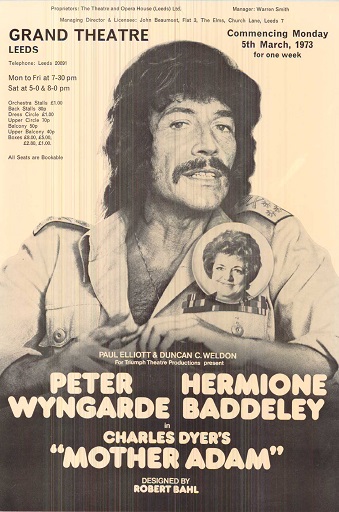
Presented by Triumph Productions Ltd. British tour, 1973

Character: Adam

The Story

The action takes place in Adam’s Mother’s bedsitter in a cathedral town . The museums is nearby. The time is the present day.

This production of Charles Dyer’s third play in a trilogy on loneliness which began in 1963 “This is a story of a man and his mother, of courage and optimism: of how Adam becomes a saint… nearly!”

It is the present in Mammle’s attic, a Sunday in a cathedra town. The museum is nearby.

This production of Charles Dyer’s third play in a trilogy on loneliness which began in 1963 “This is a story of a man and his mother, of courage and optimism: of how Adam becomes a saint… nearly!”

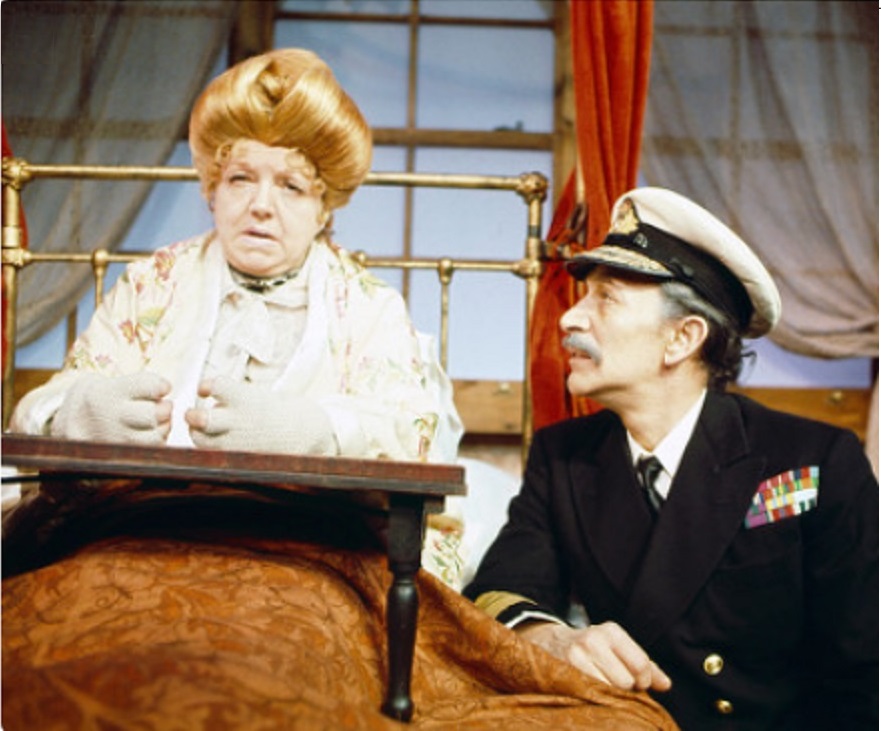
Below right: Peter as Adam, with Hermione Baddeley as his mother.
MOTHERADAM

Audience Opinion

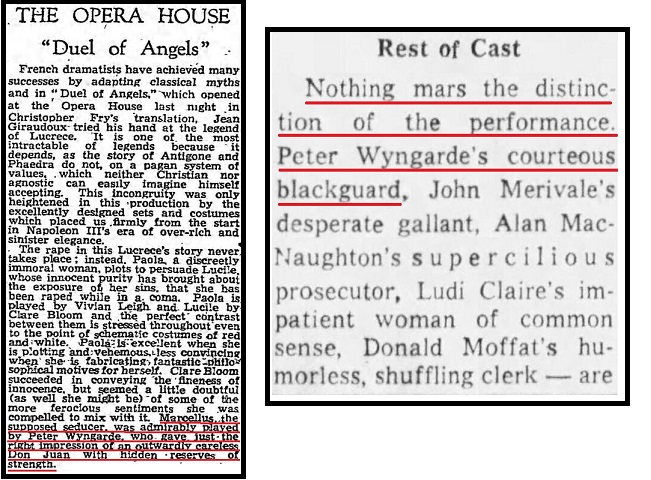
Critics Comments

“…an odd role you might think for Peter Wyngarde. But since the sick-room relationship is kept vital and bearable by the son’s flow of talk and outrageous play-acting, it is an attractively eloquent one for him.”The Birmingham Evening Mail – January 23rd, 1973.

“Peter Wyngarde gives a performance of near genius – a great actor in the very best sense of the word.” Harold Hobson, Theatre Critic.

“…As for Peter Wyngarde, in this play he approaches with a quiet, unassuming step, very close to greatness.” The Times – January 23rd, 1973.

“…And Peter Wyngarde as her much-mothered son extracts all possible sympathy from an implausible and over-written script.” Eric Shorter – Daily Telegraph January 17th, 1973.

REVIEW: Dracula

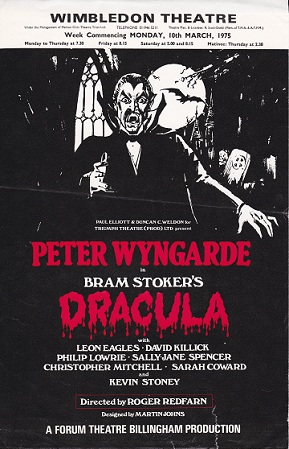
Presented by Triumph Theatre Productions Limited. National Tour: February 1975.

Character: Vivorde Szekels/Count Dracula

The Story

The action takes place in the Main hall of Doctor Seward’s Mental Sanatorium near London in 1924. 

Act I:

  • A late winter evening

 Act II:

  • i. Several days later – dusk
  • ii. The early hours of the following morning
  • iii. The vault

DRAC2 - Copy

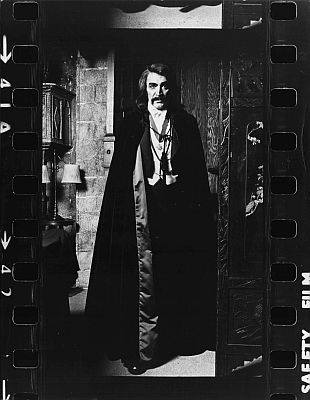
I remember thinking that Count Dracula must be the modern-day Father Christmas as I walked into the Theatre Royal in York on the evening of February 3rd, 1975. The auditorium was filled mostly with teenagers as I recall, with the occasional adult of carefully cultivated nervous dispositions thrown in for good measure, and we all had a great time watching Peter doing his X-Certificate bit with the powers of darkness.

So why did they used to keep the kids away from Dracula and his pals? None of the old films had so many laughable shocks as this touring revival, and not letting the toffee-suckers in to see this would be akin to barring them from a pantomime.

To say that the play was not really scary would deny the success of a series of brilliantly executed stage effects – rats galloping and bats hurtling about to the accompaniment of delighted screams; chairs moving, books opening, doors slamming, darkness falling – all in a variety of interesting ways. But the biggest scare was reserved for the ghost train… with broad daylight and a toffee apple waiting at the other end.

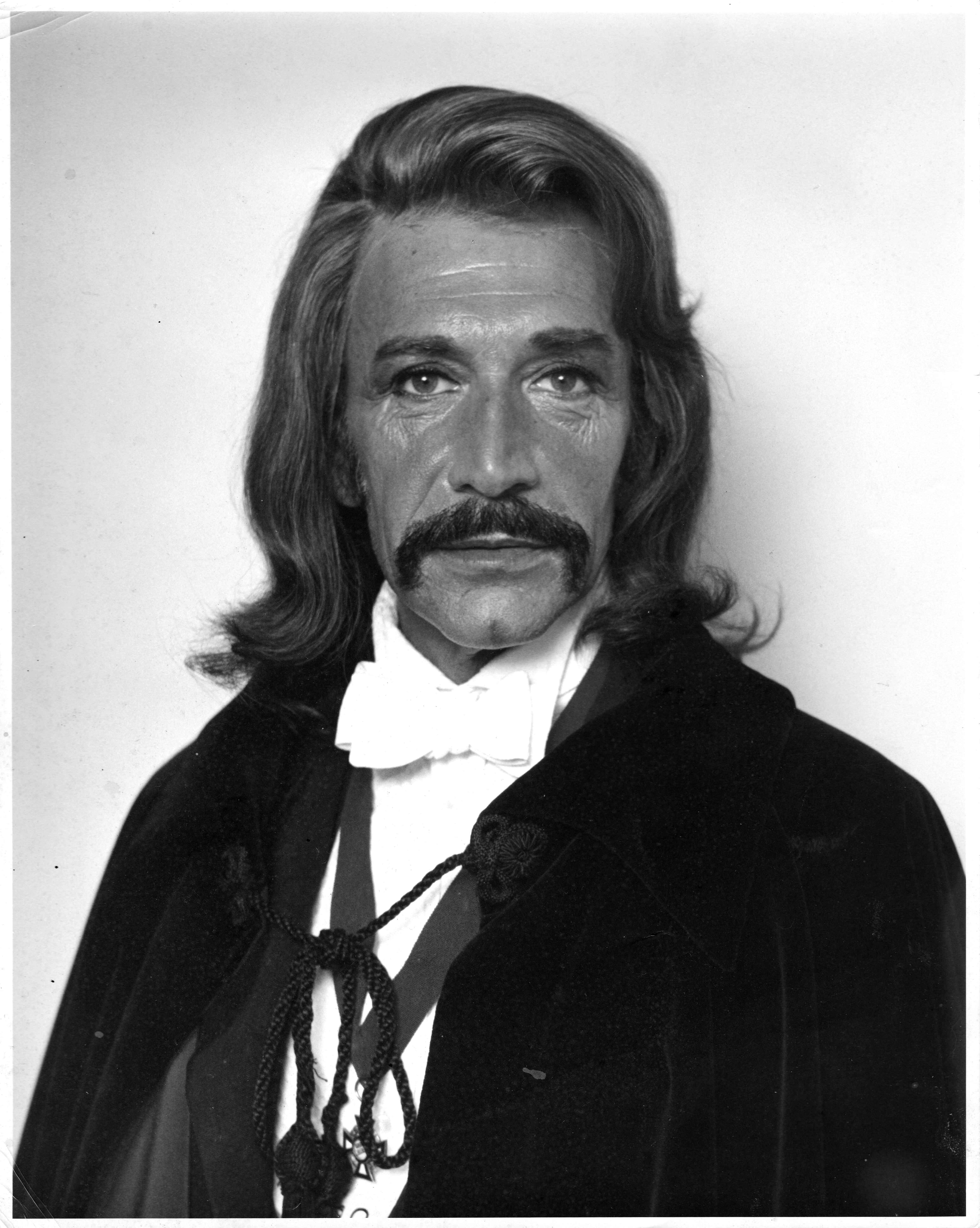
On the impressive Gothic set prepared by the Billingham Forum Workshops, Peter was the master of ceremonies as the Count himself. He didn’t need to act a great deal, but appear and disappear at will in an amazing series of Victorian conjuring tricks.

His face, itself one of the best Gothic facades in show business, might be thought an asset to the part, yet more emphasis appeared to be placed on his scarlet-lined cloak.

1 - Copy

The plot was not what could be described as awe-inspiring, switching between extremes of stage fright and long periods when the cast stood around telling each other what was what, who was who, and indeed, who was dead. Yet the audience – myself included – was content enough to wait, and watch Philip Lowrie as the madman Renfield gibbering his way in and out of his padded cell.

The unfortunate man ate rats and insects, raving behind the curtains, was mysteriously bitten on the neck, appeared drenched in blood, and was dragged out screaming: “Fools! Fools! The whole world is mad!”. A likeable character all the same.

Comic relief, should we have still needed it, was the province of David Killick – and army officer/silly-ass type who never quite got round to mentioning the “guaund piauno” but who asks Dracula: “Don’t you drink, old man?”

Leon Eagles played the exorcist professor – the one character to whom we might have looked for a little coolness and perhaps one of the genuine shudders, but he turned out to be the most melodramatic of the entire cast – the Count included!

Occasionally, the dialogue managed to laugh at itself as in Dracula’s comment about Transylvanian wine not travelling well, but more often than not, it was just background noise between the marvellous effects which were designed by Peter himself. He even spoke his great climatic oration as though it didn’t matter, and it didn’t. His stage-presence itself was simply awe-inspiring.

In Retrospect

DRACPOST

When Count Dracula and his blood-thirsty habits descended on York, the result was never disappointing.

The play was more funny than frightening, and for the Seventies at least, a little too far-fetched to scare anyone. However, it was wonderful entertainment, with magnificent special effects, both on and off stage.

As might be expected, Peter made a splendid Count in a full-length scarlet-lined cloak. He trapped a young girl into becoming one of his undead brides with great style, but perhaps because the story is known so well, his actions were a little predictable, although never dull. Another minor criticism was that the production lacked a little in the way of suspense, and the outcome rarely seemed in doubt when the forces of the darkness clashed with those of light.

Apart from Peter himself, Sally-Jane Spencer as Mina Seward – the young girl who falls into Dracula’s clutches, and Leon Eagles as the priest who was called upon to rescue her, were excellent.

Small Bites

20180214_112440

Left: The bespoke fangs that Peter wore whilst playing Dracula

DRACULA1

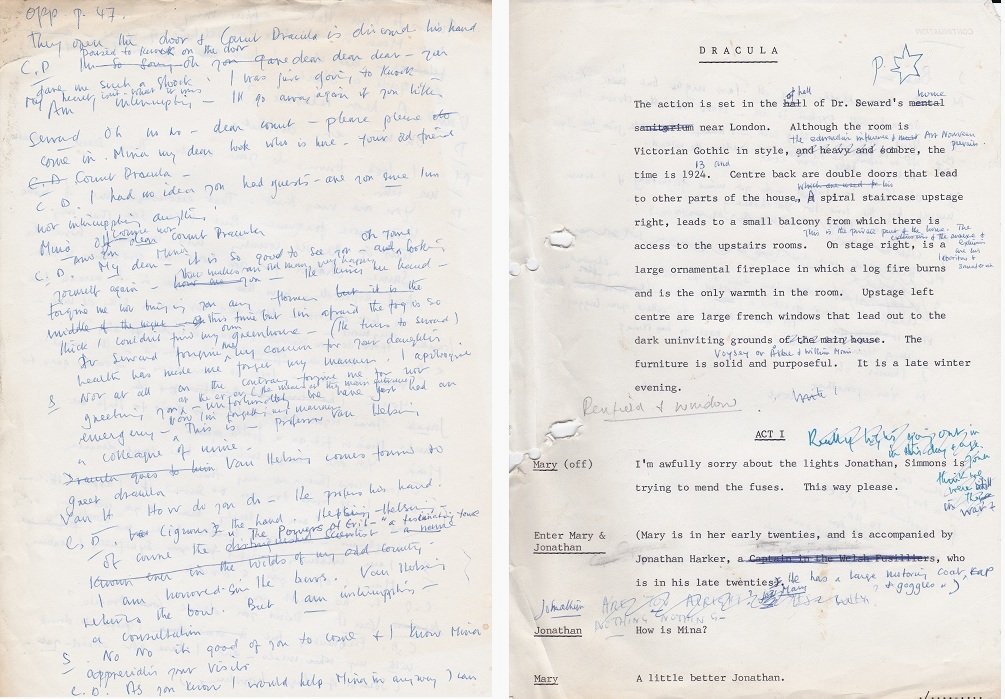
Above: A page from the original script with Peter’s notes and revisions

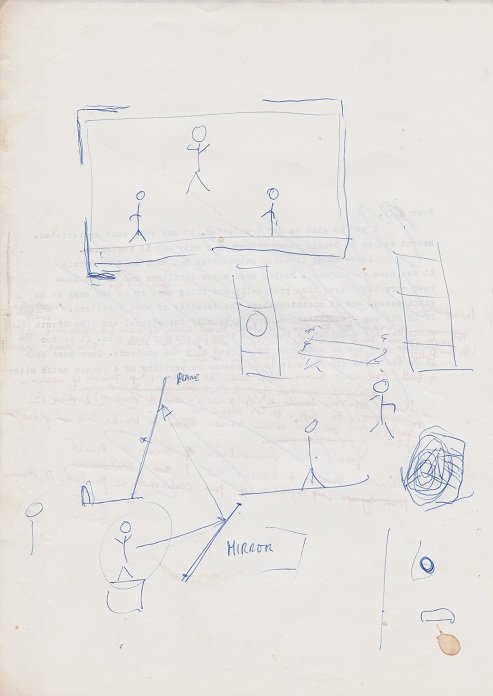
Below: A sketch drawn by Peter to demonstrate how the special effects (using mirrors) in the play would work.

DRACULA

REVIEW: The Good Woman of Setzuan

Presented by the English Stage Company at the Theatre Royal, Brighton and the Royal Court Theatre in London. October 1956.

Character: Yang-Sun

The Story

The play takes place in the Chinese town of Setzuan in the 1930’s

  • Prologue: A street, evening
  • Scene 1 – A Small Tobacco Shop
  • Scene 2 – Wang’s Sewer Pipe by the river
  • Scene 3 – The Tobacco Shop
  • Scene 4 – The Municipal Park
  • Scene 5 – Wang’s Sewer Pipe
  • Scene 6 – The Tobacco Shop

INTERVAL

  • Scene 7 – The Tobacco Shop
  • Scene 8 – A Private Dining Room in a cheap restaurant
  • Scene 9 – Wang’s Sewer Pipe
  • Scene 10 – The Yard behind Shen Te’s Shop
  • Scene 11 – Shaui Ta’s Tobacco Factory

INTERVAL

  • Scene 12 – The Tobacco Shop now an office
  • Scene 13 – Wang’s Sewer Pipe
  • Scene 14 – A Courtroom

SATCHWAN-1

Peter as Yang-Sun – an unemployed pilot

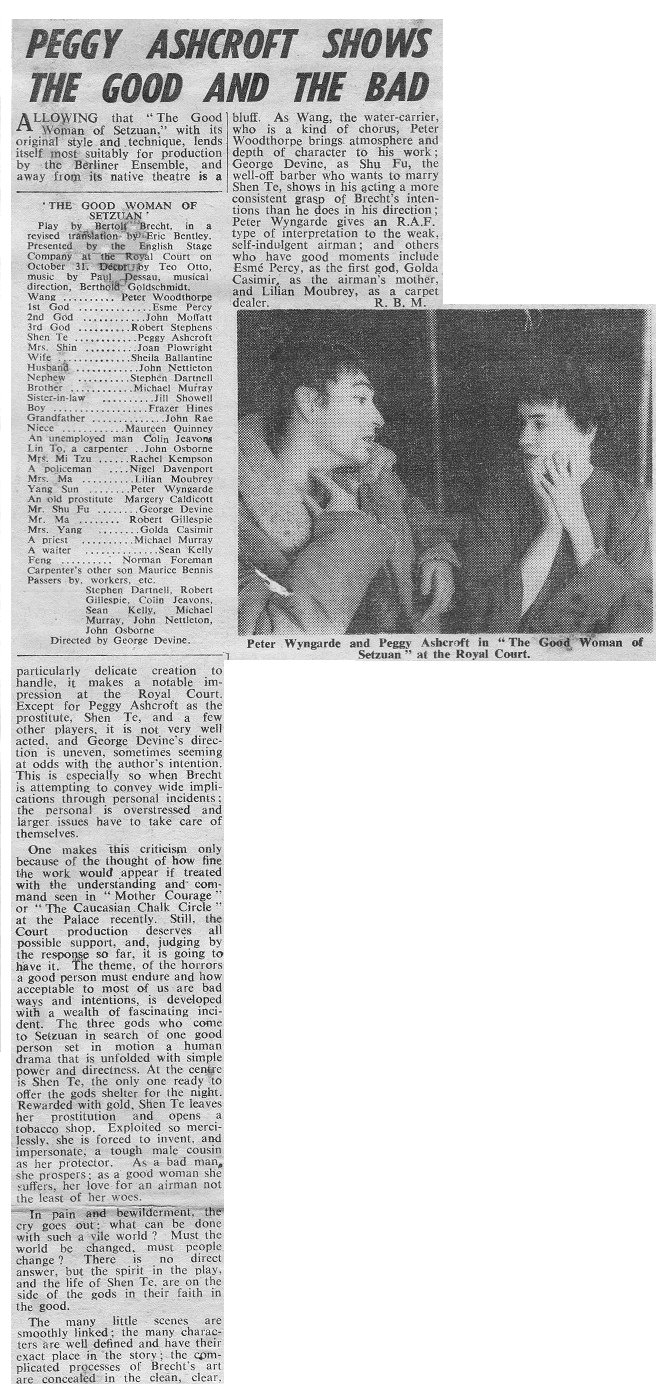
Producer George Devine was surely carrying out his obligations to the audience he had created at the Royal Court Theatre in attempting the first ever professional full-scale production of Bertold Brecht’s play in English. The difficulties were formidable: his stage wasn’t big enough to begin with; nor, in fact, was his resources. The comparatively small number of actors he was able to afford were not, naturally, trained in the kind of acting that Brecht demanded – indeed, some were even expected to take on more than one part. However, the attempt proved well worth making and, even if the difficulties were not fully overcome in this production, the effort was a courageous one and deficiencies were more than compensated for by the performance of Peter Wyngarde, who tackled the difficult role of the good-for-nothing Chinese airman, Yang Sun, both imaginatively and professionally.

The little fable on which the three-hour play was strung is very simple (and none the worse for that!). Three Chinese deities – played by Esme Percy, John Moffatt and Robert Stephens – set out from Heaven on a quest. The world is to be destroyed unless they can find one good man or woman in it. For a time not only are they unable to find a good person – they don’t even meet a bad person with enough enlightened self-interest to pretend to be good! However, just when all appears to be lost, the three gods happen upon the small village of Setzuan, where a poor prostitute by the name of Shen Te takes them in thinking them to be beggars, and offers them food and shelter.

To reward her kindness, the gods give her a bag of gold with which she buys a tobacconists shop, and she is at last able to escape both her old profession and her poverty. As with so many prostitutes in fiction, Shen Te (Peggy Ashcroft) has a heart of gold, and as might be expected, some of her less scrupulous neighbours seize upon the opportunity to take advantage of her good nature, preying on her hospitality and eating her out of house and home.

27540624_1701281749922449_2006628932950249163_n

At last she is forced to invent a tough male cousin, Shui Ta (herself in disguise) who, with the help of a policeman, drives the rabble from the shop. As herself, she falls in love with Yang Sun (Peter Wyngarde), an unemployed pilot and promises to find him the large bribe necessary to buy himself into a job. However, as her male cousin and protector, she discovers that the airman is only using her for his own ends, but by now she has not only been betrayed and exploited, but is pregnant by him too!

Nevertheless, as the tough ruthless male, she flourishes, and after setting up a tobacco factory, installs the pilot as her foreman who, by grinding down the poor, makes a fortune for his employer. Wickedness, it appears, is always rewarded whilst goodness is trampled upon.

YANGSUN

Knowing that Shen Te has a stake in her cousin’s thriving business, Yang Sun accepts her proposal of marriage, and a wedding party is arranged to take place at the tobacco factory. But when the pilot discovers that his intended bride knows of his deception, he attempts suicide. In spite of his dishonesty, Shen Te takes pity on the weak, self-indulgent airman when she finds him about to hang himself in the woods. Sitting under a tree in the rain, she diverts him with a charmingly told ‘Story Of The Cranes’.

During the coming weeks, She is forced more and more frequently to adopt the guise of Shui Ta in order to keep her pregnancy a secret – until it seems that Shen Te has disappeared altogether. Convinced that the vile factory owner has murdered his friend, Wang the water carrier (Peter Woodthorpe) confides in the local barber, Shu Fu about Shen Te’s disappearance. Since Shu Fu (George Devine) is himself in love with Shen Te, and enlists the help of Yang Sun, who on learning that his lover is pregnant with his child, forces the police to arrest Shui Ta, who is brought to trial.

On hearing of Shen Te’s plight, the three wandering gods return to earth as her judges, and some irony is extracted from the respectable and the rich speaking on behalf of the tight-fisted capitalist. When Shen Te at last reveals herself as the impostor and the villagers discover her subterfuge, the gods airily insist that she is the one good woman they require to justify them leaving the world as it is, and they promptly return to Heaven.

In Retrospect

There were many scenes in this play, but there was little sense of movement. They illustrated what was intended to be geometrical clarity and the simplicity of a fairy tale – the rather dusty thesis that human beings, or it may be the world that they have created for themselves, are so constituted that it is virtually impossible for them to do good without trampling on others faces.

YANG SUN

The fable consists of deliberate simplifications, but the treatment is forbiddingly portentous. While the woman of Setzuan is a poor prostitute, her natural goodness is noticed by three deities who happen to be on a virtue-spotting tour of the world. Set up in a shop by the gods and bidden by them to remain good and yet to love, she finds that her goodness is likely to be her ruin.

The hand that is extended to the beggar is at once torn off. She tries to resolve the schizophrenic conflict that has been set up in her mind between sentiment and judgment, feeling and fact, heart and head, by dividing herself into two different people. She is She Te, the good woman; she is also Shui Ta, an invented cousin who protects her property from parasites including, not least, the young pilot with whom she falls in love and who proposes marriage.

When she discovers that she is to have a child by her lover, Yang Sun, the tight-fisted spiv takes over her affairs completely and adds to her property by viciously sweating labour and exploiting human credulity. As the woman she is merely a heroine; as the man, merely a villain; and both belong spiritually to the cartoon-strip of life.

The only moment in which Shen Te humanizes the heroine is when she proposes marriage to the hungry, unemployed pilot who is contemplating suicide. The young man’s despair, the tenderness of the woman, and the gathering thunder clouds over the trees all contrive to touch the scene with poetry. The reminder of the story is told, as in most Brecht plays, in a series of scenes and song – some brilliant, others not so, but which provide Peter with his first opportunity to sing live on stage.

By all accounts, the first act was the the worst, but this was worth enduring, as the second and third would give Peter the chance to bring himself to the fore as the shiftless pilot. Other notable performances came, of course, from Dame Peggy Ashcroft in the lead role of Shen Te, Peter Woodthorpe as Wang and George Devine as the affluent barber, Shu Fu.

BLOG3

Critics Comments

REVIEW: Esso World Theatre – ‘The Way of the World’

A.K.A.: ‘Voices Of Man’

Broadcast: Monday, 13th January 1964 (USA)

Character: Mirabelle/Himself

Rehearsals took place from Monday, 14th October to Thursday, 24th October, 1964. A full dress rehearsal for all actors was held on Friday, 25th October.

The Esso World Theatre was a showcase of what was considered to be the best of British theatre, which was premiered on WOR-TV (Channel 9) in the United States on Tuesday, January 13th, 1959.

The Standard Oil Company (Esso) – much the most artistically adventurous of all the sponsors, were given the opportunity to offer some of London’s top players a chance to illustrate what was colourfully described by the Washington Post as: “The Puritan and Cavalier’ threads running through British culture.”

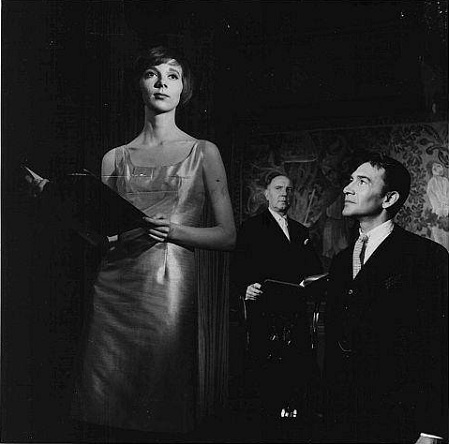
Below Right: Peter with Anna Massey and, (background), Sir Ralph Richardson

ESSO

With Sir Ralph Richardson acting as a guide through the ages, and a company consisting on none other than Peter Wyngarde, Anna Massey, Angela Baddeley, and Paul Rogers, the excursion through the pages of British literature proved, it seemed, to be an “unreserved joy”, as the New York Times described it; “A feast for the viewer hungering for exiting words spoken with the precision and eloquence that are the traditions of the British stage.”

ITC fans will doubtless be familiar with director Cyril Frankel, who was personally chosen by Producer, Bert Lawrence, to take charge of the project, and in doing so, succeeded in avoiding even the slightest trace of hackneyed staging, and displaying an enthralling diversity of visual concepts which ranged from readings on a park bench, to comedy in an empty room, to an off-screen rendition of Shakespeare – illustrated by a camera scanning the interior walls of Westminster Abbey.

In order to present a suitable opening, Angela Baddeley kicked-off the proceedings by reading an in presentation of Geoffrey Chaucer’s ‘The Wife of Bath Tale’, which was filmed in a field of wild horses. ‘Paradise Lost’ brought together Sir Ralph Richardson and Anna Massey, followed by excerpts from Robert Herrick, John Bunyon and John Dunne.

But the highlight of the evening was undoubtedly a scene from ‘The Way of the World’, which was performed by Peter in the role or Mirabelle, with Anna Massey as Millamant.

Bringing the hour to a close was a contemporary example of the theme of ‘Puritan versus the Cavalier ‘. From a bench in London’s Hyde Park, Peter Wyngarde and Paul Rodgers recited an extract from ‘One Warm Sunday’, taken from ‘Portrait Of And Artist As a Young Dog’, by Dylan Thomas.

Running Order

  • ‘Puritan Versus Cavalier’: A short play-within-a-paly set in York. The drama being performed is of God (Peter Wyngarde) conversing with Noah (Ralph Richardson) and his wife (Anna Massey). The Wakefield Mystery Plays – edited by Martial Rose, Doubleday & Co. Inc., Garden City, New York, 1962.
  • The 2nd Section is set at York Minster, with Richardson as Satan, Anna Massey as Eve, with Peter Wyngarde narrating.
  • Next, a prologue from Geoffrey Chaucer’s, ‘The Wife of Bath’ – read by Ralph Richardson.
  • There are then readings of a selection of poems which were illustrated on screen by drawings from ‘The Pilgrims Progress’. This was then followed by a short intermission, after which was a reading of ‘One Warm Saturday’ – a short story by Dylan Thomas.
  • There then follows a short play featuring Peter Wyngarde as Mirabelle and Anna Massey as Mrs. Millamant.
  • Next, a reading by Ralph Richardson under the title, ‘Jeremy Collier’ – with the voices of Peter Wyngarde, Anna Massey and Paul Rogers.
  • After the tolling of the bell at York Minster, Richardson recites from T.S. Elliot’s ‘Choruses From The Rock’

Critics Comments

 “The hilarious subtlety of the humour and the high style of the occasion were perfectly realised in the superb playing achieved under the inspired guidance of Cyril Frankel. Mr Peter Wyngarde was completely captivating in the brilliance of his characterisation.” The New York Times – January 14th, 1964.

ESSO-2

N.B. The production also featured actors from the York Festival Theatre Company.

REVIEW: Butley

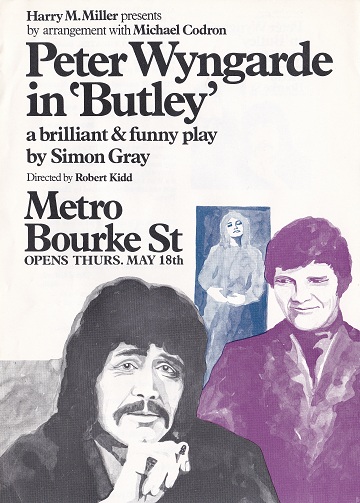
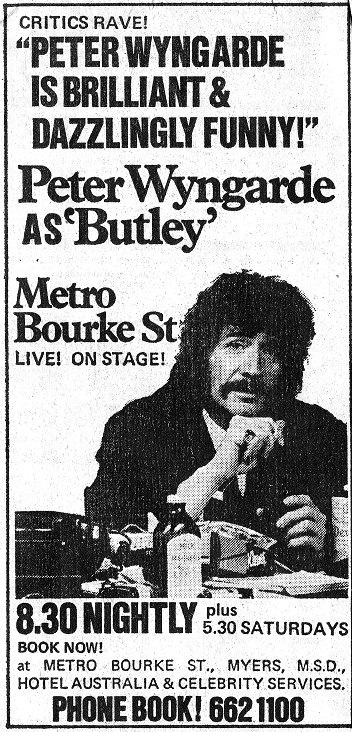
Presented by Harry H. Miller Productions at the Metro Bourke Street Theatre, Melbourne, Australia. May 1972

Character: Ben Butley

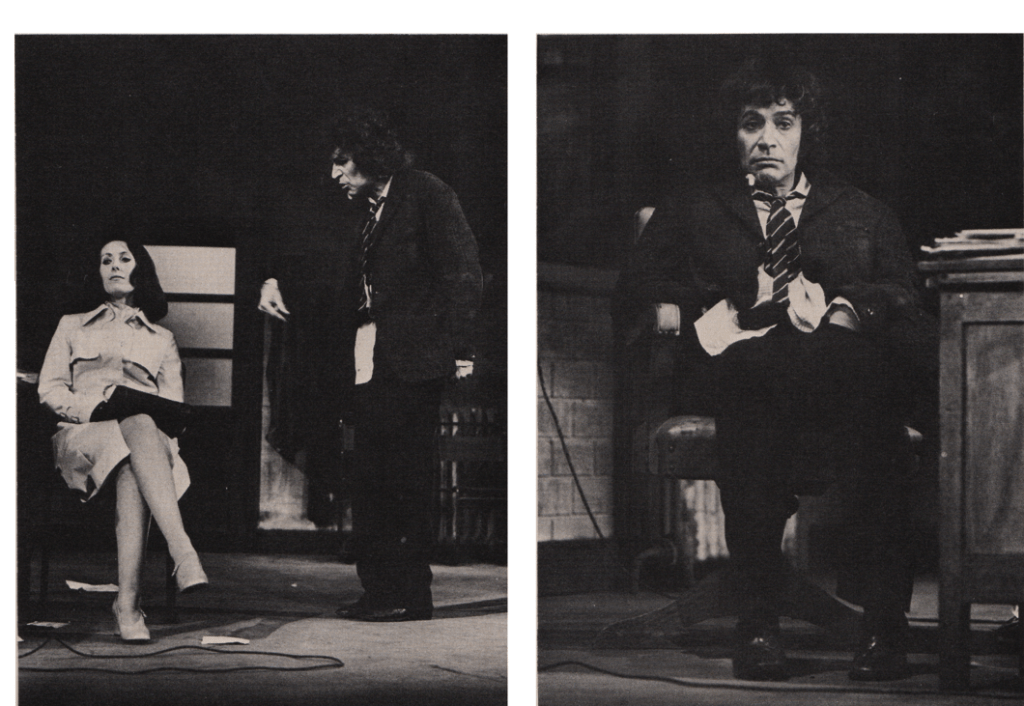
Above: Peter as Ben Butley

Some Background

When ‘Butley’ began its run in Melbourne, Australia, it was already enjoying great success thousands of miles away in London, and believed by many critics to be one of the most brilliant pieces of contemporary writing ever to hit the commercial stage. The entertaining skill of its author – Hampshire-born, Simon Gray – had already been recognized with a London Evening Standard Drama Award, and public response had confirmed the enthusiasm with which the critics had greeted it. For anyone who has never had the opportunity to see ‘Butley’ (Alan Bates took the lead role in the 1973 American Film Theatre Production), the only way to describe it is a bitingly funny observation of a very credible situation involving difficult and often abrasive human relationships.

The play, which is set in an office of the University of London, centres around the exploits of one Ben Butley – a lecturer and alcoholic – who succeeds in insulting just about anyone unfortunate enough to cross his path. Harry H. Miller, head of the theatre production company which staged the play at the Metro Theatre in Melbourne said at the time that he felt they were fortunate to have been able to secure Peter’s services in the lead role. “His television series have made him internationally popular, “ he said, “and anyone fortunate enough to have seen him perform in the theatre abroad will have no doubt of his gifts as a stage actor. My determination to cast him in a production of mine began when I met him during a brief visit he made to Australia little more than a year ago, and I am happy that the opportunity has occurred with this production of Butley.” In the play, Peter played a cantankerous man who shares both his office and flat with Joseph, his former star pupil, who is now a teacher himself.

The Story

BUTLEY2

The word Butley might well one day pass into language. As Mitty is to daydreaming, Butley is to self-destruction. Not the simple physical suicide, but the death of a thousand self-inflicted emotional wounds.

On the day that the story is set, Ben faces both the breakdown of his marriage to Anna, and the reproductions of his intense relationship with Joseph. His painful discoveries are made against a backdrop of University politics and the instability of student unrest. Ben, of course, greets every twist and turn with a blistering torrent of expletives and rhetoric. What was so wonderful about Peter’s performance as the defeatist Butley, was his ability to be so funny in the face of such tragedy. His stark, unsentimental approach to Ben’s relationship with Anna and Joseph, and the cynical send-up of his academic life, coupled with his sceptical view of the teacher/pupil associations were truly stunning.

Peter Wyngarde plays university lecturer, Ben Butley, who shares his office and his flat with a former star pupil, Joey, now also a teacher. On the day that the play is set, Butley faces both the ultimate breakdown of his marriage and of his intense friendship with Joey. Butley’s painful discoveries are made against a background of petty university politics and unease about student dissent. He greets them with a blistering torrent or repartee and rhetoric.

Butley is the person who wilfully wrecks all his personal relationships; who mocks everything he hold sacred, who murders all he holds dearest. His moment of complete self-abasement is his orgasm of fulfilment. Simon Gray’s play was a brilliant character study and a profound one.

When the play begins, Ben is waiting with malice aforethought for Joe to return from a weekend spent with ben’s rival, Reg Nutall (Bruce Kerr). Joes’ dilemma is to decide whether to leave Ben for Reg, and then summon the courage to do it. Ben recognises his doubts and sets about multiplying them and adding to Joe’s confusion. He taunts and torments Joe, stalks him cat-and-mouse fashion, freeing him momentarily and then pinning him again with his claws.

He teases and tantalises, advancing backwards and retreating forwards – driving his victim nearer and nearer to the corner from which there is no escape. Lover, wife, colleague, pupils – all are prey to the lash of Ben’s tongue and the dark side of his mind. And they all flinch and retreat in the face of persistent malevolence. And what a malevolence! Misanthropy dressed in magnificent words; the summit of sarcasm; a spluttering series of verbal firecrackers exploding across the footlights.

BUTLEY1

Structurally it is unorthodox. Its main character is on stage for its duration and the plot unfolds in a series of verbal punch-ups between Butley and the satellite characters

Butley wins all the battles but loses the war. Academic niceties such as “balance” and “interplay” of characters go by the board. Butley hogs the lot and a wonderfully convincing self lacerating sardonic man emerges. A tormented tormentor driven by daemons he recognises but cannot control.

From the moment he ambled into the seedy office, Peter Wyngarde was in full control of the main character. He imbued Ben with a sense of physical self-disgust. This was no intellectual’s absentminded (or studied) shabbiness. You could almost smell his socks!

The climax was the finest piece of dramatic writing since ‘A Man For All Seasons’. It was a confrontation between Ben and his rival, Reg. They began their joust slowly, warily; rapier against cutlass. Ben stepped up the pace. Joe enters. Ben realises this is his last chance to keep the vacillating Joe, so he throws it away in a glorious go-for-broke avalanche of taunts and jeers.

Joe is spellbound, amused, and finally alienated. Ben’s best performance brings about his defeat. He is alone.

Butley was first presented in London in 1971, with Alan Bates in the title role, with Richard Briers taking over the part. A friend of mine was fortunate enough to see both the above, but reported that Peter eclipsed them both.

Critics Comments

REVIEW: The Enchanted

Presented by the London Arts Theatre Committee Ltd. at The Arts Theatre, London – April 1954.

Character: A Young Man/The Ghost

The Story

Act I:

  • A wood near a lake, in provincial France; early May

Act II:

  • The edge of the lake; June

Act III:

  • Isabel’s room; the next day

ENCHANTED

Above: Peter (Centre, standing) as A Young Man/Ghost

If you believe in ghosts and the after-life, then this charming play would have delighted you, I’m sure. But even if you don’t, chances are, you’d have been every bit as enchanted as the characters were said to have been. No doubt Jean Giraudoux’s ‘Intermezzo’, which was admirably translated by Maurice Valency as ‘The Enchanted’, wrote the piece for an audience who were much more sceptical and fatalistically indifferent to the matters of life and death than we are today.

But it was full of charm, wit, philosophy, satire and whimsical inventiveness than the listener who, according to the authors theories, were much more important than the beholder, were compelled into his world and there held spellbound and persuaded to believe. The tale begins by establishing that life within a small town in provincial France has never been quite the same since the report of a the untimely death of a young man by drowning which, in turn, has spawned stories of a ghostly apparition close to a local lake.

Happiness has at last descended upon the town! And further still, chance has discovered for once a sense of fair play; in a local lottery, the cash prize has gone to the neediest couple instead of the richest, while the consolation prize of a motorcycle has been won, for the first time, by a young man instead of the Mother Superior of the convent! However, the authorities in Paris, horrified at this “subversion of the natural order”, send down an Inspector, who is the very embodiment of good sense, and armed with reason and regulations, is to report on these alarming manifestations and cosmic radicalism. He sets about trying to persuade the local committee – the dim-witted Mayor, the somewhat philosophical Doctor, and the Supervisor of Weights and Measures – that in fact there is no ghost, and that a young woman by the name of Isabel, who claims to be in touch with it, is nothing but a wicked influence.

The second clause is easier to prove, since Isabel is standing in for the local schoolmistress, and the flock of little girls who accompany her are soon to be in a dangerous frame of mind. Less easy to prove, however, is the non-existence of the ghost and the Inspector, who has found himself attracted to the beautiful, but other-worldly teacher, has to fall back on trying to exorcise the spectre instead. When it is rumoured that Isabel is to meet with the spectre by the lakeside to learn from him, she hopes, the true meaning of life and death, the members of the Committee solemnly congregate in a nearby wood to spy on her. It soon becomes apparent that she is in love with the ghostly young man, but little known to her, the Inspector has hired two doleful assassins to test whether or not the spirit is for real. When the ghost finally materializes, the somewhat poetic image is instantaneously shattered by the sound of bullets ripping from the executioners revolvers: the “ghost” was indeed merely flesh and blood, and falls dead into the distraught school teacher’s arms. Yet no sooner has the young man paid the ultimate penalty for his dishonesty, that his spirit rises to confound the inspector and his henchmen. The story concludes when, the following day, the ghost visits Isabel in her room, where he begs her to join him on the “other side”.

A bizarre scene of rivalry between the spirit and the Government Inspector ensues, and the rest of the townsfolk are enlisted to combine their efforts to help save the young teacher from stepping through the door which Death has left so invitingly open. In retrospect: To quote Jean Giraudoux himself, the effect of the ‘The Enchanted’ was to leave its audience “bewitched, bothered and bewildered”. Bothered? A great deal. Bewildered? A little. But bewitched? Entirely! What bothers me, however, is how to get the extraordinary mixture of fantasy, realism, philosophy, occultism, satire, poetry, and good old-fashioned French logic into any kind of description that might convey something of its atmosphere.

What bewilders me is the multiplicity of things that it had to say. What bewitched me is Giraudoux himself, and his astonishing faculty for being absurd and profound, satirical and moving, all at the same time! Who but he could conduct a serious discussion on life and death, by the way of a mock-solemn story of a French multiplicity scandalized by the discovery of a well-authenticated ghost in their midst? Who else could hold an audience rapt over a scene in which a pompous Government official develops the theme that if one ghost is allowed, then all the myriads of dead will come thronging back to life to disturb the political stability of the entire country? But I should not indulge too much in continuing a description of the play, for inevitably a prose outline would only serve to destroy the magic and, anyhow, it could give no idea of the ingenious invention and charming fancy which was built up right from its beginning. However, it was pleasing to read that John Fernald received the accolades that he so richly deserved, as a play of this kind tends to make considerable demands on a producer. There is first an unusual amount of tricky stage management which, I understand, was triumphantly achieved at the Arts Theatre. The great climax, for instance, where Peter as the ghost, makes his final bid for Isabel; she is “out”, but still revivable, and the entire cast combine with the tin-pot town band outside to get through her unconsciousness in a concerted cacophony of sound from the living world to draw her back. The scene was absolutely superb, and was brilliantly handled by all concerned.

No less difficult for the producer was to strike the widest range of notes that the play needed and yet sustain the prevailing mood of fantasy which held it together. Under Robert A. Batty’s expert direction, this occasionally slow-moving production, in which grouping, lighting and atmospheric off-stage sounds were made all the more spell-binding in no small part by Peter’s stylish and imaginative portrayal of the young man/ghost. His handling of the part successfully suggested ghostliness without obviously straining for the macabre. Of course ‘The Enchanted’ was outrageous nonsense; it was absurd to think that the officials of a provincial French town might be concerned by the alleged activities of a local ghost or for them to hire two assassins to shoot the apparition in order to prove to both the citizens and themselves, that he was in fact flesh and blood!

However, as the almost poetic exchanges between Peter as the ghost and Valerie Hanson as the infatuated schoolmistress never allowed the audience to pick holes in it. It was so surely and beautifully shaped, with masterly dramatic sense and high levels of imagination, that even its long-drawn-out wordiness and irrelevant stuffing’s were readily forgiven at the interplay of shadow and scintillation, and at the fundamental searching’s for the mystery of itself. It is obvious the author meant his play to be seen as a huge and elaborate joke, and in doing so, to be pondered on many different levels. The thing now becomes a philosophical speculation argued with impeccable logic; now it is a piece of extravagant satire at the expense of the town officials. Again, there is a kind of poetic evocation of the atmosphere which is traditionally kind to theatrical phantoms, with a witty and charming interpretation of the innocence of the schoolmistress; a wonderfully burlesque view of provincial organizations and of all the sights and sounds of life calculated to rescue a human being from the clinging hands of death.

Critics Comments

AWARDS and NOMINATIONS

Award Nominations

Additional Awards

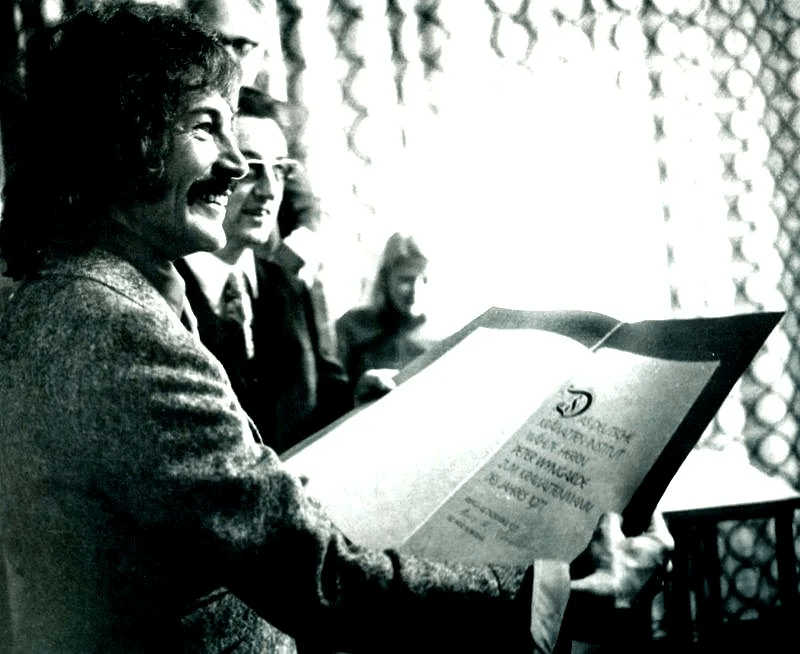
Above: Peter receiving the award on 14th November, 1971. See the certificate here.

PETER-10

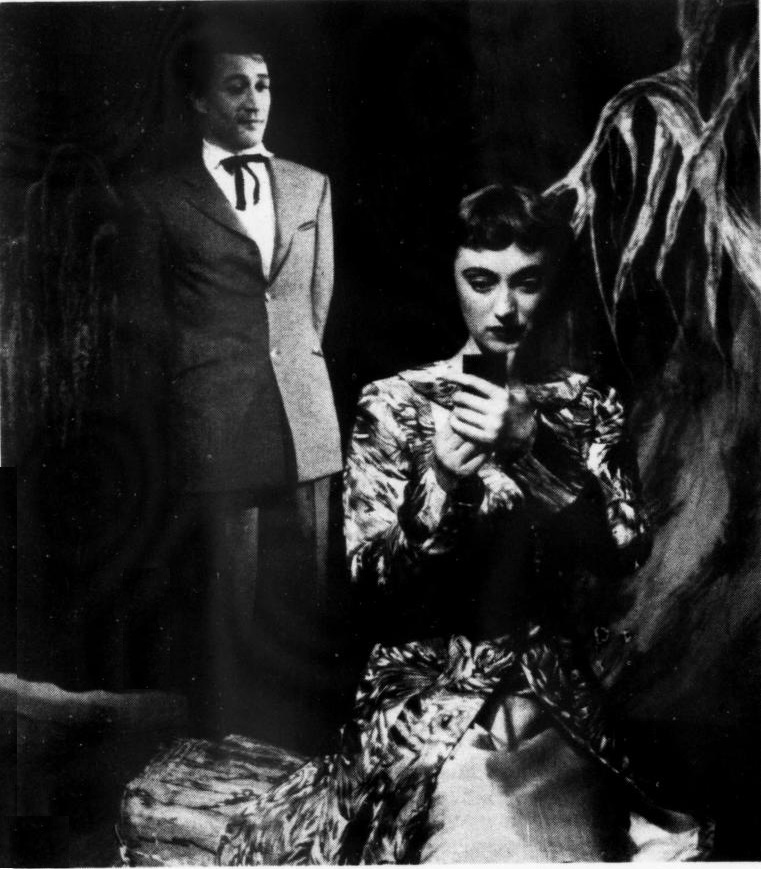
Above: From a shoot organised by the publishers of Petticoat magazine.

Film Awards

The Innocents:

1961

  • National Board of Review, USA
  • Awarded (NBR Award): Best Director – Jack Clayton

1962

BAFTA

  • Awarded: Best Film from any Source
  • Nominated: Best British Film

Cannes Film Festival

  • Nominated (Palme d’Or): Jack Clayton

Directors Guild of America

  • Nominated: Outstanding Directorial Achievement in Motion Pictures
  • Awarded (DGA Award): Jack Clayton

Edgar Allan Poe Awards

  • Awarded: Best Motion Picture
  • Best Script: Truman Capote and William Archbald

Writers Guild of America

  • Nominated: Best Written American Drama: Truman Capote and William Archbald.
  • ‘The Most Frightening British Horror Film Ever Made’,

Night Of The Eagle/Burn, Witch, Burn

1981

REVIEW: The King and I

Presented by Triumph Theatre Productions: British National Tour and at the Adelphi Theatre, London 1973.

 Character: The King of Siam

“Yes, Louis, I like him very much indeed!” Anna Leonowens – speaking of the King

The Story

Whether or not you believe in the basic idea of the Victorian governess taming the Eastern despot to bring Siam into the orbit of Western ideas, Sally Anne Howes shone brilliantly as Anna Leonowens – singing, acting and dancing superbly opposite Peter Wyngarde as King Mongkut, who had the formidable task of playing the part associated so strongly with Yul Brynner. He gave a harsher, more barbaric conception of the role, and in doing so, succeeded to a remarkable degree in exorcising the ghost of his predecessor.

When this Forum Billingham production hit the London stage in October of 1973, it had been almost twenty years to the day from the very first performance of Rodgers’ and Hammerstein’s musical on Drury Lane. Through the years its tunes had kept alive the memories of the barbaric King of Siam’s conflict with the genteel English Governess. Now once more, Victorian primness mingled with Eastern dignity and pageantry in a truly first-class revival.

Undoubtedly, the strengths of this likeable musical were the score and the sentimental use of the King’s children – each of whom had their tiny bit of business to perform, and their efforts were rewarded with enough applause to make their seniors green with envy – though they too were given an astonishingly warm welcome. Songs such as “Hello Young Lovers”, “Getting To Know You” and “Shall We Dance?” were greeted by the enthusiastic sell-out audience at each and every performance as if they were old friends, and the singing too was exceptionally well executed, particularly by Ms Howes, who showed an authority on stage few critics thought she possessed.

With Peter, however, we leave the sphere of music for that of acting, for although he had a number or two that he performed in a half-spoken, half-sung style, his portrayal of the King moved from cruel autocracy to the “civilization” of the Western World that he could only half comprehend, and touched depths of understanding rarely ever encountered in a musical. With his hair drawn back into a top-knot at the crown and with his circumflex moustache remaining to remind us that he’d once been the debonair Jason King, he built up an imaginary character rather as Robert Stephens did with his Atahualipa; lacking any real knowledge of the actual man, he assembled a collection of characteristics which the audience were quite willing to accept as the real thing.

In King Mongkut, Peter portrayed a contradictory combination of charm and cruelty, of feudal instincts and of a desire to progress which was epitomized in the performance of David Morris as his eldest son, Crown Prince Chululongkorn, who has recognized the need for change but who has remained totally loyal to his father. Nevertheless, Peter made a dashing enough King, especially when the Governess, swaying and swooning in her crinoline, teaches him to waltz.

ki

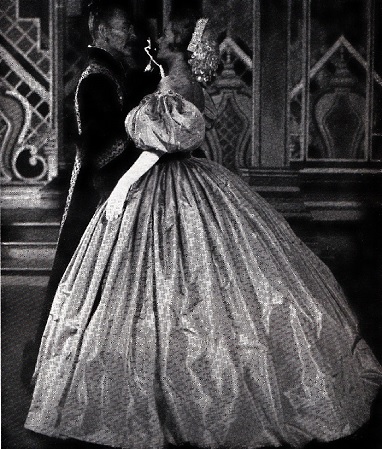
Left: Peter and Sally Anne Howes perform the famous ‘Shall We Dance’ sequence

Although he may have lacked the bulk and authority of Yul Brynner, Peter still managed the role in a style that was personal, charming and finally, moving. His unique interpretation gave the King a more abrasive approach to any problems arising. With feet astride, hands on hips and head tilted sideways, Peter was the complete dictator, yet at the same time, he injected a touch of humour, not only in his facial and finger-waving gestures, which immediately endeared him to the audience. Dressed in a series of embroidered house-coats by Jasper ver Deep décolletage which revealed his somewhat unSiamesely hairy chest, Peter portrayed the role with his usual air of flamboyance, and was totally convincing as both the monarch and savage, but coming into his own in the final quiet moments.

Even those who are not particularly sympathetic to the idiom of the musical would have probably enjoyed this show and then been caught up in its sentimental, but not maudlin, story. From the moment that we see the English widow arrive in Bangkok in the 1860’s, as governess to the King’s children, to discovering that there are over 60 of them with another dozen or so on the way, we are swept along by the enchanting tale which stems from the difference between the Eastern and Western way of life, and on the mutual respect and love which develops between Anna and the King.

KING

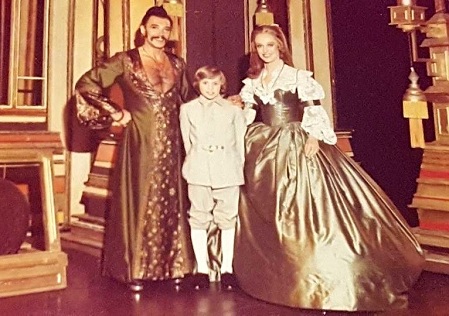
Above: Peter as the King, with Stephen Grover as Louis Leonowens and Patricia Michael, who took over as Anna Leonowens when Sally Anne Howes left the production.

In Retrospect

‘Showboat’ had hoisted its anchor and Rogers and Hammerstein’s Siamese classic had taken its place on London’s Drury Lane for the autumn and Christmas season in 1973. However, the American musical was committed in the main to proving that the advent of the British Governess was a good thing for Siam. Whistling her happy tune, she infected the downtrodden with courage; she mounted a dramatization of ‘Uncle Tom’s Cabin’ which helped to persuade the King that absconding lovers should not be punished; and the sight of a woman standing up to his bad tempered father proved to Prince Chululongkorn that when he eventually becomes king, no one would need to grovel.

This remarkably handsome revival appeared a good deal more acceptable to theatre-goers than the rather messy versions which had preceded it over the years. It did not aspire to the splendours of the original version at the Adelphi, but it did not skimp either; the settings were elegant and tasteful, the orchestra made an impressive sound, and only the lighting seemed a little hesitant.

In the lead roles, Peter and Sally Anne Howes made stately and appealing work of playing the barbarian King and the widowed Governess, and of whom Duncan C. Wheldon, director of Triumph Theatre Productions described as, “An absolutely delightful couple.”

Of course, many people would’ve had the vision of Yul Brynner and Deborah Kerr etched in their minds when they took their seats at the opening night. Well, that was too bad for Mr Brynner and Ms Kerr! Peter, with his shaggy mane swept back into a top-knot and his famous Zapata moustache in its usual villainous droop, stood astride on his padded throne, and succeeded in instilling a deal of sheer acting into the role. There were many moments when the chemistry between he and Ms Howes was so effective that the action developed a genuine dramatic tension. Although it must be said that he sometimes looked uneasy in his role as the savage, he did come into his own in the quieter moments, and his moving portrayal of the King’s death in the final scene.

Regal Facts

k

Right: A distraught Mrs Anna with the dead King.

  • More than 400 youngsters were auditioned for the parts of the Kings children – 56 of them were finally chosen. Three groups of 8 to 14-year-olds worked on a rota basis to perform on alternate nights of the week, with one group of stand-ins. Amongst the group of 11-year-olds was Charlotte Barker – daughter of comedian, Ronnie.
  • The play visited most of Britain’s principal theatres during a 12 week period during the summer of 1973, before reaching the West End of London on Wednesday, October 10th of that year.
  • After Peter and Sally Ann Howe’s dined together at Mario and Franco’s Terrazza restaurant during the plays visit to the Grand Theatre in Leeds, the head Chef was said to be so delighted to see his famous clients that he served up a rather special dish the following day, called Medallions De Veau a’la Jason.
  • On September 13th, 1973, Peter and Sally Ann Howes sailed into the Pool of London on the Chinese junk, the Hoi Lung (Sea Dragon), in full costume to publicise the opening of the show in the West End. (See newspaper cutting).
  • Peter sang three songs in play: ‘A Puzzlement’ in Act 1; ‘The Song of the King’ (with Anna) and ‘Shall We Dance?” (with Anna) in Act 2.
  • The management of the Adelphi theatre in Drury Lane reported that they were unable to cope with the demand from female patrons asking for opera-style binoculars, as those in the Upper Circle and Rear Stalls were desperate to get a close-up view of Peter!
  • The production boasted an orchestra of over sixty musicians, and the sets were designed by the legendary Terry Pearson.
  • After every energetic performance of the famous ‘Shall We Dance?’ segment, the audience would demand an equally energetic encore of the waltz. Although always happy to oblige, due to the sweltering heat from the theatre lights and the weight of the heavy costumes, Peter and his co-star, Sally Anne Howes, would be given oxygen in the wings before they were able to go back on stage.
  • The demand for tickets was so great that the West End run would be extended. However, Sally Ann Howes had already signed a contract to appear in another play in the United States. Her part was taken by Patricia Michael.
  • Whilst playing at the Adelphi Theatre, a block-booking was made by 400 teenage girls – all of whom raced to the stage door after the show in the hope of catching a glimpse of Peter.
  • As it’s a custom for the actors in a play to exchange presents, Peter gave Sally Ann Howes a huge sculptured elephant, handmade by craftsmen in Thailand.
  • Remembering that the King wears glasses in the show, she gave him a pair of Georgian spectacles. He had the lenses taken out of them, and wore them on stage.
  • Peter appeared in all 260 performances of the play.
KING&I

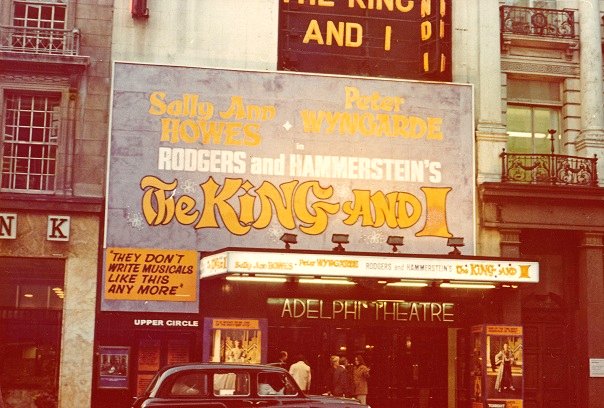
Above: The Adelphi Theatre in London at the time that ‘The King and I’ was playing there.

Critics Comments

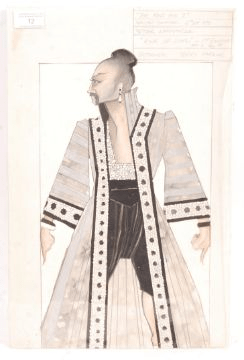
The original costume design artwork by Terry Parsons, and shows the outfit as worn by Peter in Act I Scene II. Watercolour and mixed media on board. Pencil details to top corner. Rare piece of theatre history. Measures approximately; 44cm x 29cm.

Click below for more about ‘The King and I’

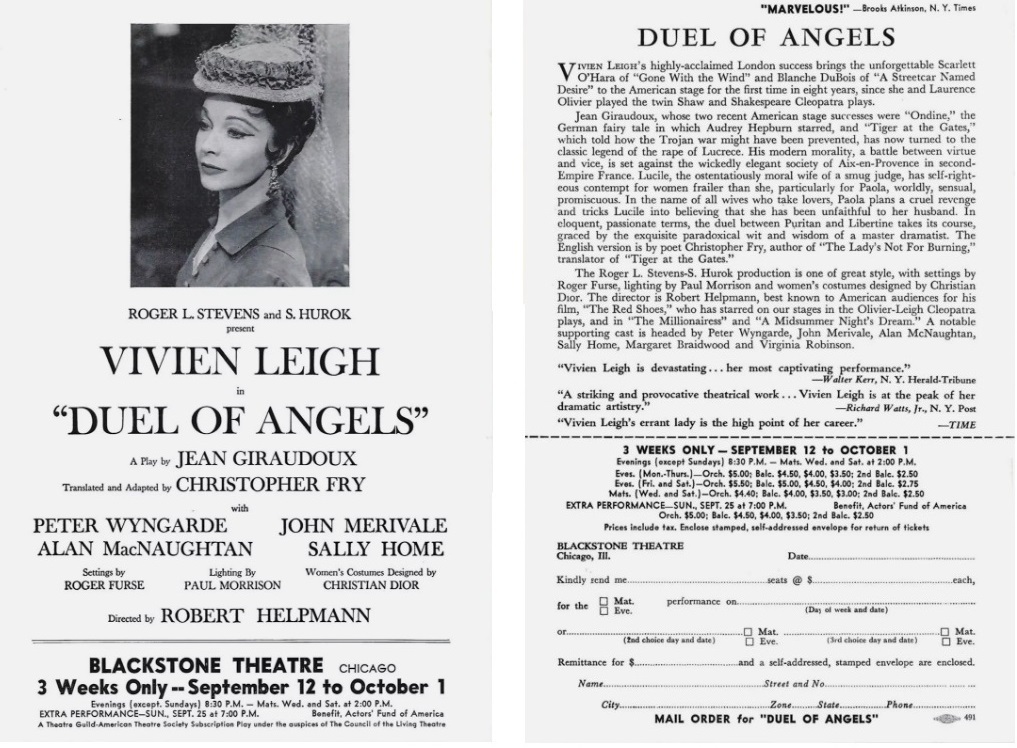
REVIEW: Duel of Angels

British Tour 1958/59

Opened: Apollo Theatre, London, April 24, 1958

Character: Count Marcellus

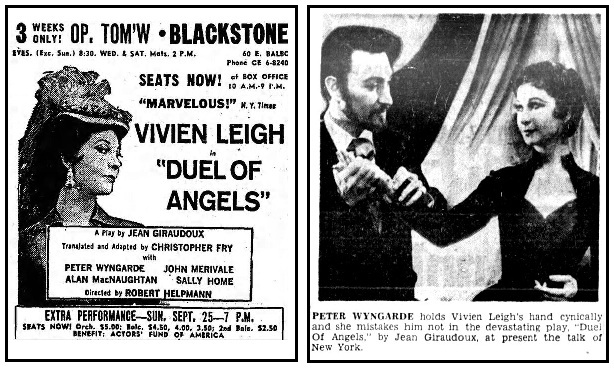
US tour – presented by Roger L. Stevens and S. Hurok

Opened: Helen Hayes Theatre, New York, April 19, 1960.

American Tour 1960 (selected theatres): Alcazar Theatre, San Francisco – Blackstone Theatre, Chicago – Blackstone Theatre, Chicago – Helen Hayes Theatre, Broadway, New York – National Theatre, Washington D.C. – Shubert Theatre, New Haven, Connecticut

Character: Count Marcellus

e715ec70db217daff14341b03a33f218

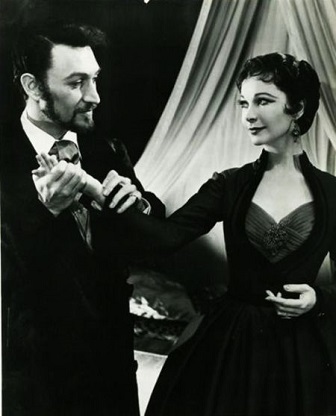
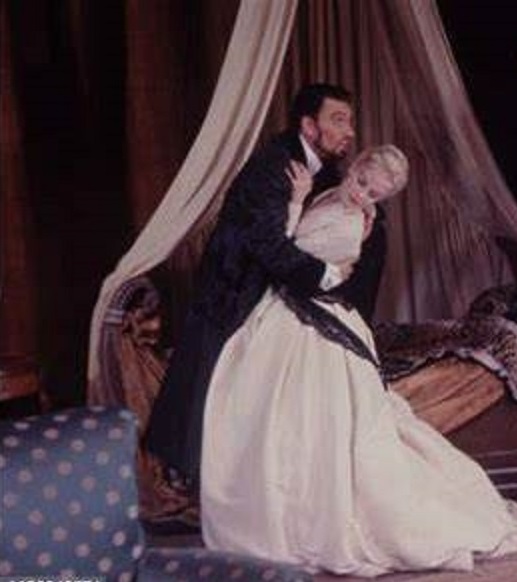
 Above: Peter as Count Marcellus and Vivien Leigh as Paola

  • The Terrace of the café
  • A room at Marcellus’ house
  • Mr. Justice Blachard’s study

“There is nothing more impressive as a good horseman climbing the stairs” Poala about Count Marcellus

Some Background

‘Duel of Angels’ by Jean Giraudoux, was another theatrical skirmish between the sexes that seemed so popular throughout the late Fifties and Sixties. On this occasion, however, it lined up firmly on the side of woman, and pours destructive barrages of scorn of the disparaging moral standards of men.

Giraudoux was clearly fascinated by the legend of the lady, Lucretia, whose reputation for integrity was a hot topic in ancient Rome. However, when she was coerced into adultery by the tempestuous Sextus, she revealed her wrongdoing to her husband the following morning, and then ended her own life. Giraudoux asks in his play why she did it, and was it really worth it?

The Story

OIP (5)

The action of ‘Duel of Angels’ is moved from the Eternal City to the small French town of Aix-en- Provence in 1968, where the authors Lucretia is represented by Lucile (Claire Bloom/Mary Ure) [1], the prim wife of Justice Blanchard (Robin Bailey/Alan MacNaughtan) [2] – a straitlaced reforming judge, who has vowed to rid the town of vice.

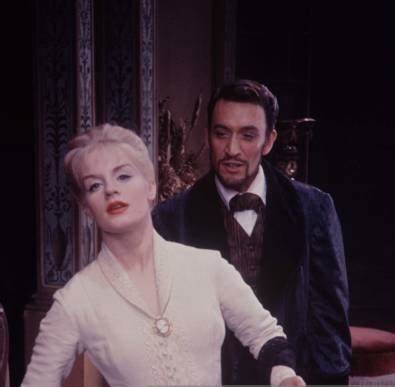
Right: Peter as Marcellus, with Mary Ure as Lucile.

So determined is Lucile not to compromise her moral code, that she will not so much as communicate with anyone who she believes to be guilty of unfaithfulness.

“Try asking her for sugar”, one of the townsfolk announces, “and if you’ve just been reading the Decameron she won’t touch it!”

Particularly disturbed by this woman’s aggressive virtue is Poala (Vivien Leigh) – a married woman who has slept with all but a handful of men in the town. In complete opposition the Lucile, she believes that all women should be united in their collusion to deceive men.

Matters take a turn when Lucile is motivated to telling Paola’s husband of her cheating, and so she must take her revenge. Whilst the Judge’s wife sits sipping ice water on the terrace of a café, Poala hatches her plan

ANGELS

To this end she decides to drugs Lucile and has her taken to the bedroom of the handsome Count Marcellus (Peter Wyngarde) – a man with a certain reputation in the town. Believing that the Count has raped her, Lucile’s desperation leads her to demand that her husband must restore her honour. However, when he finds that his wife has dishonoured him – even under the influence of drugs, has a most unsympathetic attitude – regarding her as hopelessly tainted. However, before Blanchard can exact revenge on Marcellus, the Count falls fowl to bullet fired by Armand [3] – Poala’s jealous husband.

The resulting altercation leaves the Count dead and Lucile’s husband a fugitive, but this is not the worst of it. Only after Marcellus death does she learn that he had never so much as laid a finger on her. Lucile now realises that Paola was right all along; it’s men that use the innocence of their wives only to reinforce their own self-esteem.

Disillusioned by her husband, and finding only finding immorality around her, she takes poison in order to claim her final victory of virtue over deceit and degradation.

Barbette [4] is left with the difficult speech in which the author shifts the ultimate blame on to the stupidity and grossness of men.

“Vice has a mission to perform today, and no man alive is going to make him relinquish it!” Count Marcellus.

In Retrospect

Jean Giraudoux, whose play was translated from French into English by Christopher Fry, was apparently willing to allow the spotlessness represented by Lucille to show, not only an aspect of cruelty, but also an aspect of silliness. In the second act, her conviction that her chasteness has been sullied leads to the conviction that she must be the wife of the man who had violated her. It becomes, in her view, the duty of him then to then kill himself.

Marcellus, Poala’s former lover, is confronted by her husband, Armand. The two men are obliged to fight a duel. “As soon as I opened my window I could see that today is a day of reckoning,” Armand tells him. “The sky is clear blue and an invisible line cuts sheer across it; you can tell at once it’s a judgement sky”

ANGELS

The manner in which she tries to wash out the stain by bringing about the death of Marcellus rises to a point of melodramatic excitement, but the third act brings the audience back to earth when it realises that there was really no motive behind this survival of the enduring virtue. Ironically, it’s only after Marcellus’ death that she herself is driven to suicide – not from shame, but from the exposure of the deception.

The woman who would rather die than acknowledge evil may have been beaten in the duel, but only her vanquisher knew the bitterness that often eats at the victorious. Lucile, dressed from head to toe in white, expressed the fall of the gentle being, whose sense of purity the world had outraged, most admirably. Paola meanwhile – attired in all crimson, let the world’s shame discreetly appear in the acceptance of her rival’s death.

Giraudoux’s play was as unsparing as it was brilliantly theatrical. It was a melodrama, as Paola put it, which was played out by a set of characters who didn’t realise they were in a farce.

ANGELS2

Caricatures from (left) The Daily Telegraph: Lucile and Paola, watched by Count Marcellus and, (right), the Count in The Tatler – both 1958.

Critics Comments

Special Awards

While playing Count Marcellus in Duel of Angels on Broadway, Peter won a Tony Award for being ‘The Most Promising Newcomer’.

He also picked up another award that same year – The ‘San Francisco Award for Best Actor in a Foreign Play’ – again for his portrayal of Count Marcellus.

A Bit Of Trivia

The play which, in the original French was entitled ‘Pour Lucrece’, was originally to be called’ Vice With Virtue’.

 All the ladies costumes in the play were designed and made by Christian Dior.

ANGELS-1

ANGELS6

Left: Programme from the Helen Hayes Theatre on Broadway, 1960, with ticket stub


REVIEW: St. Joan

Presented by John Fernald at the Art’s Theatre Club, Cambridge: 20th September to September 25th, 1954

The Art’s Theatre, London: Opening night – Wednesday, 29th September, 1954

Character: Dunois

The Story

Part I

  • Vaucouleurs
  • Chinon
  • The River Loir

Part II

  • The Headquarters of the Earl of Warwick
  • The Cathedral of Rheims

Part III

  • The Bishop’s Court, Rouen
  • Epilogue, twenty-five years later

Shaw characterised Saint Joan as “A Chronicle Play in 6 Scenes and an Epilogue”. Joan, a simple peasant girl, claims to experience visions of Saint Margaret, Saint Catherine , and the archangel Michael, which she says were sent by God to guide her conduct.

Scene 1 begins with Robert de Baudricourt complaining about the inability of the hens on his farm to produce eggs. Joan (Siobhan McKenna) claims that her voices are telling her to lift the siege of Orleans, and to allow her several of his men for this purpose. Joan also says that she will eventually crown the Dauphin (Kenneth Williams) in Rheims cathedral. De Baudricourt (Kevin Stoney) ridicules Joan, but his servant feels inspired by her words. De Baudricourt eventually begins to feel the same sense of inspiration, and gives his consent to Joan. The servant enters at the end of the scene to exclaim that the hens have begun to lay eggs again. De Baudricourt interprets this as a sign from God of Joan’s divine inspiration.

DUNOIS

In Scene 2, Joan talks her way into being received at the court of the weak and vain Dauphin. There, she tells him that her voices have commanded her to help him become a true king by rallying his troops to drive out the English occupiers and restore France to greatness. Joan succeeds in doing this through her excellent powers of flattery, negotiation, leadership, and skill on the battlefield.

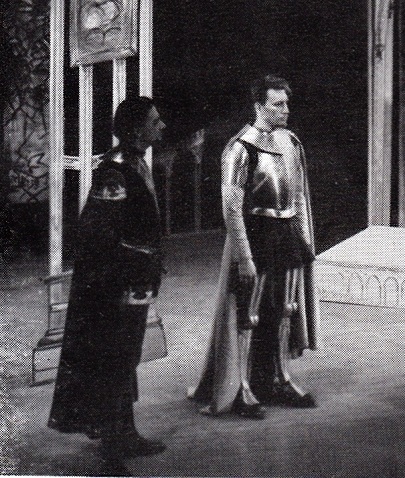
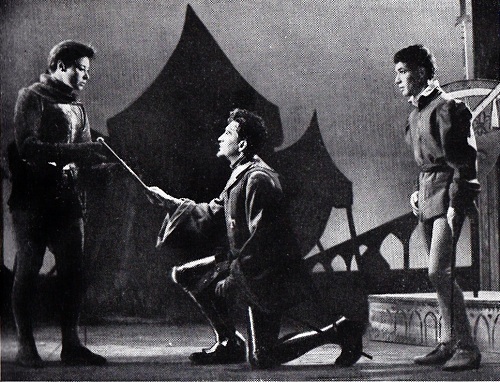
In Scene 3, Dunois (Peter Wyngarde) and his page are waiting for the wind to turn so that he and his forces can lay siege to Orléans. Joan and Dunois commiserate, and Dunois attempts to explain to her more pragmatic realities of an attack, without the wind at their back. Her replies eventually inspire Dunois to rally the forces, and at the scene’s end, the wind turns in their favour.

Ultimately she is betrayed, and captured by the English at the siege of Compiègne. Scene 6 deals with her trial. Chaplain John de Stogumber (David March) is adamant that she be executed at once. The Inquisitor (Charles Lloyd Pack), the Bishop of Beauvais (Oliver Burt), and the Church officials on both sides of the trial have a long discussion on the nature of her here-say. Joan is brought to the court, and continues to assert that her voices speak to her directly from God and that she has no need of the Church’s officials. This outrages de Stogumber. She acquiesces to the pressure of torture at the hands of her oppressors, and agrees to sign a confession relinquishing the truth behind her voices. When she learns she will be imprisoned for life without hope of parole, she renounces her confession.

Joan accepts death at the stake as preferable to such an imprisoned existence. De Stogumber vehemently demands that Joan then be taken to the stake for immediate execution. The Inquisitor and the Bishop of Beauvais excommunicate her and deliver her into the hands of the English. The Inquisitor asserts that Joan was fundamentally innocent, in the sense that she was sincere and had no understanding of the church and the law. De Stogumber re-enters, screaming and severely shaken emotionally after seeing Joan die in the flames, the first time that he has witnessed such a death, and realising that he has not understood what it means to burn a person at the stake until he has actually seen it happen. An soldier had given Joan two sticks tied together in a cross before the moment of her death. Brother Martin Ladvenu (Desmond Jordan) also reports that when he approached with a cross to let her see it before she died, and came too close to the flames, she had warned him of the danger from the stake, which convinced him that she could not have been under the inspiration of the devil.

In the Epilogue, 25 years after Joan’s execution, a new trial has cleared her of heresy. Brother Martin brings the news to the now-King Charles (Kenneth Williams). Charles then has a dream in which Joan appears to him. She begins conversing cheerfully not only with Charles, but with her old enemies, who also materialise in the King’s bedroom. An emissary from the present day (at the time of the play, the 1920s) brings news that the Catholic Church is to canonise her, in the year 1920. Joan says that Saints can work miracles, and asks if she can be resurrected. At this, all the characters desert her one by one, asserting that the world is not prepared to receive a saint such as her. The last to leave is the English soldier (Barry Lowe), who is about to engage in a conversation with Joan before he is summoned back to hell at the end of his 24-hour respite. The play ends with Joan ultimately despairing that mankind will never accept its saints.

Peter Remembers St. Joan

“I was in St Joan in which I played Dunois. Kenneth Williams, as many of you will know, was the Dauphin and was marvellous. Certainly the best Dauphin by far; a spoilt coiled spring of vulnerability, and irrepressibly funny. But the great quality was his faith in Joan.

Most English actors fail compliment their women. The one thing that made Joan unique was the fact that she was a woman. If she wasn’t, how could you assess her as a saint?! Kenneth William’s Dauphin treated her as a woman first. While Siobhan McKenna’s Joan was one of the great performances, I believe it was inspired by this simple premise.

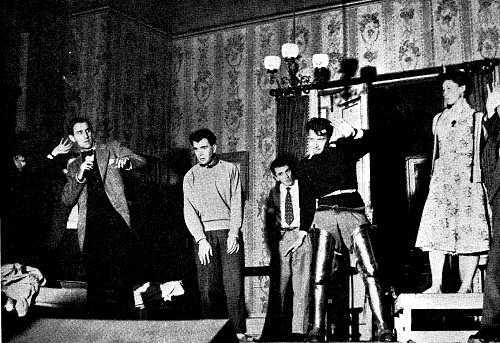
Above: Peter (second from the right) and the rest of the cast rehearsing St Joan at the Art’s Theatre, London. Note Peter wearing leg armour, which he did from an early stage in rehearsals to get used to their weight.

In the cathedral scene when the Dauphin is to be crowned, Kenneth had one of the longest and most difficult of speeches which required intense concentration. On the first night this was even more intense, and nerve racking. It was a great speech and he delivered it beautifully.

For his coronation Dunois, my character, was resplendent in full armour as leader of France’s military might. Rightly or wrongly I was placed by the production centre stage – a position I knew Kenneth would much preferred he was in! He was wrong, as his speech was much more effective when it was by his throne, with Joan by his side. If he’d have delivered it centre stage, it would have appeared as a “purple passage” and lost its sincerity and reality.

No one else spoke in this scene as we were like the peers and the government listening to the ritual proceedings of the coronation. It was the triumphant scene, before Joan’s fall from grace and reincarnation. But it lasted twenty minutes and we all had to stand still, as well as listen, intently.

I believe that both Assistant Director, Sir Peter Hall, and the plays’ author, George Bernard Shaw, were wrong about the relationship between Dunois and Joan.

Dunois treated her as she was to herself: a peasant girl. He was to her a glorious, handsome soldier, who was capable of giving her all of the man that he was, with the help of God”.

In Retrospect

joan-1

Right: Peter as Dunois (kneeling), hands his orders to Joan

Probably of all Shaw’s plays ‘Saint Joan’ has the best chance of lasting, not only for being free from faded argument but also for the sustained excitement of its treatment of history.

It is all admirable theatre, made all the more gripping on account of Shaw’s fairness to the judges and his characteristic refusal to use Joan as a romantic pawn. In 1964, a full-scale revival was overdue; in the meantime audiences were grateful to the Art’s Theatre for its courage in putting so massive a play on its small stage, and in finding such an impressive cast.

Voices were heard just as freely in Connemara as in the Voges, and an Irish Joan was a reasonable innovation. Siobhan McKenna, who carried a natural ring of poetry, had no difficulty in persuading audiences that filled the Art’s that Joan’s link with the Saints was the driving force in her life. Sybil Thondike made her a more plausible leader; here Joan’s domination of her men sprung mainly from her simple mysticism.

It would’ve been too much to ask that in a pocket production the play should get its full effect at every point, but director John Fernald wasted nothing at his disposal, and Paul Mayo’s skeleton sets suggested all that was needed, without fuss.

Kenneth William’s Dauphin made an odd and interesting study of senile adolescence. Meanwhile, Dunois, the French general who suffered most from Joan’s military unorthodoxy and who yet remained devoted, was played by Peter both attractively and with great passion. The humorous superciliousness of Douglas Wilmer’s Warwick was excellent.

No one, it seems, are ever certain about the Epilogue to this play. It is an old quarrel, in which Shaw made his answers to his critics. He felt obliged to show that his heroine didn’t finish at the stake; but in the theatre this mixed roll-call of ghosts and dreamers still seemed somewhat of an anti-climax. Surely Warwick’s final “The last of her? I wonder!” says everything to everyone with the merest smattering of history.

Saintly Facts

26993643_1701278576589433_409948127193292725_n

Quite early during rehearsals, Peter took to wearing armour so that he wouldn’t feel strange in it during performances. (Please see additional photographs of Peter in leg armour).

The first dress rehearsal took place at The Art’s Theatre, Cambridge, before moving to the West End. It was reported in Plays and Players that when the final curtain fell, ‘There was hardly a dry eye in the house, amidst the deafening applause and shouting’.

Every night at the Art’s Theatre was a sell-out, and the run had to be extended.

George Bernard Shaw describes Peter’s character of Dunois as: “A good-natured and capable man who has no affectations and no foolish illusions”

When the play moved to St. Martin’s in 1955, Peter left the cast to film his role as Pasaunius in Alexander the Great.

Critics Comments

Dunois2