Author: peter wyngarde
POLL: Department S

Click below for more on Department S…
© Copyright The Hellfire Club: The OFFICIAL PETER WYNGARDE Appreciation Society: https://www.facebook.com/groups/813997125389790/
APPRECIATION SOCIETY

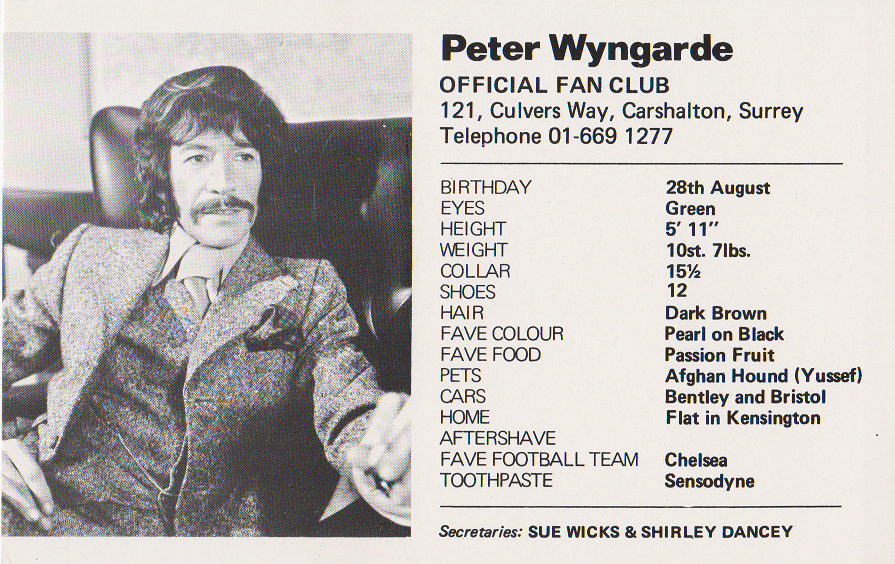
THE PETER WYNGARDE OFFICIAL FAN CLUB
The Official Peter Wyngarde Fan Club – 1954 to 1985
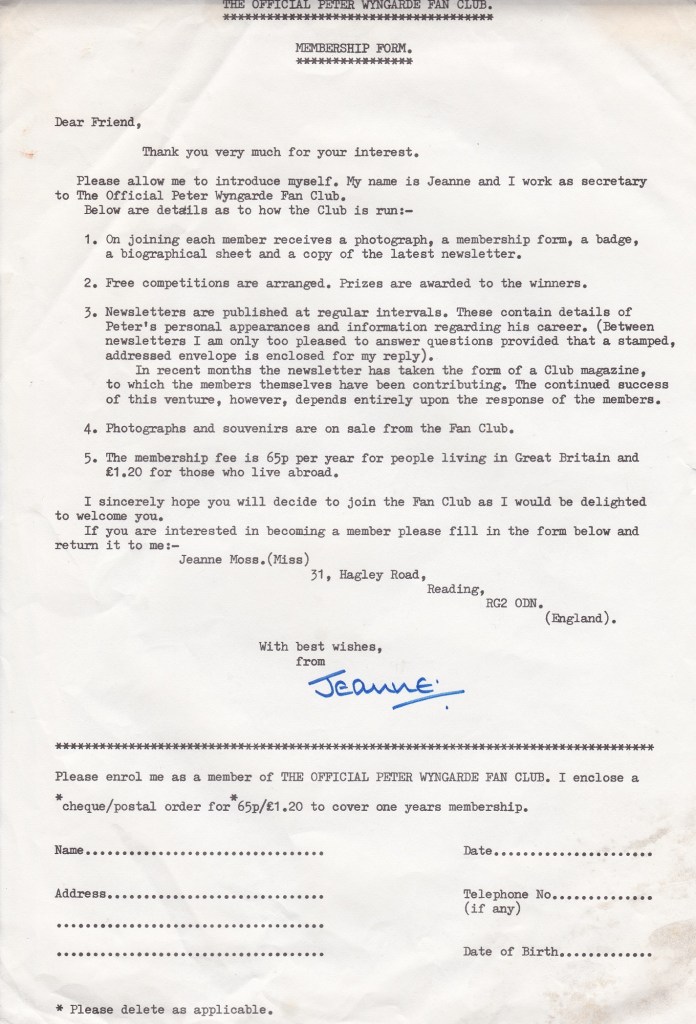
| Peter had an Official Fan Club from as early as 1954. That first incarnation was run by Carole Glaiser from her home in Rhyl, North Wales. By 1960, the Club had been taken over by Marion Porter, of Bexleyheath, Kent. She would latterly hand over the reins to Jeanne Moss in 1969. |


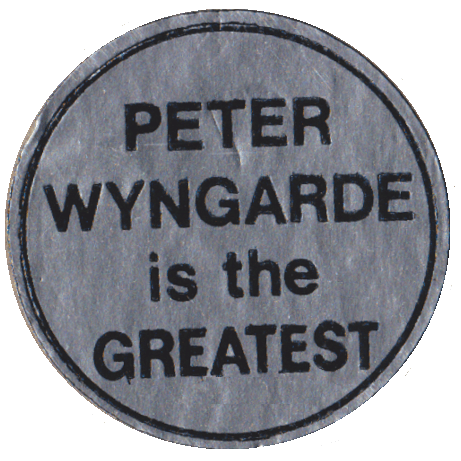
Above: An original badge and sticker

| In 1970, Shirley Wicks and Sue Dancy took the helm of the Fan Club. Below is the content of a typical ‘Newsletter’ dating from 1972. Shirley and Sue would run the Club until 1978. |
| THE OFFICIAL PETER WYNGARDE FAN CLUB. 121, CULVERS WAY, CARSHALTON, SURREY. TELEPHONE: 01-699 1277 Hello fans. Here we are again with our first newsletter of the New Year. Firstly, may we thank you all for the lovely Christmas cards that you sent us. And of course Peter would like to thank you for all his presents and cards. He would especially like to thank Miss Gay Archer, one of our members in New Zealand for the lovely smoking jacket that she sent. Sue has now had a telephone installed, so any of you who would like to phone and ask questions, or in fact if you just want to chat, please ring the following number. 01-669. 1277. any time after 6:00 PM. RENEWAL OF MEMBERSHIP The club has now been running for a year, so the people who joined in the first place are now due to renew the membership (if they want to, of course). The new membership fee is 11. -s.0d. (55 new pence). This will cover the new postage rates. Also, if you have sent in 10 shillings for renewal, could you please send the balance in stamps or a postal order if you prefer? Membership numbers due for renewal are 1 – 124. FAN CLUB CONVENTION As most of you know, we held our first fan club convention on the 7th of August at the Kensington Close Hotel. It was a great success. Peter arrived at the hotel at 8:30 PM (late as usual), accompanied by his faithful friend, Yussef, (his Afghan Hound). Peter strolled into the Sun Lounge, wearing a grey pin-stripe suit with an apricot shirt and, would you believe it – white boots. A few screams came from his left, but apart from this everybody stayed in their seats and kept calm. When asked what would you like to drink, he replied, “A double rum and coke please”. This put the waiter in a bit of a fluster as he had not got a glass big enough, so he sent for one pronto. Peter walked around and chatted with everyone, cracking little witticisms here and there and signing photographs. Later in the evening, Peter awarded prizes to the winners of the raffle and quiz. He thoroughly enjoyed himself the whole evening and once another convention in near future, but with dancing this time. Peter left the hotel around 10:45 PM to meet some people for dinner. But we all had 2 1/2 hours of heaven. Peter has been inundated with letters since the convention because, as s Peter puts it, “Secret agent Yussef was flashing his address on his thick head”. In other words, Peter left his name and address on Yussef’s collar (as many of you know). Peter is passed on ALL of the mail as he cannot possibly read and answer them all. Therefore, would those of you who have Peter’s address please send all letters to the fan club, and if we think he should answer any of them, we will pass them on to him in the correct manner. Several of you were taking photographs at the Convention. As we didn’t, we would be very pleased if some of you would write in and let us know if we can buy some snaps off you, or perhaps borrow the negatives. If you have any photographs with either of us in, we would definitely love to hear from you. THE AWARD FOR THE BEST DRESSED PERSONALITY OF 1970 Peter was presented with the above award in Carnaby Street, at John Stevens on the 15th of August 1970, and we are sure that you all agree he deserved it. There were many other stars there, including Barry Gibb, Ray Morgan, Arthur Wild. Alan Whitehead and also the pop group, Edison Lighthouse, though mind you, OUR Peter stood out way above all these. The award was a silver statuette of Beau Brummell worth £500. JASON KING Peter is still busy at Borehamwood Studios filming the new Jason King series. About half the filming has been done now but, as yet, the TV company have not got a release date. They had intended screening to be in February sometime, but now they think it will be in the Autumn Season. But don’t worry, he’s definitely coming back. Most of Peter’s time is taken up with filming, so apart from that he’s not doing much else. But further down the page you will see that one of his Saturday evenings will be occupied in a near future. COMPETITION As we have not had that many entries for our competition, we are going to keep it open for another month. The competition is to design a poster or sticker that the Fan Club can use at a later date. Prizes are £1.00 vouchers that can be used for purchasing goods from the Fan Club. If your design is used, you will be sent a further £1.00. THE WHITE DEVIL Because of a strike in Rome by the technicians, will now not be filmed. PEN PALS Pamela Y. Quick. Aged 18. 72, Beresford Road, North End, Portsmouth. PO2, 0BZ. Hants. Likes reading oil, painting and playing the piano. Wendy Biggs. Aged 11. 111. Manby Rd. Castle Vale, Birmingham 35, Warks. Likes reading, stamp collecting and drawing. RAVE UP On the 27th of February we are hoping to older buffet and dance at the Pembridge Court Hotel. You will be able to rave it up with Peter as your partner, dancing to discotheque music, and lighting and eating as much as you like. The Pembridge Court Hotel is in Pembridge Gardens, which is the road running down besides Notting Hill Gate underground station. You can purchase as many tickets as you like, but if you want to go, please let us know by the 23rd of January as we have to arrange for catering. Money can be sent later, but we have to know the numbers then. Tickets are. 30s. -0d. each. We are, sorry the price is so high, but this is the cost of a London hotel. SPECIAL OFFERS We have just bought some new Combs in cases they are printed with I LOVE PETER WYNGARDE OF DEPARTMENT S. The cost of these are only 1s. -3d each, plus a stamped addressed envelope. We also have three new 10″x8″ black and white photos of Peter. The cost of these are 3s. -6d. for one. 3s. -9d. for two and all three for 9s. -6d. . plus a large enough stamped addressed envelope. If you would like a price list which includes all the other items we sell which include stickers, books, pens, etc. Please write to us for one. Well, that’s all for this month. Bye for now. All our best wishes. Shirley and Sue. |

Above: Poster given to fans in the Membership Pack
Below: A ticket for the Peter Wyngarde Fan Club Buffet and Dance at the Pembridge Court Hotel, 34, Pembridge Gardens, London – 27th February 1972.

Below: A Fan Club ‘Newsletter’ from August 1978. The Club was now being run by Jacky Chapman from South Harrow in Middlesex. Jacky kept the Club open until 1985 when it finally closed for good.

You may’ve noted how all of the Fan Club secretaries were perfectly comfortable to include their home addresses and telephone numbers on all of the forms and newsletters. It’s highly unlikely that ANYONE would dare to risk such a thing today!
Click below for more about Peter’s fanbase...

GAMING WITH JASON KING

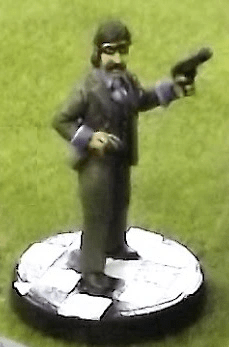
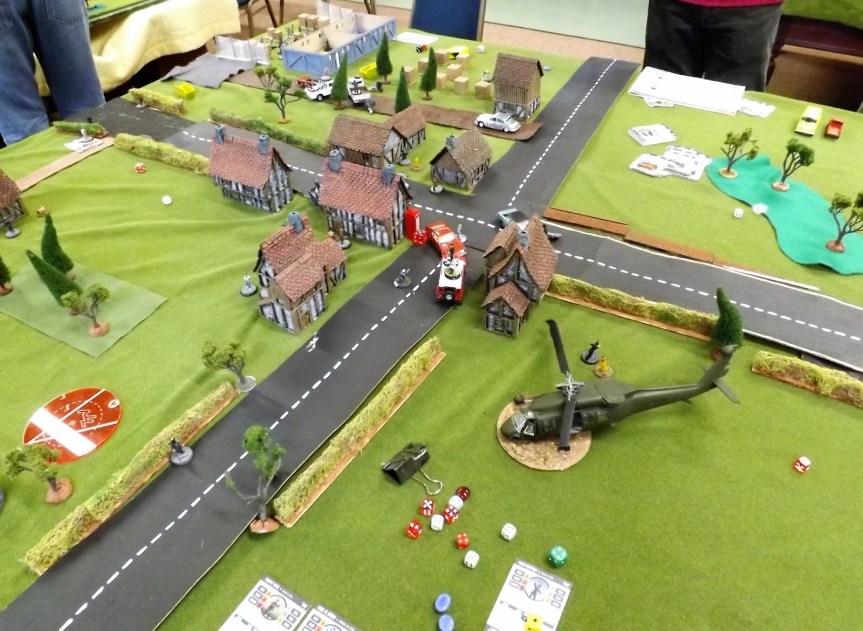
To honour the late, great Peter Wyngarde, the Whipton-based Devon Wargames Group decided to play a Department S/Jason King inspired game. See what happened below…
| Hi Tina, Thank you for getting in touch re our tribute game to Peter Wyngarde, and really pleased that you enjoyed our sincere nod to a British actor that was very familiar to a fair few of the chaps in our club in the role of Jason King, including me, and who were very sorry to hear of his passing. I chair the club and I have copied this message into our game organisers, Mr Chas Carter and Vince Hyland, who I’m sure would be very pleased to have you reference their game on Peter’s Official Appreciation Website. Thank you for getting in contact Jonathan Jones (J.J.). |

“To mark the sad passing of Peter Wyngarde, we decided to take us back to his youth and the wonders of Department S.” J.J.
Left: Enlargement of the Jason King gaming piece.

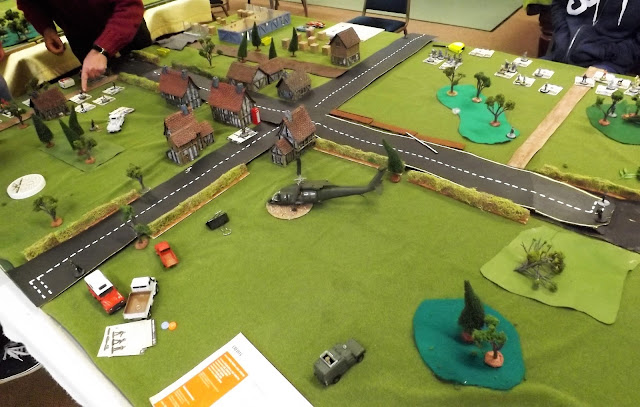
The scenario was that a British army helicopter had crashed in the Devon countryside whilst transporting the advanced ZX80 top secret computer. The local Police had secured the crash site, but were unaware of the true situation. Department S agents were dispatched to make contact with the
Police and recover the advanced machine.

The scene opened at the crash site, near a crossroads in a small hamlet. The Police had established road blocks on each of the roads into the area and officers were posted by each part of the widely scattered wreckage.

Drawing up at one checkpoint, Jason King flashed a ready smile to the officers. A quick check against his “seduction” special ability (best not to ask), persuaded the constables to wave him through.

Meanwhile, on a different approach road, Stewart Sullivan was not finding things so easy. “Look, I work for Interpol.” he said. “Interpol, who are they then Sir ? We don’t have any of that in these here parts.” the officer replied.

On the last two roads, vehicles carrying east European agents were waved down by the Police. Their approach was less subtle and sub machine gun fire rang out. One officer fell, but the other dodged.
A shotgun fired and he dodged again, Matrix style. “FFS” the east Europeans said in Russian. Finally a volley of pistol shots cut him down.

Seeing a policeman by a piece of wreckage, Jason King and a scientist went to investigate. “Is that a computer?” King asked. “No” said the boffin, “That is a clock radio”. “Ah” said King “Just as I thought. “

Elsewhere on the crash site, foreign agents cut down a policeman and grabbed the piece of nearby wreckage.

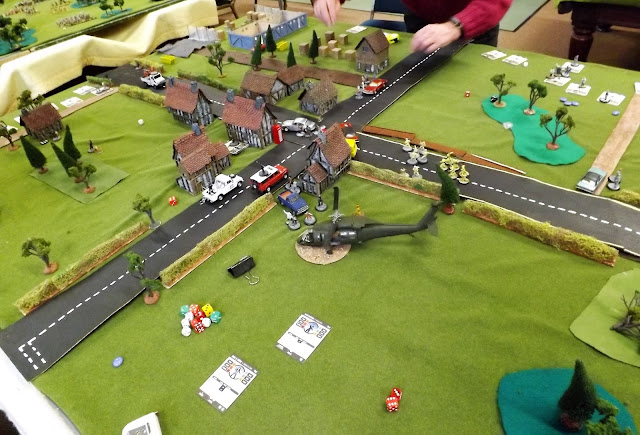
Meanwhile, Stewart Sullivan and his colleagues had spoken to the chief constable on their car’s radio telephone and been granted access to the hamlet. Just as they arrived foreign agents opened fire from the crossroads and a fire fight developed. Minor cast members on both sides were cut down and a Cortina 2.0 GXL slewed across the junction. It’s occupant gave fire to the a group of Department S security officers and four officers emptied their pistols into his vehicle. The car erupted in a fireball.

Jason King and his boffin drove towards the enemy agents carrying part of the wreckage. As they neared the group, an “evil co-star” leapt onto the side of the vehicle. “I have been waiting to take my revenge on you King” he said (vendetta special ability) and fired through the window, killing the boffin. Using his “impossibly cool” trait, King avoided the fire, blew smoke from his cigar in his assailants face, pushed him from the vehicle and ran him over. “That is why I am a star” he said as he drove on.

At the crossroads things were going in favour of the forces of law and order. One denim clad thug remained and he laughed off every attempt to gun him down. It began to look like denim was bulletproof, but he was eventually overwhelmed.

The enemy agents carrying the ZX80 got into a waiting Jag (it is always a Jag) and gunned the engine.
Just then a Land Rover driven by Stewart Sullivan rammed their car, disabling it. The foreign spies jumped out and tried to run off with the secret device. At this point King came speeding towards them across a ploughed field. Leaning from the window he fired a shot, killing the man with the ZX80. The man next to him picked up the device and ran to a waiting car. As it drove off, with King in hot pursuit, the closing credits read:

To Be Continued…..

The game was played to the excellent “7TV” rules from “Crooked Dice”. They certainly catch the 60s/70s vibe.

Many thanks to Chas and Charlie, who played the dastardly devils and Steve L, who joined me with the men from Department S. A well deserved win for the enemy agents, in a close fought game.
P.S. No velvet was harmed or shirt frill creased during the making of this programme, but Jason King’s Chelsea boots did get muddy. Nothing a good buffing with some “Cherry Blossom” polish can’t sort out though.

REVIEW: That Was The Week That Was

Broadcast: Saturday, 1st December, 1962
Character: Himself

Some Background
‘That Was the Week That Was’ was a groundbreaking satirical television programme, produced and broadcast by the BBC from November 1962 and until late December of the following year. The show was the brainchild of broadcaster, author and stage director, Ned Sherrin, and Jack Duncan (founder of the satirical magazine Private Eye with Richard Ingrams and Paul Foot), and was hosted by David Frost.
Arriving just in time for the Profumo affair, ‘That Was The Week That Was’ gained a reputation for savage satire. It witnessed and commented on all the major events of the time, including producing a special, non-satirical, edition as a tribute following the assassination of President Kennedy.

As well as launching David Frost into the nation’s living-rooms, the programme also established the careers of such varied talents as Roy Kinnear, Lance Percival and Willie Rushton as well as providing an outlet for writing by Keith Waterhouse, Richard Ingrams, David Nobbs, Christopher Booker, Peter Tinniswood, Bill Oddie, Michael Frayn, Johnny Speight, Clement Freud and Graham Chapman among numerous others.
With the satire came a vast numbers of complaints. Nonetheless the BBC kept the show on for two series, only finally bowing to the inevitable when the perceived need to avoid political controversy during the run-up to the 1964 General Election resulted in the programme being halted.
Peter’s Appearance
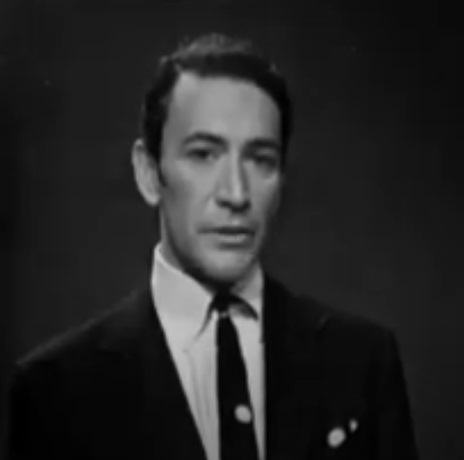
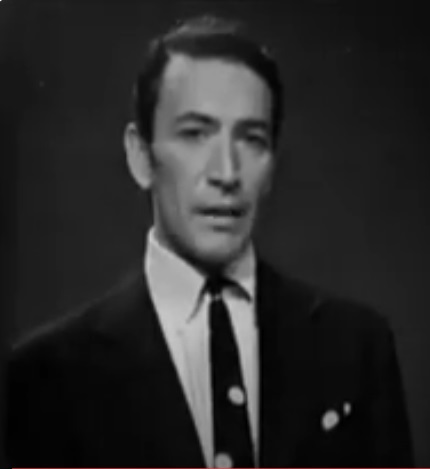
Peter invites the audience to consider the words of ” one of the vice presidents of the Paignton operatic, drama and choral society society RN (retired)”, who complains about the proposed staging of John Osborne’s play, ‘Look Back In Anger’. which he describes as “Muck”, in the Devonshire town.
“We feel it is up to us to keep Paignton clean,” the gentleman exclaims, to which Peter asks the following question: “Was he thinking of the John Osborne that wrote to his fellow countryman last year. The John Osborne that denounces the England of the Bomb, bingo and the Twist. ‘Damn you England, you’re rotting now, and quite soon you’ll disappear. My hate will overrun you yet if only for a few seconds. I wish it could be eternal.”
Various character punctuate the monologue, including a working class man (played by Kenneth Cope); two British navel officers (Willy Rushton and Roy Kinnear), and scenes from Osborne’s play, ‘The Entertainer’ are recreated with Lance Percival playing Archie Rice – the character made famous by Laurence Olivier.


POLL: The Peter Wyngarde Album

Click below for more information on Peter’s album
© Copyright The Hellfire Club: The OFFICIAL PETER WYNGARDE Appreciation Society: https://www.facebook.com/groups/813997125389790/
COMEDY SKETCHES, NARRATIONS & READINGS
GUEST COMEDY SKETCHES
1962 That Was The Week That Was
Peter performs a sketch

Broadcast: 1st December, 1962
1984 The Two Ronnies Christmas Show
Broadcast: 25th December, 1984
Character: Sir Guy

Peter as Sir Guy
1994 The Lenny Henry Show
Broadcast: 28th December, 1994
Character: Mr Bad

As Mr Bad on The Lenny Henry Show
NARRATIONS
1957 The Truffles
Broadcast: 16th December, 1957
Character: Narrator
1964 Monty – The Life of Field-Marshal Lord Montgomery of Alamein
Broadcast: 1st September, 1964
Character: Narrator
2013 Timeshift
Episode: How to Be Sherlock Holmes: The Many Faces of a Master Detective
Broadcast: 23 December 2013
Character: Narrator

Listen to Peter’s comments on his favourite Sherlock Holmes
READINGS
1956 Exclusive!
A series of short stories read by Peter TWW Channel 10 (South Wales and the West of England)
Broadcast: October 1956

Peter in TWW Channel 10’s Exclusive
1957 The Rain In August
Broadcast: 25th November, 1957
A reading by Peter Wyngarde
1958 Sunday Special
Broadcast: 11th May, 1958
Peter reads the story of Shadrach, Neshach and Abednego

1959 The Black Cat
Broadcast: 8th March, 1959
A reading of Edgar Alan Poe’s short story by Peter Wyngarde
1959 The Tell Tale Heart
Broadcast: 30th March, 1959
A reading by Peter Wyngarde
1960 Meeting Point: The Bible Comes Alive – In Translation
Broadcast: 13th March, 1960
Peter reads St. Paul’s speech to the men of Athens, and an extract from his letter to the Christians at Colossae
1964 The Pity of War
Broadcast: 4th August, 1964
Peter Wyngarde reads he poems of Wilfred Owen read by Peter and Alan Dobie
His life and poetry introduced by C. Day-Lewis
N.B. The original broadcast was on BBC2, but was repeated on BBC1 on 5th November, 1968 under the title ‘Contrasts – The Pity of War’
Click below for…

PUBLIC SCREENINGS OF PETER’S WORK
Screenings of films and television episodes in which Peter has appeared since 1993
| DATE | LOCATION | EVENT | PROGRAMME |
| 22nd November, 1993 | National Film Theatre, London | Advance Screening | The Memoirs of Sherlock Holmes: The Three Gables |
| 24th June, 1994 | National Film Theatre, London | The British Film Institute – Midsummer Celebrations | A Midsummer Night’s Dream |
| 11th February, 1994 | The Great Hall, The Shakespeare Institute, Stratford-Upon-Avon | The 1st Shakespeare Television Festival | A Midsummer Night’s Dream |
| 5th August, 1995 | Stourbridge Town Hall, West Midlands | Raiders of the Lost Archives | Night Conspirators |
| 5th September, 1996 | National Film Theatre, London | Jack Hylton Season | Hotel Riviera |
| 17th October, 1996 | The Arts Theatre Movie Museum, Oahu, Hawaii | Burn, Witch, Burn/Night of the Eagle | |
| 25th June, 1997 | The National Film Theatre, London | A Tribute To Sydney Newman | The Avengers: A Touch of Brimstone |
| 22nd July, 1997 | The National Film Theatre, London | Pride Arts Fesival | On Trial: Sir Roger Casement |
| 6th March, 1998 | Murray Hill Cinema Club, New Jersey | The Innocents | |
| 2nd May, 1998 | Cinema 1 – The Everyman, Hollybush Vale, London | Henry James Season | The Innocents |
| 19th January, 2000 | The Mary Pickford Theatre, Washington DC | John Bull and Uncle Sam Festival | Department S: Six Days |
| 19th January, 2000 | The Egyptian Theatre, Hollywood, California | 1st Annual Festival of Fantasy, Horror and Sci-Fi | Burn, Witch, Burn/Night of the Eagle |
| 1st February 2002 | London | 1st Annual Horror and Sci-Fi Festival | Flash Gordon |
| 25th May, 2002 | The National Museum of Photography, Film and Television, Bradford | Fantastic Films Festival | The Innocents and Night of the Eagle |
| 24th March, 2012 | Animation Creative League, Pacoima, California | The Innocents | |
| 28th November, 2015 | BAFTA, Piccadilly, London | 35th Anniversary Celebration of Flash Gordon | Flash Gordon |
| 21st June, 2016 | Sheffield Park, East Sussex | The Innocents | |
| 31st January, 2017 | Brattle Theatre, Harvard Square, Cambridge, Massachusetts | Burn, Witch, Burn | |
| 1st July, 2017 | The National Film Theatre, London | Gross Indecency: Queer Lives Before and After the ’67 Act | On Trial: Sir Roger Casement |
| 3rd July, 2017 | The National Film Theatre, London | Gross Indecency: Queer Lives Before and After the ’67 Act | South |
| 27th September, 2017 | Savanah, USA | International Savanah Film Festival | Burn, Witch, Burn/Night of the Eagle |
| 29th September, 2017 | Portmeirion, Wales | Fall Out – The Prisoner at 50 | The Prisoner: Checkmate |
| 6th February 2019 | National Library of Scotland, Kelvin Hall on | Queen of Scots | |
| 18th-20th October, 2019 | Fear In The Fens Festival | Night of the Eagle | |
| 31st July, 2020 | Picturehouse Central, Great Windmill Street, London | 40th Anniversary Celebration | Flash Gordon |
| 6th & 17th October, 2021 | Prince Charles Cinema, Leicester Square, London | The Innocents | |
| 4th, 9th, 13th, 23rd, 27th & 30th December, 2021 | The National Film Theatre, London | The Innocents | |
| 15th & 16th October, 2022 | The Austin Film Society Cinema, Austin, Texas | Hallowe’en Celebration | The Innocents |
| 23rd October, 2022 | Bristol IMAX cinema, Bristol | Forbidden Worlds Festival | Night of the Eagle |
| 23rd October, 2022 | St George’s Theatre (Community cinema), Bristol | Night of the Eagle & Department S | |
| 14th October, 2023 | The Prince Charles Cinema, London | OctoberFest | The Innocents |
| 17th November, 2013 | Various Picture House Cinemas (UK) | The Innocents | |
| 20th July, 2024 | Savoy Theatre, Monmouthshire | Talking Pictures Festival | The Siege of Sidney Street |
| 20th October, 2024 | Frida Cinema in Santa Ana, California | Hallowe’en Screening | The Innocents |
| 26th August, 2025 | Chamber Films, Malone Road, Belfast | See below* | Night of the Eagle |
| 26th October, 2025 | Star and Shadow Cinema, Newcastle-Upon-Tyne | The Innocents |
*A series of carefully curated cinematic evenings, introduced by author and film fan, John Patrick Higgins. Themed welcome Cocktail included.
Chamber Films will showcase the classic and the curious, the weird, the wired and wonderfully askew. There’s no theme, no thesis, no seam running through these films, unless there is. The subconscious is a hell of a film programmer.

Above: Poster for the Fear In The Fens Festival, 2019
Email from The Psychotronic Film Society of Savannah – 25th September, 2017
| Peter Wyngarde Tribute My organization, the Psychotronic Film Society of Savannah, has been holding public screenings of underappreciated and/or overlooked feature films for the past 14 years. We have won several awards in this area for such things as Best Local Film Series and Best Indie Cinema, and are routinely named the Runner-Up for Best Local Film Festival (after the big, international Savannah Film Fest). From time to time, we salute some of my favorite actors, directors, cinematographers, screenwriters, producers, etc… with a special screening of one of their films on or around their birthday. As there seems to be some confusion surrounding Peter’s actual date of birth, I just decided to salute him on September 27th! We are not announcing the exact name of the film in advance, as we do from time to time. It will not be revealed until the film itself rolls. We are simply asking adventurous film lovers to take a chance, buy a ticket and be pleasantly surprised. We do this because I have found that sometimes, when we announce a film in advance that can be easily found on DVD or through internet streaming services, people take my advice and watch it privately, rather than showing up to our screening – which causes us to lose money, as licensing to show most copywritten films in public here in the states can be quite costly! So, strictly between you and I and Peter, we will be screening the original, European cut of Night of the Eagle AKA Burn, Witch, Burn. Our venue is a 50-seat coffeehouse that we black out one night a week and turn into a cozy, quiet screening room. Please convey my thanks to him in advance for any assistance he may be able to provide in such matters, as well as my heartfelt appreciation for the enjoyment and inspiration his artistic endeavors have given me over the years. I look forward to hearing back on all of this, and hope this message finds you both doing well. Best, Jim Reed Executive & Artistic Director – The Psychotronic Film Society of Savannah |
Click here for more information…

THE INNOCENTS: A subtle exploration in possible psychosis
Written by Donato Totaro

Above: Peter as Peter Quint
The Innocents remains one of the greatest, most frightening gothic horror films ever made, a film brimming with formal brilliance and thematic complexity. The black and white cinemascope frame is governed with the utmost care by director of photographer Freddie Francis, playing the edges of the frames against each other, placing objects in striking relief from each other on the sides or background and foreground. Clayton and Francis manipulate the lenticular distortions of the scope lenses to eerie effect, making objects in the foreground appear large and positioned in a dreamy haze. The world of the Bly estate feels in a permanent vivid mode, heightened by either depth of field, framing, lighting or sound. As the story goes, based on Henry James’ 1898 novella The Turn of the Screw, a governess, played by Deborah Kerr, is hired by an uncle (Michael Redgrave) to look after two precocious children, Flora (Pamela Franklin) and Miles (Martin Stephens) at the Victorian estate known as Bly. The other prominent resident is the down-to-earth maid, Mrs. Grose (Megs Jenkins). Miss Giddens arrives at Bly, meets the children and settles into her role of governess with a slightly anxious disposition. Things go well until she begins to learn of the sordid past love affair between the previous, now deceased groundskeeper Peter Quint (Peter Wyngarde) and previous Governess Miss Jessel. Miss Giddens begins to sense their ghostly presence at Bly, and suspects that the children are also being affected by the ghosts, although neither Mrs. Grose or the children admit to any such ghostly presence.
The Innocents is a classic case of what Tzvetan Todorov called the “pure fantastic”, a film whereby the audience is ‘stuck’ between two possible interpretations of the events experienced by the characters: are the ghosts from the house’s past real or are they imagined by the characters as either a product of past trauma or psycho-sexual repression? If you accept that the ghosts are real, we arrive at one or more of the following meanings of the events:
A: Supernatural Explanation
1: The ghosts are real and have possessed Miss Giddens
2: The ghosts are real and have possessed Flora (and Miles, and in the process, sending Miss Giddens to the brink)
3: The ghosts are real and have possessed Flora, Miles and Miss Giddens (one then can wonder, why not Mrs. Grose?)
4: The ghosts are real and are simply expressing their evil presence onto the house, which affects Miss Giddens and the children (if not to the point of possession)
If you accepts that the ghosts are not real, we arrive at one or more of the following meanings of the events:
B: Natural Explanation
1: Miss Giddens is having a neurotic breakdown
2: Due to Miss Giddens’ sheltered life she is sexually repressed, and being exposed to both the salacious back-story of Miss Jessel and Peter Quint and Miles’ precocious behaviour, she begins to identify with Miss Jessel and project her sexual anxieties onto the ghosts
3. Less likely but possible part of the psychological make-up is that Miles and Flora are scarred by sexual abuse they suffered under Quint & Jessel. And perhaps, just perhaps, they had something to do with their deaths (maybe, everyone at Bly, Mrs. Grose, Miles, Flora, and minor character Anna [Isla Cameron], are guarding the secret of what really happened to Quint and Jessel. Perhaps they were abusing the children and the others reacted to this by murder. And this would explain why the ghosts come back with a vengeance). Is the reason Miles was expelled from school, “causing injury to others” a hint at what he is capable of?
C: A third altogether different reading
The whole film is being imagined by Miss Giddens, as suggested by the opening and closing shots; and the repeat of a line from the credit scene to the opening scene, in which case whether the ghost is real or not is inconsequential.

Above: Quint influencing Miles (Martin Stephens)
Main Aesthetic Aim of the Film or: Tying Us Up in a Cognitive Quagmire
Throughout the film there is a development in terms of how director Jack Clayton plays out the natural/supernatural explanation, wanting to maintain enough ambiguity in the text so that viewers could never feel fully comfortable reading the film one way or the other. Clayton plays an aesthetic balancing act in his use of point of view, framing, sound, acting and performance and other formal touches. Discounting Miss Giddens hearing someone call out ‘Flora’ when she first arrives at Bly House, the first five ghost sightings (noted in my analysis below) are clearly demarcated as being from Giddens’ subjective point of view. Up until this point the viewer leans toward the ghosts being a product of her imagination/neurosis/fantasy. In one of them, the shot remains subjective but Flora is also in the shot with the ghost, though Flora does not claim to see the ghost. The fifth sighting begins to ‘reduce’ the weight of subjectivity by introducing what can be construed as a concrete, objective element, so the idea of the ghosts as real can be entertained. This involves a drop of liquid we see at the table where Miss Giddens sees the ghost of the former Governess sitting. Is the drop of water Miss Jessel’s tear -which would establish the ghost as real? Or is it spilled water? Or does Giddens imagine seeing the tear? On the sixth sighting (twice in the same scene), Clayton frames for the first time the ghost and Giddens in the same shot, with her & Flora in the foreground of the shot, and the ghost in the background, displacing the subjectivity and allowing the viewer to read the shot as objective. It is clear that Clayton needed to introduce claims of objectivity to maintain an aesthetic balance between the natural and supernatural reading. At the climax we get the ninth and final sighting of the ghost, and what might be construed as the most powerful formal evidence of the ghost as being real: we see both Miss Giddens, Miles and the ghost in the same frame, but even here Clayton is clever enough to re-introduce an element of doubt & uncertainty through subtle formal decisions. If the ghost was real Miles, who was standing right next to Giddens, would have seen it. But does he? The framing of Miles and the level of his eye line gaze before he faints, in relation to where the ghost was to have appeared, makes it physically impossible for Miles to have seen the ghost.
Although the film is not always subjective, the range of narrative information, our knowledge of events is restricted to what Miss Giddens knows. We never see or hear the children speak to each other. Or Mrs. Grose to the children or to maid Anna (Isla Cameron). There are scene which may begin with these characters seen together, but there is no expansion of what was said. This is an important device which keeps things on the borderline between psychological and supernatural.
For the balance of this study I will proceed with a scene by scene analysis which highlights moments where the narrative balances between natural/supernatural through alternating various formal and narrative elements, aided by selected frame grabs from the recent BFI blu ray release.
Scene by Scene Analysis:
The film opens (and closes) on a close-up of Miss Giddens’ hands against a black background (frame comparison at end). A snippet of this moment of Giddens praying also appears quickly in the dream sequence at 60’10,” wearing the same frilly white pyjama top (see end for frame grabs). Her hands are in supplication, like in the end; and the sound is the same as the end, with her crying sobs and bird whistles. The song we hear over the credit scene sung by a child’s voice, which comes back later, is “O Willow, Waly.” We hear Miss Gidden say, “More than anything I love children. They need affection, love, someone who will belong to them, and to whom they will belong.” As noted by Stephen Rebello in his excellent overview of the film, both from its production history and aesthetic analysis, he claims that the use of the word ‘belong’ “introduces the theme of possession in the governess’ choice of the word ‘belong’” (p. 55). Clayton notes, “That credit sequence caused me more headache and heartache than the rest of the film together….We did it after the rest of the shooting was completed. I wanted something very evocative, very strong. It is almost an exact duplicate of a shot I have at the very end of the film, so you’re not certain if she is lost in her own thoughts or is in reality” (p. 55). This dissolves to the first post-credit scene, the Uncle asking her, “Do you have an imagination?” A telling question. Does this suggest the whole film is a flashback, since it ends on this shot after Miles has died in her arms? Or has it all been in her mind? Even the way it dissolves to an out of focus shot of Giddens, coming into focus with an echo sound suggests a flashback or memory:
When we first see him he is also wearing a white flower on his lapel, and flowers will be a heavily featured part of the art direction all the way through, with strong possible symbolic meaning. Flora’s name also suggests a flower. The uncle equates ‘truth’ with imagination. We also hear the uncle relate to her the need the children have for love and affection using the exact same phrase as was heard in the credit scene. How can that be? Either this is a great coincidence, or a suggestion that what we are about to see is a product of her imagination. These and other dissolves are modulated to achieve an affect. Rebello explains: “Termed “multiple dissolves,” the technique involved an overlay of three distinct images –one from the scene ending, a second ”floating” image, the third from the beginning of the following scene– which gave the film’s transitions an eerie, languid sense of flow” (p. 55).
When Miss Giddens arrives on the grounds of Bly House (9’30”-10’30”) she hears Flora’s name called out two or three times. When asked by Miss Giddens, Flora says she didn’t hear her name being called out. It is a brief but subtle first indication that Miss Giddens is predisposed to “hearing” things.
In a scene where the governess’ helper Anna and Mrs. Grose give Flora a bath Flora exclaims, “Miles is coming, Miles is coming,” to which Mrs. Grose replies “You know very well that Miles is at school.” A few scenes later as Miss Giddens reads letters we learn that Miles is expelled from school and will be coming home, making Flora’s earlier statement prophetic. When Miss Giddens’ brings this up, Flora pretends not to hear. Does this suggest the children have a psychic bond?
Web/Entrapment Motifs
At 20’40” we get a dramatic deep focus shot where Miss Giddens looks worried because of news of Miles’ expulsion, but Flora, disinterested in the letter, is entranced by the butterfly trapped in a spider’s web.
This allusion to ‘webs’ and entrapment becomes a clever motif in the mise en scène, connecting back to when Miss Giddens first enters the Bly mansion and is framed within a stained glass window in the shape of a web, and then a few seconds later, between a bouquet of white roses and the stained glass web-shaped window with Flora framed below it. This is then developed with the association of Miles to the statue of the chained man in the next scene (see below).
As Giddens asks Mrs Grose about the letter she wonders about Miles’ corruptive behaviour: “I like a boy with spirit, but not to the degree to contaminate…to corrupt.” Mrs. Grose laughs: “Master Miles. Misses are you afraid he will corrupt you?” Throughout this dialogue framed in the background between them is a statue of a man in chains (see below), a possible symbolic reference to Miles and his eventual entrapment in Miss Giddens’ paranoia. To make the connection even stronger, the shot dissolves to Miles arriving at the train depot and the placement of Miles in the frame replaces that of the outgoing image of the statue (22’20”). (The statue here is recalled in the reflected statue that appears behind Quint at the window, shown in a later slide).
And then the motif of webs and entrapment comes full circle in the climax, where Miles is trapped within the high hedges of the circular garden, eventually dying trapped within the arms of Miss Giddens.
The garden scene from a little under half an hour into the film begins with a huge CU of a white flower, and then cuts to Miss Giddens surrounded by flowers. Why are there so many flowers depicted in this film? What do they symbolize? According to Freud, flowers symbolized female genitalia, and virginity, both of which are fitting to the film’s treatment of Giddens as a sexually repressed virgin who will be aroused sexually by the Bly House. Continuing with this ‘natural’ sexual imagery, just as she is about to cut a flower (we see scissors in her hand), a symbol of her losing her virginity, of her ‘vagina’ being ‘cut’ into, she sees the disturbing image of a beetle crawling out of the statue of a little boy (Miles?). The image seems to disturb her, cementing the first of many sexual invocations– like later, sex is both attractive and repulsive to her (and like the ghosts); then the sound goes silent, a possible subjective (or authorial mark) cue. The statue oddly holds two detached hands in each hand, another odd symbol (of death, and desire?).
1st sighting of a ghost, from Miss Giddens’ POV
Very tellingly, right after this sexually symbolic scene, we get her first sighting of Quint the ghost (or Quint the sexual projection of the repressed Giddens), atop a very phallic tower (29’00”). The scene cuts to her POV of blaring sunlight –a vision of a man, Quint, atop the watchtower, with slow motion shots of birds flying by the tower. She goes to the top of the tower to investigate her sighting and sees Miles there, then asks him if he saw the ‘man’ at the top of the tower, to which he replies in the negative. This is the first time Miss Giddens projects Quint onto Miles.
2nd sighting of a ghost: her POV
36’00”-41’15”: While playing hide and seek with the children, Miss Giddens sees Miss Jessel walk by her at the end of the corridor.
Then she goes into the attic and finds a music box which plays the song we hear the children singing, and a little animated ballerina in the music box (which explains why Flora will later play the ballerina). She comes across a glass encased photo of Quint.
As if to echo or foreshadow when she first sees Quint it is again behind glass, a window. And then near the end Miles throws Flora’s turtle through the window, shattering the window at the exact point where Quint was sighted by Giddens.

Above: Quint peering through the window at Miss Giddens (Deborah Kerr)
3rd ghost sighting: her POV (39’00”-39’30”)
The scene continues with Miles play wrestling with Miss Giddens, while the diegetic music box continues to play. Giddens claims that Miles’ horse playing is hurting her. But is the pain real, or is it her active hyper imagination that makes it feel like pain? Or is she feeling sexually aroused by Miles’ touches after having seen the photo of Quint, and hearing the music? The scene establishes the children as mischievous, perhaps more than naive. As she looks for a hiding place she sees a face, that of Quint, behind the window (echoing the picture of Quint behind the glass). When we first see him floating toward the camera in the background, she is framed like Flora in the garden scene, when Flora is playing with a butterfly that is eating a spider (prey and predator theme). Then we see Quint as her POV. Clayton is clever with the assignation of subjectivity here because it seems that Quint appears to us before her, which would make it objective, but she has her head turned and through her peripheral vision seems to acknowledge the presence of the ghost at its onset.
Again, it is interesting the way the profile framing in the beginning of the above sequence recalls Flora in profile earlier, with Giddens in the spot where Quint will be. Framing as projection? When she confronts Mrs. Grose, the maid tells her Quint is dead. She recoils and then we get a HA shot with the kids at the top of the stairs laughing at her, that underscores either her paranoia, or legitimizes the supernatural (because the children are possessed to laugh).
47’00”- When the kids dress up and act out a play, it is telling that the lyrical dialogue that Miles chooses deals with a Lord coming back from the grave “….leaving the marks of his grave on my floor.” As a reaction, we can see how Miss Giddens looks terrified and Mrs. Grose has a smile on her face, suggesting how the event is experienced differently according to one’s state of mind: Mrs. Grose has no imagination, Giddens too much! It is a game for Grose, a portentous sign for Giddens.
4th sighting of a ghost (music turns creepy), narrational coding is poised between authorial & subjective
51’20”-52’30”: Flora retells an episode from the past and is humming the song from the music box, which Miss Giddens associates with Jessel and Quint. She asks Flora where she learned the song, but she does not recall. The music turns non-diegetic electronic. We see a CU of Giddens looking off-screen, and then cut to the ghost of Miss Jessel in black standing among the reeds. It is clearly framed as Giddens’ POV, as it cuts back to her reacting. Then it cuts to another POV but now with Flora in the shot, her back to the camera, which creates some confusion over the narration: is it still Giddens’ POV? Flora has her back to us with the ghost of Miss Jessel in the extreme background, hence can be cued as Giddens’ ‘displaced’ subjectivity. Miss Giddens asks Flora, “Who is it?” and it cuts back to her. A CU of Flora suggests she sees nothing, or is at least puzzled by the question. Then a follow-up shot reveals no ghost in the shot. The Governess assumes Flora saw the ghost but there is no such evidence, which may prove her neurosis or over active imagination, drawn from her sexual repression, psychosis, sexual obsession, which she draws out in the sexual relations between Quint and Miss Jessel.
Grose tells her all the details of the past sordid affair between Miss Jessel and Peter Quint, with Giddens listening intently. She even forces Grose to tell all the details: “I can hear them together.” Grose also implies that the children saw them having sex (‘with doors wide open”). Giddens tries to make it seem as if the children are under the spell of the two ghosts. The governess is lit from below to give her a sinister look (57’55”). Flowers are present in this exchange, even their shadows, as they are all through the film.
t is no coincidence that Miss Giddens experiences an unsettling dream directly after learning of the sordid details of the love affair between Miss Jessel and Quint. The POV is ambiguous, is it omnipotent or subjective? The dream underscores her obsession with Quint, the affair, and his hold over the children. During the dream there are several evocative superimpositions: one of her full lips in CU (which she will later use to kiss Miles) and the children. Another of her asleep ‘lying’ below the superimposed image of Quint on the tower, a highly sexualized collage. She also ‘sees’ Quint walking hand in hand with Miles, and Flora dancing with Miss Jessel.
As Miss Giddens approaches the study we hear off-screen crying. It is Jessel’s voice, an internalized subjective audio? As Miss Giddens turns her head the camera pans with her and we see Jessel seated, in black, at the desk, crying. The shot is framed from Giddens’ POV, then cuts back to her recoiling into darkness. Miss Giddens walks over to the desk and sees what she must interpret as a remnant of Miss Jessel: a drop of water on the chalkboard Miss Jessel was writing a mathematical equation on.
Are we to think the drop of liquid is Miss Jessel’s tear? Or is Giddens imagining it? Could it be spilled water from one of the containers on the desk? Note how the position of Miss Jessel seated at the desk is identical to Giddens seen seated there earlier. And now Miss Giddens is dressed in all black, to look more like Miss Jessel, who is always seen in a black dress.
In the next scene, Miss Giddens tells Mrs. Grose that she has changed her mind about going to London because they must keep close guard of the children, and “mustn’t take a chance.” In the shot she looks wide-eyed and speaks in a slow drawl, as if she is possessed by Miss Jessel, whom she begins to resemble more and more. When she tells Mrs. Grose about the event we get this surreal exchange:
Giddens: From now on we must never let them [the children] out of our sight. We can’t take the slightest chance.
Mrs. Grose: Of what?
Giddens: She was here. She was waiting for me.
Mrs. Grose: Who?
Miss Giddens: She spoke.
Mrs. Grose: She spoke????
Miss Giddens: It came to there. Oh I could feel pity for her, if she herself were not so pitiless. And hungry. Hungry for him. For his arms, his lips, but they can only reach him, they can only reach each other by entering the souls of the children and possessing them….the children are possessed.
Mrs. Grose responds as if in agreement, or perhaps to make it seem like she is in agreement, “So surely, you must tell the Master.”
At 67’00” the camera dollies around Miss Giddens seated at the fireplace with a book, the Bible; a flower petal falls onto the cover. It is the first time we see her with her hair down, like Miss Jessel. She hears the piano play but the keys are not moving (subjective sound?). The framing has a vase of fresh white flowers in the right foreground, dominant. Why so many flowers? Why are they so fresh? What do they symbolize? Again according to Freud, flowers symbolized female genitalia, and virginity, both of which are fitting to the film’s treatment of Giddens as a sexually repressed woman who has been aroused sexually by the Bly House. The freshness of the flowers suggesting her newly shaped sexuality (hair down another such sign).
Miss Giddens walks the night hallways with wind howling, searching the subjective sounds she hears of Miles reciting that ‘grave’ song. She finds Flora in her bedroom looking out the window, where Miles is walking in the circle garden in his white pajamas. Giddens collects him and accompanies him to bed, where she discovers a dove with a broken neck, foreshadowing Miles’ neck at the end. Miles’ asks that she ‘kiss’ him, which both ‘attracts and repulses’ her. After the kiss, there is a close-up of her trembling lips, then a CU of a satisfied, smiling Miles. (A close-up which would no doubt solicit a laugh from a contemporary audience.)
6th Sighting: Jessel in the Meadow again (79’00”-80’50”)
In the second gondola scene Miss Giddens sees Miss Jessel again. Miss Giddens is dressed in black and begins to ask Flora forceful questions about Jessel, insisting she can ‘see’ her (as she will do in the final scene with Miles, insisting that he ‘sees’ Quint). This is the first time we get a ghost and Giddens in the same frame, the first POV which in cinema language could be construed as ‘objective’ and hence proof of the ghost being real. But it isn’t that obvious. The camera is close to the backs of the two characters, hence can be read as a displaced subjective shot. And it has an odd optically induced feel, as if it is a process shot, which wasn’t the case with the other appearances of the ghost. Hence it feels more artificial, unreal than the first such sighting of Jessel.
Mrs. Grose arrives to console Flora, who is now screaming, crying, having a breakdown. Mrs. Grose gives no indication at all that she saw a ghost. Jessel is no longer in the frame, as Giddens still tries to convince them they can ‘see’ her. Grose uses common ‘natural’ explanations to make sense of Flora’s hysteria: Giddens has rekindled a traumatic memory for Flora, which she is forced to relive (and is not ‘possessed’). Another way to read this more ‘objective’ representation of the ghost is that by now, later in the plot, and in Giddens’ denial/psychosis/fantasy, the ghosts have taken a more ‘real’ presence for her, they are becoming ‘more real’ in her mind. This is repeated in the final scene where this form of ‘displaced subjectivity’ or ‘3rd person point of view’ is played out with Quint, Giddens and Miles. Only when Grose and Flora leave do we get another POV shot with Jessel in the frame. Only now the rain in the foreground and weeping on the bridge wall behind Jessel gives the image an oddly unreal feel.
7th Sighting: Jessel Again
After Mrs. Grose and Flora have left, Miss Giddens ‘sees’ Miss Jessel for a second time, again in the meadow, the rain now coming down hard. This sighting is now back to being purely subjective.
The scenes of Flora yelling and screaming off-screen are harrowing. This triggers an argument between Grose and Giddens where Grose takes the natural explanation (a ‘bad memory’) and Giddens the supernatural one. Foreshadowing The Exorcist, Grose wonders where Flora might have learned the cuss words she was using. In a wonderful shot Miss Giddens insists that Grose depart Bly with Flora, and leave her alone with Miles, and on those words (“except for Miles”) we can see a small portrait of Quint on the wall between them. “Trying to make me admit something that isn’t true.”
She has transferred herself into Jessel, and Quint into Miles, reflected in that portrait of Quint. Mrs. Grose asks, “What am I to tell their uncle?” Miss Giddens, as if it is obvious, “Why, the truth.” Grose hesitates, the replies, “Yes, the truth.”
8th Sighting: Quint at Window (95’30”-96’30”)
Miles now assumes the role of the ‘master of the house’, her symbolic ‘protector’ and ‘lover’. Giddens tries to ‘trick’ Miles into admitting the ‘other’ presence in the house, but Miles does not bite. The scene switches outside to the greenhouse, where flowers and plants are in abundance. Miles: “I’m different.” “That’s why you are afraid.” In one shot white roses are framed between them, as she hears rustling sounds outside (her sexuality is being aroused). Miles admits to having said bad things at school, “sometimes I hurt things”. And that he screams at night, “The master said, I frightened the other boys.” She relates that to Quint, but he doesn’t. Miles says he “made them up in his head” but Giddens tries to persuade him to say that it was Quint’s influence. This is a similar dynamic to the argument she had with Mrs. Grose: a natural vs. supernatural explanation of Miles’ behaviour. Triggered by her eyeline glance, we get a POV shot of Quint outside the window of the greenhouse behind a CU of Miles, condensation smearing the window, as does perspiration on both Miles and Mrs. Giddens’ faces. Giddens recoils into a supplication pose which uncannily echoes the opening credit scene. “You’re afraid you might be mad,” yells Miles. Miles calls her a ‘hussy’ and a ‘dirty minded hag’ all of these fitting the Freudian sexually repressed reading of the narrative events. Both Miles and Quint begin to laugh maniacally. In one shot both Miles and Quint have a self-satisfied smirk on their faces. Miles throws Flora’s turtle through the window, smashing it, another connection to the broken glass encasement of Quint’s pocket portrait.

Above: Quint peering down at Miss Giddens in the garden at Bly House
9th and final sighting: Quint (97’30”)
In the final scene, the harried Giddens still insists, “Say his name and it will all be over.” Miles asks, “Who?” “Your insane.” Miles speaks what many audience members might think. “You must tell me his name.” Miles: “He’s dead.” Odd electronic music begins. She yells “look” as the camera quickly pans from one statue to another, from her POV, until stopping at a low angle shot of Quint atop a pedestal where a statue would be. She finally terrifies the boy into saying his name, “Peter Quint, Peter Quint.” But then Miles leaves her arms and walks about asking “where, where?” This then cuts to the most compelling shot to argue the ghosts as real. A high angle shot from above Quint’s left shoulder looking down at Giddens, who is looking back at him, and Miles, who is not looking up at where Quint would be. It cuts to a closer shot of Miles as he shouts, “Where you devil” but tellingly, his eyeline glance is straight ahead, not an angle which would match Quint’s position up on the pedestal. The language of cinema tells us that Miles DOES NOT or CAN NOT see Quint, which again casts the story back into ambiguity. This is no doubt why Clayton had Quint appear so high: to creep back an element of doubt into the veracity of the shot where we see ghost & Giddens in the same frame. Miles seems frozen, or in a state of shock. The sound turns silent. Miles falls forward, at which there is a cut on action of his fall to the ground to the HA shot, only now Quint is not there, but a statue. An important point: even if there are two shots where we see a character other than Miss Giddens in the frame with a ghost, detracting from it being subjective, you must remember that NO character EVER admits to having seen the ghost that Giddens claims to have seen. Neither Flora, Mrs. Grose nor Miles admit that they have seen the ghost.
While Miles is being held in Miss Giddens’ bosom, as she tries to convince him to “say his name” Miles utters the words “forgive me” (97’00”). It is enigmatic. What is he asking forgiveness for? For what he did at school? For the way he treated Miss Giddens? For murdering Jessel and Quint? Just as Miles’ head falls limply back against its own weight, we hear the sound of birds, connecting this gesture to his dove with the broken neck. Maybe this is to suggest that Miles, like the beautiful, pure white dove, is an ‘innocent’ trapped in the clasp of Miss Giddens’ psychosis.
The finale leading to ‘the kiss’ begins with HA shot from atop the pedestal and statue’s shoulder looking down at Giddens and the fallen Miles. We see Giddens place her right arm UNDER Miles to lift him up (la pieta?), and then she begins to caress his head. “He’s gone now Miles. You are safe. Your free. I have you. He’s lost you forever.” When his head falls back limply (like his dove) and she calls out his name without response, she must realize he is dead and yells out a primal scream “Miles” and we hear the whimpers we heard at the start of the film. We see a hand momentarily enter the frame from below to caress her own face, to wipe away a possible tear, and then the hand slips out of frame as the shot cuts to a CU of her about to kiss Miles. Whose hand is this? Given its smallness, it would appear to be Miles’ hand, but he seemed deathly still in the previous shot, dead even. The movement seemed to awkward to have been Mrs. Giddens’ hand. One explanation for why the gesture may feel odd is that it is Miss Giddens’s desire for Miles to caress her face.
Then we get the second full on lips kiss between them. The first earlier in the film egged on by Miles, this time by Giddens. Her hand caresses his face. Making it even more shocking is that Miles’ eyes are still open. Her head pulls away and falls out of the frame left. Fades to black, then fades back in with the same bird sounds and a close-up of her hands set against the same black background as the opening, with the final end credits.
What does it mean that the same shot, maybe even scene occurs three times in the film during ontologically different narrative points. The first time it is during the credit scene, which according to Bordwell & Thompson & Smith in Film Art are nondiegetic, although they can still tell us something about the story we are about to see. “Credit scenes are nondiegetic, but they can assist our understanding of the story” (p. 95). The second time it occurs in a dream, hence is inter-diegetic, since it is part of Giddens’ subjective world, and the third time it is diegetic, since it follows and concludes the final scene.
When I have taught this film several students have suggested that Miles and Flora may have killed Jessel and Quint, and this fact is the secret they hold close to their hearts, and which continues to traumatize them. More likely, they were damaged psychologically by the Quint/Jessel sexual trysts, to the point where maybe they were involved, perhaps even abused sexually, which would explain the sexual tensions that exist between the different characters, especially Miss Giddens and Miles. The Innocents is an exemplary gothic, (possibly) supernatural (possibly) ghost story which continues to entrance viewers with a delicate and complex aesthetic approach to ambiguity which manages to generate fear and ontological uncertainty in equal measure.
Deborah Kerr, “Recalling the film in a letter, she observed, “With Jack Clayton’s help, plus my own feelings, I tried to tread a very narrow tight-rope between Miss Giddens being an internally and sexually tormented woman, and a completely normal human being who found herself beset by evil powers. I think Jack and I both wanted to leave it to the audience, which resulted in the film’s strangely disturbing quality” (Stephen Rebello, “Jack Clayton’s The Innocents.” Cinefantastique, Volume 13, Number 5, June-July 1983, p. 51-55 (quote on p. 53).
Bibliography
Bordwell, David, Kristen Thompson, Jeff Smith. Film Art: An Introduction. New York: McgRaw-Hill Education, 12th ed., 2020.
Rebello, Stephen. “Jack Clayton’s The Innocents.” Cinefantastique, Volume 13, Number 5, June-July 1983, p. 51-55
Todorov, Tzvetan. The Fantastic: A Structural Approach to a Literary Genre. Cornell University Press; 1 edition (May 31 1975).
Click below for more about The Innocents…