JASON’S KING-DOM

The Story of Elstree Studio’s

Written by Tina Wyngarde-Hopkins

Situated on the edge of Hertfordshire, just 25 miles north of London, Elstree is known throughout the world as one of the major centres of British film making. However, as any viewer of film credits will have notices, Elstree Studios are in fact located in Borehamwood – the ‘wrong side’ of the railway tracks’ (literally) from its more upmarket neighbour, the REAL Elstree.
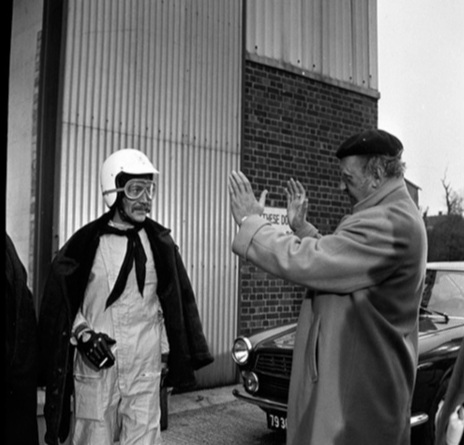
ELSTREE3

Left: Peter taking direction on the Backlot of Elstree filming a scene for ‘Department S‘.

In the heyday of the ‘British Hollywood’, there were several studios in the town; MGM British National, The Gate, The Ideal, The Neptune, and so on. But the studios that played host to Jason King started out as the brainchild of an American film entrepreneur, one JD Williams. Shortly after the completion of his studios, however, Williams went into disagreement with his partners and the studios (with more of a touch of irony) fell into the hands of John Maxwell – a Scots lawyer who’d been brought in to handle litigation concerning the rift. Maxwell was a small-time cinema owner with a history of film distribution who was keen to entre production as the government were about to fix a firm foundation for the British film industry in the form of the much maligned quota system of 1927. 

Maxwell immediately achieved a quick turnaround of films at the newly acquired BIP Studios. So much so that the industry somewhat mischievously gave it the nickname the ‘Porridge Factory’. Some say this was in honour of Maxwell’s Scottish roots, with the other school of thought appropriating the name to the fast production of ‘pot boiler’ movies of the period.

Nevertheless, the studios succeeded and Maxwell developed an empire with his acquisition of hundreds of cinemas. By 1937, the empire was known as the now familiar name of The Associated British Picture Corporation, and its chain of cinemas had the corporate identity of ABC. Everyone who was anyone eventually passed through the gates of the ABPC. In 1929, the company was credited with the very first British sound production due to the, then, ‘boy wonder’, Alfred Hitchcock, re-shooting his ‘Blackmail’ feature after almost finishing it, to utilise the new RCA sound process. Future US president, Ronald Reagan, made a movie at the studios, whilst in the 1970’s, ‘Star wars’ and its sequels offered the British Film Industry a ‘New Hope’.

John Maxwell died in 1940, and at the time, the studios had been commandeered by the British Army for wartime activity. After the War, the “Porridge Factory” faced stiff competition from both J. Arthur Rank at Pinewood and the newly opened MGM British, which was built literally just across the street. After his death, Maxwell’s family struggled to regain control of the empire he’d built – finally losing out in 1946, when Warner Brothers bought a controlling stake.

Despite the American influence, the studios continued to make films with a distinctly British flavour, such as ‘The Dambusters’ in 1955. In the same year, Britain also saw the introduction of commercial independent television. The board at ABPC realised that this was a sign of things to come and thus successfully bid for a franchise to serve London and the Midlands. So was born ABC TV – soon to become a production company for one of the classic series of the Sixties, ‘The Avengers’.

Television rapidly gained hold and with eth diminution of the “Swinging Sixties”, a hectic film production schedule was under way in Britain. with more and more studios turning themselves over to TV shows. More importantly, they invested in new sound stages and technology especially for the medium.

Department S was the 6th ITC television series yo be filmed at ABPC Studios. The twist here being that in 1962, Lew Grade had acquired the nearby National Studios (now BBC Elstree) – home of the Eastenders soap, yet continued to have his major productions filmed elsewhere. The advantage of ABPC was that it boasted a versatile backlot with not one, but TWO sizable tanks. Therefore, with a little bit of dressing, “The backlot would double as everything from Berlin to Hong Kong… you just changed the window shutters.” Johnny Goodman – on ‘The Saint’.

Many areas of the Studios turned up repeatedly in various series; one of the favourites being a concrete thoroughfare between the scene docks and the smaller stages. This was where a crated Jason King was dropped off by his associates in ‘A Thin Band of Air’, and which doubled for Rotterdam Docks in The Champions episode, ‘The Invisible Man’.
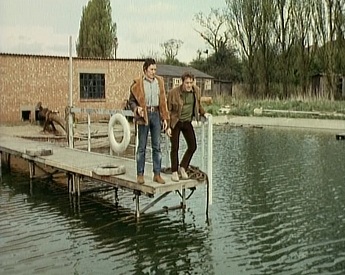
ELSTREE1

Right: Peter in a scene from The Champion’s episode, ‘The Invisible Man’ on a jetty at Tank 2 at Elstree.

A major refurbishment of the facility in the 1960’s gave ABPC, not only a new administration block, but probably its most utilised feature in those wonderful ITC adventure series – the underground car park; a scene of assassination and abduction aplenty (as noted in Department S episodes, ‘The Man From X’ and ‘A Small War of Nerves’, and the Jason King stories, ‘Flamingoes Only Fly On Tuesdays’ and ‘As Easy As A.B.C.’. 

The ITC series undoubtedly gave ABPC Studios the breathing space it needed to stave off closure as befell its more glamorous neighbour, MGM, in 1970. However, ABPC was not totally immune and in 1968 a successful takeover bid was staged by musical and electronics giant, EMI. Despite this, Department S is still credited as having been produced at associated British, with Jason King being credited to EMI-MGM Studios (after its closure, MGM US had sponsored a three-year joint finance with EMI so as to maintain a small UK production base).

By the time of the EMI takeover, British production was flourishing. Vast numbers of cinemas had closed as TV took over, and there was precious little call for indigenous film making. By now, Hollywood ruled.

In the late 1970’s, EMI had been bought out by Thorn and another double-barrelled name was evident on the Shenley Road. But the studios had long since passed into decline – neither EMI nor Thorn had invested much in the infrastructure. Cold walls and plaster were quickly (and cheaply) coated with paint, but that was about it.

The rebirth of the facilities came with the making of ‘Star Wars’; for the sequel ‘The Empire Strikes Back’, Thorn actually erected a huge silent stage to accommodate its blockbuster sets. Then Steven Spielberg came on George Lucas’ recommendation to make his ‘Indiana Jones’ series of films. the future of the studio was looking rosy.

Above: Peter during a break in filming ‘Jason King’

But then the rollercoaster ride that is British film making took a dip and it was announced in 1986 that the studios were to be sold to the Cannon Group, whose disastrous tenure ended as soon as 1988. Enter the Brent Walker Group, who called their new venture Goldcrest Studios; overstretched themselves and ended up in the criminal courts.

This was the final blow for the ‘Porridge Factory’ as a group, and in a desperate (and ultimately unsuccessful) bid to survive, sought to divest itself of its less productive assets. A major redevelopment was announced for the studios, with the site and the number of studios shrinking, but with the new sits to be installed with all the latest film technology. The bulk of the land was to be released for redevelopment.

Thus in 1991, the whole of the eastern side of the studio complex fell to the bulldozers. The lack of investment and interest in the studios was revealed when the front offices of the building were pulled down. When the admin functions where moved, the entire site had simply been abandoned and shut off. Indeed, inside the old Hammer Film office, it was like walking aboard the Marie Celeste; scripts, publicity materials, pressbooks –all lying where they had done so for the last 20-odd years, gathering dust.

Fortunately, those familiar tall trees and some of the old haunts of Jason King, the Champions et al, still exist. Hertsmere Borough Council purchased the remaining stages from Brent Walker under a compulsory purchase Order and reinstituted filmmaking alongside the new Tesco supermarket, where photos of some of Elstree’s finest film adorn the walls in tribute to those better day.

MUCH better days!

Department S At Elstree

18. Ancillary Services Block:

The wide covered alleyway at the side of this Block is where we see Sullivan fighting with two thugs in ‘The Last Train to Redbridge’, and the building also doubles for Interpol’s Auto Division building where Annabelle Hurst checks out the burnt out Rolls-Royce in ‘The Double Death of Charlie Crippen’. It’s also used as parts of Heathrow and Orly Airports in ‘Six Days’ and ‘The Trojan Tanker’, respectively.

15. Backlot:

A cemetery that had been especially made for the ‘Randal and Hopkirk (Deceased)’ series is seen in both ‘The Ghost of Mary Burnham’ and ‘The Double Death of Charlie Crippen’.

The scene from ‘A Cellar Full of Silence’, where Jason just managed to get out of the exploding phone box, was also filmed here.

The Backlot Dirt track is where Annabelle notices a newly painted gatepost in ‘The Pied Piper of Hambledown’, and is also utilised in ‘The Shift That Never Was’.

14. Perimeter Road:

This is where Jason is beaten up by Dave Prowes in ‘The Treasure of the Costa del Sol’. It also makes an appearance in ‘The Man From X’, ‘A Fish out of Water’ and ‘Dead Men Die Twice’.

1 & 2: Main Gateways:

These were used as the entrance to Orly Airport in ‘The Trojan Tanker’.

9: (Behind) Soundstages 5&6:

This consisted of several small utility buildings, plus a handful of larger constructions that included a big red brick structure which could house as many as fifteen different sets. This served as the background for when Sullivan leaves the Aerospace research facility in ‘The Man From X’.

11 or 13: Tanks:

Jason steps off a jetty into one of the Tanks in ‘Last Train to Redbridge’.

Town Façade:

By redressing this set, it became a Spanish town in both ‘Les Fleurs Du Mal’ and ‘Who Played The Dummy?’, Istanbul in ‘The Perfect Operation’ and London in the pre-titles segment of ‘The Man From X’.

16 & 21 – Underground Car Park:

Appears in ‘The Man From X’ when Jason comes to the aid of Wanda Ventham, and becomes a warehouse at London Airport in ‘Six Days’. It can also be seen in ‘The Man in the Elegant Room’, ‘The Bones of Byrom Blaine’.

Peter, Joel Fabiani and Rosemary Nichols are seen standing on the Entrance Ramp of the Car Park at the very end of ‘Ghost of Mary Burnham’.

6: The Vaults:

This was a whitewashed, single story building which had stood on the Elstree site since the studio began production in 1927. It makes an appearance in ‘The Last Train to Redbridge’ as the East London Mortuary and in ‘The Mysterious Man in the Flying Machine’.

*This area of the studio is now occupied by a Tesco Supermarket.

ELSTREE6

Throughout the time he spent filming at Associated Elstree, Peter used Dressing Room No. 515, which was at the side of Soundstages 3&4 (circled on Layout above).

Also see…

REVIEW: The Sunday Night Play – ‘Loyalties’

Broadcast: Sunday, 29th April, 1962 

Character: Ferdinand de Levis

The Story

Captain Ronald Dancy, D.S.O.[1] (Keith Michell), has just retired from military service and is now at a loose end, with no idea what to do with himself. Having become familiar to a life of discipline and combat, he entertains himself with his love of horses and women, but nothing can replace the brutal excitement he craves.

Currently penniless, Dancy marries Mabel (Jennifer Wright) – a well-to-do woman who has long admired him, and who has a temperament that he’s always desired in a woman. Nevertheless, the former Captain is still forced to sell his most prized horse to his friend, Ferdinand De Levis (Peter Wyngarde), as he can no longer afford to keep the Mare. Despite his penniless state, Darcy nonetheless managed to retain membership of some of the most exclusive gentleman’s clubs in London, and with them the friends who’d request the company of himself and his new wife at weekend gatherings at some of the most exclusive addresses in the country.

LOYALTIES

On one such occasion at Meldon Court – the home of his old chum, Charles Winsor (Jack Watling), Dancy is furious to learn that De Levis has sold on the horse for a hefty profit on the £1,000 he’d received. Later that same evening, amidst the male banter and revelry, Dancy’s bitterness inspires him to make a £10.00 wager with De Levis that he can leap atop a four-foot high bookcase in a single bound. Ferdinand accepts, and Dancy subsequently wins the bet. De Levis, however, is condescending – saying that a real gentleman would never indulge in such infertile parlour games – and least not for such a trifling amount of money. This insult irritates Dancy still further.

Around 12 that night, Winsor and his wife are wakened by De Levis, who informs them that the money he’d accepted for the sale of the horse has been taken from his room, and demands that the matter is immediately explored. Winsor and his friend, General Canynge (Felix Alymer) are, together, horrified at the assertion that someone at the Manor could be responsible for such a crime, and yet neither is keen to point a finger at either the staff or guests. De Levis’, nevertheless, insists that the police are summoned.

“Chasing a man like a pack of hounds because he isn’t your breed.” Ferdinand de Levis of Captain Dancy’s friends.

Immediately, the visitors begin close ranks against De Levis – asserting that he’s handled the situation indelicately. He, in turn, construes that their stance is born more from bigotry than out of any other concern, given that he’s a Jew. Dancy, meanwhile, does little to dissuade Ferdinand’s supposition by taunting De Levis about his race.

 When Inspector Dede (Michael Collins) and a Constable (Max Latimer) arrive to begin their investigation, a number of theories are put forward concerning who the perpetrator might be, but when De Levis asserts that Dancy is the thief, and that he can provide poof to support the claim, he’s told in no uncertain terms by the other guests to keep the allegation to himself.

De Levis reluctantly agrees to remain silent, but only until he can deliver the necessary evidence, but when he realises that he’s been expelled from the clique, he openly points the finger at Dancy.

Over the course of the next couple of days, the disagreement between De Levis and Dancy is pored over by the group of friends – all of whom are reluctant to believe that the Captain could be responsible for such a dishonourable act. That’s until Dancy is ultimately unmasked when the notes taken from De Levis’ room are discovered and traced back to him.

“Since when is a thief a gentleman…” Ferdinand de Levis

Although De Levis is finally vindicated, before the group will give Darcy up, they devise a plan for the Captain to disappear before he’s arrested. Yet, conversely, the play ends in tragedy when Darcy choses to hang himself to avoid the disgrace of being taken into custody.

LOYALTIES2 001

[1]: Distinguished Service Medal

‘SOUTH’: BFI Screening

Monday, 3rd July, 2017

During July and August, 2017, the British Film Institute hosted a two-month season of LGBT+ cinema to mark the 50th anniversary of the Sexual Offences Act.

‘Gross Indecency: Queer Lives Before and After the ’67 Act’, looked at the decade before and after homosexuality was partially decriminalised in England and Wales. Starting with the Wolfenden Report in 1957 and going through to the onset of the AIDS crisis in 1977, it shone a spotlight on the LGBT+ community during that time.

Part of the season included ‘Queerama’, which is a documentary created using historical footage held by the BFI National Archive. It traced gay life in Britain from the end of the First World War and throughout the 20th Century, backed by a soundtrack including John Grant, Goldfrapp and Hercules & Love Affair.

There was also be special previews of BBC documentary ‘The People’s History of LGBT+’, as well as new drama ‘The Man in the Orange Shirt’.

DD2C7H6WsAEXoc9

The first part of the season – which ran through July – focused on the run-up to the Sexual Offences Act, with cinematic milestone ‘Victim’ (1961) being one of the main draws.

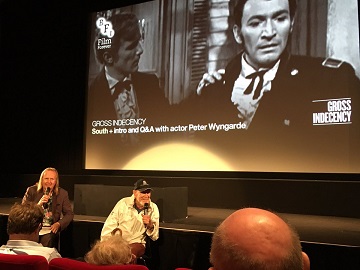
It was shown alongside one of the UK’s earliest surviving gay TV dramas, ‘South’, which starred Peter as Lieutenant Jan Wicziewsky.

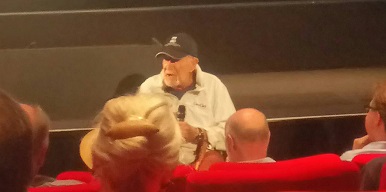
Peter took part in a special Q&A after a screening of the drama on 3rd July.

But the season was launched with a screening of On Trial: Sir Roger Casement (Granada Television, 1960), also starring Peter, which is a dramatic retelling of one of the most gripping legal trials in British queer history.

Other screenings included ‘Consenting Adults 1: The Men’ and ‘Consenting Adults 2: The Women’ (BBC, 1967), ‘The World Ten Times Over’ (Wolf Rilla, 1963) and a story of ‘Romeo and Romeo in the south London suburbs’, ‘The Leather Boys’ (Sidney J Furie, 1964). For the second part of the season in August – which focuses on the decade after the Sexual Offences Act was passed – ‘The Killing of Sister George’ (Robert Aldrich, 1968) and ‘Staircase’ (Stanley Donen, 1969) was shown, along with ‘Sunday Bloody Sunday’ (John Schlesinger, 1971).

Transcript Peter’s Q&A

How did you get the part?

I can’t remember as it was so long ago. However, I do recall wickedly agreeing with director, Mario Prizek, who is now an executive producer on the splendid series, ‘NCIS’, that we not tell Graydon Gould, who played Eric McClure, that he was fighting a duel with someone who was in love with him; but that the duel was over his fiancé. How we got away with it is obscure, but we did manage it.

Graydon was totally heterosexual, and had actually expressed some mildly anti-gay feelings. Of course he read the script, but Mario somehow managed to put over to him the idea of what it really was – a Greek Tragedy. At that time, no actor would dream of playing a poof; the fear was being associated with homosexuality – in spite of Hollywood insisting that every British actor was gay.

I was asked after the play was shown if I was a poofter, and I provided them the answer given by the French heartthrob, Alain Delon, after he was asked if he was gay: “We are all gay, are we not?” But then he was French, not British or American, so he got away with it!

19657344_10154977117789125_9004188584526780471_n

It was a real ordeal at the time, as Graydon kept asking questions which were very difficult for Mario to deal with. For example, he asked why my character – Jan Wicziewsky – would allow himself to be killed when a cut, given the circumstances, would suffice. Mario couldn’t tell him that it was meant to be symbolic of penetration; otherwise he’d have walked off the set!

Mario had offered the part to a number of actors with the script in its original form, but had been repeatedly turned down; ‘playing a poof – and on the telly? You must be joking! No! Never!’

The play was broadcast on 24th November, 1959. Can you tell us a little about your career before that point? 

I’d done numerous plays, both on TV and the stage, including playing Sydney Carton in ‘A Tale of Two Cities’; Isambard Kingdom Brunel in ‘Engineer Extraordinary’, for which all the engineering calculations and mathematical equations had to be written out for me and distributed about the sound stage, because I’m completely innumerate. And Petruchio in ‘The Taming of the Shrew’ at The Bristol Old Vic.

I’d also played de Levis in ‘The Light Is Dark Enough’ – a long verse play – with Dame Edith Evans, who was probably the greatest actress on the British stage. She confided in me afterwards that she’d particularly asked for me, because she’d never acted for TV before and she wanted me to point out where all the cameras where, and to tell her where to look.

I recall a mad incident whilst we were doing that particular play. In one scene, I was to do my final speech standing next to a Palladian pillar, which we’d decided I was to speak very softly. Because it was going out live, a stagehand was to move the pillar the moment I’d finished and set it up with the other used scenery. However, because I was speaking so quietly, he thought I’d actually come to the end of the dialogue and moved the pillar from behind me.

Suddenly, I was made aware that there was a taxi waiting for me, as I’d booked a flight to New York to see the opening night of ‘Look Back In Anger’ on Broadway, I was whisked across the studio at breakneck speed and out to the cab.

When I told Dame Edith about the pillar incident afterwards, she said that she wondered why I was so jerky. I was trying to hold on to the scenery! 

Where you aware of the production of the play in which Sir Peter Hall directed Denholm Elliot under club conditions? [1] 

This is a very tricky one. I was appearing as Dunois in ‘St Joan’ at the Art’s Theatre in Leicester Square with Siobhan McKenna, which was directed by John Fernald, who later became head of the Royal Academy of Dramatic Arts.

His new Assistant Director was Peter Hall – both of whom disagreed with my interpretation of the relationship between Dunois, as leader of the French forces, and Joan. In my considered opinion, I felt that Shaw’s preface that Dunois had no physical attraction to Joan, as a woman, was mistaken. Here was this red-blooded, dyed-in-the-wool commander of the French Army. Of course he desired her as a woman. Siobhan agreed. We both felt that the only real contact The Maid had ever had with a man was with Dunois. Whether their relationship had ever been consummated physically was neither here nor there. The point was that she adored him, as he her. This, we believed, was our only chance to see her as a human being, before she was transformed into a saint.

Peter (Hall) didn’t agree, and he took a strong dislike of me from that time on. It was then that I realised it was not wise to cross him – EVER! I learned from Vivien Leigh that Olivier wanted me to lead the Company at the National Theatre, but when the theatre was handed over to Hall, I was dropped, and was labeled as being “difficult to direct”.

That was never the case for those I respected, like Jean-Louis Barrault, who directed me in ‘Duel of Angels’, in which I appeared with Vivien, and Jack Clayton, for whom I played the ghost of Peter Quint in ‘The Innocents’.

I left the production just before it transferred to the West End to make a film in Spain [2]. Siobhan blamed the short run of the play, which had been so successful at the Art’s, on the recasting of Dunios [3], who played the part as Hall instructed.

I still maintain that if Shaw had eaten a good rump steak instead of sticking to his avowed vegetarianism, he’d have come round to my way of thinking on Dunois and Joan! Alas he never did.

I’m also convinced that John Fernald wanted me to be in his production of ‘South’ at The Art’s, but Peter Hall managed to convince him that dear old Denholm Elliot was better casting.

Your performance of the tortured lead is very powerful. Can you tell us something about the attitude to getting the character across?

I just remembered the feelings I had as a child in a Japanese prisoner of war camp in Shanghai.

‘South’ is the earliest known television play with a gay subject. Did you hesitate at all at taking the role?

No, of course not. It was a bloody good part and a wonderful script.

How was it received?

Appallingly!

19598778_10154977109674125_2032110897946410541_n

In Roger Langley’s biography of me [4], there’s just a couple of lines about the play. He then adds references to the reaction it got in the newspapers. These were the dailies that used words like “Disgusting” Filth, “Pervert” in their articles, which showed the calibre of critics back in the day.

Several of the papers mentioned me directly – saying that the blame for all this “filth” should be put on the shoulders of the man who was recently nominated as ‘Actor of the Year’. Peter Cushing inevitably won it, and quite rightly. Strangely, Sidney Bernstein [5] had recommended Peter (Cushing) for the part of Lieutenant Wicziewsky in ‘South’, but he had other obligations so it was offered to me. I thought it was a staggering piece of theatre, and having Mario Prizek directing was the cherry on the cake.

Is there anything else you’d like to say?

I think Julien Greene, who wrote the play, would be delighted that we’re still talking about this piece now.

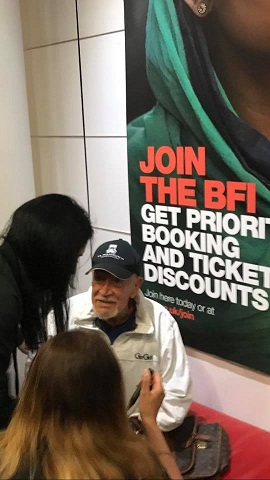
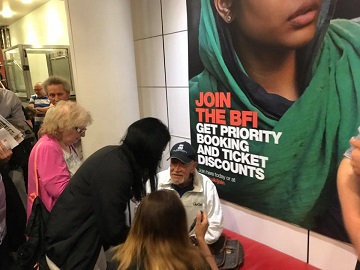
“Peter Wyngarde was mobbed after our screening of South @BFI tonight. What a treat to have him with us as we kick off Gross Indecency” Simon McCallum – Curator, The British Film Institute

More about ‘South’

THE MAKING OF: Doctor Who – ‘Planet of Fire’

  • Part 1 Broadcast: February 23rd, 1984
  • Part 2 Broadcast: February 24th, 1984
  • Part 3 Broadcast: March 1st, 1984
  • Part 4 Broadcast: March 2nd, 1982 

Character: Timanov

Implausible as it may sound, but the original idea for ‘Planet of Fire’ came via a postcard that dropped through the letterbox of Doctor Who producer, John Nathan-Turner, around Christmastime, 1982. The card had been sent by none other than Director, Fiona Cummings, who’d been passing time on the Mediterranean island of Lanzerote during a strike by BBC technicians, which had halted the recording of another Doctor Who episode she’d been working on.

For some time, Nathan-Turner had been toying with the idea of shooting Season 21 of the series in a more exotic location, and after making the requisite inquiries, had discovered that the volcanic island of Lanzerote was not only expedient for air travel, but was both economical and easy to reach, thereby making it an agreeable place to work for all concerned.

At the time, Cumming’s was on the verge of introducing a new Companion for the Doctor; a young woman with the improbable name of Perpugilliam Brown which, mercifully, would be shortened to just Peri. It was also around this point that regular cast member, Mark Strickson, who’d played Turlough for the previous 15 or so months, asked to be freed from his contract – saying that he felt he couldn’t take the character any further. Co-incidentally, Peter Davidson had also announced via the tabloids that he had no plans to return after series 21 came to an end, and so it was suggested that the time was ripe to bring in a completely new regular cast.

FIRE2

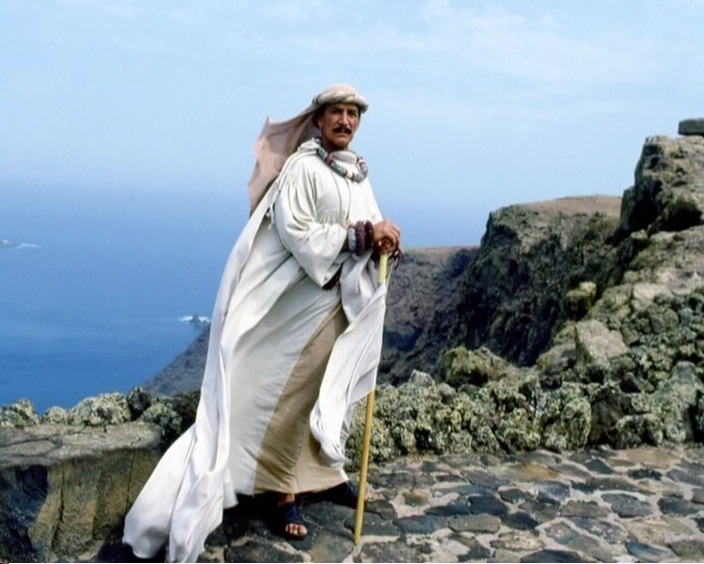
Left: Peter as Timanov at the Observation Point on Lanzerote

Having reached an amicable agreement with Strickson, Nathan-Turner turned to Script Editor, Eric Seward, who really had no wish to see Turlough depart at the same point that Peri arrived. But as fate would have it neither he, nor Scriptwriter Peter Grimwade, were given little option, especially as Davidson’s contract was due to end in May of 1984.

Nathan-Turner was especially keen that Davidson’s successor – who turned out to be Colin Baker, should appear in the very last story of Season 21. Indeed, given the number of minor characters that were also due to jump ship in the fourth serial of that year, there’d be a greater than normal roll of personnel either arriving or departing in ‘Planet of Fire’, so a number of other plots and scenarios that’d originally been considered, were put on the backburner.

A decision was also made at this point to scrap the Doctor’s robotic ally, Kamellion, given that technicians working on the show were experiencing more than their fair share of glitches when operating the contraption; most notably in keeping the computer controlled pre-recorded dialogue co-ordinated with the movement of its mouth.

Finally in May 1983, Eric Seward met with Peter Grimwade to discuss a storyline that might include all of the previously mentioned components and more. Grimwade’s association with Doctor Who had dated back to the early 1970’s when Jon Pertwee was in the lead role. Back then he’d acted as Production Manager, and it was he who’d introduced Turlogh to the series, so it couldn’t have been more fitting for him to have also overseen the departure of the character.

One of the constraints that would bind Grimwade was the shortlist of locations that would be used during filming. Astonishingly, his only aid was a set of snaps taken by Fiona Cumming’s on her holiday on Lanzerote from which he was expected to create the setting for the fictional planet of Sarn. Having never visited the island himself, much of what he wrote was based on his own travels to the Greek Islands over the years. Such was the budget for the episode, that he was forced to contact the Lanzerote Tourist Office, who kindly furnished him with the additional information he required.

Meanwhile, Fiona Cummings who, to date, had worked on three earlier Doctor Who stories, was named as Director on ‘Planet of Fire’, whilst virtual new-comer, John Peacock, was appointed as Costume Designer.

Since the original Technical Specialist responsible for programming the Kamelion robot had tragically died in an accident several months earlier, it was suggested that extra technicians would be need to control the metal companion. But that, it was quickly realised, would drain additional cash from an already overextended budget. Peter Grimwade solved the problem by using the android as little as possible in his script, and by having it taken over by The Master – therefore making it appear in human form.

Initially, the core of Grimwade’s script had been intended to accentuate the menace of religious radicalism through the character Timanov, who would be played by Peter Wyngarde. However, Script Editor, Eric Seward, was resolute in “watering down” the role of the ‘Chief Elder’, despite Grimwade’s belief that he was being “too cautious”. Nevertheless, a sequence in which Timanov was seen sacrificing himself in a volcano was lost in the final edit.

In the end, the script was amended several times to fit in with the locations – if or when they were found. This disheartened Grimwade to the point where he left all the re-writing to Seward.

Production Diary

20160815-153032

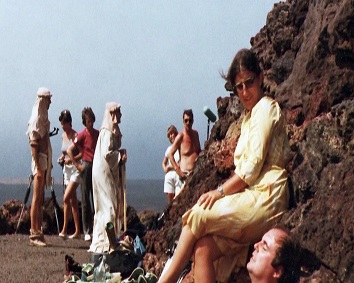
Right: This photograph shows some of the cast and crew during a break filming ‘Planet of Fire’. Peter is fourth from the left in the background. Director, Fiona Cumming’s can be seated on the rocks to the right in the foreground.

Friday, 19th August, 1983: John Nathan-Turner appears at a news conference which had been organised to introduce Nicola Bryant (Peri) and Colin Baker (the new Doctor) to the public.

In the meantime, Peter, plus 34 other members of the cast and crew, was flown out to Lanzerote.

Thursday, 13th October: The Production Crew arrived on the island. 

Friday, 14th October, 1983: 6am. The very first scene was shot at Papagayo Bay, which featured all three members of the regular cast, plus Michael Bangereter as Curt and the late Dallas Adams, who plays Professor Howard Foster.

As it turned out, the morning proved to be considerably cooler than normal on the island, much to the consternation of Niciola Bryant, who was scripted to swim to shore from Howard’s boat, which had been hired locally. Almost all of the scenes that day are shot off-shore.

A much smaller version of the TARDIS had been flown out to the island by the crew, which was 1/3 the size of the regular prop. When in shot, it was cleverly lined up closer to the camera so as to make it appear normal size. It also explains why none of the cast were ever seen either entering or leaving the Police Box during the episode.

As a result of his character not being part of the primary days shoot, Peter spent the day at the hotel sunbathing. 

Saturday, 20th August, 1983: This turned out to be a very gruelling day for everyone involved. The cast and crew were required to take a long coach-ride out to the North-Eastern tip of the island, where several scenes involving Peter as Timanov and Edward Highmore as Malkon were committed to film for Part 1. Some additional scenes when ‘The Lookout’ spots the TARDIS for the very first time, were also shot.

Peter, Highmore and Simon Sutton, who played ‘The Lookout’, were also required for a sequence at a popular observation point on the island known as the Mirator del Rio. The exterior lighting of the café at the Point was used to complete the scene, plus a couple of interior sequences involving Timanov and Malkon.

One of the major problems that the actors and crew faced during the days shoot was the high winds for which Lanzerote is famous. Due to rapid cloud movement, one particular sequence involving Peter and Simon Sutton at ‘The Lookout Point’ had to be shot more than once, since the earlier part of the scene had begun in shadow, while it ended with both actors immersed in intense sunshine.

20160815-153441

Left: Peter with Edward Highmore

By late afternoon, filming had fallen badly behind schedule. In an attempt to make up the time Director, Fiona Cummings, was compelled to approach Peter to ask if he might possibly say his lines a little quicker than he’d originally been asked to do (in the original script, the ‘Chief Elder’ was styled as a man who was as ‘Old as the mountain itself’, but looked much younger due to his breathing in the invigorating fumes of the volcano over many years). Peter Grimwade had actually proposed that Peter should present his lines much slower than all the other actors so as to give the impression of his advanced years. But, of course, when the story was conceived, he’d had no idea that the clock would prove to be such an enemy.

Sunday, 18th October, 1983: After Saturday’s exertions, everyone was given the day off. Peter spends his time sunbathing (again!) – one of his favourite pastimes.

Monday, 19th October, 1983: The cast and crew were taken to the National Park area of the island, as the volcanic region which surrounds it was used as a stand-in for the ‘Fire Mountain’ on the planet of Sarn. Peter was needed to work largely at the ‘Guides Caves’, where he takes part in several scenes involving Bryant, Sutton, Davidson, Strickson, the late Anthony Ainley as The Master, plus James Bate as Amyard.

Tuesday, 20th October, 1983: More scenes on the ‘Fire Mountain’ were filmed near the National Park, and at the Cave of Doves, Sheep Hill and at assorted other locations on and around the mountain.

A very steep area known to locals as Camel Path doubled as the mouth of the ‘Great Volcano’, where the Doctor and Amyard meet Peri in Part 4 of the episode. Also shot that day were Adams’ scene as M-Kamelion-H (his face was coated in silver make-up for the sequence), and Timanov’s very first encounter with the so-called ‘Outsider’.

Wednesday, 21st October, 1983: The last day of the shoot on location largely involved the three regular cast members at the ‘Yellow Area’ on ‘Fire Mountain’ and at Los Hornitos. There was one sequence, however, which featured James Bate and Jonathan Caplan as Roskal, who Timanov had sent in search of the great god, Logar.

Wednesday, 26th October, 1983: After arriving back in England, and being granted a few days off, the cast and crew reassembled at TC1 at BBC Television Centre in London for the first part of the interior recording. The first scenes put onto film were set in the ‘Bunker’ and featured James Bate, Barbara Shelley as Sorest and a rag-tag band of extras playing the “None-Believers”.

Recording continued with a number of sequences which were situated outside the ‘Hall of Fire’, which involved Peter Davidson, Bryant, Ainley and Highmore. The ‘Hall of Fire’ was made up of a series of interlocking sets with hinged walls for effortless removal and stowage. At the moment that Timanov musters ‘The Fire Lord’, the camera was simply juddered about to give the feeling that an earthquake was taking place. Fragments of polystyrene and other airborne debris was flung from an overhead gantry to give the impression of falling rubble. 

Thursday, 27th October, 1983: The entire day was dedicated to the outstanding scenes in the ‘Hall of Fire’, all of which were filmed in running order. Initially there were proposals to record some scenes in ‘The Master’s Laboratory’, but because progress had slowed to a snail’s pace by this juncture, those segments had to be delayed for several days.

In the ‘Sacrificial Chamber’, which was part of the ‘Hall of Fire’, the action was shot using a gas burner and blue filter, which was then overlaid onto film in post-production. In certain other scenes, the back wall of the ‘Cell’ was removed so that the views from behind the gate into the ‘Hall’ where Timanov was standing, were visible.

During a couple of sequences, Timanov was armed with a staff-like weapon from which a red beam was superimposed. The very same method was used during the shooting of both Zuko (Max Arthur) in Part 1 of the story, and Malkon in Part 3.

After the recoding of this group of scenes was finally completed, another fortnight of rehearsals took place for the second phase of shooting.

FIRE4

Above: Original listing for the four-part story in The Radio Times

Wednesday, 9th November, 1983: Shooting began on the Second Phase at TC6 at BBC Television Centre. The majority of work involved the Special Effects Team, and was set in and around the TARDIS, and on Kamelion who would change from a mechanoid into human form and back again. Some scenes set in the ‘Seismic Control Centre’ were also shot – again using filters for the Numismaton Gas sequence.

A model of an underground chamber had been especially constructed and put behind a CSO Screen to produce the illusion of a lava flow, and a rage of flames that emerged from the tunnel. Meanwhile, a series of slides showing the Lanzerote landscape were projected as a backdrop. Work involving The Master’s metamorphosis was also completed, whilst Gerald Flood made a series of audio tapes of dialogue for the Kamelion character at the BBC Radiophonic Workshop.

Thursday, 9th November, 1983: Finally the scenes in ‘The Master’s Laboratory’, which had been deferred from October 27th were recorded, plus a couple of sequences in the ‘Trion Spaceship’.

Friday, 10th November, 1983: More special effects using CSO’s were produced, and smoke boxes were added to the scenes that were set amongst Sarn’s ruins and the Master’s Black TARDIS.

Entirely for reasons of timing, some of the shorter scenes that had been shot both on location on Lanzerote, and in the studio in London, were deleted, and the sequence featuring Peter in the ‘Hall of Fire’ was held in reserve until the running order had been finalised. A scene which was cut completely from the final edit involved Peter and James Bate – the latter of whom had come to refute the reality of the great god, Logar, to Timanov.

A number of pieces of ‘stock footage’ from the BBC Library were used in Part 3 of the story. These included over 50 feet of 35mm film from Movietone, and several 16mm shots of erupting volcanoes courtesy of Visnews.

Composer, Peter Howell, recorded a 34-minute score at the BBC Radiophonic Workshop in London for the episode, which predominately featured flutes and pipes [1].

Although no Reaction Index was recorded for the four-part story, viewing figures were considered to be good, with each part of the story picking up around 7,500,000 viewers.

JASON KING BIOGRAPHY

Written by Mr P.P. Wyngarde and T. Wyngarde-Hopkins

BIOG1

Only one aspect of the colourful, amusing and romantic crime-novelist-investigator, Jason king, was empathised in Department S. Jason came into the stories when called upon to help solve baffling crimes for INTERPOL. Seen more briefly was the other aspect of him – the successful writer with the world at his fingertips.

Tumbling headlong into adventure, whether he sought it or not, Jason was lured into danger by those who thought they could make use of him. He jet-propelled himself into situations because of his insatiable curiosity, and was tricked into all sorts of trouble because of his reputation.

Accompanied throughout his adventures by some of the world’s most intriguing characters, and seeking inspiration for his best-selling Mark Caine novels, Jason’s enquiring mind led him into everything from international intrigue to local revolutions. From tense drama to comedy-filled situations. From dire peril to the welcoming arms of a beautiful girl. This is HIS story…

Jason King was born on 25th December, 1941, in Darjeeling, India; the only son of Robert James King – President of the KingSteel International Engineering Corporation and his wife, the Countess Theresa de Jouvert. His family line can be traced back to the 11th century, since his mother was not only a direct descendent of Louis XIV of France, but his father’s connections produced not one, but two, American presidents this century.

As a young child, Jason showed none of the creative flair for the pen that he would later in life. In fact, his talents appeared to lie in the field of music, and by the age of 7, he was already proficient with the violin and had reached Grade 5 at the piano. In spite of being hailed as something of a child protégé by his tutor, Jason abandoned the keyboard at the age of 11 when he left the musical arena for the fields of Eton.

Having excelled at both rugby and boxing at his new school Jason, unfortunately, began to attract the wrong kind of attention from his schoolmasters, and was expelled for ‘unruly behaviour’ at the end of his third term. After spending the summer holidays at his mother’s ancestral home in the South of France, Jason was sent to live with his maiden aunt in Vevey, Switzerland, where he completed his education.

Dismissing his parents’ wishes for him to return to England to study law at Cambridge University, Jason took up a position with a national newspaper as a freelance journalist, but after becoming increasingly restless with the restrictions that bound him, he handed in his resignation and went to join a couple of old college chums in Morocco. It was there that he found himself on the wrong side of the law for the first time in his life when, after some high-jinx following a 24-hour drinking binge, he managed to get himself arrested for gun-running and gold-smuggling!

Fortunately for Jason, his father’s intervention succeeded in convincing the Morroccan authorities that the accusation against his wayward son were unfounded, and after a brief return to England Mr King senior, through his connections in the Colonies, insisted that Jason take a position with the Hong Kong Police Department as a Forensic Adviser.

In the summer of 1963, whilst dining out one evening at the Hong Kong Hilton with family friend and colleague, Alan Keeble, Jason was introduced to the English actress, Marion West who, at the time, was on location in the City. There was an instant attraction between the two – much to the dismay of Keeble, who was himself in love with the beautiful Ms West (although his feelings had never been reciprocated). One week later, on June 21st, the couple were married at a small church in Chelsea, west London, with Keeble acting as Jason’s Best Man.

After seeing out his obligations of his three-year contract with the Hong Kong police, during which time he’d become fluent in Chinese, Russian and Italian, Jason and his wife returned to London, where Marion resumed her career in the West End, and Jason began to realise his talent for writing short stories, many of which were published.

In October of 1966, Marion left London for the United States to star in a new Harold Pinter play in New York, whilst he husband, who was at last making a name for himself as a writer, remained in London to work on his second novel, ‘From China, Yours Sincerely’.

Having played to sell-out audiences every night on Broadway for two months, Marion was looking forward to returning home to London where she was to tell Jason that she was expecting their first child. On arriving at Kennedy Airport on the morning of December 23rd, Marion was to learn that her flight had been diverted to Chicago. She immediately called Jason and told him not to expect her home until later that evening. It was to be the last time that he would ever speak to his beautiful young wife, as the plane on which she was travelling crashed just five minutes after taking off in dense fog with the loss of 326 passengers and crew.

After Marion’s untimely death, the grieving author threw himself wholeheartedly into his work, and following on from the success of ‘From China, Most Sincerely’, Jason penned what is arguably his most famous novel, ‘Index Finger, Left Hand’, which remained on the International Best Sellers List for more than five years.

BIOG2

In May of 1968, at the personal recommendation of the Home Secretary himself, Jason was approached by Sir Curtis Seretse – head of the newly formed Department S; an off-shoot of INTERPOL, to assist in solving a most baffling crime which had been perpetrated in the heart of London. Having enjoyed his work with the Department a great deal, Jason was asked to lend his services on a more regular basis, and so he teamed up with two other agents – Annabelle Hurst and American, Stewart Sullivan. Together, they helped to solve some of the world’s most intriguing crimes.

In 1971, after sustaining a gunshot wound to his left leg during a mission in Spain, Jason decided it was time to leave Department S to concentrate on his writing, and found some solace at his new homes in Paris and Geneva. In July of that year, he was awarded the prestigious ‘Enzio Prize for Literature’, which was presented to him in Zurich. Thanks to the huge sales of his Mark Caine novels which, at that time had topped over 136 million, Jason King was hailed as the most popular novelist in the word.

Fame and fortune proved to have it drawbacks, however, as Jason suddenly found himself catapulted into the Super Tax bracket back home in Britain, so for the second time in his life he found himself on the wrong side of the law, after a much-publicised altercation with Her Majesties Inspector of Taxes. It resulted in the scribe exiling himself to Paris on a permanent basis.

Whilst the Inland Revenue laid siege to Jason’s bruised and battered bank account, his accountants worked tirelessly in an attempt to stem the flow of his fortune into the Treasury coffers. To this end, Jason was instructed to take on a number of staff – which, at his own insistence, consisted of women mainly under the age of 25, to run his business affairs. It was also suggested that he invest much of his cash in off-shore concerns, which included a hotel and leisure complex in the Bahamas, and a country residence in Surrey, which he claimed was run by his maiden aunt, Ms Claire Devlin… aged 21!

Jason’s plans to live a life of relaxation following his departure from Department S was, regrettably, short lived, as his reputation as a playboy-adventurer frequently preceded him. From Venice to Berlin, Moscow to Bangkok – wherever Jason went, trouble was sure to follow.

In 1972, he met and fell in love with a young French woman by the name of Toki who, at that moment in time, was involved with the notorious gangster, Jean le Grand. Jason’s own involvement with Toki was his first serious relationship since the death of his wife some eight years earlier, and in spite of Toki’s concerns for his safety, Jason insisted that they continue their affair. Over the course of several months, Toki would meet with Jason whenever she could free herself from le Grand’s clutches, but when it became apparent that the girl herself was now in danger, Jason reluctantly sent her away to what he believed was a safe haven at a chateau he rented in Neice. Two weeks after giving birth to a son, Robert Jason, Toki was found murdered at the rustic hideaway and the child, unbeknown to Jason, was taken and raised by Toki’s elder sister at her home in Nemes.

Devastated by Toki’s death, Jason returned from his jet-setting lifestyle and became a total recluse, living and working at a monastic retreat in the mountains of Tibet. In 1996, he returned to London, where it was suggested that he might once again take up a position with INTERPOL – purely in an advisory capacity.

It has also recently been reported that a 45-year old Frenchman had succeeded in tracing Jason to his country retreat in Surrey, and upon their meeting presented himself as the author’s son, Robert. Although initially Jason’s vanity would not allow him to believe that he could possibly have a son of 45, Robert’s incredible charm, devastating good-looks and rapier wit soon convinced Jason that no-one else could possibly be his father.

JASON KING PERSONAL FILE

JasonKing

Name: Jason King

Date of Birth: 25th December, 1941

Place of Birth: Darjeeling, India.

Mother: Countess Theresa de Jouvert

Father: Robert James King, OBE

Siblings: None

Marital Status: Widower

Colour of Eyes: Blue

Colour of Hair: Dark brown

Height: 6 feet

Weight: 161 pounds (11.5 stones)

Homes: Luxury apartments in London, Geneva and Paris. Farmhouse in Surrey, England.

Achievements: Second place in the 169 Le Mans Grand Prix. Won the Enzio Prize for Literature, 1971.

Skills: Black belt in Judo and Karate. Proficient in the use of firearms.

Cars: Two Bentley Continentals.

Vices: Beautiful women, Sobranie cigarettes, Balenciga aftershave, Stornaway Scotch Whiskey, strawberries and vintage Champagne.

Languages Spoken: English, French, Russian, Chinese and Italian 


REVIEW: Television World Theatre: ‘The Dark Is Light Enough’

Broadcast: Sunday, 26 January, 1958

Character: Richard Gettner

“On Sunday night the actor (Peter Wyngarde) will reach the pinnacle of his currently successful run when he appears with dame Edith Evans in the BBC television presentation of Christopher Fry’s ‘The Light is Dark Enough’’ The Radio Times

GETTNER

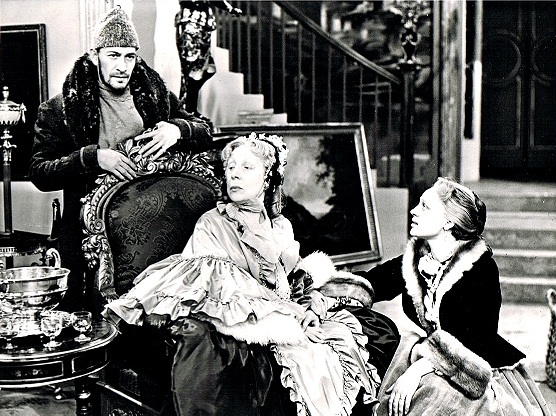
Above: Peter as Richard Gettner, with Dame Edith Evans as Countess Rosmarin and Barbara Everest as Bella.

The Story

The Dark is Light Enough’ is a 1954 play by Christopher Fry, that was written especially for Dame Edith Evans and which is set during the Hungarian Revolution of 1848. The drama, which Fry himself called ‘The Winter Play’, is set in an Austrian country house in Austria, and mostly concerns the impact the rebellion has on the inhabitants and visitors of the house.

The play opens as the household awaits the return of the Countess (Dame Edith) from a journey she should never have taken. With her, she brings Richard Gettner (Peter Wyngarde) – a young deserter from the Hungarian Army who also happens to be her former son-in-law. Soon, her own drawing room is the centre of a personal and military battlefield.

The Countess Rosmarin Ostenburg is a distinguished lady of wit, independence, compassion and honesty. At the bottom of the heap is the shrewd and cunning rascal, Gettner who, it turns out, has no integrity at all. Edith Evans and the cast she headed made little mistake in this story of a highly civilised Austrian countess involved, in spite of herself, in the Revolution. It’s only by her persuasiveness that the play could stand. Her actions in sheltering the dishonourable Gettner, who had formally married her daughter, and preserving him from capture by the Hungarian Army, rather than her second (and more worthy) son-in-law – are no further recommendation.

The course of the action has varied consequences – few of them pleasant, ending in the peaceful death of the Countess and a Sidney Carton-esque change of heart from Gettner that comes about for the simple reason that there is nothing else to be done.

The author was once told by a wise old colleague that characters are never all black or white, but should be drawn in grey. This Fry doesn’t do in his play, since he draws the Countess in all white, and Gettner in black. He does so, not in the cause of realism, but to present an intellectual dispute; simply to let ‘Good’ and ‘Evil’ fight it out.

Apart from several other well-drawn people, representing either amusing worldliness or sincere convictions, the play concentrates on the ordeals of the Countess’ conscience: She’s above any petty hostilities and bitterness and, overflowing with forgiveness, is grievously hurt by the callousness of Gettner’s unprincipled behaviour.

Through a last final act of self-sacrifice, in which she gives up her own life to save another, the Countess redeems Gettner, and some of her own strength and nobility becomes his.

In Retrospect

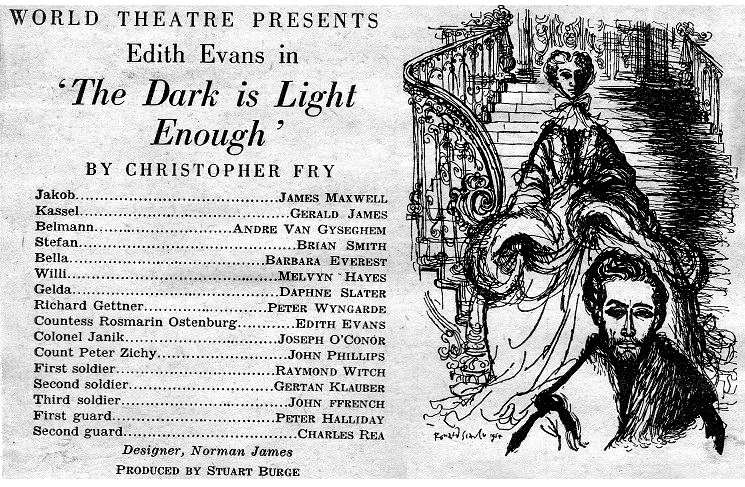
For Director Stuart Burge’s presentation, Norman James designed some wonderful settings, which accurately depicted an Austro-Hungarian country house in the middle of the19th Century. For the play itself poet, Christopher Fry, had devised three not-so- pleasing acts, which were full of twists and turns, but containing little stimulation. At one point in the drama, a character remarks, “the language is full of yes-no and no-yes.”

Ever a lover of costume drama, the BBC saw to it that everybody was richly bedecked and Peter, as the leading man, looked particularly handsome in uniform. I am not at all clear in my mind what exactly it was that Fry was driving at with his very wordy script. Indeed, he was described by one critic as ‘sounding like warmed-over Oscar Wilde, as in “It would be easier to love you than like you.”

As we already know, the Hungarians have rebelled against the Austrians, and the Countess’ home is clearly a gathering place for both sides – particularly when she has her Thursday “at-homes”. So the screen is usually filled with people, and most of those individuals stand around for the majority of the time waiting for somebody else to stop talking. This takes time, as the drama is in unrhymed verse.

When Peter is doing the speaking, the play comes alive, as he’s a striking, forceful actor who had one of the best and clearest voices on both stage and screen. But even what he says might strike the audience as being indefinite, so he didn’t offer us much guidance in leading the viewers through a plot of unspeakable complication.

In spite of certain very real difficulties in the play at hand, it did seem at one point that Fry’s words were ready to stop messing about and settling down. Until then the unforeseen lyricist who gave us ‘The Lady’s Not for Burning’ and a number of even more eccentric self-satisfactions had had enormous fun with the language. It was often white-knuckle, yet occasionally unruly to the point of recklessness. As Dame Edith, playing the Austrian Countess, chooses to risk her own life and endanger her loved ones to perform an entirely uncompromising act of mercy, she speaks with a quiet self-confidence: “I am always perfectly guilty of what I do,”, then with acerbity: “People are always ready to die for what death will take away from them”, and finally with humour “Are you military by nature or misfortune”. And each of the lines belongs, not to a whimsical flight of Mr. Fry’s more wayward creation, but to the woman who’s thinking it.

DARK

Elsewhere in this histrionic verse in praise of human kindness there are further indications of the author’s beginning assignation with reality; his initial affection for aspect in addition to deftness.

Much of the second act involves an intangible, enticing, yet completely alive relationship between the good-for-nothing deserter, Richard Gettner and Bella (Barbara Everest) – the Countess’ daughter, who has loved him, lost him, and is now jeopardising her second marriage by indulging him with a kindness he does not deserve. As Gettner and Bella move clumsily, then impulsively toward each other we, as the viewer, are never sure what this persistent love is meant to signify, or where it might lead. For that instant, it seems very real; completely fleshed, and is working out its unique purpose before our eyes, and the moment means that Fry has started to see his characters in terms of their secrets rather than just their words.

And so, toward the end of the play, when the bemused viewer, whose lives have been turned upside down by seemingly pointless silences to remark that he knows a clear truth “in the still of my mind”, it’s conceivable to believe that these individuals do still have reserves, places of rest, behind their vivid and enthusiastic word-play, and this finding of depth signifies, we presume, an incredible progress for the author.

These encouraging things apart, it’s still necessary to say that some of ‘The Dark is Light Enough’ is too intangible by far: if the characters fumble with great honesty, they often don’t get their hands on anything that is very final, or particularly secure. The play is almost always stopping in mid-act.

Nevertheless, it’s made all the more enjoyable by Peter in an immensely problematic role of a man who trusts that “good has rejected him” and who, immediately turns himself into the sort of boorish and thankless rogue who’d taunt even those who’ve saved him. The part is multifaceted. Richard Gettner wavers between longing for love and utterly destroying it, yet Peter thrived in doing much more than just reciting the play, line-by-line, and allowing the contrasting values fall where they may.

As the lady who adores him and unobtrusively winds her way through this intricate world, Barbara Everest as Bella is lovely to look at and a joy to listen to. The quantity of her elegance and ability might be witnessed by the fact that her final scenes in which, dying, she expresses her compassion to make a threadbare universe bearable, are her best.

Gerald James (Kassal) is excellent as a bearded and snappy member of the Countess’ circles; as is the superb John Philips (Count Peter Zichy ), and André Van Gyseghem (Belmann), who brought power and passion to his portrayal of the Countesses sympathetic husband; with Joseph O’Connor as Colonel Janik, Melvyn Hayes (Willi) and Daphne Slater (Gelda), adding colour to a monochrome recording.

The production as a whole, then, was both striking and effective. The play has its own sporadic ambiguities, in which there’s not really light enough. But Fry gradually and tolerantly fleshed out those dancing skeletons.

Critics Comments

 “Dame Edith Evans and Peter Wyngarde were as superb as they are always expected to be, and they were perfectly supported by the rest of the cast” The Stage

“… but the performance of Mr. Peter Wyngarde rewarded special attention” The Times

_____________________________________

The following is a personal letter which was sent to Peter by the actor, James Cairncross, after the broadcast of ‘The Dark is Light Enough’:

REVIEW: I, Spy – ‘Let’s Kill Karlovassi’

Broadcast: Monday, 11th September, 1967 (USA)

Character: George

Some Background

I, Spy was a US television series which ran for three seasons and a total of 56 episodes.

This ground-breaking series (it was the first to feature a black actor in a lead role), ran between 1965 and 1968, and followed the adventures of American intelligence agents, Kelly Robinson (Robert Culp) and Alexander Scott (Bill Cosby), who would travel the world under the guise of semi-pro tennis players; Robinson masquerading as the amateur player with Scott as his coach.

With its exotic locations, some have suggested that the show was a bid to rival the James Bond films, but whilst that might be stretching things a tad, it was unique in that it was actually filmed on location in places extending from Venice to Tokyo; Athens to Morocco.

The series was never broadcast in the UK.

The Story

GEORGE-4

The story opens on the Greek island of Hydra where, in the harbour, a group of tourists are coming ashore from a ferry.

Among the assembled sightseers emerges Alexander Scott and Kelly Robinson, who stand out from the others who are disembarking from the boat – not only for their attire, but because their business is something other than relaxation. Their mission, it transpires, is to find and kill Dennis Karlovassi (Walter Slezak) who, they’ve been informed, is the head of spy ring on the island.

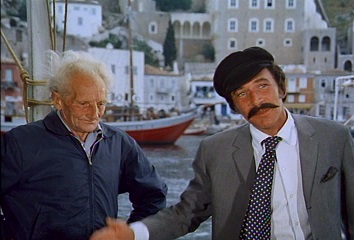
It’s in this opening scene that we get our first glimpse of George (Peter Wyngarde), who arrives at the harbour with his elderly father and their horse and trap to collect the two American’s from the ferry. It’s here that Robinson and Scott meet Marie Galoney (Ruth Roman) – their contact on the island.

The two men are whisked backed to Ms Galoney’s villa, where she’s entertaining a gathering of friends in the garden. She identifies a suspected Communist agent amongst her guests, and tells the duo that five such agents who’d arrived on Hydra over recent months had disappeared – all after meeting with Karlovassi. It’s believed that each of them had been smuggled off the island to Cyprus where they were being instructed to become members of a paramilitary unit.

“George would do anything for me. Anything! Wouldn’t you, George?”

GEORGE-1

It emerges that Marie has another reason to want Karlovassi dead. George, an employee of hers, is the Agent’s second in command. He also happens to be completely besotted with her, and in a peculiar demonstration of his devotion, Maria instructs him to cut off his moustache, which in spite of some half-hearted protestations, he inevitably obeys. She believes, therefore, that if Karlovassi is eliminated, George would be made head of the unit, thereby making her party to all the intrigue and surreptitious goings on in the region.

It should be pointed out at this juncture that Robinson and Scott are not assassins by trade, and so they attempt to devise a way of seeing off Karlovassi without killing him face-to-face. Their first endeavor involves them planting an incendiary device on the Spy’s fishing boat, but as they do so, they’re knocked out by an assailant welding a wrench.

When finally they regain consciousness, the two find themselves at Karlovassi’s villa, where they quickly realise that the overweight, middle-aged man is not quite the heartless villain they’d been lead to believe. In fact, he’s just another struggling Greek fisherman who’s trying to support his wife and daughter. It also becomes clear that his spying for the Communists is common knowledge on the island and that he’s really only in the game to make a little extra money. Of course, now that Robinson and Scott know that he’s actually quite a decent sort of chap, their assignment suddenly become eminently more difficult to carry out.

On a second visit to Karlovassi’s home the following day, the two American’s witness an attack on the family, which results in the inhabitants coming under heavy automatic gunfire and the villa being destroyed by explosives. Yet in spite of a determined counter by Scott and his partner, the two are captured and taken back to Maria’s house by one of the assailants.

Ms Galoney is shocked when she learns that the attack, which was carried out under her instructions, had gone ahead in spite of Karlovassi’s wife and daughter being inside the house. Scott and Robinson reveal that the Communist agents that’d arrivied on Hydra had not been taken to Cyprus as first thought, but were deposited on deserted island a few miles from Hydra where, thereafter, Karlovassi would deliver supplies to them twice a week.

Maria and the two American’s insist upon Karlovassi takes them to the island to see for themselves. George drives the three of them down to the harbour and, giving the impression that he’ll be staying behind, allows them to get aboard the fishing boat.

Once onboard, Maria and the two men are astonished to find Karlovassi’s wife and daughter below decks. Whilst the trio are held at gunpoint by the wife, her husband shows them the body of the Communist who’d attended Maria’s party a few days earlier.

It’s at this point that George makes his entrance, and is instructed by his superior to tie the three captives up. Karlovassi finally reveals his true purpose; he is, in fact, much more important than he’d lead the two American’s to believe. He tells them that he’s in line promotion, and will soon be taking up a new position in Prague.

“What would you rather be, George – head of a silly little spy ring, or my husband?”

GEORGE-2

Once George is left in charge of holding the prisoners, Maria tries to encourage him to freeing them by promising to marry him. All three of the captives believe that her plan has worked when the young man produces a flick-knife from his trouser pocket, and appears as if he’s ready to cut the ropes binding their hands and feet. Their expectations are quickly dashed, however, when all he does is hack a lock of Maria’s hair, and departs with a promise that he’ll think about her proposal.

When they finally arrive at the island, George, Karlovassi, Maria and both Scott and Robinson disembark, leaving the wife and daughter onboard the boat. The Spy says that he has plans for the two men, and so he instructs George to wait until they’ve left and then he’s to dispense with Maria. Robinson attempts to delay the action by putting doubt into Karlovassi’s mind about George’s ability to carry out orders. It’s enough for him to insist that George shoot the woman immediately.

However, before he’s willing to follow his superiors instructions, the young man solemnly asks Maria if she meant what she’d said on the boat; that she’d marry him. “No, George”, she replies quietly. “I want to live, but I lied”

In spite of his disillusionment at Maria’s cruel invention, when Karlovassi presses for his subordinate to carry out his order, George turns the gun on the rotund little man, sending the Spy charging back in the direction of the boat.

It’s now that gunshots are heard from the direction of the vessel, which is moored several meter’s off-shore. It can only be Karlovassi’s wife and daughter. Whilst Scott and Robinson take cover amidst the rocky terrain, George saunters indifferently in Maria’s direction, and is hit in the back with a stray bullet.

As the two American’s watch Karlovassi’s boat sail away, they turn to see Maria lovingly tending to George’s wound. Perhaps there was hope for him yet…?!

Personal Observations

GEORGE-3

This is quite an unusual role for Peter, as he plays a character that’s difficult to fathom even right up to the end of the episode. Perhaps it’s seeing him portray a man who’s subordinate to a woman, given that the majority of his guest-star roles have been the strong, misogynistic types.

Nevertheless, he succeeded in creating a very likable individual in George who, although seemingly insignificant within the scheme of the story, is actually the pivotal character. If it hadn’t been for his devotion to Maria, which Kelly Robinson uses to plant a seed of doubt into Karlovassi’s mind, all three of the prisoners would’ve met their end.

This was the last of a trio of appearances that Peter made on American television in the mid-to-late 60’s; the others being ‘The Further Adventures of Gallagher’ (1965) and ‘Lucy in London’ (1966).

It’s interesting to note that Bill Cosby won an Emmy for his part in this episode, in spite of Peter stealing the show, as always!  

  1. It was curious that most of the characters in the episode were given very unGreco-like names – i.e. George, Dennis, Flora etc.
  2. The director managed to find a way of getting Peter to remove his shirt!
HYDRA

Above: A rare production shot of Peter. Note the cameraman in the back of the carriage.


REVIEW: Sword of Freedom – ‘The Sicilian’

Broadcast: Monday, April 21st, 1958

Character: Colonna

Some Background

Produced by Sapphire Films for ITC, and recorded at Alliance Studios in Twickenham, England, ‘Sword of Freedom’ ran for three series (39 x 30-minute episodes), which were broadcast from 1958 to 1960. It was set in Renaissance Florence, and followed the swashbuckling adventures of artist, Marco del Monte (Edward Purdom), and his friends Sandro, played by Rowland Bartrop, and Adrienne Corri as Angelica. The villains of the piece included semi-regulars, Derek Sydney as Captain Rodrigo and Martin Benson as the evil Duke de Medici.  The series tells the story of the trio of freedom-fighters and their campaign against the ruling Medici’s and Machiavelli’s.

The Story

SWORD

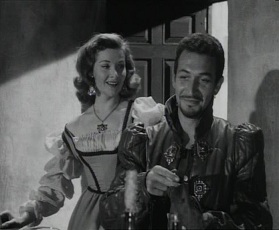
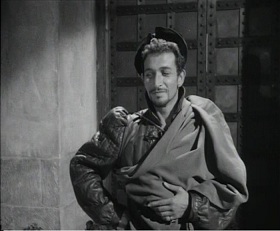
When Sicilian, Colonna (Peter Wyngarde) arrives at the gates of Florence, he does so with one object: to relieve as many people of the great City of their money. The young man, we soon learn, is a hustler and confidence trickster who, armed with a marked deck of cards, seeks out a suitable dupe to scam.

Above Right: Peter as Colonna with Adrienne Corri as Angelica

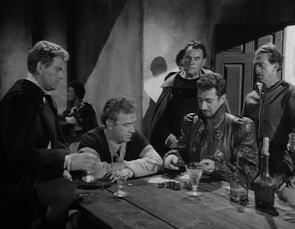
A suitable mug soon appears in the form of Sandro, who has been entrusted with money raised by a group of freedom-fighters to print protest literature denouncing the ruling de Medici family. Colonna immediately homes in on the tipsy chump, and professes to know nothing about gambling for which the City of Florence is so renowned. Inviting the young stranger to join him at Niccolo – his favourite watering hole, the trusting Sandro doesn’t see that Colonna has switched the house cards for his own deck.

After just a few hands, Sandro’s friends and fellow member of the Republican Campaign, Angelica and Marco del Monte, arrive just in time to see the hapless stooge play his last coin. When reality finally bites, the brawny Sandro is too shamefaced to face his comrades, and leaves the inn under a cloud. Meanwhile Colonna, believing that no one is watching, switches the cards again – leaving the ‘good’ deck on the table. However, unbeknown to him, del Monte has spotted his deception, and instructs Angelica to use her feminine wiles to get the cards from the Stranger “by any means” she can. In the meantime, he follows Sandro outside.

vlcsnap-2016-12-27-10h48m12s222_zpsp79vciir

Sandro, it transpires, has decided to throw himself into the River Arno. Marco leaves just in time to see his friend leap into the murky waters below, where he’s forced to follow and drag him safely to the bank.

When ­­­­­­­­­­­­­­Sebastiano (Basil Dignham) – another member of the rebel gang, learns of Sandro’s stupidity, del Monte pledges to recover the coins on his thoughtless friend’s behalf, and immediately sets about devising a plan.

The dice-makers of Florence are renowned across Europe for the great pride they take in their workmanship and honesty, so it’s no easy task for Marco to find one who’s willing to sell him a weighted set. The Craftsman tells Marco that he’s only willing help if he promises to destroy the dice the moment they’re no longer needed, to which he agrees. The next thing on the agenda is to find Colonna and to earn his trust.

Marco and Angelica manage to track down the cunning rogue, who is just about the leave the City. After first threatening to report him to the authorities – the punishment for cheating at cards being hanging or strangulation, they then make him an offer; to join them in a scam of their own. In view of the alternative, the Sicillian gladly agrees. Del Monte tells Colonna that a meeting of the city’s bankers and merchants is planned to take place at Niccola’s that evening, where the three of them could make a fortune at their expense. 

Later that evening at the inn, del Marco produces the modified dice he’d acquired earlier in the day, and challenges Colonna to a game of chance whilst they wait for the wealthy personages to arrive. He offers he young man the bagged and sealed dice to inspect, and once he’s happy with them, the game begins.

Colonna, however, is entirely bemused can’t by how his luck has changed, when Marco repeatedly throws one double-six after another. Nevertheless, he continues to lay his bet in the hope that his fortunes will improve. They don’t, and soon he’s lost every Florin he’d taken from Sandro.

SWORD-2

In a fit of rage, Colonna accuses del Monte of cheating, but the artist is unrepentant – saying that he’s only taken back the money that Sandro had been tricked out of. The coins are immediately returned to Sebastiano, who plans to use it to print a batch of anti-de Medici pamphlets.

Of course, Colonna isn’t the type of man to let del Monte and his group get away with ‘his’ money, and so he follows Marco, Angelica and Sebastiano back to the artist’s studio on the banks of the river. Once alone Colonna – dagger drawn, confronts del Marco, and the two men contest a deadly fight, until the Sicilian card shark is inevitably disarmed and plunges to his death in the river below.

The Retrospect

As always Peter steals the episode from what is otherwise a lacklustre and mediocre cast.

It was interesting to see that he was wearing the same (red) jacket as Colonna as he did in the ‘Lucy in London’ segment during which he played Petruchio to Lucille Ball’s Kate. He also looked rather strange with one earring in his left ear.

The episode was unremarkable, yet enjoyable. It was clear from the opening scenes that crafty scoundrel would, inevitably, be beaten at his own game by the lantern-jawed hero, Robert Purdom. But, who cares! The pleasure of seeing a very young Peter in tights was worth purchasing the ‘Sword of Freedom’ DVD set for on its own.

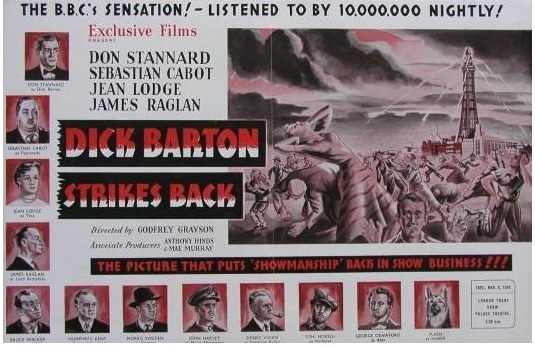
REVIEW: Dick Barton Strikes Back!

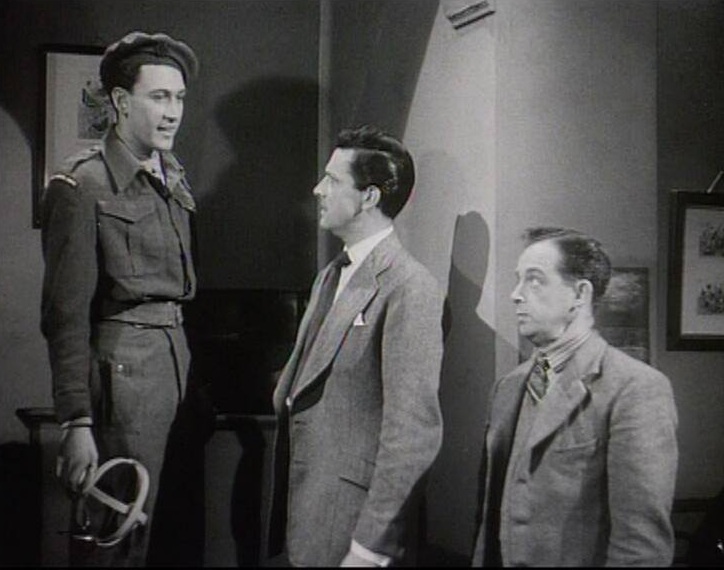
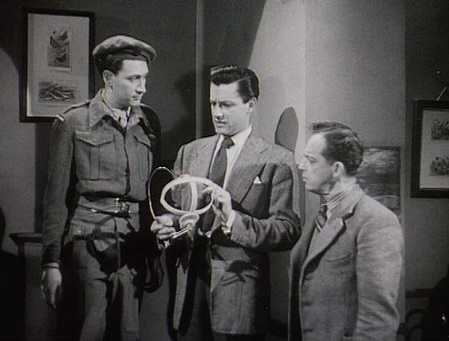
Although Peter only makes a fleeting appearance in this film, as a completest project, I feel that it’s still necessary to include it on this ‘Site.

The Story

BART1
BART2
BART3

Above: An original poster from the film

Peter’s Role

REVIEW: No Laughing Matter

The Arts Theatre, London. Opening night – Wednesday, 23rd January, 1957.

Character: Gérard Barbier

The Story

Act 1

  • The attic of Gérard’s house in Paris.
  • Early one evening in Lens.

Act II

  • A suit in a hotel on the Coté d’Azur.
  • Three weeks later. Morning.

Act III

  • The same. Two hours later.
  • Time – The present.

The characters seemed to be such happy, successful lovers in ‘No Laughing Matter’, that when the mood changed the shock must’ve been deep. The strength of this amusing comedy lies in its basic firmness of approach; in the goal the author had in mind of showing the audience that such goings-on as he depicts so wittily and ingeniously, are not a subject for entertainment only. So as well as a bright story about love, written with enormous competence, there is a moral tale.

Purely as entertainment, it’s all the better for this. The humour had an edge of reality; the situations in which the two couples become involved were rooted in life, and not merely personal episodes with no outside connections; and individually the characters were interesting as human beings.

On the surface of things this was just another story of the eternal triangle (in duplicate), but the author was so clever with his characterisation that a whole philosophy emerged. However, audiences were encouraged to take the play as they pleased, since the author knew how to amuse on an easy level, and how to leave the lesson to those who wished to listen to it.

Translated from French into English, Armand Solacrou’s comedy (originally entitled ‘Histoire de Rire’) deals with two married women, their husbands and their lovers.

In the opening scene, Gérard Barbier (Peter Wyngarde) is absolutely delighted when his best friend, Jean-Louis (Paul Daneman) tells him that he’s been having an affair with a married woman, and is about to elope with her. In typical male fashion, Gérard brings up every conceivable moral and philosophical argument in support of his friends action; actively encouraging him to go ahead with his plan.

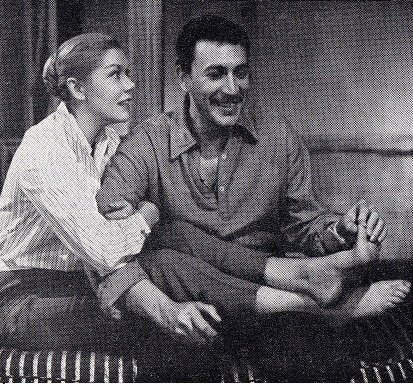
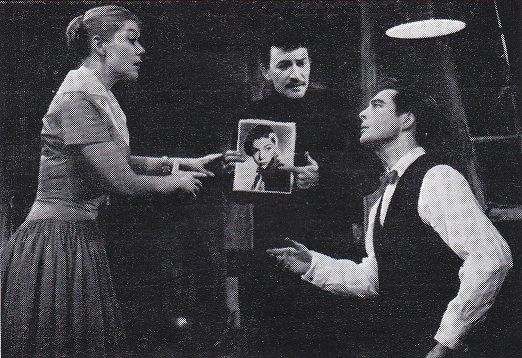
Below: Peter (seated) as Gérard, with Brenda Bruce as Addy and Paul Daneman as Jean-Louis.

LAUGHING

In the meantime, Gérard’s wife Addy (Brenda Bruce), has been meeting with her lover, Lancelot Berenson (Alec McGowen) – a miserable mouse of a man – at her and Gérard’s home to make plans to elope themselves that evening. Lancelot, however, doesn’t share Addy’s heartless enjoyment of danger for its own sake, and begins to get cold feet. He tells her that he’s concerned about the effect their action will have on others.

The arguments that Gérard made earlier take on a different colour when he finds a photograph of his wife which she’d given to family friend, Jean-Louis, to pass on to her husband after she’d left with Lancelot. She’d hoped that her angry husband would tear it to pieces when he learned that she’s left him. Gérard, however, is heartbroken when he learns of his wife’s betrayal.

Meanwhile, Jean-Louis and Hélène Donaldo (Faith Brookes), who has left her husband to elope with him, feel that they can enjoy their happiness without any feelings of guilt.

With so much heartbreak and upheaval, all the couples and their lovers decided to meet at a hotel on the Coté d’Azur to work out their problems; happily for the most part, but tragically for one of the lovers, who takes romance a little too seriously.

After talking through their differences, Addy decides to return to the arms of her husband, who’s been driven crazy with grief at her running away. Now she’s back, he tries to put the nightmare behind him and indulges in light-hearted banter with her about the happy times they spent together in the early days of their marriage.

Below: Addy after she returns to Gérard.

LAUGHING3

As for Jean-Louis and Hélène –their idyllic happiness is shattered by the unexpected arrival of Hélène’s wily husband, Gilles (Anthony Ireland), who has decided to use reverse psychology when he calls on his wayward wife and Jean-Louis. He surprises both of them by talking calmly about their elopement. Cunningly, he sows seeds of doubt in their minds, knowing full well that Jean-Louis will then quarrel with Hélène and leave her with no other course but to return home to him.

The author’s brief implied comment that a lack of religion was the cause of an increase in infidelity and, consequently, unhappiness, hardly needed such a serious presentation, even if the lesson was underlined in the end by the sound of a single gunshot signifying a suicide.

In Retrospect

It was at long last that London gave some recognition to Amand Salacrou, and as with such cases at the time, it was the forward-thinking Art’s Theatre that brought the backward-looking West End bang up to date. It wasn’t as if there had to be much pioneering spirit on show, given that ‘No Laughing Matter’ had been running in Paris for almost three years by the time it hit the London stage.

On the surface, ‘No Laughing’ Matter seems like another story of the eternal triangle (in duplicate!), but the author had been so clever with his characters that a whole new viewpoint emerges. Although billed as a ‘Comedy’, there were many moving pieces as well as comic ones – all of which were played with superb polish.

Salacrou’s comedy has invariably been described by theatre-goers as a more heart-felt version of ‘Private Lives’; a bit more serious, too, as the French tend to take marital infidelity rather more seriously than we Brits. Certainly, the play started cheerful enough, but soon turned brittle and heartless. In the second half, the mood changes dramatically, and it’s now that the audience see that what previously seemed so amusing is really both tragic and heart-breaking.

Laughting4

By engaging the audiences’ feelings, this comedy proved to be so much deeper and interesting than any British play on marital relations. Critics at the time described Salacrou’s wit as “keen and civilised”, and his style “fluent and assured”. “He combines the wisdom of a philosopher with the inventiveness of a genuine comedy writer”, Plays and Players suggested.

If there was one criticism of the play, it was that Peter Wood’s production, although subtle and balanced, was often coy when really it should’ve been cruel. His lighting and Paul Mayo’s sets were superb by all standards, and he was able to capture the Coté d’Azur atmosphere brilliantly.

Other things, however, weren’t quite as successful. Paul Daneman, it was said, brought “polish and charm”, but there was neither “poetry nor passion in his performance”. 

Brenda Bruce was “nowhere near as cruel or heartless enough”, and Faith Brook as Hélène “was rather too matter-of-fact”.

And what about Peter. Well, he stood out for special praise from most critics. F.B.G. of Plays and Players described him thusly: “Peter Wyngarde manages to forget his Anglo-Saxon reserve and gives full life and conviction in his portrayal as the outraged husband.” 

The Sunday Times commented in their 27th January, 1957 issue: “…Mr Peter Wyngarde handles this woman’s husband of his volatile temperament…”

“Of the two young men, Peter Wyngarde succeeds in looking pretty French (with all that implies)…” The Spectator 

“Peter Wyngarde is much better as the husband who cannot believe that cuckoldry could happen to him.” Manchester Guardian

One critic at the time commented that, perhaps, ‘No Laughing Matter’ bore the imprint of having been written over twenty years earlier, and that it might not therefore command success in the West End proper. He was right, but added that the play was “both entertaining and adult.”

Above: Original flyer from The Arts Theatre – February, 1957