

Although Peter only makes a fleeting appearance in this film, as a completest project, I feel that it’s still necessary to include it on this ‘Site.
The Story
Viewed today, Dick Barton Strikes Back! is far more than merely an early British crime thriller. It is a fascinating time capsule from the immediate post-war years, a glimpse into the formative days of Hammer Films, and, for admirers of Peter Wyngarde, an intriguing footnote in the career of an actor who would later become one of British television’s most charismatic stars. The film even contains Wyngarde’s uncredited theatrical debut, in a tiny role as a soldier.
Directed by Godfrey Grayson and released in 1949, the film was based on the immensely popular BBC radio character Dick Barton, a square-jawed special agent whose adventures captivated millions of listeners during the 1940s. At a time when Britain was still recovering from the effects of the Second World War, audiences flocked to stories featuring heroic figures battling sinister foreign threats, and Dick Barton was perfectly suited to that climate.
The plot is gloriously outlandish, even by the standards of its era. Dick Barton, played by Don Stannard, finds himself facing a ruthless international criminal organisation led by the villainous Fouracada, portrayed with considerable enthusiasm by Sebastian Cabot. The gang has developed a terrifying scientific weapon capable of devastating entire communities. Once activated, the machine unleashes destructive sonic energy with catastrophic consequences, threatening Britain on an unprecedented scale. Barton and his faithful colleague Snowey White must race against time to prevent disaster and stop the criminals before they achieve their ambitions.
The story is undeniably absurd, but that is part of its enduring appeal. Modern audiences accustomed to gritty realism may find themselves smiling at the film’s earnestness, yet it never becomes boring. There is something wonderfully innocent about its determination to entertain through fast-moving action, colourful villains and improbable scientific inventions. The film belongs to a period when adventure stories embraced fantasy without embarrassment.
One of the film’s greatest strengths is its pace. Running for just over seventy minutes, it wastes very little time. There is no psychological introspection, no unnecessary subplot and no attempt to complicate matters with moral ambiguity. The good characters are clearly good, the villains are unmistakably bad, and the audience is invited to enjoy the ride. In many respects, it resembles a cinematic comic strip brought vividly to life.
Particularly enjoyable is the performance of Sebastian Cabot as Fouracada. Long before becoming internationally known for very different roles, Cabot demonstrates a flair for theatrical villainy. He understands precisely the sort of film he is appearing in and consequently delivers a performance full of menace, confidence and just the right amount of melodrama. His presence elevates the material considerably.
The film is also noteworthy as an early Hammer production. Although it predates the studio’s celebrated horror cycle by almost a decade, careful viewers can already detect signs of what would later become the Hammer style. The atmosphere, the emphasis upon unusual scientific threats, and several unexpectedly effective suspense sequences hint at the direction the company would eventually take. Some scenes involving the destructive effects of the sonic weapon possess a genuinely unsettling quality and reveal an ambition beyond the film’s modest budget.
From a technical standpoint, the film inevitably betrays its age. The special effects are rudimentary, the production values are modest, and certain lines of dialogue occasionally verge on the unintentionally humorous. Nevertheless, these attributes contribute to the film’s overall charm, capturing a distinctively British cinematic style from an era in which ingenuity frequently compensated for limited resources. Furthermore, the utilization of authentic locations, such as Blackpool, provides the production with a refreshing sense of realism.
For Peter’s fans, however, the film possesses a unique appeal. Few contemporary viewers could have anticipated that one of the anonymous soldiers appearing briefly on screen would subsequently become the star of Department S, Jason King, The Champions, and numerous distinguished stage productions. Although his appearance is fleeting and uncredited, it marks the inception of a remarkable professional trajectory.
Viewed from the perspective of the twenty-first century, there is something inherently endearing about such an early screen appearance. Every celebrated actor must begin their career somewhere, and it is compelling to observe Peter’s first tentative steps into the world of feature films. For dedicated enthusiasts of his work, this brief glimpse adds a significant dimension to the viewing experience.
Ultimately, Dick Barton Strikes Back! merits revisiting not only for its historical significance, but for its sheer enthusiasm. The film does not aspire to be sophisticated cinema; instead, it focuses on delivering excitement, mystery, and adventure with unwavering conviction. The result is a highly enjoyable example of post-war British popular entertainment that remains surprisingly engaging more than seventy years after its release.
As a thriller, the film is lively and entertaining. As an early Hammer production, it is historically significant. As a Dick Barton adventure, it successfully captures the spirit of a beloved radio hero. Finally, as a footnote in the career of Peter Wyngarde, it offers a fascinating glimpse of a future star at the very beginning of a long and distinguished journey through film, television, and theatre. For these reasons, Dick Barton Strikes Back! remains well worth seeking out today.
Peter’s Role
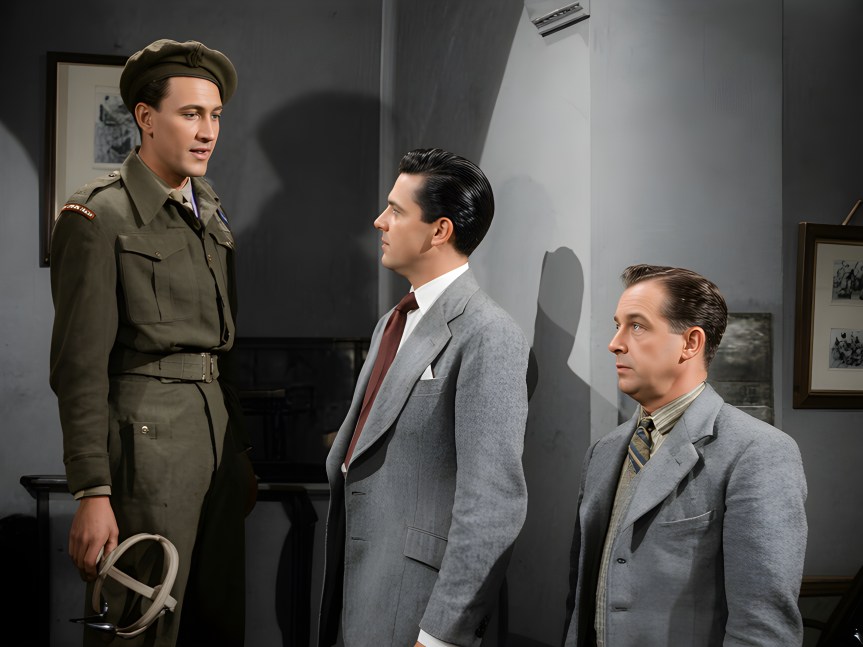
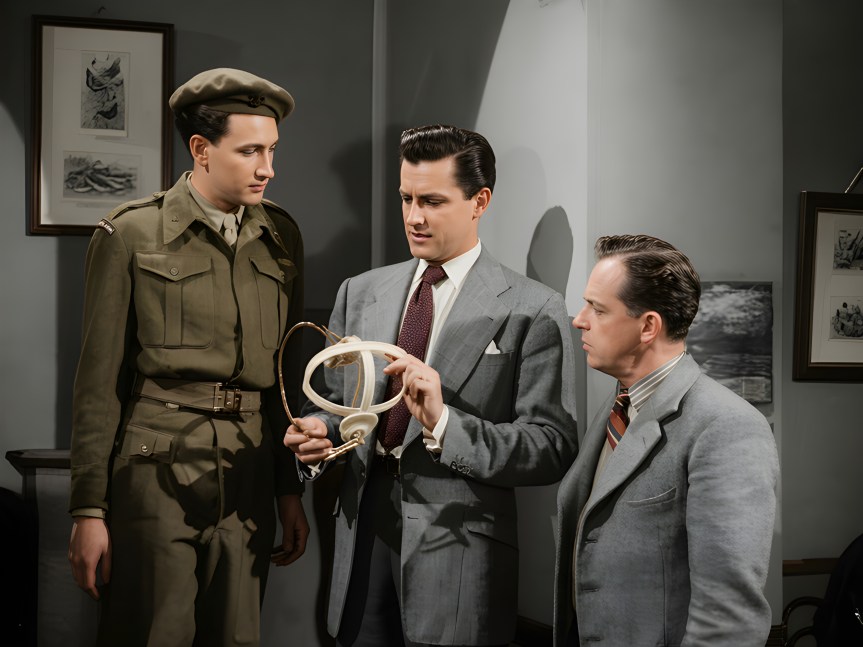
A very young Peter plays an Army Cadet, who descends a metal staircase at HQ to hand Barton and Snowey a futuristic-looking wire helmet, which proves invaluable to their solving the case. Hoo-rah! His appearance on screen last just a few seconds, and the character was unnamed in the credits.
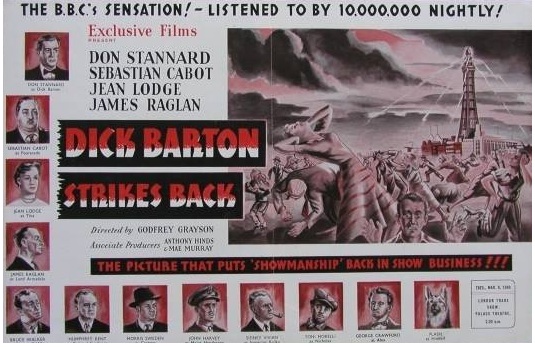
Above: An original poster from the film


