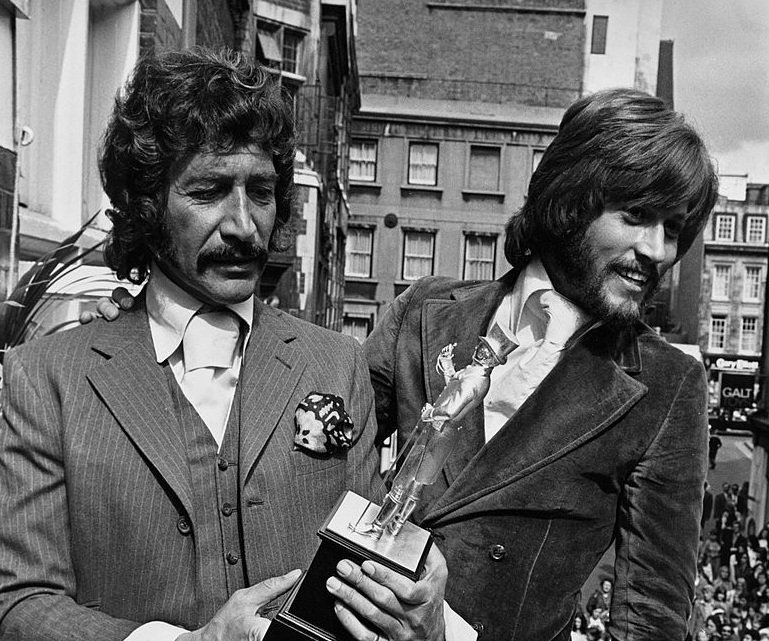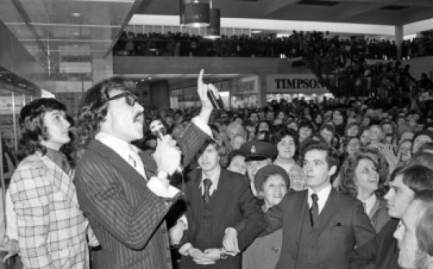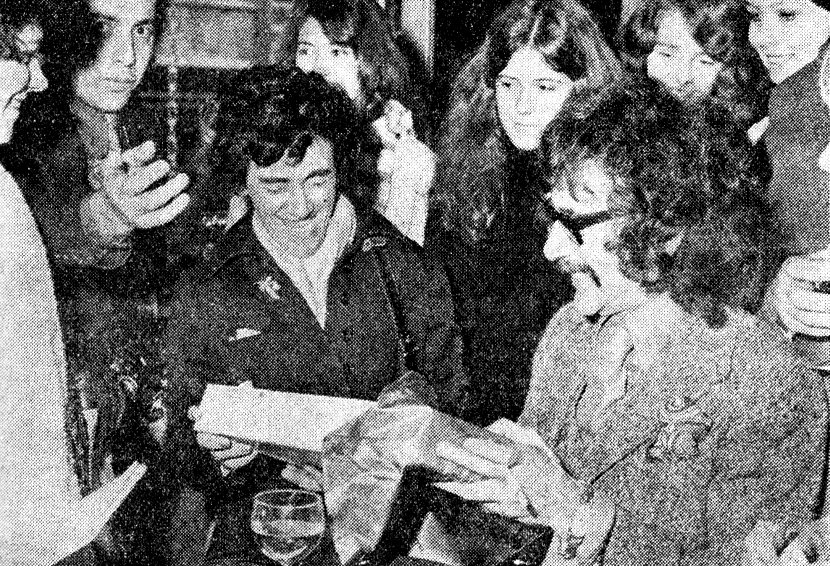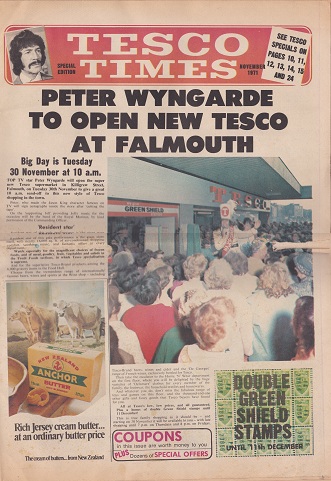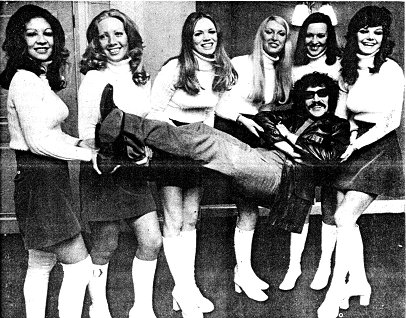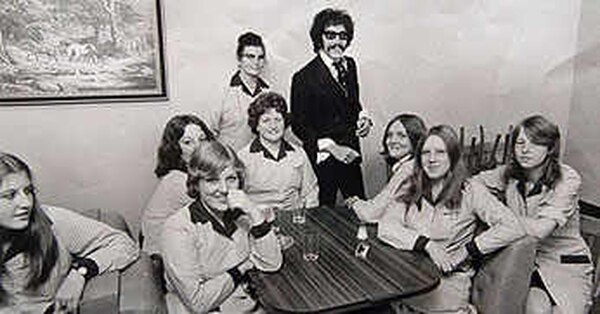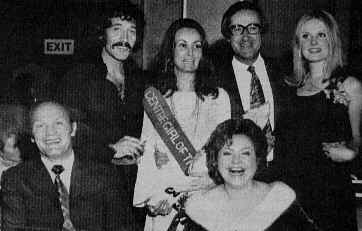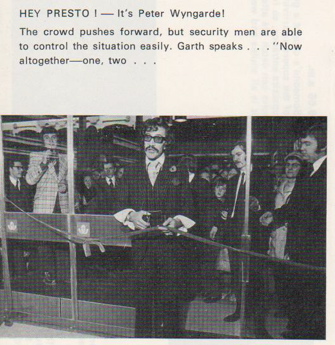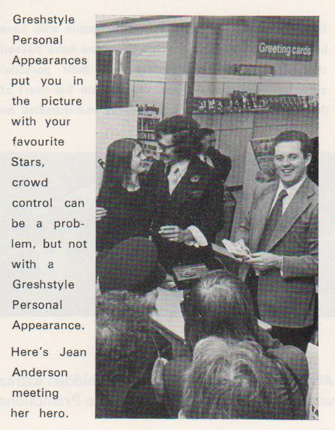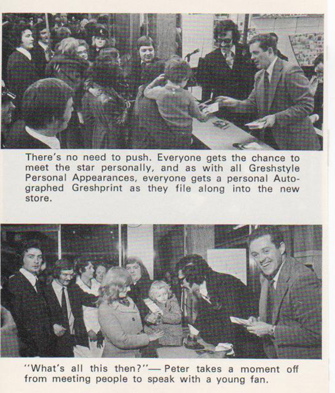
In December 1971 Peter, along with a number of other well-known personalities from stage and screen, took part in a one-day Golden lo charity event under the canvas of the world famous Circus Krone in Munich, (West) Germany. It was there that the moustachioed-one took the applause of the capacity crowd after a spot of clowning around, which involved being doused in water, and having his expensive handmade jacket torn off.
But not content with reducing his tailor to tears, something a little more daring was expected from Germany’s favourite television hero, and so it wasn’t long before Peter found himself curled up like a contortionist in a 5 ft x 4ft basket, suspended below a hot air balloon, which was hovering almost 100 feet above the circus ring.
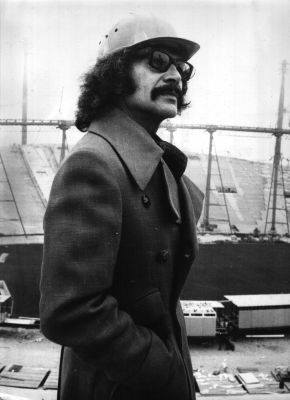
Left: During his visit to Munich, Peter was treated to a private tour of the Olympic Stadium and Village, that was still under construction at the time.
For the rehearsal Peter, who arrived dressed in faded blue denims and with a red silk scarf wrapped around his neck, told a British journalist who’d accompanied him that, although the routine was “hard on the bum”, he’d found himself in far more precarious positions prior to taking the role of Jason King:
“I was once fighting in a cable car high above the Swiss Alps, when the door slid open and I slipped on my new boots,” he said. “The terror on my face was so real that they had to cut it out of the film!”
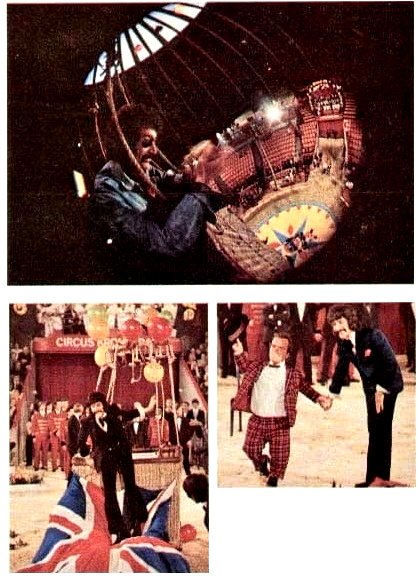
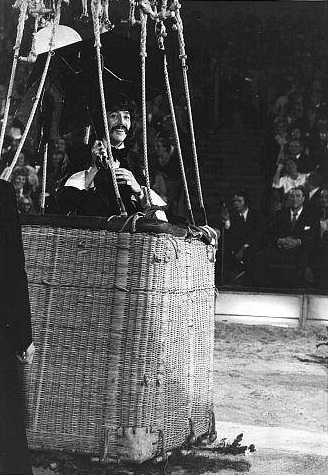
Looking up from the basket during a try-out, Peter noticed that there was only about a 12 children’s balloons tugging at the ropes. There was, however, a strong cable holding our hero aloft.
“Damn it!” cried Peter. “You’d have thought that they’d have given us a real balloon!”
The day of the main event hadn’t started too well for the adventurous actor, who’d arrived to find that his dressing room was situated midway between the elephant stalls and a pen holding the performing pig! However, because Peter is always prepared to see the funny side of every situation, he simply placed a few bunches of fresh flowers in the wash basin, and left to attend an autograph session at a Munich department store – muttering something about everything being “alright on the night”.
Back in 1971, Peter had replaced (West) Germany’s Chancellor, Willy Brant, as the country’s most popular personality in numerous polls, so everywhere he went in the Bavarian capital, he was mobbed by crowds of adoring fans.
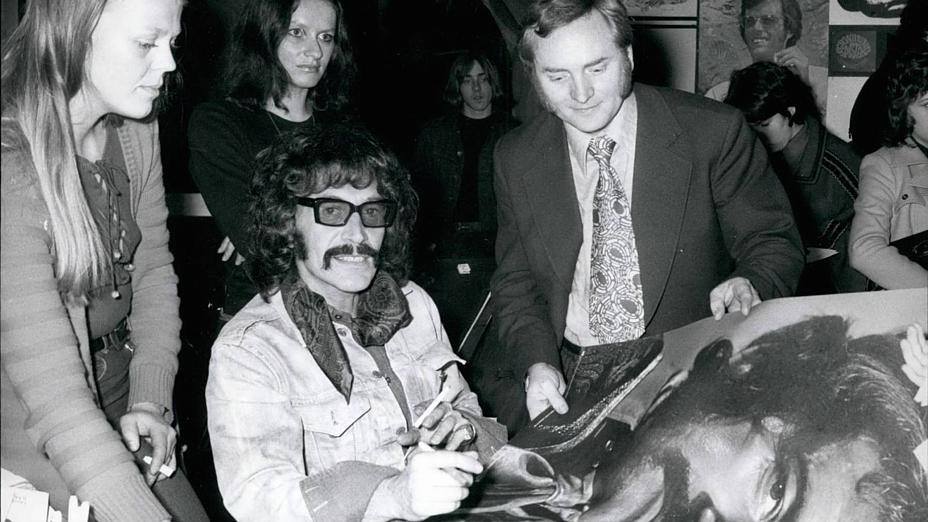
One of his stop-off’s on 12th December, was to sign his posters at the ‘Schwabing poster shop. After all the adoration, it was something of a relief, therefore, for him to return to the relative peace of his dressing room in the evening to prepare for his grand entrance.
Left: Peter is lowered safely to the ground from the roof of the Big Top
Crouching inside the tiny basket out of sight of the unsuspecting crowd, Peter was hauled high above the heads of the capacity audience – accompanied only by an umbrella and a huge Union Jack flag, which he insisted was unfurling before he made his decent. “Well, we are joining the Common Market, after all!” he quipped at the time.
As the balloon was lowered slowly to the ground, Peteremerged; his cuffs turned back characteristically (“It’s the only sensible way to wear a shirt; they don’t get in the way, and you can look at your watch!”) to the applause of the crowd, who confirmed him as the star of the show. Well, he did say something about it being alright on the night!
Trivia…. Other guests at the gala event were Italian actress Gina Lollobrigida, and actors Marc Slade (‘The High Chaparral’) and Ron Ely (‘Tarzan’).
Read about Peter’s other promotional tours by clicking below:
Portmeirion Friday, 28th September – Saturday, 29th September 2017
My own personal adventure to this event began at 2pm on Thursday, 27th September, when I picked Peter up from Runcorn Station in Cheshire to begin our 90+ mile drive to Portmeirion in North Wales.
His train from London Euston pulled into Runcorn right on time, so Peter and I were on the road by 2.20. Since traffic was light both on the Weston Bypass and the M53, we were into Wales in what seemed like a blink of an eye.
Because we weren’t tied to time, we decided to stop for a break in Llangollen; a beautiful little village which is built next to a fast flowing river, and has its own historical steam railway and horse-drawn canal boats. We had lunch – Peteropting for a baked potato and salad, after which we both clambered back into my car and off we went again.
Having only ever visited Wales once or twice in his career, Peter was taken by the stunning landscape which complemented our route along the A5, and which became ever more impressive once we turned off towards Blaenau Ffestiniog. There, we passed the mountains of slate which acted as a backdrop for several scenes in the ‘Clash of the Titans’ remake that was filmed back in 2010.
We finally pulled into Portmeirion around 4.45pm, where we were met at the Toll Gate by a member of staff from the elegant Village hotel where Peter would be staying, who ferried down there in a shuttle bus.
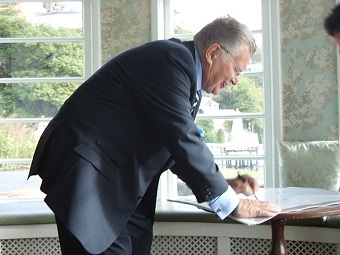
Below: Derren Nesbitt in the hotel signing posters
Peter had been booked into ‘House One’ on the 1st Floor, which had a spectacular view of the Village on one side and the Estuary on the other. Each room in the hotel is decorated in its own unique fashion, and Peter’s was adorned with scenes from ancient China that was complimented by antique black lacquered furniture to match.
Only he and actress Fenella Fielding – another guest at the event, were due to stay in the Village itself, whilst the rest of the troupe; Derren Nesbitt and his wife, Miranda. Jane Merrow, Annette Andre and Norma West, plus their agent, Thomas Bowington and myself, would be billeted in Porthmadog – a village three miles up the coast. The original plan was for me to await the arrival of the others who were travelling down from London by coach, and we’d all go up to our hotel together. However, by 7.30 that evening there was still no sign of them, and since Peter was being pressed to order his evening meal, I decided I’d drive over to Porthmadog myself and check in to my digs.
Imagine my surprise when I arrived there to find that there was no indication on the hotel computer of any us having been booked in for the night. I immediately Thomas to ask him what I was meant to do – hoping that he and the other actors and actresses would be arriving soon. To my astonishment I was advised that, due to a combination of road works on the motorway, and the driver of the coach taking a wrong turn (easy done on the tiny lanes in North Wales), they’d be on the road for several hours yet.
It was 11.40pm when I heard that the coach had finally pulled into Portmeirion, and with several octogenarian passengers on board Thomas, quite rightly, refused to move them another inch – insisting that they were all accommodated at the plush Village hotel.
An arrangement was made for everyone to meet in the Village hotel restaurant at 9am the following morning. It was a relief to me that I’d actually get something to eat, as there was nowhere to get any food at the hotel I’d been staying at. I drove the three miles down to Portmeirion, and instead of leaving my car on the ‘public’ car park, my Jeep became a Mini Moke for the day as I was allowed to take it down to the hotel and park it in the space allotted to Peter’s room.
As I drove through the hotel gates, I immediately spotted Thomas who was talking to very smartly-dressed gentlemen who I recognised as Derren Nesbitt. Unlike Peter, Mr Nesbitt, I learned, is an early-riser, and was rearing to get to work. Since the main event was only due to start at 9.30, Thomas decided to oblige him by having him sign some posters while we, and the other actors, went for breakfast.
I was told that all of our party – myself included – would be accommodated at the Portmeirion Hotel that evening, so I was to pick up my key from reception. Imagine my delight when I took my bag up to my room (‘House Seven’) to see the view from my window. It was worth the trip just for that!
Above Right: The view of the Estuary from our window
Around 9.30, I went up to see how Peter was getting on, only to find that he’d been unwell during the night and was asking to see a doctor. I immediately went downstairs to reception, where a call was made to the nearest surgery which was two miles away in Minfordd. Thanks to the cruel and savage cuts made to the National Health Service by the gangsters we have in government at present, doctor’s no longer do house-calls, and we were told that if we wanted someone to attend we would have to call an ambulance. Otherwise, I’d have to drive him to the nearest Accident and Emergency department, which was 50 miles away at Bangor Hospital.
With this information, I went back up to Peter and gave him the news. He didn’t wish to trouble an ambulance crew, but at our insistence (Thomas and I), we arranged for one to come out to him just to be on the safe side. You’ll be relieved to hear that it only took said ambulance 7 hours and 40 minutes to reach us, by which time Peter was – thankfully – feeling much better.
Although the gates opened at 8am for registration, with Screening Rooms available from 9, the main Event began at 9.30 with an announcement by Fenella Fielding through the Village P.A. system. Thomas and I were standing outside in the hotel grounds at the time, when the strangest thing happened. As Fenella said “….and now the weather. Today with be fine with the chance of showers”, right on cue, the heavens opened and it absolute poured with rain! (Given her obvious powers of prophesy, I did ask her at breakfast the following morning if she had next week’s Lottery numbers!).
Peterwas due to be interviewed after a screening of a restored version of ‘Checkmate’ in Hercules Hall, so it was up to me to get him ready for his big moment. Because he’d had a bang to his knee a couple of days earlier, and given the Village is a bit up hill and down dale in its layout, we felt it would be safer for him to make his way to the Hall in a wheelchair.
Whilst all this was going on, Fenella made an announcement over the P.A. system from The Green Dome, summoning fans over to the Hall advising that, just for today, it was Number 2 in town, not Jason King!
The shuttle bus was summoned and we put the ‘chair, which we’d borrowed from the hotel, in the back. We soon discovered, however, that said ‘chair had no brakes and, with the bus having to first go up what seemed like a 1 in 5 hill, then down the other side, Thomas and I were holding on to the ‘chair for grim death! Peter, of course, was blissfully unaware that any of this was going on, and was gleefully regaling us one of his theatrical anecdotes as the two of us grimaced and sweated in the back.
Once out of the bus, we were all ushered into the ‘Green Room’, where Peter had a cup of tea whilst we listened to the final scenes of ‘Checkmate’ playing in the adjoining Hall. As the film concluded, it was at that moment that I wheeled Peter in to huge applause by the crowded gallery of loyal Prisoner fans.
He opened the interview by telling the story of how, when he was on tour in a play in South Africa, the sets were hijacked by outlaws whilst in transit, which resulted in him having to go out on stage to explain to the audience why there was no scenery!
Needless to say, the fans loved his contribution to the Event, and gave him a rapturous applause. Little did they know that Thomas and I now had to face the prospect of getting him back up the steep ramp to the waiting mini bus – again without the aid of brakes, and on to the hotel.
As we arrived at the entrance to reception, two really nice guys – one of them Hellfire Club member, John Uttley, were waiting outside to see Peter, who was happy to chat with them and sign a copy of his album plus a couple of other knick-knacks.
We then took Peter to one of the many lounges in the hotel, where he was delighted to meet journalist and Hellfire Club member, Andrew Roberts, who’d arranged to do an interview for Classic Car magazine about the great man’s life-long love of cars. There Peter chatted away happily about some of the many vehicles he’d owned.
Afterwards, he had a little chat with his old friend – fellow actor, Nickolas Grace, we escorted him back up to his room where he had a little snooze until it was time for his evening meal.
Thomas and I shared our meal with the wonderful Annette Andre, who herself had suffered somewhat from the previous days’ coach trip from London; Miranda and Derren Nesbitt – the latter of whom was full of the most wonderful stories; Jane Merrow, Fenella Fielding and her companion, Simon, and last but not least Norma West.
After I’d made sure that Peter was fine and well, Thomas and I finally managed to get a moment to ourselves in the bar, accompanied by a pint of cider shandy and a bottle of beer.
Later on, when everyone had vanished to their rooms, I went for a stroll around the Village on my own, having not had a chance to look around during the day. I took the opportunity to see the new sculpture of Patrick McGoohan in Battery Square which McGoohan’s daughter, Catherine, had unveiled earlier in the day.
Since we were expected to vacate the hotel by 10am, I set my alarm for 8, had a quick shower and went down for breakfast which I shared with Fenella and Simon. On my way back upstairs, I bumped into Derren and Miranda and we had a little chat; both of them asking after Peter. Derren said that he didn’t think that I’d know who he was but, of course, I’ve seen him many times, both on TV and films (‘The Blue Max’, ‘Where Eagles Dare’ etc.). Additionally, my Mum had dined out for many years on seeing him in my hometown (St Helens) where he was appearing at the theatre, wearing purple velvet trousers and matching boots. When I regaled this story to them, Miranda turned to Derren and exclaimed: “Purple boots?”“Well,” he replied. “Everyone was wearing purple boots in the Seventies!” True!
I walked into Peter’s room and found him still in the arms of Morpheus; the breakfast tray I’d ordered for him still outside the door. I woke him up and reminded him that he had an hour to get ready to leave, so whilst he went for a shower I began packing his things.
Based on the debacle that had been the coach trip down to Portmeirion two days earlier, all but the most hardy amongst the troupe of thespians (namely Fenella and Simon), had elected to take the train back to London, which would first entail a 50-mile taxi journey to the station in Bangor.
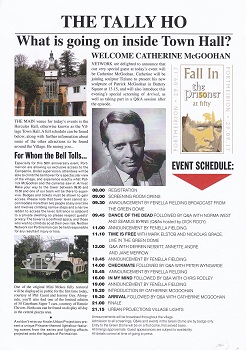
Right: The official event programme and map
It had also been Thomas’s plan to be back in London in time to meet Peter from the train at Euston Station, and to ensure that he got home safe and sound. This strategy also needed to be revised, so he opted to drive back to Runcorn with us as Peter was booked on the 15.03 train.
Now, there’s something you need to know about my car. As much as I love him (I call him Eddie, for that is his name), he is rather small inside – i.e. two seats in the front/two in the back. Whilst this was fine when there was just Petertwo days earlier, but we now had an extra passenger and his luggage to transport. (For those of you Brits who remember the game on ‘It’s A Knockout’ [1] which involved about 40 people carrying plates of jelly, shoehorning themselves into an Austin Mini, well it was something like that!)
So we had Thomas in the back seat with Peter’s bags (he came with one small case, but managed to accumulate enough stuff to fill two additional pieces of luggage for the return journey!), while Thomas’s and I had to stuff our bags in the ‘boot’ (actually a space about 10in x 12in).
I know that we would have to get to Runcorn Station no later than 2.50pm to guarantee that Thomas could get a ticket and we could ensure Peter got safely onto the train. Since it was now 12.20, which meant that we would have to do the drive in one go, there was no room for any further delay. However, since a travel party is only as strong as its weakest bladder, everyone made a final dash to the loo and we off.
With the additional amount of running about that I’d had to do for Peter over the weekend, I told my travelling companions that I’d have to put some petrol in the car at the garage about a mile outside Portmeirion. Peter couldn’t understand this given that we had just under half a tank on board. What he failed to realise was that in rural North Wales, there could be 40 or 50 miles between fuel stations, and if we were to run out in the middle of nowhere….
The tank now full, off we went over some of the bumpiest roads known to mankind; traversing our way around random sheep, deep patches of water, low cloud and mist, not to mention the occasional cattle grid that played havoc with Peter’s bad back.
Mercifully, once the B Roads were negotiated safely and we reached the A5, and subsequently the A55 and laterally the M53, we were able to pick up speed and make up some time – in spite of the torrential rain and spray from the road. We inevitably pulled up outside Runcorn Station at 2.45 exactly. Whilst Thomas dashed inside to get his ticket, I helped Peterand his bags(!) out of the car and onto the platform, just as the train rounded the bend into the Station.
Once the two guys were safely on board, I climbed into the carriage to hastily plonk down Peter’s luggage, whilst he gave me a huge hug which I hastily had to get myself out of, as the door was about to shut and I’d soon find myself trapped and en route to Crewe!
My trip home was short tho’ not sweet, thanks in no small part to the road works and diversions caused by the soon-to-be completed Merseyside Gateway Bridge over the River Mersey. Thomas called the moment he and Peter arrived in London (the journey being just 1 hour, 50 minutes) to let me know that they’d arrived safe and sound.
Although those of us behind the scenes were paddling like crazy underneath, the general consensus from the fans, the event was a huge success. I guess that’s all that matters!
An affectionate look at some of the bloopers in Peter’s films and TV series
Strange as it may sound to our younger readers, back in the olden days, if you wanted to watch something on telly, you had to do it at the time it was broadcast. There was no such thing as being able to catch your favourite programme an hour later on +1, and there was certainly no iPlayer or SKY+; no videos, DVD’s or Blu-Ray’s either, so you’d see a television series once and once only. That was it.
One of the irritating thing’s about this was that if you thought you’d seen something dubious on screen, like spotting a character with a Beehive in one scene, and then them appearing completely bald in the next, you couldn’t just rewind live TV to make sure your eyes weren’t deceiving you.
It was clear by the number of continuity errors in TV programmes of the 1960’s and 70’s that directors/editors etc. expected these shows to be broadcast only once – possibly twice – so they didn’t worry too much about the odd blooper here and there. Certainly, no one could’ve foreseen that within the coming years, everyone would have VCR’s in their own homes, and that these series would be pored over and scrutinised ad infinitum by fans. Indeed, by the mid-1980’s, ‘Nit-Picking’ had become an international sport.
When the first episodes of ‘Department S’ and ‘Jason King’ were released on VHS in the early 1990’s, a whole list of continuity errors were identified. Here are some of the more obvious ones and the episodes in which they appeared.
Firstly, Department S…
♦ Probably the most error-strew episodes of Department S is ‘Six Days’. For instance, when Jason and Annabelle are in the airline’s office at London Airport listening to a recording of the missing planes’ radio communications, Jason goes to stand at the window. He has a lit cigarette in his left hand and a glass of Scotch in his right. He lifts the glass and takes a sip, but as he lowers the glass again, it’s moved from his right hand to his left, and the cigarette has disappeared.
♦ When Walsham drives up and stops outside his flat, he notices Jason’s maroon Bentley parked in the street to the rear of where he pulls up. We’re shown that Annabelle is in the car alone, but when we’re given Walsham’s point-of-view through his own rear-view mirror, both Jason and Annabelle are in the Bentley.
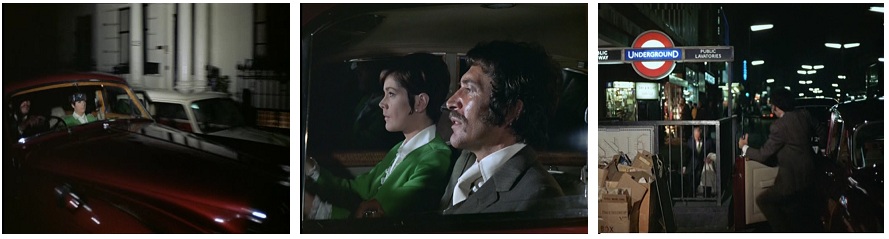
♦ Annabelle and Jason are in the Bentley, staking out a house in central London (or at least she is; he’s snoozing in the passenger seat!). A black cab arrives to pick up their quarry, and the two take off after him. First Annabelle is driving the Bentley, but as they come to a road junction, Jason is at the wheel. However, when the cab stops to drop off its passenger and the Bentley pulls up behind it Jason (or at least a stand-in!) gets out of the passenger-side door, and follows his target into a London Underground station.
Jason driving the Bentley… now it’s Annabelle!
♦ In the pre-title sequence of ‘The Pied Piper of Hambledown’, the pub landlord’s daughter is looking through the window of one of the vacant houses in the village, where she sees an unfinished breakfast on the kitchen table. However, we’re told later on in the story that the villager all disappeared during the night – i.e. approximately 00.55, as her alarm clock and peek through her bedroom window testifies.
♦ In the same episode, Annabelle organises the investigation into the missing villagers with some female associates, when a shadow of a microphone boom following her across the pub lounge, and can be seen clearly above the door just before Jason enters.
♦ Still in ‘…Hambledown’, – towards the end of the same episode, we see Susan’s father, who’s at the holding centre, reading a copy of ‘Index Finger, Left Hand’, The photograph of Jason King on the back of the book is a face-on portrait. However, when Jason picks the book up, the photo’ of the author is now in profile. The picture then returns to its original position in the next shot when the book is handed back to Susan’s father.
♦ ‘The Ghost of Mary Burnham’: When Jason is posing as an Irish window cleaner in order to get into the villains flat, he gets out of the lift carrying a ladder, his bucket is clearly empty (save for a cloth). However, when he’s seen and is instructed to get on and clean the windows, the bucket is suddenly full of water!
♦ ‘Who Played The Dummy?’: When Annabelle rescues Jason from the cafe, the white Jaguar they escape in is first a left-hand drive, then a right-hand, and latterly a left-hand again!
♦ In ‘A Ticket To Nowhere’ Lisa Crane, the Karate expert manages to dispatch Stewart Sullivan swiftly with her finely-honed skills, but seemingly forgets all about her Martial Arts prowess when she loses a cat-fight with Annabelle Hurst later on. It would appear that the amnesia-packed plot affected the script writer, too!
♦ In ‘One of Our Aircraft Is Empty’, when Annabelle is abducted from her hotel room, she’s wearing a dark top and trousers. However, in her very next scene, when her captor brings her to the place where Stewart and the other passengers are being held, she’s suddenly wearing a yellow jumper and skirt.
♦ Also, when the passengers on board the plane are about to be sent to their death, Chalmers punches a protesting Finch on the left-side of his face. However, Finch is clearly seen clutching the right-side. Even Annabelle Hurst is convinced Finch is correct, as she applies her handkerchief to the man’s right temple.
♦ In ‘A Cellar Full Of Silence”, Jason is lying on a couch in the Department S office with an obviously empty ice-bag on his head, having been knocked unconscious in an earlier scene. Annabelle and Stewart arrive, and the team begin watching a cine film of a university Rag. While they discuss the case, Jason can be seen in the background putting on a pair of sunglasses, and then reaching over to get a glass of Scotch from an occasional table. He places the glass on his lap, and lifts the ice-bag up with his right hand. In close-up, however, the ice-bag is still on his lap, then back in his hand as he’s seen again in the background. He now puts the bag on the occasional table. Yet, when we once more go to close-up, Jason is still taking ice from the bag which is once more resting on his lap, and putting it into the glass. In the final background shot, the ice-bag is on the table!
♦ ‘The Trojan Tanker’: It’s undoubtedly that Peter’s voice has been dubbed on where Stewart Sullivan exclaims “Il belle sola”, after throwing down the parasol in the beach scene.
Unfortunately, ‘Jason King’ didn’t fare any better in the blooper stakes as you’ll see…
♦ Peter clearly fluffs his lines in the pre-title sequence of ‘A Deadly Line In Digits’, when he’s seen sitting at a table outside a café near the ski-run – arguing with Ryland. He has to stop in the middle of the line: “I’m recovering from physical exhaustion!” to include the prior line which he seems, momentarily, to have forgotten: “Well, that’s presumptuous. I’m no longer with Department P, Q, R or S!”). He then repeats the line in its entirety.
♦ In ‘Variations On A Theme’, the footage cuts back and forth for a considerable time from exterior location shots to interior studio shots. One moment in the exterior shots, Peter’s hair is wavy and unkempt, the next (in the studio), it’s styled and perfectly groomed, as well as being a good inch or two longer.
Of course, ‘Department S’ and ‘Jason King’ weren’t the only series to feature such mistakes. Keeping to the Peter Wyngarde theme, here are a few of the blunders that managed to remain in the Prisoner episode, ‘Checkmate’:
♦ During the aerial view of the Village during the opening sequence of the episode, there is no sign of the human chessboard, yet moments later, it’s all laid out and the players on it.
♦ The chess move “Knight to Queen’s Bishop Three” is called, and appears to be completed by a ‘Pawn’, yet there’s no ‘Pawn’ in the appropriate square.
♦ When Number 6 appears to be filling in a crossword, it looks as if the puzzle has been pasted into a regular newspaper, as there’s an article in it which mentions various driving offenses and the Worcestershire town of Kidderminster!
♦ When Number 6 and ‘The Rook’ approach the Villager who’s painting the wall for the first time, a man’s voice can be heard in the shouting “You alright there, Fred?”.
♦ During the Word Association test at the Hospital, the ‘Nurse’ (Number 39) is holding a notebook, which disappears in the following close-up. But after Number 6 says (“Free”) “For All”, the book is back in her hand.
♦ When Number 2 has spoken to ‘The Rook’ on the beach, the latter is wearing his badge. However, when he walks across to the tent, the badge has gone, but it reappears once he’s inside the tent.
♦ ‘The Queen’ is sitting on a rock while talking to Number 6 about her locket. But when the Supervisor sees her a second or two later, she’s paddling in the water, before she’s momentarily spotted back on the rock.
♦ At the end of the episode, when No.6 is fighting with the crew of the Polotska, we see Number 2 drumming his fingers on the top of his shooting stick, and then clicking a button on the control panel using the point of his umbrella. However, in between these shots, when Number 2 is shown sitting in his chair, he doesn’t have the umbrella/shooting stick with him.
♦ When Number 6 punches one of the Guardian’s up in the Bell Tower, there’s the sound of a large splash, despite the Tower being nowhere near the sea.
♦ After the struggle between Number 6 and the crew of MS Polotska and Rover arrives to accompany the ship back to shore, none of the unconscious crewmen can be seen anywhere.
And what about the episodes of The Avengers in which Peter guest starred…?
♦ ‘A Touch of Brimstone’: Right at the beginning of the episode, when Sir John Cleverly Cartney pours himself a drink, there’s no chocolates on the arm of his chair. But when the camera cuts to him sitting in front of the TV, the box has suddenly appeared on the chair arm. We then cut back to Cartney as he is selecting one of the chocolates which he has carefully placed along the arm of his chair!
♦ In ‘Epic’, during the scene where Emma Peel has a six-shooter pistol and fires several shots at Stewart Kirby in the guise of a Red Indian, she discards the gun in the buckboard. Later, when she’s walking through the back lot and comes to a notice on the electrified fence, the previously discarded weapon is back in her hands. Still later, when she runs into the policeman, the pistol has disappeared again.
♦ Also in Epic”, at the end of the fight between Emma Peel and Kirby in the guise of a Confederate soldier, Peter swings a punch past Diana Rigg’s head, but she reacts and then pretends to be unconscious.
Of course, the type of gaffes described above weren’t confined solely to television series. Big-budget feature films are often strewn with blunders and slip-ups. Take ‘Night of the Eagle’ (‘Burn, Witch, Burn’) for example…
♦ After the giant eagle has smashed through the main door of the college to pursue Professor Taylor, we see the door back in one piece in a later shot.
♦ At the very beginning of ‘Flash Gordon’, Emperor Ming and General Klytus are discussing “An obscure body in the SK system”, which the inhabitants refer to as the planet “Earth” – which pronounced as if the word is completely foreign to them. However, at that moment, Klytus activates a button on his console labelled ‘Earthquake’.
♦ Also on the console amongst the choice of catastrophes, Typhoon and Hurricane are listed as separate items. Typhoons and Hurricanes are the same weather system and are just called by different names around the globe.
♦ After Dale and Flash take off from Dark Harbour, they fasten their seatbelts as turbulence begins, but when it gets really bad, Dale jumps into Flash’s lap without unfastening her seatbelt.
♦ As the capsule carrying Flash, Dale and Zarkov crash lands on Mongo, and one of Ming’s guards looks through a porthole into the craft, it seems that he’s just outside. However, the next shot reveals a crowd of guards, but they’re behind the ship and far away from the capsule.
♦ When General Klytus tells Flash and Dale that they have until “The sands run up” to say their goodbyes. Dale is distraught when she sees that the Timer is about to run out, she tries to turn it over, but there’s far more sand in it than when she first looked at it.
♦ After their escape from Mingo City, Princess Aura is showing Flash how to fly the ship in which they’re travelling to Arboria. She tells him that, “The left lever controls direction, and the right controls altitude”. Moments later while still flying, Flash gets angry at Aura for not showing him how to use the thought amplifier, so he shoves the left lever forward. The ship responds by going into a nose-dive.
♦ When Flash is on Arboria, he sees the initiations ceremony of a young Arborian man, who bleeds light green blood when he’s bitten by the Wood Beast. However, when Prince Barin fights Flash at Sky City later on, his blood is red.
♦ After General Kala announces the execution of Zarkov and Barin, there’s a small scene when the gold faced guards are lined up and ordered to march by their superior in a distorted voice. The voice matches the mouth movements of the superior for several words, then doesn’t as his mouth is closed. However, the voice continues to sound off.
♦ After the bloody fight between Prince Barin and Flash at Prince Vultan’s Sky City, both emerge without a single scratch on them in spite of sustaining numerous cuts from whips and spikes.
♦ In the same fight, Flash’s shirt (which he’d been wearing on Arboria) goes from clean to dirty and then clean again.
♦ During the wedding sequence, Prince Barin is charging around Ming’s Palace with a ray gun. He’s seen at one end of a corridor when three guards appear from around a corner at the opposite end. He promptly shoots one of them. When we next see him, Barin and the remaining two guards have switched positions (Barin is now standing over the body of the guard whom he initially shot down).
‘Record Collector’ features editor, Mark Paytress unearths three unique songs recorded in honour of Peter Wyngarde…
In recent years, Peter Wyngarde’s profile has received a dramatic boost, climaxing in the availability – of much of his work on DVD – including ‘Department S’ and ‘Jason King’ – two series which seem to improve with age.
But few are aware that some of the earliest recognition of this revival of fortunes came via an obscure pop group who sung Peter’s praises on no less than three tracks on their obscure ‘Give Us A Light You Bastard’ album (sometimes known as ‘Off The Top of Our Heads’).
This record, which exists on a handful of test-pressings, is yet to emerge on the commercial market. Indeed, even tapes of its contents are preciously guarded, so I was pleased to receive a copy several months after the album was recorded – back in April 1990, during three days in the wake of legendary Hollywood actress, Greta Garbo.
If you can imagine the comfortable and uplifting music of Ray Coniff filtered through the crazed eyes of a social outcast like Charles Manson, you’ll begin to understand the Breadwinner world-view. Unconventional (but not forcedly so) and endearingly melodic, the bands album is a remarkable example of how of our eras best music still manages to elude the prying eyes of the mass media. I spoke to the somewhat reticent ex-band members to find out a little more about their fascination with Peter Wyngarde.
“I was still in short trousers when Jason King was on TV,” says ‘Big’ Bob McGrath, the groups percussionist and singer/composer of the reggae-influenced ‘If Wyngarde Was A Woman’.
“I knew nothing about his wonderful LP until, believe it or not, I found a copy – weather-beaten but still playable, under a bush in the New Forrest. It was a revelation. I sang in several punk bands, but we’d never have been able to get away with a song like ‘Rape’, even in those days. As I’m sure most Wyngarde fans appreciate, it’s totally bloody mad!”
Playing it to his friends, McGrath and his mates in Dogloo Art Group eventually wrote to Petervia his agent, and received some answers to a questionnaire that they intended to publish in their ‘One More War’ fanzine’.
“I have to say that he was a bit bemused by our line of questioning,” says Breadwinner’s Morris De Cony. “But his replies were delivered with all the wit and understated cool that one would expect. We weren’t disappointed, not until Dogloo got banned from performing in our local town and we decided to shelve the magazine. Our approach to the arts has always been irreverent and controversial, and when the local council read the synopsis of our performance, which included an exhibit of ‘The Human Prune’ (where one band member sits in a bath all day, and is rushed on the stage in the evening covered in wrinkles), they pulled the show. Instead, the musical wing of Dogloo, Breadwinner, set about making a record”.
The three Peter-related tunes on ‘Give Us A Light…’ were composed in the irreverent style pioneered by Wyngarde on his own album. ‘Because he’s a Sex God par excellence, we just had to write a song that dealt with that, but from a different perspective. So I came up with the idea of ‘If Wyngarde Was a Woman’, says McGrath. ‘The rest of the band loved it. It was in the true Dogloo spirit, and suitably Wyngardeian, too. We had great hopes for it; Morris was forever harping on about us doing a ‘Top of the Pops’, all decked out in Jason King-style, perhaps with Peter doing a little cameo walk-on. For all I know, he probably still harbours such a dream, the fool!”
‘If Wyngarde Was a Woman’, which opens with a cheesy drum beat, is the aural equivalent of an exquisite piece of porcelain in Harrods; part reggae, part Latin amore – it’s the perfect accompaniment to one of Seňor King’s most exotic assignments.
‘On a seagulls wings I fly with Pete up to the sky Please don’t ask me why oh, if Wyngarde was a woman.’
And the chorus is a hoot, too…
‘If Wyngarde was a woman I’d sail the seven seas to buy her jewels and spices And other sexy treats.’
You can almost hear Jason’s flares flapping with delight!
“We were all concerned that a woman’s touch was also needed,” says the band’s chanteuse – the stunning Fay Allright, who wrote ‘Hey There, Petter (sic) Wyngarde’, the second of the Peter trilogy on the album.
“I wrote it with two things in mind: ‘Le Petomane’, the film starring Leonard Rossiter which detailed the career of the French bloke who used to fart for a living. And the constant playing of Peter’s album which I fell in love with. Set to a canter reminiscent of the ‘Telstar’ man, Joe Meek. ‘Hey There, Petter Wyngarde’ was a solo effort that defies easy description.
“I don’t care much for trends in popular music,” says Fay. “I work on the basis of what interests me at any particular time, and my Wyngarde obsession was reaching a peak when I wrote that song. I knew no record label was going to touch us; after all, everything was rave music, the grunge style was coming in and I knew we’d be impossible to market in that climate. So I found a mad violinist, double-tracked my voice, and did what I thought suited the mood best. I’m still very proud of that song.”
Best of all, perhaps, is ‘Jason Kinky Winky’, midway through the second side of the album. As DJ, Steve Wright could, with a few plays, transform this frivolous piece of country-tinged MOR into an overnight classic. Featuring the harmonising voices of De Cony and Allright, ‘Jason Kinky Winky’ is all your wildest Stereolab and St Etienne fantasies come true. It’s the kind of track, like, ‘The Birdy Song’ which immediately implants itself into your memory – just one hearing and you’ll never be able to forget it! Morris even turned in a Rockabilly-style solo.
“I always imagine Jason King as a Teddy Boy grown up,” says De Cony, “which is why we decided to add the James Burton[1] touch. The impassioned Wyngarde fan will detect several references to his album littered throughout the lyrics: ‘Billy Sexy Hippie’ gets a name check, and the pay-off line, ‘Gas gets rid of all the stinky’, is a direct steal from the Wyngarde album”.
Sadly there are no plans to make the Breadwinner album more freely accessible: “I see myself as one of life’s customers,” says Mr Rubbish – the pseudonymous fourth member of the Breadwinner set-up, “and I prefer to buy records than to make them. I really couldn’t give a toss about the album, quite frankly. It was only the continual badgering of Morris, and the promise of lots of free cider at the recording sessions that tempted me and Big Bob into the studio in the first place.
“We had a saying in Dogloo: ‘Art for art’s sake’, and I’d much rather stick to that than be tempted by big money offerings from corporate record companies. We aspire to nothing but pure indulgence; intoxicated on homemade wine, and our fantasies.
“If the record ever came out properly, I’d be most unhappy though, of course, I’d love Peter to be aware of our continual devotion to his life and work”.
As if to prove his distance from the record-producing world, Mr Rubbish has since handed over the master tapes of the album to me – a copy of which was sent to Hellfire Club president, Tina Wyngarde-Hopkins.
Respecting the wishes of the Breadwinner collective, I’ve decided not to actively court the record companies. However, if there was a way in which the three Wyngarde-related could be combined into a tribute disc, I see no barriers involved. All those who’ve heard the songs in question have emerged punch-drunk and in a state of disbelief. Breadwinner have managed to sustain a Jason King sensibility decades after he left our screens. And as the quest for Exotica – records that stand far removed from rocks’ interminable trajectory has shown, there is a demand for music that slips between the net of courting fashion. Hopefully, on the back of this, this trio of Wyngarde-inspired tributes will see the light of day officially. We’ll keep you posted.
[1] Burton’s distinctive guitar playing can be heard on the early Ricky Nelson singles, as well as later Elvis Presley recordings.
Over the years as Secretary of The Official Peter Wyngarde Appreciation Society, I’ve received many a strange, interesting and controversial letter from fans (and foes!), but not provoked such a reaction from our membership than the following, which was written by Mr Paul McGuinness of Newcastle-Upon-Tyne.
Dear Tina,
I remember that it was around 7.30 in the evening when ‘Department S’ first appeared, but being just a child, I felt that it was just like ‘The Champions’, which had just finished its run. However, it was not long before I was into the storyline – hook, line and sinker.
I remember vividly that the first episode was ‘The Ghost of Mary Burnham’. I also recall the announcer at the end saying it wasn’t the episode scheduled to be shown. It helped that the first episode to be shown was such a good one, as they clearly wanted to show the best stories first to get people interested.
I think that the reason ‘Department S’ was so big was because of the blatant commercialism. This had a lot to do with Edwin Astley – composer and arranger. Another reason was the scripts. They were excellent – they were strong and the lines were straight and to the point.
The acting was great too, but this is where everyone is wrong in not recognising the other members of the cast, who were less flamboyant than Peter Wyngarde, but who gave the show a base. ‘Department S’ was NOT Peter Wyngarde; it was a combination of all the things I’ve mentioned above. I can only think that in 1970, Peter Wyngarde was God (well, he thought so!) People told him that it was HIS performance that made the show, disregarding his fellow actors in the series, who were not recognised or given credit by the media, or through the public.
If ‘Department S’ was the most blatantly commercial show of all time, the ‘Jason King’ was just the opposite. Geoffrey Howe one destroyed the economy with one budget. I expect Peter Wyngarde destroyed his career with 26 episodes of ‘Jason King’!
The scripts were dreadful. There was no Joel Fabiani or Rosemary Nicols to give the show balance. His image was changed from a masculine one to a rather thinner version of Frank Spencer. maybe subconsciously he wanted to destroy the character. He certainly destroyed him in the eyes of the public.
Yet there is no doubt that this man can act. His performance in ‘The Saint’ episode, ‘The Man Who Likes Lions’ will verify this. ‘The Saint’ sometimes suffered because many episodes were just the same, but in this episode he was a rather masculine one where he got his role from within and is probably a truer expression of himself. This is why he appealed to so many women. This is why I want to come back to ‘Jason King’, because it was this series that destroyed the credibility of Peter Wyngarde.
He will never be forgiven!
Patrick McGoohan, who I recently watched in a Sunday night film, fell into the same trap when he left ‘Danger Man and did ‘The Prisoner’, which was complete rubbish, and he never recovered!
There’s little doubt that ‘‘Department S’’ was the best detective series ever made. Today, they make programmes for two hours which introduce characters. In my opinion, two hours is too long. You need to be direct with the scripts. The music has to be exciting, bring the show to its thrilling climax, and keeping its audience on the edge of their seats.
I would very much like to know if Peter was given the chance to do another series of ‘Department S’, and if so, did he turn it down? Did he get on with the other members of the cast, and does he regret making ‘Jason King’?
Also, do you know if Rosemary Nicols wore a wig in the show, or was she advised to do so, as she looks so much better? Was Anthony Nicholls from ‘The Champions’ her father?
Paul McGuinness
It was clear based on the questions at the end of this letter that its author was more than a little confused as to who – or more specifically, WHAT he was writing to. The clue to our concern was in the title: The Official Peter Wyngarde Appreciation Society. We were not a club specifically devoted to ‘Department S’, therefore the enquiries relating to Rosemary Nicols were somewhat misplaced [1].
Nevertheless, I welcomed Mr McGuiness’s contribution as I’ve done all others, andrespected his opinion, although I myself didn’t completely agree with it.
To begin with, Peter’s move from ‘Department S’ to ‘Jason King’ in 1971, wasn’t his choice but that of Lew Grade and ITC. He certainly had no influence over the fate of the characters – Annabelle Hurst, Stewart Sullivan or Sir Curtis Seretse. And whilst Mr McGuinness clearly doesn’t rate ‘Jason King’ as highly as he does the original series, his opinion is just that: a mere view-point – not fact. There are many fans who actually prefer ‘Jason King’ to ‘Department S’ – one of those people being none other than ITC’s own Dennis Spooner [2].
Another fallacy that was touched upon in McGuinness’s letter is that Peter’s career was somehow “destroyed” post ‘Jason King’. This point has been discussed several times in other articles in this Blog, so I won’t go through it all again. What I will say, however, is that it’s clear that most people see Peter solely as a television actor, and that when he chose to return to the stage after he completed the final episode of ‘Jason King’, certain members of the public simply believed he’d disappeared.
Mr McGuinness’s lack of awareness concerning Peter’s post-‘Jason King’ career is one thing, but as a self-confessed fanatic of a show which he declared as “the best detective series ever made”, you’d have at least expected him to know that ‘The Ghost of Mary Burnham’ was not the first episode o ‘Department S’ to be shown on British TV. The debut episode was, in fact ‘Six Days’, which was broadcast on Sunday, 9th March, 1969. ‘The Ghost of Mary Burnham’ was actually shown much later on Thursday, 18th February, 1970.
Following my reply to Mr McGuinness, a number of fans decided to join the debate. These included the following:
“Mr. McGuinness definitely lost me when he wrote that ‘The Prisoner’ was “complete rubbish”, said Uwe Sommerlad. But he’s got a (single) point – ‘Department S’ was a better show, as far as I’m concerned, and it had to do with the balance; having just Jason King gave us the pleasure of seeing more of Peter Wyngarde, but it became a tad too fanciful. ‘Jason King’ needed a down-to-earth element it lacked – a Watson to Sherlock Holmes (“You are the one fixed point in a changing world, Watson.”), you may say, to make sure it’s only a 7% Solution and not an overdose. “Having said that – Jason King is still a very entertaining show, of course. And who needs the (fine) Edwin Astley when he gets the (great) Laurie Johnson?”
Wayne Webster added his thought as follows: ‘In ‘Department S’, l like the chemistry between Peter Wyngarde and Joel Fabiani who were great together. The Jason King character was perfect for the time. As for the Jason King series the more l revisit the series the more l like it (l know some think this series was not strong). Peter Wyngarde should be proud of this character.”
‘It might be fair to say the three leads on ‘Department S’ are like a balanced meal – starter, main, and dessert. Jason king is just dessert – and while that is my favourite course it is best not to over indulge”, Hellfire Club member, Patrick Nash said .
“However, this letter seems to be from someone craving attention and sadly he is getting it. ‘Danger Man’ is just about forgotten today – ‘The Prisoner’ considered a classic of all time. ‘Department S’ is
just about forgotten – Jason king fondly remembered. While it would be interesting to hear Peter Wyngarde’s views on how ‘Jason king’ affected his career it has to be said it has granted him a sort of immortality – and that is due to the solo show. It seems many other people also have a fondness for dessert.”
Diane Brierley, meanwhile, says that she’s a fan of both series: “Peter was brilliant as Jason King in both series. I can’t think of a single other actor who could have given life to this sexy, flamboyant character the way Peter did. The first time I watched him in ‘Department S’ he had me hook, line and sinker! Personally I have to say that I preferred the story lines in ‘Department S’ but it was always Peter’s show. Joel was fab too but I think Annabelle could have been played by any actress. Rosemary never came across as very special in the part to me. Just to add, ‘Department S’ absolutely WAS Peter Wyngarde for without his acting ability, superb voice and diction and ability to make Jason King the primary character the programme would not have been the success that it was. Not forgetting his damn good looks and style obviously!!”
“Well, everyone is entitled to their opinion,” Australian, Tania Donald says pragmatically. “TV shows and movies are such a matter of personal taste after all – but I wouldn’t think that these views outlined above are held by many of Peter Wyngarde’sadmirers. ‘Department S’ and ‘Jason King’ are different shows, by design. I think it would have been very evident to the producers of ‘Department S’ that Peter was a huge part of the show’s success and the next logical step would be to cater to the public’s admiration of Peter by showcasing his talents in his own series – which Jason King did and very successfully too. Peter is amazing in Jason King and the shows huge and continued popularity says much more about his masterful performance than the personal opinion of one fan ever could’.
‘Both shows are fabulous. Each shows different sides to the character, with the series Jason King being a more personal portrayal. The fact that nearly 50 years later we are here discussing this should be testament enough to the quality of Peter‘s performance!’ Dave Asher.
‘I always loved ‘Department S’ because it seemed to have lots of sci-fi and weird bits to it. Jason King, on the other hand, my mum used the like (I wonder why?) but as a youngster I could never get into the stories and it was on quite late at night as well.’ David James Manning.
After the above comments were posted on our Facebook page, I then received the following email from Jeannette Griffiths from Perth, Australia:
Dear Tina,
I’m not usually much of a letter writer, but after reading Paul McGuinness’ manic utterings I felt compelled to put pen to paper.
Although I accept that most people associate Peter with Jason King as, without doubt, the flamboyant author was his most popular and best-loved creation to date, it really makes my blood boil to think that there are still such narrow-minded people out there who seem to think that that once ‘Jason King’ came to an end in 1973, Sir Lew Grade stuck Peter in a box and put him up in the attic with the Christmas tree and old photo albums!
In spite of your selfless hard work in bringing the countless aspect of Peter’s extensive career to our attention, it still hasn’t sunk in with certain cloth-heads out there that the character of Jason King was not, and never will be, the pinnacle of Peter Wyngarde’s career.
If Paul McGuinness had been paying attention, he’d have noticed how often Peter has stated in interviews that, just after ‘Jason King’ ended its run on TV, he had no desire to make another long-running television series, and only wanted to return to the theatre – which I believe he did with great success. Surely it doesn’t take an Oxford don to work out that actors don’t just drop off the face of the earth the moment we switch of out TV sets!
Had it not occurred to Mr McGuinness that, perhaps, Peter saw himself primarily as a stage actor and that, maybe, ‘Department S’ and ‘Jason King’ were merely a diversion from what he saw as his main vocation? What some people clearly fail to understand is that television isn’t the be all and end all of a professional actors life. In fact, many thespians still look down on the box as the ‘Poor Relation’, and frown upon those who make it their life’s work.
Based on the reviews I’ve read, Peter’s career actually hit a peak after ‘Jason King’ finished, and did not nosedive as McGuinness advocates.
My advice to those people who think that Peter’s career amounts to nothing more than a four year period between 1969 and 1973, is to get off the couch, potato brain, and grab a life!
I also received this missal from Mr Grayson Dunning from Mid Glamorgan, who reacted thusly:
Dear Tina,
I’m writing in response to Paul McGuinness’ letter. Whilst I disagree with some of what he says, he’s not as wide of the mark as some people might think. There are three points in his letter that I’d like to make.
Firstly, I do believe that Joel Fabiani played an important anchor role in ‘Department S’ and was a vital to its artistic, if not commercial, success. His down-to-earth and fact-seeking character kept the drama grounded in realism as Jason went off on his flights of fancy. But let’s not be mistaken, it was Peter who gave the show its colour and impetus; he supplied its adrenalin, if you like, and it was he who the viewers tuned in to watch.
As for Rosemary Nicols, the less said about her the better! (How could she have possibly have believed herself to be an actress of any real worth with THAT voice?! Every time I hear it I’m reminded of the scene in ‘Jaws’ where Robert Shaw scrapes his fingernails down a blackboard!).
Secondly, looking from a fundamentalist viewpoint, dramatically and intellectually, ‘Jason King’ is inferior to ‘Department S’. However, it is not “rubbish”; to anyone like myself who has a deep love of all things Wyngardian, and who can happily sit through fifty minutes of Peter free-wheeling through all manner of ludicrous mayhem; coiffured and tarted up like a prize peacock, then its manna from heaven. therein lies its underrated appeal. On a pure ‘fun’ scale, it outstrips ‘Department S’.
Thirdly, I agree with Paul: ‘Jason King’ did ruin Peter’s TV career. But I think one can go even deeper to the core of the problem than Paul did in his letter. The more I think about it, and without being too harsh, it was Peter’s own fault. The character of Jason King became too over the top and cartoonish in its depiction of the ‘ideal woman’s man’. And Peter made the fatal mistake of allowing the boundaries between actor and character to become blurred you can see this in the countless interviews given at the time). he fell for the sex symbol status he acquired and encouraged it, instead of distancing himself; keeping his head down and making people sit up and concentrate of him as an actor (as opposed to wondering what he might be like in the sack!).
Peter seemed to revel in his pin-up status but it doesn’t do your career any good over the long term. People forget you’re an actor, and stop taking you seriously as one. You become a caricature, as Peter did – linked to a particular era of TV. But, inevitably, in TV as in everything else, when one era eventually comes to an end another one begins and some of the baggage is left behind – often the most defining people of the previous era, because they’ve become old fashioned; unhip, or inextricably linked to a bygone age: an anachronism. Only in recent years has Peter become revered by fans of all things cult.
The general TV audience has a shallow appreciation of what’s put in front of them, with a limited attention span, which the TV producers are in tune with and respond to. Unfortunately, to the general television audience Peter was, and always will be Jason King from the Seventies; ‘medallion man’. If only he hadn’t allowed character and actor to merge into one all those years ago, who knows what else he might’ve achieved on TV. On the other hand, Peter’s theatrical career thrived because the stage is a completely different animal; it draws in a limited yet more cultured audience that would have a deeper appreciation and understanding of Peter’s work. After all, there is no doubting he is one of the finest, most talented actors of his or any generation.
I wonder if he actually now feels that he allowed himself to get too closely linked to the Jason King character at the time, or whether he had a preference for either ‘Department S’ or ‘Jason King?
Well let’s find out…
It was then Peter’s turn to weigh into the debate…
Dear Grayson,
I’d just like to say that I couldn’t agree with you more about Joel’s contribution to ‘Department S’ but, as usual, money raised its ugly head and the producers would only make the second series (‘Jason King’) if they had just one wage bill alone to pay and not three ! (The tailor’s bill alone was more than my salary!).
Secondly, I don’t think that ‘Jason King’ was in anyway inferior to ‘Department S’ – just different. I do think, however, that the lack of finance was partly responsible for the absence of good locations etc.
In the first series, Jason was only brought in at the very last moment when all else had failed. In ‘Jason King’, the idea was to discover a more ‘private self’; a deeper and more serious side to the character. Looking back now, perhaps he should never have been exposed to all those other influences, or allowed to take himself so seriously. Unfortunately at times, sentiment became more important than the plot. I do feel it was a mistake to make Jason so vulnerable, and in retrospect, that was perhaps the only major fault of the series. However, on a fun scale, it did outstrip ‘Department S’.
Now to a very important point: Acting is about being the person you play., and I think an actor succeeds only if he becomes the character he portrays – totally, which is what film and television acting is all about. Alas, it appears that it’s been a faithful audience which has blurred the imagery in this case.
Finally, I think that you’ve got the point of one era ending and another beginning slightly out of focus, and that the “baggage” to which you refer has itself become the dumping ground as opposed to the era itself. After all, that “era” has once again come around, the difference being that now some people prefer to call it ‘Cult’.
You must remember that ‘Jason King’ was a send-up of the James Bond films of that time, and this was the point of its humour. As you know, Bond won all his fight whilst Jason, on the other hand, rarely ever emerged unscathed from his! Like the master once said: “There is too much nonsense spoken about sex as there is too much nonsense spoken about television!” After all, they’re both primarily there to entertain; a talent to amuse.”.
Sincerely,
Peter
P.S. And can we please stop referring to Jason King as a “Medallion Man”! After all, the only time he ever wore a medallion was when he went undercover as another character, in the ‘Shake & Shout’ scene in ‘The Man From X’ (‘Department S’).
What are your thoughts on the Department S v Jason King debate; which series don prefer? Let us know here!
[1]. I pointed Mr McGuinness in the direction of the Actors Equity to see if they might be able to assist him in contacting Ms Rosemary Nicols, or her representative.
[2]. Story Consultant on both ‘Department S’ and ‘Jason King’.
The Education of Mr Surrage’, which was written by Allan Monkhouse, was by no means just a ‘Period Piece’, or simply one of those age-war situations.
The play, which was published in 1913, but set a year earlier in 1912, had been a regular on the reparatory circuit in the 20’s, 30’s and 40’s (it was first performed by the Liverpool Theatre Company), and would probably have remained tucked away in a dusty pigeonhole somewhere thereafter if producer, Cliff Owen, hadn’t added it to the growing number of stage plays that turned out to be well suited to television. There were, of course, many such plays brought to TV in the late 1950’s and early 60’s which were, regrettably, spoiled by the medium.
Conversely, many others got by quite adequately on TV, and some – most notably those written by Checkov and Ibsen, had been hugely successful. And then there were those like ‘The Education of Mr Surrage’, which was rarely ever performed in theatre by the end of the Fifties, but which was given a new lease of life thanks to the small screen.
The Story
Our tale begins in the Drawing Room of Perceval Surrage’s (Maurice Denham) home, which is approximately 40 miles outside of London. Surrage is a 50-year-old widower, a retired businessman and father of two girls – Rose (Sally Home) and Violent (Jennifer Daniel), and a son, Archie.
On this occasion, the three grown-up ‘children’ have organised a gathering of friends whom they wish to introduce to their father; believing that they will assist in his “liberal development”, and ultimately drag him kicking and screaming into the 20th Century.
Two of these ‘friends’ – Geofrey Vallence (Peter Wyngarde) – a Painter, and the unusually named, Arthur Suckling (Peter Reynolds), a playwright, have already arrived and have been shown to their respective rooms. Meanwhile, a third guset – the mysterious Mrs Stains, we’re informed, will be making her way the Surrage household by motor car.
Perceval is someone who might be described as a simple man – but only in the sense that he enjoys an uncomplicated life; he likes what he likes, and that’s good enough for him. But whilst he might appear a bit dull, he’s not incapable of irony, nor is he adverse to seeking out new adventures.
Whilst Archie regales his sister’s on how fortunate he was to have persuaded such a man as Geofrey Vallence to come to their home, Mr Surrage Sr. is assured that, in spite of the Painter being one of the most distinguished living Modern Artists, the two will get along just fine.
Nevertheless, the older man is convinced that his offspring are actually ashamed of him, as he’s long since heard a single compliment on his taste in art, or for the type of furnishings he has in his home. Archie, however, assures him that that’s not the case, and this only wish is to help enrich his father’s life.
It’s at this point in the proceedings that Mrs Stain’s (Vera Fusek) finally arrives, and Archie immediately introduces her to his father. She’s a well-dressed lady of around 35-years of age, and extremely composed. She’s followed into the Drawing Room by Bendloss (John Le Mesurier) – Surrage’s Valet, who announces to Archie that one of the guests – namely Vallence, requires the loan of a shoe.
“Just the one?” enquires Surrage Sr.
It would appear that the young Artist had discovered that the boots he’d arrives in leak water, and that he’d only brought one shoe in his luggage.
As Archie goes off to assist his Artist friend, Arthur Suckling appears in the Drawing Room for the first time to make the acquaintance of Surrage and his guest, Mrs Stains – the latter of whom announces that she’d “known” Vallence previously.
Suckling begins to tell his host how he’d run into the Artist at King’s Cross Station earlier that day, and how the young Painter had tried to convince him to travel Third Class with him. Both Mrs Stains and Surrage are both bemused by this revelation, as it doesn’t sound like the actions of a successful artist: Why on Earth would he wish to ride Third Class? “Because he had to!” replies Suckling: The renowned Painter, it would seem, is not quite as successful as at first believed.
At that moment Archie strolls back into the Drawing Room with the much-discussed Artist; a slovenly-dressed and bearded young man, who greets both his host and fellow guests politely but casually.
Rather impertinently, Valence then asks Mr Surrage whether Mrs Stains is his wife, only to latterly recognise her as a former acquaintance. A shocked silence fills the room, until Violet arrives and hands the Painter a cup of tea.
“I see that you’re looking at my pictures”, the older man observes of Valance.
“Yes,” the young man replies curtly. “They are pictures!”
Archie quickly interjects with an explanation on his friend’s behalf: “Valence,” he stammers, “belongs to a new order”, whereupon Surrage Sr. is forced to concede that he isn’t exactly up-to-date with modern society.
Artists like he and Vallenace, Suckle continues, are not ordinary people. This comment, however, results only in the Painter calling the playwright a “fool” which, once again fills the room with shocked silence.
The two girls, Violet and Rose, decide that the best course of action given the atmosphere amongst their guest is to invite Mr Suckling to join them in the garden. Valence refuses their invitation – deciding instead to continue his conversation with their father.
The older man asks his companion if he likes this part of the world, but Valence retorts by confessing that he really has no idea where he is!
The impression given by the young Artist is that he has only contempt for the former Businessman and his family; might the reason for his accepting Archie’s invitation to visit merely be to see Mrs Stains again? But Vallence tells Surrage that he had no idea that she’d be there.
Surrage admits to the younger man that he only agreed to their friends coming because he wished to understand his children more. But Vallence has little interest in this bonding exercise; he accepted Archie’s invitation merely to get the chance of a proper meal! The older man appears wounded to hear this, but as the Painter is quick to point out, making such a confession hurt less than having to go without food.
There is a moments silence between the two men, until Surrage tells the blunt Artist that his children believe him to be a great painter. “They’re right!”, he responds, without a hint of conceit, but then announces that he’s decided to leave.
Surrage is taken aback to hear this, and repeatedly asks the young man to remain. Why, Valence demands, “so you can watch me eat?!” The older man refutes this, and again implores him to remain.
When at last Valence agrees to stay put, he asks the older man why he allows his grown-up children to bully him – and more importantly, why he consents to let them inflict his sort on him. Surrage has no answer to that, and decided to join his family in the garden.
As Surrage disappears, in strolls Mrs Stains, who wants to know what Valence is doing there. He tells her that he hopes his host, who is clearly well-to-do, might buy some of his paintings. But what about her? It would seem that she’s had similar thoughts – but it’s not paintings she hopes to sell….
Above: The TV Times – 18th January – 24th January, 1959
In Retrospect
Back in the day, when playwrights and novelists wished to emphasise the differences between conventional society and the world inhabited by forward-thinkers and creative types, an artist would often be introduced to the story – in this instance he comes in the shape of Geofrey Valence. In helping to draw a sharp contrast between himself and the bourgeoisie Surrage, the Painter provided the author with a straightforward premise around which to constructed his story.
With both wit and a refreshingly observed approach, the bourgeoisie Surrage was able to deal skillfully with every situation – which included coping with the arrival of Modern Artist. The elderly former businessman had never before met a man like the outrageous Valence – who wolfed down his food like a wildman; frequently pilfered money, and was abominably rude. Yet, by the end, Valence was more perturbed by the middle-aged man than Surrage was by the Artist. Within six months – although still with no real understanding of Modern Art, the old boy finds himself organising an exhibition of Valences’s work and selling it like proverbial hot cakes!
The peculiar quality of this play was that it was as much a study of Surrage as it was of the dashing, yet unscrupulous, Painter. While the preoccupation of the quiet, older man was that he’s falling behind and failing to understand the new ways, he’s still capable of taking the wind out of the Artist’s sails with his persistent and pertinent questions.
Whilst it could be said that Maurice Denham’s clever study of Surrage holds the centre of the screen; his every facial expression being a pleasure to observe, Peter’s portrayal of the despicable Artist blows everyone else off the screen. Even with everything loaded in his favour – especially towards the end of the story when he takes over as Valence’s agent, it was all Denham could do to stand up to Peter’s character.
And whilst Peter made an excellent foil for the lead character, Vera Fusek was fascinating as the mysterious Mrs Staines. Surrage’s children were more in the nature of a commentary rather than fully realised, which appeared to be a flaw of many of Monkhouse’s characters, as he seemed to lack the vital constructive knack. whilst he could put a useful assortment of persons in front of an audience, he didn’t quite know how to keep them interpenetrating.
If I have one small criticism, it’s that there seemed to be several loud crashed and bangs off-set which didn’t appear to have any obvious part in the plot, but otherwise I found the whole thing to be a thoroughly enjoyable comedy.
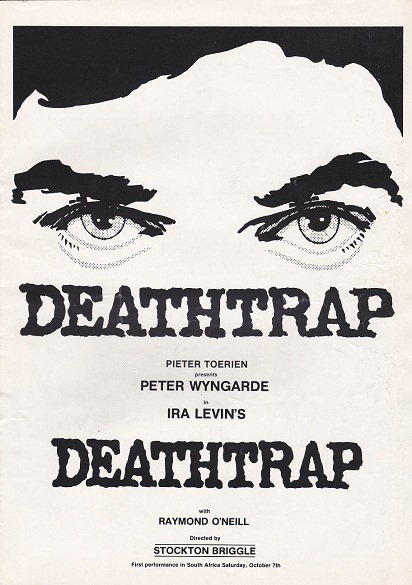
Presented by Pieter Toerien by arrangement with Bret Adams, African Tour – 1978
Character: Sidney Bruhl
The action takes place in Sidney Bruhl’s study in the Bruhl home in Westport, Connecticut
Act I
Scene One: An afternoon in October
Scene Two: That evening
Scene Three: Two hours later
Act II
Scene One: Two weeks later, morning
Scene Two: A week later, night
Scene Three: A week later, afternoon
Above: Peter with producer, Pieter Toeien, and director, Stockton Briggle
Some Background
‘Deathtrap’ was written in 1978 by Ira Levin, and is a play within a play.
The comedy-drama was first performed in Boston in February, 1978, and thereafter moved to the Biltmore Theatre on Broadway. The production focused on here was one of the first stagings of Levin’s piece outside the United States.
In 1982, it was made into a film starring the late Christopher Reeve, Michael Caine and Dyan Cannon.
Alternating intrigue with humour, and throwing in more than one mind-reeling plot twist, Ira Levin’s ‘Deathtrap’ is a classic suspense thriller.
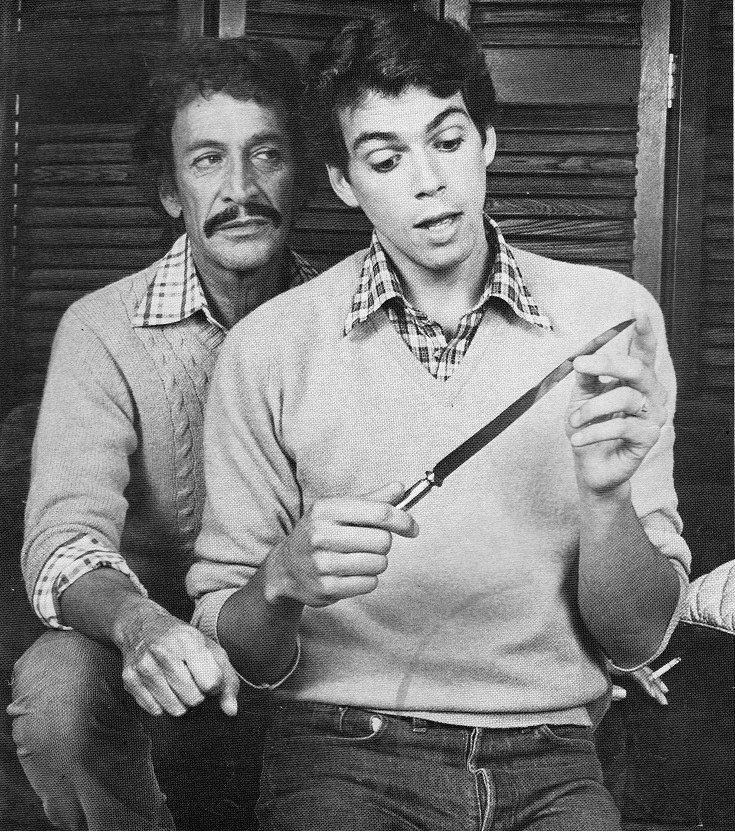
Below: Peter as Sidney Bruhl with Raymond O’Neill as Clifford Anderson
The play is both the epitome of the classic thriller, as well as a playful insider’s poke at the genre. “A thriller in two acts,” says Sidney of his protégé’s script at the opening curtain. “One set. Five characters. A juicy murder in Act One, unexpected developments in Act Two. Sound construction, good dialogue, laughs in the right places. Highly commercial.”
It’s an apt description of the play the audience is about to experience. Furthermore, as the narrative progresses, Levin continues to toy with references to his own play, within the context of Clifford’s script of the same name.
But Levin – nor Bruhl, for that matter! – invented the dramatic structure of the ideal thriller. Throughout the play, Levin cleverly alludes to the collection of other memorable thrillers to which Deathtrap belongs: Anthony Shaffer’s Sleuth, Dial “M” for Murder by Frederick Knott, Agatha Christie’s Witness for the Prosecution, and Angel Street by Patrick Hamilton, which Sidney credits with infecting him with thrilleritis malignis at the age of 15, the very same age at which Levin himself decided upon the career of a writer.
When multiple sets and many players mean mounting production costs, the advantages of a single set and limited cast are obvious. ‘Sleuth’, the play to which ‘Deathtrap’ is most often compared, took that theory to the extreme: Shaffer utilized a single set and only two actors to create one of the biggest hits of the 1970s, opening on Broadway in November 1970 and running for more than 1,100 performances. Its slim production costs, hardly at the expense of effective drama, are certainly one key to the show’s longevity. (Deathtrap, however, would beat Sleuth at its own game, running for nearly 1,800 shows later that decade).
The Story
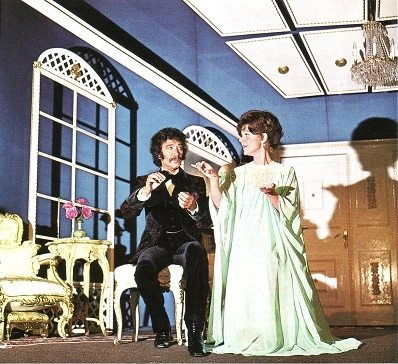
Sidney Bruhl (Peter Wyngarde) is a celebrated writer of Broadway thrillers who’s suffering through a dry spell. After a string of embarrassing flops, he’s spending time in his comfortable Westport, Connecticut, home with his nervously afflicted wife, Myra (Beryl Gordon), hoping to be touched with inspiration along the lines of that which resulted in The Murder Game, Sidney’s magnum opus.
To make Sidney’s slump all the more painful, Clifford Anderson (Raymond O’Neill), a student of one of Sidney’s writing seminars, has recently sent his mentor a copy of his first attempt at playwriting for Sidney’s review and advice. The play, ‘Deathtrap’, is a five character, two act thriller so perfect in its construction that, as Sidney says, “A gifted director couldn’t even hurt it.”
Using his penchant for plot, and out of his desperate desire to once again be the toast of Broadway, Sidney, along with Myra, cook up an almost unthinkable scheme: They’ll lure the would-be playwright to the Bruhl home, kill him, and market the sure-fire script as Sidney’s own.
But shortly after Clifford arrives, it’s clear that things are not what they seem. Indeed, even Helga Ten Dorp (Patricia Sanders), a nosey psychic from next door, admits that her visions appear correct only in part. When the mystic leaves, Sidney calms his wife by pointing out that only a fraction of what had been revealed was actually correct, and that the clairvoyant had not precisely recounted the murder of Clifford at all. It’s only then that Myra admits her own closet hope that Sidney would go through with his plan to kill the young writer and take his script.
On that note, the two get ready for bed when suddenly Clifford – who is covered from head to toe in mud, grabs Sidney from behind and beats him to death. Completely traumatized by what she’s just witness, Myra collapses and dies from heart-failure. Once Clifford has checked to ensure that the woman is indeed deceased, he announces to Sidney that their “plan” has been successful; the young man’s murder had clearly been staged to free Burhl from his wife.
Two weeks later, and Clifford has moved into the Burhl’s home. Sidney, meanwhile, is still struggling with writers block when his attorney, Porter Milgrim (Robin Dolton) tells him that he’d witnessed Clifford locking a manuscript he’s been working on into his desk drawer. Immediately, Sidney goes to the drawer where he discovers that Clifford has been working on a piece entitled ‘Deathtrap’, which is unmistakably based on the plot to instigate Myra’s death.
When he returns home, Sidney challenges Clifford, who exclaims that he will simply move out and continue working on the play should the older man continue to object. Reluctantly Sidney resolves to help write the play.
A short time later, Helga returns to the house to warn Sidney that Clifford is planning to harm him, so the playwright tells his lodger that he’s managed to finish the second act of the play, but needs to run it by him to make sure it’s convincing. Little does the young man know, but Sidney has contrived a plan to stop him writing about Myra’s slaying: by acting out the sections he’s completed, he hopes to kill Clifford and make it look as if he was merely defending himself.
Clifford, however, has anticipated this move, and has replaced the bullets in Sidney’s revolver with blanks. Unwittingly, Sidney has given his former accomplice the ending he needed for his play.
He now compels Sidney to handcuff himself to a chair. The ‘cuffs, though, are replicas and Sidney is soon able to make his escape, whereupon he mortally wounds Clifford with a crossbow. Convinced that Clifford is dead, Sidney telephones the police, but as he does so the young man clambers to his feet behind the playwright, and wrenching the arrow from his own body, he plunges it into Sidney. Both men drop to the ground, dead.
A week later, Helga contacts Porter Milgrim, and tells him what actually occurred at the Bruhl house through her visions.
The two instantly recognise what a first-rate story it would make if brought to the stage. But neither can agree over the finer points, and each of them begin to quarrel and intimidate the other over what financial gains might come from the play.
“Wyngarde’s sharply-etched performance was a triumph of acting, employing a Cheshire Cat grin and a look of self-satisfaction when tossing off a bon mot – of which ‘Dear Liar’ has many”.
The Story
As with most literary personalities, there’s been much written about George Bernard Shaw’s work. However, the average theatregoer would probably be unacquainted with the private concerns of the man who wrote ‘Pygmalion’ [1], and who won both a Nobel Prize for Literature and an Academy Award, but who, latterly, turned down a knighthood.
‘Dear Liar’ was written by Jerome Kilty in 1957, and was first performed on Broadway in 1960. In this production, American actress and founder of the Viennese English Theatre, Ruth Brinkmann, plays Mrs Campbell, with Peter Wyngarde as her testy paramour, George Bernard Shaw.
The play recounts the (purportedly) unconsummated affaire de plume between the playwright and actress that lasted for over forty years. As in the much more recent Vita & Virginia[2], ‘Dear Liar’ is what might be described as a “epistolary drama”, which involves the actors narrating and then reading aloud the letters exchanged between the characters.
Shaw was a prolific letter-writer, who traded correspondence with such luminaries as G.K. Chaterton, H.G. Welles and Michael Collins (amongst others), but it was Mrs Beatrice Sella Campbell, who proved to be his passion and muse.
There is little doubt that Kilty did a stellar job in entwining the innumerable strands of the story, and the two actors were skilful and polished; injecting spirit and vitality into both figures.
Portraying the sophisticated and tasteful leading lady in ‘Dear Liar’ had become something of a formality for Ruth Brinkmann by the time she and Peter took to the stage in 1976, having played her at the English Theatre several times during the 1960’s and early 70’s [3] – on each occasion being directed by her husband, Franz. Of particular note in Brinkmann’s performance was her comical depiction of Mrs Campbell playing Eliza Doolittle [4] to Shaw’s Professor Henry Higgins; endeavouring to transmute her voice from that of a native of Kensington into that of a Covent Garden flower girl. With gusto Brinkmann, as the theatrical diva, shrieked and squawked through her lines as she prepared for the part while Peter, as Shaw, grumbled, bullied and criticised the demoralised actress.
For his depiction of the egocentric writer, Peter, decided to forgo the familiar grey-whiskered appearance most familiar of Shaw, instead he opted to keep the droopy Jason King moustache and cascade of dark brown curls in which to play the influential playwright and theatre critic. The wearing of a pair of half-moon spectacles in the second half of the play was the only compromise he made to indicate the passage of time. Nevertheless, he offered a fiery performance; at times roaring his thoughts, feelings and contradictions both passionately and enthusiastically, and portraying the dramatist as both self-centred and yet caring.
The letters that were exchanged between the two were filled with wordplay, vitality and, sometimes, acrimony. The two discussed art, philosophy and politics, alongside their own hopes and dreams. As an actor, Peter has always been adept at briskly moving from enthusiastic rough-and-tumble to passionate feeling – as he was required to do when reading news of Campbell’s son, who’d fought in the Great War, or when discussing something more frivolous. It was these sharp mood changes that disclose the understanding that lay beneath Shaw’s hot-headedness and petulance. Peter also managed to control Shaw’s brisk patois commendably, too, whilst rapidly firing off the scribes impatient histrionics as surly as if he’d penned them himself.
The simplistic stage backdrop ensured that all attention remained, quite rightly, remained on the two players. The only furniture was two wooden chairs, though the tea cups, lamps and paperweight were imagined.
Whilst the letters between the two were alive with deep thought, punch and often rancour, one was left with the feeling that there was a huge void across which neither Campbell nor Shaw could ever transcend. Clearly, both these individuals were far more absorbed by their own notions and feelings than they were with the others.
Theatre Notes
Beatrice Sella Campbell was not only one of the greatest English actresses at the beginning of the Century but was, for decades, an intimate soulmate of playwright, George Bernard Shaw. Jerome Kilty dramatized the sometimes very active correspondence to create a highly successful collage of correspondence:
‘Dear Liar’ is a piece of theatrical history, but above all a mosaic of the intimate relationship of two great theatrical personalities. This summer sees the fourth production of ‘Dear Liar’, again under the skilled direction of Franz Schaffranek. Ruth Brinkmann again plays Stella excellent as an actress at the height of her triumphs. Evidently capable of taming the shrewish, egocentric Shaw.
Peter Wyngarde, who achieved international fame since appearing in 53 countries as the dandified agent Jason King in the TV series, Department S, does not resemble Shaw in appearance, only in his Emerald isle dialect, and bring the dramatic monument down from his pedestal, showing Shaw the man, with all his weaknesses. Particularly moving his relation of the cremation of his mother, and uproariously funny is the ‘Pygmalion’ rehearsal. Without doubt, this ‘Dear Liar’ is another feather in the English Theatre’s cap.
Wiener Zeitung
By Johann Werfring
When the young New Yorker actress Ruth Brinkmann planned a three-day stay in Vienna in 1959, this should have a lasting impact on the cultural life of the Austrian federal capital. On the very day she arrived, she witnessed the theatrical performance of Schnitzler’s “Das weite Land” with Paula Wessely. “In a city where you play such a theater, I would like to stay,” she thought to herself, as she later explained in a newspaper interview.
Shortly thereafter, the well-traveled tourist at the Café Hawelka in Vienna’s inner city met the now legendary poet H. C. Artmann, who introduced her to a young director of the Burgtheater in Vienna, to whom she gave the answer a year later: Franz Schafranek.
In 1963, they performed the first production with Jerome Kilty’s “Dear Liar”. With Ruth Brinkmann’s “Dear Liar” partner Anthony Steel, there was a powerful name. Everything went well, and as a result not only Viennese-speaking Viennese tourists, but also Viennese more and more arose in the performances.
Of course the first time had not been a honey lick. At first Franz Schafranek, the director, distributed copied notes during the day and sat at the cash desk in the evening. But the hard work was worth it, because the artistic professionalism gained not only in the country itself but also internationally high recognition.
From 1974, Vienna’s English Theater was a permanent venue in Josefsgasse in Josefstadt. Numerous stars, including Joan Fontaine, Anthony Quinn, Leslie Nielsen, Linda Gray, Larry Hagman, and Gracia Patricia of Monaco, have been successful. Peter Wyngarde, also known as “Jason King”, worked with “Dear Liar” in 1977.
Also the “School tours”, which currently bring hundreds of performances to 250,000 pupils all over Austria, contributed to the fact that the theater became an Austrian “institution”. In the meantime, Julia Schafranek, daughter of the two founders, has been very successful.
Notes:
[1] The film ‘My Fair Lady’ is based on the play, ‘Pygmalion’. [2] ‘Vita & Virginia’ (1992). A drama based on the correspondence between Vita Sackville-West and Virginia Woolf. [3] 1963, 1972, 1973, and 1974. [4] Campbell played Eliza Doolittle in ‘Pygmalion’, which premiered at His Majesties Theatre, London, on 11 April, 1914.
Presented by Ashway Productions Ltd., in association with The Laurence Parness Organisation Ltd. British tour, Summer/Autumn 1976
Character: Prince Bounine
The Story
The action takes place in the Reception Room of Prince Bounine’s mansion in the outskirts of Berlin.
Act I: A January Evening
Act II: An afternoon one weeks later
Act III: An afternoon two weeks later
The play tells the story of a group of unscrupulous Russian exiles: the Tzar’s former aide-de-camp Prince Bounine (Peter Wyngarde) – artist Piotr Petrovsky (David Griffin), and banker, Boris Adreivich Chernov (David Nettheim), decide to exploit Anna Broun (Nyree Dawn Porter), when she claims to be Princess.
The men decide to form a consortium to raise funds amongst the exiled White Russian community to provide backing for ‘Anastasia’ to reclaim a inheritance of over £3,000,000, which the syndicate plan to share between themselves. Their main concern is to convince the Court in Exile – and especially the Dowager Empress Marie (Elspeth March), the Tsar’s mother.
As speculation concerning the Princess begins to spread across Europe, there is no shortage of subscribers willing to aid the conspirators and the young woman who, there is little doubt, bears a striking resemblance to the long-lost Anastasia.
Right: Peter as Prince Bounine with Nyree Dawn Porter as Anastasia
Matters take an unexpected turn when the Prince Bounine and his accomplices begin to realise that Anne might actually be the real deal.
Obviously traumatised by the machinations of the three accomplices, ‘Anastasia’ reaches out to to in a catatonic trance the Dowager Empress who, aware of the men’s deception, answers with her own yearnings and wishful thinking. Self and reality are whatever we want them to be, it would seem, and all untrustworthy, unsound and brittle.
Anastasia Enigma
In 1918, the Grand Duchess Anastasia Nikolaevna of Russia and the rest of the ruling Romonov family, were reported massacred by Bolshevik Bolshevik Red Guards in Ekaterinburg, and controversy thereafter raged as to whether the 17-year-old Duchess escaped death and was smuggled out of Russia.
The tragic events leading up to the assassination of the last Tsar of Russia are well recorded in history. The young Tsarevich Alexis – only son of the Tsar Nicholas and the Empress Alexandra, was an haemophiliac; a genetic disease inherited through the line of his Great Grandmother, Queen Victoria, and his suffering caused the Empress to turn to Rasputin; a wandering holy man. Through his hypnotic powers, Rasputin could elevate her son’s pain. The tremendous hold that the mystic had over the Empress was one of the major factors that led to the Revolution. The Tsar was naïve, ill-advised and believed wholeheartedly in the autocracy. When the country asked for reform and a sharing of the Imperial power with a more responsible government, the Tsar, influenced by Alexandra and Rasputin, refused and revolution was inevitable.
The Revolution in 1917 culminated in the downfall of the fabulously wealthy Romanov dynasty. In 1918 Nicholas and Alexandra, their daughters Olga, Tatiana, Marie and Anastasia, and the Tsarevich Alexis were imprisoned at Ekalerinburg. It is reported that on the night of July 16th the entire family, along with four retainers and a pet spaniel, were shot and bayonetted to death and their bodies disposed of in a disused mine shaft.
However, over the years there have been a number of claimants to the title of the Grand Duchess Anastasia; heiress to a vast fortune, and the rumours persist that the young Anastasia miraculously escaped the massacre and was smuggled out of Russia by sympatisers. One of the most famous of these was Anna Broun, also known as Anna Anderson, who was the only woman who tried legally to establish herself as the legitimate heiress to the Romanov legacy. her case was finally dismissed in the German courts in 1967.
Nyree Dawn porter who played Anna Broun in this play, said at the time that she had an open mind on the subject. During her research for the role she’d come across an out-of-print book entitled, ‘I Am Anastasia’, that had been written by Broun. She said she found the story intriguing. “When I first heard the story, I thought she must’ve been a charlatan,” Ms Porter said. “Then I read the book and found myself completely bemused, There are so many factors to think about. Anna had a schizophrenic side to her character – she had to find herself. She’s not nice, but she wasn’t insane. And is she wasn’t Anastasia it was a long time to live a lie. The play is very close to what really happened. The characters are fact, though some have been given different names and a certain amount of dramatic licence has been taken”.
Peter, who portrayed Prince Bounine in the play, shares Ms Porter’s views on Anna Broun. “I haven’t got an answer to it at all,” he says. “But I’m fascinated by certain aspects of the story – the fact, for instance, that Anna could not or would not speak Russian when she was first found., though it later turned out that she spoke the language fluently. Also that the claims for the Tsar’s money were suddenly dropped and nobody has made a claim since, even though there’s a great deal of money involved. In 1912, the Tsar was the richest man in the world”.
Such an intriguing and romantic mystery is an obvious subject for dramatization. A film version of ‘Anastasia’ was made in 1956 starring Ingrid Bergman and Yul Brynner as Anna and prince Bounine, and in 1971, Kenneth McMillan created a full-length ballet about Anastasia for Lynn Seymour and the Royal Ballet. More recently, a musical version became a box office hit on Broadway. This particular play was adapted by Guy Bolton from the French novel by Marcelle Maurette.
At the time that this play was touring the UK, there was a chance that the Anastasia legend might have a sequel. In ‘The File on the Tsar’ (Gollancz) – a book published in the mid-1970’s by Tom Mangold and Anthony Summers, new evidence was brought to light, suggesting that other members of the Romanov family may’ve survived. One fact is certain – the Anastasia enigma will continue to be of enduring appeal and interest.
Actor David Nettheim on working with Peter in ‘Anastasia’:
“Peter Wyngarde was really an outrageous character. You couldn’t believe the clothes he wore. We played a West End season at the Cambridge Theatre. He played the principal lead character, which Yul Brynner played and which I played before Yul Brynner at the very first season – at four days’ notice I might add, but that’s another story. Peter was flamboyant and didn’t like the designs for his costumes when he saw them on paper. He didn’t say anything, went off and engaged a designer to design all his uniforms, which looked over-the-top!”
Actually, both Peter’s uniform, and the costumes worn by Elspeth March, were designed by Alan Sievewright! And you wonder how these ridiculous stories begin….
A bit of Trivia
Peterhad previously worked with Nyree Dawn Porter and Elspith March in ‘The Duel’ at the Duke of York’s, London, in 1968, and with Ms March in ‘Underground’ – National British tour, 1983.
This play is extremely difficult to review, given that it’s not only based on true events, but the dialogue is taken, word-for-word, from actual court records which are well documented elsewhere. Nevertheless….
A Bit Of Background
‘On Trial’ was a series of 60-minute reconstructions of famous British trials produced by Peter Wildeblood for Granada TV in Manchester. The premise of this detailed and brilliantly executed set of plays was to present them in documentary-style form, complete with external narrator – Andrew Faulds and commentator, Brian Ingis. It could be said that the series was a precursor to the kind of programmes that became popular on British TV thereafter, such as ‘Crown Court’ (1972-1984).
The series opener was ‘Sir Roger Casement’ – the play focused on here. The 10-epiode run continued with the trials of other illustrious and/or notorious personages (depending on your point-of-view), that included Oscar Wilde, and Sir Charles Dilke.
Historical Facts
Roger David Casement was born in Dublin, Ireland, on 1st September, 1864. After becoming a member of the British Diplomatic Corps. he was hailed a national hero for his activities in both South America and Africa.
At the turn of the 20th century, Casement was assigned to what was then the Belgian Congo, where he was instrumental in exposing the pitiless and exploitative practices used upon the indigenous peoples by Leopold II – King of Belgium, who plundered the colonies rich mineral deposits for his own personal gain.
Casement was instrumental in bringing this this outrage to the ears and eyes of the world, forcing Leopold to surrender the whole of the Dependency to his nation. Alas, this move did little to improve the lot of the population.
On his return from the Congo, Casement was directly assigned to a posting in Peru, where he was to find that similar crimes were being committed to those in Africa. He worked tirelessly to bring the plight of the people to the attention of the world’s governments and, in 1911, was rewarded for his humanitarian work with a knighthood.
The Play and the story behind it
A realistic and skillfully edited reconstruction of the trial of Sir Roger Casement for High Treason, opened a new series entitled ‘On Trial’ for Independent Television on Friday, July 8th, 1960. The case itself was an interesting and notorious one, although much more for its aftermath than for the matter for which Casement actually stood trial.
The story told through this play is of the trial of Sir Roger David Casement in 1916 for High Treason. The events that lead to this point were as follows:
It was on Good Friday of 1916, when the First World War was at its height, that Sir Roger Casement was arrested after landing from a German U-Boat on the Irish coast. His trial for treason, overshadowed by the existence of his notorious private diaries, was one of the most sensational in British history. The last of the great state trials at bar, Casement’s trial is still of enduring interest to lawyers, but since his counsel, Sergeant Alexander Sullivan, declined to put him into the witness box, the four-day trial in the court of the Lord Chief Justice in June of 1916, lacked the cut-and-thrust which marked Sir Edward Carson’s cross examination of Oscar Wilde.
_________________
As the first shots of World War I were being fired, Dublin-born Casement made had his way to Wilhekmine in Germany, where he’d proffered both his skills and knowledge to the Kaiser in return for his backing in freeing Ireland from British rule. An agreement was struck, and Casement was returned to the coast of Eire in a U-boat.
The idea was that Casement would play a leading part in the Easter Uprising, where he was to distribute a consignment of arms to the rebels. However, the handover failed and casement was captured and detained by the British.
As a result of what the British government saw as a major betrayal, Casement was stripped of his Knighthood and charged with treason. Numerous well-known personalities came to Casement’s defence – including such luminaries as Gilbert Chesterton, Arthur Conan Doyle Edmund Morel and George Bernard Shaw – who suggested that the Accused must’ve suffered some sort of mental aberration to have carried out such an act of “evil” against the State, although their well-meaning interfering was not welcomed by Casement, who resented the implication that he was mentally ill.
Fortuitously for the Government, Scotland Yard supremo, Sir Basil Thompson, happened upon a much bigger stick with which to beat Casement with in the form of the infamous ‘Black Diaries’; a set of journals in which the Irishman had kept detailed account of his sexual encounters and homoerotic fantasies whilst in service to the Crown. The authorities ensured that copies of the Diaries were distributed widely enough to ensure that the growing appeals for leniency were quickly suppressed. Casement was hung at Pentonville Prison on 3rd August, 1916.
Peter’s Performance
This wasn’t Peter’s first daring role, having played exiled Polish officer, Lieutenant Jan Wicziewsky in Granada’s production of Julien Green’s ‘South’ in November 1959.
The play concentrates on the moments of high drama: the collapse of Sullivan at the end of the third day; Casement’s speech from the dock; the solemnity of the three judges, each wearing a black cap passing the death sentence. Although he had little dialogue during the first 50 minutes of the play, the jewel in the crown of this production is undoubtedly Casement’s ‘Closing Speech’, which was spoken in its entirety byPeterwho, at the age of just 27, played the 51-year-old Irishman with exceptional dignity and restraint. His performance in the title role; convincingly suggesting that Casement, sitting scribbling furiously or quizzically listening from the dock, dominated the proceedings, and his final scene was exceptionally moving.
The Speech
“My Lord Chief Justice, as I wish to reach a much wider audience than I see before me here, I intend to read all that I propose to say. What I shall read now is something I wrote more than twenty days ago. I may say, my lord, at once, that I protest against the jurisdiction of this Court in my case on this charge, and the argument that I am now going to read is addressed not to this Court, but to my own countrymen.
With all respect I assert this Court is to me, an Irishman, not a jury of my peers to try me in this vital issue for it is patent to every man of conscience that I have a right, an indefeasible right, if tried at all, under this Statute of high treason, to be tried in Ireland, before an Irish Court and by an Irish jury. This Court, this jury, the public opinion of this country, England, cannot but be prejudiced in varying degree against me, most of all in time of war.
I did not land in England; I landed in Ireland. It was to Ireland I came; to Ireland I wanted to come; and the last place I desired to land in was England. But for the Attorney General of England there is only “England”—is no Ireland, there is only the law of England—no right of Ireland; the liberty of Ireland and of Irish is to be judged by the power of England. Yet for me, the Irish outlaw, there is a land of Ireland, a right of Ireland, and a charter for all Irishmen to appeal to, in the last resort, a charter that even the very statutes of England itself cannot deprive us of—nay, more, a charter that Englishmen themselves assert as the fundamental bond of law that connects the two kingdoms.
This charge of high treason involves a moral responsibility, as the very terms of the indictment against myself recite, inasmuch as I committed the acts I am charged with, to the “evil example of others in the like case.” What was this “evil example” I set to others in “the like case,” and who were these others? The “evil example” charged is that I asserted the rights of my own country, and the “others” I appealed to aid my endeavour were my own countrymen.
The example was given not to Englishmen but to Irishmen, and the “like case” can never arise in England, but only in Ireland. To Englishmen I set no evil example, for I made no appeal to them. I asked no Englishman to help me. I asked Irishmen to fight for their rights. The “evil example” was only to other Irishmen who might come after me, and in “like case” seek to do as I did. How, then, since neither my example nor my appeal was addressed to Englishmen, can I be rightfully tried by them? If I did wrong in making that appeal to Irishmen to join with me in an effort to fight for Ireland, it is by Irishmen, and by them alone, I can be rightfully judged.
From this Court and its jurisdiction I appeal to those I am alleged to have wronged, and to those I am alleged to have injured by my “evil example,” and claim that they alone are competent to decide my guilt or my innocence. If they find me guilty, the statute may affix the penalty, but the statute does not override or annul my right to seek judgment at their hands.
This is so fundamental a right, so natural a right, so obvious a right, that it is clear the Crown were aware of it when they brought me by force and by stealth from Ireland to this country. It was not I who landed in England, but the Crown who dragged me here, away from my own country to which I had turned with a price upon my head, away from my own countrymen whose loyalty is not in doubt, and safe from the judgment of my peers whose judgment I do not shrink from. I admit no other judgment but theirs. I accept no verdict save at their hands. I assert from this dock that I am being tried here, not because it is just, but because it is unjust. Place me before a jury of my own countrymen, be it Protestant or Catholic, Unionist or Nationalist, Sinn Feineach or Orangemen, and I shall accept the verdict and bow to the statute and all its penal ties. But I shall accept no meaner finding against me than that of those whose loyalty I endanger by my example and to whom alone I made appeal. If they adjudge me guilty, then guilty I am. It is not I who am afraid of their verdict; it is the Crown. If this be not so, why fear the test? I fear it not. I demand it as my right.
That, my lord, is the condemnation of English rule, of English-made law, of English Government in Ireland, that it dare not rest on the will of the Irish people, but it exists in defiance of their will—that it is a rule derived not from right, but from conquest. Conquest, my lord, gives no title, and if it exists over the body, it fails over the mind. It can exert no empire over men’s reason and judgment and affections; and it is from this law of conquest without title to the reason, judgment, and affection of my own countrymen that I appeal. I would add that the generous expressions of sympathy extended me from many quarters, particularly from America, have touched me very much. In that country, as in my own I am sure my motives are understood and not misjudged for the achievement of their liberties has been an abiding inspiration to Irishmen and to all men elsewhere rightly struggling to be free in like cause.
My Lord Chief Justice, if I may continue, I am not called upon, I conceive, to say anything in answer to the inquiry your lordship has addressed to me why Sentence should not be passed upon me. Since I do not admit any verdict in this Court, I cannot, my lord, admit the fitness of the sentence that of necessity must follow it from this Court. I hope I shall be acquitted of presumption if I say that the Court I see before me now is not this High Court of Justice of England, but a far greater, a far higher, a far older assemblage of justices—that of the people of Ireland. Since in the acts which have led to this trial it was the people of Ireland I sought to serve—and them alone—I leave my judgment and my sentence in their hands…
My counsel has referred to the Ulster Volunteer movement, and I will not touch at length upon that ground save only to say this, that neither I nor any of the leaders of the Irish Volunteers who were founded in Dublin in November, 1913, had quarrel with the Ulster Volunteers as such, who were born a year earlier. Our movement was not directed against them, but against the men who misused and misdirected the courage, the sincerity and the local patriotism of the men of the north of Ireland. On the contrary, we welcomed the coming of the Ulster Volunteers, even while we deprecated the aims and intentions of those Englishmen who sought to pervert to an English party use—to the mean purposes of their own bid for place and power in England—the armed activities of simple Irishmen. We aimed at winning the Ulster Volunteers to the cause of a united Ireland. We aimed at uniting all Irishmen in a natural and national bond of cohesion based on mutual self-respect. Our hope was a natural one, and if left to ourselves, not hard to accomplish. If external influences of disintegration would but leave us alone, we were sure that Nature itself must bring us together.
How did the Irish Volunteers meet the incitements of civil war that were uttered by the party of law and order in England when they saw the prospect of deriving political profit to themselves from bloodshed among Irishmen? I can answer for my own acts and speeches. While one English party was responsible for preaching a doctrine of hatred designed to bring about civil war in Ireland, the other, and that the party in power, took no active steps to restrain a propaganda that found its advocates in the Army, Navy, and Privy Council—in the Houses of Parliament and in the State Church—a propaganda the methods of whose expression were so “grossly illegal and utterly unconstitutional” that even the Lord Chancellor of England could find only words and no repressive action to apply to them. Since lawlessness sat in high places in England and laughed at the law as at the custodians of the law, what wonder was it that Irishmen should refuse to accept the verbal protestations of an English Lord Chancellor as a sufficient safe guard for their lives and their liberties? I know not how all my colleagues on the Volunteer Committee in Dublin reviewed the growing menace, but those with whom I was in closest co-operation redoubled, in face of these threats from without, our efforts to unite all Irishmen from within. Our appeals were made to Protestant and Unionist as much almost as to Catholic and Nationalist Irishmen.
We hoped that by the exhibition of affection and good will on our part towards our political opponents in Ireland we should yet succeed in winning them from the side of an English party whose sole interest in our country lay in its oppression in the past, and in the present in its degradation to the mean and narrow needs of their political animosities. It is true that they based their actions, so they averred, on ‘‘fears for the Empire’’ and on a very diffuse loyally that took in all the people of the Empire, save only the Irish. That blessed word “Empire” that bears so paradoxical a resemblance to charity! For if charity begins at home, “Empire” means in other men’s homes and both may cover a multitude of sins. I for one was determined that Ireland was much more to me than “Empire,” and that if charity begins at home so must loyalty.
Since arms were so necessary to make our organisation a reality, and to give to the minds of Irishmen, menaced with the most outrageous threats, a sense of security, it was our bounden duty to get arms before all else.
We have been told, we have been asked to hope, that after this war Ireland will get Home Rule, as a reward for the life-blood shed in a cause which whoever else its success may benefit can surely not benefit Ireland. And what will Home Rule be in return for what its vague promise has taken and still hopes to take away from Ireland? It is not necessary to climb the painful stairs of Irish history—that treadmill of a nation whose labours are in vain for her own uplifting as the convict’s exertions are for his redemption—to review the long list of British promises made only to be broken—of Irish hopes raised only to be dashed to the ground. Home Rule when it comes, if come it does, will find an Ireland drained of all that is vital to its very existence—unless it be that unquenchable hope we build on the graves of the dead.
We are told that if Irishmen go by the thousand to
die, not for Ireland, but for Flanders, for Belgium, for a patch of sand on the deserts of Mesopotamia, or a rocky trench on the heights of Gallipoli, they are winning self-government for Ireland. But if they dare to lay down their lives on their native soil, if they dare to dream even that freedom can be won only at home by men resolved to fight for it there, then they are traitors to their country, and their dream and their deaths alike are phases of a dishonourable fantasy.
But history is not so recorded in other lands. In Ireland alone in this twentieth century is loyalty held to be a crime. If loyalty be something less than love and more than law, then we have had enough of such loyalty for Ireland or Irishmen. If we are to be indicted as criminals, to be shot as murderers, to be imprisoned as convicts because our offence is that we love Ireland more than we value our lives, then I know not what virtue resides in any offer of self-government held out to brave men on such terms. Self-government is our right, a thing born in us at birth; a thing no more to be doled out to us or withheld from us by another people than the right to life itself—than the right to feel the sun or smell the flowers or to love our kind. It is only from the convict these things are withheld for crime committed and proven—and Ireland that has wronged no man, that has injured no land, that has sought no dominion, over others—Ireland is treated to-day among the nations of the world as if she were a convicted criminal.
If it be treason to fight against such an unnatural fate as this, then I am proud to be a rebel, and shall cling to my “rebellion” with the last drop of my blood. If there be no right of rebellion against a state of things that no savage tribe would endure without resistance, then I am sure that it is better for man to fight and die without right than to live in such a state of right as this. Where all your rights become only an accumulated wrong; where men must beg with bated breath for leave to subsist in their own land, to think their own thoughts, to sing their own songs, to garner the fruits of their own labours—and even while they beg, to see things inexorably withdrawn from them—then surely it is a braver, a saner and a truer thing, to be a rebel in act and deed against such circumstances as these than tamely to accept it as the natural lot of men.
My lord, I have done. Gentlemen of the jury, I wish to thank you for your verdict. I hope you will not take amiss what I said, or think that I made any imputation upon your truthfulness or your integrity when I spoke and said that this was not a trial by my peers. I maintain that I have a natural right to be tried in that natural jurisdiction, Ireland my own country, and I would put it to you, how would you feel in the converse case, or rather how would all men here feel in the converse case, if an Englishman had landed here in England and the Crown or the Government, for its own purposes, had conveyed him secretly from England to Ireland under a false name, committed him to prison under a false name, and brought him before a tribunal in Ireland under a statute which they knew involved a trial before an Irish jury? How would you feel yourselves as Englishmen if that man was to be submitted to trial by jury in a land inflamed against him and believing him to be a criminal, when his only crime was that he had cared for England more than for Ireland?”
A Bit Of Trivia
Mention of the infamous ‘Black Diaries’ was made only in passing at the end of the play by the Narrator, in spite of their coming into the public domain around the time that the play was broadcast.
Producer, Peter Wildeblood, played a major part in the decriminalising of Homosexuality in the United Kingdom, having been one of only three gay men to appear before the Wolfenden Committee [1]. He himself had been arrested and sent to Wormwood Scrubs in the 1950’s for his part in the Montagu Case [2]. His 1955 memoir, ‘Against the Law’, was adapted by the BBC into a documentary in 1967.
[1]. Departmental committee set up by the British government under Sir John Wolfenden that recommended the decriminalisation of homosexuality in the UK.
[2]. Lord Edward Douglas-Scott, 3rd Baron Montagu of Beaulieu (1926-2015), who was put on trial in the mid-1950’s for Gross Indecency.