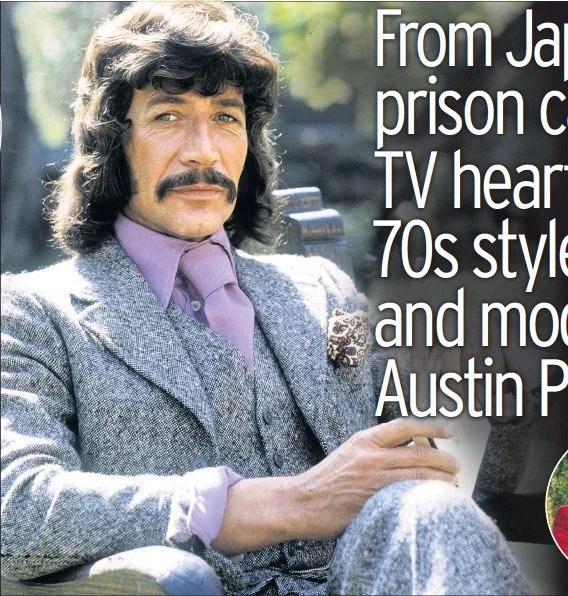
A STYLE legend to the end, actor Peter Wyngarde was still laying down the law on fashion from his hospital bed in his final days. The Jason King star, whose medallion man dress sense ruled the 1970s and helped spawn Austin Powers, remained adamant that a shirt collar should always remain unbuttoned.
But beyond the sideburns, chest hair, lapels and moustache was the sharp mind of a former inmate of a Japanese prison camp whose life was as eventful as any of the shows he starred in.
After Peter died on Monday, aged 90, manager Thomas Bowington said: “Peter was one of the most unique, original and creative actors that I have ever seen.
“There were few things in life he didn’t know. I sometimes called him the King because he simply knew everything.
“He was a mentor on everything, from sports cars to how to make a good cup of tea and how to do a tie and shirt.
“Even in hospital he was saying that you shouldn’t button the upper button on a shirt. He was the most exceptional person I met in my life and a great mentor and teacher.”
Peter’s real name, the date and place of his birth and his parents’ nationalities and occupations are unclear.
But the most commonly accepted story is that he was born Cyril Goldbert at his aunt’s home in Marseilles in 1927.
His parents split and his dad – believed to have been a British diplomat – took him to Shanghai in 1937, months before war broke out between China and Japan.
Peter was imprisoned by the Japanese invaders aged 16 in 1943, possibly having been mistaken for his father, who was away working and had left Peter with a neighbouring Swiss family.
He once recalled: “I was herded into a truck for an internment camp for civilians about 40 miles outside Shanghai.
“All the other children were members of British families, but I was alone.”
He spent the rest of the war as a Japanese prisoner alongside novelist JG Ballard, who later wrote Empire of the Sun about their experiences. Peter
became a runner in the camp, passing news to inmates in neighbouring huts, until he was caught. As punishment a guard broke both his feet with a rifle butt and he had four weeks in solitary confinement. But he continued to pass on coded messages in plays staged in the prison canteen. He said: “The main character, Macbeth, was Churchill. “Some important news event, like the D-Day Landings, would become, ‘Our heroes have arrived among the Gauls and taken over Brittany.” At the end of the war he sailed to Liverpool, where the prisoners were welcomed home by King George VI, who shook Peter’s hand – and, he later claimed, pinned a medal on his chest.
The malnourished teen was sent to a sanatorium in Switzerland to recover. On his return he studied law at Oxford University for three months, before winning a place at RADA.
There he trained as an actor alongside Albert Finney, Peter O’Toole and Alan Bates – who became his flatmate.
One of his first small film roles put him alongside Bette Davis, who asked to see him between shoots.
He said: “She had a cigarette in a holder. From behind a huge plume of smoke I heard her snarl, “I hear you have a big c**k”. And with that, she handed me a note: ‘Be here at 8.30!’
“It had the address of her hotel and the room number. Apparently she went through every actor and technician under the age of 25 at the studio.”
Peter was in 1956 film Alexander the Great with Richard Burton, and in
the 1960s appeared in The Avengers and The Saint. But his big break came in 1969 when he got the role of novelist-turned-detective Jason King in spy series Department S.
His character was written as a deskbound Oxford professor, but Peter had other ideas. He said: “I thought it was a bit dull.
“I had the bright idea of basing him on Ian Fleming. The clothes were sort of an extension of me. I’d go to the tailor with my designs. I was a bit of a peacock.”
His wide-lapelled three-piece suits, turned-back cuffs and matching shirt-and-tie combos helped inspire Mike Myers’ spoof spy Austin Powers.
Peter became a heart-throb and style-setter, once beating Cliff Richard and George Best to be crowned Britain’s best-dressed man.
Soon he was the star of his own spin-off show, Jason King, with love interests played by actresses including Kate O’Mara, Felicity Kendal and Stephanie Beacham.
Peter said of them: “They were the television equivalent of a Bond girl.”
He told how he “fell in love with” Felicity on her first day, saying: “She is and was one of the most attractive things around.”
He enjoyed a brief music career, but his 1970 spoken-word album When Sex Leers Its Inquisitive Head, including a single entitled Rape, was branded “inappropriate” and withdrawn from sale after four days. It did not dent his popularity, though, and in Australia he was mobbed by 30,000 female fans at Sydney Airport.
But Peter’s career was destroyed after he was convicted of “gross indecency” with a lorry driver in the toilets of Gloucester bus station in 1975. Married to actress Dorinda Stevens for three years in the 1950s, Peter said he was straight and denied claims of a relationship with Alan Bates. He said: “I’ve never had any doubt about my sexuality. I’m mad about women.”
But he disappeared from television and battled alcoholism, admitting later: “I drank myself to a standstill.”
After quitting booze he made a comeback in the 1980s, in Doctor Who: The Planet of Fire, and as General Klytus in Flash Gordon.
Manager Mr Bowington said the star continued working until the end and had several roles and appearances lined up before he passed away.
But he never returned to the peak of his powers, and said his career was ruined by “small-minded people”.
He died at the Chelsea and Westminster Hospital in Central London having been ill for several months – an uncharacteristically ordinary end to a most extraordinary life.
Please note that some of the additional information provided here by the journalist named below may not be accurate, so it should be treated with caution.
Sunday, 19th December 1993
The distinguished British actor said Jason King had champagne and strawberries for breakfast, just as he did.
Jason King went from national idol to national joke the day the first narrow lapel was sold in Carnaby Street in 1977. It was for that reason, I was told when attempting to set up an interview, that Peter Wyngarde, the actor who played him, was wary of meeting the press. All we ever talked about was Jason King, the kipper-tied, crushed-velveted, flared-trousered, ridiculous star of ITV’s Seventies detective series Department S. Wyngarde, it was explained to me, was a classical actor of many parts.
Given this warning, and the fact it is about a thousand years since Department S, I hadn’t expected even to recognise Wyngarde. Imagine my surprise, then, when I spot at the other end of the hotel where we are to lunch – Jason King, complete with a scaled-down version of the Zapata moustache, a raw silk shirt and a flash suit. The toll the years have taken (he claims not to know his age but it must be 60-odd) only becomes apparent when he removes his fedora to reveal a dramatic reduction in the bouffant.
‘I decided Jason King was going to be an extension of me,’ he says over his dietetically-correct lunch. ‘I was not going to have a superimposed personality. I was inclined to be a bit of a dandy, used to go to the tailor with my designs. And my hair was long because I had been in this Chekhov play, The Duel, at the Duke of York’s.’
The pilot of Department S was reshown, firmly within inverted commas, by BBC 2 on August Bank Holiday. A previewer brilliantly described a typical plot as having King drive his Rolls to a country mansion occupied by a mad colonel and mini-skirted daughter, drink a bottle of claret, smoke 50 cigarettes, and flirt with the daughter before arresting everybody. Not every detail is correct, however. Wyngarde points out it was a Bentley, not a Roller, and champagne, not claret.
Wyngarde boasts that he is the last of the matinee idols, an incurable romantic. He was married once, briefly, at the age of 22, and had a love affair with Vivien Leigh: wooing women has never been a problem. ‘My problem,’ he says, ‘is that they fall in love with Jason King and find I am really Dracula.’
Is he really Dracula?
‘I am, in a way, very sadistic. There is a sadistic streak in me, but I think women quite like it. You have got to be tough with them, really tough and then they love you for it. Treat them with any amount of charm, that’s how you start – then you throw off the frock coat and put on the bearskin. I love being the caveman. The reason I think I am sadistic is that men have a side that hates their mothers. Having so many women is a revenge against your mother.’
He was taken from his mother when he was tiny. She was, he says, beautiful, a Claudette Colbert lookalike and racing driver, ‘quite a gel and chased by men all over the place’. His father, a diplomat, divorced her and took Peter with him to China only months before war with Japan broke out. While separated from him, Wyngarde was captured and taken to the same internment camp as J. G. Ballard. The alternative explanation for his ‘sadism’ lies there, in Lung-hui. He has an indelible memory of two adults fighting over a quarter inch of ribbon fish.
Back in England, after public school and the briefest period reading law at Oxford, he began acting in rep. By his account, his was a prodigious but unreliable talent. One day, having just seen Rebecca at the cinema, he played the racket-swinging juvenile lead in a drawing-room comedy in the style of a moody Olivier: ‘All the other actors thought I’d gone mad and I was sacked.’ On another occasion, in a Somerset Maugham play, he broke into a popular song of the time ‘A Room with a View’. He was sacked again. Nevertheless, he made it to the West End.
His stories, told the long way round, present him as more misunderstood than misunderstanding. He lost the lead in a production of King John by telling the director how he should direct it. In St Joan he insisted that Shaw had missed Joan’s sexuality. Having been promised the title role in the film Alexander the Great, he lost out to Richard Burton and, compensated with a subsidiary part, was left on the cutting room floor when the studio objected to the homo-eroticism of their scene together.
Department S and the spin-off, Jason King, brought Wyngarde all the fame he could want, and then some. Voted by Australian women the man they most wanted an affair with, he arrived at Sydney airport in 1970 and was mobbed. ‘It was one of the most terrifying experiences I can remember. They got me to the ground, tore my clothes, debagged me and cut my hair off (he points downwards). I was in hospital for three days.’
Feeling he could take the part of Jason King no further, he left after two series. What happened next? Readers with sufficient memory will recall a trivial, but embarrassing, court conviction in 1975, an incident I have agreed not to dwell upon. He says only that it upset him deeply at the time, but that he does not feel it affected his career. In the late 1970s and 1980s his career nevertheless described a steep decline: small parts, small films, panto. He blames type-casting.
‘In the late 1970s the whole character had gone into a kind of icebox. He was still loved but he was no longer hot. But all the scripts called for Jason King. It was the lack of imagination of producers. And if you’re a perfectionist – horrible expression – which is what I am, producers don’t like it, because they are so mediocre.’
So how does he rate himself? ‘Extremely high. I mean why am I doing it if I don’t think it’s important?’
Wyngarde’s anecdotes not only exhaust my reserves of tape but stretch over two lunches. He is full of the future too. He has just filmed an episode of Granada’s Sherlock Holmes (his cameo was enthusiastically applauded when it was shown last month as part of the National Film Theatre’s Holmes season) and he wants to direct.
‘Someone said, ‘It’s so sad about you, Peter – if only you had said ‘yes’ more often’, he tells me over lunch number one. Peter Hall apparently once complained that Wyngarde ‘was not a company man’. I have no idea whether this is the real reason for his fall. And, likeable though he is, I doubt if Peter will ever be quite honest enough with himself to discover the true cause either.
Raise a glass of vintage port to late genre icon Peter Wyngarde. Salut! The late Peter Wyngarde always suited the outlandish. A carafe of vintage port in human form, he was a magnetic, flamboyant presence who seemed to live his life between inverted commas; too outsized to be contained by the real world but utterly at home in the imaginary. Certainly it’s his genre turns that made him an icon. In The Avengers episode “A Touch Of Brimstone” he’s John Cleverly Cartney, a bullwhip-snapping dandy who leads a resurrected Hellfire Club. “Checkmate” in The Prisoner casts him as a memorably sly Number Two, matching wits with Patrick McGoohan’s Number Six.
1980’s Flash Gordon hid his imperious, vulpine features behind the glittering mask of Klytus, kinkster-in-chief of planet Mongo and master of the royal bore worms. It was left to that majestically louche voice to stamp Wyngarde’s brand of gently decaying decadence on the role. 1961’s The Innocents gave him no voice at all, but his wordless ghost, gliding like a kite on the edge of reality, is unforgettable.
Jason King made him a household name. Wyngarde first played the foppish sleuth in Department S (1969-70) before winning his own, more outrageous spin-off show in 1971. Dismissed by the star as a “blasé idiot”, King was a colossus in crushed velvet who seemed to have Hai Karate aftershave swilling in his veins, a genuine sex symbol who now looks like a merciless parody (the Austin Powers films took inspiration). Made obsolete by punk, naff as nylon in the ’80s, he was reclaimed by ’90s ironists as the ultimate bossa nova action hero. Wyngarde and his creation blurred, but then they always had done: “Jason King has champagne and strawberries for breakfast, just as I did myself.”
The finer details of his personal history were elusive (“I prefer to be a man without a past”). Was he born Peter Paul Wyngarde, as he claimed, or Cyril Goldbert? In Marseille? Or Singapore? Was his father a British diplomat, his mother a racing driver, or were those the glamorous longings of a natural shapeshifter who once admitted, “As a child it was difficult to differentiate sometimes between fact and fantasy”?
No matter. Print the legend and live it too. As he said of Jason King, “He was the right character at the right time. I guess he just brought some colour into people’s lives.”
Nick is from an obscure body in the S-K system, your majesty.
Today I’m going to talk a little bit about a programme called “Department S” which was one of several filmed action series made by ITC Entertainment in the late nineteen sixties intended for the international market. This need to appeal to the world – and especially the USA where big the money was – explains why several of these series featured American or Canadian – if they were cheaper or more readily available – actors in a lead role, in order to appeal to an American demographic.
There was some logic to this, although the US success of The Avengers and The Saint also suggests that American audiences might have been finding an essential British quirkiness appealing too, and maybe found a faux-American setup far less appealing than their own genuine home-grown variety.
Anyway, whatever you might think of their reasoning, the creative minds at the Incorporated Television Company used to sit around trying to come up with new and exciting variations on the Action/Adventure format. By this time, The Champions had come and gone, but that notion of a European-based investigation team made up of an American man, a British man, and an exotic woman seems to have stuck, and so “Department S”, the mysterious section of Interpol where all the baffling and unexplained mysteries ended up going, was born.
Before we get going, however, I want to tell you a little story. It’s not a particularly interesting story, but I thought I’d share it anyway. On one of my DVD shelves I have a set called “The Best of ITC Entertainment” which contains one episode each of about sixteen ITC series; The Saint, The Prisoner, and so on. I picked it up in a sale at some point and it sat on the shelf gathering dust for several years once I’d watched the ones I’d fancied when I first bought it. So, anyway, one evening a couple of years ago now, I spotted this set sitting there and realised I’d all but forgotten that I’d ever bought it. So, because I was either bored or at a bit of a loose end, I thought I’d have a look at it, and, well, to be perfectly honest –
“That’ll be a bit of a laugh” I thought.
– because the reputation of these series had taken a bit of a battering over the years, not least because of the number of spoofs that appeared, a lot of which seemed to find the costumes and manner of those later nineteen-sixties folk worthy of mockery, despite the fact that such “far out” fashion was thought of as being “cool” – whatever that is.
Anyway, in the disc went and, because I’d sort of forgotten all about it really, I not quite randomly chose to watch the episode of “Department S” that was on the disc which was called “A Small War of Nerves” and settled down to mock and, do you know what, it turned out to be an absolutely marvellous hour of television and features one Anthony Hopkins, no less, in an absolutely cracking role about a scientist having a breakdown over the nerve agent he has developed, and his desire to release that same toxin to infect the general population as a warning.
And watching his TV somewhere in a gold-plated mansion, young Terry Nation had a notion…
Each episode would start with some kind of a mystery. Some were downright bonkers – A plane arriving at Heathrow perfectly normally, but five days late – A tailor’s dummy assassinated – spacesuits in the home counties – and some were far more mundane, but they always provided a terrific teaser that made you want more and, perhaps more importantly, keep watching.
Anyway, ITC made twenty-eight episodes of this hokum before they moved on, as they tended to, to making another idea instead.
Jason King may have been the breakout character, one who was so popular he was given his own show a couple of years later in which his old pals from the Department never showed up unfortunately, but the team in Department S was a very strong one despite him and, if the circumstances had been right – as they almost never were at ITC – a second series, or perhaps more, wouldn’t have been the worst idea in the world.
Because in many ways this is “The X Files” before there were any X Files; this was “Jonathan Creek” before he went to magic school; this was “Mission: Impossible” but filmed in the home counties; This was “Torchwood” with its feet planted more firmly on the ground.
It was, of course, none of the above, and yet, in some small way, perhaps all of them. After all, setting up an intriguing mystery in a cold open and then allowing the audience to work out what exactly was going on alongside their heroes was – and is – a fine premise for a television series even now.
The thing we need to realise about all of these ITC series is that they remain eminently watchable despite their vintage. This may have something to do with them being made on film – so that the fast editing means that they appear slicker and far more pacey that a lot of the television surrounding them from similar times – but it’s also to do with the fact that they were made to be entertaining, and the hollow, empty, tragedy-beset personal lives of the main characters were, on the whole, left behind them when they went to work.
Which is another thing the angsty, melancholy, and sometimes downright depressing modern day action series might want to think about from time to time.
Do we really need to know about their broken homes, estrangement from their kids, money problems, or substance abuse temptations when they’re jet-setting around the world and giving the bad guys a jolly good sock to the jaw?
Perhaps nowadays we do, especially if shiny BAFTAs are to be grabbed and Twitter trends are the currency of popular drama series, but back then we really didn’t, and few of these kinds of shows would have benefitted from such things.
One of Jason King’s ex-lovers suing him for paternity, or Stuart Sullivan having shouting matches over the morning ham and eggs with a partner who worries about his close relationship with Annabelle Hurst, who herself is being plagued by an alcoholic hippy of a younger sister whilst dealing with inappropriate behaviour in the workplace would not have made “Department S” a better series at all, but you’d struggle to get away from all that stuff now.
And that’s what they were.
Getaways.
A bit of escapist fun all set in a world that the armchair travellers of the late 1960s could really only dream of, and one which ultimately fed the boom in the package holiday industry just a few short years later.
It’s a relatively progressive series, too. Featuring a black character in a leading role – the boss of the outfit indeed – in 1968 when such things were rare in television, if not the world in general. It is never, ever questioned that Sir Curtis Seretse is in charge, which must have upset various of the more unpleasant factions of the viewing public in those less enlightened times, but we really ought to applaud ITC in general for developing a far more diverse casting strategy in certain of its shows – “UFO” and “Danger Man” to name but two – far earlier than some other production companies of the era, and applaud them for this piece of casting in particular.
But you win some and you lose some.
Sadly there is still an overdependence on what might only be thought of now as attractive “Totty” (or whatever derogatory term was in fashion at the time) amongst the female characters, but at least with Annabelle, she was CLEVER totty, and they very swiftly dispensed with the notion of her having to appear in her underwear or a bikini at every opportunity once they realised that it wasn’t strictly necessary and that requirement was serviced fairly well by Jason’s various playmates whenever we got a brief glimpse of his extraordinary lifestyle.
It is, of course, disappointing that the scriptwriters made Annabelle get immediately into an “only wearing her underwear” ploy in an early episode having established her cleverness credentials in an era of growing enlightenment, especially as the gentlemen of the team did not have to resort to similar measures whenever they had made an illegal covert entry into a suspect’s apartment, and it did cause a certain amount of eye-rolling at Holmes Towers when I was trying to extol the virtues of the series, but happily, this aspect of the show seemed to vanish fairly swiftly.
Happily, the show’s other assets made it a far more enjoyable prospect and we persisted past this particular display of late-1960s idiocy to find a good, solid, and very enjoyable set of episodes to be entertained by.
And the show is funny too… Witty…
Whether or not that is down to the influence of the stars finding the humour in it, or the scriptwriters finding aspects of the stars’ personalities to play up to will no doubt have caused endless debate through the years, but Stuart, Annabelle and Jason make a winning team who seem to play off each other rather well and have a delightful on-screen chemistry that simply works, all with a knowing twinkle and a great sense of fun being had.
Who knows? Maybe they were all perfectly beastly to each other, but it all seems like a lot of larks and fun were being enjoyed over at Pinewood in those days.
“Department S” was actually in production at the same time as another ITC series, the original version of “Randall and Hopkirk (Deceased)” – accept no imitations – which was a show that I have very fond memories of watching as a child.
It’s one of the few that I would make a point of watching and, in later years, I almost jumped for joy – not something I even think about doing very often – when a repeat season was announced on some channel or other, giving me my first opportunity in several decades to see those shows that once made me so very happy.
Such a strange childhood in which ghosts and down-at-heel detectives would bring me some joy, but there you are.
Interestingly, Stewart Sullivan’s car in “Department S” is usually the other white Vauxhall Victor that wasn’t Jeff Randall’s one in “Randall and Hopkirk” – the one with the black vinyl roof – and even has a consecutive number plate with it, suggesting that they were bought as a job lot on the same day.
Given that the red mini that Jeannie Hopkirk drove in the other show also turns up from time to time in “Department S”, you do get the impression that one crew was filming on the opposite side of the road as the Department S crew were filming on the other.
In fact some scenes even have that air, as if both crews were out on the same street on the same day or, as is more likely I suppose, one crew were doing the second unit stuff for both shows at the same time.
Although I do find myself occasionally looking for their reflections, or trying to catch a glimpse of some hairy-backed grip disappearing around a corner in search of the next set-up, or hoping for a swift pan to accidentally catch another film crew unawares.
Of course for contemporary viewers at least, one of the things that “Department S” and several other ITC series of the times offered was a slight taste of the lifestyles of what we once called the “Jet Set” at a time when most British people’s annual holidays might involve a week at their preferred seaside resort and ideas of faraway places might only be the stuff of dreams involving “Spend, spend, spend” style pools wins.
After all, despite the fact that the late 1960s was an exotic era, all kaftans, flowery shirts, strange cigarettes, and the Beatles heading off to faraway places, most people’s lives were fairly grim and unexciting, knitted tank tops and the daily grind, and those Olympian celebrities from the newsreels heading off to the sunshine and beaches covered in bikini-clad exotic (ie foreign) women, and millionaire playboys gambling in the casinos of the south of France were such stuff as your average Joe from Doncaster could only dream of.
And so, the international best-selling novelist Jason King having supermodels fling themselves at him as he fought off desperate ne’er-do-wells whilst sipping champagne at eight o’clock in the morning with his cornflakes and caviar must have been exciting to anyone living a life that more closely resembled the hapless hopes of a couple of donkey-jacket wearing Likely Lads.
Okay, okay… Perhaps fewer of us might dream of being shot at and coshed by desperados each and every week of our lives, but in the era when James Bond was often king of the box office, being swept off your feet by a brave, smart and clever fellow, or being such a fellow, must have been the fantasy of many a young – and not-quite-so-young – viewer.
Especially as you always knew that with their names on the credits, no real harm was ever going to come to them, despite the occasional walking cane, bandage, or make-up induced black eye.
In many ways, “Department S” – with its weekly mystery which needed resolving through the cleverness of its protagonists – was something of a prototype for “The X Files” (although that in itself is now a pretty old show) which became a massive hit in the 1990s, so maybe it was just ahead of its time?
One thing that we did find enjoyable from working our way through the series were the preposterous fight scenes. They just wouldn’t make them like that any more. One thing to keep a particular eye out for is the regular “Jason Fling” as he would hurl himself into the fray from the top of any flight of stairs which happened to be available.
Magnificent stuff!
The stuff of legend!
And precisely the sort of stuff that made Peter Wyngarde an international star – especially (apparently) amongst the housewives of Australia – for a time at least, until he got caught by the tabloids. It is he, however, who is behind the shiny gold mask of Klytus in the Dino de Laurentis “Flash Gordon” movie, and he carried on working steadily if not spectacularly, until his death in early 2018.
His co-stars didn’t fare quite so well in their acting careers, it seems, and whilst Jason King would get his own series several years later, not least because of those Australian housewives, the rest of the Department were transferred to over to the Bureaux des TV Heaven and hardly ever heard from again – although several similar Departments would turn up on TV from time-to-time.
For Dennis Alaba Peters, “Department S” seems to mark both the high point and the end of his acting career, and he died in 1996.
Like generally seems to been the fate of several glamorous female actors in adventure series, Rosemary Nichols didn’t go on to enjoy international superstardom, but left acting to pursue other career opportunities, although it was with some satisfaction that I realised that she had once had a very small role as one of the street kids in “The Blue Lamp” which made me feel suitably happy anyway.
Joel Fabiani had a pretty successful career playing similar characters to Stewart Sullivan in several high-profile TV series and movies, although I didn’t think that I’d seen all that many of them.
Happily, a few weeks ago, just after we’d worked our way through the entire run of “Department S”, we were watching a movie we’d recorded off the TV which was called “Snake Eyes” and who should we spot in it playing the senator who is the target of the assassination plot that provides the main thrust of the plot of the movie? Joel Fabiani! Only Stewart Sullivan himself! Just after I’d really begun to suspect that he’d never been heard of since.
On occasions, especially towards the end of the show when a streak of cynicism towards the Establishment was creeping in, the endings to the episodes were left deliberately oblique or ambiguous and it would sometimes finish on a very poignant or poetic note, but seemed to indicate – even in a slice of hokum such as this – that the darker, anti-establishment, and more distrustful side of the 1960s was beginning to creep into the mainstream, much as it would with “Mission: Impossible” on the other side of the Atlantic at around the same time, when government intervention into the affairs of foreign states was starting to leave a far more bitter taste when it couldn’t even solve its own problems.
Perhaps this is why “Department S” was disbanded? Because it was no longer fashionable? Okay, Sir Lew always wanted a new idea to try out in the American market for the next new season, so it was more likely that, but both this series, and the slightly shabbier world of “Randall & Hopkirk” deserved a longer run, but it was not to be.
Which is something of a shame, really.
Now I’ll accept that nowadays, a lot of “Department S” can look a little cheesy (if not the full gorgonzola) and cheap in comparison to what’s on now – although in terms of a lot of the TV at the time it actually looked gloriously and outrageously expensive – and, like in a lot of other ITC stuff constructed out of the stores at Pinewood, there’s a lot of recycling of sets, and the directorial style can now seem somewhat old-fashioned, all though it still makes for some really watchable entertainment on the whole, despite its vintage.
I also accept that the fashions and the attitudes can veer from the outrageously camp to the downright sexist, and that some of the shows probably don’t look all that great in modern terms…
And yet… and yet…
I maintain that, of all the ITC Adventure series that were created during those golden years, “Department S” is the one format that could be dusted down and polished up to be remade for modern audiences if a modern Writer’s Room could conjure up enough impossible scenarios that needed resolving.
And – because it was, is, and remains utterly fabulous – they wouldn’t even have to change the theme tune.
Special exhibitions that have featured photographs of Peter Wyngarde
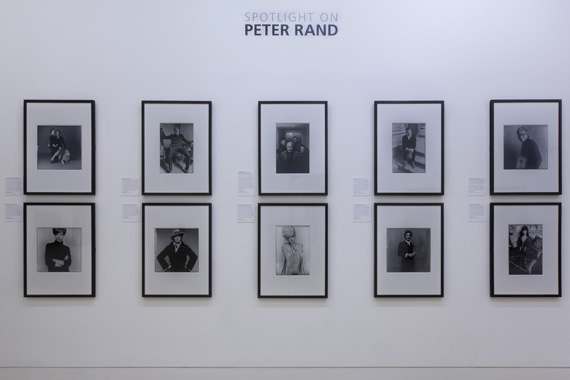
Spotlight On Peter Rand Exhibition
National Portrait Gallery 17 April until 16 September 2012
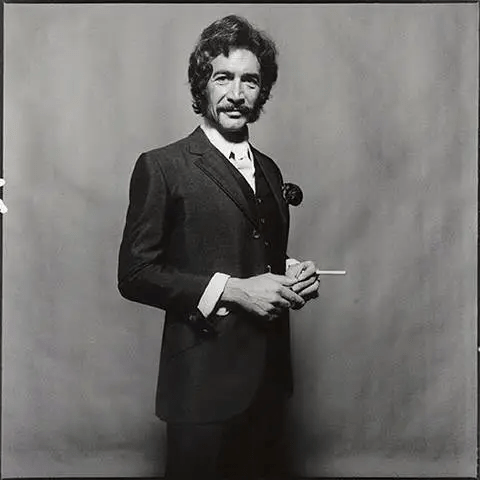
This display celebrated the acquisition of a group of sixteen photographs by Vogue photographer Peter Rand, and the publication of The Day of the Peacock: Style for Men 1963-1973 (2011) which features many of Rand’s fashion photographs.
Born in Dorset, Rand attended Ealing Art and Photographic College, before working as an assistant to Peter Peck at Woburn Studios (1958-9). In 1960, he joined the John French Studios, and in 1962 two of his photographs appeared This display celebrated the acquisition of a group of sixteen photographs by Vogue photographer Peter Rand, and the publication of The Day of the Peacock: Style for Men 1963-1973 (2011) which features many of Rand’s fashion photographs.
Left:Photographed by Peter Rand bromide print, 10 September 1969 13 7/8 in. x 13 7/8 in. (353 mm x 352 mm) image size. Purchased by the National Gallery in 2011
This display focused on ten key works from this period which are exhibited for the first time, and includes photographs of actors Peter Wyngarde, Fenella Fielding, Ian Holm, Anna Massey, Sarah Miles with her brother Christopher, Corin Redgrave, Mike Sarne; playwright Harold Pinter with the cast of The Caretaker, singer Dusty Springfield, and entrepreneur Richard Branson. Peter Rand continues to specialise in portraiture and fashion photography
The Peter Rand photograph of Peter (2nd from the right, bottom row) in the National Portrait Gallery exhibition in 2012
TV TIMES60th Anniversary Exhibition
Blue Fin Building, 110 Southwark Street, London– 17th September – 18th October 2015
TV Times has been in publication since 1955. To celebrate this 60th anniversary and as part of the Merge Festival 2015, the TV listings magazine showcased a selection of exclusive images from its vast archive in two exhibitions in Southwark, London.
Using its unique access to the stars of the time TV Times have curated ‘60 Years – 60 Iconic Images’ which features exclusive images of celebrities of television, sport, music and entertainment shot by some of the greatest British photographers including David Bailey, Cecil Beaton and Patrick Lichfield.
In addition to the 60th anniversary exhibition, Illuminate Productions curated an exhibition of never-before-seen images of some of the biggest music stars from the 1960’s to the early 1908’s. Musicians including James Brown, The Beatles, The Doors and Kate Bush were featured revealing moments in the performance spotlight as well as unguarded, behind the scenes shots.
An ostentatious music promo director, Patrick Church (Keith Allen), has thumbed his nose at making the new UB40 video, as he believes he’s in line to work with David Bowie on his next project. Unfortunately, the job is given to young up-and-coming director and so Patrick is forced to go back – cap in hand – to UB40 in the hope that they’ll give him a second chance.
The band are playing a concert which Church decides to attend. Unbeknown to Patrick, a scientist (Adrian Edmondson) and his assistant have set up an experiment in Psychic Transportation in their lab behind the concert hall, and when he makes a dash to the toilet during the show, he steps into what he believes is a porta-loo, but is in fact one of the chambers being used by the scientists. There his DNA becomes mixed with that of football hooligan, Steve (Gary Olsen), who is taking part in the experiment. The result is that the personality of the once pretentious director is gradually morphing into that of a yobbish Cockney Arsenal supporter.
On the day of the video shoot of UB40’s new single, the camera happens to be focused on the band’s bass player when Patrick calls for the shot to end. The director is annoyed when he realises what has happened, and immediately demands for the film to be re-shot – only this time he instructs the shocked cameraman not to “finish on the sooty”.
At the after-shoot party, Patrick’s incessant muttering doesn’t go unnoticed, nor does his swilling pint after pint of beer instead of his usual spritzers. Much the worse for drink, he takes umbrage at a black man who he claims is hitting on his girlfriend, and resolves to open a bottle of Champagne in the man’s face. Soon after, Patrick withdraws to the toilets, where shortly after his girlfriend follows to find him having sex with another woman.
The following day, the girlfriend arrives at the flat she shares with Patrick, only to find him in bed with yet another woman. She decides to pack her things and leave, but discovers that all her clothes have been replaced with some overtly tarty attire which she herself would never wear. Patrick is now seen morphing bodily into The Yob. Moments later, he’s stopping down the road, chanting, “You’re gonna get your ‘ead kicked in!”
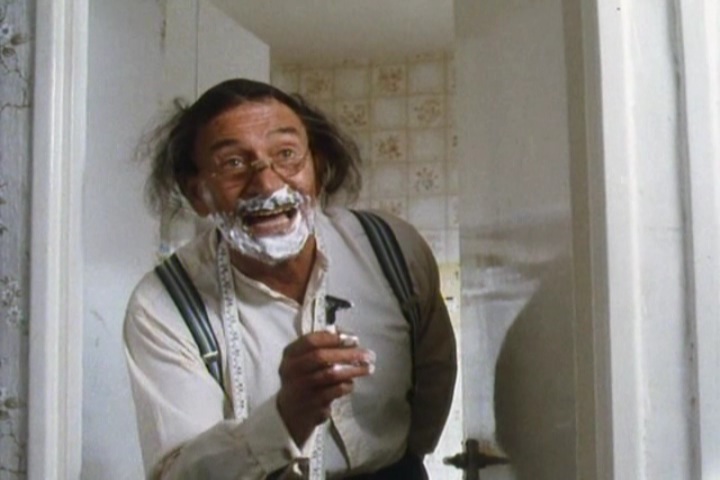
Moments later, the scientist and his assistant roll up in their car and explain that Steve, who is perfectly happy with the persona he inherited from Patrick, is driving his mother (Gwen Walford) and step-father, Mr. Kendel (Peter Wyngarde), round the bend.
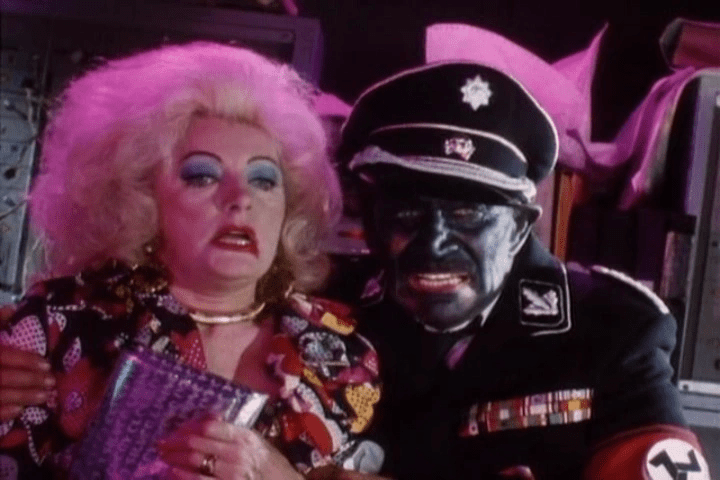
At the local pub sometime later, there’s a fancy dress competition for which Mr. Kendel has turned up dressed as a black Nazi – complete with SS uniform. But it’s Steve that wins the competition, but just as he’s about to accept his prize, Patrick arrives and proceeds to viciously head-butt him, which causes all the other patrons to go crazy.
Patrick and Steve are separated by the scientists and taken back to their lab, where it’s hoped that the botched procedure can be reversed. But then the assistant comes up with a better idea – namely to merge the two men into one.
While the two scientists are concentrating on setting up the procedure, they fail to notice the lab cat chasing a fly into one of the Transference Pods. When the door of the pod in which Patrick and Steve were bundled into opens, they find a devastatingly handsome man, but whose lower half is that of a Ginger Tom cat.
A Bit Of Trivia
This episode featured a number of well-known faces and future stars, including: Lilly Allen, Warren Clarke and Julian Firth amongst others.
Derrick Branche, who played a character called Chris Bell, was a school friend of Freddie Mercury.
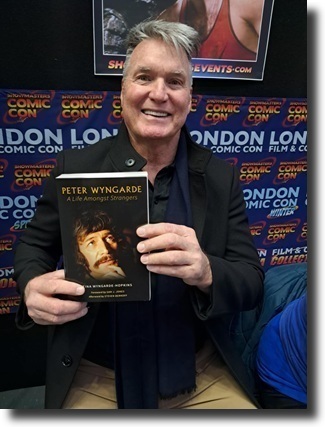
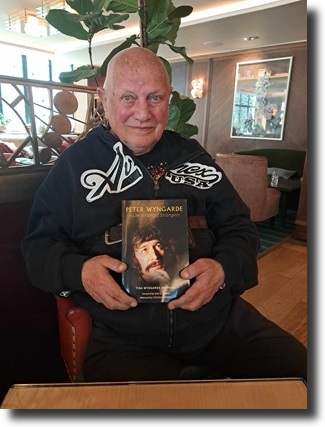
Since my book, ‘Peter Wyngarde: A Life Amongst Strangers’ was published in February 2020, I’ve received many comments and opinions – the vast majority of which have been extremely complimentary – including an absolutely glowing appraisal from Peter’s friend – the multi-award-winning actor, director and author, Steven Berkoff.
Additionally, I’ve had a great many questions from fans around the world which I’ve done my utmost to respond to either personally, or via this website. One of the most frequent queries has been, how much of Peter’s own writings did I rely on in the book? The fact is that I used quite a large amount of Peter’s personal writing throughout the work, which included letters and diary entries etc.
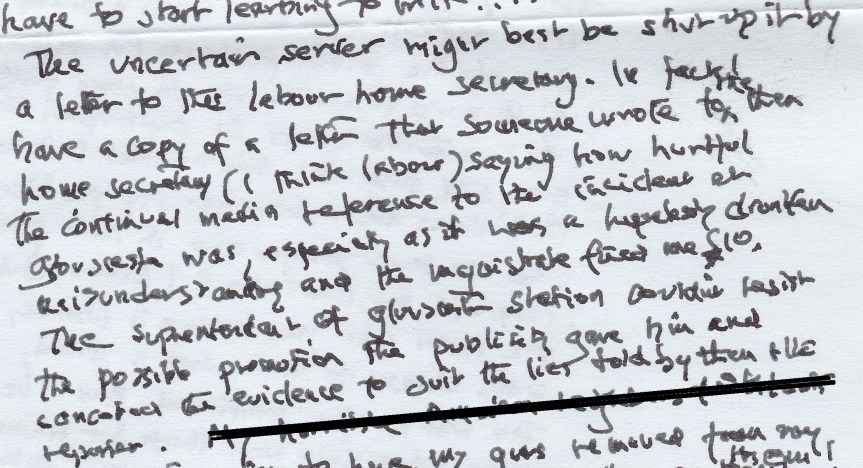
Around the tail-end of 2013, Peter and I began working on what he hoped would be his autobiography. His way of working was to write the text longhand in a notebook, and then I’d type it up for him on my computer. What appears for the most part in Chapters One and Two of ‘A Life Amongst Strangers’ come almost directly for him, although when you read what he’s written (see below), you’ll doubtless understand why much of it needed editing, and also why I was compelled to temper at least some parts of his work – not least because it was quite graphic in parts. Certainly, Peter had a unique way of telling a tale – complete with colourful language!
Below are the drafts I used in the opening two chapters of ‘A Life Amongst Strangers’, which those of you who have read it will recognise, I’m sure:
This page begins in France, where Peter had gone to recover from his time in the Civil Assembly Centre in Shanghai during World War II.Here he mentions waking to find the American girl he’d picked up the night before still in his hotel room the morning after, and of her looking completely different from when he first met her, as she was now wearing no make-up.
He then transfers to the village of Vergèze and La Maison de Genvière where he encounters the lovely Rosameurde and immediately “fell in love with her”. He says that he was surprised “now” at being so attracted to her as, “I’m usually a tit man and Rosameurde’s were practically invisible.“
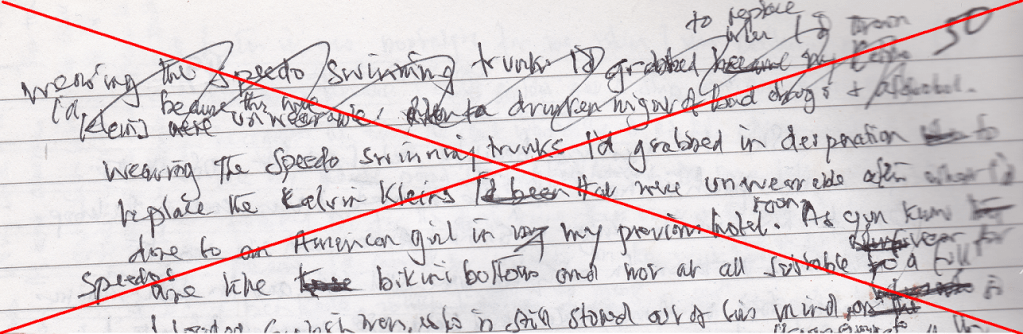
Another draft of the same scene: Here, Peter again mentions the American girl he’d spent the night with, and the reason he was wearing such unconventional underwear: “Wearing the Speedo swimming trunks I’d grabbed in desperation to replace the Kalvin Kleins* that were unwearable after what I’d done to the American girl in my previous hotel.”
*He, of course, wouldn’t have been wearing Kalvin Klein’s (sic) back then!
In this slightly revised section, he says that he’d been forced to wear a belt with his shorts because they were too big for him, but even then he was left with part of his backside showing, which he says made him look like “The proverbial British builder*” and, “resulting on the other side exposing my erection above the belt buckle which she [Rosameurde] could see sticking out.”
He goes on to describe the beautiful Rosameurde flirting with him as she picks up his heavy luggage: “She let go of the suitcase and rose up very close to me, both hands now fumbling with the belt clasp, that they soon released.” It was the ring of the phone that was to intrude on the moment.
A second draft of his first meeting with Rosameurde. He says: “I looked down and caught the shine in her eyes [that were] directed at my crotch. If they could have spoken [they would have told me] to unbutton my flies… somewhere a telephone was ringing, as she was on my first button. She dropped the heavy bag and ran towards the phone.”
He then writes: “Rosameurde noticed the bulge immediately in my shorts and her surprise followed an immediate welcoming smile before she bend over and deliberately rubbed her head against me…”
Peter now goes on to describe how he met and married his wife, Dorinda Stevens:
Further to discussing Rosameurde (above), Peter says of Dorinda, “She too was beautiful and I got her…” He continues with: “But for her, I was her knight in shining armour and she was the princess in the tower. In reality, we were still kids…”
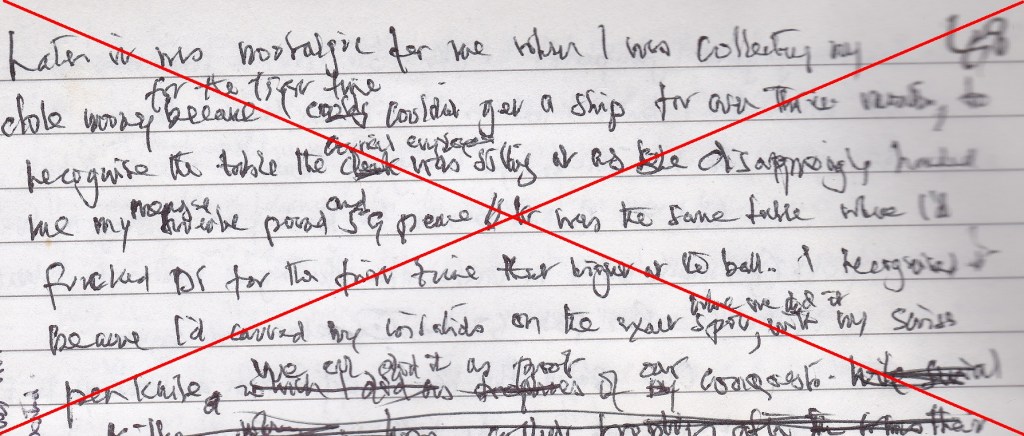
In this section, Peter makes mention of the ball that he, Dorinda and some mutual friends [fellow actors] attended at Southampton town hall. A few days later, he’d gone back to the town hall to collect a Social Security payment. He describes the “disapproving” clerk behind “the same table where I’d f****d Dorinda for the first time,” and where he’d carved his initials into the wood with a penknife.
In this part, Peter tells of his and his wife’s desperation to conceive, and of them both having fertility tests – she at St Mary’s Hospital in Paddington, and he at a clinic in Marylebone. He was found to be fine but, sadly, Dorinda was not.
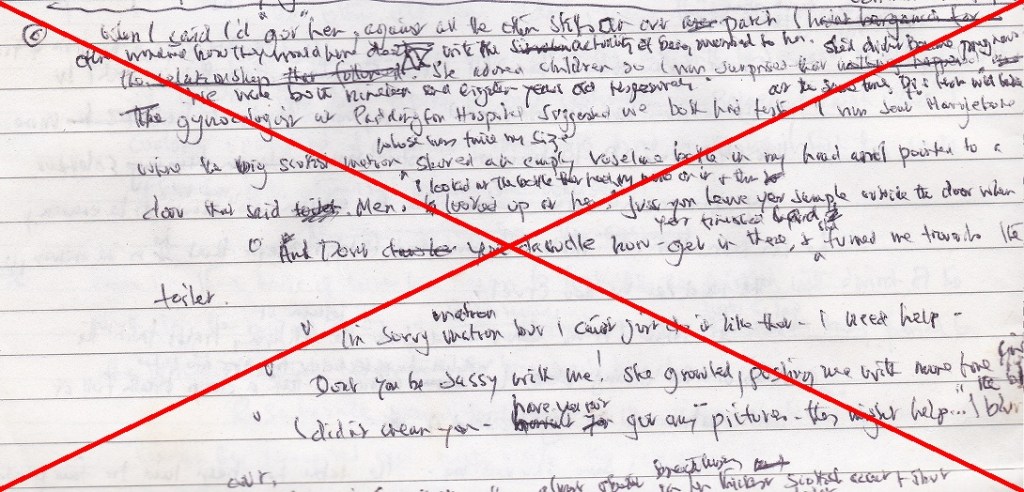
He goes on to describe his visit to the fertility clinic, and how he’d told the attendant nurse who he describes as “twice the size” of him” that he needed help in producing a sample: “I can’t just do it like that!” Said nurse had responded with, “Don’t you get sassy with me!” “I didn’t mean you,” he’d gulped, adding, “Have you got any pictures that might help?”
He now describes how he arrived home from 9 months in Spain filming ‘Alexander the Great‘, to find that Dorinda had been unfaithful to him. He says that all manner of thoughts were flashing through his head, and that it had crossed his mind that something had been going on between his wife and their female lodger: “A least it isn’t a guy,” he thought. “Then finally shutting up shop with my chauvinist pig fantasy of having two women at the same time, one of them a dyke. My mind had become a cesspit.”
On this page, Peter admits to a somewhat bizarre reaction he had to discovering his wife’s infidelity; he decides to cook breakfast! He even asks how she and her male lover would like their eggs cooked – “Flipped or sunny-side up?”
Peter’s reaction The supposed homosexual relationship with Alan Bates
It has been suggested by American author, Donald Spoto in his 2008 book, ‘Otherwise Engaged: The Life of Alan Bates’, that Peter and Bates had lived together “as a couple” at 1, Earls Terrace, London W8 for over a decade (1956-1966). In actual fact, Peter only took out a lease on the aforementioned flat in 1958 (see here) and Bates only appears on the Electoral Roll as living at this address from 1960.
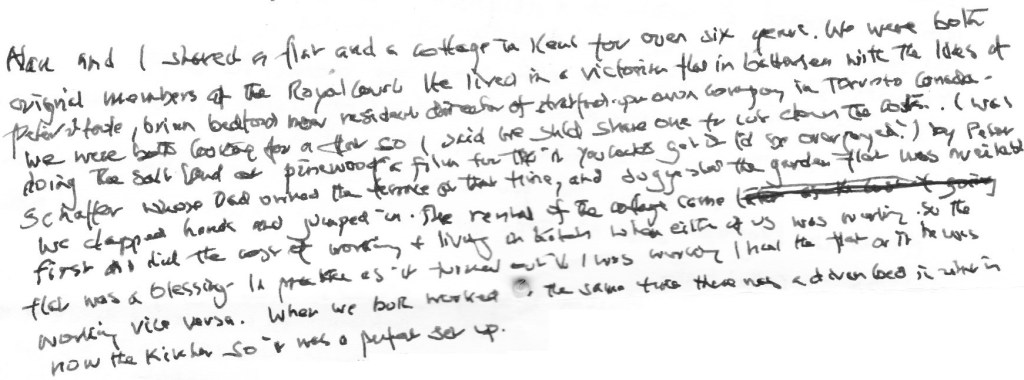
Here Peter explains in his own hand the nature of his “relationship” with Bates, and the reason for them moving into the flat in Kensington.
The above reads: “Alan and I shared a flat and a cottage in Kent for over six years, We were both original members of the Royal Court. He lived in a Victorian flat in Battersea with the likes of Peter O’Toole, Brian Bedford who is now the resident director at the Stratford-Upon-Avon company in Toronto, Canada. We were both looking for a flat so I said we should share one to cut down on costs. I was doing The Salt Land at Pinewood, a film for TV (if you could get it I would be overjoyed) by Peter Schaffer whose dad owned the Terrace* and suggested the Garden Flat was available. We clapped hands and jumped in. The rental of the cottage came first as did the cost of working and living in hotels [in London] when either of us were working, so the flat was a blessing. In practice as it turned out that when I was working [in the West End] I would have the flat, or if he was working, vice versa. If we were both working at the same time there was a divan bed in what is now the kitchen so it was a perfect set up”.
*Earls Terrace, London W8 where Peter lived from 1958 until his death in 2018.
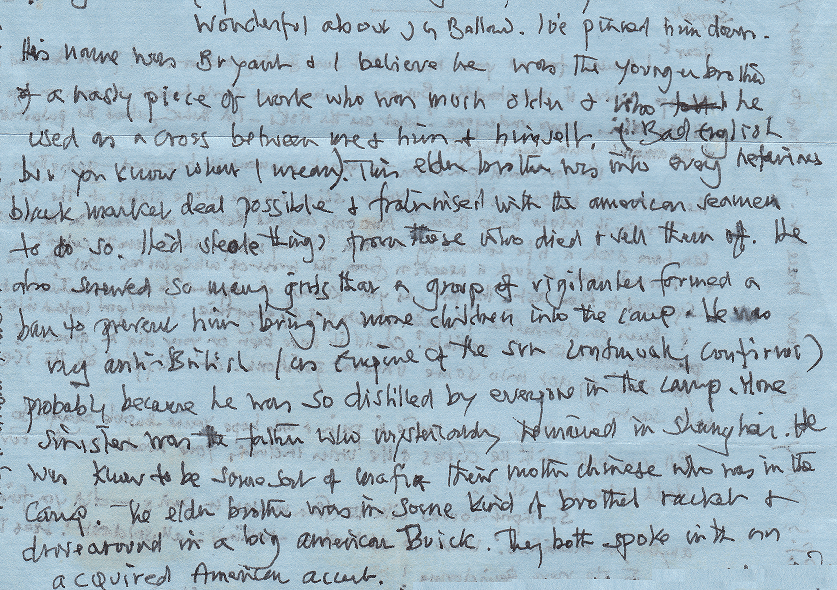
Peter’s response To the J.G. Ballard question
For many years, author and satirist, J.G. Ballard, claimed to have known Peter while the two of them were internees at Lunghua Civil Assembly Centre near Shanghai during World War II. Peter had always denied this – saying that he had no memory of Ballard at all.
On 7th August 1997, The Guardian newspaper published an interview with the Ballard, which was conducted by journalist, Andrew Billen. The following extract is from that article:
“Ballard is not being pious and he is, anyway, in little danger of being damned as politically correct. In 1973, when he was still thought of as a science fiction writer, he published Crash, a novel celebrating the eroticism of car smashes. The kinkiness of Crash, and of some of his other works (one, featuring the Kennedy assassinations, is called The Atrocity Exhibition), reminds me of a fairly weird interview I once conducted with the actor Peter Wyngarde. The one-time Jason King had talked about his preference for sadistic sex. I am reminded because Wyngarde and Ballard were in the same internment camp. ‘Oh,’ Ballard says when I mention it, ‘I don’t think that sort of thing affects your sex life. I’d have thought it needed to be much more personal than that, but then I don’t have any strain of S&M in me, so I wouldn’t know.’”See the full interview here:
In actual fact, Peter’s exact words were as follows: “I adore flying. I’m trying to improve my tennis and my passion is sex. I think I’ll change that. My passion is sophisticated sex.”
Here, in Peter’s own hand, is his thoughts on the matter:
And, below, about the ‘sadistic sex’ slur:
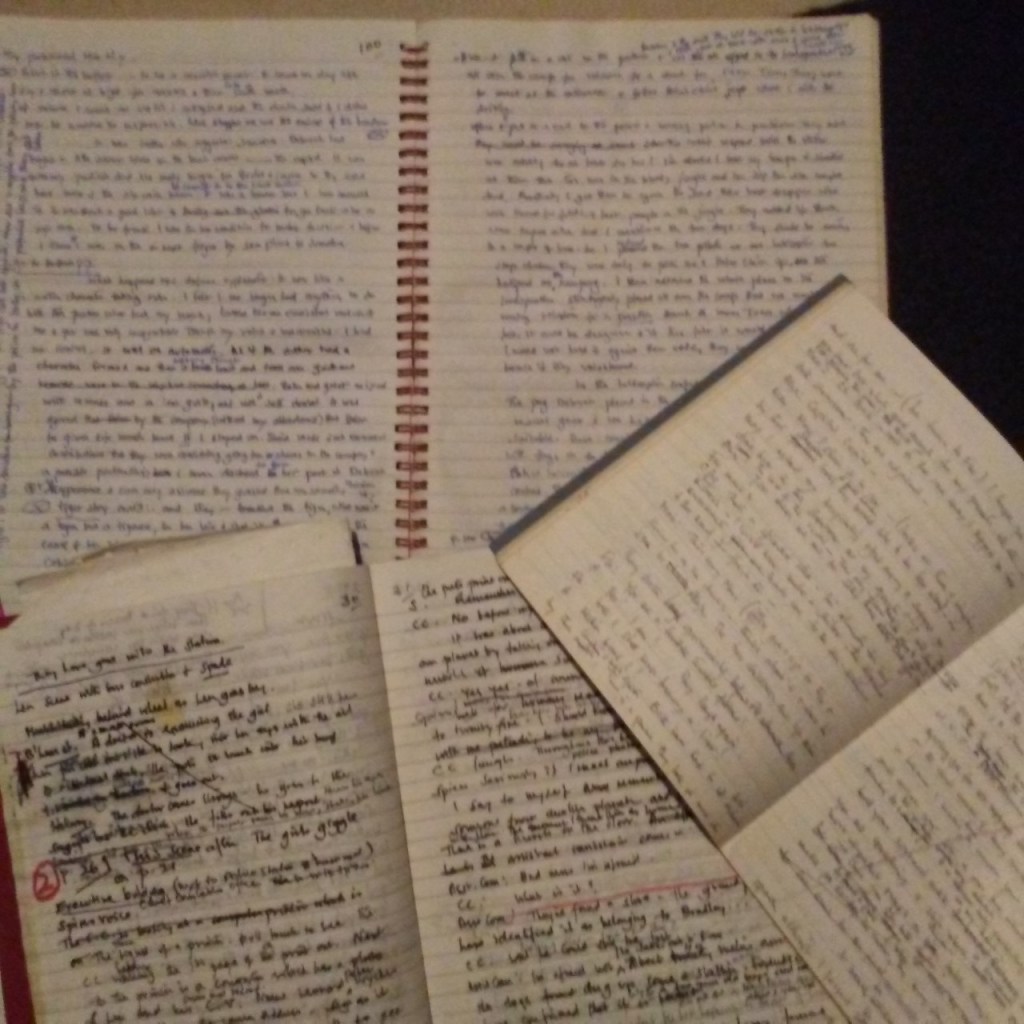
Other writings As quoted from in the book
All the books seen below are written in Peter’s own hand
Having been the victim of a supposed ‘sex scandal’ himself in 1975, Peter comments on the incident involving actor, Hugh Grant, and LA call girl, Divine Brown (Estella Marie Thompson) in June 1995.
In a 2012 letter to his, then, recently widowed sister-in-law, Peter confirms to having never known his “blood family” (see pages 399-400). The final two paragraph of the letter read: “There never seemed to be enough time to get to know people – Henry and his family included.
Since we have never managed to continue(?) relations, you’ll forgive me if I don’t attend Henry’s funeral.”
Some of the following are already posted on this website to illustrate other points, but were used in the book:
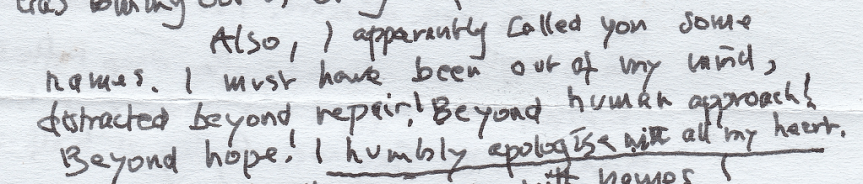
When Peter and I reconnected back in the early 2010’s, he wrote this in his second letter to me. Prior to our earlier parting, we’d exchanged some rather cutting words, which is what he’s apologising for here. Alas, one idiot who I’d been foolhardy enough to confide in some years ago, has taken one specific word out of many spoken during an heated exchange and used it as an excuse to fuel a vendetta.
The above reads as follows: “Also, I apparently called you some names. I must have been out of my mind, distracted beyond repair! Beyond human approach! Beyond hope! I humbly apologise with all my heart“.
A letter in reply to his friend, Norman Richardson, after his (now quashed) conviction in 1975. It reads:
Thank you so much for your letter. I was very moved and touched by your concern.
[I] will never understand the vindictiveness of the gutter press or the police and their obvious need to trap the public for their own ends. It is of course our laws that are still barbaric and its attitude that is Victorian.
My only consolation is that there are still people like you who are intelligent enough to know what is truth.
For that, and the faith you have, has given me a strength which is infinitely more powerful than all their stupid rubbish.
With affection and love,
Peter
Above and Below: Peter writes about the hurt he has felt at the continued harassment by the press over the incident in 1975.
Peter’s reaction the the (in)famous interview with Princess Diana – ITV, 1995.
Above: A letter to ‘Kenny Grice’* – the reprobate that I speak of in my book.
*As you know, ‘Kenny Grice’ is a pseudonym that I gave to this person as I didn’t wish cause any upset or embarrassment to his family.
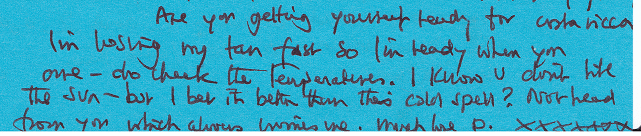
Above: A note to me from Peter while he was in France attending to his recently deceased stepbrother’s business affairs. It reads: “Are you getting yourself ready for Costa Ricca (sic). I’m ready when you are – do check the temperatures.I know U don’t like the sun – but I bet it’s better than this cold spell? Not heard from you which worries me. Much love, P xxxxxx”
I was to meet him in France with the intention of flying out to Costa Rica for a holiday.
A letter that reached me the day after the previous one. Here he talks about finding a villa for us to get away for a while.
Here he tells of the Paternity Trial in Vienna during the mid-1970’s (see Page 282 – ‘A Life Amongst Strangers’).
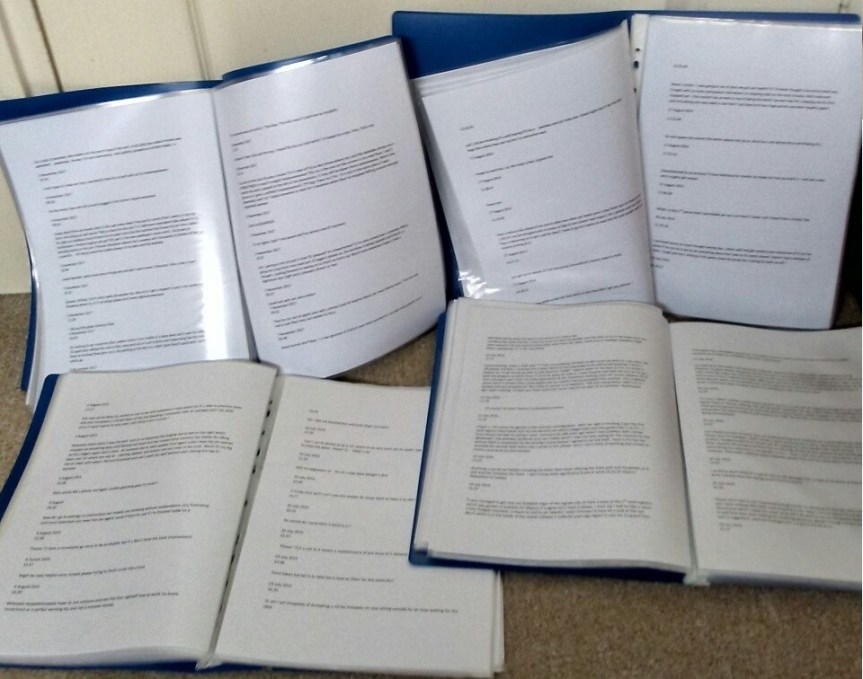
I was to download every text message that Peter sent to me over a 20 year period, initially as an aide memoire when helping him both professionally and personally with various projects. Ultimately, I was thankfully that I did as I was not only able to use many of them in my book, but they have also become incredibly precious to me on a personal level.
There are several thousand messages which have been printed out and stored in four files. This made it easier for me to look up specific times and dates.
I have many hundreds of personal letters and other writings which I relied on when writing my book which I will add to this page when time allows.
Peter Wyngarde: A Life Amongst Strangers is available from the following retailers:
Amazon – Bam! – Blackwells – The Book Depository – Foyles – The Hive – Waterstones – WH Smith – Blackwells etc. Or directly from the publisher.
Peter as Dr. John Hallem with Stuart Damon as Craig Stirling
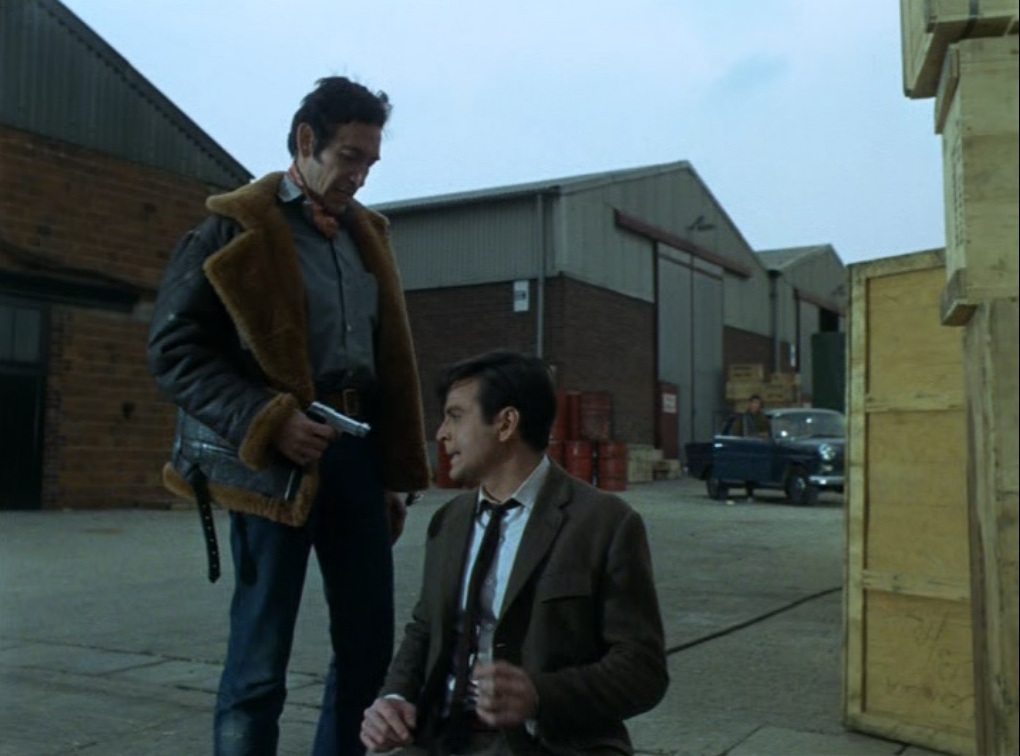
Surgeon, John Hallem (Peter Wyngarde) is not the man the well-heeled patients believe he is. He and fellow doctor, Charles Sumner (James Culliford), are in fact planning to steal over $30,000,000 in gold bullion, and have hatched a plan to get the Sir Frederick Howard (Basil Dignam) – the manager of one of London’s biggest banks – to help them do it.
During surgery at Hallen’s private clinic recently, a tiny microphone had been implanted into Sir Frederick’s ear, and since then he’s been plagued by voices instructing him to carry out specific tasks; refusal or failure to do so has resulted in painful and debilitating shocks via the implant.
In the meantime, irregularities in the international money market coupled with rumours of the sudden movement of large amounts of gold bullion, have reached the Champions team – Sharon Macready (Alexandra Bastedo), Craig Stirling (Stuart Damon) and Richard Barret (William Gaunt) – at their Nemisis HQ in Geneva. They manage to persuade their boss, Commander W.L. Tremayne (Anthony Nicholls), to let them investigate.
Stirling flies into London to speak with the managers of all the major banks, amongst them Sir Frederick Howard, who he advises of a possible raid on his bank’s gold reserves. Howard assures Stirling that all possible security procedures are in place, and that the bank’s vaults are impenetrable. But while Stirling is initially satisfied with this, his superhuman hearing happens to pick up the sound of a man’s voice emanating from the implant in Sir Frederick’s ear.
Shortly after being ushered from the premises, Stirling witnesses Sir Frederick running from the bank. He follows him into a side street where he finds the banker lying on the pavement surrounded by a small group of onlookers. As luck would have it, a doctor is among the passers-by and, seemingly, is able to come to the elderly gentleman’s aid.
When later Sir Frederick is examined by Sharon Macready, she finds a scar inside his ear which suggests that he had recently had surgery, and so Stirling sets about finding the hospital or clinic where the procedure was carried out.
Peter with James Culliford as Dr. Sumner
Hallem and Sumner, meanwhile, have taken delivery of the gold they had coerced Sir Frederick into releasing to them, which the two crooks have cunningly had cast to resemble industrial machinery. A rust-coloured paint is added to enhance the effect. Arrangements are made to have the “machinery” shipped out of the country to Holland, where the two villains plan to collect it at the post of Rotterdam.
For the moment Hallem returns to the clinic, where Craig Stirling eventually arrives to carry out his investigations. He immediately recognised Hallem as the doctor who’d attended to Sir Frederick on the street the previous day, and a fight ensues. While the surgeon is no match for the physically-enhanced agent, when Dr. Sumner suddenly makes an appearance the two surgeons combine to overpower the American and injecting him with a tranquilliser. Realising that they can’t leave him at the clinic, they decide to take him with them to Holland, and so he’s bundled into the back of their car.
When Macready and Barrett finally turn up at clinic they find that the two doctors have already left – probably with their colleague. A call to Hallem’s from his contact in Rotterdam tips off the agents as to the destination of the two surgeons, Stirling and the stolen gold, and so they catch the first flight to Holland.
After planting a similar device to the one given to Sir Fredrick in Stirling’s ear, Hallem and Sumner dump the agent at a roadside in the middle of the desolate Dutch countryside, Through it, the two wayward medics are able to keep track the American’s movements.
It’s not long before Stirling has revived himself enough to set off in pursuit of the surgeons who, by that time, are well on their way to the port of Rotterdam. Unbeknown to them, their contact,
Customs Officer Van Velden (Aubrey Morris) has discovered that the piece of “machinery” is in fact far more valuable than he’d been lead to believe, and so when Hallem and Sumner arrive to collect it, he demands a substantial increase in the payment he’d previously agreed on. Hallem’s response to Van Velden’s ultimatum is to gun the Dutchman down and to conceal his body in one of the warehouses.
By this time, Stirling has managed to make his own way to the port and is spotted by Sumner, who’d been busy loading the gold onto a lorry. Although Hallem is able to temporarily render the agent helpless by use of the ear implant, Stirling makes a dash for the dock with both Hallem and Sumner in pursuit where he throws himself into the water. When he fails to surface after several minutes, the two crooks leave believing that Stirling must surely have drowned.
With Hallem and Sumner back on the road – this time with the gold, Stirling is safe to leave the water, and on doing so discovers that his colleagues, Sharon Macready and Richard Barratt, have themselves arrived at the warehouse. After Macready removes the device from Stirling’s ear, the three of them set off in after the two crooked surgeons.
Convinced that they’ve got away with the perfect crime, Hallem and Sumner allow themselves a wry smile, but when Hallem glances in his wing mirror and spots the NEMISIS agents trailing him, he realises that their celebrating had been somewhat premature. His response is to increase speed, but the winding country roads and the weight of the gold conspire to blow the lorry’s tyres blow and the overburdened vehicle is sent crashing into a tree.
Dazed and Injured, Hallem manages to scramble out of the damaged cab, and hoping to evade capture, he attempts to stagger into a woods. But as Stirling and his colleagues close in, Hallem inevitably loses consciousness and it’s game over.
The play, written by American playwrights Arnaud d’Usseau and James Gow, tells the story of decorated Black army officer Brett Charles who has attempted to gain employment as a school teacher upon his return home from World War II. Unfortunately, the racial prejudice that he had left behind in America, while he was stationed in Europe, was still very much in evidence upon his return after he is accused by his new employer, Senator Ellsworth Langdon, of the theft of a gold watch. The play follows Brett’s psychological readjustment on coming home after the war and his pursuit of “fairness” after experiencing a war in which the colour of his skin was irrelevant to the goal of fighting a common enemy.
1948 The Government Inspector
Year: 1948
Character: Osip
When the locals in a small town in Russia learn that an undercover government inspector is coming for a surprise visit, an unfortunate case of mistaken identity sends the village spiraling into a world of panic and greed. The Government Inspector is often said to be Nikolai Gogol’s masterpiece, a comedy of errors that provides clever commentary on the extensive political wrongdoing of Imperial Russia. When it opened, it caused an uproar in the Russian press. Eventually, Tsar Nicholas I had to intervene in order for the production to move forward. Since its premiere in the 1830s, The Government Inspector has been translated and adapted for many different productions, most notably the Chichester Festival in 2005.
The inspiration for The Government Inspector came from a conversation between Gogol and Alexander Pushkin, another famous Russian writer. Apparently Pushkin had actually been mistaken for a government inspector at one point in his life. He mentioned this to Gogol, who then turned it into a play. Witty, smart and wildly satirical, The Government Inspector exposes the corruption of a provincial town with biting hilarity.
1950 Othello
Year: 1950
Character: Sylvius
Shakespeare’s Othello is one of his most intimate and devastating tragedies of all. It is a story about society, status and the nature of the outsider – but it is also a story about the love and trust between friends, and between men and women.
Defying her father and society to follow her heart, Desdemona secretly marries Othello – a powerful general, and a Moor. Despite her father’s objections in court, Desdemona remains committed to Othello and follows him from Venice to Cyprus, where he is commissioned to serve. Iago, a junior officer and Othello’s most trusted adviser, is tormented by his lack of promotion. Despite Othello’s confidence in Iago’s honesty, Iago reveals that he is in fact hateful of Othello, and sets out to destroy Othello and Desdemona’s happiness, manipulating Othello to serve his own ends. Iago convinces Othello that his wife has been unfaithful with the up-and-coming young soldier Michael Cassio.
As Iago draws Othello and the audience into a web of half-truths, secrets, and betrayal, scandal is fuelled — families and friendships destroyed — until a piece of supposed evidence of Desdemona’s infidelity, a handkerchief (which Iago calls “trifle light as air”) tragically undoes them all. Othello commissions Iago to kill Michael Cassio, and then smothers Desdemona in her bed. When Emilia discovers Othello in the act, she confronts him and explains that it was Iago who tricked them all. Iago kills Emilia, but not before Othello has learned what has been done. Othello commits suicide, and Iago is taken into custody. The play ends before we know what ultimately happens to Iago, but we do know that a profusion of devastation has been left in his wake.
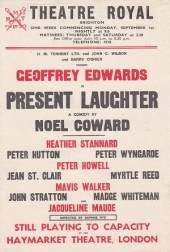
1946 Present Laughter
Year: 1946
Character: Morris Dixon
Present Laughter is lighthearted farce that celebrates playwright Noel Coward’s legendary wit and larger-than-life persona. Based on Coward himself, actor Garry Essendine is the star of the London theatrical scene at the height of his fame and adored by legions of admirers–perhaps a little too much. Fans regularly throw themselves at Garry’s feet, drawn in by his charm and charisma, throwing his household into chaos. In the week before Garry is set to embark on an African tour, he is forced to juggle a besotted young woman with stars in her eyes, an unhinged young playwright obsessed with being in Garry’s presence, his best friend’s wife who is determined to seduce him, his manager, his producer, his secretary, his estranged ex-wife, and an impending mid-life crisis as his 40th birthday looms ever closer.
1946 Quality Street
Year: 1946s
Character: Ensign Blade
Phoebe Throssel lives on Quality Street with her sister Susan. She has been courted by Valentine Brown, a handsome gentleman who decides to enlist in the Napoleonic Wars. Ten years pass when Valentine returns to Quality Street as a celebrated captain, and he is greeted by a more mature, less glamorous Phoebe. When Phoebe sees the disappointment in Valentine’s face, she is emboldened to create a younger alter-ego named Miss Livvy. Phoebe, disguised as Miss Livvy, begins to attend balls and relive her youthful glory days. As she rekindles her romance with Valentine, can she juggle both personas or will her deception ruin her reputation forever? From the beloved writer of Peter Pan, J. M. Barrie’s Quality Street is an English farce about growing old that is sure to delight audiences.
1950 Tobias and the Angel
Year: 1950
Character: Raguel
When a fellow Jew is killed, Tobit – a Jewish man from Nineveh – chooses to break the law by giving him a proper burial. The next morning Tobit is blinded by a group of sparrows (played by a children’s chorus) who throw their droppings in his eyes. Remembering that he is owed money by Raguel, a relative in Ecbatana, he sends his son Tobias to reclaim it. A stranger offers to help guide Tobias on his way. On the way, the stranger encourages Tobias, who is something of a good-for-nothing and only interested in dancing, to pay attention to the world around him – to listen to the songs of the trees, the mountains, the river. In the river, they are attacked by a giant fish. Hearing its hidden song, Tobias is able to overcome it, and the stranger tells him to take its heart and gall.
In Ecbatana, meanwhile, Sara, Raguel’s daughter, is held under the spell of a devil, Ashmodeus, who kills her husband on their wedding night. When Tobias arrives, he falls in love with Sara. The stranger, however, has eyes only for the unseen devil, and he instructs Tobias to use the fish’s heart to break Ashmodeus’ spell. This enables Tobias to wed Sara without being killed, and they return to Nineveh. Tobias uses the gall to cure Tobit’s blindness, and the stranger reveals himself as the angel Raphael.
1946 When We Were Married
Year: 1946
Character: Gerald Forbes
Priestley’s 1938 British farce begins when a group of old friends, all married on the same day in the same chapel, gathers at the Helliwells’ home to celebrate their silver anniversary. When they discover that they are not legally married, each couple initially reacts with proper Victorian horror “what will the neighbours think?”. But soon all three couples find themselves reevaluating their marriages. In the end, of course, everything turns out well, and the play ends on a happy note.




























 PETER WYNGARDE: The Official Website