

By Neil Hendry – The Official Ian Hendry Tribute
A couple of years ago, I received an email from Tina Wyngarde-Hopkins, Peter Wyngarde’s beloved soulmate.
Peter and Ian worked together back in the 60s, in a television play called The Crossfire which also featured Eric Portman, Jeannette Sterke and Roger Delgado. Set during the Algerian War, it was first broadcast as part of ITV’s Play Of The Week, on 7th February 1967. And it was that play that first inspired Tina to get in contact with me, some five decades later, to see if I had a copy.
By lucky coincidence, I had been sent a message a year or so earlier, by someone who had found a copy of the play, which included Anglia TV’s famous ‘knight in armour on horseback’ opening.
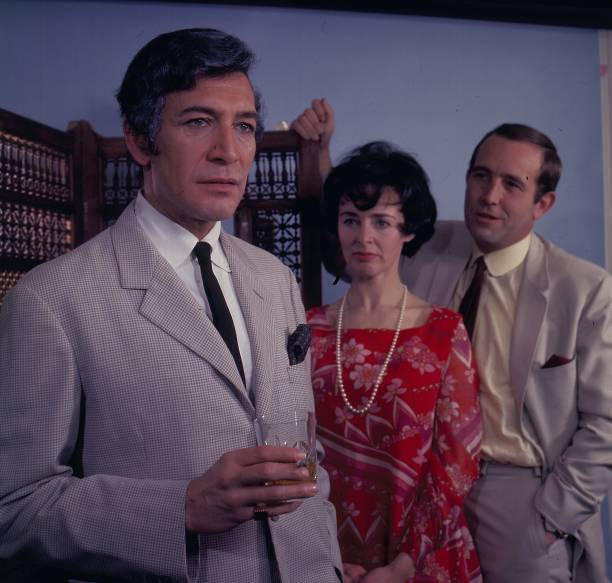
I was also fortunate to be able to exchange a few emails with Peter. He remembered working with Ian, but could not recall any specific details from the production itself, but was hoping that the recording would help to jog his memory! I made a copy of The Crossfire and posted it off to them.
For someone who was so young at the time, in the early 70s, I didn’t realise that I was corresponding with THE Jason King, until a short while after when I read more about his life and career. And what a wonderful, colourful and varied life he has had, including being kept captive in the Lunghua Civilian Assembly Centre – a Japanese internment camp in Shanghai, during the second world war.
A fellow detainee at that time, was J.G. Ballard, who famously retold the events in the biographically influenced, Empire of the Sun; subsequently made into a film by Steven Spielberg.
In an interview with Tina Wyngarde-Hopkins from 2017, Peter reflected on that time in the Japanese interment camp, when still just a young boy. Tina wrote:
“However, when the Japanese forbade prisoners in one block from communicating with those in another, Peter was used as their runner to spread the radio news through the camp. But then one day he was caught by a guard, who broke both his feet with rifle butts to stop him ever running again. He was then thrown into solitary confinement for a month. When he came out, he could barely walk and had to rely on crutches. His feet still show the signs of that beating to this day.”
I understand that Peter was still active until relatively recently, appearing at special events and reunions, related to the various shows that he appeared in.
Robert C. contacted me via this website[1] in the Spring of 2017 and mentioned that:
“Hope to meet Peter Wyngarde at Portmierion for The Prisoner’s 50th. If I get the chance that is I will ask him about working on Crossfire with Ian Hendry”.
The Guardian’s original obituary was mean spirited and quite frankly, nasty.[2] In my haste to publish an appreciation following a 24 hour domestic power cut, I used a source that I had always relied on previously. On this occasion, I should have been more careful as what I consider to be reputable paper was clearly lacking in editorial control. I have since removed that text from this article and apologise for any offence cause by it’s easier inclusion.
The Guardian subsequently published an appreciation by Toby Hadoke, it seems to try and rectify their earlier mistake and also to add detail on a number of key omissions:Appreciation: Peter Wyngarde obituary – Toby Hadoke, Tuesday 23rd January 2018 – The Guardian
The obituary of Peter Wyngarde overlooked a number of the talents and successes of this suave and charismatic performer who never lost his ability to inspire fascination.
Before Jason King he had an early television success as Will Shakespeare (1953) – a taxing part that earned him the admiration of the production’s pioneering producer/director Rudolph Cartier. By 1965, when lured to play the arrogant and dangerous Baron Grüner in an episode of Sherlock Holmes, he had enough clout for the producers to accede to his agent’s stipulation that on foreign sales prints he – uniquely – be inserted into the opening titles and credited alongside the leads Douglas Wilmer and Nigel Stock, both of whom he was also paid considerably more than).
His quirky tastes embraced cult shows which showcased his versatility and zeal – he is glorious in both of his episodes of The Avengers (1966-67) and a cunning and aloof Number Two in The Prisoner (1967). As the religious zealot Timanov in the 1984 Doctor Who story Planet of Fire he imbues a flawed character with a tremendous tragic dignity.
His non-speaking role in the film The Innocents (1961) is no glorified bit part. He is a memorably spooky, spectral presence and gets second billing, a year after his effective turn as a ruthless gang leader in The Siege of Sidney Street.
His extensive theatre work attracted many good notices from the outset and included Shylock and King John, via Jack Pinchwife (The Country Wife) and more than 200 performances as the lead in The King and I (Adelphi theatre and tour, 1973-74). He also directed productions at the Bristol Old Vic and the Yvonne Arnaud theatre, Guildford.
In later years he was gracious with fans and a writer of detailed and helpful letters crafted in attractive – if minute – handwriting, generously extolling the virtues of colleagues he admired such as Cartier, Wilfred Lawson and Patrick McGoohan: unpredictable talents all, who should give some clue as to where his sensibilities lay.
A perfectionist, he was doubtless sometimes difficult, but the scandal that dented his career should not overshadow the many fine qualities of a charming, seductive, watchable leading actor with an offbeat streak.
In closing…
My heartfelt condolences go to Tina Wyngarde-Hopkins who spent much of her life devoted to Peter. I know she was very close to him and will be feeling a great sense of loss. And to Peter’s agent, Thomas Bowington.[3]
Thomas describes Peter with great affection:
“He was one of the most unique, original and creative actors that I have ever seen. As a man, there were few things in life he didn’t know. I sometimes nicknamed him ‘the King’ because he simply knew everything. He was a mentor on everything you can think of, from sports cars to how to make a good cup of tea and how to do a tie and shirt.
He died at the Chelsea and Westminster hospital [in London], and even then he was saying that you shouldn’t button the upper button on a shirt. As a person he was the most exceptional person I met in my life and a great mentor and teacher.”
Our thoughts and condolences also go to Peter’s many friends and fans around the world.
For those wishing to find out more about the life of Peter Wyngarde, I can really recommend this excellent and authoritative interview from 2017, by Tina Hopkins:
The Ultimate Peter Wyngarde Interview by Tina Wyngarde-Hopkins
Neil Hendry*
Editor, Official Tribute To Ian Hendry
*Neil is Ian Henry’s nephew
Notes:
[1]: The Official Tribute to Ian Hendry
[2]: The first ‘obituary’ was written by Gavin Stewart Gaughan, who was latterly sacked by The Guardian. See ‘Wikipedia: To Theeartofit‘
[3]: Bowington Management
Further to the following newspaper and magazine articles:


BBC News – 18th January, 2018

The Last Word: Obituary series. Matthew Sweet talks about the life and career of Peter Wyngarde Friday, 19th January, 2019. Click here to listen.

Peter Wyngarde, Charismatic Star of ‘Jason King,’ Dies at 90
By Rhett Bartlett – January 18, 2018 1.33am
Aside from playing the louche spy, he headlined horror film ‘Burn, Witch, Burn!’ opposite Janet Blair and popped up as a villain in the camp classic ‘Flash Gordon.’
Peter Wyngarde, the charismatic star of spy series Department S and its spinoff show, Jason King, and a mainstay of British television, has died. He was 90.
Wyngarde died Monday at the Chelsea and Westminster hospital in London, his agent Thomas Bowington announced.
Wyngarde appeared in films such as Alexander the Great (1956), The Siege of Sidney Street (1960) and The Innocents (1961) as well as seminal British television shows including The Avengers; The Saint; The Champions; Doctor Who; and The Prisoner, where he portrayed Number Two in the episode “Checkmate.”
Wyngarde is most fondly remembered for Department S, a spy series that ran for two seasons in the U.K. starting in 1969. He played the suave handlebar-moustached Jason King, an author of adventure novels and a member of Interpol who always seemed to get the girl.
After the success of Department S, Wyngarde’s character was given his own spinoff, simply titled Jason King, that ran for 26 episodes in the U.K. and was syndicated around the world. Mike Myers has cited the dandy lothario spy as an inspiration for Austin Powers.
In the camp cult classic Flash Gordon (1980), Wyngarde, behind a gold metallic mask, played the menacing General Klytus, commander of Ming the Merciless’ police force. He meets his gruesome end at the hands of the title character (played by Sam J. Jones), who throws him on a platform of spikes.
Wyngarde, who was born in Marseille, France, also headlined the horror film Burn, Witch, Burn! (1962), playing a professor whose wife (Janet Blair), unknown to him, is practicing witchcraft.
He also had a modest career as a recording artist at the height of his Jason King fame.
A number of British television, stage and screen actors paid tribute to Wyngarde on social media.

Doctor Who and Department S actor Peter Wyngarde dies aged 90
The actor passed away in hospital after a career spanning 80 years
By Francis Taylor – 18 January, 2018
Actor Peter Wyngarde, the star of Doctor Who and Department S, has died aged 90.
His agent and manager confirmed that he had passed away in a London hospital. He described the Jason King actor as “the most exceptional person I met in my life and a great mentor and teacher.”
After beginning his career on stage in 1947, he went on to act alongside Richard Burton in Alexander the Great. But it was taking the lead role in Department S and its subsequent spin-off Jason King that made him a household name. It was a character that was said to be the inspiration behind the comedy character Austin Powers.
He also played Timanov in four episodes of Doctor Who in 1984.
Wyngarde’s agent, Thomas Bowington, said that the actor was “one of the most unique, original and creative actors that I have ever seen.
“As a man, there were few things in life he didn’t know,” said Bowington. “I sometimes nicknamed him the King because he simply knew everything.
“He was a mentor on everything you can think of, from sports cars to how to make a good cup of tea and how to do a tie and shirt,” he added. “He died at the Chelsea and Westminster Hospital and even then he was saying that you shouldn’t button the upper button on a shirt.”

Peter Wyngarde, flamboyant actor known for Jason King and Flash Gordon
By Brian Pedreigh – 18th January, 2018

Peter Wyngarde, who has died, probably aged 90, lived a life as dramatic and mysterious as the plots in the hit television show Department S (1969-70), in which he played the outrageously flamboyant novelist and secret agent Jason King.
The mysteries begin with his arrival in the world, probably in Marseilles, anywhere between 1924 and 1933, according to various sources. He was in Shanghai when the Japanese invaded and spent much of the Second World War in an internment camp, an experience that scarred him both mentally and physically.
As Jason King, Wyngarde became a style icon, with his droopy moustache, hair that looked like a bearskin hat and a wardrobe of wide-lapelled,
three-piece suits, cravats and open-necked shirts in colours so bright they might hurt sensitive eyes. Wyngarde was a sex symbol, mobbed by women and idolised by the gay community. Although Wyngarde was married for a while, there were persistent rumours of gay relationships, including one with Alan Bates.
It has been suggested he had a showbusiness nickname of Petunia Winegum, though his appreciation society argued that the name was created for a Two Ronnies sketch. In 1975 he was convicted of “gross indecency” with a lorry driver in a public toilet and was fined £75.
Announcing the death, Wyngarde’s agent said he was 90, suggesting he was born in 1927. It seems his father was a diplomat, or according to Wyngarde, some sort of secret agent. “My father took me from my mother when I was a tiny child”, he said. “She was beautiful – a real Claudette Colbert lookalike and racing driver, who was chased all over the place by men.”
His mother was French and married a Russian called Henry Goldbert. JG Ballard, author of Empire of the Sun, said he remembered “the future Peter Wyngarde” in Shanghai as a boy called Cyril Goldbert.
Wyngarde said that in the internment camp the guards caught him taking messages between different blocks and broke both his feet, leaving him on crutches at the end of the war.
He claims he enrolled to study law at Oxford University after the war, but dropped out. He appeared on stage at the Glasgow Alhambra as early as 1946 in a play called Pick-up Girl. He established himself as a maverick and challenging actor, and recalls being sacked from a genteel drawing-room comedy for playing his role in the style of a moody Laurence Olivier.
He shared a London flat with Alan Bates. On rumours of a more intimate relationship, he later said: “All I’ll say on this occasion is that there’s been a lot of speculation and lies written about that time in my life. I certainly feel betrayed by a particular individual to whom I’d previously only ever shown the greatest respect and kindness.”
While working in repertory theatre Wyngarde married a young actress called Dorinda Stevens, but the marriage was short-lived.
He was Sydney Carton in a 1957 BBC adaptation of A Tale of Two Cities and in 1958 he appeared with Vivien Leigh in Duel of Angels in the West End and on a tour that included both Edinburgh and Glasgow. Leigh was married to Olivier at the time, but there seems little doubt that she and Wyngarde were soon in a relationship.
He played Peter Quint in the film The Innocents (1961), a psychology lecturer in the horror film Night of the Eagle (1962) and Number Two in an episode of the cult TV series The Prisoner (1967).
He had a couple of roles in The Avengers (1966-67), including a notable S&M episode in which he whips Emma Peel (Diana Rigg), and in The Saint (1966-67), in which he blacked up to play a Turkish villain.
Wyngarde was reluctant to take the role of Jason King in Department S, the name of an Interpol team that investigates baffling cases such as the disappearance of a plane in mid-air.
Producer Monty Berman was equally reluctant to approve him. It was director Cyril Frankel, who had worked with him before, who wanted him. Frankel said: “He was a very fine actor, but unfortunately a difficult person.”
Wyngarde was appearing in the West End and eventually wrote his acceptance on a napkin at dinner, on condition that each day he would be driven to the theatre after filming.
Jason King was envisaged as a tweedy Oxford don, but Wyngarde reinvented the character as the flamboyant hedonist, remarking on one occasion that it was “a bit too early for coffee… I think I’ll have Scotch.” King was essentially an extension of Wyngarde himself. Wyngarde admitted he was “a bit of a dandy”. He also struggled with alcoholism.
There were two series, first broadcast in 1969-70, but the character proved so popular that he got his own spin-off series Jason King (1971-72), and they found new audiences with video, DVDs and repeats. Mike Myers said King inspired his character Austin Powers.
Wyngarde’s status as a cult star was further enhanced by his appearance as the masked villain Klytus in Flash Gordon (1980). Although viewers could not see his face, the silky voice was recognisable and in context distinctly sinister.
“The one thing I remember most about shooting the film was the weight of the costume,” he said. “Another difficulty was being able to see the other characters, all of whom were wonderfully cast, with a mask over my face.”
Wyngarde went on working occasionally in film, television and theatre – appearing in the Doctor Who story Planet of Fire in 1984 and in Aladdin at His Majesty’s in Aberdeen in 1984-85, but his last credits on IMDB were over 20 years ago. He said his career was ruined by “small-minded people” after his 1975 arrest.
In an interview for his appreciation society just last year he said: “I’m getting letters from a lot of younger people… They tell me that they’ve seen me in Flash Gordon or Night of the Eagle, and then have discovered Jason King as a result.
“I had to phone the hospital a few days ago to rearrange an appointment, and when I gave the lady my name, she said: ‘Wyngarde – like the actor?’ I said, ‘Yes. I am the actor.’ She only sounded about 12.”

Veteran British Actor Peter Wyngarde Dies at 90
By Stewart Clarke – 19th January, 2018
Veteran actor Peter Wyngarde, who starred as flamboyant investigator Jason King in the iconic 1970s British police series “Department S,” has died. He was 90. Wyngarde died in a West London hospital, his agent Thomas Bowington told Variety.
“Peter Wyngarde passed away peacefully in his sleep early evening Monday at the Chelsea and Westminster Hospital,” Bowington said, adding that Wyngarde was “one of the most original and truly great actors I’ve ever seen and by far the most exceptional man I have ever met.”
Wyngarde had a long career on stage and screen but is best known as handlebar-mustachioed investigator King. He also appeared in classic series including “The Avengers,”” “The Saint,” and “The Prisoner.”
The King character was an author and investigator in “Department S,” and in 1971 was given his own series, “Jason King.” The show was cancelled in 1972, but Wyngarde continued to appear on stage and screen in Britain and internationally.
His movie appearances included “The Innocents” and “Night of the Eagle.” He also starred in the 1980 movie “Flash Gordon.”
Wyngarde was born in Marseilles, France, to an English father and French mother.

| Please Note: The article below was hastily penned by actor and writer, Toby Hadoke, after The Guardian was forced to remove the original “obituary” (published on 18th January, 2018), due to the number of complaints it attracted from the public. Purposefully unpleasant and needlessly spiteful, the earlier piece had been authored by Gavin Gaughan, a part time journalist from Oxford. The Guardian were to dispel with Mr Gaughan’s services thereafter. |
Appreciation: Peter Wyngarde obituary
The Guardian – 23rd January, 2018. By Toby Hadoke.
The obituary of Peter Wyngarde overlooked a number of the talents and successes of this suave and charismatic performer who never lost his ability to inspire fascination.
Before Jason King he had an early television success as Will Shakespeare (1953) – a taxing part that earned him the admiration of the production’s pioneering producer/director Rudolph Cartier. By 1965, when lured to play the arrogant and dangerous Baron Grüner in an episode of Sherlock Holmes, he had enough clout for the producers to accede to his agent’s stipulation that on foreign sales prints he – uniquely – be inserted into the opening titles and credited alongside the leads Douglas Wilmer and Nigel Stock, both of whom he was also paid considerably more than).
His quirky tastes embraced cult shows which showcased his versatility and zeal – he is glorious in both of his episodes of The Avengers (1966-67) and a cunning and aloof Number Two in The Prisoner (1967). As the religious zealot Timanov in the 1984 Doctor Who story Planet of Fire he imbues a flawed character with a tremendous tragic dignity.
His non-speaking role in the film The Innocents (1961) is no glorified bit part. He is a memorably spooky, spectral presence and gets second billing, a year after his effective turn as a ruthless gang leader in The Siege of Sidney Street.
His extensive theatre work attracted many good notices from the outset and included Shylock and King John, via Jack Pinchwife (The Country Wife) and more than 200 performances as the lead in The King and I (Adelphi theatre and tour, 1973-74). He also directed productions at the Bristol Old Vic and the Yvonne Arnaud theatre, Guildford.

‘What a life. What a legend’: tributes paid to cult TV star Peter Wyngarde
Fans honour the stylish star with tweets and memories.
The Guardian -19th January, 2018.
Writers, celebrities and cult TV enthusiasts are among those paying tribute to the actor Peter Wyngarde, who has died aged 90. Wyngarde was best known for his role as the author and sleuth Jason King in Department S and the spin-off that followed. The character was summed up by one of the most famous lines from the show: “A bit too early for coffee … I think I’ll have Scotch.”
He also appeared in a series of other cult TV shows, including The Saint, The Avengers and a turn as the mysterious Number Two in an episode of The Prisoner.
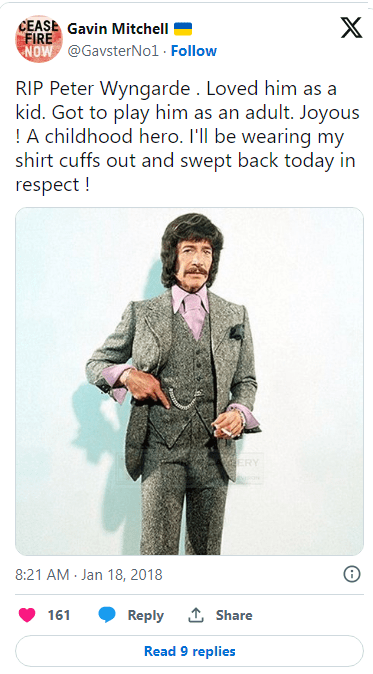
Many on social media referenced Wyngarde’s distinctive style.
His agent and manager, Thomas Bowington, said: “He was one of the most unique, original and creative actors that I have ever seen.”
People have been sharing their memories of encountering Wyngarde, including a time he signed a copy of a review of one of his performances for Johnny Mains – and passed a verdict on it.
Bob Stanley, author and member of the pop group Saint Etienne, recalled a dinner quip that summed up Wyngarde. “I’m 50% vegetarian, 100% bisexual.”
Tributes have been littered with phrases such as “flamboyant” and “larger than life”. Away from the screen, Wyngarde’s life was complicated.
During a time when it was difficult to be an openly homosexual celebrity, it was known in acting circles that Wyngarde was gay – with Petunia Winegum as a nickname – but it was kept secret from the public. Wyngarde did, though, play the lead in the first gay British TV drama, a 1959 broadcast of a play called South. Set as the US civil war loomed, Wyngarde’s character agonised over his love for an officer.
He was outed publicly as gay in 1975 following charges of gross indecency, and the ensuing scandal saw his television appearances dwindle. During the 1980s and 1990s he guested on shows such as the Two Ronnies and the Lenny Henry Show, and took a role in the Comic Strips Presents film The Yob. His last cult TV appearance came in 1984, opposite Peter Davison in the Doctor Who episode Planet of Fire. The story, which unusually for the show was shot on location in Lanzarote, featured Wyngarde as Chief Elder Timanov.
He also recorded an album in 1970, reissued in the 2000s as When Sex Leers Its Inquisitive Head. One review describes the album as “the kind of thing one would hear if one spent some time with Jason King, who always boasted an air of world-weary bitterness beneath his promiscuous frolicking”. Mostly it features Wyngarde providing narration over various backing tracks. It was withdrawn soon after its original release, owing to controversy over the inclusion of a song called Rape.
Wyngarde will also be fondly remembered for his gloriously over-the-top performance as the gold-masked villain General Klytus, the commander of Ming the Merciless’s secret police force in the 1980 Flash Gordon movie.
Wyngarde’s distinctive style as a TV detective was also much parodied. Mike Myers stated he was the influence for the dress sense of Austin Powers, and Jason King was the inspiration for Mister Six in Grant Morrison’s The Invisibles comic.
Martin Clunes and Harry Enfield got the cue for their The Playboys sketch from him, and Wyngarde also inspired Peter Richardson’s role in the 1993 Comic Strip Presents short film Detectives on the Edge of a Nervous Breakdown.
Wyngarde died at Chelsea and Westminster hospital in London on Monday, having been unwell for a couple of months.

Before Austin Powers there was ‘Jason King’ – and the fabulous Peter Wyngarde who has died aged 90
No one rivalled Jason King, the detective he played in the series of the same name, for sheer insouciant, arch, camp style. But Wyngarde fell victim to the disapproval of a homophobic era‘
By Sean O’Grady – 18 January 2018.
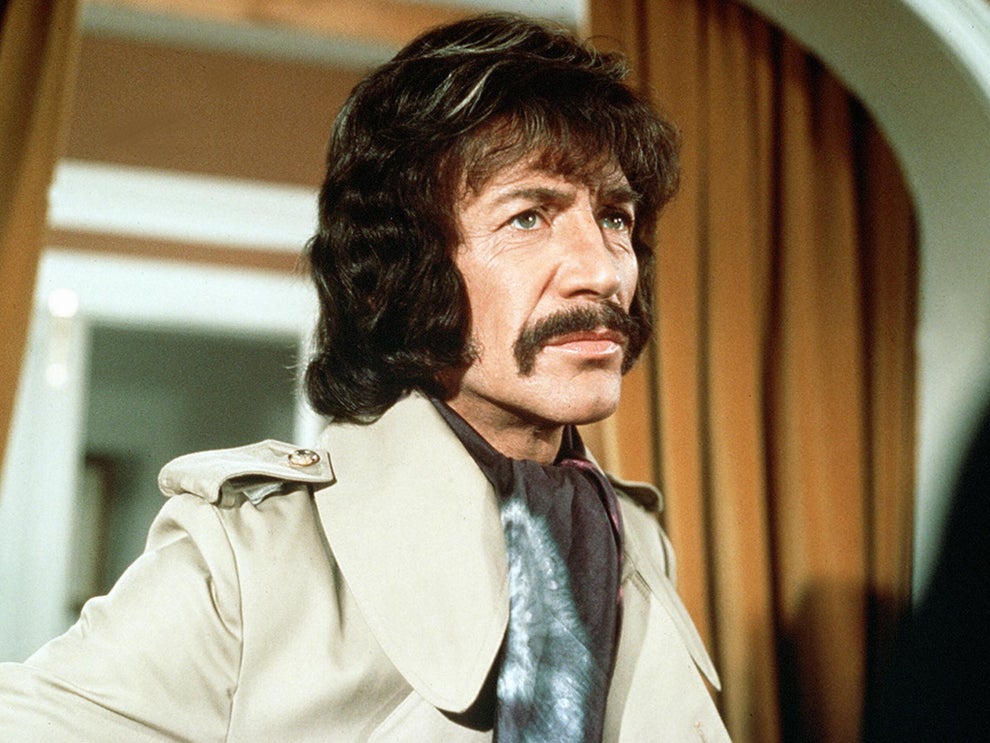
When I was growing up in a little terraced house in Leicester, there would be beamed into our living room telly a glimpse of an impossible glamorous world filled with fast cars, frightening gangsters and one unimaginably stylish and exotic central character – Jason King – played by Peter Wyngard, who has died aged 90.
I remember that he was a writer for a living, imagine that, and had a 1950s Bentley Continental coupe – which he took to the Continent to confront villains in places such as Paris, Vienna or Monaco. He ate strawberries – for breakfast, when we were only just discovering Alpen. He drank champagne at any and all hours, inexplicably.
He was elegant and always surrounded by beautiful things. He had a Zapata moustache, like the popular singer of “Where Do You Go to My Lovely?” Peter Sarstedt or Derek Dougan who played for Wolves, when they were a big club). He was frilly and flared in every way, like the Dr Who of the era, Jon Pertwee, another fully frilly and flared telly hero. He might as well have come from another planet, a sci-fi show such as Space 1999 or The Tomorrow People.
There was a magnificent vogue at the time for rich playboy-style crime-fighters, such as Tony Curtis (plus Ferrari Dino) and Roger Moore (plus Aston Martin V8) in The Persuaders, each and every episode a glorification of violence and sexism. Or The Avengers, a more civilised and surreal take on the genre, with Patrick Macnee in a bowler hat and Diana Rigg in a leather cat suit. No wonder those men who watched telly in the 1970s when they were growing up later found themselves on the wrong side of history, feminism and #MeToo. No TV personality, though, rivalled Jason King for sheer insouciant, arch, camp style.
But then, one day, when I was a slightly bigger kid it all stopped. No more Jason King on his chaise longue in his Chelsea mews home, no more seducing models in clothes made by Balmain, no more sipping Napoleon brandy in his apartment on the Boulevard St Michel.
The shows, harmless escapes from the three-day week and power cuts, and with sometimes ingenious plotting, weren’t even repeated. I had assumed that it was somehow a matter of fashion, and that just as glam rock gave way to punk, so too must Jason King flamingo flights of fancy gave way to The Sweeney’s gritty realism.
It was only much, much later that I read, I think in Private Eye, the reason for Wyngarde’s switch from ubiquity to obscurity. It was an incident that took place in the rather unglamorous and unerotic surroundings of the gents’ loos at Gloucester Bus Station. Wyngarde was caught, very possibly by some sort of a police entrapment, engaged in what was described as an act of gross indecency with a man.
Wyngarde maintained his innocence and proffered the explanation, for why he had been discovered prone in a cubicle, that he had slipped backwards on a piece of soap carelessly left on the floor. He was given a token fine, but this television career, at any rate, was simply over.
Nowadays it wouldn’t happen (the prosecution I mean, not the slipping over on the soap) and we’d condemn the sort of treatment he suffered at the hands of the telly executives of the time as homophobic.
Reading about Wyngarde’s life since it seems he made the best of things and picked up some work in the theatre, and sounded a proud and charming man who hardly deserved what had happened to him. It was a rather backhanded compliment that the various parodies inspired by the lies of Wyngarde – the Austin Powers movies being much the most celebrated – were vastly more famous than the actor who had inspired them. It should have been that Wyngarde would have gone to many more roles on the small screen and, in due course, played a willing cameo to his alter ego in some of those successful – and lucrative – homages to his 1970s persona that later emerged. A shame.

In memory of Peter Wyngarde, debonair star behind Jason King
From the ghostly face at the window in The Innocents to suave spy Jason King in cult TV series Department S, Peter Wyngarde cut an irreplaceable dash in British films and TV of the 1960s and 70s.
By David Parkinson – 18th January, 2018
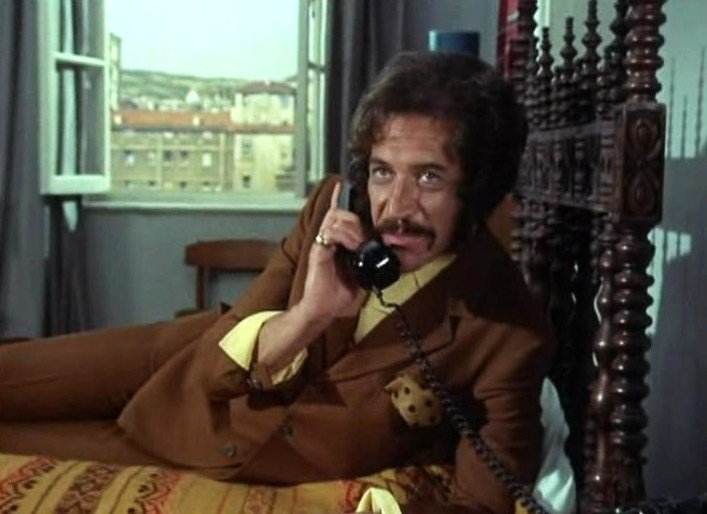
Peter Wyngarde, who has died at the presumed age of 90, took the role of Jason King in the ITV series Department S (1969-70) because he relished its spirit of adventure. His own life was certainly far from dull and there are often conflicting versions of its key events in circulation. Debates rage about his parentage and date of birth, and whether the renowned French actor Louis Jouvet was his uncle.
But, wherever the truth lies, Wyngarde seemingly caught the acting bug while being interned by the Japanese in the Lunghua Civilian Assembly Centre near Shanghai, where he played all the characters in his own variation on Dr Jekyll and Mr Hyde.
Whether or not he quit law studies at Oxford or abandoned classmates Alan Bates, Albert Finney and Peter O’Toole at RADA (“if you learn too much, you become aware of it; it can become tedious”), Wyngarde’s career almost ended with his debut after he was fired from a 1947 production of Noël Coward’s Present Laughter. Yet, by the time Vivien Leigh gave him a second chance to make good on the stage in Duel of Angels (1958), he had palled up with Richard Burton in Robert Rossen’s Alexander the Great (1956) and become a heartthrob as Sydney Carton in a seven-part BBC serialisation of A Tale of Two Cities (1957).
Although he would seethe anarchist fury as Peter the Painter in Robert S. Barker and Monte Berman’s The Siege of Sidney Street (1960) and prove a hauntingly menacing presence as Peter Quint in Jack Clayton’s masterly Henry James adaptation, The Innocents (1961), Wyngarde found his métier on television rather than the big screen. Having impressed as Sir Roger Casement in On Trial (1960), he guested in a number of cult shows. As John Cleverly Catney, he led a latter-day incarnation of the Hellfire Club in the 1966 Avengers episode, ‘A Touch of Brimstone’, and, later the same year, crossed swords with Roger Moore as The Saint in ‘The Man Who Liked Lions’.
In 1967, Wyngarde’s Number Two tormented Patrick McGoohan during an human chess game in the ‘Checkmate’ instalment of The Prisoner. He would also crop up in The Baron, I Spy, The Troubleshooters and The Champions before he was placed in charge of the Interpol unit charged with cracking cases that had left others baffled, in Department S. Modelling novelist-turned-sleuth Jason King on James Bond creator Ian Fleming, Wyngarde proved so suave and magnetic that he was invited to reprise the character in a 1971 spin-off series.
After one 26-show season, however, he tired of playing this “blasé idiot” who looked “like a Mexican expatriate” and spoke with an “awful English accent”. Yet it would remain Wyngarde’s most iconic role, even though he battled black magic in Sidney Hayers’s Night of the Eagle (1962), revelled in malevolence as secret police chief Klytus in Mike Hodges’ Flash Gordon (1980) and reeked of hypocrisy as a government grandee in James Marcus’s Tank Malling (1989).
He even confronted Peter Davison as the elder of a parched world in the 1984 Doctor Who storyline ‘Planet of Fire’, and enjoyed a degree of notoriety in 1998 when the press latched on to ‘Rape’, a track from a 1970 speak-sing album that had been reissued as When Sex Leers Its Inquisitive Head.
To the end, however, Wyngarde lived up to his definition of sophistication: “To be, but not seem to be.”

Peter Wyngarde obituary – 1927 – 2018: Flamboyant TV star who inspired Austin Powers
by Jane Warren – 19th January, 2018
In the late-1960s TV series Department S and later in its spin-off Jason King, actor Peter Wyngarde was an all-action lady-killer with huge sideburns, a lush moustache and a serious whisky habit.
“A bit too early for coffee, I’ll have a scotch,” was a typical line in a series that was an enjoyable parody of spy and detective dramas such as The Saint and The Avengers.
The flamboyant tailored suits Wyngarde wore for the part were never so tight that he couldn’t karate chop himself out of trouble – a critical consideration as he had insisted his character, based on James Bond creator Ian Fleming, would never carry a gun.
The two series made Wyngarde a huge star. He was once mobbed on arrival in Australia by 30,000 screaming women.
Some fans would send him intimate items of clothing to sign, others would “throw brassieres all over the car, on the antennae and so on”
…Such was his status that Jason was the most popular choice of name for boys in 1971. Even the children’s show Blue Peter named its Siamese cat after his character.
But Wyngarde – who has died aged 90 – enjoyed an earlier career as a serious Shakespearean actor and once revealed that he nearly refused the role.
“I looked hideous,” he once said of his on-screen styling. “He was this blasé idiot floating about on screen looking like a Mexican expatriate. I nearly decided not to go with it.”
He relented and came to relish playing “this very romantic extension of me” that allowed him to wear “peacock” fashions of his own devising. He also had a hand in other aspects of the production’s creation. “I was told I was going to be an Oxford professor sitting at his desk solving problems. I thought it was a bit dull. Then I had the bright idea of basing him on Fleming.”
Perhaps this is not so surprising given that Wyngarde’s father is believed to have been a member of the British diplomatic corps, while Fleming’s wartime service working for Britain’s Naval Intelligence Division provided much of the background detail and depth of the James Bond novels.
The actor also persuaded TV bosses to film on location – something very rarely done in the 1960s and 70s due to cost.
“They agreed to send just me and a cameraman away,” he once explained.
“When we went to Rome and came across a gaggle of nuns I just ran into the middle of them like some terrible rooster among all these hens. Then we would write stories to fit in with the location shots.”
Jason King was also renowned for its glamorous actresses, many of whom went on to become household names. They included Stephanie Beacham, Kate O’Mara and Felicity Kendal – whom Wyngarde confessed he fancied like mad.
“Why has no woman ever been finally able to tame you?” the actor was asked in 1973 by gay chat show host Russell Harty.
“It did happen once, a long time ago, but I have great choice, great variety,” said Wyngarde drolly of a brief marriage to actress Dorinda Stevens in his early 20s. “I don’t think I’d like to get tied down in any shape or form.”
In fact Wyngarde – who once described himself as “100 per cent bisexual” and was nicknamed Petunia Winegum – had a decade-long affair with actor Alan Bates that is believed to have begun in 1956 after Bates made his debut in Look Back In Anger.
The relationship was said to have been “a psychologically damaging, Pinter-style situation”.
In 1975 Wyngarde was fined £75 under his real name Cyril Louis Goldbert for “gross indecency” with a lorry driver in the toilets of Gloucester bus station.
This followed a caution for similar activities in Birmingham. Although he appeared on stage in South Africa and Austria after the bus-station episode his TV career came to a standstill and he took consolation in drink.
In a 1993 interview he said: “Jason King had champagne and strawberries for breakfast, just as I did myself. I drank myself to a standstill. When I think about it now I’m amazed I’m still here.”
As attitudes to homosexuality became more liberal Wyngarde made cameo appearances on film, including as a masked villain in the 1980 movie Flash Gordon, but he never forgave the “small-minded people” who had wrecked his career.
But Wyngarde was nothing if not a survivor. Born in France he had spent his childhood in the Far East due to his father’s diplomatic career and was interned in the Lunghua Civilian Assembly Centre outside Shanghai when Japan attacked China.
His feet were broken by a guard who caught him smuggling messages between barracks but the Japanese did let the prisoners put on plays, a concession that showed him his calling.
At the end of the war he returned to England, went to drama school, adopted his stage name and started out in rep before finding success in the West End. But it was as the high camp Jason King that he achieved lasting fame.

Farewell to a Hellfire Club Inspiration
In their latest look at outdated pop culture references in comics, CSBG looks at the real life inspiration for the Hellfire Club AND Austin Powers!
By Brian Cronin – 20th January, 2018

This is Foggy Ruins of TIme, a feature that provides the cultural context behind certain comic book characters/behaviors. You know, the sort of then-topical references that have faded into the “foggy ruins of time.” To wit, twenty years from now, a college senior watching episodes of “Seinfeld” will likely miss a lot of the then-topical pop culture humor (like the very specific references in “The Understudy” to the Nancy Kerrigan/Tonya Harding scandal).
Reader Bruce P. wrote in to note the passing of a major British pop culture icon who also ended up playing a major role in the introduction of the Hellfire Club!
Peter Wyngarde was one of those celebrities that you don’t really get to see any more in the internet age, which is that no one really knows WHAT the heck happened to him during his early life. He told so many conflicting stories about his background that people aren’t even sure that the age he gave upon his death a few days ago was the correct one.
In any event, late in the 1960s, Wyngarde began to make a real career out of notable guest appearances in British TV series, including playing the main villain in the 1966 Avengers episode, “A Touch of Brimstone,” where Emma Peel has to go undercover as a member of the Hellfire Club, of which the leader, Honorable John Cleverly Cartney, is played by Wyngarde with all the over-the-top pomp and circumstance that you would expect from an underground “Sin” club…
John Byrne and Chris Claremont were both teenagers when this episode came out and, probably much like many teenage boys at the time, the episode (particularly Diana Rigg in a corset) likely left a very much lasting impression, as years later, they adapted the Hellfire Club to the pages of the X-Men….
After his success as a guest actor in the late 1960s, Wyngarde was given his own series, where he played the over-the-top international man of mystery, Jason King, in Department S.
King clearly seems to be a visual inspiration for Mike Myers’ Austin Powers (King even said “Groovy, baby” in one episode of his series).
Wyngarde’s Jason King character was also the visual inspiration for Mastermind’s new look as a member of the Hellfire Club, as well as his new name, which was a combination of the Jason King character and the Peter Wyngarde actor to become Jason Wyngarde…
Farewell to an actor so great at being over the top that he left an impression in a multitude of media!

Obituary: Peter Wyngarde
By Michael Quinn – 6th February, 2018
Success in Department S and Jason King brought Peter Wyngarde fame in the early 1970s but cost him a later career on television. Typecast as the flamboyant, womanising novelist and sleuth Jason King, his later small-screen career amounted to little more than a handful of guest spots.
Wyngarde’s own background was itself the stuff of fantasy, the actor deliberately obfuscating his past to create confusion about his date of birth, family name and much else. Increasingly enamoured of the rakish, bed-hopping dandy persona he had created, he found himself wrong-footed by a shift towards what he dismissed as “all that naturalistic stuff”.
The son of a diplomat, much of his early life was spent in Asia. He fled from Singapore to the UK when the Japanese army invaded in 1941 and claimed to have later read law at Oxford. He trained at RADA briefly before finding work in regional repertory companies, making his debut at the Buxton Playhouse in 1946.
Without the mannerisms that would define his later career, he showed considerable early promise, The Stage noting his “outstanding performance [of] power and vitality” as Jonah in Nathan Shaham’s They’ll Arrive Tomorrow at the Irving Palace Theatre in 1952.
His theatre profile continued to rise, appearing alongside Peggy Ashcroft and Joan Plowright in Brecht’s The Goodwoman of Szechwan (sic) at the New Theatre, Oxford (1956), with Vivien Leigh (whom he claimed to have had an affair) and Claire Bloom in Jean Giraudoux’s Duel of Angels at the Apollo Theatre (1958, transferring with it to Broadway in 1960) and taking the title role in Edmond Rostand’s Cyrano de Bergerac and directing Eugene O’Neill’s A Long Day’s Journey Into Night for the Bristol Old Vic in 1959.
The same year, he attracted attention on television with “a stunningly brilliant performance” in Julien Green’s American Civil War-era South, and as a “flashing-eyed, dashing” Petruchio in a broadcast of the Bristol Old Vic’s The Taming of the Shrew.
In 1964, he played Oberon to Anna Massey’s Titania (A Midsummer Night’s Dream) on TV and shared the stage with Margaret Rutherford in Jean Anouilh’s Time Remembered at the New Theatre, Bromley.
He was seen in the world premiere of Tennessee Williams’ The Two-Character Play at the Hampstead Theatre (1967) and an adaptation of Chekhov’s novel The Duel at the Duke of York’s Theatre (1968).
He made several visits to Austria, South Africa and Australia, where he appeared in the premiere of Simon Gray’s Butley in 1971.
Returning home, he was the eponymous Siamese royal in The King and I for 260 performances at the Adelphi Theatre. Later West End appearances included Marcelle Maurette’s Anastasia (Cambridge Theatre, 1976), Michael Sloan’s Underground (Prince of Wales Theatre, 1983) and William Wycherley’s The Country Wife (Mermaid Theatre, 1990).
Other notable television credits included Sydney Carton (A Tale of Two Cities, 1957), Rupert of Hentzau (1964), The Avengers (1966-67) and Doctor Who (1984), while on film he memorably played the masked Klytus in Flash Gordon (1980).
He was married to the actor Dorinda Stevens and had a long-term relationship with the actor Alan Bates. In 1975, he was found guilty of gross indecency after an incident in a public toilet and was declared bankrupt in 1982.
Peter Wyngarde was born Cyril Louis Goldbert on August 23, 1927 (some sources claim 1926 and 1928) and died on January 15.

Peter Wyngarde 1928 – 2018
Starburst – 18th January, 2018
Few actors epitomised the gaudy stylishness of the 1960s and early 1970s better than the charismatic Peter Wyngarde, who passed away on January 15th after a short illness at the age of 90.
Although he kept his true age – and, indeed, much of his own personal biographical history (he spent time as a child during the Second World War at an internment camp for children near Shanghai) – shrouded in mystery, Peter Wyngarde (his birth name, at least, is accepted as Cyril Goldbert) was a regular on many of the classic ITV adventure series of the 1960s including The Saint and The Avengers and he appeared as No 2 in ‘Checkmate’, an episode of Patrick McGoohan’s The Prisoner in 1967. But he became an “overnight sensation” in 1969 when he was cast as flamboyant thriller author/investigator Jason King on ITC’s Department S (think X Files without the torches…or monsters or alien invasion conspiracies) alongside Rosemary Nicholls and Joel Fabiani. TV had never seen a hero quite like King, with his extravagant champagne-quaffing lifestyle, extraordinary fashion sense and luxurious handlebar moustache – although he was nearly an entirely different character, as he told Hellfire Club (named after his appearance in the legendary ‘A Touch of Brimstone’ episode of The Avengers in 1966), the Peter Wyngarde Appreciation Society, just last year. “When Department S was being planned, I was told that I was going to be an Oxford professor sitting at his desk solving problems for two Americans. I thought it was a bit dull. Then I had the bright idea of basing him on Ian Fleming. The clothes were sort of an extension of me. I was a bit of a peacock then. I loved clothes, but I didn’t much like the kind of fashions that were about for guys in those days. Then I saw a picture of an Edwardian riding jacket and I thought it had real style, so I did some drawings and had a similar coat made.” King was an instant hit, a worldwide sex symbol, and the character was resurrected in a less-successful and more mundane series (Jason King) in 1971.
Wyngarde more or less disappeared from TV screens during the rest of the decade but his career flourished on stage and he had little time for critics who insisted that his career had become derailed. “That’s because they haven’t the intellect to notice that there are mediums other than television,” he told Hellfire Club. “If you’re not on the box every week they think you’ve disappeared! My first love was always the stage, and after Jason King ended, I couldn’t wait to return to the theatre. I feel that if some journalists had a brain, they’d be dangerous!”
Notable screen roles followed though. In 1980 he played Klytus in Flash Gordon and appeared in the 1984 Doctor Who serial ‘Planet of Fire’ alongside Peter Davison’s fifth Doctor. “I’d been asked to appear in the series in the 1970’s, but it was due to be filmed entirely on a soundstage, which I’d have hated, so I turned it down. When ‘Planet of Fire’ came about, I was told that we’d be filming almost exclusively on location (the serial was filmed in Lanzarote), so I jumped at the chance. It gave me the opportunity to do a lot of sunbathing between my scenes, which I love.” In 1994 he appeared as Langdale Pike in Granada’s acclaimed Memoirs of Sherlock Holmes series with Jeremy Brett as the Great Detective. He left a stage production in 1995 after contracting a throat infection and much of his subsequent work involved providing voiceovers and narrations and attending fan events celebrating the ‘golden age’ of classic and cult television.
A vibrant, outspoken and outrageous talent – “He was one of the most unique, original and creative actors that I have ever seen,” said his agent/manager Thomas Bowington – Peter Wyngarde might not have scaled the professional heights of some of his contemporaries and Jason King might not have been the work he’d have preferred to have been remembered for but in both Department S and his own series he created a character and an image which in many ways helped define both a generation and a decade.

Peter Wyngarde: Cult TV star who inspired Austin Powers dies aged 90
BBC – 18th January, 2018.
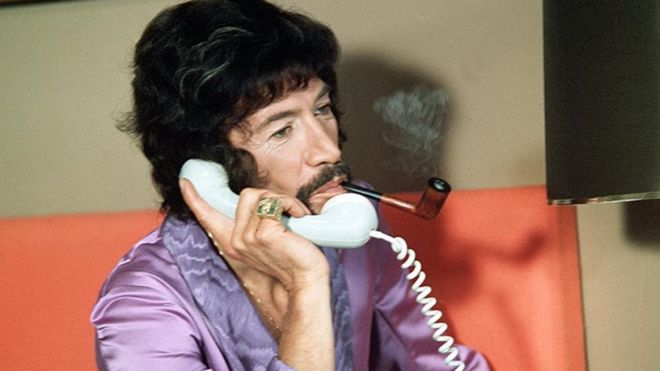
Wyngarde played dandy detective Jason King in the 1970s TV show of the same name – which was a partial inspiration for the Austin Powers films. He had numerous stage roles, as well as playing the gold-masked Klytus in Flash Gordon and Timanov in Doctor Who. His agent and manager, Thomas Bowington, described him as “one of the most unique, original and creative actors” he had seen.
“As a man, there were few things in life he didn’t know.”
“I sometimes nicknamed him The King because he simply knew everything,” Bowington added.
Wyngarde started his career on stage, in a production on Noel Cowards’ Present Laughter at Birmingham’s Theatre Royal in 1947; and later starred opposite Richard Burton in the big-screen adaptation of Alexander the Great.
In 1959, he starred in ITV’s South – which some have claimed was the first gay drama on British television.
Set during the US Civil War, it featured Wyngarde as a Polish army lieutenant Jan Wicziewsky, who must decide who he loves: Miss Regina, a plantation owner’s niece; or a tall, rugged officer called Eric MacClure.
Broadcast live at a time when homosexuality had not been decriminalised in the UK, the drama received scathing reviews in the press.
“I do NOT see anything attractive in the agonies and ecstasies of a pervert, especially in close-up in my living room,” noted The Daily Sketch’s critic.
“I think you have to give Wyngarde a massive pat on the back in terms of the bravery in taking this role,” said BFI curator Simon McCallum when South was rediscovered five years ago.
The furore over the programme did not affect the actor’s career, and he guest-starred in a number of 1960s television shows including The Saint, The Prisoner and The Avengers before debuting Jason King in the spy drama Department S.
The character proved so popular that Wyngarde got a spin-off series, which made him a household name in the US and Australia.
He started his own fashion column in a daily newspaper and, after Australian women voted him the man they’d most like to have an affair with, was mobbed at Sydney airport.
“It was one of the most terrifying experiences I can remember,” he later recalled. “They got me to the ground, tore my clothes, debagged me… I was in hospital for three days.”
Wyngarde was briefly married to actress Dorinda Stevens in the 1950s, and then had a long-term relationship with actor Alan Bates.
His career suffered a setback in 1975 when he was arrested and convicted of “an act of gross indecency” with a lorry driver. He was fined £75 by magistrates under his real name Cyril Louis Goldbert.
The star said the conviction upset him deeply, but did not affect his career. However, his days as a leading man were largely finished.
He attributed his decline to type-casting by “small-minded people”, but homophobia was undoubtedly a factor.
King remained his best-known character, a globe-trotting playboy with an astonishing array of outfits. And it wasn’t just his sartorial extravagance that inspired Mike Myers to create Austin Powers: King even uttered the phrase “groovy, baby” in one episode.
“I decided Jason King was going to be an extension of me,” he once said. “I was inclined to be a bit of a dandy – I used to go to the tailor with my designs.”
However, he took the character’s lifestyle a bit too literally, battling alcoholism in the 1980s. He only quit after cutting ties with a close friend in a fight he couldn’t remember.
“Jason King had champagne and strawberries for breakfast, just as I did myself,” he told The Observer in 1993.
“I drank myself to a standstill. When I think about it now, I’m amazed I’m still here.”
Wyngarde died at Chelsea and Westminster Hospital in London after being unwell for a few months.
His agent said that, despite his age, the actor had roles and appearances lined up for the coming year.
Mark Gattiss was among those paying tribute on Twitter.
“What a life. What a legend. Jason King is dead. Long live Jason King!”
Fellow Doctor Who writer Paul Cornell also paid tribute, acknowledging that many details of Wyngarde’s life, including his place of birth and parentage, were unclear.
“It’s terrible and impossible that #peterwyngarde is dead,” he wrote, linking to the star’s uncharacteristically caveat-heavy Wikipedia page.
“Such an extraordinary, detail-disputed, life. He was oddly magnificent.”
OTHER TRIBUTES



 PETER WYNGARDE: The Official Website