


Series: The Saint
Broadcast: Friday, 18th November 1966
Character: Tiberio Magadino
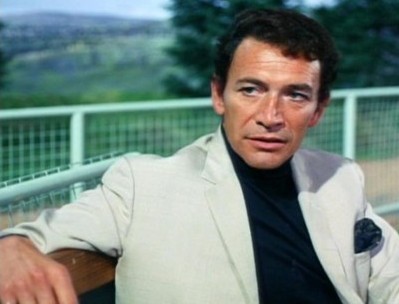
“Our sick, decadent society today, what has it produced?… Long-haired, self-absorbed effeminates. I’d like to see them all quietly exterminated!” Tiberio Magadino
Story Synopsis
In the episode of The Saint titled “The Man Who Likes Lions,” Simon Templar becomes entangled in a perilous web of intrigue involving the enigmatic and affluent Teberio Magadino—a man whose fascination with lions is surpassed only by his appetite for power and manipulation. What commences as a seemingly straightforward investigation evolves into a complex battle of wits, as Templar exposes a network of criminal activity concealed beneath a veneer of sophistication. Magadino’s imposing estate, featuring various exotic animals, serves as an unusual and often menacing backdrop to the unfolding drama.
As Templar delves deeper into the mystery, it becomes evident that Magadino is far more dangerous than he initially appeared. Beneath a cultured exterior lies a calculating and ruthless individual who views others much as he views the predators he admires: as creatures to be controlled, utilised, or discarded. Consequently, Templar must employ his intelligence, charm, and resourcefulness to uncover the truth while evading the numerous traps and deceptions set in his path.
The episode systematically builds tension through a combination of suspense, action, and psychological confrontation. Much of its appeal derives from the contrast between Templar’s effortless confidence and Magadino’s cold, deliberate authority. Their encounters evolve into a contest between two formidable personalities, each determined to outmanoeuvre the other. As the stakes rise, Templar moves closer to uncovering the full extent of Magadino’s schemes.
The climax brings the conflict to a resolution as Simon finally exposes the criminal activities at the heart of the mystery. While justice ultimately prevails, the viewer is provided with an engrossing adventure defined by danger and memorable characterisation. Although the episode contains all the elements that contributed to the success of The Saint, it is particularly noted for Peter’s compelling portrayal of Teberio Magadino; the villain’s intelligence, charisma, and underlying menace render him one of the most memorable adversaries Simon Templar encounters throughout the series.
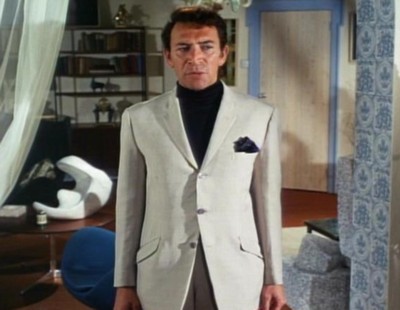
Thoughts on the episode
Among the many notable episodes of The Saint, “The Man Who Likes Lions” remains one of the most compelling examples of the series’ capacity to blend adventure, intrigue, glamour, and eccentric villainy into an engaging hour of television. Broadcast during the programme’s black-and-white era, the episode provides Roger Moore with one of his most vibrant adversaries in Teberio Magadino, portrayed with considerable flair and intelligence by Peter Wyngarde. While the plot offers an enjoyable synthesis of suspense and exotic menace, it is Peter’s performance that ultimately elevates the production beyond mere entertainment, transforming it into one of the more memorable entries in the series.
As Simon Templar, Roger Moore operates within familiar territory. Effortlessly charming, witty, and resourceful, Moore navigates the narrative with the confidence that became synonymous with the role. By this stage in the series, he had perfected the Saint’s balance of sophistication and mischief. However, a primary reason the episode succeeds is that Moore is presented with an adversary capable of matching his screen presence.
That adversary is Teberio Magadino.
From his initial appearance, Magadino emerges as a figure who commands attention. Peter possessed one of the most distinctive presences in British television; tall, handsome, and endowed with a remarkable speaking voice, he had the ability to render even the simplest line significant. More importantly, he understood that genuine menace rarely stems from shouting or theatrical displays; rather, it arises from confidence, self-control, and intelligence. These qualities are central to his portrayal of Magadino.
The character could easily have devolved into a one-dimensional villain. The title itself, “The Man Who Likes Lions,” suggests a larger-than-life figure bordering on caricature. Yet, Peter avoids the obvious path. Instead of portraying Magadino as a conventional criminal mastermind, he creates a character of considerable sophistication, possessing charm, refinement, and even a degree of humour. This renders him infinitely more interesting than many television villains of that era.
One of the most striking aspects of Peter’s performance is his restraint. Where lesser actors might have been tempted by excess or histrionics, Peter adopts a contrary approach, remaining calm, measured, and unhurried. This proves far more effective, as it establishes the sense that Magadino is perpetually in control and thinking several moves ahead. Even when events shift against him, he retains an air of confidence that renders him a formidable opponent for Simon Templar.
Such qualities were characteristic of Peter’s finest work; he excelled at portraying intelligent men whose danger derived from mental agility rather than physical brutality. Magadino fits firmly within this tradition, and the audience is never in doubt that he is a man capable of meticulous planning and calculated action. Consequently, the stakes are heightened whenever he and Templar are in opposition.
The scenes between Peter and Roger Moore are particularly compelling. While both actors possessed immense charisma, they deployed it in divergent ways. Moore’s Saint is breezy and perpetually amused, whereas Peter’s Magadino is cooler, more enigmatic, and considerably darker. This contrast creates a fascinating dynamic, producing a palpable sense of two highly intelligent men testing one another.
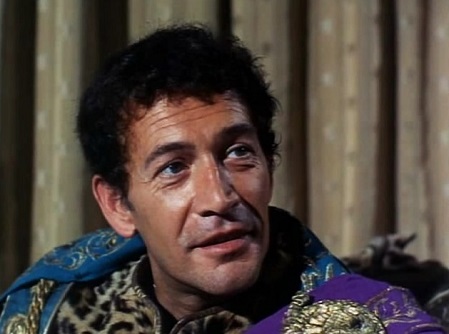
These exchanges are especially effective because Peter refuses to be overshadowed. While many guest actors struggled to maintain presence opposite the hugely popular Moore, Peter possessed the confidence and ability to match Moore scene for scene. This transforms their interaction into a genuine contest rather than a foregone conclusion, leaving the audience more invested in the conflict.
The role also showcases Peter’s extraordinary vocal range. His voice – one of the most recognisable in British entertainment – was rich, cultured, and capable of conveying both charm and menace. As Magadino, he employs this skill brilliantly; every line is delivered with precision and purpose. He avoids unnecessary volume, yet there is always an underlying current of authority, ensuring that even casual remarks carry significant weight.
Furthermore, Peter brings a necessary ambiguity to the character. Although Magadino is clearly the antagonist, he is never portrayed as a mere caricature of evil. Instead, Peter suggests a man who genuinely enjoys power, sophistication, and the finer things in life. This almost aristocratic complexity makes the character far more compelling than a straightforward villain.
The episode itself benefits greatly from this approach. While the plot contains all the expected elements of The Saint – danger, mystery, exotic settings, and clever detective work – it is Magadino who provides much of the narrative momentum. The story succeeds not simply because Templar must solve a problem, but because the man obstructing him is so intriguing.
The production values are equally impressive. Like many ITC productions of the era, the episode exudes style, offering an international flavour and a sense of glamour and adventure that became hallmarks of the series. The direction maintains a brisk pace, while the script balances suspense with the light touch that made the show so popular.
Nevertheless, any discussion of “The Man Who Likes Lions” must acknowledge the extent to which the production benefits from Peter’s innate star quality. Even at this relatively early stage of his career, many of the attributes that would later secure his fame are already apparent: the elegance, the intelligence, an air of mystery, and an absolute command of the camera.
Viewed from a contemporary perspective, the episode is particularly compelling as it offers a glimpse of Peter prior to his iconic success as Jason King. There are moments in which the future television star is clearly emerging; the confidence and magnetic presence that would eventually captivate millions are already fully formed. Yet, in contrast to the flamboyant King, Magadino is a darker, more controlled figure, allowing Peter to demonstrate a different facet of his considerable talent.
Ultimately, “The Man Who Likes Lions” succeeds on several levels. It remains an entertaining episode of The Saint, replete with intrigue and suspense. It provides Roger Moore with an excellent showcase as Simon Templar and delivers the sophistication and adventure expected by the audiences of the series. Most significantly, however, it features one of Peter’s finest guest appearances in 1960s television.
His portrayal of Teberio Magadino is intelligent, charismatic, and quietly menacing, further proving Peter’s rare ability to elevate any production in which he appeared. Rather than creating a stereotypical television villain, he fashioned a memorable antagonist whose charm was as dangerous as any weapon. More than sixty years after its original transmission, it is his performance that lingers most strongly, serving as a reminder of why Peter was regarded as one of the most compelling screen actors of his generation.
In Retrospect
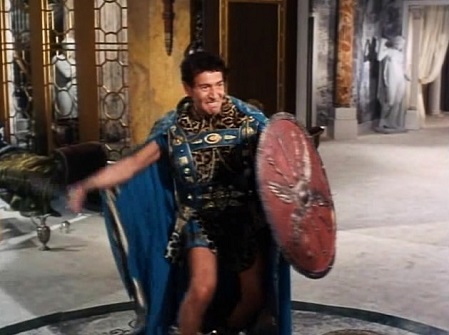
“Marvelous archetype: the sort of men who raised Rome to the peak of her power.” Tiberio Magadino
Those familiar with Peter’s body of work will appreciate the diversity of his talent. In Night of the Eagle, he portrays a composed and level-headed college professor; in Sherlock Holmes: The Three Gables, he embodies the enigmatic Langdale Pike. Furthermore, as Jason King, he captured the charming persona for which he is so well-regarded.
In this episode of The Saint, he depicts a character who is both lethal and notably violent. Peter effectively conveys the danger and intensity driving his role. His passion stands in stark contrast to some of the other performers in the piece, who appear to treat acting as little more than the correct delivery of lines and a polished appearance.
One of Peter’s most recognizable attributes is his commanding screen presence and natural ease before the camera. While he portrays Tiberio exactly as the role requires, it feels as though the script fails him in several instances. For example, the encounter where Templar “bumps into” Tiberio outside the zoo’s lion enclosure is unconvincing; it seems improbable that Tiberio would be there, given that he keeps lions at his own home.
Additionally, if Tiberio were truly a contract killer, he likely would have eliminated Templar as a threat rather than allowing him to uncover the truth so effortlessly.
Roger Moore is capable, though perhaps not particularly impressive here, as he leans too heavily into the suave playboy archetype for my liking. Similarly, Suzanne Lloyd’s portrayal of Claudia was unremarkable; had Lady Penelope taken the role, I suspect the performance would have been significantly more impactful.
Nevertheless, the episode remains entertaining and watchable – particularly for those who enjoy seeing their favourite actor in Roman attire.


One thought on “REVIEW: The Man Who Liked Lions”