


Broadcast: Monday, October 24th, 1966 (USA )
Character: Himself
The Story

When Lucy in London aired on CBS on 24 October 1966, it represented an ambitious departure for Lucille Ball. Filmed entirely on location in London, the hour-long television special was designed to capitalise on the worldwide fascination with “Swinging London”, then at the height of its cultural influence. Starring Lucille Ball alongside Anthony Newley and featuring appearances by The Dave Clark Five, the programme combines comedy, music, sightseeing and sketch performances into a colourful celebration of Britain as viewed through an American lens. While Ball is unquestionably the star attraction, one of the special’s most intriguing moments comes courtesy of Peter, whose brief but memorable appearance adds an extra layer of sophistication and theatricality to the production. The special includes a sequence in which Lucy participates in a scene from Shakespeare’s The Taming of the Shrew opposite Peter.
When Lucy in London aired on CBS on 24 October 1966, it represented an ambitious departure for Lucille Ball. Filmed entirely on location in London, the hour-long television special was designed to capitalise on the worldwide fascination with “Swinging London”, then at the height of its cultural influence. Starring Lucille Ball alongside Anthony Newley and featuring appearances by The Dave Clark Five, the programme combines comedy, music, sightseeing and sketch performances into a colourful celebration of Britain as viewed through an American lens. While Ball is unquestionably the star attraction, one of the special’s most intriguing moments comes courtesy of Peter, whose brief but memorable appearance adds an extra layer of sophistication and theatricality to the production. The special includes a sequence in which Lucy participates in a scene from Shakespeare’s The Taming of the Shrew opposite Peter.
Viewed today, Lucy in London functions as a fascinating time capsule. London in the mid-1960s was regarded as the centre of youth culture, fashion and innovation. The programme enthusiastically embraces this reputation, taking viewers on a whirlwind tour of famous landmarks, fashionable boutiques and tourist attractions. Lucille Ball’s character, Lucy Carmichael, arrives expecting a conventional sightseeing experience, only to be swept into a series of increasingly eccentric adventures led by Anthony Newley’s charming guide.
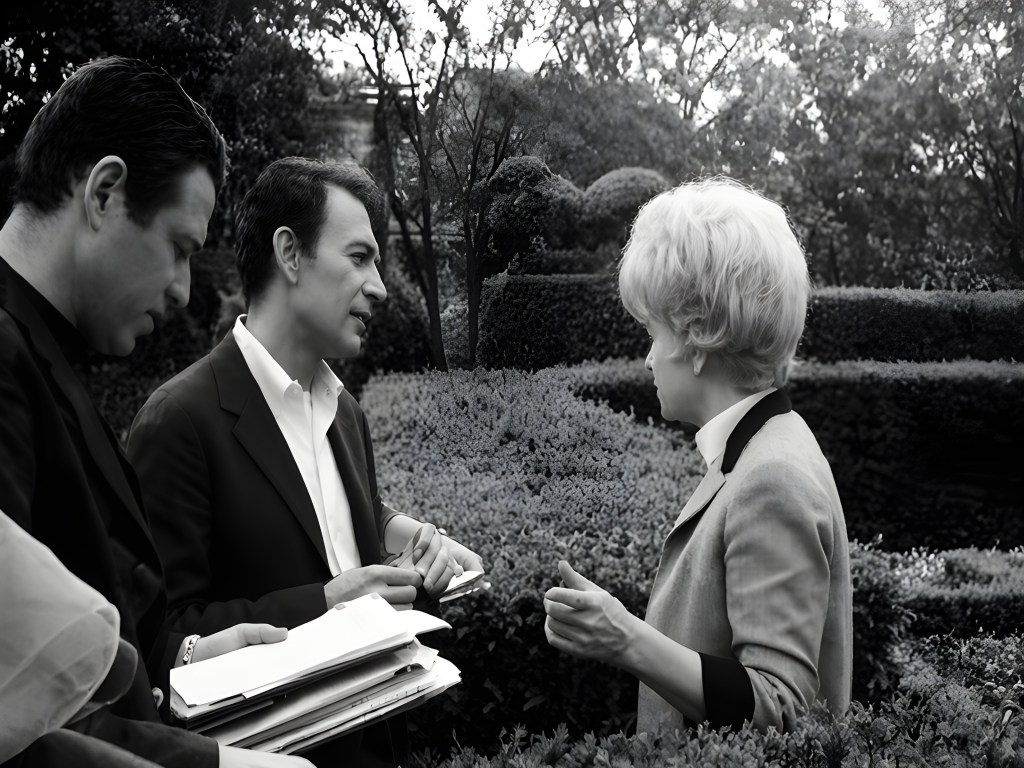
Right: Peter, Lucille Ball and Director, Steve Binder run through the script.
Yet among all the pop music, colourful fashion and comedic sightseeing, Peter’s appearance stands out as one of the programme’s most memorable highlights. By 1966, Peter was already becoming a familiar face to British audiences, possessing a distinctive screen presence that set him apart from many of his contemporaries. Handsome, elegant and blessed with a remarkable voice, he projected an air of intelligence and authority that made him instantly recognisable.
Although relatively brief, the scene provides a wonderful showcase for Peter’s talents. Surrounded by the broad comedy that dominates much of the special, he brings a sense of classical theatrical gravitas. His performance is confident and assured, reminding viewers that beneath the charming television personality was a highly trained actor with a strong command of dramatic material. While the sketch is played for laughs, Peter never treats the Shakespearean material carelessly. Instead, he performs with conviction, lending credibility to the proceedings even as Lucy’s comic instincts threaten to derail them.
What makes his appearance particularly enjoyable is the contrast between Peter’s polished sophistication and Lucille Ball’s deliberately chaotic comic style. He plays the scene straight, allowing Ball’s reactions to generate the humour. It is a classic comic technique: the more serious one performer remains, the funnier the antics of the other become. Peter understands this perfectly. Rather than competing for laughs, he acts as a dignified anchor around which the comedy revolves. His restraint demonstrates considerable skill and contributes significantly to the success of the sequence.
There is something uniquely fitting about Peter’s presence in a special intended to celebrate London and British culture. Few actors of the era embodied a particular brand of cultivated British elegance as effectively as he did. Even in a relatively modest role, he represents a theatrical and literary tradition that contrasts with the youthful pop culture showcased elsewhere in the programme. While The Dave Clark Five represent a modern Britain, Peter provides a connection to the country’s dramatic heritage. Together, these contrasting elements create a richer and more varied portrait of London than might otherwise have been achieved.
Furthermore, the sequence serves as a testament to Peter’s versatility. Although later audiences would primarily associate him with stylish and charismatic screen roles – particularly those requiring authority and intelligence – he was equally adept at handling classical material. In Lucy in London, viewers catch a glimpse of that broader range; even within the constraints of a light entertainment special, he imbues his performance with professionalism and flair.

Anthony Newley also merits considerable praise. His warm rapport with Ball forms the backbone of the production, and his musical performances lend energy and personality to the proceedings. Meanwhile, various London locations, including Madame Tussauds and the River Thames, provide vibrant settings that keep the programme visually engaging. The entire special reflects an era in which television productions were increasingly willing to operate on a grand scale and take cameras beyond the confines of the studio.
Admittedly, not every aspect of Lucy in London has aged perfectly. Some of its references are inevitably rooted in 1960s fashions and attitudes, and modern audiences may find its structure somewhat episodic. Rather than following a strong narrative arc, the special often resembles a collection of sketches and musical interludes linked by Lucy’s journey across the city. Yet, this very quality contributes to its charm, capturing a specific cultural moment with remarkable vividness.
Ultimately, Lucy in London remains an entertaining curiosity and a valuable record of both Lucille Ball’s enduring comic brilliance and London’s mid-1960s cultural prestige. For admirers of Peter, it offers an especially rewarding glimpse of the actor during a pivotal period of his career. Although his appearance occupies only a small portion of the running time, it is handled with intelligence and style. His poise, theatrical authority, and natural charisma leave a lasting impression, proving that even a brief role can become one of a production’s highlights. In a special filled with memorable personalities, Peter succeeds in doing what he often did best: commanding attention whenever he appears on screen.
Some Notes
Lucille Ball had been to see the play, ‘Duel of Angels‘ on Broadway in 1960, in which Peter played Count Marcellus opposite Vivien Leigh. Ball was so enamoured with the young actor that she was determined to work with him, and so when the opportunity arose for her to film in London, Peter’s agent was the first she rang.
Peter’s Comments
| “Lucy may’ve thought I was kidding, but if she wanted to play this straight she would be a marvellous Kate. Her looks are absolutely right as is her vitality. And she’s a good enough actress to be able to do it”. Peter Wyngarde – Las Vegas Sun, 23 October, 1966 |


2 thoughts on “REVIEW: Lucy in London”