It’s over 50 years since an actor friend and I secured a part in a play in Stratford. As I remember, neither of us were particularly ‘Well off’ at the time, so instead of trying to find rooms in the town, we decided to look for alternative accommodation for the duration of the play.
Having scoured the local newspapers for what seemed like an eternity, we managed to find what appeared to be the perfect place; a large rural cottage located in a small hamlet just five miles outside of Stratford. The rent, if my memory serves me correctly, was one pound and ten shillings per week (£1.50), which even we two struggling actors could afford.
But there, it seemed, lay the catch: wasn’t this amount really a bit TOO much of a bargain to be true? I decided to make some enquires just to be sure that there hadn’t been a printing error but found, to our delight, that the figure was indeed correct. We decided to accept and moved in right away.
It was the middle of summer and the play, which was now in its third week, had proven to be a huge success. Following one of the many backstage parties that were thrown by the theatre manager, my friend and I were driving back to the cottage around 12.30am, when a young man appeared from nowhere, and sped across the road right in front of our car. I screamed out to my friend at the wheel, who immediately applied the brakes. We just managed to miss the man by mere inches.
A couple of nights later we were, again, driving back to the cottage after the evening performance when the same thing happened. Since the play was taking a break for a few days, we decided it was best if we stayed ‘home’ for the duration.
Following the end of the play’s run in July, my friend decided to audition for another production at the same theatre, and was successfully engaged in the lead role. I, on the other hand, had decided to take the remainder of the summer off, and spent much of my time sunbathing in the garden of the cottage.
One evening, however, whilst I was driving my friend to the theatre, I spotted what appeared to be the man who’d we’d almost killed on two previous occasions sitting on a fence by the side of the road. The moment he spotted us, he made a dash for the cover of the woods to our left, at which point I screeched the car to a halt and decided to go off after him. But despite that fact that I’d virtually been on his heel as he’d made off, I was unable to find him anywhere. It seemed as if he’d literally disappeared into thin air.
Later that same evening we arrived at the cottage to find that it’d been ransacked; all the furniture had been turned over, and there were paper and books strewn everywhere. I immediately made my way to the village police station, which appeared to be manned by one middle-aged officer to whom I related our tale.
Scratching the top of his head, he replied casually: “Did you know, Sir – that cottage is meant to be haunted? No one stays there for longer than a couple of days.” It suddenly occurred to me why the rent had been so low! I immediately returned to my friend who’d been left to tidy up the mess.
The following day whilst my friend was at the theatre, I decided to take a trip down to the local library to do a spot of research about this supposed “Haunted Cottage”. I found a book containing records of the family who’d lived there for many years. Among the lists of births and deaths, one entry leapt out at me: ‘Possibly Murdered’.
A few days later while I was at the cottage alone, I noticed that one of the watercolour’s on the drawing room wall was hanging lopsided, but as I walked over to fix it, it suddenly dropped from its hanger and crashed facedown onto the floor at my feet.
Noticing that the brown backing paper had begun to peel, I decided to remove it completely, and found amongst the padding of old newspapers dating back to the 1800’s, a piece of parchment containing what appeared to be a confession. Further investigation at the library revealed that the gentleman whose name appeared at the bottom of the document had been a labourer employed by the cottage owner.
At the age of only 23 years, he’d fallen in love with his Master’s wife of 17, and in a fit of jealousy, had murdered his employer who, it transpired, was over three times older than his wife.
Since I’d promised to pick up my friend from the theatre that evening, I left the ‘confession’ on the large oak table in the kitchen, and went out through the back door. Having relayed the story to my fiend as we drove back along the dark, winding country lanes which lead to the cottage, I half expected to arrive ‘home’ to find the confession missing.
I was slightly disappointed to see it still lying there on the table where I’d left it, but from that day on there wasn’t a single disturbance in the house, nor did we ever see the young man who’d twice darted across the road in front on the car.
It’s my belief that the ‘entity’ in question had been desperately searching for the confession behind the painting in order to finally put his troubled spirit to rest.
“Money? I made programmes because I believed in them”
“Why schedules used to take me ten minutes”
“I believe in hunches not research”
In April 1972, Sir Lew Grade, the Deputy Chairman and Managing Director of the ATV networks, produced revealing evidence before the House of Commons all-party Select Committee on Nationalised Industries who were inquiring into the Independent Television Authority (ITA). Sir Lew was closely scrutinised by eight MP’s: Sir Henry d’Avigor-Goldsmid, Sir Donald Kaberry, David Crouch, Jack Dormand, John Golding, David Stoddart and Christopher Tugendhat, with Russell Kerr in the chair.
“The ITA interfered too much in the compilation of programmes,” explained Lord Grade.
“In the early Seventies I was asked to bring back the so-called ‘Sunday Night at the London Palladium’. One of the major companies said, “We’ll take it if you include beat the clock’. I said ‘fine’. Bit the ITA said, ‘No, you can’t do the Palladium with ‘Beat the Clock’. You can do it without – but the BBC can do a version of it with Bruce Forsythe on ‘The Generation Game’. I couldn’t see the logic in that. After all, we did start it.
“What really concerned, me was that the Authority were inclined to take part in the creation and creativity of programmes such as ‘The Champions’, ‘Department S’ and ‘Jason King’, which should’ve been left to the professionals.
“Of course I fully understood the responsibility of the Authority to see that there was a balanced programming. I agreed with that. However, I would like to emphasise one thing. We (ATV) didn’t make 35% of all British programmes because we had to. We did them because we wanted to.”
It was suggested by Sir Donald Kaberry during the House of Commons meeting that the ITA may have been guilty of interfering and even altering Lord Grade’s judgment with regard to the content and scheduling of his programmes.
“This was true in many cases“, he said.
“For instance, in the Midlands on a Wednesday evening we showed ‘Jason King’. I described it to the committee as a series of 26 short films; a lighthearted adventure programme starring Peter Wyngarde. It was not networked.
“Starting the very same week was another series called ‘Callan’ featuring Edward Woodward in the title role. It was a gritty, rough-tough programme.
“The ITA said: ‘You can’t put ‘Jason King’ on at eight O’clock, because at nine O’clock you have ‘Callan’. Fine, I could see that argument. ‘But you can put ‘Cade’s County’ on. Now that was an American programme, and about three times as rough as ‘Jason King’, but because they happened to wear Stetson hats instead of a three-piece suit and use Jeeps instead of a Bentley, that was OK. I just couldn’t see the logic in it myself. That’s where I think they ought to have left it to the professionals.”
Sir Lew was once quoted as saying that it took him just ten minutes to produce a broadcast schedule, and John Goulding asked if this were true. “Yes,” he replied.
“When someone joins the ITA, they are there for five years. It takes them three years to find out what it’s all about, and a further two years to learn about it. At the time of this inquiry, I had been in the entertainment industry for 47 years. Suddenly everything was at the recommendation of the Authority. Surely I had the qualifications to decide whether the great British viewing public was mature enough to watch both ‘Jason King’ AND ‘Callan’ in the same evening!”
In spite of Lord Grade giving the impression that he (amongst others) had occasionally been “bullied” by the ITA, he took great pride in the fact that he’d never been influence by such trivialities as profit or loss, and had made television programmes because he believed in them.
“If someone came to me and said: ‘We want to make this series called ‘Jason King’ for £8,000 an episode, what kind of thing can we produce for this amount. That’s how I did things.
“When somebody brought me and idea I would read it, and if I liked it, I’d say ‘We’ll make it’, regardless of the cost.
“I remember ‘Department S’ cost four times what some of the other series at the time cost to make, but the idea was good; it was an exciting one. That’s why when I was asked, ‘With the extra hours will you make money?’, I didn’t know, but you can’t stop progress.
“In 1971, I think we made about £800,000 profit on £15,000,000 capitalisation for our studios, and that was without the capitalisation involved in films, and yet we still went ahead and made many new series, including ‘Jason King’, because I believed that in the end it would work out right. I believe in hunches not research.”
It’s a little known that the Lew Grade was amongst a number of consortiums bidding for control of the much talked about ITV2 which, of course, eventually emerged as Channel 4. It was his hope that with it he might shake off the restraints of the ITA. It was his belief that ITV2 would complement the three existing channels, and afford him more freedom with regard to programme scheduling.
Sir Lew Grade was certainly confident in his ability to fly by the seat of his pants.
This is an on-going archive of Peter’s appearances in the press and magazines throughout the years, so do please check it out from time-to-time for new additions.
THE TV TIMES
Great Britain: December, 1957
Peter’s first ever cover feature! Here he is as Lionel Collins in ‘Love Her To Death’
TV Times (UK): 13th January, 1963.
Here Peteris pictured (top) in the role of Glenkin in the Associated-Redifusion production of ‘Darkness At Noon’, in which he starred alongside Albert Lieven, Ronald Adamson and Edward Rees.
On The Air (USA): January 1964
Article about the Esso World Theatre – a showcase of British theatre and performers. Features Petera nd Anna Massey on the cover.
Look Eastwards (UK): August 1964 Local TV listings magazine for the Bristol area of England.
TV Times (Australia): August 1969
Nova Antenna Magazine (Portugal): 1969
TV Week (Australia): September 27, 1969
Featuring Peteras Jason King from Department S. The strange thing about this cover was that Department S was not due to start on South Australian screens until the following year, but was showing Victoria and New South Wales. Due to the bulk of the magazine being printed in Melbourne and then distributed to state agencies for listing inclusions, they had to take whatever cover was featured. No articles are inside relating to Peter or Department S.
Flama (Portugal): January, 1970
Det Nye (Norway): March, 1970. ‘Department S’ reaches the continent and Jason captures the imagination of Europeans everywhere, as seen here on the cover of this Norwegian weekly, Det Nye. Peter became a regular in the magazine, appearing on an almost weekly basis, either in the form of an article or centre-page pin-up.
TV Times (UK): May 22, 1970. As the popularity of ‘Department S’ and its central character, Jason King, continues to grow, Peter is afforded the front page of this issue of the TV Times, along with a two-page interview entitled, “Love, Peter Wyngarde and an Eastern promise”.
Televizier (Holland): 1970 TV listings magazine.
Bild und Funk (West Germany): 1970.
Television and radio listings magazine.
Aktuell (Norway): June 1970. Norway’s most popular television magazine celebrates the arrival of Peter in Oslo. Surrounded by female bodyguards, all wearing Jason King T-Shirts, Peter goes out to meet some of the 20,000 fans who turned up to greet him in the Norwegian capital, and to visit a local hospital.
Bravo (West Germany): April 1971. .
Na (Norway): June 1970
Featuring a four-page article on Peter’s visit to the capital, Oslo.
Bravo (West Germany): April 1971
Tele (West Germany): June 10, 1971.
Veronica (Holland): 8th December, 1971
Teenage magazine. Three page feature on Peter and Jason King.
TV Expres (Belgium): 1972
3-Page interview, accompanied by photographs from the Jason King series.
Hor Zu (West Germany): July/August, 1971 Peter receives the star treatment with a three-page feature on the Department ‘S’ spin-off, Jason King.
Gong (West Germany): 1972
Det Nye (Norway): March 1972. Once again Peter features on the cover of Norway’s ‘Det Nye’, along with his girlfriend, model Elisabeth Skjortekjole, both of whom are seen kissing at Peter’s luxury London apartment, and holding hands together on the South Bank of the River Thames.
Freizeit Revue (West Germany): 1972. Two-page interview with photographs.
Petticoat (UK): April 1972
Gong (West Germany): May, 1973
Tros Kompass (Holland): TV listings magazine: 15-21 January, 1972
Kurier TV Magazine (Austria): 23rd September 1973
Where (South Africa): 1978
Flash Gordon Special Issue (USA): 1980
Action TV (UK): 2000
Five page interview with Peter, and in-depth feature on Department S.
Famous Monsters (USA): September 2016 (issue No. 283)
The Darkside (UK): March 2017
The Chap (UK): Spring 2005
The Mirror (UK): 19th January, 2018
Infinity (UK): October 2020
Camera Obscura: Issue No.23.
(USA): ‘Peter Wyngarde Special’.Published in 1996 by the Birmingham branch of the Prisoner appreciation society, ‘Six of One’. Includes articles on actors who had appeared in both The Prisoner and Department S; transcript of Peter’s 1993 appearance on Pebble Mill; biography and analysis of Peter portrayal of No.2 in Checkmate.
SUB magazine (UK): Issue 14 – March 1994
Orange Alert: Spring 2018 – Official magazine of ‘Six of One’ – The Official Prisoner Appreciation Society
Plays and Players (UK): October 1954
The Straits Times (Singapore): September 1955
Coventry Evening Telegraph (UK): April 1957
TV Mirror (UK): December 1956
The Birmingham Post and Gazette (UK): 4th April, 1957
Radio Times (UK): 1957
TV Mirror and Disc News (UK): December 1957
The Children’s Newspaper (UK): 1958
TV Mirror (UK): 16th November, 1958
Daily Mirror (UK): 5th January, 1958
Radio Times (UK): August 1958
Picturegoer (UK): February 1959
Birmingham Evening Dispatch (UK): April 1959
The Stage and Television Today (UK): October 1959
Daily Mirror (UK): July 1960
The Daily Express (UK): May 1961
TV Times (UK): 1961
ABC Review (UK): 1961
Kinematograph Weekly (UK): 14th December, 1961
Radio Times (UK): 28th April – 4th May 1962
Daily Mirror (UK): 5th May, 1962
TV Times (UK): 21st June,1964
Radio Times (UK): February, 1965
Daily Mirror (UK): 1966
The TV Times (UK): April 1966
TV Times (UK): 1967
TV Times: 1967
The TV Times (UK): 1969
The Canberra Times (Australia): 7th November, 1969
TV listings magazine (USA): 1970
Bravo (West Germany): 1970
Jeremy (UK): 1970
TV Times (UK): March 1970
TV Times (UK): March 1970
TV Times (UK): 1970
TV Times (UK): 1970
The Record Song Book (UK): May 1970
Catch!: 1970
An unusual magazine dating from the 1970 football season – aimed at young people around the world to help them learn English. It was published in Glasgow by MGP, and focuses on Chelsea Football Club. One of its 8 pages is devoted to the stars of Department S.
Unknown (Japan): 1970
Arbeiderbladet (Norway): June 1970
Daily Express (UK): 1970
FAB208 (UK): 1970
Look In (UK): 1970
Parade (UK): 4th July, 1970
Na (Norway): July 1970
19 (UK): December 1970
Bravo (West Germany): January 1971
De Lach (Holland): 1971
TV Ekspres(Belgium): 1972
TV Times (UK): 22-28 May, 1971
Freizeit Revue (West Germany): 1972.
BRAVO (West Germany): 1971
BRAVO (West Germany): April 1971
TESCO (UK): In-House Newspaper – November 1971
Bravo (West Germany): 1971
The Herald Sun (Australia): 1971
Look-In (UK): December 1971
Jasmin (West German): December 1971
Bravo (West Germany): 1972
TV Times (Australia): July 1972
The Australian: 5th May, 1971
Tros Kompas (Holland): TV listings magazine: 15-21 January, 1972
Cosmopolitan (UK): April 1972
Television Annual (New Zealand): 1971
Cosmopolitan (UK): December 1972
Melbourne and Victoria Herald (Australia): 1972
Frau (West Germany): 31st January, 1973
Daily Mirror (UK): 21st August, 1973
Bild und Funk (West Germany): October 1973
Bravo (West Germany): November 1973. A shortlist of film, TV and music stars in a readers poll to win the ‘Golden Otto’.
The Royal Alexander Theatre, Toronto, Canada: March-May 1983
Prince of Wales Theatre, London: July-August, 1983
Character: Alexander Howard
‘Twelve people on a journey that ends in death’
Some Background
‘Underground’ is a dramatic play set on the London Underground, which opened in February 1983. Although the play was only given a lukewarm reception by the critics, it did little to dampen audience enthusiasm, as the play went on to brake all box office records at the time.
At the time the play was staged author, Michael Slone, had just written and produced The ‘Return of The Man from U.N.C.L.E.’ for CBS TV, which brought back the original stars, Robert Vaughan and David McCallum. ‘Underground’ was his first stage play.
Director, Simon Williams, was perhaps best known for playing James Bellamy in the long-running drama series, ‘Upstairs Downstairs’.
Raymond Burr, who played American lawyer, Jim Maclain, had been eager to work on the British stage, because of its tradition of fine acting. “It was one of the reasons they got a long list of big names for the play”. That list included Peter as Alexander Howard, Alfred Marks, Gerald Flood, Elspeth March and Ronald Leigh-Hunt.
Much of the equipment for the sets were loaned to the production by London Underground, which included all the carriage seats and guard uniforms.
Left: Raymond Burr and Peter during a performance at the Prince of Wales Theatre: Whilst the play was at the Royal Alexander Theatre, Toronto, Burr had tripped on cables backstage and damaged the cartilage in his knee. He had to use a walking stick for the rest of the tour.
The Story
“Take twelve people at random and put them in a confined space with the temperature rising, and there you’ll see the layers of humanity slowly being stripped away”.
One of the characters says this early on in the first act of the play, but is it prophetic or calculated?
A London Underground train, carrying eleven passengers and a guard (Glynn Mills), hurtles through the black tunnels underneath City traffic. It slows in one of the claustrophobic arteries and stops. Nothing unusual in that, as every weary London commuter who’s passed through Edgeware Road could testify. However, the difference on this occasion is that the train does not start up again.
All the passengers know is that there is certainly another carriage next door to them, but nothing after that; no cab and no driver. They’re cut off – completely stranded.
As they sit, totally isolated, listening to the reverberations of other trains thunder around them, they have no idea whether they might strike at any moment.
With the temperature rising and claustrophobia closing in, this odd assortment of characters – all confined within a sweating nightmare, little by little begin to divulge his thoughts to the audience. These individuals include Jim Maclain – an American lawyer from New York who’s says he’s in London for a holiday… or might it really be business of a deadly kind?
There’s Alexander Howard (Peter Wyngarde) – an English businessman, in his three-piece suit and gold watch chain, who says that he has an appointment in the city… and a lot of suppressed anger inside.
A cynical computer programmer, Graham Craig (Ian Cullen), who looks at human beings as cyphers that could be put through one of his machines.
Michael Preston and Elizabeth Snowden (Marc Sinden and Linda Hayden) – A young British couple; he, an abrasive and she, frightened.
A beautiful raucous dancer (Liz Edminston) who uses sex for defence, and an old tramp (Ronald Leigh-Hunt) whose delirious memories in some strange oblique way appear to reflect the atmosphere of what’s happening to them.
But what IS happening?
The passengers get to know each other as the minutes lengthen and the tempers shorten. Suddenly a window is smashed and the lights go out in the carriage, then two gunshots are heard. When the lights come on again, a man lays dead in a pool of blood. Which one of them shot him? And why? Were the fatal bullets meant for someone else and, more importantly, will the killer strike again?
While the audience watches and reacts to the passengers’ same feelings of claustrophobic terror, they wonder if there’s more to all this than a simple case of murder?
Shapes and shadows; what seems real could be a trick of the light. A terrifying plan unfolding in a dark place where it cannot be stopped. What is really happening on the London Underground carriage?
Take twelve people at random….
Original Poster
A Bit Of Trivia
During one performance of the play at the Birmingham Hippodrome, Ronald Leigh-Hunt’s wig accidently caught fire, but Peter and Alfred Marks were of little use, as all the pair could do was fall about laughing!
When Peter Wyngarde first acquired the acting bug as a child in Lung-Hau Civil Assembly Centre during World War 2, he never for one moment envisaged that he’d be besieged by hysterical women or coveted by gay men. To him, performing on stage was a kind of religion, and he saw actors as the priests.
His very first ‘role’ was in ‘Dr Jekyll and Mr Hyde’, a production of which was put on in the Camp canteen; theatre being one of the only concessions the Japanese would allow. To help his performance, Peter“borrowed” a prop from the Commandant in the form of a rabbit which the Officer wished to have for his lunch. When Peter was found to be the culprit of this heinous crime, the budding young thespian was put into solitary confinement for two weeks.
Right: Peter surrounded by adoring fans
When liberated from the Camp by the American’s in 1945, and finally brought home to England, he completed his education both in Britain and Switzerland. Although, or perhaps because, there was a very well-known actor already in the family (the French player, Louis Jouvert, is Peter’s uncle), his parents pressed him to go into law, and so he obtained a place at Oxford University. Whilst he managed to stick it out for a couple of months, his heart really wasn’t in it, and so he found a position at an advertising agency in central London.
It was during his lunch break one day that he passed the Hippodrome Theatre on the corner of Leicester Square and Charing Cross Road, where he spotted a line of people queuing outside. He asked one of the young men standing in line what he was waiting for, and was informed that there was an open audition taking place. Peterautomatically joined the line.
When his turn came around to take to the stage the director and producer, who were both sitting in the front row of the stalls, asked him which part he’d be reading for. Peter had no idea, and so replied, “THE part”, and began to recite all the lines from every character in the script. Nevertheless, both the men in the stalls were sufficiently impressed to cast him as the understudy to the lead in the play which opened in Brighton the following month.
‘I wish he was a lot younger like myself. I’m 13.’From Janet from Birkenhead, 1971
It didn’t take long for Peter to establish himself as a genuine young talent, nor did his good looks and natural charisma go unnoticed by the ladies. Indeed, in an Fifties edition of Plays and Players magazine, under the banner ‘Tomorrow’s Lead’, he was already being referred to as a “heartthrob”, and it was reported that, more often than not, there’d be a gathering of female admirers assembled outside the stage door wherever he appeared.
By the time he’d made his very first television appearance, the BBC were being inundated with letters from fans – mainly of the female variety, asking who he was; was he married, and when would they be likely to see him on TV again.
It wasn’t just the fans who were left drooling. Actress, Patricia Laffan, was said to have fallen for him in a big way (“If I were a film producer I would sign Peter Wyngarde up right away. He has everything – looks, height, a black magic voice… and he can actually act.”), as did Theatre Critic, Margaret Hinxman[1]. Both Dame Edith Evans and Cicely Courtneidge were also said to have “adored” him.
It’s said that when Vivien Leigh first met Peter during rehearsals for ‘The Good Woman of Setzuan’ at the Royal Court in 1956, she was smitten. He was a founding member of the theatre, which had become a magnet for young up-and-coming actors and playwrights. Both Ms Leigh and her husband, Lawrence Olivier, were regular visitors.
In 1957, Peter was cast as Sidney Carton in the BBC’s seven-part rendition of Charles Dicken’s ‘A Tale of Two Cities’, which was broadcast between mid-August and mid-September. The Corporation found themselves under a tsunami of mail, exclusively from female fans, wanting to know more about Peter and requesting photographs. It was even reported in the press that one well-to-do lady who’d seen his portrayal of the tragic hero, Carton, had replaced a priceless Van Gogh painting over her fireplace with a picture of Peter!
When asked back in 1957 what he thought of all the attention he was getting from female admirers, he said: “It’s absolutely wonderful. I’m delighted to think I’ve replaced Tommy Steele – or Van Gogh – in their hearts.”
"I rang up the telephone exchange but they could't help me because you are ex-directory. I do advise you to put your name in the phone book. It saves such a lot of trouble. You must now think me a very rude girl, but I don't mean to be. I'm a great fan of yours, so is my mum and grandmother."From Helen from Harley, 1971.
When Peter was cast as Count Marcellus in ‘Duel of Angels’, Vivien Leigh, whose marriage was already in trouble, saw her opportunity to bag a new man. Mary Ure, who played Lucile in the production, said: “Peter was a beautiful boy who all the ladies in the cast wanted to take to bed. Vivien managed to seduce him”.
It wasn’t just the ladies in the cast who were besotted, as lines of woman gathered at the stage door every night just to catch a glimpse of him as he left, and bags of fan mail were delivered to his dressing room every day.
Letters were sent in their droves to both the BBC and ITV from fans demanding to see more of Peter on their screens, but in newspaper and magazines interviews he said that he would deliberately tone down any sex appeal he might have: “I suppose you must call it that – unless it’s needed for the plot. I believe actors should steer away from their natural traits. They’ll still show through in your final performance, but they’ll be much more realistic if you restrain them.”
Finally, Peter was given the opportunity to shine on the big screen when he was asked to play Peter Piatkow in MidCentury’s retelling of ‘The Siege of Sidney Street’ and, again, the papers and magazines were inundated with letters from fans… and references to his sex appeal: “Both as the icy fanatic and the passionate lover, Peter Wyngarde is utterly convincing. The dark brown voice can also be as warm as a caress; ruthless as a razor slash.”
The trend continued when he was cast as Professor Norman Taylor in ‘Night of the Eagle’ ([1]. “Peter Wyngarde scores as the dreamiest screen professor since James Mason took up teaching in ‘Marriage-go-Round”), with American fans joining the fray when the film was released in the US under the title of ‘Burn, Witch, Burn’.
It’s a myth, therefore, that Peterhad only been considered a “Don Juan-type”AFTER he took on the role of Jason King. Certainly, many of the fans who’d followed his career from the early days in theatre and TV felt aggrieved at the insinuation that he was something of an overnight sensation – as did Peter, who was quick to point out that he’d been gracing our screens for years.
"Thank you for adding me to the group. I remember Peter breaking my heart playing Sidney Carton in 'A Tale of Two Cities' on television. I also went to see him in 'Duel of Angels' (twice) at the Apollo Theatre when he played Count Marcellus, with Vivien Leigh and Claire Bloom. In those days I was a member of his official fan club. As you can tell - I've been a long-time admirer!"
Kristina Taylor
But whilst his popularity and heartthrob status had been confined mainly to the UK until then, his role in ‘Department S’ brought him to a new, worldwide audience. The fan mail rolling in for him carried postmarks from every corner of the world – most notably Australia and (West) Germany, where he became a HUGE star, and as far away as Japan and Canada. The office which had been set up at Elstree to deal with fan mail received for both Peter and his Co-star, Joel Fabiani, were unable to cope, and so a separate ‘Club’ formed to deal with enquiries about Peter, whilst Elstree took care of letters concerning the other actors in the series.
Peter tells of how his home in West London was besieged by woman, who took to sleeping outside the entrance. This caused endless problems with his affluent neighbours, who demanded that the girls be removed, and they were not afraid of engaging the police to carry out the job.
“I’d walk naked into my drawing room after taking a bath,” he says, “to find some teenage girl standing on my balcony, or a middle-aged woman peering over the 10ft garden wall! One day I’d be sitting at a set of traffic lights in an open-top car, when I’d get pairs of knickers thrown at me, or I’d find a hysterical lady suddenly sat in the front seat”.
Left: Peter receiving a pair of knickers from a female fan
It didn’t get any better when he went abroad. Thousands of women were waiting for him when he arrived in Denmark, Sweden, and Norway in 1971, and in Australia, up to 40,000 woman and girls had stormed Melbourne Airport for his visit there.
“While in Australia, I was put on the fifth floor of a hotel, where I was told I’d be perfectly safe,” he recalls. “But I woke to find one of the maids cutting my chest hair, and half a dozen young women had managed to scale the heights to onto my balcony during the night”.
He was regularly sent the most bizarre requests from fans: “They’d ask me for clippings from my moustache when I shaved, and would send me pairs of pants which they’d ask me to wear and return to them. Some of the message I got were obscene; I couldn’t believe they were from women!”
'He is just a regular human-being with a difference. Please could you send me some photo's and details about him, and I will be a fan forever. I love his sideburns and moustache. I will send some weed killer for Christmas.'Ann from Rushdean, 1971
Rather alarmingly, in the 1970’s, ‘Valentine’ – a magazine aimed at teenager girls, one 13-year-old wrote an open letter to Peter saying:
‘I’m 5ft tall and weigh 6 stone and will do anything (within reason) for/to/with you (cross out the ones that do not apply). Could you send a lock of hair, left-overs from dinner, nail clippings, old toothbrushes, hairy boiled sweets – anything of yours.’ From ‘A Fanatic’ – Heather of Preston, 1971.
In Sydney, Australia, he spent three days in hospital with concussion after being mobbed by a 35,000-strong swarm of women aged from 12 to 65: “They took EVERYTHING; my trousers and boxer shorts. I was terrified!”
At the time, Peter was regularly voted the ‘Sexiest Man in the Universe’ or some such, by infatuated fans, and can lay claim to some of the most bizarre titles known to man:
1971: ‘The Man We Would Most Like To Lose Our Virginity To’ (Australia)
1971: ‘The Man We Would Most Like To Be Lost In Space With’ by a survey of Texan schoolgirls.
1972: ‘The Man with the Sexiest Voice on TV’ (Sun newspaper).
1972: ‘Most Compulsive Male TV Character’. (TV Times).
1972: ‘Sex of the Best’ (‘She’ magazine).
1973:’The “Unofficial” Mister World’ by readers of ‘The Daily Mail’.
1973: ‘The Most Kissable Man In Britain’ by readers of ‘Petticoat’ magazine.
In 1971, poster manufacturer, Pace International, announced that Peter’simage had outsold those of Hollywood giants, Paul Newman and Robert Redford by FIVE to ONE.
In 1973, it was reported that the husband of 29-year-old Anne Howard, had walked out on his wife of ten years after she and her friend, Joan Whipp, 38 – both members of the Women’s Circle, went to see Peter on every night of his run in ‘Mother Adam’ at the Grand Theatre, Leeds.
Right: Peter with one of his fans at an Official Fan Club meeting
In addition to being popular with the ladies, Peter had quite a following amongst gay men, although their devotions weren’t quite so obvious. Indeed, a VERY famous male pop singer penned an incredibly intimate song for him, which was never recorded: “I found the whole thing rather peculiar,” he exclaims. “I never really understood why one man would send that sort of thing to another. I really just wanted to distance myself from it!”
He was also perused by a member of the backroom staff whilst working at The English Theatre in Vienna during mid-1970’s: “I don’t even remember his name, as I really wasn’t interested,” Peterrevealed. “I ended up kicking him in the balls when he wouldn’t take ‘No’ for an answer!”
Nevertheless, Peter’s relationship with his fans – even the crazy and pushy ones, has always been good. He tries to answer all the mail that’s sent to him by his admirers, and has never knowingly refused to sign an autograph. During the tenure of his original Fan Club, he’d endeavour to attend every Club convention, and to meet up with Members after organised trips to see him on stage.
When I formed The Hellfire Club in the early-1990’s, one of the first things he said to me was that he’d do all he could to help and support me. He was always there to answer fans questions and often contributed to the quarterly Club magazine in the form of Q&A’s, and would regularly write articles. He did the same when we moved onto our own Website, and latterly the Facebook incarnation.
Above: Two of Peter’s handwritten notes to the members of The Hellfire Club.
We did, however, have one particular individual who, for reasons known only to himself, would cock-a-snoop at the idea that Peter took an active role with his Appreciation Society. Whenever I’d tell someone that his or her post had been read by Peter, or that he’d personally responded to a fan via our F.B. Page, this individual would instantly post a snide remark, followed by an Emocion showing a knowing wink, as if to say, “Yeah – right!” As I quickly pointed out to this person, there was his ‘belief’… and then there was FACT! Certainly, those who’d been with us right from the earliest days of our Society knew how much input Peter had then, and continues to have right up to today.
Sadly, with this courtesy comes an air of expectancy on the part of certain individuals. Whilst we’ve never pledged that every question or enquiry forwarded to us will receive a personal response from Peter, some people still believe that it’s their right. Indeed, whilst working on this article, one of our Members posted a number of questions on our Facebook Page concerning Peter’s involvement in ‘The Innocents’. Given the fact that we have several detailed articles on this Blog in which Peter has participated, I pointed him to the appropriate sections. It transpired, however, that this wasn’t enough for him, as I received the following message the very next day (said message is printed, verbatim):
“That wasn’t what I was hoping for after all Mr. Wyngarde has posted personal replies on this fan group before I am very disappointed by not having a proper reply. It was rather lazy on your part. therefore I am leaving your group’”
Even though we don’t charge a fee to join our Society, nor expect payment to view this website, this character still managed to convince himself that he’d somehow been short changed and, predictably, ended up throwing his toys out of the pram when he felt he wasn’t given preferential treatment. He obviously expected Peter to be there at his beckon call, with scant regard for anything more significant that might be happening in his personal life other than to answer his questions. This kind of behaviour seems to be indicative of the culture of entitlement pervading society today. All I can say is that, if this particular individual considers himself more eligible than the rest of our Members, then he’s did us all a huge favour in leaving!
I once asked Peter what he thought of all the adulation he’s received over the years and still, to a great extent, continues to receive: “I really don’t understand it all,” he said. “I went into acting because that’s what I loved. While I wanted an audience to enjoy a performance on the night, it never occurred to me that anyone would take it any further. I certainly didn’t envisage my having a fan club, or that people might plaster the walls of their bedroom with posters. No, that was never in my mind”.
Right: Peter signing autographs for a line of fans (2016)
Peter’s fans are nothing if not faithful. In 1980, a Bradford housewife named Dorothy Szekely, set up a ‘Bring Back Peter Campaign’, in an attempt to restore her favourite actor to British TV screens. Dorothy, a life-long fan, says of her crusade: “We have missed him on our televisions and from the stage. He’s best remembered as the hero, Jason King, but he’s one of our best actors and we can’t afford to lose him”. On hearing that a petition boasting over 20,000 had been sent to both the BBC and ITV companies, the ever-modest actor was said to be “Flattered”.
When the Hellfire Club magazine inevitably moved from the printed page to the Internet in 1999, Peter wrote the following for our members:
I have thought about writing something for the Club, but as yet am hoping against hope that a miracle will wash aside sad thoughts.
It’s somehow so final thinking of an obituary. Maybe that’s what should have been my first line. Because I can’t believe after all these years of triumph and such a marvelous magazine we won’t be getting any more. But then that’s how we thought after the first batch of Department S and a miracle did come along, and we made another 13 episodes. Then, of course, came Jason King. So maybe that’s how we should be looking at the closure of this chapter of the Club – just a breather.
What is important is to thank Tina for her unprecedented and fantastic captainship of a wonderful vessel of joy and fun, and the devoted love that was all rolled into what became known worldwide as The Hellfire Club. She steered us through every storm and muddy water, and we should all drop her a line to tell her how her brilliant and clever contributions made us wonder, laugh, and sometime shed a few tears mixed with the crocodile ones.
Thank her too for all the variety and colour she brought to her articles, and we shouldn’t forget her unquestionable spirit either, which was unswerving even when the dice had been thrown against her, proving her complete and total unselfishness. These are all qualities which the old press barons would’ve admired – if only the present tabloids had her dedication and love we’d have papers we could be proud of instead of the garbage collectors which make us so ashamed.
But then there is NO love in Fleet Street, only hatred and petty larceny of souls. They’d hate The Hellfire Club because it was built for and around love of the highest quality. It built up a star and gave him confidence and courage when the chips were down. I shall be eternally grateful.
Every good wish to you all, and a personal “Thank You” for being so brilliantly faithful.
Sadly, but with unbridled optimism… Yours with much love,
PETER
And so to the individual who’d convinced himself that Peter had no interest in his Appreciation Society; that he never bothered to read the magazines or, latterly, the posts on the Club’s Facebook?
In a long and varied career Carl Gresham wan an actor, presenter, newspaper columnist, musicologist and broadcaster.
In the 1960s an inspired decision lead to him to form Greshstyle Personal Appearances – a specialist agency which promoted and managed guest appearances by many of the big stars of the day. By the 1970s Carl’s client list was a veritable Who’s Who of the showbiz world of the period.
In 2014,Carl generously gave up his time to chat to me about those days and, more particularly, working with one of his top stars, Mr. Peter Wyngarde.
Carl passed away in February 2023.
_________________________________
Above: Front and back view of an original promotional card for Peter’s appearance at the FineFare supermarket in Trowbridge, Wiltshire.
AS: Carl, thanks very much for agreeing to this interview for Peter’s website. I’ve read your book from cover to cover – it certainly is a fascinating story.
CG: It’s my pleasure, because Tina’s been lovely – she’s been so helpful and she’s been so chuffed about the bits and pieces that I passed on to her. She really is a lovely darling. My association with Peter goes back an awful long way you know. I don’t know how much you know about Peter. I’m sure you know an awful lot though.
AS: I know a fair bit, but Tina’s the expert! (Laughs)
CG: Fantastic! Right, shall we get started Sir?
AS: Carl, thanks very much for agreeing to this interview for Peter’s website. I’ve read your book from cover to cover – it certainly is a fascinating story.
CG: It’s my pleasure, because Tina’s been lovely – she’s been so helpful and she’s been so chuffed about the bits and pieces that I passed on to her. She really is a lovely darling. My association with Peter goes back an awful long way you know. I don’t know how much you know about Peter. I’m sure you know an awful lot though.
AS: I know a fair bit, but Tina’s the expert! (Laughs)
CG: Fantastic! Right, shall we get started Sir?
AS: Yes. Long before your association with Peter, can I ask how did you get hooked into showbiz?
CG: I wanted to be in show business! What I did was I applied for all sorts of things. I got onto Granada Television’s list, for extras roles. I thought that could be a bit of fun – I’m not really interested in being an ‘ac-tor’. But the very first day I was in Coronation Street I met all these lovely people and I got chatting away with them. I became very friendly with Pat Phoenix- you know, ‘Elsie Tanner’? She said, “I’m going on a PA tonight Carl and if you want to come with us you can, ‘cause you’re staying over aren’t you?” I said, “Yes, fair enough.” I remember that this was a Friday night, lashing with rain, and we’re going to a bingo club in Blackburn or Bury or somewhere with a B in it. People were just piling into her. I’m saying to her, “What the heck’s going on here Pat? Why isn’t there someone to guard you?” “Oh no…” she said. I asked about her Agent, “What did he do- just take your commission?” She said, “Yeah,” so I said, “You mean he didn’t turn up and look after you or anything?” and she said, “No”
On my second day I’m doing my Corrie scenes and she’s talking to me. I’m saying, “I think its awful Patricia. I don’t know! I’m thinking of going into showbiz on the theatrical side as an Agent- not as an actor.” And she said, “If you ever do love I’m your first client!” And of course once you get Pat Phoenix online they all come. They all want to be part of the deal. I did get asked by her Agent to lay off his client. I said,” Well you know, you ought to talk to your client. What I’m doing is- I’m not taking these people away from you- I’m offering them a service that you don’t do because you’re lazy!” (Laughs) So I’m either gonna die here or whatever…but it sort of developed because then what happened was I saw an advert in The Stage newspaper- they’re making a film in Bradford called ‘Billy Liar’, and it starred Tom Courtenay.
They wanted a stand-in. What they wanted to do was to use somebody locally because in that way they wouldn’t have to pay any expenses for food and hotels. It wasn’t an awful lot of money but I thought it could be quite fun. So the first day I get there to the hotel, which is next door to the railway station, and there’s a guy there called Peter Holdsworth who was a showbiz columnist. He was very good to me when I started. He wrote me up, “He was in Coronation Street last night” when I’d just stood at the bar and said, “Mrs. Walker can I have a pint of your best?” He said, “You were really good though Carl.” And I said, “Oh thank you.”
Anyway he was very nice you see, so I told him that I’d got this job with Tom Courtenay. I’m sat down with Tom, having a cup of tea, and Peter comes in with the camera and takes a few pictures. As he’s walking away Courtenay says to me, “What’s all that about then?” I reply,” It’s just the local press doing a little story about the fact that I’ve quit my job, I’ve got into Corrie and I’ve come in here to do a stand-in job.” He says, “Just a minute, I’m the star the film!” I told him it’s like only a case of ‘local boy makes good’. I said, “No, no, no – you’ve got it wrong there young sir” He said, “Put it this way Carl- if that article appears, you’re sacked!” It did and I was! (Laughs)
Left: An original press photo’ taken at one of Carl Gresham’s events. Here, Peter is seen with 17-year-old Jean Anderson, who he met while opening a new Woolworth store at the Arndale Centre in Luton, Bedfordshire, on November 8th, 1971.
AS: After the first Elsie Tanner thing- the PA- how quickly did you get into that side of things?
CG: Well I started the agency up straight away really, because I knew various bingo club people and I used to say to them, “Look, I can get you Pat Phoenix.” “What? Can you?” “Oh yeah, yes, I can – but it’s got to be organised.” And I would go and arrange it and it would be like a military operation; the same with Peter Wyngarde. It was all done ‘The Gresh Way’- there was no other way of doing it than that, frankly. I’d done a couple of things at Caton Bay Holiday Camp after the owner had seen one of the other other PAs we’d done. He asked, “I’m just thinking Carl- could we have celebs at the camp?” I said, “Well you could, but the problem I’ve got with people- certainly people in Corrie – is they don’t know from one week to the next if they’re working the next week. So I can’t say to you they will come next week or the week after, but I can guarantee I’ll get you ‘A Coronation Street Star’ at some time and they’ll appear, and do whatever. I could plan it and one would say I can’t do it next week, and another one would say, “I’ll do Pat’s as she on this week- she can’t go”
It was a fantastic success and there happened to be a young lady there with her parents and her Dad was an area manager for Woolworths. He told his boss in London, “Have you seen this thing? Look I’ve got the brochure here.” He said, “We’re thinking what we’re going to do about all these refurbishments here.” They were going to refurbish every single Woolworths in England, Ireland, Scotland & Wales. And he said, “I’m just wondering…” And the guy, who was an absolutely wonderful gentleman, Mike Sherlock, Chief Executive of Woolworths Europe Inc.
He worked from Marylebone High Street, which was then Woolworth’s European HQ. He got his secretary to ring me and arrange a meeting. Now I’m a lad from Bradford thinking, you know, I’ve got a lot of people on my books now. I didn’t have Eric & Ernie by then but I’d got all the Corrie people and I’d got people from Crossroads, It was all ticking over very nicely. He explained what he wanted to do and I said, “That’s fine. The only thing I have to tell you is that I’ll do everything. I’ll do all you advertising for you, I’ll do the posters for you,” I said, “We put in the compere- we do the entire thing at a price. All you have to worry about is paying me.” And he said, Well that sounds good to me Carl quite frankly.” And I mean I’m going back a long, long time.
AS: I see that everything – the whole package – is fully endorsed with the Gresh name.
CG: Absolutely. And what I would do is- in the case of somebody like Peter, living in London- I would send a car- a private taxi – to his home. He’d be taken to the airport, or Kings Cross if he was, say, going to Leeds. He’d get a First Class rail ticket- and be staying overnight in a First Class hotel. When he got there I would meet him, and take him round.
The chap from Woolworths said to his Secretary “Can you go and get me that cheque for Mr. Gresham? What is it? G-R-E-S-H-A-M?” I said, “Yes.” Now I’m going back to the late 60s-early 70s- a very long time ago- and he gave me a cheque for £500! He said, “Now will that get us going?” I said, “Well you’ve not bought anybody.” And he said, “No, well we’re going to be booking people, you see.” He said, “You let me know whatever else you want.”
That was the way we did the business- I worked it out what I wanted; sometimes I made a mistake and I didn’t make as much. It didn’t matter- the next time I pulled it back so it was OK. What I found out what happened- particularly with Woolworths- was that the Area Managers’ wives decided whom they wanted to meet. So they’d say I want to meet Eric & Ernie- well Eric & Ernie weren’t available… I want to meet Hughie Green- well Hughie was one of mine, so he could do that. They wanted to meet Peter Wyngarde; he was one of mine so we could probably do that.
I mean Peter, after Eric & Ernie, was the most popular person in Britain on my books, everyone wanted to meet Peter Wyngarde. He couldn’t possibly do all of them. And so I would arrange to go with my compere- who was a wonderful man called Garth Cawood- wonderful guy. We would meet at the store- at Woolworths- 4 o’clock the day before, for the rehearsal. And we did a proper rehearsal like you’d do in a theatre- right, we’ll go down there and we’ll do this… And if you remember the old Woolworths they had these long aisles- 3 or 4 aisles. The middle aisle was usually completely blocked off. You could have people in the other aisles but not in the middle aisle, which was called ‘The Gresh Way’. Then Peter would walk down there, shake hands with people if he wanted to do, which was entirely up to him. Then when he got to the end I made sure there was a door at the back of us, if there was an emergency, get out. It would probably go to a stock room but it didn’t matter. We rarely ever needed that. The audience got the Greshpics, and the Peter would be there for one hour and then go upstairs and talk to the people in the Management Office for about another half hour or so.
Now what happened here was when we did the Arndale Centres it was too dangerous. What happened was people- particularly liking Peter – they would come and stay the night. They never knew which hotel we were in; sometimes they were lucky- sometimes they were not. Sometimes Peter would say, “I’ll just have my dinner in my room love.” That’s fine- it worked for him anyway. They found out that we never came out of the store’s front entrance or went into the store that way. We were like Cinderella- as soon as we’d done the PA we disappeared and no one knew where.
They suddenly cottoned on to where we were and if it was an Arndale Centre, of course, we could go inside the Arndale Centre downstairs, and drive into the delivery area in the loading bays. Of course nobody was allowed in there because there were literally huge lorries- huge juggernauts, massive things, delivering. We had our car; we could take our car in but they wouldn’t let pedestrians in. It was too dangerous, far too dangerous. So they’d stand outside and wait for Peter as we came out.
But, to go back, if it was in a store in a town and it wasn’t an Arndale Centre, that was a little bit of a problem because they got to know that we left by the loading bay. And even though it was a much smaller loading bay it could have been dangerous if they weren’t careful. So the guy would have to say, “Look he’s gone,” “No that’s Mr. Wyngarde’s car- we know it’s Mr. Wyngarde’s car.” “Well yes, but he’s left- he’s gone. He’s got a taxi and gone.” Although we know he hasn’t gone (laughs). I have to say they were very good. Peter was also extremely good with them, you know. He didn’t mind- he had a job to do and he was very, very happy to do the job. So anyway, we’d get there at 4 o’clock. My compere Garth would set up all his own equipment- his microphone, his speakers and everything, just outside the front door. No when you’ve got 5000 screaming women at you, you know, it’s a big novelty! (Laughs).
AS: So when you did the rehearsal that would be just you and your team- it wouldn’t be Peter or whoever?
CG: No, no, no – that’s correct. Peter was nowhere near. It was myself and the executives of Woolworths, and I’d say, “We’ll put Peter there.” You’d get the odd manager at the stores; the clever clogs who thought he knew what he was going to do. And the Area Manager would ask, “You OK Carl?” And I’d say, “Yes it’s OK but I think we’ll…” and he’d say, “What’s the problem? We’ll do whatever you say.” And it would suddenly dawn on him what this little manager chap wants to do and he (the manager) said, “Well I thought we’d do it this way…” And the Area Manager would say, “No- we do what Mr. Gresham says. Mr. Gresham dictates what’s going on here- nobody else. He does these all the time for us you know.”
Well the Woolworths Manager’s worked in the store all his life and it’s the first time he’s met a celebrity and he thinks we’d do it his way, which wouldn’t be the right way. We would dictate what we were going to do. Then when Peter would arrive he’d be telling me what train he’d catch because I’d got the tickets for him I knew which bloody train he’d catch! I’d send Garth, or I’d go myself, and we’d collect him from the station, bring him back in a hired car to his hotel and go to his room.
Nine times out of 10 he would have dinner with the management. Now and again he’d say, “I’m a bit tired love, can you explain?” Not a problem- you have to have what you like. And of course there were times when these girls had got in- somebody would say he’d be in the hotel and he wasn’t there, and they would wonder. I would say, “He doesn’t stay here you know, love…” (Laughs) and they’d say, “What?” and I’d say, “I don’t know who told you Peter stays here. He’s been in to say hello, but he’s out in the sticks, in some very nice little inn somewhere…” and make some name up. I’ve got visions of these women turning up at these pubs and saying, “Have you got Peter Wyngarde here?” (Laughs)
AS: Did any of the girls ever catch you out on that one and did they actually get to Peter?
CG: No, no, no…they caught me out in as much as if they were going to wait in the loading bay area for us to leave, because they would know we were leaving; they’d smile. But they were always very polite because they met him and they did all the fan thing. One particular story…all the Woolies Area Managers- they were really super people. They’d been told by their Head Office to do what they were told. Anything Mr. Gresham wanted, they got for us. They were fine about that because it worked for them.
They had one guy, a lovely guy; he ran the Mansfield and surrounding area. His wife had met Larry Grayson, his wife had met Hughie Green and his wife had met Peter Wyngarde in the different stores. He rang me and he said, “Carl, I’ve got the list for the new store in ‘blah blah’. I said, “Oh yes?” And he said, “I hope it will be OK, but can I change something?” I said, “Well, what’s the problem?” He said, Well the wife’s met all these people and it’s my turn now. Can you get me Anne Aston?” (Laughs) You remember her in ‘The Golden Shot?’
AS: Yes, I remember Anne.
CG: And that’s what I did! He said, “The wife’s had 3- let me have bloody one!” (Laughs) And that’s only one. He said, “Can we have Elsie Tanner?” I said, “Sure, of course you can, all being well. The guys would say that the wives had met Peter Wyngarde, they’d met Hughie Green, they’d met the people from Emmerdale and Corrie and now I’d like a chance of a visit from one of the ladies please. When I told Anne Aston all this she started laughing. She was very, very good with them. They were all very good. The only one we ever had a problem with was Simon Dee. Not only did he not turn up for a PA, after a lot of careful arrangements had been set in place, but he also sent a rather uncomplimentary Telegram (on the day) to explain his absence! Mind you, Woolworths didn’t care in the end because the story got so much press coverage. They said, “You know, we’ve had so much publicity. We’ve had every newspaper in the country saying Simon Dee didn’t turn up because he was a pain!” (Laughs)
AS: What an idiot!
CG: Absolutely. Absolutely. And I never spoke to his Agent again. He had somebody else he wanted me to use. I said, “I’m not interested. You knew all that was going on- you could have told me. I could have got somebody else in. I could have got Morecambe & Wise…” I couldn’t have got Morecambe & Wise but I told him I could, “I could have got Hughie Green. I could have got anybody I wanted, not letting these people down. What you did was totally unforgivable, so I would never use you and don’t bother ringing me again!” He never did. He never had anyone that I wanted anyway, because I’d got my core Artistes. Tony Blackburn came or any of the other DJs came. We used to use DLT a lot. What a nice guy. I’m so sad about all the trouble he’s going through lately.
In the main it ran like clockwork. I had a very small staff; I had a PA and some people working in the office, the bookers and some others. We were having lunch the one day and I said, “You know, this is all wonderful,” I said, “we’re going all over the country, escorting all these big stars. We’re meeting all the people, they’re ringing in saying, ‘Can you put me on your books?’ It’s all lovely, but one day it will all go belly up.” They said, “No, no it won’t.” I replied, “I’m telling you now- not today, not tomorrow, you know. We’ll be alright for a while. We may get away with it for a year, we may even get two years.” We got about four years out of it then it started to get very slow. Then the inevitable happened and we began, sadly, to lose some of these wonderful performers as time took its toll.
AS: To wind things back a bit, how did you first become aware of Peter Wyngarde?
CG: Right. By the time I met Peter I’d been known for using big name celebrities and I was at the Dorchester Hotel with two of my friends. Pete Murray was one of them. He had a show called Open House, where he invited guests onto the radio in the morning. He was very, very nice indeed. There was another guy with us, a friend of mine called Engelbert Humperdinck. I didn’t work with him, I just knew him. I’d worked with Peter (Murray) and he said, “Oh look, there’s Peter Wyngarde over there, speak to him…you never know.” I said, “Oh he wouldn’t want to work with me…,” and Peter (Murray) said, “I dunno. Peter – come over here!” and he introduced me.
Peter said, “Hello, I’ve heard a lot about you Carl.” I said, “Well you’re not going to be interested in me, surely? We do these PA events.” Peter went on to say, “Oh you know, I’ve got a few months off before the next series.” Now if they don’t volunteer their home contact number I don’t ask for it, because that’s the way it is in our show business. If he wanted me to have it he would have given it to me. So what I have to do is I have to ring his agent.
In those days Peter was with a big international company called ICM. Now ICM had got offices in New York, in Canada, in Sweden- all over the world! They looked after people like Michael Caine, Roger Moore – those kind of people- Peter O’ Toole. Mainly all they’re interested in, to be honest with you, are movies. How many million pounds they’d get for the actors, and how many millions of pounds for their company. Now this guy’s name isn’t Hymie but I’ll call him Hymie because, well, that’s showbiz! I knew that he handled Peter, so I rang him up. The minute I said I was speaking to his client last night he goes, “What? Pardon?” I said, “I was talking to your client last night, Peter Wyngarde.” He says, “You were talking to him?” “Yes,” I respond, “I was talking to him.” He asks, “Why would you do that?”
I explained that I was just at the hotel with Pete Murray and my other clients and he says,”Oh yes?” And I said I was introduced to him and that he’d just made some overtures that he might be interested in doing the personal appearances. Then he replied, “What are you talking about?” so I knew he had no idea what I meant. I explained that it was one of those opening shops sort of things, “And you were talking to my client about it?” he said, and I said, “Yes, I spoke to your client and I’m just ringing now to see if we can do a deal.” So he says, “What are you going to give me then?” and I replied, “What do you mean- what am I going to give you?” And he said, “To appear?” And I said, “Hymie- I’m a promoter; I put all the things together. You know we do work with Morecambe and Wise, Larry Grayson, Les Dawson- you know, they don’t get much bigger! Peter would be a tremendous value to us, for our Woolworth’s circuit to start with, and the bingo clubs would use him as well.” He said, “That’s right- so what are you going to pay?” I said, “It’s not the way it works, Hymie.” He said, “Just a minute young man, if you can’t be bothered telling me what you want you can go **** yourself!” and then he put the ’phone down on me.
I just thought ‘that’s it!’ and I thought no more of it. Then I’m at the Lancaster Gate, three weeks later, and again a gang of my friends were there. Tony Blackburn was there, Dave Lee Travis was there, David Hamilton’s there and many other people that I know. This guy comes up to me and says, “Mr. Gresham!” and it was Peter. I said, “Oh hello Peter.” He said, “Can I have a word?” I said, “Of course you can love.” He said, “We met- do you remember that- about two weeks ago at the Dorchester?” I replied, “We did, we did.” He said, “You were with Pete Murray,” and I said, “Yes, that’s right. And then he said, “I haven’ heard anything.” So I said, “Well there’s a good reason for that Peter.”
We went and had a drink in a quiet room there and I told him the story. Peter said, “What a c**t!” He said, “Actually I never thought to give you my number- I’m sorry. Let me give you my number now and if anything comes up.” He said, “Do you think Woolworths will be interested in me?” I said, “I know for a fact they will be interested. I know they would love to have you, because you’re suave and what have you.” He’d just done the series of ‘Department S’ and had started recording ‘Jason King’ which as you know was the second series, because they gave him his own show. Peter said, “You ring me Carl. Have a word with Woolworths and ring me.”
We’ve got to go on a little bit now so I did ring him. I spoke to Woolies and they asked me what I thought. Now I’ve got to be careful here because I don’t know what he’s going to want and I know that I’ve got to give him a fair price. I’ve got to think of my ‘up and downs’; I’m putting people in from Coronation Street for 50 or 60 quid. I’m putting Morecambe and Wise in for many, many thousands of pounds. I’ve got to make sure that there’s some balance left for me. You know, at the end of the day. So I’m thinking, and they said, “We’re thinking of offering him a contract Carl, if you’re happy. We’ll do it through you of course and we’d want him to do 12 for us.” And I’m thinking 12 !!! – I can retire with that! I said, “Give me five minutes and I’ll ring you back,” and that was fine.
I rang Peter – and I mean this is the kind of man he was- he said, “Oh hello Carl – can you fix me one?” I said, “How about if I can fix you twelve?” He said, “What do you mean, twelve?” I said, “I’ve just spoken to Woolworths. I told you they’d be interested and obviously it depends on what the deal is.” He said to me, “Look Carl, what do you think is fair?” That is a guy who- and I’ve got to be careful, I want him to get as much money as he can and leave me a penny to live on. So I very quickly did a calculation. Now you’ve got to remember that I have to pay all his expenses. I’ve got to send a private car or taxi to his home. Get him to the station or to the airport, put him in a beautiful room in a nice 5 star hotel (4 star if they can, and have something left for me.)
So I worked out a silly amount for Woolies; I’d given them the figures and I thought, “They won’t buy that!” It wasn’t more than Morecambe and Wise but we’re on those lines really. And they said, “We’ll pay that Carl. Does that include the compere?” I said, “That includes everything!” So I cut it in half. I thought half for him and half for me and he said to me, “Now that’ll do nicely Carl,” he said, “Will you look after me?” I said, “All you need to do Peter is put yourself in my hands. I need you at the hotel the night before.” He said, “Not a problem.” I said, “It’s a 24 hour gig this; you’ve got to leave home at 2 o’clock in the afternoon to get a train to wherever it will be and you won’t get home till 2 o’clock the next day.” He said, “That is fine with me- when will you pay me?” I said, “I’ll pay you on the day- are you happy with that?” He said, “That’ll do for me.”
Then we’ve done 6 of these PAs and he’s a hoot! He’s absolute…he’s a charmer beyond belief. Wonderful person! No wonder I enjoyed it. So I’m in the office one day and the ‘phone rings… “Carl baby! How are you?” “Who’s that?” say I. “It’s Hymie, my love! I said, “Hello Hymie! How are you Hymie?” He said, “I’m very, very well- how are you then?” I said, “Yeah I’m OK. How can I help you?” I knew exactly why he was ringing me – I knew exactly what the score was. He said, “Peter Wyngarde.” I replied, “Oh yes, Peter Wyngarde – what can I do for you?” He said, “He’s got some dates off you Carl and he’s doing some PAs for Woolworths for you.” I said, “That’s correct, yes.” So Hymie says, “I’m only double checking- what are you paying him?” I said, “Hymie- you were so rude to me. You thought I was a piece of rubbish, simply because I wasn’t a London agent. I’d called you with the courteousness I’ve given anybody, to ask you about Peter. I suggest if you want to know what Peter Wyngarde is receiving from me, then you ask him!” Then I put the ‘phone down.
I then called Peter and when I told him that story he said, “You haven’t told him have you?” I said, “Peter I have no intention of telling him!” Peter said, “Let him try Carl – let him try!” I never heard another word – I never asked Peter either; I couldn’t give a damn. But I imagine if the guy had said, “Well can I have some commission Peter?” he’d have said no! (Laughs).
AS: So did Peter finish his full stint of appearances for you?
CG: Well no – sadly- because I don’t know how much you know about it but there was a problem with a high profile court case. Now the thing about that is we were contracted to do 12 PAs and I – even to this day – I think he was set up. I had a long chat with Peter about this. He understood- he said, “I can’t do Woolies at the moment Gresh.” I simply said, “Let’s postpone it and see how things go.” Which is exactly what the guy from Woollies said. He said, “Is he going to be upset?” I said, “It doesn’t make any difference, Michael. It doesn’t make any difference. We cannot be associated with this situation. It’s not my fault- I don’t believe it was Peter’s fault, but I can’t prove that.” I mean if I could have proved it I’d have gone to court on his side, but it did upset him a lot.
AS: So how many out of the twelve PAs did he manage to do for you? Just the six?
CG: Ten – we did ten. We’d done the ten and then let’s say the ten was on the Friday, and the Sunday papers came out with the news that he’d been arrested that weekend. He was mortified, totally mortified about the whole thing. And he said, “Do you think we can do it?” And I said, “Well we can’t do any at the moment Peter until the court case is finished. You’ll have to see what happens there. But at the moment I think you’re best keeping your head down.” Obviously I wouldn’t have put him anywhere for his sake. Because a) it would have been embarrassing if some idiot had come and tried to hit him or something – although our security was very good. Secondly I thought also for his own peace of mind it was better. I think he was a clever man. I don’t think he squandered his money. I think he made sure he was OK, but those many thousands of pounds he got from me I’m hoping helped. I’m just thinking what a fool the guy was at ICM. I mean he could have had 10% or 15% or whatever he was taking from these people. (Laughs)
AS: Can I be cheeky and ask what his average fee was for a PA?
CG: I can’t disclose that my friend because it might be something I want to use later.
It was sizeable – certainly sizeable. I mean they couldn’t have Morecambe & Wise only because we were so busy doing other things. It wasn’t that they didn’t want to do Woolworths. Ernie rang me and said, ”Damn it, you’ve got Wyngarde working for you now! You don’t want us anymore.” I said, “I didn’t want to tell you actually Ernie- I’m just replacing you.” (Laughs) He came from Leeds did Ernie. That raised a laugh it did.
AS: He appreciated your sense of humour.
CG: Oh yes, certainly. The boys loved working when we did, and they said, “If you come through Carl we’ll come to that first. If we’ve nothing else on we’ll see- we’re not that bothered, but if it’s through Carl we’ll do them.” That’s what everybody said working with me. Well apart from the Simon Dee, maybe
When Eric died we still kept working with Ernie and he was just wonderful – people loved him. He was a very clever man, you know- a very, very clever man. He was lovely.
AS: You mentioned something about security and organisation at the PAs. How did that work?
CG: The thing is when we went anywhere at all I could have put my hands on any security guys I wanted, but I did it all myself. I also used the staff in places like Woolworths to ‘Stand there- don’t move’; ‘stand there- don’t move’ and they were lovely. They were only there to protect Peter for himself, but there was no need to worry because people were always very good. The Compere would say, “When Peter arrives please, don’t all rush because I’m only little and you’re all big. You can do all the damage- so please, don’t knock me over. I promise you nobody will leave this store without an autograph from Peter, or a picture.” We said that everything would be fine. We’d done the pictures in advance- all the pictures, because I owned the world copyrights; I still do. The signatures, you see, we did all of those in advance.
AS: Were they original signatures or were they pre-prints?
CG: Oh no they were prints, but the way that they were printed was different. I did them for people for a long time because nobody could copy them. They were in my copyright because of the way it was done. One day we got a ‘phone call from New York. They said, “We’ve seen these Greshpics that you do Mr. Gresham. We’ve got a very big client who’s doing a world tour. Is there any chance we could negotiate a deal? “I told them that of course there was.
It took a long time to get sorted and in the end sadly we never got a deal, but that person was Michael Jackson. He wanted 10 million signed pictures- different signatures. His signatures, but different ones so that they could mix them up. Matter of fact we did it for Barry Manilow- they mixed them all up. We did the same for Bob Monkhouse- he had a few. When Cannon & Ball were at their height, we did all of their stuff. But we’d mix it in, so that if they sent two signatures to the same address they saw that they looked just slightly different.
AS: So they were printed signatures- they weren’t hand-signed.
CG: Well they weren’t ‘printed’ signatures because no one knew the difference. It was the easiest thing in the world, now I look back, to copy- but my signatures had two things. First of all they had indentations in. No printed signature had indentions- they were just photo copies. All mine had indentations. But what was more important was, if you got a picture of PeterWyngarde on a Greshpic you could put your finger on your tongue and you could wipe off the ink! The ink came off. Now that was a very clever way of doing it. It was a very simple thing I’d worked out, and no-one but myself and the guy who published them, who printed them for me, knew this process at the time and it had to be that way.
All the time people would say to me, “Will you do this for me? Will you do that?” They wanted us to do something for the 007 people. But then we got so far down the road and they wanted a million printed, so I wanted the money up front. I’m not doing them- putting myself to all the trouble of doing a million of these and then them saying that they don’t like them, you know. But we almost got Michael Jackson- I know that for a fact; his people in America wanted him to do it. I said, “Just give me 3 or 4 different signatures, but don’t send me photocopies of his signature. Then I can’t do it- I need a proper signature that he has originally signed. I know what happened when they came- they weren’t signed by him. I knew- I could tell; I’m very good at signatures. I said, “I can do this for you, but what you’re doing is fooling his fans. “ I wasn’t sorry we didn’t get that deal in the end because somebody in the office had just written ‘Michael Jackson’. It was very near- very near, of course it was, but it wasn’t correct. When I told them why it wasn’t correct the guy said, “Mr. Gresham- you’re a very clever man Mr. Gresham. I’m sorry we bothered you. Goodbye.” (Laughs) Imagine why Jackson wouldn’t want to do the signatures? I don’t know… Manilow was a different thing. It was not done by him, it was done by his touring people in Europe, but they were so very good that I said, “I’ll go with that- I don’t mind.” And he was over the moon with them- he thought they were wonderful.
AS: So the Greshpics then- were that sort of very clever Autopen style from day one?
CG: Yes. Absolutely
CG: Greshpics- always pre-signed. When we went to Caton Bay we took Greshpics and we’d say, “He’s been signing these all day long- he’s knackered!” (Laughs) “Don’t be asking him for an autograph love, they’re here! And you’ve got a picture as well! Look- on the back you’ve got a biography. Can you see that? Yes.”
AS: Yes, and they had a few mentions of The Gresh as well on there I see…
CG: (Laughs) Tony Blackburn – bless his cotton socks- he said about his card, “There’s more blinking mentions of your name than mine!” (Laughs) And he was right! ‘Carl Gresham Presents’, ‘Carl Gresham says’, ‘Carl Gresham did this’. Amazing. Forsyth said, “I’d better come and do some of these PAs, hadn’t I?” I said, “Brucie love, it’s up to you.” He said, “Yes, I was talking to Peter.” Now whether Peter told him what pay he was on I don’t know. I don’t think PETER would do that. But Forsyth knew that if I was paying Peter Wyngarde to do a PA and he got the same money, he’d be a happy bunny! (Laughs)
AS: Can you remember what was the biggest turnout you had for one of Peter’s appearances?
CG: The biggest ones really were around 5000 and they were definitely in the Arndale Centre Woolworths, because you couldn’t physically get 5000 people in the main street of a town or city. In the Arndale Centre all of the stores had glass all the way round them. 5000 people was not that difficult to do there, but it soon fills up and that’s why they had the problem in Barnsley. They said that British Home Stores were worried and Woolworths understood that. The day after that we hit every newspaper in the town- in the country, “Peter Wyngarde – barred!” But most of them said “Jason King Sent Off!” That was amazing!
What we did was I’d meet Peter at the railway station and drive him down. So we’d drive down one little hill, then we’d drive down another little hill, so I could get to where the Arndale Centre delivery area was. I knew where we were going. Then a police car comes – a little mini – with a little police lady. The thing is about these people is that they do know the name, but they always remember the stars by the characters; that’s how they love them. So this lady gets out of the car, she had a policeman with her as well. She said, “Hello! How are you Jason? Eh..it’s nice to see you.” And he’s wonderful. He says, “Hello. Nice to see you.”
She said, “Mr. Gresham sir, I’m sorry but we can’t let you into Barnsley.” I said, “What do you mean, can’t let me in?” She said, “I’m very sorry but there’s a bit of a problem. Where you’re going – The Arndale Centre – there’s about 5000 people at least in there we reckon. All the people around the stores are a bit frightened if the windows were to go in.” That is absolutely true. It would be a disaster! So I said, “Oh – that’s fine. This isn’t one of my friends on the TV is it? One of those guys who does all the gags?” She said, “No, no, no – I promise you we are proper police.” So I said, “Show me your warrant card.” Then Peter whispered, “Carl, will I still get paid?” I said of course he would, then he said, “Right – let’s bugger off and have lunch!” (Laughs)
So we buggered off into the hills and again, you see, we walk in somewhere and they don’t expect to see someone like Peter Wyngarde there. They know he’s in town, and they’re all going, “It is him…” and the thing is they do it you know as if you’re not there. They’ll say, “That’s Peter Wyngarde.” “No it’s not, he’s in Woolies.” “That’s Peter Wyngarde!” Then they get confused, and they come over to him – particularly the elderly people – and they’ll say, “Hey – do you know who you are?” (Laughs) Or they get confused and they say, “Mr. Wyngarde, do you know, you’ve been my fan for years.” (Laughs) They get totally tongue-tied.
CG: Another little story which ties in with Peter ever so slightly…
One of the things I used to have as a job, when I left school, I loved music so I became a record department manager. I worked in various places and eventually I became manager of the Co-op. It was the first time they were ever doings records and things, you see. I’m very proud of all this vinyl stuff – the new releases came in on a Thursday. This was one Thursday, and this guy comes up to me- a very tall guy. He says to me, “Excuse me, can you help me?” So I say, “Yes, of course.” He asks, “Have you got Dommage, Dommage?” I say, “I don’t think we have.” He says, “It’s on Decca…” I say, “Dommage Dommage – no we haven’t got it. Can you tell me who it’s by?” He says, “It’s by a guy called Englebert Humperdinck.” I said, “Oh- who one earth is Englebert Humperdinck?” He says, “I am!” (Laughs) Now he was working at the Broadway Bar in Bradford, which was a great place, but he hadn’t had massive hits and that was his first record ever. His very, very first…
27 years later I’m in the Knightsbridge Hotel and there are all these people there. There’s Hughie with me, and there’s Peter Wyngarde with me. There are all these stars of my lot with me and all of a sudden this tap on the shoulder comes. And it’s Englebert – and he says, “Gresham, did you ever get ‘Dommage Dommage?” Isn’t that a lovely story? (Laughs)
AS: One of the photos in your book, from one of Peter’s appearances – and you can clearly see there’s a police lady in the middle of the crowd – it’s quite a big crowd. Who paid for the policing?
CG: Ermm – Woolworths did!
AS: So you didn’t get stung for that?
CG: Oh no – no, no. Woolworths always paid for that. We did have some things where there were minor threats from what we thought were lunatics & nutters, They would write to people, who would right to someone else and it would get back to us that there might be an incident at this particular venue. So I had this number which I could ring at Woolworths and they would talk to the local police and say, “Can you put a couple of girls or a couple of men on- just to be there just in case?” Nothing ever happened. If anybody had got near they wouldn’t have got very far but nothing ever actually happened like that.
AS: So Peter never got mobbed at any Gresh PAs then?
CG: Never did he once get mobbed. Never ever – because there was always an out. We always made sure there was an out. I made sure I had my gang with me in case I needed it. In the end Peter always used to say, “I hope you don’t mind me asking this question but it will be OK won’t it?” And I used to say, “It will be OK. Just turn up and leave the rest to me!” (Laughs)
AS: And it all went like clockwork!
CG: It did – it all went like clockwork. It came to a point where Peter would say to me, “I’ve had somebody ask me about doing a PA. Can you talk to them, because I can’t work without you Carl? Will you have a word with them?” So I’d say, “Of course I will.” Then I’d ring back and say, “Well they sort of want to do thing their way.” “No,” Peter would say, “We don’t do that Mr. Gresham, do we?” And I’d say, “We don’t, Mr. Wyngarde.” (Laughs)
AS: So did Peter just do Woolworths for you or did he do anybody else?
CG: He did Fine Fare. He did Ladbrokes. He did Mecca – he did lots. That tour of Woolworths – the 12 – would have been a fantastic thing. It was just a tragedy that we lost the last two really.
AS: Did you used to watch Peter on the TV, and if so, what did you think of the stuff like Dept. S and Jason King?
CG: I loved it! I actually thought he was very suave. He had that thing where he had his cuffs twisted back and that to me was the epitome of suaveness, you know. He’d always got his cuffs done and in Woolworths the girls would go, “Ooh he’s got his cuffs!” He didn’t lose that persona even when we were having a drink. He was still nice and quiet and whatever, but once he learnt – and this is the thing- ‘The Gresh Way’ – it’s funny is this because I still had this thing they’d started, ICM, about wanting commission from Peter. I got a call about two weeks later and this voice said, “Carl,” I said, “Hello,” he said, “Roger Moore here.” I said, “Oh hello Roger.” He said, “Carl, I hear you’re using Peter?” “That’s true,” I said, “He’s from your Agent love,” and I told him the story about Hymie. So Roger said, “Oh don’t worry about him!” But I said, “The thing is – I’m not being funny with you but you can’t commit to me to a PA today for a months ahead, because you’ll be doing a film or something.” Then he came out with the most wonderfully stupid comment like, “Can’t you say – will be appearing, Roger Moore, subject to availability?” I said, “I may as well put Frank Sinatra will be appearing if I do that! We’ve got to have a fair chance that you can do it.” (Laughs)
AS: So out of all your illustrious client list, where would you rate Peter? How would you rate him, as a personal friend or performer?
CG: As far as popularity there’s little doubt. After Morecambe & Wise the second most popular performer was Peter Wyngarde – no question. It was always if they couldn’t have Morecambe & Wise could they have Peter Wyngarde? (Laughs) Hughie Green was also very popular because he was on TV all the time. I mean Peter wasn’t on all the time. I mean there was when he was first getting going, of course. I’m amazed that they aren’t showing it at the moment- I can’t see it on any of the SKY channels, can you?
AS: No not at the moment- it did have a run a few years ago on Bravo but nowadays it’s mainly DVD. All of the collectors have got it on DVD so we just flip them out any time. Can I ask what your personal favourite memory of Peter is? Or have I already had it?
CG: You’ve had it really, because it was that occasion when we were coming out of Barnsley, when he said, “Will I get paid?” and I’d said of course he would and he’d said, “All right, let’s bugger off and have lunch…!” (Laughs) That epitomises what he was like, you know. Of course he was going to get paid – it wasn’t his fault that they couldn’t let him in. In the end they made more money by not having him there – if he had been there, there could have been a riot, I don’t know. I wouldn’t have thought so but you just don’t know. If windows had have gone in that would have been huge- that would have been serious.
AS: It’s amazing that the organisation was still content even though he actually couldn’t turn up.
CG: Of course the thing is where would they get the sort of publicity that they got the next day in virtually every national newspaper? Even though it said ‘Jason King Barred!’ or ‘Jason King Kicked Out Of Barnsley!’, he’s got his cheque – he’s not worried. They were quite happy to pay him. There were never ever any problems like that. It was nice to work with the right people!
AS: Have you got any message you’d like to pass on to Peter through his Facebook page?
CG: Well I hope he’s going to be fine and that everything’s going well. And maybe one day- if we can get my idea for a TV thing from my book off the ground- we’ll get him back where he belongs on the old telly! I hope it puts a smile on his face when he hears the word ‘Greshstyle’, because that is what it’s all about.
As long as people remember what I did for them and why I did it…I mean it was just an amazing thing! I mean when you think of the logistics of all of this it was quite something!
AS: How big was your organisation at the peak of all this Carl? Because you possibly couldn’t- particularly when you’ve got days like when have 36 stars going out to different Woolworths – you couldn’t accompany everybody. How did that work.
CG: No- that’s correct, I couldn’t. But by the time we got to that 36 tour thing I’d got the people who wanted to be Gresh’s. Everybody knew what to do- everybody knew how to do it and I had to put my trust in people. I had people in my office who went down to London and did things as well. One of the big problems we get would be that I’d have Peter Wyngarde, Hughie Green, Frazer Hines, Violet Carson and Pat Phoenix all doing a gig somewhere in Britain on the same day.
Where am I going to go? I always went with Peter. It wasn’t the pressure – I just loved being in his company, because he was so funny. He really was such a very funny man! Looking back at those times once it started there was an avalanche. Agents would ring me asking for their clients to be on my list. It was just one of those very strange things where sometimes it just all fits together and it’s just wonderful.
AS: So when Peter did one local to me, in Stourbridge. You would have been there?
CG: Where’s that- Stourbridge? Yes, because it’s near home you see. The occasion was- I’m not sure if it’s Stourbridge as I can’t find my diary- we stayed over because we were doing something the following day. I think it was something like opening a new Bingo Club. So I put him into a nice hotel and he’s rest all day because I don’t think (he never told me anyhow) that he wasn’t too keen on playing golf. I don’t think he played golf
AS: Shooting was his thing. He liked his shooting before they banned handguns. He used to go down to Bisley all the time.
CG: Really?
AS: Yes. Well time has caught up with us Carl and I had better let you go back to your business. It’s been wonderful to talk to you- thank you again for sparing the time to chat. It’s been absolutely fascinating! I suspect- knowing you and speaking to you as I have now- I suspect the book is only the tip of the iceberg.
CG: My pleasure, and thank you for your kind words about the book in your earlier e-mails.
“Paul, either make love to me or make some more coffee!”
Some Background
The Man in Room 17 was a British espionage drama made by Granada Television which ran for two series between 1966 and’67.All the stories, which were written by Producer, Robin Chapman, were centred around the British government’s Department of Social Research, which was headed by Edwin Oldenshaw – a former World War II agent turned criminologist, who would solve problematic cases with the assistance of his assistants, Ian Dimmock (Michael Aldridge), who was succeeded in later episodes by Imlac Defraits, who was played by Denholm Elliot.
In 1967, a spin-off series – The Fellows (Late of Room 17), saw Oldenshaw reunited with Ian Dimmock at All Saints College, Cambridge University, where both agents had been appointed to the Peel Research Fellowship.
The Story
Saturday morning. A car pulls up outside a luxury apartment block in Westminster, London, and out steps confident Hungarian Interior Designer, Paul Panacek (Peter Wyngarde).
A suspicious-looking character[1] a trilby and black trench coat walks by the main entrance of the building; stares at Paul, but doesn’t break his stride. “You have some change for the (parking) metre, please?” Panacek calls after him, and the man turns around and hands him a couple of coins.
The entrance to the building consists of a revolving door, which both Paul and this Man both try to get through at the same time; Panacek to the left, the Man to the left. This causes the door to jam. Panacek gestures to the Man to step outside, which he does. “You are in the wrong!” Paul asserts, “and I am in the right. In Britain, you drive on the left-hand side, no?” With that, the Hungarian turns around and takes off through the door, leaving the Man standing open-mouthed with disbelief.
Once inside the lobby, Paul askes the doorman if the contractors in his employ had arrived, and he’s told that they’d been there for 2 hours already. Stepping into the lift, he’s just pulls the cage door shut when the man he’d encountered outside arrives, just as the lift begins its accent to the second floor. Paul shrugs ironically.
Over in Room 17 of the Department of Social Research, Edwin Oldenshaw (Richard Vernon), Imlac Defraits (Denholm Elliot) and Tracey Peverill (Amber Kammer) are discussing Paul over breakfast.
Oldenshaw – a distinguished man in his mid-Sixties, tells his younger colleagues that Panacek is not to be taken lightly: “Our man [1] didn’t realise the kind of person he was following,” he says between mouthfuls of kidneys and toast. “He’s the kind of man who enters a revolving door after you, but comes out in front!”
Tracey giggles, but Oldenshaw advises her that, whilst she might laugh now, she’d soon discover that Paul is in fact a very dangerous man who should not be taken so lightly. It transpires that the Hungarian, who is working on the home of a Lady Pennington, is actually a spy, who’s using his interior design business as a cover.
The young woman quickly points out that Panacek had only redecorated the apartment six months ago. Now he was changing it from the modern Swedish interior he’d installed then back to its original Edwardian.
Oldenshaw tells Tracey that it’ll be her responsibility to keep an eye on Paul, and that she’ll needs to be especially careful. She’d worked with him on the last occasion he was in London, but hadn’t noticed anything suspicious about him. Defraits adds that Paul had especially asked for her, but wonders why he’s come back to England so soon?
“If we knew that,” Defraits replies, “you wouldn’t have been given the job!”
Oldenshaw tells her that Lady Pennington has gone away for the weekend, and that Paul had moved into the flat for the duration. Basically, that’s all they know. “You observe and report on anything that doesn’t contribute to his cover as an interior designer”, she’s instructed. “He’s expecting you in half-an-hour,” he adds, as she grabs her coat and heads for the door.
Over at Lady Pennington’s flat, two workmen are installing panels to the lounge walls, whilst Paul draws out plans on a clipboard. He tells the two contactors to finish up what they’re doing and take the rest of the day off. One of them asks their boss about the overtime payment they’d been promised, but is assured that it’s safe. In fact, Paul gives the two men a couple of extra quid each and tells them to treat themselves to a drink on their way home. Neither of them can believe their luck.
Once the workmen are out of the way, Paul goes to the bathroom where we find a middle-aged woman lounging in a huge tub. He complains to her about all the chaos at the flat; the contractors and everything else he’s had to cope with. She reminds him that he doesn’t have much time to accomplish his objective. Paul is flippant, however, saying that he may just get a promotion, if ever he managed to get everything finished.
Left: Paul and Yvonne discuss tactics
Again, the woman mentions time, but he responds by saying that there’s nothing he could do while the workmen were there. The woman reminds him that a consultant from Sprite and Co. will be calling sometime that morning, which Paul had completely forgotten all about. “You see,” the woman adds sarcastically, “You keep saying there’s plenty of time, but there’s not”; unless they get the “information” back within a week, it would be useless.
She asks why he didn’t get Lady Pennington to go away for longer than just the weekend, since two days simply aren’t enough to get everything completed. Paul says that he’s had difficulty enough persuading her to let him re-design the flat, let alone anything else. At that very moment, the doorbell rings. “That’s him (the consultant) now”, the woman mutters. Paul smiles knowingly. “Her!”
She adopts a disapproving tone, and warns him not to let “her” interfere with his real work. “Like you, I wasn’t born yesterday!” replies Paul, with a small dig at her age.
By this time the ‘Consultant’ (Tracey) has already let herself into the hallway when Paul arrives to greet her with a wolf whistle. They run into each other’s arms like old friends. She corrects him when he refers to her as a “smart chick” – saying that the term is old hat. “I’ve been out of London for six months,” he gasps, “and ‘chick’ has become a dolly!”
After all the small talk, Paul invites Tracey into the flat, and begins to show her all Lady Pennington’s furniture and knick-knacks that are piled up in one of the rooms. He then takes her through into the lounge, where most of the building work and renovations are being carried out.
Once there, she hands him a book of wallpaper samples, whilst the woman who’d been taking a bath earlier, listens intently to their conversation from an adjoining room. When she eventually shows herself, Paul introduces her to Tracey as his Assistant, Yvonne Cass (Judy Parfitt), who announces that Lady Pennington wishes to speak with him on the phone. Before taking the call, he tells Tracey that he’ll see her again on Monday, and she leaves.
The moment he hears the front door close, Paul turns to Yvonne angrily, and asks why she’d fabricated the call from Lady Pennington. She tells him that she suspects that Tracey isn’t who she claims to be, and points out that her arrival had been too soon and too neat. Paul however, assures her that he’s worked with Tracey before, and that she’s an innocent girl who’s beyond reproach. Yvonne is outraged: “And YOU don’t suspect her?” she inquires, cynically. “Just because she has a pretty face!” It’s HE, she suggests, who’s the innocent!
Panacek accuses her of being suspicious of everyone which, she reminds him, is what she’s paid for. Paul thinks on what’s been said for a moment, then asks what she proposes to do about Tracey.
“Not me, YOU!”, she barks, punctuating every word by tapping Paul’s cheek with the flat of her hand. “And your Hungarian charm”.
Back at base, Tracey reports her findings to Defraits and Oldenshaw. Although she hasn’t found out much, she is able to give them the name of Yvonne Cass – the “assistant” that Paul had introduced her to earlier. Defraits reveals that she’s British; an agent, and Paul’s ‘Political Mentor’. She’s also a known killer. He also adds that it’s fortuitous that Panacek is unable to see Tracey again until Monday, as it will afford British agents to check out the flat.
Oldenshaw advises Tracey to go home and get some sleep, but just as she prepares to leave, a call comes in for her from Sprite and Co.. They tell her that Paul had rung their office to invite her to dinner that evening. Oldenshaw instructs her to accept with a nod of his head and produces a cheque book from his desk drawer. “Now what do I do?” she asks as she’s handed a cheque for what is obviously a very generous amount of money.
Oldenshaw tell her to go out and shop at the most beguiling boutique she can find, adding that he expects his agents to dress suitably… for any operation.
As she goes leaves, she flashes the cheque at Defraits, who is equally aghast at the amount she’s been given. “And to whom are we going to charge her dress allowance to this time?” he asks. “I’m not sure,” Oldenshaw replies. “Isn’t it time the rates went up again?!”
Over at the flat, we find Paul and Yvonne moving furniture around in an attempt to make the lounge area look a bit more welcoming. Given the amount of shifting and lugging he’s been doing, he questions Yvonne’s reason for disallowing him to simply take Tracey out for dinner.
Yvonne explains that if Tracey is an agent, it would make it easier for them to observe her at the flat than it would at a restaurant. She adds that when she arrives, he should take his time making coffee to give her a chance to check out the place should she be planning to do so.
Once all the furniture has been place in the desired positions, Paul attempts to complement Yvonne, but gets no reaction. He observers that she simply doesn’t care, to which she says her aloofness is part of the assignment: “If she does turn out to be an agent,” she adds, “I shall have the last pleasure!”
Back at Room 17, Tracey is giving her colleagues a private fashion show comprising of all the clothes she’d bought for her dinner date that evening. The opening outfit is a skimpy black dress which could barely be classified as a T-shirt. The two men regard her thoughtfully. Since the whole point is to disarm Panacek, Oldenshaw comments, “I’d prefer more bosom and less knee!” Ms Peverill returns to the sofa, where there’s a pile of other items of clothing to choose from.
The next getup from the rack is a flowery top-and-trouser combo, to which Oldenshaw gives a curt, “No!” The accent, he says, is on seduction, not horticulture! “And besides, it went out last week!”
Right: Paul awaits Yvonne’s approval of his evening wear.
Whilst Tracey continues to totter about the office in just her underwear, Oldenshaw and Defraits discuss the morals of what they’re asking the young woman to do: “You do realise that we’re acting like a couple of pimps!” the older man comments. Yes. And on government money, too!
Over at the flat, Yvonne is in the kitchen busy preparing snails for the dinner later. Paul enters and embarks on his own fashion show. First he shows off a double-breasted tweed number, to which Cass merely shakes her head. Paul tuts and leaves.
Meanwhile, we find Oldenshaw testing a large range of perfumes, whilst Tracey ponders over an array of earrings. Her mind is quickly made up when Oldenshaw tells her to take the pearl set, since the transmitter inside them has a range of 2 miles.
Back in Flat 12, Yvonne wanders into Paul’s bedroom to find him putting the final touches to a formal black dinner suit and white shirt. “You look like an ageing bull fighter”, she hisses. He gruffly begins to undress while cursing her in Hungarian.
When finally Oldenshaw has agreed on both the outfit and scent Tracey will be wearing that evening, they go through the plan – which includes checking the transmitter in the heal of her stilettos. That, Oldenshaw remarks, should tell us all they need to know. “Let’s hope I can exhaust him”, Tracey adds as she gets up to leave.
Whilst Oldenshaw and Defraits lament the passage of time in Room 17, Tracey is already ringing the bell at Flat 12. When Paul answers the door, we find that he’s changed his clothes yet AGAIN to a pair of casual trousers and light-coloured turtle neck. He asks her in enthusiastically and offers to take her coat. When he sees her elegant new, he feels somewhat underdressed by comparison.
Whist she goes through into the recently remodelled lounge, Paul quickly inspects her coat to see if she’s concealing anything in the pockets. Oldenshaw and Defraits listen in to the small talk between the two back at the office.
Tracey tells Paul that he shouldn’t have gone to so much trouble, when they could’ve simply gone out to dinner. He responds by saying that he enjoys the challenge of cooking, but is slightly concerned when she jokingly asks if he has an ulterior motive in asking her there. He quickly counters by declaring that, actually, he has; he needs to pick her brain. What ideas might she have to make the room perfect? He hands her a glass of sherry, then excuses himself to check on the oven: “I am cook and waiter”.
Over at the Department of Social Research, Defraits discoveres that Oldenshaw has been going through Lady Pennington’s bank statements in the hope of finding some clue as to why Panacek and Cass are so interested in her.
Paul and Tracey, meanwhile, are sitting at the table – she watching him devour a plate of snails, when they suddenly small burning. “My goulash!” he cries. She offers to help, but he declines. She uses his absence to take a look around the room.
In the kitchen, Yvonne is putting some of their food onto a tray. By the time Paul returns to the lounge, Tracey is seated back at the table. He insists that they must have music to accompany their meal, and puts a 78rpm on an old wind-up gramophone. Next, he uncorks a bottle of champagne – making sure to spray Tracey as he does so. Apologizing profusely, he checks out her shoes as he wipes them over with a cloth.
As he reappears from under the table, he touches Tracey’s hand which is resting on the chair arm and notices that she’s very tense. He also spots her pearl earrings. He asks if he may look at them closer, and takes one of the clip-ons to examine it – commenting all the time about how stunning they are. He then decisively drops it into the steaming bowl of goulash. Again, he apologises, and makes a dash to the kitchen to clean it. Tracey is starting to get the feeling she’s been rumbled!
Yvonne checks the piece of jewellery, and confirms to Paul that Ms Peverill is an agent. Cass immediately produces a gun. Deflated by this betrayal, Panacek tell her to leave the young woman to him.
During this time, Oldenshaw and Defraits have been concerning themselves over Tracey’s safety, since they can no longer hear what’s going on. Nevertheless, the older man is still able to quip that it might be indecent to listen in anyway, given that Tracey’s mission was to seduce the Hungarian!
When we return to the flat, Paul and Tracey have finished dinner and are now sitting on the sofa. They appear to be talking about interior decorating, since Paul insists that a room should reflect the personality of the individual that lives there. With that, Tracey light a cigarette and laments that there would be no point in her taking on such a project, since she’s always on the move.
Paul suggests that she’s merely making excuses, and that she’s really running away from something. This causes her to react: “To move is simply to move!” she snaps.
But her job – doesn’t that keep her in London? She shakes her head, saying that she needs to travel in order to give people advice: “People like you”. Paul looks crestfallen on hearing the last remark: “So, I’m still just people, huh?” he asks solemnly. He then leans over and kisses her gently on the nose. She reacts by going in for a full-on smooch; all the time, Yvonne is listening from the kitchen.
“Now you are seducing me!” he laughs. Tracey sits up and takes a drag from her cigarette: “Paul, either make love to me or make some more coffee!” Some coffee or both, he wonders. “If you want both”, she replies, “then yes. I thought you said you always do what you want to do!”
It’s clear from her demeanour that she has feelings for him, and that she’s beginning to question what she’s doing there. Sensing that there’s a conflict of feelings, he asks what’s wrong. She smiles at him, then says: “You should go and make more coffee”
Left: Peter gets jiggy with Amber Kammer as Tracey Peverill
As Paul heads off to the kitchen, Tracey stubs out her cigarette and opens the heel of her shoe. She now begins a walk around the flat to see if she can detect anything untoward. As she approaches one of the recently-fitted wall panels, the transmitter gives off a high-pitched squeal.
In the kitchen, Yvonne is making coffee, whilst Paul paces up and down – hands in his pockets. Callously, Cass snipes: “He thinks she’s really fallen for him. You’d better be right!” He snatches the coffee pot from her and returns to the lounge.
As Paul approaches Tracey the heel of the shoe, which she has back on her foot, gives way and she falls into his arms. Throwing her arms around his neck, she begins kissing him, whilst kicking the damaged footwear under the sofa.
He, however, concerned about her ankle, and in spite of her protestations, gently rubs the sore joint. While doing so, he cleverly reaches under the sofa and produces the shoe – the heel of which is open and showing the transmitter.
Paul gets to his feet, and in a fit of rage, strikes Tracey hard across her face whereupon she admits to finding the listening devices hidden in the flat. He’s distraught at her duplicity, but she persists – asking if the equipment is to record politicians who drop in for a drink and to talk in confidence. “It’s all very clever, Paul!”, but then as he’s quick to point out, so is she!
She enquires if Lady Pennington is aware of what’s going on, but he declines to respond. There’s a moments silence between the two, but then she says in a very sincere tone: “You won’t believe me, but I’m very sorry I found out”. He reluctantly acknowledges that she had a job to do.
She tells him that she’s sorry, because she thought there might be a chance for them, and confesses that she’s far too susceptible to these sort of tricks. “Maybe I am, too”, Paul concedes. Tracey picks up her handbag as if to leave, but he snatches it from her. Then, after a moment’s pause, hands it back to her. He looks at her with some sadness in his eyes and says: “I want to take that chance you mentioned. Do you?”
Without waiting for her to respond, Paul reaches behind one of the wall panels and produces a reel of audio tape, which he sets fire to. She asks him how long it will take him to destroy all the surveillance equipment in the flat. He tells her that if she were to come back at 9 the next morning, everything will be gone by then. She asks if he’ll be able to trust her to return. He tells her he’ll try.
“But what will you tell your bosses?” he enquires. She shrugs, saying that she’ll tell them that she found nothing of interest in the flat, and that he was doing nothing more menacing than redecorating.
Back at the office, Defraits is attempting to wake Oldenshaw, who’s been sleeping on a sofa. The younger man tells his boss that its 5.30am, and that Tracey still hasn’t reported back.
At the flat, Paul is standing on a pair of stepladders – a cigarette dangling from his lips, trying to take down the wall panels. Yvonne appears: “So, she got as far as the dummies, did she?” He tells her that Tracey has gone to report back to her bosses, which is exactly what he wanted her to do. Cass thinks he’s gone mad, but Paul assures her that they have plenty of time to get rid of the authentic tapes and be out of there before she returns.
When she arrives back at Room 17, Tracey tells Oldenshaw and his assistant that she’d examined the flat thoroughly, but that there was nothing suspicious there at all. Defraits tells her that he finds that very difficult to believe, but his boss cuts him off abruptly and thanks the girl for everything she’s done. She asks Oldenshaw if she might be released from the assignment, and he agrees.
Whilst Tracey changes back into her own clothes –tears streaming down her face, Oldenshaw reveals to Defraits that during the last 24 hours. Panecek hasn’t once left the flat. Therefore, whatever’s going on, starts and ends there.
Defraits reminds him of what Tracey had told them – namely, that she’d found nothing dubious going on there. But maybe she was mistaken? Oldenshaw doesn’t accept his assistant’s theory, saying that the girl is never mistaken, nor is she corruptible: “But she does have one other characteristic; she’s vulnerable to charm. She’s obviously lied to protect Panacek because she’s in love”.
Imlac Defraits shakes his head in disbelief, but Oldenshaw insists that it can be the only possible explanation. And the only way to get her to tell the truth is to show her what Paul really is. He suggests sending her back to him because, more than solving the case, Tracey needs to be taught a lesson.
At that moment, Tracey walks back into the office, whereupon Oldenshaw apologises for keeping her up for half the night: “But, at least you were able to clear Panacek of suspicion”, he adds, shrewdly. He goes on to tell her that word had reached him of Lady Pennington’s imminent return, and that it would be unfortunate if they had to inform her that she’d been “harbouring a charming viper to her bosom!” Tracey leaves knowing exactly what she must do.
Once she’s out of the door, Defraits turns to his superior and asks what they would do if she was to co-operate with Paul. “I have been known to be ruthless!” comes the reply.
Over at the flat, Paul and Yvonne are busy with hammer and chisel, knocking through a brick wall in an effort to retrieve the recording equipment they’d planted there (actually, Paul is doing all the hammering, whilst Yvonne – squatting in her spangly dress, obviously couldn’t knock the top of a custard!).
Just as Paul reaches through the hole he’s made in the wall, the doorbell rings, which startles the pair. The look at each other inquisitively; might it be the neighbours? Or the police!
Having been left outside while the two criminals try to guess who’s there, Tracey takes the key Paul had given her earlier in the day and lets herself in. She calls out to him. On hearing her voice, he instructs Yvonne to get rid of her.
Cass tells Ms Peverill that Panacek is too busy to see her, but she isn’t willing to accept what she’s told, so she pushes past the older woman and into the lounge where she catches the Hungarian just as he’s pulling another reel through the hole in the wall.
“What did you come back for, you fool?” he snaps. She tells him she’d come to warn him, but when she sees that the atmosphere has turned hostile, she attempts to make a run for it, only to find that Cass has blocked her exit. However, she managed to get into the room she’d seen earlier, where all Lady Pennington’s furniture is piled up. There, she takes a pistol from her handbag and fires off a couple of warning shots at the door. Undeterred, Cass grans her own handgun, and follows her into the storeroom. Paul, meanwhile, dives for cover on the sofa.
The two women circle each other, so Tracey fires off another couple of shots. Yvonne calls out to Paul to carrying on recovering the surveillance equipment while she deals with the girl.
Fortunately, Tracey is able to get out of the room and finds a phone, which she uses to ring the Office, but she’s only able to utter a few hurried words when Cass fires at the junction box on the wall and the connection is lost.
At the office, Oldenshaw is holding the phone receiver in his hand. He tells Defraits that, although their colleague sounded perturbed, she was not panicked. This proved, if nothing else, that she’s not in league with Panacek.
Defraits is aghast at the older man’s complacency, and insists that he sends D.I.5. in to assist her. Oldenshaw refuses, however, saying that they must give Tracey the chance to complete the job. Defraits goes ahead and calls D.I.5. anyway.
In the meantime, Paul has packed all the equipment into a large leather hold hall, and both he and Yvonne make for the door in a hail of bullets from Tracey’s gun… until Cass hears the tell-tale click of an empty chamber, and goes after the girl.
Right: Paul and Yvonne attempt to remove the surveillance equipment from the wall,
In Room 17, Oldenshaw is preparing breakfast, must to Defraits’ irritation: “How can you possibly do that at a time like this?” The Older man explains that Tracey is not only an excellent shot, but is sufficiently resourceful to get herself out of any situation. Besides, she has only one dangerous opponent. Defraits corrects him: “Two!” Yvonne? Yes! But Paul? “I don’t think so,” he exclaims. “He loves himself too much!”
Oldenshaw then instructs Defraits to show a little faith, and to put out three coffee cups. If she wishes to continue working with them, he adds, Ms Peverill must learn to distinguish between work and pleasure.
Defraits is quite shocked by this rather blasé attitude towards the girls safety – telling him that when they’d first met in Peking, he thought that Oldenshaw was a man of intelligence, wit and humanity. He isn’t sure if he could continue to work with someone he’d been so wrong about. He adds that if they haven’t heard from the girl with in the next 10 minutes, he would resign.
At that very moment, the phone rings. Tracey is on her way over.
Over breakfast, the three agents discuss the previous day’s events. Tracey asks if Paul will get a long sentence. Oldenshaw tells he that he will – such things being the way of the world. Defraits adds that Panacek is not the kind of man to grieve over – even if she did like him.
“Oh, he has plenty of charm, I’ll grant you” the older man continues. “But so do all Hungarian’s – it’s a national commodity”. They’ll use it, he says, to buy anything – even secret information on tapes buried in a wall.
There’s a moment’s contemplation when, then Oldenshaw asks Tracey if Paul had ever shown her how to make a Hungarian Omelette. She tells him, no.
“It’s a well know recipe. First steal six eggs…”
In Retrospect
Paul Panacek was an interesting and very different character for Peter to play, and showed off his versatility as an actor.
The viewer is kept in doubt right up to the very end as to what type of person Panacek really is, given that he has so many traits. Certainly, he has more faces than the proverbial town hall clock, and that has four!
With Tracey, he’s the charmer – the easy-going boyfriend-type with whom she could envisage spending the rest of her life. He appears under the thumb of Yvonne – his supposed ‘Assistant’, who has him run ragged; changing from one garment to the next until she’s finally satisfied with him. And yet, he’s still able to display his guile and ruthlessness when push comes to shove.
The story is a fascinating blend of espionage, comedy and thriller, but there are a few question marks hanging over the script which I wasn’t able to come to terms with, however. For instance:
During the opening scene at Lady Pennington’s flat, Paul dismisses the two workmen who comment that it’s only 10.30 in the morning. Tracey turns up shortly thereafter and stays only a a few minutes, and yet when she returns to Room 17 immediately thereafter, Oldenshaw advises her to go home and get some sleep.
It’s understood that Paul has moved into Flat 12 for the duration of Lady Pennington’s weekend away. So why did he take so many changes of clothes for such a short stay?
When Tracey and Paul were plotting to cover for each other; he promising to destroy the surveillance equipment and her to lie to her superiors so that they could carry on seeing each other, how did Tracey know that Oldenshaw and Defraits could no longer hear them vi the radio transmitter in her earring?
In spite of these glaring errors, ‘First Steal Six Eggs’ is a very classy episode, with all the turns putting in outstanding performances. Amber Kammer as Tracey Peverille was very good, as she didn’t come over as many female characters did back in the Sixties, as a weak and feeble woman. Yes, she was inevitably duped by Panacek, but she was able to hold her own when she finally realised what a cad he was.
PETER: ‘The Thief of Baghdad’ – the Alex Korda version
QUESTION: Who is your favourite poet?
PETER: W.H. Auden
QUESTION: What is your favourite animal?
PETER: Panther
QUESTION: What’s your favourite colour?
PETER: Azure Blue
QUESTION: What’s your favourite food?
PETER: Fresh fish, salad and anything healthy
QUESTION: What’s your favourite drink?
PETER: Paw Paw juice
QUESTION: Do you support a football team?
PETER: I used to be a mascot at Stamford Bridge, so it would have to be Chelsea
QUESTION: A mascot at Stamford Bridge?
PETER: I’d be invited down there for home games, so I knew all the players and ex-players. I became a bit of a good luck charm, so they called me their “Mascot”.
QUESTION: What items would you put in a time capsule to tell future generations that you’d been here?
PETER: All my faithful fans (Crawler!).
QUESTION: What’s the strangest request you’ve ever had from a fan?
PETER: I once had a request from the widow of a RAF officer to dress up in her dead husband’s uniform (a photo’ of him in the uniform accompanied it). There were also several others which I don’t mention…!
QUESTION: You said in a 1972 interview with the Daily Express that you expected people to forget about Jason King once the series had come to an end. What then do you think of the fact that so many people around the world still love the character so many years on?
PETER: Amazed!
QUESTION: Have you ever used your acting ability to get yourself out of a sticky situation?
PETER: Yes – when I was almost mugged by two youths. I turned to them and went into a karate position, and started shouting at the top height of my voice, as threateningly as I was able: “Do you know who I am?” “No mate. Who?” “Jason King!” They looked at each other before the older of the two said: “Sorry Jason. We didn’t know it was you! Sorry!” And they ran off. I think I was more surprised than they were, and to this day I can’t think what came over me. Perhaps it was because it was very dark and I couldn’t tell how old they were, which was probably about 14 or 15!!!
QUESTION: What do you consider to be the best moment in your acting career?
PETER: When the director of the famous Old Vic asked me to do a season there.
QUESTION: I know it’s become a bit of a cliché, but do you remember what you were doing on the day John F. Kennedy was shot?
PETER: Yes. I was watching a play at the Globe Theatre in London’s Shaftsbury Avenue. It was during the interval that the buzz went around. I was with another actor friend, and we cried like babies, hoping it wasn’t true!
QUESTION: Does it ever upset you that, in spite of playing so many wonderful parts throughout your career, many people still only associate you with Jason King?
PETER: Occasionally.
QUESTION: Why does being remembered primarily as Jason King upset you?
PETER: Because I’ve done so much other work, which most people tend to ignore. I’d like to think that I’ll be remembered as more than just a one trick pony.
QUESTION: If you had a time machine, what era would you most like to visit?
PETER: The millennium after the next one!
QUESTION: If your life story was ever put onto film, which actor would you most like to play you?
PETER: Someone from the millennium after the next one!
QUESTION: Is there any part on stage or screen that you’d still like to play?
PETER: Iago in ‘Othello’, or perhaps ‘Richard III’
QUESTION: What is the most dangerous thing ever to have happened to you on stage?
PETER: Shouting at a woman in the audience in Washington DC who kept rattling her gold and diamond bracelets throughout my speeches in ‘Duel of Angels’, only to discover at the reception afterwards that she was the President’s wife! If it had been General Pinochet’s wife in South America, I probably would have faced a firing squad! As it was, I couldn’t understand why the audience didn’t approve of my attack as her behaviour must have annoyed them too. Unfortunately, it seemed that they’d not come to see the play, or even Vivien Leigh for that matter, but just to watch Jacky Kennedy shake her diamonds!!!
QUESTION: Was it difficult for you to take the lead role in ‘The King and I’ with it being so closely associated with Yul Brynner at the time?
PETER: To begin with, I couldn’t learn a line without hearing him saying it. But after doing some research (and staying at the King’s birthplace by kind invitation of his grandson), I found a way of getting over it as he was, of course, a completely different kind of king from the one played by Brynner. It was particularly difficult for me because I’d been a great fan of Brynner ever since I saw him in a musical at the Winter Garden in London when he had a full head of hair.
QUESTION: What do you think now that your LP has been re-issued on CD, and the controversy over the song ‘Rape’?
PETER: Total pusillanimous attitude of the producers! Apparently, Alan McGuire heard from a friend that the Daily Mail would slate it because of ‘Rape’ not being ‘politically correct’ in their tiny-minded, unimaginative opinion. Hope you’ve all bought it!
QUESTION: What is your idea of absolute sophistication?
PETER: To be, but not seem to be.
QUESTION: Do you believe that the English gentleman still has a place in the modern world?
PETER: No more, nor less, than the House of Lords.
QUESTION: Who, in your opinion, is or was the quintessential English gentleman?
PETER: My father, in real life, who was always kind, courteous, well-mannered to everyone, especially those who annoyed him, because he had a wicked sense of humour. David Niven, who had all these qualities. I suspect Leslie Howard and Ronald Coleman. Alas, all of a different age. Today, we see glimpses in the fictional characters on television, like Steed in the Avengers and of course Jason King!
QUESTION: And the quintessential lady?
PETER: Lady Cunard; the former Lady Olivier (Vivien Leigh); the Duchess of Devonshire; Dame Edith Evans. Alas all gone too. Occasionally on television: Emma Peel, Joanna Lumley, and repeats of anything with Audrey Hepburn and her namesake, Katherine.
QUESTION: Are you satisfied with the way young people attire themselves these days?
PETER: The young have always been the last to appreciate youth, or its foibles.
QUESTION: Should acts of common courtesy towards the ladies be discarded as the chauvinistic ephemera of a bygone age?
PETER: Most certainly. When practiced today it seems to be seen by women of a certain class as a weakness, who never show their appreciation except with an occasional embarrassed grunt, or push you aside with their huge shoulder bags as they fly through the door you’ve been stupid enough to open for them.
QUESTION: Are there any aspects of contemporary life which suggest that progress is not always necessarily a good thing?
PETER: Those who haven’t the guts to admit they’re wrong when it affects so-called progress. Like this absurd snobbery for the fastest and most expensive cars. A sure sign of impotence in men (penis envy) and in women, not getting it (substitute 4x4s, another form of penis envy).
QUESTION: What items of clothing do you consider to be the height of vulgarity?
PETER: Wearing trainers with evening dress, or jodhpurs at Ascot, except when riding a horse. Wearing drag when taking a bath, or someone else’s when taking a shower.
QUESTION: Is there any kind of facial hair that you feel is acceptable in today’s world?
PETER: All that help to make a dull or shapeless face altogether more pleasing to look at, not including women who grow moustaches or beards, willy-nilly.
QUESTION: Which of your daily tasks would you prefer to be carried out by a servant?
PETER: All those I find repetitively tedious, like shaving and spending hours in the bathroom on personal maintenance. Above all doing my exercises for me, making me feel so much better than when I do them myself.
QUESTION: What vices, if any, do you believe are conducive to beauty of mind and elevation of the soul?
PETER: Most, I’m glad to say, except excess.
QUESTION: What is your greatest ambition?
PETER: To be a better person.
QUESTION: Which person of our time do you most admire?
PETER: The Italian film director, Luchion Visconti. His film ‘Death in Venice’ is a feast for the eyes.
QUESTION: What does happiness mean to you?
PETER: To lie on a beach in the sunshine, being lazy. Not to hear anything about wars or crime, and to wait for a lovely evening.
QUESTION: What makes you unhappy?
PETER: Physical and mental pain. Humiliation. Human misery.
QUESTION: Are there any experiences in your life that you’d have rather missed?
PETER: None at all. Every experience – even a bad one, has its advantages.
QUESTION: What do you consider to be your greatest talent?
PETER: Energy and concentration.
QUESTION: What about faults?
PETER: I’m too impatient and easily hurt.
QUESTION: What quality do you most appreciate in a woman?
PETER: Humour. If a woman can’t laugh, she’d get on my nerves!
QUESTION: What’s the most unusual gift you’ve ever been given by a fan?
PETER: A return air ticket to California.
Question: Did you use the ticket?
PETER: It was given to me by Sammy Davis Jr, who was a huge fan. No, I didn’t use it.
QUESTION: If you won the Lottery, what would be the first thing you’d buy?
PETER: A round-the-world air ticket
QUESTION: If you were to get stuck in a lift with one of the characters you’ve played, who would you most want it to be?
PETER: Either Isambard Kingdom Brunel or Sir Roger Casement
QUESTION: Do you have a favourite Beatles song?
PETER: ‘Yesterday’
QUESTION: If you had the opportunity to remake any of your films (no expense spared), what would it be?
PETER: ‘The Siege of Sidney Street’
Question: Why ‘The Siege of Sidney Street’?
PETER: Because I’d like to see some proper money put into it, as it’s a really good story.
QUESTION: Can you play a musical instrument?
PETER: Yes. Piano and violin.
QUESTION: Which sports do you enjoy playing?
PETER: Fencing, tennis, pistol shooting (targets) and clay pigeon shooting.
QUESTION: What sports do you like to watch?
PETER: Formula 1 racing, boxing and tennis.
QUESTION: Which sports would you like to excel at?
PETER: Darts, snooker and archery
QUESTION: Have you ever seen a ghost?
PETER: Yes, several.
QUESTION: If you were a contestant on ‘Mastermind’, what would your specialist subject be?
PETER: Theatre and films.
QUESTION: What was your most memorable moment in the theatre?
PETER: The opening night of ‘Cyrano de Bergerac’ at the Bristol Old Vic in May, 1959
Between February and June, 1959, Peter did a highly successful season at the world famous Old Vic theatre in Bristol, where he both performed and directed.
The three plays that he was involved with were ‘The Taming of the Shrew’, ‘Long Day’s Journey Into Night’, and ‘Cyrano de Bergerac’.
Play The Taming Of The Shrew
The Theatre Royal, Bristol. 24th February to 14th March, 1959
Character: Petruchio
PART I. Padua: In the streets and in the garden of Baptista’s house.
PART II: Petruchio’s house in the mountains and the streets of Padua.
PART III: On the road to Pardua. A street in Pardua. The garden of Lucentio’s house.
Background
‘The Taming of the Shrew’ is one of William Shakespeare’s early plays, which was written around the same time as ‘Richard III’, ‘The Two Gentlemen of Verona’ and ‘The Comedy of Errors’, whilst he was still in his 20’s.
The playwright unashamedly borrowed a lot the entire plot from other writers; his contribution being mainly vitality of language and a humanity and reality that pervades this version of the story.
The scene is the rumbustious Elizabethan’s idea of Italy, so that we have a mixture of Italian names and manners with English ones – whichever suits the moment.
It’s not a polished comedy. Indeed, some critics have said that it often feels as if Shakespeare never stopped to think whilst writing it, but that it came blubbering out of his mind almost too quickly to write down. As a result there are inconsistencies and flaws in construction, but audiences have still been swept along by the pace of the writing and the wonderful situations of a good story.
At the end, some might like to see Kate “tamed” by Petruchio, while others might think she has found an easier method to get her way, and a surer one.
Review
Someone once wrote that this play is like a red rag to feminists. It is, in fact, a play where there’s no compromising!
Below: Peter as Petruchio with Joan Heal as Katharina
The point is that the audience must see the complete surrender of Katarina – at least as a wife. The aggravated stance of the Latin has to disappear, and the vinegar tongue cut out. And while Joan Heal seemed to slip just a bit too easily into her role of suppression, she portrayed her “taming” as a most clever piece of contrasting acting.
As The Shrew; untamed, she unleashed torrents of words that were, on occasion, on the verge of being unintelligible. When she was enraged, a snarl, a roar, a flick of the head, or swish of her skirts said as much as a verbal retort. Joan Heal certainly seemed to enjoy herself in her outrages, and made the most of her effective sermon on the duties of womankind.
If, like most men, Kate would seem like a decidedly bad risk as a wife, then surely many woman would say of Petruchio that he’s not a particularly nice piece of work either. There appears to be altogether too much sadistic enjoyment derived from his wife’s course of discipline!
If there is one small criticism about Peter’s portrayal of Petruchio, it was that he sometimes sacrificed clarity for speed – he took the text in the earlier passages at a tempo that might suggest that he wanted to get rid of it all at once. But then Petruchio has a point to prove, He’d confidently announced his intention of marrying ‘The Shrew’ on the strength of hearsay evidence. The overall effect, however, was that the character he played was a determined ‘Tamer’, and a likeable one at that; a man who would make “Katharina the curst” a good lover as well as a good husband, once he’s calmed her fiery spirit.
Probably the best scene in the play is at the banquet, where Petruchio creates just the right atmosphere of good-humoured command, which acts as a helpful introduction to Kate’s speech – laying down the articles of womanly devotion and duty.
As it was, the two protagonists were very well matched. The sparks flew, the fun grew, and a fabulous time was had by the actors and audience alike.
The following was taken from the Bristol Evening News
‘The Old Vic’s younger brother gave, as younger brothers often do, a lesson in deportment to its elder with this version of ‘The Taming of the Shrew’, which was wholly delightful, simple, straightforward, lively, quick and clear. For the non-purist, it had been performed in cowboy costume, in Victorian dress, as a masque and even to music. But never had a production given such enjoyment to so many as Frank Dunlop’s perfectly straight production.
Speed is the essential accompaniment of simplicity, and for speed the producer must look to his designer for ingenuity. Patrick Robertson in his long reign as resident designer at Bristol managed to solve innumerable problems more difficult than this one of rapidly alternating pace. It’s unlikely that he ever solved one so neatly as this. Using the ancient 18 Century drum, which had been a permanent fixture at the impressive little theatre, he dropped down the most impressive backcloths, and Mr Dunlop, on a sloping stage, used them not only wisely, but in the end, wittily.
The company itself was an excellent one; light of hand, foot and tongue. Nothing overdone, nothing overstressed, almost every point made, and once made, quickly whisked away. Joan Heal as Katharina gave a sterling, robust performance and a wholly convincing account of the part.
Her wildest fury, however, was no more than a paddy compared with the tornado of Peter Wyngarde as her tamer who, at one alarming moment sent a table all but hurtling into the stalls! He was, of course, romantic, dashing and in perfect control as Petruchio. He made great play with changes of speed in his voice and these changes were highly effective. He and Miss Heal were beautifully matched, and with such a fine pair centre stage, little could go wrong’.
NOTE: One of the tricks that Peter would do while playing Petruchio, was to swing on a rope from the balcony of the Old Vic, onto the stage… That was until he mistimed his leap during one afternoon performance, and ended up breaking a couple of ribs!
Critics Comments
“Peter Wyngarde on his debut at the Bristol Old Vic, immediately proves himself a commanding actor. He’s a swashbuckling figure, cracking his whip and tongue with equal purpose”.The Evening Post
“Mr.Wyngarde’s visual presentation of the part is dashingly effective. Lithe and bearded, he approaches the task with a zestful glint in his eyes, and at the moment he informs Katharina that he was born to tame her, he assumes an authority and magnetic quality that would quell a storm”.Western Daily Press.
“Peter Wyngarde was romantic, dashing and in perfect control as Petruchio. He made a great play with changes of speed in his voice, and these changes were highly effective. He and Patricia Heal as Kate were beautifully matched, and with such a fine pair at centre stage little could go wrong.”Theatre World – February, 1959
“Peter Wyngardeis a flashing-eyed, dashing Petruchio, part psychiatrist and part lion-tamer, and always confident of his ability to control the situation”.The Stage
The Taming Of The Shrew on TV
I dare say that nobody minded the last minute alteration to Granada’s scheduling so that ‘The Taming of the Shrew’ could go out to the whole ITV network on Good Friday -27th March, 1959.
Initially, a one-hour adaptation of the Shakespeare comedy, was due to be screened on Thursday in the TWW [1], Southern and Scotland regions only. However, Granada decided to cancel the broadcast of ‘To Keep Our Way of Life’ in favour of the Old Vic Production, which was performed at the TWW Pontacca Studio in Cardiff.
‘While most TV comedies are in the doldrums, the taming of the shrew is a flurry of whirlwind action and dialogue almost from start to finish.
Whipped along by a commanding performed by Peter Wyngarde as the dashing suitor, Petruchio, this Bristol Old Vic production had that feature essential both to Shakespeare and TV – plenty of pace.
Frank Dunlop is the producer whose job it was to adapt the play from its two-hour full version to 60 minutes for the TV screen.
“At first I was rather worried about cutting a play to half its length, but I’ve simplified the sub-plot and all the best scenes are left virtually as they were written”’The Liverpool Echo
[1] TWW – Independent television company covering South Wales and the West of England.
Above: Programmes from each of the three productions that Peter was involved in during the 1959 Season
Play Long Days Journey Into Night
The Theatre Royal, Bristol. 17th March to 4th April, 1959
Produced and Directed by Peter Wyngarde
ACT I
Scene 1. 8.30am
Scene 2. Around 12.45
Scene 3. About half an hour later.
ACT II.
Around 6.30 in the evening.
ACT III.
Around midnight
The play is set in the living room of Tyrone’s summer home during one day in August, 1912.
Review
Eugene O’Neill’s play deserves a place among the more notable achievements recorded by the Bristol Old Vic Company at the Theatre Royal.
This autobiographical play, in which the author lays bare old torments with painful frankness, makes considerable demands on the actors charged with expressing the tragedy of the ill-starred James Tyrone (William Hutt), who can’t help destroying themselves.
The play is lengthy, the pace necessarily slow, with its repetitive pattern of emotional outbursts, quarrels and momentary displays of underlying affection, but the attention is held even though the long and difficult third act, by the skill and insight of the director, Peter Wyngarde.
This is one of those occasions when natural acting gives the audience the feeling that they’re looking through a window at real people, rather than at actors across the footlights.
Dorothy Reynolds (Mary Cavan Tyrone) returned to the Old Vic Company after her spell performing comedy on stage, to remind audiences of her qualities as a serious actress with a moving, thorough performance, which fully expressed the tragedy of the drug addict. Another former Bristol Old Vic actor. Ronald Hines, contributed a realistic study of James Tyrone Jr., her dissolute elder son.
The quartet was completed by two-newcomers: Canadian actor William Hutt, who gave an amazing performance as the authoritarian father, who’s prepared to sacrifice his family to his own fear of the poor house, and John Charlesworth, who contributed a faultless recital as the sensitive but ailing younger son. Susan Lawrence managed to make her mark in a brief appearance as the maid.
Note: The actors were changed for this play as the Old Vic Company were rehearsing for the televised version of ‘The Taming of the Shrew’.
Play Cyrano De Bergerac
The Theatre Royal, Bristol. 19th May to 6th June, 1959
Character: Cyrano
ACT I.
Scene 1: A performance at the Hotel de Bourgogne.
Scene 2: The Bakery of the Poets.
ACT II
Scene 1: The House of Roxane.
Scene 2: The Siege of Arras.
ACT III
The Park of a Convent.
The first two acts take place in 1640; the third in 1655.
Background
‘Cyrano de Bergerac’ was first produced in an age when it was not unusual in the large theatres for horses, coaches and even trains to thunder onto the stage.
This production managed to get by with just over 30 players (some playing more than one part). One of those actors was Patrick Stewart (playing ‘Cut-Purse’ and a ‘Cadet’), who is now better known as Captain Jean-Luc Picard in Star Trek: The Next Generation and Professor Xavier in The X Men franchise.
What a challenge then to the Bristol Old Vic Company to do justice to the sweep of Rostand’s ‘Cyrano’ in this anti-romantic age, which specialised in the small cast, the single set, and the small crowd.
Review
At the time that Cyrano de Bergerac was performed at the Bristol Old Vic, it was the most expensive play ever staged at the theatre, which spoke volumes about the faith the management had in their young leading man, Peter Wyngarde. It needed to be expensive, since Rostand’s happy mixture of traditional French comic fancy and romantic invention was achieved as much by a rich diversity of small, fine strokes or characterization as by the big, bold theatrical situations.
Above Right: Peter as Cyrano and Ingrid Hafner as Roxane
Other than by engaging a great number of actors – 64 in total – there was no way of creating the noisy commotion of the first act, and if this hubbub which carries on from the theatre to the poet’s bakery were skimped of players the importance of the background would be diminished. The poets, cut-purses and literary Bohemians, the quarrel-picking Cardinals guards, and the King’s Musketeers each had some distinctive colour to contribute to the drama that sprang from their mist.
Without them, the audience would understand less easily the nature of the “preciosity” from which the comedy extracts a special kind of nobility and pride and tenderness and nobility. There were no cost-cutting of these scenes, since this revival was regarded as an amiable offering made by the theatre to its patrons in the hope not of immediate profit, but of future goodwill.
Such optimism deserved to succeed, and it did. John Hale’s direction, however, began by setting the actors too careful a pace, but he handled the love scenes resourcefully – winding itself up to a splendid pitch at the Siege of Arras where the hungry Gascons cover themselves in glory and come to a temperate close amongst the autumn leaves.
The character of Cyrano is, more or less, a biographical study of a mid-17th Century wit, philosopher, soldier and swordsman, whose courage and daring are matched only by his capacity for putting into mouths of lovers verse calculated to melt even the most immovable maiden.
If this production muffed some of the comedy’s subtleties at least it managed to bring out its endearing quality. Peter played Cyrano with a sympathetic touch. The rhyming duel on which he defeats his opponent with the concluding line of an improvised ballad was done with the romantic brilliance of a d’Artagnan, and coming to court Roxane on behalf of his inarticulate friend, he made it clear that the self-sacrifice had its sexual as well as its sublime side. He didn’t let the extreme selflessness of his love mar his artist’s pleasure in framing the words that were to imprint his heart, his wit and his sense of beauty on the woman who, but for the misfortune of his nose, might be his own.
Sadly, Ingrid Hafner was less successful with Roxane. She’s most effective in the autumnal garden, quietly making her discovery of the dying Cyrano’s generous and exquisite self-denial.
Special Note: For this production, the apron of the stage had to be extended to afford the actors freedom of movement, and two of the theatre boxes were used during the ‘Play Scene’.
Above: Cyrano (Peter Wyngarde) completes his Ballade stabbing at the Vicounte de Valvert (Philip Anthony) in a duel at the Hôtel de Bourgogue.
‘Peter Dons Big Nose Just To Be Different’ – The Daily Mail – 20th May, 1959
“West End star Peter Wyngarde last night why he left the bright lights of a £20-a-night season with the Bristol Old Vic.
The 26-year-old actor, who co-starred with Vivien Leigh in ‘Duel of Angels’, skipped Noel Coward’s latest play, a big film and two TV offers to return to the provinces. Donning a gigantic false nose for his debut as Cyrano de Bergerac, he said: “Some time ago I declined an offer to appear with the London Old Vic. This is much more exciting.
“After 30 TV plays in three years I wanted to do classical roles with new people. Nothing would please me more than to lead a company at the London Old Vic, but they were stuck with a fixed programme with the same people time and time again. This had no original appeal for me. Now with a new director, we hope things will happen.”
Critic’s Comments
“Peter Wyngardefastens on his actors feast – last enjoyed by Sir Ralph Richardson – with a cocksure flourish”.The Daily Express.
“Peter Wyngarde as Cyrano displays one of the most remarkable pieces of acting I’ve ever seen in the theatre.”Brian Booker – The Guardian
“In Peter Wyngarde, an actor still in his twenties, they have a magnificent Gascon – the poet, the soldier, the clown and the romantic Romeo barricaded behind a grotesque nose.” The Daily Mail
“The production by John Hale, moves with the play with all the panache of its hero”.The Times
“Peter Wyngarde is magnificent as the complex-ridden Romantic. Whether as the soldier, the poet or the tender lover, he gives a compellingly brilliant portrayal of Rostand’s individualist, hampered by a grotesque nose”.The Bristol Evening World
“…each character was decisively and sympathetically established in this persuasive production by actor Peter Wyngarde, and the relationships between them were responsibly handled in the fluctuating mood of this antipathetic household.” Peter Rodford, Plays and Players – May 1959
“Peter Wyngarde‘s Cyrano must be the best performance he has given. He has the grand romantic manner that makes a truly great Cyrano, and he makes this hero – whose only weakness is his dread of his own ugliness – dominate the stage.”The Daily Express – May 19th, 1959.
“I withstand the blasts of time, can’t you see?” Langdale Pike
The Story
“I don’t think that any of my adventures with Sherlock Holmes started quite so abruptly, or so dramatically, as that which I associate with the Three Gables”. Thus began the story upon which this feature of Granada Televisions The memoirs of Sherlock Holmes is based.
The televised episode, however, has certain deviations and difference from the original story – all to the benefit of the viewers and, I suspect, to accommodate the medium in which it’s presented.
Some changes concern additional scenes or the creation of details and a general rearranging of the unfolding of the mystery, as any adaptation is bound to have, but one particular change, that demands special mention here, is the expansion of the character of Langdale Pike from minor background role to, well… more prevalent background role. Why mentionable, I hear you ask, as if you didn’t know? Because the character is of course played by Peter Wyngardewho, I might add, is woefully underused.
Langdale Pike – gossip columnist and encyclopeadia of information concerning the comings and goings; the intertwined relationships, and secrets of London’s elite.
Perfect for Peter? Yes, indeed! The character is described by Watson as a “Strange, languid creature, as well as a transmitter for all the gossip of the metropolis”. And Holmes, naturally, helped Langdale to knowledge on occasions. In the original story, Langdale is only briefly referred to, with Watson describing him when Holmes pays him a visit in order to gather information, and to help shed light on the baffling and dangerous case. But in the televised version, the character is expanded, so that we’re able to see him in the flesh. A treat indeed!
‘The Three Gables’ provided a rich hour of fine drama during a season of none-descript situation comedies, bland American imports and endless reruns of old, over worn films. If any kind of criticism is to be made of this production, I’d say that the camera indulged slightly once too than necessary on reflections and double-exposures, and that Jeremy Brett’s Holmes is a little TOO dramatic and flouncy (but convincing and always watchable). That’s all, since the series was a veritable gem for Granada.
We first meet Langdale in the opening scene where a ball is taking place. Society lady, Isadora Klien is suitably impressed by the Duke of Lomond, who is wearing the head of a bull and Douglas Mayberry as a matador, acting out a bull fight for entertainment. Watching all this drama, Langdale sits on a golden throne and reflects with his pocket watch held before him.
He expertly notices that the affections and interest of Isadora abruptly moves away from Douglas towards the Duke. Landale Pike depends upon such social engagements to glean the majority of the tittle-tattle constituting his newspaper column.
Douglas Maybury is cast aside, he brutally beaten and left to die under the instruction of his former love, and so he sets himself a task. He will write the story of his life and affair with Isadora Klien, and will ruin her as she has ruined him. When inevitably Douglas succumbs to the injuries inflicted by Isadora’s henchmen, the script is complete. Realising that her whole social existence would crumble beneath the scandal should the manuscript ever become public, she sets about finding it. However, when has it stolen and brought to her, she discovers that the final page is missing. The author’s revelations and the evidence of murder are both contained on that page.
Later, Holmes visits Langdale to have him identify the picture of a woman that had been found in Douglas Mayberry’s locket. Langdale first plays a game with Holmes – asking him what he makes of a lady he points out in the park. Holmes assesses her without ever really looking in her direction; using his imaginative skills to make a precise deduction.
Pleased with his opinion, Langdale finally reveals who the lady is and where she comes from, for Langdale knew all along but was testing Holmes.
The two gentlemen are equals, as Holmes comments: “Under that veneer, he is totally isolated, like me” – suggesting a common bond between them, and partly the reason for their relationship. At the mere mention of Douglas Mayberry, Pike comments: “Poor boy, and what a waste”, demonstrating that he not only knows the intricacies of his affair with Isadora, but that there’s more to him than merely gossip. He chooses what constitutes his column and refers to himself as “The good angel”, as he prefers not to ruin any Society figure with a scandal. And indeed in that particular era of British history, what is true doesn’t hold much weight as that which APPEARS to be true. Appearances matter. Gossip reigns, and Langdale is king.
Holmes mentions that Douglas was involved with a rich, well-placed lady and enquires if she’s known to him. Langdale displays a smug smile; he definitely knows something, but is he going to tell? Writing the name on a slip of paper he folds it, and offers it to his old friend, but then as suddenly withdraws it: “Tittle for tattle?” he exclaims. Langdale likes to play games. Holmes is not amused by this condition, and attempts to take the slip from Pike’s hand. Pike promises to retain the paper until the favour is met.
It is this scene that really puts the character on the map – introducing Langdale; showing a little of what he’s capable of and, indeed, how he works. Much more than merely a gossip, Langdale appears to sincerely care for the Society by which he earns his keep.
During a lavish garden party and masquerade ball hosted by the Duke of Lomond’s family, Holmes again consults Langdale who, needless to say, was invited. He greets Holmes with:
“You owe me a favour, dear boy. Remember?”
They discuss the current investigation, and as Isadora’s name is mentioned, a sudden change comes over Langdale; his mood blackens and his propensity for fun wilts.
“She’s deadly!“ he confides.
Holmes is beginning to put the pieces together. Langdale reveals that the Duke of Lomond’s mother is dead-set against Isadora’s forthcoming marriage to her son; that she recognises what the woman is, even if her love-struck son does not. When later Holmes meets with her, she urges him to break the scandal, but he has other plans.
Isadora Klien is confronted by Holmes, who reveals that he knows she’s responsible for the beating Douglas suffered that resulted in his death. The fact that he’d died from pneumonia caused by a ruptured spleen is not, in itself, enough to convict her. Holmes couples this with the knowledge that Isadora is not as noble as she at first appears and is, in truth, the daughter of gypsies. To her, the revelation of this truth poses more of a threat than the hangman’s rope ever could. She agrees, reluctantly, to call off the wedding to the Duke of Lomond and is thus saved from scandal.
At the end of the tale – when Holmes finally solves the mystery and is revealing the numerous twists and turns to Watson, he spots Langdale and raises his cane to him in acknowledgement. Langdale, in turn, proffers the slip of paper expectantly, then comes to realise that Holmes is not going to reciprocate; Sherlock Holmes cannot be played so easily.
Langdale tears the slip of paper into confetti and scatters the pieces into the air. There is a final glimpse of him is of him lifting his monocle to his eye. Watching.
In Retrospect
Peter Wyngarde plays Langdale Pike so well it seems, as with Jason king, as if the part was written for him. “I supress much more than I expose,” Pike reveals, and how true. Peter underplays Pike, toning down gestures which Brett would certainly have overstated. His manner and tone are made for this costume Drama; his gravelly voice and refined gestures ARE Langdale Pike.
“I withstand the blasts of time,” Langdale cries after Holmes. “Can’t you see?”
Written by Ian Smith
Character Building
Below is a pen and ink sketch drawn by Peter to illustrate his idea for the costume he would wear in the Memoirs of Sherlock Holmes episode, The Three Gables. As you can see, he’s written detailed instructions about every part of the jacket. In case you can’t read his handwriting (From top – clockwise):
Langdale Pike
Spy Glass
Similar to cravat. Lace sleeves.
Black Lace.
Black neck band.
Gold thread.
High collar.
Gold thread cravat.
Black water silk coat.
Black water silk breeches.
Shining black boots.
Walking stick gold nob.
Cuffed sleeves.
“Peter Wyngarde played Langdale Pike – a Victorian Nigel Dempster in ‘The Three Gables’, which opened the 1994 season of The Memoirs of Sherlock Holmes. As always, Peter was distinguished by his rapier wit and style. A memorable performance”June Wyndam-Davis – Producer: The Memoirs of Sherlock Holmes
On Monday, 22nd November, 1993, the National Film Theatre in London showed a preview of The Memoirs of Sherlock Holmes episode, ‘The Three Gables’ (it was broadcast for the first time on British television four months later, on March 7th, 1994). Peter was a special guest at the event.
The following letter was written by Brenda Peck (Howes and Prior Theatrical Agency) to Carolyn Bartlett, Casting Director at Granada Television:
Dear Carolyn,
How are you? Well, I hope.
Although I’m trying this on agency stationary, it’s really just a personal note to thank you for casting the delicious Peter Wyngarde in ‘The Three Gables’ episode of the new Sherlock Holmes series, which was previewed at the NFT on Monday evening, and which, of course, I went along to see: going along there last evening, too, to catch the Illustrious Client episode in the 60’s television starring Douglas Wilmer.
I’ve been a great admirer of his work since, I suppose, the 50’s: certainly long before he was Jason King – when he was beautiful Sydney Carton in those splendid BBC classic serials we used to have on Sunday teatimes and what a joy he was in ‘Duel of Angels’ with Vivien Leigh in the West End all those years ago.
It’s a great shame we don’t see more of him these days – as someone in the audience on Monday evening and last night on leaving the NFT was saying how marvelous he was and I don’t think they seemed to know him previously – so I’d appreciate your considering him in future for anything else you might be working on. Of course, there’s no need to acknowledge this but thank you for reading it.
Best Wishes,
Yours Sincerely,
Brenda (Peck).
Fans Comments
Tania Donald: Pike, as played so beautifully by Peter, is certainly a most memorable character in the series. One could almost imagine Langdale Pike getting his own spin-off series: he’s so intriguing.
Patrick Nash: Very interesting piece. I do feel he was underused in this episode (as guess everyone on here will agree), but still a good performance in a popular show. Is it possible for PW to give an insight to these blogs? For example was it his intention to underplay the part, or was that how he was asked to play it. How did he find working with Jeremy Brett as he was (if I recall correctly) already looking quite unwell by this point. Just a thought.


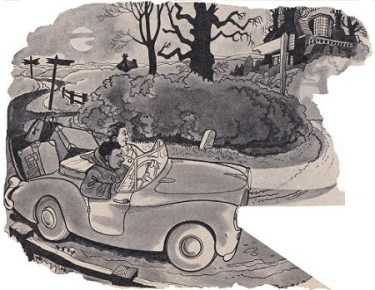
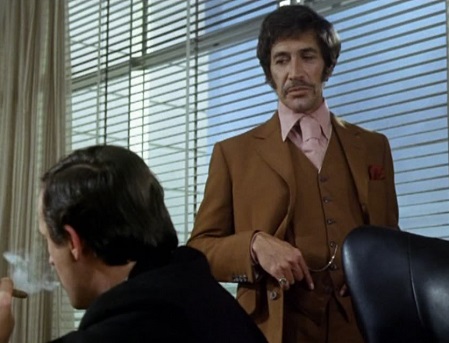
![DEPARTMENT S - S01E12 - The Man Who Got A New Face (1968) [DVDRip]_avi_snapshot_33_22_[2011_11_09_16_27_00]](https://peterwyngarde.uk/wp-content/uploads/2017/05/department-s-s01e12-the-man-who-got-a-new-face-1968-dvdrip_avi_snapshot_33_22_2011_11_09_16_27_00.jpg)




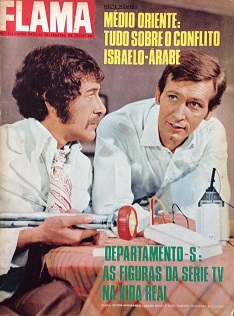
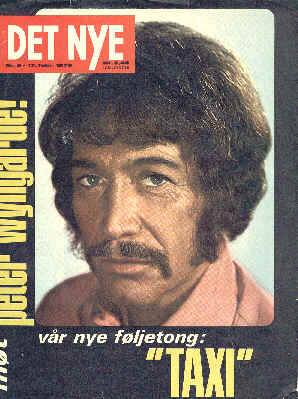

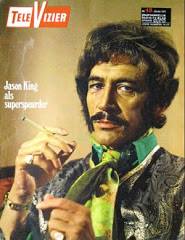


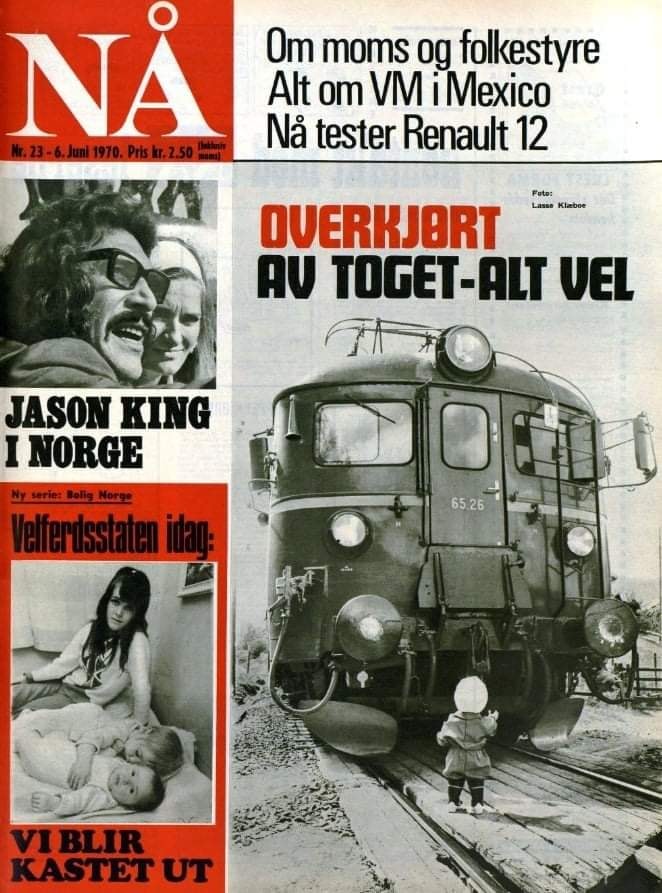


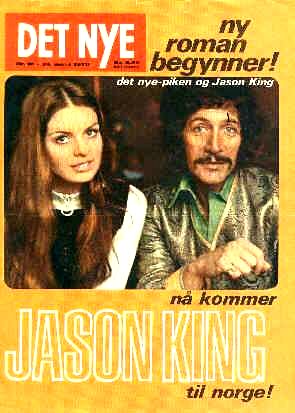


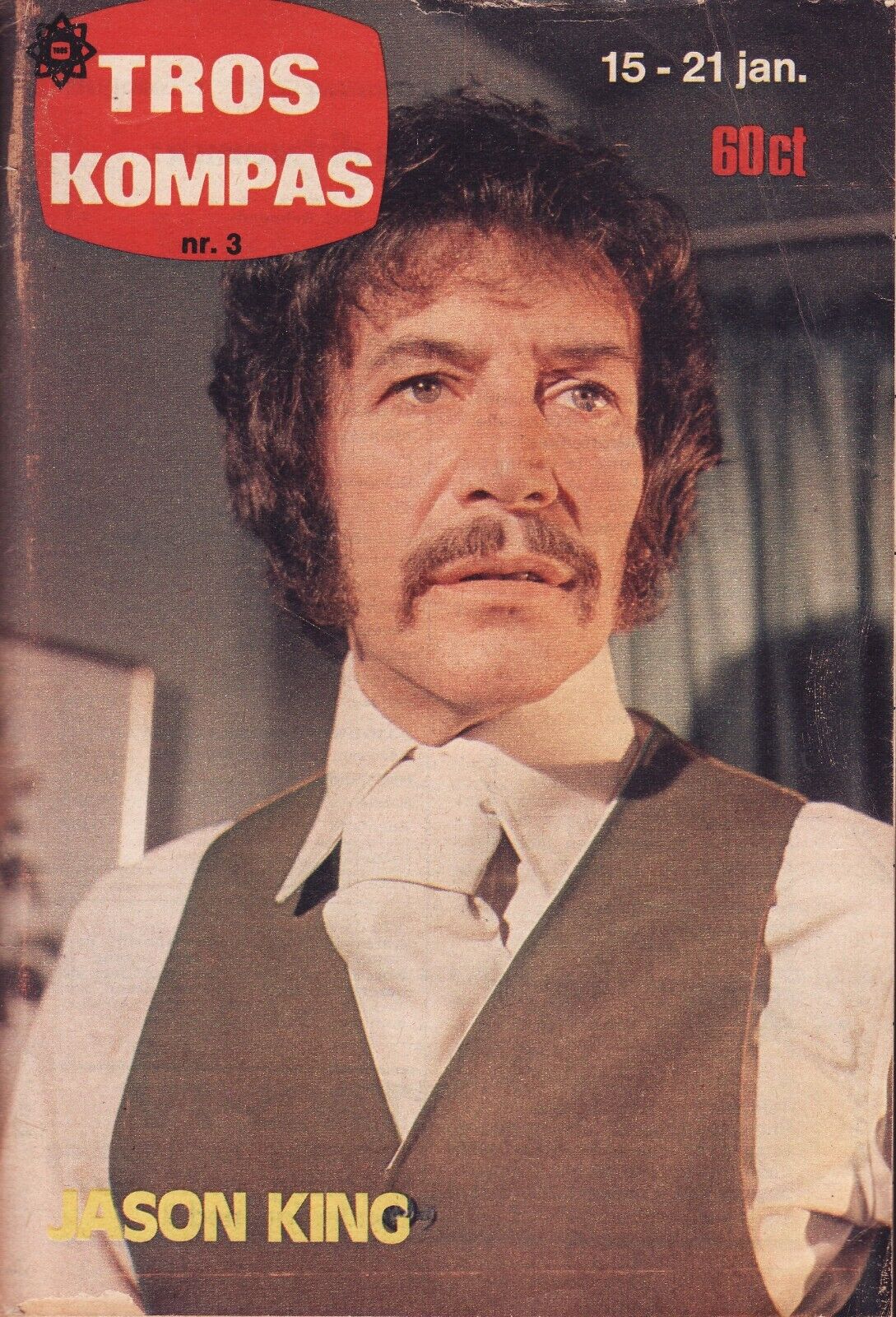

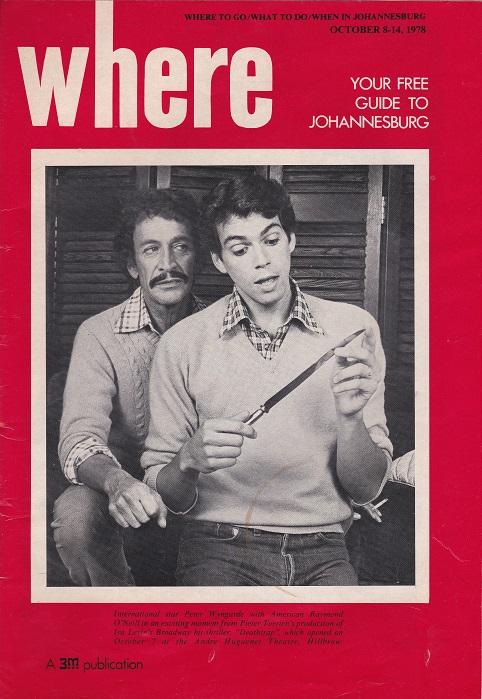




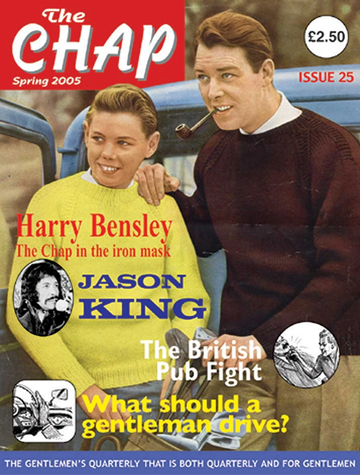





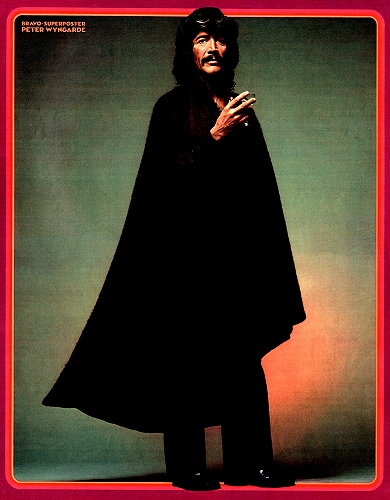
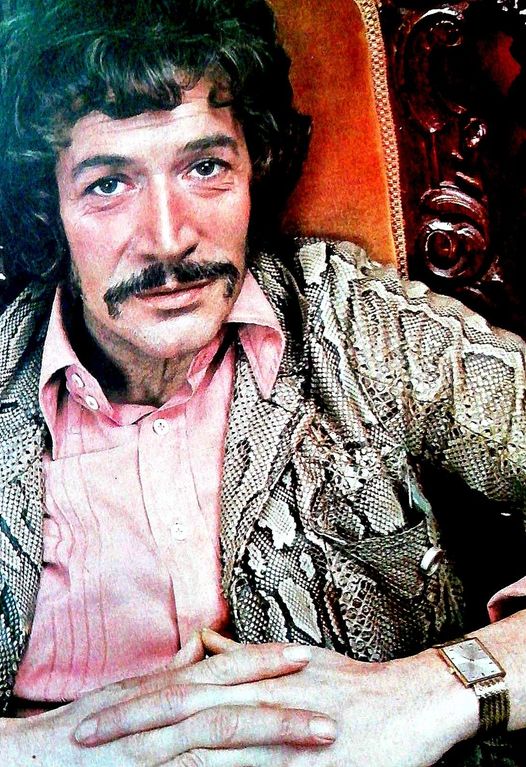
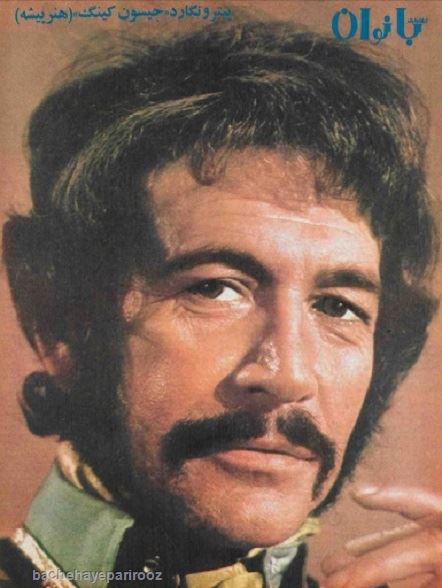
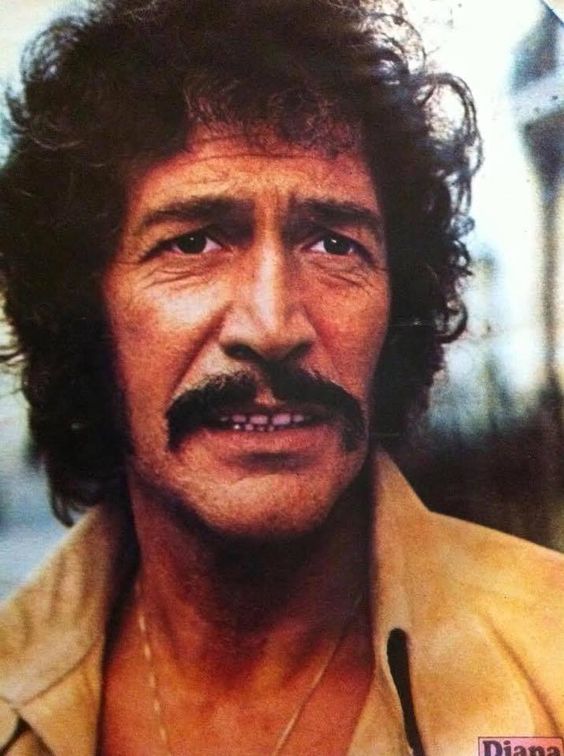
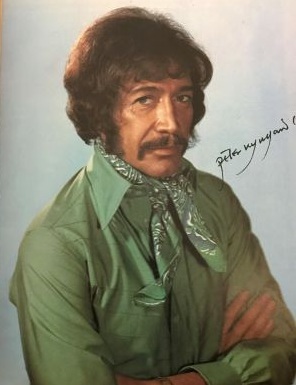

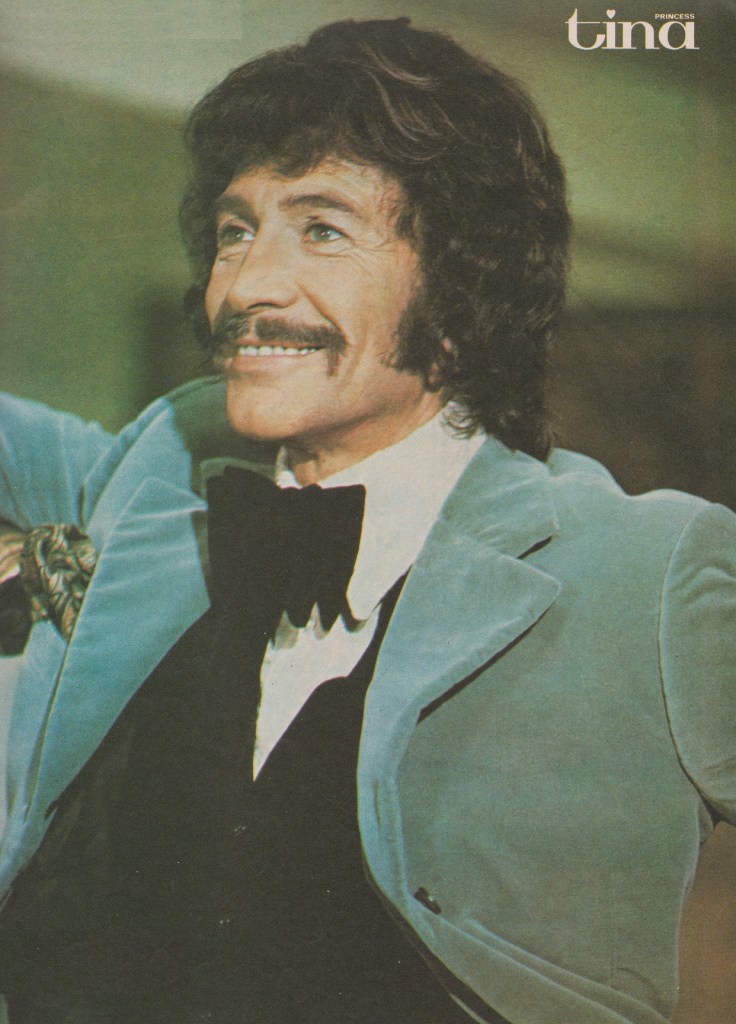
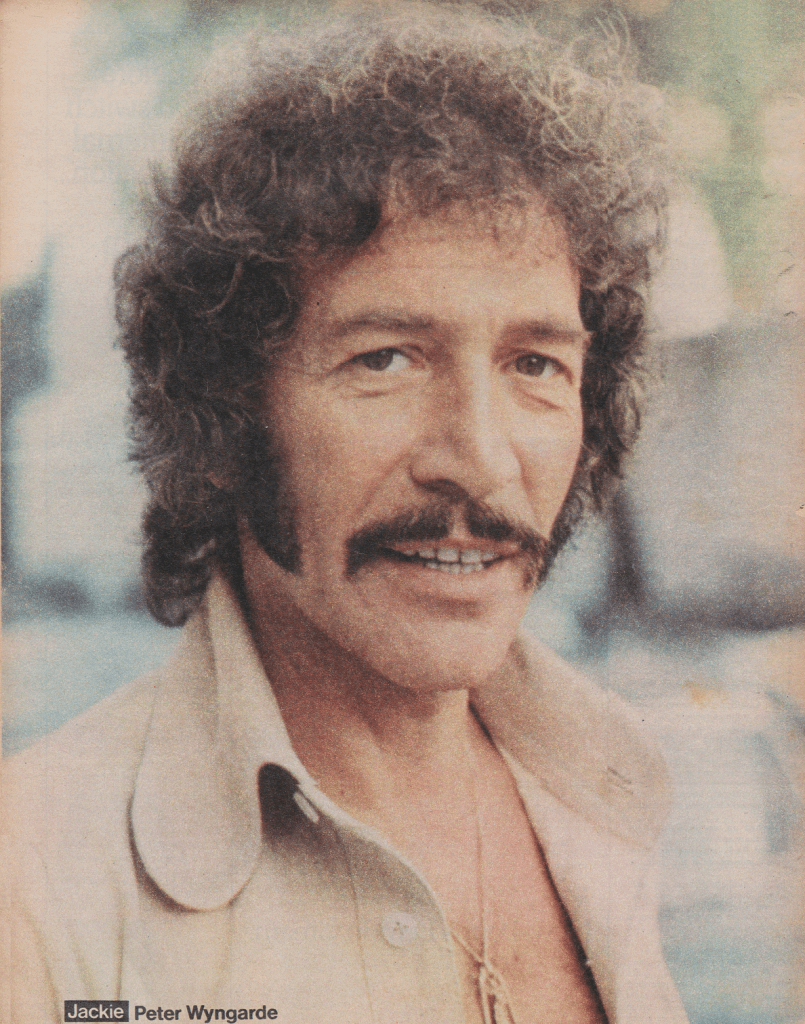
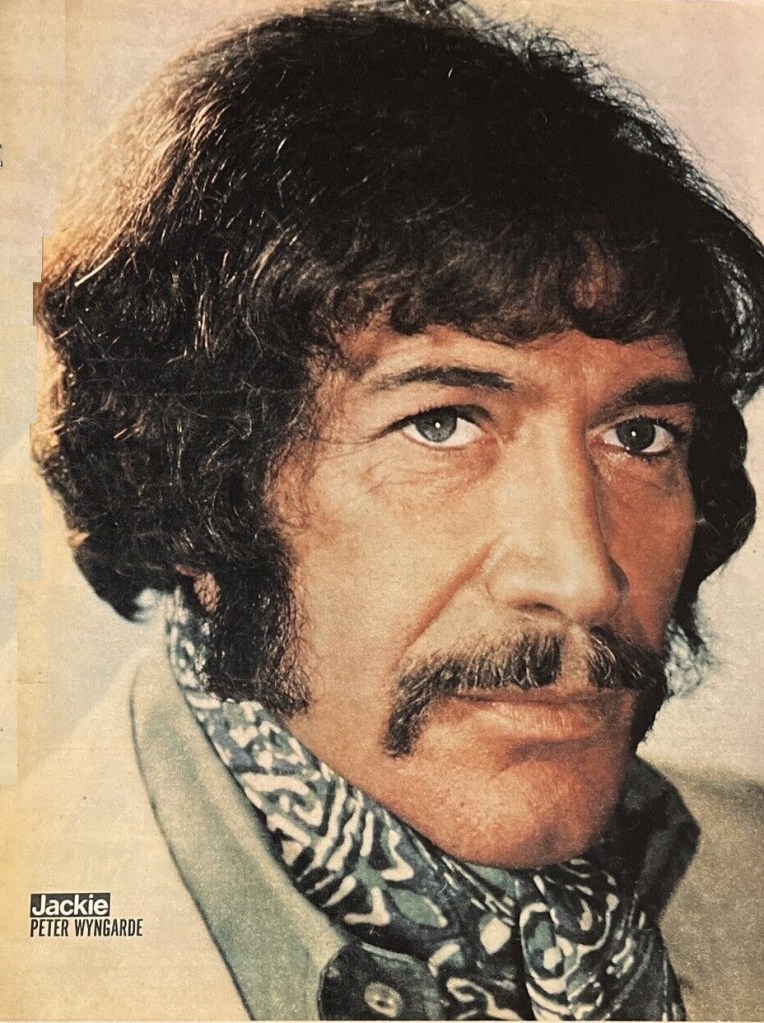
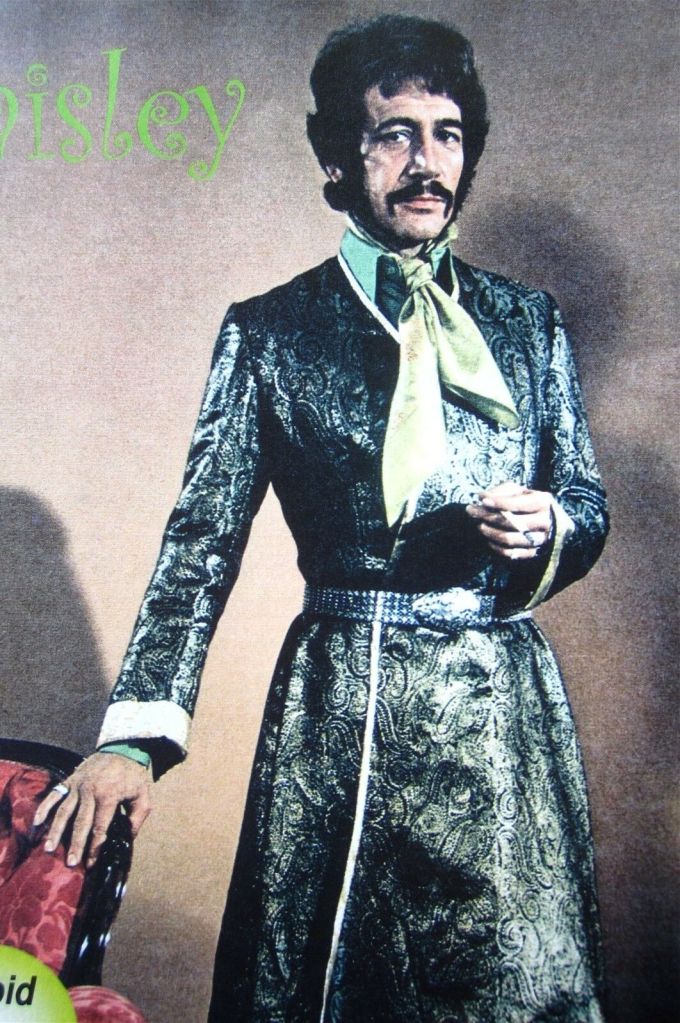
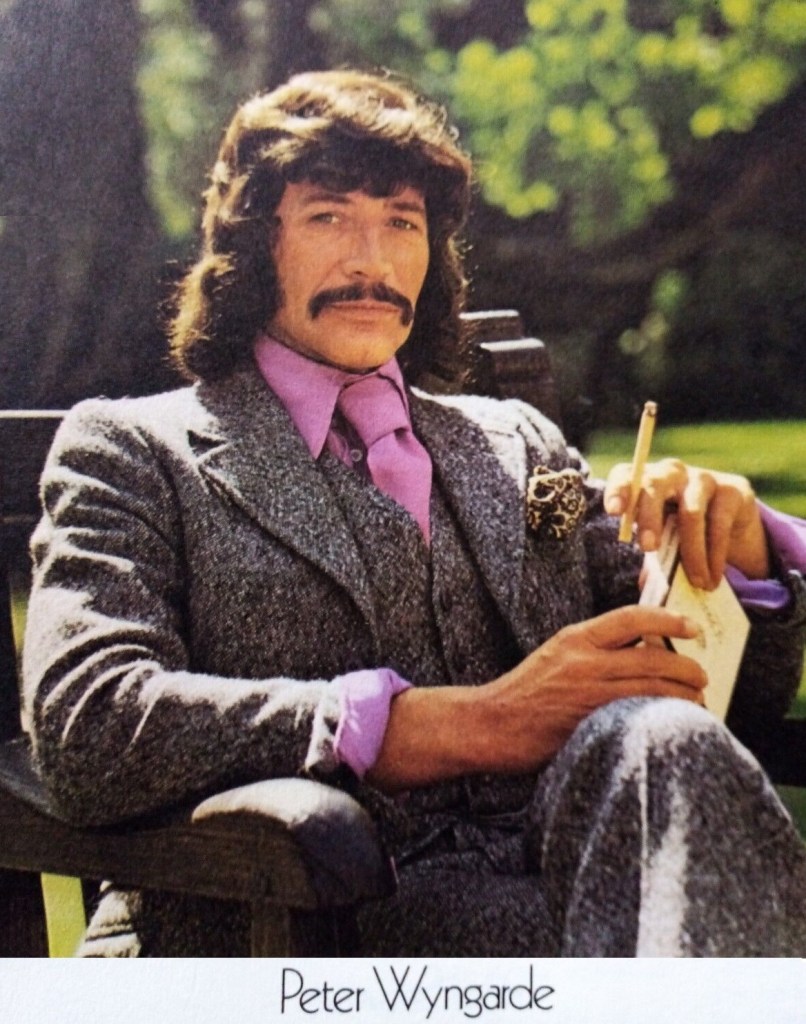
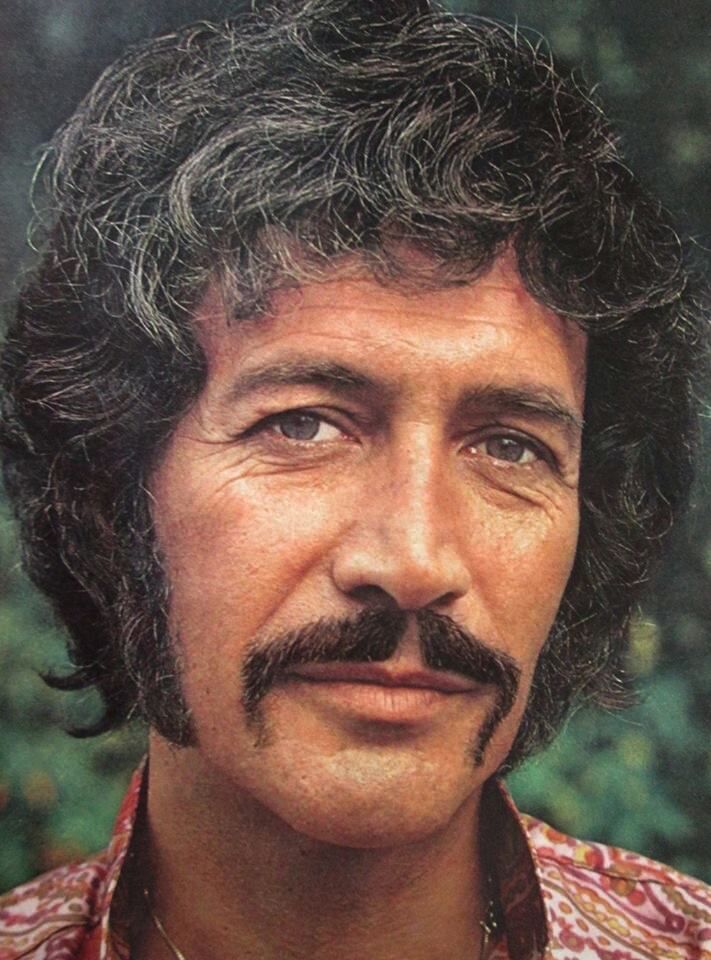
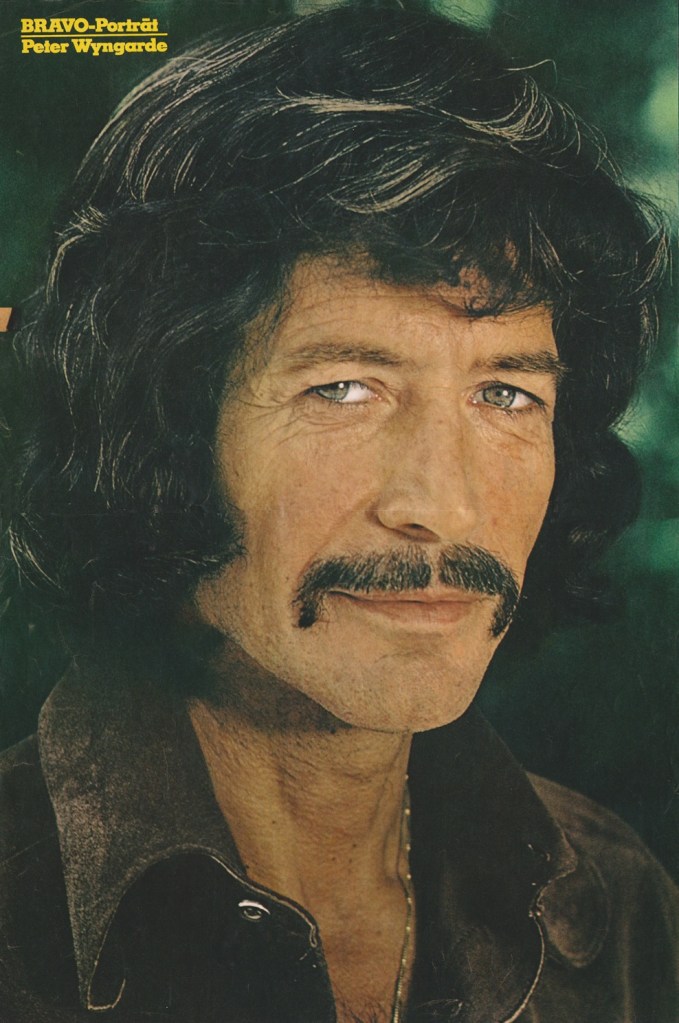

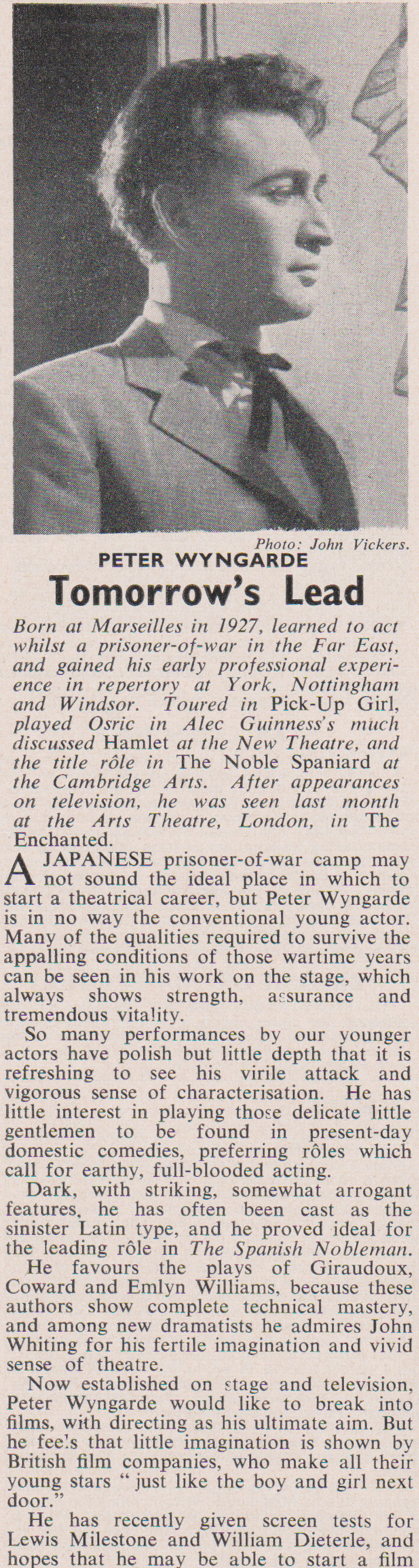

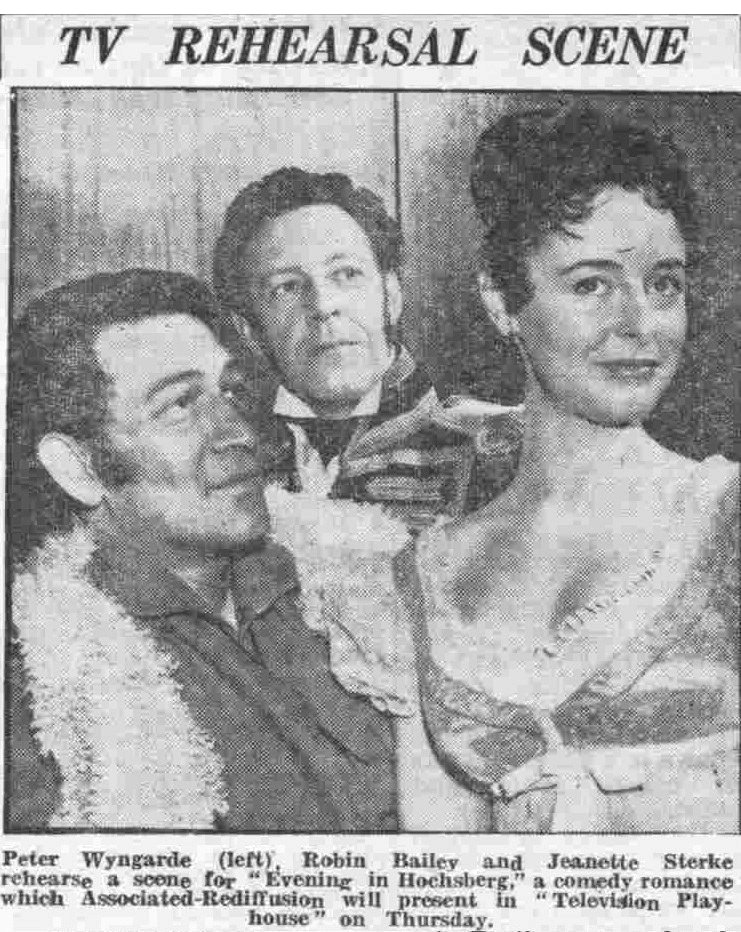


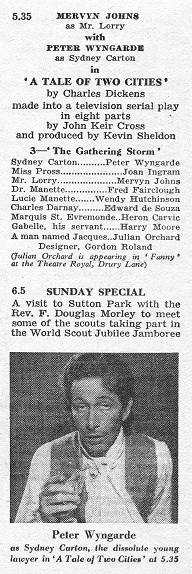
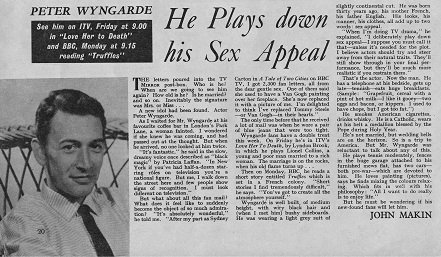


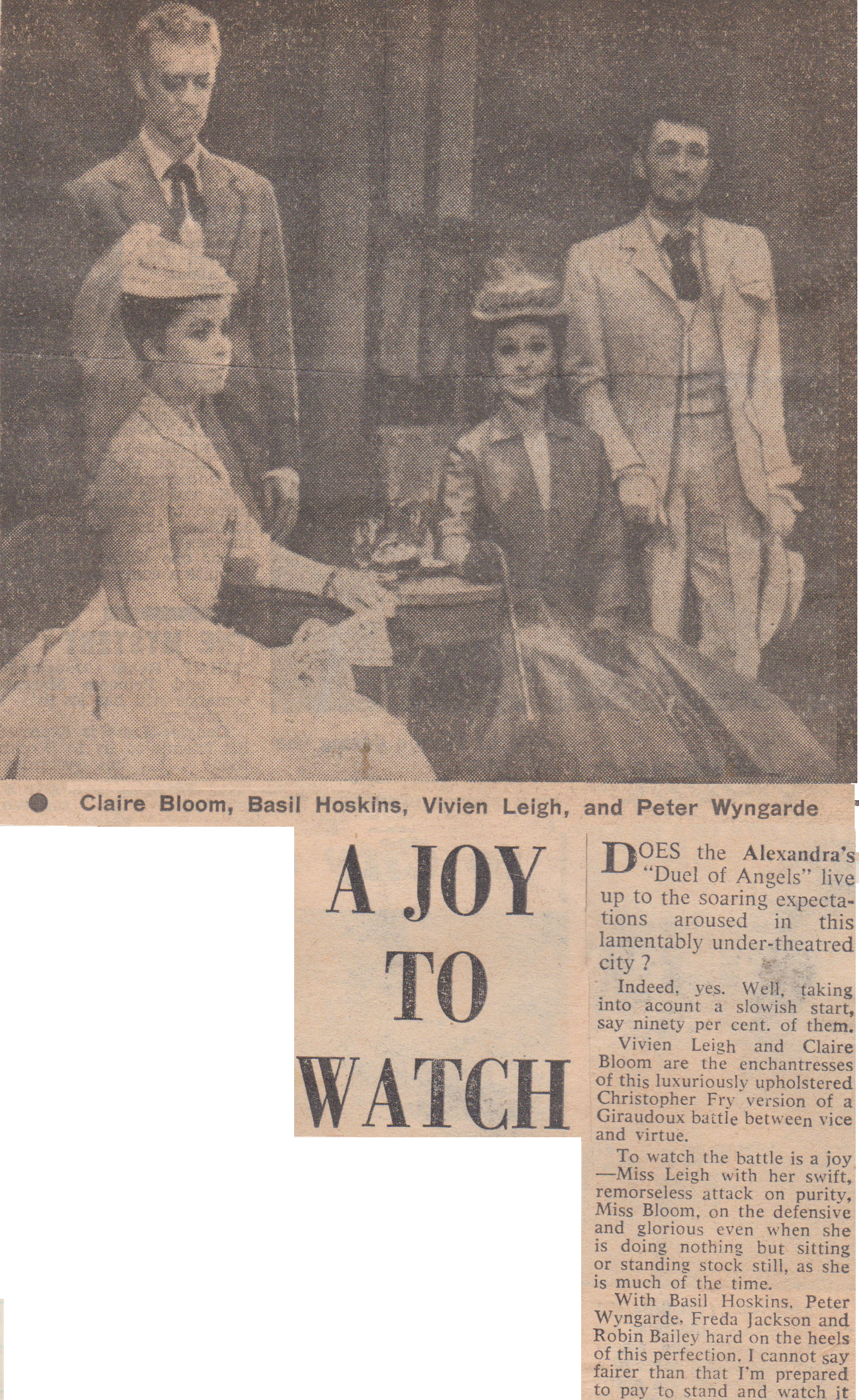
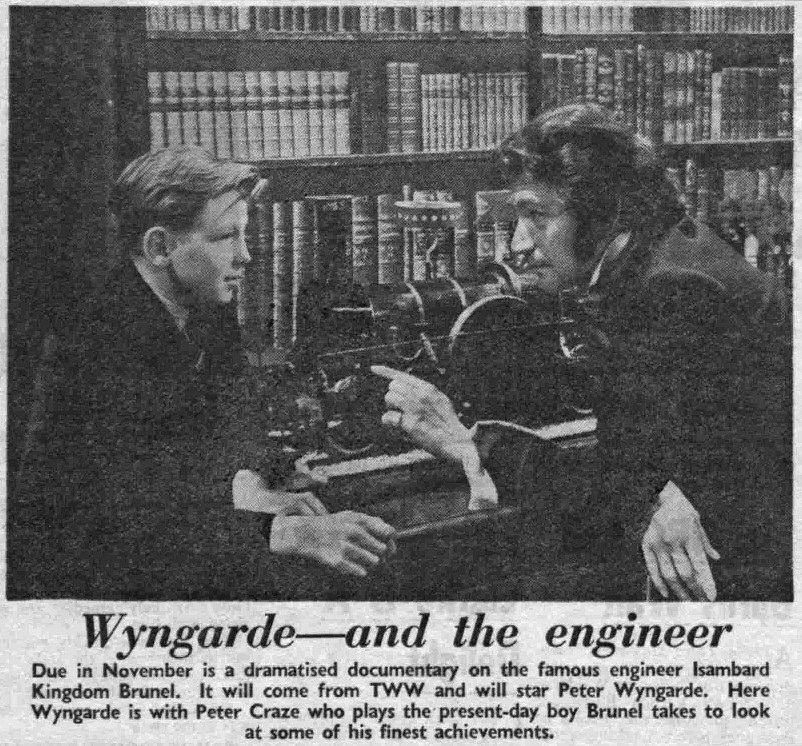

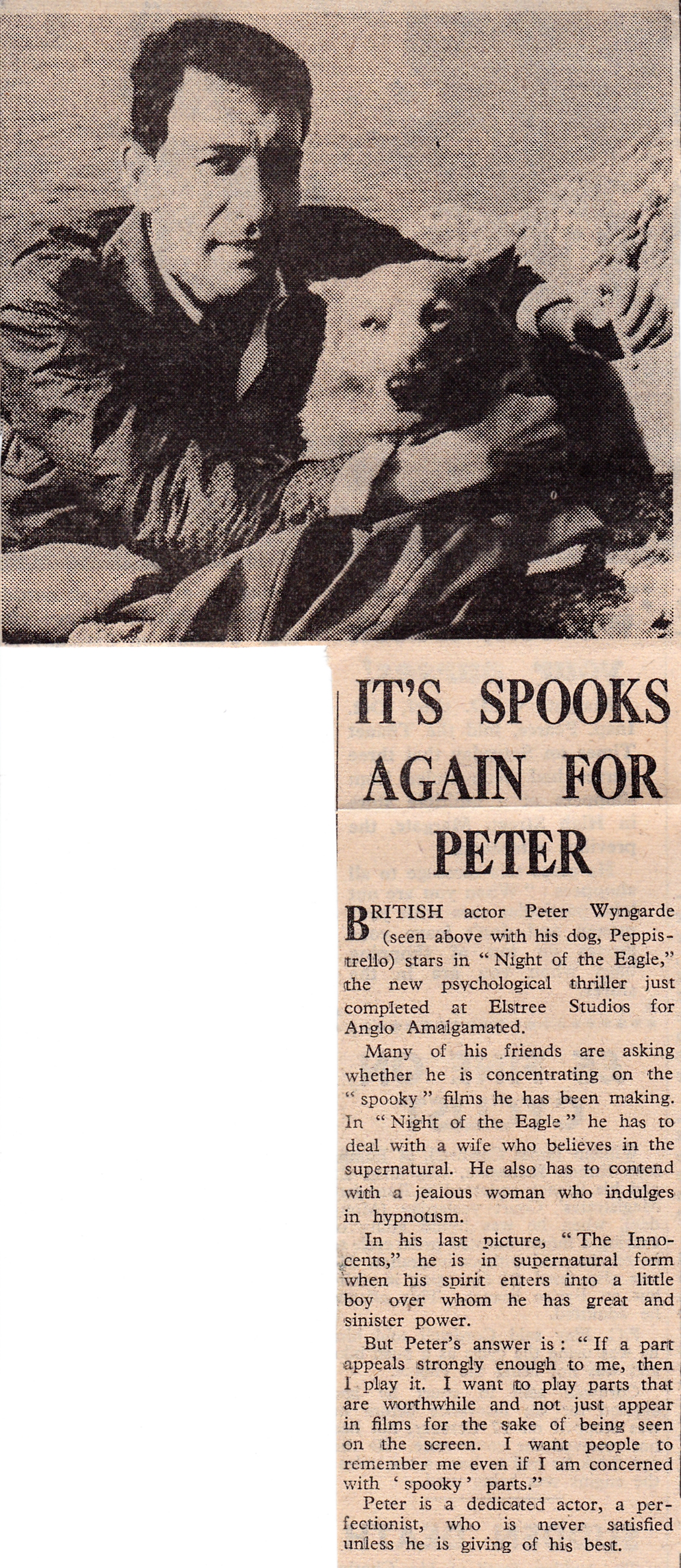


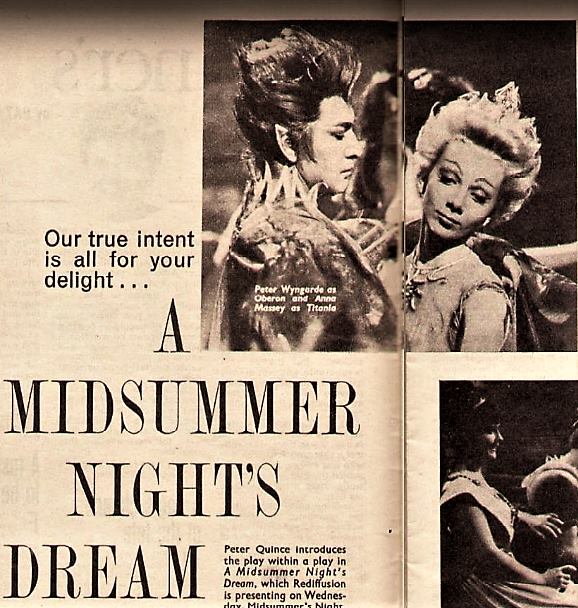
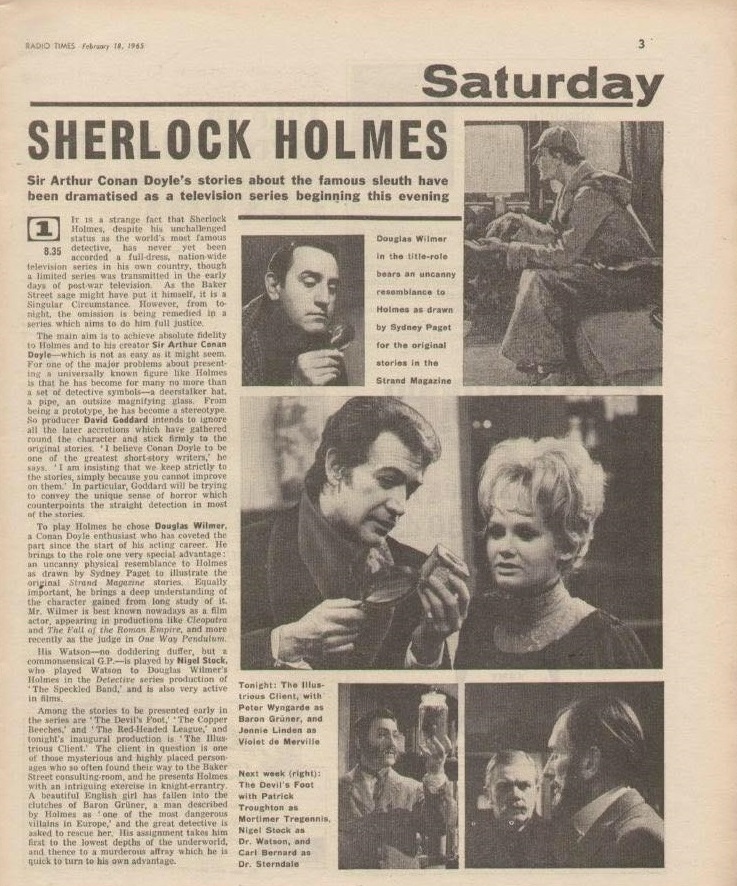


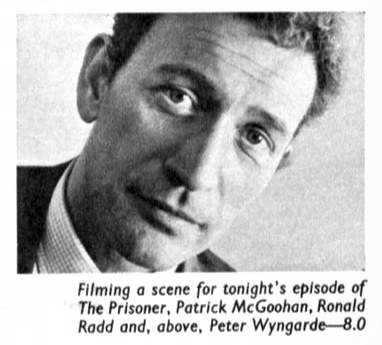
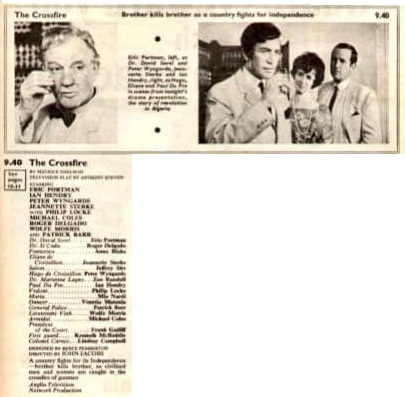
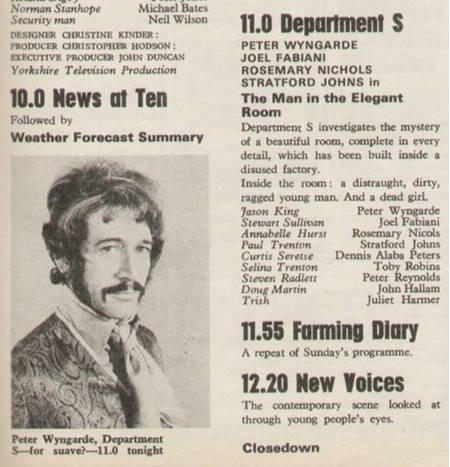


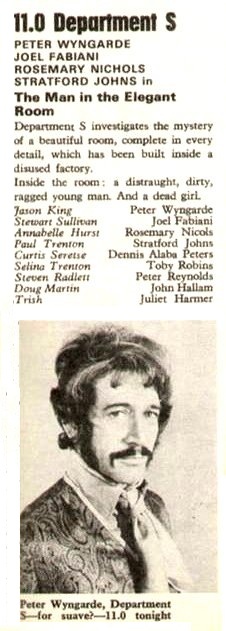
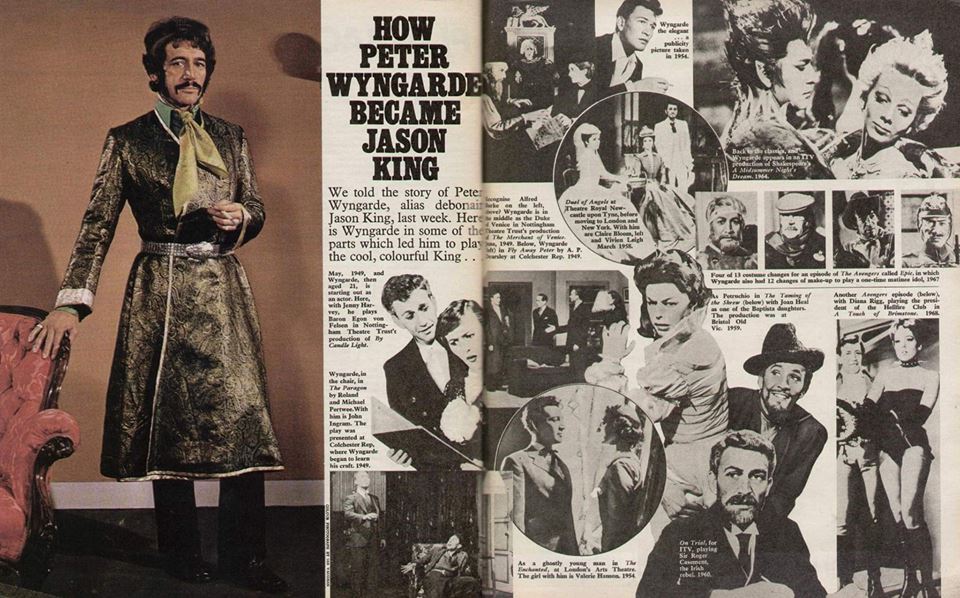
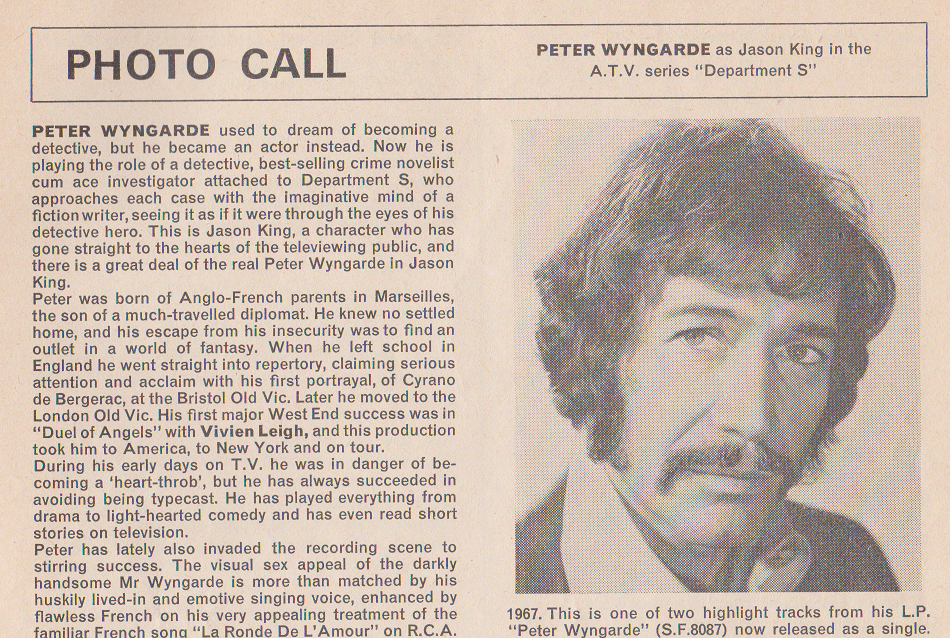

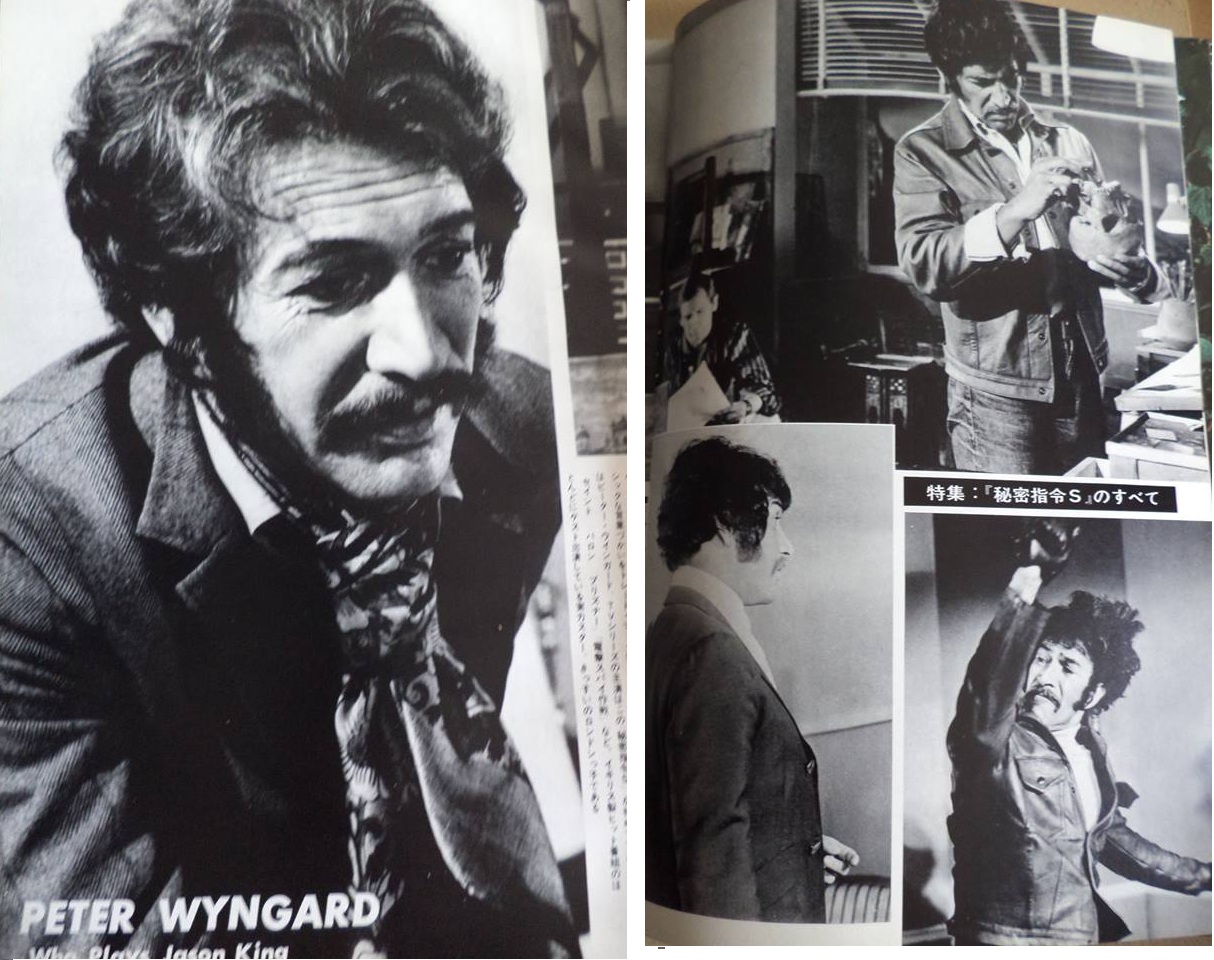
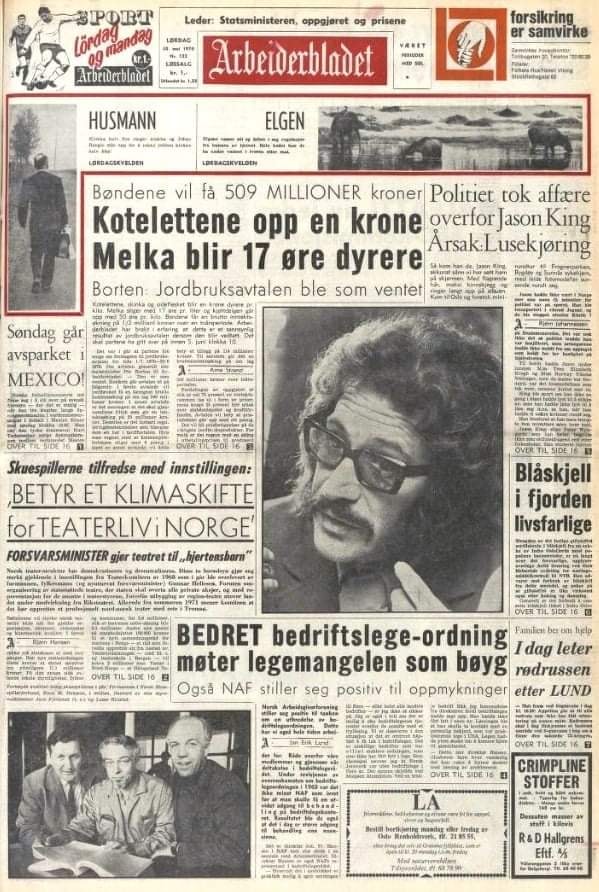


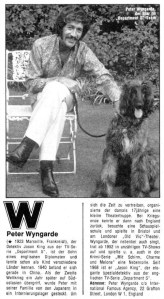


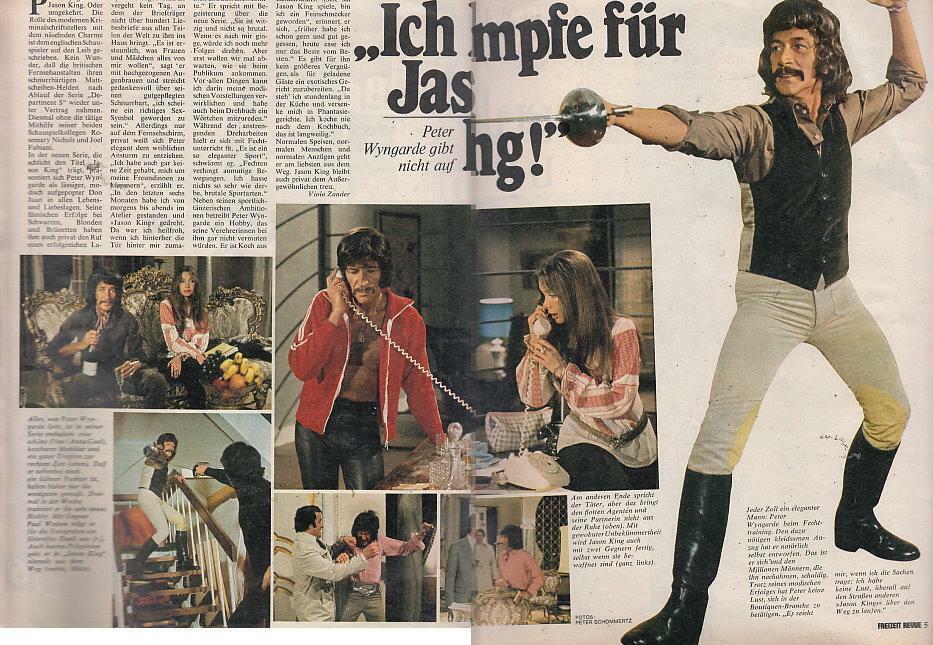


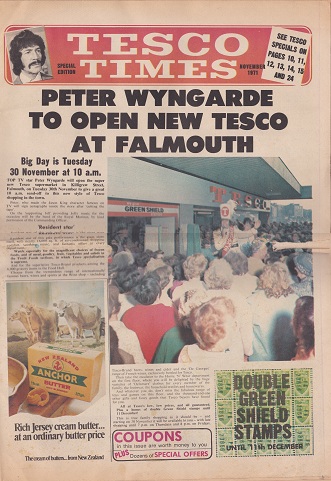

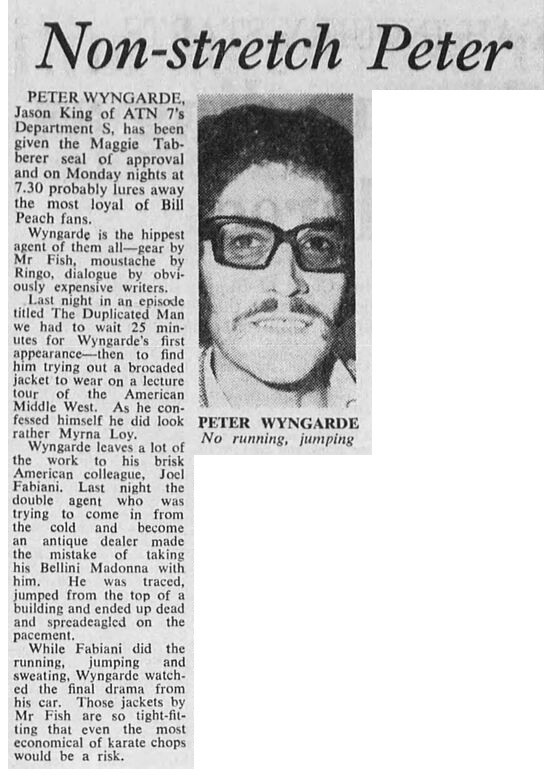

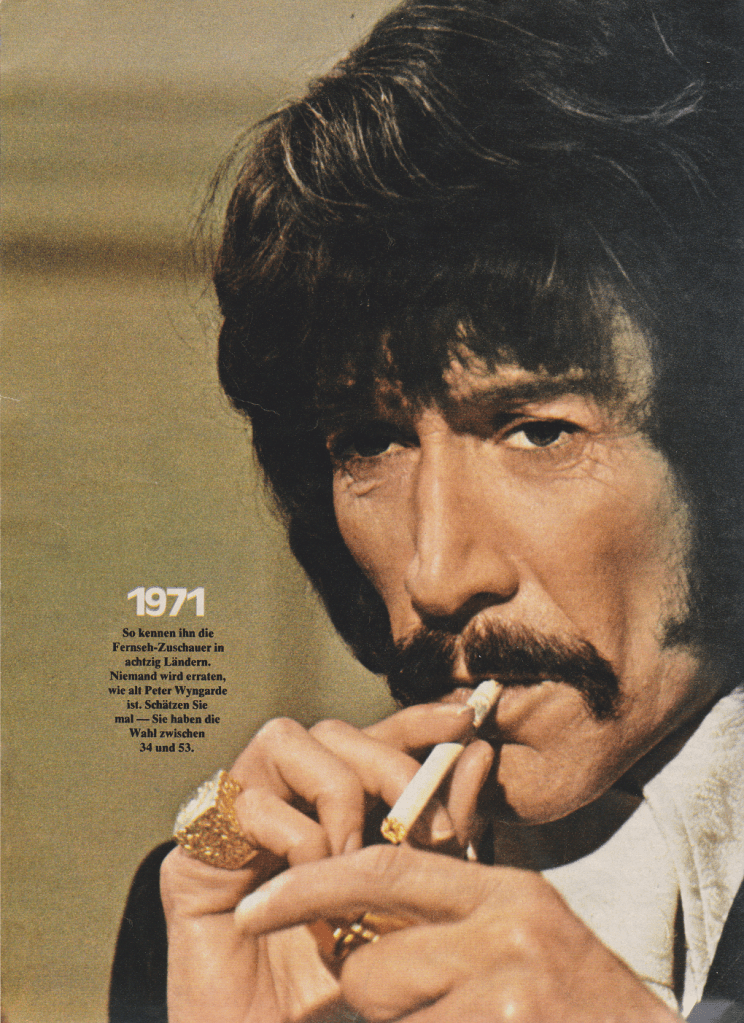
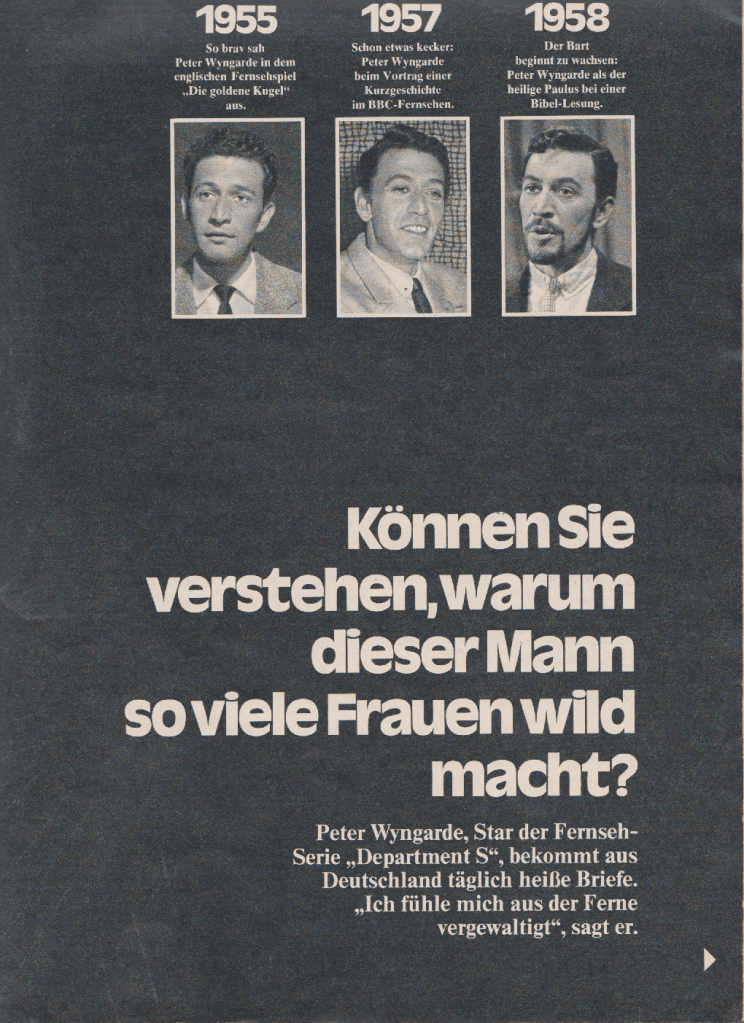
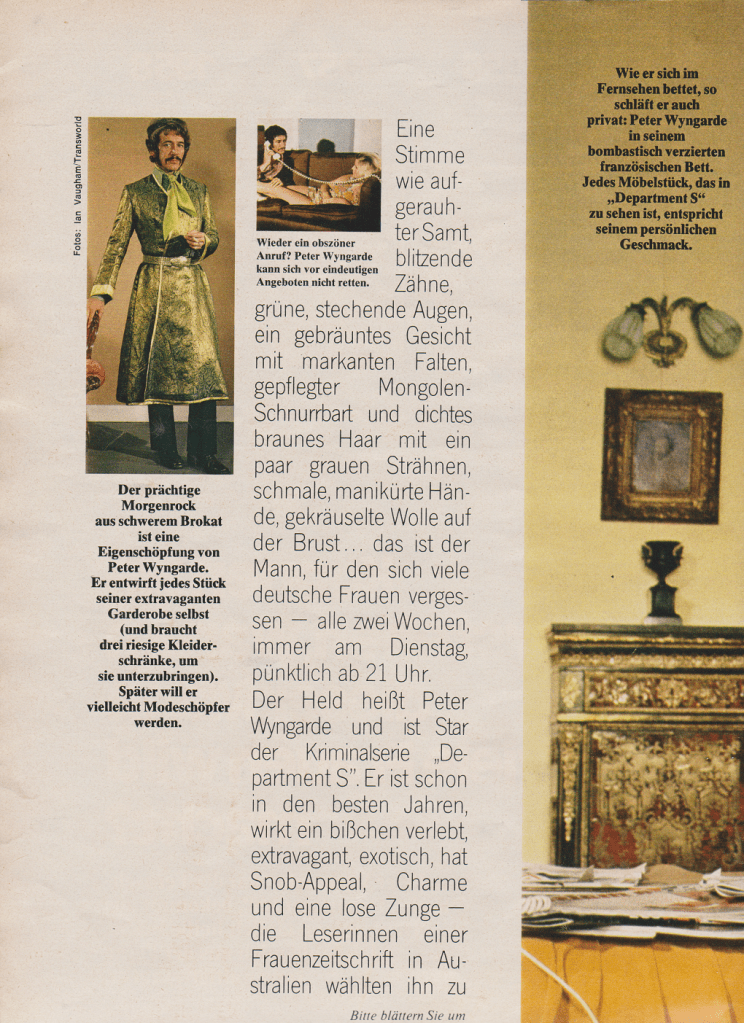
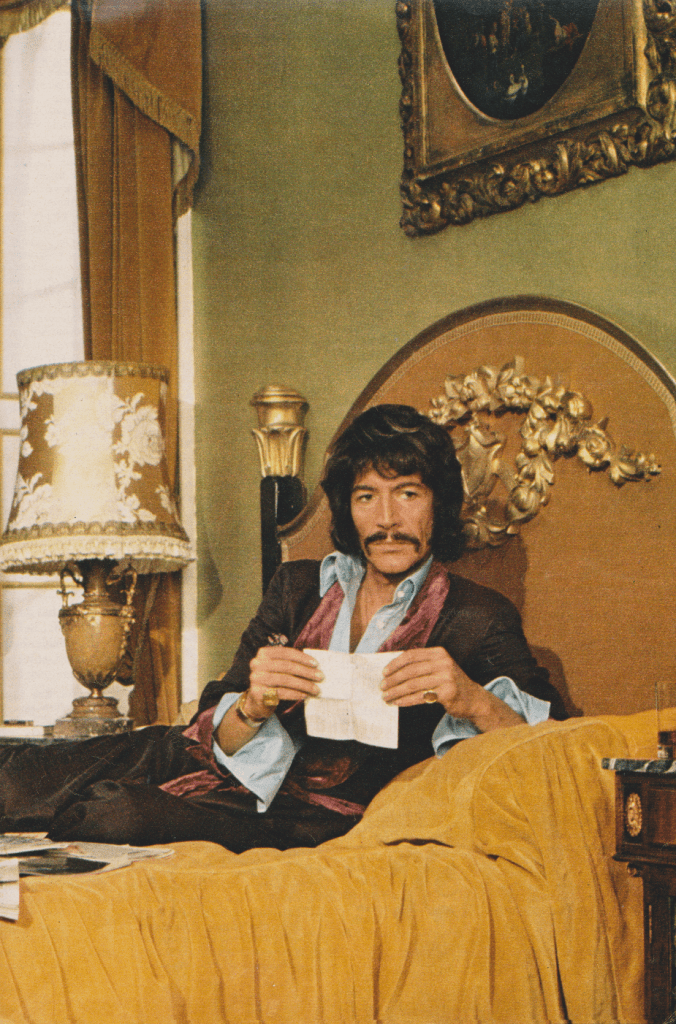
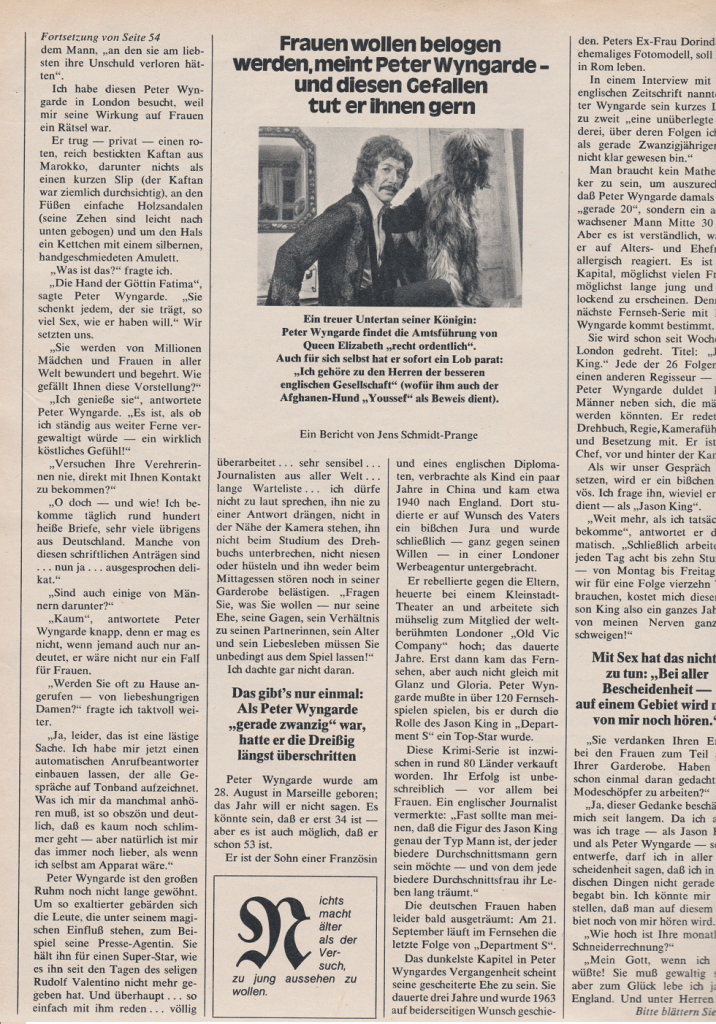
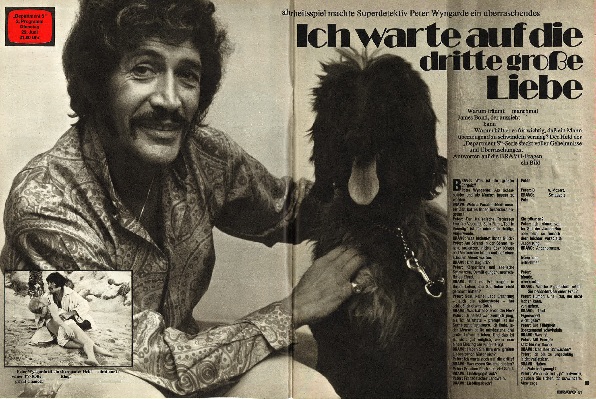


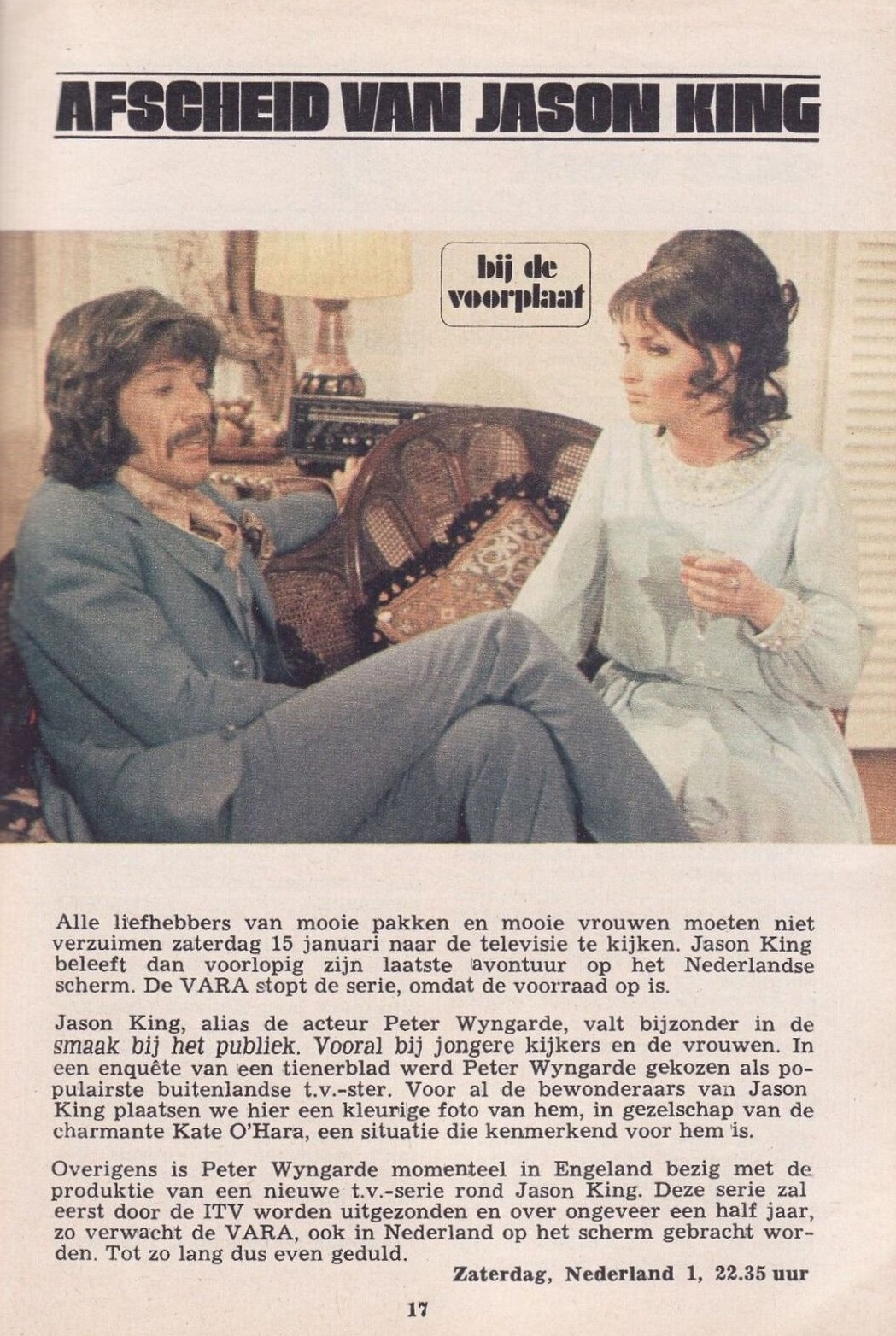


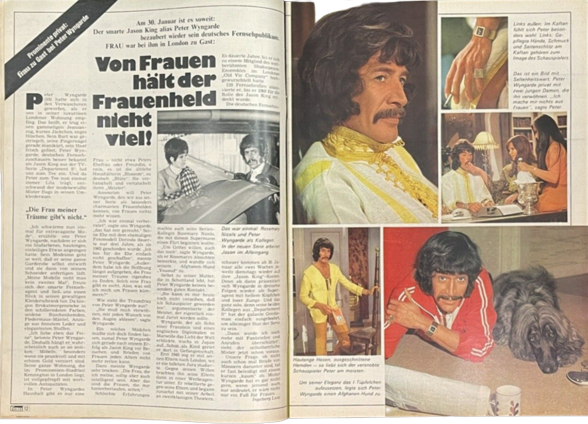


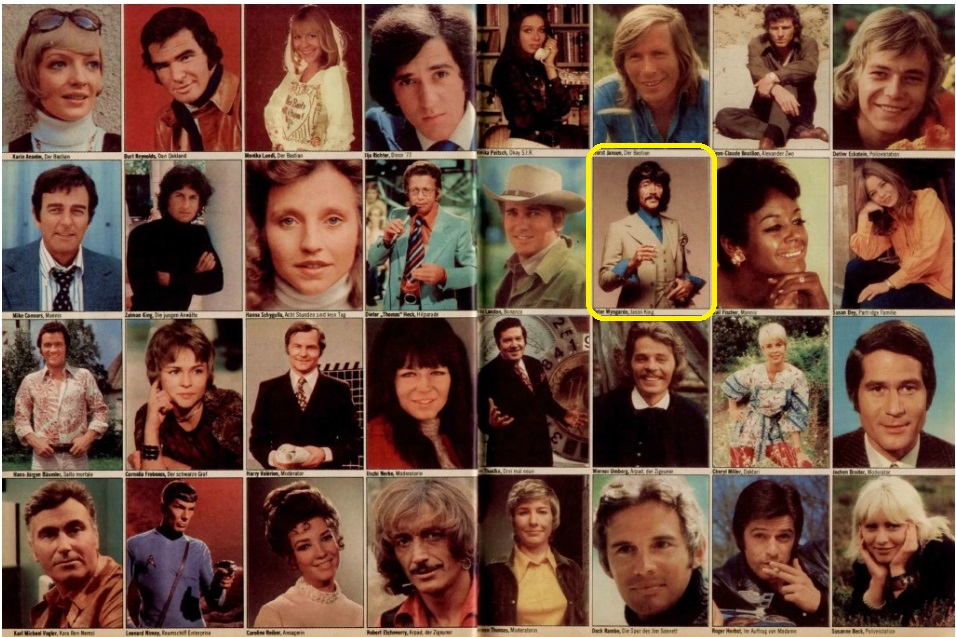


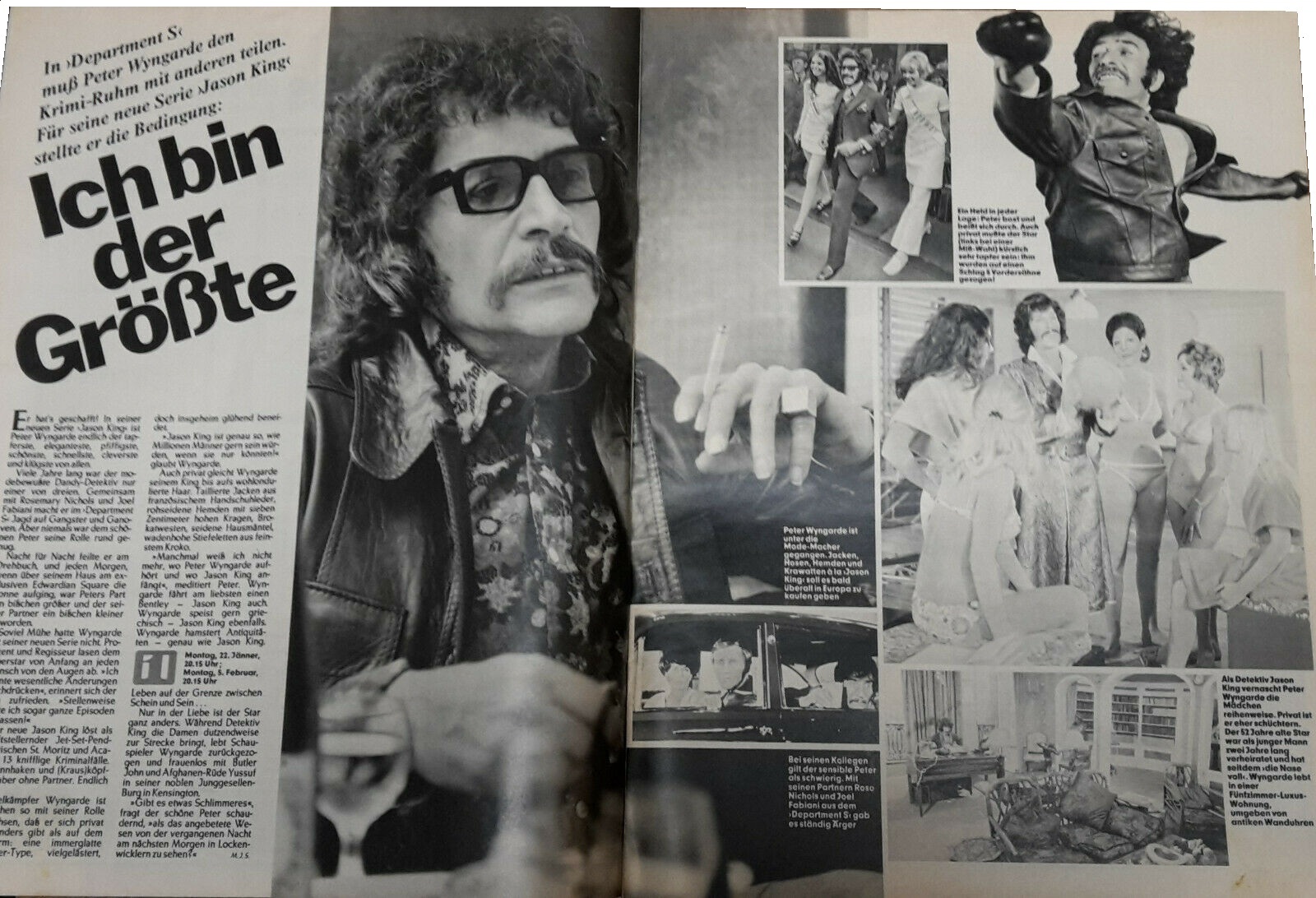
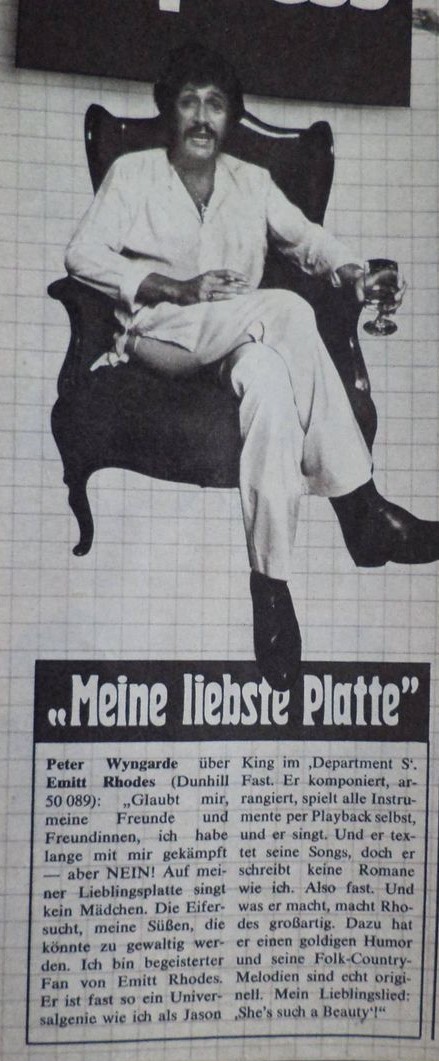


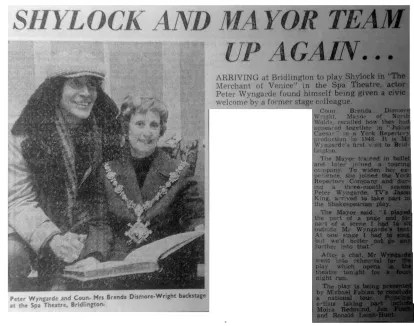


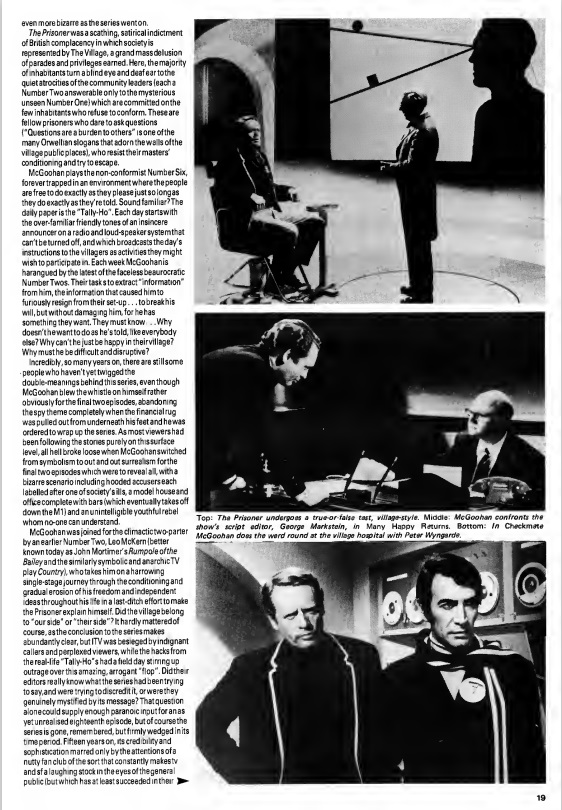

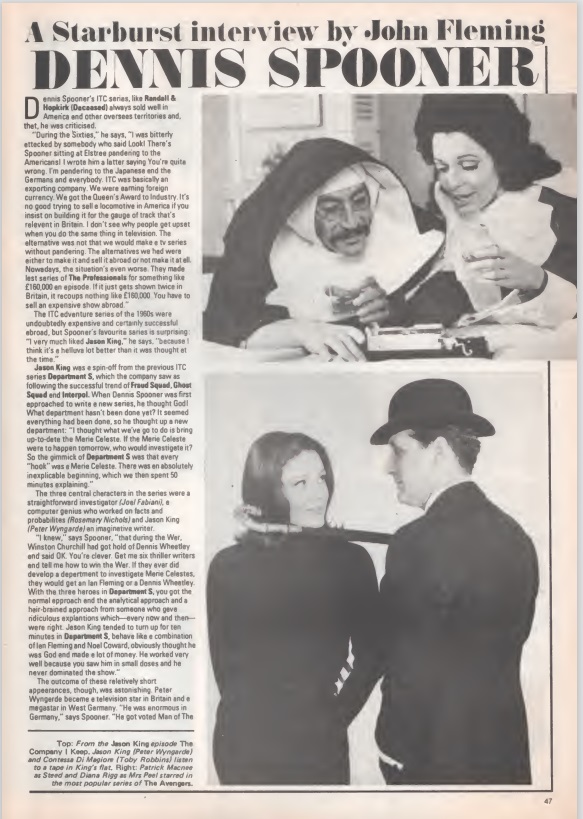
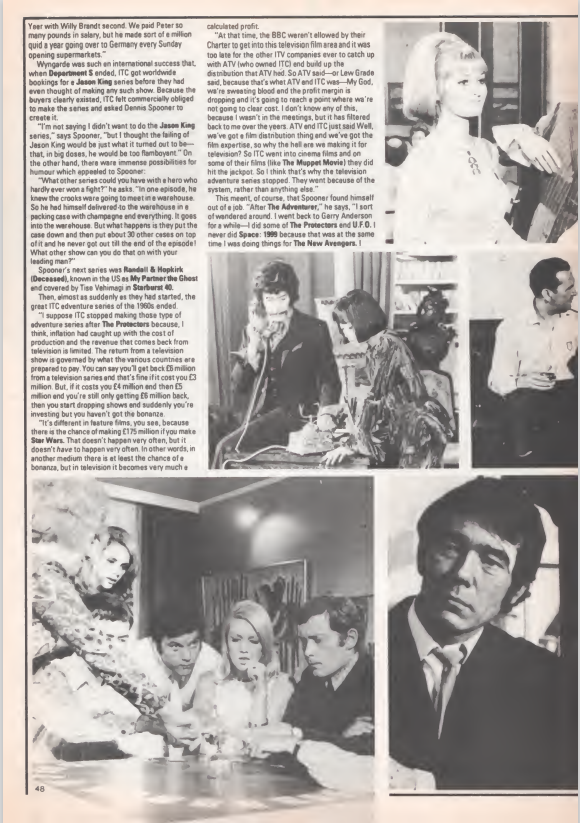
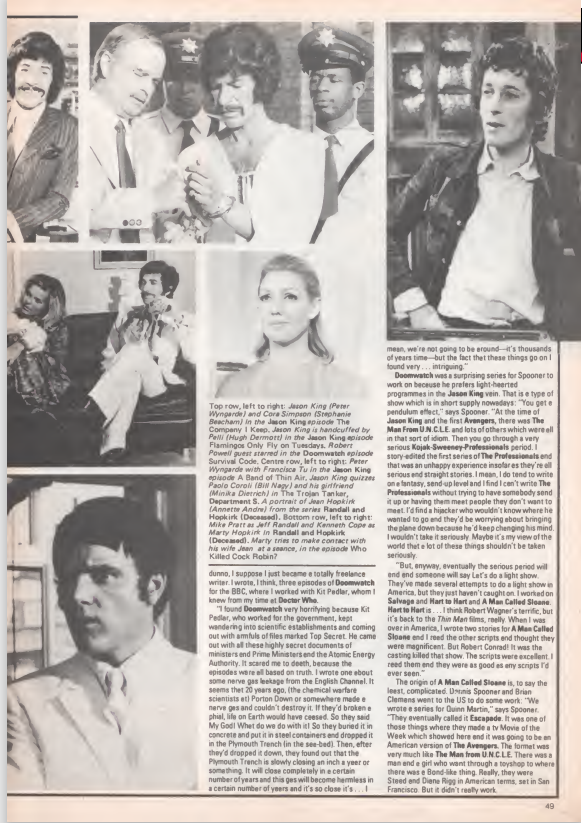
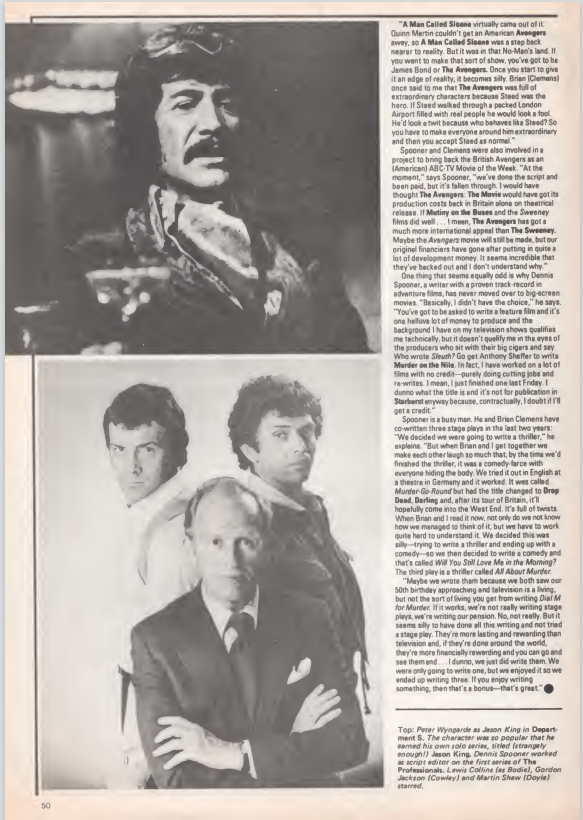
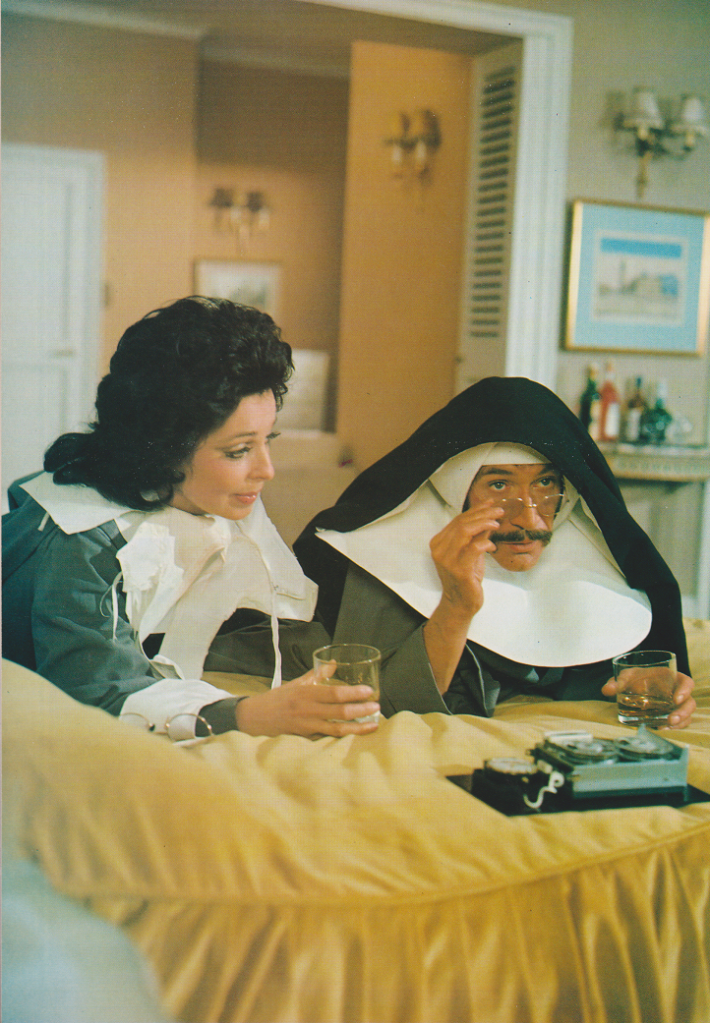
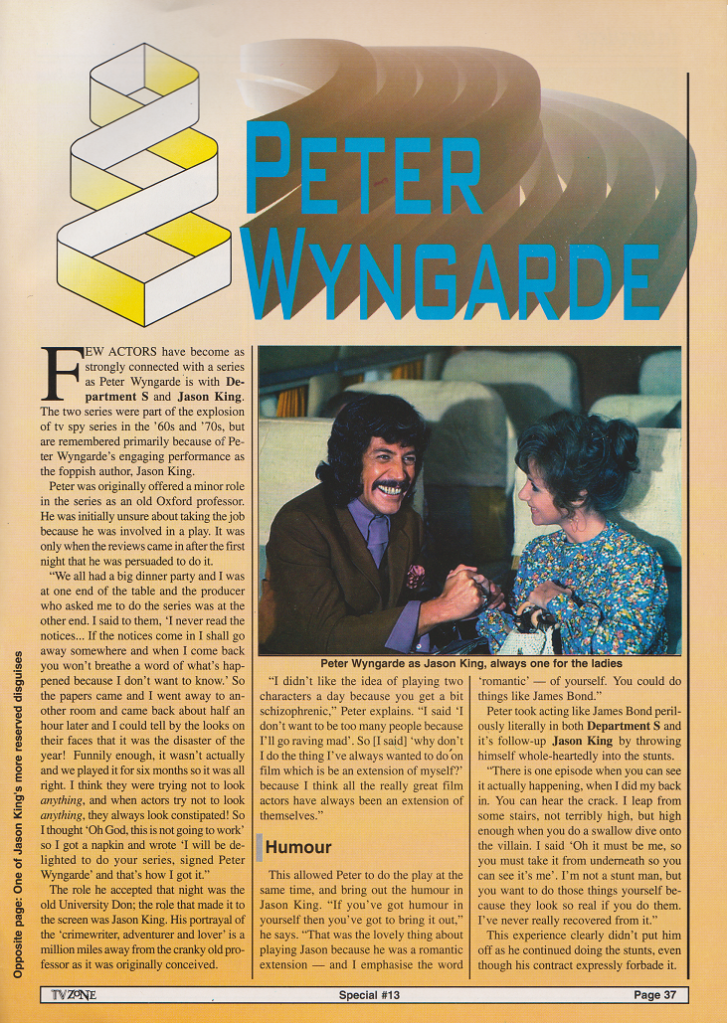
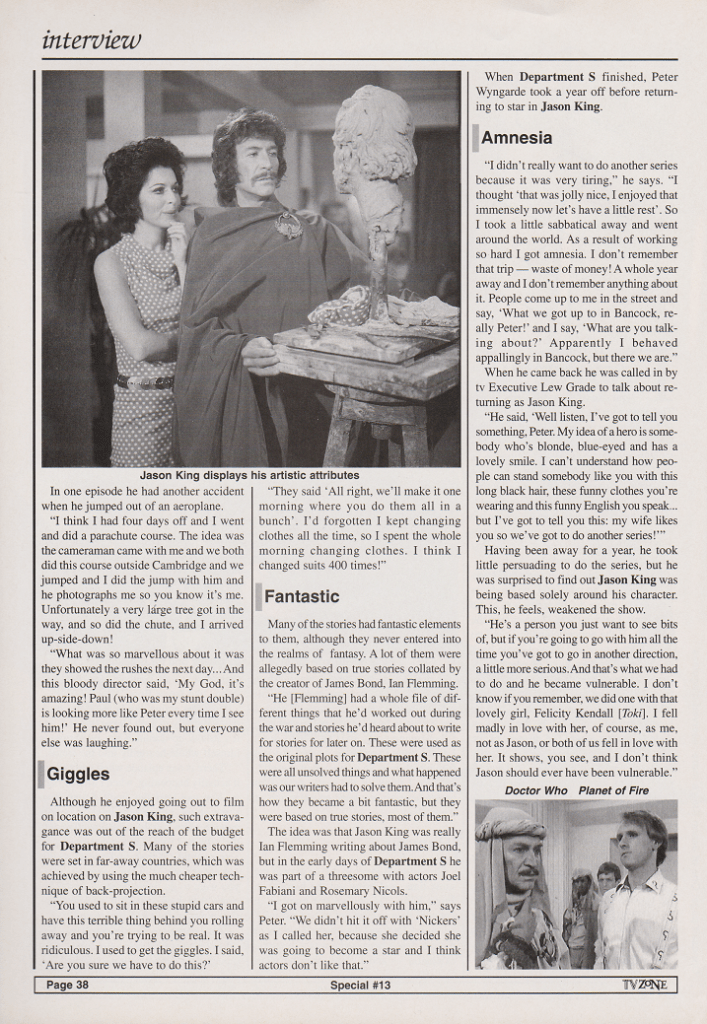
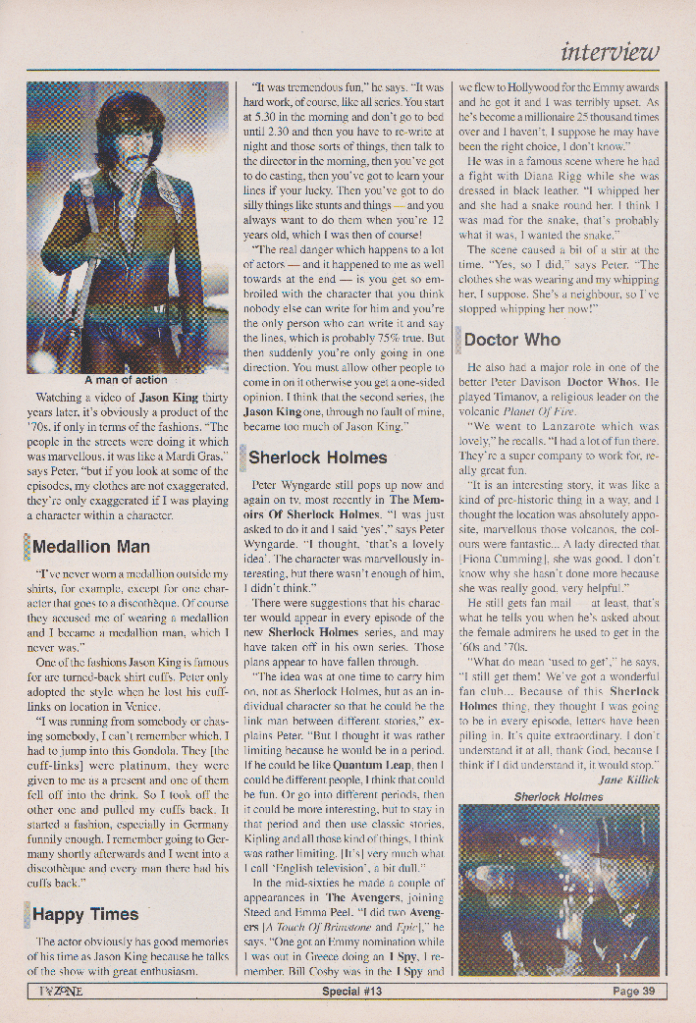

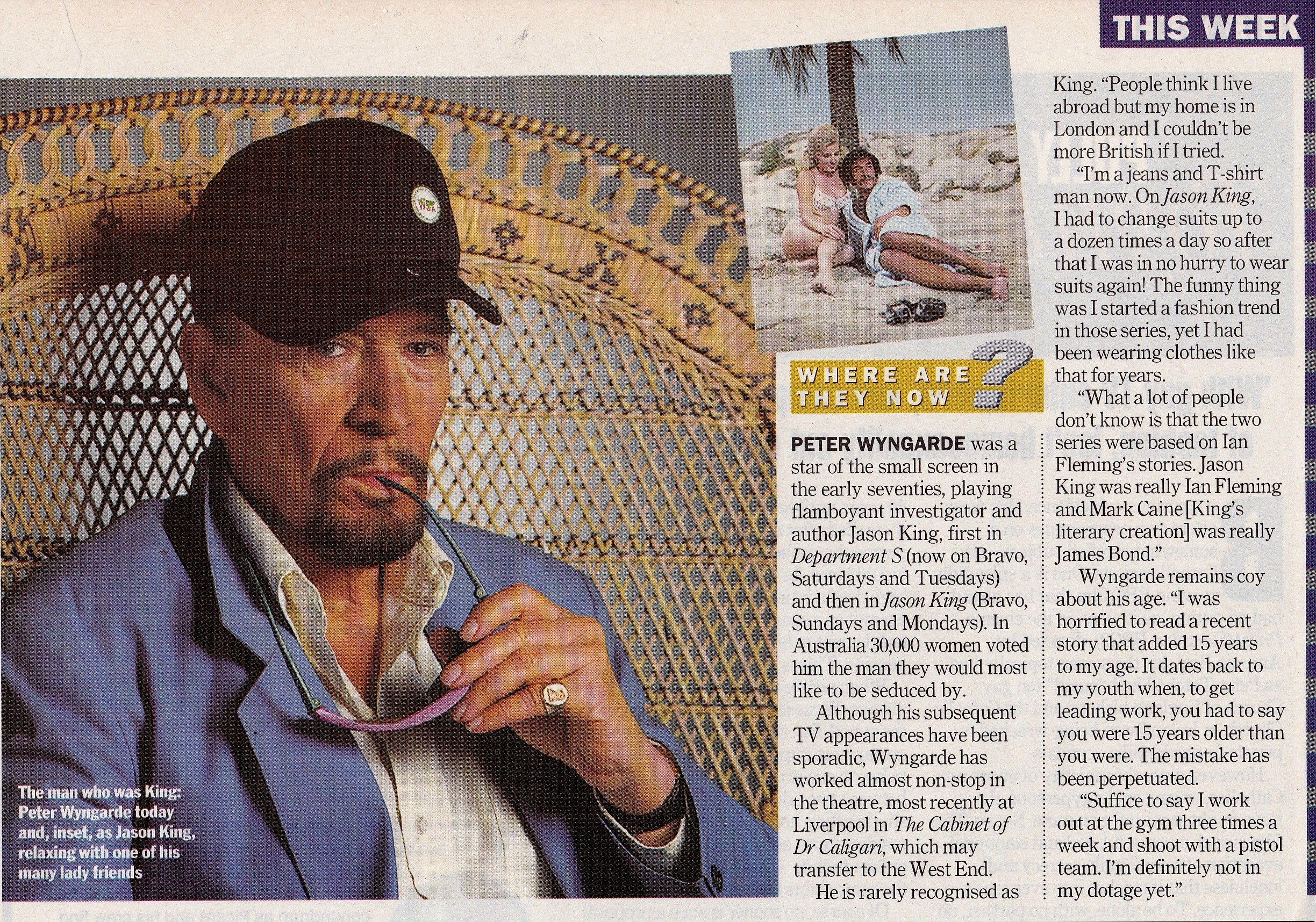
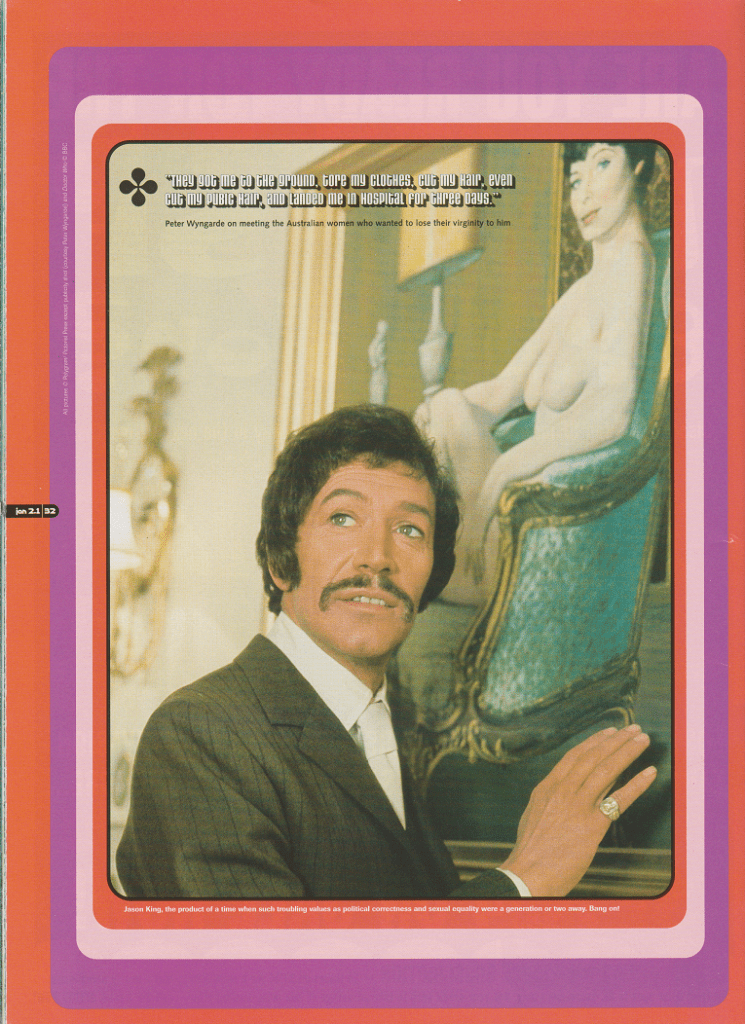
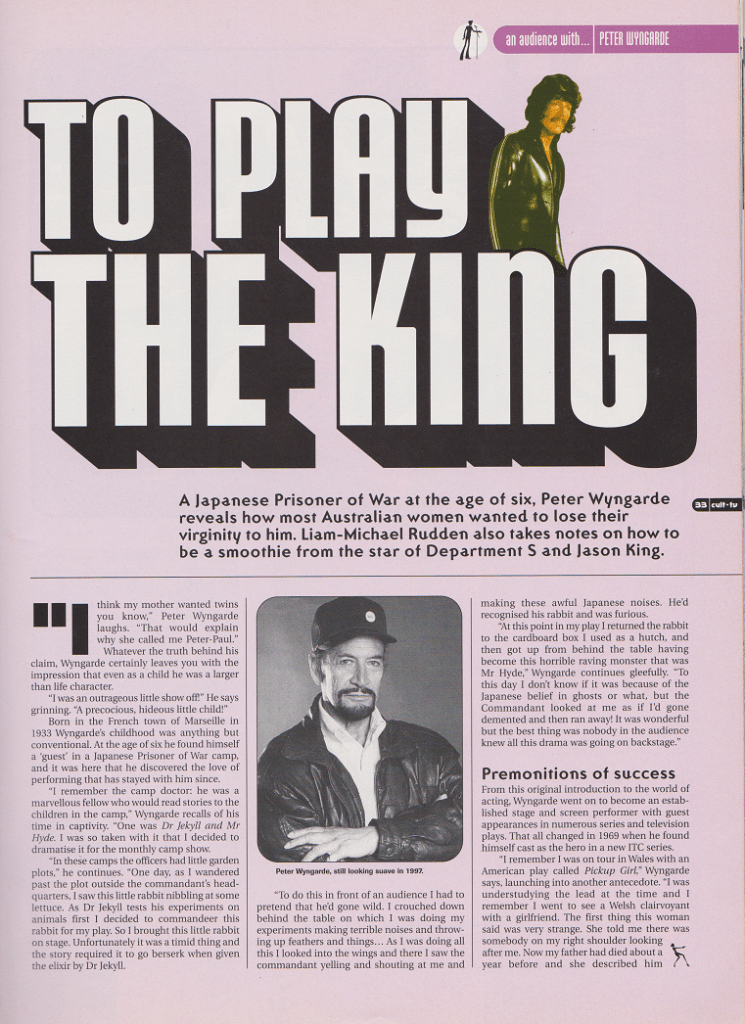
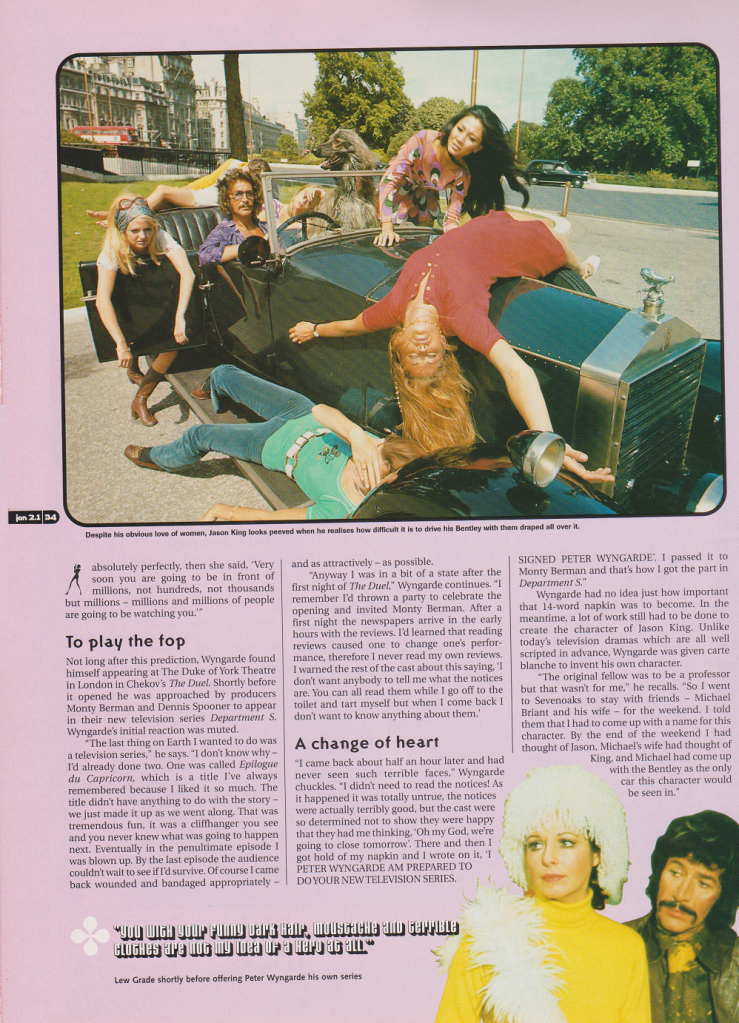
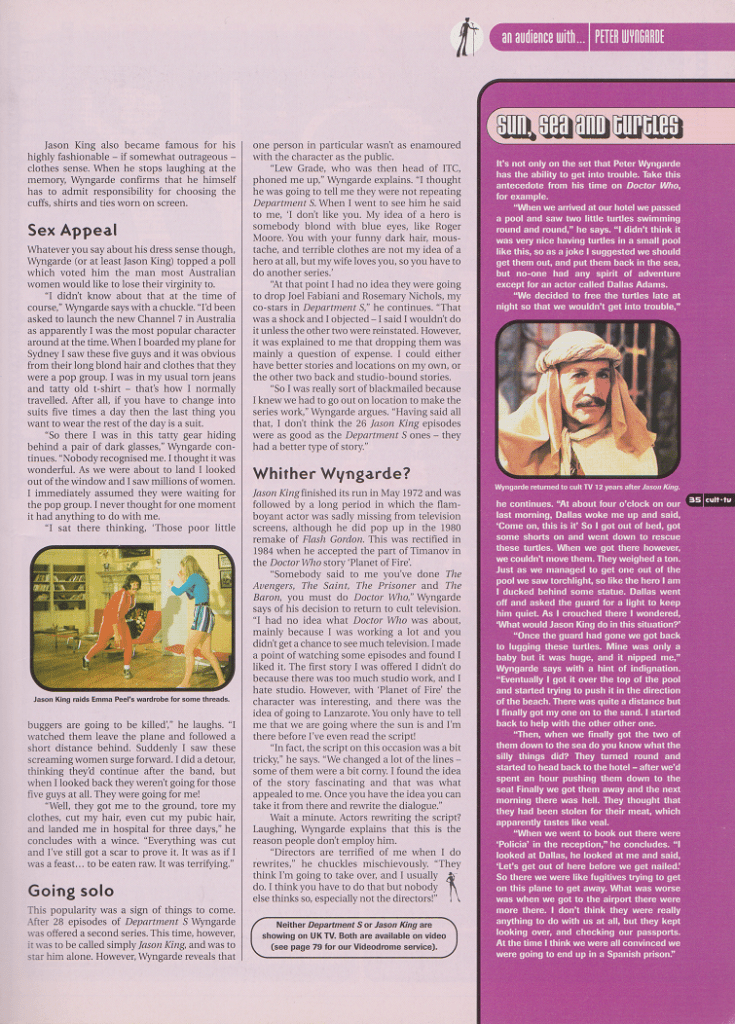
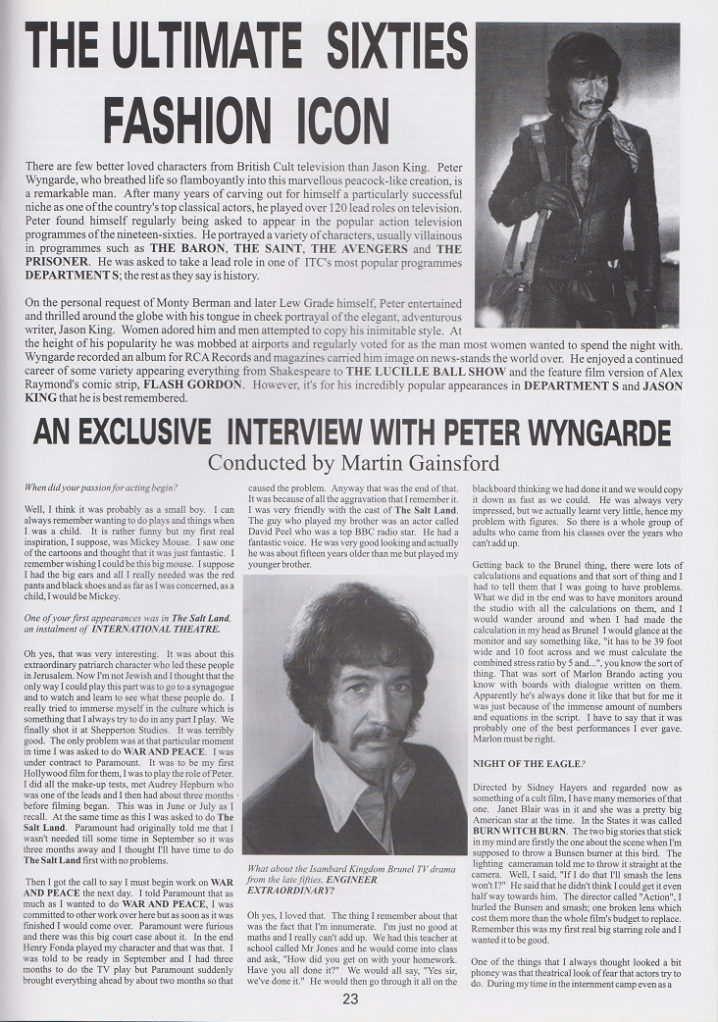
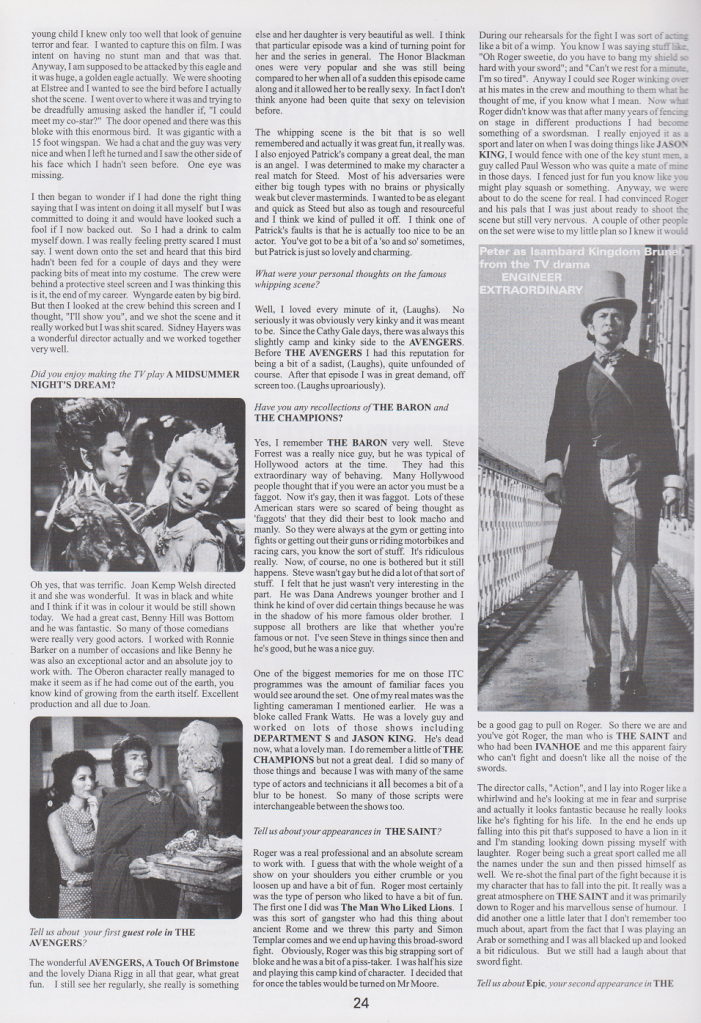
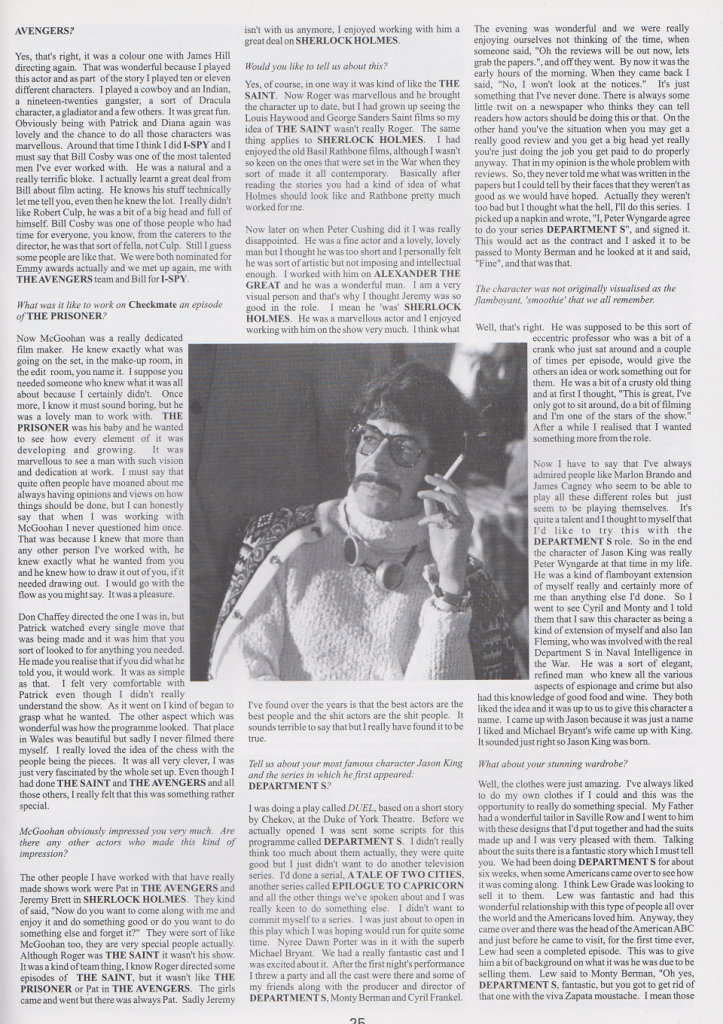
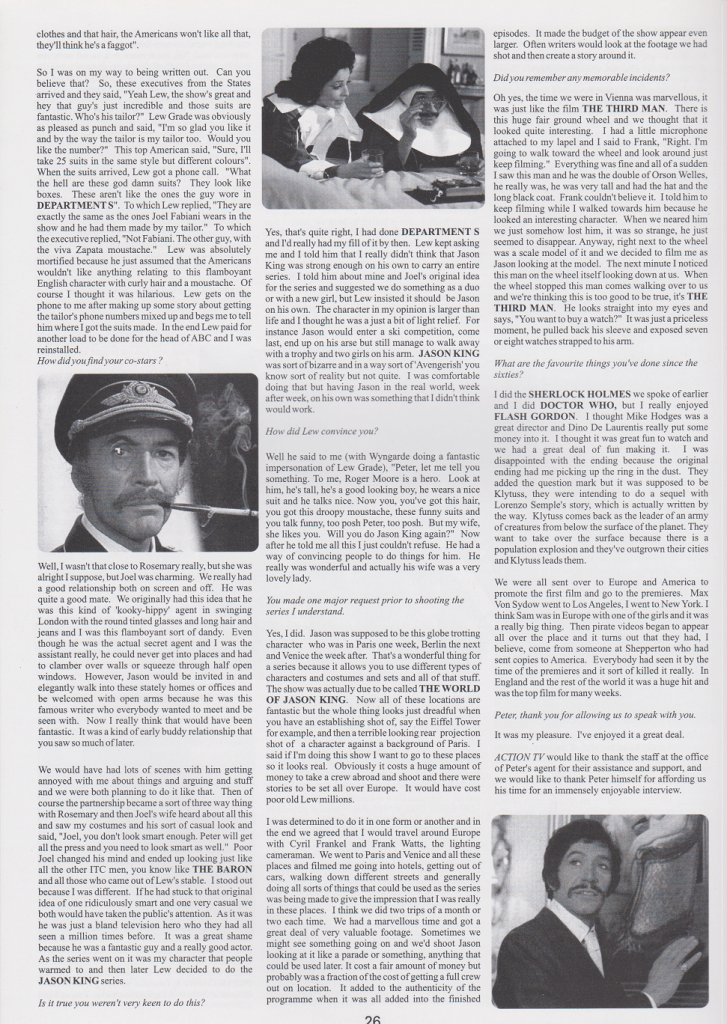
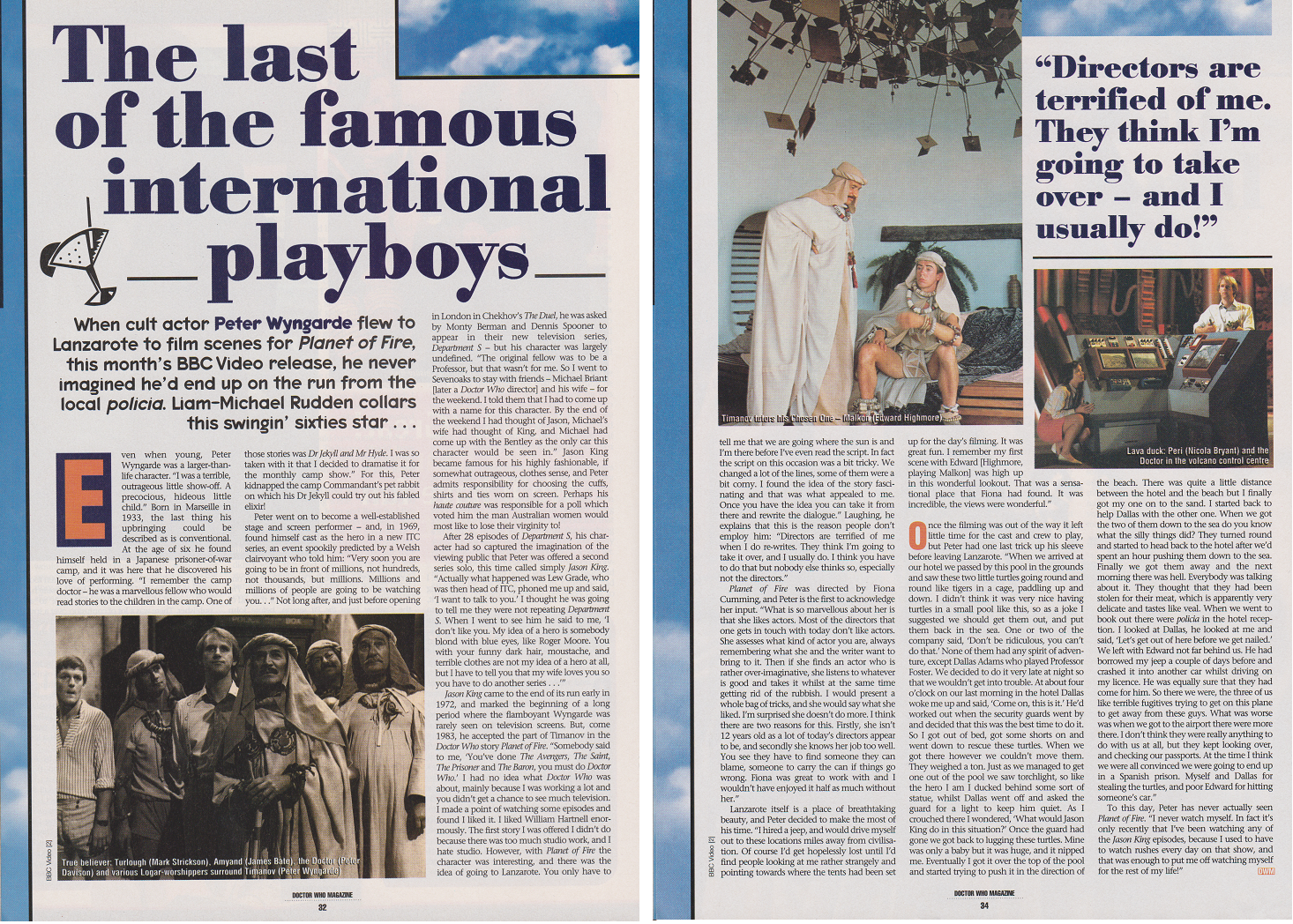
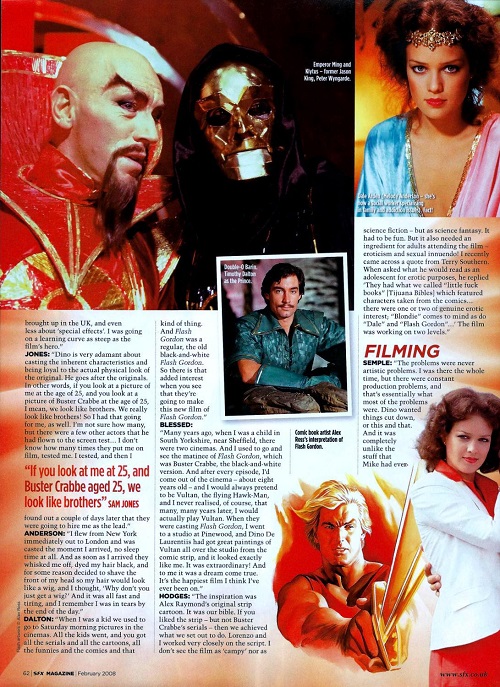


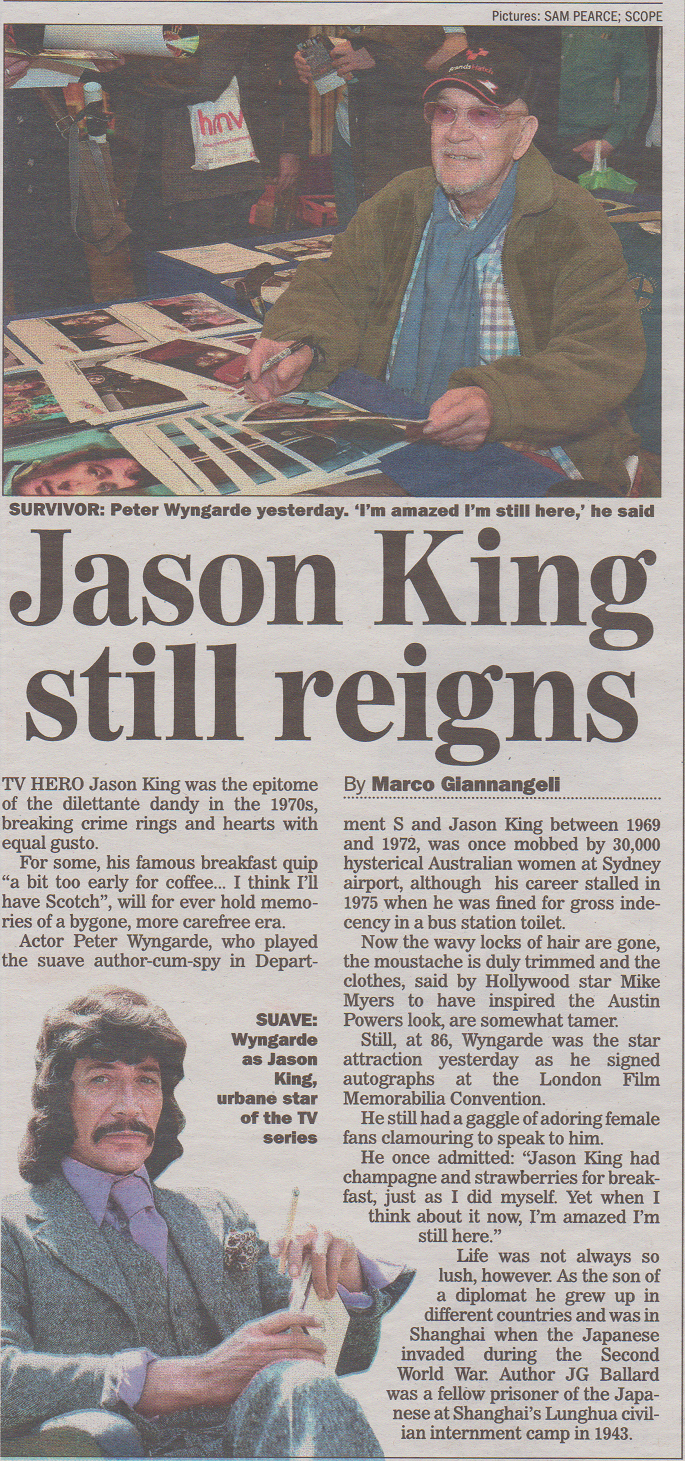

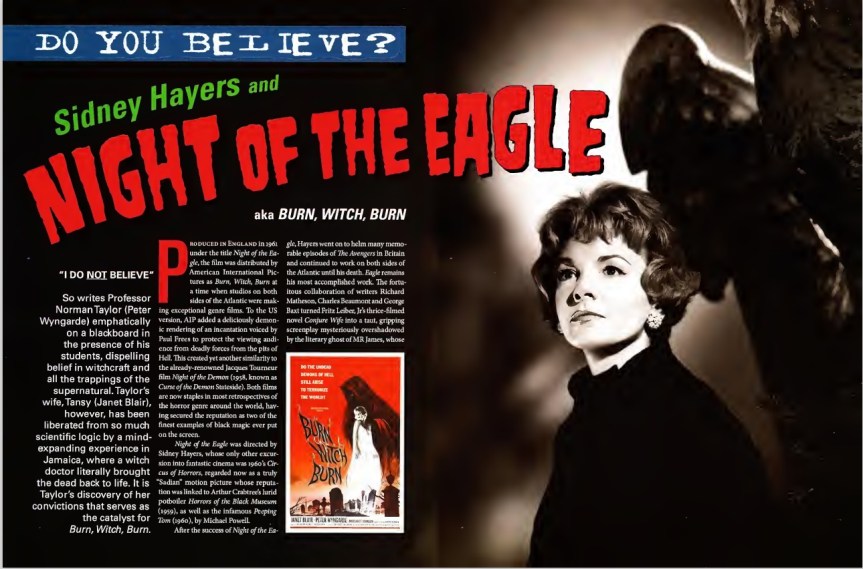
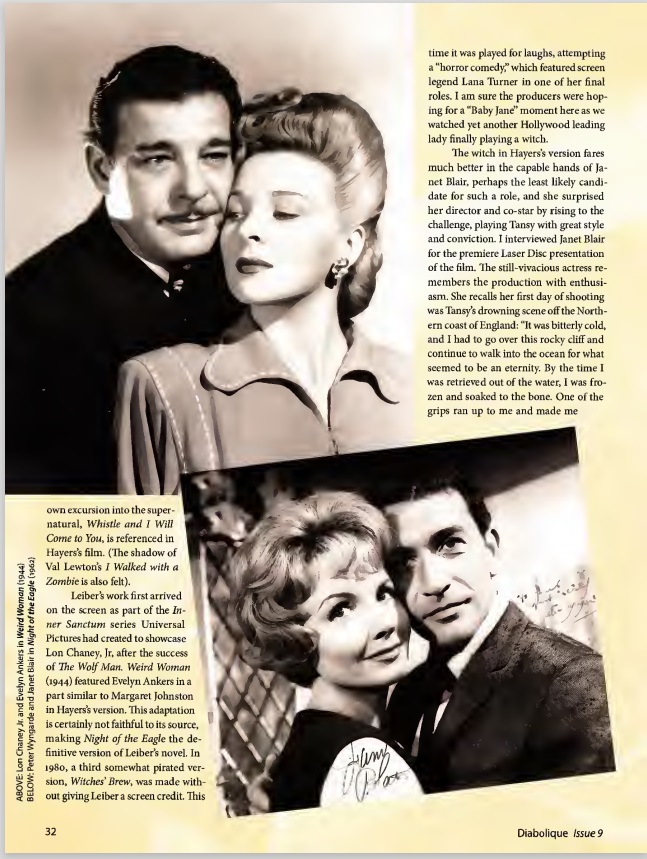
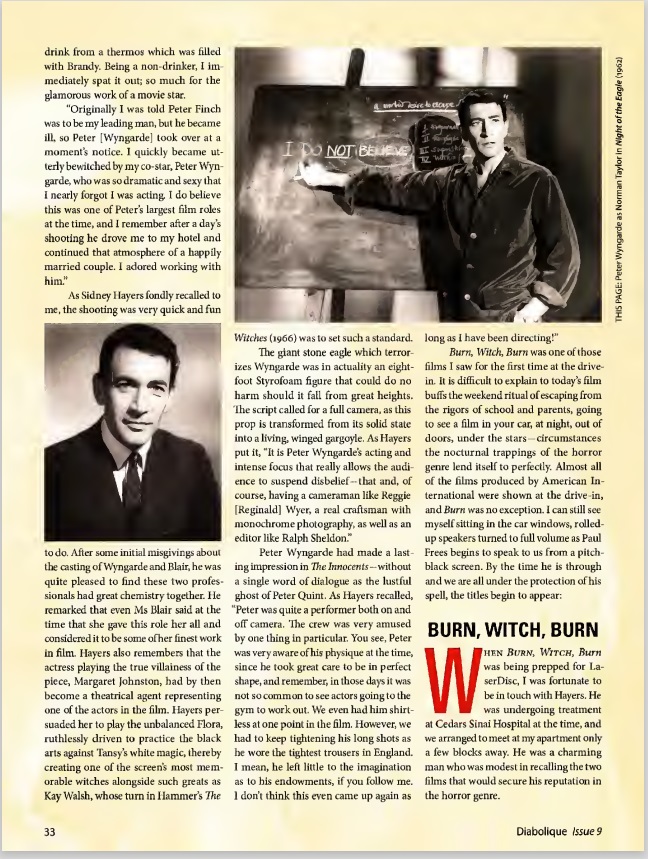
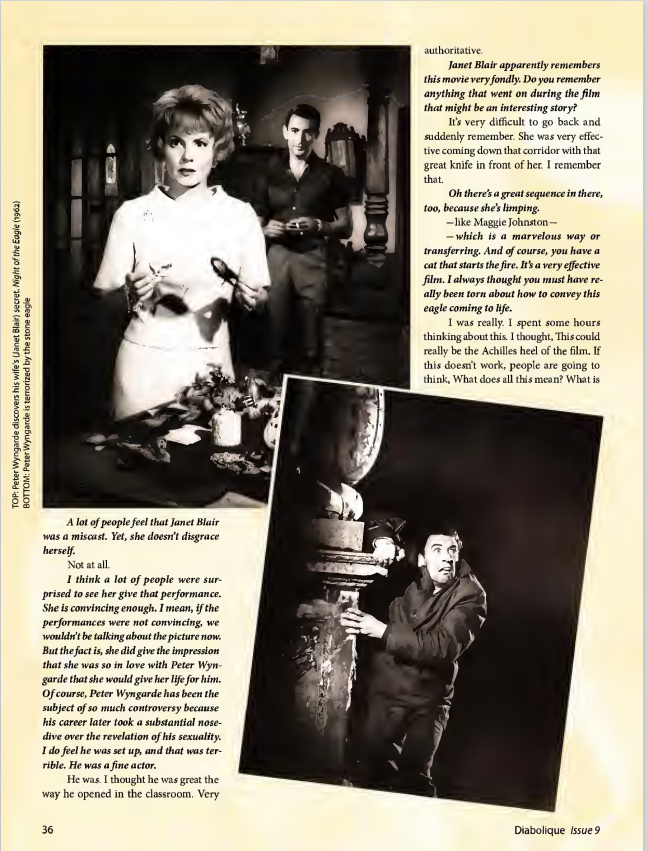
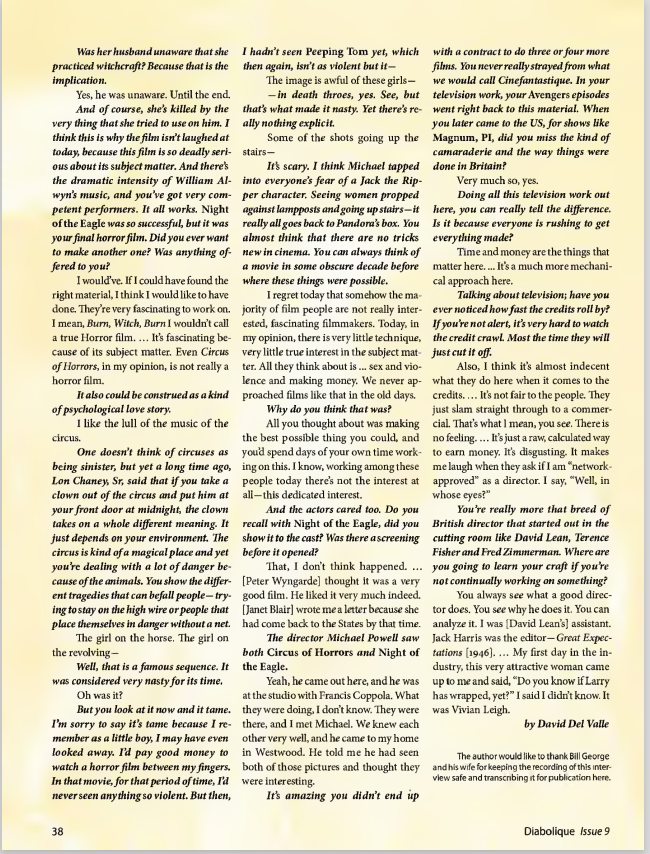
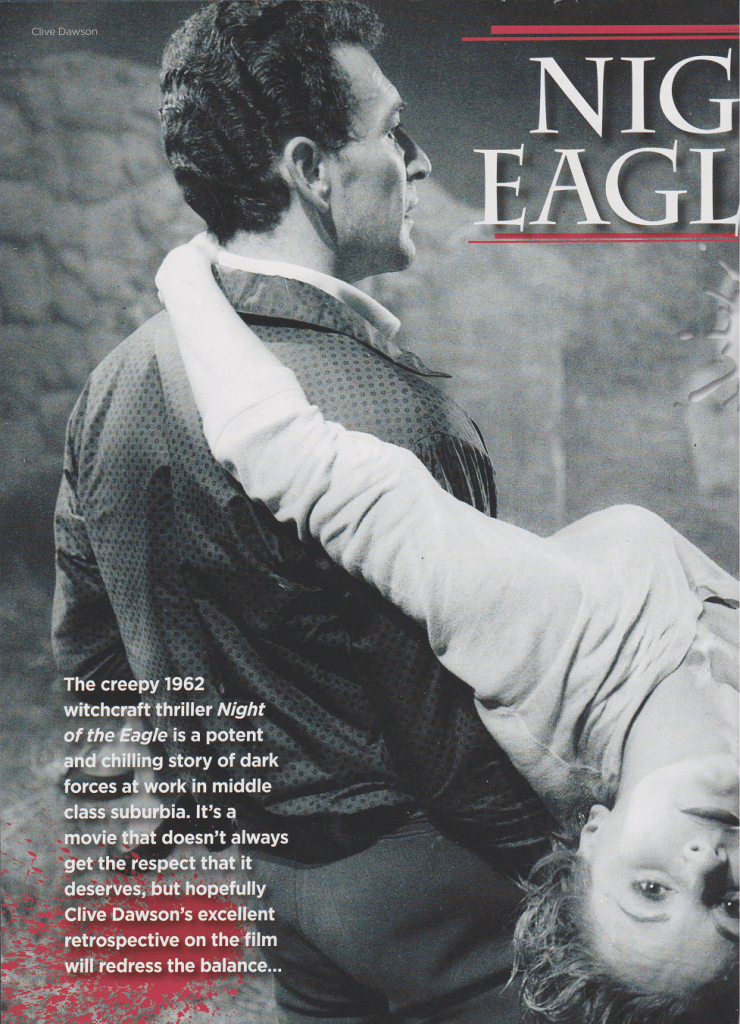
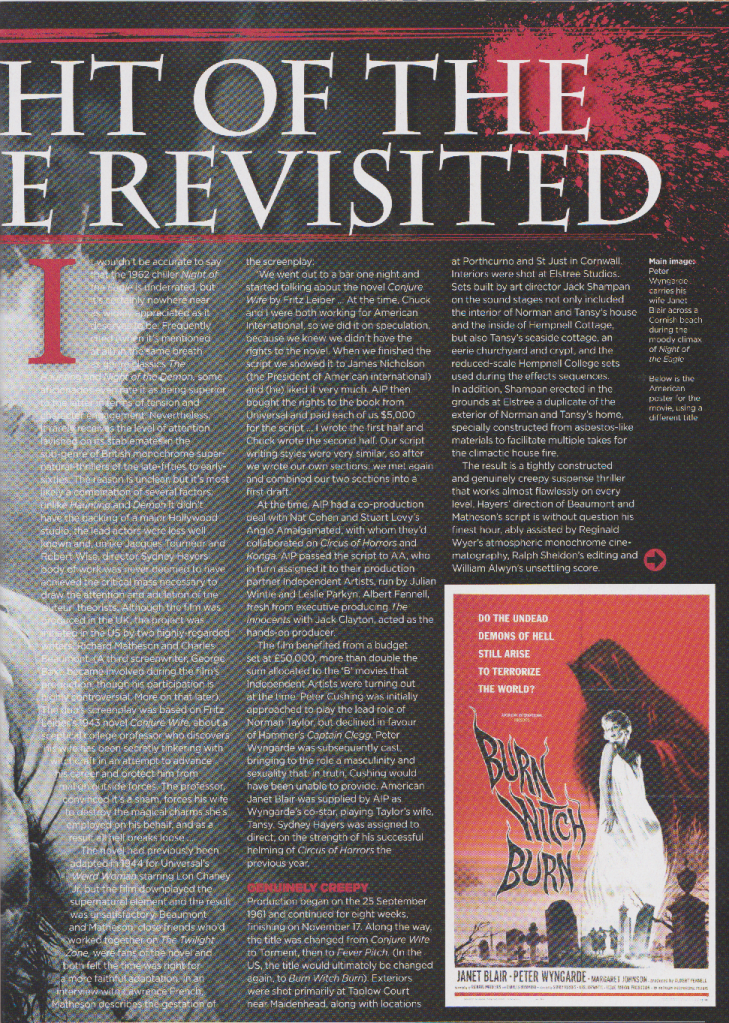
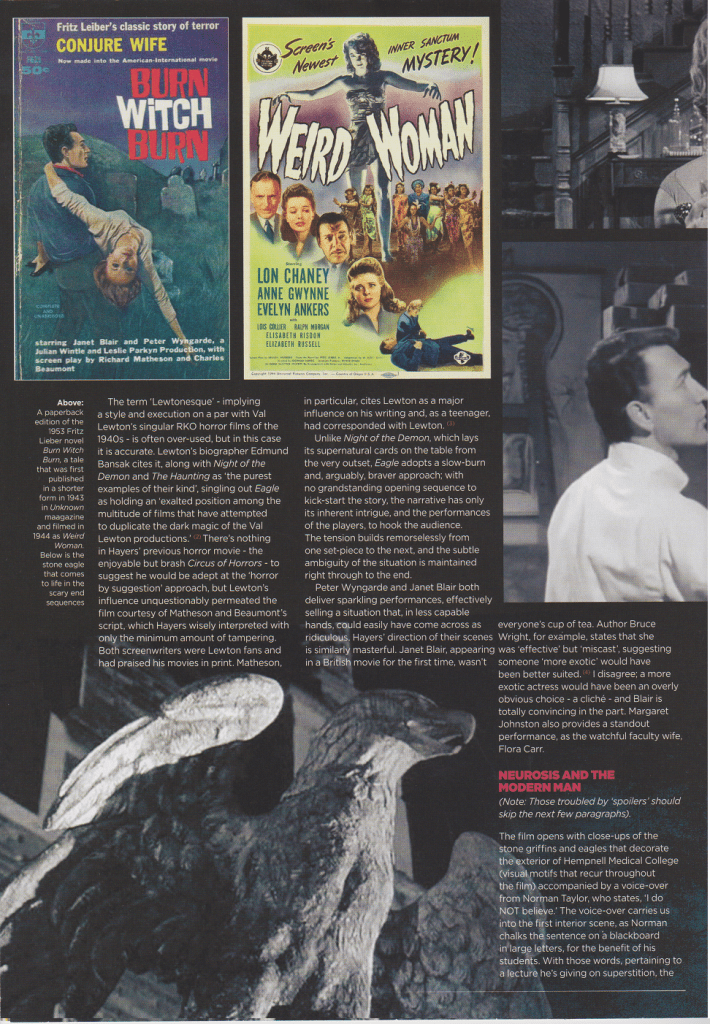
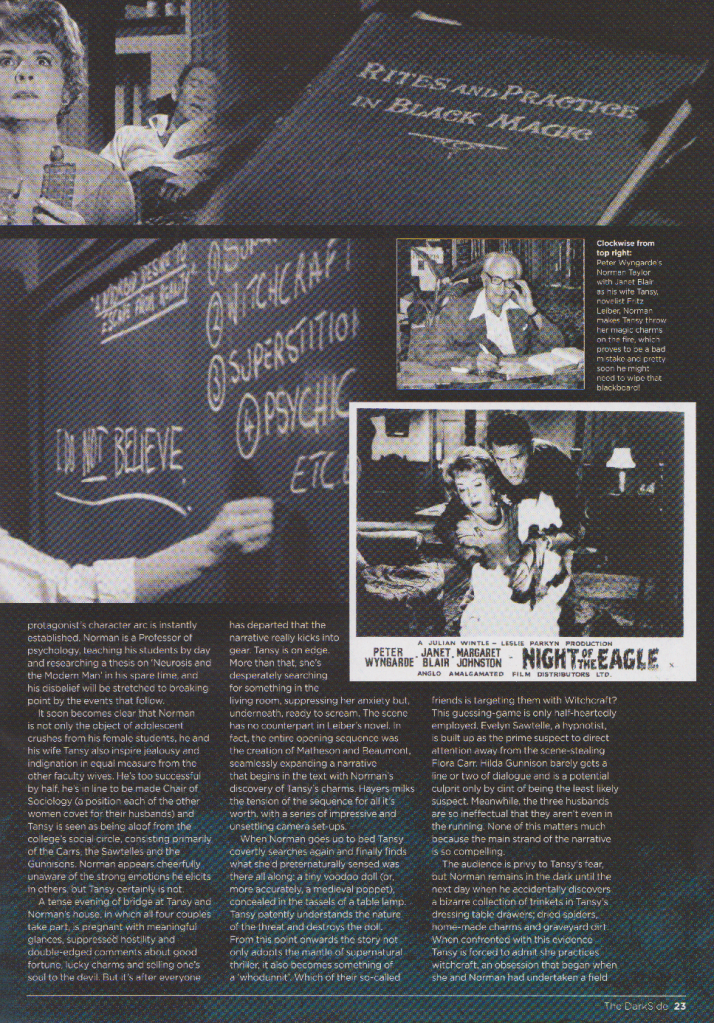
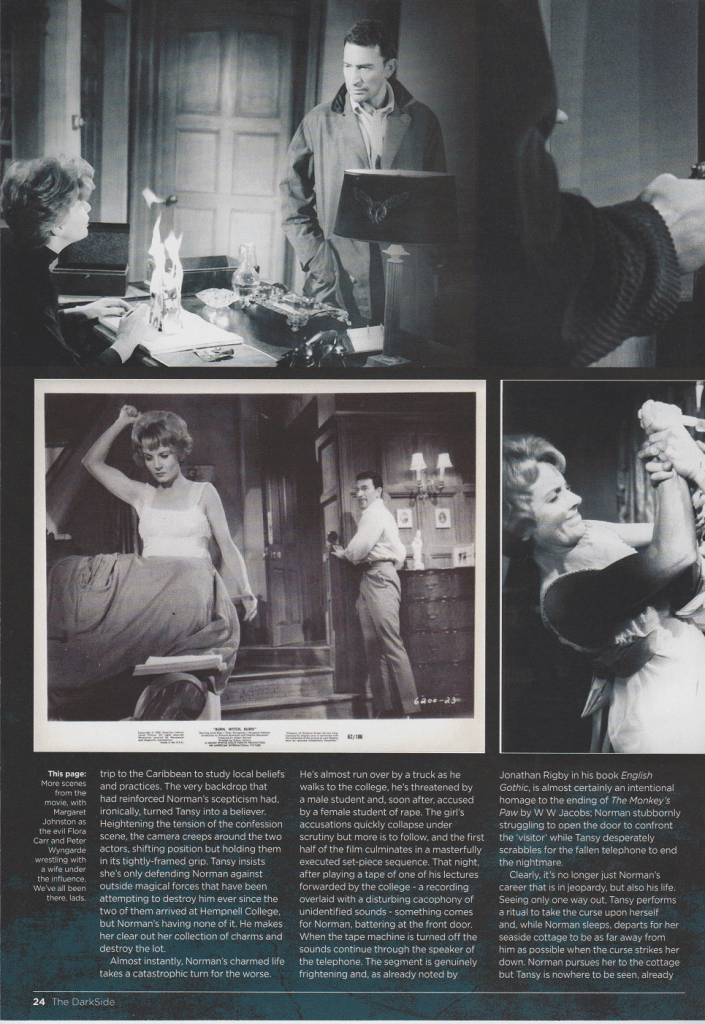
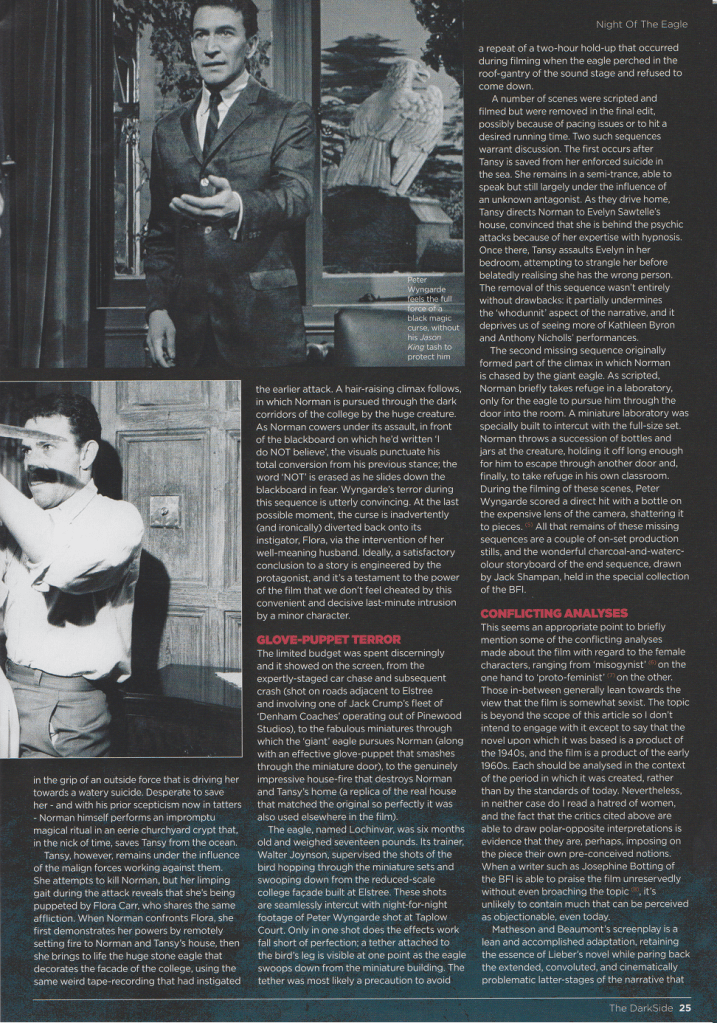
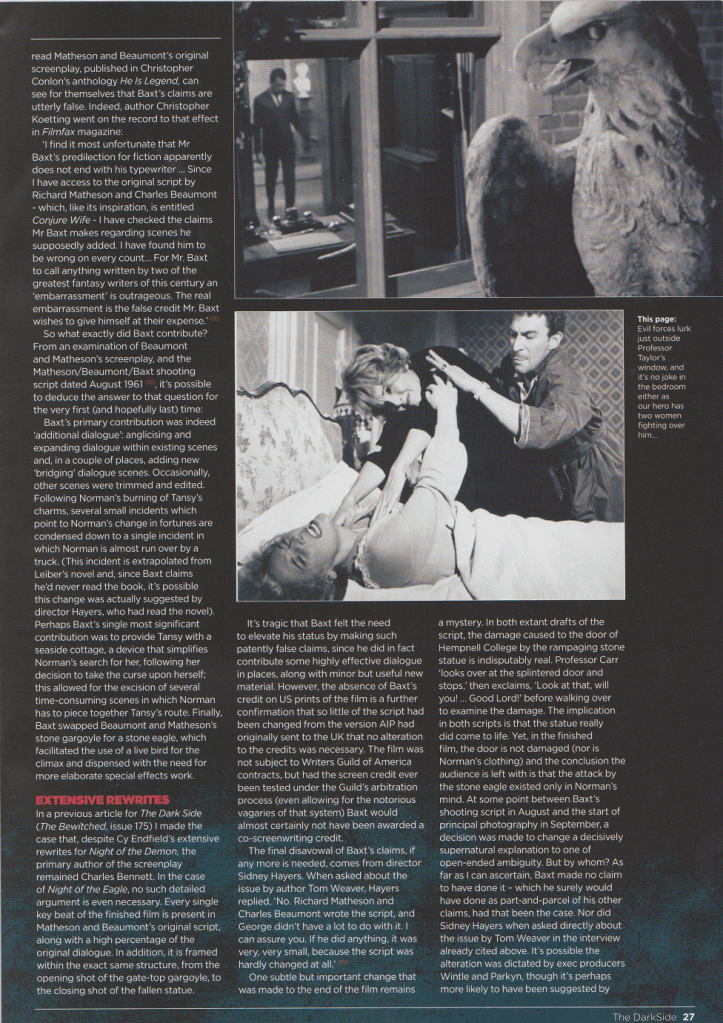
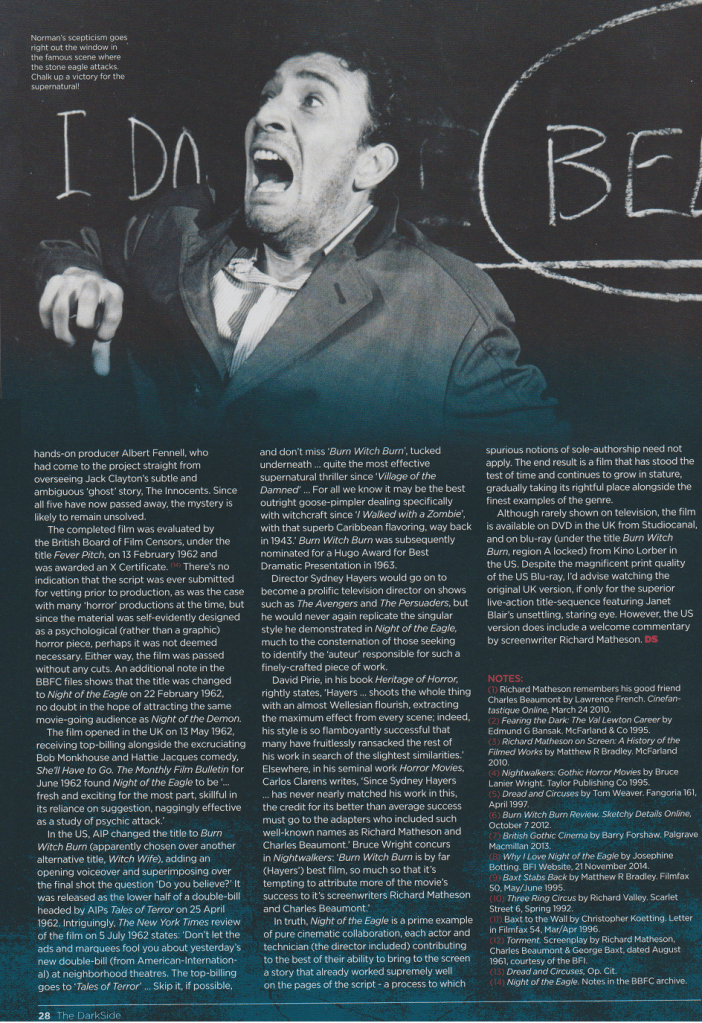


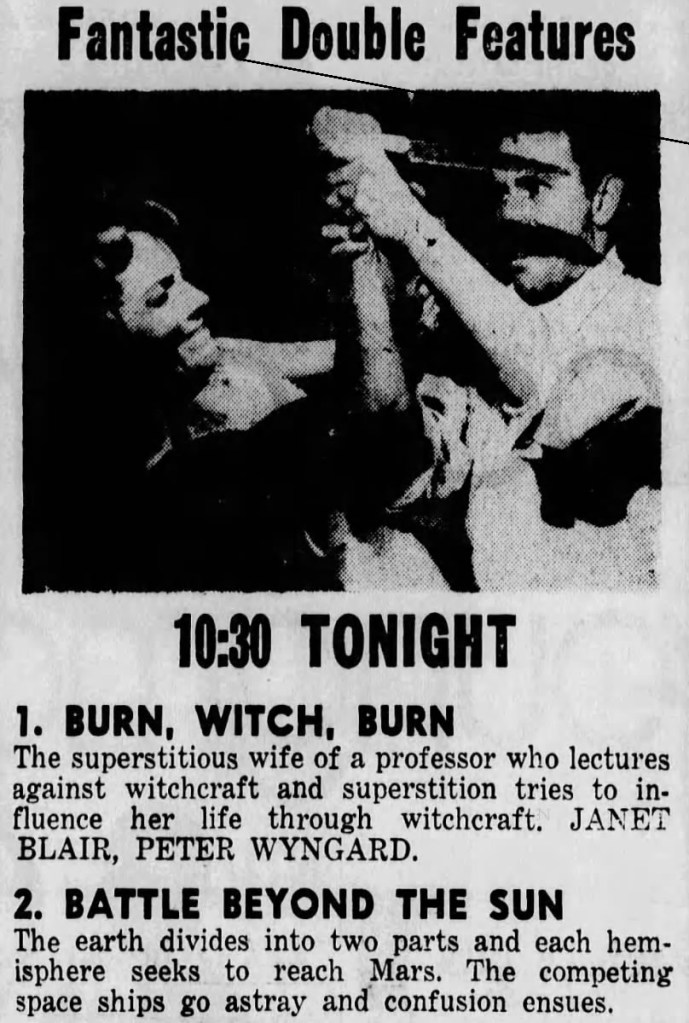
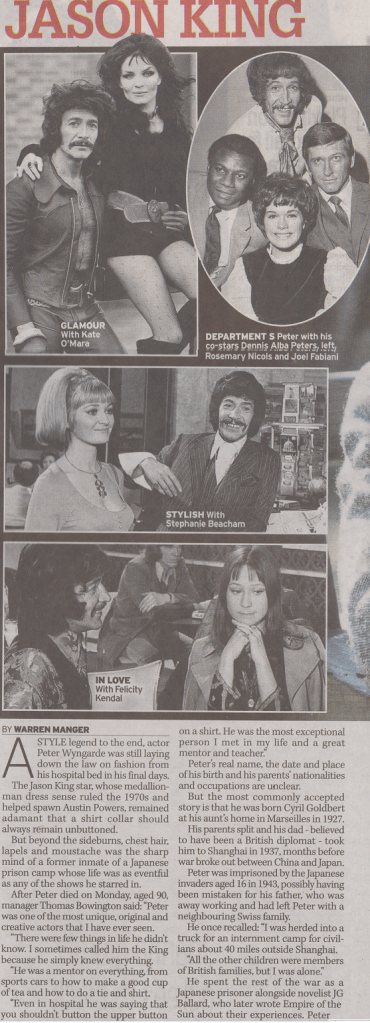
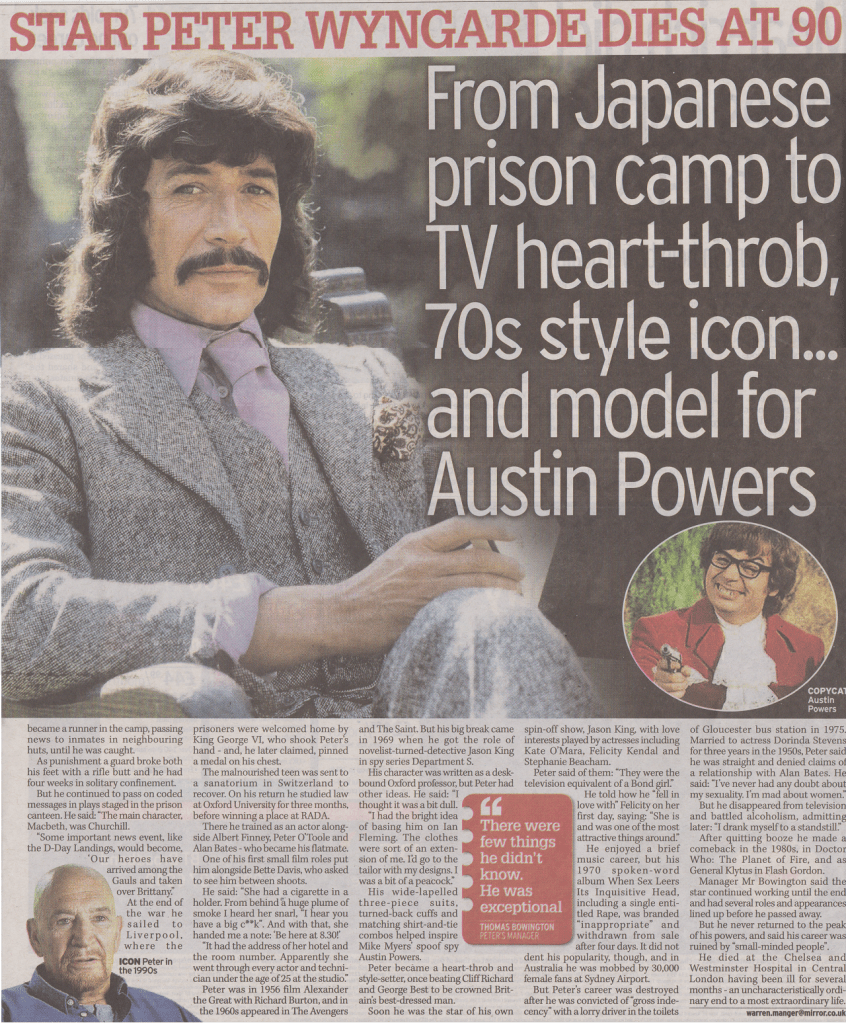
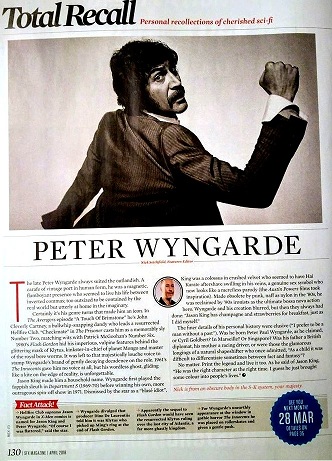
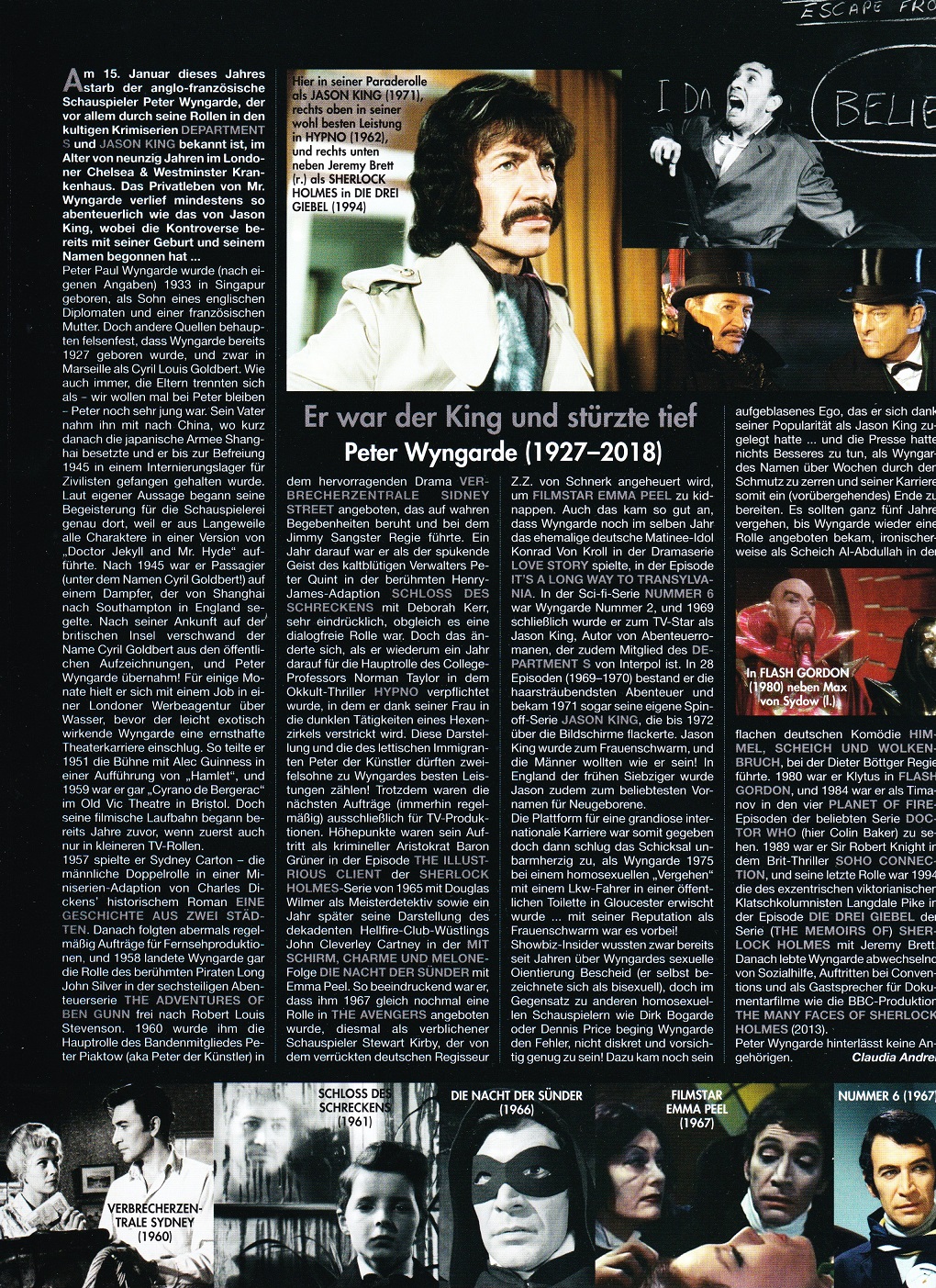
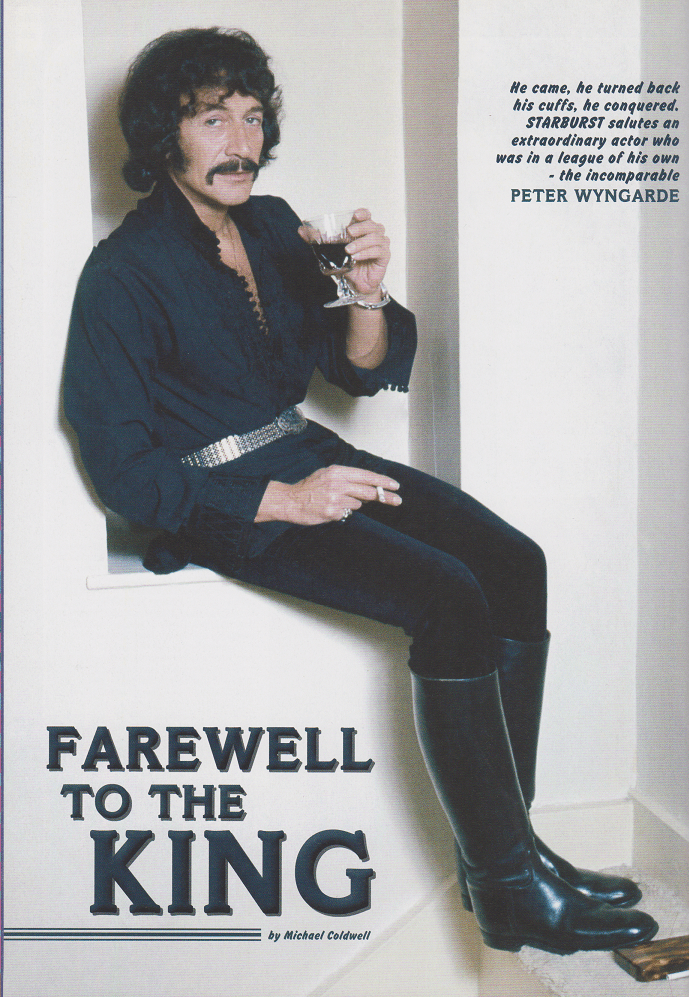
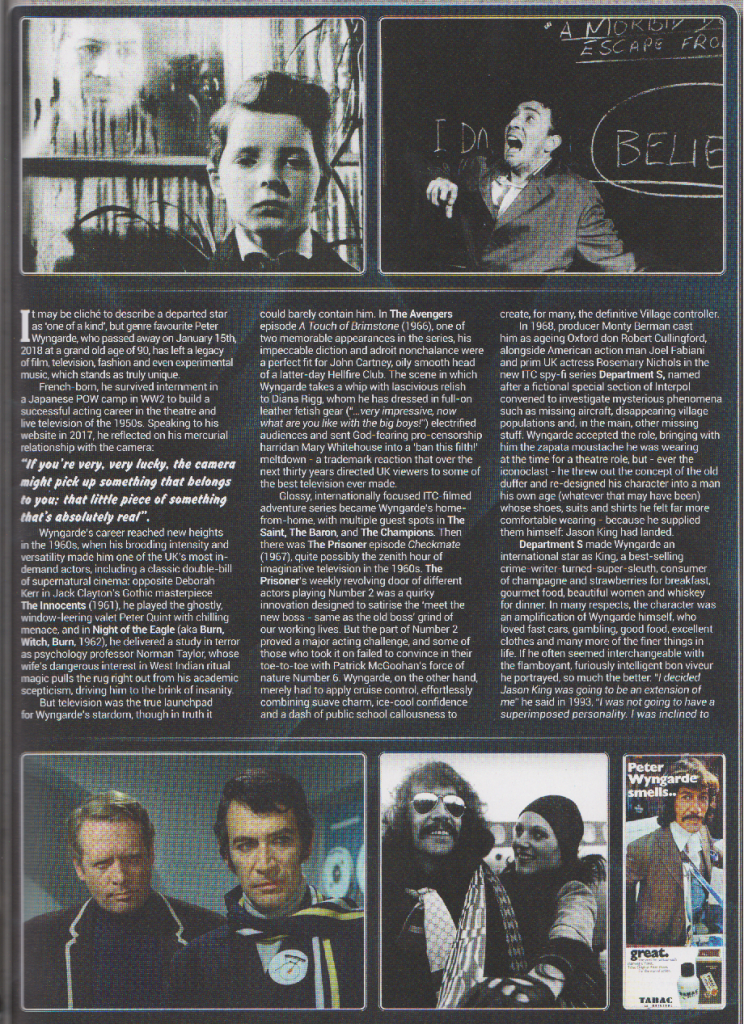
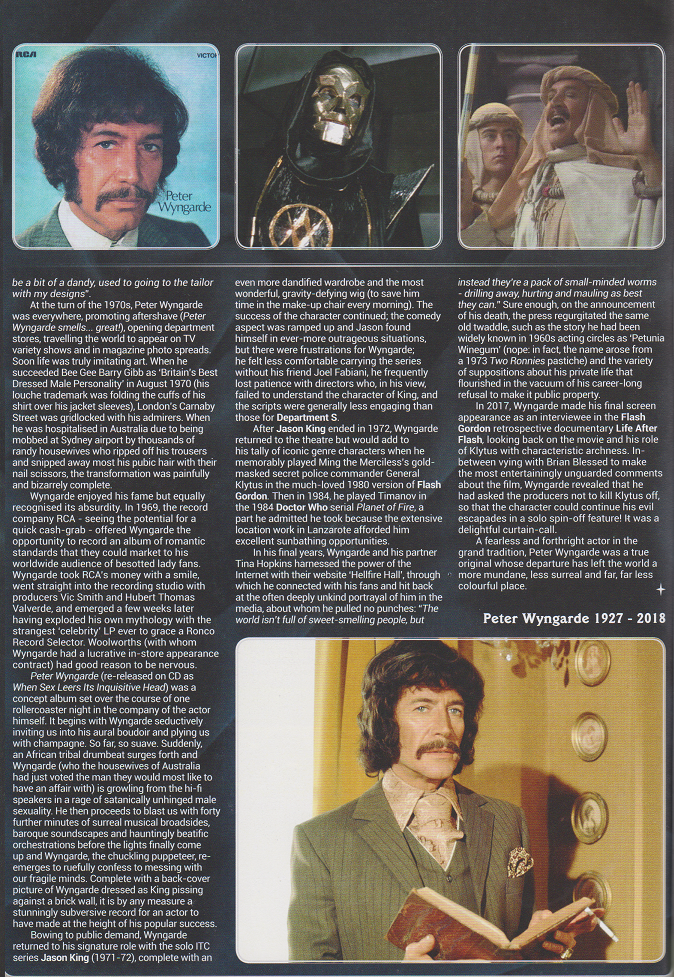
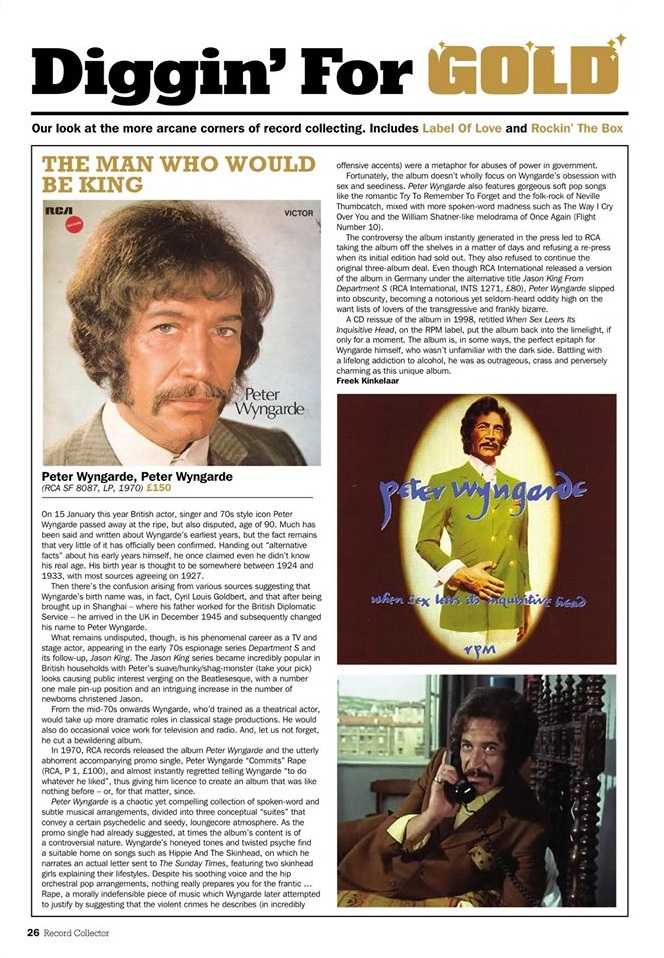
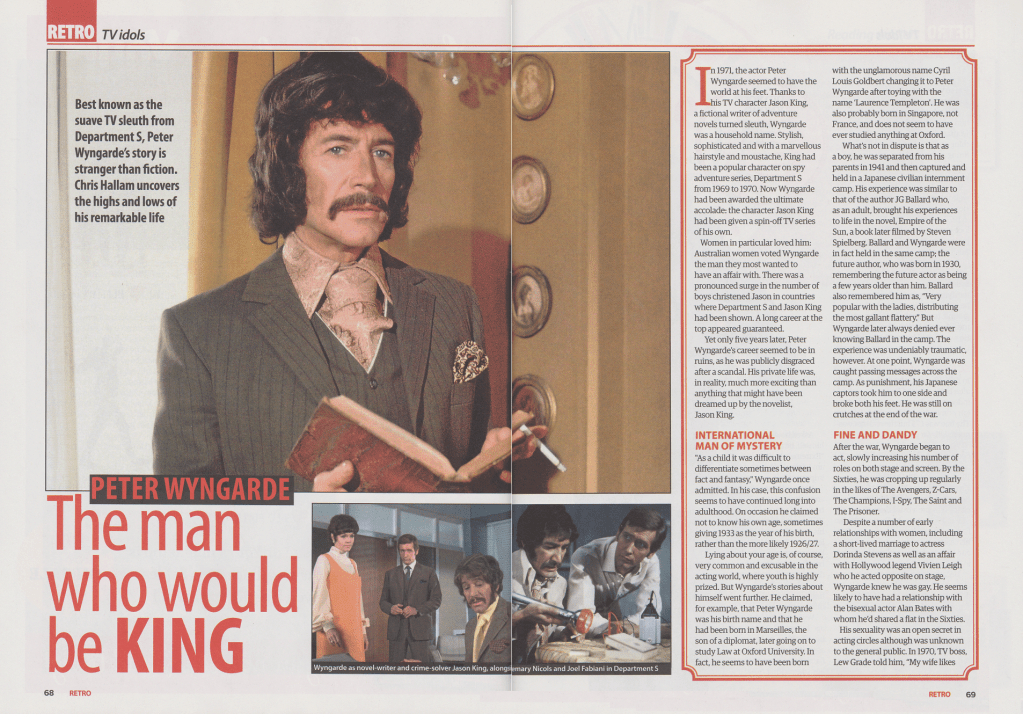
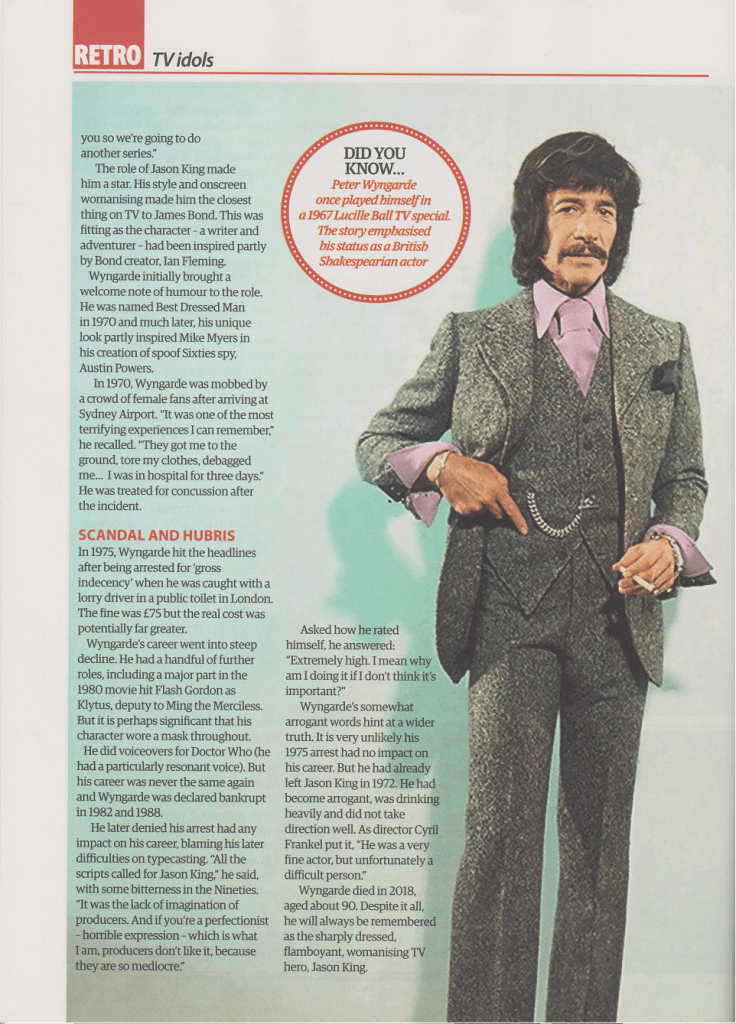
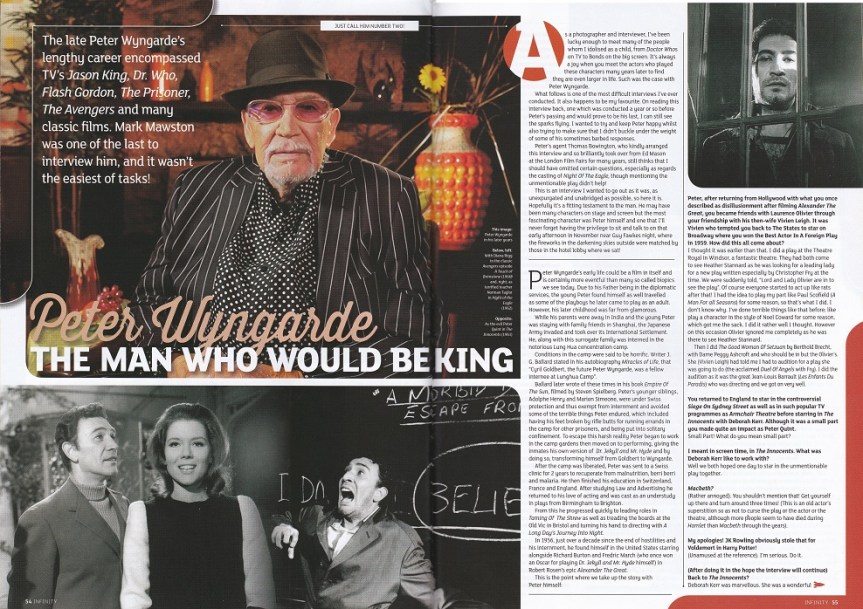
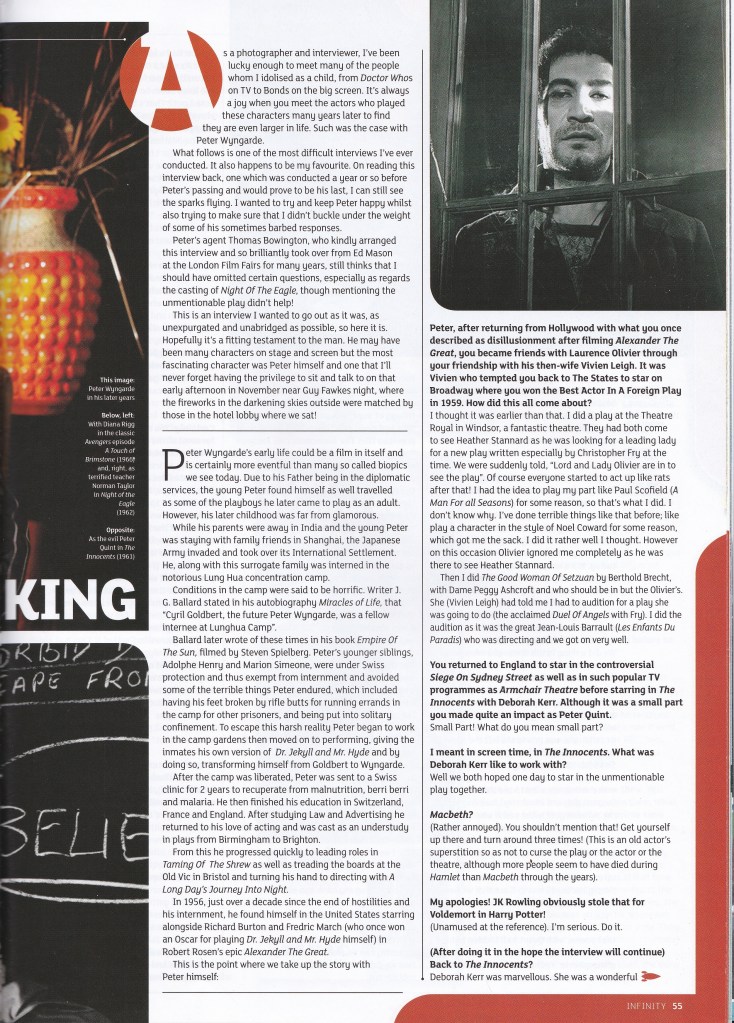
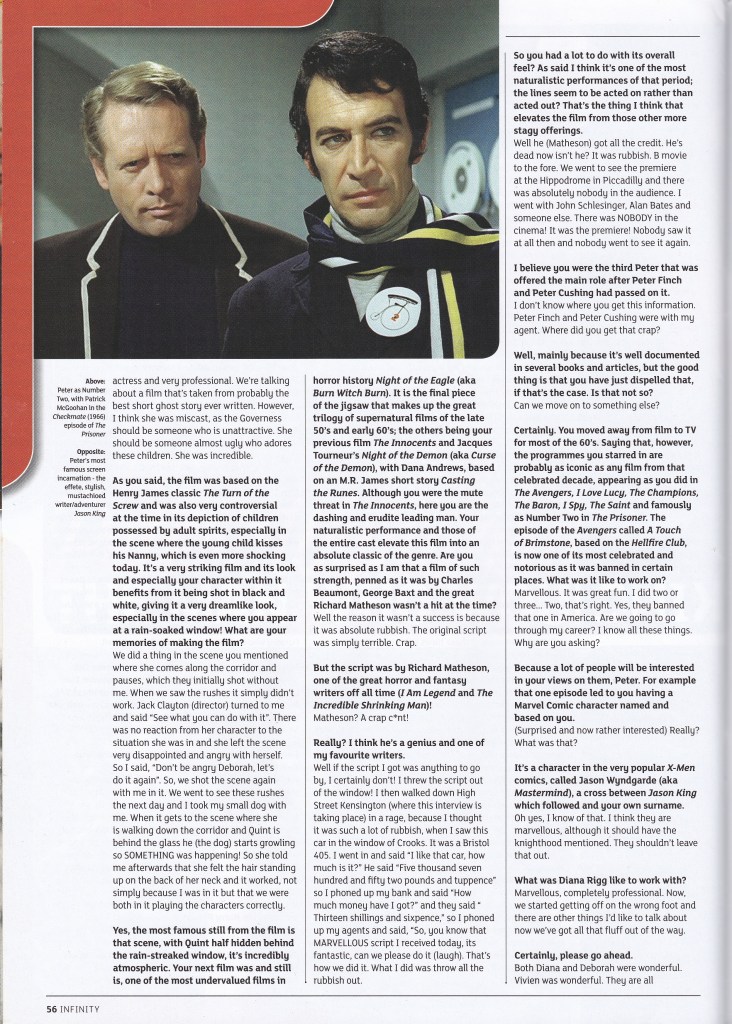
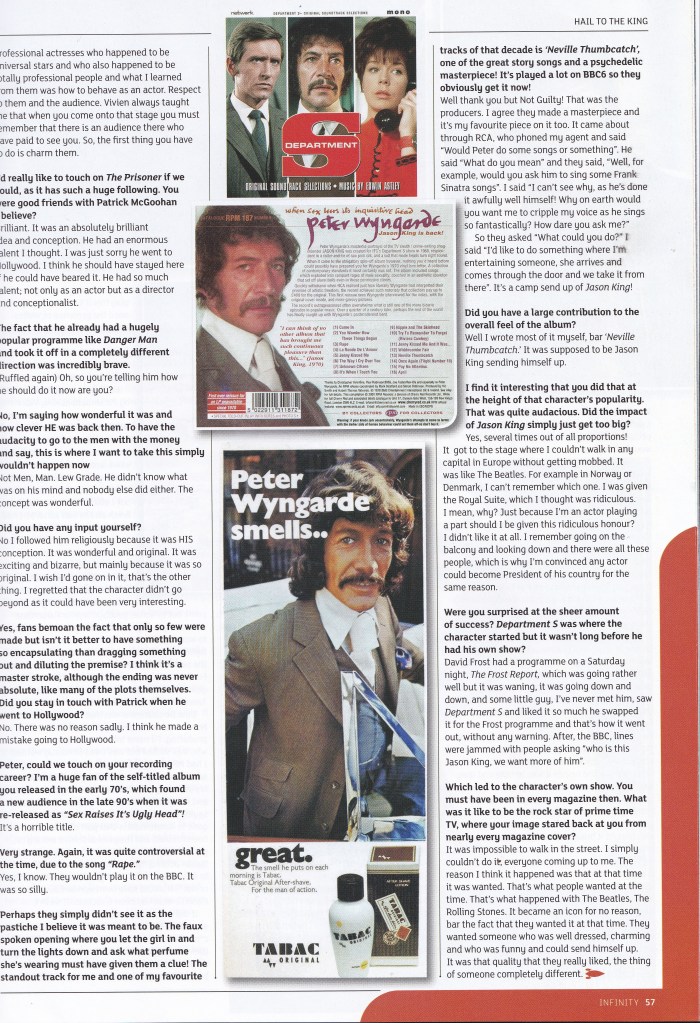
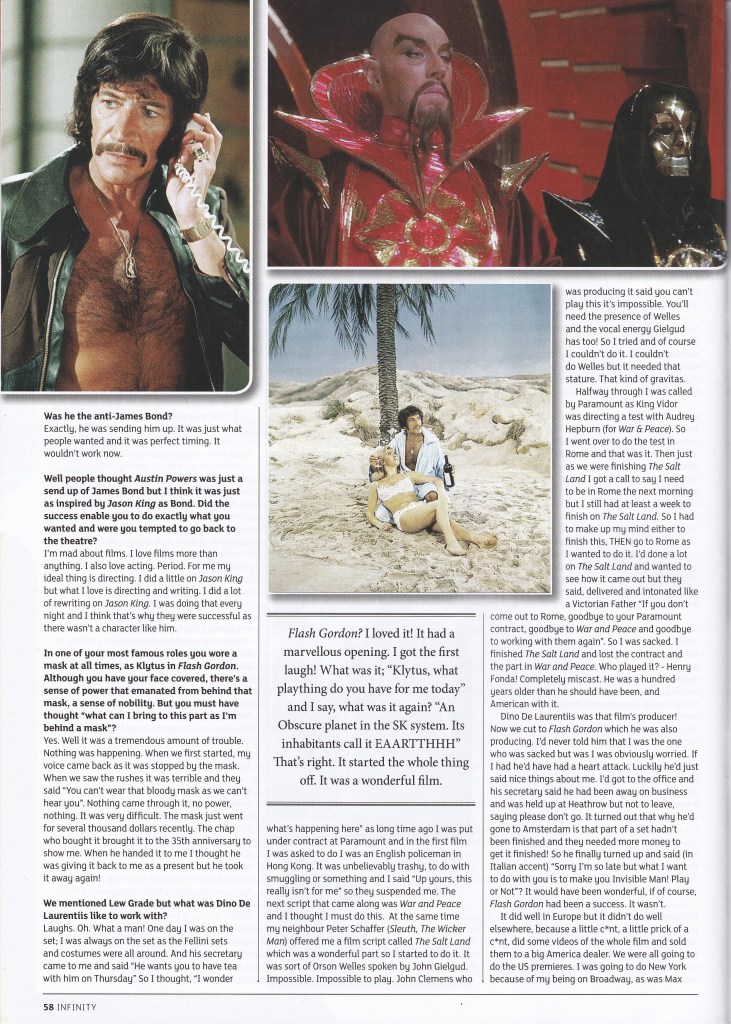
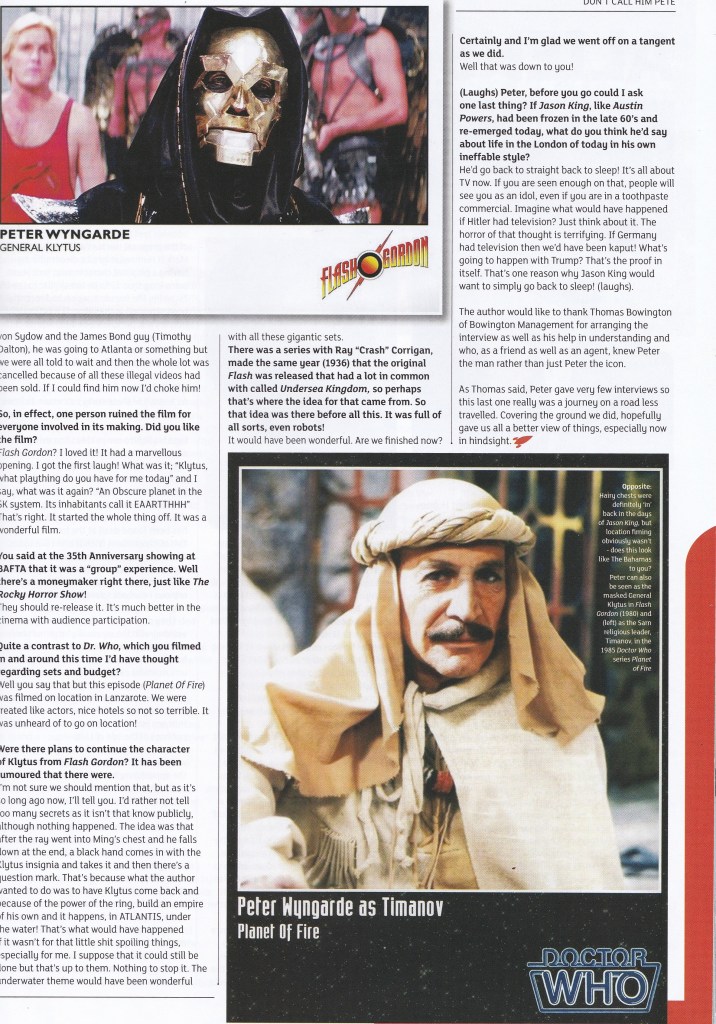
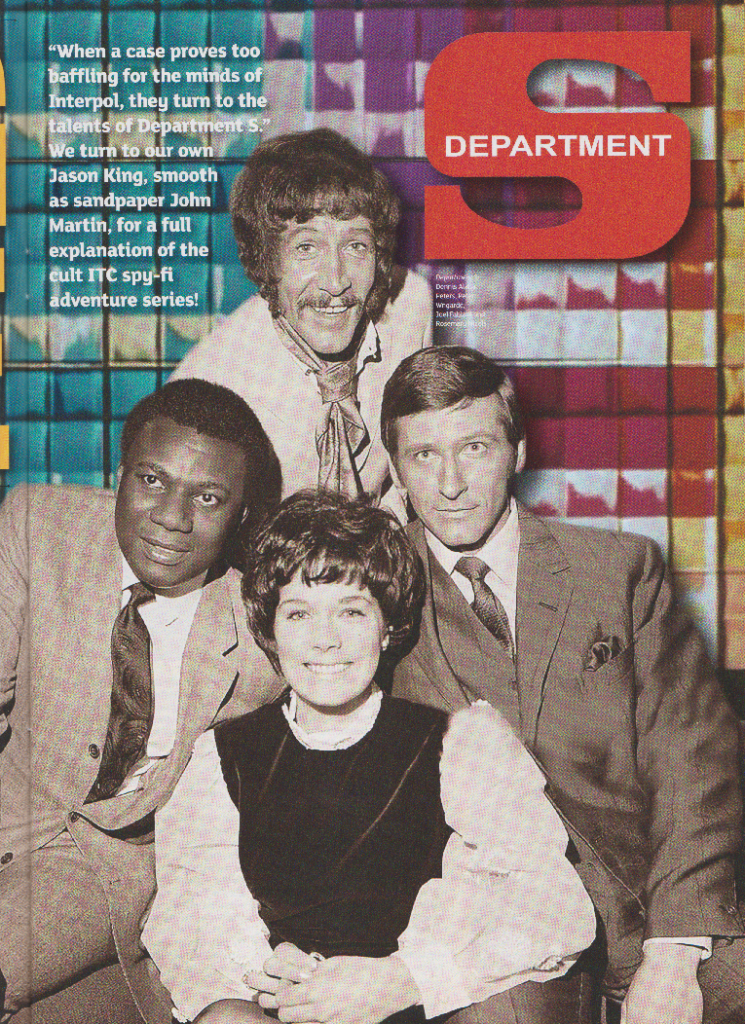
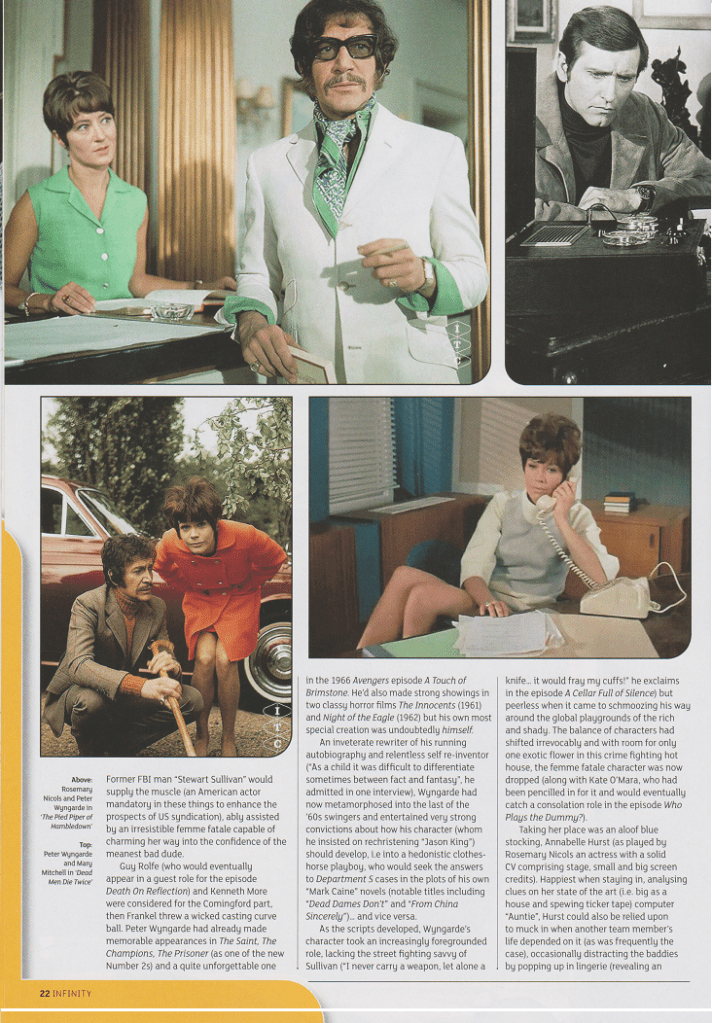
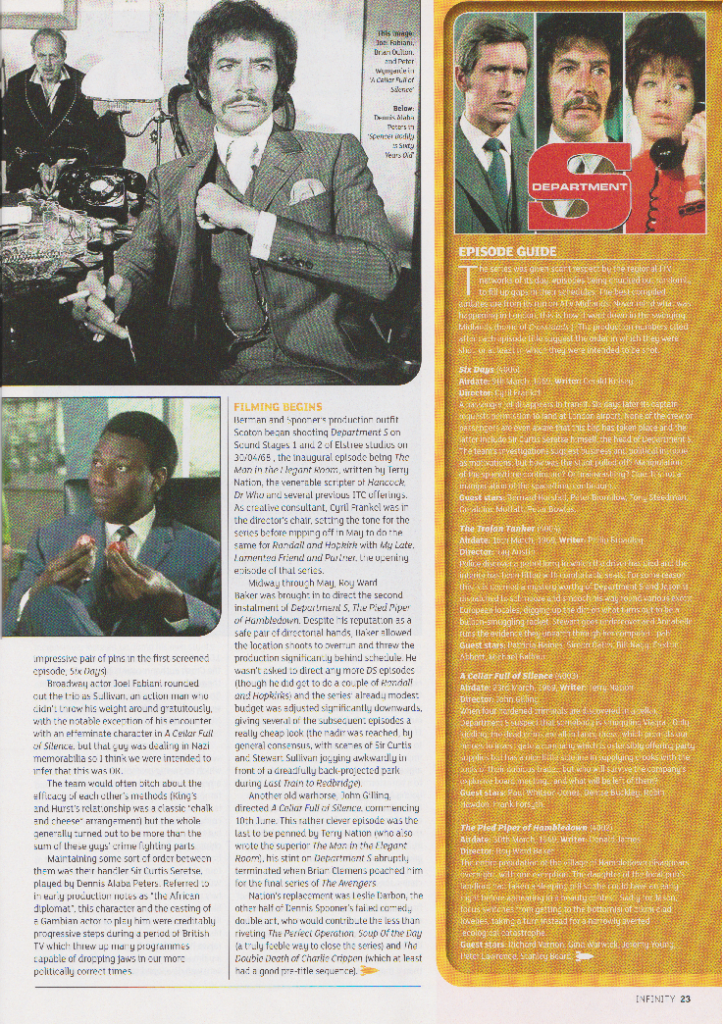
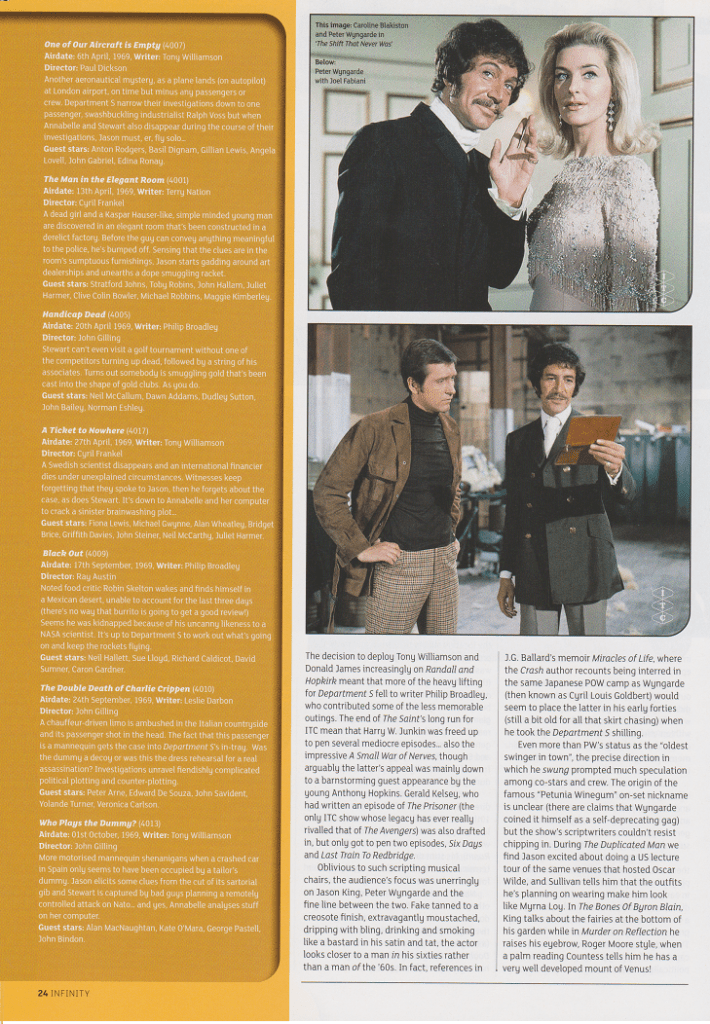
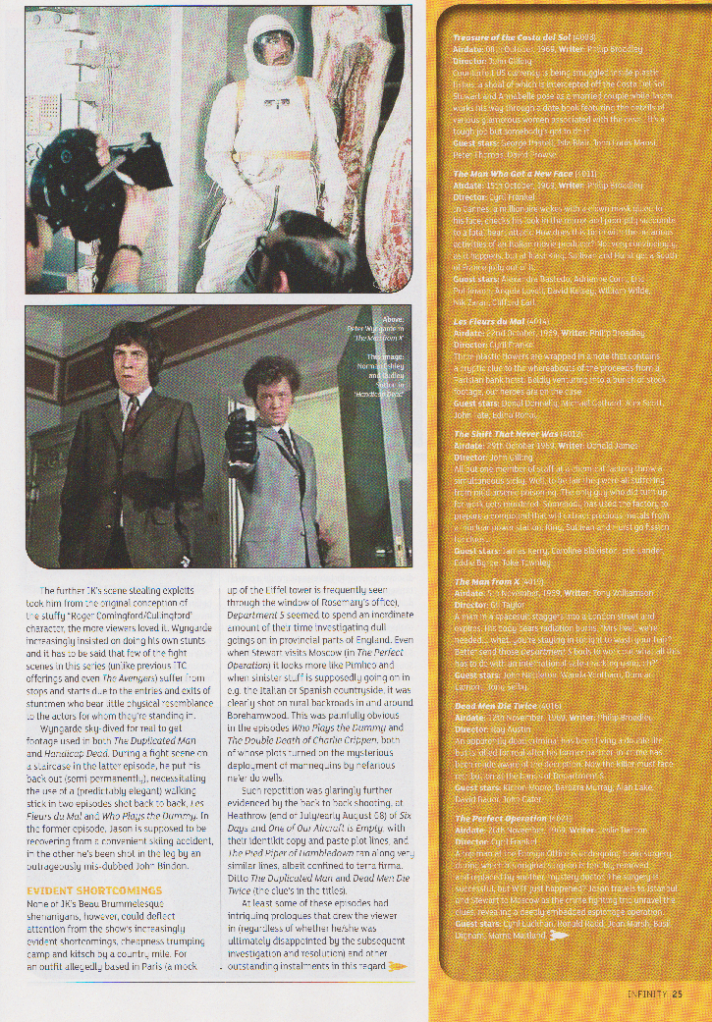
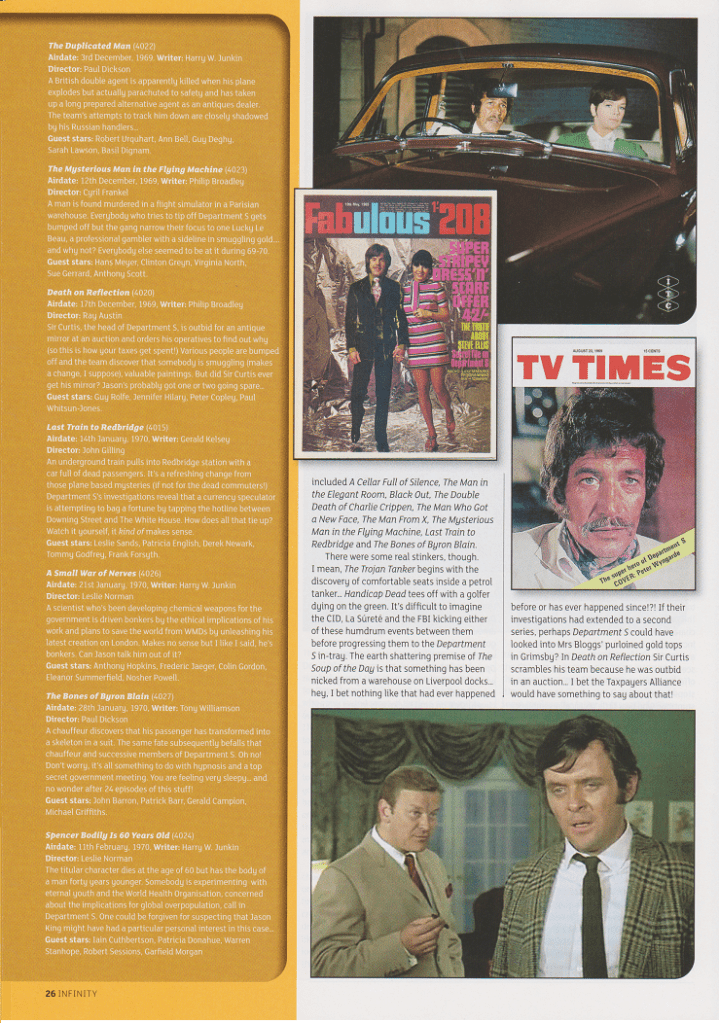
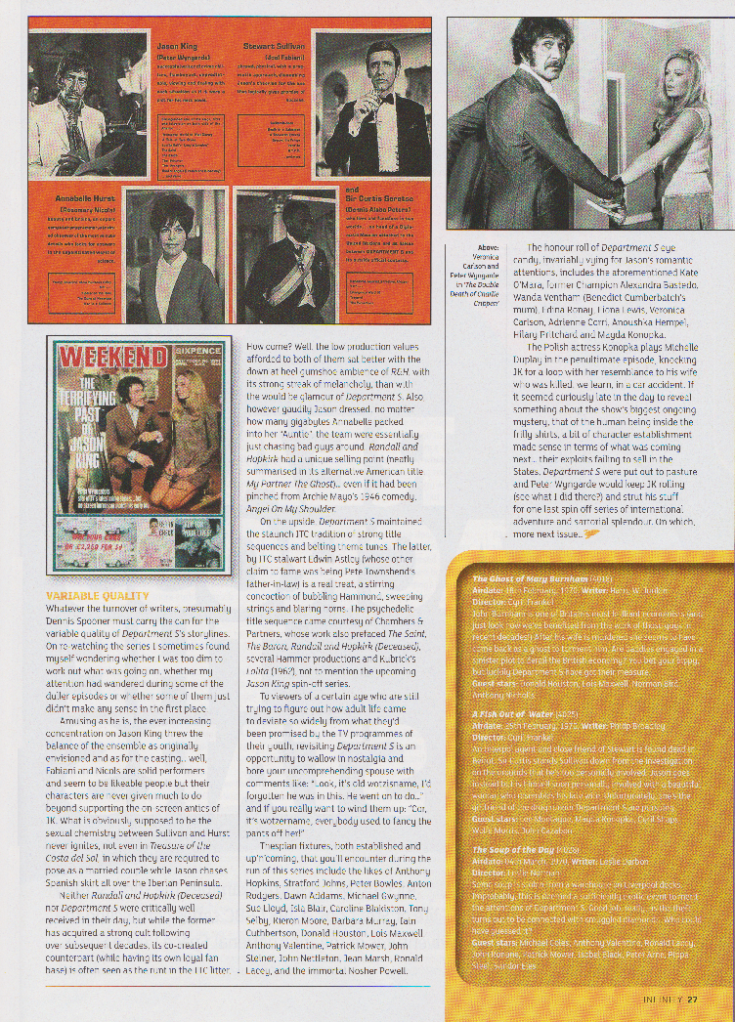
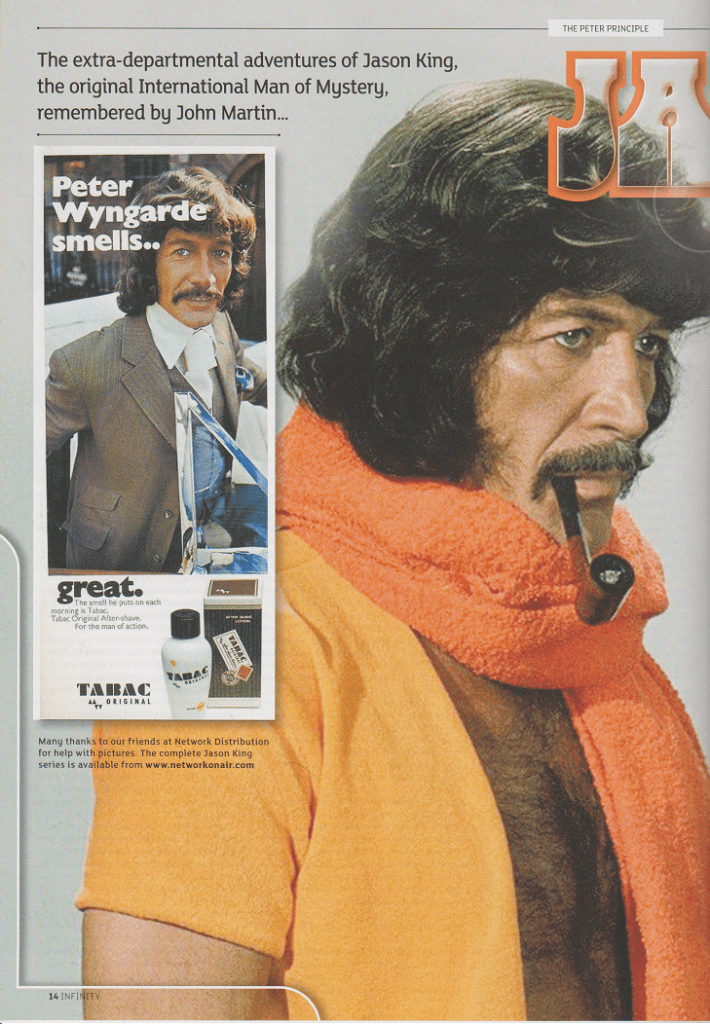
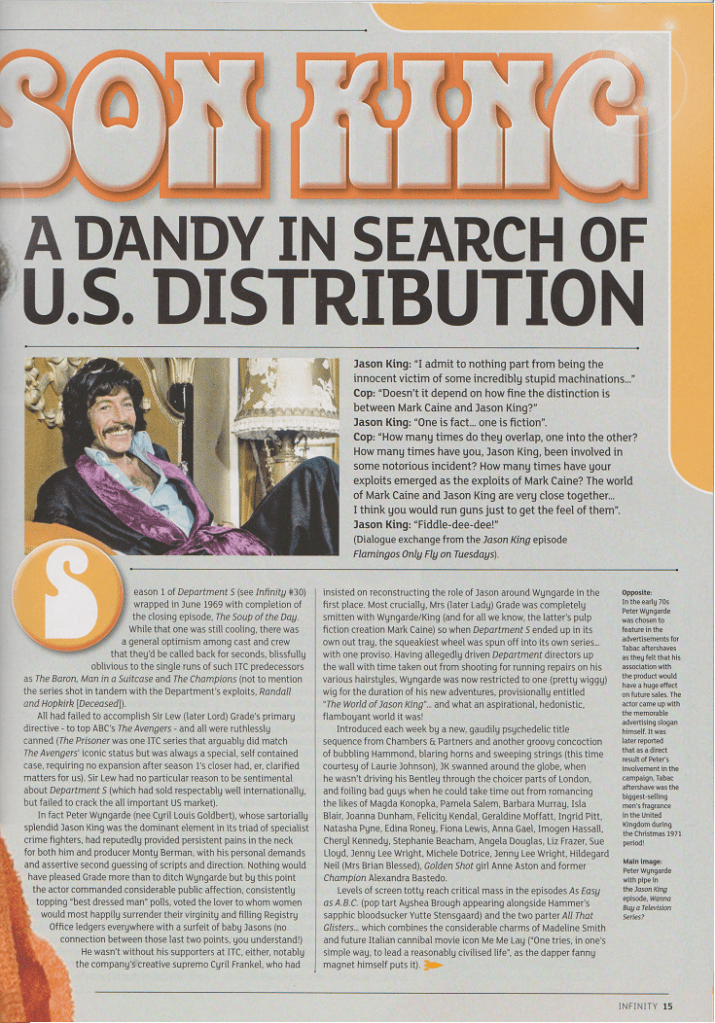
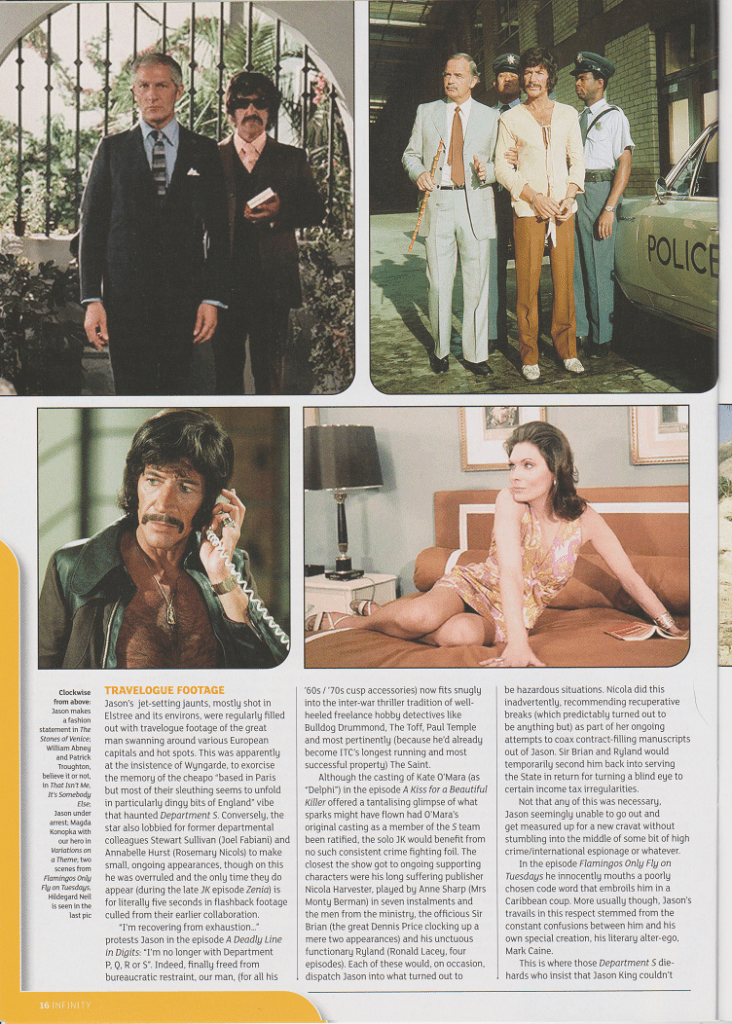

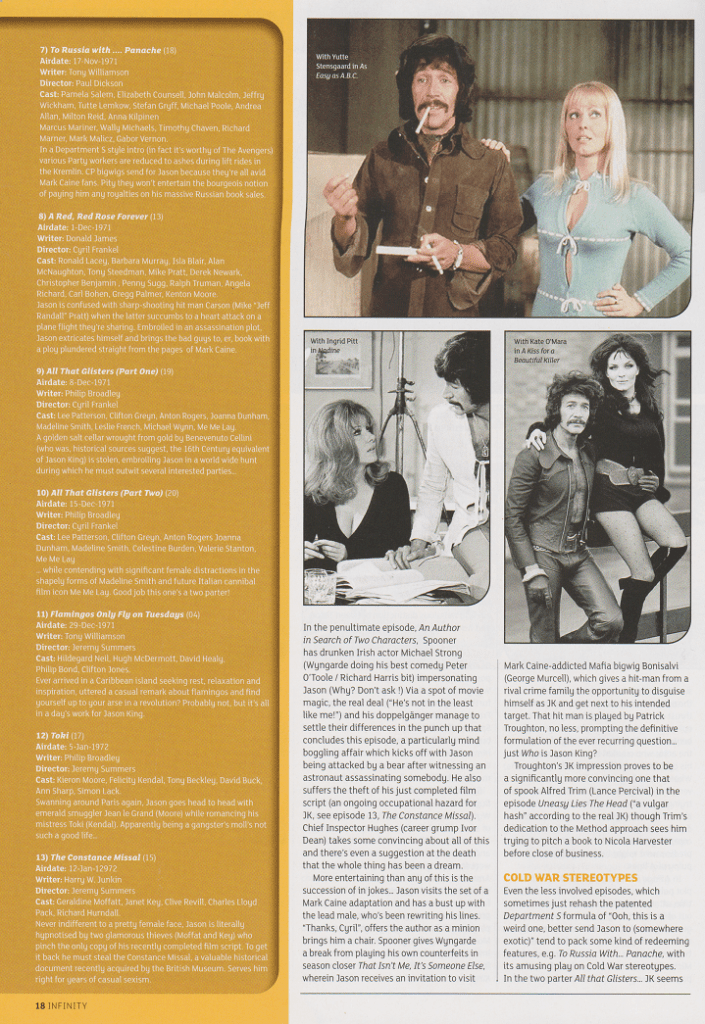
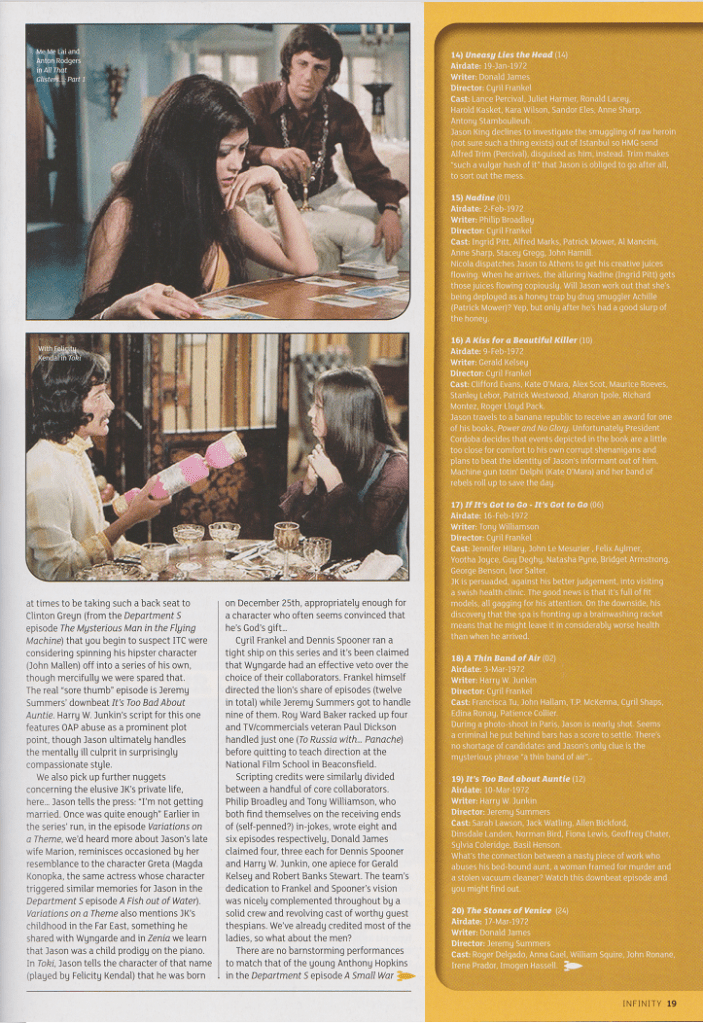
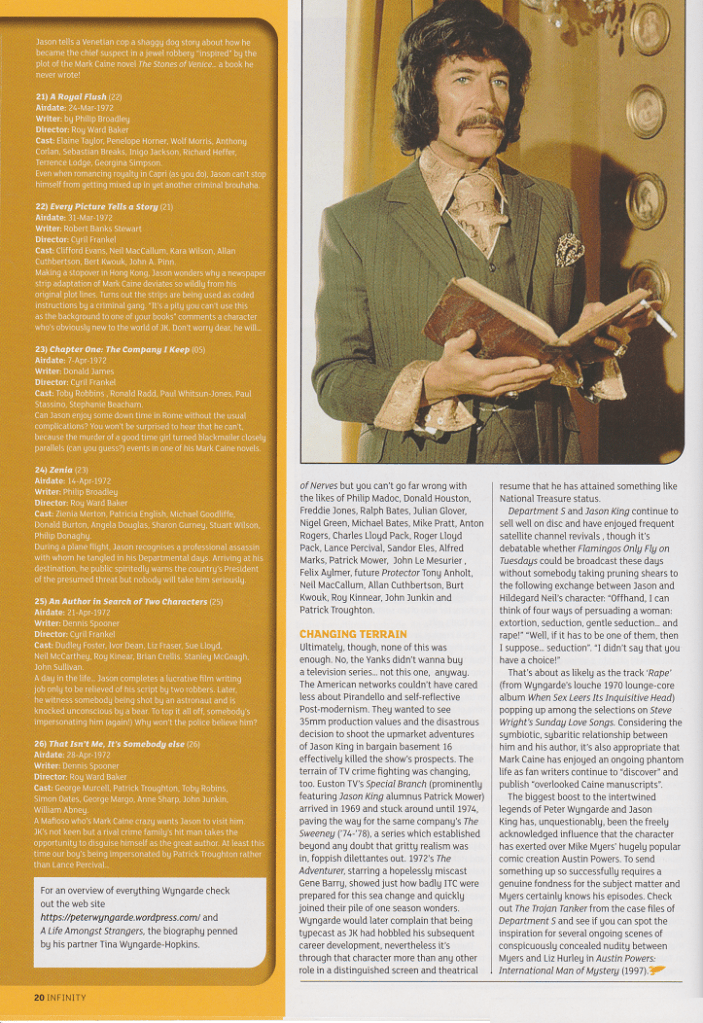


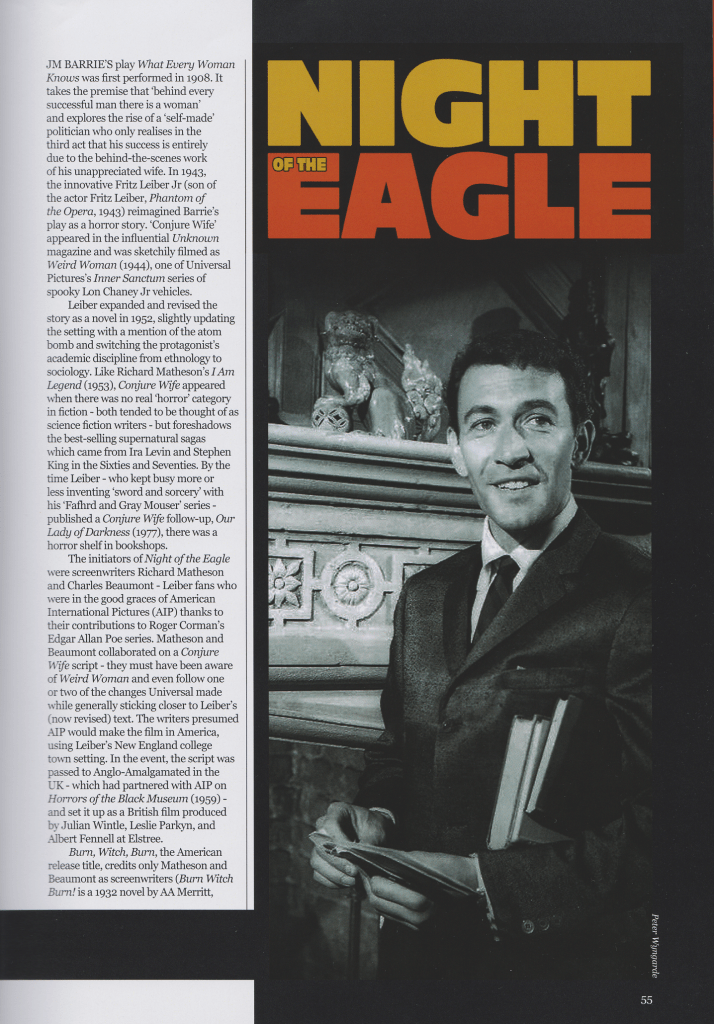
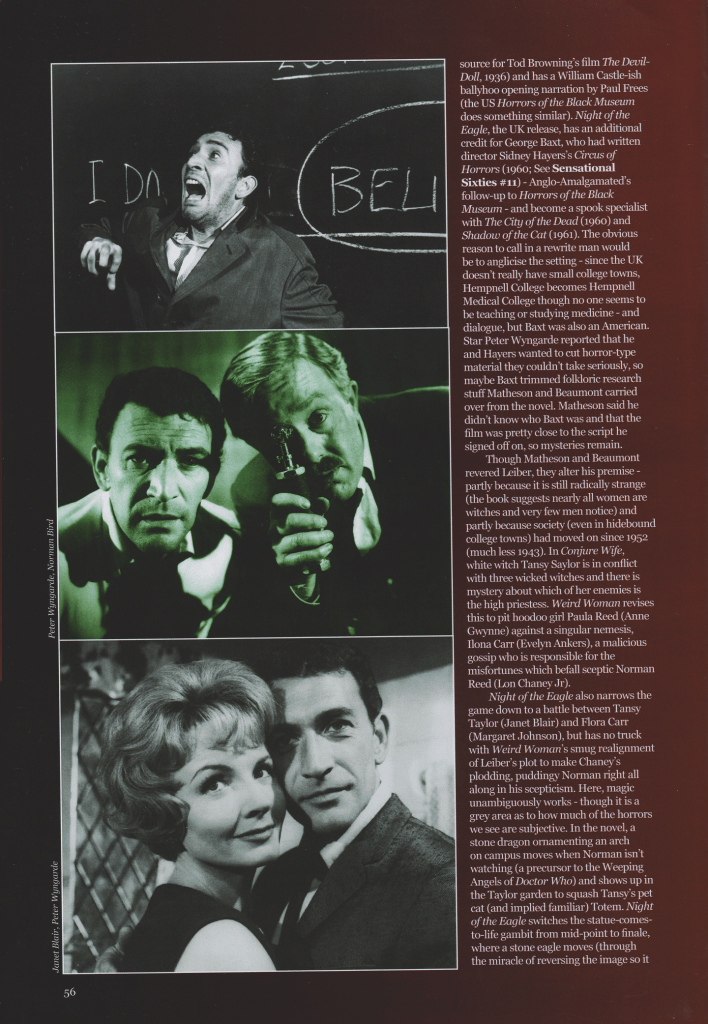
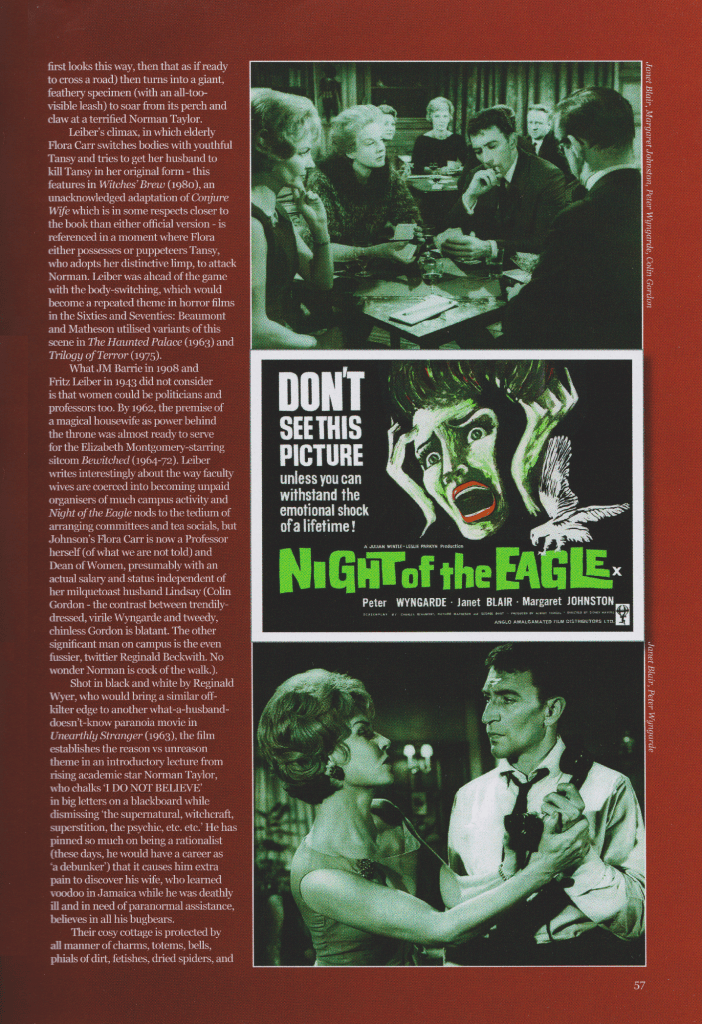
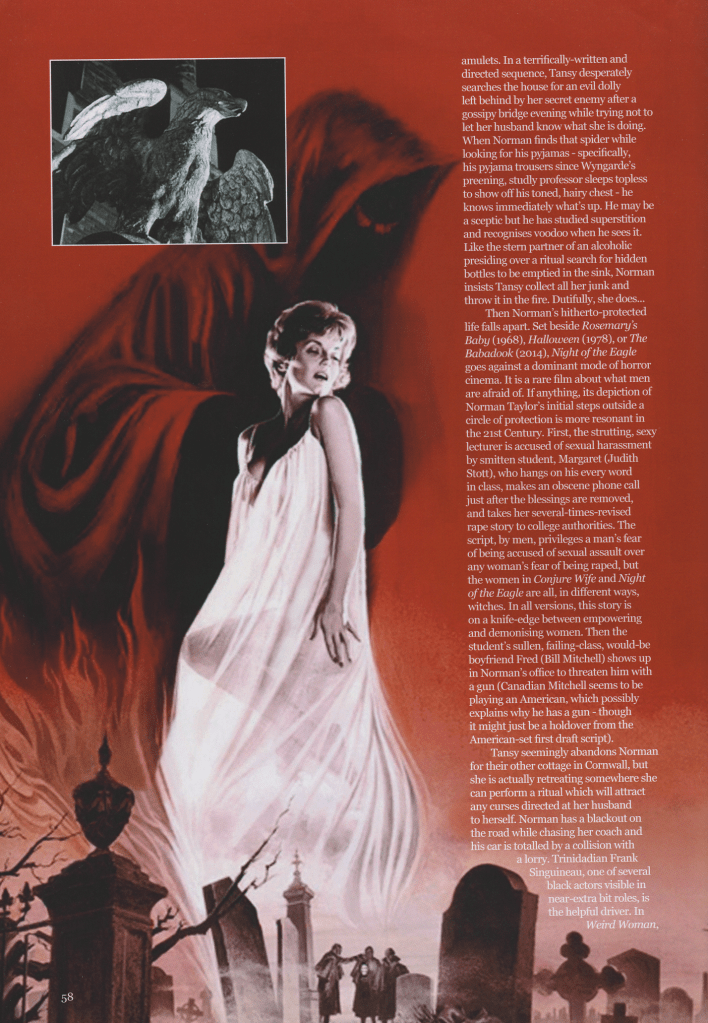
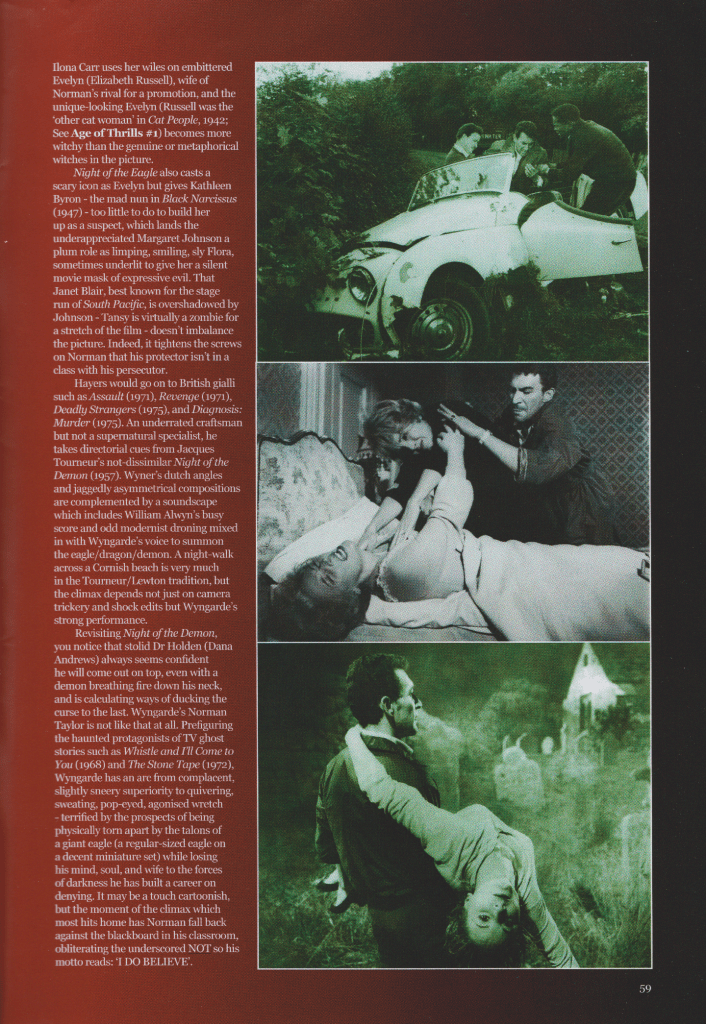
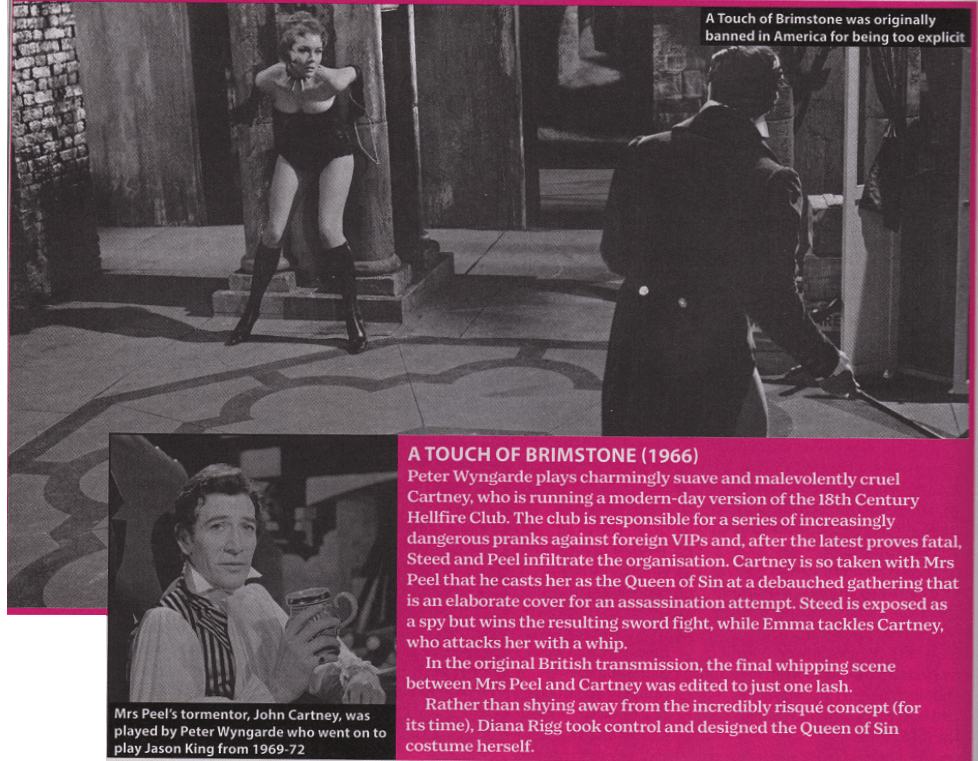
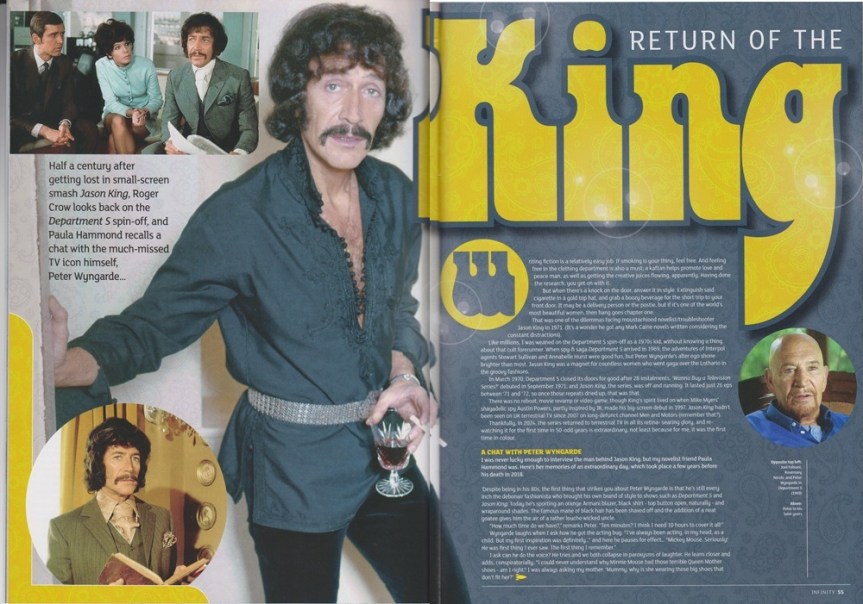
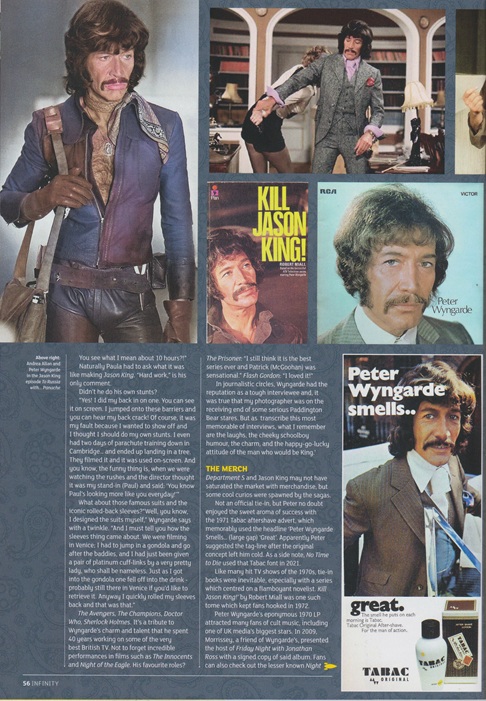
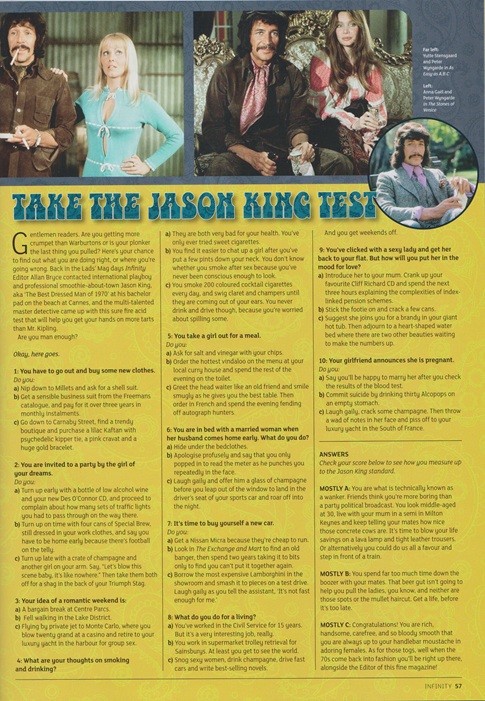
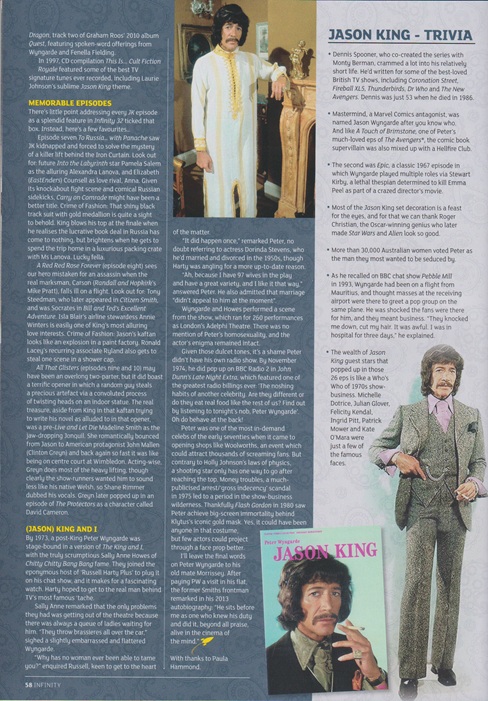
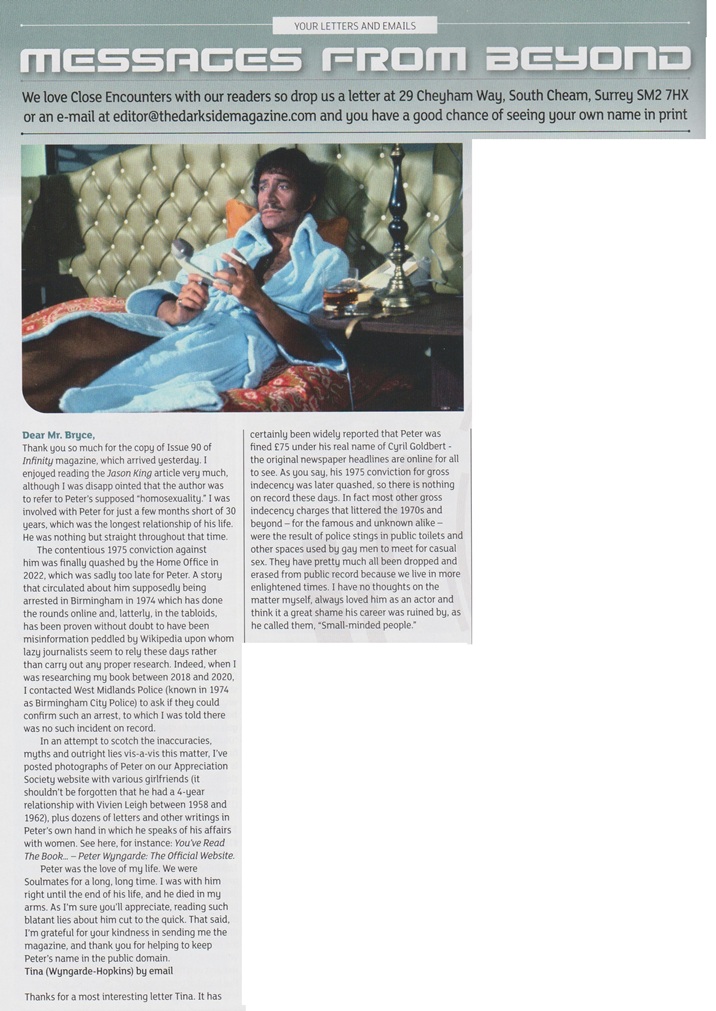

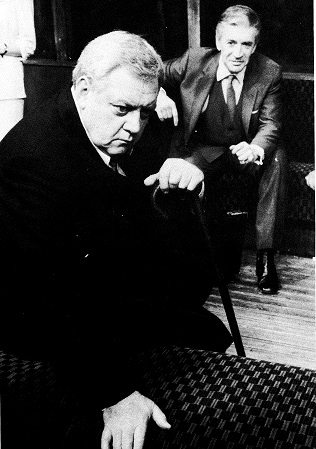
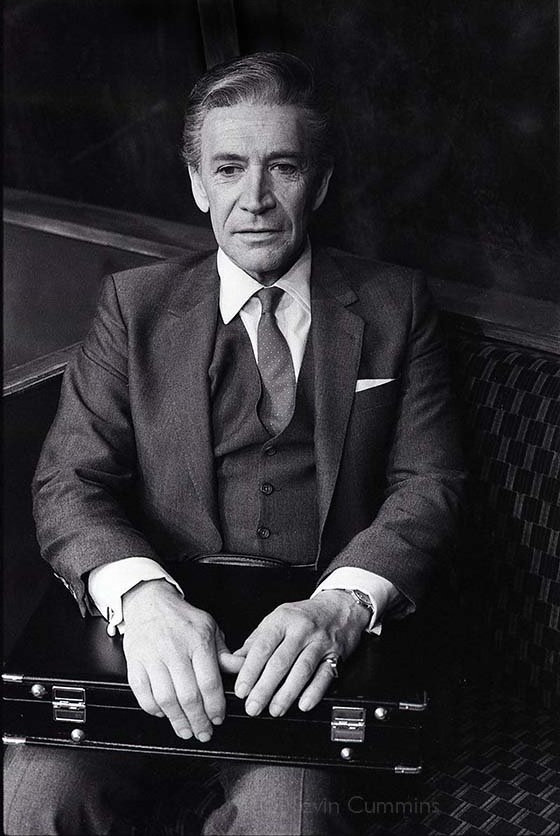
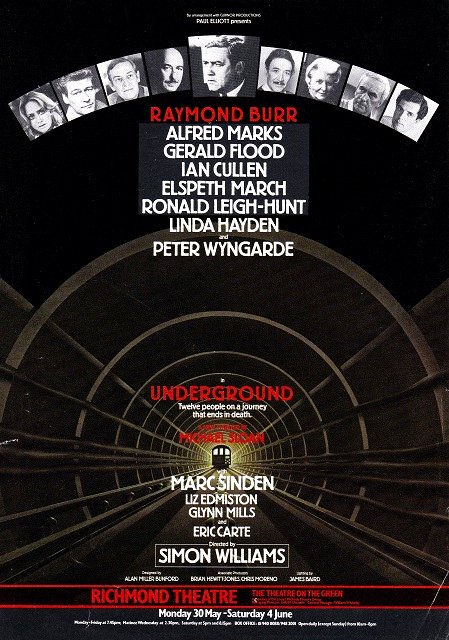
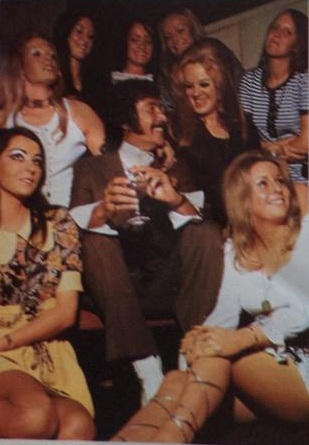
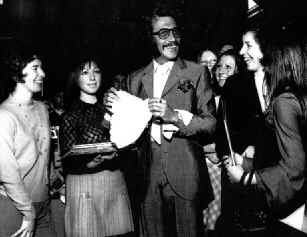
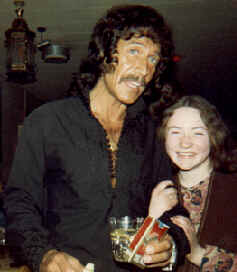
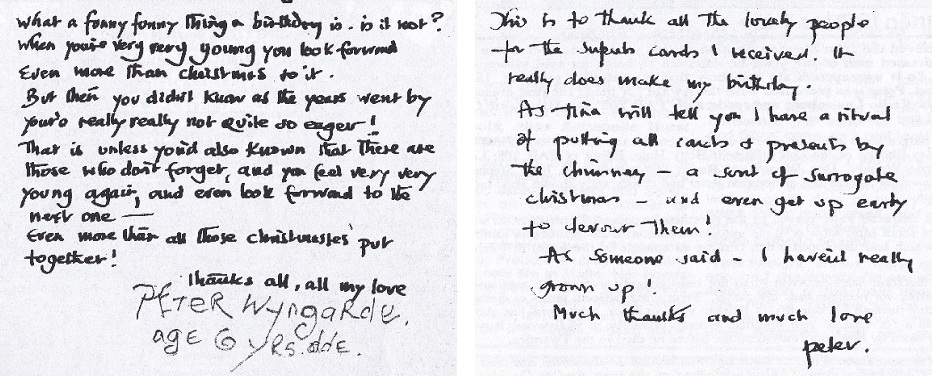
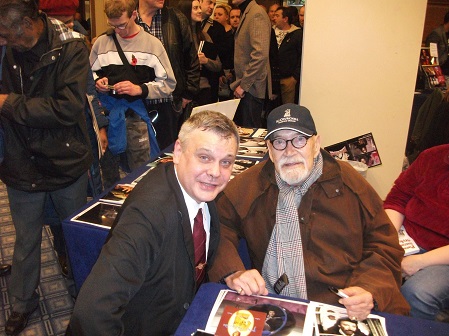
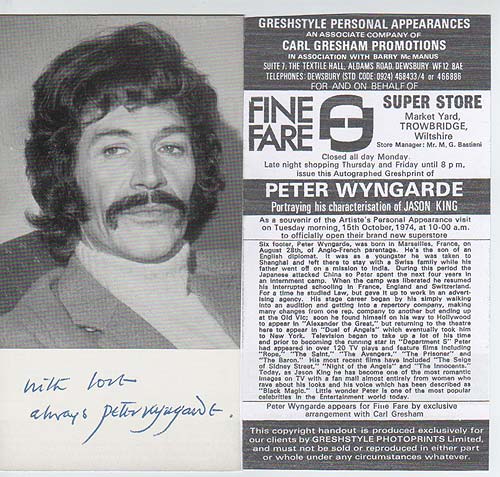
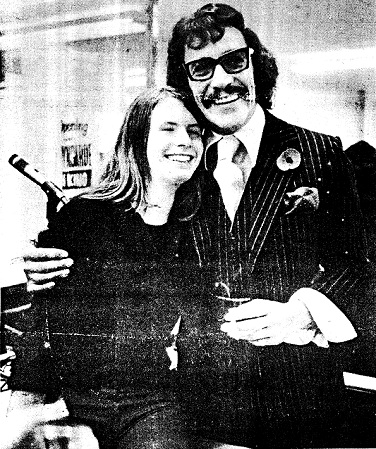


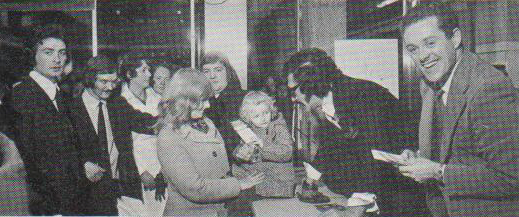
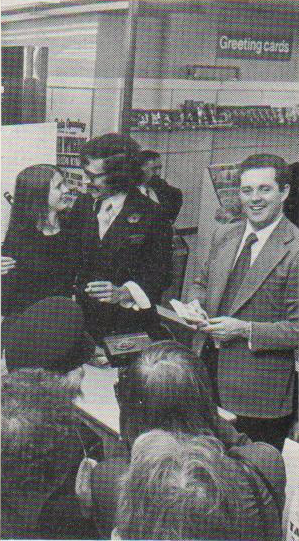
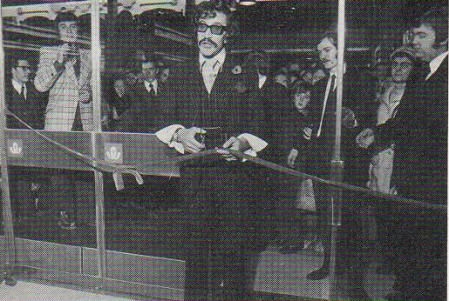




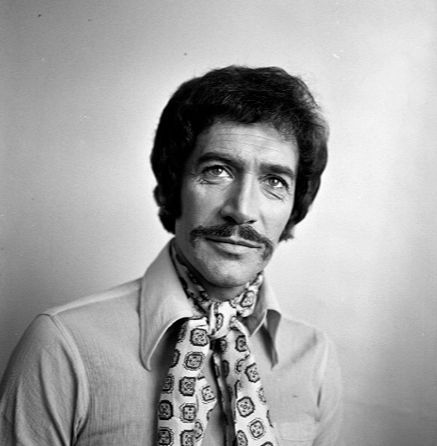
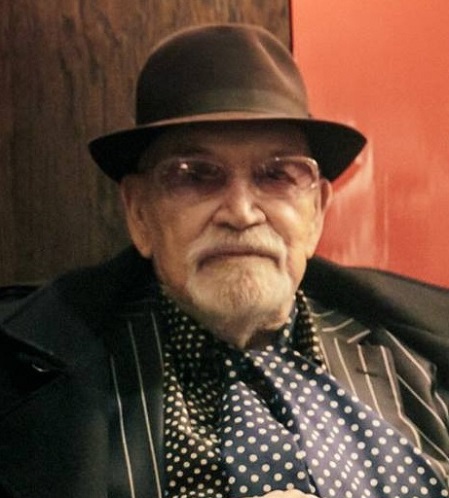
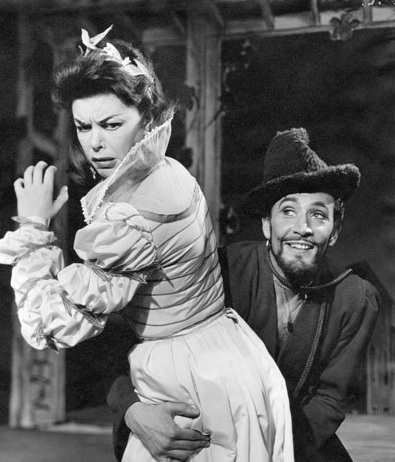

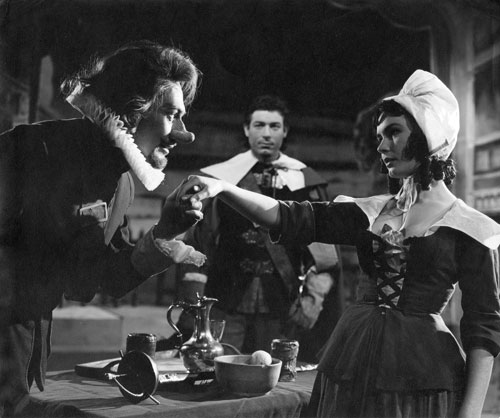


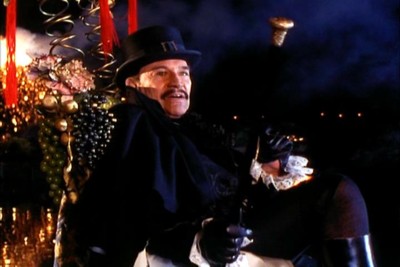


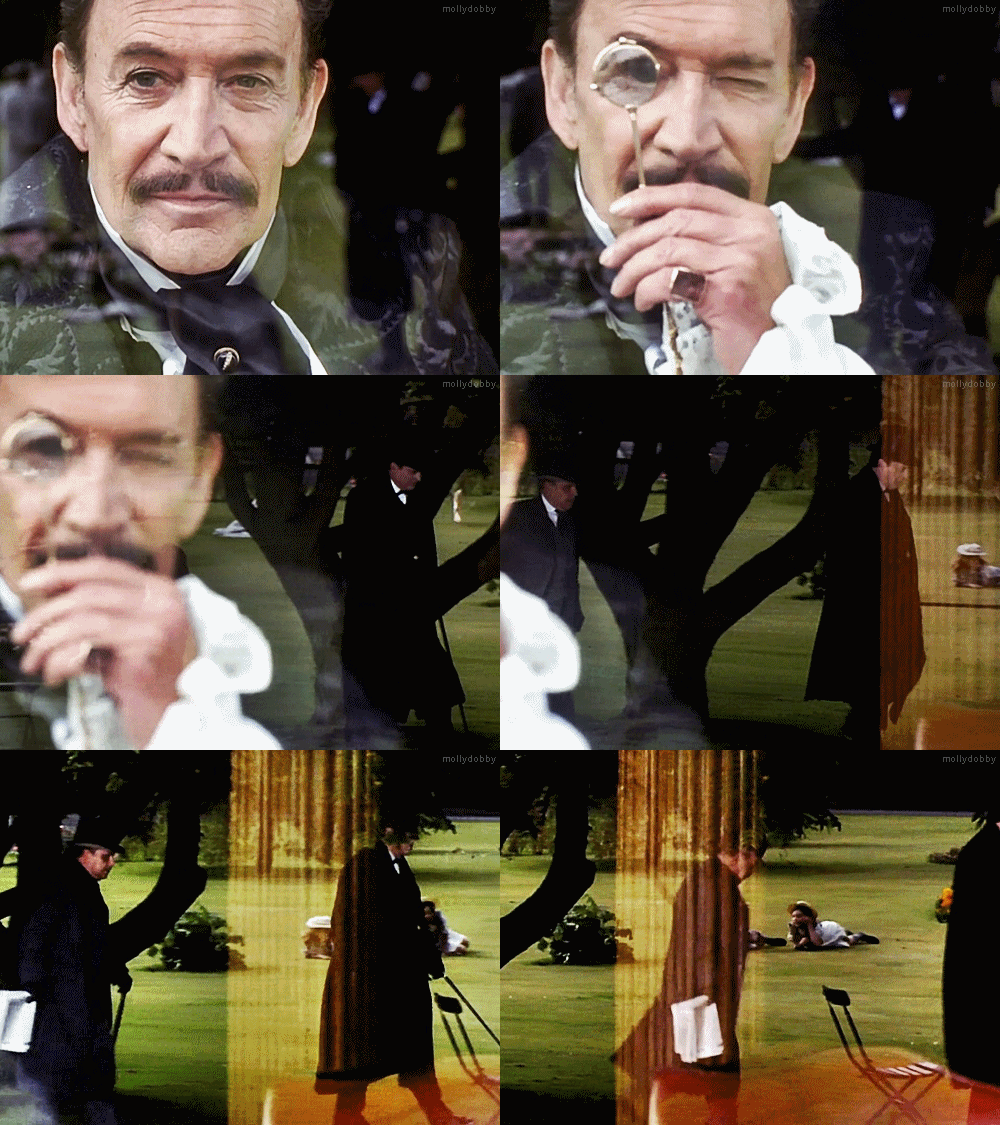
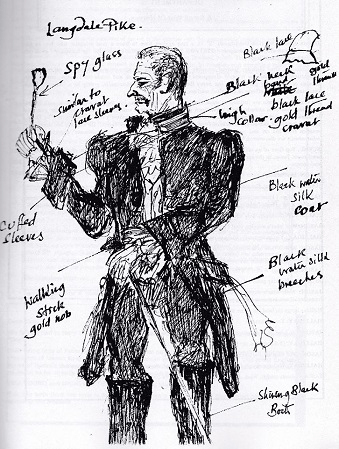
 PETER WYNGARDE: The Official Website