


Presented by Paul Elliot and Guvnor Productions
British Tour: February, 1983
The Royal Alexander Theatre, Toronto, Canada: March-May 1983
Prince of Wales Theatre, London: July-August, 1983
Character: Alexander Howard
‘Twelve people on a journey that ends in death’
The Play
Underground, written by Michael Sloane, is a gripping theatrical thriller that transforms a mundane modern experience into a nightmare scenario. Premiering in 1983 and later staged at London’s Prince of Wales Theatre, the play demonstrates how suspense can be generated through confinement and the unpredictable nature of human behaviour under pressure, rather than through elaborate spectacle.
The premise is deceptively simple: a London Underground train comes to an unexpected halt deep beneath the city. A group of passengers is trapped within the carriage; while initially irritated by the inconvenience, they gradually become alarmed as it becomes clear that rescue is not imminent. As the situation deteriorates, the air becomes stifling, tempers fray, and the passengers’ social facades begin to slip. Amidst power failures and growing panic, a murder is committed, forcing the passengers to realise they are trapped not only underground, but with a killer.
What distinguishes Underground from conventional thrillers is its setting. Sloane cleverly exploits a common commuter anxiety: the fear of being trapped beneath the earth with no means of escape. By taking the familiar discomfort of a train stopping in a tunnel and magnifying it into genuine terror, the playwright taps into a relatable, visceral fear.
The play’s primary strength is its claustrophobic atmosphere. The audience is placed in a position similar to that of the characters; with no possibility of escape, every scene unfolds within a limited environment. This creates a mounting sense of confinement as the drama progresses, making the walls of the carriage feel as though they are closing in on both the characters and the spectators.
Right: Raymond Burr and Peter during a performance at the Prince of Wales Theatre, London

Sloane skilfully ratchets up the tension. What begins as a mechanical failure steadily evolves into a psychological crisis. Minor irritations escalate into serious conflicts, and ordinary people, deprived of comfort and certainty, begin to reveal unexpected facets of their personalities.
The passengers represent a diverse cross-section of social classes and backgrounds, a dynamic that becomes increasingly significant as pressure mounts. While some attempt to remain rational, others succumb quickly to panic. Alliances shift and suspicions multiply; as in the best mystery dramas, every character becomes a potential suspect.
One of the most remarkable aspects of the play is its use of confinement to expose character. Under normal circumstances, these passengers would remain strangers, sharing a brief journey before disappearing into their separate lives. Forced into uncomfortable proximity, their fears, prejudices, and strengths are gradually revealed.
The murder serves as a critical turning point. Until that moment, the primary threat is the environment; once the killing occurs, the danger becomes intensely personal. The characters must contend with the knowledge that someone in the carriage is capable of murder, shifting the drama from a survival story into a psychological thriller.
The play also benefits from its pacing. Sloane understands that suspense depends on uncertainty, revealing information sparingly. Each clue raises new questions, and every revelation deepens the mystery. This encourages the audience to act as detectives, studying the passengers’ behaviour to identify the killer before the final disclosure.
While the plot is exciting, the play is at its best when examining human behaviour. The reactions feel believable because they arise from genuine psychological pressures. Sloane demonstrates how quickly civilization can unravel when people are frightened, showing that those who initially appear respectable may harbour flaws, while others prove far more resourceful than first impressions suggest.
The dialogue contributes significantly to the realism. Conversations feel spontaneous and natural, capturing the awkward tension that develops among strangers in a crisis. Occasional moments of humour provide brief relief, which in turn makes the darker developments more effective.
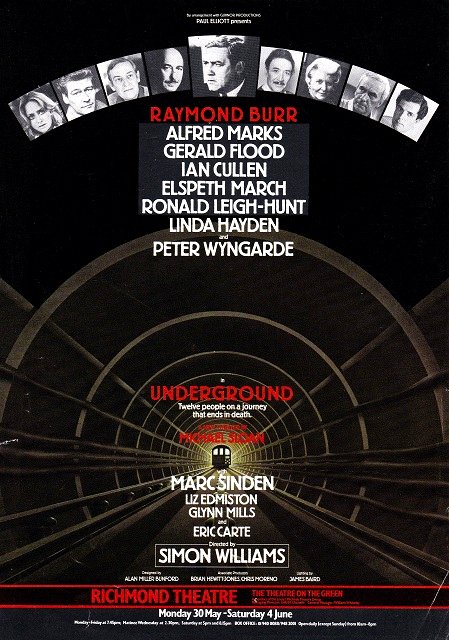
This original production featured an impressive cast alongside Peter as Alexander Howard, including Raymond Burr, Alfred Marks, Gerald Flood, and Elspeth March. Directed by Simon Williams, the production transferred to London’s West End following performances in Toronto and a British tour.
Viewed today, the play’s structure feels cinematic. The enclosed setting, rising body count, and ensemble cast resemble many thrillers that became popular in later decades. However, the theatrical setting enhances the suspense; the immediacy of live performance heightens every moment of tension.
If the play has a weakness, it may be that some character types reflect the conventions of 1980s thriller writing. Certain figures initially fit familiar stereotypes, though Sloane generally avoids predictability by giving his characters more depth than is initially apparent.
Ultimately, Underground succeeds because it taps into universal fears: confinement, isolation, and powerlessness. Most unsettling is the fear that an ordinary stranger may harbour deadly intentions. By combining these anxieties within an ingenious setting, Michael Sloane created a thriller that remains effective long after its original production.
More than four decades after its premiere, Underground remains a well-constructed and entertaining suspense drama. Its clever premise and exploration of human behaviour under extreme pressure ensure it continues to hold an audience’s attention. It proves that sometimes the most frightening place imaginable is not a haunted house or a remote mansion, but an ordinary train carriage from which there is no escape.
Focus On Alexander Howard
Alexander Howard is a pivotal figure in Underground, Michael Sloane’s suspenseful thriller set aboard a stranded London Underground train. While the play features an ensemble cast trapped in increasingly desperate circumstances, Alexander emerges as a particularly compelling character. In the original 1983 production at the Prince of Wales Theatre, the role was portrayed by Peter Wyngarde, whose commanding stage presence lent the character a significant sense of authority and mystery.

Defined by control and confidence, Alexander initially appears poised and self-assured, embodying the own demeanour of someone accustomed to social standing and authority. He serves as an effective foil to the other passengers, whose anxieties surface quickly as the train remains immobilised. This composure creates a sharp contrast with the panic and confusion that gradually permeate the carriage.
As the crisis intensifies, however, Alexander is drawn into the atmosphere of suspicion that defines the play. A primary strength of Underground is that the occurrence of a murder renders virtually every passenger a potential suspect. The audience is prompted to scrutinise each character’s motives and reactions; Alexander’s reserve makes him especially intriguing, as he rarely reveals his true thoughts.
The character contributes significantly to the play’s exploration of human behaviour under pressure. Sloane illustrates the rapid erosion of social conventions when individuals are confined in frightening environments, and Alexander’s reactions help underscore the escalating tension. The calm assurance he displays at the outset is steadily challenged by the precarious situation surrounding him.
Furthermore, Alexander benefits from a layer of ambiguity. Unlike many thrillers where roles are clearly defined as hero, victim, or villain, Underground maintains a more complex dynamic. Because the passengers are strangers to one another, every character remains a mystery. Alexander’s reserved nature enhances this uncertainty, sustaining the play’s suspense.
For the performer, the role presents a nuanced challenge: the actor must project enough authority to command the stage while maintaining the mystery essential to the thriller’s success. Too much transparency would weaken the tension, while too much distance might render the character unsympathetic. When executed successfully, Alexander Howard becomes one of the play’s most captivating figures.
Ultimately, Alexander Howard is an essential component of the carefully constructed suspense in Underground. Intelligent, composed, and enigmatic, he embodies the uncertainty at the heart of the drama. Through characters like Alexander, Michael Sloane creates a world where appearances are deceptive, tensions are constant, and every passenger may have something to hide.
Original Poster
A Bit Of Trivia
| During one performance of the play at the Birmingham Hippodrome, Ronald Leigh-Hunt’s wig accidently caught fire, but Peter and Alfred Marks were of little use, as all the pair could do was fall about laughing! In Toronto, Raymond Burr, tripped while in rehearsals and broke his leg! |


2 thoughts on “REVIEW: Underground”