

Broadcast: Thursday 31st October, 1957
Character Jerome Taillard
Some Background
Ordeal By Fire is based on a drama written in French (‘L’Epreuve du feu’) by Herman Closson and translated into English by E.J. King Bull.
The production garnered attention due to the involvement of its director, Rudolph Cartier. As one of the BBC’s most esteemed producers and directors, Cartier had been responsible for several prestigious television dramas throughout the 1950s. His participation indicates that Ordeal by Fire was viewed as a significant undertaking rather than a routine studio presentation.
Regrettably, as was common with many BBC productions of the 1950s, Ordeal by Fire appears to be missing from the archives, and there is no known commercial release. Consequently, modern assessments must rely upon cast records, television listings, and contemporary references rather than extant recordings.
It remains certain that Ordeal by Fire was a prestigious historical television drama directed by Rudolph Cartier, featuring a notable ensemble cast and providing Peter Wyngarde with one of his first substantial television roles as Jerome Taillard.
The cast also included Beatrice Campbell as Martine, André van Gyseghem as the Marquis de Saint-Avare, John Longden as De La Fayette and Ronald Radd as Robechon.
The Story
Hermann Closson’s BBC play presents intriguing dramatic possibilities, particularly regarding the difficulty people have in accepting the mortality of their idols, especially when their deaths are reported under unusual circumstances. Is it conceivable that Joan of Arc could have escaped from the stake at the last moment, or that another gloriously patriotic figure might have taken her place?
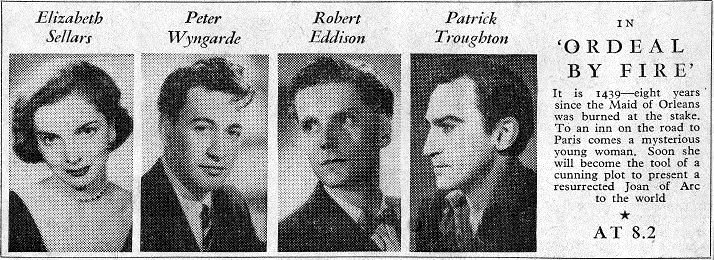
There is always a chance for a deeply romantic twist, and in the span of eight years (the play is set in 1439), anything could have transpired. Unscrupulous conspirators might exploit a superficial resemblance in a daring attempt to advance their political objectives. Viewers may find themselves engaged by Elizabeth Sellers’ imaginative portrayal of the counterfeit, who gradually comes to understand the genius and spirit of the original, particularly in her scenes with La Hire (Patrick Troughton) and the former Dauphin, now Charles VII, as interpreted by Robert Edison with poignant pathos.
Peter, portraying the cynical young scholar, Jerome Taillard and André van Gyseghem as the Marquis de Saint-Avare, as the flamboyant fop, both delivered performances marked by intelligence and insight.
However, after an hour and a half, listeners may have become overly aware of the melodramatic mechanisms inherent in the concept itself, rather than being swept away by its novelty, which should have conveyed a sense of urgency. Nevertheless, Rudolph Cartier effectively captured the ambivalence and wonder of those who had once known the Maid of Orléans.
After Thoughts
There was a lingering uncertainty regarding the notion that seeing equates to believing in Hermann Closson’s ordeal by fire. Many individuals may recall it vividly from the radio adaptation of the play. This perception clashed with established beliefs. Alternatively, it is possible that the play does not lend itself to a second viewing after one has encountered its peculiar paralyzing effect. The prologue, in which an adventuress is convinced, eight years post Joan of Arc’s demise, to impersonate a maid who has returned, was sufficiently sharp and enthusiastic. However, unexpectedly, the narrative became somewhat disjointed during the court scenes where the imposter faced both Charles and La Heir, and her own conscience should have created a thrilling dynamic. Unfortunately, this did not occur, despite E. J. King and Rudolph Cartier’s production providing ample opportunity for it.
Critics Comments
| “I was grateful for the acting of Peter Wyngarde, Robert Eddington, and William Fox for me Elizabeth Sellers was too clipped, too pinched of speech.” The Listener – 7th November, 1957 |

Crossed Wires
According to the Internet Movie Database (IMDb), this 1957 BBC production of ‘Ordeal By Fire’ has been mistaken for for a 1960’s American documentary of the same name, which about wildfires in the United States. Although the cast of the play are listed correctly, the cover photograph and synopsis are wholly related to the aforementioned documentary.
As might be expected, numerous other film and TV-related websites, including BC Originals, letterboxd.com, Plex, The Movie Database (TMDB), Kinorium, Reelgood etc. have copied this information..


