

Broadcast: Tuesday 10th January, 1956
Character: Prince Prince Amerigo
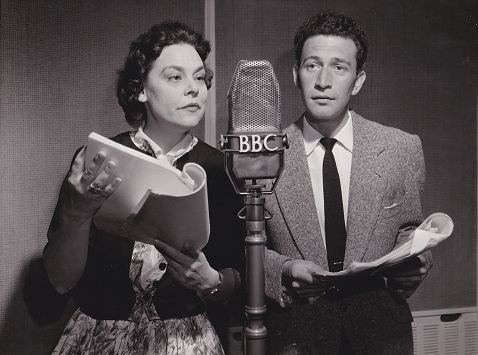
Above: Peter as the Prince and Irene Worth as Charlotte Stant reading ‘The Golden Bowl’ – adapted from Henry James’ novel, and recorded for transmission in the BBC’s Third Programme on October 2nd, 1955.
Adapted from Henry James’s celebrated 1904 novel, The Golden Bowl is a richly textured drama exploring the complexities of love, marriage, loyalty, and deception. The narrative centres upon two intertwined marriages: that of the affluent American heiress Maggie Verver (Clare Austin) and the impoverished Italian aristocrat Prince Amerigo (Peter Wyngarde), and that of Maggie’s father, Adam Verver (MacDonald Parke), to Charlotte Stant. Beneath the surface of these seemingly ideal unions lies a web of concealed passions and emotional betrayals that gradually undermine the stability of all involved.
The distinction of The Golden Bowl as a remarkable piece of drama lies in its emphasis on psychological conflict rather than overt action. Much of the tension is derived from the unspoken; characters engage in polite social navigation while concealing desires, suspicions, and disappointments. The result is a play of extraordinary subtlety, wherein every conversation carries hidden meanings and every gesture hints at deeper emotional currents.
At the centre of the drama stands Prince Amerigo, arguably the most complex character in the work. An impoverished Italian nobleman, he marries Maggie Verver despite a prior romantic involvement with Charlotte Stant (Irene Worth). His decision is influenced in part by financial necessity, as his aristocratic title has outlasted the wealth traditionally associated with it.
The Prince is a superbly ambiguous creation. Rather than a conventional villain, he is neither cruel nor deliberately malicious; instead, he is a flawed man torn between passion, ambition, and obligation. His tragedy stems from the fact that he recognises his own weaknesses yet lacks the resolve to overcome them. While he genuinely values Maggie and the kindness she offers, he remains emotionally drawn to Charlotte. This internal conflict provides the character with extraordinary depth.
Furthermore, the Prince’s intelligence is a defining trait. He navigates the social sphere with sophistication and grace, possessing the charm expected of a European aristocrat. Throughout the play, he demonstrates wit, refinement, and an acute awareness of the delicate social balances that govern society. However, these qualities also serve as instruments of self-deception; his ability to rationalise his actions prevents him from confronting the moral consequences of his choices.
The symbolic significance of the Prince is also central to the drama. Critics have frequently noted the parallel between Prince Amerigo and the cracked golden bowl. The bowl appears flawless at first glance, yet contains a hidden defect. Similarly, the Prince projects elegance and nobility while concealing a fundamental weakness. This metaphor is one of James’s most powerful dramatic devices, suggesting that even the most beautiful relationships may harbour unseen fractures.
As the drama unfolds, the Prince becomes increasingly compelling due to his state of perpetual tension. He is caught between two women, two moral obligations, and two versions of himself: the public Prince – noble, courteous, and devoted—and the private Prince – restless, yearning, and unable to extinguish old passions. The conflict between these identities fuels the entire narrative.
His relationship with Maggie is particularly intriguing. Initially, Maggie views him as an idealised romantic figure. However, as she becomes aware of his imperfections, the balance of power shifts. The Prince, who once seemed to possess control and confidence, finds himself increasingly vulnerable. This reversal constitutes one of the most satisfying elements of the play and demonstrates James’s mastery of character development.
The scenes involving Charlotte are equally powerful. Their shared history imbues every encounter with an emotional intensity that contrasts sharply with the restraint of the surrounding society. The audience senses that neither has completely escaped their past feelings; however, those feelings exist within a framework of guilt and danger, ensuring that every meeting contributes to an inevitable sense of tragedy.
For an actor, the role of Prince Amerigo presents a magnificent challenge. The character requires charm without arrogance, sophistication without coldness, and moral weakness without outright villainy. A successful performance must reveal the Prince’s humanity even while exposing his failings. When this balance is achieved, Amerigo becomes one of the most memorable figures in modern drama.
Ultimately, The Golden Bowl succeeds by transforming a simple tale of adultery into a profound examination of human relationships. The play poses difficult questions regarding love, loyalty, and self-interest, while refusing to offer easy answers. At its heart stands Prince Amerigo, a character of immense subtlety and contradiction: attractive yet flawed, sympathetic yet exasperating, and noble in title, if not always in conduct.
Upon the conclusion of the narrative, it is the Prince who remains most prominent in the reader’s memory. His internal conflict between desire and duty, and between honesty and concealment, provides The Golden Bowl with much of its emotional depth. As a dramatic construct, Prince Amerigo stands as one of Henry James’s most accomplished achievements: a figure whose outward brilliance fails to fully obscure an underlying fracture.


