

1964 Cyrano De Bergerac
- Listening Length: 2 hours and 30 minutes
- Program Type: Audiobook
- Version: Unabridged
- Publisher: Caedmon
- Language: English
- Number of Discs: 3
Peter played the part of the Comte De Guiche
Cast: Ralph Richardson, Anna Massey, John Fraser, Ronald Fraser and Michael Gwynn.

Track list:
Disc 1:
1. Act 1: A Performance at the Hôtel de Bourgogne
2. Act 2: The Bakery Of The Poets
Disc 2:
1. Act 3: Roxane’s Kiss (Beginning)
2. Act 3: Roxane’s Kiss (Concluded)
3. Act 4: The Cadets Of Gascoyne (Beginning)
Disc 3:
1. Act 4: The Cadets Of Gascoyne (Concluded)
2. Act 5: Cyrano’s The release came with a portfolio, which includes notes on and photos of several notable productions of the play and the entire script of the play.
Among the various distinguished recordings released by Caedmon Records during the 1960s, Cyrano de Bergerac serves as a particularly exemplary illustration of the label’s commitment to disseminating classic literature and drama to a broader audience. Based upon Edmond Rostand’s celebrated verse drama, this 1964 production captures the romance, wit, heroism, and melancholy that have established the play as one of the most beloved works in global theatre. While the recording naturally lacks the visual splendour of a stage performance, it compensates through compelling vocal interpretations and a rigorous emphasis on the beauty of Rostand’s language. For enthusiasts of classic theatrical recordings, it remains a fascinating and highly rewarding listening experience.
The narrative centres upon Cyrano, a brilliant soldier, poet, and duellist whose extraordinary talents are overshadowed, in his own estimation, by his prominent nose. Secretly enamoured with his cousin Roxane, he believes himself too physically unattractive to merit her affection. Consequently, he lends his eloquence to the handsome but inarticulate Christian, assisting him in wooing Roxane through letters and speeches of breath-taking poetic beauty. The play’s synthesis of comedy, romance, and tragedy remains as potent in audio form as it is on stage, and the Caedmon adaptation succeeds in preserving the emotional depth of Rostand’s masterpiece.
A significant merit of the recording is the calibre of the supporting cast, among whom Peter Wyngarde makes a memorable impression as the Comte de Guiche. Although de Guiche is not the central protagonist, he is nonetheless a pivotal figure. Ambitious, intelligent, and accustomed to exercising his will, he represents both a romantic rival and a political obstacle. While it would have been simple to portray the Count as a conventional antagonist, Peter imbues the role with considerable complexity.
Even at this stage of his career, Peter possessed one of the most distinctive voices in British acting. Rich, cultivated, and immensely expressive, it was ideally suited to recorded drama. Absent the benefit of facial expression or physical presence, he conveys de Guiche’s authority solely through vocal nuance. His delivery is measured and controlled, reflecting the confidence of a man accustomed to command; yet, beneath this aristocratic refinement lies an undercurrent of frustration and wounded pride that Peter reveals with great skill.
Particularly impressive is the manner in which Peter avoids reducing de Guiche to a mere antagonist. He recognizes that the Count is, in many respects, a prisoner of his own passions. His desire for Roxane is genuine, even if his methods are often manipulative. The performance reveals a man whose power cannot secure the one thing he truly desires. There is an unmistakable sadness beneath the character’s arrogance, which Peter interprets perfectly. As a result, de Guiche emerges not as a caricature, but as a recognisably human figure – flawed yet sympathetic.
Listeners familiar with Peter’s later portrayals of sophisticated and charismatic characters, most notably Jason King, may recognize the qualities that would eventually make him such a popular screen presence. His natural elegance, immaculate diction, and commanding vocal authority are all evident here. Furthermore, there is a restraint to the performance that demonstrates his versatility; rather than dominating the production, he serves the ensemble and contributes to the overall dramatic balance.
The audio format further highlights an aspect of Peter’s talent that was occasionally overshadowed by his striking physical appearance. Throughout his career, critics frequently praised the musical quality of his voice and his ability to communicate character through speech alone. In Cyrano de Bergerac, listeners can appreciate these gifts in their purest form. Every line is carefully judged, and every emotional shift is subtly conveyed. The result is a performance that rewards close listening and demonstrates why Peter was so highly regarded in theatre and radio, as well as in television and film.
Beyond Peter’s contribution, the production succeeds because it respects the intelligence of its audience. Rather than radically abridging or simplifying Rostand’s text, it preserves much of the play’s verbal richness. The language remains glorious, retaining the humour, poetry, and emotional resonance that have endured for over a century. The performers approach the material with sincerity and conviction, allowing the listener’s imagination to construct the world of seventeenth-century France.
Indeed, there is something uniquely effective about experiencing Cyrano de Bergerac through sound alone. The absence of visual spectacle places a greater emphasis on the text and the performances. Rostand’s poetry becomes the primary attraction, and the listener is invited to enter directly into the emotional lives of the characters. The Caedmon recording demonstrates the power of audio drama when entrusted to skilled actors and strong source material.
The recording currently holds significant historical value, as it preserves the artistry of a generation of classically trained performers distinguished by their exemplary command of language. For fans of Peter Wyngarde, it provides a compelling insight into an actor in the process of refining the qualities that would subsequently garner him international acclaim. His portrayal of de Guiche is intelligent, nuanced, and impeccably delivered, further demonstrating the versatility and sophistication that defined his finest work.
In conclusion, Caedmon’s 1964 recording of Cyrano de Bergerac remains a profoundly rewarding adaptation of Rostand’s classic play. Characterized by its poetic richness, atmosphere, and emotional resonance, the production captures the essence of the original text while utilizing the inherent intimacy of the audio medium. Peter’s depiction of the Comte de Guiche is one of the recording’s primary strengths, showcasing a performer capable of imparting depth, humanity, and authority to a complex supporting role. For those appreciative of classic drama, vintage spoken-word recordings, or the work of Peter, this enduring production merits rediscovery.
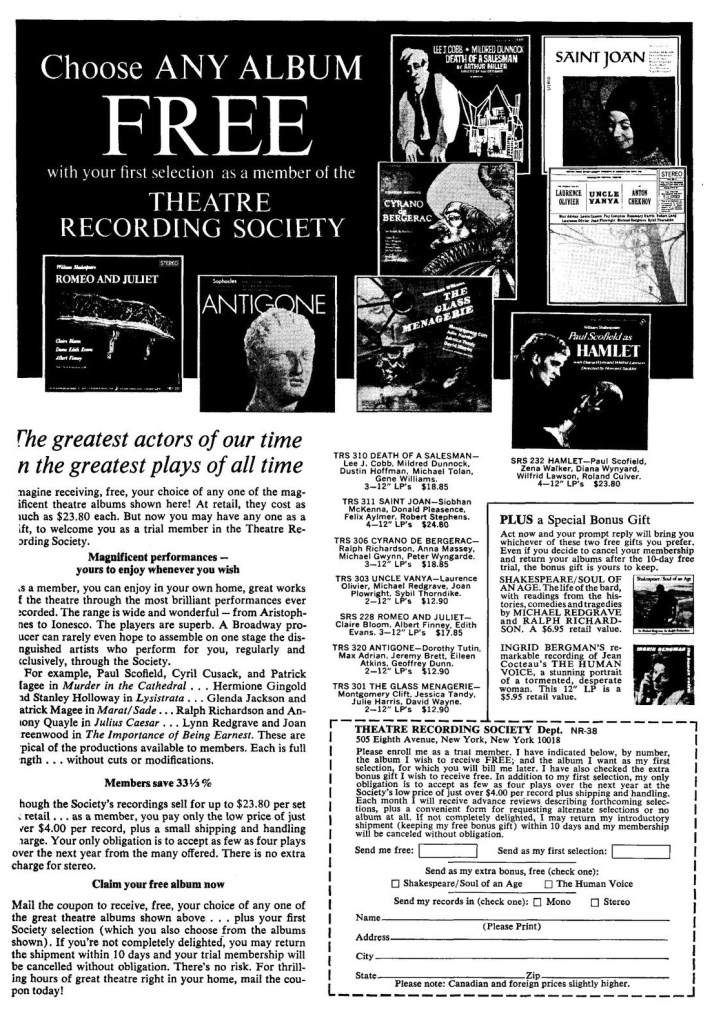
Above: Contemporary mail order advertisement from The National Review
| Note: Peter’s name in the sleeve notes is misspelt as, Peter Wyngard. |
1965 The Two Gentlemen of Verona

- Listening Length: 1 hour and 55 minutes
- Program Type: Audiobook
- Version: Unabridged
- Publisher: Caedmon – 1965
- Language: English
- Number of Discs: 3
- Catalogue Number: SRS-202-M
- Shakespeare Recording Number: SRS-202-(3)
Peter played Valentine in this production.
Cast: Edward De Souza, Joanna Dunham and John Laurie.
Tracklist:
Disc 1:
1. Act 1, Scenes 1, 2, 3
2. Act II, Scenes 1, 2, 3, 4
Disc 2:
1. Act II, Scenes, 5, 6, 7
2. Act III, Scene 1
3. Act III, Scenes 1 (Cont’d), 2
4. Act IV, Scenes 1, 2
Disc 3:
1. Act IV, Scenes 3, 4
2. Act V, Scenes 1, 2, 3, 4
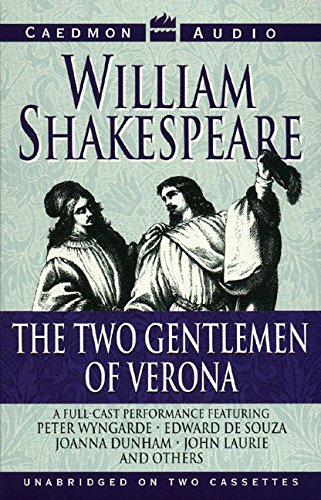
Above right: Cassette edition (unabridged). Released by HarperCollins on 22 April, 1995
Amidst the numerous Shakespearean recordings released over the decades, both the original vinyl release by Caedmon, and the later HarperCollins’ audio cassette presentation of The Two Gentlemen of Verona offers listeners the opportunity to rediscover one of the Bard’s earliest and most charming comedies through the artistry of a distinguished cast. Of particular interest to admirers of Peter Wyngarde is his portrayal of Valentine, the play’s romantic hero and moral centre. The recording serves as a reminder that long before he achieved enduring fame as Jason King, Peter had already demonstrated a remarkable affinity for classical drama and verse-speaking.
The Two Gentlemen of Verona occupies a fascinating place within Shakespeare’s canon. It contains many themes that would later reappear in the playwright’s more substantial works: friendship, love, betrayal, mistaken identity, loyalty, and forgiveness. At its core are two young gentlemen, Valentine and Proteus, whose friendship is tested when both become entangled in romantic complications. Valentine travels to Milan, where he falls deeply in love with Silvia; Proteus eventually follows, and despite his devotion to Julia, becomes infatuated with Silvia himself. What follows is a blend of romance, comedy, and emotional conflict that showcases Shakespeare’s developing dramatic gifts.
In the role of Valentine, Peter brings warmth, intelligence, and youthful idealism to the character. Although Valentine is often overshadowed in critical discussions by the more complex and flawed Proteus, he remains a crucial figure. His sincerity and generosity provide the ethical foundation upon which much of the drama rests. Peter clearly understands this dynamic, avoiding the temptation to render Valentine as merely noble or virtuous. Instead, he presents a genuinely human character whose optimism and emotional openness make him both appealing and believable.
One of the most striking aspects of Peter’s performance is his effortless command of Shakespearean language. His voice, possessing the rich texture and precision that would later become familiar to television audiences, appears ideally suited to verse. Every line is articulated with clarity, yet the delivery is neither forced nor academic. He treats Shakespeare’s words as a living language rather than a literary recitation, allowing the underlying emotions to emerge naturally.
This capability is particularly evident in Valentine’s romantic scenes with Silvia. Peter captures both the excitement and vulnerability of a young man experiencing profound love. His performance conveys genuine tenderness without descending into sentimentality. There is a freshness and sincerity to his portrayal that renders Valentine’s devotion entirely convincing, helping the listener understand why Silvia reciprocates his affection so completely.
The audio format places a particular emphasis on vocal performance, and Peter rises magnificently to the challenge. Stripped of costumes, scenery, and physical gesture, he must create the character solely through voice. His interpretation demonstrates the skills that had earned him considerable acclaim on stage long before his television success. Through subtle changes in tone, pacing, and emphasis, he paints a vivid portrait of a man whose idealism is tested but never destroyed.
Listeners familiar with Peter’s later screen roles may be surprised by the relative simplicity and earnestness of Valentine. There is little trace here of the flamboyance, irony, or larger-than-life charisma that would define Jason King. Instead, we hear an actor committed to serving Shakespeare’s text and exploring the emotional truth of a fundamentally decent young man. The performance reveals another dimension of Peter’s talent, demonstrating both his versatility and his classical foundations.
The supporting cast contributes significantly to the success of the recording, delivering a spirited and engaging interpretation of Shakespeare’s comedy. The interplay between Valentine, Proteus, Julia, and Silvia constitutes the emotional core of the drama, while the comic sequences provide an effective contrast. Throughout the production, a judicious balance is maintained between humour and sincerity, allowing Shakespeare’s wit to flourish without diminishing the play’s emotional gravity.
This recording is particularly noteworthy for its preservation of a Shakespearean performance style that integrates technical precision with emotional accessibility. The actors exhibit a profound respect for the language, ensuring it never becomes a barrier between the characters and the audience. In this regard, Peter’s portrayal of Valentine serves as an exemplary model of classical acting; his performance is elegant without being mannered, and expressive without becoming excessive.
For Peter’s fans around the world, the recording provides compelling evidence of the attributes long praised by theatre critics. His vocal authority, linguistic sensitivity, and ability to convey complex emotions through a seemingly effortless technique are all prominently displayed. It is evident why he was so highly esteemed within classical theatre circles and why directors consistently entrusted him with demanding literary roles.
Ultimately, Caedmon and HarperCollins’ The Two Gentlemen of Verona serves as both an enjoyable Shakespearean recording and a significant showcase of Peter’s talent. His Valentine is noble yet engaging, romantic without being sentimental, and heroic while remaining fundamentally human. The performance serves as a reminder that, beneath the charisma and glamour that later established him as a television icon, lay a gifted classical actor with a profound understanding of language and character. For those interested in Shakespeare, audio drama, or the remarkable career of Peter Wyngarde, this recording remains a rewarding and illuminating listen.
Comments
| Wyngarde’s performance as Valentine highlights his command of Shakespearean language and stage presence, reflecting his broader theatrical career, which included roles such as Osric in Hamlet and Petruchio in The Taming of the Shrew. This 1965 recording is notable for Peter Wyngarde’s performance, but also as a collectable item for fans of classic theatre and vintage recordings. It remains a valuable example of mid-20th-Century Shakespearian audio productions, preserving the youthful energy and lyricism of Shakespeare’s early work. |


