


Produced by Robert Maugham at the Yvonne Arnaud Theatre, Guilford. September-October, 1966
Character: Hugo Barrett
The story is set in Chelsea, London. Present day.
The Story
Tony Williams (Barry Justice), a prosperous resident of London, claims to be involved in a project aimed at constructing cities in Brazil. He moves into his newly acquired townhouse in Chelsea and employs Hugo Barrett (Peter Wyngarde) as his manservant. Although Tony possesses wealth, he lacks resolve, discipline, and a true understanding of his own life, a fact that Barrett perceives within moments of their introduction.
Barrett seems to adapt effortlessly to his new role, and a subtle bond forms between him and Tony, while they maintain their respective social positions. However, the dynamics begin to change when Tony’s girlfriend, Sally Grant (Jennifer Daniel), meets Barrett, who she dislikes immediately..She grows suspicious of him and urges her fiancé to terminate Barrett’s employment, but he declines. This causes tension between the couple, and while they argue and their relationship begins to fall apart, Barrett is always in the background.I
In the meantime, Barrett organizes the household with a level of efficiency that flatters Tony, simultaneously fostering his dependence on Barrett.
Barrett presents Vera to the household as his sister, persuading Tony that a maid is necessary to help with housework. Tony accepts this explanation that they are siblings without question. Vera, being young and alluring, quickly initiates a calculated seduction of Tony. When the couple return from a foreign holiday unexpectedly and find Barret and Vera in bed together, Tony furiously dismisses the pair of them – but not before Vera makes known that she has been sleeping with Tony behind Sally’s back. Sally reacts by breaking of her engagement to Tony and leaves.
By this stage, Tony has grown dependent on both Barrett and Vera. He starts to drink excessively, a habit worsened by Sally’s refusal to take his calls. One day, Tony runs into Barrett at a pub, where Barrett weaves a story about Vera having deceived them both. He implores Tony to reinstate him as his manservant, and Tony agrees.
Once back in his old position, Barrett starts to drink openly and to introduces unsavory characters into the home. He speaks to Tony with a casual disrespect, occasionally showing little regard for politeness. Tony,, succumbing to alcohol and lethargy, endures every humiliation.
Slowly, the two characters begin to reverse their roles, with Barrett assuming greater control while Tony regresses into a state of infantilism. Barrett also subtly brings Vera back into the household. Sally arrives, attempting to persuade Tony to return to her. She discovers him completely reliant on Barrett, who provides him with alcohol and prostitutes. As she navigates through the grim scene, she unexpectedly kisses Barrett, who responds to her advances with force.
As his behavior becomes increasingly violent, Sally fights to escape his grasp, while Tony, emerging from his drunken haze, tries to step in. Unfortunately, he stumbles and falls to the floor, prompting laughter from Mabel (Edina Ronay), one of the prostitutes. In a fit of rage, Tony lashes out, leading Barrett to command everyone to leave. Before exiting, Sally strikes Barrett with the jeweled collar of her coat. Barrett, taken aback, quickly regains his composure and drapes her coat over her shoulder as she departs. He then ascends the stairs where Vera awaits him, passing by Tony, who is slumped on the floor, clutching a glass of whiskey.

After Thoughts
Barrett is a shrewd and sophisticated servant who gradually takes control of the household and its residents. He orchestrates the seduction of Vera and capitalizes on Tony’s vulnerabilities to disrupt the traditional master-servant relationship. As the balance of power changes, he remains eerily composed and turns the house into a venue for psychological manipulation.
Vera is Barrett’s fiancée, who becomes embroiled in the evolving power dynamics of the household. Although she appears to be an innocent bystander, she employs seduction to maneuver and influence the relationships surrounding her. Her involvement complicates allegiances and intensifies the moral complexity at the core of the narrative.
Susan is Tony’s girlfriend who perceives impending danger and confronts Barrett’s increasing dominance. She evaluates Tony’s connections and moral character, ultimately finding herself marginalized as the struggle for power escalates. Her exit signifies the disintegration of Tony’s previous alliances and the victory of manipulation over genuine affection.
The Servant delves into the true nature of control within a domestic environment. Barrett’s presence disrupts Tony’s sense of authority and gradually alters the power dynamics. Tony’s reliance intensifies as alcohol and submissiveness weaken his hold on independence. The interaction of control, skill, and societal roles fuels the primary conflict.
Barrett weaves a complex web of deceit that obscures the distinctions between servant, lover, and confidant. By creating false personas and exploiting Tony’s vulnerabilities, he transforms the household dynamics. Vera’s allure further complicates the situation, turning love into a means of exerting power. The domestic narrative evolves into a performance aimed at undermining stability.
As allegiances splinter, Susan’s skepticism and Tony’s desire for connection clash with Barrett’s dominance. The romance and camaraderie that once grounded the household disintegrate into manipulation and degradation. The film reaches a climax where vulnerability is weaponized, and the social structure unravels.
Barrett persuades Tony to employ a maid, allowing him to introduce Vera, his fiancée, into the home. His explicit intention is to have Vera seduce Tony as part of his strategy to gain leverage and control over his employer. By ensnaring Tony in a sexual liaison with Vera, Barrett establishes a secret that he can later exploit against him.
Some Background
Following the triumph of the 1963 film adaptation of ‘The Servant’, author Robin Maugham chose to adapt the narrative into a stage play. This production at the Yvonne Arnaud Theatre was regarded as a preliminary performance before its transfer to the Garrick Theatre West End.
At that time, director Ronald Hayman had limited experience in theatre, and, as was often the case with Peter, he found himself directing the director!
Hayman urged Peter to adopt an East London accent for his portrayal of Barrett, a task that proved challenging for him. He argued that if Peter were to pursue this endeavor, it would likely resemble Dick Van Dyke’s portrayal of Bert the chimney sweep in ‘Mary Poppins’, ultimately distracting the audience. This led to a clash between the director and the actor.
In the end, the cast became disillusioned by with Hayman and, inevitably the play inevitably didn’t move to the West End.
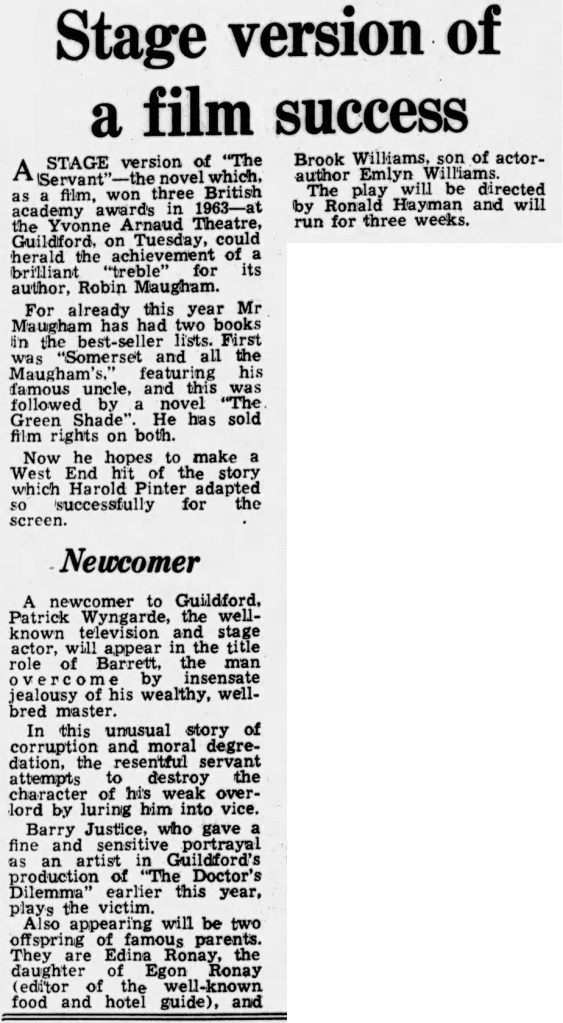
Above: From the Surrey Mirror and County Post – 2nd September, 1966

PETER WYNGARDE WAS NOT GAY. THIS IS A MYTH CONJOURED UP BY THE BRITISH TABLOIDS
PETER WYNGARDE DID NOT HAVE A ROMANTIC RELATIONSHIP WITH ALAN BATES. THIS WAS A LIE PERPITRATED BY DONALD SPOTO IN HIS BOOK, ‘OTHERWISE ENGAGED: THE LIFE OF ALAN BATES’
PETER WYNGARDE WAS NOT ARRESTED OR CAUSTIONED IN KENNEDY GARDENS OR ELSEWHERE. THIS IS A LIE CREATED BY WIKIPEADIA AND COPIED BY THE BRITISH TABLOIDS.
THE 1975 CONVICTION AGAINST PETER WYNGARDE WAS LATTERLY QUASHED BY THE HOME OFFICE (UK GOVERNMENT) AS BEING “UNPROVEN”.

