


Produced by The Richmond Theatre Reparatory Company, London.
July 1950
Character: Clem
Act I
- Scene I: 10 pm on a Saturday evening in March
- Scene II: Three hours later
Act III
- The following evening about 7pm
Act III
- Four hours later
The Story
The year is 1950, a period when television had not yet supplanted the Wireless. The Jukebox, dancing at the Palais, and frequent visits to the Cinema served as popular entertainment for the public, and the Death Penalty was still applicable in cases of Murder.
Madam Tic-Tac (Margaret St. Barbe-West), is so-called due to her dual disabilities of blindness and deafness, which limit her communication to hand signals* Attributing her condition to carelessness In a hospital, and harbouring resentment towards the significant physical isolation it has imposed on, her.she attempts to get her own back on society by embarking upon a life of crime. Nevertheless, she displays extraordinary kindness to Beth – a young girl who, as well as working in the cafe, acts as her eyes and ears.
*A traditional form of sign language utilized by bookmakers at British racecourses until the early 21st Century.
The gang begin to draw the attention of a local police in the person of Detective Segreant Harris – especially when, during a raid, a night watchman is fatally shot by Clem (Peter Wyngarde), a manipulative and dangerous young man who serves as the gang’s second-in-command.
Things start to take a turn when taxi driver, Rudge (Leslie Yeo) – a timid man by nature but who is also a member of the gang, becomes unnerved by Clem’s actions, believing that committing murder is crossing a moral line. He decides that he is going to surrender to the authorities, thereby revealing the Tic-Tac Gang’s operations. On discovering Rudge’s intentions, Clem takes measures to eliminate him and to create an alibi for himself by framing Madam Tic-Tac’s son, Luke..
When she realizes the situation, Madam Tic-Tac immediately understands that she must safeguard her son whom, until this point, she has successfully kept away from her illicit dealings. Utilizing both her connections in the criminal underworld and her own cleverness, she manages to outsmart Clem and rescue her son, while all time understanding that she will ultimately be killed by him.
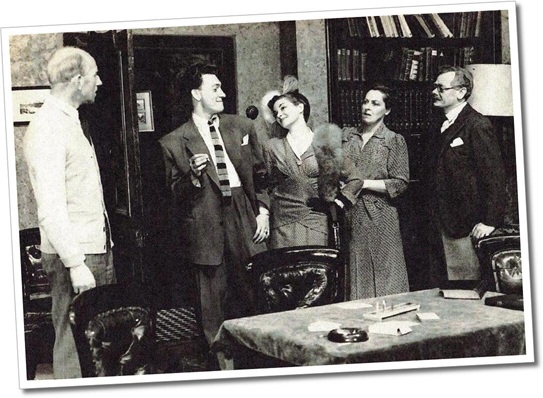
Above: Peter (second from left) as Clem
In Retrospect
Written by Falkland L. Cary and Philip Weathers and staged globally, this work is acknowledged as a thriller characterized by robust character development and dramatic intensity, distinguishing it within mid-20th-century theatre.
The narrative centers on themes of loyalty, deception, and the ethical dilemmas faced by the central character, Madam Tic-Tac. Her protective nature towards Luke and Beth, despite her own limitations, stands in stark contrast to the nefarious ambitions of Clem and the fear-motivated actions of Rudge. This creates a gripping, morally intricate storyline set against a backdrop of criminality which lies at the heart of both the suspense and the emotional depth of the play. The interactions among these characters propel the tension and lead to the tragic conclusion of the story.
Press Comments
| “Admirably proving their acting talent are Peter Wyngarde, almost unrecognisable as the super spiv, Clem, and Leslie Yeo. as Rudge, the get-away driver.” The Richmond Herald – 29th July, 1950 |


