


Presented by Paul Elliot at His Majesty’s Theatre, Aberdeen: 7th December 1984 – 5th January 1985.
Character: Abarnazar
Act One
Prologue: Abanazar’s Lair
- Scene 1: In old Pekin
- Scene 2: Outside Pekin
- Scene 3: The Princess’s garden
- Scene 4: Widow Twankey’s Launderette
- Scene 5: Outside Pekin
- Scene 6: A ravine in the mountains
- Scene 7: Inside Abanaza’s cave
Act Two
- Scene 1: The Festival of Lanterns
- Scene 2: Widow Twankey’s Launderette
- Scene 3: Outside Pekin
- Scene 4: The Garden of Aladdin’s Palace
- Scene 5: The Flight to Egypt
- Scene 6: Aladdin’s palace in Egypt
- Scene 7: Back home in Pekin
- Scene 8: The Royal Wedding
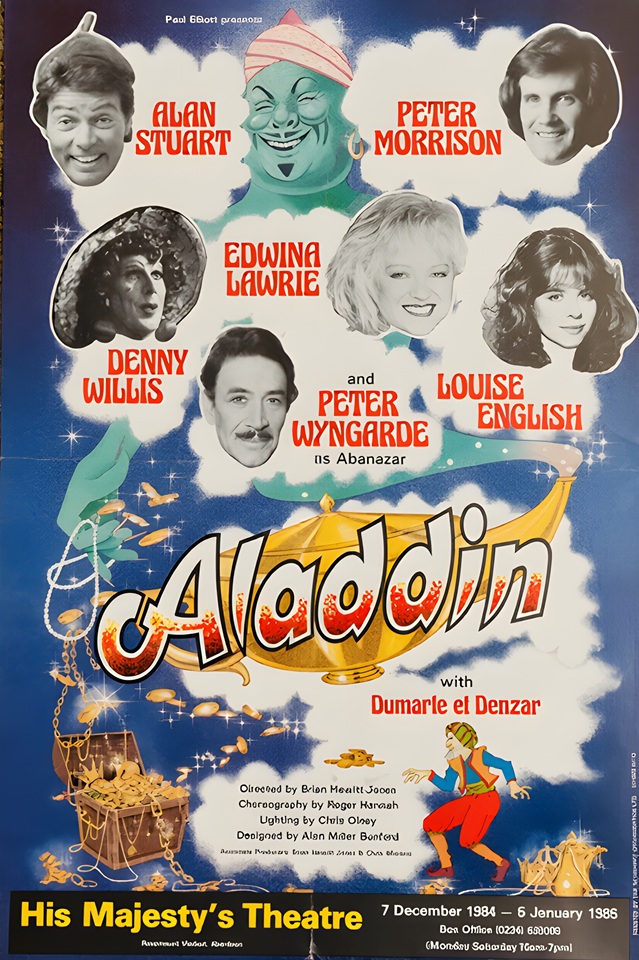
The pantomime Aladdin is one that lends itself particularly to spectacular and colourful settings and costumes, and the 1985/85 Christmas season a spectacular production at His Majesty’s Theatre, Aberdeen, that left nothing to be desired.
In this respect with a first half finale inside up Abarnazar’s (Peter Wyngarde) cave, that glittered and sparkled with a delightful festival of lanterns and a lavish ‘Willow Pattern’ to close the evening. Only in magical effects did the presentation fall a little short of expectations. Add a multi-talented cast an eight-strong dancing chorus augmented by a group of lively youngsters from the Jessiman Shool of Dance, and the clever specialty act and there was all the ingredients for a successful show which was proven with every performance a sell-out.
While Peter was the target of hearty rounds of “Boo’s” from the audience, the children especially took to wishy Washy Washy, played by Scottish comedian, (Allan Stewart), who not only used his ability as an impersonator to excellent effect at many appropriate moments, but he also has a warmth of personality that makes the character irresistible, Denny Willis was his inimitable self as Widow Twanky – brilliantly funny at his best; his funny walk reminiscent of part of his Hunting Quartet but, alas, was been given too few opportunities to use his comic skills to the full.l
Peter Morrison in the role of the Emperor, was said to have made an impressive figure, and carried off the part with great style displaying equal poise and polish in his singing. Meanwhile, Louise English looked every inch a princess to win all hearts, and she too was an accomplished singer Edwina Lori .
Meanwhile, Peter ruled the stage as a splendidly evil looking magician, Abanaza. According to the Aberdeenshire Press and Journal, “He (Peter) needs more vocal bite to complete the characterization.” which was a strange comment to make given that Peter had one of the most powerful voices of the world stage.
The show was enhanced with a performance of the dancing skeletons by Dumarte et Denzar – one of the oldest specialty acts in the business, which provoked shrieks of delight and laughter from the children.
Focus On Abanazar
Abanazar – whose name varies slightly across different versions of the story – serves as the primary antagonist in the pantomime Aladdin and remains one of the most iconic villains in the British pantomime tradition. Driven by greed and an ambition for power, he provides the essential conflict that drives the narrative. While Aladdin represents the hope for a better life, Abanazar embodies the forces of selfishness and manipulation.
The core of Abanazar’s motivation is his obsession with the magic lamp. Aware that the lamp is hidden within a mysterious cave and can only be retrieved by Aladdin, Abanazar devises a plan to deceive the young man. By masking his true intentions and posing as a long-lost relative or family friend, he uses false kindness to gain the trust of Aladdin and his mother. This deception establishes him as a calculated manipulator willing to exploit others to achieve his goals.
Unlike villains who rely on brute strength, Abanazar utilizes intelligence and psychological leverage. He identifies the vulnerabilities of others and uses promises of wealth to manipulate Aladdin into compliance. However, this polished exterior hides a ruthless nature; the moment Aladdin refuses to surrender the lamp, Abanazar drops his facade and reveals his true character.
In production, Abanazar is typically portrayed as a larger-than-life figure. His presence is emphasised through extravagant costumes, including flowing robes, jewels, and dramatic cloaks, designed to both impress and intimidate. The role requires a performance that relishes in villainy, often involving direct interaction with the audience to provoke the traditional boos and hisses. This interaction is a cornerstone of the pantomime experience, with children particularly enjoying the opportunity to warn Aladdin of the villain’s schemes.
Despite his antagonistic role, Abanazar is rarely depicted as truly frightening. Instead, he balances menace with comedy. His grandiloquent speeches, exaggerated confidence, and frequent failures make him an entertaining figure rather than a terrifying one. This balance allows the audience to enjoy his antics while still rooting for his eventual defeat.
Symbolically, Abanazar represents the misuse of power. His desire for the lamp is not born of necessity, but of an insatiable hunger for domination. This stands in stark contrast to Aladdin, who uses magic to improve the lives of others. This dichotomy highlights the story’s central moral: that honesty, courage, and kindness are more valuable than material wealth or power.
Ultimately, Abanazar is an indispensable element of Aladdin. Without his antagonism, the protagonist would have no obstacle to overcome and no opportunity to demonstrate his growth. Cunning, theatrical, and endlessly entertaining, Abanazar remains a definitive pantomime villain, captivating generations with his blend of malice and humour.
| And that rakish fellow, Peter Wyngarde, must have regarded his reception as the dastardly Abanazar as a triumph. I swear he almost brought the house down when he announced wickedly he had let all their dad’s car tyres down outside the theatre. David Smith – Evening Express: 03/12.84 |


