


Broadcast: Tuesday 7th December, 1954
Character: Worthy
The action of the play takes place in the household of Loveless, Lord Foppington and Sir Tunbelly Clumsey in 1696.
Some Background
‘The Relapse’ was written in 1696 by John Vanbrugh as a sequel to Colley Cibber’s comedy ‘Love’s Last Shift‘ (1696). Amanda, Loveless, and Lord Foppington (known as Sir Novelty Fashion in ‘Love’s Last Shift’) are the only characters to feature in both plays.
At the time ‘The Relapse’ was screened, there had been much discussion in the press concerning what is and what is not “obscene” on stage in the theatres, and moreover on TV. Naturally, views diverged. I was an age whenever the subject of sex was raised there were inevitably cries of “FILTH” from certain quarters followed, followed by indignant phone calls to the ‘papers and the BBC.
Media commentators believed that the broadcast of Vanburgh’s play would have a particularly hard time of it. As Phillip Hope-Wallace of The Listener was to put it, “Evidently the notion that anyone is free to inflict his own phobias on the public dies hard.”
There was speculation amongst drama critics that this BBC version of the play might be ‘tidied up’, as the original form of ‘The Relapse’ couldn’t be defined as family viewing. Some of the antics of Vanburgh’s characters barely skirted propriety. There certainly appeared to be much confused thinking on the subject.
On a general level ‘The Relapse, which had been so carefully prepared for the ‘Stage By Stage’ series of plays, was said to be superior to in style and spirit to the famous production at the end of war (with Cyril Richard as Lord Foppington), and was a true reproduction of the theatrical mode of its day, and a fully fashioned piece of television. As one critic stated, “The whole piece strikes a blow at hypocrisy and, if it didn’t put people off by being too long (2 hours), it may have sparked some interest in Vanburgh’s other works, if not in his architecture.”
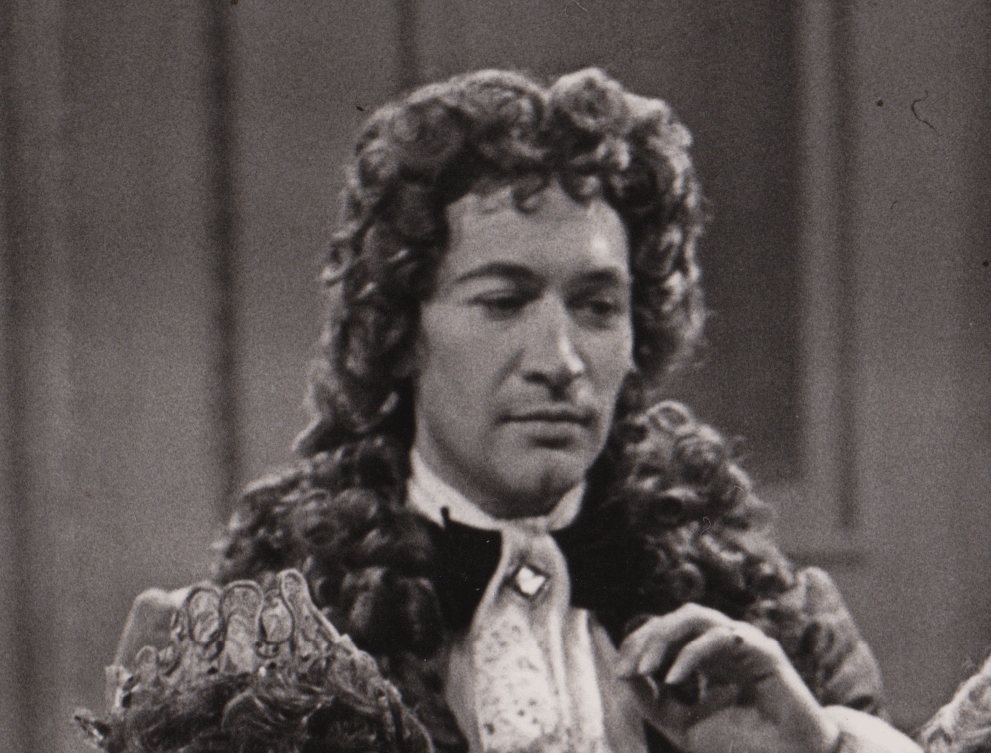
Above: Peter as Worthy
Story Synopsis
Loveless (Michael Gough) is a gentleman who, after experiencing marital difficulties, resides quietly in the countryside. Despite his efforts to reform, he frequently travels to London, where he struggles to maintain his resolve. During one such visit to the city with his wife, Amanda (June Shields), Loveless becomes captivated by Berinthia (Moira Lister), a charming widow whose face he sees in a crowd and who is later revealed to be Amanda’s cousin. This infatuation leads to an affair with Berinthia, further exacerbating the tension between him and Amanda.
Key to the plot is the introduction of Novelty Fashion, or Lord Foppington (Geoffrey Bayldon) as he is now known – a title he has bought. He is a character who embodies the arrogance and excesses of the newly wealthy aristocracy, contrasting sharply with his brother Young Fashion (John Hayter), who struggles with debt. He neglects his younger brother, Fashion, and is initially engaged to Miss Hoyden (Jessie Evans) – a wealthy heiress and daughter of country squire, Sir Tunbelly Clumsey (David Bird), However, he becomes infatuated with Amanda’s beauty, leading to a confrontation with Loveless, during which Lord Foppington is wounded.
At Lord Foppington’s house, he and Young Fashion argue. This argument becomes heated, and Young Fashion challenges his brother to a duel.
At a garden, Loveless meets Berinthia and asks her about a “distemper”, which turns out to be his love for Berinthia. Berinthia leaves Loveless’ company and then meets with Worthy and the two begin plotting (largely driven by Worthy) to steal Amanda and Loveless. After they finish plotting, Berinthia meets with Amanda and begins sowing the seeds of doubt in her mind about Loveless’ reformation.
Meanwhile, Young Fashion travels to the home of Lord Foppington’s soon-to-be-bride, Miss Hoyden. He is nearly shot at but able to convince Hoyden’s father that he is Lord Foppington using a stolen letter.
Amanda and Berinthia talk, with this talk serving to plant even more seeds in Amanda’s mind. Worthy then arrives and takes Amanda away to play cards with her. Later that night, Loveless breaks into Berinthia’s house and hides in her wardrobe. Though’s is found, he is able to convince Berinthia of his undying love and she stops a servant from discovering him. Loveless carries Berinthia away to a nearby couch.
Young Fashion is able to meet Miss Hoyden (who has been literally locked in her room) and her governor, Nurse. Their meeting is broken up by the arrival of the real Lord Foppington. Young Fashion is able to convince Sir Turnbelly that Lord Foppington is a fraud and (after scaring away Lord Foppington’s men with pistol shots), he is arrested and thrown into a doghouse. Foppington is able to summon Sir Turnbelly’s neighbour, leading to Young Fashion fleeing before he can be found out as the real fraud.
The next day, Young Fashion and Coupler (Kenneth Conor) receive a letter revealing that Lord Foppington has courted Miss Hoyden and will soon marry her. Young Fashion is able to convince Nurse (Nuna Davey) and Bull (James Bree) – Sir Turnbelly’s chaplain – that he should be married to Miss Hoyden instead of Foppington.
Meanwhile, Berinthia is able to convince Amanda that her husband has failed to keep his vow of matrimony and has relapsed into his roguish way. This is the cue for Worthy (Peter Wyngarde) – a sophisticated young gentleman of the town who once courted Berinthia – swoops in and attempts to seduce Amanda, who only barely succeeds in summoning her virtue to reject his advances.
Amanda, Loveless, Worthy, and Berinthia then attend the marriage of Hoyden and Lord Foppington. After a masque featuring Cupid and “Hymen”, Young Fashion crashes the wedding. Though Sir Turnbelly tries to have him arrested, Young Fashion is able to successfully plead his case for marrying Miss Hoyden.
In what the author seemingly intended to be an antidote to the play’s liberalism, the once amoral libertine, Worthy, has a sudden repentance and reformation, resulting in his becoming an admirer of female virtue. This change of heart, we’re told, has came about after Amanda resisted him to remain loyal to her husband.
A bit of Trivia
| The play was broadcast live from the stage of the Television Theatre at Lime House, London, before an invited audience. The play began at 8.30pm. There was a short interval at 9.30. |

Above: The Radio Times – 3rd December, 1954

 PETER WYNGARDE: The Official Website