


Presented by Bill Kenright Ltd. – The Old Vic, London – September 1985
Character: Carlton Fitzgerald
The action of the play is set in the living room of Irene Livingstone’s suite in the Ritz-Carlton Hotel in Boston, Massachusetts, USA.
Act I:
- 5.30pm
Act II:
- 11.45pm that evening
Act III:
- 3.30am
The Story
Moss Hart’s Light Up the Sky remains one of the most entertaining and affectionate comedies ever written about the theatre. First produced in 1948, the play serves as a sharp satire of theatrical egos, backstage volatility, and the profound emotional instability that accompanies the launch of a new production. Set entirely within a suite at Boston’s Ritz-Carlton Hotel during an off-Broadway preview, the play offers audiences a humorous and insightful glimpse into the world behind the curtain.
The enduring appeal of Light Up the Sky lies in the fact that its comedy is derived from recognizable human frailties rather than far-fetched scenarios. Hart portrays the actors, writers, producers, and directors with a blend of affection and ruthless honesty. Because Hart was a member of this community, he possesses a deep understanding of their vanity, self-doubt, and occasional absurdity. Consequently, the play critiques the theatrical community without descending into cruelty.
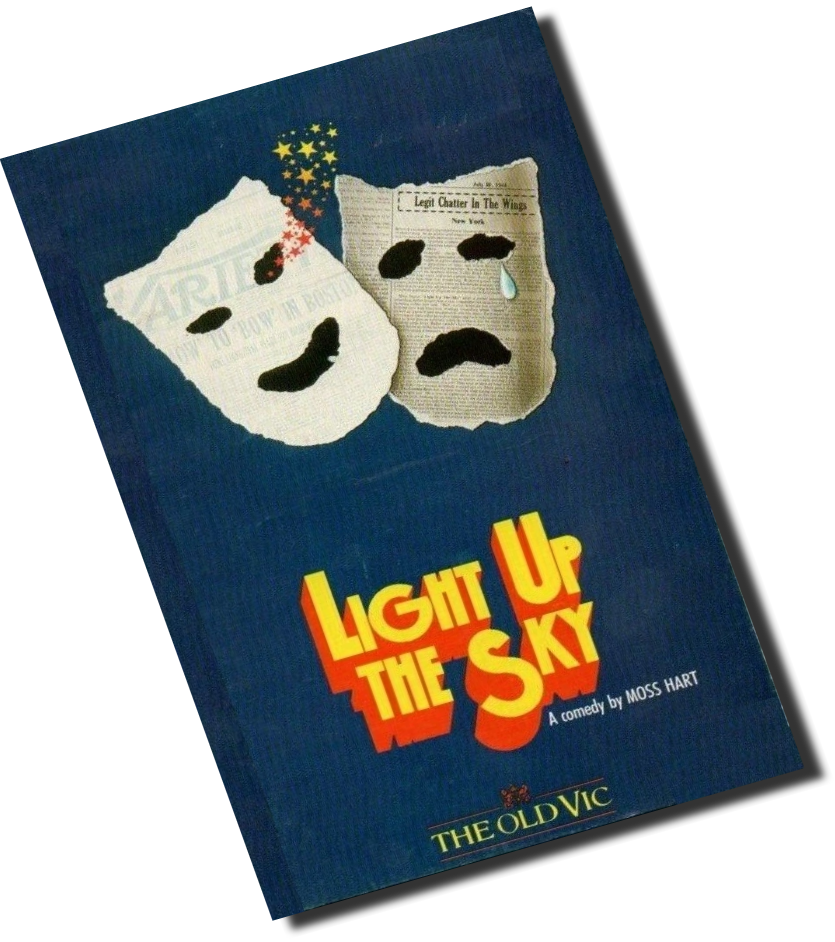
The plot is elegantly simple: a group of theatre professionals gather before and after the opening-night performance of a new play. Initially, confidence is high; the producer and creative team are convinced of the show’s success. However, when the audience’s response appears lukewarm, optimism rapidly shifts to despair. Those who were previously praising the production suddenly scrutinise every detail, from the script to the casting. Yet, as favourable reviews arrive, these attitudes pivot once again, and the characters rush to claim the success they had recently condemned.
This premise allows Hart to expose the fragility of human confidence. The speed with which the characters oscillate between triumph and disaster is both comedic and painfully believable. Their reactions highlight a dependence on external approval and illustrate how quickly artistic conviction can vanish in the face of criticism.
A primary strength of the play is its ensemble of eccentric characters, Sidney Black (Robert Morse), the producer, is flamboyant and enthusiastic, yet often out of his depth. Having invested heavily in the production, he swings between boundless optimism and near hysteria. His character serves as a poignant reminder that confidence does not always equate to competence.
Equally memorable is Stella Livingston* (Maxine Audley), the temperamental star of the show. Self-absorbed and convinced of her own importance, she embodies the stereotype of the theatrical diva. However, Hart writes her with such wit that she remains endearing rather than irritating, and her exaggerated reactions provide many of the production’s biggest laughs.
The director, Carleton Fitzgerald (Peter Wyngarde), provides further comic relief. As an intensely sensitive artist perpetually on the verge of emotional collapse, he responds to every setback with melodramatic despair. Hart effectively skewers the image of the “tortured genius,” making Carleton’s recurring crises increasingly humorous as the play progresses.
At the centre of the drama is the young playwright, Peter Sloan (Jack Elliot). Unlike his seasoned colleagues, Peter arrives with genuine idealism. He believes in the intrinsic value of his work, only to receive a harsh education in the realities of the theatre world. Through Peter, Hart examines the vulnerability of any artist who places their work before public judgment.
While primarily a comedy, the play maintains a serious undercurrent. Beneath the witty dialogue lies a commentary on the nature of artistic creation. Hart suggests that the theatre is sustained by a volatile mixture of talent, vanity, courage, and blind faith. He posits that while the industry depends on the opinions of others, genuine creativity requires the courage to ignore them.
The dialogue remains one of the play’s greatest assets. Hart possessed an exceptional ear for comic conversation, and the script sparkles with sharp observations and rapid-fire exchanges. The characters interrupt and contradict one another in a manner that feels entirely natural. Even today, the humour retains its freshness because it is rooted in universal human behaviour.
The play’s pacing is also noteworthy. Hart structures the action with precision, steadily building tension as misunderstandings accumulate. The audience is drawn into the emotional chaos, recognizing aspects of their own behaviour in the characters’ flaws. By the time the final revelations arrive, the comedic payoff feels earned.
Perhaps the most appealing aspect of Light Up the Sky is its fundamental affection for its subject. While Hart satirises theatrical excesses, he never loses sight of the passion that drives his characters. Their anxieties and absurdities stem from a deep investment in their craft – a quality that is ultimately admirable.
The play also serves as a fascinating time capsule of post-war American theatre. While its references reflect a specific era, its themes remain universal. Anyone who has worked in a creative field or experienced the emotional volatility of a major project will recognise the feelings Hart so skilfully portrays.
Ultimately, Light Up the Sky is more than a backstage comedy; it is a perceptive examination of ambition, ego, and the unpredictable nature of success. Through colourful characters and sparkling dialogue, it remains one of Moss Hart’s finest achievements, continuing to delight audiences with its humanity and its loving portrayal of the wonderfully irrational world of the theatre.
*Irene Livingston in other productions of the play.
Focus on Carlton Fitzgerald
Carleton Fitzgerald is one of the most memorable and entertaining characters in Light Up the Sky, Moss Hart’s witty backstage comedy regarding the triumphs and disasters of theatrical life. As the director of a new Broadway-bound production, Carleton embodies the traits traditionally associated with theatrical genius: sensitivity, artistic passion, nervous intensity, and a tendency toward emotional excess. Through him, Hart creates an affectionate yet satirical portrait of a director perpetually balanced between confidence and catastrophe.
From his first appearance, Carleton establishes himself as a figure of considerable comic importance. He approaches every aspect of the production with immense seriousness, viewing the play not merely as entertainment but as a significant artistic achievement. However, this devotion is accompanied by a notable lack of emotional stability. Carleton experiences every setback as a personal tragedy and every success as a miraculous vindication; his reactions are rarely measured, often escalating to the point of comedy.
A defining trait of the character is his susceptibility to anxiety. Throughout the play, he is preoccupied with how the production will be received, and even minor issues can trigger spirals of self-doubt. This nervous temperament serves as an effective vehicle for Hart’s satire of the industry. The theatre is depicted as a profession where emotions run dangerously high, and Carleton serves as the primary example of this phenomenon.
While Hart mocks the character’s dramatic tendencies, he never presents Carleton as merely ridiculous. Beneath the humour lies a genuine admiration for his commitment to the craft. His anxieties stem from passion rather than vanity; unlike other characters driven by personal prestige or financial gain, Carleton is deeply invested in the artistic quality of the work.
The character is particularly effective due to the contrast between his professional authority and personal insecurity. As director, he occupies a leadership position and should theoretically be the most composed individual in the room; instead, he is often the most volatile. While others look to him for reassurance, he frequently requires it himself—a contradiction that drives much of the play’s comedy.
Carleton’s interactions with the company reveal further layers to his personality. He shares producer Sidney Black’s tendency toward dramatic overreaction, though they express their anxieties differently. While Sidney is loud and blustering, Carleton is intensely emotional and artistic. Together, they create some of the play’s most humorous moments as they react to rumours and imagined disasters.
His relationship with the star, Irene Livingston, is equally engaging. Both possess strong personalities and inflated artistic sensibilities, making their exchanges a constant source of amusement. Although they both view the production as vitally important, they are vulnerable to the same fears. Their conversations often reveal the fragile egos hidden beneath their theatrical confidence.
Perhaps the most endearing aspect of Carleton Fitzgerald is his humanity. For all his melodrama, audiences recognise a familiar struggle in his behaviour. Most people have experienced moments of self-doubt or fear of failure; Carleton simply experiences these emotions on a theatrical scale. His tendency to imagine the worst possible outcome makes him both comic and sympathetic.
Hart uses Carleton to expose the inherent unpredictability of the theatre. The director’s emotional journey mirrors the larger narrative, oscillating rapidly between hope and despair. These sudden shifts illustrate the uncertainty that surrounds every new production.
There is also a deeper truth beneath the comedy: Carleton represents the artist’s vulnerability. Because directors, writers, and actors invest so much of themselves in their work, criticism can be difficult to bear. His overreactions demonstrate how personally creative individuals experience professional setbacks. Hart acknowledges this reality even while laughing at it.
Ultimately, Carleton Fitzgerald is one of the most successful comic creations in Light Up the Sky. Talented, insecure, and endlessly dramatic, he embodies both the absurdity and the passion of the theatrical profession. Through Carleton, Moss Hart celebrates the artists who devote their lives to the stage while gently poking fun at their eccentricities. The result is a character who remains entertaining and deeply human long after the final curtain falls.


2 thoughts on “REVIEW: Light Up The Sky”