


EPISODES:
- Recalled to Life: Sunday, 29th July, 1957
- The Gathering Storm. Broadcast: Sunday, 4th August 1957
- The Jackal. Broadcast: Sunday, 11th August 1957
- The Honest Tradesman. Broadcast: Sunday, 18th August 1957
- The Storm Breaks. Broadcast: Sunday, 25th August 1957
- The Darkness. Broadcast: Sunday, 1st September 1957
- A Hand of Cards. Broadcast: Sunday, 8th September 1957
- The Footsteps Die Out. Broadcast: Sunday, 15th September 1957
Character: Sydney Carton
“It is a far, far better thing that I do now than I have ever done, it is a far, far better rest that I go to now than I have ever known” – Sydney Carton
Some Background
Charles Dickens story of ‘A Tale of Two Cities’ is probably so familiar to anyone reading this review that it would be difficult to tell you anything that you didn’t already know. But no matter how acquainted one is with the story, there is still something wonderfully moving in its famous climax on the steps of the guillotine – especially when the man playing the part of the novel’s hero, Sydney Carton, is real-life hero, Peter Wyngarde.
Certainly, Peter’s depiction of Carton resulted in the BBC receiving around 4,500 letters – almost all from women – who immediately fell in love with the actor while watching this eight-part serial. According to the Beeb, they had never taken delivery of more letters address to a single actor in one of their own production, either before or since.
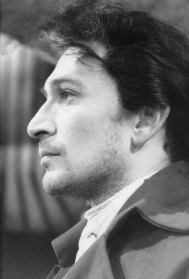
There is a great deal in the comment made by dramatist and poet, G.K. Chesterton, that a man rereads a detective novel because he has forgotten the plot, but that he rereads a Dickens’ novel because he has remembered the plot.
Right: Peter as Sydney Carton
There are fewer characters in ‘A Tale of Two Cities’ that in Dickens’ earlier books, but they are all memorable: the pathetic Dr Manettes, kind Mr Lorry, the terrible Defarges and their equally dreadful enemy, St. Evrémonde (Heron Carvic), good Gerry Cruncher, (played by Ronald Radd) of the secret fishing expeditions, and the formidable Miss Pross (Joan Ingram) with her mysterious attacks of “The Jerks”.
But of all the characters in the story, Sydney Carton – the self-indulgent young lawyer who said of himself, “I shall never be better than I am” and yet, one day, superbly was.
It was a joy to meet all these wonderful creations of Dickens’ imagination through the distinguished cast that producer, Kevin Sheldon, assembled for this production.
The Story
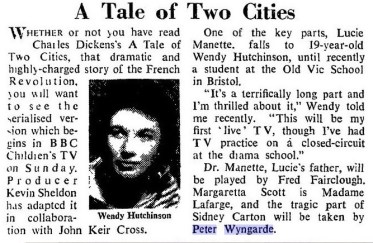
The story begins just prior to the French Revolution in 1775 when bank clerk, Jarvis Lorry (Mervyn Johns), travels to Paris to help reunite Dr Alexandre Manette (Fred Fairclough) with Lucie (Wendy Hutchinson), his long-lost daughter. Manette had recently been released from prison having served an 18- year sentence in the infamous Bastille.
Lorry intends to bring the Doctor with his 17-year-old daughter together at the room he’s been renting over a wine shop in the City. The Doctor, it emerges, cannot remember anything about of his life prior to his imprisonment, but on meeting his devoted Lucie for the first time, begins to regain his memory.

Five years later, the Doctor has built a successful medical practice in his house in London. Lucie, meanwhile, has become engaged to a Frenchman by the name of Charles Darnay (Edward de Souza), who has turned his back on his former aristocratic life in France for a new life in England. We learn that Darney’s real name is Evrémonde and that he’d formally been put on trial for treason. Fortuitously, he was saved from the gallows by a young barrister, Sydney Carton (Peter Wyngarde), who also happens to be the spitting image of the Frenchman.
Although the Doctor is delighted when his daughter finally marries Darney, he’s completely unaware that his new son-in-law’s father and uncle had been the parties responsible for his imprisonment.
As a result of the continued persecution of the lower orders by the French aristocracy, an uprising begins in France, at which point Darney decides that he must return to his homeland in an attempt to save Monsieur Gabette – a former household servant of his. On his arrival in Paris, Darney is recognised, rearrested and imprisoned for the supposed crimes of the Evrémondes family.
When Dr Manette learns of Darney’s fate, he and Lucie race to Paris where, with the help of Sydney Carton, they manage to negotiate the temporary release of the young nobleman.
Unbeknown to all concerned, Carton has been hopelessly in love with the Doctor’s daughter since their first meeting, and seeing her with her infant daughter – bereft at the thought of Darney’s execution, Carton take his place at the prison and is brought to the guillotine in his stead.

A Bit Of Trivia
‘A Tale of Two Cities’ was filmed entirely in the Medieval French city of Bourges, and was shown as part of the BBC’s Children’s Hour.
Veteran British actor, Julian Orchard, played three different characters in the play, including Jacques, and two other unnamed men.
Critics Comment
“The TV production was very well done, and I think that in Peter Wyngarde, the actor who portrayed Sydney Carton, the dissolute barrister, we have yet another new British top-liner.” June Morrow – Woman’s Own
A Far Better Thing?
| Fresh from his success in the BBC serial ‘A Tale of two Cities’ comes Peter Wyngarde. He is in Rudolf Cartier’s important Thursday play, ‘Ordeal By Fire’. Many Viewers have written to me about Peter Wyngarde playing of Sydney Carton in the Dickens serial. And thousands more have written to him and the BBC. It’s good, therefore, to see the TV companies snap him up. But Rudy Cartier already knows Wyngarde’s work well. He had him as Will Shakespeare, in the Clemence Dunn play, some years ago. Peter has been seen in a dozen or so TV plays in the past few years and in each he has caught the eye – and held it. It’s time he had the really big break now. Shirley Long – TV Mirror, October 1957 |

 PETER WYNGARDE: The Official Website
One thought on “REVIEW: A Tale of Two Cities”