

1948 Deep Are The Roots
Year: 1948
Character: Chuck Warren
The play, written by American playwrights Arnaud d’Usseau and James Gow, tells the story of decorated Black army officer Brett Charles who has attempted to gain employment as a school teacher upon his return home from World War II. Unfortunately, the racial prejudice that he had left behind in America, while he was stationed in Europe, was still very much in evidence upon his return after he is accused by his new employer, Senator Ellsworth Langdon, of the theft of a gold watch. The play follows Brett’s psychological readjustment on coming home after the war and his pursuit of “fairness” after experiencing a war in which the colour of his skin was irrelevant to the goal of fighting a common enemy.
1948 The Government Inspector
Year: 1948
Character: Osip
When the locals in a small town in Russia learn that an undercover government inspector is coming for a surprise visit, an unfortunate case of mistaken identity sends the village spiraling into a world of panic and greed. The Government Inspector is often said to be Nikolai Gogol’s masterpiece, a comedy of errors that provides clever commentary on the extensive political wrongdoing of Imperial Russia. When it opened, it caused an uproar in the Russian press. Eventually, Tsar Nicholas I had to intervene in order for the production to move forward. Since its premiere in the 1830s, The Government Inspector has been translated and adapted for many different productions, most notably the Chichester Festival in 2005.
The inspiration for The Government Inspector came from a conversation between Gogol and Alexander Pushkin, another famous Russian writer. Apparently Pushkin had actually been mistaken for a government inspector at one point in his life. He mentioned this to Gogol, who then turned it into a play. Witty, smart and wildly satirical, The Government Inspector exposes the corruption of a provincial town with biting hilarity.
1950 Othello
Year: 1950
Character: Sylvius
Shakespeare’s Othello is one of his most intimate and devastating tragedies of all. It is a story about society, status and the nature of the outsider – but it is also a story about the love and trust between friends, and between men and women.
Defying her father and society to follow her heart, Desdemona secretly marries Othello – a powerful general, and a Moor. Despite her father’s objections in court, Desdemona remains committed to Othello and follows him from Venice to Cyprus, where he is commissioned to serve. Iago, a junior officer and Othello’s most trusted adviser, is tormented by his lack of promotion. Despite Othello’s confidence in Iago’s honesty, Iago reveals that he is in fact hateful of Othello, and sets out to destroy Othello and Desdemona’s happiness, manipulating Othello to serve his own ends. Iago convinces Othello that his wife has been unfaithful with the up-and-coming young soldier Michael Cassio.
As Iago draws Othello and the audience into a web of half-truths, secrets, and betrayal, scandal is fuelled — families and friendships destroyed — until a piece of supposed evidence of Desdemona’s infidelity, a handkerchief (which Iago calls “trifle light as air”) tragically undoes them all. Othello commissions Iago to kill Michael Cassio, and then smothers Desdemona in her bed. When Emilia discovers Othello in the act, she confronts him and explains that it was Iago who tricked them all. Iago kills Emilia, but not before Othello has learned what has been done. Othello commits suicide, and Iago is taken into custody. The play ends before we know what ultimately happens to Iago, but we do know that a profusion of devastation has been left in his wake.
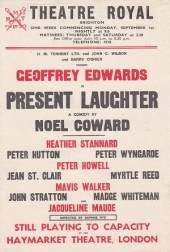
1946 Present Laughter
Year: 1946
Character: Morris Dixon
Present Laughter is lighthearted farce that celebrates playwright Noel Coward’s legendary wit and larger-than-life persona. Based on Coward himself, actor Garry Essendine is the star of the London theatrical scene at the height of his fame and adored by legions of admirers–perhaps a little too much. Fans regularly throw themselves at Garry’s feet, drawn in by his charm and charisma, throwing his household into chaos. In the week before Garry is set to embark on an African tour, he is forced to juggle a besotted young woman with stars in her eyes, an unhinged young playwright obsessed with being in Garry’s presence, his best friend’s wife who is determined to seduce him, his manager, his producer, his secretary, his estranged ex-wife, and an impending mid-life crisis as his 40th birthday looms ever closer.
1946 Quality Street
Year: 1946s
Character: Ensign Blade
Phoebe Throssel lives on Quality Street with her sister Susan. She has been courted by Valentine Brown, a handsome gentleman who decides to enlist in the Napoleonic Wars. Ten years pass when Valentine returns to Quality Street as a celebrated captain, and he is greeted by a more mature, less glamorous Phoebe. When Phoebe sees the disappointment in Valentine’s face, she is emboldened to create a younger alter-ego named Miss Livvy. Phoebe, disguised as Miss Livvy, begins to attend balls and relive her youthful glory days. As she rekindles her romance with Valentine, can she juggle both personas or will her deception ruin her reputation forever? From the beloved writer of Peter Pan, J. M. Barrie’s Quality Street is an English farce about growing old that is sure to delight audiences.
1950 Tobias and the Angel
Year: 1950
Character: Raguel
When a fellow Jew is killed, Tobit – a Jewish man from Nineveh – chooses to break the law by giving him a proper burial. The next morning Tobit is blinded by a group of sparrows (played by a children’s chorus) who throw their droppings in his eyes. Remembering that he is owed money by Raguel, a relative in Ecbatana, he sends his son Tobias to reclaim it. A stranger offers to help guide Tobias on his way. On the way, the stranger encourages Tobias, who is something of a good-for-nothing and only interested in dancing, to pay attention to the world around him – to listen to the songs of the trees, the mountains, the river. In the river, they are attacked by a giant fish. Hearing its hidden song, Tobias is able to overcome it, and the stranger tells him to take its heart and gall.
In Ecbatana, meanwhile, Sara, Raguel’s daughter, is held under the spell of a devil, Ashmodeus, who kills her husband on their wedding night. When Tobias arrives, he falls in love with Sara. The stranger, however, has eyes only for the unseen devil, and he instructs Tobias to use the fish’s heart to break Ashmodeus’ spell. This enables Tobias to wed Sara without being killed, and they return to Nineveh. Tobias uses the gall to cure Tobit’s blindness, and the stranger reveals himself as the angel Raphael.
1946 When We Were Married

Year: 1946
Character: Gerald Forbes
Priestley’s 1938 British farce begins when a group of old friends, all married on the same day in the same chapel, gathers at the Helliwells’ home to celebrate their silver anniversary. When they discover that they are not legally married, each couple initially reacts with proper Victorian horror “what will the neighbours think?”. But soon all three couples find themselves reevaluating their marriages. In the end, of course, everything turns out well, and the play ends on a happy note.

 PETER WYNGARDE: The Official Website
One thought on “SUPPORTING ROLES”