


Broadcast: Wednesday, 24th June 1964
Character: Oberon
Produced by Rediffusion and filmed at Wembley Studio 5 in London, A Midsummer Night’s Dream was broadcast on Midsummer Night, 1964.
This version of the play was transmitted to honour the 400th anniversary of The Barde’s birth, and no less than George H.W. Rylands – Shakespearean scholar and theatre director of King’s College, Cambridge, was brought in to advise on the script. Also involved was Guy Woolfenden, then Director of Music at the Royal Shakespeare Theatre, who adapted Felix Mendelssohn’s celebrated incidental music for the production.
With Joan Kemp-Welch at the helm, every attempt was made to avoid a modern approach to the play. You wouldn’t know it, but this was Rediffusion’s first ever attempt at an in-house adaptation of a work of Shakespeare, but with a generous £16,000 budget; a small fortune back then, no expense was spared on the sets by Michael Yates, and lighting (there were 400 lamps used, with 40 lighting changes), the cast were given every opportunity to shine. Indeed over £4,000 was spent on the costumes alone!
The all-star cast was headed by Peter Wyngarde and Anna Massey as the squabbling King and Queen of the Faeries, Oberon and Titania, but were ably supported by Patrick Allen as Thesus, Cyril Luckham as Egeus, Benny Hill as Bottom, Alfie Bass as Thisbe, Bernard Bresslaw as Snout and Tony Tanner as an exceptionally energetic and feral Puck.

Above: Peter as Oberon with Anna Massey as his wife, Titania.
The very stylised and exacting approach by Kemp-Welsh showed the fairy scenes off to their best effect, and Guy Woolfenden original score added to the otherworldly ambience. Interludes featured a small corps de ballet (choreographed by Juan Corelli) set to Mendelssohn’s famous suit (performed by the Philharmonic Orchestra and the Ambrosian Singers) made good use of the well-designed costumes by Sheila Jackson.
“I thought this play was absolutely terrific. It was directed by Joan Kemp, who was herself a former actress. It had a wonderful cast, that included Anna Massey as Titania and Benny Hill as Bottom. The make-up department made my character, Oberon, appear as if he’d just come out of the earth; just like he’d grown from the earth itself. I genuinely believe that if it’d been filmed in colour as opposed to black and white, it would still be shown on TV today”. Peter Wyngarde
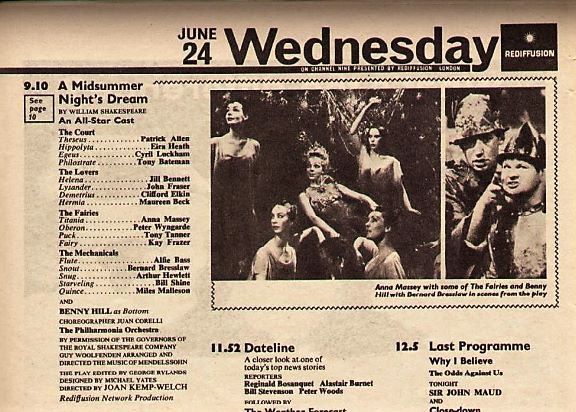
Above: TV Times- 21st to 27th June, 1964
Critic’s Comments
| “The most imaginative TV production of a Shakespeare play during the quarter-centenary year” Alan Blyth, TV Times 19 June 1964. “I have never seen a beer matched pair tha Peer Wyngarde’s Oberon and Anna Massey’s Titania.” Peter Black – Daily Mail “Peter Wyngarde as Oberon is up to his usual standard of excellence”. Geoff Welsh – The Daily Mail, June 1964. “With his smouldering presence and magnificent voice, the late Peter Wyngarde (c. 1928-2018) played Oberon in the 1964 ITV production of Shakespeare’s A Midsummer Night’s Dream. Shakespeare Magazine – Twitter |
From the BBC
Screened on Midsummer’s Day, 1964, this ITV adaptation pulled in 3.8 million viewers – the Bard’s greatest television audience to that date. Transmitted to honour 400 years since Shakespeare’s birth and directed by Joan Kemp-Welch, the production deliberately sought to appeal to a wide audience, casting comics and musical theatre actors alongside more traditional thespians like Patrick Allen and Peter Wyngarde.
Philip Purser, The Sunday Telegraph’s television critic from 1961-87, recounts a wonderful anecdote concerning Benny Hill’s performance as Bottom:
| Sir, Reading your archive feature reminds me of a lucky improvisation in my weekly television review, which attracted attention exactly 47 years ago (June 28, 1964). The pioneer commercial television company Associated-Rediffusion had put out its first Shakespeare production – A Midsummer Night’s Dream, with Benny Hill as Bottom. I found Joan Kemp-Welch’s production good, with its cobwebby forest setting, Mendelssohn’s music and a superb, Lucifer-like Oberon from Peter Wyngarde. And, yes, Benny Hill did make the most of his part. But to give him sole billing above the title while ignoring the gods and lordly mortals of the cast was surely putting the cart before the horse? As I typed this I suddenly spotted, and substituted, an alternative version – it would be putting the arse before the court. They liked it in Arts and Features, but had to clear such a rude word with the paper’s founding editor, the donnish ex-schoolmaster Donald McLachlan. He pronounced it acceptable as a play on words. A letter from Michael Flanders, who with Donald Swann formed a celebrated comedy act, was printed the next week. Did my jest, he wondered, reflect my sincere opinion – or was I guilty of putting the coarse before the art? But posted directly to me from Spain, where he’d sped on holiday after the show, was a wildly enthusiastic postcard from Benny himself. Philip Purser Television critic, The Sunday Telegraph, 1961-87 Towcester |
![Dream_avi_snapshot_01_06_28_[2014_01_11_12_38_19]](https://peterwyngarde.uk/wp-content/uploads/2016/07/dream_avi_snapshot_01_06_28_2014_01_11_12_38_19.jpg)
Above: Peter as Oberon with Tony Tanner as Puck
Since it was photographed in black and white, this production had already been denied an almost essential element of its magic. Therefore, tremendous visual daring would have to be deployed to make up for the lack. And it is reasonable enough to suppose that a commercial company such as ITV, having committed themselves to the risk of losing so many millions of viewers for two hours peak showing should want to play safe and retain as many millions as they could. So, a pleasantly conventional production, with Mendelssohn‘s music, and a corps de ballet, and a clutch of well-known TV comedians for the Mechanicals.
The play opened, a little bafflingly perhaps, with Theseus and Hippolyta in close up – not a very strong exposition of framework. But as soon as we came to the forest, Michael Yates’ layers of gauzes were used to evoke a pretty atmosphere, although the lighting might be considered rather strong. Joan Kemp Welch, the director, played some effective conjuring tricks with a disappearing Oberon – acted with a controlled combination of the sinister and the majestic by Peter Wyngarde – and achieved some scenes of real charm as, for instance, Titania’s bower with Bottom and the attendant elves. The verse-speaking, as one might expect, was of a high standard. The TV Times
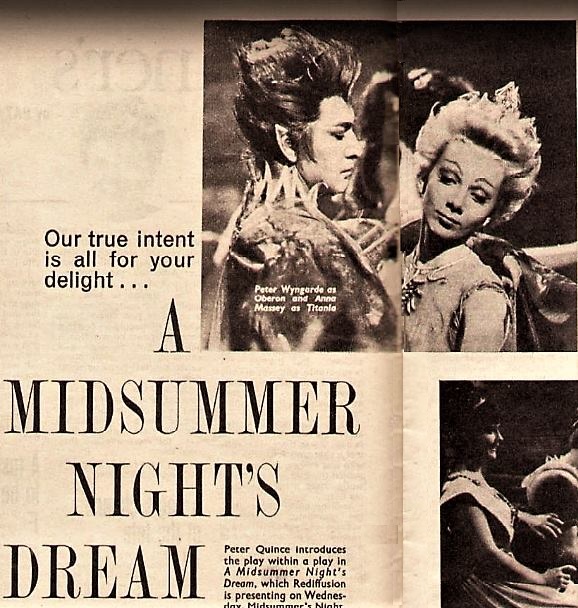
Above: TV Times- 21st to 27th June, 1964
A bit of the Trivia
| Diaphanous gauze screens were used for the very first time on British television in this play, to help Peter and Tony Tanner to conceal themselves in the woods. |

 PETER WYNGARDE: The Official Website
One thought on “REVIEW: A Midsummer Night’s Dream”