It was well-known amongst Peter’s friends that he was a fantastic cook. Here are three of his own favourite recipes.
First, a dish which Peter described as being “frankly Swank and great for scoring in the ‘up with the Joneses’ game”.
Superbird
A chicken (or pheasant)
A few rushes of Burton
A bottle of white table wine
Half a cup of stock
Two sticks of celery
A large onion
Two medium carrots
Honey.
Make cuts in the cheque in or pheasant and slotting bits of bacon. Put bird in a casserole dish and pour over the white wine. Add stock. Fry celery in a little butter to soften and add to casserole. Add chopped carrots. Cooking oven for 45 minutes (gas mark 4, 350). Remove from oven and spread honey generously over pheasant or chicken. Return to oven and cook for a four further 45 minutes.
Now a dish that Peter said would make your friends squirm with embarrassment to think of all the trouble you have taken for them.
Sausage Special
Rice for 4
16 Sausages (two for each serving)
8 ounces of prawns or shrimps
Small fresh crab
Two medium onions
Six medium size tomatoes
One red or green pepper
Garlic.
Boil rice and drain well. Same time grilled sausages to drain excess fat and drop into pieces about an inch long. Fry onions gently until they’re just transparent. Chopped Peppers and fry until just soft. Skin tomatoes and slice. For all the ingredients including prawns and crab into a casserole and stir them gently so that they are mixed together. Sprinkle with garlic. Cooking oven (gas mark 4, 350) for 40 minutes.
For special dinner parties, Peter would produce his…
Wyngarde Special
Beef marinade
2 Pounds of beef
Half a bottle of red table wine
A tablespoon of vinegar
2 Medium onions
2 Leeks
3 carrots
3 Tomatoes
1 Pound of potatoes
Half cup of beef stock.
Chop beef into 2 inch chunks. Covering a dish with red wine and vinegar and leave in fridge for three days. On the day to be served, slice onions comment leeks, carrots and potatoes into large pieces. Put me, wine marinade and stock in a casserole and add vegetables. Cooking oven (gas mark 5, 375) for an hour.
Happy cooking!
Read more about Peter’s cooking prowess by clicking below:
Broadcast: BBC Home Service – Sunday, 1st August, 1954& BBC Home Service– Monday, 25th January, 1965
Character: Prince AlbertTroubiscoi
The Story
Léocadia (A.K.A. ‘Time Remembered’) tells the story of a young Prince Albert Troubiscoi (Peter Wyngarde) who had fallen madly in with an opera singer, Léocadia Gardi.
Although the young regent only knew her for three days, when she is accidently strangled by her own scarf following an impassioned discussion about art, the inconsolable Prince on only through his memory of the beautiful young woman.
His doting aunt, the Duchesse d’Andinet d’Andaine (Gladys Young) decides to reconstruct all the places that her nephew and his lady-love had spent those precious three days — employing actors to play all the parts of the people the couple had encountered during those three short days of happiness.
The girl chose by the Duchess to, hopefully lay to rest Léocadia ghost is Amanda (Dorothy Gordon) – a poor milliner from Paris who bears an uncanny resemblance to the singer. She’s asked to seduce the Prince with the hope that she might help heal his broken heart.
To begin with, Albert clings desperately to his memories, but as he slowly begins to fall in love with Amanda, he starts to realise that his melancholy reminiscences of Léocadia are all to do with his concerns about the ephemeral nature of life. Soon the anguish he has been feeling give iway to his new-found feelings for Amanda and, inevitably, the imaginary world created by his aunt, the Duchess, begin to crumble
From The Radio Times
At last somebody is going to put out and lose Léocadia! After the enormous success here of l’invitation au Château (Ring Round the Moon) one wanted for a production of this even more delicious blend of comedy, fantasy and poetry. Would the Oliviers do it? (They later essayed a far less rewarding piece in rather the same vein). Surely, Peter Brook would see equally dazzling opportunities here, and Oliver Messel be drawn by those scenic directions which call for a Chateau, and the classical park to which an eccentric Duchess has imported the inn, the ice-cream stall and the taxi-cab (now ivy-covered) that remind her nephew of his great love affair? And what a chance for a composer in the musical requirements that are so much part of the piece! Surely some management would score a triumph with this enchanting work?
But no: the first production here has been left to the enterprise of the BBC, which, at least in the drama, is now the strongest bastion this side of the Entante Cordiale. And, incidentally, Léocadia should finally put paid to those who persist in regarding Anouilh as nothing but a sex-obsessed advocate of the death wish (rather as if one were to read only, say, Timone of Athens, and conclude that Shakespeare was a gloomy fellow), for it is compact of humour, and makes fun of those very ideas of life-rejection with which one sometimes hears the author associated. Indeed, the underlying point of Léocadia is surely that life is immensely worth living. There is certainly a bitter, cruel, misanthropic side to Anouilh, but it is purblind to deny that there also runs through his work a strain of thought, of which Léocadia is early evidence and his new play about Joan of Arc the most recent, averring that life must be faced, not shunned. And that is hardly a pessimistic doctrine.
From The Times
Léocadia was written in 1939, the last of Anouilh’s pièces roses (Shaw-like, he categorises his work as noir, rose, or brilliant. The plot deals with a Prince who mourns a dead opera singer, Léocadia, and spends his time palely loitering in the park where his aunt, the Duchess (Gladys Young), has reconstructed the places linked with the brief romance; now she employs Amanda, a little milliner from Paris, to impersonate the dead diva for three days.
But no brief summary of events can convey the enchanted quality of the play that is wildly funny, and genuinely moving, moon-touched and then mocking, tender, ironical and farcical by turns; in short, a little masterpiece. The Duchess is the grandest of Anouilh’s grandes dames, and there is a charming duffer called Lord Hector (Norman Shelley), a name so much more impressively pronounced French fashion!
A play making such adroit use of all the theatres resources cannot be easily or fully transported to radio, but Raymond Raikes may be trusted to make us feel that we have waited too long for this first production.
Peter Wyngarde The “Just Right” Actor
The decision to broadcast Jean Anouilh’s romantic comedy Léocadia (Third, Sunday and Thursday) set a problem for the producer Raymond Raikes; he had to find an actor who was ‘just right’ to play the important part of the Prince. Since the play had been translated from the French, an actor with a French background was the ideal choice and it was with this thought in mind that, sometime later, Raikes chanced to watch a television production of Liebelei. Impressed by the acting of Peter Wyngarde and thinking that, at any rate, he looked French, Raikes made some inquiries and discovered that the young man was the nephew of Louise Jouvert, the famous French actor.
At the same time, Peter Wyngarde, learning that Léocadia was to be broadcast, telephoned his agent and said, in effect: ‘I must play the part of the Prince; it’s been one of my ambitions for years’. Result: Peter plays the Prince – the first major radio role of an actor who says he learned to act during his years as a P.O.W. in Burma[1]. He was taken prisoner in 1941.
John Hart has composed special music for Leo cardia, including a waltz, road to love, which will be played on a type of zither which has never before been erred on the air in this country.
In June 1970, Peter was invited to doa short promotional tour in Norway, where Department S had been a huge success.
Notice: Some of the images below are not of our usual standard due to the quality of the photographs in newspapers at the time.
Above: Norway’s biggest-selling newspaper reports on the arrival of Peter to the capital, Oslo.
Below: Peter meets a young disabled fan at a hospital in the Norwegian capital of Oslo.
Above: Peter with another fan at the hospital.
Above: Meeting more patients from the same hospital
Above: Taking to the river in a boat fit for a King!
Above: Peter with his all female “Bodyguards” – each wearing a Jason King T-shirt.
Above: Peter with a couple of his ‘Bodyguards’
Above: Peter addressing the crowd as one of his ‘bodyguards’ looks on.
Right: Peter makes the cover of the June 1970 issue of Aktuell magazine in Norway. It tells of how over 30,000 fans had turned out in Oslo to greet him.
Left: A news article from the time of his visit to Oslo. The photograph appears to show Peter handing a pen back after signing an autograph.
Below: Peter walking with his bodyguards
Above: A ‘bodyguard’ gets a special “Thank You” from Peter.
Above: The Norwegian press reported on the tour, daily.
Read about Peter’s other promotional tours by clicking below:
Please note that some of the additional information provided here by the journalist named below may not be accurate, so it should be treated with caution.
June 2019
What follows is one of the most difficult interviews I’ve ever conducted. It also happens to be my favourite. As I’m reading it back, one which was conducted a year or so before Peter’s passing and will prove to be his last, I can still see the sparks flying. I wanted to try and keep Peter happy whilst also trying to make sure that I didn’t buckle under the weight of his sometimes barbed responses.
As a photographer and interviewer, I’ve been lucky to meet many of the people whom I idolised as a child, from Doctor Whos, on TV to big names on the big screen. It’s always a joy when you meet the actors who played these characters many years later to find they’re even larger in life. Such was the case with Peter Wyngarde.
Peter’s agent Thomas Bowington, who kindly arranged this interview and so brilliantly took over from Ed Mason at the London Film Fair many years ago, still thinks that I should have omitted certain questions, especially as regards to the casting of Night Of The Eagle, though mentioning the unmentionable play didn’t help!
This is an interview I wanted to go out as it was, as unexpurgated and unabridged as possible, so there it is. Hopefully it’s a fitting testament to the man. He may have been many characters on stage and screen but the most fascinating character was Peter himself and I’ll never forget having the privilege to sit and talk to him that early afternoon in November near Guy Fawkes Night, where the fireworks in the darkening skies outside were matched by those in the hotel lobby where we sat!
Peter Wyngarde’s to early life could be a film in itself and is certainly more eventful than many so-called biopics we see today. Due to his father being in the diplomatic service the young Peter found himself as well travelled as some of the playboys he later came to play as an adult. However, his later childhood was far from glamorous.
While his parents were away in India and the young Peter was staying with family friends in Shanghai, the Japanese Army invaded and took over its International Settlement. He, along with this surrogate family was interned in the notorious Lung Hua concentration camp.
Conditions in the camp was set to be horrific. Right as JG Ballard stated in his autobiography ‘Miracles Of Life’, Cyril Goldbert, the future Peter Wyngarde, was a fellow internee at Lung Hua camp.
Ballard later wrote of these times in his book ‘Empire Of The Sun’, filmed by Steven Spielberg. Peter’s younger siblings, Adolph Henry and Marion Simone, were under Swiss protection and thus exempt from internment and avoided some of the terrible things Peter endured, which included having his feet broken by rifle butts for running errands in the camp for other prisoners, and being put into confinement. To escape this harsh reality Peter began to work in the camp gardens then moved onto performing, giving the inmates his own version of Doctor Jekyll And Mr Hyde and by doing so transforming himself from Goldbert to Wyngarde.
After the camp was liberated, Peter was sent to a Swiss clinic for two years to recuperate from malnutrition, beri beri and malaria. He then finished his education in Switzerland, France and England. After studying law and advertising he returned to his love of acting and was cast as an understudy in place sfrom Birmingham to Brighton.
From there he progressed quickly to leading roles in Taming Of The Shrew as well as treading the boards at the Old Vic in Bristol and turning his hand to directing with A Long Day’s Journey Into Night.
In 1956, just over a decade since the end of hostilities and his internment, he found himself in the United States starring alongside Richard Burton and Fredric March (who once won an Oscar for playing Dr Jekyll and Mr Hyde himself) in Robert Rossen’s epic Alexander The Great. This is the point where we take up the story with Peter himself.
Peter, after returning from Hollywood with what you described as disillusionment after filming Alexander the Great, you became friends with Laurence Olivier through your friendship with his then-wife (Vivien Leigh). It was Olivier who tempted you back to the States to star on Broadway where you won ‘The Best Actor In A Foreign Play’ [award] in 1959. How did this all come about?
I thought it was earlier than that. I did a play at the Theatre Royal in Windsor, fantastic theatre. They had both come to see Heather Stannard as he was looking for a leading lady for a new play written especially by Christopher Fry at the time. We were suddenly told, Lord and Lady Olivier are in to see the play. Of course everyone started to pick up like rats after that! Ihad the idea to play my part like Paul Scofield (A Man For All Seasons) for some reason, so that’s what I did. I don’t know why. I’ve done terrible things like that before like play a character in the style of Noël Coward for some reason, which got me the sack. I did it rather well I thought. However on this occasion Olivier ignored me completely as he was there to see Heather Stannard.
Then I did The Good Woman Of Setzuan by Berthold Brecht, with Dame Peggy Ashcroft. She (Vivien Leigh) had told me I had to audition for a play she was going to do (Duel of Angels) with Fry. I did the audition as it was the great Jean-Louis Barrault (Les Enfants De Paradise) who was directing and we got on very well.
You returned to England to start in the controversial Siege of Sidney Street as well as in such popular TV programmes as Armchair Theatre before starring in The Innocents with Deborah Kerr. Although it was a small part you made quite an impact as Peter Quint.
Small part! What do you mean small part?
I mean in screen time, in The Innocents. What was Deborah Kerr like to work with?
Well, we both thought one day to star in the unmentionable play together.
Macbeth?
(Rather annoyed). You shouldn’t mention that! Get yourself up there and turn around three times! (This is an old actor superstition so as not to curse the player or the actor or the theatre, I don’t know people seem to have died during Hamlet and Macbeth through the years).
My apologies! JK Rowling obviously stole that for Voldemort in ‘Harry Potter’!
(Unamused at the reference). I’m serious. Do it.
(After doing it in the hope the interview will continue). Back to The Innocents?
Deborah Kerr was marvellous. She was a wonderful actress and very professional. We’re talking about a film that was taken from probably the best short ghost story ever written. However, I think she was miscast, as the Governess should be someone who is unattractive. She should be someone almost ugly who adores these children. She was incredible.
As you said, the film was based on the Henry James classic ‘The Turn of The Screw’ and was also very controversial at the time in its depiction of children possessed by adult spirits, especially in the scene where the young child kisses his nanny, which is even more shocking today. It’s a very striking film and its look and especially your character within it benefits from it being shot in black and white, giving it a very dreamlike look, especially in the scenes where you appear at a rain-soaked window! What are your memories of making the film?
We did a thing in the scene you mentioned where she comes along the corridor and pauses, which they initially shot without me. When we saw the rushes it simply didn’t work. Jack Clayton (director) turned to me and said, ‘See what you can do with it’. There was no reaction from her character to the situation she was in and she left the scene very disappointed and angry with herself. So I said, don’t be angry Deborah, let’s do it again. So, we shot the scene again with me in it. We went to see these rushes the next day and I took my small dog with me. When it gets to the scene where she’s walking down the corridor and Quint is behind the glass he (the dog) starts growling so something was happening! So she told me afterwards that she felt the hair standing up on the back of her neck and it worked, not simply because I was in it but that we were both in it playing the characters correctly.
Yes, the most famous still from the film is that scene, with Quint half hidden behind the rain-streaked window, it’s incredibly atmospheric. Your next film was and still is, one of the most undervalued films in horror history Night of the Eagle (aka Burn Which Burn). It is the final piece of the jigsaw that makes up the great trilogy of supernatural films of the late 50s and early 60s; the oldest being your previous film The Innocents and Jacks Turner’s Night of The Demon (aka Curse of the Demon), with Dana Andrews, based on the an M.R. James short story Casting The Runes. Although you were the mute threat in The Innocents, you are the dashing and erudite leading man. Your naturalistic performance and those of the entire cast elevate this film into an absolute classic of the genre. Are you a surprised as I am that a film of such strength, penned as it was by Charles Beaumont, George Baxter and the great Richard Matheson, wasn’t a hit at the time?
Well, the reason it wasn’t a success is because it was absolute rubbish. The original script was simply terrible. Crap.
But the script was by Richard Matheson, one of the great horror and fantasy writers of all time (I Am Legend and The Incredible Shrinking Man)!
Matheson? A crap cunt!
Really? I think he’s a genius and one of my favourite writers.
Well, if the script I got was anything to go by, I certainly don’t! I threw the script out of the window! I then walked down to High Street Kensington (where this interview is taking place ) in a rage, because I thought it was such a load of rubbish, when I saw this car in the window of Crooks. It was a Bristol 405. I went in and said, “I like that car, how much is it?” He said ‘£5,7s and tuppence,’ so I phoned up my bank and said ‘How much money have I got? And they said ‘’13 shillings and sixpence’, so I phoned up my agents and said, ‘So, you know that MARVELLOUS script I received today, it’s fantastic, can we please do it (laugh). That’s how we did it. What I did was throw all the rubbish out.
So, you had a lot to do with its overall film? As I said I think it’s one of the most naturalistic performances of that. The lines seemed to be acted on rather than acted out? That’s the thing I think that elevates the film from those although more stagy offerings.
Well, he (Matheson) got all the credit; he’s dead now isn’t he? It was rubbish. B movie to the fore. We went to see the premiere at the Hippodrome in Piccadilly and there was absolutely nobody in the audience. I went with John Schlesinger, Alan Bates and someone else. There was nobody in the cinema! It was the premiere! Nobody saw it at all and nobody went to see it again.
I believe you were the third Peter that was offered the main role after Peter Finch and Peter Cushing had passed on it.
I don’t know where you get this information. Peter Finch and Peter Cushing were with my agent. Where did you get this crap?
Well, mainly because it’s well documented in several books and articles, but the good thing is that you have just dispelled that, if that’s the case will stop if that’s not so?
Can we move on to something else?
Certainly. You moved away from film to TV for most of the 60s. Saying that the programmes you starred in are probably as iconic as any film from that celebrated decade, the parts as you did in The Avengers, I Love Lucy, The Champions, The Baron, I Spy, The Saint and famously as Number Two in The Prisoner. The episode of The Avengers called A Touch of Brimstone, based on the Hellfire Club, is now one of its most celebrated and notorious as it was banned in certain places. What was it like to work on?
Marvellous. It was great fun. I did two or three, that’s right, two. Yes, they banned that one in America. Are we going to go through my career? I know all these things. Why are you asking?
Because a lot of people will be interested in your views on them, Peter. For example, that one episode leads to you having a Marvel Comic character named and based on you.
Surprised and now rather interested really? What was that?
It’s a character in the very popular X-Men comics, called Jason Wyngarde (aka Mastermind), a cross between Jason King which followed and your own surname.
Oh yes, I know of that. I think they’re marvellous, although it should have the knighthood mentioned. They shouldn’t leave that out.
What was Diana Rigg like to work with?
Marvellous, completely professional. Now, we started getting off on the wrong foot and there are other things I’d like to talk about now we’ve got all that fluff out of the way.
Certainly, please go ahead.
Both Diana and Deborah were wonderful. Vivien was wonderful. They are all professional actresses who happened to be universal stars and who also happened to be totally professional people and what I learned from them was how to behave as an actor. Respect to them and the audience. Vivien always taught me that when you come onto the stage you must remember that there is an audience there who have paid to see you. So, the first thing you have to do is charm them.
I’d really like to touch on The Prisoner if we could, as it has such a huge following. You were good friends with Patrick McGoohan I believe?
Brilliant. It was an absolutely brilliant idea and conception. He had an enormous talent I thought. I was just sorry he went to Hollywood. I think he should have stayed here if he could have beard it. He had so much talent not only as an actor but as a director and conceptionalist.
The fact that he already had an usually popular programme like Danger Man and took it off in a completely different direction was incredibly brave.
(Ruffled again) Oh, so you’re telling him how he should do it now are you?
No, I’m saying how wonderful it was and how clever he was back then. To go to the men with the money and say, ‘this is where I want to take this simply wouldn’t happen now.
No. Men like Lew Grade. He didn’t know what was on his mind and nobody else did either. The concept was wonderful.
Did you have any input yourself?
No, I followed him religiously because it was his conception. It was wonderful and original. It was exciting and bizarre, but mainly because it was so original. I wish I had gone on in it, that’s the other thing, I regretted that the characters didn’t go beyond as it could have been very interesting.
Yes, fans bemoan the fact that only so few were made but isn’t it better to have something so encapsulating then dragging something out and diluting the premise? I think it’s a masterstroke, although the ending was never absolute, like many of the plots themselves. Did you stay in touch with Patrick when he went to Hollywood?
No. There was no reason sadly. I think he made a mistake going to Hollywood.
Peter, could you touch on your recording career? I’m a huge fan of the self-titled album you released in the early 70s, which found a new audience in the late 90s when it was re-released as ‘Sex Raises Its Ugly Head’![1].
It’s a horrible title
Very strange. Again, it was quite controversial at the time, due to the song ‘Rape’.
Yes, I know. They wouldn’t play it on the BBC. It was so silly.
Perhaps they simply didn’t see it as the pastiche I believe it was meant to be. The faux spoken opening when you let the girl in and turn the lights down and ask what perfume she’s wearing must have given them a clue! The stand-out track for me and one of my favourite tracks of that decade is ‘Neville Thumbcatch’, one of the great story songs and a psychedelic masterpiece. It’s played a lot on BBC6 so they obviously get it now!
Well, thank you but not guilty! That was the producers. I agree they made a masterpiece and it’s my favourite piece on it too. It came about through RCA, who phoned my agent and said “Would Peter do some songs or something”. He said “What do you mean” and they said, “Well, for example, would you ask him to sing some Frank Sinatra songs”. I said I can’t see why, as he’s done it awfully well himself! Why on earth would you want me to cripple my voice as he sings so fantastically? How dare you ask me? So they asked what could you do? I said “I’d like to do something where I’m entertaining someone, she arrives and comes through the door and we take it from there”. It’s a camp send-up of Jason King!
Did you have a large contribution to the overall feel of the album?
Well, I wrote most of it myself, bar ‘Neville Thumbcatch’. It was supposed to be Jason King sending himself up.
I find it interesting that you did that at the height of that character’s popularity. That was quite audacious. Did the impact of Jason King simply just get too big?
Yes, several times out of all proportion! It got to the stage where I couldn’t walk in any capital in Europe without getting mobbed. It was like The Beatles. For example in Norway or Denmark, I can’t remember which one. I was given the Royal Suite, which I thought was ridiculous. I mean why? Just because I’m an actor playing a part should I be given this ridiculous honour? I didn’t like it at all. I remember going on the balcony and looking down and there were all these people, which is why I’m convinced any actor could become president for the same reason.
Were you surprised at the sheer amount of success? Department S was where the character started but it wasn’t long before he had his own show?
David Frost at had programme on a Saturday night, The Frost Report, which was going rather well but it was waning, it was going down and down, and some little guy, I’ve never met him, saw Department S and liked it so much he swapped it for the Frost programme and that’s how it went out, without any warning. After, the BBC, lines were jammed with people asking who is this Jason King, we want more of him.
Which led to the character’s own show. You must have been in every magazine then. What was it like to be the rock star of prime time TV, with your image staring back at you from nearly every magazine cover?
It was impossible to walk in the street. I simply couldn’t do it, everyone was coming up to me. The reason I think it happened at the time – it was wanted. That’s what people wanted at that time. That’s what happened with The Beatles, The Rolling Stones. I became an icon for no reason, by the fact that they wanted it at the time. They wanted someone who was well dressed, charming and he was funny and could send himself up. It was that quality that they really liked, the thing of someone completely different.
Was he the anti-James Bond?
Exactly, he was sending himself up. It was just what people wanted and it was perfect timing. It wouldn’t work now.
Well people thought Austin Powers was just a send up of James Bond but I think it was just as inspired by Jason King as Bond. Did the success enable you to do exactly what you wanted and were you tempted to go back to the theatre?
I’m mad about films. I love films more than anything. I also love acting. For me my ideal thing is directing. I did a little on Jason king but what I love is directing and writing. I did a lot of rewriting on Jason King. I was doing that every night and I think that’s why they were successful as there wasn’t a character like it.
In one of your most famous roles you wore a mask at all times, as Klytus in Flash Gordon. Although you have your face covered, there’s a sense of power that emanated from behind that mask, a sense of nobility. But you must have thought ‘What can I bring to this part as I’m behind the mask?’
Yes. Well it was a tremendous amount of trouble. Nothing was happening. When we first started, my voice came back as it was stopped by the mask. When we saw the rushes it was terrible and they said, “You can’t wear that bloody mask as we can’t hear you”. Nothing came through it, no power, nothing. It was very difficult. The mask just went for several thousand recently. The chap who bought it brought it to the 35th Anniversary to show me. When he handed it to me I thought he was giving it back to me as a present, but he took it away again!
We mentioned Lew Grade but what was Dino de Laurentiis like to work with?
(Laughs). What a man! One day I was on the set. I was always on the set as the Fellini set and costumes were all around. And his secretary came to me and said he wants you to have tea with him on Thursday so I thought, I wonder what’s happening here as a long time ago I was put under contract at Paramount and in the first film I was asked to do I was an English policeman in Hong Kong. It was unbelievably trashy, to do with smuggling or something and I said, “Up yours, this really isn’t for me”, so they suspended me. The next script that came along was War and Peace and I thought I must do this. At the same time my neighbour Peter Schaffer (Sleuth, The Wicker Man) offered me a film script called The Salt Land which was a wonderful part so I started to do it. They were sort of Orson Welles spoken by John Gielgud. Impossible. Impossible to play. John Clements who was producing it said, “You can’t play this it’s impossible. You’ll need the presence of Welles and the vocal energy of Gielgud too! so I tried and of course I couldn’t do it. I couldn’t do Welles but it needed that stature. That kind of gravitas.
Halfway through I was called by Paramount as King Vidor was directing a test with Audrey Hepburn (for War and Peace). So I went over to do the test in Rome and that was it. Then just as we were finishing The Salt Land I got a call to say I needed to be in Rome the next morning but I still had at least a week to finish on The Salt Land. So I had to make up my mind either to finish this, THEN go to Rome as I wanted to do it. I’d done a lot on The Salt Land and I wanted to see how it came out but they said – delivered and intonated like a Victorian father, “If you don’t come out to Rome, goodbye to your Paramount contract, goodbye to War and Peace and goodbye to working with them again. So I was sacked. I finished The Salt Land and lost the contract and the part in War and Peace. Who played it? Henry Ford! Completely miscast. He was 100 years older than he should have been, and American with it.
Dino de Laurentiis was that film producer! Now we cut a Flash Gordon which he was also producing. But never told him that I was the one who was sacked but I was obviously worried. If I nearly had a heart attack. Actually, he just said nice things about me. I’d got to the office and his secretary said he had been away on business and was held up at Heathrow but not to leave, saying, “Please don’t go”. It turned out that why he’d gone to Amsterdam is that part of a set hadn’t been finished and they needed more money to get it finished! So he finally turned up and (said in Italian accent), “Sorry I’m so late but what I want to do with you is to make you The Invisible Man!” It would have been wonderful, if of course, if Flash Gordon had been a success. It wasn’t.
It did well in Europe but it didn’t do well elsewhere, because of a little cunt, a little prick of a cunt, did some videos of the whole film and sold them to a big American dealer. We were all going to do the US premieres. I was going to do New York because of my being on Broadway, and Max Von Sydow and the James Bond guy (Timothy Dalton), he was going to do Atlanta or something but we were all told to wait and then the whole lot was cancelled because of all these illegal videos. I wish I could find him now, I’d choke him!
So, in fact, one person ruined the film for everyone involved in its making. Did you like the film?
Flash Gordon? I loved it! It had a marvellous opening. I got the first laugh! What was it – ‘Klytus, what plaything can you offer me today/’ and I said, what was it again? “A planet in the SK system. It’s inhabitants call it EAARTTHHH”. That’s right. He started the whole thing off. It was a wonderful film.
You said at the 35th Anniversary showing that it was a group experience. Well there’s a money maker right there, just like The Rocky Horror Show!
They should re-release it. It’s much better in the cinema with audience participation.
Were there plans to continue the character from Flash Gordon? It has been rumoured that there were.
I’m not sure we should mention that, but as it’s so long ago, I’ll tell you. I’d rather not tell too many secrets as it isn’t that known publicly. The idea was that after the spike went into Ming’s chest and he falls down at the end, a black hand comes in with the Klytus insignia and then there’s a question mark. That’s because what the author wanted to do was to have Klytus come back and because of the power of the ring, build an empire of his own and it happens, in Atlantis, under the water! That’s what would have happened if it wasn’t for that little cunt spoiling things, especially for me. I suppose that it could still be done but that’s up to them. Nothing to stop it. The underwater theme would have been wonderful with all those gigantic sets.
There was a series with Ray ‘Crash’ Corrigan, made the same year (1936) that the original Flash was released that had a lot in common with that, it was called Undersea Kingdom, so perhaps that’s where the idea for that came from. So that idea was there before all this. It was full of all sorts, even robots!
It would have been wonderful. Are we finished now?
Certainly, and I’m glad we went off on a tangent as we did.
Well, that was down to you!
(Laughs). Peter, before you go could I ask one thing? If Jason King, like Austin Powers, had been frozen in the late 60s and re-emerged today, what do you think he’d say about life in London; in the London of today in his ineffable style?
He’d just go straight back to sleep! It’s all about TV now. If you are seeing enough of that, people will see you as an idol, even if you are in a toothpaste commercial. Imagine what would have happened if Hitler had television? Just think about it. The horror of that thought is terrifying. If Germany had had television then we’d have been kaput! What’s going to happen with Trump? That’s the proof in itself. That’s one reason why Jason would simply want to go back to sleep! (Laughs).
_____________________
I would like to thank Thomas Bowington of Bowington Management for arranging the interview as well as his help in understanding and who, as a friend as well as agent, Peter the man rather than just Peter the icon.
As Thomas said, Peter gave very few interviews so this last one really was a journey on a road less travel. Covering the ground we did, hopefully gave us all a better view of things, especially now insightful.
Interview by Mark Mawston.
Notes:
[1]. The CD was actually entitled, ‘When Sex Leers It’s Inquisitive Head’.
Please note that some of the additional information provided here by the journalist named below may not be accurate, so it should be treated with caution.
Monday, 25th May, 1970
Marriage Keeps Peter Single
An Australian female fan magazine voted him ‘The Man We’d Like To Lose Our Virginity To’ and his hotel was besieged with applicants. “Which is all very complimentary,” says Peter Wyngarde, who recently returned from a personal appearance tour of Australia. “But it only aggravates my basic problem: I desperately want children of my own but I can’t bear the thought of getting married again. I know that nowadays a wedding ring has become unfashionable, and although I’ll swing along with the best of the 70s crowd, when it comes to being a father, I’m positively Victorian”.
We were talking in Peter’s flat… a bachelor haven stacked with tasteful bric-a-brac, off beat antiques and expensive cut glass, enhanced by the faint tang of expensive leather.
Two teenage girl organisers of his fan club had just called, leaving engraved pencils and membership cards. Peter was overwhelmed. “What a marvellous lot kids are these days,” he mused. “I’m often on the verge of contemplating marriage so that I might one day have children like them. Then I recall my own unhappy married life and I cry off the idea. My wife and I were divorced some years ago after 5 years of marriage and she now lives in Rome. But the past is the past and I don’t see any point in talking about it even to mentioning her name”.
And his age? “What does it matter? “How does he ward off the onslaught of one of the largest female fan followings in show business? “It can be difficult,” he says. I’m staggered to find myself swamped with female affection after my role in TV’s Department S. One girl offered a pair of panties for me to sign, so I did – on the back. Of course, there’s always the thought that it’s not really me thereafter, but my TV Jason image”.
The phone rang. Peter ignored it. “I had to install an answering machine because no matter how I changed my number the girls always found it. They still put messages on the tape, but it’s not as embarrassing as having to answer calls personally. Some of them are so obscene I can’t believe I’m listening to a woman”
“But it’s not this genuine fans who do the worst pestering. For instance, arrived home on one occasion to find a £750 package of China. I thought it was a wonderful present until I found out that a couple of girls had ordered it in my name.
“Another time I was told by a window cleaner that I had cost his pal a divorce. It seems that this lad started dressing and making up to look like I do on TV. The girls apparently liked it. He became a raver and his wife divorced him and blamed me. I’m grateful for that Jason image, an yet I’m worry at making it stick too close.
“I’ve been invited to do my own singing show, but what intrigues me most is the offer of a horror film. In this I play a deformed character with an acid-scarred face who can only jabber. At the end of the film he’s cured by miracle surgery and only then would it be imperative for me to act in person. So I’m going to suggest that an understudy plays me until the last scene and I’ll just pop into the studio for a day to finish off the film. Movie making the easy way and… and do you know, I wouldn’t be at all surprised if the film company agreed!”
Neither would I… unless there’s a protest from the leading ladies!
Please note that some of the additional information provided here by the journalist named below may not be accurate, so it should be treated with caution.
September 1995
It’s His Department
Peter Wyngarde might be living quietly in London these days, but his character, Jason King, is riding high in the popularity stakes.
Jason King was one of the most flamboyant and charismatic of screen heroes. He not only changed the way men dressed, but could also be credited with changing the face of television.
The colourful writer and investigator, played by Peter Wyngarde, first in Department S and then in his own series, remains a cult figure.
It was Wyngarde who brought his own sense of style to Jason King and also persuaded the television bosses to film on location – something very rarely done in the 60s and early 70s.
Says the actor, now almost 70-years-old and living quietly in London, “I wanted us to stop doing those terrible studio backdrop scenes, but I was told that location filming was just too expensive.
“Eventually they agreed to send just me and a lighting cameraman away. We went to Vienna and did shots by the wheel that featured in The Third Man and a man appeared dressed in black with a hat pulled down over his face, looking just like Orson Welles. He was actually selling watches, but it was wonderful stuff.
“We went to Rome and came across this gaggle of nuns and I just ran into the middle of them like some terrible rooster among all these hens,” he says. “Then we would write storylines to fit in with the locations shot.”
The result of this inspired improvisation was a very different looking series. The idiosyncratic King was very much the creation of Wyngarde himself.
“When Department S was being planned, I was told that I was going to be an Oxford professor sitting at his desk who solved problems for two Americans. I thought that was a bit dull. Then I had this bright idea of basing him on Ian Fleming.
“The clothes were a sort of extension of me. I was a bit of a Peacock then. I love clothes, but I didn’t much like the kind of fashions that were
about. Then I saw a picture off an Edwardian riding coat and I thought it had real style, so I did some drawings and had a similar coat made. A conventional tie never look right with it and I had the idea of making the shirt and tie the same colour.”
That idea started a popular fashion, as did the trademark of turning back cuffs, which actually evolved by accident.
“We were filming in Venice in a gondola and one of my cufflinks felt off into the water,” recalls Peter. “The camera was rolling so I just turned back my shirt cuffs over the sleeve of my jacket and that was how it began.”
The influence of Jason King in his heyday was almost frightening. He was an all-action hero but, at Peter’s insistence, he had no guns.
“I was in a park once. Some kid playing and one of them kicked another one really hard in the crotch. I asked him what he thought he was doing. This kid just rolled back his cuffs and said, ‘I’m Jason King, who are you?’ And I thought, that’s it, I’m never going to ever to carry a gun.”
Please note that some of the additional information provided here by the journalist named below may not be accurate, so it should be treated with caution.
Spring 2000
An Exclusive Interview with Peter Wyngarde
When did your passion for acting begin?
Well, I think it was probably as a small boy. I can always remember wanting to do plays and things when I was a child. It is rather funny but my first real inspiration, I suppose, was Mickey Mouse. I saw one of the cartoons and thought it was just fantastic. I remember wishing I could be this big mouse. I suppose I had the big ears and all I really needed was the red pants and black shoes, and as far as I was concerned, as a child, I would be Mickey.
One of your first appearances was in The Salt Land, an instalment of International Theatre.
Oh yes, that was very interesting. It was about this extraordinary patriarch character who led these people in Jerusalem. Now I’m not Jewish and I thought that the only way I could play this part was to go to a synagogue and to watch and learn to see what these people do. I really tried to immerse myself in the culture which is something that I always try to do in any part I play. We finally shot it at Shepperton Studios. It was terribly good. The only problem was at that particular moment in time I was asked to do War and Peace. I was under contract to Paramount. It was to be my first Hollywood film for them. I was to play the role of Peter. I did all the make-up test, met Audrey Hepburn.It was one of the leads and I then had about three months before filming began. This was in June or July as I recall. At the same time as this I was asked to do The Salt Land. Paramount had originally told me that I wasn’t needed until sometime in September so it was three months away and I thought I’ll have time to do The Salt Land first with no problem.
Then I got the call to say I must begin work on War and Peace the next day. I told Paramount that as much as I wanted to do War and Peace, I was committed to other work over here but as soon as it was finished I would come over. Paramount with furious and there was this big court case about it. In the end Henry Fonda played my character and that was that. I was told to be ready in September and I had three months to do the TV play but Paramount suddenly brought everything ahead by about two months so that caused the problem. Anyway that was the end of that. It was because of all the aggravation that I remember it. I was very friendly with the cast of The Salt Land. The guy who played my brother was an actor called David Peel, who was a top BBC radio star. He had a fantastic voice. He was very good looking and actually he was about 15 years older than me but played my younger brother.
What about the Isambard Kingdom Brunel TV drama from the late 50s, Engineer Extraordinary?
Oh yes, I loved that. The thing I remember about that was the fact that I am innumerate. I’m just not good at maths and I really can’t add up. We had this teacher at school called Mr. Jones and he would come into class and ask, “How did you get on with your own work?Have you all done it?” We would all say, “Yes Sir. We’ve done it.” He would then go through it all on the blackboard thinking we had done it and we would copy it down as fast as we could. He was always very impressed, but we actually learned very little, hence my problem with figures. So there is a whole group of adults who came from his classes over the years who could not add up.
Getting back to the Brunel thing, there were lots of calculations and equations and that sort of thing and I had to tell them that I was going to have problems. What we did in the end was to have monitors around the studio with all the calculations on so I would wander around and when I had make the calculations in my head as Brunel I would glance at the monitor and say something like, “It has to be 39 foot wide and 10 foot across and we must calculate the combined stress ratio by 5 and…” you know the sort of thing. That was sort of Marlon Brando acting, you know, with boards with dialogue written on them. Apparently he’d always done it like that but for me it was just because of the immense amounts of numbers and equations in the script. I have to say that it was probably one of the best performances I gave. Marlon must be right.
Night of the Eagle?
Directed by Sidney Hayes and regarded now as something of a cult film, I have many memories of that one. Janet Blair was in it and she was a pretty big American star at the time. In the States it was called Burn Witch Burn. The two big stories that stick in my mind are firstly the one about the scene when I’m supposed to throw a Bunsen burner at this bird. The lighting cameraman told me to throw it straight at the camera. Well, I said, “If I do that I’ll smash the lens won’t I?” he said that he didn’t think I could get it
even halfway towards him. The director called, “Action”, and I hurled the Bunsen and smash; one broken lens which cost them more than the whole film’s budget to replace. Remember this was my first real big starring role and I wanted it to be good.
One of the things that I always thought looked a bit phoney was that theatrical look of fear that actors try to do. During my time in the internment camp even as a young child I knew only too well that look of genuine terror and fear. I wanted to capture this on film. I was intent on having no stuntman and that was that. Anyway, I am supposed to be attacked by this eagle and it was huge, a Golden Eagle actually. We were shooting at Elstree and I wanted to see the bird before I actually shot the scene. And went over to where it was and trying to be dreadfully amusing I asked the handler if I could meet my co-star? The door opened and there was this bloke with this enormous bird. It was gigantic with a 15 foot wingspan. We had a chat and this guy was very nice and when I left he turned and I saw the other side of his face which I hadn’t seen before. One eye was missing.
I then began to wonder if I had done the right thing saying that I was intent on doing it all myself but I was committed to doing it and would have looked such a fool if I now backed out. So I had a drink to calm myself down. I was really feeling pretty scared I must say. I went down onto the set and heard that the bird hadn’t been fed for a couple of days and they were packing bits of meat into my costume. The crew were behind a protective steel screen and I was thinking this is it, the end of my career: ‘Wyngarde eaten by big bird’. But then I looked at the crew behind the screen and I thought, I’ll show you, and we shot the scene and it really worked but I was shit scared. Sidney was a wonderful director actually and we work together very well.
Did you enjoy making the TV play A Midsummer Night’s dream?
Oh yes, that was terrific. Joan Kemp Welsh directed it and she was wonderful. It was in black and white and I think if it was in colour it would be still shown today. We had a great cast, Benny Hill was Bottom and he was fantastic. So many of those comedians were really good actors. I worked with Ronnie Barker on a number of occasions and like Benny he was also an exceptional actor and an absolute joy to work with. The Oberon character really managed to make it seem as if he had come out of the earth, you know kind of growing from the earth itself. Excellent production and all due to Joan.
Tell us about your first guest role in The Avengers?
The wonderful Avengers, A Touch of Brimstone and the lovely Diana Rigg in all that gear. I still see her regularly, she really is something else and her daughter is very beautiful as well. I think that particular episode was a kind of turning point for her and the series in general. The Honor Blackman ones were very popular and she was still being compared to her when all of a sudden this episode came along and it allowed her to be really sexy. In fact I don’t think anyone had been quite that sexy on television before.
The whipping scene is the bit that is so well remembered and actually it was amazing, it really was. I also enjoyed Patrick’s company a great deal; the man is an angel. I was determined to make my character a real match for Steed. Most of his adversaries were either big rough types with no brains or physically weak but clever masterminds. I wanted to be elegant and quicker, but also tough and resourceful and I think we kind of pulled it off. I think one of Patrick’s faults is that he’s actually too nice to bean actor. You’ve got to be a bit of a so-and-so sometimes, but Patrick is just so lovely and charming.
What were your personal thoughts on the famous whipping scene?
Well, I loved every minute of it, (laughs). No, seriously, it was obviously very kinky and it was meant to be. Since the Kathy Gale days, there was always this slightly campy and kinky side to The Avengers. Before The Avengers, I had this reputation for being a bit of a sadist (laughs), quite unfounded of course. After that episode I was in great demand, off screen too (laughs uproariously).
Have you any recollections of The Baron and The Champions?
Yes, I remember The Baron very well. Steve Forrest was a really nice guy, but he was typical of Hollywood actors at the time. They had this extraordinary way of behaving. Many Hollywood people thought that if you were an actor you must be a faggot. Now it’s gay, then it was faggot. Lots of these American stars were so scared of being thought of as faggots that they did their best to look macho and manly. So they were always in the gym or getting into fights or getting out their guns or riding motorbikes and racing cars, you know the sort of stuff. It’s ridiculous really. Now, of course no one is bothered but it still happens. Steve wasn’t gay but he did a lot of that sort of things. I really felt that he just wasn’t very interested in the part. He was Dana Andrews younger brother and I think he kind of did certain things because he was in the shadow of his more famous older brother. I suppose all brothers are like that whether you’re in films are not. I’ve seen Steve in things since then, but he was a nice guy.
One of the biggest memories for me of those ITC programmes was the amount of familiar faces you would see around the set. One of my real mates was the lighting cameraman I mentioned earlier. He was a bloke called Frank Watts. He was a lovely guy and worked on a lots of those shows including Department S andJason King. He’s dead now, what a lovely man. I do remember a little of The Champions but nor a great deal. I did so many of those things and because I was with many of the same type of actors and technicians it all becomes a bit of a blur to be honest. So many of those scripts were interchangeable between the series too.
Tell me about your appearances in The Saint?
Roger was a real professional and an absolute scream to work with. I guess that with the whole weight of a show on your shoulders you either crumble or you loosen up and have a bit of fun. Roger most certainly was the type of person who liked to have a bit of fun. The first one I did was The Man Who Likes Lions. I was this sort of gangster who had this thing about Ancient Rome and we threw this party and Simon Templer comes and we end up having this broad sword fight. Obviously, Roger was this big strapping sort of bloke and he was a bit of a piss-taker. I was half his size and playing this camp kind of character. And I decided that for once the tables would be turned on Mr. Moore.
During our rehearsals for the fight I was sort of acting like a bit of a wimp. You know I was saying stuff like, “Oh Roger sweetie, do you have to bang my shield so hard with your sword” and “Can’t we rest for a minute, I’m so tired.” Anyway, I could see Roger winking over at his mates in the crew and mouthing to them what he thought of me, if you know what I mean. Now what Roger didn’t know was that after many years of fencing on stage in different productions I had become something of a swordsman. I really enjoyed it as a sport and later on when I was doing things like Jason King, I would fence with one of the key stuntmen, a guy called Paul Wesson – he was quite a mate of mine in those days. I fence just for fun you know like you might play squash or something. Anyway, we were about to do this scene for real. I had convinced Roger and his pals that I was just about ready to shoot the scene but was still very nervous. A couple of other people on the set were wise to my little plan so I knew it would be a good gag to pull on Roger. So there we are and you’ve got Roger, the man who is The Saint and had been in Ivanhoe, and me this apparent fairy who can’t fight and doesn’t like all the noise of the swords.
The director calls, “Action,” and I lay into Roger like a whirlwind and he’s looking at me in fear and surprise and actually it looks fantastic because he really looks like he’s fighting for his life. In the end he ends up falling into the pit that supposed to have a lion in it and I’m standing looking down, pissing myself with laughter. Roger, being such a great sport called me all the names under the sun and then pissed himself as well. We reshot the final part of the fight because it is my character that has to fall into the pit. It really was a great atmosphere on The Saint and it was primarily down to Roger and his marvellous sense of humour. I did another one a little later that I don’t remember too much about it, apart from the fact that I was playing an Arab or something and I was all blacked up and looked a bit ridiculous. But we all had a laugh about the sword fight.
Tell us about Epic, your second appearance in The Avengers?
Yes, that’s right, it was a colour one with James Hill directing. That was wonderful, wonderful because I played this actor and, as part of the story, I played 10 or 11 different characters. I played a cowboy and an Indian, a 1920s gangster, a sort of Dracula character, a gladiator and a few others. It was great fun. Obviously being with Patrick and Diana again was lovely and the chance to do all those characters
was marvellous. Around that time I also did I, Spy and I must say that Bill Cosby was one of the most talented men I’ve ever worked with. He was a natural and a really terrific bloke. I actually learned a great deal from Bill about film making. He knows his stuff technically let me tell you; even then he knew the lot. I really didn’t like Robert Culp. He was a bit of a big head and full of himself. Bill Cosby was one of those people who has time for everyone, you know, from the caterers to the director, he was that sort of fella, not Culp. Still I guess some people are like that. We were both nominated for Emmy Awards actually and we met up again, me with The Avengers team and Bill for I, Spy.
What was it like to work on Checkmate, an episode of The Prisoner?
Now McGoohan was a really dedicated film maker. He knew exactly what was going on on the set, in the make-up room, in the edit room, you name it. I suppose you needed someone who knew what it was all about because I certainly didn’t. Once more, and I know it must sound boring, but he was a lovely man to work with. The Prisoner was his baby and he wanted to see how every element of it was developing and growing. It was marvellous to see a man with such vision and dedication at work. I must say that quite often people have moaned about me always having opinions and views on how things should be done, but I can honestly say that when I was working with McGoohan I never questioned them once. That was because I knew more than any other person I’ve worked with, he knew exactly what he wanted from you and he knew how to draw it out of you, if it needed drawing out. I would go with the flow as you might say. It was a pleasure.
Don Chaffey directed the one I was in, but Patrick watched every single move that was being made and it was him that you sort of look to for anything you needed. He made you realise that if you did what he told you, it would work. I felt very comfortable with Patrick even though I didn’t really understand the show. As it went on I kind of began to grasp what he wanted. The other aspect which was wonderful was how the programme looked. That place in Wales was beautiful but sadly I never filmed there myself. I really loved the idea of the chess with the people being the pieces. It was all very clever, I was just very fascinated by the whole set up. Even though I had done The Saint and The Avengers and all those others, I really felt that this was something rather special.
McGoohan obviously impressed you very much. Are there any other actors who made this kind of impression?
The people I have worked with the I’ve really made shows work with is Pat in The Avengers and Jeremy Brett in Sherlock Holmes. They kind of said, now do you want to come along with me and enjoy it and do something good, or do you want to do something else and forget it? They were sort of like McGoohan too, they are very special people actually. Although Roger was The Saint it wasn’t his show. It was a kind of team thing, I know Roger directed some episodes of The Saint, but he wasn’t like The Prisoner or Pat in The Avengers. The girls came and went but there was always Pat. Sadly Jeremy isn’t with us anymore, I enjoyed working with him a great deal on Sherlock Holmes.
Would you like to tell us about this?
Yes, of course, in one way was kind of like The Saint. Now Roger was marvellous and he brought the character up to date. I had grown up seeing Louis Hayward and George Sanders in The Saint films so my idea of The Saint wasn’t really Roger. The same thing applied to Sherlock Holmes. I’d enjoyed the old Basil Rathbone films although I wasn’t so keen on the ones that were set in the War when they sort of made them all contemporary. Basically after reading the stories you had a kind of idea of what Holmes should look like and Rathbone pretty much worked for me.
Now later on when Peter Cushing did it I was really disappointed. He was a fine actor and a lovely, lovely man but I thought he was too short and I personally felt he was sort of artistic but not imposing and intellectual enough. I worked with him on Alexander the Great and he was a wonderful man. I am a very visual person and that’s why I thought Jeremy was so good in the role. I mean he was Sherlock Holmes. He was a marvellous actor and I enjoyed working with him on the show very much. I think what I found over the years is that the best actors are the best people and the shit actors are the shit people. It sounds terrible to say that but I really have found it to be true.
Tell us about your famous character Jason King and the series in which he first appeared Department S?
I was doing a play called The Duel, based on a short story by Chekhov, at the Duke of York Theatre. Before we actually opened I was sent some scripts for this programme called Department S. I didn’t really think too much about them actually. They were quite good but I just didn’t want to do another television series. I’d done a serial, A Tale Of Two Cities and another series called Epilogue to Capricorn and all the other things we’ve spoken about and I was really keen to do something else. I didn’t want to commit myself to a series. I was just about to open in this play which I was hoping would run for quite some time. Nyree Dawn Porter was in it with the superb Michael Bryant. We had a really fantastic cast and I was excited about it. After the first night’s performance I threw a party with all the cast and some of my friends along with the producer and director of Department S, Monty Berman and Cyril Frankel. The evening was wonderful and we were really enjoying ourselves not thinking of the time, when someone said, the reviews will be out now, let’s grab the papers. And off they went. By now it was the early hours of the morning. When they came back I said, “No, I won’t look at the notices.” It’s just something that I’ve never done. There is always some little twit on a newspaper who thinks they can tell readers how actors should be doing this or that. On the other hand you have the situation where you may get a really good review and you get a big head when really you’ve just done the job you get paid to do properly anyway. That in my opinion is the whole problem with reviews. So, they never told me what was written in the papers but I could tell by their faces they weren’t as good as we would have hoped. Actually, they weren’t too bad but I thought what the hell, I’ll do this series. I picked up a napkin and wrote,’ I, Peter Wyngarde agree to do your series Department S,’ and signed it. This would act as the contract and I asked it to be passed to Monty Berman and he looked at it and said, fine, and that was that.
The character was not originally visualised as the flamboyant, smoothie that we all remember.
Well, that’s right. He was supposed to be this sort of eccentric professor who is a bit of a crank who just sat around and a couple of times per episode, would give the others an idea or work something out for them. He was a bit of a crusty old thing and at first I thought, this is great, I’ve only got to sit around, do a bit of filming and I’m one of the stars of the show. After a while I realised that I wanted something more from the role.
Now I have to say that I always did like people like Marlon Brando and James Cagney who seem to be able to play all these different roles but just seemed to be playing themselves. It’s quite a talent and I thought to myself that I’d like to try this with the Department S role. So in the end the character Jason King was really Peter Wyngarde at that time in my life. He was a kind of flamboyant extension of myself really and certainly more of me than anyone else had done. So I went to see Cyril and Monty and I told them that I saw this characters being a kind of extension of myself and also Ian Fleming, who was involved with the real Department S in Naval Intelligence in the War. He was a sort of elegant, refined man who knew all the various aspects of espionage and crime but also has this knowledge of good food and wine. They both liked the idea and it was up to us to give this character a name. I came up with Jason because it was just a name I liked and Michael Bryant’s wife came up with King. It sounded just right so Jason King was born.
What about your stunning wardrobe?
Well, the clothes were just amazing. I’ve always liked to do my own clothes if I could and this was the opportunity to really do something special. My father had a wonderful tailor in Savile Row and I went to him with these designs that I’d put together and had the suits made up and I was very pleased with them. Talking about the suits, there is a fantastic story which I must tell you. We had been doing Department S for about six weeks, when some Americans came over to see how it was coming along. I think Lew Grade was looking to sell it to them. Lew was fantastic and had this wonderful relationship with this type of people all over the world and the Americans loved him. Anyway, they came over and there was the head of the American ABC and, just before he came to visit, for the first time ever, Lew had seen a complete episode. This was to give him a bit of a background on what it was he was due to be selling them. Lew said to Monty Berman, “Oh yes, Department S, fantastic, but you’ve got to get rid of that one with the Viva Zapata moustache. I mean, those clothes and that hair, the Americans won’t like all that, they’ll think he’s a faggot.
So I was on my way to being written out. Can you believe that? So, these executives from the States arrived and they said, “Hey Lew, this show’s great and a that guy is just incredible and those suits are fantastic. Who’s is tailor? Lew Grade was obviously as pleased as Punch and said, “I’m so glad you like it and by the way the tailor is my tailor too. Would you like his number?” This top American said, sure I’ll take 25 suits in the same style but different colours. When the suits arrived, Lew got a phone call. “What the are these God-damn suits? They look like boxes. These aren’t like the ones the guy was wearing in Department S.” To which Lew replied, “They are exactly the same as Joel Fabiani wears in the show and he had them made by my tailor.” To which the executive replied, “Not Fabiani. The other guy, with the Viva Zapata moustache.” Lew was absolutely mortified because he just assumed that the Americans wouldn’t like anything relating to this flamboyant English character with curly hair and a moustache. Of course I thought it was hilarious. Lew gets on the phone to me after making up some story about getting the tailor’s phone number mixed up and begs me to tell him where I got the suits made. In the end Lew paid for another load to be done for the head of ABC and I was reinstalled.
How did you find your co-stars?
Well, I wasn’t that close to Rosemary really, but she was alright I suppose, but Joel was charming. We really had a good relationship both on screen and off. He was quite a good mate. We originally had this idea that he was this kind of kooky hippie agent in swinging London with the round tinted glasses and long hair and jeans and I was this flamboyant sort of dandy. Even though he was the actual secret agent and I was the assistant really, he could never get into places
and had to clamber over walls or squeeze through half open windows. However, Jason would be invited in and elegantly walk into these stately homes or offices and be welcomed with open arms because he was this famous writer who everybody wanted to meet and be seen with. Now I really think that would have been fantastic. It was a kind of early buddy relationship that you saw so much of later.
We would have lots of scenes with him getting annoyed with me about things and arguing and stuff, and we were both planning to do it like that. Then of course the partnership became a sort of three-way thing with Rosemary and then Joel’s wife heard about all this and saw my costumes and his sort of casual look and said, “Joel, you don’t look smart enough. Peter will get all the press and you need to look smart as well.” Poor Joel changed his mind and ended up looking just like all the other ITC men, you know like The Baron and all those who came out of Lew’s sable. I stood out because I was different. If he had stuck to that original idea of one ridiculously smart and one very casual, we both would have taken the public’s attention. As it was he just became another bland television hero who they had all seen a million times before. It was a great shame because he was a fantastic guy and a really good actor. As the series went on it was my character that people warmed to and then later Lew decided to do the Jason King series.
Is it true you weren’t very keen to do this?
Yes, that’s right for, I done Department S and I’d really had my fill of it by then. Lew kept asking me and I told him that I really didn’t think that Jason King was strong enough on his own to carry an entire series. I told him about mine and Joel’s original idea for the series and suggested we do something as a duo or with a new girl, but Lew insisted it should be Jason on his own. The character, in my opinion, is larger than life and I thought he was just a bit of light relief. For instance, Jason would enter a ski competition, come last, end up on his arse but still manage to walk away with a trophy and two girls on his arm. Jason King was sort of bizarre and in a sort of way ‘Avengerish’; you know sort of reality but not quite. I was comfortable doing that but having Jason in the real world, week after week, on his own was something that I didn’t think would work.
How did Lew convince you?
Well, he said to me (with Wyngarde doing a fantastic impersonation of Lew Grade), “Peter, let me tell you something. To me, Roger Moore is a hero. Look at him, he’s tall, he’s a good-looking boy. He wears a nice suit and he talks nice. Now you, you’ve got this hair, you’ve got this drooping moustache, these funny suits and you talk funny, too posh Peter, too posh. But my wife, she likes you. Will you do Jason King again?” Now after he told me all this I just won’t refuse. He had a way of convincing people to do things for him. He really was wonderful and actually his wife was a very lovely lady.
You made one major request prior to shooting the series I understand.
Yes, I did. Jason was supposed to be this globe-trotting character who was in Paris one week and in Berlin the next and Venice the week after. That’s a wonderful thing for a series because it allows you to use different types of characters and costumes and sets and all of that stuff. The show was actually going to be called ‘The World of Jason King’. Now all of these locations are fantastic but the whole thing looks just dreadful when you have an establishing shot of, say the Eiffel Tower for example, and then a terrible looking rear projection shot of a character against a background of Paris. I said if I’m going to do this show I want to go to these places so it looks real. Obviously it costs a huge amount of money to take crew abroad and shoot and there were stories set all over Europe. It would have cost poor old Lew millions.
I was determined to do it in one form or another and in the end we agreed that I would travel around Europe with Cyril Franklin and Frank Watt, the lighting cameraman. We went to Paris and Venice and all these places and filmed me going into hotels, getting out of cars, walking down different streets and generally doing all of the things that could be used as the series was being made to give the impression that I was really in these places. I think we did two trips a month or two each time. We had a marvellous time and got a great deal of very valuable footage. Sometimes we might see something going on and we’d shoot Jason looking at it like a parade or something, anything that could be used later. It cost a fair amount of money but it was probably a fraction of the cost of getting a full crew out on location. It added to the authenticity of the programme when it was all added into the finished episodes. It made the budget of the show appear even larger. Often writers will look at the footage we had shot and then create a story around it.
Did you did you remember any memorable incidents?
Oh yes, the time we were in Vienna was marvellous, it was just like the film The Third Man. There is this huge fairground wheel and we thought that it looked quite interesting. I had a little microphone attached to my lapel and I said to Frank, right, I’m going to walk towards the wheel and look around – just keep filming. Everything was fine and all of a sudden I saw this man and he was the double of Orson Welles, he really was. He was very tall and had the hat and the long black coat. Frank couldn’t believe it. I told him to keep filming while I walked towards him because he looked an interesting character. When we neared him we just somehow lost him, it was so strange, he just seemed to disappear. Anyway, right next to the wheel was a scale model of it and we decided to film me as Jason looking at the model. The next minute I notice this man on the wheel itself looking down at us. When the wheel stopped this man comes walking over to us and we’re thinking this is too good to be true, it’s The Third Man. He looks straight into my eyes and says, “You want to buy a watch?” It was just a priceless moment. He pulled back his sleeve and exposed seven or eight watches strapped to his arm.
What are the favourite things you’ve done since the 60s?
I did the Sherlock Holmes we spoke of earlier and I did Doctor Who, but I really enjoyed Flash Gordon. I thought Mike Hodges was a great director and Dino de Laurantiis really put some money into it. I thought it was great fun to watch and we had a great deal of fun making it. I was disappointed with the ending because the original ending had me picking up the ring in the dust. They added the question mark but it was supposed to be Klytus. They were intending to do a sequel with Lorenzo Semple’s story, which was actually written by the way. Klytus comes back as the leader of an army of creatures from below the surface of the planet. They want to take over this surface because there is a population explosion and they’ve outgrown their cities and Klytus leads them.
We were all sent all over Europe and America to promote the first film and go to the premiers. Max von Sydow went to Los Angeles, I went to New York. I think Sam was in Europe with one of the girls and it was a really big thing. Then pirate videos began to appear all over the place and it turned out that they had, I believe, come from someone at Shepperton who had sent copies to America. Everyone had seen it by the time of the premiers and it sort of killed it really. In England and the rest of the world it was a huge hit and was the top film for many weeks.
Peter, thank you for allowing us to speak with you.
Please note that some of the additional information provided here by the journalist named below may not be accurate, so it should be treated with caution.
Saturday, 18th December, 1971
The King Holds Court
Jason King is a smart dresser. So is Peter Wyngarde. They have other things in common. “King is an adventurer,”said Mr Wyngarde, in his rich Christmas pudding voice. “It’s all the things that most people would like to be, including myself but don’t, or can’t because they have a mortgage to pay and a job to hold down! What makes him human is that he can laugh at himself – he doesn’t always win!”
Winning for Peter Wyngarde has not come easily. For years he made a good but unspectacular living from parts in television plays and series such as The Saint, The Baron, The Prisoner, The Avengers. He appeared in numerous stage plays – heavy classical roles in Shakespeare, comedy and thrillers. Women posted fan letters by the thousands when he played the tragic part of Sydney Carton in a television production of A Tale of Two Cities. They were grief-stricken when Carton nobly sacrificed his own life at the guillotine to save the young hero. But still no one really recognised that Wyngarde was ideal for the kind of sleek sleuth he now presents in a TV series Jason King, the follow up programme to Department S.
Peter Wyngarde now lives in the basement flat in Kensington, London, that is crowded with knick-knacks an antiques.
He seems to enjoy his life. He gets a lot out of it and he gives a lot back. He paints to help him relax and he draws caricatures during breaks on set. “I draw the crew, other actors, anybody who is around.” Does he show his subjects the result? “Oh,” he ponders, wiggling his moustache. “Only if I know there won’t be hurt by them”.
He treats success modestly and still seems overwhelmed at being recognised.
What’s it like to have complete strangers rushing up to you? “Abroad it’s quite fantastic,” he said, his eyes twinkling as he answers the question. “They scream and run after you, the traffic stops, they grab your hand and pump it up and down, somehow managing to slap you on the back at the same time. It’s impossible to go into a restaurant without being aware that every mouthful is being watched!” He laughed. He has a generous laugh.
“Do you know…” he continued, “it was getting so bad I decided to go out in disguise. I was staying in a hotel in Australia. I put on a false beard, flattened down my hair and wore a pair of granny glasses!” He was looking mischievous now, the master of disguise, the actor acting to save his privacy. “I was sure I wouldn’t be recognised, but I’d only gone a few steps when my instinct told me I was being followed. I ran. They ran. I dashed into the hotel service lift. They followed. They were two girls and they thrust their autograph books at me. I signed one and then signed the other, I asked them how they’d recognise me. There was a silent. Then in a kind of flat, voice, one of them said, ‘Oh, it’s not John Lennon!’
Just the kind of situation Jason King will get himself into and out again!
Please note that some of the additional information provided here by the journalist named below may not be accurate, so it should be treated with caution.
29 May-4 June, 1971
The Peter Pan World of Peter Wyngarde
The Man Without A Past
15 years ago, Peter Wyngarde played Sydney Carton in a TV production of A Tale of Two Cities. He received 2,500 fan letters, one of them from a woman who replaced a Van Gogh from over her fireplace with his photograph.
It is interesting to see, in retrospect, in the curious prudishness of the Fifties, Wyngarde became a heartthrob by playing the past, while today, after a solid middle-of-the-order TV career in which “heavy” and “typical bastard” parts abound, he has emerged a heartthrob once more – playing the present. You can’t, after all, have anything more ‘now’ than Jason King: ask the 35,000 women that mobbed him in Sydney, Australia.
To look at Wyngarde as he was – playing Petruchio in The Taming of the Shrew, or flicking a deft sword in Cyrano de Bergerac (his first big stage success), or receiving rave notices in London’s West End and on Broadway in Duel of Angels with Vivien Leigh – and to look at him now, you almost see two different men.
Then he looked like any continental actor (he is Anglo-French), his hair tightly waved, cropped short, and his teeth bared in a lover’s smile or a swine’s sneer, dominating his face.
Now Wyngarde looks like no one but himself, unless you want to be cruel and see a likeness to gypsy guitarist Manitas de Plata. The hair, greying quickly, rings the face like an Edwardian libertine’s and the teeth have become secondary to the droopy moustache.
Time has made the face thinner, the nose more equine and deeply sculptured the flesh beneath the eyes. Time may not be cruel but it is inexorable. It’s passing, however, bothers Wyngarde not a jot: he has had to live to get a face that way. Not that he’ll talk about his past. He has no Proustian compunction to remember it, at least not in public: and he never strays beyond those areas he has already clearly defined and bartered for publicly in the journalists marketplace.
“I don’t believe in the past,” he told me with simple abruptness when we met for lunch in one of London’s most “in” restaurants. “I never think of it unless people force me into it. I prefer to be a man without a past, and my entire philosophy is based on that. The present is what interests me. I’m really just beginning to live now. That man of 15 years ago certainly has nothing to do with me. Each phase of my life has been left and is now dead. The kernel stays the same, put the development must be allowed to extend. I feel, if anything, that I have had to mature very slowly, not only now am I at the stage where most men are in the early 20s. Imagine someone in their early teens and comparing that with what he is in his early 20s, and you may grasp why I am such a different person from the man I was”.
The man is father to the boy and the boy Wyngarde has been extensively written about. At the age of 12, when Shangai fell to the Japanese, he was captured in the Chinese town of Lung-Hau (his diplomat father was away on a mission) and had left him with friends and was put into a concentration camp. He was there for four years and was tortured by rifle butts on the bare feet for carrying messages between huts. It took two years in a Swiss sanatorium for him to recover from malaria, malnutrition and his injuries. The major clues to the man is buried there.
“It might sound odd, but although I went through hell at that camp, I was barely aware of it at the time,” Wyngarde said. “It was only in later years that I realised just how bad it must have been. My young mind flapped down and shut out a lot of it. That is something to do with my desire not to remember the past. Not just that, but any period. Perhaps I’ve overdone it and I now apply it even to the good things. But that’s it. That’s why I think I matured slowly. I wasn’t just deprived of much of my childhood, I lost a lot of my adolescence, too. If you take that vital stage away from a person’s development then the whole process of becoming a man is vigorously distorted. I almost feel that I am having my adolescence now. No doubt about it. But I don’t think it has anything to do with being a television star. It would have been the same if I’d been in any kind of job. In many ways it’s much more fun than having your adolescence when you’re in your physical teens. For instance, I can talk to young people well, marvellously. All my real friends are very young. And I’m always in the company of young people. To tell you the truth, when I’m with an older person I nearly always feel about 18. More often than not, I feel very shy, too. One night I was at a private dinner were there were some very important people, all wealthy and getting on a bit. Throughout the whole evening I felt like the young son of the household being allowed in for his first adult dinner”.
Television has a way of making Wyngarde look like a small boy, physically. In fact, he’s well-built, if lean, and a little over middle height. What kind of a person he was as a young man it is difficult to hazard: he was in his mid-20s when the newspapers and magazines began to pick him up in the late 50s, and then they were more interested in his two cars and his breakfast habits and his fencing practise in the garage than him. Perhaps that was only he allowed them to be interested in. Wyngarde, in any case, refuses to be led into any area of his past which might give away his age, an attitude which can only partly be explained by his repugnance for the past. The little boy again?
One has much greater sympathy with his refusal to discuss marriage, other than in the abstract. He was married, he says: it lasted five years and that’s the end of it. To whom he was married and when, is nobody’s business but his own. Different sources have him married at ages varying from 22 to 38. “It’s the past,” he shrugged, refusing to be drawn. “It’s over there somewhere. Would I get married now? I don’t want to get hurt again”. And then he added, the small boy given way to Jason King which tends to happen when Wyngarde is under pressure, “Life is too short to spend with one woman”.
If he refuses to turn his head to look behind him, Wyngarde is eager-eyed for the future – the future which becomes the present before rushing into the past. What of Wyngarde’s future?
“I must do movies,” he said, “and not just because of whatever money might be in it, either. Put it like this, we live through our ears and through our eyes. Now, in this simplest form, the theatre is sound, spoken word. And by comparison, in its simplest form, film is sight. I have come to realise that my natural creativity is a visual one. That’s why I want to make films. Don’t get me wrong, I’m not knocking television. It is a magnificent medium for a visual actor. But with television I am not all that fond of the basic principle of using four cameras. I think that in a way that’s like doing a painting with four painters. One painter with one brush stroke can give greater simplicity. To me, films are all about economy along with an ability to experiment to a greater degree. The whole trend nowadays is to create character. Now the only thing that gives character to a modern audience is action. Just to put someone there to mouth words is no longer good enough. There must be action, too. Moving pictures defined themselves. I believe that in that special sphere lies the best means of satisfying my need for self-expression”.
At the moment, Wyngarde is having fun (he’s fond of that word) and he’s making the most of it. He has the tax bills to prove it. On that subject: “I love living in London and I hope I won’t be forced to leave purely for tax reasons. Actors spend many years struggling and then only a few make it into good money. We bring a fortune into the country and I do think the whole tax thing should be reappraised, don’t you?”
And Wyngarde, one time hopeful in advertising and the law (he tried writing too) and self-confessed fantasist, smiled… a small boy smiling from a lived-in face.
Please note that some of the additional information provided here by the journalist named below may not be accurate, so it should be treated with caution.
22-28 May, 1971
Love, Peter Wyngarde and Eastern Promise
Jason King is the writer-investigator who helps Department S solve its more bizarre cases. Jason King is played by Peter Wyngarde. In between filming a new series to be called The World of Jason King, Wyngarde talked about himself, trading stamps, stardom… and about The Hand of Fatama.
In the gently elegant, detached and vaguely aristocratic way of his, Peter Wyngarde is rather interested to see what’s going to happen…
There he was, on location in Morocco as Jason King for The World of Jason King and in between shooting he found himself in the local marketplace when suddenly, he was confronted by a fortune teller.
“He was like John the Baptist, with grey hair and incredible blazing eyes,” he says
Surrounded by a shoving, pushing crowd, Wyngarde gave a coin to the seer. “This man actually told me that I was going to have three children, very soon, one after the other, and that I wouldn’t be married! That, I think, is the answer to anyone who asked me if I am ever likely to get married again”.
For all that, at the idea of siring children is strong.
“As long as they keep their independence and I keep mine,” he says, obviously recalling his broken marriage. “I believe greatly in independence, and if I did marry again we would have to live in separate houses”.
And who would look after the children? Wyngarde? “Oh no, I expect one of the various mothers would. I think I’m the hunter, you see, if you keep a hunting creature in its cage it will lose its individuality”.
This probably sums up the public image of Peter Wyngarde. Women all over the world drive themselves into frenzies over him; write to him the kind of letters that make the Kama Sutra look like a convent school text book.
One Australian magazine voted him The Man Whom Women Would Most Like To Lose Their Virginity To. “But women who throw themselves at me don’t interest me,” he explains. “I feel I must be the one to do any chasing that’s got to be done”.
He stretches his long, lean legs in the vivid scarlet velvet-corduroy trousers. His shirt is pale cream, etched with leaping gnomes and elves. A healthy-looking man, with his deep sun-tan and droopy moustache.
It is difficult to appreciate that as a child he was brutally tortured in a Japanese prisoner of war camp. For three years, from the age of 14, he suffered deprivations that many an adult succumbed to.
When he was freed, he was riddled with sickness, shrunken with malnutrition. He could only get around with the aid of crutches, his feet shattered after an interrogation session conducted with rifle butts.
“The part of my childhood is almost completely gone from my mind. I have rejected it. The pain and the danger have been pushed right out of my mind.”
Wyngarde was born near Marseilles, his mother French and his father, an English diplomat. He was in Shanghai when the Japanese attacked. When they drove him away in a truck he thought he was going off on a lovely holiday. It took two years in a Swiss hospital to recuperate from this particular “holiday”. Later, in London, he turned his hand to finding a worthwhile job. First it was the law, but he lost interest. Then he tried writing, but gave it up to become an actor. Now, he is reverting more to writing. He has written a screenplay which he plans to direct if Jason King gives him a chance.
His career has brought him recognition in repertory, television, films, the West End and Broadway. Then came Department S and stardom.
His long dark hair with a streak of grey, bobs enthusiastically. “Tell me, have you seen Budgie?” He is referring, of course, to Adam Faith’s new TV series.
“I like that chap very much indeed. He makes me roar with laughter. I first met him at a party many years ago and he turned to me and said, ‘We’re all right Pete, ‘cause we’ve got the cheekbones. It’s the cheekbones that count. They catch the eye highlights.’ Of course he’s perfectly right. Good cheekbones are a tremendous help to an actor”.
He touched the medallion hung around his neck. “I got in Morocco along with the prediction’s. It’s The Hand of Fatima, and legend goes that while you have it you’ll never be without sex. The true translation from the original should be that you would never be without love, but there is no equivalent word in the Arabian dictionary. So I’ve translated it myself”.
Does he find it difficult to live up to the big star image. “I don’t attempt to. I think it’s pointless. To prove it to you; I was doing a recording session in Soho and every morning I would put on a pair of jeans and an old sweater and grab the first taxi. One driver didn’t say a word all the way, which is unusual for a British taxi driver. When I was paying him, he said, ‘Excuse me, but I hope you don’t mind me asking, but you did get the award for The Best Dressed Man In England, didn’t you?” True, Wyngarde did get such an award but treats it in the same way as all the other trappings of stardom and adulation. “It’s all part of the training. Actors are brought up and taught to act the part of being a star. It’s as much part of the job as saying your lines”.
His famed drooping moustache blossomed first in the Chekov play, The Duel, at the Duchess Theatre in London, two-and-a-half years ago. Its origins, despite those who may have ideas about Mexico and Zapata, are Russian.
“The character was supposed to be a Tartar, and the moustache helped round off the character.” And from that, Jason King was born.
He laughs a languid laugh – that manages to become so animated to the point of schoolboy glee. We walked back to his dressing room from the set where he has just completed a scene from The World Of Jason King.
“This,” he says, “is an indication of a person’s real personality” – and he produces a massive bunch of keys. Pendants and discs separate the keys into bunches
“Have you ever seen so many keys? Ever? And every single one has a purposeful. These three are keys to the flat, that’s the key to the cottage, that’s for the dressing room, that’s the key to the garage…”
In the garage is his beloved Bentley which he bought from a surgeon. “It’s the last of a classic line made in 1958 and I adore it”.
With the car – at 12 miles a gallon – came a bonus which appealed to his bargain-hunting instincts. “Green Shield Stamps”, he declared. “I collected thousands and thousands of them with the petrol and oil. I was saving up to get a scooter. Then someone broke into the car and stole stole the lot! Oh, I’m mourned those stamps”.
In Wyngarde’s London home is the accumulation of years of bargain hunting. But probably his greatest interest is antique clocks. Even as we talk a man is busy hanging Wyngarde’s latest acquisition – a 1320 Swiss Buco – at his home. For 10 minutes, Wyngarde talks to me about hanging the weighted chains. “Collecting clocks is a sign of madness. Make of that what you will”.
When he next gets a break from work he plans to take up flying. “I’ve got 7 hours, but I consider I’ll be starting from scratch. I don’t think one should take a pilot’s licence, one needs to do the navigation too – and that means a bit of swatting”.
Recently he toyed with the idea of buying a new kind of mini helicopter for £2,000. “I thought I’ll get one of those and buy a place up in Norfolk and I’ll be able to commute to the studios”. Approaching the airfield with his chequebook he looked up to the sky. There it was, his longed for mini helicopter, hovering overhead. As he watched, it fell apart and crashed. “It was a tremendous tragedy, the pilot was killed. But I don’t think one should let these things play on one’s mind or we would worry about every car or train crash or, even, scheduled air flight”.
“One of Wyngarde’s great relaxations is writing. “I tried painting. I was good at it as a child but when I tried it some time ago, I realised it was really a whim”. These days, it seems that most personalities spend every spare moment on a golf course. Not Wyngarde. “I’ve only played once, in the teeth of an hailstorm. My partner said I should take it up. He said I had a good swing. I said I don’t care what I’ve got, I don’t want to play it again!” And he hasn’t. “I don’t understand it”.
He does enjoy fencing, tennis and swimming. “But really, I’m very happy finding a wild bit of country with a wild beach and lots of sun. I don’t need too many people around me”.
It is time for him to see the film rushes of The World of Jason King. We leave the dressing room, and he locks it from his great bunch of keys. I hadn’t notice before, but there on the door, designed as a knocker, is a huge Hand of Fatima.


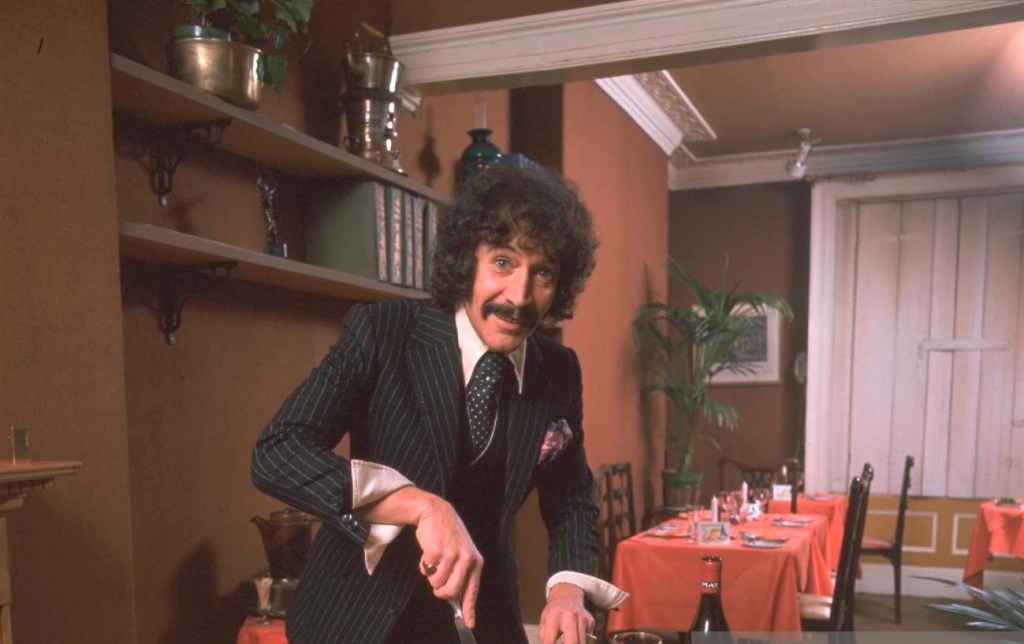


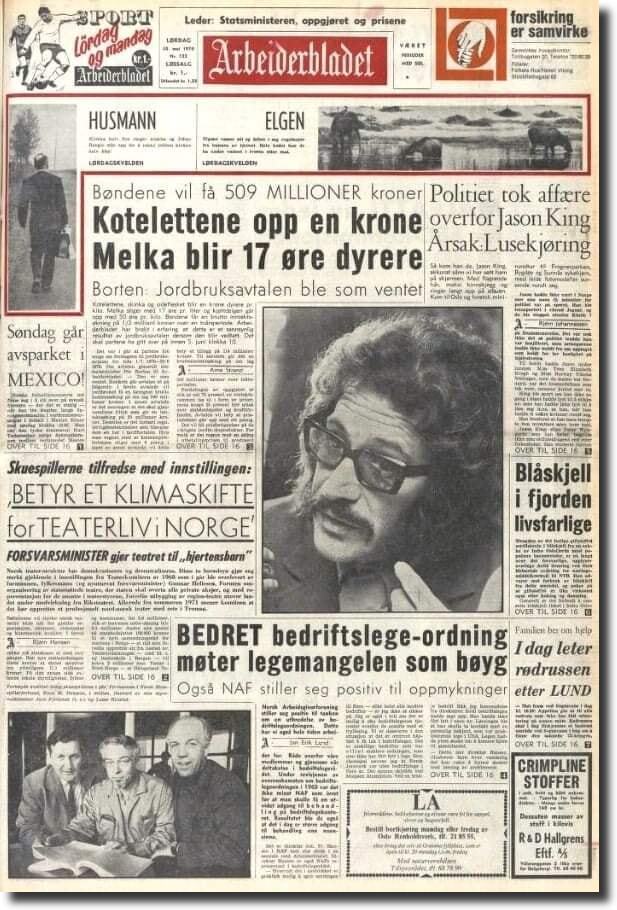

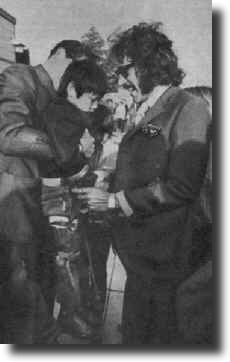
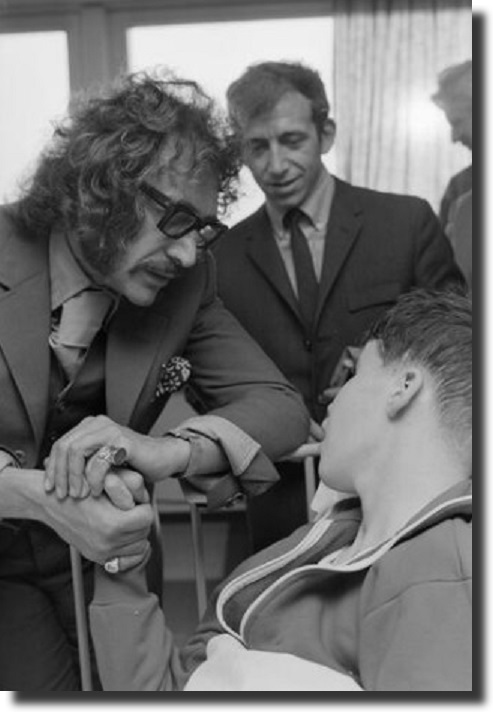

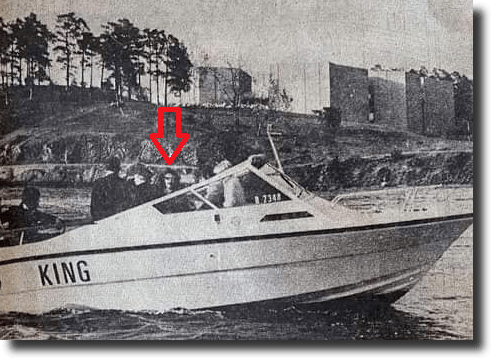
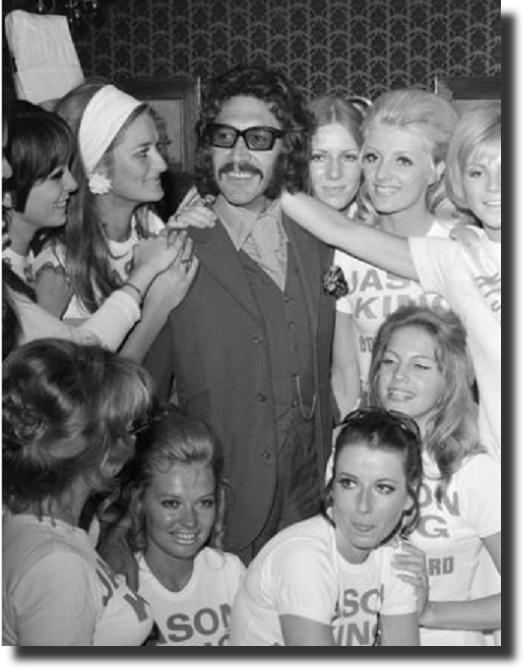
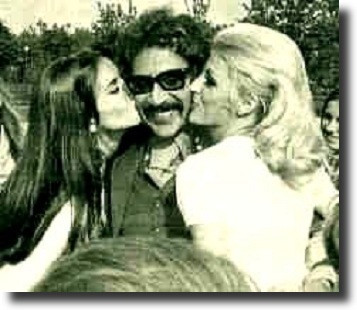






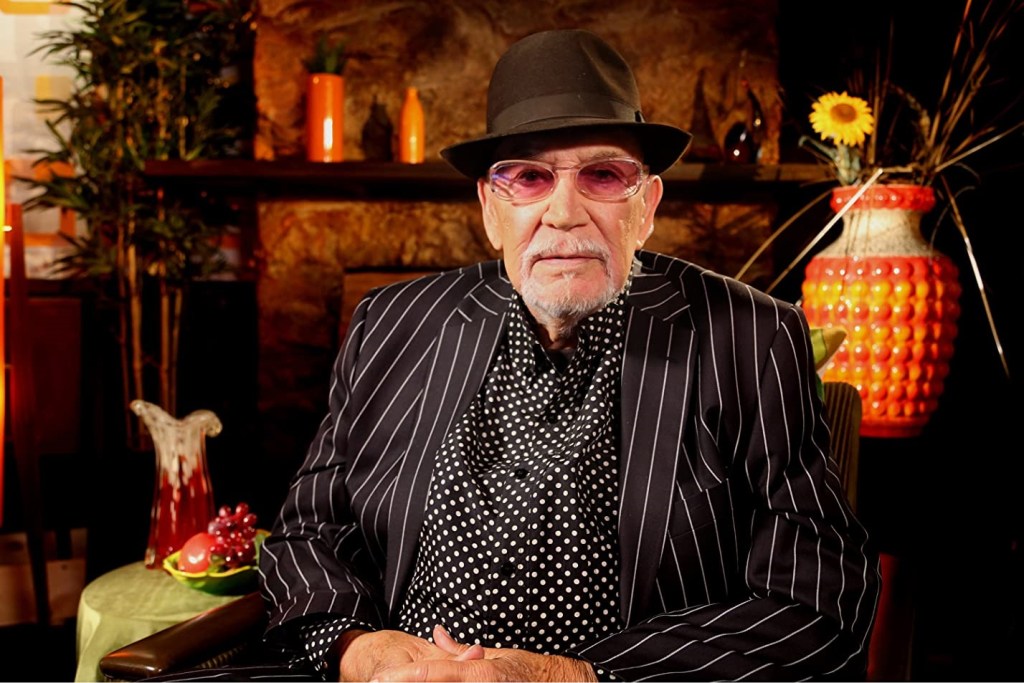

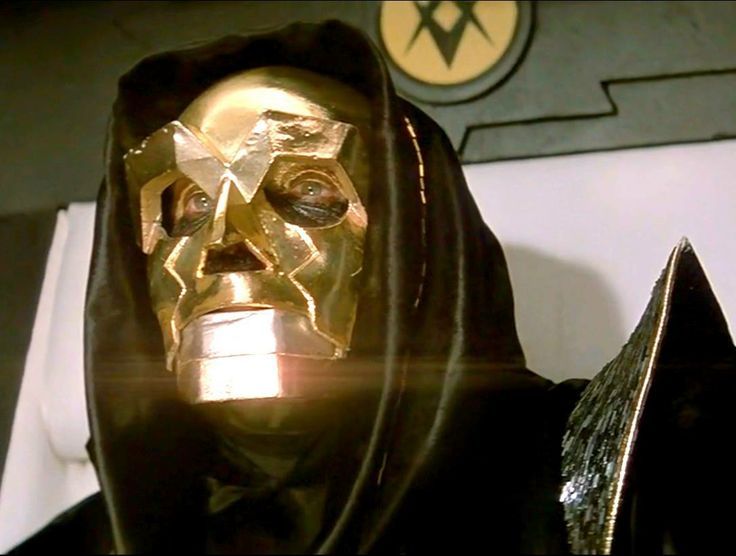


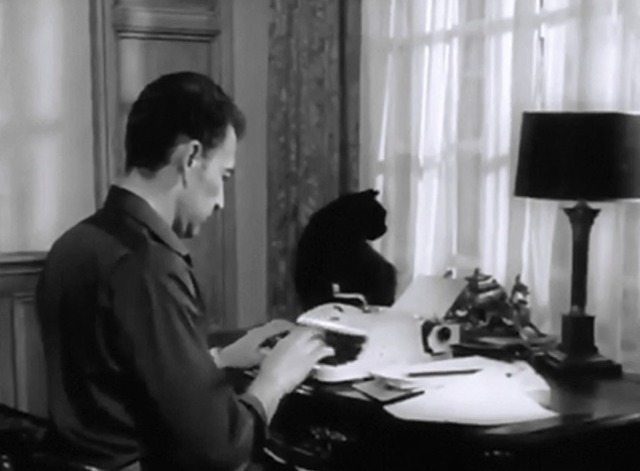

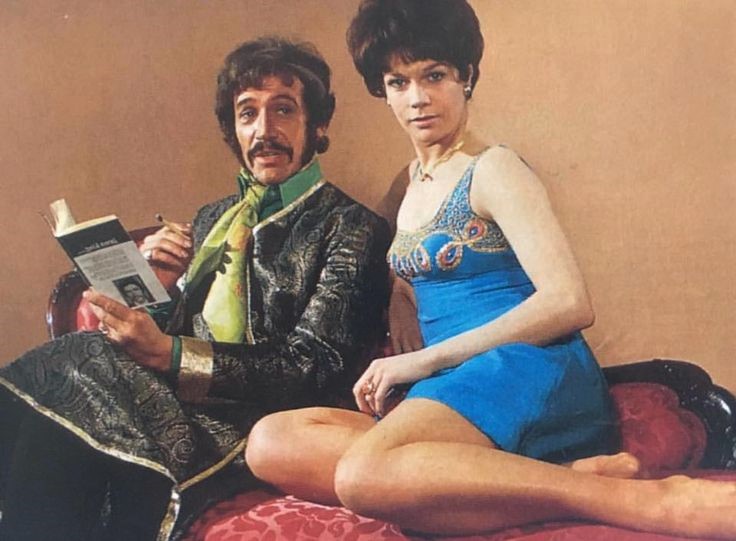
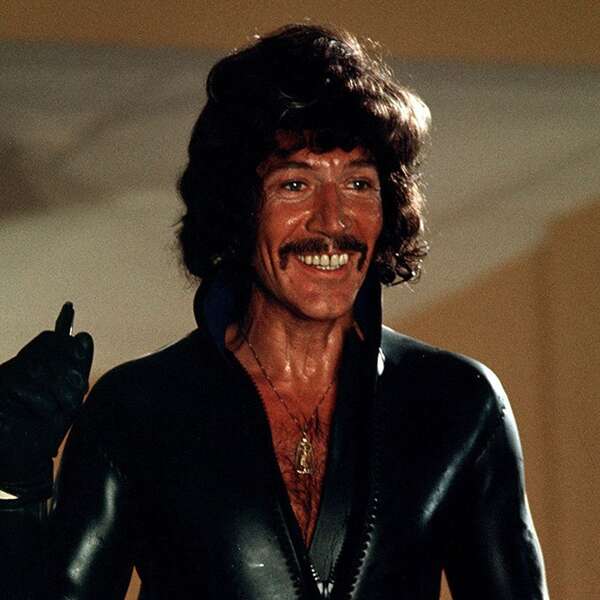

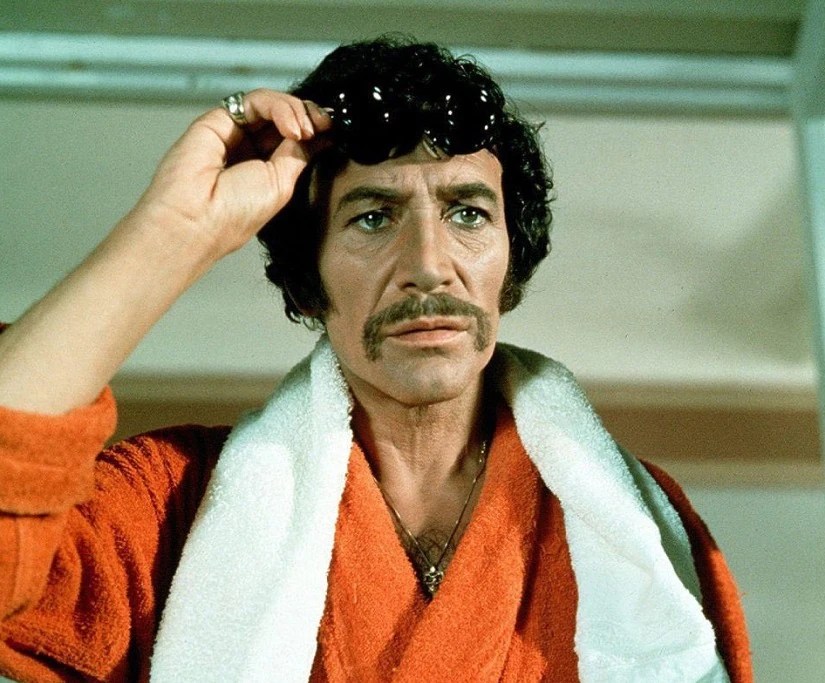
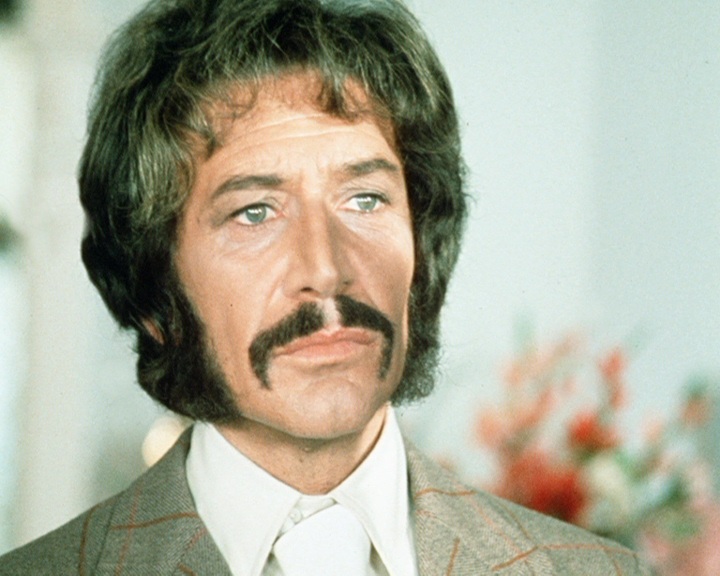

 PETER WYNGARDE: The Official Website