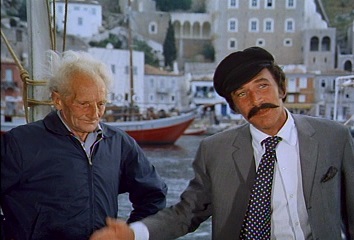
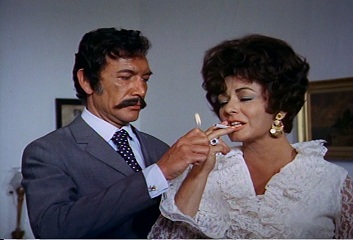
Presented by Ashway Productions Ltd., in association with The Laurence Parness Organisation Ltd. British tour, Summer/Autumn 1976
Character: Prince Bounine
The Story
The action takes place in the Reception Room of Prince Bounine’s mansion in the outskirts of Berlin.
Act I: A January Evening
Act II: An afternoon one weeks later
Act III: An afternoon two weeks later
The play tells the story of a group of unscrupulous Russian exiles: the Tzar’s former aide-de-camp Prince Bounine (Peter Wyngarde) – artist Piotr Petrovsky (David Griffin), and banker, Boris Adreivich Chernov (David Nettheim), decide to exploit Anna Broun (Nyree Dawn Porter), when she claims to be Princess.
The men decide to form a consortium to raise funds amongst the exiled White Russian community to provide backing for ‘Anastasia’ to reclaim a inheritance of over £3,000,000, which the syndicate plan to share between themselves. Their main concern is to convince the Court in Exile – and especially the Dowager Empress Marie (Elspeth March), the Tsar’s mother.
As speculation concerning the Princess begins to spread across Europe, there is no shortage of subscribers willing to aid the conspirators and the young woman who, there is little doubt, bears a striking resemblance to the long-lost Anastasia.
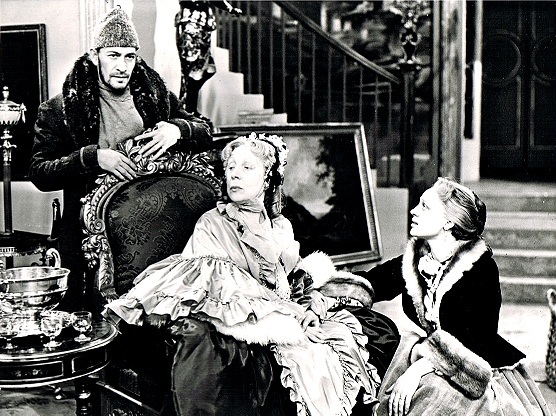
Right: Peter as Prince Bounine with Nyree Dawn Porter as Anastasia
Matters take an unexpected turn when the Prince Bounine and his accomplices begin to realise that Anne might actually be the real deal.
Obviously traumatised by the machinations of the three accomplices, ‘Anastasia’ reaches out to to in a catatonic trance the Dowager Empress who, aware of the men’s deception, answers with her own yearnings and wishful thinking. Self and reality are whatever we want them to be, it would seem, and all untrustworthy, unsound and brittle.
Anastasia Enigma
In 1918, the Grand Duchess Anastasia Nikolaevna of Russia and the rest of the ruling Romonov family, were reported massacred by Bolshevik Bolshevik Red Guards in Ekaterinburg, and controversy thereafter raged as to whether the 17-year-old Duchess escaped death and was smuggled out of Russia.
The tragic events leading up to the assassination of the last Tsar of Russia are well recorded in history. The young Tsarevich Alexis – only son of the Tsar Nicholas and the Empress Alexandra, was an haemophiliac; a genetic disease inherited through the line of his Great Grandmother, Queen Victoria, and his suffering caused the Empress to turn to Rasputin; a wandering holy man. Through his hypnotic powers, Rasputin could elevate her son’s pain. The tremendous hold that the mystic had over the Empress was one of the major factors that led to the Revolution. The Tsar was naïve, ill-advised and believed wholeheartedly in the autocracy. When the country asked for reform and a sharing of the Imperial power with a more responsible government, the Tsar, influenced by Alexandra and Rasputin, refused and revolution was inevitable.
The Revolution in 1917 culminated in the downfall of the fabulously wealthy Romanov dynasty. In 1918 Nicholas and Alexandra, their daughters Olga, Tatiana, Marie and Anastasia, and the Tsarevich Alexis were imprisoned at Ekalerinburg. It is reported that on the night of July 16th the entire family, along with four retainers and a pet spaniel, were shot and bayonetted to death and their bodies disposed of in a disused mine shaft.
However, over the years there have been a number of claimants to the title of the Grand Duchess Anastasia; heiress to a vast fortune, and the rumours persist that the young Anastasia miraculously escaped the massacre and was smuggled out of Russia by sympatisers. One of the most famous of these was Anna Broun, also known as Anna Anderson, who was the only woman who tried legally to establish herself as the legitimate heiress to the Romanov legacy. her case was finally dismissed in the German courts in 1967.
Nyree Dawn porter who played Anna Broun in this play, said at the time that she had an open mind on the subject. During her research for the role she’d come across an out-of-print book entitled, ‘I Am Anastasia’, that had been written by Broun. She said she found the story intriguing. “When I first heard the story, I thought she must’ve been a charlatan,” Ms Porter said. “Then I read the book and found myself completely bemused, There are so many factors to think about. Anna had a schizophrenic side to her character – she had to find herself. She’s not nice, but she wasn’t insane. And is she wasn’t Anastasia it was a long time to live a lie. The play is very close to what really happened. The characters are fact, though some have been given different names and a certain amount of dramatic licence has been taken”.
Peter, who portrayed Prince Bounine in the play, shares Ms Porter’s views on Anna Broun. “I haven’t got an answer to it at all,” he says. “But I’m fascinated by certain aspects of the story – the fact, for instance, that Anna could not or would not speak Russian when she was first found., though it later turned out that she spoke the language fluently. Also that the claims for the Tsar’s money were suddenly dropped and nobody has made a claim since, even though there’s a great deal of money involved. In 1912, the Tsar was the richest man in the world”.
Such an intriguing and romantic mystery is an obvious subject for dramatization. A film version of ‘Anastasia’ was made in 1956 starring Ingrid Bergman and Yul Brynner as Anna and prince Bounine, and in 1971, Kenneth McMillan created a full-length ballet about Anastasia for Lynn Seymour and the Royal Ballet. More recently, a musical version became a box office hit on Broadway. This particular play was adapted by Guy Bolton from the French novel by Marcelle Maurette.
At the time that this play was touring the UK, there was a chance that the Anastasia legend might have a sequel. In ‘The File on the Tsar’ (Gollancz) – a book published in the mid-1970’s by Tom Mangold and Anthony Summers, new evidence was brought to light, suggesting that other members of the Romanov family may’ve survived. One fact is certain – the Anastasia enigma will continue to be of enduring appeal and interest.
Actor David Nettheim on working with Peter in ‘Anastasia’:
“Peter Wyngarde was really an outrageous character. You couldn’t believe the clothes he wore. We played a West End season at the Cambridge Theatre. He played the principal lead character, which Yul Brynner played and which I played before Yul Brynner at the very first season – at four days’ notice I might add, but that’s another story. Peter was flamboyant and didn’t like the designs for his costumes when he saw them on paper. He didn’t say anything, went off and engaged a designer to design all his uniforms, which looked over-the-top!”
Actually, both Peter’s uniform, and the costumes worn by Elspeth March, were designed by Alan Sievewright! And you wonder how these ridiculous stories begin….
Critics Comments
“There are moments when Peter Wyngarde, as the scoundrelly Prince Bounine, seems like a cross between Henry Higgins and Svengali. He is dark, dashing and plausible,” Birmingham Evening Mail – 15h June, 1976
A bit of Trivia
Peterhad previously worked with Nyree Dawn Porter and Elspith March in ‘The Duel’ at the Duke of York’s, London, in 1968, and with Ms March in ‘Underground’ – National British tour, 1983.
This play is extremely difficult to review, given that it’s not only based on true events, but the dialogue is taken, word-for-word, from actual court records which are well documented elsewhere. Nevertheless….
A Bit Of Background
‘On Trial’ was a series of 60-minute reconstructions of famous British trials produced by Peter Wildeblood for Granada TV in Manchester. The premise of this detailed and brilliantly executed set of plays was to present them in documentary-style form, complete with external narrator – Andrew Faulds and commentator, Brian Ingis. It could be said that the series was a precursor to the kind of programmes that became popular on British TV thereafter, such as ‘Crown Court’ (1972-1984).
The series opener was ‘Sir Roger Casement’ – the play focused on here. The 10-epiode run continued with the trials of other illustrious and/or notorious personages (depending on your point-of-view), that included Oscar Wilde, and Sir Charles Dilke.
Historical Facts
Roger David Casement was born in Dublin, Ireland, on 1st September, 1864. After becoming a member of the British Diplomatic Corps. he was hailed a national hero for his activities in both South America and Africa.
At the turn of the 20th century, Casement was assigned to what was then the Belgian Congo, where he was instrumental in exposing the pitiless and exploitative practices used upon the indigenous peoples by Leopold II – King of Belgium, who plundered the colonies rich mineral deposits for his own personal gain.
Casement was instrumental in bringing this this outrage to the ears and eyes of the world, forcing Leopold to surrender the whole of the Dependency to his nation. Alas, this move did little to improve the lot of the population.
On his return from the Congo, Casement was directly assigned to a posting in Peru, where he was to find that similar crimes were being committed to those in Africa. He worked tirelessly to bring the plight of the people to the attention of the world’s governments and, in 1911, was rewarded for his humanitarian work with a knighthood.
The Play and the story behind it
A realistic and skillfully edited reconstruction of the trial of Sir Roger Casement for High Treason, opened a new series entitled ‘On Trial’ for Independent Television on Friday, July 8th, 1960. The case itself was an interesting and notorious one, although much more for its aftermath than for the matter for which Casement actually stood trial.
The story told through this play is of the trial of Sir Roger David Casement in 1916 for High Treason. The events that lead to this point were as follows:
It was on Good Friday of 1916, when the First World War was at its height, that Sir Roger Casement was arrested after landing from a German U-Boat on the Irish coast. His trial for treason, overshadowed by the existence of his notorious private diaries, was one of the most sensational in British history. The last of the great state trials at bar, Casement’s trial is still of enduring interest to lawyers, but since his counsel, Sergeant Alexander Sullivan, declined to put him into the witness box, the four-day trial in the court of the Lord Chief Justice in June of 1916, lacked the cut-and-thrust which marked Sir Edward Carson’s cross examination of Oscar Wilde.
_________________
As the first shots of World War I were being fired, Dublin-born Casement made had his way to Wilhekmine in Germany, where he’d proffered both his skills and knowledge to the Kaiser in return for his backing in freeing Ireland from British rule. An agreement was struck, and Casement was returned to the coast of Eire in a U-boat.
The idea was that Casement would play a leading part in the Easter Uprising, where he was to distribute a consignment of arms to the rebels. However, the handover failed and casement was captured and detained by the British.
As a result of what the British government saw as a major betrayal, Casement was stripped of his Knighthood and charged with treason. Numerous well-known personalities came to Casement’s defence – including such luminaries as Gilbert Chesterton, Arthur Conan Doyle Edmund Morel and George Bernard Shaw – who suggested that the Accused must’ve suffered some sort of mental aberration to have carried out such an act of “evil” against the State, although their well-meaning interfering was not welcomed by Casement, who resented the implication that he was mentally ill.
Fortuitously for the Government, Scotland Yard supremo, Sir Basil Thompson, happened upon a much bigger stick with which to beat Casement with in the form of the infamous ‘Black Diaries’; a set of journals in which the Irishman had kept detailed account of his sexual encounters and homoerotic fantasies whilst in service to the Crown. The authorities ensured that copies of the Diaries were distributed widely enough to ensure that the growing appeals for leniency were quickly suppressed. Casement was hung at Pentonville Prison on 3rd August, 1916.
Peter’s Performance
This wasn’t Peter’s first daring role, having played exiled Polish officer, Lieutenant Jan Wicziewsky in Granada’s production of Julien Green’s ‘South’ in November 1959.
The play concentrates on the moments of high drama: the collapse of Sullivan at the end of the third day; Casement’s speech from the dock; the solemnity of the three judges, each wearing a black cap passing the death sentence. Although he had little dialogue during the first 50 minutes of the play, the jewel in the crown of this production is undoubtedly Casement’s ‘Closing Speech’, which was spoken in its entirety byPeterwho, at the age of just 27, played the 51-year-old Irishman with exceptional dignity and restraint. His performance in the title role; convincingly suggesting that Casement, sitting scribbling furiously or quizzically listening from the dock, dominated the proceedings, and his final scene was exceptionally moving.
The Speech
N.B. Peter recounted this speech in it’s entirety in one take. Quite a feat!
“My Lord Chief Justice, as I wish to reach a much wider audience than I see before me here, I intend to read all that I propose to say. What I shall read now is something I wrote more than twenty days ago. I may say, my lord, at once, that I protest against the jurisdiction of this Court in my case on this charge, and the argument that I am now going to read is addressed not to this Court, but to my own countrymen.
With all respect I assert this Court is to me, an Irishman, not a jury of my peers to try me in this vital issue for it is patent to every man of conscience that I have a right, an indefeasible right, if tried at all, under this Statute of high treason, to be tried in Ireland, before an Irish Court and by an Irish jury. This Court, this jury, the public opinion of this country, England, cannot but be prejudiced in varying degree against me, most of all in time of war.
I did not land in England; I landed in Ireland. It was to Ireland I came; to Ireland I wanted to come; and the last place I desired to land in was England. But for the Attorney General of England there is only “England”—is no Ireland, there is only the law of England—no right of Ireland; the liberty of Ireland and of Irish is to be judged by the power of England. Yet for me, the Irish outlaw, there is a land of Ireland, a right of Ireland, and a charter for all Irishmen to appeal to, in the last resort, a charter that even the very statutes of England itself cannot deprive us of—nay, more, a charter that Englishmen themselves assert as the fundamental bond of law that connects the two kingdoms.
This charge of high treason involves a moral responsibility, as the very terms of the indictment against myself recite, inasmuch as I committed the acts I am charged with, to the “evil example of others in the like case.” What was this “evil example” I set to others in “the like case,” and who were these others? The “evil example” charged is that I asserted the rights of my own country, and the “others” I appealed to aid my endeavour were my own countrymen.
The example was given not to Englishmen but to Irishmen, and the “like case” can never arise in England, but only in Ireland. To Englishmen I set no evil example, for I made no appeal to them. I asked no Englishman to help me. I asked Irishmen to fight for their rights. The “evil example” was only to other Irishmen who might come after me, and in “like case” seek to do as I did. How, then, since neither my example nor my appeal was addressed to Englishmen, can I be rightfully tried by them? If I did wrong in making that appeal to Irishmen to join with me in an effort to fight for Ireland, it is by Irishmen, and by them alone, I can be rightfully judged.
From this Court and its jurisdiction I appeal to those I am alleged to have wronged, and to those I am alleged to have injured by my “evil example,” and claim that they alone are competent to decide my guilt or my innocence. If they find me guilty, the statute may affix the penalty, but the statute does not override or annul my right to seek judgment at their hands.
This is so fundamental a right, so natural a right, so obvious a right, that it is clear the Crown were aware of it when they brought me by force and by stealth from Ireland to this country. It was not I who landed in England, but the Crown who dragged me here, away from my own country to which I had turned with a price upon my head, away from my own countrymen whose loyalty is not in doubt, and safe from the judgment of my peers whose judgment I do not shrink from. I admit no other judgment but theirs. I accept no verdict save at their hands. I assert from this dock that I am being tried here, not because it is just, but because it is unjust. Place me before a jury of my own countrymen, be it Protestant or Catholic, Unionist or Nationalist, Sinn Feineach or Orangemen, and I shall accept the verdict and bow to the statute and all its penal ties. But I shall accept no meaner finding against me than that of those whose loyalty I endanger by my example and to whom alone I made appeal. If they adjudge me guilty, then guilty I am. It is not I who am afraid of their verdict; it is the Crown. If this be not so, why fear the test? I fear it not. I demand it as my right.
That, my lord, is the condemnation of English rule, of English-made law, of English Government in Ireland, that it dare not rest on the will of the Irish people, but it exists in defiance of their will—that it is a rule derived not from right, but from conquest. Conquest, my lord, gives no title, and if it exists over the body, it fails over the mind. It can exert no empire over men’s reason and judgment and affections; and it is from this law of conquest without title to the reason, judgment, and affection of my own countrymen that I appeal. I would add that the generous expressions of sympathy extended me from many quarters, particularly from America, have touched me very much. In that country, as in my own I am sure my motives are understood and not misjudged for the achievement of their liberties has been an abiding inspiration to Irishmen and to all men elsewhere rightly struggling to be free in like cause.
My Lord Chief Justice, if I may continue, I am not called upon, I conceive, to say anything in answer to the inquiry your lordship has addressed to me why Sentence should not be passed upon me. Since I do not admit any verdict in this Court, I cannot, my lord, admit the fitness of the sentence that of necessity must follow it from this Court. I hope I shall be acquitted of presumption if I say that the Court I see before me now is not this High Court of Justice of England, but a far greater, a far higher, a far older assemblage of justices—that of the people of Ireland. Since in the acts which have led to this trial it was the people of Ireland I sought to serve—and them alone—I leave my judgment and my sentence in their hands…
My counsel has referred to the Ulster Volunteer movement, and I will not touch at length upon that ground save only to say this, that neither I nor any of the leaders of the Irish Volunteers who were founded in Dublin in November, 1913, had quarrel with the Ulster Volunteers as such, who were born a year earlier. Our movement was not directed against them, but against the men who misused and misdirected the courage, the sincerity and the local patriotism of the men of the north of Ireland. On the contrary, we welcomed the coming of the Ulster Volunteers, even while we deprecated the aims and intentions of those Englishmen who sought to pervert to an English party use—to the mean purposes of their own bid for place and power in England—the armed activities of simple Irishmen. We aimed at winning the Ulster Volunteers to the cause of a united Ireland. We aimed at uniting all Irishmen in a natural and national bond of cohesion based on mutual self-respect. Our hope was a natural one, and if left to ourselves, not hard to accomplish. If external influences of disintegration would but leave us alone, we were sure that Nature itself must bring us together.
How did the Irish Volunteers meet the incitements of civil war that were uttered by the party of law and order in England when they saw the prospect of deriving political profit to themselves from bloodshed among Irishmen? I can answer for my own acts and speeches. While one English party was responsible for preaching a doctrine of hatred designed to bring about civil war in Ireland, the other, and that the party in power, took no active steps to restrain a propaganda that found its advocates in the Army, Navy, and Privy Council—in the Houses of Parliament and in the State Church—a propaganda the methods of whose expression were so “grossly illegal and utterly unconstitutional” that even the Lord Chancellor of England could find only words and no repressive action to apply to them. Since lawlessness sat in high places in England and laughed at the law as at the custodians of the law, what wonder was it that Irishmen should refuse to accept the verbal protestations of an English Lord Chancellor as a sufficient safe guard for their lives and their liberties? I know not how all my colleagues on the Volunteer Committee in Dublin reviewed the growing menace, but those with whom I was in closest co-operation redoubled, in face of these threats from without, our efforts to unite all Irishmen from within. Our appeals were made to Protestant and Unionist as much almost as to Catholic and Nationalist Irishmen.
We hoped that by the exhibition of affection and good will on our part towards our political opponents in Ireland we should yet succeed in winning them from the side of an English party whose sole interest in our country lay in its oppression in the past, and in the present in its degradation to the mean and narrow needs of their political animosities. It is true that they based their actions, so they averred, on ‘‘fears for the Empire’’ and on a very diffuse loyally that took in all the people of the Empire, save only the Irish. That blessed word “Empire” that bears so paradoxical a resemblance to charity! For if charity begins at home, “Empire” means in other men’s homes and both may cover a multitude of sins. I for one was determined that Ireland was much more to me than “Empire,” and that if charity begins at home so must loyalty.
Since arms were so necessary to make our organisation a reality, and to give to the minds of Irishmen, menaced with the most outrageous threats, a sense of security, it was our bounden duty to get arms before all else.
We have been told, we have been asked to hope, that after this war Ireland will get Home Rule, as a reward for the life-blood shed in a cause which whoever else its success may benefit can surely not benefit Ireland. And what will Home Rule be in return for what its vague promise has taken and still hopes to take away from Ireland? It is not necessary to climb the painful stairs of Irish history—that treadmill of a nation whose labours are in vain for her own uplifting as the convict’s exertions are for his redemption—to review the long list of British promises made only to be broken—of Irish hopes raised only to be dashed to the ground. Home Rule when it comes, if come it does, will find an Ireland drained of all that is vital to its very existence—unless it be that unquenchable hope we build on the graves of the dead.
We are told that if Irishmen go by the thousand to
die, not for Ireland, but for Flanders, for Belgium, for a patch of sand on the deserts of Mesopotamia, or a rocky trench on the heights of Gallipoli, they are winning self-government for Ireland. But if they dare to lay down their lives on their native soil, if they dare to dream even that freedom can be won only at home by men resolved to fight for it there, then they are traitors to their country, and their dream and their deaths alike are phases of a dishonourable fantasy.
But history is not so recorded in other lands. In Ireland alone in this twentieth century is loyalty held to be a crime. If loyalty be something less than love and more than law, then we have had enough of such loyalty for Ireland or Irishmen. If we are to be indicted as criminals, to be shot as murderers, to be imprisoned as convicts because our offence is that we love Ireland more than we value our lives, then I know not what virtue resides in any offer of self-government held out to brave men on such terms. Self-government is our right, a thing born in us at birth; a thing no more to be doled out to us or withheld from us by another people than the right to life itself—than the right to feel the sun or smell the flowers or to love our kind. It is only from the convict these things are withheld for crime committed and proven—and Ireland that has wronged no man, that has injured no land, that has sought no dominion, over others—Ireland is treated to-day among the nations of the world as if she were a convicted criminal.
If it be treason to fight against such an unnatural fate as this, then I am proud to be a rebel, and shall cling to my “rebellion” with the last drop of my blood. If there be no right of rebellion against a state of things that no savage tribe would endure without resistance, then I am sure that it is better for man to fight and die without right than to live in such a state of right as this. Where all your rights become only an accumulated wrong; where men must beg with bated breath for leave to subsist in their own land, to think their own thoughts, to sing their own songs, to garner the fruits of their own labours—and even while they beg, to see things inexorably withdrawn from them—then surely it is a braver, a saner and a truer thing, to be a rebel in act and deed against such circumstances as these than tamely to accept it as the natural lot of men.
My lord, I have done. Gentlemen of the jury, I wish to thank you for your verdict. I hope you will not take amiss what I said, or think that I made any imputation upon your truthfulness or your integrity when I spoke and said that this was not a trial by my peers. I maintain that I have a natural right to be tried in that natural jurisdiction, Ireland my own country, and I would put it to you, how would you feel in the converse case, or rather how would all men here feel in the converse case, if an Englishman had landed here in England and the Crown or the Government, for its own purposes, had conveyed him secretly from England to Ireland under a false name, committed him to prison under a false name, and brought him before a tribunal in Ireland under a statute which they knew involved a trial before an Irish jury? How would you feel yourselves as Englishmen if that man was to be submitted to trial by jury in a land inflamed against him and believing him to be a criminal, when his only crime was that he had cared for England more than for Ireland?”
Above: New Statesman – 16th July, 1960
A Bit Of Trivia
Mention of the infamous ‘Black Diaries’ was made only in passing at the end of the play by the Narrator, in spite of their coming into the public domain around the time that the play was broadcast.
Producer, Peter Wildeblood, played a major part in the decriminalising of Homosexuality in the United Kingdom, having been one of only three gay men to appear before the Wolfenden Committee [1]. He himself had been arrested and sent to Wormwood Scrubs in the 1950’s for his part in the Montagu Case [2]. His 1955 memoir, ‘Against the Law’, was adapted by the BBC into a documentary in 1967.
[1]. Departmental committee set up by the British government under Sir John Wolfenden that recommended the decriminalisation of homosexuality in the UK.
[2]. Lord Edward Douglas-Scott, 3rd Baron Montagu of Beaulieu (1926-2015), who was put on trial in the mid-1950’s for Gross Indecency.
On Saturday, June 17th, 1989, Steven Ricks of TR 7 Productions interviewed Peter at the Thatched Barn (The Elstree Moat House) in Borehamwood, Hertfordshire (England), for his film, ‘The Prisoner Investigated’.
Sadly, the interview was never used in any form by TR 7 Productions, and was hidden away on file until Mr. Ricks gave permission for the Hellfire Club to publish the complete transcript.
Steven Ricks: How did you first become involved with The Prisoner series itself?
PETER: I think it was Pat (McGoohan) who asked me to play Number 2. I think it came about because a long time ago I did a series called ‘Epilogue To Capricorn’, which was probably one of the best titles for any series in the world, but which probably had one of the worst scripts in the world! So the actors got together with the director, who was wild and crazy and was eager to do things, and he said: “What do you want to do then? I said, “Throw away the script – throw it in the bin, and we’ll just ad-lib. We more or less know what the characters are, and we could take it from there.” It became the top TV series of the time, because nobody knew what was happening. Does that echo something that happened with The Prisoner?
Steven Ricks: Yes.
PETER: And I think that’s how it came about. Pat said: “Would you like to do it?” And I said, “Of course I would! I love doing things like that.” I mean, the marvellous thing about filming – I don’t want to sound like that character I told you about who did that interview with all the clips of different actors on ‘Wogan’ [1], and sound like one of them, because actors talking about acting is one of the most boring things in the world – I must warn you of that to begin with. The great thing about this is that if you can do something that is off the cuff, which is what movies are about for me – it’s much more exciting. If it’s right off the cuff, then it works. If you’ve got the time and the money to do a David Lean film, which you can take time with and work on it – he has worked on a film for fifteen years. But of course, Patrick didn’t have that time, you see. He was the only guy who had a script. He knew what he was going for and I think it had a lot to do with that kind of excitement of creating something out of an idea, really.
Steven Ricks: What did you think of the script when you actually read it?
PETER: I don’t think I did.
Steven Ricks: You didn’t have a script?
PETER: I never read scripts anyway. If I can avoid it. I don’t think there’s any point in reading most of them. I’ll tell you another little secret about film scripts. If you pick up a film script and in the first ten pages there is dialogue, the best thing to do is throw it in the bin, if you can, because they are called moving pictures, and moving pictures have to move. You have to have action. If they do, then that’s great, but if there is all yap-yap-yap-yap-yap, page after page after page, you are into a radio play, or a theatre play.
Steven Ricks: Radio with pictures.
PETER: Yes, radio with pictures, or film plays – which they did for a very long time.
Steven Ricks: So, were you originally going to be going up to Portmierion village when they started out?
PETER: As far as I know – I was looking forward to that. I was rather disappointed that I never saw it, really. The studio had the operations room. I remember running round on the MGM lot, which was supposed to be a cut of the location thing. I remember running about a bit, because I remember those terrible blue Dunlop shoes that we all had to wear. I think he (McGoohan) must’ve had a deal with Dunlop or something – I thought they were hideous! But everyone wears them now, don’t they? Now they are popular. I just thought they were hideous. They were alright on a yacht, I thought, but I wasn’t mad about them on land.
Steven Ricks: When it came to do some of the studio stuff, where you’ve got the desk and all the control panels etc….
PETER: I was looking up, I think. At the big screen.
Steven Ricks: Did that cause problems sometimes?
PETER: Sometimes the angles were tricky, I think. And also the stuff they used on it – it was film in those days, not video.
Steven Ricks: Yes, it was film.
PETER: So the film had to be pushed onto screen. It had to match the second screen and the third screen and the fourth screen. So there was always a tiny bit of technical hitch going on there; there was always a bit of hold-up while they did those sorts of things. Waiting for the thing to do – it was a bit like watching a television, or a video now where you go (imitates a voice running backwards) it all goes back and you’ve got everybody going like that, and you come back on it. So there was a lot of technical things to do. I remember a fight that I had on a platform while these things were going on and I suddenly thought – we all stopped, because we thought ‘Oh my God! It means that every time we throw a punch we’ve got to match it up with the thing over there!’So Patrick very sensibly shot it at a different angle so we didn’t have to do all that. He was very good, you know, as a director. He should’ve directed a great deal more, I think.
Steven Ricks: Don Chaffey was the director on that particular episode.
PETER: Patrick did a lot.
Steven Ricks: Patrick did a lot?
PETER: Oh yes. He was the over-all boss on the thing; he watched every single thing. It was his baby, you know. He did ‘Danger Man’ to begin with, and he didn’t have a great say on the whole series – it was just one of those things, and as a result of that he said: “What would you like to do?” And he said: “As a matter of fact, I’ve got this idea”, and he went forward and presented it. This old hat to you?
Steven Ricks: Well, no.
PETER: But you’ve heard it all?
Steven Ricks: But I haven’t got it on film.
PETER: The thing that happened, I think. First, he did ‘Danger Man’ – huge success. Then he was asked what he’d like to do next, and I think he said I would like to do a series of my own. And Lew Grade said he could. Lew Grade didn’t know what was going on – he hadn’t a clue. And when it (The Prisoner) came out, I don’t think he was overjoyed by the idea, was he? There was a great deal of publicity saying ‘What the hell is going on?’ He’s a very honest man, in a way, Lew Grade. I did a series called Department S, which was very, very successful, and I was summoned to his office – this just gives you an indication of how I think Patrick had to deal with him, as I’m sure that the same thing applied. When he said, “Listen. I’ve got to tell you something. I don’t have my heroes like you. My heroes are blond; they’ve got blue eyes, and they are good looking. You come along here with a Viva Zapata moustache and you have this long black hair down to your shoulders, and you wear these funny clothes with your cuffs turned back. That’s not my idea of a hero. But, he said, I must tell you – my wife loves you, so we’ll do another series, OK!” And that’s how we did the second series, and I’m sure the same happened with Pat. He probably said ‘I don’t know what the hell’s going on, but some people like it. Let’s go on.’ You know you only usually do thirteen to begin with – or whatever it is, and if they work, they carry on. If they don’t work… There’s a lot of money involved, especially in those days. Especially for an English series, because there wasn’t all that much money floating about for that sort of thing. It was a feather in (Grade’s) cap; he allowed Patrick to do it, and it was huge – and it still has a phenomenal cult following.
Steven Ricks: What was Patrick like as a director.
PETER: Very helpful. Very, very helpful indeed. I think that he has got an outer sort-of surface, hasn’t he? One gets the feeling of it – and especially of the character he was playing. But beneath it he has got a very wicked sense of humour. I believe so. There was an instance when one of the actors said: “I don’t understand what this means.” And I caught Pat’s eye, and he looked at me and sort of went (he winks). And so the actor didn’t see that, and he said: “Well, I think that he means…”. Patrick had written it, remember, and he was directing it. And the actor said: “I think he’s a bit thick, isn’t he?”, and Patrick said: “Yes. That’s a very good idea to play him thick.” And this fellow said: “Do you really think so, Pat?Do you think that’s a good way of doing it?”“Yes,” he said. “Play him as thick as you can.” So that sort of thing worked.
Steven Ricks: Now, there was a particular sequence in ‘The Prisoner’ series where you were sitting meditating and you do a karate chop at the end of the scene.
PETER: Did I?
Steven Ricks: Do you remember doing that?
PETER: I don’t. Uh! I was meditating? Oh, yes. Of course. Of course. That’s right – now that was something. I remember now. You’re bringing it all back. Isn’t that amazing? That was something I think I was into at the time. I was into yoga, and I thought, ‘Wouldn’t it be nice to do it here.’ And I think that’s how it came about. Yes, that’s how it came about. I don’t think it was in the script; may’ve been. There may’ve been an indication of it, and one took it from there. You only need an idea to go schoom with it, really. I think that’s what happened there.
Steven Ricks: Was it the original intention for you to play Number 2 once, or were you going to play it more than once?
PETER: I think the original idea was to go all the way through, and then whatever happened – whoever played the… was I the first one, or was someone else the first one? I think Leo (McKern) was the first one.
Steven Ricks: You were third.
PETER: Somebody was the first one when it was shown. Was that Christopher Lee?
Steven Ricks: No. It was Guy Doleman who was the very first one.
PETER: That’s right! He was going to go all the way through. I think he was the one who was going to go all the way through, and then they decided to change them, which I thought was more interesting for everyone, really. No, I don’t think that the original idea was to have a different Number 2; one each episode. There was an idea of having a guest star, because they did that with ‘Danger Man’, didn’t they? And all the series of that time.
You remember, you said you thought that I had shot some of the ‘Jason King’ thing over here at the Thatched Barn; I don’t think we did. I think we shot ‘The Saint’ (The Man Who Liked Lions) here. I have a feeling. I remember an orgy scene by a pool (laughs), and we were all supposed to dress up in Roman costumes. That was the time that Roger (Moore) and I were supposed to fence at the end of it, or sword fight – not fence. A sword fight. I pretended to Roger that I’d never picked up a sword in my life, and that I didn’t know what to do. In fact, I’d fenced at the Green Club (London) – you know, the whole thing – and I love it, absolutely love it. So I thought it would be a little game with Roger, and we had to do this fight thing, you see, and every time he came along to see how the doubles were doing with me, I would go: “Oh! Oh! Oh, God!” And I said: “Roger, do you think it would be better if you did it with a double?” He said: “Peter, we must see your face!” “So,” I said, “Can’t we just do it like they do in the Errol Flynn movies, you know, and have my face looking fierce like that?” He said: “Come on, have a go! We have one big take, OK?” It was ‘The Man Who Liked Lions’, that’s what it was called, and I had to knock him – bang, bang, bang, bang, and he gets hold of me and sticks the sword in me, and I fall into the lion’s den, which is the end of the movie – marvellous big moment. So he said to the stunt boys: “He’s a bit tricky about the fighting, isn’t he? Never mind, I’ll make him look tough; don’t worry. Then we can do the cuts and that sort of thing”. So I just went and really let him have it. And I went bang, bang, bang, bang, and I got Roger. He fell into the lion’s den! That was the episode that was filmed here.
Steven Ricks: There was also an actor called George Coularis….
PETER: Oh, yes! Yes!
Steven Ricks: …He was in ‘Citizen Kane’.
PETER: And the other one – ‘The Magnificent Andersons’. He was in what they called The Mercury Players. Mad as a hatter!
Steven Ricks: What was he like?
PETER: Wonderful. Eccentric. Crazy. Volatile. Terrific. Lovely. A very good actor; loved life and loved acting, which was shown, and everything was larger than life – off screen as well as on screen. I loved George; he was lovely. Super. It was a very happy series you know. Nobody knew what was going on, but it didn’t seem to matter.
Steven Ricks: Did you try to ask anybody? Did you ask Pat?
PETER: Everybody asked everybody, and then there was always a kind of – you know it was rather like the George Orwell thing, ‘1984’, which has parallels with this, hasn’t it? It’s a bit like that where you know something interesting is happening, but feels that you might be put away if you make too many inquiries! You know what I mean? And I don’t think that feeling was always around – people were sort of doing that occasionally, you know – you weren’t quite sure. It had a great atmosphere for the series, not just chummy-chummy actors together. It had this extraordinary atmosphere, I remember that. I mean, America has never done anything like that. It shows the kind of innovation that we are still capable of. Not recently, but ‘The Young One’s’ is an example of comedy which I love. I think it’s terrific – absolutely terrific. But not a great deal of television is new, is it? Do you know what I mean? You can hardly call ‘Dallas’ new, can you? Or ‘Coronation Street’ for that matter. It’s just getting into its 100th year or something!
Steven Ricks: It seems like it. Have you seen the episode you are in of ‘The Prisoner’?
PETER: I think I saw it at the time. I think I was terribly vain and watched myself relentlessly. I thought I was the most beautiful that had ever happened on the screen. Now you have to drag me to see myself in anything! I’ve just done a film and won’t go near the bloody thing, and I’m told it’s alright.
Steven Ricks: What did you think of your actual performance – of how the whole thing fitted together?
PETER: I really have no idea. I think that actors go through various kinds of phases. When I was an even less experienced actor – and that was pretty inexperienced – I went through a phase of being all the heroes I had seen on the screen. One day I would give you a performance of Errol Flynn; another day I was Noel Coward, and another day I was Ronald Coleman. They were the kind of movie and stage actors of the time – I was John Gielgud all over the place. It was awful! The series I did helped me more than any other thing I can think of to learn how to act on screen, but I think that if you’re lucky, if you are very, very lucky, the camera might pick up something that belongs to you – that is you; that is real; that is absolutely real. And you can’t lose that, you see. You don’t want to learn too much, because if you learn too much, you become aware of it. It becomes very boring. And we know lots of actors don’t we, who we think ‘Oh, he’s going to do the same old thing again. Isn’t he sick of it!’ He must have to see himself occasionally. One of them is appearing tonight. He’s probably your hero, so I’ll leave you to guess who that is.
Steven Ricks: Can you tell me. You said earlier that you saw Leo McKern. Whilst you were doing your one?
PETER: Well, Leo and I were up at rep in Nottingham. He played the father in ‘The Winslow Boy’ when I played the QC, I remember. We were both in rep with the lovely Maxine Audley and the guy who did a television series about a very seedy detective. Do you know who I mean?
Steven Ricks: When was that?
PETER: About 20 years ago. He wore terrible clothes – a raincoat.
Steven Ricks: You mean Peter Falk?
PETER: No. An English one. He was terrific. He was up there – Alfie Buerk. Do you remember Alfie Buerk?
Steven Ricks: Yes, I do.
PETER: You must’ve seen the series [2].
Steven Ricks: I don’t think I have.
PETER: You were what – 12?
Steven Ricks: You said you had seen Leo McKern whilst you were shooting.
PETER: Yes, while we were shooting. But you see we were doing things back-to-back, so he was in another studio, and I was where we were. And of course because we knew each other, I watched some of his and he came and watched some of mine. He hadn’t done a lot of movies – we were all fairly newish. So I think that had a lot to do with it.
Steven Ricks: What sort of things was he shooting? Was he just shooting on the same set you were doing?
PETER: Yes. You had the big set, you know. So he would come and do it in the afternoon, or whatever it was – maybe with Patrick directing, you see. Don (Chaffey) would be doing one bit, and he (McGoohan) would be doing the other.
Steven Ricks: Well, I think that I’ve asked just about asked you everything I wanted to ask you. Really?
PETER: You’re done with me? Well, that wasn’t very painful, was it?
Steven Ricks: I can’t think of much else to ask you. Except, what do you think of the way the series has received such a following.
PETER: Why do I think it has?
Steven Ricks: Yes.
PETER: I think for the reason I gave earlier on – that people weren’t quite sure what was going to happen next. Also, that they weren’t quite sure what it was about, and I think people like puzzles. If you have a murder like in the ‘Colombo’ thing, which have been wildly popular for a long time; all those sorts of things – Agatha Christie is another perfect example. Who did it. It’s a puzzle, isn’t it. And you want to watch the puzzle come out. Now, with ‘The Prisoner’, you knew there was something behind it, and it infuriated you because you couldn’t what it was, and the only way you could find out was by tuning in each week. It’s the extension of the cliff-hanger, isn’t it? Of the hero or the heroine going down a pit and clinging onto the end of the plane or train or whatever it is, and whether she falls down into the pit or not. You have got to know, haven’t you? That’s what it’s about. I thought that what had happened was that it had different levels; there was the Fascism – underlying Fascism there. The thing of terrorist governments. The Communism of the time, if you remember the Stalin attitudes. China had become Communist. It had all those layers underneath as well, which I don’t think were conscious, but they evolved consciously as a result of it. I think that was one of the main things.
Also, Patrick had a very strong, extremely stylised personality. He had an extraordinary delivery, for a start. It was very staccato, and an interesting delivery which I believed developed as a result of ‘Danger Man’, but it was carried forward into this. It was much more pronounced, because he as a person didn’t have that staccato, which I think he introduced for himself. And I think rightly for himself.
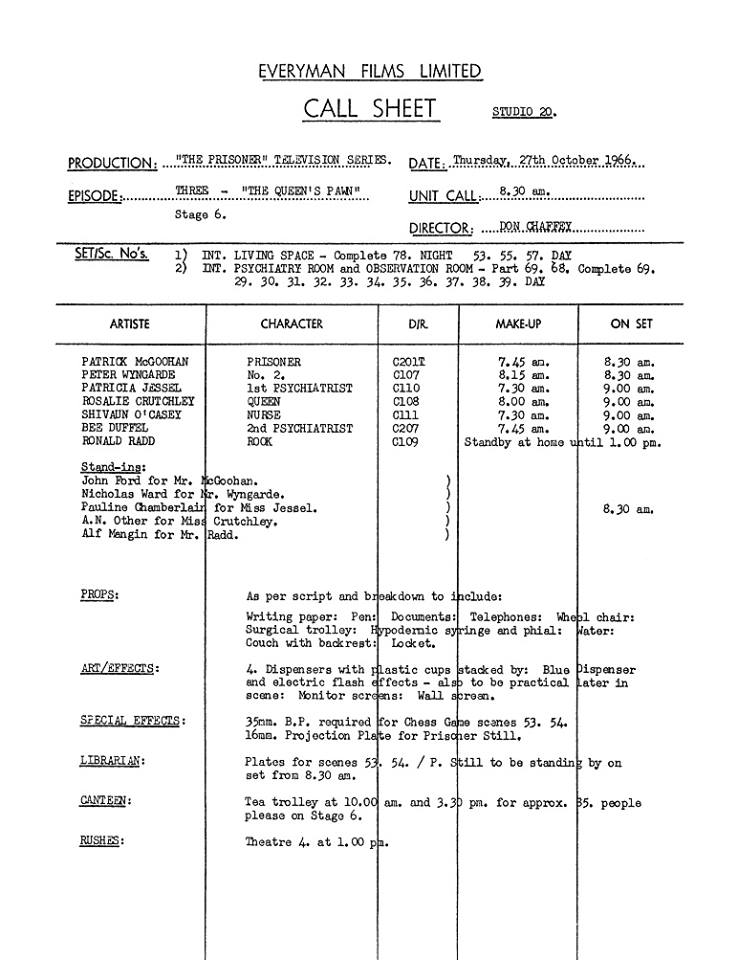
(Above): Original ‘Call Sheet’ from ‘Checkmate’
I would’ve liked him to have stayed in this country and made a contribution here instead of going off to America. I really think he could’ve made a contribution here, which in America is more difficult to do. People like Mickey Rourke, they like showing their psychological mishaps on screen, don’t they? They like to show that there is something psychologically wrong with them, and they love to expose themselves. I know that actors can’t help exposing themselves. The moment that you are in front of a camera you are exposing yourself, aren’t you, really? You are on stage and you are naked – really, no matter what you make. You can have armour plating on, but you are still naked on that stage. And every creak of their armour plating shows, you know; you can’t hide it. But the American’s take it one degree further. They do it psychologically and mentally as well. They show you all their awful behaviour. They behave badly I think sometimes on screen. I find that unforgivable. I don’t think that you should behave badly on screen. You can be nasty by implication – I don’t think you have to show it, really. It’s bad enough to be naked all over the place without having to show the wounds as well, don’t you agree?
Situated on the edge of Hertfordshire, just 25 miles north of London, Elstree is known throughout the world as one of the major centres of British film making. However, as any viewer of film credits will have notices, Elstree Studios are in fact located in Borehamwood – the ‘wrong side’ of the railway tracks’ (literally) from its more upmarket neighbour, the REAL Elstree.
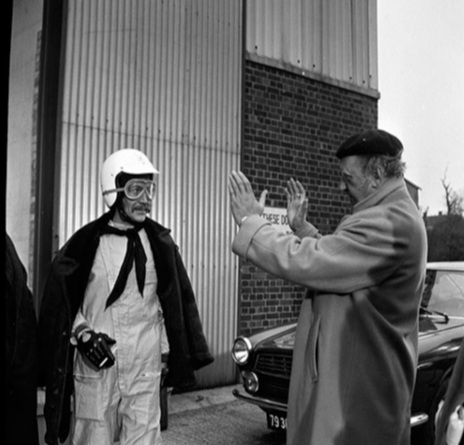
Left: Peter taking direction on the Backlot of Elstree filming a scene for ‘Department S‘.
In the heyday of the ‘British Hollywood’, there were several studios in the town; MGM British National, The Gate, The Ideal, The Neptune, and so on. But the studios that played host to Jason King started out as the brainchild of an American film entrepreneur, one JD Williams. Shortly after the completion of his studios, however, Williams went into disagreement with his partners and the studios (with more of a touch of irony) fell into the hands of John Maxwell – a Scots lawyer who’d been brought in to handle litigation concerning the rift. Maxwell was a small-time cinema owner with a history of film distribution who was keen to entre production as the government were about to fix a firm foundation for the British film industry in the form of the much maligned quota system of 1927.
Maxwell immediately achieved a quick turnaround of films at the newly acquired BIP Studios. So much so that the industry somewhat mischievously gave it the nickname the ‘Porridge Factory’. Some say this was in honour of Maxwell’s Scottish roots, with the other school of thought appropriating the name to the fast production of ‘pot boiler’ movies of the period.
Nevertheless, the studios succeeded and Maxwell developed an empire with his acquisition of hundreds of cinemas. By 1937, the empire was known as the now familiar name of The Associated British Picture Corporation, and its chain of cinemas had the corporate identity of ABC. Everyone who was anyone eventually passed through the gates of the ABPC. In 1929, the company was credited with the very first British sound production due to the, then, ‘boy wonder’, Alfred Hitchcock, re-shooting his ‘Blackmail’ feature after almost finishing it, to utilise the new RCA sound process. Future US president, Ronald Reagan, made a movie at the studios, whilst in the 1970’s, ‘Star wars’ and its sequels offered the British Film Industry a ‘New Hope’.
John Maxwell died in 1940, and at the time, the studios had been commandeered by the British Army for wartime activity. After the War, the “Porridge Factory” faced stiff competition from both J. Arthur Rank at Pinewood and the newly opened MGM British, which was built literally just across the street. After his death, Maxwell’s family struggled to regain control of the empire he’d built – finally losing out in 1946, when Warner Brothers bought a controlling stake.
Despite the American influence, the studios continued to make films with a distinctly British flavour, such as ‘The Dambusters’ in 1955. In the same year, Britain also saw the introduction of commercial independent television. The board at ABPC realised that this was a sign of things to come and thus successfully bid for a franchise to serve London and the Midlands. So was born ABC TV – soon to become a production company for one of the classic series of the Sixties, ‘The Avengers’.
Television rapidly gained hold and with eth diminution of the “Swinging Sixties”, a hectic film production schedule was under way in Britain. with more and more studios turning themselves over to TV shows. More importantly, they invested in new sound stages and technology especially for the medium.
Department S was the 6th ITC television series yo be filmed at ABPC Studios. The twist here being that in 1962, Lew Grade had acquired the nearby National Studios (now BBC Elstree) – home of the Eastenders soap, yet continued to have his major productions filmed elsewhere. The advantage of ABPC was that it boasted a versatile backlot with not one, but TWO sizable tanks. Therefore, with a little bit of dressing, “The backlot would double as everything from Berlin to Hong Kong… you just changed the window shutters.” Johnny Goodman – on ‘The Saint’.
Many areas of the Studios turned up repeatedly in various series; one of the favourites being a concrete thoroughfare between the scene docks and the smaller stages. This was where a crated Jason King was dropped off by his associates in ‘A Thin Band of Air’, and which doubled for Rotterdam Docks in The Champions episode, ‘The Invisible Man’.
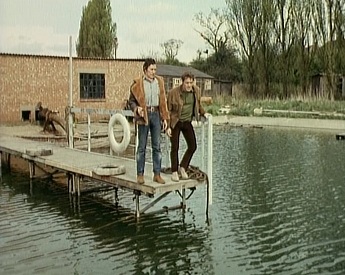
Right: Peter in a scene from The Champion’s episode, ‘The Invisible Man’ on a jetty at Tank 2 at Elstree.
A major refurbishment of the facility in the 1960’s gave ABPC, not only a new administration block, but probably its most utilised feature in those wonderful ITC adventure series – the underground car park; a scene of assassination and abduction aplenty (as noted in Department S episodes, ‘The Man From X’ and ‘A Small War of Nerves’, and the Jason King stories, ‘Flamingoes Only Fly On Tuesdays’ and ‘As Easy As A.B.C.’.
The ITC series undoubtedly gave ABPC Studios the breathing space it needed to stave off closure as befell its more glamorous neighbour, MGM, in 1970. However, ABPC was not totally immune and in 1968 a successful takeover bid was staged by musical and electronics giant, EMI. Despite this, Department S is still credited as having been produced at associated British, with Jason King being credited to EMI-MGM Studios (after its closure, MGM US had sponsored a three-year joint finance with EMI so as to maintain a small UK production base).
By the time of the EMI takeover, British production was flourishing. Vast numbers of cinemas had closed as TV took over, and there was precious little call for indigenous film making. By now, Hollywood ruled.
In the late 1970’s, EMI had been bought out by Thorn and another double-barrelled name was evident on the Shenley Road. But the studios had long since passed into decline – neither EMI nor Thorn had invested much in the infrastructure. Cold walls and plaster were quickly (and cheaply) coated with paint, but that was about it.
The rebirth of the facilities came with the making of ‘Star Wars’; for the sequel ‘The Empire Strikes Back’, Thorn actually erected a huge silent stage to accommodate its blockbuster sets. Then Steven Spielberg came on George Lucas’ recommendation to make his ‘Indiana Jones’ series of films. the future of the studio was looking rosy.
Above: Peter during a break in filming ‘Jason King’
But then the rollercoaster ride that is British film making took a dip and it was announced in 1986 that the studios were to be sold to the Cannon Group, whose disastrous tenure ended as soon as 1988. Enter the Brent Walker Group, who called their new venture Goldcrest Studios; overstretched themselves and ended up in the criminal courts.
This was the final blow for the ‘Porridge Factory’ as a group, and in a desperate (and ultimately unsuccessful) bid to survive, sought to divest itself of its less productive assets. A major redevelopment was announced for the studios, with the site and the number of studios shrinking, but with the new sits to be installed with all the latest film technology. The bulk of the land was to be released for redevelopment.
Thus in 1991, the whole of the eastern side of the studio complex fell to the bulldozers. The lack of investment and interest in the studios was revealed when the front offices of the building were pulled down. When the admin functions where moved, the entire site had simply been abandoned and shut off. Indeed, inside the old Hammer Film office, it was like walking aboard the Marie Celeste; scripts, publicity materials, pressbooks –all lying where they had done so for the last 20-odd years, gathering dust.
Fortunately, those familiar tall trees and some of the old haunts of Jason King, the Champions et al, still exist. Hertsmere Borough Council purchased the remaining stages from Brent Walker under a compulsory purchase Order and reinstituted filmmaking alongside the new Tesco supermarket, where photos of some of Elstree’s finest film adorn the walls in tribute to those better day.
MUCH better days!
In December 1996, actors and technicians associated with Elstree Studios were invited to witness the unveiling of a plaque to commemorate and celebrate the achievements of the Studio itself and of the Hammer Film division.
Amongst the assembles dignitaries was Peter – dressed in a black baseball cap and sunglasses, Sylvia Simm, Ron Moody, Nigel Hawthorne, Pat Coombs, Liz Frazer, Lana Morris, Barry Morse, William Lucas and Hammer legend, Christopher Lee – the latter of whom accepted a Lifetime Achievement Award on behalf of his great friend, Peter Cushing.
Department S At Elstree
Above: Arial view of the Elstree lot
Areas at Elstree featured in Department S
SITE KEY:
1. Gateway 2. Production Offices 3. Cafeteria/Restaurant 4. Film Processing Laboratories 5. Film Vaults (demolished) 6. Sound Stages 1&2 7. Sound Stages 3&4 8. Sound Stages 5&6 9. Soundstage 10 (demolished) 10. Tank 2 11. Utility Buildings 12. Tank 1 13. Perimeter Road (a new structure was built here after Department S and Jason King was completed) 14. Backlot 15. Underground Car Park exit 16. Set Assembly block 17. Ancillary Services block 18. Soundstages 7, 8 & 9 19. Administration block 20. Underground Car Park entrance
18. Ancillary Services Block:
The wide covered alleyway at the side of this Block is where we see Sullivan fighting with two thugs in ‘The Last Train to Redbridge’, and the building also doubles for Interpol’s Auto Division building where Annabelle Hurst checks out the burnt out Rolls-Royce in ‘The Double Death of Charlie Crippen’. It’s also used as parts of Heathrow and Orly Airports in ‘Six Days’ and ‘The Trojan Tanker’, respectively.
15. Backlot:
A cemetery that had been especially made for the ‘Randal and Hopkirk (Deceased)’ series is seen in both ‘The Ghost of Mary Burnham’ and ‘The Double Death of Charlie Crippen’.
The scene from ‘A Cellar Full of Silence’, where Jason just managed to get out of the exploding phone box, was also filmed here.
The Backlot Dirt track is where Annabelle notices a newly painted gatepost in ‘The Pied Piper of Hambledown’, and is also utilised in ‘The Shift That Never Was’.
14. Perimeter Road:
This is where Jason is beaten up by Dave Prowes in ‘The Treasure of the Costa del Sol’. It also makes an appearance in ‘The Man From X’, ‘A Fish out of Water’ and ‘Dead Men Die Twice’.
1 & 2: Main Gateways:
These were used as the entrance to Orly Airport in ‘The Trojan Tanker’.
9: (Behind) Soundstages 5&6:
This consisted of several small utility buildings, plus a handful of larger constructions that included a big red brick structure which could house as many as fifteen different sets. This served as the background for when Sullivan leaves the Aerospace research facility in ‘The Man From X’.
11 or 13: Tanks:
Jason steps off a jetty into one of the Tanks in ‘Last Train to Redbridge’.
Town Façade:
By redressing this set, it became a Spanish town in both ‘Les Fleurs Du Mal’ and ‘Who Played The Dummy?’, Istanbul in ‘The Perfect Operation’ and London in the pre-titles segment of ‘The Man From X’.
16 & 21 – Underground Car Park:
Appears in ‘The Man From X’ when Jason comes to the aid of Wanda Ventham, and becomes a warehouse at London Airport in ‘Six Days’. It can also be seen in ‘The Man in the Elegant Room’, ‘The Bones of Byrom Blaine’.
Peter, Joel Fabiani and Rosemary Nichols are seen standing on the Entrance Ramp of the Car Park at the very end of ‘Ghost of Mary Burnham’.
6: The Vaults:
This was a whitewashed, single story building which had stood on the Elstree site since the studio began production in 1927. It makes an appearance in ‘The Last Train to Redbridge’ as the East London Mortuary and in ‘The Mysterious Man in the Flying Machine’.
*This area of the studio is now occupied by a Tesco Supermarket.
Throughout the time he spent filming at Associated Elstree, Peter used Dressing Room No. 515, which was at the side of Soundstages 3&4 (circled on Layout above).
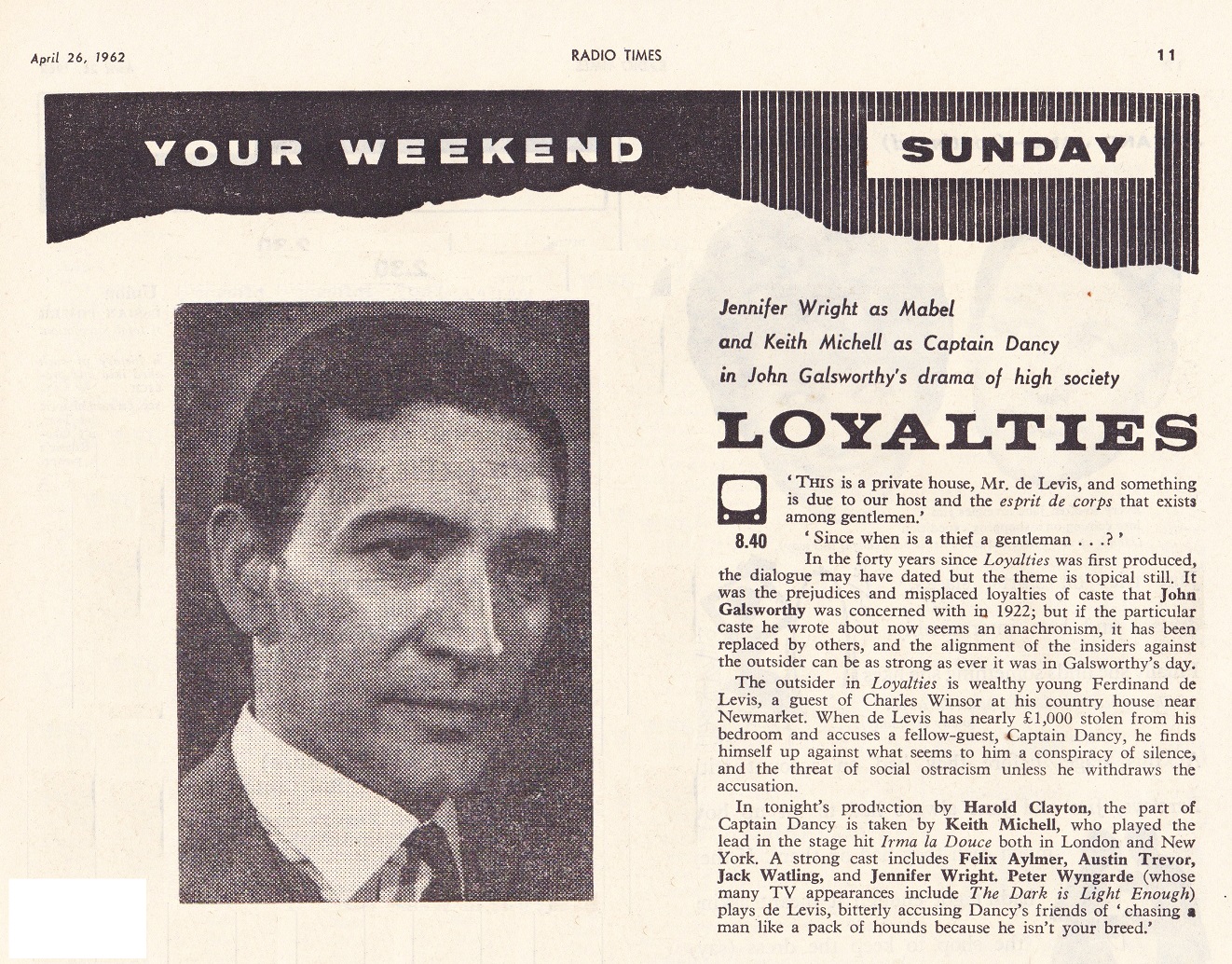
Captain Ronald Dancy, D.S.O.[1] (Keith Michell), has just retired from military service and is now at a loose end, with no idea what to do with himself. Having become familiar to a life of discipline and combat, he entertains himself with his love of horses and women, but nothing can replace the brutal excitement he craves.
Currently penniless, Dancy marries Mabel (Jennifer Wright) – a well-to-do woman who has long admired him, and who has a temperament that he’s always desired in a woman. Nevertheless, the former Captain is still forced to sell his most prized horse to his friend, Ferdinand De Levis (Peter Wyngarde), as he can no longer afford to keep the Mare. Despite his penniless state, Darcy nonetheless managed to retain membership of some of the most exclusive gentleman’s clubs in London, and with them the friends who’d request the company of himself and his new wife at weekend gatherings at some of the most exclusive addresses in the country.
On one such occasion at Meldon Court – the home of his old chum, Charles Winsor (Jack Watling), Dancy is furious to learn that De Levis has sold on the horse for a hefty profit on the £1,000 he’d received. Later that same evening, amidst the male banter and revelry, Dancy’s bitterness inspires him to make a £10.00 wager with De Levis that he can leap atop a four-foot high bookcase in a single bound. Ferdinand accepts, and Dancy subsequently wins the bet. De Levis, however, is condescending – saying that a real gentleman would never indulge in such infertile parlour games – and least not for such a trifling amount of money. This insult irritates Dancy still further.
Around 12 that night, Winsor and his wife are wakened by De Levis, who informs them that the money he’d accepted for the sale of the horse has been taken from his room, and demands that the matter is immediately explored. Winsor and his friend, General Canynge (Felix Alymer) are, together, horrified at the assertion that someone at the Manor could be responsible for such a crime, and yet neither is keen to point a finger at either the staff or guests. De Levis’, nevertheless, insists that the police are summoned.
“Chasing a man like a pack of hounds because he isn’t your breed.”Ferdinand de Levis of Captain Dancy’s friends.
Immediately, the visitors begin close ranks against De Levis – asserting that he’s handled the situation indelicately. He, in turn, construes that their stance is born more from bigotry than out of any other concern, given that he’s a Jew. Dancy, meanwhile, does little to dissuade Ferdinand’s supposition by taunting De Levis about his race.
When Inspector Dede (Michael Collins) and a Constable (Max Latimer) arrive to begin their investigation, a number of theories are put forward concerning who the perpetrator might be, but when De Levis asserts that Dancy is the thief, and that he can provide poof to support the claim, he’s told in no uncertain terms by the other guests to keep the allegation to himself.
De Levis reluctantly agrees to remain silent, but only until he can deliver the necessary evidence, but when he realises that he’s been expelled from the clique, he openly points the finger at Dancy.
Over the course of the next couple of days, the disagreement between De Levis and Dancy is pored over by the group of friends – all of whom are reluctant to believe that the Captain could be responsible for such a dishonourable act. That’s until Dancy is ultimately unmasked when the notes taken from De Levis’ room are discovered and traced back to him.
“Since when is a thief a gentleman…”Ferdinand de Levis
Although De Levis is finally vindicated, before the group will give Darcy up, they devise a plan for the Captain to disappear before he’s arrested. Yet, conversely, the play ends in tragedy when Darcy choses to hang himself to avoid the disgrace of being taken into custody.
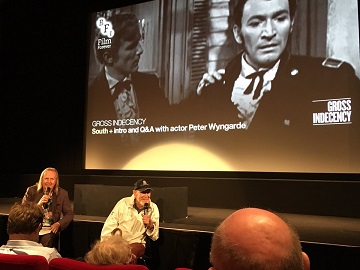
During July and August, 2017, the British Film Institute hosted a two-month season of LGBT+ cinema to mark the 50th anniversary of the Sexual Offences Act.
‘Gross Indecency: Queer Lives Before and After the ’67 Act’, looked at the decade before and after homosexuality was partially decriminalised in England and Wales. Starting with the Wolfenden Report in 1957 and going through to the onset of the AIDS crisis in 1977, it shone a spotlight on the LGBT+ community during that time.
Part of the season included ‘Queerama’, which is a documentary created using historical footage held by the BFI National Archive. It traced gay life in Britain from the end of the First World War and throughout the 20th Century, backed by a soundtrack including John Grant, Goldfrapp and Hercules & Love Affair.
There was also be special previews of BBC documentary ‘The People’s History of LGBT+’, as well as new drama ‘The Man in the Orange Shirt’.
The first part of the season – which ran through July – focused on the run-up to the Sexual Offences Act, with cinematic milestone ‘Victim’ (1961) being one of the main draws.
It was shown alongside one of the UK’s earliest surviving gay TV dramas, ‘South’, which starred Peter as Lieutenant Jan Wicziewsky.
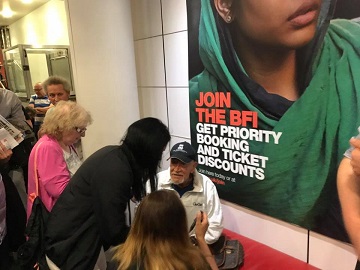
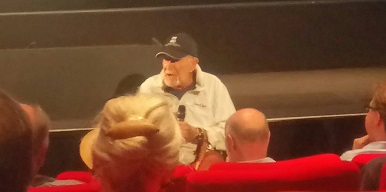
Peter took part in a special Q&A after a screening of the drama on 3rd July.
But the season was launched with a screening of On Trial: Sir Roger Casement (Granada Television, 1960), also starring Peter, which is a dramatic retelling of one of the most gripping legal trials in British queer history.
Other screenings included ‘Consenting Adults 1: The Men’ and ‘Consenting Adults 2: The Women’ (BBC, 1967), ‘The World Ten Times Over’ (Wolf Rilla, 1963) and a story of ‘Romeo and Romeo in the south London suburbs’, ‘The Leather Boys’ (Sidney J Furie, 1964). For the second part of the season in August – which focuses on the decade after the Sexual Offences Act was passed – ‘The Killing of Sister George’ (Robert Aldrich, 1968) and ‘Staircase’ (Stanley Donen, 1969) was shown, along with ‘Sunday Bloody Sunday’ (John Schlesinger, 1971).
Transcript Peter’s Q&A
How did you get the part?
I can’t remember as it was so long ago. However, I do recall wickedly agreeing with director, Mario Prizek, who is now an executive producer on the splendid series, ‘NCIS’, that we not tell Graydon Gould, who played Eric McClure, that he was fighting a duel with someone who was in love with him; but that the duel was over his fiancé. How we got away with it is obscure, but we did manage it.
Graydon was totally heterosexual, and had actually expressed some mildly anti-gay feelings. Of course he read the script, but Mario somehow managed to put over to him the idea of what it really was – a Greek Tragedy. At that time, no actor would dream of playing a poof; the fear was being associated with homosexuality – in spite of Hollywood insisting that every British actor was gay.
I was asked after the play was shown if I was a poofter, and I provided them the answer given by the French heartthrob, Alain Delon, after he was asked if he was gay: “We are all gay, are we not?” But then he was French, not British or American, so he got away with it!
It was a real ordeal at the time, as Graydon kept asking questions which were very difficult for Mario to deal with. For example, he asked why my character – Jan Wicziewsky – would allow himself to be killed when a cut, given the circumstances, would suffice. Mario couldn’t tell him that it was meant to be symbolic of penetration; otherwise he’d have walked off the set!
Mario had offered the part to a number of actors with the script in its original form, but had been repeatedly turned down; ‘playing a poof – and on the telly? You must be joking! No! Never!’
The play was broadcast on 24th November, 1959. Can you tell us a little about your career before that point?
I’d done numerous plays, both on TV and the stage, including playing Sydney Carton in ‘A Tale of Two Cities’; Isambard Kingdom Brunel in ‘Engineer Extraordinary’, for which all the engineering calculations and mathematical equations had to be written out for me and distributed about the sound stage, because I’m completely innumerate. And Petruchio in ‘The Taming of the Shrew’ at The Bristol Old Vic.
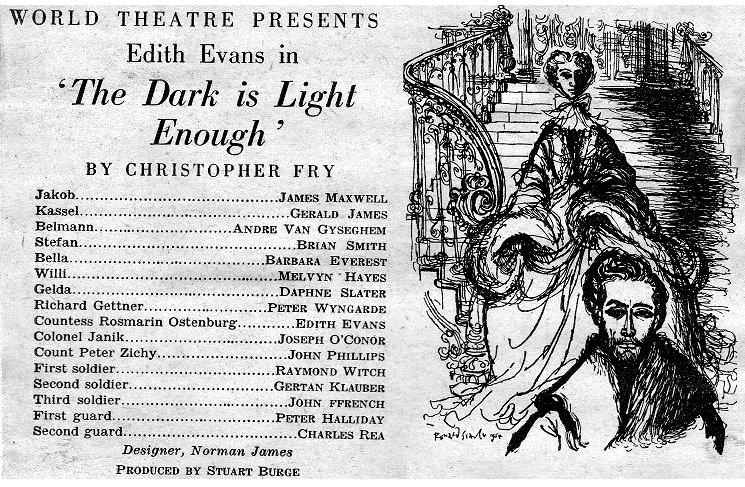
I’d also played de Levis in ‘The Light Is Dark Enough’ – a long verse play – with Dame Edith Evans, who was probably the greatest actress on the British stage. She confided in me afterwards that she’d particularly asked for me, because she’d never acted for TV before and she wanted me to point out where all the cameras where, and to tell her where to look.
I recall a mad incident whilst we were doing that particular play. In one scene, I was to do my final speech standing next to a Palladian pillar, which we’d decided I was to speak very softly. Because it was going out live, a stagehand was to move the pillar the moment I’d finished and set it up with the other used scenery. However, because I was speaking so quietly, he thought I’d actually come to the end of the dialogue and moved the pillar from behind me.
Suddenly, I was made aware that there was a taxi waiting for me, as I’d booked a flight to New York to see the opening night of ‘Look Back In Anger’ on Broadway, I was whisked across the studio at breakneck speed and out to the cab.
When I told Dame Edith about the pillar incident afterwards, she said that she wondered why I was so jerky. I was trying to hold on to the scenery!
Where you aware of the production of the play in which Sir Peter Hall directed Denholm Elliot under club conditions? [1]
This is a very tricky one. I was appearing as Dunois in ‘St Joan’ at the Art’s Theatre in Leicester Square with Siobhan McKenna, which was directed by John Fernald, who later became head of the Royal Academy of Dramatic Arts.
His new Assistant Director was Peter Hall – both of whom disagreed with my interpretation of the relationship between Dunois, as leader of the French forces, and Joan. In my considered opinion, I felt that Shaw’s preface that Dunois had no physical attraction to Joan, as a woman, was mistaken. Here was this red-blooded, dyed-in-the-wool commander of the French Army. Ofcourse he desired her as a woman. Siobhan agreed. We both felt that the only real contact The Maid had ever had with a man was with Dunois. Whether their relationship had ever been consummated physically was neither here nor there. The point was that she adored him, as he her. This, we believed, was our only chance to see her as a human being, before she was transformed into a saint.
Peter (Hall) didn’t agree, and he took a strong dislike of me from that time on. It was then that I realised it was not wise to cross him – EVER! I learned from Vivien Leigh that Olivier wanted me to lead the Company at the National Theatre, but when the theatre was handed over to Hall, I was dropped, and was labeled as being “difficult to direct”.
That was never the case for those I respected, like Jean-Louis Barrault, who directed me in ‘Duel of Angels’, in which I appeared with Vivien, and Jack Clayton, for whom I played the ghost of Peter Quint in ‘The Innocents’.
I left the production just before it transferred to the West End to make a film in Spain [2]. Siobhan blamed the short run of the play, which had been so successful at the Art’s, on the recasting of Dunios [3], who played the part as Hall instructed.
I still maintain that if Shaw had eaten a good rump steak instead of sticking to his avowed vegetarianism, he’d have come round to my way of thinking on Dunois and Joan! Alas he never did.
I’m also convinced that John Fernald wanted me to be in his production of ‘South’ at The Art’s, but Peter Hall managed to convince him that dear old Denholm Elliot was better casting.
Your performance of the tortured lead is very powerful. Can you tell us something about the attitude to getting the character across?
I just remembered the feelings I had as a child in a Japanese prisoner of war camp in Shanghai.
‘South’ is the earliest known television play with a gay subject. Did you hesitate at all at taking the role?
No, of course not. It was a bloody good part and a wonderful script.
How was it received?
Appallingly!
In Roger Langley’s biography of me[4], there’s just a couple of lines about the play. He then adds references to the reaction it got in the newspapers. These were the dailies that used words like “Disgusting” Filth, “Pervert” in their articles, which showed the calibre of critics back in the day.
Several of the papers mentioned me directly – saying that the blame for all this “filth” should be put on the shoulders of the man who was recently nominated as ‘Actor of the Year’. Peter Cushing inevitably won it, and quite rightly. Strangely, Sidney Bernstein [5] had recommended Peter (Cushing) for the part of Lieutenant Wicziewsky in ‘South’, but he had other obligations so it was offered to me. I thought it was a staggering piece of theatre, and having Mario Prizek directing was the cherry on the cake.
Is there anything else you’d like to say?
I think Julien Greene, who wrote the play, would be delighted that we’re still talking about this piece now.
Notes:
[1]. The Lord Chamberlain had banned the play from openly accessible theatres. [2]. ‘Alexander the Great’ in whichPeterplayed Pasaunius. [3]. Robert Cartland was cast as Dunois after Peter left ‘St Joan’. [4]. ‘Peter Wyngarde – King of TV. A biography’ Roger Langley. Escape Publications 2012. [5]. Lord Sidney Lewis Bernstein. Founding chairman of Granada-Group. [6]. 35,000 Australian woman voted Peter‘The Man We Would Most Like To Lose Our Virginity To’.
“Peter Wyngardewas mobbed after our screening of South @BFI tonight. What a treat to have him with us as we kick off Gross Indecency”Simon McCallum – Curator, The British Film Institute
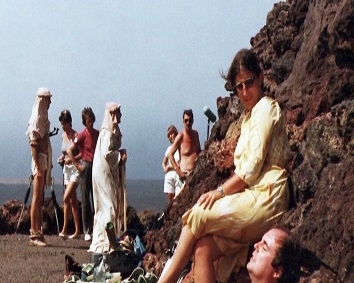
Implausible as it may sound, but the original idea for ‘Planet of Fire’ came via a postcard that dropped through the letterbox of Doctor Who producer, John Nathan-Turner, around Christmastime, 1982. The card had been sent by none other than Director, Fiona Cummings, who’d been passing time on the Mediterranean island of Lanzerote during a strike by BBC technicians, which had halted the recording of another Doctor Who episode she’d been working on.
For some time, Nathan-Turner had been toying with the idea of shooting Season 21 of the series in a more exotic location, and after making the requisite inquiries, had discovered that the volcanic island of Lanzerote was not only expedient for air travel, but was both economical and easy to reach, thereby making it an agreeable place to work for all concerned.
At the time, Cumming’s was on the verge of introducing a new Companion for the Doctor; a young woman with the improbable name of Perpugilliam Brown which, mercifully, would be shortened to just Peri. It was also around this point that regular cast member, Mark Strickson, who’d played Turlough for the previous 15 or so months, asked to be freed from his contract – saying that he felt he couldn’t take the character any further. Co-incidentally, Peter Davidson had also announced via the tabloids that he had no plans to return after series 21 came to an end, and so it was suggested that the time was ripe to bring in a completely new regular cast.
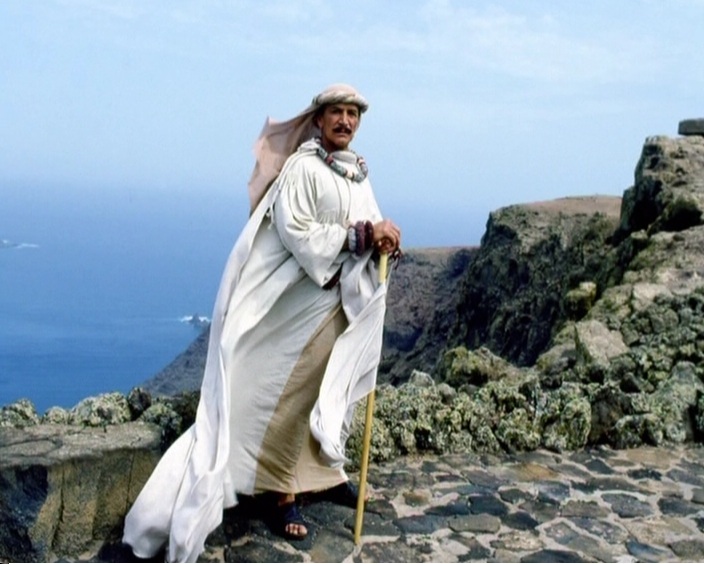
Left: Peter as Timanov at the Observation Point on Lanzerote
Having reached an amicable agreement with Strickson, Nathan-Turner turned to Script Editor, Eric Seward, who really had no wish to see Turlough depart at the same point that Peri arrived. But as fate would have it neither he, nor Scriptwriter Peter Grimwade, were given little option, especially as Davidson’s contract was due to end in May of 1984.
Nathan-Turner was especially keen that Davidson’s successor – who turned out to be Colin Baker, should appear in the very last story of Season 21. Indeed, given the number of minor characters that were also due to jump ship in the fourth serial of that year, there’d be a greater than normal roll of personnel either arriving or departing in ‘Planet of Fire’, so a number of other plots and scenarios that’d originally been considered, were put on the backburner.
A decision was also made at this point to scrap the Doctor’s robotic ally, Kamellion, given that technicians working on the show were experiencing more than their fair share of glitches when operating the contraption; most notably in keeping the computer controlled pre-recorded dialogue co-ordinated with the movement of its mouth.
Finally in May 1983, Eric Seward met with Peter Grimwade to discuss a storyline that might include all of the previously mentioned components and more. Grimwade’s association with Doctor Who had dated back to the early 1970’s when Jon Pertwee was in the lead role. Back then he’d acted as Production Manager, and it was he who’d introduced Turlogh to the series, so it couldn’t have been more fitting for him to have also overseen the departure of the character.
One of the constraints that would bind Grimwade was the shortlist of locations that would be used during filming. Astonishingly, his only aid was a set of snaps taken by Fiona Cumming’s on her holiday on Lanzerote from which he was expected to create the setting for the fictional planet of Sarn. Having never visited the island himself, much of what he wrote was based on his own travels to the Greek Islands over the years. Such was the budget for the episode, that he was forced to contact the Lanzerote Tourist Office, who kindly furnished him with the additional information he required.
Meanwhile, Fiona Cummings who, to date, had worked on three earlier Doctor Who stories, was named as Director on ‘Planet of Fire’, whilst virtual new-comer, John Peacock, was appointed as Costume Designer.
Since the original Technical Specialist responsible for programming the Kamelion robot had tragically died in an accident several months earlier, it was suggested that extra technicians would be need to control the metal companion. But that, it was quickly realised, would drain additional cash from an already overextended budget. Peter Grimwade solved the problem by using the android as little as possible in his script, and by having it taken over by The Master – therefore making it appear in human form.
Initially, the core of Grimwade’s script had been intended to accentuate the menace of religious radicalism through the character Timanov, who would be played by Peter Wyngarde. However, Script Editor, Eric Seward, was resolute in “watering down” the role of the ‘Chief Elder’, despite Grimwade’s belief that he was being “too cautious”. Nevertheless, a sequence in which Timanov was seen sacrificing himself in a volcano was lost in the final edit.
In the end, the script was amended several times to fit in with the locations – if or when they were found. This disheartened Grimwade to the point where he left all the re-writing to Seward.
Production Diary
Right: This photograph shows some of the cast and crew during a break filming ‘Planet of Fire’. Peter is fourth from the left in the background. Director, Fiona Cumming’s can be seated on the rocks to the right in the foreground.
Friday, 19th August, 1983: John Nathan-Turner appears at a news conference which had been organised to introduce Nicola Bryant (Peri) and Colin Baker (the new Doctor) to the public.
In the meantime, Peter, plus 34 other members of the cast and crew, was flown out to Lanzerote.
Thursday, 13th October: The Production Crew arrived on the island.
Friday, 14th October, 1983: 6am. The very first scene was shot at Papagayo Bay, which featured all three members of the regular cast, plus Michael Bangereter as Curt and the late Dallas Adams, who plays Professor Howard Foster.
As it turned out, the morning proved to be considerably cooler than normal on the island, much to the consternation of Niciola Bryant, who was scripted to swim to shore from Howard’s boat, which had been hired locally. Almost all of the scenes that day are shot off-shore.
A much smaller version of the TARDIS had been flown out to the island by the crew, which was 1/3 the size of the regular prop. When in shot, it was cleverly lined up closer to the camera so as to make it appear normal size. It also explains why none of the cast were ever seen either entering or leaving the Police Box during the episode.
As a result of his character not being part of the primary days shoot, Peter spent the day at the hotel sunbathing.
Saturday, 20th August, 1983: This turned out to be a very gruelling day for everyone involved. The cast and crew were required to take a long coach-ride out to the North-Eastern tip of the island, where several scenes involving Peter as Timanov and Edward Highmore as Malkon were committed to film for Part 1. Some additional scenes when ‘The Lookout’ spots the TARDIS for the very first time, were also shot.
Peter, Highmore and Simon Sutton, who played ‘The Lookout’, were also required for a sequence at a popular observation point on the island known as the Mirator del Rio. The exterior lighting of the café at the Point was used to complete the scene, plus a couple of interior sequences involving Timanov and Malkon.
One of the major problems that the actors and crew faced during the days shoot was the high winds for which Lanzerote is famous. Due to rapid cloud movement, one particular sequence involving Peter and Simon Sutton at ‘The Lookout Point’ had to be shot more than once, since the earlier part of the scene had begun in shadow, while it ended with both actors immersed in intense sunshine.
Left: Peter with Edward Highmore
By late afternoon, filming had fallen badly behind schedule. In an attempt to make up the time Director, Fiona Cummings, was compelled to approach Peter to ask if he might possibly say his lines a little quicker than he’d originally been asked to do (in the original script, the ‘Chief Elder’ was styled as a man who was as ‘Old as the mountain itself’, but looked much younger due to his breathing in the invigorating fumes of the volcano over many years). Peter Grimwade had actually proposed that Peter should present his lines much slower than all the other actors so as to give the impression of his advanced years. But, of course, when the story was conceived, he’d had no idea that the clock would prove to be such an enemy.
Sunday, 18th October, 1983: After Saturday’s exertions, everyone was given the day off. Peter spends his time sunbathing (again!) – one of his favourite pastimes.
Monday, 19th October, 1983: The cast and crew were taken to the National Park area of the island, as the volcanic region which surrounds it was used as a stand-in for the ‘Fire Mountain’ on the planet of Sarn. Peter was needed to work largely at the ‘Guides Caves’, where he takes part in several scenes involving Bryant, Sutton, Davidson, Strickson, the late Anthony Ainley as The Master, plus James Bate as Amyard.
Tuesday, 20th October, 1983: More scenes on the ‘Fire Mountain’ were filmed near the National Park, and at the Cave of Doves, Sheep Hill and at assorted other locations on and around the mountain.
A very steep area known to locals as Camel Path doubled as the mouth of the ‘Great Volcano’, where the Doctor and Amyard meet Peri in Part 4 of the episode. Also shot that day were Adams’ scene as M-Kamelion-H (his face was coated in silver make-up for the sequence), and Timanov’s very first encounter with the so-called ‘Outsider’.
Wednesday, 21st October, 1983: The last day of the shoot on location largely involved the three regular cast members at the ‘Yellow Area’ on ‘Fire Mountain’ and at Los Hornitos. There was one sequence, however, which featured James Bate and Jonathan Caplan as Roskal, who Timanov had sent in search of the great god, Logar.
Wednesday, 26th October, 1983: After arriving back in England, and being granted a few days off, the cast and crew reassembled at TC1 at BBC Television Centre in London for the first part of the interior recording. The first scenes put onto film were set in the ‘Bunker’ and featured James Bate, Barbara Shelley as Sorest and a rag-tag band of extras playing the “None-Believers”.
Recording continued with a number of sequences which were situated outside the ‘Hall of Fire’, which involved Peter Davidson, Bryant, Ainley and Highmore. The ‘Hall of Fire’ was made up of a series of interlocking sets with hinged walls for effortless removal and stowage. At the moment that Timanov musters ‘The Fire Lord’, the camera was simply juddered about to give the feeling that an earthquake was taking place. Fragments of polystyrene and other airborne debris was flung from an overhead gantry to give the impression of falling rubble.
Thursday, 27th October, 1983: The entire day was dedicated to the outstanding scenes in the ‘Hall of Fire’, all of which were filmed in running order. Initially there were proposals to record some scenes in ‘The Master’s Laboratory’, but because progress had slowed to a snail’s pace by this juncture, those segments had to be delayed for several days.
In the ‘Sacrificial Chamber’, which was part of the ‘Hall of Fire’, the action was shot using a gas burner and blue filter, which was then overlaid onto film in post-production. In certain other scenes, the back wall of the ‘Cell’ was removed so that the views from behind the gate into the ‘Hall’ where Timanov was standing, were visible.
During a couple of sequences, Timanov was armed with a staff-like weapon from which a red beam was superimposed. The very same method was used during the shooting of both Zuko (Max Arthur) in Part 1 of the story, and Malkon in Part 3.
After the recoding of this group of scenes was finally completed, another fortnight of rehearsals took place for the second phase of shooting.
Above: Original listing for the four-part story in The Radio Times
Wednesday, 9th November, 1983: Shooting began on the Second Phase at TC6 at BBC Television Centre. The majority of work involved the Special Effects Team, and was set in and around the TARDIS, and on Kamelion who would change from a mechanoid into human form and back again. Some scenes set in the ‘Seismic Control Centre’ were also shot – again using filters for the Numismaton Gas sequence.
A model of an underground chamber had been especially constructed and put behind a CSO Screen to produce the illusion of a lava flow, and a rage of flames that emerged from the tunnel. Meanwhile, a series of slides showing the Lanzerote landscape were projected as a backdrop. Work involving The Master’s metamorphosis was also completed, whilst Gerald Flood made a series of audio tapes of dialogue for the Kamelion character at the BBC Radiophonic Workshop.
Thursday, 9th November, 1983: Finally the scenes in ‘The Master’s Laboratory’, which had been deferred from October 27th were recorded, plus a couple of sequences in the ‘Trion Spaceship’.
Friday, 10th November, 1983: More special effects using CSO’s were produced, and smoke boxes were added to the scenes that were set amongst Sarn’s ruins and the Master’s Black TARDIS.
Entirely for reasons of timing, some of the shorter scenes that had been shot both on location on Lanzerote, and in the studio in London, were deleted, and the sequence featuring Peter in the ‘Hall of Fire’ was held in reserve until the running order had been finalised. A scene which was cut completely from the final edit involved Peter and James Bate – the latter of whom had come to refute the reality of the great god, Logar, to Timanov.
A number of pieces of ‘stock footage’ from the BBC Library were used in Part 3 of the story. These included over 50 feet of 35mm film from Movietone, and several 16mm shots of erupting volcanoes courtesy of Visnews.
Composer, Peter Howell, recorded a 34-minute score at the BBC Radiophonic Workshop in London for the episode, which predominately featured flutes and pipes [1].
Although no Reaction Index was recorded for the four-part story, viewing figures were considered to be good, with each part of the story picking up around 7,500,000 viewers.
“Planet of Fire’ was my first TV work since ‘Jason King’, and it nearly killed me on location in Lanzerote. The place is full of volcanoes, which is ideal for scenes of an alien planet, but it played hell with a trapped nerve in my back. I was in so much pain that I couldn’t walk properly, We came up with the perfect answer – give the priest a staff. Doctor Who fans will think it’s a prop, but I really needed it!” Peter Wyngarde
Notes:
[1]. In February, 1985, BBC Records released an album of music entitled ‘Doctor Who – The Music II’, which included a band devoted to Howell’s incidental tracks from ‘Planet of Fire’, and which featured the piece, ‘The Outsiders Appearance Before Timanov’ from Part 2.
Other spin-offs from the episode included a novelisation of the story by Peter Grimwade, which was published in hardback by W.H. Allen in October 1984. A paperback version followed in February of 1985 as book No.93 in the Target Series. The latter was also issued as part of the Seventh Doctor Who Gift Set in 1985.
Written by Mr P.P. Wyngarde and T. Wyngarde-Hopkins
Only one aspect of the colourful, amusing and romantic crime-novelist-investigator, Jason king, was empathised in Department S. Jason came into the stories when called upon to help solve baffling crimes for INTERPOL. Seen more briefly was the other aspect of him – the successful writer with the world at his fingertips.
Tumbling headlong into adventure, whether he sought it or not, Jason was lured into danger by those who thought they could make use of him. He jet-propelled himself into situations because of his insatiable curiosity, and was tricked into all sorts of trouble because of his reputation.
Accompanied throughout his adventures by some of the world’s most intriguing characters, and seeking inspiration for his best-selling Mark Caine novels, Jason’s enquiring mind led him into everything from international intrigue to local revolutions. From tense drama to comedy-filled situations. From dire peril to the welcoming arms of a beautiful girl. This is HIS story…
Jason King was born on 25th December, 1941, in Darjeeling, India; the only son of Robert James King – President of the KingSteel International Engineering Corporation and his wife, the Countess Theresa de Jouvert. His family line can be traced back to the 11th century, since his mother was not only a direct descendent of Louis XIV of France, but his father’s connections produced not one, but two, American presidents this century.
As a young child, Jason showed none of the creative flair for the pen that he would later in life. In fact, his talents appeared to lie in the field of music, and by the age of 7, he was already proficient with the violin and had reached Grade 5 at the piano. In spite of being hailed as something of a child protégé by his tutor, Jason abandoned the keyboard at the age of 11 when he left the musical arena for the fields of Eton.
Having excelled at both rugby and boxing at his new school Jason, unfortunately, began to attract the wrong kind of attention from his schoolmasters, and was expelled for ‘unruly behaviour’ at the end of his third term. After spending the summer holidays at his mother’s ancestral home in the South of France, Jason was sent to live with his maiden aunt in Vevey, Switzerland, where he completed his education.
Dismissing his parents’ wishes for him to return to England to study law at Cambridge University, Jason took up a position with a national newspaper as a freelance journalist, but after becoming increasingly restless with the restrictions that bound him, he handed in his resignation and went to join a couple of old college chums in Morocco. It was there that he found himself on the wrong side of the law for the first time in his life when, after some high-jinx following a 24-hour drinking binge, he managed to get himself arrested for gun-running and gold-smuggling!
Fortunately for Jason, his father’s intervention succeeded in convincing the Morroccan authorities that the accusation against his wayward son were unfounded, and after a brief return to England Mr King senior, through his connections in the Colonies, insisted that Jason take a position with the Hong Kong Police Department as a Forensic Adviser.
In the summer of 1963, whilst dining out one evening at the Hong Kong Hilton with family friend and colleague, Alan Keeble, Jason was introduced to the English actress, Marion West who, at the time, was on location in the City. There was an instant attraction between the two – much to the dismay of Keeble, who was himself in love with the beautiful Ms West (although his feelings had never been reciprocated). One week later, on June 21st, the couple were married at a small church in Chelsea, west London, with Keeble acting as Jason’s Best Man.
After seeing out his obligations of his three-year contract with the Hong Kong police, during which time he’d become fluent in Chinese, Russian and Italian, Jason and his wife returned to London, where Marion resumed her career in the West End, and Jason began to realise his talent for writing short stories, many of which were published.
In October of 1966, Marion left London for the United States to star in a new Harold Pinter play in New York, whilst he husband, who was at last making a name for himself as a writer, remained in London to work on his second novel, ‘From China, Yours Sincerely’.
Having played to sell-out audiences every night on Broadway for two months, Marion was looking forward to returning home to London where she was to tell Jason that she was expecting their first child. On arriving at Kennedy Airport on the morning of December 23rd, Marion was to learn that her flight had been diverted to Chicago. She immediately called Jason and told him not to expect her home until later that evening. It was to be the last time that he would ever speak to his beautiful young wife, as the plane on which she was travelling crashed just five minutes after taking off in dense fog with the loss of 326 passengers and crew.
After Marion’s untimely death, the grieving author threw himself wholeheartedly into his work, and following on from the success of ‘From China, Most Sincerely’, Jason penned what is arguably his most famous novel, ‘Index Finger, Left Hand’, which remained on the International Best Sellers List for more than five years.
In May of 1968, at the personal recommendation of the Home Secretary himself, Jason was approached by Sir Curtis Seretse – head of the newly formed Department S; an off-shoot of INTERPOL, to assist in solving a most baffling crime which had been perpetrated in the heart of London. Having enjoyed his work with the Department a great deal, Jason was asked to lend his services on a more regular basis, and so he teamed up with two other agents – Annabelle Hurst and American, Stewart Sullivan. Together, they helped to solve some of the world’s most intriguing crimes.
In 1971, after sustaining a gunshot wound to his left leg during a mission in Spain, Jason decided it was time to leave Department S to concentrate on his writing, and found some solace at his new homes in Paris and Geneva. In July of that year, he was awarded the prestigious ‘Enzio Prize for Literature’, which was presented to him in Zurich. Thanks to the huge sales of his Mark Caine novels which, at that time had topped over 136 million, Jason King was hailed as the most popular novelist in the word.
Fame and fortune proved to have it drawbacks, however, as Jason suddenly found himself catapulted into the Super Tax bracket back home in Britain, so for the second time in his life he found himself on the wrong side of the law, after a much-publicised altercation with Her Majesties Inspector of Taxes. It resulted in the scribe exiling himself to Paris on a permanent basis.
Whilst the Inland Revenue laid siege to Jason’s bruised and battered bank account, his accountants worked tirelessly in an attempt to stem the flow of his fortune into the Treasury coffers. To this end, Jason was instructed to take on a number of staff – which, at his own insistence, consisted of women mainly under the age of 25, to run his business affairs. It was also suggested that he invest much of his cash in off-shore concerns, which included a hotel and leisure complex in the Bahamas, and a country residence in Surrey, which he claimed was run by his maiden aunt, Ms Claire Devlin… aged 21!
Jason’s plans to live a life of relaxation following his departure from Department S was, regrettably, short lived, as his reputation as a playboy-adventurer frequently preceded him. From Venice to Berlin, Moscow to Bangkok – wherever Jason went, trouble was sure to follow.
In 1972, he met and fell in love with a young French woman by the name of Toki who, at that moment in time, was involved with the notorious gangster, Jean le Grand. Jason’s own involvement with Toki was his first serious relationship since the death of his wife some eight years earlier, and in spite of Toki’s concerns for his safety, Jason insisted that they continue their affair. Over the course of several months, Toki would meet with Jason whenever she could free herself from le Grand’s clutches, but when it became apparent that the girl herself was now in danger, Jason reluctantly sent her away to what he believed was a safe haven at a chateau he rented in Neice. Two weeks after giving birth to a son, Robert Jason, Toki was found murdered at the rustic hideaway and the child, unbeknown to Jason, was taken and raised by Toki’s elder sister at her home in Nemes.
Devastated by Toki’s death, Jason returned from his jet-setting lifestyle and became a total recluse, living and working at a monastic retreat in the mountains of Tibet. In 1996, he returned to London, where it was suggested that he might once again take up a position with INTERPOL – purely in an advisory capacity.
It has also recently been reported that a 45-year old Frenchman had succeeded in tracing Jason to his country retreat in Surrey, and upon their meeting presented himself as the author’s son, Robert. Although initially Jason’s vanity would not allow him to believe that he could possibly have a son of 45, Robert’s incredible charm, devastating good-looks and rapier wit soon convinced Jason that no-one else could possibly be his father.
JASON KING PERSONAL FILE
Name: Jason King
Date of Birth: 25th December, 1941
Place of Birth: Darjeeling, India.
Mother: Countess Theresa de Jouvert
Father: Robert James King, OBE
Siblings: None
Marital Status: Widower
Colour of Eyes: Blue
Colour of Hair: Dark brown
Height: 6 feet
Weight: 161 pounds (11.5 stones)
Homes: Luxury apartments in London, Geneva and Paris. Farmhouse in Surrey, England.
Achievements: Second place in the 169 Le Mans Grand Prix. Won the Enzio Prize for Literature, 1971.
Skills: Black belt in Judo and Karate. Proficient in the use of firearms.
“On Sunday night the actor (Peter Wyngarde) will reach the pinnacle of his currently successful run when he appears with dame Edith Evans in the BBC television presentation of Christopher Fry’s ‘The Light is Dark Enough’’The Radio Times
Above: Peter as Richard Gettner, with Dame Edith Evans as Countess Rosmarin and Barbara Everest as Bella.
The Story
Among the many ambitious live television dramas produced during the golden age of British broadcasting, The Dark Is Light Enough occupies a position of particular interest. Broadcast by the BBC in January 1958 as part of Television World Theatre, the production brought Christopher Fry’s celebrated verse play to the screen under the direction of Stuart Burge. The cast featured the legendary Dame Edith Evans as Countess Rosmarin Ostenburg – reprising a role written specifically for her – while a young Peter Wyngarde delivered one of the most compelling performances of his early career as the morally compromised Richard Gettner.
Set against the turbulence of the 1848 Hungarian Revolution, The Dark Is Light Enough is neither a conventional historical drama nor a straightforward political play. Rather, it serves as a philosophical examination of morality, forgiveness, sacrifice, and redemption. Although Christopher Fry described the work as a “Winter Comedy,” it contains substantial tragic elements. The drama unfolds primarily within an Austrian country house, where personal conflicts mirror the sociopolitical upheavals occurring beyond its walls.
The narrative commences with the return of Countess Rosmarin from an unexpected journey. Accompanying her is Richard Gettner, her former son-in-law and a deserter from the Hungarian army. By granting him sanctuary and protecting him from capture, the Countess unwittingly transforms her drawing room into a moral battleground. As the drama progresses, political loyalties, familial obligations, and questions of personal honour become inextricably intertwined.
The central conflict is ethical rather than military. The Countess embodies compassion, wisdom, and forgiveness, maintaining a belief in the inherent goodness of others even when circumstances suggest otherwise. Richard Gettner stands at the opposite end of the moral spectrum; opportunistic, cynical, and self-serving, he represents a profound challenge to the Countess’s faith in humanity. Their relationship constitutes the emotional and intellectual core of the play.
For Peter, the role of Richard Gettner provided an exceptional opportunity to demonstrate his dramatic range. At this stage of his career, he had not yet achieved the widespread fame associated with Department S and Jason King. Nevertheless, his performance reveals many of the qualities that would later establish him as one of British television’s most distinctive actors.
Richard Gettner is a demanding role to execute. Unlike conventional antagonists, he is not driven by grand ambitions or ideological convictions; rather, his selfishness is personal and relatable. He is a man who consistently prioritises his own interests over those of others, lacking the Countess’s sense of duty and moral certainty. In the hands of a lesser actor, such a character might easily become one-dimensional, yet Peter ensures that Gettner remains compelling throughout the narrative.
One of the most impressive aspects of Peter’s performance is his ability to convey intelligence beneath the character’s moral failings. While Gettner is frequently manipulative, he is never foolish. Peter portrays him as a man keenly aware of human weaknesses and adept at exploiting them; his quick wit and charm allow him to navigate situations that would overwhelm a less resourceful individual.
This complexity prevents the audience from dismissing Gettner as merely contemptible. There is a persistent sense that different circumstances might have produced a better man, had he possessed greater courage or integrity. Peter subtly suggests layers of disappointment and frustration beneath the character’s self-centred exterior.
His scenes with Dame Edith Evans are particularly striking. Evans portrays the Countess with extraordinary warmth and authority, creating a character who seems almost too virtuous for the harsh world she inhabits. Peter wisely avoids attempting to compete with her moral presence, instead creating a sharp contrast. Consequently, Gettner becomes the embodiment of human weakness confronting human virtue.
The resulting tension energises every shared scene. The Countess continually seeks reasons to forgive and protect him despite his repeated failures, while Gettner appears both attracted to and threatened by her goodness. Their interactions shift from mere plot progression to a clash of opposing visions of humanity.
Christopher Fry’s language presents additional challenges. Written in poetic verse, the dialogue requires actors capable of delivering heightened language without sacrificing emotional authenticity. Peter rises magnificently to this task. His naturally rich voice handles the text with remarkable assurance, providing Fry’s words with rhythm and meaning without sounding artificial.
This command of language became a hallmark of Peter’s career. Whether performing Shakespeare, contemporary drama, or adventure series, he possessed an unusual ability to make dialogue sound simultaneously elegant and natural. In The Dark Is Light Enough, that gift is already evident.
The production also benefits from Peter’s strong physical presence. Tall, handsome, and charismatic, he immediately draws attention upon entering a scene. However, he uses these qualities intelligently; rather than presenting Gettner as conventionally heroic, he allows charm to become another weapon in the character’s arsenal. The audience understands why others might trust him, even when experience suggests they should not.
What makes the performance particularly memorable is the gradual transformation Gettner undergoes. The character’s journey toward self-awareness and redemption is neither simple nor sentimental. Fry avoids easy moral solutions, and Peter respects this complexity; the changes that occur within Gettner feel hard-won and uncertain.
According to contemporary assessments, Gettner begins as a largely dishonourable figure but eventually experiences a profound change of heart. This transformation carries genuine emotional weight because Peter never attempts to make the audience sympathise with the character prematurely. Redemption becomes meaningful precisely because it is not guaranteed.
Visually, the production was typical of high-quality BBC drama of the period. Television budgets were limited, and much depended upon performance rather than spectacle. Fortunately, The Dark Is Light Enough is ideally suited to this approach, as the drama unfolds primarily through conversation, moral conflict, and character interaction.
The supporting cast also contributes significantly to the production’s success. Daphne Slater, Joseph O’Conor, James Maxwell, and others create a believable social environment. Yet, even among such distinguished company, Peter emerges as one of the most memorable presences.
Regrettably, this adaptation is among many productions of the era that no longer survive in the BBC archives, making contemporary appreciation dependent upon documentation and surviving recordings outside official holdings. Even so, its reputation has endured, due in large part to the calibre of its cast and the strength of the material.
Looking back, The Dark Is Light Enough offers a valuable glimpse of Pete before stardom transformed his public image. Later audiences would associate him with flamboyance and larger-than-life personalities, but Richard Gettner reveals another side of his talent: thoughtful, restrained, and psychologically nuanced.
In many respects, Gettner represents one of the most challenging roles Peter undertook during his early television career. The character requires charm without heroism, intelligence without wisdom, and vulnerability hidden beneath arrogance. Peter meets every challenge with remarkable confidence and skill.
Ultimately, The Dark Is Light Enough serves as a distinguished example of serious television drama from an era when the medium was still establishing its artistic potential. Its examination of morality and redemption remains potent, complemented by the provocative nature of Christopher Fry’s poetic writing. Central to the production is Peter’s compelling portrayal of Richard Gettner, a performance that illustrates why he would soon emerge as one of Britain’s most admired and distinctive actors. Although eclipsed by his subsequent achievements, this early role remains a significant milestone in a remarkable career and stands as one of the finest demonstrations of his dramatic capabilities.
In Retrospect
For Director Stuart Burge’s production, Norman James designed exquisite settings that accurately depicted an Austro-Hungarian country house in the mid-19th century. However, the play itself, devised by the poet Christopher Fry, consisted of three lacklustre acts; while full of twists and turns, they offered little genuine stimulation. At one point in the drama, a character remarks that “the language is full of yes-no and no-yes.”
Given the BBC’s penchant for costume drama, the cast was richly attired, and Peter, in the leading role, appeared particularly striking in uniform. Nevertheless, it remains unclear what Fry intended to convey with his verbose script. Indeed, one critic described his writing as “warmed-over Oscar Wilde,” citing the line: “It would be easier to love you than like you.”
The narrative centres on the Hungarian rebellion against the Austrians, with the Countess’s home serving as a gathering place for both factions—most notably during her Thursday “at-homes.” Consequently, the screen is frequently crowded with characters, many of whom remain stationary for long periods while others speak. This pacing is further slowed by the fact that the drama is written in unrhymed verse.
The production gains momentum when Peter speaks; he is a forceful and commanding actor with one of the finest voices on stage and screen. Yet, even his delivery can seem indefinite, providing little guidance for the viewer navigating a plot of immense complication.
Despite these inherent difficulties, there are moments where Fry’s prose settles into a more coherent rhythm. Until then, the eccentric lyricist – known for The Lady’s Not for Burning and several other self-indulgent works—seemed to be experimenting with the language. His style was often gripping, yet occasionally unruly to the point of recklessness. As Dame Edith, portraying the Austrian Countess, chooses to risk her own life and endanger her loved ones to perform an uncompromising act of mercy, she speaks with quiet confidence: “I am always perfectly guilty of what I do.” She continues with acerbity: “People are always ready to die for what death will take away from them,” and finally with humour: “Are you military by nature or misfortune?” Each of these lines feels less like a whimsical flight of Fry’s imagination and more like the genuine thoughts of the woman herself.
Elsewhere in this dramatic verse celebrating human kindness, there are further indications of the author’s emerging engagement with reality—specifically, an initial preference for substance and dexterity.
Much of the second act centres on an ethereal yet palpable relationship between the derelict deserter, Richard Gettner, and Bella (Barbara Everest). As the Countess’ daughter, Bella has loved and lost him, and is now jeopardizing her second marriage by extending a kindness to him that he arguably does not deserve. As Gettner and Bella move clumsily, then impulsively, toward one another, the viewer remains uncertain as to what this persistent love signifies or where it may lead. For a moment, the connection feels entirely authentic, unfolding with a unique purpose; it suggests that Fry has begun to conceive of his characters through their secrets rather than merely their dialogue.
Consequently, toward the end of the play – when the bewildered viewer, whose perspective has been upended by seemingly pointless silences, remarks that he knows a clear truth “in the still of my mind” – it is plausible to believe that these individuals possess inner reserves behind their vivid wordplay. This discovery of depth represents a significant progression for the author.
Despite these encouraging elements, it must be noted that portions of ‘The Dark is Light Enough’ remain overly abstract. While the characters struggle with genuine honesty, they often fail to reach a definitive or secure conclusion. The play frequently feels as though it halts mid-action.
Nevertheless, the production is enhanced by Peter, who delivers a nuanced performance in the problematic role of a man believing that “good has rejected him.” He convincingly portrays a boorish and thankless rogue who taunts even those who offer him salvation. The role is multifaceted; Richard Gettner wavers between a longing for love and the total destruction of it. Peter succeeds by doing more than simply reciting the lines, allowing the contrasting values of the character to emerge naturally.
Barbara Everest, as Bella, is both visually and auditorily captivating as she unobtrusively navigates this intricate world. Her elegance and skill are most evident in her final scenes; as she dies, her expression of compassion makes a threadbare universe feel bearable.
Gerald James (Kassal) is excellent as a sharp-tongued member of the Countess’ circle, as are the superb John Philips (Count Peter Zichy) and André Van Gyseghem (Belmann), who brought power and passion to the portrayal of the Countess’ sympathetic husband. Joseph O’Connor as Colonel Janik, Melvyn Hayes (Willi), and Daphne Slater (Gelda) further add vibrancy to the monochrome recording.
Overall, the production was both striking and effective. While the play contains sporadic ambiguities where the “light” is insufficient, Fry has gradually and patiently fleshed out these skeletal structures.
Critics Comments
“Dame Edith Evans and Peter Wyngardewere as superb as they are always expected to be, and they were perfectly supported by the rest of the cast”The Stage
“… but the performance of Mr.Peter Wyngarderewarded special attention”The Times
_____________________________________
The following is a personal letter which was sent to Peter by the actor, James Cairncross, after the broadcast of ‘The Dark is Light Enough’:
James Cairncross C/O Vaudeville Theatre The Strand London W.C.2. Wednesday, 29th January 1958
Dear Peter,
May I please offer my sincere congratulations on your really excellent performance in ‘The Dark is Light Enough’ on Sunday evening. I saw this play twice in the theatre – once at Brighton before it came into town, and on the first night at the Aldwych – and while I love and admire Dame Edith more than any other actress, and thought hers an incomparable performance, I was so baffled on both occasions by the rest of the play that I simply couldn’t enjoy it as much as I wanted to. My clearer understanding of the piece on TV was largely due to your performance, and to Daphne Slater’s, and I am very grateful to you both.
Come to think of it, you seem to have got TV acting pretty well buttoned up all round, and that is no mean feat, for it’s a ghastly medium is it not.
Broadcast: Monday 11th September, 1967 (NBC – USA)
Character: George
Some Background
I, Spy was a US television series which ran for three seasons and a total of 56 episodes.
This ground-breaking series (it was the first to feature a black actor in a lead role), ran between 1965 and 1968, and followed the adventures of American intelligence agents, Kelly Robinson (Robert Culp) and Alexander Scott (Bill Cosby), who would travel the world under the guise of semi-pro tennis players; Robinson masquerading as the amateur player with Scott as his coach.
With its exotic locations, some have suggested that the show was a bid to rival the James Bond films, but whilst that might be stretching things a tad, it was unique in that it was actually filmed on location in places extending from Venice to Tokyo; Athens to Morocco.
The series was never broadcast in the UK.
The Story
The story opens on the Greek island of Hydra where, in the harbour, a group of tourists are coming ashore from a ferry.
Among the assembled sightseers emerges Alexander Scott and Kelly Robinson, who stand out from the others who are disembarking from the boat – not only for their attire, but because their business is something other than relaxation. Their mission, it transpires, is to find and kill Dennis Karlovassi (Walter Slezak) who, they’ve been informed, is the head of spy ring on the island.
It’s in this opening scene that we get our first glimpse of George (Peter Wyngarde), who arrives at the harbour with his elderly father and their horse and trap to collect the two American’s from the ferry. It’s here that Robinson and Scott meet Marie Galoney (Ruth Roman) – their contact on the island.
The two men are whisked backed to Ms Galoney’s villa, where she’s entertaining a gathering of friends in the garden. She identifies a suspected Communist agent amongst her guests, and tells the duo that five such agents who’d arrived on Hydra over recent months had disappeared – all after meeting with Karlovassi. It’s believed that each of them had been smuggled off the island to Cyprus where they were being instructed to become members of a paramilitary unit.
“George would do anything for me. Anything! Wouldn’t you, George?”
It emerges that Marie has another reason to want Karlovassi dead. George, an employee of hers, is the Agent’s second in command. He also happens to be completely besotted with her, and in a peculiar demonstration of his devotion, Maria instructs him to cut off his moustache, which in spite of some half-hearted protestations, he inevitably obeys. She believes, therefore, that if Karlovassi is eliminated, George would be made head of the unit, thereby making her party to all the intrigue and surreptitious goings on in the region.
It should be pointed out at this juncture that Robinson and Scott are not assassins by trade, and so they attempt to devise a way of seeing off Karlovassi without killing him face-to-face. Their first endeavor involves them planting an incendiary device on the Spy’s fishing boat, but as they do so, they’re knocked out by an assailant welding a wrench.
When finally they regain consciousness, the two find themselves at Karlovassi’s villa, where they quickly realise that the overweight, middle-aged man is not quite the heartless villain they’d been lead to believe. In fact, he’s just another struggling Greek fisherman who’s trying to support his wife and daughter. It also becomes clear that his spying for the Communists is common knowledge on the island and that he’s really only in the game to make a little extra money. Of course, now that Robinson and Scott know that he’s actually quite a decent sort of chap, their assignment suddenly become eminently more difficult to carry out.
On a second visit to Karlovassi’s home the following day, the two American’s witness an attack on the family, which results in the inhabitants coming under heavy automatic gunfire and the villa being destroyed by explosives. Yet in spite of a determined counter by Scott and his partner, the two are captured and taken back to Maria’s house by one of the assailants.
Ms Galoney is shocked when she learns that the attack, which was carried out under her instructions, had gone ahead in spite of Karlovassi’s wife and daughter being inside the house. Scott and Robinson reveal that the Communist agents that’d arrived on Hydra had not been taken to Cyprus as first thought, but were deposited on deserted island a few miles from Hydra where, thereafter, Karlovassi would deliver supplies to them twice a week.
Maria and the two American’s insist upon Karlovassi takes them to the island to see for themselves. George drives the three of them down to the harbour and, giving the impression that he’ll be staying behind, allows them to get aboard the fishing boat.
Once onboard, Maria and the two men are astonished to find Karlovassi’s wife and daughter below decks. Whilst the trio are held at gunpoint by the wife, her husband shows them the body of the Communist who’d attended Maria’s party a few days earlier.
It’s at this point that George makes his entrance, and is instructed by his superior to tie the three captives up. Karlovassi finally reveals his true purpose; he is, in fact, much more important than he’d lead the two American’s to believe. He tells them that he’s in line promotion, and will soon be taking up a new position in Prague.
“What would you rather be, George – head of a silly little spy ring, or my husband?”
Once George is left in charge of holding the prisoners, Maria tries to encourage him to freeing them by promising to marry him. All three of the captives believe that her plan has worked when the young man produces a flick-knife from his trouser pocket, and appears as if he’s ready to cut the ropes binding their hands and feet. Their expectations are quickly dashed, however, when all he does is hack a lock of Maria’s hair, and departs with a promise that he’ll think about her proposal.
When they finally arrive at the island, George, Karlovassi, Maria and both Scott and Robinson disembark, leaving the wife and daughter onboard the boat. The Spy says that he has plans for the two men, and so he instructs George to wait until they’ve left and then he’s to dispense with Maria. Robinson attempts to delay the action by putting doubt into Karlovassi’s mind about George’s ability to carry out orders. It’s enough for him to insist that George shoot the woman immediately.
However, before he’s willing to follow his superiors instructions, the young man solemnly asks Maria if she meant what she’d said on the boat; that she’d marry him. “No, George”, she replies quietly. “I want to live, but I lied”
In spite of his disillusionment at Maria’s cruel invention, when Karlovassi presses for his subordinate to carry out his order, George turns the gun on the rotund little man, sending the Spy charging back in the direction of the boat.
It’s now that gunshots are heard from the direction of the vessel, which is moored several meter’s off-shore. It can only be Karlovassi’s wife and daughter. Whilst Scott and Robinson take cover amidst the rocky terrain, George saunters indifferently in Maria’s direction, and is hit in the back with a stray bullet.
As the two American’s watch Karlovassi’s boat sail away, they turn to see Maria lovingly tending to George’s wound. Perhaps there was hope for him yet…?!
Personal Observations
This is quite an unusual role for Peter, as he plays a character that’s difficult to fathom even right up to the end of the episode. Perhaps it’s seeing him portray a man who’s subordinate to a woman, given that the majority of his guest-star roles have been the strong, misogynistic types.
Nevertheless, he succeeded in creating a very likable individual in George who, although seemingly insignificant within the scheme of the story, is actually the pivotal character. If it hadn’t been for his devotion to Maria, which Kelly Robinson uses to plant a seed of doubt into Karlovassi’s mind, all three of the prisoners would’ve met their end.
This was the last of a trio of appearances that Peter made on American television in the mid-to-late 60’s; the others being ‘The Further Adventures of Gallagher’ (1965) and ‘Lucy in London’ (1966).
It’s interesting to note that Bill Cosby won an Emmy for his part in this episode, in spite of Peter stealing the show, as always!
It was curious that most of the characters in the episode were given very unGreco-like names – i.e. George, Dennis, Flora etc.
The director managed to find a way of getting Peter to remove his shirt!
Above: A rare production shot of Peter. Note the cameraman in the back of the carriage.


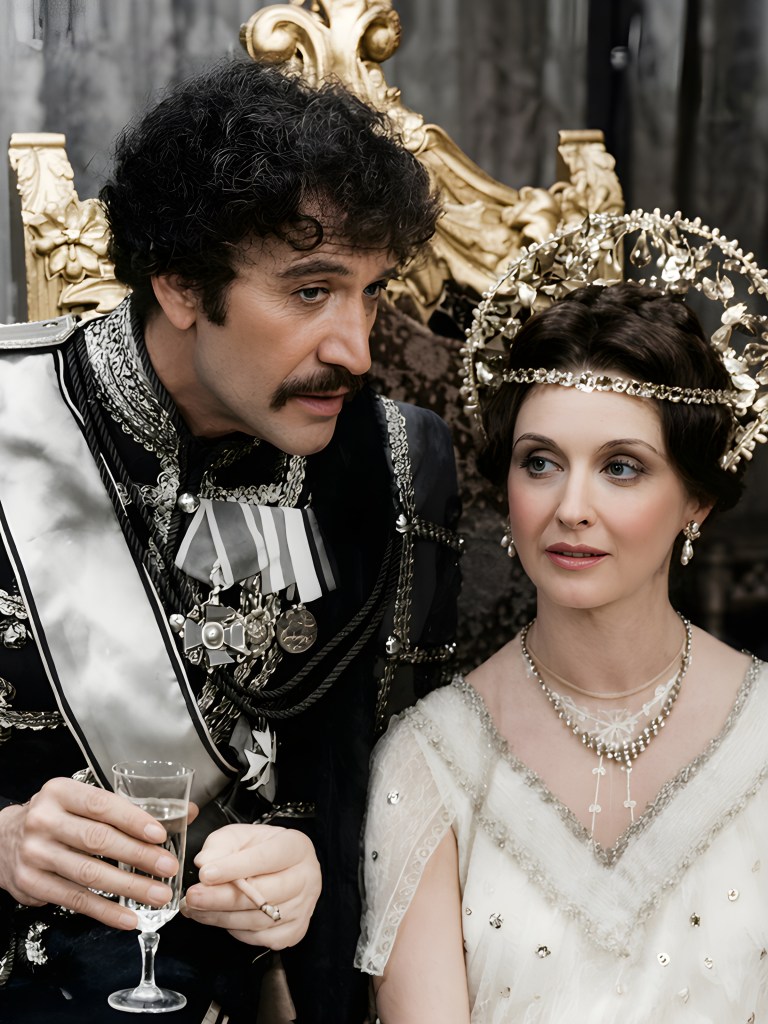

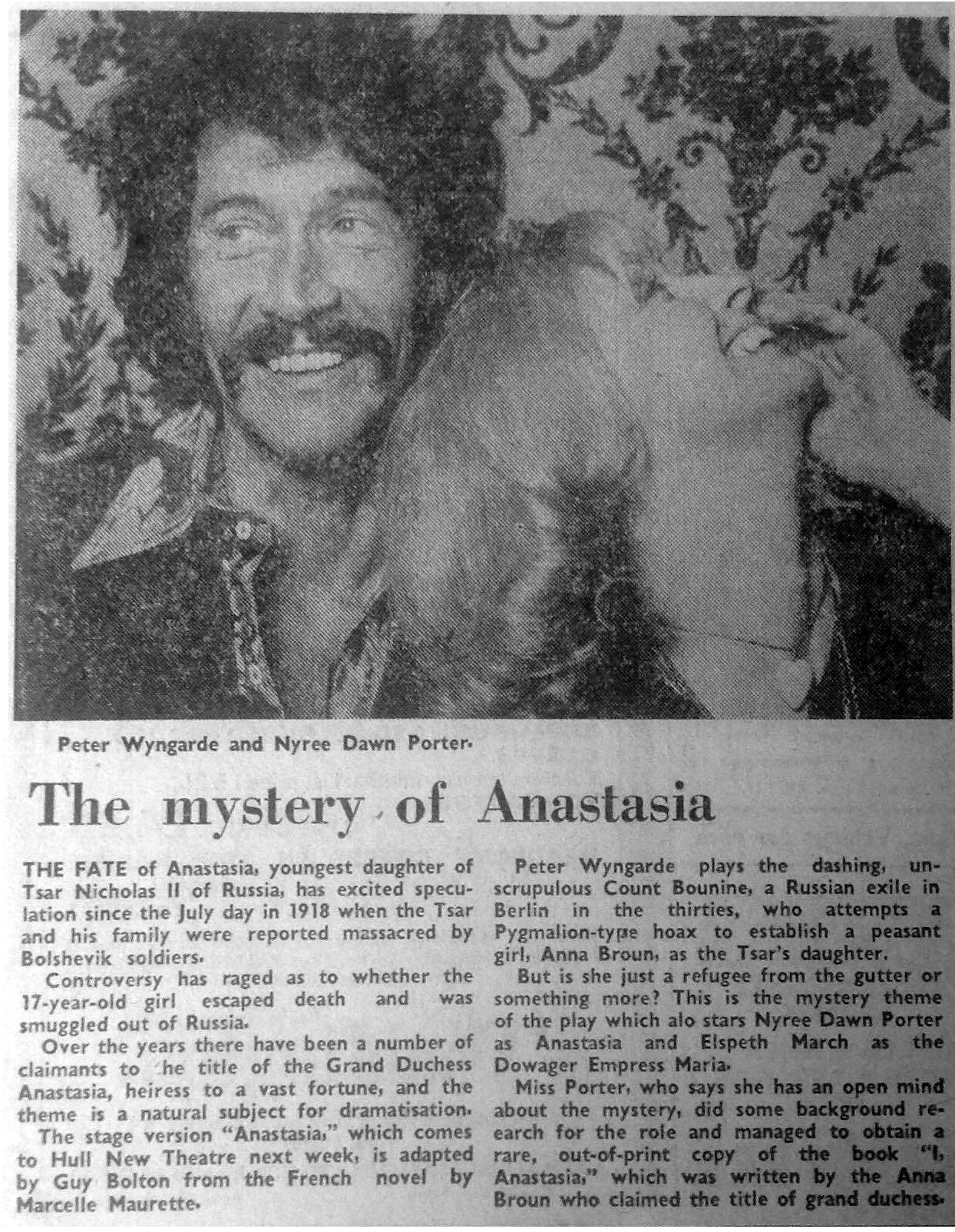


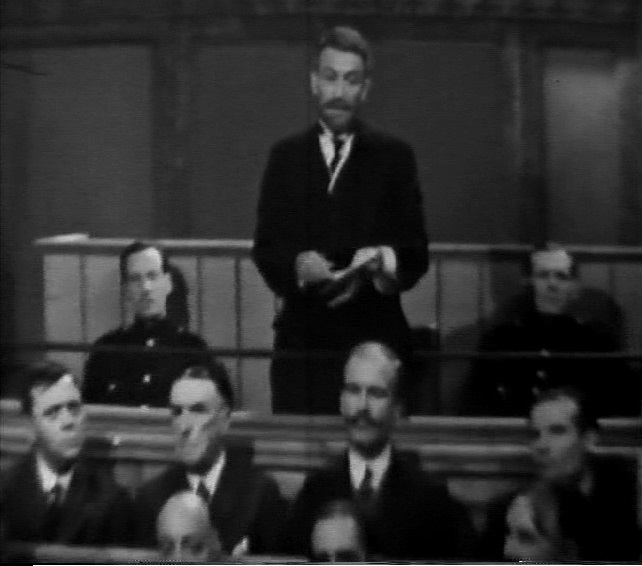
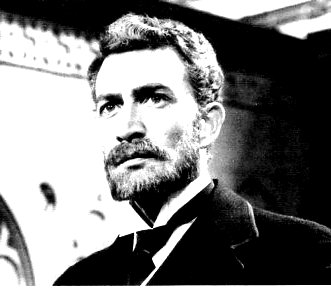

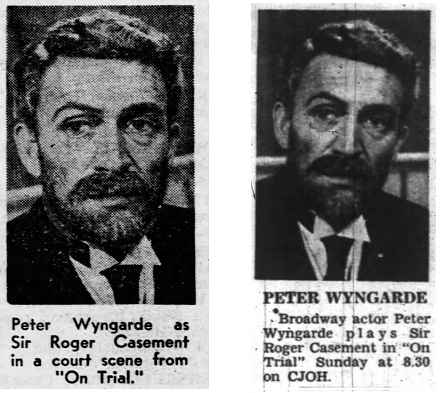
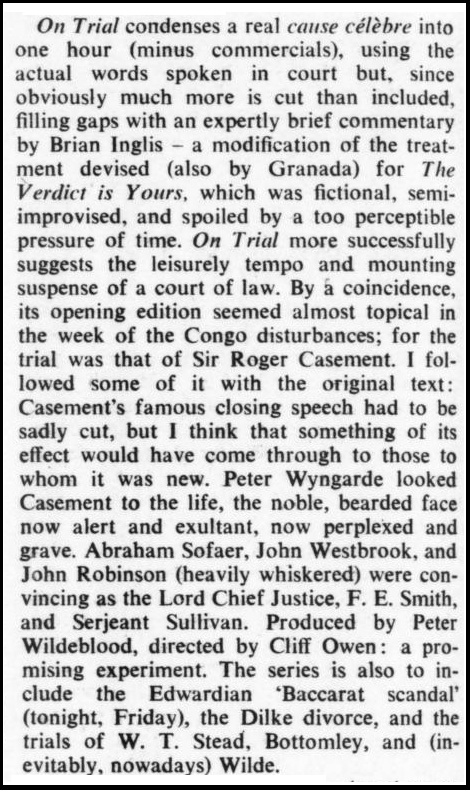
 the third screen and the fourth screen. So there was always a tiny bit of technical hitch going on there; there was always a bit of hold-up while they did those sorts of things. Waiting for the thing to do – it was a bit like watching a television, or a video now where you go (imitates a voice running backwards) it all goes back and you’ve got everybody going like that, and you come back on it. So there was a lot of technical things to do. I remember a fight that I had on a platform while these things were going on and I suddenly thought – we all stopped, because we thought ‘Oh my God! It means that every time we throw a punch we’ve got to match it up with the thing over there!’So Patrick very sensibly shot it at a different angle so we didn’t have to do all that. He was very good, you know, as a director. He should’ve directed a great deal more, I think.
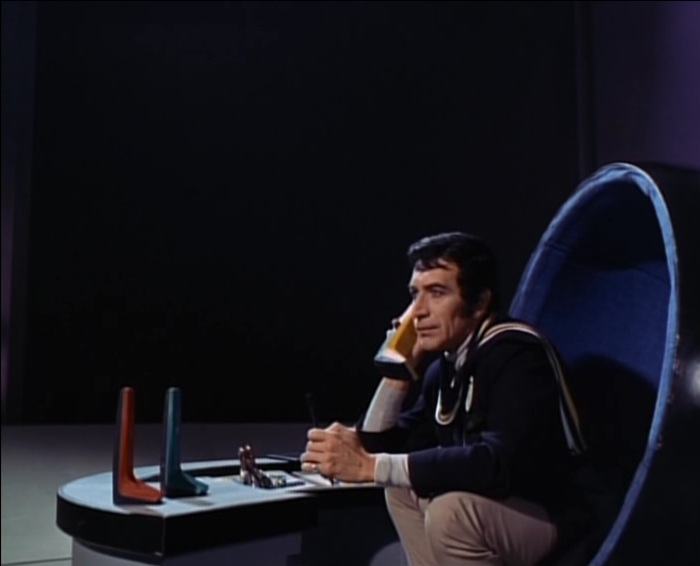 You remember, you said you thought that I had shot some of the ‘Jason King’ thing over here at the Thatched Barn; I don’t think we did. I think we shot ‘The Saint’ (The Man Who Liked Lions) here. I have a feeling. I remember an orgy scene by a pool (laughs), and we were all supposed to dress up in Roman costumes. That was the time that Roger (Moore) and I were supposed to fence at the end of it, or sword fight – not fence. A sword fight. I pretended to Roger that I’d never picked up a sword in my life, and that I didn’t know what to do. In fact, I’d fenced at the Green Club (London) – you know, the whole thing – and I love it, absolutely love it. So I thought it would be a little game with Roger, and we had to do this fight thing, you see, and every time he came along to see how the doubles were doing with me, I would go: “Oh! Oh! Oh, God!” And I said: “Roger, do you think it would be better if you did it with a double?” He said: “Peter, we must see your face!” “So,” I said, “Can’t we just do it like they do in the Errol Flynn movies, you know, and have my face looking fierce like that?” He said: “Come on, have a go! We have one big take, OK?” It was ‘The Man Who Liked Lions’, that’s what it was called, and I had to knock him – bang, bang, bang, bang, and he gets hold of me and sticks the sword in me, and I fall into the lion’s den, which is the end of the movie – marvellous big moment. So he said to the stunt boys: “He’s a bit tricky about the fighting, isn’t he? Never mind, I’ll make him look tough; don’t worry. Then we can do the cuts and that sort of thing”. So I just went and really let him have it. And I went bang, bang, bang, bang, and I got Roger. He fell into the lion’s den! That was the episode that was filmed here.