TRIBUTES TO THE KING

Words from the heart by Peter’s fans and admirers

I made my own tribute to Peter using archive interviews, clips, trailers, Soundtracks and music from the Films & TV show he’s appeared in. Tony Richards

For me, Peter Wyngarde was a true star, personifying originality, style and class. He was evocative of an era when stars were people that you looked up to because they possessed special talent, and Peter had that in abundance.

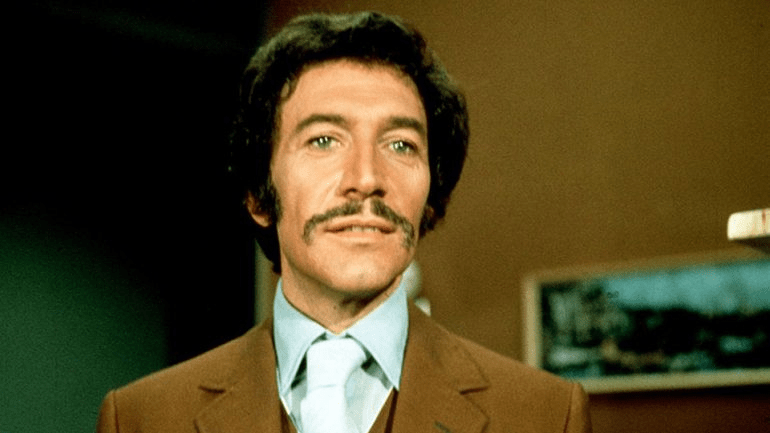
If I may explain, I have been a long-time admirer of Peter since he first came to my attention through his portrayal of Jason King when I was a teenager in the late 60s and early 70s. In those days of black and white television, and long before the digital versatile disc, his impact upon me was through his celebrity status. All these years later, whilst his celebrity remains firmly intact, I am beginning to truly appreciate the depth of his artistic attributes. Peter’s appeal is inter-generational. My son Lee was born in the post-Jason King 80s yet he shares my admiration. We are still learning about Peter’s illustrious career and this article, which focuses mainly on Department S, is an affectionate tribute from two of his fans. We both regard him as one of the country’s foremost acting talents and a captivating personality.

In Department S Peter was quite simply THE Star. His distinctive characteristics produced a riveting screen presence, and he dominated the scenes in which he appeared. Peter’s star quality was precisely what differentiated Department S from its contemporaries.  In today’s world, where there may be a reticence to recognise genuine stars, I find it instructive to paraphrase Sir Noel Coward on stardom, “… if you’ve worked all those years to become a big star it’s really rather silly to pretend that you are not one” and “…the stage is a place for extraordinary people – not a series of ordinary people”.  In the nicest possible way, I feel that these quotations from one of the theatre’s most revered figures serve to endorse Peter’s star status, which he earned through his individuality and peerless talent. This individuality was perfectly illustrated by Peter’s defining performances throughout the Department S run, during which time it became one of the most popular programmes on television.

In the episode “Soup of The Day” Peter’s tongue-in cheek-humour is evident when Jason tries to initiate a romantic liaison with a lady secretary (Isobel Black) who counters his suggestion by stating that her mother will be chaperoning her that evening.  Jason’s retort is to advise her that as his mother is chaperoning him, two chaperoning mothers might become rather confusing!  The comic timing and delivery is superb.

In “The Man from X” Peter’s talent for characterization is showcased when Jason impersonates a New York safe cracker complete with an accent and mannerisms that seem much more authentic than those of the actual New Yorkers we have encountered in the Big Apple.

In “One of our Aircraft is Empty” Peter’s gift for understated witticism is revealed in an early scene when his colleague Stewart Sullivan (Joel Fabiani) is unimpressed with Jason’s innovative explanation of mysterious events. Jason’s riposte is devastating “…Stewart, when you find that my idea works – a postcard will do!

In “The Bones of Byrom Blain” Peter effortlessly projects Jason’s bon vivant lifestyle when ordering lunch in a stylish restaurant. The waiter suggests a fish dish as an entrée and Jason elegantly corrects his culinary faux pas with “… yes quite excellent I am sure, but perhaps for the main challenge a venison D’Artagnan with a Volney ’64?” This authoritative panache underscores Jason’s mastery of all social situations and his love of high living. Throughout the episodes of Department S Peter’s stunningly original interpretation of Jason King provides the central theme of the plot lines. Peter simply takes the viewer on an exciting journey every time he appears on screen and never disappoints.

Peter’s consummate versatility as a performer is perfectly illustrated in his portrayal of Baron Gruener in the 1964 production of the Sherlock Holmes story “The Illustrious Client”. This role is the antithesis of Jason King and Peter projects the Baron’s menace with exquisite finesse. Two scenes stand out.  Firstly, when the Baron rebukes his fiancée (Jennie Linden) for entering a certain room in his home without his permission he exudes a power and authority which seem absolute. Secondly, when the Baron warns Sherlock Holmes (Douglas Wilmer) of the dangerous consequences of crossing him, there is a palpable sense of the steel fist being barely concealed within the velvet glove. Peter’s incarnation of the Baron could not be further away from the urbanity of Jason King and is a flawless demonstration of his superlative performance range.

The extent of Peter’s continuing influence was confirmed when Mike Myers based Austin Powers on a combination of Jason King and James Bond. Peter’s portrayal of Jason provided a key inspiration, particularly in the sartorial department. This is a cinematic homage indeed and may have prompted Jason to state “…remind me to sue for copyright”!  Continuing on the theme of James Bond, if ever there was a role that was tailor made for Peter then surely that was 007 himself.  Ian Fleming’s original depiction of the Bond character combined a world weary, cynical toughness with glamour and sophistication. I feel that Peter would have been perfect for the screen role, combining the charm and wit of Roger Moore and the ruthless edge of Sean Connery. Whilst the Bond movies have been hugely successful with great actors in the role, I still find it fascinating to speculate on what might have been!

The decade that followed Department S was the golden age of television drama and produced many fine actors. Edward Woodward, Bernard Hepton, Peter Barkworth, James Maxwell and T.P. McKenna are particular favourites of mine. Peter rightfully takes his place amongst this stellar cast list and, for me, is elevated to singular status because his on screen persona makes you feel better about life.  As Jason King, he is upbeat, positive and avant garde in his pleasure seeking – someone who is indisputably unburdened with the travails of the ordinary world. Peter’s appeal continues to transcend generations and ephemeral trends. Thank you Peter and long may your star shine with dazzling intensity.

By Neil Haddow and Lee Haddow  – Glasgow


When looking at cult icons there are not many who can lay claim to going toe-to-toe with Dick Barton, Alexander the Great, Ben Gunn, Sherlock Holmes, The Baron, The Avengers, The Saint, The Prisoner, The Champions, Flash Gordon, Doctor Who and The Two Ronnies! Peter Wyngarde is a man who can and when he did, he did it in great style!

The enigmatic Peter Wyngarde transcended every screen and stage he appeared on and as people clambered to find out more about him the mystery of the man grew deeper! As Jason King, Wyngarde captured the souls of a generation. This role which began in the television series “Department S” and later in its spin-off “Jason King” remains as relevant today as it did back in 1969. What makes it even more interesting was Wyngarde revealed to CultFaction.com back in August 2017 that he “didn’t want to commit to a series, but they wore me down and I ended up signing on the dotted line. Actually, it was on a napkin in a restaurant.” It was the guarantee of “carte blanche” to do whatever he liked with the role that lead Wyngarde to developing a character that can comfortably stand next to James Bond, The Saint, The Beatles, and The Avengers in the tapestry of British iconography.

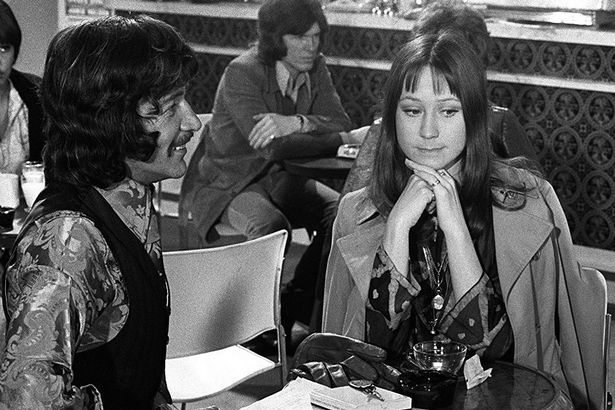
PROD-Peter-Wyngarde-Felicity-Kendal

How far does this influence spread? Well between 1976 and 1979, The Bullet comic – ran a story called “Fireball” where its hero looked a lot like Peter Wyngarde; as did John Byrne’s comic book character Jason Wyngarde (big clue in the name!), leader of The Hell Fire Club in The Uncanny X-Men. Even in recent years, it is clear to see that the character of Mr. Six in Grant Morrison’s The Invisibles is heavily based on Jason King. When asked about the influence King had Wyngarde humbly responded “I just believe he was the right character at the right time. I guess he just brought some colour into people’s lives.”

Wyngarde was more than just Jason King though, his turn as John Cartney in The Avengers “A Touch of Brimstone” episode remains one of the shows most discussed episodes, as did his role as Number 2 in The Prisoner episode “Checkmate.” Wyngarde was a man who could make the most out of any role he was given and had the ability to snatch a scene from under the show’s regular stars. It was in fact the challenges he placed on himself as a character actor that led him to taking the role of Klytus in Flash Gordon as he “felt it would be a new challenge in projecting a character from behind a mask,” and project he did.

The contribution Peter Wyngarde made to popular culture is unquestionable (I haven’t even touched on his music career) and his influences lives on today. Michael Myers has stated on record that without Peter Wyngarde there would be no Austin Powers and his name remains a cool name to drop into conversation be it the Harry Enfield comedy sketch “The Playboys” or Garth Marenghi’s Darkplace noting that Wyngarde “had it all” – the fact remains like all good artists, Wyngarde’s work will be rediscovered and enjoyed for generations to come.

Thank you Peter.

By Brett Summers – The Cult Faction: https://cultfaction.com/

‘A LIFE AMONGST STRANGERS’

For the first time ever in print, the complete life story of a television and style icon

To place your order from either Amazon or directly from the publisher, click on the appropriate icon below:

The book is available as a Hardback, Paperback and eBook

Further information

Peter Wyngarde: the name elicits memories of an actor with worldwide renown and instantly adhesive star quality. During a more leisurely time, so far from internet gossip as to be barely recognisable, this is a biography that glued two people together for several decades to create a journal of the rise and relaxation of a household name and the adoration they enjoyed.

The author has not placed their subject on a pedestal to unwittingly create an epic story of fame, fortune, the price of both and the cost of each other. With a wealth of stories to fascinate and appal in equal measure, and given it’s subject’s continuing fascination for a more worldly generation who would barely have heard of the power of the Lord Chamberlain, there is plenty to consume a worldwide readership for the story of someone whose fame hid fragility but whose status was the stuff of legend. 


AUTHOR’s NOTES

Firstly, the is not a conventional biography, as it’s in two parts, the first half of which tells Peter’s story from his birth until the late 1980s, which was when I first met him. It then becomes more of a memoir, covering both his career and our time together.

There are contributions to the book from many well-known personalities, who were Peter’s friends and colleagues.

Much of what’s contained in the book is in Peter’s own words, which has been taken from his own writing, and both letters to and from him – including the 2,000 letters, texts and emails he sent to me.

Since Peter gave few interviews to the press and little is known about his private life, many myths have inevitably sprung up about him. This book dispels many of those rumours and tackles the misconceptions born out of media misrepresentation with reasoned argument and genuine evidence.

The book is extremely detailed and honest. Although many of the fallacies about Peter are dispelled within its pages, there has been no attempt to whitewash over the bad moments in his. I have been 100% truthful throughout, and provides evidence to back any argument I make.

I have relied on my vast collection of private papers, original scripts, legal documents, court transcripts, personal diaries and private audio tapes etc., collected by myself over a 30-year period.

The book will also include some rare and never-before-seen photographs of Peter from his childhood, and throughout his seventy-year career.

The nature of the relationship I shared with Peter is laid bare in HIS words, and corroborated by mutual friends and show business acquaintances. This, I hope, will finally put to bed the vicious and cruel accusations levelled against me in the wake of Peter’s death in January, 2018.

The project is backed by Peter’s agent, Thomas Bowington (https://bowingtonmanagement.uk/).

The book is available to buy from the following outlets: Amazon, Waterstones, WH Smith, Gardners Books, Barnes & Nobel, Bertrams, Nielsen, Ingram, Bam! and Indiebound. You will also be able to purchase directly from Austin-Macaulay themselves.

The author of this book does not wish to make any money from Peter Wyngarde’s name. Any royalties earned from the sale of the biography will be donated directly to

Click below for…

blog-raf-100-austin-macauley

REVIEW: The Gambler

Broadcast:Thursday, 9th August 1956

Character: Marquis de Grieux

Some Background

What can one possibly do in a place called Roulettenburg than play Roulette?

Technically, it’s a spa town, and some of the characters do talk about “taking the waters”, but it’s the casino rather than the spring which draws them to this part of the Rhine; it’s to the whirling table and spinning ball that visitors devote themselves.

And with what devotion! ‘The Gambler’ is a study in obsession, an account in which the hoarse call of the croupier is answered without regard to the cost in terms of money and lives.

In the first stages of the play it’s simply money that draws the principle characters to the casino. The General is up to his ears in debt; even his stepdaughter inheritance is mortgaged to the Marquis de Grieux, who dogs their every footstep awaiting repayment. There can’t be any delay, since the Generals aunt is dying, and then he’ll be able to clear his debts and be able to marry the merry-eyed Mademoiselle Blanche.

In the middle of all this – half-spectator, half-participant, stands the tutor, Ivanovich, poor himself (his wages are always in arrears) and tortured by Polina who he loves but who flaunts before him her relationship with the Marquis de Grieux and a potential lesion with an Englishman.

Alexis hates the casino; he despises his bad luck, crudity and greed of those who play there. But he’s driven to play himself to try to get money for Polina. She spurs him on; others use him too, and the fever sets in…

The Story

The events take place in the German spa town of Roulettenberg in 1850.

Private tutor, Alexei Ivanovich (James Donald), arrives in town with his employer’s three young nieces, the grown-up Polina Alexandrovna (Rosalie Crutchley), and her two younger sisters.  

gambler

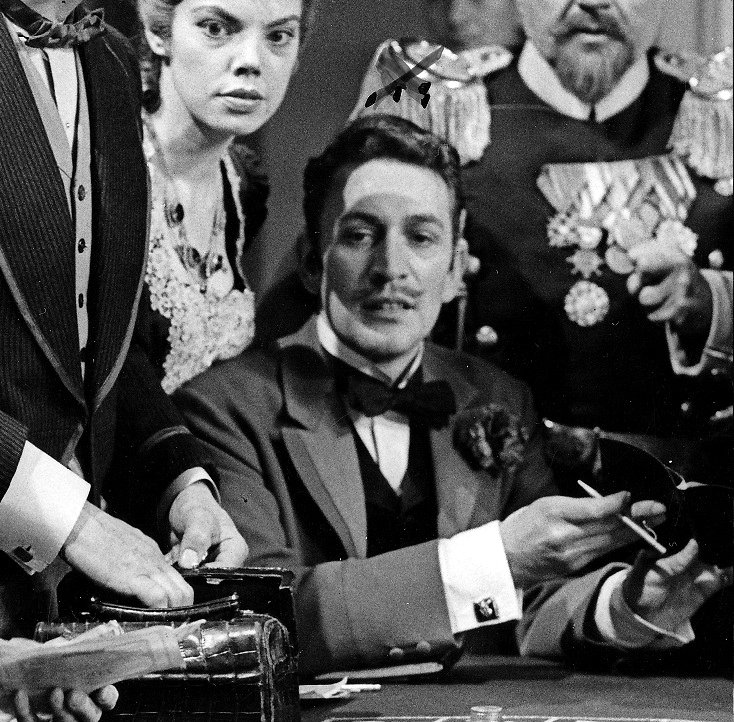
The head of the family, General Zagoriansky, latterly arrives in Roulettenberg. He has been forced to secure large loans against his properties in Russia to a wealthy young Frenchman, the Marquis de Grieux (Peter Wyngarde).

Alexei describes the Marquis as follows: De Grieux is like all Frenchmen, that is, cheerful and amiable when it was necessary and profitable, and insufferably dull when the necessity to be cheerful and amiable ceased. A Frenchman is rarely amiable by nature; he is always amiable as if on command, out of calculation”.

With the General is Mademoiselle Blanche Cominges (Andrée Melly) – a notorious gold digger, whose plan is to accept Zagoriansky’s proposal of marriage as soon as he receives an inheritance from his aunt back in Russia. Polina, meanwhile, is perused both by the Marquis and an English nobleman by the name of Astley (Gordon Whiting), whilst the penniless Alexei who’s also in love with her, is treated with all the contempt she can muster.

One day, however, Polina asks Alexei to place a bet for her at the town’s casino. Although he initially delays – fearing that she’ll lose her money, the wager turns out to be a winner. However, when he asks her why she’d been so desperate for him to lay the bet, she refuses to tell him.

Alexei, it emerges, has loved Polina since their first meeting – a fact that she’s well aware of. But when he finally plucks up the courage to tell her of his feelings, her response is cruel and heartless. Nevertheless, he sets out to uncover what Polina needed the winnings for, whereupon he learns from Astley that Zagoriansky’s family are penniless.

During a walk in the mountains one day, Alexei pledges himself – body and soul – to Polina, adding that he’d gladly throw himself off the nearest cliff if it was to please her. When moments later, the two see the Baron and Baroness Burmerhelm (Boris Ranevsky and Elaine Inescort) who’re also taking in the mountain air. Polina challenges Alexei to verbally abuse the couple, both for her own amusement and to test Ivanovich. Without a moment’s indecision, he lets fly at the Baron and his wife – resulting in him losing his job teaching Zagoriansky’s children.

Soon afterwards, the General’s aunt (Hermione Baddeley) – who is known to the family as Baboulinka (‘Grandmother’) – turns up in the town with her Servant (Gerald Lawson) having made a full recovery. She declares that she’s been aware all along of her nephew’s debts, and that she’s determined he will never get his hands on any of her money. She now asks Alexei to act as her guide around town, which is famed equally for its restorative waters as it is for its gambling den. It turns out that the old lady wishes to gamble.

Once at the roulette table, she places a large amount of money on her chosen number, which she subsequently loses. This losing streak continues for most of the night, and so by the time she leaves for home three days later, she’s squandered over 100,000 Roubles.

Returning from the railway station after seeing Zagoriansky’s aunt off, Ivanovich is met by Polina, who’s waiting for him at his hotel. She shows him a letter from the Marquis de Grieux who, it says, intends to sell her stepfather’s properties in an effort to recoup the money he’s owed.

Polina now admits that she is de Grieux’s lover, but wishes that she has enough money so that she could free herself from the French nobleman. When he hears this, Alexei immediately goes to the casino and eagerly places bet after bet, until he’s able to return to Polina with his pockets filled with gold. Initially, she indicts Alexei of attempting to buy her as de Grieux had done, but then she thinks better of him, and the two eventually fall asleep on the couch in his room. In spite of this, the following morning she requests 25,000 Francs from Alexei, which she instantly throws back into his face before leaving to find Mr Astley with whom she’s been trading notes.   

On learning that Zagoriansky has been disinherited by ‘Baboulinka’, Mademoiselle Cominges leaves the hotel where she’d been staying with the General, but before she returns to Paris with her Chaperone, she successes in tempting Alexei to go with them.

After only a month in the French capital, Mademoiselle Cominges manages in squandering Alexei’s entire fortune on elaborate dinners and lavish parties. Unbeknown to the former tutor, the General has followed them to Paris, and once the Lady has protected enough of Alexei’s money, she dumps the young man and marries Zagoriansky.

Now destitute, Alexei starts to gamble as his last option to survive. One day, whist passing through a park in Bad Homburg, he bumps into Mr Astley who’s sitting on a park bench. The Englishman tells the former tutor that Polina, who is now resident in Switzerland that, in spite of her barbed comments towards him, she really did love him. Astley adds that, whilst Alexei had been away, Baboulinka had finally passed away, leaving all her wealth to Polina and her siblings.

Before leaving, Astley hands Ivanovich some cash, in spite of his knowing that it would inevitable end up in the hands of a croupier somewhere. As the Englishman predicted, Alexei heads for the nearest casino, dreaming of what made him win in Roulettenberg and of going to Switzerland to find Polina. 

Critics Comments

REVIEW: The English Family Robinson – ‘Free Passage Home’

Broadcast: Thursday, 21st November, 1957

Character: Doctor Bannerji

Some Background

Iain McCormick’s prestige as one of television’s most competent playwrights in the 1950’s, stood higher than ever after the completion of his four-play cycle, ‘The English Family Robinson’.

Although the press appeared not to be greatly impressed by the first play in the series (‘The Third Miracle’ – Broadcast: 14th November, 1957), each of the other subsequent episodes succeeded in improving on the one before. Indeed, Norman Cook of the Liverpool Echo described ‘Free Passage Home’ – the fourth and final instalment of this mini-series – as “a masterpiece of the dramatic, but finely controlled television craftsmanship”. 

By all accounts, the saga had been and excellent, thought-provoking series that stressed the fact that Britain – usually blamed by all sides in any situation, had done much for the Indian people and had nothing to be ashamed of. 

The Story

McCormick’s ‘English Family Robinson’, was a four-part drama series which drew a lifelike picture of India during British rule, with each of the stories being presented in an intensely and personal way. The fourth and final play brought the epic up to 1947.

‘Free Passage Home’ told the story of Ross Robinson’s son, Sandy – a commissioner in the Indian Civil Service, who’s charged with the duty of handing over the administration at the time of the partition of India on August 15 of that year. Unfortunately his North-Western District of Dalpor is bisected by a river which becomes the frontier between the new India and Pakistan.

The story opens just two days before the handover. Robinson has been ordered to avoid violence at all costs, but the inflamed racial tensions threaten to break into a wave of murder and destruction, while refugee columns struggled to reach safety through hostile country.

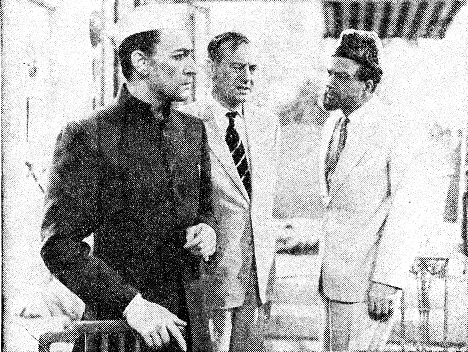
Peter (left) as Doctor Bannerji, with John Robinson as Sandy Robinson and Olaf Pooley as Mirza from the play, ‘Free Passage Home’ – the last episode of the plays in the ‘English Family Robinson’ series.

family

Inside Robinson’s office, there’s a cross-section of the political forces at work in this darkest of hours before the dawn of a new nation. At first, the Commissioner’s sympathies appear to lie with the representatives of the new Pakistan, who were courteous and co-operative. The Hindu leader – Doctor Bannerji (Peter Wyngarde), on the other hand, is an arrogant fellow, who’s loathed to co-operate and pointedly discourteous. In the end, however, even he was shown to be not so bad after all.

The Commissioner even had a good word for the Communist leader, who was also shown earning the gratitude of the British by rescuing the Robinson’s wife from an angry Hindu mob.

‘Free Passage Home’ successfully combined powerful entertainment value with a tolerably praiseworthy attempt to summarise the political arguments of the period (and which continue to this day) of a period in Indian history which was at once great and tawdry.

Critics Comments

REVIEW: Mr Gillie

Richmond Theatre, London

Character: Tom Donnelly

“I do not like cages. I think that the few minutes between the door of the cage and the jaws of the cat make life worth living.”

The Story

William Gillie (Percy Cartwright) is a school headmaster who lives in the Scottish coal-mining village of Crult; a place where his pupils are fated for the domestic service or the mine. Undeterred by the misgivings of his long-suffering wife (Margo Boyd) and much against the ideals of the churchmen who pay his wages, Gillie perseveres in offering private tutoring in philosophy and literature to any of his pupils that shows some academic promise.

To date, not a single one of Gillie’s students have shown any real promise, leading the Education Committee to question his suitability as a teacher.

PITBOY

Things go from bad to worse when Pit Boy Tom Donnelly (Peter Wyngarde), a capable young writer, announces that he’s not only involved with Nelly (Pamela Galloway) – the daughter of the village doctor, but that they intend to elope to London. Soon public opinion turns against Gillie, who is accused of offering the two young lovers unsuitable careers advice and, moreover, for failing to stop them from consummating their affair on church property. The angriest of his accusers is none other than Dr Watson, who is enraged that he might lose his daughter to “A black-faced pit boy!”

Right: Peter as Pitboy, Tom Donnelly

Further to the pressure placed upon the Education Committee by Dr Watson, the village schoolhouse is inevitably closed down. Wageless and destitute, Gillie falls behind with the rent on his cottage, which leads to the landlord evicting the former teacher and his accommodating wife. Tragedy strikes when a van that’s been hired to take away the couple’s furniture, accidentally runs down Gillie and he’s killed.

Now on the ‘other side’, the teacher is put on trial by a saintly Procurator and Judge to decide whether Mr Gillie actually achieved anything in life, or if endeavour and wishes are good enough.

In Retrospect

‘Mr Gillie’ was first performed at the King’s Theatre in Glasgow, in 1950, and starred the legendary Alistair Sim in the lead role. Subsequently, it transferred to the Garrick Theatre in London and was filmed by the BBC.

The entire play is set in the Gillie’s front room, where copious amounts of tea are served to visitor that passes through the front door.

Each of the characters are affectionately depicted by author, James Bridie, who bestows upon them his own gift of wit and humanity. The scene where Gillie castigates the selfish doctor for wanting to keep his daughter at home, cooking and cleaning for him rather than allowing her to spread her wings, is especially good. His defence of the hard-nosed Nelly, is carried out in spite of his knowing that her determination to marry Tom – an immature adolescent from the same village, is doomed to failure. Of course, the middle-aged schoolmaster, in chastising Watson, fails to acknowledge that he himself has trapped his own wife into the same tedious existence.

REVIEW: The Widows of Jaffa

Broadcast: Friday, 7th June, 1957

Character: Mustafa

The Story

Playwrights like to have a setting that’s self-contained, such as a lifeboat at sea, a tiny flat, or a country house. In this play author, Evan Jones, put his characters in a refugee camp on the Gaza strip because he knew something about it, and because it seemed to him as good an image of the modern world as any of the above.

If any piece of territory qualifies for the title ‘God-forbidden’ the Gaza strip was it in the late 1940’s. There was nothing there but sand, a single crumbling town, and 250,000 unwanted people.

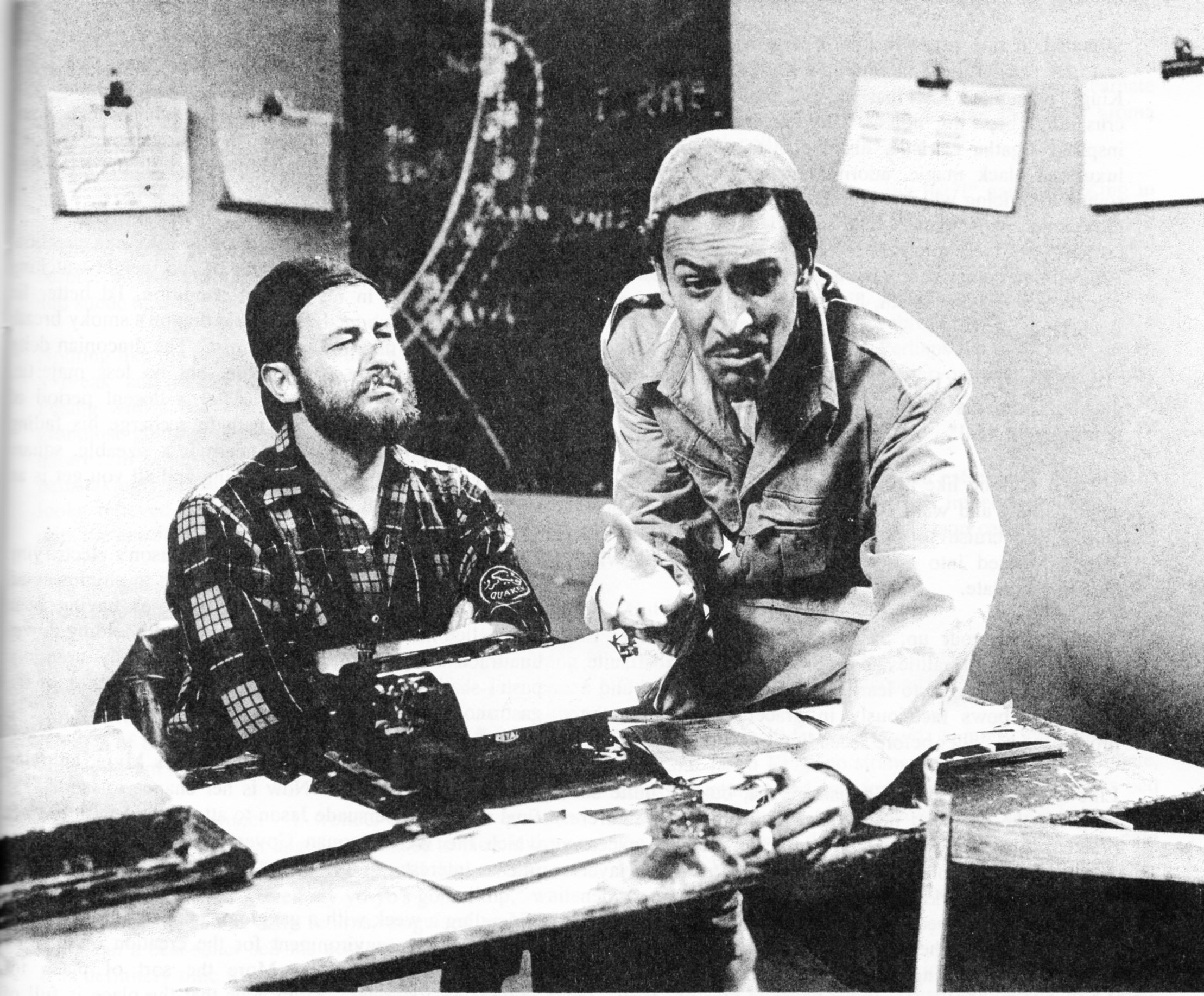
Below: Peter as Mustafa, with Leo McKern as Eddie

JAFFA

The refugees had lived in Gaza for almost a decade. Israel, overburdened with her own persecuted people, did not want them. The Arabs were already rich in poverty, and while the refugees remained they could maintain their quarrel with Israel. Although the conscience of the world would not let them die, the statesmen couldn’t find a solution to their problems. Meanwhile, the Arabs would not accept Israel because, to them, the country was a usurper of their ancient land; a western colony that brought ideas and techniques which threatened their way of life.

This was the background to ’The Widows of Jaffa’, but the play was not about politics – it was about people. In the 1940’s, the refugee camps were organised by a group of Quaker volunteers working for the United Nations. Their biggest problem was registration. This had to be done through the representatives of the refugees, since the only outside force was the corrupt and defeated Egyptian Army. In the interests of justice, the Registration Lists had to be accurate. The volunteers were strangers and outnumbered, but they had a weapon: the power of hunger.

‘The Widows of Jaffa’ was loosely based on the experiences of the author who, after completing his education at the small liberalised Quaker college of Harvard, Pennsylvania, went to Palestine with the American Friends Service Committee. The action takes place in 1949, several months after the Arab-Israeli War.

Soldiers were specifically excluded from the play, which tells the story of a newly-arrived Quaker missionary in one of the camps camp on the Strip.

The misery of this ‘waiting out of time’ and the appalling thought that such wretchedness could exist only a few hours away from the capitals of Europe were the predominant impressions taken from this powerful and wonderfully-acted drama.

Desperately wanting to know whether Christ’s teachings could be made to work, Camp Leader, Andrew – played by Patrick Allen, finds nothing but deception, cynicism and corruption around him.

In sharp contrast to the idealist Andrew, Camp Coordinator, Eddie (Leo McKern), is frustrated and disillusioned – wisecracking his way through one of the dirtiest jobs in the world. He and Andrew clash over almost everything, not least the Ration Lists that the team have been sent to make.

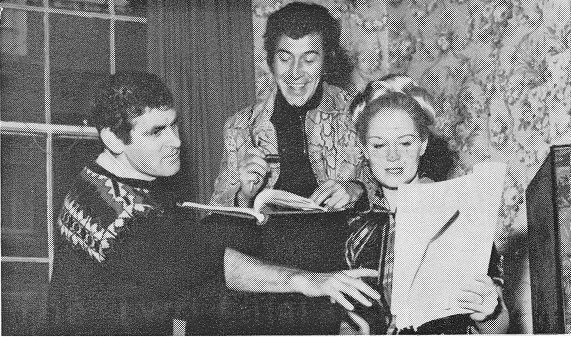
Left: Peter with Patrick Allan, Leo McKern and Evan Jones during a rehearsal for the play.

Additionally there’s interpreter, Mustafa (Peter Wyngarde), who is embittered by the loss of his homeland, and yet is torn between his allegiance to the Arabs and his attraction to the Westerners who he works for.

Into the mix comes merchant, Abu Mahmoud (Harold Kasket), who controls the Lists for his own personal profit; the boy, Abdel Rahman (Frank Aiello), who has known no life but that in the camps; and the eponymous widows of Jaffa, veiled from head to toe – pawns in a struggle for food.

It was to the credit of the three principal actors that they didn’t allow Jones’ philosophising to drown out the characters.

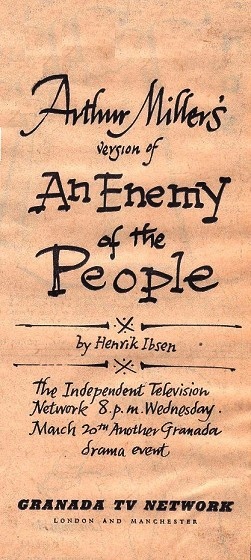
REVIEW: Play of the Week – ‘Enemy of the People’

Broadcast: Wednesday, 20th March 1957

Character: Hovstad

The story is set in Norway. 

 Act I: Dr Stockmann’s Living Room.

Act II: Dr. Stockmann’s Living Room.

Act III: The Editorial Office of ‘The People’s Herald’.

Act IV: Large hall at Captain Horster’s house

Act V: Dr Stockmann’s Study.

Some Background

One of the greatest writers of the 19th Century – Henrik Ibsen, provided a tense story for Granada’s Play of the Week on 20th March, 1957.

This play was of enormous interest because it had been adapted by one of America’s foremost dramatists – Arthur Miller. Granada couldn’t have chosen a more dramatic moment to present Miller’s version of this great work, because it concerned a man’s fight for what he believes to be right.

Miller himself was a champion of what he believed to be right, having refused to reveal the names of fellow writers who took part in extreme Left Wing activities in the late 1940’s, even though this denial brought him before a Congressional Committee and led to him facing trial on charges of contempt of Congress.

No dramatist was more in harmony with Ibsen than Miller. His work on ‘Enemy of the People’ revealed his understanding of the formers mind and of his craft.

Miller, who was once married to Marilyn Monroe, had written many famous plays, including ‘Death of a Salesman’ and ‘All My Sons’. His thesis of the latter of these works was similar to that of ‘Enemy of the People’. The message implicit in both these plays is that a man’s social responsibilities are above self-interest: he should champion what he believes is right even though it may bring disaster to himself and to his family.

Miller’s adaptation altered nothing of the essence of ‘Enemy of the People’. The great play was there with all its warmth of feeling, its humour and its depth. Though the characters express themselves differently (Miller had substituted language of the 1880’s with that of the 1950’s), the meaning of their words were not altered but sharpened. Every word landed a punch.

The principal character is Dr Stockmann – general practitioner of a small town, who discovers bacteria infecting the water supplying a newly-opened health spa. He warns the leading men of the town, who refuse to believe him. When he’s inevitably proved to be correct, he exclaims: “Now they’re going to get it with both barrels!” 

Ibsen was the first dramatist to make his characters behave as they would in real life, his language would be probably be far more choice!

Ibsen wrote ‘An Enemy of the people’ in 1882 as a fighting reply to the abuse hurled at him after the publication of ‘Ghosts’ a year earlier. When he was reviled by the public, the press and the intellectuals, he promptly sat down to satirise, in ‘Enemy of the People’: the crassness, hypocrisy and stupidity of the “compact majority”.

Dr Stockmann is an irrepressible character; optimistic, fiery and with his own sly humour. “Well, it shows you, that’s all,” he comments on his return from a public meeting with his clothes torn. “A man who goes out to fight for the truth should never wear his best suit.” 

Stockmann is a typical; “agitator” to be found in every community, and ‘An Enemy of the People’ was full of fun – one of the most exuberant plays Ibsen ever wrote.

“I am descended from peasants and believe in my people!” Hovstad

The Story

The play opens in Dr Stockmann’s (John Robinson) living room, where his wife (Jessica Spencer), is welcoming Mr Billing (Tom Criddle) who’s been invited to dinner. No sooner has this gentleman taken his seat at the table when there’s a knock at the door. When Mrs Stockmann answers it, she finds Hovstad (Peter Wyngarde) – Editor of the local left-wing newspaper, ‘The People’s Herald’, standing outside.

Moments after Hovstad’s arrival, there’s a second knock at the door. This time it’s her brother-in-law, Peter Stockmann (Clive Morten) – the town’s Mayor. Hovstad and the Mayor greet each other rigidly, and then begin to discuss the building of the new public baths, which both agree are an excellent addition to the town. However, when Hovstad announces that the baths had originally been Dr Stockmann’s idea, the Mayor appears annoyed.

Just as the Newspaper man takes his seat at the dinner table, the Doctor arrives home, bringing with him his two sons, Eilif (Brian Franklin) and Morten (Anthony Wilson), along with Captain Horster (Edward Forsyth). It’s clear from the off that the Doctor and his brother – the Mayor, are not on the best of terms, since the GP snappily counters each and all of his brother’s observation and opinions, and routinely talks over him.

Nevertheless, the Mayor asks his brother what he thinks of an article he’d penned about the new baths for Hovstad’s ’paper. The Doctor replies cryptically that he hopes the piece won’t be printed immediately, as it might turn out to be unfitting. The Mayor becomes agitated at this, since the Doctor plainly doesn’t wish to enlighten him any further on this point. With Stockmann remaining tight-lipped, the Mayor decides to leave.

The following day, Hovstad and his colleague, Billing, plus Horster and Mrs Stockmann meet at the latter’s home for a chat over a drink and a cigarette. The Editor brings up the difficult relationship between the Mayor and his ‘paper. But before a heated exchange ignites between the two men, the Captain interjects – announcing that he himself is due to sail to America soon. Hovstad and Billing are both stunned to hear this, and remind the sailor that he’d be missing an important election that’s scheduled to take place in the town later that month.

Momentarily, Petra (Jill Dixon) – Dr Stockmann’s daughter and the night school teacher, arrives with a letter for her father, which he’d clearly been eagerly awaiting. He takes the letter with him to his study where it’s read. When he reemerges, Stockmann announces that he’d recently taken samples of the water at the new public baths which he’d subsequently sent to a lab. The result of the tests he’d carried out were contained in the envelope brought by his daughter. The water, he declares, is dangerously polluted.

The Doctor goes on to tell the gathering that contaminated water from local industries has been seeping into the bath’s pump room, and that if the town’s hierarchy had listened to his advice about the drainage system in the first place, this problem would’ve been avoided.

Those around the table are full of admiration for the Doctor’s prompt action, and praise him for saving the town. The predicament, he maintains, can easily be rectified.

A few days later, Mrs Stockmann hands her husband a newly delivered letter, which is a response from the Mayor to the report from the lab. His reply curtly states that he will speak with Stockmann about it at a later date.

Some days later, the Mayor calls on his brother for the sole purpose, it transpires, of sniggering at the Doctor’s findings – saying that the Town Council would be mad if they were to believe it. Just then Hovstad arrives, and tells the Doctor that he hopes to publish an article about his findings in ‘The People’s Herald’, which he hopes will kindle a campaign against the town’s right-wing leadership since the real contamination, he says, comes from them.

Whilst the Doctor agrees that Right-Wing ideology is not the way forward, he’s still somewhat reluctant to start a concentrated assault on the Town Council which, after all, is led by his own brother.

Aslaksen (John Salew), a friend of the Stockmann’s and Chairman of the influential Homeowner’s Association, arrives to offer his support to the Doctor. He suggests that he should organize a peaceful demonstration in an effort to exert pressure on the Council to resolve the issue. The Doctor, however, doesn’t believe that such a protest is necessary, as he’s certain that he can persuade the baths’ Board of Directors to take the required action.

When Aslaksen’s departs, Hovstad, who’d been listening intently to the other men’s conversation, dubs the Doctor a weakling for his lack of desire to take on the Council, but Stockmann insists that if the Mayor fails to act with regard to town’s water system, then Hovstad would be welcome to publish the whole of the laboratory’s report in his ‘paper.

In the Editorial Office of ‘The People’s Herald’ the following afternoon, Hovstad is writing at his desk when Billing arrives with a copy of Dr Stockmann’s findings. The two men deliberate over the persuasiveness of the report, and how they might use it to confront the Council. Hovstad is convinced that if the Doctor’s pitch is officially recognised, then the Mayor would inevitably be confronted by those who invested in the baths and the powerful Homeowners Association.

At this point Stockmann turns up to disclose to the newspaper men the details concerning the row he’d had with his brother. The three of them agree that this scandal could well result in the downfall of the Council and its leader. When Aslaksen also appears, they each inn turn guarantee the GP that both the left-wing activists of the town, and the regular man on the street, will all back him. Secretly, both Hovstad and Aslaksen agree that the Doctor will be very useful to both of them, even if for different reasons.

When Aslaksen vacates the office, Hovstad and Billing – the latter of whom, it emerges, is standing for public office himself (if only to annoy the establishment!), converse about how much they’d like to be rid of him. Unfortunately, they have to rely on him and the powerful Homeowner’s Association whose money enables them to publish their newspaper. They then consider the possibility of the Doctor providing them with financial support.

As Billing leaves, Petra arrives to translate an English news item for the paper, but on reading it she immediately changes her mind – saying that the content is in direct opposition to everything that she and the ‘paper stands for. Hovstad explains that he thought the piece, which is about how higher ideas (or ‘Free Thinking’) can help guide a person’s actions, would help keep their less gifted readers happy.

Although Petra might expect this kind of low calculating from Hovstad, she’s surprised at Billing, with whom she’s involved with romantically. Whilst she still refuses to translate the article, she thanks the Editor for his support of her father.

To Hovstad’s astonishment, the Mayor now arrives and remarks on what a marvelous set-up the young Editor has. He begins by talking about his brother’s proposition for the baths, to which Hovstad claims to have no knowledge. That’s until the visitor notices a copy of the Doctor’s report lying on the desk.

The Mayor continues by warning Hovstad that, if Stockmann’s proposals are accepted by the Council, it could prove disastrous for the town. The baths, he explains, would have to close for upwards of two years, and that the costs for all the work would have to come from a civic loan.

On hearing this, both Hovstad and Billin begin to have second thoughts about backing the Doctor who, at that very moment, is seen walking towards the office. Given that he doesn’t wish to be seen fraternising with newspaper men, the Mayor hides from his brother in an adjoining room.

Stockmann wishes to see the first draft of the article about his findings, but Hovstad tells him that it’s not as yet been prepared. While the cheery medic interprets the two journalists caginess as a sign that they might be planning some festivities in his honour, Hovstad attempts to convey how things actually stand.

Just then Mrs Stockmann charges into the office, where she begs her husband not to risk everything by publishing his article. The Doctor smiles and calmly reassures her that he’ll soon have the majority of the townsfolk behind him. He then notices the Mayors traditional hat and cane lying on a chair, and deduces that his brother must be in the office somewhere. He puts the hat on and begins impersonating his sibling, until the Mayor can stand the insult no longer, and shows himself in the doorway of the adjoining room.

Several days later, a large room at Captain Horster’s house is full to the rafters with people from the town. Mr Billing has been sent to report on the meeting, whilst Horster is there with Mrs Stockmann and her children.

Meanwhile, Hovstad, Aslaksen and the Mayor arrive and take their places. They’re followed in short order by Dr Stockmann, who’s greeted with a mixture of applause and cat-calls from the assembled crowd.

The Mayor immediately prevents his brother from addressing the gathering with his report or, indeed, from mentioning the baths at all. Whilst he and Aslaksen work in tandem to influence the people in thinking that the Doctor is merely attempting to damage the interests of the town, Hovstad asserts that his sole concern is for the Doctor and his dependents. A recommendation is passed that the Stockmann’s case should be dismissed.

The Medic is plainly angry at the betrayal of those who’d sworn to support him. The final straw comes when a drunk (Reginald Marsh) staggers into the meeting room just as the Doctor is about to speak, and demands his right to be heard. Whilst the interloper is quickly dispensed with, Stockmann reminds those assembled that it was initially his idea to build the baths, and that he only ever wanted those facilities to be beneficial to the people of the town.

Although Aslaksen attempts to quiet him, the Medic’s parting shot is aimed at the Council, his says that he hadn’t bargained for the immense foolishness of those in power. In this he means the disappointing behaviour of his own brother. But, he adds, they’re not the party most guilty of stupidity. The people themselves must shoulder most of the blame for allowing the power of the majority to lie in the hands of the minority.

He now rounds on Hovstad and asks if, as a supposed ‘Freethinker’ himself, if he would agree with him. The Editor replies that, nowhere has it ever been said in print that he’s a “Freethinker” adding that, no, he does not agree with Stockmann’s foolish statement. “I am descended from peasants and believe in my people”, the newspaperman retorts.

Undeterred, Stockmann asserts that if the Peoples Herald refuses to publish his report, he will find a newspaper in another town that will.

ENEMY OF2

With this, Hovstad stands and accuses Stockmann of being “An Enemy of the People”. In his agitated state, the Doctor agrees – stating that he’d be happy to remain so as long as he knows that what he’s doing is right. Meanwhile, as Aslaksen collects the ballot papers from the assembled crowd, Billing tells several of the locals that the Doctor is, in fact, a heavy drinker, and as a result, had recently been deprived of a raise in his salary by the Council.

When Aslaksen announces the result of the vote, and Stockmann is affirmed ‘An Enemy of the People’, he leaves with his family – the sound of the masses chanting “Enemy!” ringing in his ears.

The morning after the meeting, Dr Stockmann is found picking up the stones that had broken every window of his study the evening before. To add insult to injury, the landlord arrives thereafter to serve the family with notice of their impending eviction. In spite of this downturn in his fortunes, the Doctor remains optimistic now that he’s decided to leave for America with his family on Captain Horster’s next boat, where they’re to start a new life.

His wife is not quite so sure about the plan – proposing that a move to another town in Norway would be more prudent, but the Doctor is resolute; the people will be the same wherever they go in their own country, he maintains. At least in America things might be different.

The Doctor feels wholly justified in planning the family’s relocation when Petra arrives home to tell her parents that she’s been dismissed from her job after her boss was intimidated for employing her.

When Horster arrives, however, the Doctor’s fervor is dealt a blow on learning that the Captain has also lost his position – having been dismissed by the ship’s owner for his continued support of the Stockmann’s.

Hot on Horster’s tail is the Mayor, who arrives at his brother’s home to announce that the Doctor has been removed from his position as Medical Officer at the baths, and to request that he leaves town for six months or so. If, after that time, he’s willing to freely withdraw his testimony regarding the polluted water, then the Council would consider giving him his job back.

As a man of principal, the Medic flatly refuses to cooperate. The Mayor now suggests that the reason his brother feels so assured in his defiance of the Council, is because Morten Kiil – a local tannery owner – has provided for the Doctor and his family in his Will. This comes as a total surprise to the Stockmann, but when the Mayor adds that the elderly businessman might now decide to rewrite his Will in view of the Medic’s recent behaviour. Stockmann reject this, saying that Kiil has no love for the authorities, and that he’d be absolutely delighted to see the Doctor rocking the boat.

On hearing this, the Mayor accuses his brother of causing trouble in the town merely to ingratiate himself with Kiil, and now that he’s armed with this information, he assures the Doctor that he’ll never get his job back.

When Kiil arrives moments later, he brings with him a number of share bonds in the baths. The tannery owner suggests that if the Doctor was to retract his statement, the value of the shares that he’d bought cheaply that very morning would increase substantially, and leave him as the majority shareholder. He’d then be able to start work on the repairs that the GP had originally recommended. He asks the Doctor to consider his proposal, and to let him have his answer that afternoon.

As Kiil leaves, Aslaksen and Hovstad arrive with their own proposal for Stockmann. They’re aware that Kiil has been buying up blocks of shares, so they offer to give the Doctor full use of ‘The People’s Herald’ as soon as Kiil gains control of the baths so that he can convince the public that the water problem has been solved.

The two men advise the Doctor that the press have a huge amount of power in a town like theirs; all that they would require is some form of recompense in order to keep the newspaper running. Stockmann retorts sardonically – saying that it would be a travesty for sure if ‘The ‘People’s Herald’ – a real “friend of the people” should fold. However, since he himself has been declared ‘An Enemy of the People’, he really couldn’t care less what happens to the ‘paper! He then chases the two men from the house with his walking cane.

On hearing the commotion, Mrs Stockmann, Petra and Captain Horster come from the living room to see what’s going on. They find the Doctor writing the word ‘No!’ three times in large letters on a card which he’s ready to send to Morten Kiil. He then announces to his wife that they won’t now be sailing to New York as planned, but will stay put and fight. Given that the family are about to lose their own home, the Captain offers them a place at his house. There, the Doctor would be able to continue running his medical practice for the poorer residents of the town, since the more affluent townsfolk would doubtless refuse to see him.

Stockmann gratefully accepts Horster’s generous offer and vows to take on the rats that run the Council. His sole concern, he confesses, is that there might not be a single man in the town who’d be willing to carry on the fight after he’s gone.

When Eilif and Morten – Stockmann’s sons arrive having been sent home from school for fighting, the Doctor resolves to establish a school for the poor in the hall where he was declared ‘An Enemy of the People’.

Mr Stockmann, though, still has reservations – not least as she believes that the authorities will continue to persecute her husband. He reassures here, however, that he will always be stronger than them, because he stands alone.

REVIEW: Armchair Theatre – ‘The Shining Hour’

Broadcast: Sunday, 5th January, 1958

Character: David Linden

‘The Linden’s are living a relatively happy, complacent life until Henry brings home his second wife. Their life is then disrupted and tragedy follows’.

Some Background

This play – part of the Armchair Theatre series (Season 2, Episode 17), was due to be broadcast on Sunday, 29th December, 1957, but as a result of a faulty microphone and crane camera breaking down. Great efforts were made to repair it in time for the live broadcast, but they failed. Rather than put on a makeshift production, without the use of the “Mole” camera which could be raised or lowered, the decision was taken by Canadian director, William ‘Ted’ Kotcheff, whose methods of production include great mobility of cameras, decided that the transmission could not go ahead, since the faulty equipment was integral to his plans. A “stock” film was shown in its place.

Spare parts for the broken crane were rushed in from London on the Monday, and were anxiously fitted and tested. To be on the safe side. A.B.C. a complete spare “Mole”, which weighed two tons, to be set up their studios in Manchester.

The drama, which was written by Keith Winter, was eventually shown on the following Sunday, which meant the cancellation of the telefilm, ‘Trial by Candlelight’. It also meant that one of the main players, Angela Baddley, had to be replaced by Marian Spencer at short notice since Ms. Baddley had planned to abroad on holiday during the first week in January. A.B.C. were fortunate that she was the only one who couldn’t alter arrangements to leave a further weekend free.

The production company released the following statement during the week beginning 30th December: “In fairness to Kotcheff and the play itself, the production was abandoned when it was found that repairs could not be effected in time.” There was no mention of fairness to the cast, who must’ve felt somewhat aggrieved when they realised that they were of secondary importance to a camera!

Thankfully, there were no more gremlins – at least with the equipment. Whilst four of the original cast members made the trek back to Manchester for a second time in a week, a certain Mr Wyngarde left them waiting to begin a camera rehearsal.

Thirty minutes went by, and still no Peter, and just as tempers were reaching breaking point, the great man arrived. Looking around at the solemn faces that greeted him, he quipped: “Don’t scold me. I meant to be late!”

The play was finally broadcast at 9.35pm on Sunday, 5th December, 1958, from A.B.C’s Didsbury Studios.

The Story

It was obvious from the moment the cameras swung over the dark, mid-Century farmhouse, and the full set of slightly forbidding austerity came into view, ‘The Shining Hour’ wasn’t going to fall into the ‘pleasant’ category of plays.

Set in the 1930’s, this story concerns the lives of a close-knit farming family living in the English countryside, and the tragedy of two unsuccessful marriages.

Into this family comes Lise (Elizabeth Sellars) – the Dutch second-wife of Henry (William Devlin) – the only members of the clan with the guts to go out into the world in search of his fortune.

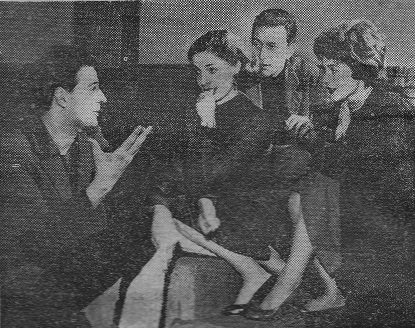
Above: From the Manchester Evening News: Contract director ‘Ted’ Kotcheff discusses a scene during rehearsals for ‘The Shining Hour’ with Peter, Elisabeth Sellars and Diana Fairfax.

Lise is violently resented by the older sister, Hannah (Marian Spencer) – a Cold Comfort Farm-type character, who flitters grimly about the place minding her brother’s business and making everybody else’s life a misery.

Soon after her arrival, Lise falls madly in love with her brother-in-law, David (Peter Wyngarde), who a particularly obnoxious son-of-the-soil. He, conversely, is already married to, Judy (Diana Fairfax) – a girl he no longer loves. Tragedy is hastened by Hannah), who informs Judy of her husband’s infidelity, which drives the attractive young woman to take her own life by walking into a burning barn.

Into this already troubled family comes another gentleman by the name of Micky (Clifford Elkin), who also gets the idea that it might be fun to pursue on of the brothers’ wives.

The most troubling part of this story concerns the character of David who, after taking his brother’s wife (in both senses of the word!), then changes his mind and decides not to elope with her!

A Bit Of Trivia

The play’s director, ‘Ted’ Kotcheff, was trained in the ‘Method’ school of acting. Peter also dabbled with ‘Method Acting’ in the mid-Fifties, but he described the discipline as merely “thinking oneself into the role”.

‘The Shining Hour’ was the third time that Peter and Elisabeth Sellars had worked together. They had planned to star in their own production of ‘Romeo and Juliet’ with the two in the leading roles.

‘The Shining Hour’ was first performed in London in 1934, with Gladys Cooper as Lise and Raymond Massey as David.

News Item

REVIEW: The Two Character Play

The Hampstead Theatre Club. December 1967

Character: Felice

  • N.B. The world premiere of the play was on Monday, 11th December, 1967.

“Your sister and you are insane!”

Some Background

This dark drama was written in the early 1960’s by American playwright, Tennessee Williams, and is believed to be semi-autobiographical, with the character of Felice being based, in part, on the author himself, and Clare – both as the ‘Actress’ and ‘Character’ – on his sister, Rose.

Although it took Williams more than a decade to write, when the play was first staged, it wasn’t particularly well-received by either critics or the paying public. It’s been suggested that, whilst audiences generally see the theatre as a diversion, Williams’ work in this instance, delivered precisely the opposite. The characters of Felice and Clare, together with the individuals who play them, are powerless to break away from their worsening psychological situation, regardless of their attempts to convince themselves otherwise. As a result, the audiences found themselves confronted by a far bleaker reality concerning the human condition that they’d bargained for.

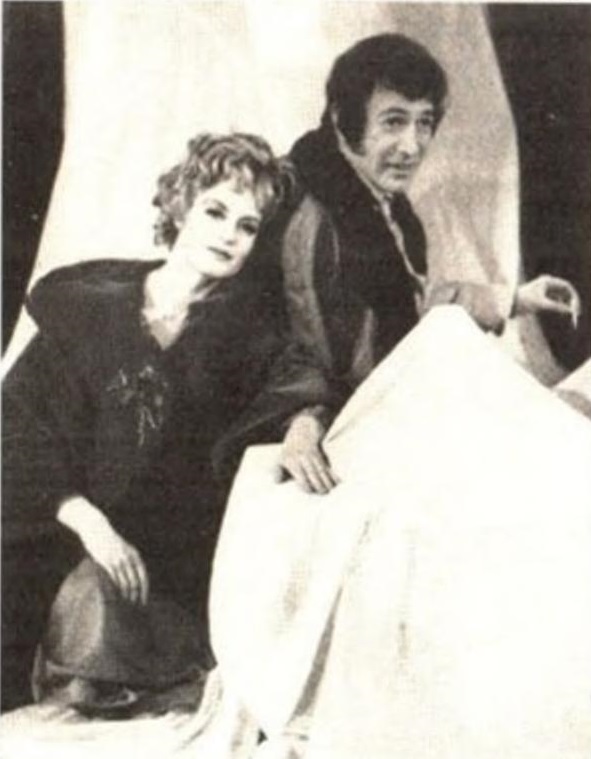
(Above): Peter and Mary Ure rehearsing the play with director James Roose-Evans

As with most of Williams’ plays, this particular composition is inhabited by broken personalities, entangled in their illusive pasts; caught within the confines of a partly-built theatre stage, representing a neglected wooden house.

By 1971, ‘The Two Character Play’ had been renamed ‘Out Cry’ – opening at the Ivanhoe Theatre in Chicago, and latterly transferring to Broadway at the Lyceum

The Story

The play tells the story of Felice (Peter Wyngarde) and Clare (Mary Ure) – a reclusive brother and sister. They are both actors on an American tour, when they’re ditched by their theatre company in what Tennessee Williams describes in the script as a dilapidated ‘State theatre in an unknown state”.

Although it shouldn’t come as a surprise to anyone who goes to see a production entitled ‘The Two Character Play’, Felice and Clare are the only two people in the work – and a very wordy piece it is too. It’s also immensely confusing, as this drama is, in fact, a-play-within-a-play.

Concerned that an audience, unaware that the main body of the troupe has left, might turn up at the theater expecting to see a performance, Felice sets about writing a play which he names ‘New Bethesda’. It’s set in a rundown house in a southern state of a America, where there’s no running water of electricity. The confusion begins when he chooses to name his two leading characters after himself and his sister, and to make the plot autobiographical. And so for most of the performance, it becomes increasingly difficult to distinguish between the two pairs of siblings: Felice and Clare ‘The Actors’ or Felice and Clare ‘The Characters’.

We learn early on that the siblings have been emotionally damaged after being witness to the catastrophic death of their parents (the father murdered their mother, and then turned a gun on himself). The two have remained reclusively in their family home ever since. By joining the theatre troupe they’re cautiously attempting to make contact with the world outside, but their interdependent relationship and deteriorating mental state has lead them to become more isolated than ever.

The two sets of siblings (‘Actors’ and ‘Characters’) are what might be described as opposite sides of the same coin. In the case of Felice, he’s at once the unstable thespian and yet, a fraction of a second later, becomes the thoughtful and perceptive resident of New Bethesda. And so whilst ‘The Two Character Play’ tops and tails between the pessimistic circus of the confined players and the misfortune of the orphaned brother and sister, the two grow increasingly disconcerted with each other. Indeed, whilst Felice develops a progressively demanding attitude with regard to how his sister should play ‘Clare’, she protests continually loudly and refuses point blankly to portray the character as he’s been written it.

Clare: I’ve lifted the receiver.

Felice: (Closing his eyes). Moment.

Clare: Felice, I said I’ve lifted the receiver.

Felice: Oh. Yes. Sorry. Who are you calling, Clare?

Clare: Not a

Felice: Soul still existing

Clare: In a world gone away.

Felice: Moment.

Clare: Are you lost in the play?

Felice: Yes. It’s a warm August day.

Clare: (Raising tender hand to his head). Felice, your hair’s grown so long. You really must find time somehow to get to the barber. We mustn’t neglect appearances even if we rarely go out of the house. We won’t stay in so much now. We’ll pull ourselves together and practice necessary deceptions so convincingly well that liables, commendable and essentials of persistence will be delivered to us again.

Felice: Go straight to the tall sunflower.

Clare: I’ve lifted the receiver.

Felice: (Closing his eyes). Moment.

Clare: Felice, I said I’ve lifted the receiver.

Felice: Oh. Yes. Sorry. Who are you calling, Clare?

Clare: Not a

Felice: Soul still existing

Clare: In a world gone away.

Felice: Moment.

Clare: Are you lost in the play?

Felice: Yes. It’s a warm August day.

Clare: (Raising tender hand to his head). Felice, your hair’s grown so long. You really must find time somehow to get to the barber. We mustn’t neglect appearances even if we rarely go out of the house. We won’t stay in so much now. We’ll pull ourselves together and practice necessary deceptions so convincingly well that liables, commendable and essentials of persistence will be delivered to us again.

Felice: Go straight to the tall sunflower.

Clare: Quick as that?

Felice: That quick!

Clare: Felice, look out of the window, there’s a giant sunflower out there that’s grown as tall as the house. (He draws a long breath, then leans out the window).

Felice: Oh, yes, I see it. Its colours so brilliant that it seems to be shouting!

Clare: Keep your eyes on it a moment, it’s a sigh to be seen. (She raises a hand not quite to her eyes but toward them, as if to shield them from the blinding light. Then she turns to the sofa to lift the pillow: Draws a grasping breath).

Felice: Moment.

Clare: Moment.

(They continue saying ‘Moment’ to each other as the stage is slowly dimmed out).

END

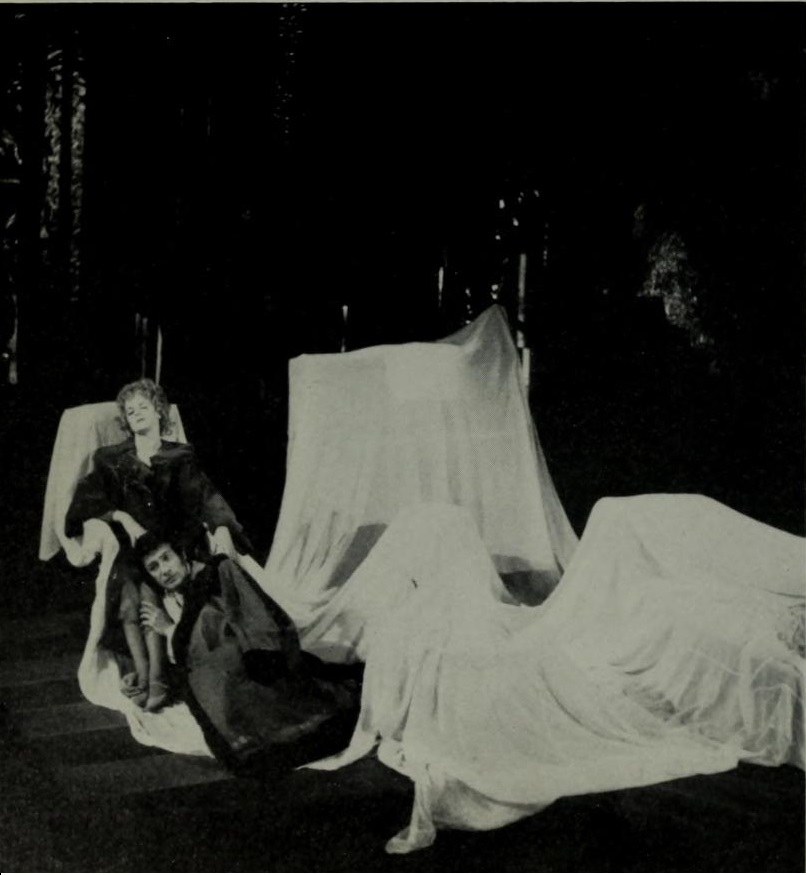
Above: Peter and Mary Ure on stage at The Hampstead Theatre Club

Peter’s View

“It is the most harrowing part I have ever done. To convey the madness in the madness, like Chinese boxes, and yet to appear saner than Clare: we both came out after the show with hoops of steel around our heads. Because it is so near the bone, it’s a terribly depressing piece to play in which is unusual; ordinarily, one comes out of acting in a play, invigorated. And yet halfway through, it takes over. It is unquestionably a great piece, especially since the Out Cry[1] revisions. It is impossible to be bad in it… well, almost impossible.

“Tennessee was at all the rehearsals, with his wrenched companion of the time bullying him. But Tennessee was gone [drunk and stoned], out of it, completely. He could offer nothing approaching dictatorial advice.

“I never saw Tennessee and Maria together, although I met her separately. But I knew this: that she was a good influence on him at a terrible time. The death of his friend Frank Merlo had overwhelmed him.”

“I never saw Tennessee and Maria together, although I met her separately. But I knew this: that she was a good influence on him at a terrible time. The death of his friend Frank Merlo had overwhelmed him.”

Notes:

[1]: The revisions of The Two Character Play was called ‘Out Cry’ – of all Tennessee William’s plays, the only one he ever typed in capital letters.