

Confusing Wikipedia for research and Internet gossips as a source, the British ‘papers are very good at reporting what they THINK is news, not necessarily what IS news. Here is their deeply concerning reliance on unsubstantiated social media tittle-tattle and online encyclopedias by the mainstream press that has fuelled many of the groundless myths about Peter Wyngarde.

On January 19th, 2018, when news of Peter’s passing was announced to the public, The Mirror tasked journalists Steve Myall and Robin Turner to pen an article about his life.

Above: Steve Myall – relied on Wikipedia for the, a-hem, ‘facts‘
It was clear from the off that neither Myall nor Turner had ever heard of Peter Wyngarde, let alone were familiar with his body of work. But rather than drag themselves away from their desks to do some proper research on the subject, they chose instead to dredge every conceivable recess of the Internet to pad it out. including fake news ‘sites, online forums and, of course, that font of all knowledge, Wikipedia(!)
The headline screeched almost hysterically…
‘How Peter Wyngarde’s secret sex life was exposed by police, destroying career of the 1970s pin up who inspired Austin Powers’
…and so the fairy tale began.
N.B. All errors have been highlighted and their original sources identified:
‘Peter Wyngarde was one of the biggest names in TV in the mid 1970s but he hid his homosexuality and when it was exposed it signalled the end of his career.
| Correction: Messer’s Myall and Turner provide no evidence of this supposed “homosexuality”; no quote from anyone who knew Peter intimately; no quote from any of his interviews confirming that he was gay. Nothing! So, evidently, their readers were just expected to take their word for it. |
Jason King with his ’70s sideburns, bouffant hair and bushy moustache was the only TV detective who sipped vintage port while catching villains.
| Corrections: In 28 episodes of ‘Department S’ and 26 episodes of ‘Jason King’, the character of Jason King was never ONCE seen drinking Port. His tipple of choice was, in fact, Stornoway Whisky or Champagne. The Port myth was taken from a film by the Comic Strip Presents… stable, entitled ‘Detectives On The Edge of a Nervous Breakdown’: |
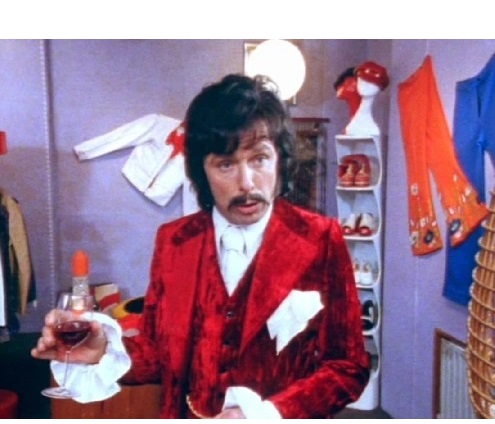
Broadcast 22nd April, 1993, featuring a character played by Peter Richardson called Jason Bentley (above).
Often dressed in a head- turning silk suit and cravat he would down large portions of alcohol at the wheel of a posh Bentley as he chased the bad guys. Small wonder then that Mike Myers based his hugely successful spoof spy Austen (sic) Powers on the moustached sleuth who could seduce continental beauties at the drop of his felt hat.
| Corrections: Jason King was never known to wear “silk suits” or, indeed, a “felt hat!” |
King was played by flamboyant Peter Wyngarde and the portrayal won him legions of female fans – he even had his own women’s fashion column. For three years while show was on air he was one of the biggest stars on the planet and in Australia was mobbed when he visited. When he arrived in Sydney Airport in 1971 he was met by an excited crowd of 35,000 fans. He was crushed when they rushed forward and spent three days in a hospital after suffering concussion.
| Correction: Peter never, EVER had his own “women’s fashion column”. |
In the show Department S his Jason King character often got the girl and as she is about to kiss him, he manages to avoid it . It was a clue perhaps to the secret he hid from his fans.
| Correction: This statement was cut and pasted directly from Wikipedia without any attempt to disguise it. As can be seen from the screenshots below, Peter is evidently not “avoiding kissing” any of these women. |

In 1975, he was arrested, convicted and fined £75 for an act of “gross indecency” in the toilets of Gloucester Bus Station*, which followed an arrest and caution for similar activities in the toilets at Kennedy Gardens in Birmingham the previous year. (*This ‘conviction’ was quashed by the Home Office in July 2023 – see later in this article).
| Correction: This is a complete fabrication that first appeared on Wikipedia in 2010. The individual responsible for posting it stated their source as Stephen Richards 2003 book, ‘Crime Through Time: The Black Museum’ (Mirage Publishing – ISBN: 1902578171). However, there is absolutely no mention of this incident in the book. Latterly, Wikipedia editors chose to remove this entry from their Peter Wyngarde ‘Biography’, but it was to reappear after the publication of Mayall and Turners article following Peter’s death in 2018. Apparently, it was re-posted because The Mirror is considered a “reliable source”. The committee that regulate the PW ‘Biography’ have repeatedly refused to acknowledge the damage done to Peter’s reputation as a result of this. This is the deeply concerning, and seemingly increasing, reliance of the British press and Wikipedia in action! |
After the first incident, Wyngarde was interviewed for the News of the World and the Birmingham-based Sunday Mercury, and asserted that the arrest was due to a misunderstanding; in his defence after the second incident he claimed he had suffered a “mental aberration”. But it was too late. He was dropped from mainstream acting roles and his career was virtually over. He said his career was ruined by ‘small minded people’ following his 1975 arrest. It was less than 10 years since the government decriminalised homosexual acts in private between two men and there was still a stigma attached to same sex relationships.
| Corrections: Again, taken directly from Wikipedia. Peter was NEVER interviewed by The News of the World, and so never “claimed” anything. Peter was NOT dropped from “mainstream acting roles”. In 1976, he played Shylock in a hugely successful British tour of ‘The Merchant of Venice’ and was back in the West End of London playing Prince Bounine in ‘Anastasia‘ at the Cambridge Theatre. He would also appear at the prestigious English Theatre, Vienna during the same year, in ‘Dear Liar‘, returning in 1977, starring in his own production of ‘The Merchant of Venice’. He would also direct and star in the European premier of Patrick White’s (Nobel Laureate) ‘Big Toys‘. In 1979, he was cast as General Klytus in Dino De Laurentiis’s Sci-Fi blockbuster, ‘Flash Gordon‘, which is now considered a classic of its genre. He also gave memorable performances in ‘Doctor Who‘, ‘Sherlock Holmes‘ and ‘The Hammer House of Mystery and Suspense‘ series. |
It was not until 2007 that claims emerged Wyngarde had a relationship with fellow actor Alan Bates during the ten years he had lived with him in the Sixties. Beneath the public face of pin up heart throb he was gay but because of public prejudices, reinforced by newspapers, it was kept secret.
| Correction: Taken from Donald Spoto’s book, ‘Otherwise Engaged: The Life of Alan Bates’ (Cornerstone – IBSN: 9780091797355). Peter merely shared a flat with Bates, as many young actors did at the time and still do (see the original tenancy agreement that Peter signed on 24th November, 1958 here). Spoto claimed that they had moved into the apartment in 1956 when, in fact, the lease only began in November 1958. Bates spent 2 years in the early sixties with Rock Hudson in the US, and eventually moved out in 1965. So the “ten years” was actually closer to five years! Until his death in 2018, Peter fiercely contended what Spoto had written about him, saying: “Alan and I shared a flat and a cottage in Kent for over six years, We were both original members of the Royal Court. He lived in a Victorian flat in Battersea with the likes of Peter O’Toole, Brian Bedford who is now the resident director at the Stratford-Upon-Avon company in Toronto, Canada. We were both looking for a flat so I said we should share one to cut down on costs. I was doing The Salt Land at Pinewood, a film for TV (if you could get it I would be overjoyed) by Peter Schaffer whose dad owned the Terrace* and suggested the Garden Flat was available. We clapped hands and jumped in. The rental of the cottage came first as did the cost of working and living in hotels [in London] when either of us were working, so the flat was a blessing. In practice as it turned out that when I was working [in the West End] I would have the flat, or if he was working, vice versa. If we were both working at the same time there was a divan bed in what is now the kitchen so it was a perfect set up”. Read the above in Peter’s own handwriting here “Beneath the public face of pin-up heart throb he was gay?” Complete supposition! |
Although well-known in showbiz circles by the nickname Petunia Winegum it fell to the police – who enforced decency laws which targeted the homosexual community – to out him. Following his public exposure in 1975 bit parts followed for Wyngarde – notably as masked character Klytus in the 1980 film Flash Gordon but he did not reach the heights of his previous fame.
| Correction: Yet another claim by Donald Spoto that appeared on Wikipedia. In fact, the “nickname Petunia Winegum” was coined by actor Roy Kinnear in 1966 while shooting an episode of The Avengers with Diana Rigg – the latter of whom confirmed this in a later interview. It was latterly used in a sketch by ‘The Two Ronnies’ in 1970. It was NOT well-known known in acting circles. See earlier entry re. Peter’s work post 1975. |
In later interviews he talked of how he battled alcoholism telling an interviewer in 1993: “I drank myself to a standstill … I am amazed I am still here”.
| Correction: The above was cut and pasted directly from Wikipedia. Peter NEVER battled “alcoholism” and there is no proof whatsoever to substantiate this claim. |
Latterly, Wyngarde’s public appearances were mainly restricted to nostalgic events commemorating television programmes where he had a cult following.
He died this week at Chelsea and Westminster Hospital aged 90.’
_______________________________
Within days of this shameful article being published, a formal letter of complaint was sent to Messrs Myall and Turner via the editor of The Mirror but neither of the two journalists, nor the editor, had the decency to acknowledge it, or to correct the atrocious amount of misinformation contained within it. A further attempt was made to have it removed some months later, but we were told the following by Kate Archer of the paper’s Complaints Department:
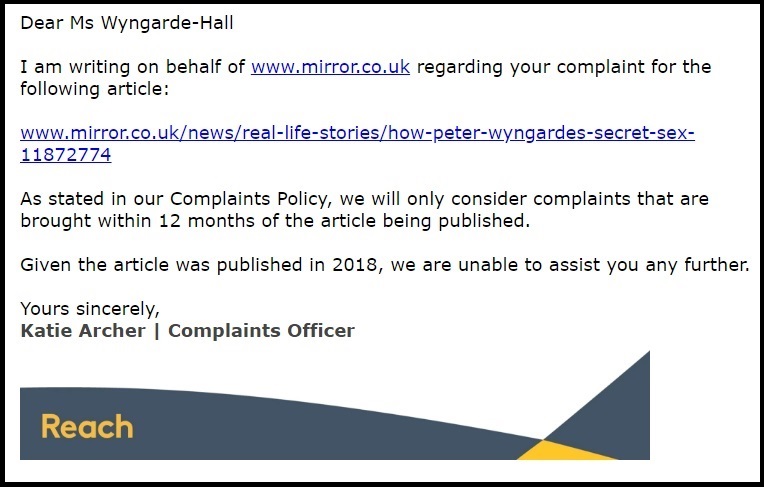
Above: Couldn’t even get my name right!
As already stated, letters of complaint were despatched within the 12 month period demanded, but were of course ignored. This is entirely typical of the British press; trash the reputation of a man who can no longer defend himself, and then refuse to make amends when their failures are highlighted.
Since this horrendous editorial was first published in The Mirror and on their website, an attempt has been made on the latter to temper the headline in the following way…

…however, no effort has been made to correct the error-strewn body of the article, despite the disinformation contained within it being brought to their attention numerous times.
It’s interesting how they speak of shame when the journalists who wrote the article I reproduced in full earlier in this piece, and the paper itself – having doggedly refused to correct, amend or delete the highlighted errors and lies – continue to behave in a most shameful way themselves.
Following a change in the law by the British government, and further to my application in April 2023, the Home Office agreed to posthumously quash the long-disputed 1975 conviction against Peter for a “crime” he vehemently denied until his final breath. According to the Home Office itself, this conviction must now be treated by the public and media alike “as if it had never happened”.
I again wrote to The Mirror, advising them of the Home Office ruling. My email was redirected to the paper’s Data Protection Department. When I finally heard from this Department, and after wading through reams of waffle about how salacious (and wholly inaccurate) stories like this are “in the public interest” (How?,,, WHY?), they stated the following:
| ‘The article did not include inaccurate or misleading information about you* when it was published or since the last update (if any).’ (*They clearly hadn’t bothered to read who the email was from, as they evidently believed that they were replying to Peter, who had past away in 2018!). |
Really?! As anyone can see from the breakdown earlier in this piece, there’s barely a line in this article that ISN’T inaccurate!!! It goes on…
| ‘The article reports facts discussed in court. In particular, in line with IPSO standards, journalists are allowed to go to court and report anything which is said or given as evidence in court.’ |
There is nothing in the article that refers to a court! The waffle continues…
| ‘According to regulatory guidance, the exemption is “specifically designed to protect freedom of expression” in the interest in light of “the vital importance of a free and independent media”. |
Does a “…free and independent media” mean “free” to lie through their teeth? Evidently so!
| “Furthermore, we understand that the article is also compliant with the Independent Press Standards Organisation (IPSO) Editor’s Code of Practice.“ |
Seemingly, this ‘Code of Practice’ entails editors to completely blank letters and emails that highlight genuine concerns regarding their employees – i.e. journalists.
The journalists moto used to be, that if you want the truth, you go to the source. These days, that clearly means Wikipedia!
Click below for more press nonsense…

 PETER WYNGARDE: The Official Website
2 thoughts on “THE BRITISH PRESS AND THE WEB”