

A.K.A. Keeping an eye on the Misinformation Corporation
| “Even now, one can look online and find rumours regarding Wyngarde’s sexuality with dubious blogs claiming all manner of evidence to his proclivities for rent boys; myths built upon myths often given the Wikipedia seal of approval.” From a review of ‘Peter Wyngarde: A Life Amongst Strangers’ by Mark Cunliffe – Den of Geek |
Over the years, the online encyclopedia Wikipedia has done irreparable damage to Peter Wyngarde’s reputation, both while he was alive and since his passing. The ‘committee’ of faceless Contributors to the Wyngarde ‘Biography’ – the majority of whom skulk behind usernames, too cowardly to put their real names to their often outlandish claims – guard their cobbled-together article jealously; denying even those who had been closest to Peter the opportunity to contribute or correct misinformation. As a result of their wanton misreporting which, inevitably, has seeped into the British press and across the Internet, Peter lived out the final years of his life accused of committing a ‘crime‘ for which he was holy innocent. This accusation has been proved beyond any doubt to have originated on Wikipedia in 2012, but which had absolutely no substance or basis in reality, and yet those responsible have not only point blankly refused to acknowledge the damage this has caused, but have either abused or imposed bans on those people who have attempted to set the record straight.
A warning from Wikipedia itself…
 “Wikipedia is not a reliable source. Wikipedia can be edited by anyone at any time. This means that any information it contains at any particular time could be vandalised, a work in progress, or just plain wrong. Biographies of living persons, subjects that happen to be in the news, and politically or culturally contentious topics are especially vulnerable to these issues. Edits on Wikipedia that are in error may eventually be fixed. However, because Wikipedia is a volunteer-run project, not every contribution can be monitored all of the time. There are many errors that remain unnoticed for days, weeks, months, or even years. Therefore, Wikipedia should not be considered a definitive source in and of itself.”
“The prevalence of non-neutral or conflict-of-interest editing and the use of Wikipedia for “revenge editing” has attracted publicity for inserting false, biased, or defamatory content into articles, especially biographies.”
What a diabolical liberty!
Despite the untold damage that Wikipedia has done, not only to Peter’s reputation, but those of numerous other well-known personalities, they’re now begging for money from the general public to keep this hotbed of disinformation out of a competitors hands. How hard-faced can you get?!

Above: Wikipedia may be useful for something, but certainly not for the reason it was designed for!
We’re all asked to dip into our pockets for up to £100+ to keep this monstrosity running. Perhaps Mr. Wales would be better thought of if he’d put the begging bowl away and think about compensating or, at the very least, apologising to those people whose reputations have been damaged or destroyed by his rag-tag band of contributor!

The Wikipedia’s Peter Wyngarde ‘biography’ as it stood on the day of his passing
All errors have been highlighted and corrected
(As of 12.02.18. – it was stated in the main body of the aforementioned article that Peter passed on 18th January, 2018. This is incorrect. He actually died on 15th January, 2018).
Birth and family background
Peter Wyngarde’s date and place of birth, his birth name, and his parent’s nationalities and occupations are all disputed. His biography at IMDb which is not supported by any primary sources but often used in other accounts of his life, states he was born Peter Paul Wyngarde on 23 August 1933 at an aunt’s home in Marseilles, France. It says his British father worked for the British Diplomatic Service resulting in the family living in various countries, including British Malaya and China. He is claimed to be the nephew of French actor-director Louis Jouvet. Primary sources indicate a likely different birth name, year of birth and family background. There is strong evidence Wyngarde was born as Cyril Goldbert, possibly in Singapore, which is the place of birth Wyngarde gave on a 1960 immigration application, although a 1956 Straits Times article about his mother does give Marseille as his birthplace.
Author J. G. Ballard wrote in his memoir (and stated in interviews and private letters that he and his family knew Wyngarde as Cyril Goldbert in Shanghai during World War II.
| Correction: Peter maintained throughout his life that he never knew or ever met J.G. Ballard. |
Regarding Wyngarde’s year of birth there is considerable variation. Different sources quote or suggest dates between 1924 and 1933. In a 1993 interview Wyngarde claimed not to know his own age.
The given names of Cyril Goldbert’s parents and siblings match those of Peter Wyngarde. His father was Henry Peter “Harry” Goldbert, born in present-day Ukraine and raised in Singapore where his mother ran the Singapore public house, and where he became a naturalised British subject in 1919 He does not appear to have been a diplomat: travel records from the mid-1940s show that he was working as Second Chief Engineer in the British Merchant Navy. Cyril Goldbert’s mother was Marcheritta (Madge) Goldbert, nee Ahin, later Macauley, who was a Swiss national. She was interviewed in the Straits Times in 1956 about her son Peter Wyngarde’s career, by which time she had remarried. Wyngarde claimed in a 1993 interview that his mother was a racing driver.
| Corrections: Peter’s father was NEVER known as “Harry”, and while Peter stated that his mother had raced cars, she was not a “racing driver”. |
The full names of the two younger Goldbert children match those of Peter Wyngarde’s purportedly elder siblings: Adolphe (later Henry) Peter “Joe” Goldbert (1930–2011) and Marion Colette Simone Goldbert, later Wells (1932–2012).
Regarding Louis Jouvet being Wyngarde’s uncle, Jouvet’s biography confirms he had two brothers, neither of whom appear to be related to Cyril Goldbert’s parents by blood or marriage.
| Correction: Peter spoke of his family connection to Jouvet from the early 1950s onwards, which was during the latter’s lifetime. See the section entitled, ‘The Louis Jouvet Question…’ later in this article for further details. |
Early life
Wyngarde told an interviewer that his parents divorced when he was very young, and that his father took him to China “only months before war with China broke out” in the summer of 1937.
In the early 1940s, Cyril Goldbert was living in Shanghai when the Japanese Army took over Shanghai’s International Settlement on 8 December 1941, and as a British citizen he was interned in the Lunghua civilian internment camp on 10 April 1943. Peter Wyngarde has spoken about his time in Lunghua, and it is included in his official biography.
After internment, Cyril Goldbert sailed from Shanghai to Southampton in December 1945 on the Cunard White Star Line vessel the Arawa, listed as an 18-year-old passenger. J.G. Ballard was also on board. After arriving in the UK, Cyril Goldbert disappears from public records under that name.
In a Q&A on a fan blog in April 2017, Wyngarde said that he studied in the Faculty of Law, University of Oxford for three months, before leaving to work in a London advertising agency.
| Correction: This is a veiled reference to this website. The definition of a “Fansite” is as follows: ‘A website about a particular performer, group, film, etc., that has been created by fans’. This ‘site was set up as an information hub for fans, journalists, authors etc. under Peter’s own supervision. |
Acting Career
In 1946, Peter Wyngarde took his first professional roles in theatre productions. An early success was in the part of Morris Albert in a production of Noël Coward’s Present Laughter which opened on 7 August 1947 at the Theatre Royal, Birmingham.
| Correction: The character that Peter played was Morris Dixon, not “Morris Albert”. |
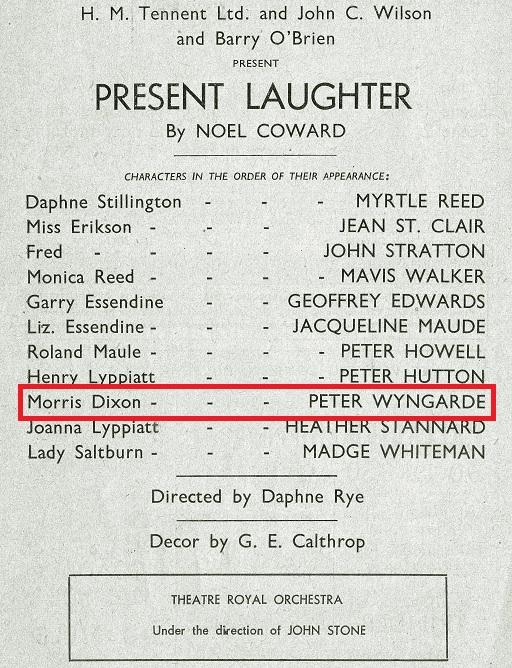
Later accounts say that he was around 13 years old when he took these early roles, but Peter Wyngarde is listed as a registered voter aged 21+ in 1948, so he was 18-20 years old in 1946 and 1947.
From the mid-1950s, Wyngarde had roles in feature films, television plays and television series guest appearances. One of these, a television adaptation of Julien Green’s novel South (1959, originally Sud), in which Wyngarde featured in a lead role, is thought to be the earliest television play with an overtly homosexual theme. He appeared as Pausanias opposite Richard Burton in the film Alexander the Great (1956), played a lead role in the film The Siege of Sidney Street (1960), and appeared as Sir Roger Casement in an episode in the Granada Television’s On Trial series produced by Peter Wildeblood. Wyngarde’s film work was not extensive, but gained attention.
In Jack Clayton’s The Innocents (1961), he had brief (unspeaking) scenes as the leering Peter Quint with Deborah Kerr and Pamela Franklin. He followed this appearance as the lead in the occult thriller Night of the Eagle (US: Burn Witch Burn, 1962). By the late 1960s, Wyngarde was guest starring in television series of the time, many of them were shown internationally, including The Avengers, The Saint, The Baron, The Champions and I Spy. He also appeared in The Prisoner (“Checkmate”, 1967) as the authority figure Number Two.
Wyngarde became a British household name through his starring role in the espionage series Department S (1969). His Jason King character often got the girl and as she is about to kiss him, he manages to avoid it, much to the annoyance of co-actor Joel Fabiani. After that series ended, his character, the suave womaniser Jason King, was spun off into a new action espionage series entitled Jason King (1971), which ran for one season (26 fifty-minute episodes). The series led Wyngarde to briefly became an international celebrity, being mobbed by female fans in Australia. A revival in October 1973 of The King and I, featuring Wyngarde in the male lead role, and initially with Sally Ann Howes as Anna, ran for 260 performances at the Adelphi Theatre in London.
| Correction: Below there are 18 screengrabs taken from both Department S and Jason King. all of which depict Peter kissing the same number of women. Not in one single image is he “managing to avoid it”. When this statement was passed to Joel Fabiani, he said it was one of the “Most bizarre things I’ve ever heard! Where do they get this rubbish from?!” This is another Wikipedia fabrication that has seeped into the British national press over the years (see ‘The British Press And The Web‘) |

| Correction: While Peter appeared in all 260 performances as the King of Siam in ‘The King and I’, not all were at the Adelphi Theatre. The production had toured mainland Britain before transferring to the West End. |
Later Career
Wyngarde appeared as the masked character Klytus in the film Flash Gordon (1980) and as Sir Robert Knight in the film Tank Malling (1989) with Ray Winstone. He appeared in The Two Ronnies 1984 Christmas Special as Sir Guy in “The Ballad of Snivelling and Grudge and A Film Story”. Other TV appearances include Doctor Who (Planet of Fire, 1984), Hammer House of Mystery & Suspense (1984) and The Memoirs of Sherlock Holmes (1994).
| Correction: The Two Ronnies sketch was entitled, ‘The Ballard of Snivelling and Grudge’. The words “A Film Story” did not appear. |
In 1983, he acted in the thriller Underground with Raymond Burr at the Royal Alexandra Theatre, Toronto, and at the Prince of Wales Theatre, London. After leaving a 1995 stage production of The Cabinet of Dr Caligari mid-performance during previews, Wyngarde mostly stopped acting but he has done occasional voice work.
| Correction: This gives the impression that Peter himself left the production midway through a performance, which is not true. The entire performance was cancelled after a hoist which was integral to the story, failed. The entire performance was cancelled. Read the full story here. |
He appeared as a guest of Simon Dee in the Channel Four one-off revival of his chat show Dee Time in 2003. In 2007, he participated in recording extras for a box-set of The Prisoner, including a mock interview segment titled “The Pink Prisoner”.
In January 2014, he narrated an episode of the BBC 4 Timeshift documentary strand, How to Be Sherlock Holmes: The Many Faces of a Master Detective. In the 2015 documentary series for Channel Four, It was Alright in the 1960s, Wyngarde expressed his unease at having to don blackface to play a Turkish man in The Saint, but said that he had done it only in the hope that a theatre director might pick him to play Othello.
Latterly, Wyngarde’s public appearances are mainly restricted to Memorabilia and other nostalgic events commemorating television programmes.
Music
In 1970, Wyngarde recorded an album for RCA Victor entitled simply Peter Wyngarde, featuring a single, “La Ronde De L’Amour”/”The Way I Cry Over You”. The album is a collection of spoken-word/musical arrangements produced by Vic Smith and Hubert Thomas Valverde. A promo single of the track “Rape” (entitled “Peter Wyngarde Commits Rape”) was also issued in 1970.
In 1998, the album was reissued on CD by RPM Records, now titled When Sex Leers Its Inquisitive Head. According to Wyngarde himself (quoted in the liner notes of the CD re-issue), prior to the RCA deal, EMI had also been interested in cashing in on his fame and suggested issuing an album of him performing a selection of Sinatra songs. However, RCA allowed him carte blanche, assuming that the record would be a failure and could be used by them as a tax loss. However, when the initial pressings quickly sold out and it showed a profit, they declined to press any more copies.
The album is now usually treated as a curiosity because of its unusual spoken-word style and the controversial subject matter of some of the tracks.
Personal Life
In the early 1950s, he was married to the actress Dorinda Stevens for 3 years.
| Correction: He was married to Dorinda Stevens for 5 years. |
Wyngarde shared a flat in Earls Terrace, Kensington, with the actor Alan Bates for some years in the 1960s.
In 1975, he was arrested, convicted and fined £75 for an act of “gross indecency” in the toilets of Gloucester Bus Station, which followed an arrest and caution for similar activities in the toilets at Kennedy Gardens in Birmingham the previous year.
| Correction: The Gloucester conviction has since been quashed (see confirmation from the Home Office later in this article). The Birmingham ‘incident’ has been proven beyond any doubt to be a fabrication which originated on Wikipedia in 2010. IT NEVER HAPPENED! (See details here). While it was eventually removed from Wikipedia in 2017, it was reposted in 2018, stating an article from The Mirror (19.01.18) as it’s source. However, Steve Myall and Robin Turner – the journalists that penned the article – had garnered the information from Wikipedia! This was yet another instance of lazy journalism, with two hacks choosing to cut and paste information directly from this online compendium rather than carry out proper, diligent research. You can read the full story here. |
Wyngarde battled alcoholism at the height of his career, telling an interviewer in 1993 “I drank myself to a standstill … I am amazed I am still here”, but that he stopped drinking in the early 1980s.
| Correction: The words “battled alcoholism” could be viewed as libelous, since Peter was never diagnosed as an alcoholic, nor had he ever received treatment for “alcoholism”. He had not drunk any kind of alcohol since 1980. |
N.B. Much of the above is still on Wikipedia.
“Wikipedia is a broken system.” Larry Sanger – Wikipedia Co-Founder
And the misinformation, wild inference and outright lies roll on…

Contentious 1975 conviction quashed…
As of Tuesday, 4th July 2023, the 1975 conviction against Mr. Peter Paul Wyngarde was quashed by the Home Office (UK Government). This means that it has been removed from all official records and must now be treated as if it never happened. We respectfully request that you remove all references to it from your website.

At the time of writing, Wikipedia editors have declined to acknowledge this.

Assumptions…
Wikipedia currently have the following statement on their Peter Wyngarde Biography page: “It was always assumed within the acting community that Wyngarde was gay”[1], and yet they have not produced a single individual from the “acting community” who has been willing to validate this.
[1]: Taken from Donald Spoto’s book, ‘Otherwise Engaged – The Life of Alan Bates’.

Peter’s background and early life…
Much has been made by Wikipedia contributors and editors of the fact that some of the details pertaining to Peter’s early life has been embellished, but that wasn’t unusual for actors of his generation. While today it’s fashionable for actors and musicians to claim to come from humble beginnings, back in the 1940’s and 50’s theatrical agents, who were invariably responsible for writing biographies for their clients, preferred to sprinkle a pinch glamour over a young actor’s back story. Anyone who does not acknowledge or understand this has no business writing about actors!
While Peter has seemingly been singled out for special treatment over this by Wikipedia, he was certainly not alone in this practice. Here are a few examples of thespians that fibbed about their age and origins:
- Both Joan Crawford and Humphry Bogart both lied about their age on their respective resumes.
- British actor, Robert Patterson stated that he’d studied at both Oxford University and at RADA. He hadn’t!
- Jay Robinson who played Emperor Caligula in both ‘The Robe’ and Demetrius and the Gladiators’, claimed to be Anglo/American, and that he’d appeared in numerous plays in England before moving to the United States. In actual fact, he was born in New York to American parents, and brought up in Florida!
- Marlon Brando insisted that he’d been born in Cairo, Egypt, when he’d actually been born in Omaha, Nebraska.
- Matinee Idol, Errol Flynn told numerous tales of his daring-do in the jungles of New Guinea, where he’d supposedly lived and worked as a youth. He also claimed that he’d once been arrested and charged with murder, but was acquitted after a mystery gold prospector gave evidence in his favour. After stealing gems from an older woman he’d taken up with; bought a small yacht and single-handed sailed to the US.
- William Hartnell, who was the first actor to play Doctor Who, stated that his father was a farmer but latterly said he was a soldier who’d taken up stockbroking.
It would seem that a lot of people today have a grandiose sense of entitlement that never exited in the days before the Internet. While the Gutter Press might well have seen public figures such as actors, musicians, politicians and even members of the Royal Family as fair game, even they had the decency to know where the line was drawn.
What we have now is a new breed of armchair nosey-parkers who, encouraged by the likes of Wikipedia, believe that they have a God-given perogative to know every micro detail about other peoples lives, to the point where the target for their intrusion no longer have the right to any amount of privacy. This voyeuristic attitude that now prevails.
In the case of the Peter Wyngarde ‘biography’ alone contributors to the piece, while still stuck on the idea that Peter was born in Singapore, have admitted to contacting record offices over there in attempt to acquire private documents pertaining to his birth. Similarly, after his funeral in January 2018, one of their number was to contact Golders Green Crematorium in a further endeavor to garner personal information. It would seem that, even in death, there is no end to the prying.
Intentional bias…?
While Wikipedia’s own guidelines speak of “impartiality” and “neutrality”, the Peter Wyngarde ‘biography’ currently has the following entry – taken from The Guardian’s universally panned ‘obituary’ of 18.01.18:
| “His director*, Cyril Frankel, said: “It got to a point where he wouldn’t accept direction.”[4] Frankel also said: “He was a very fine actor, but unfortunately a difficult person.”[63]. |
*Cyril Frankel wasn’t the only person to direct Peter on Department S and Jason King, but was the only one to have anything negative to say. This is not pointed out by anyone associated with the Wikipedia ‘biography. Here is a quote from Dennis Spooner – writer, script editor and producer of both Department S and Jason King – who worked with Peter numerously in the 1960’s, 70’s and 80’s, which the Wiki’s might care to use in the name of fairness:
“Peter was always a very courteous man, easy to work with, and who behaved off screen with the same suave sophistication that some of his on-screen roles demanded.”
“Claims…?”
The W.P. ‘biography’ currently states the following:
| “The organiser of The Hellfire Club took Wyngarde’s surname after his death[109] and in 2020 she published a biography which claimed to draw on personal knowledge of the subject.” |
It is not “claims” but FACTS! I have provided a great deal more evidence to substantiate what I’ve written – certainly more than any other biographer, and it’s far more concrete than the “reliable sources” – i.e. tabloid newspapers – that contributors to this particular biog rely upon.
Cherry Picking…
As of July 2023
| “In the late 1950s he moved to a flat in number 1 Earls Terrace off Kensington High Street in London. He would live in the same building for the rest of his life. He shared a flat there for some years with fellow actor Alan Bates and according to some sources this was a romantic relationship.[60][65][88] It was always assumed within the acting community that Wyngarde was gay[89] and while the nickname Petunia Winegum is often quoted[88][90] it may have originated in a comedy sketch rather than being a genuine nickname.[62]“ |
“….according to some sources this was a romantic relationship“: Wiki’s source in this instance is The Guardian (18.01.18), and the journo’s source, in turn, was that great god of all things Wyngardeian (apparently!), Donald Spoto and his 2007 book, ‘Otherwise Engaged: The Life of Alan Bates’).
As for the rest…
- The Wiki’s relied on a 2013 article by The Guardian’s Mark Brown who, (surprise! Surprise!) had copied and pasted his info from Donald Spoto’s aforementioned book.
- An article from The Times (unknown author – 18.01.18) which, again, had relied on claims made by the omnipresent Spoto.
- And, finally, SKY News (18.01.18) which, wouldn’t you know it, were also quoting from that great sage, Spoto.
The ‘Contributor’ that wrote and posted this paragraph seemingly believes that, just because 3 different newspapers/news outlet uses the same source or, indeed uses each other as a source, that somehow strengthens what they’re saying.
Peter vehemently denied Spoto’s claims (see ‘Peter Wyngarde: A Life Amongst Strangers Companion‘ to read what he had to say in his own hand). However, the conglomerate that have written and jealously guard the PW ‘biography’ incessantly refuse to acknowledge this as it clearly doesn’t fit their agenda.

The Louis Jouvet Question…
The group of people that manage the Peter Wyngarde ‘biography’ on Wikipedia have disputed the relationship between Peter and the French actor and director, Louis Jouvet. Since they claim to only accept professionally published sources, here are just a few that make mention of that link:
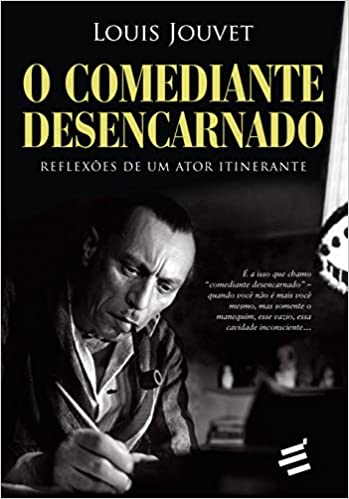
| ‘O Comediante Desencarnado – Reflexões de um ator itinerante’ Translation: ‘The Disembodied Comedian – Reflections by an itinerant actor’. Publisher : É Realizações; Artes e Cultura edition (January 1, 2014) Language: : Portuguese Brazilian ISBN-10 : 8580331668 |
Original Portugese/Brazilian: O renomado ator e diretor de teatro foi responsável pela montagem de peças de Jean-Paul Sartre, Jean Genet e Jean Giraudoux. Dirigiu La Comédie des Champs-Elysées, encenou em L’Athénée – tornando a casa conhecida, nesse período, como Théatrê de l’Athénée Louis-Jouvet – e foi professor no conceituado CNSAD (Conservatoire National Supérieur d’Art Dramatique). Também escreveu ensaios e atuou no cinema, com destaque para o filme Copie Conforme (1947). Jouvet inspirou o personagem Anton Ego, do filme Ratatouille (Pixar, 2007). O ator naturalizado inglês Peter Wyngarde é seu sobrinho.
Translation: The renowned actor and theater director was responsible for assembling plays by Jean-Paul Sartre, Jean Genet and Jean Giraudoux. He directed La Comédie des Champs-Elysées, staged in L’Athénée – making the house known, at that time, as Théatrê de l’Athénée Louis-Jouvet – and was a professor at the renowned CNSAD (Conservatoire National Supérieur d’Art Dramatique). He also wrote essays and acted in the cinema, with emphasis on the film Copie conform (1947). Jouvet inspired the character Anton Ego, from the movie Ratatouille (Pixar, 2007). English naturalized actor Peter Wyngarde is his nephew.
The following cutting was taken from the Monday, August 2nd, 1954 northern edition of The Times


Both of the above (and other references in the media) were published during Louis Jouvert’s lifetime, and yet he repeatedly failed to deny or challenge them
In view of the fact that much of the Wiki-Committee’s ‘biography’ depends upon information derived from newspapers, and that Wikipedia itself judges The Times to be a “reliable source”, it should follow that the information relating to Peter’s uncle found in THIS extract from the above mentioned daily must also be considered dependable and trustworthy(?)
J.G. Ballard: Making claims…
July 2023
Wikipedia currently state the following on the subject of author, J.G. Ballard:
| “The British author J. G. Ballard was also interned at the Lunghua camp and he travelled to the UK with Wyngarde and other former internees. In 1995, he wrote: Peter Wyngarde was in the camp, under his real name of Cyril Goldbert. We came to England on the Arrawa, and I bumped into him once or twice in the 1950s. The last time, when he had begun to be successful, he cut me dead in St James’s Park. In interviews he claims that his father was a French [sic] diplomat and is vague about his age, sometimes claiming to be younger than me. In fact, he is at least four years older than me [Ballard was born in 1930], and played adult roles in the camp Shakespeare productions.[57] Wyngarde always denied knowing Ballard or said he could not remember, but in an undated letter published by his biographer in 2020 he confirms that he knew Ballard.[58]” |
Peter did NOT confirm that he knew Ballard in Lung Hau! He maintained until the end of his life that he had never known, or knowingly met Ballard during the time they were in the camp. He states in the letter (referred to by Wikipedia – see below) that he (Ballard) MAY have been someone by the name of “Bryant”, but he was unable to confirm one way or the other. This is yet ANOTHER example of words being twisted to fit the narrative.

2012 “Professional Biography”…
| “A professional biography of the actor was published in 2012 by the organiser of the Six of One, the appreciation society of The Prisoner TV series.[104][105] It was reissued in 2019.” |
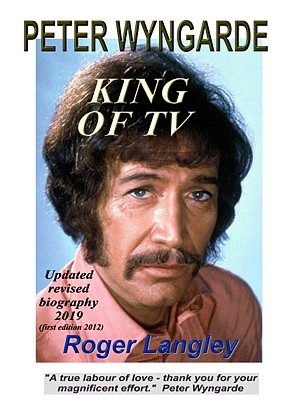 This biography was first published by Escape Books , which is the in-house publishing company of The Prisoner appreciation society, Six of One, and was basically a list of Peter’s film, stage and TV work – based, for the most part, on the listings from the original Official Peter Wyngarde Appreciation Society website (an acknowledgement of such is in the first edition). The book was self published with no input from Peter. Indeed, mention was made of this back in 2018 by someone calling his or herself ‘Muzilon’, who one of the regular contributors to the Wikipedia Peter Wyngarde ‘biography’:
| “Roger Langley’s 2012 biography of Wyngarde (self-published, so I don’t know if that counts as a “reliable source” as far as Wikipedia is concerned) contradicts The Times slightly by saying Wyngarde appeared as a Shakespearean actor in *Austria* (not South Africa) in 1975-76; and that his tour of South Africa was actually in a 1981 production of Ira Levin’s Deathtrap.” —Muzilon (talk |
N.B. See later in this article that this Peter Wyngarde ‘biography’ editors can’t seem to ,make their mind up whether this book is a “professional” publication or merely an “unreliable”, “self-published” fan pamphlet.
http://www.peterwyngarde.me.uk/
Peter’s relationship with Vivien Leigh…
| “He [Peter] called Vivien Leigh “the love of my life”[91] but none of her biographies report that they were lovers.” Wikipedia ‘contributor’ |
Well, here’s some of the books that DO report on their relationship, and these are just the ones I could think of off the top of my head…
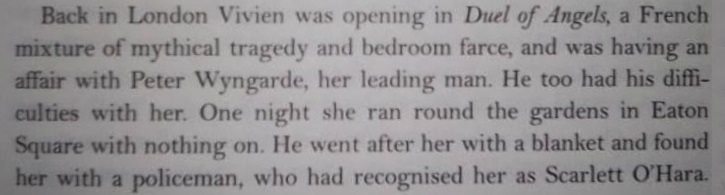
Above: Excerpt is from ‘Olivier: The Authorised Biography ‘ by Terry Coleman (ISBN-10: 0747577986 – 2005):
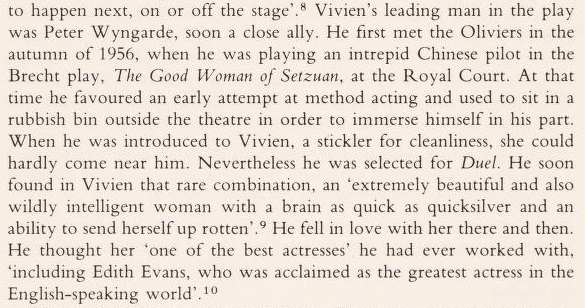
Above: ‘Vivien Leigh’ (ISBN-10: 0330311662 – 1990) by Hugo Vickers (ISBN-10: 0330311662 -1990)
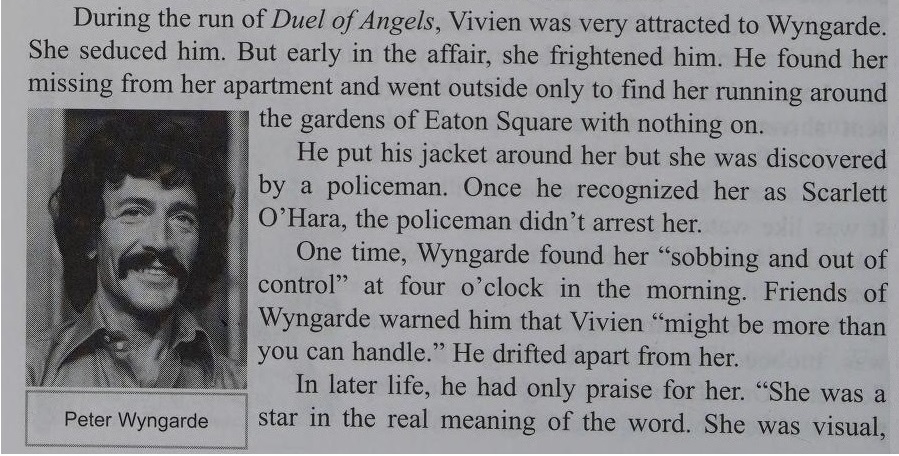
Above: ‘Damn You, Scarlett O’Hara: The Private Lives of Vivien Leigh and Laurence Olivier’ by Darwin Porter and Roy Moseley (ISBN-10:1936003155 – 2011)


Above: A cutting from the 24th November, 1960 edition of the Detroit Free Press.

Above: The following excerpt is from ‘Olivier: The Authorised Biography ‘ by Terry Coleman (ISBN-10: 0747577986 – 2005):
Peter’s marriage to Dorinda Stevens….
It would now appear that Peter’s marriage to Dorinda Stevens is an accepted fact by the Wikipedia Wyngarde ‘biography’ editors and contributors, but that wasn’t always the case, as aspersions were oft cast and conspiracy concocted to help substance to their widely-held conviction that Peter was homosexual. The following, for instance, was posted just 4 days after Peter passed away….
| “Convenient there would be no record*. And of course, PW always told the truth about his early life.” Jack1956 (talk) 09:13, 19 January 2018 (UTC) |
*Peter and Dorinda were married in Italy.
Even poor Dorinda’s sexuality is called into question…
Another example of reliance on their own imaginations for the facts!
The latest from Planet Wiki is the following regarding a reference I made to Peter’s wife, Dorinda Stevens in my book, ‘Peter Wyngarde: A Life Amongst Strangers‘:
“The 2020 biography of Wyngarde asserts that Stevens was bisexual or possibly a lesbian.”
Er, no it doesn’t! In actual fact, it was merely a reference something that had entered Peter’s mind for less than a nano second! This isn’t the first time this kind of nonsense has been randomly plucked from their respective backsides, or words put into someone else’s mouth!
Peter’s estranged family…
This has recently been replaced with…
| “However, the siblings were not reunited and Wyngarde chose to have very little further contact with his brother and sister for the rest of their lives. He outlived them both and also had no contact with his nieces* and nephews, including Henry’s Jr’s two sons who were named executors of his estate.” |
this…
| Henry Jr’s sons were executors of Wyngarde’s estate,[38] possibly against his wishes.[39][40] |
- Peter had three nephews but only ONE niece, so it’s uncertain where the idea of “nieces” (plural) came from.
- Neither of Henry Jr’s two sons (Ian and Stephen Goldbert), were “named executor” of Peter’s Will. Peter named his agent and close friend, Thomas Bowington, Executor on Wednesday, 1st November, 2017.
- The Goldbert did not “possibly” ignore their uncles’s wishes by claiming his estate for themselves, they DID ignore his wishes!
Rejection of Peter’s stepbrother, Paul Edouard Juvet…
Until only recently.the individuals that guard the Peter Wyngarde ‘biography’ had repeatedly dismissed Peter’s stepfather, Charles Léo Juvet, and still ignore his stepbrother, Paul Juvet. Again, this appears to be a case of cherry picking information.
After Peter’s father, Henry Goldbert died at sea in 1947 his mother, Marcheritta, met and married Charles. They had one son, Paul Edouard, who was born in February 1938. Paul latterly joined the French Foreign Legion, rising to the rank of Master-Chef (Senior Sergeant). He passed away in Geneva in September 1998 at the age of 60.
- See references to Paul Edouard Juvet in ‘Peter Wyngarde: A Life Amongst Strangers’ – Pages 20, 109, 144 & 355.
The National Theatre..
The following was sent to me by a member of the Official Peter Wyngarde Appreciation Society. It’s regarding four topics I make mention of in my book, ‘Peter Wyngarde: A Life Amongst Strangers’.
| “Leaving aside the claims made in the book about Wyngarde’s personal life, the assertions in its pages that Laurence Olivier wanted him to appear at the National Theatre but was overruled by Peter Hall, that the Monty Python team wanted him to appear in Monty Python’s Flying Circus, that producer Peter Rogers wanted him to play the young hero role in the Carry On films, and that he was considered as artistic director of the Chichester Festival Theatre are all extremely unlikely, and not verified anywhere else.” Dolmance (talk) 10:25, 25 September 2020 (UTC) |
Response: Much of what appears on the Wikipedia PW biography page isn’t “verified anywhere else”, but they don’t appear to have had any qualms about using them. For instance, they quote from several other published books, but appear to take the author’s word as read.
There are several points I’d like to make on this:
- A letter from Lawrence Olivier to Peter Wyngarde dated Thursday, 18th April, 1974 regarding the proposed appointment at the National Theatre.
- Letter from Eric Idle to Peter Wyngarde dated Wednesday, 24th January, 1973 stating that the Monty Python team wished him to take part in some capacity on the TV show.
- A. Letter from MCA (signature illegible) – 139, Piccadilly, London W1 – to Peter Wyngarde dated 20th June, 1962. B: Letter from Peter Rogers to Peter Wyngarde dated Monday, 8th October, 1962.
- A handwritten copy of a letter exists by Peter Wyngarde (1999) as way of application.
Comments:
| There is only one set of objective facts and figures, so there will always be speculation .. the difference between PW and much of the others thesps who issued flowery biogs and standard changing of names is PW for whatever reason must have had qualms about his early life .. being interned by the Japanese must have played a factor. He would have been a fascinating subject for ‘In the psychiatrists chair’ which therein lies the paradox as that gear is confidential. Deepinder Singh Cheema, Castle Bromwich Peter told me that he’d felt abandoned to the Civil Assembly camp as a child by his Mother, and the fact that she chose to remain in Singapore with her new husband, rather than her travelling to England to meet him on his repatriation, caused him to “hate” her for a long time. He really only began to forgive her in later life. Additionally, his father was away at sea during Peter’s formative years, and he passed away when P was 19, so he hardly knew him at all. On their return to Britain, his two siblings were placed with a family in Liverpool, while Peter himself lived in the south, so he had no real contact with them. His sister, Marion, emigrated to the USA with her new husband in 1952, and when he was old enough his brother, Henry, joined the Royal Navy. He didn’t see Marion again until 1977 (this was also the last time he saw her). He had scant contact with Henry; the first and last time he saw him after he left the Navy was in 1973, when Peter had left tickets at the box office of the King’s Theatre in Southsea when he was appearing there in 1973. Henry passed away in 2012, and Marion died in 2013. Peter declined to attend either of their funerals. He told me that when his father passed away at sea in 1947, he realised that he was entirely alone, and it was then that he decided to cut all ties with the past by changing his name and starting a new life. Tina Wyngarde Hopkins It is a shame he was given an ” alternative biography”. PW’ s own true life was infinitely more interesting and, dare I say it? , inspiring. Mike Dinken, West Palm Beach, Florida Peter, as you observe, Tina, would by no means be unusual as an actor in embellishing or changing details of his biography. I remember reading a biography of Humphrey Bogart in which it was stated that one of his favourite things to do at the film studio was to go to the publicity department and help them concoct preposterous details about his life to add to press releases. He thought it was hilarious. Tania Donald, Melbourne. |
Continued reference to The Guardian’s censured ‘obituary’ of 18.01.18…
| “One obituary described Wyngarde as playing the role “in the manner of a cat walking on tiptoe, with an air of self-satisfaction”, but that increasingly his acting became more mannered and he came to believe his own publicity.” |
| “An obituary reported that he lived partly on social security benefits.” |
The “obituary” referred to above, and from where these two segments were taken, was written by Gavin Gaughan – a semi-regular contributor to The Guardian and The Independent newspapers. While Wikipedia repeatedly bang on about “facts” and “reliable sources”, this sentence is merely the personal observation on an individual with a clear and obvious axe to grind, and so cannot possibly be described as factual. He is also involved to some degree with the Wikipedia Peter Wyngarde ‘Biography’. Such was the the public bask lash to this spiteful and inaccurate piece of fiction, that The Guardian were forced to replace it within the hour with something more balanced and competently written.
When Richard White, The Guardian’s Obituaries Editor learned of Mr Gaughan’s behaviour in the years leading up to the publication of this ‘obituary’ (he had repeatedly posted Homophobic slogans on the the Official Peter Wyngarde Appreciation Society Facebook group page and then when barred from there, threatened to write a hatchet job on the occasion of Peter’s death), he was unceremoniously dropped by the ‘paper. Click here to read the full sordid story.
The fact that these Wikipedia editors/contributors continues to quote from this appalling article speaks volumes!
Read the comments left by the public to this ‘obituary’ from The Guardian website.
CONVERSATIONS
The following has been taken from conversations between the group of individuals that maintain the Peter Wyngarde Biography of Wikipedia…
| ‘On the same issue of published books, Tina Wyngarde-Hopkins who manages the website, blog and Facebook group for PW’s appreciation society, and who says she was his romantic partner for 30 years, has announced that she has written a book called Peter Wyngarde: A Life Amongst Strangers. It will be published by Austin Macauley in 2019. I hope she doesn’t lose money, because Google reveals that the publisher does not have a great reputation. For clarity in following previous edits, Tina Wyngarde-Hopkins is the same person who was previously called Tina Bate. See https://www.thegazette.co.uk/notice/3065030 Theheartof (talk) 13:39, 28 February 2019 (UTC) 13:38, 28 February 2019 (UTC) |
| This lady has made a number of unsubstantiated and unverifiable claims about her relationship with Mr Wyngarde since his death including a denial of his documented homosexuality*. I do not therefore think that her hagiographical biography is going to be a reliable source! Dreamspy (talk) 22:57, 25 March 2019 (UTC) |
Despite being challenged several times to produce this supposed “documented” evidence of Peter’s “homosexuality”, ‘Dreamspy’ failed to do so. It can only be assumed therefore, that he/she must have been referring to tabloid speculation.
Meanwhile, ‘Dolmance’ [see below] would insist here that Peter had been a “gay man”, but would latterly downgrade him to “bisexual”. He also profess to have the gift of foresight – predicting what would and would not be included in my (then) forthcoming book:
| Sadly, that’s true — a sympathetic biography of Wyngarde could be written taking a view of him as a gay man prevented by society from being himself, but she won’t even concede that that was what he was. It’s also very likely that she’ll try to explain his barely working, in later life, as an example of his “perfectionism”, when in reality he hardly helped his cause by terming people who could have given him work “mediocre”, and remaining shackled to the outdated, kitschy Jason image. Dolmance (talk) 14:27, 2 April 2019 (UTC)’ |
Of course, it’s easy to make wild guesses and grandiose statements about other people’s private lives when you’re hiding behind a made-up name.
They spoke of “unsubstantiated and unverifiable claims” about my relationship with Peter whilst spouting unsubstantiated and unverifiable claims about me. Why should I have to prove anything to these people or anyone else? While too afraid to show their true faces – they expect me to produce evidence of my private life to them.
Incredibly, all one needs to do to create an account with Wikipedia is to enter your name (it evidently doesn’t even have to be your real name!) and an email address into a form and, voila! you’re basically free to write whatever you like about whomever you like.
When I initially saw the Wikipedia Peter Wyngarde Biography page some years ago, it was literally a mishmash of tabloid tittle-tattle and uncorroborated rumour which I immediately challenged. As a result of my refusal to back down, and my posting contrasting and far more detailed information on this website, those responsible for the ‘biography’ were forced to clean up their act.
However, since Peter’s passing, they’ve sunk to a new low by quoting numerously from Gavin Gaughan’s censured ‘Obituary’ (The Guardian 18.01.18 – see later in this article), which speaks volumes about the quality of their sources. Now it seems that I’m the latest target of their bluster.
The following is a recent conversation I had with this crew in relation to their postings (above)…
From Tina Wyngarde-Hopkins:
| I have been reading the above with interest and admiring the prophetic gifts of Messrs ‘Dreamspy’ and ‘Dolmance’ in relation to my forthcoming book. While the website for my biography is cited in the text above, it appears that neither of these characters have bothered to read the independent reviews posted on there, which state numerously that it’s one of the most frank and honest biographies that each of the critics has ever read.Knowing the type of cynics I’d be forced to contend with when I decided to undertake this project – yourselves included – I stated from the outset that I would deliver it to both fans and critics – warts and all! The story I tell has been corroborated with documentary evidence, and by Peter’s friends, enemies and colleagues alike. For the record – I do not have an obligation to substantiate or verify my private life to a bunch of faceless people who continue to skulk behind usernames. I couldn’t care less whether you believe my story or not. However, if ‘Dolmance’ and ‘Dreamspy’ wish to put their money where your mouth is when the book is published and challenge it as a work of fiction, I shall look forward to hearing from them. With regard to my change of name: This was a private matter between Mr Wyngarde and myself, and I’d thank you to stay out of my business. Given that you are still using the so-called ‘Obituary’ from The Guardian (18/01/18) as a ‘reliable'(?!) source speaks volumes. Did you not notice the number of complaints that this vile piece received from the public? Were you not aware that the creator of this piece of fiction was dumped by The Guardian when they learned of his underhandedness and the reason that he wrote this hatchet job? Tina Wyngarde-Hopkins (not hiding behind a username) — Preceding unsigned comment added by Tina Wyngarde-Hopkins (talk • contribs) 19:59, 2 June 2019 (UTC) |
From Martin Evans (Member of the committee that guard and contribute to the Peter Wyngarde biography on Wikipedia)
| Tina Wyngarde-Hopkins, I’m also “not hiding behind a username” either. You seem to be disputing the accuracy of one of the sources. I wonder could you clarify which one you mean. As far as I can see, the article currently has at least 8 different sources either directly published by The Guardian or published through it. But none of them seems to be dated “19/01/18”. Furthermore, although you don’t directly name the author of the disputed obituary piece, you seem to be making some rather serious allegations about them, which you may wish to withdraw, or else to substantiate with published facts. You also say “I’d thank you to stay out of my business”; but, as you may be aware, for purposes of WP:PSCOI, you may be required to briefly make your relationship with Peter Wyngarde quite clear. Many thanks. Martinevans123 (talk) 20:17, 2 June 2019 (UTC) |
From Tina Wyngarde-Hopkins: :
| The article to which I refer was quoted a number of times in the main body of the PW biography. It was written by Gavin Gaughan and published in The Guardian on 19th January, 2018. I do not wish to withdraw what I said about the author of the aforementioned piece as it is true. I have an email from The Guardian’s Obituaries Editor, Mr. Robert White who, having learned what had led up to Gaughan penning the article, wrote: “I cannot foresee any situation in which Gavin Gaughan would be asked to write for us again.” Re. “as you may be aware, for purposes of WP:PSCOI, You may be required to briefly make your relationship with Peter Wyngarde quite clear.” That is never going to happen! I don’t see anyone else having to provide evidence of THEIR relationships. It just smacks of voyeurism! I feel that the two individuals to whom I referred previously – namely ‘Dolmance’ and ‘Dreamspy’ – should retract their wildly speculative comments about me and my forthcoming book. They have absolutely no right to question my integrity, or to make wild speculations about a product prior to it going on sale that might damage the reputation of both its creator and the product itself. The Wyngarde Estate would also be interested in seeing the “published documentation” (referred to above) that they claim categorically proves beyond doubt that Mr Wyngarde was “homosexual”. Tina Wyngarde-Hopkins — Preceding unsigned comment added by 92.28.74.222 (talk) 20:53, 2 June 2019 (UTC) |
From Martin Evans
| Hello again Tina Wyngarde-Hopkins. Thanks for your swift response. Regarding “That is never going to happen”, have you actually read WP:PSCOI? Regarding Gavin Gaughan, you’ll note that I said “published facts”, not private emails to which only you have access. If you have a problem with this source, you’ll need to explain where you think it is materially wrong, i.e. which items in the article are untrue or should not be included because that source can be shown to be unreliable. You (and any other editors trying to follow this thread) might find it useful if you always logged in to your editor’s account and always singed (sic) your posts with four tildes (sic). Thanks. Martinevans123 (talk) 21:05, 2 June 2019 (UTC) |
From Tina Wyngarde-Hopkins:
| Dear Martin Evans, Thank you, but I’m not interested in WP:PSCOI. I don’t feel that I have to justify myself to anyone – certainly not Wikipedia! Regarding the Guardian article: I feel that it would be highly unlikely that such a high profile daily newspaper would publish the fact that they’d been obliged to unceremoniously drop one of their regular contributors, so to expect “published facts” is ludicrous! It was clear from the outset that all Mr Gaughan had done was trawl the internet for any kind of malicious gossip and/or unsubstantiated tittle-tattle which he then cobbled together under the auspices of an ‘obituary’. It speaks volumes about the people who maintain this PW biography that, in spite of the number of complaints this particular article attracted from the public, they still persisted in using it as a “reliable source”. Further to the use of Robert Sellars book, ‘Don’t Let The Bastards Grind You Down’ (as mentioned above): One doesn’t need to be Sherlock Holmes to deduce that Mr Sellars had used Donald Spoto’s biography, ‘Alan Bates: Otherwise Engaged’ as a source. Indeed, most of the paragraphs devoted to Mr Wyngarde in his book are quoted almost word-for-word. It should be pointed out to some of your ‘colleagues’ that just because something is published/repeated more than once, it doesn’t make it more true. I intend to dispel the claims made in both of these “legitimately published books” via my biography, using REAL documentary evidence. We still await Dreamspy’s “documented evidence” that supposedly categorically proves that Mr Wyngarde was “homosexual” (this should not include 44-year old tabloid cuttings that report on a specific incident in 1975. This would not demonstrate what ‘Dreamspy’ alludes to). I’d also like to remind ‘Dreamspy’ and ‘Dolmance’ to remove their slur on my integrity. Neither of these characters know me personally and therefore have no justification in suggesting that I am anything other than who I say I am, and 100% honest. They should also remove the guesswork regarding my forthcoming book. Again, they know absolutely nothing of its content, and therefore have no basis for their outlandish remarks. N.B. I have absolutely no interest in Wikipedia protocols. Once the document(s) referred to here have been forwarded and the comments about myself removed from this page, I shall have nothing more to do with this contemptible website. — Tina Wyngarde-Hopkins (talk • contribs) 10:56, 3 June 2019 (UTC) |
Now come the threats, as were referred to by Sharyl Attkisson in her exposé, ‘The Dark Side of Wikipedia’ (see the head of this article).
From Martin Evans
| You say you are “not interested in WP:PSCOI” and that you have “absolutely no interest in Wikipedia protocols”. If that is the case you can expect to have your account indefinitely blocked as being WP:NOTHERE. Good luck with your forthcoming book, which other editors may or may not find a useful source for this article. Regards. Martinevans123 (talk) 18:03, 3 June 2019 (UTC) |
While it appears acceptable for these so-called “editors” to publish just about anything they like about any individual they choose, the moment you complain or request evidence of their assertions, they immediately move to block your account. It’s as if these faceless people are playing God with other people’s lives and reputations, but refuse to take responsibility for, or criticism of, their actions.
With Messrs ‘Dreamspy’ and ‘Dolmance’ remarkable Delphic gifts, I wonder why they continue to relying on tabloid newspapers for information, when all they need do is look into the future for the requisite tittle-tattle and unsubstantiated gossip necessary for their article!
Needless to say, the “documented evidence” that Peter was “homosexual”, as referred to by Messrs ‘Dreamspy’ and ‘Dolmance,’ was never forthcoming!
Did you know… that an average of 1,000 people are blocked from Wikipedia EVERY DAY for attempting to edit or correct misinformation on the encyclopedia’s website? Tina Wyngarde-Hopkins was to become one of that number in 2016 when she dared to put right the mass of inaccurate content that made up the Peter Wyngarde ‘biography’.
| “I’ve done quite a bit of reporting about how Wikipedia is definitely NOT “the encyclopedia anyone can edit.” It’s become a vehicle for special interests to control information. Agenda editors are able to prevent or revert edits and sourcing on selected issues and people in order to control the narrative. My own battle with Wikipedia included being unable to correct provably false facts such as incorrect job history, incorrect birth place and incorrect birth date.” Sharyl Attkisson – Emmy Award-Winning Investigative Journalist and New York Times Best Selling Author. |

Watch Sharyl Attkisson’s jaw-dropping exposé, ‘The Dark Side of Wikipedia’ here
In Biographical Summaries of Notable People (My Heritage): www.myheritige.co.uk
| Gender: | Male |
| Aliases: | Cyril Louis Goldbert, Wyngarde, Peter, Peter Paul Wyngarde, Cyril Goldbert |
| Birth: | Aug 23 1928 Marseille |
| Nationality: | United Kingdom |
| Occupation: | Actor |
| Residence: | Marseille |
This particular website, just like Wikipedia, invites any Tom, Dick or Harriett to contribute information, or to edit the details contained therein. Contributors to the Wikipedia Peter Wyngarde ‘Biography’ have repeatedly used My Heritage as a source. Perhaps someone should inform them that, apart from a couple of weeks following his birth, Peter has never been a resident of Marseilles!
The point, as above, is that if there are inaccuracies in a supposed primary source, then you have to ask yourself, what other pieces of so-called “reliable”(!) or ‘substantiated evidence’(!!) did this particular Author rely upon to compile his article? And how many others have, in turn, used his work as a source?
Sorting the wheat from the chaff…
Isn’t it strange that the guru’s who have been writing, monitoring and defending all the misinformation that has made up the Peter Wyngarde ‘Biography’, are content for us to believe that what we read on Wikipedia is the truth, the whole truth, and nothing but the truth, whilst continuing to insist that anyone using OUR ‘site should “use caution”? This is in spite of our website being compiled by someone who knew Peter Wyngarde intimately for 30 years, based it on personal experience and relying on original documents and first-hand accounts. BIZARE!
Whilst they regard us with suspicion, they refer to the likes of the The Sun and The Mirror as “reliable sources”. NONE of these ‘papers have access to the same material that we have, so what Wikipedia consider to be trustworthy, WE wouldn’t touch with a bargepole!
Anyway, let’s just have a look at the discussions taking place in Wiki’s back bedroom…
Synthesis?
| “In my view, the whole section on “Birth and family background”, and much of the Early life” section, is synthesis with elements of original research. There is clearly a mass of conflicting evidence about his birth, parentage and early years, and when alive he and his family vigorously contested many of the details in the article. The article goes into a great amount of detail over the conflicting claims, but it is not up to any of us editors to identify the truth of the matter. We need to wait to see what emerges from the researches and obituaries published in reliable sources, and then summarise them – and, in the meantime, we should edit out much of the (in my view) synthesis and original research in the current article. Thoughts? Ghmyrtle (talk) 15:21, 18 January 2018 (UTC) |
Mr Wyngarde and his next-of-kin had/have every right to “vigorously contest” the inaccurate information published online by Wikipedia.
| A lot of it is backed up by references, and it gives an interesting perspective, while at the same time acknowledging the uncertainties. It seems alright to me, but I’ll be interested in the majority view. MidnightBlue (Talk) 15:45, 18 January 2018 (UTC) |
| Many of the references are to primary sources, and given the disputes with his family and/or friends we should be treating them with great caution. Ghmyrtle (talk) 15:56, 18 January 2018 (UTC) |
| I’ve now had a go at removing much of the material derived from primary sources, large chunks of which appear to me to be original research about his various purported relatives. It’s all fascinating stuff, but not in a Wikipedia biographical article. Ghmyrtle (talk) 22:11, 18 January 2018 (UTC) |
| Since you mention the website of the Peter Wyngarde Appreciation Society (PWAS), I note that we already have editors here busily deleting information quoted from that site on the grounds that “it’s just a fan site” and “this isn’t a reliable source.” Since the website claims to be Wyngarde’s official “mouthpiece”[4] and features interviews with the man himself I would have thought it would be OK to cite it (with caution) as per WP:ABOUTSELF, noting when it conflicts with other sources. Perhaps we should try to get a consensus here about how to handle quoting PWAS.–Muzilon (talk) 23:44, 18 January 2018 (UTC) |
We are NOT “Just a fansite”. This label has been discussed previously on this ‘site. We are an Official – i.e. sanctioned – information ‘site. What is Wikipedia if not just a free space that anyone and everyone can add to and/or edit, regardless of whether they’re conversant enough to do so?
It’s not the place of Wikipedia’s contributors, editors or moderators to brand other websites, or to demean them in an attempt to enhance their own importance. The last place any self-respecting author or journalist would go to find source material is Wikipedia, as it’s become a bi-word for unreliability worldwide.
The reason that the information posted by the Administrator of the Official Peter Wyngarde Appreciation Society often conflicts with other sources is because those other sources are incorrect!
| None of the claims made by the PWAS can be independently verified. Rather than taking an honest and accurate look at his life PWAS treats him with undue reverence, even strongly denying his now widely acknowledged homosexuality. Jack1956 (talk) 03:16, 19 January 2018 (UTC) |
ALL of the so-called “claims” made on our Facebook page and website can be verified by the original documentation – many of which we have published online (see ‘You’ve Read The Book, Now Read It In Peter’s Own Words’, ‘Peter Wyngarde: A Life Amongst Strangers Companion‘ and ‘Thoughts Of Peter‘). These papers, which include contracts, passports, royalty receipts, theatre programmes, scripts, filming schedules, personal correspondence (between Mr Wyngarde and actors, directors, producers et al), personal diaries (1952-2018), overseas visas… etc., are stored in the Peter Wyngarde Archive, which is in the keeping of Tina Wyngarde-Hopkins and Bowington Management.
The fact that the Wikipedia contributor(s) have no access to this documentation does not diminish the accuracy of the information that appears on our Facebook page or this website. On the contrary, it serves to highlight the poor quality of material accessible to them – i.e. their reliance on tabloid and magazine articles, et al.
“…PWAS treats him with undue reverence”. Peter achieved much critical acclaim throughout his career, winning and being nominated for numerous awards, unlike the contributors to his Wikipedia ‘Biography’, who are obliged to write about actors because they haven’t the talent themselves to be one. What is actually “undue” is the faith in which supposed ‘professional journalists’ put in Wikipedia!
“…his now widely acknowledged homosexuality.” Widely acknowledged? By whom? Where is Jack1956’s irrefutable evidence to substantiate this wild speculation? Not even a yellowing copy of The News of the World – Circa 1975 – was forthcoming.
| Well, maybe he was bisexual, I’m not really worried about that. On more objective matters, PWAS says he was married to Dorinda Stevens for seven years, whereas the WP article says three years. Which is correct?—Muzilon (talk) 03:25, 19 January 2018 (UTC) – married Michael Boultbee in Nairobi in 1957. |
Now suddenly Peter is reduced in rank from an absolutely, categorically, bona fide ‘Homosexual’ to “maybe” being “Bisexual”…
| No record of a marriage to a Wyngarde or Goldbert at any time suggesting they never married. Jack1956 (talk) 08:12, 19 January 2018 (UTC) |
Below is taken from the Electoral Roll showing Peter and Dorinda Stevens living as man and wife at 9, Holland Park Road, London in 1953. The original Marriage Certificate and Divorce Papers are kept in the Peter Wyngarde Archive.

| If there was a marriage it may not have been in the UK, so may it not necessarily be in those records? Ghmyrtle (talk) 08:35, 19 January 2018 (UTC) |
Peter and Dorinda Stevens were married in Italy.
| Convenient there would be no record. And of course, PW always told the truth about his early life. Jack1956 (talk) 09:13, 19 January 2018 (UTC) |
“Convenient”.? Are they suggesting that in the early 50s, a conspiracy involving Peter, Dorinda Stevens and their respective families and friends for the sole purpose of hoodwinking a gang of busybodies controlling a ‘biography’ on a global system of interconnecting computers decades prior to it being invented? Oh, pur-leeze!
| No online record, at any rate. According to the Talk page archives they were listed as Mr & Mrs Wyngarde on the UK electoral roll in 1953.–Muzilon (talk) 22:03, 21 |
Hallelujah!
| What seems to be widely acknowledged now is that he was bisexual, rather than homosexual. It’s certainly true that PWAS treats him with some reverence, and where their statements conflict with other published information that site should be treated with great caution. But it should not be completely dismissed as unreliable – it seems well-informed on many matters and may contain information that is unchallenged elsewhere. Although some of the obituaries in usually reliable sources may have derived some of their information both from here and PWAS, they should provide the basis of the article here. Ghmyrtle (talk) 08:33, 19 January 2018 (UTC) |
“…widely acknowledged’… We’re back to this old chestnut! A couple of weeks before this was posted, the members of the Wikipedia Peter Wyngarde Biography conglomerate were adamant that Peter was ‘homosexual’. Now they’re certain he’s ‘bisexual’. Why don’t they just admit that they’ve not only been barking up the wrong tree, but are in the entirely wrong forest?!
There’s a COLOSSAL difference between Wikipedia’s reliance on press articles/ internet gossip, and the first-hand information used by our Website. If the contributor(s) and editors of the P.W. ‘biography’ choose to treat us with “…great caution”, that’s their prerogative. It wouldn’t be the first time that they’ve dismissed the facts in favour of publishing fallacious material published in a gossip rag, so why break the habit of a lifetime?!
Birth and family background
| This section is currently tagged with WP:UNDUE. But I think it’s a reasonable size What do others think? This is the only issue now preventing posting the death of Wyngarde at RD on the main page. Thanks. Martinevans123 (talk) 19:10, 19 January 2018 (UTC) |
| I’ve given it another trim. The article as a whole is starting to look more balanced, but some more work might be beneficial. Bring me the bore worms…. Ghmyrtle (talk) 19:26, 19 January 2018 (UTC) |
| Does anyone know why the newspaper i is quoting the specific birthdate of 27 August 1927? Jack1956 (talk) 12:05, 20 January 2018 (UTC) |
Questioning a so-called “reliable source”? Aren’t the papers supposed to be utterly infallible where ‘The Truth’ is concerned?! It’s not like any of them have been sued for libel or anything so grubby. This will never do!
| I would have thought that depends on the newspaper. Perhaps for the reasons given in “Note 1”? in the article? Perhaps because they have access to the birth records for Marseille? It’s only really the year that’s been in dispute. All of the initial BBC radio news reports I heard described him as “aged 90”, so you would assume they did some homework. Newspapers typically don’t disclose their sources, and indeed may deliberately choose not to. Martinevans123 (talk) 12:45, 20 January 2018 (UTC) |
“…depends on the newspaper”? But I thought ALL of them were right ALL the time?!
| His passport says he was born on 28 August 1937, not 1927. [1] 2.31.166.197 (talk) 05:40, 26 February 2018 (UTC) |
| We have no way of verifying the authenticity of that image[14]. (Are you even allowed to wear a baseball cap in a British passport photo? —Muzilon (talk) 08:38, 26 February 2018 (UTC) |
Quite clearly, it IS legal to wear a baseball cap in a British passport photo. See, Muzilon, you learn something new on this website every day!
(Note to Muzilon: Might I suggest, if you still suspect that the image on this ‘site had been faked (a very serious accusation, by the way!), you should contact your local Passport Office to enquire about the baseball cap thing. When they inform you that it’s perfectly acceptable to wear headgear as long as it doesn’t cover any part of your face, you can leave a little note of apology for me at the bottom of this page. I shall look forward to reading it.
| How very odd. I searched here, but failed to find anything at all. Martinevans123 (talk) 17:25, 20 January 2018 (UTC) |
| PS: The first notice of his death seems to have been given by his agent, who presumably knew that PW was born in 1927 rather than 1933 regardless of what he had previously claimed. Ghmyrtle (talk) 17:28, 20 January 2018 (UTC) |
| I just did a further small edit of the details of the wartime correspondence about the Goldbert children, which I viewed at the National Archives before adding it here recently. It does not mention Cyril or any of the children by the first names, but as I have added in my note on the edit, the family name, ages and genders of the children everything else correspond exactly with Cyril, Adolphe and Marion. Theheartof (talk) 11:15, 21 January 2018 (UTC) |
| Your edit summary says: “The children are not named in the correspondence, but the names and ages correspond exactly with Cyril, Adolphe and Marion.” That looks a bit self-contradictory? Martinevans123 (talk) 11:40, 21 January 2018 (UTC) |
| “Names” = family name, I assume….? Ghmyrtle (talk) 13:55, 21 January 2018 (UTC) |
| Yes, I was trying to keeping it short. There are no *given* names for the children in the correspondence, only the family name, the parent, and the ages and genders. I have edited again to remove my previous “Master Goldbert” Theheartof (talk) 13:09, 23 January 2018 (UTC) |
Theatre work in South Africa and Austria?
| This unreliable source claims that, after his arrest, he did some stage work in South Africa and Austria. Do we have a better source for this claim? If so, it could be added to the article. Ghmyrtle (talk) 18:39, 23 January 2018 (UTC) |
There is no better source of information concerning the theatrical productions in which Peter starred than on this website! There’s a comprehensive list of ALL his stage work, plus reviews and photographs of the plays performed in South Africa and Austria.
If the Wikipedia contributor(s) and editors decide that this information is too “unreliable”, then they might try contacting the theatre’s where the productions were staged. I’m sure that the managers of these venues will be happy to furnish them with exactly the same information that can be found here on this ‘site…!!!
| His Times obit also makes a passing comment that he “worked as a Shakespearean actor in South Africa [and] appeared on stage in Vienna,” without giving any further details.–Muzilon (talk) 10:26, 27 January 2018 (UTC) |
Peter never performed Shakespeare in South Africa. Sorry lads, but this is just ANOTHER example of one of your “reliable sources” getting it wrong.
| Roger Langley’s 2012 biography of Wyngarde (self-published, so I don’t know if that counts as a “reliable source” as far as Wikipedia is concerned) contradicts The Times slightly by saying Wyngarde appeared as a Shakespearean actor in *Austria* (not South Africa) in 1975-76; and that his tour of South Africa was actually in a 1981 production of Ira Levin’s Deathtrap. —Muzilon (talk) 11:15, 7 February 2018 (UTC) |
Christ on a bike, this is getting confusing! Here, one of these editors describes Roger Langley’s book, ‘Peter Wyngarde – King of TV’ as being “self-published” and therefore doesn’t know whether it “counts as a reliable source”, and yet in the main body of the ‘Biography’ they refer to the same book as being “professionally published” (see earlier in this article). This is making my head spin!
| The article now says simply: “In the late 1970s he performed in the theatre in South Africa and Austria.” So, we could add a reference to early 1980s if necessary. Ghmyrtle (talk) 19:26, 7 February 2018 |
Oh dear, Ghmyrtle! If only you’d checked this website instead of dismissing it out of hand, you’d have found that Peter appeared on stage in Austria and South Africa in the mid-1970s, NOT the “early 1980s”.
Birth year in lead and infobox (again)
| I know this is going over old territory but I’m not sure we should be stating his birthdate as 23 August 1927 quite as confidently as we are. When the following section starts with “… date and place of birth, his birth name, and his parents’ nationalities and occupations are all disputed.” it doesn’t seem to sit that the lead and infobox birthdates don’t carry a {{disputed}} tag. I appreciate that The Guardian and i both seem quite definite but The Times [2] is more circumspect and goes no further than “probably born on 23 August 1928” (yes 1928). I doubt the truth will ever emerge so I think the lead ought to reflect the uncertainty more than it does (and this is before I get lambasted on Facebook again as the author of this article by the person who runs the PWAS). Nthep (talk) 15:06, 26 January 2018 (UTC) |
You only get “lambasted” on Facebook, Nthep, because you and your mates keep getting things wrong.
| I’ve no objection to adding more {{disputed-inline}} tags, and then removing them as and when they are resolved. Ghmyrtle (talk) 15:12, 26 January 2018 (UTC) |
| Actually, the Guardian obit is not very definite: it states “c. 1926 or 1927.” And the last I heard, the PWAS manager was banned from Wikipedia for issuing legal threats about this article.–Muzilon (talk) 09:37, 27 January 2018 (UTC) |
Tina Wyngarde-Hopkins was “banned” from Wikipedia for daring to edit and/or correct misinformation posted about Peter Wyngarde by the above contributors (see earlier comment re. 1,000 people EVERY DAY are banned from Wikipedia for attempting to edit/correct misinformation posted on their website).
| Re the truth of his DOB never emerging, will the GRO death record and details held Golders Green Cemetery be reputable sources? Theheartof (talk) 12:20, 27 January 2018 (UTC) |
| Re the truth of his DOB never emerging, will the GRO death record and details held Golders Green Cemetery be reputable sources? Theheartof (talk) 12:20, 27 January 2018 (UTC) |
| I don’t think the date of his death is in dispute in any way? Martinevans123 (talk) 12:22, 27 January 2018 (UTC) |
| The GRO death certificate is only reliable for date of death, not date of birth as it is only created on the information given by the person making the report and is only what they believe to be correct and therefore maybe inaccurate to a greater or lesser extent. Nthep (talk) 13:28, 27 January 2018 (UTC) |
Peter’s death was registered by his life-long friend, Mitzi Kalinski.
| Out of curiosity I contacted Singapore’s vital records department to determine whether there is a record of a Cyril Goldbert being born there around 1927. They were not very helpful, but it seems they won’t release any information about Singapore birth records to an unrelated third party unless the person in question was born at least 100 years ago. —Muzilon (talk) 00:07, 7 February 2018 (UTC) |
| As pointed out by an anonymous IP editor above, PWAS has suddenly produced what purports to be a scan of Wyngarde’s passport showing an implausible birthdate of 28 August 1937 (place of birth: “Marseille”.) His biography page has also been updated to state that he had three “step-siblings”: Henry, Simone and Charles. This is the first time a “Charles” has been mentioned, as far as I know.–Muzilon (talk) 09:22, 26 February 2018 (UTC) |
| The basic point needs to be reiterated – that what Wyngarde claimed is not necessarily what was true. Some of the points of detail mentioned in the PWAS article may well be true, but others may not be. It is certainly not the case that he was born in both 1937 and 1933, as they (currently) claim. Ghmyrtle (talk) 17:40, 26 February 2018 (UTC) |
What would be a more accurate statement here is that what Wikipedia claim is not necessarily true!
PERSONAL COMMENT
| I find it utterly deplorable that, within days of his passing, the individuals referred to above were actually debating whether or not to contact Golders Green Crematorium in an effort to garner information about Peter. Clearly, the whole rotten lot of them are devoid of any morals or decency. Whilst those of us who grieved and despaired at our loss, these sorry excuses for human beings were thinking only of acquiring yet another morsel of information for their wretched page. “Lambasted on Facebook”? That’s the very LEAST they deserve! The lot of them should hang their heads in shame! Whilst I’ve seen the best of people during the last few weeks, I’ve also run into the very worst of them. Come the day these people suffer the loss of their Soulmate; or a parent, grandparent, sister, brother, child or best friend, I hope they spare a thought for my beloved Peter and I, and realise how it might feel if they were to learn that a complete stranger was planning to call the cemetery of choice in an effort to obtain private information relating to their loved one. Thankfully, those of us who have experience of such pond life had anticipated this, and requested that all services assigned with Peter care use the utmost discretion should they be contacted by the kind of callous and cold-hearted people discussed here. Thank God that Peter passed without fully realising how low some parties will stoop to procure what they want. Tina Wyngarde-Hopkins |
More on Wikipedia…

 PETER WYNGARDE: The Official Website
![[1]](https://peterwyngarde.uk/wp-content/uploads/2017/12/img_20180212_0001.jpg?w=334&h=227)